Tag Archives: Aisslinn Nosky

Bach Akademie Delights and Mystifies With “A Musical Offering”

Review: A Musical Offering at St. Mark’s Lutheran

By Perry Tannenbaum
Whether it’s jazz, bluegrass, or the rock fantasias of Eric Clapton, John McLaughlin, and Carlos Santana, much of modern music is rooted in the appeal of riffing on a tune. That allure has been around for centuries, known as theme and variations when dressed up in the periwigs and cravats of the Baroque Era. Among the great classical composers who have shown off their wizardry in the form are Rachmaninoff, Tchaikovsky, Brahms, Beethoven, and Bach.

Embellishing a melody and cracking open its chord structure are at the heart of theme-and-variations praxis, but there are also wicked, macho elements of challenge, competition, and virtuosity baked into the form. The jam session in jazz becomes a cutting contest when two titans collide. Who can imagine and execute the most intricate, complex, and satisfying variation?

So it was gratifying to learn that Johann Sebastian Bach’s A Musical Offering originated as a challenge. The challenge was issued in Berlin to the visiting Leipzig master – by none other than Frederick II, King of Prussia, his son Carl Philipp Emanuel’s employer. After Bach had duly impressed the king, his noblemen, and an assembly of the finest musicians in Europe by improvising new compositions on each of the new fortepianos at court, King Frederick laid down his gauntlet.
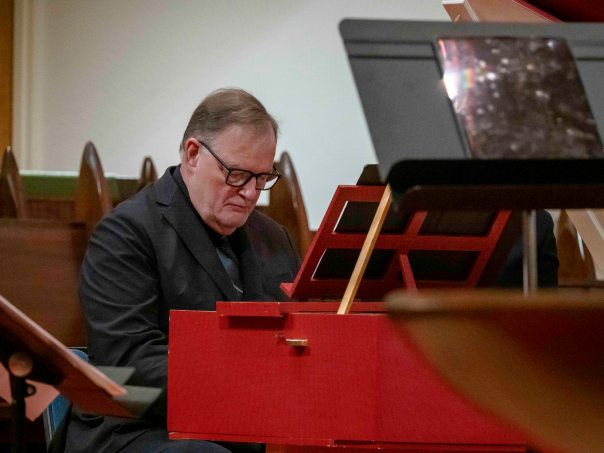
Compose a three-part fugue on the spot based on a melody he, the king, had written. Game on! Bach sat down once again at one of the keyboards he had just tested and tossed off a brand new 1747 masterwork on May 7, the first piece in Bach Akademie Charlotte’s inaugural concert of 2025 at St. Mark’s Lutheran Church, played by renowned harpsichordist Ian Watson.

Thankfully, “Frederick the Great” was royally miffed to see Bach meet his challenge so effortlessly. He literally doubled down on his challenge to humiliate his distinguished guest, daring Bach to execute a six-part fugue on the same tune. Here Bach judiciously yielded, saying that he would need some time at home to fulfill such a daunting assignment on such a worthy theme. Within two months, at age 62, Bach delivered on the king’s request and completed the six-part invention plus over a dozen more canonic gems.

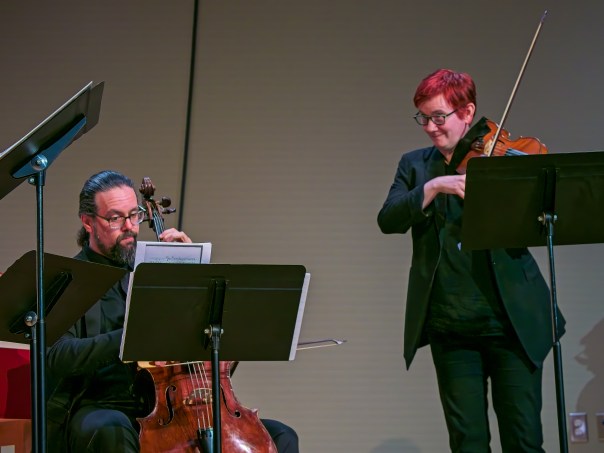
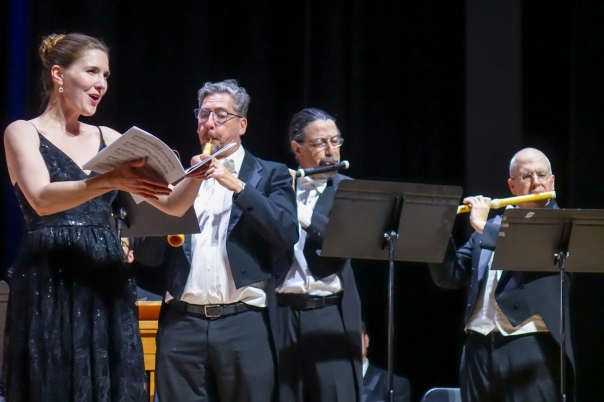
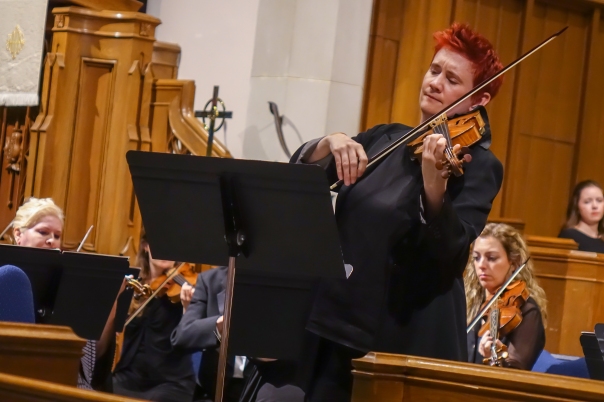
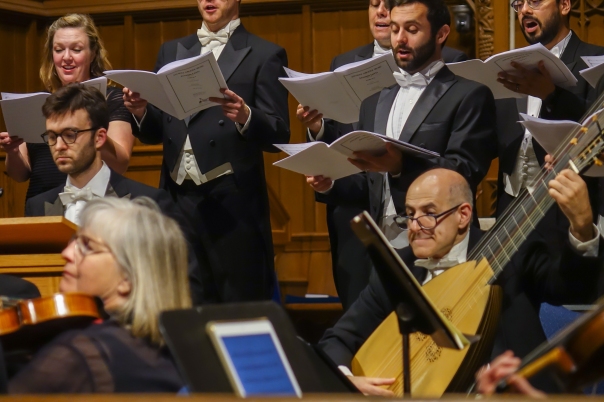
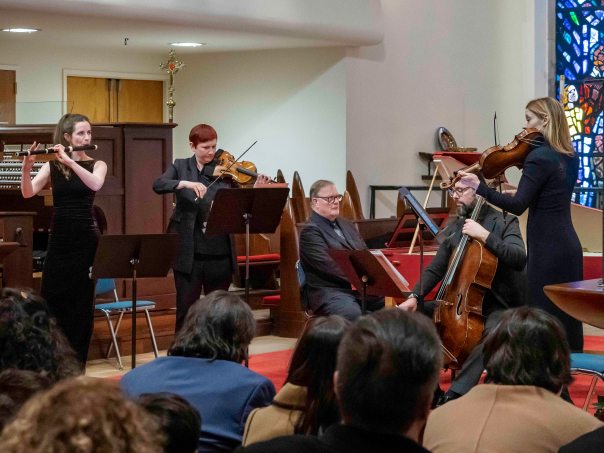
Modern recordings of A Musical Offering are all over 50 minutes in length and, depending on whether the original theme is prefaced, 16 or 17 tracks. Various instrumental configurations are available after the initial solo track. For this live Akademie concert, BACh artistic leader Guy Fishman assembled an all-star quintet that included himself on cello, Watson at the keyboard, Emi Fergusson on transverse flute, co-artistic leader Aisslinn Nosky on violin, and Renée Hemsing playing viola and violin.

Though I have four or five Goldberg Variations in my collection, I’ve never heard Bach’s most famous variations performed live, so this opportunity to hear the lesser-known Musicalisches Opfer was doubly special. Interspersed with the marquee piece of the evening were three other works, a CPE Bach Violin Sonata, a flute sonata by King Frederick II, and a Cello Sonata by Carl Heinrich Braun, another Bach contemporary.

Fishman’s spoken remarks, supplemented by his generous program notes, vividly described the king’s arrogance and his guest’s tactful responses. Nor did the principal cellist of Boston’s Handel & Haydn Society avoid detailing the various devices and complexities that Bach lavished on his thematically connected compositions. But with five musicians assembled before us, many in the audience must have been surprised that Watson alone would be playing Bach’s opening salvo.

The result was denser and tinnier than orchestral recordings of the Ricercar a 3, with less linearity than a recording on organ that I’ve heard. Three voices presented by two hands on a live stage! No matter how dense that sounded – remember that an organ can differentiate with multiple keyboards and registers plus a pedal board – it was amazing to see and hear.

Each new movement in the piece was usefully punctuated by musicians rising and sitting while music stands were being set up in new configurations. Nevertheless, confusion set in before we reached the second piece of the evening, the King of Prussia’s Flute Sonata No. 9. Three movements were listed under the Musical Offering and the ensemble was clearly playing more.

I lost track. Scattered in the program, in clusters of three, five, and five (if I’m deciphering the typography properly), were the remaining pieces of the Musical Offering. Titles for the remaining movements didn’t entirely correspond with titles of any recording available to me on Apple or Spotify. The four Sonata movements embedded in the piece could have been mistaken for another listing if it weren’t for the BWV catalog number, and a hefty number of the segments that could easily be recognized were played sooner or later than common practice.

Most recordings don’t label any of the movements “Quaerendo invenietis,” a title given twice in the Akademie program, and where they do appear, they are played consecutively. Not at St. Mark’s Lutheran. The climactic Ricercar a 6 that Frederick had ordered, for another example, usually claims Track 9 on Musical Offering recordings. At St. Mark’s Lutheran, it was sixteenth and last on the bill. Thus I can say with conviction that all five instrumentalists were involved in the glorious finale, but I’m more than a bit hazy on most of the rest.
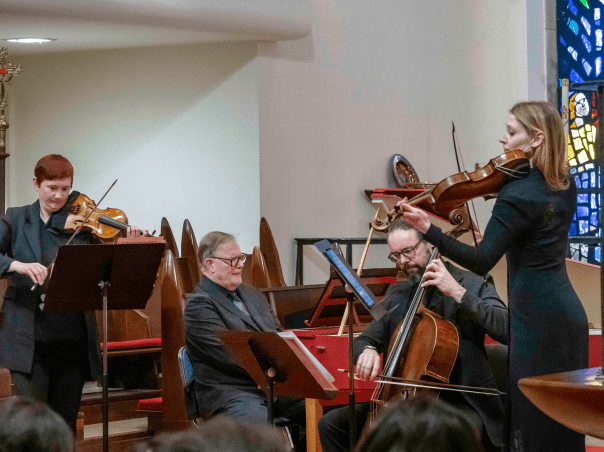
While this disorientation made it impossible for us to even attempt to track the incredible gymnastics of Bach’s inventions – themes and variations played in reverse, simultaneously in varying tempos, descending instead of ascending, or even upside down – the confusion didn’t carry over to the other pieces on the program. Here we were freer to scrutinize and enjoy.

Fergusson, of course, benefitted most from the spotlight shifting toward the non-Musicalisches pieces. One of these by Frederick II, in addition to the four-movement sequence embedded in the Offering, was a flute sonata. It was possible, upon hearing Fergusson’s performance of the king’s Sonata No. 9, to reserve judgment for a little while since the first of Frederick’s three E-minor movements was at a slow Grave tempo. Prussia’s monarch was a flutist, after all, writing chiefly to spotlight his own prowess.

But the next two movements were fast and faster, Allegro assai and Presto, so there could be no doubting Frederick’s genuine proficiency as a composer or as a performer. The piece was also sufficiently virtuosic to tempt me toward rushing to judgment on Fergusson, partly because the acoustics at St. Mark’s were so extraordinarily friendly to her transverse flute.

This performance was the best I had seen live on baroque flute since 2004 when I had the privilege of seeing, hearing, and meeting Michala Petri at the Verbier Festival. When we arrived at the four-movement Trio Sonata for Flute, Violin, and Continuo shortly after intermission, my reflex reactions to Fergusson’s artistry were bolstered. In the lyrical odd-numbered movements, her fruity tone bloomed again. And in the two uptempo Allegros, where her virtuosity not only impressed but intertwined with Nosky’s delicious work, one could nearly marvel as much at the musicians as at the composer.

“Now for something completely different,” Fishman quipped before leaning into Graun Sonata for Violoncello and Continuo in C, accompanied by Watson. If you’ve heard Fishman tackle Bach’s Cello Suites here in Charlotte, the three-movement Graun was lighter and less daunting. Fishman seemed to have the most fun with the final Allegretto, making it dance in its 3/4 waltz tempo.

Even simpler, Fishman joined Watson as continuo partners in Carl Philipp Emanuel’s Violin Sonata in D, accompanying Nosky. Here again, the piece was not a stretch for anyone involved, but it brought us merrily enough to intermission, with another movement in 3/4, a leisurely Menuet sandwiched between two iterations of a faster one.

The piece closes a delightful collection of CPE Violin Sonatas released by Rachel Podger in 2023, demonstrating over and over that Bach’s most prestigious son merits more play. Three minor-key sonatas on the same disc are equally fine. The E-minor, in particular, yields more pleasure in less time.

Photos by Perry Tannenbaum

Charlotte Bach Festival Travels Back to the Future With “Bach, the Next Chapter”

by Perry Tannenbaum

CHARLOTTE, NC – With the departure of the two people most instrumental in establishing Bach Akademie Charlotte and the Charlotte Bach Festival, artistic director Scott Allen Jarrett and chief exec Mike Trammell, we couldn’t help wondering how radical changes might be at the 2024 festival. The new artistic leaders filling in for Jarrett have actually been with the Bach Festival since the first Charlotte celebration in 2018. All three – concertmaster Aisslinn Nosky, cellist Guy Fishman, and keyboardist Nicolas Haigh – have made significant contributions in performance season after season. The new executive director, Garrett Murphy, began his hosting chores last spring at the Venetian Vespers concert, prior to the last year’s Bach Fest that featured marathon offerings of Johann Sebastian’s Christmas Oratorio.

The changes for 2024 were somewhat telegraphed by the first glimpses we had of Claudio Monteverdi’s Vespers of 1610 in that spring concert last year. For the first time, the headline works for the opening and closing concerts at Charlotte Bach are not by Bach. The laurel for the big opening at Sandra Levine Theatre was Antonio Vivaldi’s The Four Seasons, with Nosky fronting a string reduction of the iconic score that reprised her triumph as guest soloist with the Charlotte Symphony a few months before the inaugural festival. Stamping and mugging, red-headed Nosky brought the Red Priest’s electricity back. But with two afternoon sessions devoted to demonstration concerts of the Vespers, the closing concert with Monteverdi’s gem has been clearly designated as this year’s top highlight.

Not that Johann has been totally neglected. He had some play when Peter Blanchette, inventor of the 11-string archguitar, unofficially opened the festival with a “Bach at the Brauhaus” event at the temporary Pianodrome constructed at the Brooklyn Collective. And in the wake of The Four Seasons, where Bach’s “Tilge, Höchster, meine Sünden” served as a handsome preamble, Jonathan William Moyer‘s Organ Recital was all-Bach, an earth-shaking German Organ Mass that may be the best organ concert in the festival’s history.

In this year of transition, the “Bach, the Next Chapter” concert instantly stood out for me as the most telling event in this year’s lineup. Not only was the festival looking at Bach’s predecessors and contemporaries to explore their influence, it was now guiding us forward to examine his legacy – beginning in his own family with his most illustrious son, Carl Philipp Emanuel Bach. That extra stretch of the envelope – at a new venue, the Kathryn Greenhoot Recital Hall, never before called into service at Charlotte Bach – made “Next Chapter” a little more fetching than the half dozen other festival events scheduled at sites making their CBF debuts.

“Next Chapter” began with Johann Sebastian’s Magnificat, but only a small taste of its Canon Perpetuus – played by Nosky, Fishman, and oboist Kristin Olson – enough to establish the Leipzig master’s achievement as a jumping off point. Then before playing CPE’s Sonata for Oboe in G minor, Olson discussed how the younger Bach was intent on diverging with his illustrious father. Without the modern oboe’s metal keys, the baroque oboe would prove to be a fussier instrument, requiring more frequent swabbing, and its tone was noticeably thinner in the opening Adagio movement, with a litheness that seemed even better suited to the middle Allegro. The wide leaps of the closing Vivace were effortlessly navigated, and Olson’s tone grew slightly richer.

Johann Gottleib Graun’s Trio Sonata in B-flat for Violin and Viola actually brought four musicians to the fore. Harpsichordist Jennifer Streeter teamed with Fishman on the continuo while violist Maureen Murchie shared the title roles with Nosky. Introducing the piece, Nosky emphasized the new tendency of composers to give the spotlight to multiple soloists. Yet the promised parity between violin was only confirmed in the opening Adagio before it was discarded in the middle Allegretto, where Nosky was clearly the superior among equals in drawing technical challenges. Murchie had more of a chance to shine in the closing Vivace, where she had the first run at the theme.

All five hands came on deck for Johann Adolph Hasse’s Sonata for Oboe, Violin and Viola, though we were cautioned that Hasse was likely not the true composer of this charming piece. Olson drew most of the spotlight, with Nosky her chief responder, but Murchie had more challenges here than in the preceding piece. Nosky and Murchie withdrew for the next work by Princess Anna Amalia of Prussia, and Olson had the joy of announcing the discovery of a woman composer in the generation that followed Bach. Nosky’s excellent program notes offered only a slight clarification, reminding us that Anna Amalia studied with a student of Johann’s, distancing her musically from Bach by an additional generation.

Olson also confided that the piece was originally written for flute before possessing it in scintillating fashion with her oboe. The beauties of the opening Adagio drew even richer sounds from the oboist, yet Olson had to pause before the ensuing Allegretto “so all the notes will come out,” explaining the troubled relationship between her instrument and moisture as she swabbed. Fishman sat by patiently before upstaging his colleague, helpfully quipping that it was the same with his cello. Not to worry, Olson more than answered back with dazzling work on both the Allegretto and the concluding Allegro ma non troppo.

Nosky and Murchie returned for the evening’s finale, Johann Gottlieb Janitsch’s Quadro in G for Oboe, Violin and Viola, but once again Olson more than justified her top billing – in a four-movement crowdpleaser that was the most radical break with the Baroque Era that we heard. Once again, we had a swabbing pause between movements as Olson primed her instrument for the final fireworks of the Vivace non troppo. If you think of the baroque music canon as a cavalcade of perpetual motion machines, this last salvo was a shocker. Olson excelled yet again, laying down the gauntlet on multiple occasions and, rather than merely repeating, Nosky and Murchie fired back their flaming responses – after dramatic silences that crackled with tension.

Photos by Perry Tannenbaum

Charlotte Bach Is Breaking Out All Over

Preview: Charlotte Bach Festival 2024

By Perry Tannenbaum

Since 2018 – with a pandemic hiatus – singers, musicians, and ancient instruments have been gathering to greet the summer at the Charlotte Bach Festival, a nine-day celebration of the Baroque Era’s best. Well, once again, the assembly has gathered, but they’re branching out. Embracing new locations, new composers, and venturing beyond the baroque.

Neither of the headline pieces at the festival’s big Saturday night concerts is by the great Bach patriarch, Johann Sebastian. The big kickoff features violinist Aisslinn Nosky, who first dazzled the Queen City in 2018 playing Antonio Vivaldi’s The Four Seasons at Belk Theater with the Charlotte Symphony. Now the redhead is offering a Red Priest encore with authentic baroque instruments at the Sandra Levine Theatre at Queens University.

Of course, Vivaldi was a contemporary of Bach’s, and Johann will share the bill with Antonio, launching the Opening Concert in Tilge, Höchster, meine Sünden, a church cantata based on Giovanni Pergolesi’s famed Stabat mater – only with a new text based on Psalm 51. On the other hand, Claudio Monteverdi’s Vespro della Beata Vergine, more commonly known as the Vespers of 1610, was premiered 40 years before Bach’s birth. Or maybe 414 years before its Charlotte premiere at Charlotte Bach’s Closing Concert on June 22, also at the Levine.

Bach Akademie Charlotte, the festival presenters, performed a teaser of the complete Vespers last March at an all-Venetian concert.

“That was the one we did at Myers Park Presbyterian,” recalls Akademie president Garrett Murphy. “We had quite a good audience for that, and a preview movement of the Monteverdi Vespers. We knew at that moment we were going to do that whole piece, so the artistic leadership team designed a whole festival around that theme of what was happening in Italy.”

Vespers also gets the biggest build-up with a sequence two noonday demonstration lectures, “The Monteverdi Experience” I & II, at St. Peter’s Episcopal Church on Thursday and Friday – both free with the purchase of Vespers tickets. Clearly the festival climax.

Plus the entire piece hasn’t been played here in ages, if at all.

“Our musicians are most excited about that,” Murphy confides. “For them, that’s the festival, and they are coming together with great excitement to perform the Monteverdi Vespers and are really hoping that folks will come out.”

Leadership of the festival is also branching out in the wake of artistic director Scott Allen Jarrett’s departure. A triumvirate now reigns as artistic leaders, including Nosky, cellist Guy Fishman, and keyboardist Nicolas Haigh. While they craft the festival’s programming – and a burgeoning season of Akademie concerts between festivals – Haigh’s spouse, soprano Margaret Carpenter Haigh, corrals the talent.

Each of the four will also headline a festival concert. After Nosky’s Vivaldi on Saturday, Margaret Haigh teams up with theorbo master William Simms for Lagrime mie: Songs of Lamentation, Disdain, and Renewal next Monday at the McColl Center on N. Tryon Street. She’ll naturally be singing songs by Italians, including Giovanni Kapsberger, Luigi Rossi, Monteverdi, and of course Barbara Strozzi’s “Lagrime mie,” for she has privately labeled the entire 2024 festival “Bach Akademie Goes Italy.”

But not before she and Simms begin in the Renaissance and Elizabethan England with a sheaf of songs by renowned lutenist composer John Dowland.

Nicolas, a fixture on harpsichord and organ at past festivals, steps into the spotlight as he leads the Bach Akademie Charlotte Choir and the festival’s four vocal fellows in “The Renaissance Motet” with compositions by Giovanni da Palestrina, Giaches de Wert, Nicolas Gombert, and the marvelously innovative Englishman, William Byrd. This Wednesday night concert and the Tuesday night “Vocal Fellows Recital” preceding it bring a new site into play, both for the festival and the QC.

Apparently, the Holy Comforter Episcopal Church on Park Road is ready for its closeup.

Fishman opens another new frontier for the festival at Trinity Presbyterian on Providence Road in what promises to be one of the season’s most revelatory programs “The Cello, Ascending.” Leading an assortment of Akademie Choir and Orchestra members, Fishman will illustrate what he subtitles “The Rising Virtuosity of the Baroque Cello” as the instrument shed its subsidiary timekeeping role of providing an ensemble’s bass line and emerged as a major solo voice. The mix of composers will include Vivaldi, Handel, and Gabrielli along with less familiar names.

Arguably the most trailblazing of all the Bach Festival concerts is the Tuesday event, “Bach, the Next Chapter,” staged at a previously undiscovered underground treasure: the Kathryn Greenhoot Recital Hall, below the Levine at the Sarah Belk Gambrell Center.

Nosky leads a tight-knit group in guiding us into the influence JS had on the generation after him, including Princess Amalia of Prussia and his own most famous son, Carl Philipp Emanuel Bach. Spoiler: Johann was a very popular name in the Bachs’ day.

“Since the first time I toured Queens,” Murphy remembers, “I’ve been excited about using that Katherine Greenhoot Recital Hall downstairs, which I think is a perfect size venue for something like this. It’s beautiful, about 150 seats, I think. And very modern and a nice little space. But this is something we’re excited to share with Charlotte and are hopeful that we can continue to grow a following for C.P.E. Bach as well.”

ImaginOn almost gets its Charlotte Bach concert debut as it hosts “Lunch and Learn” at noon on Tuesday. Carolina Pro Musica’s multi-instrumentalist mainstay Holly Maurer and Weber State University professor Esther Jeehae Ahn will go over some Baroque basics and explore the influence Italian composers, from Monteverdi to Vivaldi, had on J.S. Bach in a casual bring-your-own-lunch setting. Sorry, kids, this freebie is “sold” out.

Which brings us to Charlotte Bach’s guest celebs and another free event. Peter Blanchette, the virtuoso inventor of the 11-string archguitar takes the festival’s popular Bach@The Brauhaus series to The Pianodrome on S. Brevard Street in The Historic Grace at the Brooklyn Collective. Blanchette has arranged hundreds of Bach compositions for his invention, but his repertoire ranges from medieval and Renaissance to contemporary and world music. Already this Friday’s revels are sold out.

But perhaps in honor of Simms and his many-stringed theorbo, you’ll also find a cash bar Monday night at the McColl for the Lagrime mie concert.

St. Peter’s mighty organ gets a workout as virtuoso Jonathan William Moyer plays J.S. Bach’s complete German Organ Mass – with an intermission – on Sunday evening. Then on Monday afternoon, Moyer offers an Organ Masterclass at Providence United Methodist, listening to and critiquing local organists, then showing how it’s done. This freebie, open to the public, starts at 2:00 PM.

“He is now the professor at Oberlin, and a consummate artist, doing recitals all over the world,” Murphy says about Moyer. “He’s doing the complete, as they call it, Organ Book Three, but it has a lot of familiar tunes, and it’s a pretty epic thing to hear all at once. He is just delighted to be coming and playing that organ at St. Peter’s, one of the few, I’m told, in the country that can really do that piece justice.”

Planning by the new Nosky-Fishman-Haigh troika has already begun for the 2026 Bach Festival and beyond. Meanwhile, they will be tag-teaming Bach Akademie’s upcoming regular season, just announced this week. Lift-off is set for September 7 when Fishman will play all six Bach Cello Suites, split into afternoon and evening concerts with three suites each.

A new and different kind of split happens when Nicolas Haigh leads the Bach Akademie Choir in October. They’re breaking out of town! On successive nights, October 25-27, Akademie’s choral concert will be performed in Asheville, Charlotte, and Lancaster. Fishman returns for a single concert, leading the Akademie Ensemble in Charlotte on January 25.

Then before the 6th Charlotte Bach Festival returns in 2025 on June 14-21, the regular season climaxes with another three-day marathon. Nosky and Margaret Carpenter Haigh will co-lead the Akademie Charlotte Choir & Orchestra on another Asheville-Charlotte-Lancaster tour, May 9-11.

Bach Akademie is definitely spreading the music around, even into the Palmetto State. Spread the word!

Monteverdi Validated at Myers Park With Venetian Vespers

Review: Venetian Vespers with Bach Akademie Charlotte

 By Perry Tannenbaum

2023~Venetian Vespers-03

March 4, 2023, Charlotte, NC – You might gasp audibly upon learning that The Oxford Dictionary of Music proclaims that Claudio “Monteverdi’s place in the history of Renaissance music can justly be compared to Shakespeare’s in literature.” That high regard was echoed stateside by Ted Libbey in The NPR Listener’s Encyclopedia of Classical Music: “To paraphrase his contemporary Shakespeare, he bestrode the musical world like a colossus.” Yet many at the Myers Park Presbyterian Church; where Bach Akademie Charlotte presented their latest concert, Venetian Vespers conducted by Scott Allen Jarrett; were probably witnessing a live performance of Monteverdi’s music for the first time. Others had likely never heard Monteverdi anywhere but in church and/or on recordings in their entire lives.

As far as I can tell, the Renaissance colossus has never had a hearing at Belk Theater or Knight Theater in Charlotte. I’m fairly certain that my first live encounter with Monteverdi was at Spoleto Festival USA in 1991, when L’Incoronazione di Poppea was presented at Dock Street Theatre. Before then, my revelations had happened at local libraries in Columbia and Charlotte, where I could borrow and fall in love with vinyl recordings of Monteverdi’s Madrigals (there are nine books of them) followed by my discovery of L’Orfeo, the first masterpiece in opera history.

In keeping with the tone of the venues where Bach Akademie usually performs – and the liturgical spirit of their marquee composer – Jarrett, with a small chorus of six voices and an instrumental quintet, focused on two major sacred works that bookended Monteverdi’s career, his Vespro della Beata Vergine (1610) and his Selva morale e spiritual (1641). Sensing a general unfamiliarity with Monteverdi’s music and his importance, Jarrett spoke at length on both, stressing the cultural eminence of Venice at the peak of the Renaissance and Monteverdi’s towering influence over how composers would write for voice after he upended traditional practice by prioritizing text over music.

The texts that Bach Akademie performed were mostly scriptural and liturgical Latin, but Jarrett and his musicians also dipped into the “moral madrigals” found in the Selva collection, with Italian texts written by Francesco Petrarch and Angelo Grillo. In fact, Jarrett’s selections were admirably proportional to the original collections: we had twice as many excerpts from the Selva as we heard from the Vespro, and the Italian songs gave us a balanced representation of the larger collection, which on complete recordings is just over twice the size of the 1610 Vespers.

2023~Venetian Vespers-17

We began and ended the concert with full ensemble pieces from the Selva, starting with “Laudate Dominum” (second version). Sopranos Margaret Carpenter Haigh and Arwen Myers blithely chimed the opening exhortation – “let us praise” – over and over, interspersed with full choral and instrumental passages, along with a couple of merry exchanges between tenors Nick Karageorgiou and i. Four of the six Selva selections were originally for accompaniment by two violins, slots ably filled by two mainstays of Boston’s exemplary Handel and Haydn Society, concertmaster Aisslinn Nosky and Fiona Hughes.

2023~Venetian Vespers-32

Replacing the four trombones in the score as well as playing their own parts, Nosky and Hughes figured more prominently in the “Gloria” that followed Jarrett’s impressive disquisition. This larger-scaled composition also offered more opportunity for the vocalists to shine, the tenors declaiming the title word most often before the sopranos dominated with their filigree on the recurring “Domine.” Thanks to Jarrett’s intro, we were also on the lookout for the heavenly harmony lavished on the stately “peace on earth” passage, enriched by Edmund Milly’s bass-baritone, cellist Guy Fishman, and organist Nicolas Haigh.

2023~Venetian Vespers-13

Accompanied solely by Deborah Fox on theorbo, Myers and Margaret Haigh gave us a marvelous first sampling of the Vespro, “Pulchra es,” set to two amorous verses from the Song of Solomon, delicately straddling the borderline between chastity and seduction as they sang from opposite sides of the chancel. Both sopranos rejoined the male vocalists as we returned to the Selva with “Laudate pueri” (first version). The men harmonized sweetly to launch this setting of Psalm 113 before the sopranos quickened the tempo and lifted the music to joy and jubilation.

I wondered how Jarrett and Bach Akademie planned to handle “Duo Seraphim,” the next Vespro selection, since it was written for three tenors, according to the program booklet, and the conductor deployed Karageorgiou and Wilson to opposite ends of the stage. Akademie’s artistic director must have also anticipated some suspense in the room, for it wasn’t until halfway through the piece that the third tenor walked to his place upstage, behind organist Nicolas Haigh – Milly, the bass! While Milly’s tessitura didn’t need to reach quite as high as the two other tenors’, he did quite well, actually sounding louder than his comrades on a few notes. Of course, there’s another way of construing the drama of Jarrett’s staging. At the exact point where the text departed momentarily from its familiar Isaiah 6 refrain, and the heavenly witnesses to the seraphs’ “Holy, holy, holy” call were cataloged as “the Father, the Word, and the Holy Spirit,” Milly took his spot upstage before the three were said to be one.

Composed while Monteverdi was still in service to the Duke of Mantua, the “Dixit Dominus” for six voices and instruments seemed to be specially crafted for the acoustics of the Venetian Basilica of San Marco where he would later serve as the chapel maestro. John Eliot Gardner’s recording of the complete Vespro at San Marco with the English Baroque Soloists in 1986 implicitly made that point, and Jarrett, both in his introductory remarks and with the ensemble’s performance, made that point explicitly at Myers Park Presbyterian.

2023~Venetian Vespers-31

Although she didn’t get much of the vocal spotlight, alto Laura Atkinson picked up a microphone to preface the remaining three Selva selections. Both of the poems that followed, written by Monteverdi for the other five voices, proved worthy of the pulpit, as their translated titles indicated: Petrarch’s “O blind ones! What use is all your toiling?” and Grillo’s “This life is a flash of lightning.” Reminding us that this was Bach Akademie and that the Charlotte Bach Festival is slated for its return on June 10-17 (if interim managing director Garrett Murphy’s fundraising goal is met), Jarrett and company gave us a small-scale preview of the plenty to come with Johann’s “Sanctus in D.” Not the swiftest version you’ll ever hear, but light, lively, and irresistible.

“Beatus vir” (first version), set to Psalm 112, was an apt finale to this Venetian Vespers concert, carrying forward the festive mood of the penultimate Bach with invigorating vocal counterpoint – Monteverdi writing here for six exactly voices at last – and providing Nosky and Hughes, as the two violinists also prescribed by the score, with their best opportunities to shine. But it wasn’t until the music slowed down, where the Psalmist spoke on the steadfastness of a god-fearing man in the face of evil tidings, that the finale became truly grand. The sheer massiveness of the sound summoned up the church to mix its harmonies, reminding us that we were in a house of worship.

Charlotte Bach Festival Ends in Splendor, With Roaring Trumpets and a Double Dose of Oratorios

Review: Bach’s Easter and Ascension Oratorios

By Perry Tannenbaum

2022~Charlotte Bach Fest-135

June 18, 2022, Charlotte, NC – Founded in 2017 with the North Carolina Baroque Festival, Bach Akademie Charlotte presented a precocious and ambitious first edition of the Charlotte Bach Festival in June 2018. Unmistakably modeled after the renowned Oregon Bach Festival, where Akademie artistic director Scott Allen Jarrett has frequently performed, Charlotte Bach figured to flourish in a soil that is rich in churches and choirs. The second Festival in 2019, bookended by Orchestral Suite No. 2 and the St. Matthew Passion, was even more bodacious than the first, which had opened with the Orchestral Suite No. 1 and closed with the Mass in B Minor. These two acts would be tough to follow at a third Festival, but until COVID struck in 2020, nobody knew how tough. Barely three weeks after I had seen the Festival schedule for June 2020, the pandemic cancellations began, eventually including Charlotte Bach III. By the time Charlotte Bach 2022 opened at Myers Park Presbyterian Church on June 11, the Festival had been in hibernation longer than it had been live, soldiering on online with abbreviated lineups in a virtual format.

During the hiatus, there was some notable reorganizing and rebranding within Charlotte Bach, but instead of suffering any attrition, the overall lineup for 2022 was actually more robust than the one announced for 2020 – with numerous additions, one very logical substitution, and no sacrifices. Instead of the Brandenburg Concerto No. 3 on opening night, Aisslinn Nosky played Bach Violin Concerto No. 1 in A minor, BWV 1041 – the same piece she had played and conducted in her Charlotte Symphony debut in January 2018.

The performance highlighted Nosky’s installation as the concertmaster of Bach Akademie Charlotte Orchestra. After announcing Nosky’s new role at the Festival (she had been a guest artist at the 2019 fest), Jarrett announced that Guy Fishman (a guest artist at the inaugural 2018 Festival) had signed on as principal cellist with the BA|Charlotte Orchestra. Not to be overshadowed, Fishman reappeared in a midweek “Bach in a New Light” concert, playing a Domenico Gabrielli morsel and Bach’s first two Cello Suites, accompanied by laser light projections from Salty Robot Productions.

Duplicating its opening and closing concerts, respectively, in Asheville and Winston-Salem, Charlotte Bach also widened its reach within the Queen City, proving that the McColl Center could be an edgy and funky enough site for the Fishman light show and that the spectacularly renovated Sandra Levine Theater, on the Queens University campus, was acoustically attuned to the splendors of Bach’s Easter and Ascension Oratorios. Maybe there was some doubt whether the Easter and Ascension pairing at the Levine sufficiently upstaged the Violin Concerto and Dixit Dominus combo at Myers Park Presbyterian to definitively rise to the loftiness of the Festival’s finale placement and Masterwork billing. Whatever the reason, Handel’s Zadok the Priest was added to the already ample triple-trumpet heft of the Bach oratorios. Thank you!

2022~Charlotte Bach Fest-141

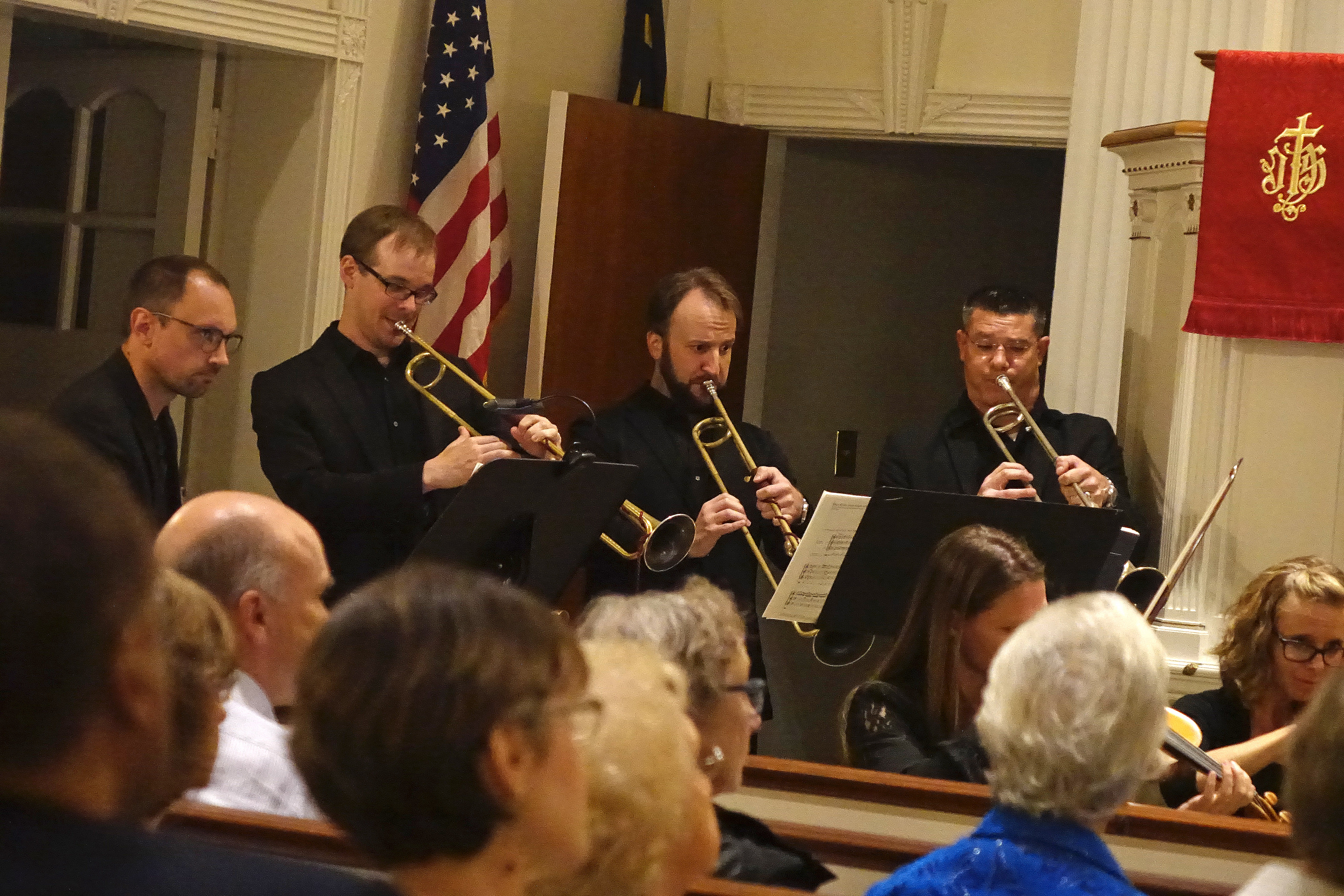
Even before the BA|Charlotte Festival Choir stood for the first time, the trumpet triumvirate – Steven Marquardt, Perry Sutton, and Josh Cohen – held forth brilliantly in the Easter Oratorio Sinfonia, gracefully counterbalanced by oboists Geoffrey Burgess and Margaret Owens. Tension and anticipation before the choral outbreak of resurrection jubilation were further sustained as Burgess lingered as the sole solo voice, playing a lovely intervening Adagio. Joined by timpanist Jonathan Hess, the trumpet trio then returned at full throttle, heralding the Chorus and its hearty “Kommt, ellet und laufet” (Come, hasten and run) invitation. Tenor Steven Soph and bass Jason Steigerwalt, so imposing as the Evangelist and Jesus (Steigerwalt singing the baritone role) in the Festival’s three midweek lecture-concerts devoted to Bach’s St. John Passion, then sang a duet, clarifying that it is the resurrection that has gladdened their hearts.

2022~Charlotte Bach Fest-110

Appropriately enough, newly rising talent took over most of the arias and recitative that followed, demonstrating the prestige of gaining a spot with the Festival Choir as Vocal Fellows. Bass Chris Talbot as John, in the first Recitative section that followed the huge chorale, and soprano Addy Sterrett as Mary Jacobi, subsequently drew their own solos. But tenor David Morales also reappeared as Peter in the Recitative following Sterrett’s lovely “Selle deine Spezereien” (O Soul, your spices) Aria, by far the longest Aria of the night, and alto Eliana Mei-Xing Barwinski also returned as Mary Magdalene.

Yet it was charming to see Festival Choir regulars also in the spotlight, Soph backed by Owens and Burgess (both switching to recorders) and alto Sylvia Leith accompanied by Owens on oboe d’amore. Marquardt, Sutton, and Cohen returned to the stage with their elongated plunger-less trumpets to join the Festival Choir once again, which had found something fresh to celebrate in their finale after much grieving, yearning, and sighing from the vocal and instrumental soloists during their absence: Jesus had conquered Hell and the Devil, and Heaven’s gates were opening for the Lion of Judah.

Alternately known as Coronation Anthem No. 1, Zadok the Priest also creates tension and anticipation with a churning crescendo of strings that could remind you of Philip Glass minimalism if you didn’t see the thunder and lightning of chorus and brass standing onstage, readying for action. In an instant, understatement flipped to overstatement when the storm broke loose at the Levine, for neither Zadok nor the prophet Nathan is exactly an Old Testament headliner of the magnitude of Solomon, held at bay until the end of the opening line.

2022~Charlotte Bach Fest-132Handel certainly packs plenty of into the brassy choral payload, less than five minutes long, that pounces upon us after the relatively quiet preamble that gurgles along for more than 25% of the composition. Bach might have dispatched a solo vocalist to narrate the prose of Zadok and Nathan anointing Solomon as King of Israel, saving the exclamations – “God save the King!” “Amen!” “Alleluia!” and “May the King live for ever!” – for the Choir. No such middle ground applied to this Handel masterwork, and Jarrett, the brass, and the Festival Choir all reveled in firing away at us in unrelenting fortissimo. Collectively, they were thrilling.

Shorter than the Easter Oratorio, Bach’s Ascension Oratorio was sensibly paired with Zadok after intermission, showcasing the Festival Choir more intensively. The more compacted – and more symmetrical – scheme has its choral segments evenly spaced at the beginning, middle, and end of the oratorio, rather than merely as two massive bookends, while discarding the two instrumental preambles that ushered in the Easter story. Instead of the same vocalists we had seen before, four more permanent members of the Festival Choir handled the two Arias and six Recitatives evenly distributed around the midpoint chorale. More satisfying than this architectural symmetry, of course, was the sustained excellence of the singing, underscoring the awesome depth and quality of the ensemble.

2022~Charlotte Bach Fest-115Three of the four featured Ascension vocalists have been with Bach Akademie since the beginning, except for tenor Gene Stenger, the Evangelist, who signed up in 2019. The Evangelist role gave Stenger the lion’s share of the scriptural verses in this Oratorio’s libretto, stitched together from Luke, Mark, and Acts, with bass Edmund Milly, no less dignified, standing in for the Two Men in White Apparel who promise the Apostles that Jesus will return from Heaven “in like manner” as they have just seen him go. Besides that key passage, Milly drew a more poignant Recitative earlier in the narrative, “Ach, Jesu, ist dein Abschied schon so nah?” (Ah, Jesus, is Thy parting now so near?)

Bach’s plum Arias here both went to women, alto Kim Leeds poignantly following Milly’s recit with “Ach, bleibe doch, mein liebstes Leben” (Ah stay, my dearest life) and following him again in Part 2, after the angelic promise, with another lovely plaint, the “Ach ja! So komme bald zurück” (Ah yes! So come back soon again) recitative. Stegner’s final recitative, concluding the narrative with a brief mashup of Acts 1:12 and Luke 24:52, sufficed to flip the mood from gloom to joy, giving soprano Margaret Carpenter Haigh the opportunity to rejoice greatly in the final Aria of the evening, vying with Sterrett and Soph and Leeds for the mightiest vocal conquest of the night, surpassing them only in charisma.

Enhancing the dramatic contrast between sorrow and celebration, Haigh could draw upon the ample instrumental support of three wind players playing contrapuntally behind her – oboist Burgess, and two flutists, Colin St-Martin and Rodrigo Tarrazza – the first musicians to rise up during the entire Ascension. Switching places with co-principal Marquardt, Cohen played lead trumpet in the latter oratorio. All three brass players returned from the wings for the final Chorus, an earthshaking fantasia set to a stanza from a Gottfried Wilhelm Sacer hymn, summoning the Christian savior to reappear.

He may not have quite reigned for ever and ever yet, but Johann Sebastian Bach (1685-1750) seemed to have retained much of his power 272 years after his death, thanks in part to better playing and singing at the Charlotte Bach Festival than any performance this imperishable genius may have actually heard in his lifetime. Georg Frideric Handel (1685-1759) has also had a pretty fine run, as the two baroque greats, born less than a month apart, close in on their 340th birthdays. It was good to have the elder Handel take his place in the Charlotte Bach programming for 2022, helping the to enhance our delight this year and to sharpen our eagerness for Festivals to come.

Originally published on 6/21 at CVNC.org

Anthem, Summer, and Winter Bring Enthusiastic Charlotte Symphony Audience to Its Feet

Review: CSO Plays Vivaldi’s Four Seasons

 By Perry Tannenbaum

2021~CSO Four Seasons-12-1

Charlotte Symphony had plenty to celebrate as their 2021-22 Classical Series began: they were playing on the Knight Theater stage for the first time since February 2020, they were beginning what is expected to be their first full season since 2018-19, it’s their 90th season, and it’s maestro Christopher Warren-Green’s farewell season as CSO’s musical director. Happy as Warren-Green and all the musicians appeared to be, there was no hiding that the return was not altogether smooth. The disconnect between what brochures in the lobby said the orchestra would be playing and the reality was fairly dramatic. All three of the selections originally scheduled in the “Russian Masters” program – including a Shostakovich symphony, a Glinka overture, and Tchaikovsky’s Violin Concerto, featuring Paul Huang – were dropped. Now we were three-quarters Italian, with works by Ottorino Respighi, Pietro Mascagni, and Heinrich von Biber served up before intermission and Huang switching off to Antonio Vivaldi’s beloved Four Seasons after the break.

When last season belatedly opened back in May at Belk Theater, in front of a socially-distanced audience, I wondered whether Warren-Green would honor Symphony’s tradition of playing our National Anthem to mark the first live concert. He declined then, and it seemed quite possible that he would hold off yet again, since the vaccinated audience, masked but no longer distanced, would be obliged to stand and sing together. But the mood was different now. Concertmaster Calin Ovidiu Lupanu preceded the maestro to the stage, gesturing so victoriously that you would have thought the orchestra had won the Super Bowl. After Warren-Green told us how glad he and his orchestra were to be playing to a live audience once again, he indeed turned sideways to cue the drumroll for the Anthem. As we stood together singing, rounding into the final eight bars, Warren-Green’s previous hesitance felt justified. For after the onset of the COVID-19 pandemic and the January 6 invasion of the nation’s Capitol, the affirmation that “our flag was still there” was more vivid now in a closely bunched crowd, suddenly fresh and renewed.

2021~CSO Four Seasons-02-1

All of the pieces that Warren-Green followed up with were musically descriptive in some fashion. Respighi chose three masterworks by Renaissance painter Sandro Botticelli for his Trittico botticelliano. The first, “La Primavera (Spring),” offered a tasty comparison with the opening Vivaldi concerto, light and airy with little solo passages that reintroduced us to the orchestra’s worthy principals playing French horn, trumpet, celesta, glockenspiel, flute, and reeds. Beauty and liveliness were nicely counterpoised in the steady, brisk tempo until the strings imposed their serenity. “L’Adorazione dei Magi (The Adoration of the Magi)” belied its expected bustle and ecstasy as it began, dark and solemn as acting principal Joshua Hood began on the bassoon and principal oboist Hollis Ulaky layered on. After some lovely runs by principal flutist Victor Wang, the middle of this movement did become more hectic and dramatic, keyed by harp and percussion, with a gently quickened tempo as the strings asserted themselves. Wang returned to the forefront at the start of the climactic “La nascita di Venere (The Birth of Venus),” surely Botticelli’s greatest hit, but the slow massing and building of the judiciously trimmed string section, forcefully topped by the violins, was the prime wonder in this satisfying ending.

2021~CSO Four Seasons-03-1

With unerring instinct, Warren-Green programmed Mascagni’s “Intermezzo from Cavelleria Rusticana” between the more substantial Respighi and Biber compositions so the three-minute piece for strings and harp played like an interlude as originally intended. The throbbing harp gave this lyrical gem a heartbeat, while the singing strings made it affecting like an aria. Now it was time for some fun as Warren-Green reveled in introducing Biber’s Battalia à 10, an eight-part evocation of warfare with some astonishing quirks. Most of these were novel ways that the musicians were called upon to replicate percussion instruments, beginning with the entire ensemble stamping their feet. Fingerboards of the basses and cellos were wrapped in paper and rapped with bows to simulate marching drums in the “Mars” section while Lupanu impersonated the piper on his violin. “Bartók slaps” were inflicted on the basses to mimic canon fire in the climactic “Battle” section, made more bizarre when the cellists turned their instruments sideways like guitars – with added mock drama when the harpsichordist fainted comically over her keyboard. Vying with this spectacle for the most memorable aspect of Battalia – and certainly the most modernistic – was the Bohemian composer’s second movement, “The lusty society of all types of humor.” Evoking the drunkenness of a teeming tavern, Biber split his little ensemble into four parts, each one playing a different song and blithely oblivious to the others. Warren-Green half-turned to us during this unspeakable cacophony and gave a little shrug.

2021~CSO Four Seasons-11-1

Returning to Charlotte for the first time since his Symphony debut two years ago, when he played the Dvořák Violin Concerto, Huang did not pale at all in comparison with the charismatic Aisslinn Nosky when she played – and conducted – The Four Seasons in 2018, the last time it had been presented here. The magnificent tone Huang achieved on his coveted 1742 “ex-Wieniawski” Guarneri del Gesù instrument was nearly as impressive as his fleet-fingered virtuosity and intensity. Even on normal occasions, recordings do not nearly capture the excitement of a live Four Seasons performance. On opening night, the pent-up hunger of this audience was palpable enough for the soloist, the musicians, and Warren-Green to feed off, and in the most turgid moments of these four familiar concertos, there was a feverish frenzy to the onset of the wind and storms that Vivaldi brings on. After the final notes of “Summer,” the crowd sprang to their feet, either electrified by Huang’s bravura or convinced that nothing could possibly follow what they had just heard. There are 12 movements, after all, so any confusion was easily forgiven – and the string players also joined the ovation, tapping their bows.

Yet there was more to come, including some nifty double bowing from Huang in the first movement of “Autumn” and a sprinkling of “Bartók slaps” from the upright basses in the last. Nor was “Winter” at all anticlimactic as Huang reached hyperintensity once again as Sirocco and Boreas engaged in windy combat. The final standing ovation was no less deserved than the previous outburst, and it lasted longer.

A Well-Proportioned “Passion” Caps the Charlotte Bach Fest

Review: St. Matthew Passion at the Charlotte Bach Festival

2019~Charlotte Bach Fest-201

By Perry Tannenbaum

The most dramatic moment at the second annual Charlotte Bach Festival may have been a moment of silence – at the climax of the St. Matthew Passion, after Bach’s Evangelist had declared that Jesus had died. Festival conductor and artistic director Scott Allen Jarrett maintained that silence longer than any I could remember on a recording or at a live performance, including Jarrett’s own with the Charlotte Symphony in November 2013.

After this loaded interlude at Myers Park Presbyterian Church, like the world itself coming to a halt, the BA|Charlotte Cantata Choir was exquisitely empathetic and hushed singing, “Wenn ich einmal soll scheiden, So scheide nicht von me” (When I depart one day, do not depart from me). The chilling desolation of this reaction was all the more poignant because of the power that the 25 singers in the Cantata Choir had poured forth just minutes earlier in mocking and taunting the crucified Jesus as he was dying on the cross.

2019~Charlotte Bach Fest-221

There had also been power aplenty from the soloists, as we were quickly reminded after the prayerful choral lament, when tenor Stephen Soph as the Evangelist continued Matthew’s narrative – with the rending of the Holy Temple, the earthquake, the opening of graves, and the rising of the dead upon Jesus’ death. No less powerful as Jesus, baritone Jason Steigerwalt’s most memorable singing had come in his Part I recitatives, at the Last Supper and during the subsequent episodes leading up to his arrest on the first day of Passover. Of course, his last words, “Eli, Eli, lama asabthani?” had a special plaintiveness.

With Jarrett’s past and present connections to the Oregon Bach Festival, the Handel and Haydn Society, Seraphic Fire, and Charlotte Symphony, the high quality of the Cantata Choir – and the instrumental and vocal soloists he can lure to Charlotte – is not at all surprising, even if their power and dynamic range can sometimes come as a shock. All 22 of the core members were accorded extended bios in the rear of the festival program booklet. Additional space was carved out for the four Vocal Fellows who fortified the Choir during the Passion and figured prominently in the midweek, midday Bach Experience performances of two Michaelmas cantatas, Nos. 19 and 149.

2019~Charlotte Bach Fest-194

Since both the core singers and fellows were chosen by Jarrett from nationwide talent pools, it wasn’t surprising that soloists singing the Passion arias were on the same level as those who had sung for Jarrett in 2013. What astonished me more was what soloists from a reduced core Choir had achieved the previous Saturday night when they performed Bach’s Magnificat at the festival’s Opening Celebration. Overall, performances at the more intimate Christ Church by sopranos Sarah Yanovitch and MaryRuth Lown, mezzos Elizabeth Eschen and Kim Leeds, tenors Patrick Muehleise and Gene Stenger, and baritone Steigerwalt had equaled or surpassed those I’ve heard on recordings conducted by Helmuth Rilling, John Eliot Gardiner, and Masaaki Suzuki.

There were additional soloists awaiting their turns at the Celebration when another Michaelmas cantata, No. 130, followed the Orchestral Suite No. 2. These included the sweet-voiced tenor David Kurtenbach, who would sing the recitative and aria at the Matthew Passion during the High Priests’ interrogation of Jesus, and – more impressive yet – bass-baritone Charles Wesley Evans, who would take the stage at the Passion in the wake of Judas’ remorse and suicide, transforming after the touching “Gebt mir meinem Jesum weider!” (Give me my Jesus back!) into the role of Pontius Pilate.

2019~Charlotte Bach Fest-208

Other superb choristers stepped forth at Myers Park Presbyterian who had not soloed during the Opening Celebration. Most conspicuous was countertenor Jay Carter, whose recitatives and arias suffused the most intense episodes of Part II with sublimity and pathos, during the scourging of Jesus and at Golgatha, the site of the crucifixion. Edmund Milly, who hadn’t sung at the Celebration, didn’t get his first solos until Simon of Cyrene carried the holy cross, lavishing his rich bass-baritone on “Komm, sübes Kreuz” (Come, sweet Cross), with a viola da gamba obbligato from Gail Schroeder. We had no sampling of soprano Margaret Carpenter Haigh’s silvery lyricism until Jesus was brought before Pilate and she sang her recitative and the “Aus Liebe will mein Heiland sterben” (Out of love my Savior wants to die) aria, with traverso flutist Colin St. Martin playing the intro and obbligato. St. Martin’s work at the Celebration in the Orchestral Suite No. 2 had been even more substantial and impressive.

2019~Charlotte Bach Fest-110

Five other members of the North Carolina Baroque Orchestra played obbligatos with Cantata vocalists, none more ballyhooed than concertmaster Aisslinn Nosky, who made gorgeous music together with Leeds in the mezzo’s “Erbarme dich” (Have mercy) aria. Following in the footsteps of cellist Guy Fishman, Nosky had been the second Handel and Haydn Society principal in successive years to perform at Charlotte Bach’s Visiting Artist Recital Series. In partnership with the American Guild of Organists, the festival presented Isabelle Demers as their other recitalist. The big improvement here was a change from the Uptown location at St. Peter’s Episcopal, where Bálint Karosi had performed, to Myers Park United Methodist. Not only did the chocolatey organ sound marvelous, it was at the front of the sanctuary, where we could actually see Demers play without having to turn around awkwardly in our seats.

Keeping with the precedent set by last year’s recitalists, both Demers and Nosky expanded the scope of the festival beyond all-Bach. Demers branched out into organ works by Alkan and Widor, and Nosky brought us a Fantaisie for Solo Violin by Telemann as well as two sections from Stand Still, a piece written for her by Michael Oesterle. Funkier by far, Charlotte Symphony trombonist Tom Burge inaugurated a new Bach at the Brauhaus event in the back room of Free Range Brewing on a wee stage that seemed, with its string of carnival bulbs and crimson curtains, best suited for magic acts or stand-up comics. Between sips of the pub’s brew – and banter from the audience – Burge played a Bach transcription, selections from Bone Kill by Michael Davis, and after slyly fishing out a euphonium from behind the curtain, Paganini’s most famous Caprice.

2019~Charlotte Bach Fest-151

Nosky’s appearance was another kind of departure from last year, extended so that she could linger and gently whip the NC Baroque’s strings into sharper shape for the Passion – and to help in spreading the festival to Chapel Hill, where the masterwork was given at University United Methodist before its closing night performance in Charlotte. The were fewer hired guns brought in from afar to fortify NC Baroque than came to sing with the Cantata Choir, and the Passion ensemble was a lean-and-mean 32, including Nosky and organist Nicolas Haigh.

The anemic organ Haigh contended with was the only fault I found with the Baroque Orchestra, not their SlimFast number. Playing on period instruments, the company places a greater premium on authenticity – and precision – than on raw power, which is fine with me. When added muscle was needed, Steven Marquardt and Josh Cohen shared leadership of a corps of valveless baroque trumpets that bloomed gloriously in the Magnificat to launch the festival and in three Michaelmas cantatas afterwards. And just before the halfway mark at the Passion, a 10-voice children’s choir from Charlotte Latin School briefly appeared.

Never too big, and never too small. When the Cantata Choir and the Orchestra reached the final “Wir setzen uns mit Tränen neider” (We sit down with tears) of the Passion, there was soothing lullaby aspect to the music that overshadowed the usual community lamentation we hear from larger groups. Tuning in to the “rest gently” motif later in this chorus, Jarrett likely had that restful aim in mind when he hushed his forces once again. That was also fine with me. Very fine.

Charlotte Bach Festival Kicks Off Year Two in Astonishing Style

Review: Charlotte Bach Festival

By Perry Tannenbaum

2019~Charlotte Bach Fest-022.jpg

Capping its second full season of operations and concerts, Bach Akademie Charlotte has launched its second Charlotte Bach Festival, and my first impressions tell me that this festival will be slightly larger than last year’s impressive inaugural. They’ve widened the reach of the eight-day event so that it stretches from Asheville to Chapel Hill, and they’ve expanded the concert lineup with a ninth offering, breaking out of their churches-only mold with “Bach at the Brauhaus” at Free Range Brewing.

Largely because they’re performing the St. Matthew Passion – and printing the entire text for festivalgoers – the handsome festival program booklet has also expanded, including 57% more advertising pages. Most exciting at the Festival Opening Celebration in Myers Park, it was obvious that awareness of the festival had grown. Last year, I could describe attendance at Christ Church Charlotte as excellent for a weakly publicized new event. This year, they were so near capacity that you have to wonder whether Charlotte Bach will be turning away customers next year or turning to a new location for their big events.

Since Johann Sebastian Bach was tasked with producing new work like clockwork – and keeping it aligned with his church’s calendar – it shouldn’t surprise us that, in some ways, festival artistic director Scott Allen Jarrett’s programming choices are formulaic. Last year and this year, for example, one of the visiting artist recitals will be by an organist – churches do come in handy at a Bach festival! – and the other will be performed by a principal from Boston’s Handel and Haydn Society, last year cellist Guy Fishman and this year concertmaster Aisslinn Nosky. Similarly, both last year’s and this year’s Opening Celebrations, performed by the BA|Charlotte Cantata Choir and the North Carolina Baroque Orchestra, have consisted of two vocal works and one of Bach’s Orchestral Suites.

2019~Charlotte Bach Fest-023.jpg

Beginning with the Magnificat, Bach’s setting for the Virgin Mary’s prayer to God (Luke 1:46-55), Jarrett was able to regale his audience immediately with the Baroque Orchestra’s heavy artillery – timpanist Jonathan Hess and three trumpeters playing valveless baroque instruments. Yet they only needed to rock the hall for about a minute before the chorus entered and began swelling toward their full volume, adding thunder to thunder. Intermediate sections reminded us of the Cantata Choir’s collective power from time to time but also spotlighted seven of the ensemble’s 17 members in solo, duet, and trio performances.

2019~Charlotte Bach Fest-009

Sopranos Sarah Yanovitch and MaryRuth Lown immediately set the bar high in their arias, baritone Jason Stegerwalt was both nimble and mellow with easy low notes in his “Quia fecit mihi magna,” and the blend between Elizabeth Eschen and Patrick Muehleise was exquisite in their alto-tenor duet. In brief intervals between the arias or in obbligato behind the soloists, there was admirable work from a solo oboe and a pair of flutes. Midway, trumpets and timpani returned for the mighty “Fecit potentiam” chorus and immediately exited, returning once more for a triumphal “Gloria Patri.” Glorious it truly was, outshining the lauded Magnificat recording conducted by Richard Hickox.

2019~Charlotte Bach Fest-005.jpg

In Season Two, we were offered Orchestral Suite No. 2, sensibly following the Suite No. 1 that launched last year’s Charlotte Bach Festival. It’s a much quieter and more intimate piece, giving flutist Colin St. Martin the opportunity to come forward and sparkle. The slightly slow tempo Jarrett chose for the long Ouverture movement certainly made me yearn for the speed-up that was telegraphed. When the tempo did quicken, it was still a half-step slow, but there was a nice gradual gain in momentum until the slow-fast cycle repeated. St. Martin produced charming staccatos in the lovely little Rondeau and renewed the appeal of the familiar melodies that crop up later in the Polonaise and the concluding Badinerie movements.

The Cantata presented after intermission was shorter than either of the pieces that preceded it, but there was a handy “To be continued…” label attached to Cantata 130 by Jarrett in his introductory remarks. This would be the first of three Cantatas to be performed at the 2019 festival written by Bach for the Feast of St. Michael. The other two – Cantata 19, Es erhub sich ein Streit (“There arose a war”), and Cantata 149, Man singet mit Freuden vom Sieg (“The voice of joy and redemption”) – would be performed separately at midday “Bach Experience” concerts during the week, fortified with analytic lectures from Jarrett. So 130, Herr Gott, dich loben alle wir (“Lord God, we all praise you”), was a gateway to those lengthier celebrations of St. Michael’s victory over Satan, alias “Der alte Drache” (“the ancient dragon”).

Slightly stunted compared with the other two Michaelmas cantatas, six movements rather than seven, Cantata 130 didn’t lack for vocal and instrumental muscle, as Jarrett brought back all the choristers who had departed for the Suite and all three trumpeters – Josh Cohen, Steve Marquardt, and Perry Sutton. But again, comparing this performance to recordings conducted by Helmuth Rilling, John Eliot Gardiner, and Masaaki Suzuki, I found the excellence of the choir and the vocalists to be most astonishing. With all the instrumental big guns firing instantly, the musical praise seemed to begin before the vocalists joined in on the opening chorus, and Eschen was no less luminous in her mezzo-soprano recit than she had been in her previous Magnificat duet.

2019~Charlotte Bach Fest-003

Any suspicion that all of the Cantata Choir’s top vocalists had already been deployed was dispelled when baritone Charles Wesley Evans, preceded and accompanied by trumpet heraldry and timpani thunder, sang his powerful “Ancient Dragon” aria, neither eclipsed nor strained by the brass and drums. Jarrett also had the luxury of spotlighting additional singers in duet, for soprano Emily Shusdock and tenor David Kurtenbach harmonized deliciously on their recitative. Kurtenbach lingered for the prayerful aria that that followed, a soft lyrical movement that saw him in duet with flutist Rodrigo Tarraza before the stately, anthemic final chorus.

One last item to pass along after attending Monday’s “Bach Experience”: Aisslinn Nosky, slated to deliver her solo violin concert on Wednesday, will linger at the festival through its conclusion, serving as concertmaster at the upcoming performances of the St. Matthew Passion.

Amid a Record Cold Wave, Nosky Brings the Heat of Vivaldi’s “Four Seasons”

Review:  Vivaldi’s Four Seasons

By Perry Tannenbaum

With only string players on assignment, Charlotte Symphony was a noticeably smaller orchestra at Belk Theater last Saturday night. But with Vivaldi’s Four Seasons on the program and redheaded Aisslinn Nosky both playing the violin solos and guest conducting, the house was as unusually full as the stage was empty. People don’t merely adore Antonio Vivaldi’s signature set of concertos. If WDAV, Charlotte’s notably successful classical FM station, has it right, they also dig all things baroque.

Aside from an excursion into Felix Mendelssohn’s Sinfonia for Strings No. 1 – written when the prodigy was a boy of 12 – that’s what Nosky brought to the podium. Nosky is one of the pre-eminent authenticists on the continent, having served as concertmaster for both Tafelmusik in Toronto and the Handel and Haydn Society in Boston. Historical practices and authentic historical instruments are her customary métier.

So is rocking a punk hairdo, flaming pink or fuchsia on some nights, and anchoring I Furiosi, an avant-garde quartet. With fellow emissaries from H+H, Nosky has gigged at Le Poisson Rouge, one of the hippest clubs in Greenwich Village. An aura of unpredictability shimmers around her.

Of course, Nosky adapted to Symphony by playing a modern violin, but tantalizing stylistic questions needed to be answered on how she would approach the music and Charlotte’s classical audience. Bach’s Violin Concerto No. 1 provided answers at the top of the program.

Nosky’s tone on the modern violin was laser thin and strong, most attractive just before her highest notes and infectiously cheerful with Symphony’s strings. The brisk pace that Nosky called for added to the sunniness of the opening movement, yet there was no superficiality to the lightness. When we moved to the middle Andante movement, Nosky entered with an exquisite pianissimo that was barely audible at first, swelling to full bloom while still allowing the cellos to dominate with their spare accompaniment. Spikey hairdo or not, Nosky subtly sculpted the closing Allegro, achieving a fine balance between her violin and the ensemble, building almost imperceptibly to the climax with gradual acceleration and crescendo.

As her concert-black outfit had signaled, Nosky wasn’t out to create outré sensations. The warmth of her chat with the audience, introducing Georg Philipp Telemann’s Don Quixote Suite, was an extension of principal cellist Alan Black’s earlier intro to the whole baroque program. Nosky reminded us that pianists and violinists, many doubling as famed composers, had led orchestras through most of classical music history, and she dished on the friendly rivalry between Bach and Telemann.

Notwithstanding the spikey punk do, you could bring this redhead home to meet your Republican dad.

I’ve found a CD, played and conducted by Jan Stanienda, that programs The Four Seasons and Don Quixote together, and the pairing makes sense. Both pieces are very imagistic, so the Telemann served as a fine foreshadowing for the Vivaldi. It would have been helpful, especially in the absence of any detailing from Nosky in her intro, to have seen the descriptive titles of the eight segments of the suite on the page with the program listings.

Flip ahead to the program notes, however, and the titles printed there would have better prepared you to fully savor the woeful waking of the Don, his adoration of Princess Dulcinea, Rosinante, Sancho, and the renowned windmills. What came through best without these prompts were the horsey flavors of the suite, the stately cantering of the overture, the quarter horse sprint of the windmill sketch, the sudden crowdpleasing interjections evoking Sancho’s donkey (effects Haydn would perfect), and the farewell gallop of the finale, ending not with a Rossini-like bang but with a surprising, slightly affecting fadeout.

Spearheaded by Nosky, the Symphony strings made an excellent case for the outer movements of Mendelssohn’s C Major Sinfonia, the second Allegro particularly impressive for its precocity. By comparison, the middle Andante in A minor struck me as moribund. Or I should say that it hardly struck me at all.

Nosky jokingly told us that, in view of the record cold weather outside the concert hall, she had considered only playing Vivaldi’s “Summer” concerto to warm us up. Then she promised there would be additional heat in the other Seasons – even in “Winter” – and there was. Written within the framework of four Italian sonnets, conveniently translated in our programs, the musical imagery of Four Seasons is probably best followed by playing a CD with the text in front of you, so Vivaldi’s backtracking refrains and mood-shifting don’t make you lose your place.

Not an absurd expectation at all: Symphony’s pre-New Year’s email blast to subscribers not only offered concertgoers a link to the translated poems, it also provided a Spotify playlist to The Four Seasons and the rest of last week’s Classics concert. Another handy subscription for Symphony supporters. Lack of such prep accounted for the major glitch of the night, when the audience applauded prematurely, forcing Nosky to confide that “Winter” was yet to come.

At the beginning of Four Seasons, “Spring” crests with a thunderstorm in the second half of its opening Allegro, and the onset demonstrated that there was sufficient artillery onstage at Belk Theater for the fireworks and hailstones to come. Nosky was at her most soulful in the middle Largo as the goatherd lay down to sleep in the meadow, and the sweetness lingered into the concluding pastoral dance with a nice attention to the strings’ harmonies.

Forebodings of the ultimate storm in the “Summer” concerto spread dramatic contrasts throughout the first two movements, both of which have fast sections, but it wasn’t until the concluding Presto that Vivaldi and Nosky reached their fullest fury. Here the flaming redhead was clearly torching the Red Priest, finally breaking into her bacchante mode, sustaining the lightning with a sizzling cadenza.

She is too authentic to linger in sensationalism, and there was plenty of artistry to display in the remaining concertos. Soloing in “Autumn,” it seemed to me that Nosky was caricaturing one of Vivaldi’s drunken peasants with a witty twist of her glissandos, and she made sure to emphasize the fadeout at the end of this season, reminding us of the kinship between Vivaldi’s sketchings and Telemann’s.

“Winter” was not only the most shivery season, it was also the darkest, bleakest, and loneliest as Nosky gave us a wan cadenza backed only by Black on cello. North winds howl in the final Allegro, allowing Nosky and Symphony to whip up one last tumult. Maybe the sun didn’t quite shine through this icy gloom, but the joy and warmth of the music did, just as the Red Priest prescribed.

A Flaming Redhead Scorches the Red Priest

Preview:  Vivaldi’s Four Seasons

By Perry Tannenbaum

Even in Charlotte, the would-be crown of the New South, you occasionally hear the grumblings backstage – or in the boardrooms of our leading performing arts companies. Our audiences are graying. Who ya gonna call? For Charlotte Symphony, this week’s startling answer is their guest soloist, Aisslinn Nosky, a redheaded violinist – sometimes fire engine red when the mood hits – who usually rocks a punk hairdo.

A blatant appeal, you could say, to younger people who might otherwise be wary of a formal concertgoing experience or just plain classical-averse. But that’s hardly half of the Nosky story. Far from dolling up and dumbing down the music she plays, Nosky is highly regarded as one of today’s prime exponents of music by Antonio Vivaldi, Johann Sebastian Bach, Georg Philipp Telemann, and Franz Joseph Haydn.

Canadian born, Nosky has strong ties to three of the most important groups in North America that specialize in this music. She’s a core member of the Toronto-based I FURIOSI Baroque Ensemble and the concertmaster at Boston’s Handel and Haydn Society. Nosky’s 10 years with the famed Tafelmusik Baroque Orchestra culminated in the 2015-16 season when she toured as their featured soloist.

Although she’ll be playing a modern violin when she teams up this weekend for a concert that will showcase works by Bach, Telemann, and Mendelssohn – while headlining Vivaldi’s Four Seasons – Nosky usually plays authentic period instruments when she performs and records with H+H or Tafelmusik. She dismisses the notion that there’s some kind of disconnect between her punkish stage persona and her punctilious preservation of authentic practices.

“I can see how on the surface it might strike some people as a jarring contradiction,” Nosky admits. “What our current audience may not know is that the idea of classical music being a highbrow/conservative art form was born entirely in the 19th century. In the 18th century, the star singers of the opera world and the most famous instrumental performers were treated like rock stars. One need only read contemporary accounts of audiences’ reactions to someone like the great opera star Farinelli to have a glimpse into the excitement and glamor which was a part of experiencing Western art music in the past.”

Many other classical musicians, conductors, or academicians are on the record with similar observations about classical music’s less stuffy, more spontaneous past. Nosky separates herself from those laments, living that bygone spontaneity right now. Check out the I FURIOSI website if you have any doubts. Or watch Nosky rockin’ out on Bach with Tafelmusik in a YouTube video.

Something unusual there: Nosky is not only playing with the ensemble, she’s directing it. That’s the plan for this weekend at Belk Auditorium. In both the Bach Violin Concerto No. 1 and the Four Seasons, Nosky will be soloing while leading the orchestra. Although the ensemble doesn’t figure to be as small as Tafelmusik’s, with 19 full-time members, you can count on Charlotte Symphony to field a smaller armada of musicians than the one that played Brahms and Beethoven back in November.

Trimming the size of the ensemble performing Haydn and Mozart became a routine practice at Symphony during the aught decade when Christof Perick wielded the baton as music director. But aside from Bach’s B Minor Mass (2002 and 2009), a Vivaldi Piccolo Concerto rearranged by and for percussionist Evelyn Glennie (2005), nothing written before Papa Haydn was presented at the Belk to Symphony’s Classics Series subscribers during those years.

Curiously enough, that Vivaldi Piccolo Concerto was conducted by Christopher Warren-Green, five years before he took over as Symphony’s maestro for the 2010-11 season. So it figured that Warren-Green would be programming more baroque at the Belk than his predecessor.

“Musicians of a symphony orchestra are expected to be extremely versatile and be able to juggle different musical styles,” says Calin Ovidiu Lupanu, Charlotte Symphony’s concertmaster since 2003. “We usually switch from a classical repertoire to a more jazzy or Broadway type of repertoire, from modern classical to baroque. Especially with the arrival of Maestro Warren-Green in Charlotte, the number of baroque programs has increased. I am sure that Aisslinn will bring her own interpretation and expertise to the stage.”

What might seem unusual, a concertmaster leading an orchestra while he or she plays the solos, is often the practice when performing Four Seasons, according to Lupanu. That didn’t happen the last time Symphony presented Vivaldi’s most famous composition in early 2010. Lupanu would know. On that January night, with Michael Christie as guest conductor, Lupanu himself was the soloist.

Oh, and this just in: Lupanu kicked off a new Charlotte Symphony chamber music series in October at Tate Hall on the CPCC campus, leading a “conductorless” concert of works by Elgar, Britten, and Shostakovich. So for the record, he set the precedent.

Nosky has a different perspective on compounding her instrumental work with conducting, reminding us that before the 19th century, concertmaster and director were interchangeable titles.

“Tafelmusik Baroque Orchestra was directed from the concertmaster’s chair by Jeanne Lamon,” Nosky recalls. “It never occurred to me that playing baroque and classical music needed to be done any other way. In fact, after a lot if research into the subject, I can say positively that the majority of orchestra music before the 20th [century] was directed by either the concertmaster or the keyboard player. People may forget that Vivaldi and Telemann and Bach initially achieved their enormous fame as performers!”

Both concertmasters, Lupanu and Nosky, cite chamber music as central to their tastes and training, so both are comfortable in reduced-size ensembles where all the musicians must keep a sharp ear out to blend and synchronize with their colleagues. Where the two seem to part company is in the outré flair that Nosky brings to the task.

“In a culture that is geared towards young performers playing for an older audience,” Lupanu observes, “someone of Aisslinn’s quality can be extremely helpful in bringing more of the baroque and early music repertoire in the concert halls. And – why not? – maybe having the younger audience attracted to this kind of music.”

Nigel Kennedy? Peter Sellars? Peter Pan? Nosky pushes back against the notion that her spiky hairdo is modeled on anybody else’s – or that it’s calculated to position her as a Pied Piper for a new generation of classical audience.

“All I can say is that my inspiration comes completely from what makes me feel comfortable when I perform. I couldn’t possibly try to look like or be anybody other than myself. If I did, I would not be true to myself. Or the music.”

Nonetheless, when Nosky moves from Handel and Haydn to the music of Vivaldi, her spiky red do inevitably takes on the tinge of an homage. Born in 1678 and ordained in 1703, Vivaldi was nicknamed the Red Priest because of his curly red locks.

It’s uncertain how much red Nosky will be sporting onstage as she plays her concertos and leads Charlotte Symphony in a Sinfonia by Mendelssohn and a “Suite from Don Quixote” by Telemann. There’s a 2013 video of Nosky clad in red lapels when she played with an H+H quartet at Le Poisson Rouge in Greenwich Village. On second glance, maybe those silky lapels were fuchsia.

One thing is certain: Just being herself, Nosky will surely be a redhead playing the Red Priest, often at a fiery clip. It will be interesting to see how many other punks show up.