“Squawks” Hasn’t Sharpened Its Claws

Review:  Charlotte Squawks 13

Charlotte Squawks

By Perry Tannenbaum

The time seemed so ripe for a Charlotte Squawks makeover. Since last year’s Squawks 12: Twelve Angry Hens, Charlotte has been rocked by the shooting of Keith Lamont Scott, the riots Uptown, the shame of national headlines, and the awkward agonies of our mayor and police chief. Rescinding the liberalized treatment for our LGBTQ community that led to the notorious HB2 law from Raleigh lawmakers, Charlotte received zilch for its concession, another Queen City humiliation.

So when the word came out that Squawks 13, riffing on the Apollo space drama, would be subtitled Charlotte, We Have a Problem, I held out the hope that Squawks might transcend its ducky cartoon logo and address substantial issues. Sharpen its feeble claws into angry talons.

Instead, the familiar formulas and musical parody format established over the years by producer-director Mike Collins and writer Brian Kahn remained intact. New wine was poured into the old bottles, presented by a slightly altered cast of admirable performers, with customary sensory overload provided by three big screen monitors – streaming memes, produced by John Merrick, that ran simultaneously with Kahn’s parodies.

Charlotte Squawks

Lightweight eggs laid by Kahn rolled in one after another, foredoomed by their safe, jejune subjects: parodies targeting rampant Charlotte construction, pussyhats, the craft brewery craze, airport delays, Carolina Panther concussion injuries. Subjects that didn’t figure to deliver hilarity consistently fulfilled their dismal potential. While it certainly was a brave public service for somebody to tell Mayor Jennifer Roberts to do something about her hair, the assault wasn’t the thunderbolt I’d hoped for.

Keith Scott, the Uptown riots, and Police Chief Kerr Putney? Never mentioned.

Not surprisingly, Kahn fares better when he abandons Squawks 13’s implied purpose of taking on Charlotte and its foibles. He finds more fertile soil ranging into more open, less threatening frontiers where the deer, the antelope, and latenight TV comedians roam. Modeled after B.B. King’s raging blues, “The Bill Is Gone” is a lusty attack on the homophobic HB2, and “Give Us Our Way, We’re Republicans” after intermission is a delicious second helping.

Our tweeter-in-chief also draws fire early and late, “Tweet Commotion” before the break eclipsed by “I Deny This Scheme” – with its Donald-Putin innuendo – after intermission. Lest you think Act 2 is pure gold compared to what precedes, beware: successive takedowns of memes, former guv McCrory, Bill Reilly, and Starbucks are all lyrically toothless (though three of the parodied songs are catchy). Collins and his cast make a nice point about the inane predictability of Charlotte 5, but the mockery of Luke Kuechly’s local CPI ad doesn’t even achieve the mediocrity it aspires to.

Charlotte Squawks

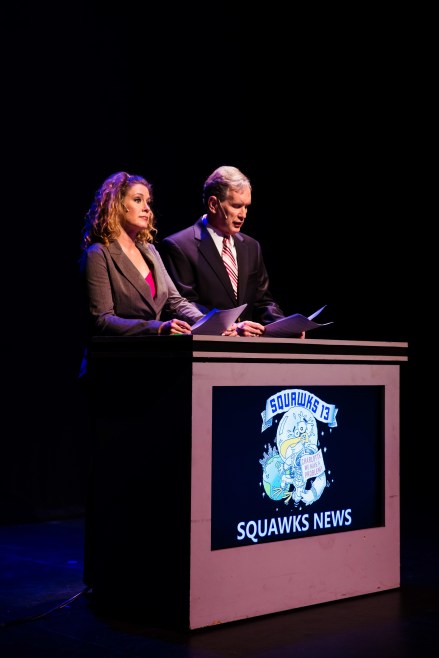
Collins’ opening monologue and his stints behind the Squawks newsdesk with Johanna Jowett are still punchy, and the new parodies poured into “Bad Day” are worth keeping the annual reprise of Daniel Powter’s song alive. But CMPD’s blunders throughout the Keith Scott debacle merited a spot on the roster of shame.

There’s always an element of schadenfreude watching Collins and his cohorts trying to deal with Linda Booth’s glitzy choreography. Aside from Jowett’s sassy irony, I’m addicted to the annual shots of brassy phoniness that Robbie Jaeger delivers. A new sensation is added to the brash Squawks bird this year, Nkeki Obi-Melekwe, who was last on my radar in 2014 as a Blumey Award nominee. That was three years after she represented Central Academy of Technology and Arts Performing Arts Academy from Monroe at the North Carolina Theatre Conference State Play Festival – and took home Outstanding Achievement in Acting honors.

Pairing Obi-Melekwe with Jaeger in the two “Thrill Is Gone” segments is a masterstroke, giving Jaeger a chance to blaze through his half of the blues shouts with white-boy chutzpah and Obi-Melekwe a chance to torch hers with the authentic flame. These showdown performances, half hilarious and half thrilling, upstage the parodies. So I’m hoping something equally loathsome will be gone over the next 12 months, just so I can see Robbie and Nkeki doin’ it again.

Dee Dee and Charles Do It Their Way

Review:  Spoleto Festival USA Jazz

By Perry Tannenbaum

Dee Dee Bridgewater didn’t exactly say that a diva can sing any damn thing she pleases. But she came damn close. Kicking off the Wells Fargo Jazz concerts at this year’s Spoleto Festival USA, Bridgewater told the crowd at Cistern Yard that it was tough luck if we didn’t get the memo: now that she has been named among the NEA Jazz Masters for 2017, she feels like she’s earned the privilege to take a break from jazz and move in a new direction.
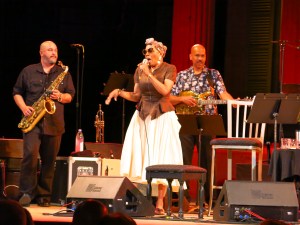
As she introduced her supporting cast, six pieces plus two backup singers called the Memphis Soulphony, Bridgewater told us that her detour was taking her back to the soul and blues of her hometown. So there were golden oldies by Big Mama Thornton, B.B. King, Al Green, Otis Redding, solos by each of the backup singers, and a purple Prince encore. The last two numbers, a Redding-styled “Try a Little Tenderness” and a communal “Purple Rain,” with many in the audience firing up their smartphone flashlights to simulate the good old butane lighter days, were distantly connected with jazz.

But if you were looking for the kind of vibes on such CDs as Dee Dee’s Feathers or Dear Ella, Bridgewater and her Soulphony weren’t ready to oblige. Or if you were expecting the coy and cooing sounds that dominate Dee Dee’s recordings, you needed to open your heart to a raunchy and raspy side of this vocalist that record execs may have muted in past years. B.B.’s “The Thrill Is Gone” and Big Mama’s “Hound Dog” both had an authentic zest of their own, raw at the core, affirming a true busting loose. You can judge for yourself when Bridgewater and Soulphony drop their Memphis CD later this year.
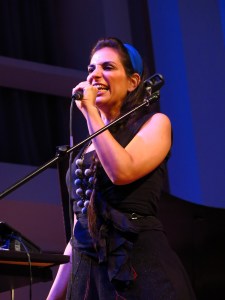
I was fearing a similar non-jazz experience from Sofía Rei when a couple of people who caught one of the transplanted Argentinian’s earlier sets asked me to get back to them after I’d seen her. As it turned out, each of Rei’s sets was different – with different titles and mixes of personnel until her final day at Spoleto. Even then, when the same trio backed her at 5:00 and 7:00pm, each set had its own title. I caught the earlier “Cursed Heaven” program, favoring that over Rei’s “Quartet” finale.

Most of the “Cursed Heaven” songs can be heard on El Gavilán*, Rei’s tribute to Chilean songwriter and folklorist Violeta Parra issued earlier this year; but with free jazz pianist Leo Genovese anchoring the rhythm section, textures were radically different from those on the CD. With Rei’s vocals, loops, and charango mostly backed by an acoustic guitar, that studio “*Hawk” is relatively tame.

The divergence and the excitement began immediately with “Arriba Quemando el Sol.” Underscored by the repetition of the loops that Rei laid down as backup and backbeat, the juxtaposition of Rei’s on-the-beat vocals with Genovese’ out-of-time accompaniment made for a burning restlessness, with percussionist Franco Pinna taking the keyboardist’s side in the conflict and bassist Jorge Roeder hedging his allegiances.

Genovese did some hedging of his own on “Mazúrquica Modérnica,” his initial accompaniment very trad with a carnival flavor, followed by a Monkish solo on his electric keys. When Rei returned for her second spot, accompanying her own vocalese on charango, Genovese was as out on piano as he had been before – only this time with an explicit Monk “Misterioso” quote.

Both Pinna and Roeder sat out “El Gavilán,” Rei and Genovese becoming a powerful duo. Rei was simply majestic here, alternating intense outbursts with soft or anguished interludes. After a bodacious electric solo from Genovese, he and Rei went beyond intense together before easing into ballad mode. The saga wasn’t quite done – it runs over 14 minutes on the CD – as Genovese ripped the first part of his sheet music off his stand to access his final jottings.

Nothing that followed matched this majesty, even after Roeder and Pinna returned to their posts, but “Rin del Angelito” was brimful of color and charm, with Genovese tooting on a melodica for one of his solos and Rei actually swinging on one of her vocals, prodded by Roeder. The finale, “Casamiento de Negros,” proved that the quartet could tap into an orgiastic Flora Purim-Airto level of intensity. Loops, vocals, and vocalese poured from the joyous Rei, and Pinna absolutely sizzled behind her on percussion.
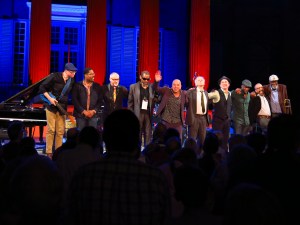
The Pedrito Martinez Group commanded a larger venue at Cistern Yard and expended plenty of energy on a hot and humid night for an appreciative audience that enjoyed the Latin beat. My enthusiasm was tempered by Martinez’s lead vocals, hardly less generic than the backup vocals from his band, and the total absence of brass to spice up the salsa.

Martinez hails from Cuba, I get that, but I much preferred Arturo O’Farrill and his 17-piece band, last year’s Latin headliners. True, the Mexican-born bandleader wasn’t universally popular: when he announced, after affirming that his countrymen aren’t rapists, that his next piece was titled “Trump, Fuck Trump,” a number of ticketholders headed for the exits. A year later, the timing was more propitious for Martinez and his congas. Our tweeter-in-chief’s executive orders on Cuba came after the festival, so Apprentice fans were spared from a Martinez reaction.

Joined by Edgar Pantoja on keyboard, Jhair Sala on percussion, and Sebastian Natal on electric bass, the Martinez Group was basically a slightly augmented rhythm section – plus a lead vocalist who could hardly compete with Rei’s individuality and fire. His best came at the end of the concert in the conga groove of the thrusting “Mambo Influenciado,” with the tastiest group vocal, and in the “Dios Mio” finale, where he took on the Herculean tasks of teaching us the lyrics, aligning us with the rhythm, and getting us all to stand.

While Martinez was mixing with the audience, Pantoja shed his sportshirt in the evening humidity and had his best moments at the keyboard with a long solo. Quoting a snippet of “Night in Tunisia,” Pantoja’s other highlight had come in “La Ballerina.” This is a solid band, but a charismatic singer or horn player fronting them would have helped them to more adequately fill the big stage.

I had first seen Henry Butler perform in 2009 at the Savannah Music Festival in 2009, his power as prodigious as his virtuosity, so I suspected that he could command the Cistern Yard stage all by himself – if the poor piano they put up there could stand up to the punishment. Backed by Steven Bernstein & The Hot 9, there was no doubt that the group was up to the challenge of wowing the outdoor crowd under the live oaks and the Spanish moss.

When Butler and Bernstein came out with their Viper’s Drag recording in 2014, I considered it one of the top 20 releases of the year, and JazzTimes critics elevated the newly formed ensemble to the top 5 big bands and large ensembles in their annual polling. So the fit and the polish of this collaboration – Butler’s bravura and Bernstein’s arranging artistry – are well-established. Rather than making that instantly apparent, Bernstein mostly yielded the stage for the first two selections to the man he proclaimed as a national treasure, allowing him to perform his prodigies with minimal accompaniment.

Most of what followed was territory covered on Viper’s Drag, including the title tune. Having already shown his chops, Butler reciprocated and allowed more of the spotlight to shine on the Bernstein 9 in “Viper’s Drag” and “Dixie Walker” than we hear in the Impulse recording. Soloing was shifted to Erik Lawrence on baritone and Matt Munisteri in live performance of “Wolverine Blues,” and Butler once again abbreviated his input.

Butler can be an impressive vocalist when covering material like “Great Balls of Fire,” “Riders on the Storm,” and most things New Orleans. Not only was he clicking vocally on “Buddy Bolden’s Blues,” he was establishing a template for the rest of the set, unleashing more of his keyboard powers on numbers that he sang.

The two vocals that followed “Buddy” were begun with awesome preludes that gave no hint of what was to come. A piano fantasia over Donald Edwards’ drums would have swamped the “Iko Iko” that was coming if Butler weren’t such a commanding and personable performer. “Dr. John on steroids” doesn’t come close to describing the preternatural contrast in moods that was resolved when Butler finally broke into song.

More of the Bernstein 9 was integrated into the closer, including the leader soloing on trumpet and Peter Applebaum on tenor sax. When I detected wisps of Dr. John in 2009, I thought I also caught the scent of Billy Preston when I first heard Butler play, confirmed on his PiaNOLA Live album. Yet the epic intro to the band’s closer began as a meditative solo, sped up to stride, returned to restless brooding, grew darker in mid-tempo, and skittered into a helter-skelter cacophony – when the Bernstein 9 joined him in Preston’s “Will It Go Round in Circles?”

Out of the darkness and confusion, a Mardi Gras party had suddenly broken out in Charleston, with the best singing and playing of the night. You can bet Preston’s hit will be on the playlist the next time this excellent big band makes a recording.

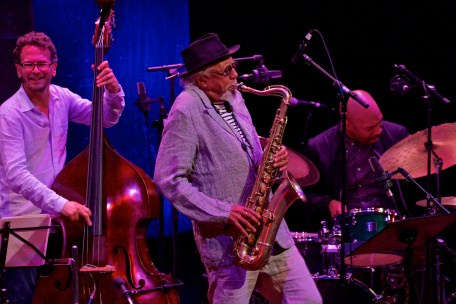
Charles Lloyd’s appearance at the marvelously made-over Gaillard Center reminded me how Spoleto Festival USA flips the script with its jazz programming. Other festival planners will try to attract audience with familiar, bankable names – and indeed, people come to see the stars. But Charleston and the Spoleto imprimatur often come first here, prodding non-fans into trying unfamiliar names out. If Spoleto books Sofía Rei and Evan Christopher,  they must be worth a listen.
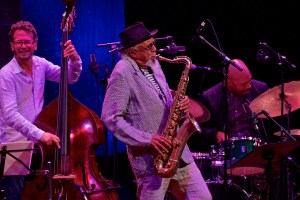
So the beautiful Gaillard, with acoustics that had already proven perfect for Randy Weston and René Marie last year, wasn’t universally crammed with Charles Lloyd believers. Though the first two ballads, “Dream Weaver” and “Defiant,” reinforced the notion that the tenor saxophonist – still vital and wailing more than 50 years after his first recordings – hasn’t radically changed his tune, a trickle of people began heading for the exits just past the midway point of the concert when Lloyd’s quartet had played “Monk’s Mood.”

Lloyd hadn’t turned against mainstreamers. If anything, I found the core of Lloyd’s new quartet, with Gerald Clayton on piano and Larry Grenadier on bass, more accessible than the combo I saw with Jason Moran and Reuben Rogers at Lloyd’s Jazz @ Lincoln Center concert in 2011.

Those new to the vintage sound of “Dream Weaver” and “Defiant” could be referred to John Coltrane’s Crescent if they liked these Lloyd compositions. The way that Lloyd broke into a 4/4 groove in “Weaver” and lathered up into a primal wail was particularly lovely, though the ominous “Defiant” intro was more Trane-like. Clayton began to shine most brilliantly when we transitioned to uptempo with “Nu Blues,” where Eric Harland, the one holdover from Lloyd’s 2011 rhythm section, launched into an epic drum solo after trading licks with the leader.

“Monk’s Mood” is signature Coltrane, of course, since he recorded it with Thelonious himself, but Harland’s chameleonic changes at the kit helped Lloyd lyrically make Monk’s tune his own. With Lloyd getting into his flute groove, Clayton working under the piano’s hood, and Harland donning a ballcap, the band seemed to be having fun plunging into the leader’s “Tagore,” though much of the mystery of the 2005 live recording remained. Clayton shattered the quietude with an astonishing solo as Lloyd fed a wisp of impromptu percussion into one of the piano mics.

Another of Lloyd’s flute classics, “Third Floor Richard” from way back in 1966, was a genial transition to the powerhouse finale, “Passin’ Thru.” Talk about a staple in Lloyd’s career, young Charles brought this line to a Chico Hamilton date in 1963, and it’s the title cut of Lloyd’s upcoming Blue Note release. Like so many formidable classic performances, this one began with an impressive bass intro. Clayton layered onto Granadier’s foundation, quickening the pace before Lloyd laid out the line. Then Clayton really amped up the intensity – and Lloyd rode onto that conflagration, turning it into a raging firestorm, capped by a blistering outchorus.

Except for his Louie’s Dream duets with pianist Eli Yamin in 2013, I’ve mostly slept on recordings by Evan Christopher, steering clear of his Clarinet Road series with the assumption that they would be old-timey tribute albums. Example: Volume 3: In Sidney’s Footsteps. Yet here he was, playing at Spoleto, sufficient reason to find whether my assumptions needed adjustment. Oh my, did they ever.

No piano here. No drums. Only one familiar title. Brian Seeger on guitar and Roland Guerin on bass fill out the new edition of Clarinet Road, and right out of the gate in “Bayou Chant,” the group was easily as edgy as it was New Orleans traditional. Bass and guitar layered onto Christopher’s unaccompanied rant, deflecting it into a 4/4 orbit, where Seeger took a thoughtful first solo. The clarinetist blazed back to the forefront, subsided into quietude before a spasmodic cadenza, and softly faded out.

With Christopher linking his next three originals to New Orleans in his spoken remarks, he made it clear that this Road was aiming toward a nouveau Dixieland. “Surrender Blue” insinuated itself with a tango, and “The Old Sober March” ignited from Seeger’s strummed intro. Edgiest by far was “Creole Wild West,” which quietly asserted its wildness when Christopher managed to integrate the sound of his clarinet keys into his a cappella preamble. Both Seeger and Guerin found paths to equal eccentricity, completing a very unlikely percussion trio before Christopher unveiled the melody.

Unsheathing one of the most familiar glisses in jazz, Christopher’s single dip into recognized rep was Ellington’s “The Mooche,” which the clarinetist has already recorded twice. He still tends to take the line too fast, but after a swiftly strummed intro from Seeger and a hurried half chorus, Christopher reined it in, varying tempos, registers, and dynamics more effectively live than on record, with Seeger providing more wacky percussion under Guerin’s solo.

“Buffalo Trace,” the one Seeger original, provided the most outré of Christopher’s intros, a brooding rumination begun with only the top half of his clarinet. The closer, “Congo in the Square,” came closest to what fans of the Clarinet Road series came for. Yet another Christopher original, it locked into some fine straight-ahead blowing after the leader’s last musical soliloquy, with a slice of “Maple Leaf Rag” embedded in the licorice. From the sound of this concert, Volume 4 of Christopher’s Road saga will be radically different from the previous three.

“Waiting for Godot” Tops Spoleto’s Edgy Theatre Lineup

Reviews: Waiting for Godot, Ramona, Murmurs, Angel, and While I Have the Floor at Spoleto Festival USA31624608012_e7866a37c7_kBy Perry Tannenbaum

Programming at Spoleto Festival USA runs in cycles as it evolves. Now in its 41st season in Charleston, SC, there is a breadth of performing arts at the 17-day event that is unparalleled this side of the annual Edinburgh Festival in the UK. Opera, dance, symphony, chamber music, jazz, and theatre flit around at nine or 10 venues daily from 11:00 AM until late in the evening. Some category-defying hybrids are also hatched during the revels.

Ever since Gian Carlo Menotti founded the American branch of his Italian festival, capitalizing on his prestige as an opera composer who briefly conquered Broadway in the early ‘50s, Spoleto has been unapologetically international in its flavor and fiercely challenging in its thrust. Last year marked a welcoming celebration of the festival’s 40th season with a long-overdue production of Porgy and Bess in its native Charleston setting – at the gloriously renovated and reopened Gaillard Center, the grandest hall in town.

Complementing the homecoming vibe signaled by the lavish Porgy and Bess, jazz programming returned homewards from its distinctively European bent to a noticeably more American groove, with René Marie, Randy Weston, Freddy Cole, Cécile McLorin Salvant, and Arturo O’Farrill topping the lineup. Three large dance troupes invaded Charleston, Bill T. Jones/Arnie Zane and LA Dance Project the most recognizable of these. Theatre was also noticeably less edgy and foreign, with Gate Theatre’s The Importance of Being Earnest and Jonny Donahue’s off-Broadway charmer, Every Brilliant Thing, among the imports.

34427821263_6eb650f394_oFor 2017, Spoleto Festival has largely shuttled back to its edgier, more challenging, and more cryptic self. The Charles Lloyd Quartet took some jazz lovers beyond their comfort zones, singer Sofia Rei came from Argentina backed by a free jazz trio, and Dee Dee Bridgewater frankly declared that she was forsaking jazz this year for Memphis blues and soul. Only one dance troupe, the Marís Pagés Company, was large enough to command the Gaillard stage, the balance shifting to smaller groups and more outré choreography.
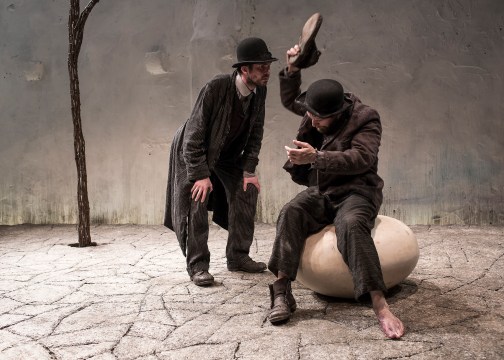
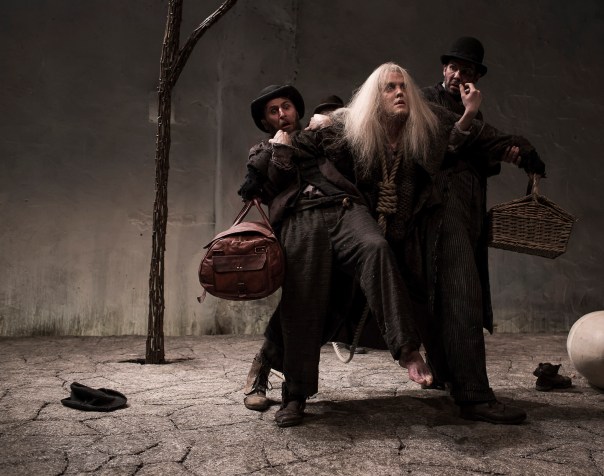
Led by Samuel Beckett’s Waiting for Godot, the 2017 theatre lineup is similarly trim, challenging, and audacious. Under the direction of Garry Hynes, this Druid Theatre production made it clearer to me that Vladimir and Estagon, awaiting the mysterious Godot and his nebulous benefits, are unsure of where they are, what day it is, and when they last met. Hynes, who won the 1998 Tony Award for directing The Beauty Queen of Leenane, also makes the friendship and mutual loyalty between our protagonists more open to question than previous productions I’ve seen. Instead of shying away from the script’s absurdism, Hynes embraces it.

30962035363_a1fd65f0fc_kMaybe other directors feel that too much absurdism might risk audience confusion and vertigo. Turns out that amping up the absurdity made the show more comical for the audience at Dock Street Theatre. Strangely enough, Aaron Monoghan as the more ignorant Estragon, isn’t as funny as his cohort. While Monoghan is a purer, less salty fool as Estragon, willowy Marty Rae turns Vladimir into a comical joy, his inquiries into his friend’s mind and his reactions to those revelation drawing equal mirth.

Although Hynes acquiesced, in a public interview at the Charleston Library Society with Martha Teichner, to the notion that Pozzo and Lucky are mere distractions in the tedium of our protagonists’ lives, her staging says otherwise. Compounding the vaudevillian exaggeration that Beckett lavishes upon Pozzo the oppressor and Lucky the oppressed, Rory Nolan as Pozzo and Garrett Lombard as Lucky upsize them, exaggerations in the flesh – and in Lombard’s case, in the hair – augmented by Doreen McKenna’s shabby and surreal costumes.

Juxtaposed with our lonely and futile heroes, Druid’s Pozzo and Lucky both seem gargantuan and powerful, though Lucky’s is a sleeping strength that Vladimir and Estragon fear to waken. At some level, they look like invaders from a real world that our lovable protagonists have skirted. Downtrodden as he is, Lucky seems to be lucky to be employed, even if humiliating subservience is the price.

So what if his boss is an overbearing boor? So is the President who won our Electoral College.31397965210_5e7f347a4a_kWhile Godot plays at Dock Street from the beginning to the end of Spoleto, there are four other presentations categorized as theatre by the festival that peep in for more limited engagements, five or six performances apiece at smaller venues. The most charming so far has been Ramona, Gabriadze Theatre’s first production at Spoleto – and at Emmett Robinson Theatre – since their doleful and stultifying Battle of Stalingrad in 2003. This time, Rezo Gabriadze’s fanciful script for marionettes and puppeteers is about a shuttling engine whose travel vistas are no more than 300 meters and the mighty love of her life, Ermon, a Trans-Siberia locomotive who spans Mother Russia in his wanderings.
As this true Penelope waits patiently for her Ulysses, a militaristic railroad official tyrannizes over her and a friend. Like any other sensible woman in these circumstances, Ramona and her pal decide to run away to the circus! Scandalous rumors reach Ermon up on tundra, but he remains steadfast in his trust. The ending is very tragic because Ramona is less adept as a tightrope walker than she was as a train. Absurd comedy doesn’t prevent the poignancy of these star-crossed lovers from shining through.

Though both had considerable strengths, Victoria Thierrée Chaplin’s Murmurs and Henry Naylor’s Angel didn’t satisfy as fully. I gradually caught up with what was happening in Avital Lvova’s portrayal of Rahana, the Angel of Kobani, but I needed my wife’s help in grasping the full details after Angel was over. Based on a true story, our narrator becomes a latter-day Joan of Arc champion of the Kurds, amassing 100 kills as a sharpshooter battling ISIS for control of her hometown.

Lvova is well-cast as an action hero, but in the rat-tat-tat battle scenes where she throws herself around on the floor, I found her to be largely unintelligible. Another woman in our row at Woolfe Theatre moved closer to the stage soon after the topsy-turvy opening, and a few minutes later, I slunk into an empty seat that was even closer to the action. I was still missing some of what Lvova was saying at close distance. Part of the excitement was how Angel broke a fundamental rule of one-person shows at the very end. I wished that I could press a rewind button to more fully enjoy it from the beginning.30928658544_4f681df730_k

A visual stunner, Murmurs had virtually no dialogue and not too much more coherence or character development. The subtitle, Aurélia and Her Ghosts, seems to have been dropped between the time that the festival brochure was printed and when the official program book – 152 pages – was codified. But it remains a useful description of the action. Aurélia Thierrée portrayed the heroine who, when we first met her, was on the verge being evicted – or rescued – from her crumbling tenement.

The crisis throws Aurélia into a strange state, for she experiences flashbacks, hallucinations, and things that go bump in the night. Instead of dialogue, Chaplin and Armando Santin provided choreography, but not enough of it to keep me consistently engaged, and Chaplin’s costume designs – with a team of three other designers – outstayed their novelty. More choreography and an infusion of music, maniacal or otherwise, would make this striking piece more impactful.

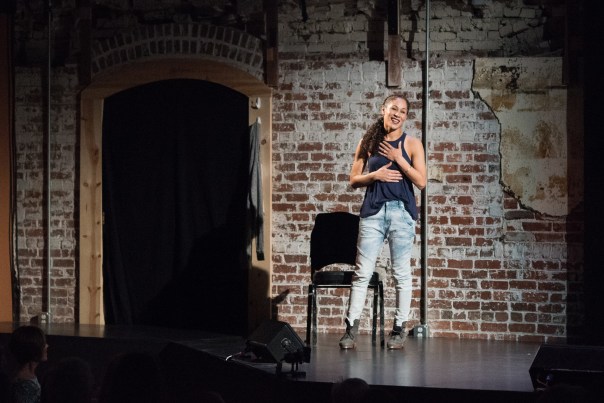
While Murmurs may be yearning to be a full-fledged dance, Ayodele Casel’s While I Have the Floor, categorized by Spoleto as dance, has an unmistakable hankering to be regarded as theatre. Like Murmurs, Casel’s world premiere morphed after the season brochures were sent out: her “virtuosic piece exploring language, communication, identity and legacy” coalesced into a tap dancer’s autobiography as the piece crystalized into a one-woman show with a title.34335386953_50bae8da23_kCasel not only explores her own artistic evolution, she connects us with heritage of tapping, tracing its development from the mid-19th century through such mainstays as Bill “Bojangles” Robinson, the Nicholas Brothers, Jimmy Slyde, Gregory Hines, and Savion Glover. She doesn’t hide her childhood infatuation with Fred & Ginger and engagingly recounts her first confrontation – as a collegian – with a true proponent of the art.
As YouTube can presumably verify, Casel’s demos of tapping are intricately rhythmic and visually dazzling. But the big surprise here is Casel’s acting chops. She can turn on the tears at a moment’s notice, and as a writer, she finds a compelling reason to display that talent. Toward the end, which threatens the dump us off at today and Casel’s well-earned fame, our narrator sprouts a mission and a cause: to revive the memory of female tappers before her and to make sure their names aren’t forgotten again.

Until you’ve witnessed While I Have the Floor, you probably haven’t seen a tap-dance show that reaches an emotional peak. Now it’s here, and Spoleto can be very proud of hosting its world premiere.


Physical Comedy Reigns Supreme in “The Actress”

Review: The Actress

By Perry Tannenbaum

You can certainly find subtler, more poetic titles than The Actress, a bittersweet comedy by Peter Quilter – with judicious snatches of Chekhov – now at Spirit Square. We follow storied actress Lydia Martin into her dressing room as she gives her farewell performance in The Cherry Orchard, electing to retire from the stage while makeup can still mask her flaws and she can still remember her lines.

With two dips into Lydia’s onstage performance and an intermission sandwiched in between, all framed by her arrival at the theater and an impromptu post-performance celebration in her dressing room, we have a neatly symmetrical five-part structure. Quilter adds a nice little wrinkle at the end as Lydia and her ex-husband adjourn to the darkened stage for a final communion. In Ryan Maloney’s set design, about a third of the Duke Energy Theatre is set aside for the Chekhov action, but I could easily imagine how beautifully this last scene would flow on a revolving set. Maloney’s lighting design recovers some of that magic.

Until that point, I found a curious lack of theatre magic and specificity. Although the Three Bone Theatre playbill specifies 1933 as the time of the action, the script doesn’t seem to help director Charles LaBorde to establish a time or a place for Lydia’s farewell. Oddly, the backstage action isn’t theatrical enough to convince me that this is a particularly momentous show. There are no acting colleagues or mentors slipping in to send her off, no reporters or photographers, not even Cherry Orchard castmates before or after the performance.

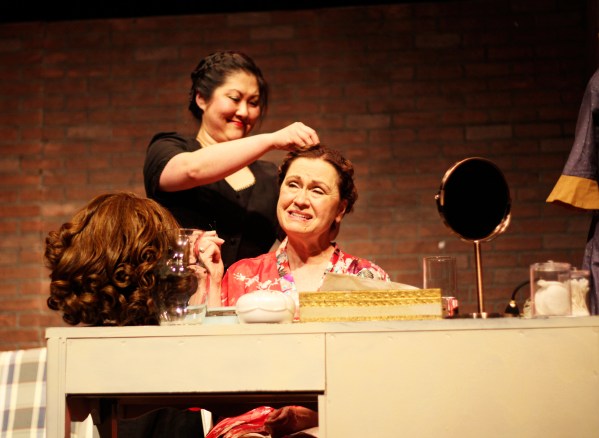
The only other person involved in the production is the director’s sedulous emissary, Margaret, who relays the unseen director’s notes to Lydia – a patently needless exercise, since it’s doubly impossible that the star will ever make use of them. Yes, there are congratulatory flowers all over the place, some from colleagues and others from admirers, but her dresser, Katherine, still finds it necessary to mist the room with perfume before Lydia enters. Amy Wada digs into Katherine’s uncertainty about whether she means anything to Lydia after a long, long business relationship, but Corlis Hayes seems to accept Margaret as a royal waste of time, mostly motivated by the prospect of leaving with a collectible memento.

Everyone else is a visitor, except perhaps for Harriet, Lydia’s agent. With Lydia retiring, Harriet doesn’t have any business with her client but she does have something to say. When Harriet is persistently shushed and ignored at the little afterparty – while drinking more and more of Lydia’s best brandy, not the swill that she presented as a token gift – whatever she had intended to say is horribly twisted, one of the most dramatic spots in this production. Zendyn Duellman, consistently irritating with her high sycophantic energy as Harriet, becomes even more memorable here.

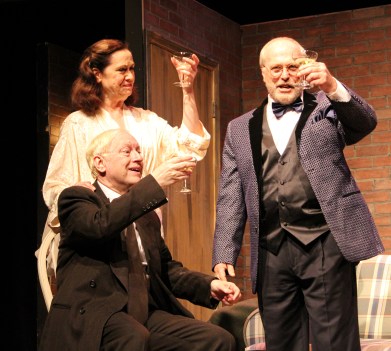
The rest of the backstage story is largely comedy. Lugging an industrial-strength decrepitude up the stairs to Lydia’s door, Hank West is able to unleash a mighty volley of coughs and wheezes when he gets there as Lydia’s rich fiancé, Charles. Whisking Lydia off to his native Switzerland seems laughably ambitious for someone so old and easily winded, but amid his bodacious wheezing, West endows Charles with a forbearance and determination that ultimately make him a bit endearing.

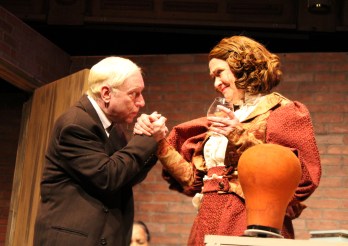
Ex-husband Paul has considerably more energy behind his persistence, and neither verbal rebuffs nor physical slaps from Lydia discourage his overtures. Bob Paolino definitely tunes into the love-hate relationship between these former intimates, and despite his conspicuous lack of appreciation for the theatre and Lydia’s artistry, brings us a redeeming softness and fatherliness when her career officially ends.

I wasn’t convinced that Paula Baldwin could wholeheartedly throw herself into Lydia’s ambivalent reaction to Paul’s forcible advances. When he called for a 1933 setting, LaBorde may have had those Hollywood films in mind where a leading man might respond, “you can hit harder than that,” to a slap in the face and manfully take it as a woman’s encouragement. That’s definitely the drift here as both Lydia and Paul get mussed up in a physical comedy interlude while the actress keeps her audience waiting.

Trouble is, when Lydia’s daughter Nicole walks through the door, Lydia has an aversion to her smoking – and a guilt about sneaking a cig for herself – that are 60 years ahead of their time. So the demands on Baldwin go beyond ambivalence. She’s actually best in Act 2, when her past faults as a wife, mother, and person come into clearer focus and a warmer, more down-to-earth side of her surfaces. She also manages to convince us that it’s not all about money with Charles.

Nicole isn’t severely messed up or resentful in Robin Tynes’ perky portrayal. We get the idea from Tynes that Nicole is a gentle reminder of Lydia’s past lapses as a wife and parent – also a counterweight against those plans to flit off to Switzerland. But once he puts her before us, Quilter doesn’t invest nearly enough into Nicole. I didn’t detect the English accent that might make her objections to Mom’s proposed move to Switzerland seem petulant and selfish. Sounding totally American, Tynes gave me the impression that Mom’s displacement would be transoceanic. Sure, she seems unsettled, but not enough to be profoundly unhappy.

More substance to Nicole would add more definition to her ambivalence – and Quilter’s serpentine script does wind up being very much about ambivalence. Ultimately, Lydia finds herself choosing between career and domestic comforts, between love and sex, and between familiar family and a new kind of life. So Quilter’s title is subtler than he probably intended. Notwithstanding its setting and the sterling Three Bone Theatre performances that make it come alive, The Actress is hardly about theatre at all.

CP Gets Its Act Together for Summer 2017

Preview: CPCC Summer Theatre 2017

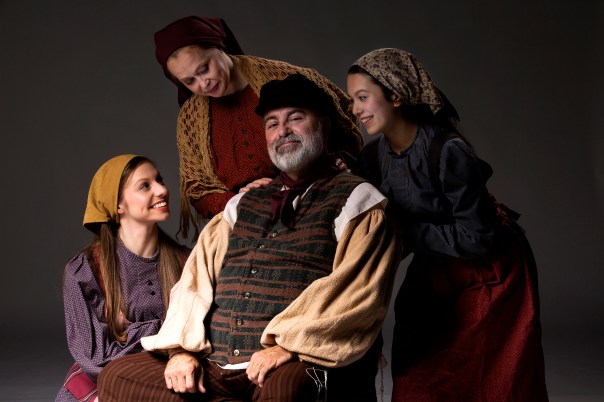
Fiddler on the Roof Promos

By Perry Tannenbaum

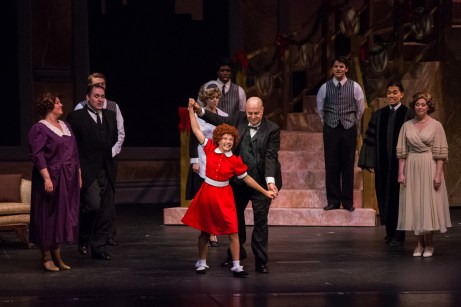
Entering its 44th season, Central Piedmont Community College Summer Theatre would be hard-pressed to surpass the lineup of shows they presented last year – Annie, Chicago, Sleuth, and Sister Act. But there are good reasons for the folks on Elizabeth Avenue to be super-confident that 2017 will be even more successful at the box office.

Yes, the family-friendly mix of popular Broadway musicals, adult comedy, and an AM kiddie show will provide the perfect refuge from a slapstick presidency that hasn’t managed to derail our strong economy (yet). And yes, after 10 years of random screeches, thumps, and bumps in the night, technicians were able to exorcise the demons that had previously haunted the Halton Theater sound system. Throughout the 2016 season, CP had its act completely together and gremlin-free.

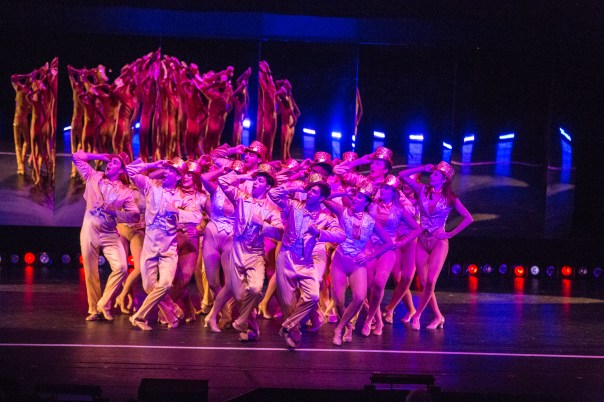
Three beloved Broadway hits are coming to the Halton to keep the good thing going, beginning with Fiddler on the Roof (June 2-10) and followed by A Chorus Line (June 16-24) before CPCC Summer Theatre makes its exit with the pop ABBA jukeboxer, Mamma Mia! (July 14-22). In between the last two Broadway extravaganzas, the summer’s kiddie musical, James and the Giant Peach (June 28-July 8) takes over the Halton by day while the nighttime action scoots across Elizabeth Avenue to Pease Auditorium with A Comedy of Tenors (June 30-July 9).

Oh yeah, one more reliable predictor of success: “We have had record season ticket sales so far,” says Tom Hollis, the CP Theatre Department chair who runs the show and will direct Fiddler and Mamma Mia!

The process of selecting CP’s summer lineup, says Hollis, is ongoing throughout the year with suggestions from audience, from members of the creative team, and consultation with other theater companies. CP wants the lowdown on what others are programming and how well tickets are selling. Radar is also aimed at what Broadway producers are making freshly available from their inventory.

“There used to be a rule of thumb that said you should wait four or five years before you do a show that had toured through,” Hollis recalls. “But that no longer seems to hold true. Our experience with Les Miz and Phantom showed that proximity to the tours actually increased sales.”

It might be assumed that tours of these perennials and Mamma Mia! – which has touched down in Charlotte no less than six times since 2002 – would spark interest in enthusiasts to see them again. Yet Hollis cites trade publication data indicating that audiences across the country who attend Broadway Lights series like those offered here by Blumenthal Performing Arts don’t ordinarily attend local theatre.

“Maybe they have spent all their money on those tickets and can’t afford to attend more,” Hollis speculates. “What we are seeing is that the combination of our more competitive pricing in comparison with the touring houses and the quality of our product makes it possible for people who love theatre but can’t afford the tour prices to see the show in our theater and bring the entire family when they do it.”

Fiddler on the Roof Promos

On the other hand, CP allows absence to make their subscribers’ hearts grow fonder of shows they’ve previously presented. Both Fiddler and Chorus Line have been done before on campus but never at the Halton, which became the home for CP’s big musicals in the fall of 2005. Budgetary considerations also go into the lineup formula, so comparatively barebones productions like Chorus Line and Chicago help to rein in the bottom line.

Additional economies are available through casting, when an actor can take on multiple roles, navigating a labyrinth of rehearsals and performances to appear in as many as four of the five shows that CP Summer mounts in an eight-week span. It takes eagerness, enthusiasm, and plenty of stamina to go through such a demanding grind, which is why the Summer acting company always skews so young.

In seasons when CP is planning shows like Annie or Oliver, they’ll hold separate auditions in February for kids on top of the cattle calls for local actors and aspiring high school interns. Then in early March, directors will trek to the Southeastern Theatre Conference for regional auditions, where collegians and recent grads come in search of summer work. CP signed up six budding pros at this year’s auditions in Lexington, KY. Look for some of this new blood in A Chorus Line, where young triple threats belong.

Perhaps the optics of overly youthful casts have grown stale for Hollis and his colleagues as the years roll by, or maybe budgetary purse strings are loosening, but we’re recognizing more veteran locals who are returning annually to the Halton and to Pease for CP’s summer rites.

Jerry Colbert, whose CP credits date back to 1974 and took the Laurence Olivier role in last summer’s Sleuth, returns as one of the over-the-hill candidates who might be the father of the bride-to-be in Mamma Mia! Alongside Colbert, Dan Brunson and Kathryn Stamas will be familiar to more recent subscribers. James K. Flynn, fatherly enough to play Tevye when CP last presented Fiddler, moves into A Comedy of Tenors along with two other familiars, Craig Estep and Caroline Renfro.

For the second successive summer, Susan Cherin Gundersheim is teamed with Beau Stroupe. Last year, she was Daddy Warbucks factotum Grace Farrell in Annie. Now in Fiddler, she gets to variously torment Tevye – or emote to his fake dream – as Golde, the mother of his five daughters.

CPCC_SummerTheatre_0008

Stroupe has walked a rocky road to Anatevka and the iconic role of the Scripture-fracturing dairyman. Photos of Stroupe as Daddy Warbucks show him with scarcely less hair than he had when he was finishing chemotherapy in late 2013 – more than a year after a grapefruit-sized malignancy was found in his intestine. A rather hostile divorce compounded his woes, so his role as the predatory Chauvelin in The Scarlet Pimpernel during the next summer seemed to chime with his embattled temperament.

The road from chemo to Anatevka led through Cherry Tree Lane, where Stroupe was George Banks, the starchy and clueless father who was transformed – along with his unruly children – in Mary Poppins through the magical nanny. A role he neither knew nor cared about until he began rehearsing, Banks awakened in Stroupe a new affection for father roles.

Warbucks pointed him in the same direction. “Again, the journey of a seemingly rigid and even detached businessman to one of tender-hearted father figure,” says Stroupe.

“I certainly relate to the journey of a father with my own four children through the difficulty of divorce and the slow healing process. It’s easy to understand the juggling act of breadwinner, patriarch, husband, father and visible member of the community. When Tevye is saying goodbye to Hodel at the train station, it takes very little effort for me to feel what any true father feels when letting his child go to live a life of their own choosing.”

New directions will be running amok when CP opens A Comedy of Tenors, Ken Ludwig’s sequel to Lend Me a Tenor, a CP Summer hit way back in 1996. No matter what its pedigree is, Ludwig’s operatic farce – think three tenors misbehaving in Paris – is the newest show CP has ever done, from farm to fork after its New Jersey world premiere in less than two years. Unheard of, as Tevye would say.

And Renfro, CP’s go-to action heroine in Dial M for Murder and Wait Until Dark, tackles a comedy – with a Russian accent! As sexy diva Tatiana Racon, Renfro will have her sights set on a very married tenor, but her seduction will farcically misfire.

“There will definitely be some good old-fashioned vamping,” Renfro promises. “I am so psyched about doing the accent. And so freaked out about it. At this point in my career, the thing that appeals to me most about a role is doing something I’ve never done before, especially if it scares me.”

Bravura Aplenty in Theatre Charlotte’s “Memphis”

Review:  Memphis

By Perry Tannenbaum

As you may have found out, ignorant buffoons can make it big in America. So why not ignorant eccentrics? If Huey Calhoun didn’t make it big as a ‘50s deejay in Memphis, the musical by Joe DiPietro and David Bryan, then his fall from celebrity wouldn’t be nearly as reckless or spectacular. When he has lost his local TV show, tossed away his shot at national fame, and blown his romantic chances with the R&B queen he has catapulted to stardom, Huey defiantly delivers the anthem he has earned, “Memphis Lives in Me.”

“One more drink and you’ll see God everywhere,” sings Huey in tribute to his chief consolation: a bluesy Beale Street honky-tonk bar. It’s the culmination of a Broadway- caliber performance that Joe McCourt is currently giving at Theatre Charlotte in the lead role that DiPietro patterned after legendary rock pioneer Dewey Phillips.

Contrary to the preproduction signals that McCourt and director Corey Mitchell were sending, McCourt hasn’t muted Huey’s nasal drawl or portrayed him as much less of a rube than Chad Kimball did on Broadway. That’s a good thing. “Sounds just like him!” my wife Sue concurred at intermission.

Whether it’s the pork-pie hat and costume by designer Rachel Engstrom, or Huey’s sidling walk – seemingly unable to unbend his knees, straighten his back, or take two consecutive steps in the same direction – McCourt also looks a lot like Kimball’s Tony-nominated portrait. Perhaps rehearsals with Dani Burke as hot young singer Felicia Farrell revealed that, if McCourt were to tone down Huey’s goofball attributes, he would come off as more of a creepy stalker.

Ultimately, McCourt has arrived at a very likable blend of naïveté, chutzpah, neediness, awkwardness, and hipness – not the easiest elements to combine – and as usual, he torches every song he touches. For her part, Burke hasn’t lost any of the voltage she first brought to the Queens Road barn when she electrified audiences with “Aquarius” in the 2014 production of Hair.


Felicia isn’t nearly the plum role Huey is, but Burke proves to be fairly formidable in her first full-fledged lead. A few of Engstrom’s creations glam her up, and I liked Burke’s regality at the “WRNB” studio, where Huey has the nerve to ask Felicia to perform live. We’ve only seen Felicia in a seedy honky-tonk before, and the top radio station in Memphis also looks pretty shabby, but Burke demands, “Where are my backup singers?” as if she’s already a star.

What’s happening here in Memphis doubly crosses racial lines as Huey brings black music to the middle of the AM radio dial and presumes to romance Felicia while promoting her talent. Both of these audacities bring powerful characters into the flow of the action. Station owner Mr. Simmons is easily the most comical of these, and Mike Carroll beautifully brings out the businessman’s starchy pomposity – and astonishment – each time a new Huey atrocity increases his listening audience, his sponsor’s satisfaction, and finally his own teenage son’s admiration.

I hardly even remembered the role of Huey’s mom from the original Broadway production, so I was fairly blown away by the heart – and the pipes – that Allison Snow Rhinehart brings to Mama. Of course, she’s as déclassé as Huey, so his outsized dreams and successes are a total shock to her, not to mention coming home one day to find his black girlfriend in her kitchen. But Mama’s prejudices occupy the same space as her love and loyalty, so Rhinehart has a couple of gratifying surprises in store for us after intermission.

Least surprising, after his triumph as Coalhouse Walker in last winter’s CPCC production of Ragtime, is Tyler Smith’s powerful portrayal of Delray, Felicia’s fiercely protective brother and owner of the dive where Huey discovers her. It doesn’t take long to catch on to Smith’s power, since he’s toe-to-toe with Burke in the opening “Underground” ensemble, and he’ll prove equally capable of facing off with McCourt on “She’s My Sister” when Delray flares up about Felicia’s interracial affair. In fact, when the catastrophe strikes that ends Act 1, I suspect that Mitchell may have imposed some unnecessary restraint on Delray’s ferocity.

But there was more than enough power from all the frontliners to justify the “Why didn’t you tell me about this place?” comments I was overhearing during the break. Apparently these newbies were undeterred by the lackluster scenic design by Chris Timmons or the generic choreography by Ashlyn Summer, which never reminded me of what my teen elders were dancing on Dick Clark’s American Bandstand or Alan Freed’s The Big Beat. Victoria Fisher’s lighting design goes a long way to redeeming the drab sets, and music director Zachary Tarlton makes sure there is always a lively jump to Bryan’s score when needed.

Maybe the best reason to be wowed by Theatre Charlotte’s Memphis is how deep the excellence goes in this cast. After AJ White literally glows in a lemon yellow outfit as Wailin’ Joe on the first R&B track that Huey spins, there are two marvelous rebirths among the black folk that Huey’s musical mission reaches. First there’s Traven Harrington as Bobby, the radio station janitor, who will pile one shocker upon another before he’s done. Then there’s Clayton Stephenson, whose transformation as Gator may leave you weeping as Act 1 climaxes.

It ain’t perfect, but Mitchell has directed one of the best efforts I’ve ever seen on Queens Road in 30+ years of covering Theatre Charlotte. Chances are better than even that Memphis will live in you if you’re in the house when this company comes out for their final bows.

Warren-Green’s Reading of Mahler’s “Resurrection” Stamps It as an Instant Favorite

Review:  Mahler’s “Resurrection” Symphony No. 2

By Perry Tannenbaum

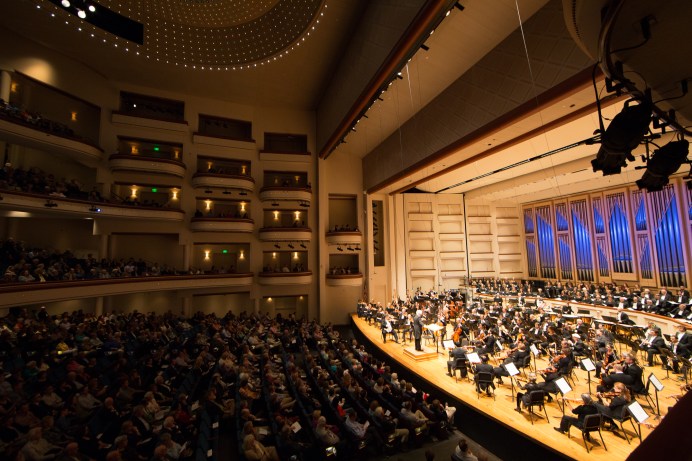
We’ve had quite a week in and around Charlotte for jubilant choral symphonies, first with A Sea Symphony up in Davidson and now with Mahler’s stirring “Resurrection” capping Charlotte Symphony’s 85th season. Turnout at Belk Theater for the grand work was robust, especially when the many latecomers were seated after the opening Allegro maestoso. Of course, the stage was heavily populated as well, the presence of the Charlotte Symphony Chorus pushing the musicians downstage and a sizeable contingent of freelance musicians further cramping their space – extra percussion, extra woodwinds, extra brass, second harp, second timpani, and lurking somewhere offstage, four more French horns. Mezzo-soprano Maya Lahyani made her entrance halfway into the third movement for the fourth movement “Urlicht (Primal Light)” alto solo, and soprano Kathleen Kim entered during the final Scherzo to join in singing Mahler’s setting of Friedrich Klopstock’s “Auferstehungslied (Resurrection Song).”

Beyond the executive decisions to beef up the orchestra and enable the horn players to follow his baton (presumably with a video installation), music director Christopher Warren-Green was artistically faultless in managing the pacing, the dynamics, and the overarching structure of Mahler’s music. There was plenty of muscle from the double basses in the opening bars, burrowing their way toward the dazzling entrance of the brass, who were as powerful and incisive as I’ve ever heard them. The winds worked well with the brass once the basses faded, and there was lovely work from the oboes, the upper strings, and – with the only imperfections of the night – the onstage horns. Percussion during the climactic explosion was thrilling, yet the strings retained a soft, kinetic excitement in the sudden hush afterwards.

Maybe the only questionable call Warren-Green made all evening was heeding Mahler’s call for a five-minute pause between the first two movements. The break was a welcome spot after more than 20 minutes of music to finally seat those patient latecomers (watching a performance on the big screens in the lobbies is far from ideal). But the audience treated the interval like an intermission, applauding what they had already heard and, in some instances, rushing for the exits for assorted urgencies. Mahler and Warren-Green undoubtedly thought the pause was a time for reflection, a grace period to accommodate the changing mood of the second Andante moderato movement, rather than an applause cue. If Warren-Green is rethinking the pause idea after its first trial, he certainly didn’t need to question whether his orchestra communicated the contrast that followed. The opening episode was suave and urbane, radically different from the thunderous and heart-rending Allegro that had preceded, until we reached a percolating section that could remind listeners of the vivace second movement of Beethoven’s “Choral” Symphony No. 9 – not andante at all. Principal flutist Victor Wang sounded ebullient over pizzicato strings, and principal harpist Andrea Mumm provided a nice sheen over another delicate ending.

The whirling motion of the third movement could lull listeners into thinking that Mahler was revisiting the waltzing “Un Bal” movement of Berlioz’ Symphonie fantastique, but there are sudden outbreaks of brass that give this “In calm, flowing motion” movement more jagged edges. Charlotte Symphony’s brasses were undeniably forceful but never overdone, and the brassy blends in the tranquil section of this movement were outstanding. Distant horns camping out backstage until their moment were as fine as the visible players, coming into view after the last big explosion of the movement – and a pair of beautifully articulated solo spots from principal trombonist John Bartlett and principal trumpeter Richard Harris.

I could assemble a fairly lengthy list of so-so mezzos who have sung with the Charlotte Symphony over the past 25 years, but I wouldn’t include the Israeli-born Lahyani on that list. From her first sweet exclamations, “O red rose!” and “Man lies in greatest need,” there was no doubting the purity and control of this voice, perfectly pointed in a hopeful, yearning direction. Beautiful fills by principal oboist Hollis Ulaky, concertmaster Calin Lupanu, and – in the faceoff between the singer and a heavenly angel – principal flutist Wang added to the delight.

Before we reach the dazzling resurrection light of the final Scherzo, there is a tumultuous instrumental drama that is longer than the previous two movements combined. A long crescendo of portentous percussion flowed naturally into the first volley of brass. Amid the general turmoil that followed, the French horn quartet departed once more with a percussionist. Sadly, these offstage voices would be more audible than a tubular bell that was misstruck by an errant mallet about three feet above all the other instruments. But the other onstage percussion during the hushed middle of the movement, a soft bass drum tattoo under the hidden horns, was absolutely spellbinding, and the piccolo filigree from Erinn Frechette was beguiling.

Entrances by the Symphony Chorus and soprano Kim were nothing short of magical, swelling up out of thin air with their wakening affirmation: “Rise again, yes, you will rise again, My dust after a short rest!” For the last sublime six minutes or so, the voices and instruments grew in strength, conviction, and triumph until all were jubilant together, cresting with a burst of brass, cymbals, a gong, and – no misfiring this time – repeated poundings of the tubular bell. It isn’t easy to shoulder aside the various Beethoven masterworks that comprise the core of Charlotte subscribers’ favorite symphonies, but with this milestone performance from Warren-Green and his musicians, Mahler’s “Resurrection” has clearly broken through to claim its place alongside the Beethoven hegemony. The spontaneity and fervor of the standing, cheering ovation that showered down on the singers, the musicians, and the directors – including Chorus director Kenney Potter – stamped this concert as one that will be talked about and remembered for a long time.

Davidson Armada Captures the Grandeur and the American Voice of Vaughn Williams’ Sea Symphony

Review: A Sea Symphony

By Perry Tannenbaum

Unlike the beauteous and quiescent beginning of Ralph Vaughn Williams’ “The Lark Ascending” that we hear more often in live performance, A Sea Symphony is rousing, massive, commanding, and majestic soon after its opening measures, with the pomp and arrogance of empire pulsing through its exclamatory choral armada. The audience at the Duke Family Performance Hall may have been startled by the onslaught of this opening movement, but with three Davidson College choruses, two vocal soloists, and the Davidson College Pro Arte Orchestra arrayed before them, they couldn’t have been completely surprised. A glance at the first line, “Behold, the sea itself,” of the Walt Whitman text tipped us off to the imperative tone that was coming, and the three teeming pages of text that followed in the program booklet were a clear indication that it would not be long delayed.

The juxtaposition of America’s signature poet with this British composer’s first symphony becomes more natural when you realize that the lives of Whitman (1819-92) and Vaughan Williams (1872-1958) overlapped a full 20 years and that the composer began the piece just eleven years after the Good Gray Poet’s death. Two of the five poems that form the text were actually published during the composer’s lifetime and two others were first unveiled just a year before he was born. The exuberance of a composer reaching his prime blends powerfully with the confidence of a poet who had already become his nation’s voice. Similarly, the commercial aspects of Whitman’s “Song of the Exposition,” written and read at the invitation of the American Institute at the opening of 40th Annual Exhibition in New York (1871), blend perfectly with the sea-spectacle of ocean vessels that Vaughan Williams paints with his chorale.

While this concert was staged at the Knobloch Campus Center at Davidson College, it quickly became apparent that I might construe the “Pro” component of Davidson Pro Arte in a couple of ways. Most of the musicians, 68 percent of the 40-piece ensemble, were indeed professionals, recognizable as members of the Charlotte Symphony, including four of its principals. Nor did I need to worry about the maturity of the solo vocalists. Bass-baritone Dan Boye and soprano Jacquelyn Culpepper have sung with the Charlotte and North Carolina Symphonies as well as appearing in numerous Opera Carolina productions. With all that local professionalism on hand, it might be useful to step back and appreciate how special this event was. Vaughan Williams’ Sea Symphony isn’t merely outside the core repertoire that most American orchestras perform; the only American recording I can find of this grand work came from the Atlanta Symphony on the Telarc label in 2006.

No, American singers do not often take on this quintessentially American text, and everybody on hand seemed buoyed by the occasion, including Pro Arte director Christopher Gilliam. And why not? The brass section, the three choruses, and timpanist Justin Bunting were all called into action before the strings. Once this éclat is exuberantly played out, the piece becomes more interesting as the text shifts from its brief “Exposition” excerpt to a judiciously trimmed version of “Song for All Seas, All Ships.” In a piece headed toward the mystic universality of Whitman’s visionary “Passage to India,” these invocations of all nations’ flags, all captains, all sailors on all seas serve as a bustling, worldly foreshadowing. To give us this bustling sensation, Vaughan Williams stirred in all his forces.

Boye took up most of the opening stanza alone, beginning with “Today a rude recitative,” but after the baritone invoked the sea’s “dashing spray,” the choruses – with another thump of timpani – whooshed in with the sudden onset of “the winds piping and blowing.” We stayed on a fairly even keel when the focus shifted from the elements to the captains and sailors. It was only when Culpepper launched the final stanza, “Flaunt out O sea your separate flags,” with a flourish of the brass behind her, that the full grandeur and variety of the opening Moderato maestoso movement was reached, fueled by the soprano’s most forceful and memorable work. Like Boye, she interacted with the chorus, but before fading into sublimity, Culpepper gave way to mighty entrances from Boye and the chorus in the penultimate line, “A pennant universal,” as her entrance – and her high notes – sealed the kinship between this first movement of Vaughan Williams’ symphonic output and Beethoven’s last.

To contrast with this sunny, majestic opening, Vaughan Williams chose “On the Beach at Night, Alone” for his Largo sostenuto. Boye was sterner than necessary, sterner than the gentle women’s voices behind him, in the meditative opening lines before the music and the text rose up to the cosmic “All souls, all living bodies.” Like the opening “Song for all Seas,” the second movement circled back to its opening line, but here the cellos and Erica Cice’s oboe increased the darkling solemnity. For his other middle movement, a Scherzo, the composer chose even more brilliantly, since “After the Sea-Ship” gave him a chance for a stylistic excursion into overtly programmatic music, most of it feasted upon by the choruses, though it was Bunting’s timpani that cued up the oceanic turbulence. The singing grew almost anthemic in the penultimate line that began with “A motley procession,” and the four-time repetition of the final word, “following,” sounded like a volley of amens in sacred music, except that the crashing of cymbals by Tara Villa Keith convinced me that it was a joyous plunge, over and over, into the waves.

A triumphal ending like this in a section Vaughan Williams titled “The Waves” might have seemed excessive if his outer movements hadn’t ended in sublimity. The beginning of the final “Explorers” movement, with text culled from three of the nine sections of “Passage to India,” offered a different kind of contrast. Orchestra and chorus grew so soft, delicate, and slow that we seemed to be floating in a mist, perfectly complementing the first line of Whitman’s section 5, “O vast Rondure, swimming in space.” The chorus built to an affirmation nearly as mighty as the waves’ when we reached the description of a poet, “The true son of God,” who shall come after scientists and engineers have done their work. But this concluding movement was not yet half done. Vaughan Williams re-launched his finale from total silence, setting the last two sections of Whitman’s “Passage” and bringing the solo voices back into his grand scheme.

After the largely devotional section 8, we set sail jubilantly as Culpepper, Boye, and the chorus took turns proclaiming “Away O soul!” Timpani and cymbals piled on shortly afterwards in the “Sail forth” stanza of section 9, punctuating a piercing high note from Culpepper. Softer at the end and fading away, Culpepper and Boye were at their sweetest, truly sailing away into the horizon – and because it was to India, eastward into a gleaming sunrise. Only the strings remained with the basses in the wake of the departed voices, reminding me of the primal quality that underpins creation in the opening bars of Wagner’s Ring cycle. It’s so soft and low that neither of the recordings I have – or a couple more I referenced on Spotify – comes close to replicating the special benediction the contrabasses bestowed on the ending. That’s another reason why this live Sea Symphony was so rare and treasurable.

Carolina Pro Musica: Serving Early Music, Family Style

Review:  Carolina Pro Musica

By Perry Tannenbaum

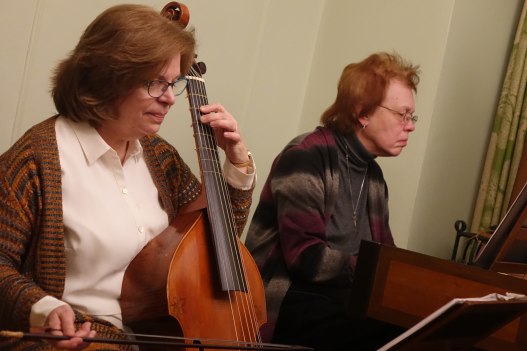
Come to a rehearsal of Carolina Pro Musica and you visit the cozy home of the group’s founder, Karen Hite Jacob, in Charlotte’s bosky Elizabeth neighborhood. Past the porch and the parlor, you enter the hub of the home, a dining room that opens up to the rest of the house, bedrooms and study to your left and kitchen straight ahead. The voice of soprano Rebecca Miller Saunders, polishing the last strains of “Solo per voi tra mille” from Handel’s Pastorella vagha bella, carries easily to the front porch, signaling to me that rehearsal has already begun.


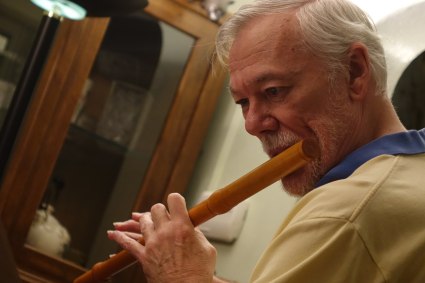
Sidling past Edward Ferrell, already poised behind his music stand to play his flauto traverso in a Bach aria, you find Jacob sitting behind her harpsichord at the opposite corner. Next to the leader sits Holly Wright Maurer, her viola da gamba nestled between her knees. You can’t say she’s in the rhythm corner with Jacob because, in this intimate space, she partially obstructs the way to the kitchen.

Carolina Pro Musica has been playing Early Music since 1977, when Jacob, after founding the Charlotte Chamber Music Workshop and its baroque ensemble, the Carolina Consort, broke away and – because lawyers confirmed that she couldn’t take the Consort name with her – drew up papers with a new name to seal the separation. Ferrell, a student at Central Piedmont Community College when Jacob taught there, joined the ensemble at the end of the 1978-79 season after earning his degree at the New England Conservatory.

Saunders and Maurer didn’t arrive until Carolina Pro Musica had undergone a few other permutations of personnel, always with the same basic instrumental-vocal makeup – with guest artists tossed into the mix. In fact, when Saunders first sang with the group in 1992, it was as a guest artist at a pair of Christmas concerts, shortly after her graduate studies at Indiana University’s Institute for Early Music. Wedding bells and a one-year sojourn in New York intervened before Saunders and her husband returned to Charlotte.

“I reunited with the group after running into Eddie at a local soccer game,” she recalls. “At that point, Holly entered the scene, and we became the foursome that you see today.”

Once again, Ferrell was a factor in Maurer’s joining. Shortly after arriving in 1994 with her husband and three sons, Maurer went to a Carolina Pro Musica concert and recognized a name. While Maurer was completing her graduate work in Early Music performance at the New England Conservatory, Ferrell had been an undergrad there. The timing was as serendipitous as their meeting, because Pro Musica was losing their viol player.

During a post-concert chat, Maurer arranged an audition with Jacob. The completed group has played contentedly together for over 22 years. When needed, Maurer adds an extra dimension to the instrumentation, for she can play a second flute or recorder behind Ferrell on pieces that call for it.

“Despite the fact that I started as a flute player,” she says, “I am most content playing viola da gamba. From the moment I first heard it, I was attracted to the mellow sound.” Teaming up with Jacob as the group’s “left hand” continuo may bring Maurer inner joy, but outwardly she’s a study in concentration and precision, tuning her gamba with an electronic device between pieces.

Crossed-up on the meeting arrangements, guest artist Carl DuPont arrives at rehearsal just in time for his vocal duet, the famed “Mein Freund Ist Mein” from Bach’s “Wachet Auf!” cantata. When the bass baritone sings as Jesus opposite Saunders’ Soul later in the week at the Sharon Presbyterian Chapel, he will need to hold back to keep from overpowering the hall. So he really needed to hold back in this quaint rehearsal space.

Slated to make his Opera Carolina debut in La Fanciulla del West next month, DuPont unquestionably has operatic power, but he’s hardly new to Early Music, having been invited to participate in the XXth International Bach Competition last year in Leipzig, Germany. Tasked with preparing two hours of compulsory repertoire for the competition, DuPont reached out to Carolina Pro Musica so he could feel more comfortable with the music.

One week before his flight to Leipzig, DuPont and Pro Musica previewed his competitive performances in a free concert at Belmont Abbey College, where Jacob’s bulging portfolio of instructional and performance duties includes directing the Arts at the Abbey concert series. It’s a collegial doorway that swings both ways, since DuPont has been an assistant professor of voice at UNC Charlotte since 2014.

Two or three run-throughs of the “Mein Freund” are performed to get tempo right for Saunders, allow DuPont to adjust his projection, and give Ferrell, playing the oboe part on flute, the chance to wrestle with Bach’s zigzags from major to minor. With the concert just days away, interchange between the artists is relaxed and quiet, not a sliver of anxiety or nerves in the air.

Without anything being said, the ensemble adjourns to the kitchen after a rehearsal that has ended less than 50 minutes past the time I was told it would start. [Pausing for a moment as I pick up my coat, I notice another keyboard that had eluded me while watching and photographing the rehearsal. Obligingly, Jacob opens two tall cabinet doors and, voilà, a tracker chamber pipe organ!

Customized to the specifications of Bach scholar Peter Williams, Neil Richerby built the organ for him in Scotland before he came to North Carolina and Duke University in 1985. When he returned to the UK, Williams prevailed upon Jacob to buy the organ rather than selling it to someone he didn’t know. What looks like an heirloom turns out to be younger than Carolina Pro Musica.]

In the kitchen, it turns out that the musicians aren’t munching or snacking as anticipated. Three stacks of newly printed paper need folding so that they can become the 12 pages of program booklet copy for Pro Musica’s upcoming concert, “Harmony of the Spheres or The Vault of Heaven.” Every sheet is in full color, handsomely designed with two-sided printing. Marketing is as professional here as the musicianship.

An outer cover of finer glossy paper completes the booklet, providing consistency for the ensemble’s 39th season. When each set of papers is properly folded and aligned, the cover is draped over the new program, becoming a booklet with a single staple punched into the middle of its spine.

So I leave the Jacobs home, [whose address isn’t visible from the nearby street where I’m parked,] thinking that Carolina Pro Musica is something of a cottage industry. The other outsider, DuPont, feels similarly as it turns out. What he finds unique is the family feel of the group’s synchronicity and rehearsal dynamic, reminding him of the gospel trio he, his mother, and his sister formed when he was younger.

DuPont may be on to something. In our follow-up interview, Ferrell informs me that his relationship with Jacob actually dates back to 1973, when she heard him play a Handel sonata for a music history class. Overhearing the performance, Jacob asked him to play at her upcoming wedding.

“So my first public performance on the recorder was in her wedding [that year].”

Notwithstanding their homespun warmth and industry, Carolina Pro Musica isn’t at all provincial – or tethered in their programming to Bach and Handel. In the “Harmony of the Spheres” concert dominated by Bach, Handel, and Telemann, there was room for a gamba sonata Johannes Schenck (1660-1712), a name absent from most music cyclopedias, while the upcoming “Paris au Printemps” in April roams through works by Clerambault, Morel, Jacquet de La Guerre, and LeClair.

When Ferrell was getting his master’s in musicology at UNC Chapel Hill, he ran across a listing of cantatas for flute, soprano, and continuo by Johann Hasse (1699-1783) in the music library. That was enough to set Jacob off on an epic quest for manuscripts in libraries across Europe – in Germany, the UK, and Sweden – so Carolina Pro Musica could publish performing editions of the works.

“The hang-up was a copy from the Benedictine monastery at Montecassino,” Jacob remembers. “No letter on my behalf from Belmont Abbey got acknowledged back around 2003 or 2004. I decided to try again in 2014 and got an email response to a letter translated to Italian for me by a monk here at the Abbey.”

Jacob was able to photograph the manuscript – “probably the autograph” – at the monastery, enabling Carolina Pro Musica to publish its own edition of Hasse’s “Pallido il volto.” A journey to the Montserrat Monastery in Spain, and jousts by various members of the group with Catalan texts and chant notation, led up to the Pro Musica’s edition of the Llibre Vermeil – years before the manuscript was available online.

Themes and songs for concerts have also come from places as far-flung as Arequipa, Charlotte’s sister city in Peru, and St. Petersburg, where Jacob visited Catherine the Great’s theater and the music museum at Sheremetev Palace, which boasts a diverse collection of instruments that includes keyboards once owned by famous Russian composers. Less frequently, the entire ensemble travels together. The flew to Wroclaw, Charlotte’s sister city in Poland, for a 1994 visit that included performances and teaching Early Music history.

Mostly fondly remembered among the group’s travels was the London trip in 2005, when Pro Musica performed at Hatchlands Park and at Handel’s House before it became a museum. “The house has historic instruments belonging to various composers, too,” says Jacob of the Hatchlands concert, “so we got a treat after the great lunch they fixed for us.”

[Closer to home, Pro Musica spent part of the summer on the road in 2005. First they gave a fringe concert – of both old and new music – during the Boston Early Music Festival, before participating in the Moravian Music Festival in Winston-Salem, performing works by Moravian composers with some Bach tossed in. Jacob still has memories of the old-style flat pedalboard she found on the Tannenburg organ in Old Salem.]

Looking ahead, musicians eager to explore a variety of Pro Musica possibilities. Widening their horizons with new guest artists is one likely direction. Larger productions – such as their “Bach Church Service” in 2000, celebrations of the ensemble’s 25th and 35th anniversaries, or the more recent collaboration with the UNC Charlotte Chorale – are another option. A lingering trove of manuscript photocopies, yet to be turned into performing editions and public performances, also beckons.

Ferrell is enthused about the near future as well: “I am really excited about our plans to do a performance next season of Bach’s complete cantata BWV 152, ‘Tritt auf die Glaubensbahn.’ It uses only two singers, a soprano and a bass, along with recorder, oboe, viola d’amore and viola da gamba.” He already has a candidate in mind for the viola d’amore part.

On the same night that Carolina Pro Musica performs their “Paris au Printemps” at St Martin’s Episcopal Church, DuPont will be returning to Sharon Presbyterian Chapel. There he will sing the role of Pontius Pilate for a staged production of Bach’s St. John Passion, presented by the Firebird Arts Alliance under the direction of David Tang.

It’s significant that Tang is the founding father of the Firebird, for he is also music director at Sharon Presbyterian. With firm roots at Belmont Abbey, UNC Charlotte, Central Piedmont Community College, and Sharon Presbyterian, there are good reasons for the Carolina Pro Musica family to be optimistic about the continued vitality of Early Music in and around Charlotte.

Enjoying Is Easier Than Understanding “The Pride”

IMG_4165[1]

Review:  The Pride

By Perry Tannenbaum

Back in the late 1950s, Philip has decided that his deep feelings for Oliver are a repugnant disease rather than a natural attraction. But in Alexi Kaye Campbell’s The Pride, there is another Philip, 50 years later in 2008, who is also crazy about Oliver. Since there are no longer any prohibitions or taboos against homosexuality, Philip now wishes to have a strong and exclusive relationship with Oliver, who still loves him.

Yet as we quickly see in the Queen City Theatre Company production, now at Spirit Square through Saturday, there is still a catch. Exclusivity is under siege. When we first encounter the modern-day Oliver, Philip will walk in on him moments after a casual hookup has gone sour with a sex worker who has dressed up in a Nazi uniform for their sadistic tryst. Finding his wayward partner in this compromising state hardens Philip’s resolve to move out of the apartment they’re sharing, so he leaves.

More radical measures are necessary in 1958. Philip goes to a Doctor who will crush the so-called perversion that lurks inside. Obviously, there is something sinister about this Doctor, augmented by Emily Eudy’s lighting design. We might find a more pointed message embedded in Campbell’s curious 1958-2008 juxtapositions: he means us to see that the sexual adjustment Doctor is a kind of Nazi – because he and the sex worker both reinforce Philip’s feeling that his relationship with Oliver is wrong, and because they are both played by the same actor.

And there you have The Pride in a nutshell, a colorfully told pair of stories, liberally sprinkled with humor, which yields up its messages obliquely through its strange juxtapositions. Because the same actors do both Philips and both Olivers, we likely assume they’re the same souls in two different eras. If they stand before us more than speculatively, reincarnated in our current millennium, then those 1958 blokes need to hurry up and die in order to reach their late 20s or early 30s just 50 years later.

Trouble is, for anybody who wishes to “get” The Pride, Campbell is as content to leave the question of what we’re seeing as open as the question of what our takeaway should be. Enjoying the show comes more easily, for director Glenn T. Griffin has brilliantly cast his men. Steven Buchanan brings an urbane twinkle to the free-spirited Olivers, yet there is a predatory edge to his persistent pursuit. We see something more intense than resistance from Cory Collins as the two Philips in reaction to the Olivers, closer to absolute loathing – some of it directed toward himself.

So this tightly-wound, comparatively starchy guy will snap unexpectedly, and Collins, Buchanan, and Griffin conspire to stage that moment superbly. What often cools the momentum established by Buchanan and Collins are the scenes with the two Sylvias. In 1958, she’s Philip’s wife, instrumental in bringing her husband close to Oliver, a children’s book author that she’s illustrating for; and in 2008, she’s an actress and Oliver’s close confidante.

Wearing two different Barbi Van Schaick wigs that help us to quickly differentiate between the two eras, Katie Addison is credible enough as the two Sylvias – but she’s only fitfully intelligible. Sifting through Addison’s British accent is so difficult that I could fully lose my grasp on what was happening when she was onstage.

No such problems when Michael Harris came along for his two bizarre roles. When Harris’s arms and wrists go limp as he switches from Nazi role-playing to the sex worker’s everyday personality, it’s an absolute hoot, amplified by Beth Killion’s radically contrasting costume designs. On the other hand, Harris was slightly terrifying as The Doctor, hardly better than Nazis in his steely contempt for gays.

This is how it was in most of the ostensibly civilized world 50+ years ago, and this is what we could be going back to in the era of HB2.