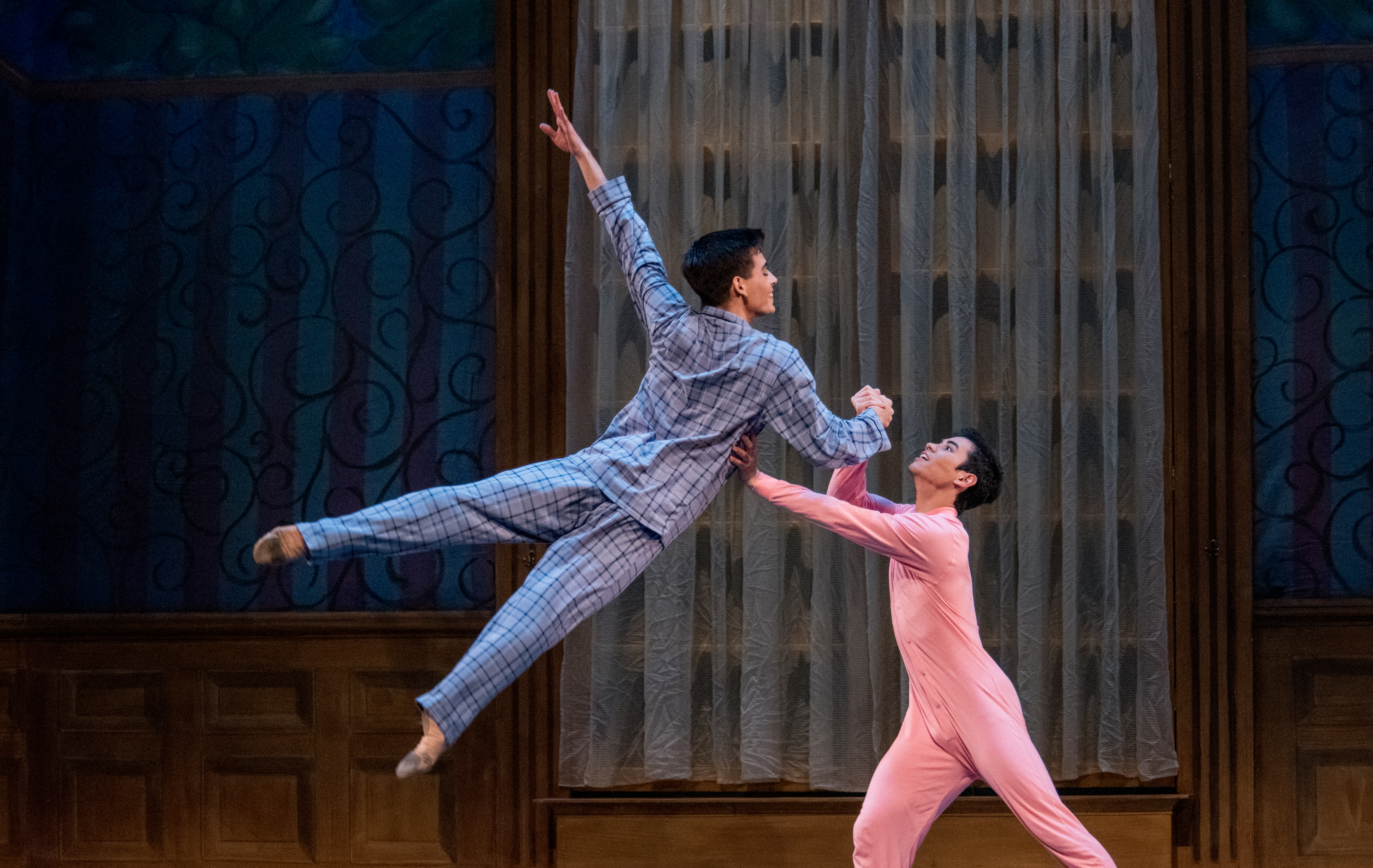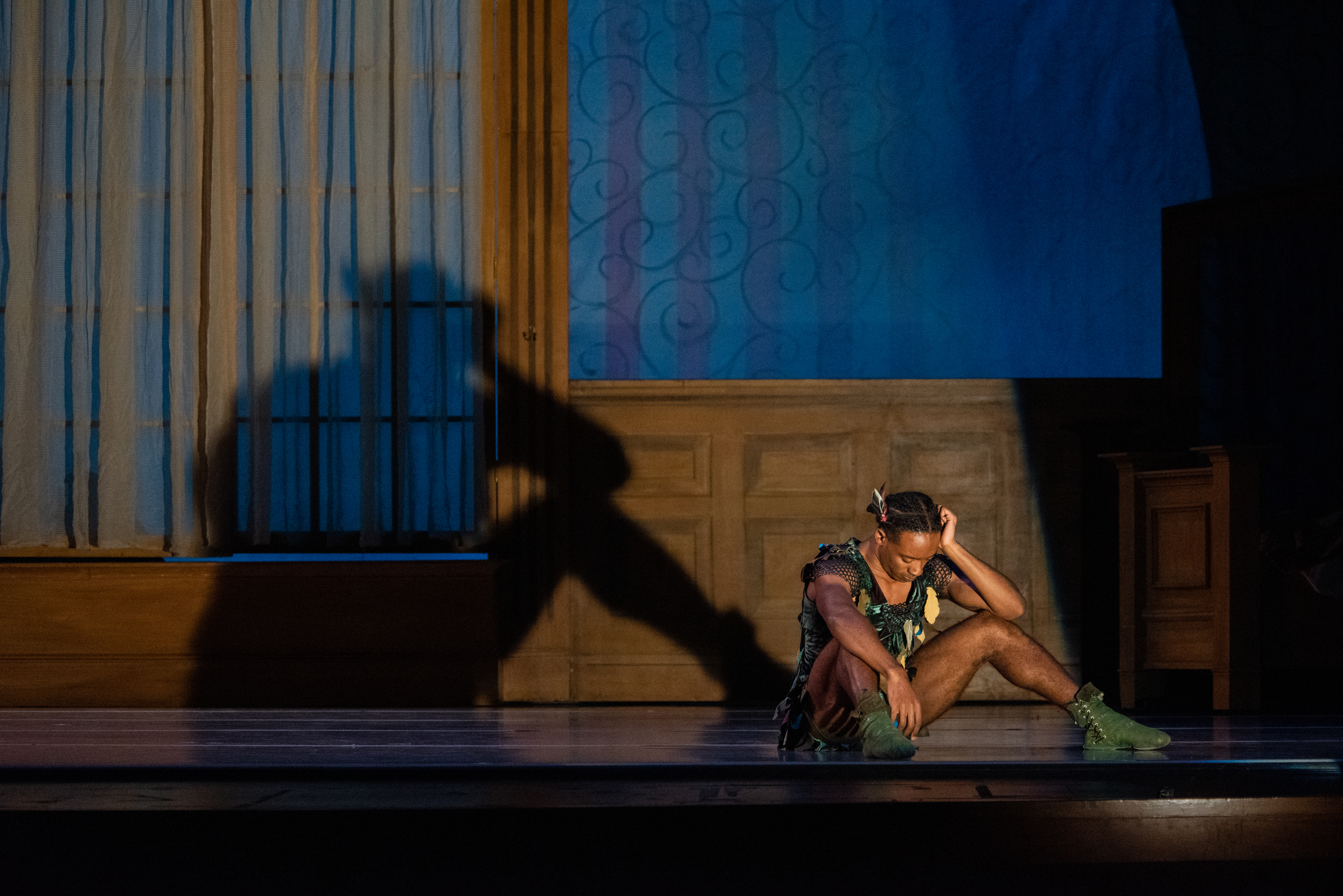
Category Archives: Theatre

“Into the Woods” Revival Resuscitates Sondheim’s Heart

Review: Into the Woods at Blumenthal PAC

By Perry Tannenbaum

INTO THE WOODS 7

Replete with wit and amazingly intricate rhyme and wordplay, intertwining no less than five fairytales, all brightly sprinkled with pseudo profundity, Steven Sondheim’s INTO THE WOODS has always left me with an aftertaste of being too clever and too cerebral. For me, it’s the polar opposite of The Sound of Music, which always has me worrying whether my glucose reading will spike the following morning. Dreading my next encounter with both of these musicals, I’m invariably surprised by how satisfied I am while I’m still in the hall and their stories unfold.

Until this week, that is, when the touring version of the posthumous 2022 revival of Sondheim’s gem rolled into Charlotte, just a little over three months after closing on Broadway. Directed by Lear deBessonet and bringing a generous bouquet from the Great White Way of players who were in the opening-night and replacement casts, this new INTO THE WOODS, dedicated to Sondheim’s memory and now at Belk Theater, breaks the spell, dispelling the aftertaste of so many local and regional productions I have seen.INTO THE WOODS 6

Of course, the clever and resourceful meshing of multiple fairytales in Act 1 still delights, but after so many reprises, it doesn’t astonish anymore. No, what knocked me over was the extensive rebalancing and reimagining of Act 2, which had always scored many of its points but had also seemed intent on ruining the magic that Sondheim had crafted before intermission.

In deBessonet’s hands, the emphasis has shifted away from the spurious “children will listen” trope that was so loudly flouted by the strayings of Little Red Riding Hood, Rapunzel, Cinderella, and Jack of “Beanstalk” fame. You may also perceive the connection between “The Last Midnight” sung by the Witch deep into Act 2 with the three midnights she gave the Baker and his Wife before intermission to collect various charms from those more famous fairytale protagonists in order to achieve the couple’s dream of having a child.

With its new emphasis on the “you are not alone” refrain, this journey Into the Woods proves that Sondheim does have a heart – and plenty of it. Tears were already welling up for me as soon as I knew that soothing phrase was about to be sung.INTO THE WOODS 4

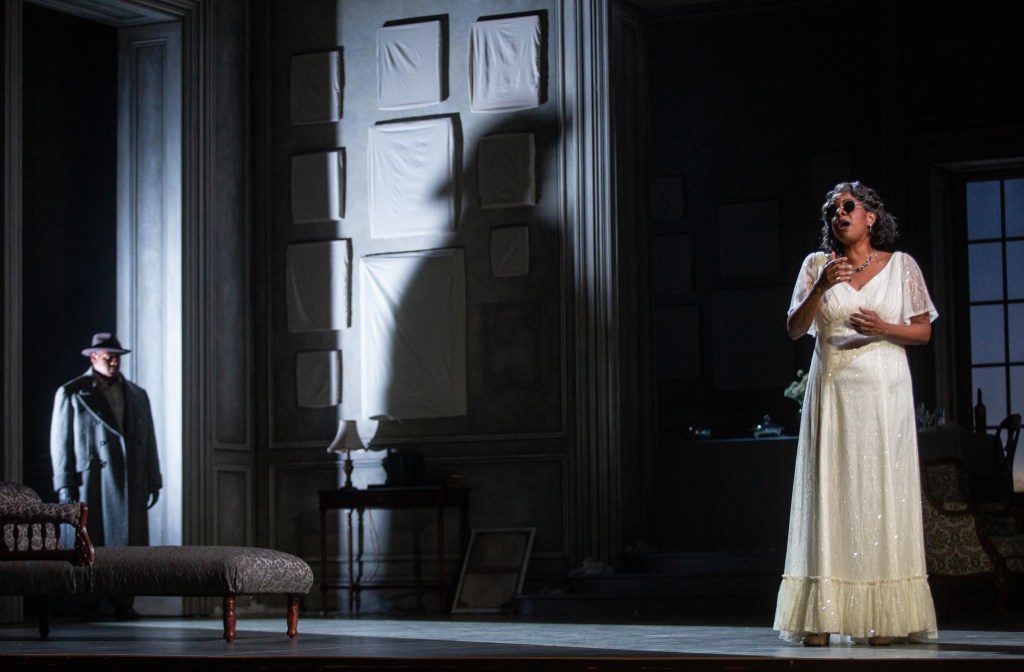
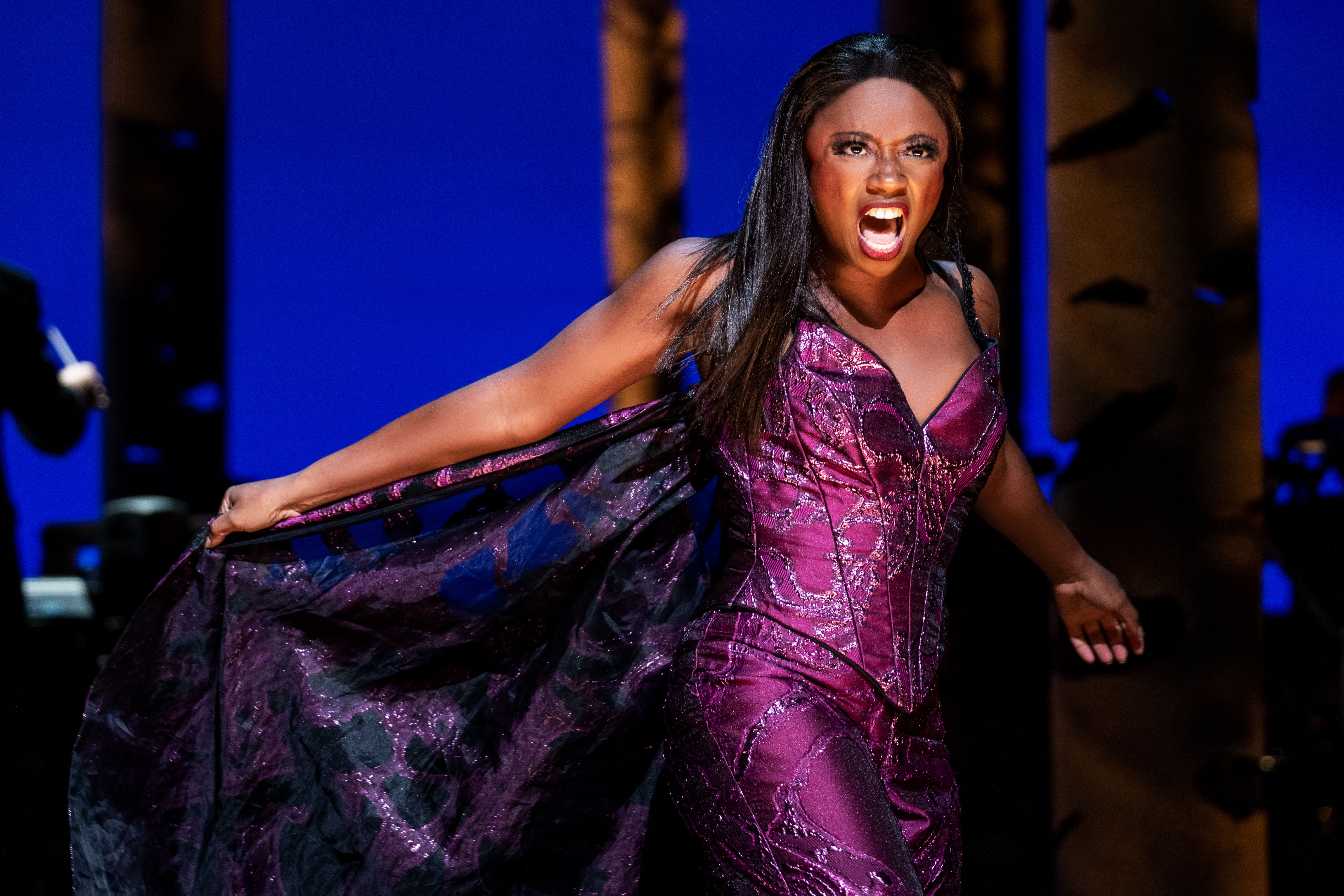
At the center of all this wonder is Montego Glover’s electrifying performance as the Witch. All too often, the defanged and chastened Witch is portrayed as reformed and fundamentally changed after intermission. That impression, a holdover from previous encounters with Sondheim’s Witch, didn’t last long here. Glover is still playing the blame game viciously, maliciously, and fiercely after regaining her youth, pointing her crooked finger at Jack as a surviving She-Giant from above wreaks rampaging vengeance upon the whole kingdom.

Feeling the impact of the Witch’s damage as keenly as her primal yearning for motherhood, Stephanie J. Block as the Baker’s Wife comes fairly close to stealing the show back from Glover. Until Glover’s devastating “Last Midnight” comes along, Block’s “Moments in the Woods” stands as the peak showstopper of the evening, poignant, raunchy, and comical.

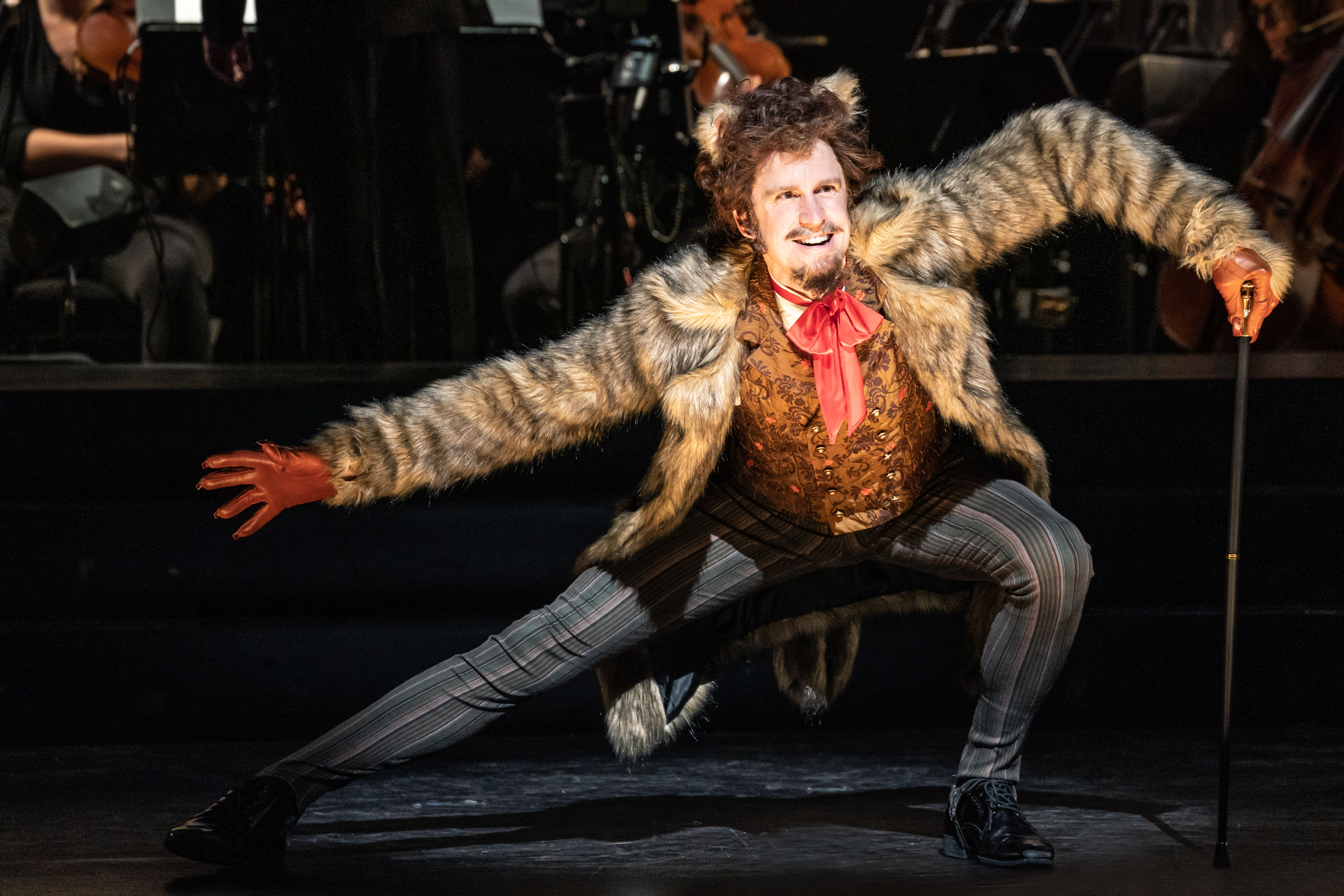
Before those powerhouse women take charge, Gavin Creel and Jason Forbach file legitimate claims to sovereignty as the two Princes in their “Agony” duets. Creel clearly drew the juicier royal role, reprising his Broadway turns as Cinderella’s Prince and Riding Hood’s Wolf. So he gets to woo Little Red with “Hello, Little Girl” in Act 1 and the Baker’s Wife with “Any Moment” after intermission. Fortunately for the audience, Creel is as full of himself as Glover.INTO THE WOODS 17

Sebastian Arcelus, Block’s husband in real life, brings more self-doubt and less smug complacency to the Baker than I’ve seen before, further updating and humanizing the pair. As Jack, Cole Thompson gives us a credulous farmboy who might not be stupid. But the lad definitely needs looking after, and Aymee Garcia as Jack’s Mother gets plenty of free rein for motherly fretting and pragmatic exasperation.

While deBessonet had little leeway in making over Diane Phelan’s modest and wholesome Cinderella and even less with Alysia Velez’s Rapunzel – who sings only a few notes but no words – he allowed Katy Geraghty to go radically bratty as Little Red Riding Hood. With the “children will listen” motif thrown to the wolves, Little Red’s new orneriness works well.

Fans who treasure Sondheim’s braininess still have plenty to savor. With music director John Bell and his orchestra onstage behind the action; and with puppeteers wielding the monstrous feet of the Giant, a golden egg-laying chicken, and Jack’s personable Milky White cow (a mischievous Kennedy Kanagawa); the tension between magic and artifice remains suspended all evening long.INTO THE WOODS 1

David Patrick Kelly as our Narrator even gets his own rostrum to declaim from as he pipes up every so often to tell our tale, dutifully turning pages as he pretends to read. Kelly’s various turns as the wizened and crouching Mysterious Man, switching from his Wizard of Oz formalwear to filthy rags as he bedevils the Baker, are a recurring treat, one of many, many winking reminders that we’re watching children’s theatre as adults.

Kudos to costume designer Andrea Hood, totally in on the mischief and fun, and puppet maker James Ortiz, whose designs will enchant young and old. Only a small but substantial number of empty seats were visible on Media Night, way up in the back of the second and third balconies. Count them as precious opportunities that were missed.

“Pippin” Is Mostly Magical at Theatre Charlotte

Review: Pippin at Theatre Charlotte

By Perry Tannenbaum

TC95-Pippin-018

There was plenty of magic to do last Friday night as Theatre Charlotte opened their new production of Pippin at the Queens Road barn. Opening night was happening in the wake of a dazzling Broadway Lights reveal at Belk Theater of a star-studded touring version of Into the Woods just three nights earlier. That compounded the new challenges already added by the 2013 Broadway revival of Stephen Schwartz’s 1972 hit, layering on new illusions, flying effects, circus acrobatics, and fire.

Behind the scenes, budgets and available talent are also stressed and stretched. Theatre Charlotte is embarking on an unprecedented series of four consecutive shows, hosting performances of Detroit ’67 (opening May 26) and I and You (June 16) at the old barn through June 25, after an excursion to the Uptown Mint Museum, where Picasso at the Lapin Agile will pay a visit beginning on May 5, the weekend after Pippin shutters. At home and on the road, TC’s running crews are booked for the next 10 weekends.

At first blush, it was tough for me to escape the notion that Woods witch Montego Glover’s wardrobe alone – not to mention her paycheck – was more expensive than this entire pipsqueak Pippin production. But the five-piece stage band directed by Lindsey Schroeder is tight, the ensemble directed by director/choreographer Lisa Blanton is brash and teeming with pro-grade talent, and the dance stylings by Sterling Masters-Deeney (home from a 12-year stint with the Broadway company of Wicked) are besprinkled with Fosse hands and pizzazz.

Before he composed Wicked, Schwartz wasn’t exactly sold on serious storytelling, so it isn’t difficult to swap out the narrative frameworks of Godspell and Pippin. Not for directors and most of the design team, anyway. For the acting troupe, most of whom are billed as Players; and for those designing the new Pippin effects and teaching performers how to execute them; it’s a different story. A granny on a trapeze? The original Javert from Les Miz learning parlor tricks? Tall orders.

Community theatres have scaled-down prep schedules as well as Slimfast budgets, so there were a few times – particularly when fire is involved – when you’ll need to brace yourself for disappointment. Otherwise, the acrobatics, the sawed woman, and the levitation stunt overachieved magnificently. Who knows, maybe by the second weekend, the kinks will be ironed out of the flame-throwings.TC95-Pippin-275

With Nehemiah Lawson as the Leading Player and Bart Copeland in the title role, both emerging from the ensemble of Theatre Charlotte’s Something Rotten, the bulk of Schwartz’s music and lyrics is in good hands. Lawson is a powerful presence and an excellent dancer, and the costume Beth Killion has designed for him strongly suggests black magic wizardry. Yet Lawson sometimes undercuts his own authority when he appears to be striving to precisely execute the choreography instead of taking over his moves, manhandling them, and making them his own.

The flimsy book by Roger O. Hirson is already lax in reminding us that the Leading Player is in charge of all the other players and their storytelling, so Lawson’s occasional spasms of fidelity don’t help. Yet his scenes with Sophie Lanser as the flawed and recalcitrant Catherine, Pippin’s true love, are beautifully calibrated in their give-and-take, and his climactic tantrum when Pippin rejects martyrdom is fairly breathtaking.

As Prince Pippin, Holy Roman Emperor Charlemagne’s son, Copeland is disarmingly wholesome, earnest, and at ease. His dancing prowess seems to improve before our eyes as he ages and becomes more worldly-wise, with an added grace that may stem from Copeland’s not taking himself seriously as a dancer. That kind of modesty works well for the major Pippin role that hasn’t won two Tony Awards (Ben Vereen in 1973 and Patina Miller in 2014), particularly when you’re a protagonist who finds himself beaten down in life no matter which path he follows toward fulfillment, his ”Corner of the Sky.”TC95-Pippin-154

While we savor the blithe amorality of Darren Spencer as Charlemagne, more aristocratic zest emanates from two female royals. Reveling in her corruption as Fastrada, Charlemagne’s current wife, Alyson Lowe gets to scheme against both her Emperor husband and her stepson Pippin, slyly maneuvering to install her valorous dimwitted son Lewis on the throne. Louann Vaughan draws the sunnier role as Charlemagne’s mom, exiled from court by the conniving Fastrada.

Her sunnier song, “No Time at All,” is the catchiest, a carpe diem song from Granny that espouses hedonism to Pippin as a better path than ambition. It also draws some of the most surprising staging as Berthe proves she hasn’t sunk into stagnant retirement. She’s as much of an opposite of Catherine as the cold-blooded Fastrada, for Lanser quickly forms a domesticated trio with Copeland and Logan Campbell as the widow’s son Theo, bonding together in the precious “Prayer for a Duck.”

Common farmer she may be – and maybe, according to Leading Player, the lowliest actor in the troupe – but Lanser reminds us she isn’t a doormat, aggressively seeking out a replacement husband when she’s on script in the Leading Player’s story and then pugnaciously inserting a song that he has not approved. Catherine needs Pippin and her “I Guess I’ll Miss the Man” is a long way from worshipful.

Matt Howie is the only other cast member who speaks, giving Pippin’s half-brother Lewis a surprisingly sweet tinge. After seeing him in numerous productions, most recently in Something Rotten, I’m not sure he can help it. Among the dozen dancers in unnamed roles, captains Georgie DeCosmo and Mitchell Dudas consistently excelled. Charlton Alicia Tapp also stood out as a slick ballroom lizard, and lithe Riley Gray breathtakingly took acrobatic honors ascending and descending the silks.

Pro-Grade “POTUS” at Booth Gets New Conservatory Run in Cornelius

Feature Review: Charlotte Conservatory Theatre’s POTUS Transfers to Cain Center

By Perry Tannenbaum

POTUS_Fenixfoto_Charlotte_5R4A2102

After the morning press conference, there’s China, an international meeting on nuclear proliferation, followed by a photo op with blinded-and-maimed Iraq War vets, and a much-anticipated endorsement of a gubernatorial candidate somewhere out in the Midwest. Pretty typical day at the White House.

But in Selina Fillinger’s frenetic presidential comedy, POTUS, neither the man in the Oval Office nor the playwright’s viewpoint is typical. Fillinger made that clear in her subtitle, Behind Every Great Dumbass are Seven Women Trying to Keep Him Alive. At opening night of Charlotte Conservatory Theatre’s production of this romp, seven frantic women directed by Stephen Kaliski had their audience laughing nearly non-stop at Booth Playhouse.

It was the second consecutive Conservatory production that reminded many of us of the last resident company at the Booth, Charlotte Repertory Theatre, which expired way back in 2005. Members of Actors Equity are back in the mix, along with members of Stage Directors and Choreographers behind the scenes. Other professional groups are involved, including the local IATSE union and United Scenic Artists. Kaliski and Conservatory Theatre co-founder Marla Brown also harbor the long-term ambition of ascending to the highest rung of regional companies and becoming Charlotte’s first LORT (League of Resident Theatres) company since Rep’s demise.

Kaliski wasn’t behind the scenes for Conservatory’s debut at the Booth last August. No, he was onstage as a rather charismatic devil named Scratch in a surprisingly amorous faceoff with Elizabeth Sawyer. Jen Silverman’s Witch was the playwright’s fresh 2018 spin on The Witch of Edmonton, first staged in 1621, and Sawyer was a dramatization of a real-life woman burned for witchcraft earlier that same year. Brown wasn’t onstage in that “then-ish” setting, but her inclination toward making Conservatory a classics-flavored company definitely was.POTUS_Fenixfoto_Charlotte_5R4A2210

With POTUS, it’s Brown who is taking the stage – nearly assuming the title role late in Act 2 as she prepares to take the place of her lookalike brother, the Prez, at a posh speaking engagement. Speaking with Brown for this story, I opined that the recent POTUS she most closely resembled was The Donald. Nope, she countered, it was Obama.

You can decide who’s right. For the Conservatory Theatre production, after closing at the Booth several weeks ago, reopens at the new Cain Center in Cornelius for another three-performance run on April 26.

Until her shocking transformation into formalwear, Brown as the drug-dealing presidential sib Bernadette looked to me like a punkish Rob Roy on the skids. Here Brown and I are in much closer agreement, since she has proclaimed, “I got that role because I can rock shorts that are hideous.”POTUS_Fenixfoto_Charlotte_5R4A2137

Yet Brown’s shorts may not be the most bizarre or hideous thing we saw at the Booth in POTUS. Iris DeWitt as Chris, a beat reporter fishing for a scoop, multitasked by sporting a pair of noisy breast pumps that reminded me of football fan craziness, helmets retooled to hold beer cans emptying into drinking straws. Katy Shepherd as presidential secretary Stephanie may be the queen oddball. After unwittingly sampling an overdose of Bernadette’s merchandise, Steph goes so far off the rails that, by intermission, she’s prancing around the West Wing dreamily with a pink swimming pool floating around her waist.

The zany, comical mayhem that brings POTUS to the end of Act 1, with all seven women in action and Chris somehow stealing focus from the ever-twirling-and-spacey Stephanie, is the closest equivalent I’ve seen in many years to the explosive circus that engulfs the stage at the second intermission of George S. Kaufman’s You Can’t Take It With You. And that fizzy moment was the only time in Fillingers’ comedy that I caught anything like a whiff of classical flavor.

Conservatory’s swerve from classicism has been both intentional and fortuitous in terms of POTUS coming here and moving up the road to Cornelius.

“We want to leave our options open in these early days,” Kaliski says, “so there was a consideration early on of, okay, we’ll always do something that has some sort of anchor in a classical story. Right now, the aesthetic we’re landing on is, you know, how can we be that company? The plays in New York that are either your non-touring Broadway shows or prestige Off-Broadway shows – we want to be the group that picks a lot of those off and brings them to Charlotte. And I think Actor’s Theatre filled this role.”

Yeah, it’s clear that the closure of Actor’s Theatre rocked this town – arguably harder than the shuttering of Rep, which left CAST (Carolina Actor’s Studio Theatre) and Actor’s Theatre in its wake. Now? We’ve devolved into a bunch of small black box theatre outfits, counterbalanced by the bigger BNS Productions. They all produce consistently fine work, but none of them can be called “that company.”

Actor’s and CAST hardly messed with the classics at all. BNS, when it isn’t producing works by its founder, Rory Sheriff, mostly does the classics by August Wilson. So there’s definitely a niche for a major company in Charlotte that plans to straddle recent hits and the classics. Or any major LORT company at all, since we’re probably the largest US market without one.

Even in its beginnings, Conservatory is flipping the script written by Queen City theatre behemoths that perished in the past. Whether suddenly or gradually, Rep, CAST, and Actor’s all disgorged their founders through actions of their boards of directors, who then proceeded to dissolve their companies – without alerting the public that they were in crisis, let alone appealing for aid.

Having founded The Warehouse up in Cornelius in 2009, Brown and her board have not liquidated her brainchild. Utilizing Warehouse’s non-profit 501c3 credentials, they have rebranded as Charlotte Conservatory, upsized their mission and ambition, and – here’s a twist – amicably disbanded their board.

“I love that space very much,” Brown still says of The Warehouse. “But I also knew that after ten years, if I continued to produce there, I would regret it. Because Charlotte has seen such a de-evolution of theatre since Rep’s demise, and such a de-evolution of our talent pool. Anybody who works on a professional level or who understands the craft either has to do it for very little money or they have to teach and then do it at theaters, other LORT companies at other cities, or they work for Children’s Theatre only.”

In the wake of COVID, which gave theatre companies plenty of time to pause and reflect; and in the wake of We See You, White Theatre, a scathing BIPOC indictment of American theatre companies’ lack of inclusivity; Conservatory Theatre is intent on being more open-ended – and more open-minded – as it continues to take shape.

Neither cliques nor permanent positions have formed as Conservatory blazes its new path.

“We didn’t start with, okay, here’s our artistic director and the managing director, and here’s our director of development, etc., etc.,” Kaliski explains. “We didn’t start with a typical organizational structure. We were kind of thinking, all right, we’re a collective in this room together, and we’re going to take it project by project to start, and each project can have its own set of showrunners, if you will, kind of like a TV show. And they’ll be in charge of that, and then we’ll kind of have a different group of showrunners or a different producing pod for the next one.”

That kind of inclusivity has allowed Kaliski and Brown to reach out, in Conservatory’s formative phase, to Matt Cosper, who still cranks out XOXO productions, and playwright/actor/director Brian Daye, a former member of the Warehouse board. Nor is this core group and others limiting their horizons to the Booth Playhouse and the Cain Center, especially since Conservatory doesn’t have the kind of sweetheart rental deal the would come with official residency at either venue.

Mint Museum, the Stage Door, and the new Parr Center are all in play for future reconnoitering and producing, along with whatever the epic renovation of Uptown’s Carolina Theatre winds up offering. Meanwhile at Cain Center, whose stage does not sport a fly loft, there’s a mutual feeling-out process as both newbie organizations find their bearings.

Both Brown and Kaliski were surprised and delighted that rights to perform POTUS became available so soon after the Broadway production closed last August. Many in their circle presumed there might be a national tour in the offing. But POTUS doesn’t make the most discreet or decorous entrance for a Cornelius audience, that’s for sure.

Brown had some trepidations when she approached Cain director Justin Dionne. “Okay, Justin,” she remembers thinking, “you understand that the first word is the C word. And I know you don’t want people coming and going, ‘This is not what we built the Cain center for.’” She squeals in a high falsetto, half-relishing this possibility.POTUS_CCT_Charlotte_Group_Fenixfoto15379 - 4

Yes, before Fillinger’s action even begins, POTUS has used this word at his morning presser – in describing the First Lady, no less. In her presence. He doesn’t know she’s there, due to a couple of additional plot points – one, we’ll learn, involving anal sex – so he explains her absence by saying, “She’s having a cunty morning.”

So Valerie Thames as chief of staff Harriet opens the show by storming onstage and exclaiming the offending adjective in its root form. Instantly radiating dignity, morality, and competence – qualities that will not be attributed to POTUS – Thames authoritatively dumps this crisis of the day in Jean’s relatively cool hands. Slim and conceivably serene, Jennifer Adams as POTUS’s beleaguered press secretary wastes little time in convincing us that poor Jean likely holds the most combustible burnout position in the West Wing.

Harriet and Jean are the women most seriously invested in keeping the dumbass alive and the most adept at getting the job done. This often involves prodding Stephanie, quite intelligent beneath her scared-rabbit exterior, into action. Bernadette, ankle monitor on her leg, is also very interested in keeping her brother alive, if for no other reason than her nefarious enterprises will ultimately require a presidential pardon.

“Harriet,” Jean memorably informs Bernadette, “is the number one reason this country continues to function.” By this time, Jean has perpetrated a monumental screw-up of her own.POTUS_Fenixfoto_Charlotte_0K9A1454

Wielding a blue slushy, Sarah Molloy makes an entrance as Dusty that rivals Harriet’s, rushing across the stage to vomit into a trashcan. Not the subtlest indication you’ll ever see that somebody is pregnant. Yet the West Wing brain trust struggles to put two and together. Bernadette sees it all rather quickly, though. You need to be truly family to understand POTUS.

Iesha Nyree as The First Lady sizes up Dusty nearly as quickly as his sister-in-law. Assailed by presidential insult and infidelity, Margaret is also complicit and invested in her dumbass husband’s political machinations. Never playing a victim card, Nyree makes Margaret formidable and conflicted. But while Fillinger flips the meaning of her subtitle upside down, hinting that impulsiveness and incompetence aren’t confined to POTUS or his gender, she spreads the inner conflict around: lurking among these ladies are two lesbians who will consider rekindling the old flames that once blazed secretly on the campaign trail.

“At least three of the characters must be women of color,” Fillinger prescribed in her script. “Actors can be cis or trans. Age is flexible. Beauty is subjective. So long as they’re fast, fierce, and fucking hilarious.”

Kaliski, Brown, and Charlotte Conservatory Theatre checked all of those boxes at the Booth. True, POTUS is a bit lightweight and more than a little over-the-top. But if you missed it in Charlotte, it’s worth the trip to follow this production up to the new Cain Center. Seeing how it all goes over with the Cornelius crowd might be an extra treat.

“Clue” Reaches New Heights of Silliness at Matthews Playhouse

Review: Clue at Matthews Playhouse of the Performing Arts

By Perry Tannenbaum

2023~Clue~18

Apparently, I didn’t have much of a clue about CLUE, a new comedy by Sandy Rustin based on the 80-year-old board game and its 1985 screen adaptation. I presumed that Matthews Playhouse would be staging the musical version that has periodically skulked around regional and community theatres after ignominiously posting its closing notice a week after it opened Off-Broadway in early December 1997.

Our playbill, listing “Original music composed by Michael Holland,” kept me in the dark a bit longer until the show began without an overture or an opening number. While we waited, we had the chance to fill out a form and predict which of the “usual suspects” would be revealed as the culprit – or culprits – at the end of the show. It’s a pretty simple form since, unlike the board game, we don’t have to sniff out where the murder takes place and which of six lethal weapons is used. Simpler than the movie, too, which was famously released with three different endings.2023~Clue~4

After directing a nearly sublime Book of Will at Belmont Abbey College back in February, Jill Bloede shows that she and her sure comedy instincts can lift up the utterly ridiculous in Matthews. She and set designer Marty Wolff aren’t going to let us forget that Clue is a board game. With sliding wood panels for walls and cunning little swinging gates for doors, we can see three rooms at a time on each side of the stage simultaneously, with a corridor representing the Boddy Mansion’s hallway completing the symmetry – seven of the nine rooms depicted (even more primitively) by the humble game board’s overhead view.

Flimsy as those thin walls may appear sliding in and out of view, they must be sturdy enough to accommodate the workings of secret panels that either flip their graphics or open and shut widely enough for the comings and goings of arms visibly wielding weapons. If your Clue erudition has stuck with you since childhood, you’ll remember that those weapons are a candlestick, a lead pipe, a monkey wrench, a dagger, a rope, and a revolver.

It’s with the entrance of our prime suspects that the plot of Jonathan Lynn’s screenplay and Rustin’s script, mimicking the film’s plot setup, swerve from the classic simplicities of the Parker Brothers’ game. Each of the six guests who have been invited to the Boddy Mansion is given one of the aliases bestowed on the iconic game pieces. Each now has a colorful – but compromising – back story that he or she is being blackmailed for. Serious enough misdeeds lurk beneath all our guests’ respectable facades for a murder motive, and their sophisticated enough for them to apply for membership among the avatars of more evolved adult board games.2023~Clue~19

So Colonel Mustard does have a military background, and Mrs. Peacock, a US Senator’s wife, has reason to be prideful. Mr. Green has a gay bent that could be costly as news of the McCarthy un-American hearings, circa 1954, seep through in radio broadcasts, and Miss Scarlet’s flame seems to be fueled by undercover stints as a high-priced madame. Professor Plum was apparently disgraced in another profession before finding refuge in academia, and Mrs. White… why is she dressed in black? Presumably because one or more of her late husbands could be the skeleton in her closet.

Now if you or I were anonymously blackmailing six evildoers with DC connections, you might think twice – or 700 times – before inviting even one of those cash cows for dinner, blowing your cover and, in a faraway secluded manor, endangering your own life. Ah, but the Lynn-Rustin silliness has just begun. Let’s distribute the six iconic murder weapons among the six color-schemed guests! And after all, if six possible murderers are gathered for an evening of killing and sleuthing – and dinner! – why limit the victims to just the ever-ready Mr. Boddy?2023~Clue~10

The whole Boddy household staff might be available to boost the body count: the maid, the cook, and the butler. Maybe we could liven (or deaden?) things up with a stranded motorist, a snoopy cop, or even a singing telegram girl? Hey, it’s a party!

With Allen Andrews as the suave and mysterious butler Wadsworth greeting mutton-chopped Jeremy Cartee as the pompous Colonel Mustard, the ball gets rolling nicely as the pair let us in on the rules of the game. Andrews as Wadsworth is so slick of a host greeting all of our suspects that he manages, through sheer brass and sliminess, to cast suspicion on himself. Cartee, meanwhile, must vie with longtime local diva Paula Baldwin as Mrs. Peacock for the distinction of being the most arrogant and pretentious of the suspects. Baldwin makes up for lost time by being the most outgoing, neurotic, and loquacious guest.2023~Clue~17

Clad in a screaming red dress, red hair garishly beribboned, and wrapped in a boa, Vanessa Davis as Miss Scarlet is the polar opposite of the cool Mary Lynn Bain as the semi-funereal Mrs. White. While Davis shoots seductive glances everywhere, Bain seems to be in perpetual mourning.

Yvette Moten’s costume designs are predictably color-coded, but they are not altogether studded with solid hues. While Andrew Pippin as the reserved Mr. Green gets to wear the most stylishly coordinated and urbane ensemble in harboring the deepest secret, Moten allows herself to go fairly wild over Johnny Hohenstein’s outfit as Mr. Plum: a cringeworthy maroon plaid jacket striped with deep purple and sky blue, a weirdly coordinated motley bowtie, and the loudest purple argyle sweater she could find.

Kathleen Cole is most notable for all the costumes – and phony eyebrows – that she wears, changing from the Cook to the Singing Telegram Girl before resurfacing as police backup. That glittery delivery girl outfit would liven any costume ball.2023~Clue~1

Bloede obviously takes much delight in maneuvering her game pieces. Sometimes they scurry around so swiftly that we lose track of them, and at other times, Wadsworth and staff parade them from room to room with a ceremoniousness that actually does evoke silly avatars moving around the squares of a game board. Yet there wasn’t a single missed beat during all the hectic scene changes at the Saturday matinees, never a missed cue, and never a flubbed line.

We seem to all get nine different rooms with all the back-and-forth of the sliding walls, so efficiently whisked in and out of sight from the wings. But I don’t remember seeing a ballroom, so I’m sure we don’t see more than eight.

Eight is enough.

B’Way “Beetlejuice” Messes With the Franchise Mojo – Design to the Rescue!

Review: BEETLEJUICE at Blumenthal PAC

Beetlejuice-2By Perry Tannenbaum

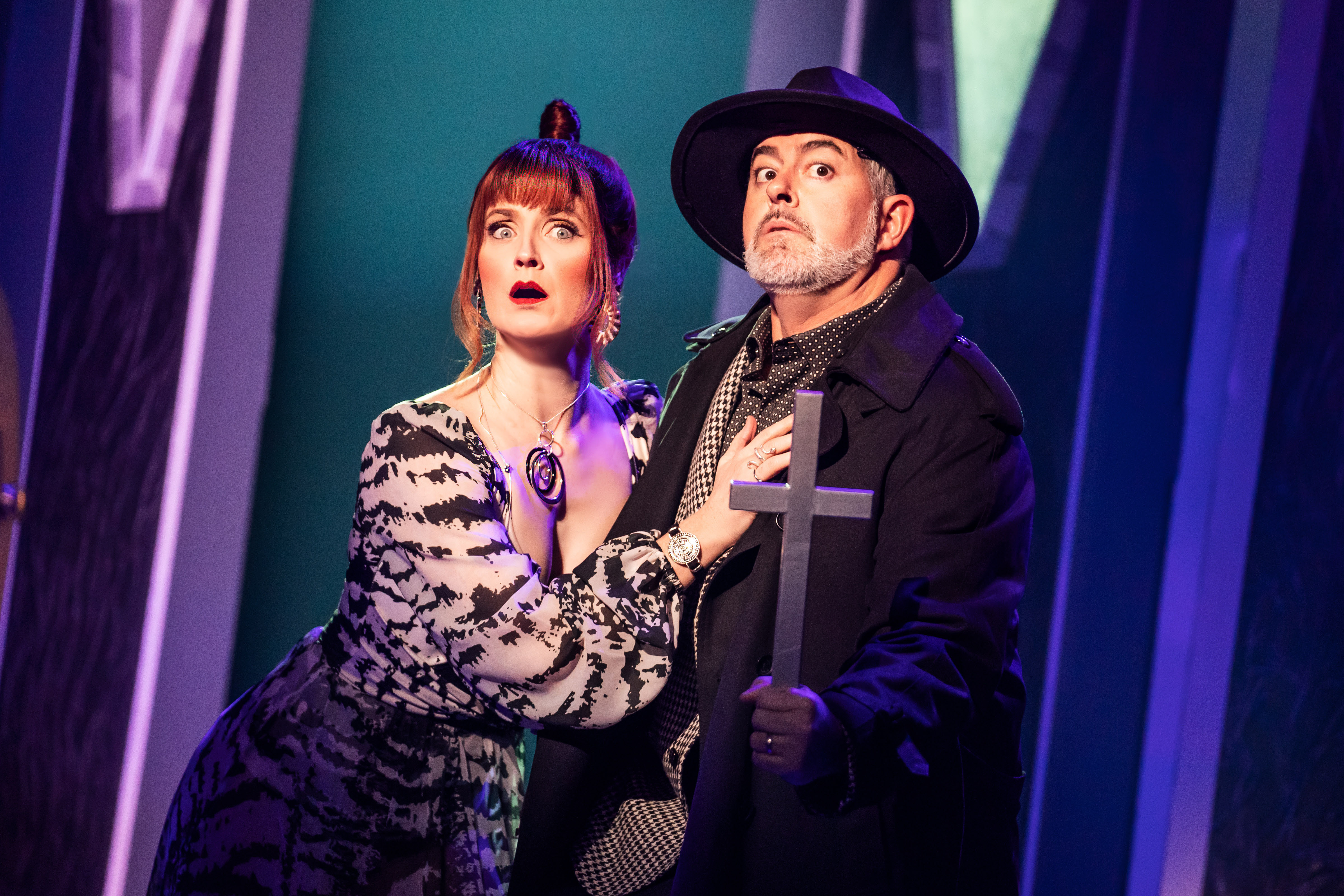
Prepare yourself for an onslaught of ghoulish purple – and wicked green! The Broadway Lights series was fiendishly lighting up Belk Theater for its first opening night there in 2023. No less than 29 purple and green spotlights are arrayed around the proscenium, the box seats, and the balcony. Some of them swivel and sweep around the hall like a bat signal, periodically slapping you between the eyes and blinding you. Twenty more LED arrays – guess what colors! – frame the stage, blinking ominously.

Organ music broods in the background, its Gothic drone abruptly halting for the BIG BANGS, two mighty jump scares that launch each of the two acts of Beetlejuice The Musical. Meanwhile, your helpful Encore playbill sports a different design scheme on its cover: black and white. Not a biggie, true, but lurking all around you, dressed in cosplay creations, are human echoes of the demonic Betelgeuse and his most famed and formal prison-striped suit. Complementing these parolees, waifs of all ages were sporting all-black ensembles such as those favored by Lydia Deetz, the title groom’s funereal bride-to-be.

Yes, I’d say somewhere around 10% of the Belk crowd on opening night were not merely pre-sold on the infernal nectar of Beetlejuice but also eager to proclaim their membership in its cult following. Scott Brown and Anthony King knew their audience well when they overhauled the 1988 screenplay that director Tim Burton wildly accessorized.Beetlejuice-9

Both the Betelgeuse role played by Michael Keaton and Winona Ryder’s Lydia have been hugely enlarged. Instead of standing in the wings (or camping underground), on-call until Barbara and Adam Maitland die and become desperate ghosts, Beetlejuice is our emcee, ingratiating himself with the audience moments after the curtain rises with a steady stream of shticks, topical references, wisecracks, and personal insults flung out to the audience. Or Justin Collette tries – oh so hard in his makeover of the Keaton portrayal, ululating his tongue when all else fails.

That obnoxious appeal can be hard to sustain when the meddlesome Bee is invisibly urging the wholesome and liberal Maitlands to electrocute themselves. Don’t remember that from the movie? Brown and King keep all their action indoors – or on the haunted house’s roof – after the opening funeral scene.Beetlejuice-11

You won’t see that scene in the movie, either. Here the graveyard scene begins to layer on new grieving and suicidal dimensions to Lydia’s familiar goth couture, establishing a new gravitas for the troubled teen. In the wake of Mamma Emily Deetz’s death, Lydia also acquires a seething Hamlet-like bitterness as she, Daddy Deetz, and his wanton fiancée Delia move into the Maitlands’ quaint country home. The sequence of events is painfully compressed here, and Lydia isn’t merely plagued by a goofy, artsy stepmother.

Since they haven’t tied the knot anymore, this is more of a betrayal and an abandonment by Daddy Charles and an opportunistic intrusion by Delia. Of course, this is a gift to Isabella Esler, who gets more of the spotlight here as Lydia and has more substantial woes to bewail in her interactions with the friendly Maitlands – more angst and yearning to belt in the punk ballads written by Eddie Perfect, most notably “Home” and “Dead Mom.”

Grievance and energy have noticeably shifted away from the rookie Maitland ghosts, played by Alec Baldwin and Geena Davis in the film. Picking up on the opening shots of Baldwin, where Adam meticulously picks up an invading spider and liberates it through his attic window, Perfect expands the Maitlands’ bleeding-heart reverence for life to the point of absurdity, demonstrating in “Fright of Their Lives” that they wouldn’t hurt a fly, much less haunt a house.

That’s likely Perfect’s best lyric, proving that the Maitlands are the neediest of the needy for Betelgeuse’s services as a “bio-exorcist.” Britney Coleman and Will Burton are so successful at convincing us of their air-headed ineffectuality that even devout Beetlejuice fans will be hard-pressed to care about whether they ever achieve their ghostly aspirations. Saving Lydia from herself and ridding the home of B-Juice become the top priorities.

Not that the elder Deetzes are any more repellent than their celluloid counterparts. Jesse Sharp actually projects a Raymond Burr-ish respectability as Daddy Charles, but even as Kate Marilley outshines him as Delia, getting her teeth into a couple of new songs, she’s no less kookie than Catherine O’Hara was, just oddly more salacious as she swaps professions, becoming a cliché-spouting life coach instead of a sculptress.Beetlejuice-1

With the diminished importance of the Maitlands and the constant pesky presence of Collette as Beetlejuice, further detaching our involvement with the story by breaking the fourth wall over and over, this horror-themed musical comedy might devolve into irredeemable silliness. Certainly, Perfect’s score doesn’t help Brown and King’s update.

Design to the rescue! However you might react to the film’s storytelling, which also implicated Robert Goulet and Dick Cavett in cameo visits, Burton’s comedy-horror stew was a visual wow, with touches of Disney, Dali, Hitchcock, and Edward Gorey. Onstage at Belk Theater, we behold an orgy of scenic, costume, lighting, makeup, wig, and projection design – augmented by magic, SFX, a special illuminated edition of The Handbook for the Recently Deceased, and puppets. Fear not, the pinhead guy we encountered in Tim Burton’s netherworld has not been left behind.Beetlejuice-6

Although we must tolerate the tasteless intrusion of an NPR tote bag, we still get the zany “Day-O” possession via Harry Belafonte, our colossal man-eating sandworm, and a free consultation with Juno in hell, featuring a surprisingly frumpy Karmine Alers in the role previously graced by Sylvia Sidney onscreen. While we’re down there, we get to see how Beetlejuice The Musical producers added fresh Carmen Miranda spice to the 2022 Broadway remount of their COVID-stunted 2018 gumbo, when they upsized the role of Miss Argentina, now shaken and shimmied by Danielle Marie Gonzalez.Beetlejuice-4

Miss Argentina’s skimpy attire, one of local legend William Ivey Long’s many bizarre and resourceful creations, cues a startling alteration in the overall color scheme. Wicked and Emerald City may be eternally green, but once Lydia returns from the realm of the dead, there are startling infusions of fiery red into the décor, including the spectacularly gauche formalwear that Beetlejuice and Miss Deetz sport for their nuptials.

It all added up to complete delight for pre-sold Tim Burton worshipers, whose enthusiasm after the calypso finale tallied even higher dB readings than those jump scares. All was foreseen by the wizards of Blumenthal Performing Arts, who announced the return of Beetlejuice – for the Christmas vacation! – the morning after opening night.

Misery Loves the Queens Road Barn

Review: Misery at Theatre Charlotte

2023~Misery-1

Fame can be unsettling, painful. It can be dangerous, corrupting, or toxic. But it was Stephen King who had the marvelous idea, with Misery, that fame could also be a gripping horror story – and in case anybody had forgotten, immensely lucrative. The 1990 film, adapted for the screen by William Goldman and directed by Rob Reiner, snagged a few awards for lead actress Kathy Bates as Annie Wilkes, bestselling author Paul Sheldon’s #1 fan. Goldman also crafted the 2012 stage adaptation that opened on Broadway in late 2015, starring Laurie Metcalf opposite Bruce Willis.

That’s the version playing now at Theatre Charlotte. Metrolina has seen previous incarnations of Misery, by Rock Hill Community and Off-Tryon Theatre, but those adaptations were by British screenwriter Simon Moore. So this Willis-Metcalf vehicle, directed by former Theatre Charlotte executive director Ron Law, qualifies as a local premiere.

The main attraction of the Moore version, retained by Goldman, is that it turned the restrictions of a live stage presentation to our advantage, stripping away the outside world almost entirely and making the story more claustrophobic – no pig, no media, no fretful literary agent, and just one law enforcement agent. It’s very much like a first-person narrative by an immobilized writer who wakes up unexpectedly inside a torture chamber.

Chris Timmons builds a silhouetted two-story set that meshes well with his drab, gloomy, lightning-streaked lighting design, while Christy Edney Lancaster layers on plenty of thunderclaps in her sound design along with pop song recordings that sound like they originated on 78 rpm shellac (quite possibly the same Liberace cuts heard in the movie). It’s very creepy at the old Queens Road barn when lights dim out and our attention becomes centered on the light shining from Annie’s upstairs bedroom, framed by lightning flashes.

2023~Misery-3We seem to be in a macabre fairytale forest or wilderness, snowbound outside of Silver Creek, Colorado. Sheldon has been severely injured in a car crash, Annie has extricated him from his wrecked Mustang, and she has somehow carried him up from a deep ravine in a heavy snowstorm and brought him home, where she is nursing him back into shape with splints, pills, intravenous fluids, and injections. As Sheldon’s #1 fan, Annie must have obtained King’s permission to stalk her idol through the storm, making this whole yarn possible.

She is a nurse by trade, we quickly see, evidence of IV treatments still lingering in the bedroom Annie has selflessly devoted to Paul’s care. Yet as I observed in my review of the 2002 Off-Tryon production, this Annie is to nursing what Typhoid Annie was to food preparation. Whether she intends from very beginning to keep Paul on the premises as a companion to her pet pig, Misery, may be open to debate, but there are revelations that topple Annie’s already-shaky equilibrium.

Paul has decided that Misery’s Child, the newest installment in his popular Misery series, soon to arrive at bookstores everywhere, will be his last. The new manuscript in his briefcase, just finished at his nearby Colorado retreat, will be a total departure from those where Misery Chastain was his beloved protagonist, the woman who Annie credits for saving her life. Now that she has saved his life, she’s sees herself as entitled to disproportional payback from her captive. Autographing his new book for her will not be nearly enough.

She rips out the phone, fully cutting Paul off from the outside world and further plunging us into a nebulous bygone era. Devout enough to be outraged by the foul language in Paul’s manuscript, Annie can discard morality in the blink of an eye when it comes to granting her idol’s freedom. Anyone who has seen the film will vividly remember that violence is in her toolbag.

2023~Misery-2

Of course, sudden explosions can always blow Paul’s cunningest escape plans to smithereens in seconds, but the finest aspect of King’s plotcraft is the cerebral battle between the imaginative author and his fanatical, adulating nurse. Avidly following his books, scrapbooking multitudes of magazine articles about him, and maybe picking up inside dope about him from nearby locals in and around the Silver Creek Lodge, Annie is a formidable adversary. She controls his food and his medicine – and as Paul’s #1 fan, she compounds her advantage by knowing so much about him.

Paul must first recover health and mobility. Then he must watch and study his keeper closely if he hopes to prevail. Rescue is tantalizingly close each time Buster, the local sheriff, drops by. But Paul isn’t aware of the initial visits as his disappearance continues to be investigated. On your way home after the thrilling climactic scenes – or maybe days later – you may begin to surmise how Paul subtly aided the inquiry.

Not all of Paul’s stratagems work in this chess game, and the retributions Annie wields on her idol can be shocking. Even more shocking onstage, perhaps, because we never get a full peep at Annie’s scrapbook and her backstory. It’s got to be tricky role for Becca Worthington to pull off live, especially since she comes off as a little more rustic than Bates and a tad meeker. The range is broader without the Hollywood coquetry, and Worthington pitches her performance more darkly when Annie veers out of control, in keeping with the gloomy lighting scheme, where sunshine and snowbanks have no place.

Costume designer Sophie Carlick also darkens our portrait of Annie, discarding the crucifix necklaces and the prim nurse-like outfits, such as Julie Andrews might wear strumming a guitar in a meadow, in favor of more rugged clothes she can credibly wear indoors and out: boots, knit socks, and dumpy cardigans. Sadly enough, when Paul asks Annie to celebrate Misery’s rebirth with a romantic dinner, Worthington doesn’t have the time, in a no-intermission production, to elaborately glam herself up for the occasion.

2023~Misery-4

Timothy Hager has fewer rooms to navigate here as Sheldon than James Caan did in the movie, stealing contraband pills and a kitchen knife from the same room where his candlelight dinner scheme goes awry. Nor must he somehow emerge from a cellar – a fourth indoor location! – where he has been dumped because there is none. Yet Hager certainly manipulates his wheelchair with all the apparent difficulty of a newbie recovering from a separated shoulder, giving us the impression of an epic exploit. Without the benefit of closeup shots, he also makes sure that Paul’s fears are visible far beyond his eyes.

Effortlessly, Hager often radiates a shambling clumsiness in his attempts at hoodwinking Annie, a fallibility Caan hardly hinted at, endearing himself to us a bit pitiably in the darkness of this snakepit. Most importantly, Hager has a firm grip on the climactic typewriter scene where he precisely executes some truly nifty fight choreography.

2023~Misery-5

Transitioning to stage, Goldman most radically altered the role is Sheriff Buster, who only visited the Wilkes cottage once in Goldman’s screenplay. Law widens the discrepancies, casting Roman Lawrence as the lawman in an auspicious Charlotte debut. Buster is no less easygoing now, but he is conspicuously younger and less snoopy, no longer visible in scenes at the office with his wife, up in the sky in a helicopter, at the crash scene, at the lodge where Paul finishes his books, in a library researching, or at the general store. Lawrence is the closest thing in this show to sunshine, arriving each time without apparent urgency or suspicion. That sharpens the drama in the denouement.

Production levels have been a bit eye-opening in the first two shows at the Queens Road barn this year, a place we’ve never before compared with Children’s Theatre of Charlotte in terms of technical prowess. With Misery, Hollywood has arrived in Charlotte at the service of thrillers. Prep for King’s famed hobbling scene was impeccable, eliciting audible gasps from the audience, but that was mere prelude. Both blood splatters in the closing scenes were absolutely spectacular, worlds beyond what community theatre delivered in my day when we taped blood capsules to ourselves backstage and hoped for the best.

These more sophisticated spectacles were likely a collaboration between Timmons and all three of the players, possibly Carlick as well, and perhaps triggered by sound cues. Or Bluetooth! The difficulty of the tech was best demonstrated at a key moment when it went wrong – Play-That-Goes-Wrong wrong. A wastebasket began smoking before Hager could toss a kitchen match into it. Presumably unnerved, Hager then tossed a key manuscript page toward the basket instead of slam dunking it to be sure. He missed!

On a movie set, these screw-ups would become a hilarious outtake. But onstage, instead of cracking up, Hager and Worthington covered up. Good thing they did, for the next cluster of fight choreography and SFX followed immediately, the most challenging moment of all. It was perfect.

BNS Conquers Adversity in Opening of Speakeasy, Shining at the New Parr Center

Review: Speakeasy by Rory D. Sheriff

 By Perry Tannenbaum

2023~Speakeasy-15

February 17, 2023, Charlotte, NC – Quick adaptation and a be-ready-for-anything state of mind are key survival tools for any performer who ventures into the minefield of live performance. But as opening night for BNS Productions’ Speakeasy inched closer, booked for this weekend at the new Parr Center – where no local theatre company has performed before – Charlotte’s preeminent black repertory company stepped on an explosive they couldn’t avoid. Just before the three-day run was scheduled to begin, one of their lead players came down with COVID.

Rory D. Sheriff, the author of the new script and founding artistic director of BNS, was forced to shuffle his cast, elevating Marcus Looney from a minor role to leading man while stepping into the vacated role himself. Both of these actors appeared on opening night, turning what would ordinarily be termed a workshop production into a rather fancy reading stage effort, enhanced by the scenery and lighting (also by Sheriff) we would expect in a full production, with six of the eight cast members off-book.

A couple of the main themes in Sheriff’s new work, starting over and working together to save the day, mesh well with the behind-the-scenes tumult. After leaving her abusive husband, Virginia is hoping to make a new life for herself – without a man, for a change – back at her dead parents’ home in 1978 Reading, Pennsylvania. Doing this her way is hindered by her wanton sister Marge, who is tirelessly “pimping” the newly-available Virginia around town, and the inevitable pursuit of men who have heard about the breakup.

The most aggressive of these is Percy, the horny neighborhood cable guy. On top of that, while leering at Marge, the mailman delivers an alarming formal letter informing Virginia that her parents left their property taxes unpaid for over 10 years. She must quickly come up with over $1000 or get out. Older brother Roosevelt, a starchy preacher man, would much rather sell the place than provide her sister with the balance.

Well, if you already have a cable guy and a mailman knocking at your door and salivating, Marge proposes that Virginia do the next best thing to prostituting herself: jointly turning the family homestead into a speakeasy, where local men can pay out to enjoy the sisters’ company in exchange for alcoholic beverage, assorted snacks, and free cable TV, courtesy of Percy. Prohibition hasn’t returned to Pennsylvania, but the sisters can’t legally peddle booze without a state license.2023~Speakeasy-09

A volatile triangle develops before intermission as Percy feels entitled to take further advantage of Virginia, spending the night and tiptoeing out the back door with the speakeasy’s take. Hard to report a crime like that to police. Virginia might have a white knight willing to champion her cause, a Winston-Salem refugee named Horse who has fallen hard for her, but she keeps pushing him away even after he wins Marge’s sincere endorsement. Cecilia McNeill has taken on a very conflicted role in Virginia, earning our empathy with her troubles while drawing our impatience – and occasionally our annoyance – with her negativity and her deafness to what Marge, Horse, and her own heart are telling her about her new beau.

McNeill carried it all off rather brilliantly in her auspicious debut if you consider how little time she had been given to acclimate to Looney as her co-star and how often her true love had to gaze downwards at his script. It was hugely helpful that Looney was off-book when he made his first entrances through the back door to the sisters’ speakeasy, and that after intermission, when he always had his script with him, he prioritized memorizing those lines where Horse should be gazing most intently at Virginia instead of the script. Otherwise, the role never appeared to be beyond Looney’s depth. A lingering photo at the BNS website of Jonathan Caldwell, originally cast as Horse, made me think that Virginia’s worries about him tossing her over would be more credible if he were there. If it were Caldwell standing up to Tim Bradley as Percy when the action peaked, I also suspect that it would have looked more like an equal match and not as brave or quixotic.2023~Speakeasy-12

Such alterations are always the byproduct of casting different actors in the same role. Sheriff can make peace with them or he could possibly like them better, but I’m sure that he would hate to discard Bradley with his imposing presence and his boisterous vulgarity. Horse the outsider and Percy the loose cannon are the two men that remind me most readily of the American Century drama cycle by August Wilson, an inspiration that Sheriff candidly acknowledges. Having appeared in three different BNS productions of Wilson’s dramas – and importing an extra roar from the title role in Sheriff’s Be a Lion – Bradley straddles those two realms magnificently, a lowlife rascal who can be quite formidable and menacing.

Alana Jones, Bradley’s slinky consort in Lion, is a bit over-directed and overly frisky here as Marge, her broad comedy projecting far beyond the stage and hall to faraway Gaston County. But the audience adored her, so Jones will likely continue mincing around her speakeasy like a cartoon cat. The contrast is certainly effective when she becomes candid and caring with Virginia. A bit of a clothes horse, Jones is my prime suspect for slowing down scene changes, for costume designer Dee Abdullah’s ample wardrobe has her feverishly changing costumes whenever she’s not sashaying onstage. I’d be surprised if she wears less than five get-ups, but the guys also have multiple outfits.

All the guys are nicely seasoned and excellent, providing additional Wilson flavoring. Dominic Weaver as Roosevelt puts a nice soft spot for Virginia in the middle of his sanctimonious hauteur that we can see from the beginning, when the upright minister is difficult, obstinate, and stingy. In his BNS debut, Andrew C. Roberts gives us some meaty civil-rights-movement context in a powerfully delivered monologue, although it seems to come from nowhere. James Lee Walker, II, has done so many uniquely stylish roles for BNS and other companies around town that I was not at all surprised to see him shine – in one scene literally shine in a glittery shirt.

A bit of the stilted dialogue we heard an opening night will likely vanish as Sheriff refines his script, and more variety in how extended monologues are staged and lit will likely materialize in the hands of a defter director. For starters, the guys might explicitly confirm what card game they’re playing at the speakeasy and which Ali fight they’re watching on TV. Feedback that Sheriff receives from this workshop edition will likely help him to sharpen his characters’ sparring and deepen their drama. He and BNS are off to a great start at their new venue.

Off-Broadway Star Shines in Three Bones’ Andy and the Orphans

Review: Andy and the Orphans at The Arts Factory

By Perry Tannenbaum

Eddie Barbanell, Susan Cherin, David Canetazzo and Vanessa Robinson (1)

When playwright Lindsey Ferrentino wrote Amy and the Orphans about her Down Syndrome aunt Amy, she convincingly demonstrated that she didn’t need to write its fraternal twin, Andy and the Orphans. But the demonstration happened too slowly. Ferrentino and director Todd Haimes needed a second Down Syndrome actor to play the title role at matinee performances when the show opened for the Roundabout Theatre Company in 2018.

Presumably, Ferrentino thought that pickin’s would be slim after finding Jamie Brewer at a New York fashion runway, the first DS person to participate in Fashion Week, through a talent agency that specialized in performers with disabilities. So the playwright didn’t specify what gender her second DS actor should be. Along came Eddie Barbanell to step onstage as the matinee understudy, and along came Andy and the Orphans, the custom-tailored male version of Ferrentino’s tribute to her Aunt Amy.Eddie Barbanell as Andy_1

Five years later – and five years closer to Andy’s real age – Barbanell is here in Charlotte, wowing audiences at The Arts Factory in Three Bone Theatre’s production of Andy and the Orphans through February 25. Meanwhile, Ferrentino has learned, through versions of her work staged in London and Spain, that you can reliably find DS actors to play DS people onstage anywhere. The real stumbling block for DS performers is the lack of roles for them.

Three Bone was actually early to the Ferrentino party, bringing the playwright’s previous work, Ugly to the Bone, to Spirit Square’s Duke Energy Theater two years ago. It was another script that showed Ferrentino’s empathy with female castaways in our society and how they are treated. Then it was Jess, an Afghanistan War vet returning to her Florida home, disfigured and disabled physically while inwardly suffering from PTSD.

While the content of Amy/Andy is more autobiographical, the location moves away from the playwright’s native Florida to New York. Precise locations shift during the action, and Ferrentino is rather circumspect about where we are or when. Without the script in my hands, I guessed that at various times we were in Staten Island, outside LaGuardia or Kennedy Airport, at a group home in Queens or Long Island, on the road, and – quite memorably – at a Burger King. Andy, his elder siblings, and Kathy, the caretaker who must accompany Andy, are on a road trip to Dad’s funeral, past the end of the fabled Long Island Expressway (and Sunrise Highway afterwards) to Montauk, the eastern tip of New York.David Catenazzo and Susan Cherin_2

Maggie and Jacob, when they aren’t bickering over whether their yearly meet-ups are Christmas or Chanukah visits, are worried over how they will break the news that Dad has died – and that Mom has already died awhile ago. This is the right comedy varnish to apply to a story that has a rather horrific dramatic core. Likewise, being overdue on telling their DS little brother that Mom and Dad are dead is a rather innocuous patina to apply to the family trait the characterizes Andy’s sibs and parents, a shocking abdication of their responsibilities toward him.

As this shabby trait becomes more and more exposed, the sideshow dinginess of Chip Davis’s traffic-themed set design becomes more and more apt for this story. It’s hard to escape the conclusion that director Danielle Melendez lucked out when Susan Cherin and David Catenazzo showed up for auditions. Cherin comes off as the kookier, more neurotic sib as Maggie, far more likely to be a fretful helicopter parent than her shambling brother. As Jacob, Catenazzo has the more Jewish name and delivers a more Jewish demeanor – compounding the comedy, since he’s the bible-toting convert who celebrates Christmas.

It’s really hard for us to be disgusted with either Cherin or Catenazzo until Maggie and Jacob are shown why they should be deeply disgusted with themselves. That’s why this key moment is such a gut punch for us.

Barbanell is extraordinary, giving us all that Ferrentino wrote into Andy and more. As an actor myself, I marveled at his cue pickup and his timing. We don’t need to be in his presence long for us to believe how he and Brewer blew away the playwright’s expectations for what a DS actor can do, or that they were the first Off-Broadway cast members to go off-book. Nor was I surprised by the end of the evening to read that Barbanell had burst into Shakespearean monologues by Romeo, Julius Caesar, and Puck the first time he met up with Ferrentino at a roadside diner, turning his interview into an audition and a theatre event. Each performance was “word perfect” by the playwright’s account.

Tacitly, then, she has admitted that she might have filled out Amy/Andy’s role more amply if she had known, going in, the full capability of DS actors. Critics who have faulted Ferrentino for not fleshing out her title character and letting us get to know him better may have overlooked just how pioneering this script is. Getting buffeted by myopic critics was the price she had to pay.

Nice thing is, Ferrentino has been asked by Netflix to adapt and direct a film version of Amy and the Orphans. That will allow her to reframe her story knowing her DS actors’ capabilities beforehand. Both Brewer and Barbanell have been tapped to be in the remake, so it’s probable we’ll get first look inside Amy and Andy’s group home. Maybe Andy’s unseen girlfriend, Tina Turner, will get thrown overboard in favor of Amy!

Sarah Molloy and Nathan Morris (1)Sarah Malloy and Nathan Morris are Sarah and Bobby – and the key reason why Ferrentino has moved her tale to the Staten Island vicinity. They are the parents of the title character, but it may take awhile before audiences catch on. My wife Sue, who taught special needs children for decades, got it the second time Sarah and Bobby locked horns. It didn’t come together for me, merely a special needs child’s elder brother, until maybe a half hour later.

Even then, notwithstanding the fine work from Malloy and Morris, I wondered why the playwright felt these dead parents needed to be onstage, in the story. There was something unsavory about both of them, that I can say, before the big reveal. Then the Staten Island connect became crucial.

[[Spoiler Alert: In the run-up to the upcoming Netflix film, it’s hard for me to predict whether the Willowbrook State School will remain a spoiler. Back in his day, Senator Robert F. Kennedy visited the facility. Not too long afterward, Geraldo Rivera dropped by with a TV crew, coming away with similar impressions. Decide for yourself by googling Willowbrook – or delaying that search – whether you wish to know about it before or after you see Andy and the Orphans. Will Netflix insist on showing us the place? Stay tuned.]]Vanessa Robinson (1)

Finally, it must be said that Vanessa Robinson’s sensational Charlotte debut as Kate has absolutely nothing to do with luck on Melendez’s part. She went way against script, where Kathy is described as Italian-American, in casting Andy’s pregnant social worker. With a down-to-earth quality that masks her admirable ability to tolerate all the Maggies and Jacobs she has dealt with over the years – and the Andys – Robinson shows us a different way to be “the walking embodiment of Long Island, New York.”

When they perform their big monologues, both Barbanell and Robinson hit it out of the park.

One of the things I had to ponder on our drive home was whether Ferrentino had been dealing from the bottom of the deck when she showed us how normal and everyday Maggie and Jacob were – not to mention Sarah and Bobby before them – in their interactions with Andy and each other. It’s only when you factor in how many hundreds and thousands of parents and siblings behaved the same way, for over four decades, that the monstrousness of such normality becomes clear.

Ferrentino is slowly, cautiously, and carefully cushioning us for a hard truth. All the time we’re thinking that we’re in on the big reveal Maggie and Jacob have in store for Andy, we are being set up with devastating circumspection.

The tables are turned suddenly. Jarringly.

Cerrudo Revives Innovative Works With Fresh Excitement

Review: Innovative Works at Center for Dance

By Perry Tannenbaum

The Deatils Are the Meaning by Helen Simoneau - full cast - photo by Taylor Jones Charlotte Ballet’s reveal wasn’t as dramatic as the recent return of the renovated Old Barn on Queens Road with a full-fledged Theatre Charlotte musical. But after the COVID shutdowns, postponements and cancellations, and the abrupt departure of artistic director Hope Muir after barely five years – the last two during the pandemic – it was hard to feel that Charlotte Ballet was all the way back until last weekend. Until we had seen some choreography by the new AD, Alejandro Cerrudo. Extra frustrating for me, since I had declared his work a perfect fit for CharBallet when I had first seen it at Spoleto Festival USA in 2014, had been the absence of his imprint on the Fall Works program at Knight Theater last October.

With Cerrudo now hosting the annual Innovative Works wintertime program, contributing a fine piece that crowns an invigorating evening at the McBride-Bonnefoux Center for Dance, we can let it all seep in. A new era has emphatically begun at the Center for Dance, with a new AD starting to reshape the company’s identity, working with a mix of familiar dancers, new dancers, and dancers who have matriculated to the varsity through the satellite Charlotte Ballet II troupe.

The state of Charlotte Ballet, to coin a phrase, is strong.HdrM by Jennifer Archibald - Olivr Oguma and Amelia Sturt-Dilley - photo by Taylor Jones

Jennifer Archibald’s vowel-starved HdrM and Helen Simoneau’s The Details Are the Meaning, both world premieres, preceded Cerrudo’s no-less-cryptic Silent Ghost. Silence was a subtle motif: It’s been awhile since Charlotte Ballet presented an entire evening of dance works that were devoid of storyline, song lyrics, or voiceovers. Taking on the hosting chores, Cerrudo recalled his takeaway from the first time he squired his daughter to a set of modern dance pieces. Comprehension was no problem at all, as it turned out. Just let it seep in was the core of his message.

On this occasion, anyway, Cerrudo discarded the introductory videos that have enhanced the studio ambience at past Center for Dance programs, where the evening’s choreographers, projected on screens flanking the audience, would talk about their works before we saw them, or dancers would give us their insights. Instead of those slick videos – all three “Behind the Ballet” videos are available at Charlotte Ballet’s website – we contented ourselves with Cerrudo’s remarks and a strange, mysterious welcome from CharBallet dancer Maurice Mouzon Jr. in a flowing black costume. Three quarters bacchante conjuration and one quarter airline steward pantomime, the conjuration was so absorbing that I really didn’t pay attention to the voiceover until Mouzon pointed out the exits to us.

That shtick was another great ice breaker, arguably the most amusing of the night.HdrM by Jennifer Archibald - Nadine Barton and Oliver Oguma - by Taylor Jones (1)

Like the other dances that followed, HdrM didn’t readily disclose its intentions, but Archibald offers a couple of useful hints in our program booklets. Her subject is environmental psychology, questioning whether society has a responsibility to humanize architecture. What the choreography takes aim at is “hard architecture,” as explored in Robert Sommer’s Tight Spaces: Hard Architecture and How to Humanize It (1974). Since there is no scenery with the fledgling piece, nor any projections, we can decide among several kinds of hard architecture that Sommer was concerned with: prisons, classrooms, asylums, hospitals, or zoos.

Kerri Martinson’s drab costumes seem to narrow that field to secure buildings for human adults, with no further clues provided by the music of Federico Albanese, Ludwig Ronquist, and Heilung. What I found most enjoyable here was Archibald’s struggling, yet never agonized, language of movement – a mixture of sensual interaction between the eight dancers and self-absorbed precision. Likewise, there were episodes when the dancers connected intimately with the flow of the music, interrupted by abrupt mechanical disconnects from the soundtrack.Silent Ghost - Anna Mains and Luke Csordas - photo by Taylor Jones

While the eight dancers never evoked a prison or an asylum, they brought us a dark, broken world. The moments of trauma were less common and affecting than the flow of brave, resolute striving. If the other choreographies reached these levels of intensity and artistry, I knew that the evening’s experience would be unforgettable.

Dressed in a different set of Martinson costumes, these in various colors with sheer unisex skirts, Simoneau’s The Details Are the Meaning showcased six fresh dancers whom we hadn’t seen in the previous piece. Though collections of Caroline Shaw compositions played by the Attacca Quartet have won two Grammy Awards since 2019, the music that Simoneau had selected was badly overmiked on Saturday night – far past the point of clarifying detail, if that was the point.

Movements in Simoneau’s setting were more classical and conventional than Archibald’s had been, with a greater tendency toward traditional partnering: Anna Mains with newcomer Oliver Oguma, Sarah Hayes Harkins with Rees Launer, and Isabella Franco with Mouzon. Beautifully executed lifts were no more lively or original, and I missed the point of the static, I-could-also-do-that poses in the middle of the piece. Combined with the wayward potting of the audio and the unsexy unisex outfits, this piece struck me as calling for more time in the workshop and more polish.Silent Ghost - Sarah Hayes Harkins and Sarah Lapointe - photo by Taylor Jones

Silent Ghost felt very consonant with the two premieres that had preceded it, so Cerrudo had been judicious in calling upon Michael Korsch to provide lighting design for the new works after serving as Cerrudo’s original designer back 2015, when Ghost premiered in Santa Fe. Saving his own work for last was also a sensible idea, for it presented more CharBallet dancers for our scrutiny and delight than either Simoneau or Archibald had engaged.

Yet as Cerrudo’s numinous title indicates, the mood was far from celebratory or triumphant, as you might expect capping an Innovative program. The ambiance hinted at in the ghostly title was perhaps best approximated by the music of Jon Hopkins and Kenny Anderson (King Creosote) – a dimly recorded household conversation mixed over New Age piano. The opening track, by Dustin Hamman, presented a similar profile with fuzzy guitar chords strummed over intermittently intelligible vocals. Additional tracks were by Ólafur Arnalds and Nils Frahm.

Costumes by Branamira Ivanova were even more monochromatic than Martinson’s for HdrM, but smarter somehow and more fun to wear and dance in. While Cerrudo’s style of movement never struck me as either edgy or outré, which Archibald’s choreography definitely had, the style was markedly individual, comfortably at odds with tradition rather than defiant of it. Silent Ghost flowed no less naturally than HdrM. There was no perceivable strain on the ensemble in clothing themselves with the choreographer’s movements, and they were all perpetually wedded to the soundtrack, no matter what combination was onstage.

These combos were often pas de deuxs pairing Sarah Hayes Harkins with Oguma or Mains with newcomer Luke Csordas, always excellent. To my understanding, past ADs at Charlotte Ballet haven’t given new company members so much spotlight so soon, tending to give the impression that there was an unofficial hierarchy. I applaud Cerrudo’s audacious impulse: it makes his new era of leadership feel more exciting and unpredictable.

Shakespeare Is a Thieving Magpie in Theatre Charlotte’s “Something Rotten!”

Renovated Queens Road Barn is ready for its closeup

By Perry Tannenbaum

Something Rotten

 We are all stupid and silly – and we all love smart-ass musicals that tell us so. That’s the deep message of Something Rotten! Theatre Charlotte’s brash, big-ass extravaganza that’s raising the curtain for the grand reopening of the iconic Queens Road barn.

Yeah, it’s been awhile since a musical opened at our venerable community theatre’s home. That was early September 2019, when Oliver! launched what would have been the 2019-20 season. But COVID-19 shut everything down in early March, before auditions or rehearsals could even begin for Dreamgirls, scheduled to open in late spring. Then a latenight fire in the waning hours of 2020 gouged a huge hole in the theater floor, smoked the ceilings, and fried all the precious electronics – lights, audio, AC, computers – and kicked the company out of their house.

For over two years, while more than $1 mil in repairs, renovations, and new equipment requisitions could be authorized and completed, artistic planning continued while navigating insurance adjustments and jumping municipal hurdles. While the new 501 Queens Road gestated and marinated for more than two years, the company hit the road, resuming production in September 2021 and hopscotching the city to keep Theatre Charlotte alive in Charlotte. The Palmer Building, Halton Theater at CP, and the Great Aunt Stella Center were the first three stops on the season-long 2021-22 road trip.

Now there have been five or six shows at the old barn, in play or concert format, since Oliver! closed back in 2019, including two iterations of A Christmas Carol, a Theatre Charlotte gotta-do-it tradition. But nothing short of a musical, one with an authentic exclamation point yelling out its title, can truly show off a theater’s brand-new bells and whistles – or put them to their ultimate test.

Of course, there had to be some extra drama, an extended drumroll, before Something Rotten! could give the renovated Queens Road barn its much-anticipated relaunch. Scheduled for its closeup last October, the revamped site wasn’t going to be ready for opening night. The 2022-23 season had to be reshuffled, and the wondrous Shakespearean mashup of a musical was postponed.

A construction project. In Charlotte! Can you believe it wasn’t finished on time??

Billy Ensley, after directing the first little musical away from TC’s home, The Fantasticks, now pilots the first leviathan since the company’s return. Three of his mates from that Palmer Building gem back in 2021 are on board with Ensley for this new voyage, all of them playing major roles and all of them delivering.

I was fairly bowled over by the brash irreverence of Something Rotten! when I first encountered this Karey and Wayne Kirkpatrick concoction on Broadway in 2016. You might wonder if the Kirkpatricks had the zany antics of The Compleate Wks of Wllm Shkspr (Abridged) on their minds when they decided to take aim at the Bard of Avon and musicals.

Certainly the methods of their madness can be traced to the Reduced Shakespeare Company – with genetic material from Forbidden Broadway and The Producers also in the DNA. The Kirkpatricks discard the merely dubious ideas that Shakespeare’s works were written by someone else, or that his awesome greatness was only fully appreciated after he died. They ignore the reality that there’s only faint, sketchy traces of the man over the course the grand Elizabethan Era.

No, all those tropes are toast. The Kirkpatricks, with John O’Farrell collaborating on the book went full-bore misinformation and alternate reality. Months before The Donald descended the Trump Tower escalator.IMG_2969-2

Shakespeare is no longer a dim peripheral figure on the Elizabethan cultural scene. He’s a full-blown superstar, recognized and wildly adored wherever he goes. Mobbed by his rabid fans, he gives outdoor spoken-word concerts to sustain the mass hysteria.

The secret of the Bard’s genius is revealed. Like the Reduced Shakespeares, Forbidden Broadway, and the Kirkpatricks after him – not to mention The Donald – the real Shakespeare was a thieving magpie. Not only did he steal from ancients like Plutarch and Ovid, predecessors like Chaucer and Boccaccio, and contemporaries like Christopher Marlowe, he cribbed from unknown wannabes and the man or woman on the street.

Case in point: after defecting from Nick Bottom’s struggling theatre company, Will takes his former boss’s name with him and dumps it into A Midsummer Night’s Dream. Another case in point: Sniffing out the possibility that Nick is working on something revolutionary for the stage, Shakespeare embeds himself in his former company, where he swipes the complete manuscript of Hamlet from its true author, Nigel Bottom. Because big brother Nick has astutely told him that “to be or not to be” is trash. Not to be.IMG_2417

A hapless mediocrity, Nick is our hero. In his crazed search for the next new thing in theatre, Nick seeks out a soothsayer to look into the future, a rather Shakespearean ploy. The eccentric soothsayer that Nick picks, Nostradamus, turns out to be a genuine visionary, but his inner crystal ball seems to be afflicted with astigmatism. Skipping over the breakthrough artform of opera on the near horizon, soon to be birthed in Italy, Nostradamus is himself amazed to see… a musical!

So powerful is this concept that Nostradamus cannot even say the word without a vatic, conjuring sweep of his right arm. He wants Nick – and us – to see it clearly, too. Nick, poor thing, doesn’t have as juicy a role as the raving Nostradamus, who must convince his skeptical client that such an impossibility can be created, believed, and become universally popular. He’ll be able to bring my play to a complete stop and have my speaking characters suddenly start singing? And he’ll be able to interrupt this blatant interruption with a whole crowd of people dancing? Tap dancing?IMG_2703

Yes, yes, and yes, Nostradamus prophesies, and audiences will lap it up. We do see, for we were living proof of this seeming insanity at the Queens Road barn, just like I was at the St. James Theatre in 2015.

Over and over, the Kirkpatricks reinforce the idea that the road from brilliant concept to acclaimed masterwork is strewn with pitfalls. Nick begins with a colossal misstep, an upbeat number called “The Black Death,” which strives to match Mel Brooks’ “Springtime for Hitler” in utter tastelessness.

So Nick hurries back to his soothsayer. What will Shakespeare’s greatest triumph be, he asks, determined to beat the Bard to the punch. Pushing away invisible cobwebs between him and the future, Nostradamus proclaims, Omelet, the Musical is the future, confident he’s setting Nick on the right track.

With creditors and prudish censors dogging his way, Nick has ample complications to overcome. The backbreaker is Nigel’s resistance. Instead of sticking to the yolks and the big egg picture, Nigel is spouting useless lines like “To thine own self be true.”

Another Shakespearean device comes into play with little brother, the double plotline. While tasked with writing the world’s first libretto, Nigel is smitten by Portia, the lovely daughter of Brother Jeremiah, the most sanctimonious and censorious Puritan in London. Avid admirers of Shakespeare, both Portia and Nigel can see the parallel between their star-crossed plight and the tragedy of Romeo and Juliet, their idol’s newest hit.IMG_3812

Ensley’s eager, able, well-drilled cast of 25 can seem like a teeming city in the confines of a barn, heartily welcoming us to two Renaissances, really, with Nehemiah Lawson as the Minstrel leading the ensemble’s bustling greeting – to the refurbished theater and olden days – when the curtain rises. They can form a credible mob around Will when he struts upon his stage.

Along with such teeming scenes, Ensley and choreographer Lisa Blanton and headshot sketch artist Dennis Delamar can pour in numerous references to familiar, beloved musicals we all know. Explicit references to Phantom, Les Miz, Cats, Sound of Music, and Chess are in the Kirkpatrick-O’Farrell script, but what about the sly nods to Annie, A Chorus Line, The Producers, and West Side Story?

There are more Broadway allusions than I’ve mentioned and still more that I may have missed. Ensley keeps the pace brisk.

Twice cast as Jesus at Theatre Charlotte in past seasons; along with leads in Rent, Memphis, and Arsenic and Old Lace; Joe McCourt steers us through Nick’s sea of troubles. Folks out in Matthews would remember McCourt’s exploits in Bonnie and Clyde more vividly, his first team-up with Ensley. The Arsenic and Old Lace agitation as Mortimer, when McCourt strayed from musicals into comedy, served as a nice precedent for his work here. When he leans away from straight-man chores opposite Will and Nostradamus, and into Nick’s showpieces, McCourt flashes his confident charisma – with comical seasoning – when he fumes “God, I Hate Shakespeare.”

McCourt is no less in command when he brings down the curtain for intermission with “Bottom’s Gonna Be on Top,” though his best soufflé may rise when he greets his troupe for the first Omelet rehearsal, absurdly exclaiming “It’s Eggs!” Yet this wannabe turn is decisively upstaged by the conceited rockstar and the wild-eyed prophet.

Perfectly cast at the Palmer in The Fantasticks, Mitchell Dudas and Kevin Roberge are even more smashing now. Dudas was a wonderfully swashbuckling El Gallo, the beguiling Fantasticks narrator, but he’s far slicker and more self-absorbed here, shining in his wicked showpieces, “Will Power” and “Hard to Be the Bard.” And the sheer arrogance of him when Dudas flashes his Shakespearean smile! You expect little LEDs to twinkle at the edges of his teeth.

Since “The Black Death” is an ensemble slaying, it’s Roberge who gets the killer solo of the night, “A Musical,” indoctrinating McCourt so thoroughly that the conjuring sweeps of Nick’s arm become nearly as prophetic. After his portrait of the more blustery Fantasticks dad, Roberge turns up his leonine energy more than a few notches. And the hair! Far more eccentric than the Einstein in Verizon ads. Think Charlton Heston on top of Sinai in The Ten Commandments.

Matt Howie, the naïf swain from Ensley’s Fantasticks, and Cornelia Barnwell mesh beautifully as the confidence-challenged Nigel and the overprotected Portia. But they’re overshadowed by a slew of quirkier characters who don’t sing nearly as much. Who comes first? Maybe Lindsey Schroeder as Bea, Nick’s proto-feminist wife, who fills out the contours of Shakespeare’s Portia in a memorable courtroom scene.

Certainly Hank West vies for the honor of favorite minor character as the shifty and resourceful Shylock, who remains a moneylender in Shakespeare’s world but transforms into the first theatre producer in Nick’s troupe and the New World. Delamar, our sketch artist and longtime Theatre Charlotte idol, gets props here for portraying a pair of pomposities: Lord Clapham, Nick’s skittish financial backer, and the Judge who must sentence Nick for his trumped-up crimes.

If there’s space for a feminist, a theatre producer, and a rockstar in this Renaissance makeover, there’s also room for a gay preacher and an outré transvestite. J. Michael Beech’s homosexuality as Brother Jeremiah is hardly latent at all as he strives to keep himself closeted with indifferent success, and we can presume that Paul Reeves Leopard as Robin gets the pick of the women’s roles in the Bottoms’ troupe, perennially dressed and simpering for the part.

Brave New World!

If the players I’ve named thus far decided to form a professional theatre company, I’d only be mildly surprised by their audacity. The new Old Barn made them all look good, first with the opulence of Chelsea Retalic’s period costumes – and the stark anachronism of Shakespeare’s glitter. Chris Timmons’ set designs didn’t look like he was working on a shoestring budget, either, indoors or out.

Better yet, the renovated 501 Queens Road facility has remained true to itself, in its lobby and its theater space. In the lobby, there are new, more modern-looking ceiling fans, which sit admirably flush to the upgraded ceiling. There were still extensive lines to the restrooms, so my inspections of the toilet – and the new backstage – must await visits to come.

In the theatre hall, the skeleton of the new scaffolding isn’t fleshed out at all with sheetrock, so the roofbeams are visible all the way to the bricks that meet it at the proscenium wall. More like a beloved old barn than ever! Artistic director Timmons, wearing his second hat as acting executive director, told me that the renovations made it possible to raise the stage proscenium. Yet there was a shower of confetti to climax the finale, where the “Welcome to the Renaissance” melody completes its last rebirth as “Welcome to America.”

Can’t remember the last time, if ever, that I had seen evidence of a functional fly loft at the Queen Road barn.

Best of all, there was a profusion of theatre lights shining in many colors, along with strategically spaced audio speakers. All are discreetly black, of course, so I couldn’t resist taking flash photos to confirm that all this equipment is spanking new. Everything worked flawlessly, including Theatre Charlotte’s soundboard. Nor did I notice any coughing or humming from the heating system. All was bliss, best feet forward, with nothing rotten except the show’s title.

Don’t be shocked to find that Something Rotten! is sold out for the rest of its current run. The show, the production, and the newborn theater are all that good. Timmons & Co. may need to add performances to meet the well-deserved demand.