Category Archives: Theatre

El Niño Mellows the Great White Way: The Lullaby of Broadway

While Charlotte theatre companies generally go into hibernation during the last two weekends of the year, finishing off extended Yuletide runs rather than opening anything new, Broadway is invariably having their top two box office weeks. Families enjoying their winter vacations swell Times Square and the surrounding theatre district to such a degree that they’ve now taken a good chunk of it and repurposed it exclusively for pedestrian traffic, sightseeing, and – hooray! – pure loafing.

During the seven full weeks when our major local companies have no mainstage premieres, Blumenthal Performing Arts has jumped into the void, opening Kinky Boots, Wicked and The Hip Hop Nutcracker. It’s a great time to scoot off to the Big Apple without any great disloyalty to Theatre Charlotte, Children’s Theatre of Charlotte, Actor’s Theatre or CPCC Theatre.

You should go. Some topnotch Broadway musicals, like The Light in the Piazza or the acclaimed revivals of Company and South Pacific, never reach us in touring versions. Have you ever seen a Sondheim musical tour Charlotte? Other shows, like Les Miz or Ragtime, only reach us when the bloom has long vanished from the rose.

Of course, there are still other shows, chiefly those built around a big-name box office draw, that are never intended for a second life on the road. Even the most acclaimed and influential off-Broadway show is no more likely to hit the road for a national tour than a show we see premiered at Actor’s Theatre or ImaginOn — unless it transfers to Broadway first.

Seeing an original Broadway production that does eventually hit Charlotte has its own rewards. You get the big names, the Tony winners and all the bells and whistles to gush about — first when you’ve see the show there and later when the tour arrives here without the same big names and big budgets. While you’ve already paid enough to reserve the privilege of nitpicking the tour, you can also quietly admire how well a truly fine piece holds up in the hinterlands without all the wowee-wow-wow technical blandishments or the megawatt glitz of a superstar lead. Cases in point: the touring versions of Wicked and The Producers.

We started going up to the Great White Way during the cusp of fall and winter many seasons ago while my wife, Sue, was still a special ed teacher taking her well-deserved holiday breaks. In recent years, hoping for smaller crowds and greater selection for our annual roundup of reviews, we’ve put off our pilgrimage till as late as February. But in 2015, after our family’s Thanksgiving revels in Baltimore, we kept heading northward, staying in New York past Chanukah.

We lucked out on both available shows and, thanks to the mellowing agent known as El Niño, the weather. Of the 15 shows we saw, seven were Broadway, four were off-Broadway, three were at the Metropolitan Opera and one was with the New York Philharmonic. Allowing for the more decadent New York state of mind, we can also claim to have seen two holiday shows. A first taste of what we saw appears here, with an ample overflow completing my roundup online:

Broadway

The Curious Incident of the Dog in the Night-Time (**** out of 4) — An autistic 15-year-old English boy is propelled toward adulthood at heart-pounding speed when he’s seized by police for a grisly crime: murdering his neighbor’s dog with a pitchfork. Not having read the best-selling novel by Mark Haddon, I can’t say which Tony Award winner is more brilliant, playwright Simon Stephens in his stage adaptation, or director Marianne Elliott (of well-deserved War Horse fame) with her high-concept production.

Like a hit TV procedural, the crime scene is right there in the middle of the stage as the action begins — and so are young Christopher Boone’s vulnerabilities as he grieves over the slain Wellington’s body. He thinks and understands things very literally, does not take easily to strangers, and plunges instantly into panic mode if he is touched. So the interview with the police bobby who arrives on the scene does not go well. But the twin traumas of the evening forge a resolve in Christopher that will painfully liberate him from some of his afflictions.

He will solve the mystery of who killed Wellington. It’s a project that’s encouraged by his special ed teacher Siobhan, who asks Christopher to keep a journal of his investigations. But Chris’s probe is discouraged, even forbidden, by his lunch-pail father Ed, a Billy Elliot-type dad, slow to grasp his own son’s unique gifts.

What will likely be surprising — and comforting — to those who haven’t read the book is that the solution of the mystery isn’t the end of the story. No, there is much more for Christopher to discover about his parents, the neighbors, and himself. The sum of it all is life-changing while that journal blossoms into the play we watch.

Except for the actress who portrays Chris’s mother, replaced by capable understudy Stephanie Roth Haberle on the night we attended, all the leads of the original September 2014 production have departed. It was hard for me to imagine that Tony winner Alex Sharpe was any more compelling — or moving — than Tyler Lea as Christopher, a performance that was free of the slightest taint of Dustin Hoffman. Rosie Benton is an empathetic teacher as Siobhan and a likably amazed narrator when she shares Chris’s journal. Andrew Long’s work as Ed is arguably the most profound, each new layer illuminating those we thought we knew.

Changing costumes and characters, the remaining ensemble swirls around Christopher as if he’s afloat in a dream. The entire grid-like set design by Bunny Christie, combined with Finn Ross’s video artistry, occasionally casts the action into an abstract realm akin to outer space. That galactic effect is especially telling when Christopher audaciously decides to travel on his own to London or when he speaks so eloquently about the stars. It even resonates when Chris plunges into the deep psychological chasm that yawns open when he discovers that his parents are not merely imperfect but deeply flawed.
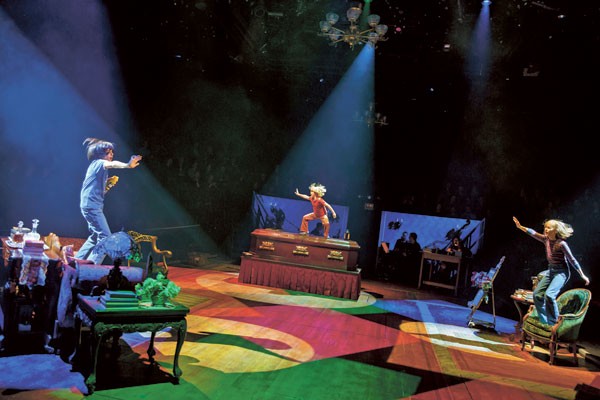
Fun Home (***3/4) — Lisa Kron has turned Alison Bechdel’s gay autobiographical novel into an anguished-yet-luminous memory play worthy not only of a Tony Award for best musical but also a Pulitzer Prize nom for best drama. Kron’s alchemy with composer Jeanine Tesori is no less magical, yielding a score that tingles with natural monologues and dialogues and shimmers with soaring, sometimes jubilant melody. The twin poles of fascination here are Alison, played by three different actresses as she reaches her current age of 43, and her domineering, charismatic father.

Aside from being a closeted gay man, Bruce is an ardent, unforgettable English teacher at the local high school in rural Pennsylvania and the ultra-fastidious owner — and restorer — of Bechdel’s Funeral Home.

“Fun Home” is the slick nickname Alison and her two siblings come up with when they ponder how they might advertise the family biz on TV. The fun lasts well into Alison’s college years at Oberlin, where she discovers she is a lesbian and finds her first love. Bechdel’s novel cannot make lesbian love as wholesome, youthful, natural, and joyous as Emily Skeggs singing “I’m changing my major to sex with Joan.”

But the fun abruptly ends when Dad spirals downward and commits suicide. Alison is left to pick up the pieces, rummage through them for clues, and construct a narrative that makes sense of it all – frame by frame on her sketchpad. For that reason, Beth Malone, observing her younger selves pad-in-hand as our narrator, has a far less engaging role as fully-mature Alison than Skeggs has as Medium Alison. The tomboyish collegian awakens to her true sexuality through the ministrations of the smart, confidently seductive Joan, given a spot-on activist cool by Roberta Colindrez.

None of the Alisons, not even Gabriella Pizzolo as the adorable Small Alison, is nearly as compelling as Michael Cerveris as the enigmatic Bruce. That’s how it should be, because Bechdel’s novel concentrates on the many facets of her father from its opening panel. It’s a breathtaking range, including cruelty and perversion, and as commanding as I found Cerveris in 2010 as the sexist physician in Sarah Ruhl’s notorious Vibrator Play, he surpasses himself here: gentler and more human than the Bruce that Bechdel’s novel introduces us to, yet still as deeply self-loathing.

With Sam Gold’s stage direction, abetted by Ben Stanton’s lighting, I found myself well-acquainted with the Bechdel family after the 99 intermissionless minutes I spent with them, especially in the intimate confines of the Circle in the Square theater. My only quibble was with how much there was to absorb so quickly. For that reason, I’d recommend streaming the cast album after you’ve seen the musical. It not only gives you a second chance to savor Tesori’s tunes and Kron’s deft lyrics, it also preserves generous chunks of the spoken dialogue.
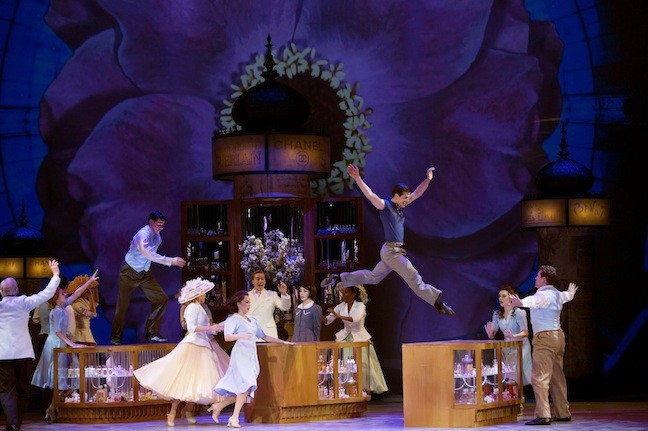
An American in Paris (***3/4) You may need to adore ballet and modern dance as much as I do to be fully swept away by director/choreographer Christopher Wheeldon’s bold homage to the famed Gene Kelly-Leslie Caron movie. Taking the characters of Alan Jay Lerner’s 1951 screenplay as a jumping-off point, Craig Lucas also steers the book more emphatically toward a post-war celebration of dance. Most of the melody remains the same, if you consider that the title ballet was a 17-minute extravaganza on celluloid, but the music and lyrics of the Gershwin brothers have been reshuffled and refortified.

There’s more variety to the music and choreography now – and more meat to the story. Jerry Mulligan remains an aspiring painter and illustrator who lingers in Paris after V-Day, but Lise, the girl he pursues all around the city, is no longer a mere shopgirl. She’s a mesmerizing ballerina with prodigious talent. A prestigious ballet company director wants to hire her after a brief audition, Jerry’s composer friend Adam wants to write a ballet for her, and her longtime protector Henri is working up the courage to ask for her hand in marriage.

Basically, the same obstacles are strewn in Jerry’s path to bliss that were in the film. Lise feels beholden to Henri because she and her Jewish family were sheltered by his family during the Nazi Occupation. At the same time, Jerry must resist the temptations offered by the predatory Milo, a poised and sophisticated patroness bent on seducing Jerry. But here Milo’s philanthropy throws a wider net than simply offering to bankroll an exhibition of Jerry’s work. Here she proposes to commission a new ballet; fostering the ambitions of Adam, who will compose it, Jerry, who will design it; and of course, Lise – the whole piece will be built around this new étoile.

An artsy bunch, all in all, considering that Henri longs to break free from his parents’ sway and become a cabaret singer. But while it’s engaging to watch the romantic complications sort themselves out, the show really gets its kick from Wheedon’s audacious ensemble dances – and takes flight on the wings of the two lovebirds, Robert Fairchild as Jerry and Leanne Cope as Lise. On Wednesdays, you have to choose one or the other, depending on whether you book the matinee or evening performance. The press rep (a woman, I might note) steered me toward the matinee, when Fairchild performs.

A principal dancer with the New York City Ballet, Fairchild has a more classic style than either Gene Kelly or Fred Astaire – and he doesn’t have to flash his moves to attract the fair sex. Singing the Gershwins’ “Liza” and “I’ve Got Beginner’s Luck,” Fairchild’s voice tops off his triple-threat credentials, evoking the velvety sound of Michael Feinstein. Subbing for Cope, Sarah Esty seemed to be the ideal partner for Fairchild, slim and delicate with a Leslie Caron allure lurking in her modesty. She’s no slouch as a ballerina, with a Princess Grace Award on her résumé.

My only disappointment, after hearing Max von Essen on the cast album, was to find Nathan Madden bringing Henri’s French accent to “I’ve Got Rhythm” – and prodding Adam to pep up the tempo. Brandon Uranowitz, another original cast member, delivers Adam’s bohemian pessimism with a Woody Allen twinkle, and Jill Paice is purest porcelain as Milo, just what you’d expect 65 years after Nina Foch originated the role.
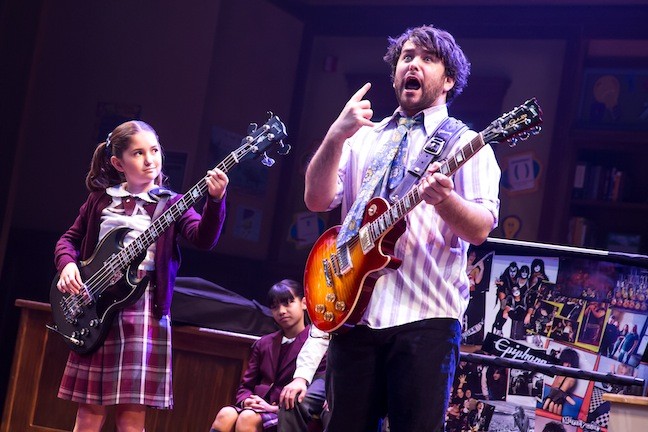
School of Rock (***1/2) — There’s very little that I can say in defense of Dewey. He’s loud and obnoxious, deceitful and undependable, slovenly and insensitive, and there’s no way this broke, borrowing loser can get a respectable job unless he steals his best friend’s name and résumé to do it. Or let me put it another way: Dewey is the raging, rambunctious soul of rock ‘n’ roll!

Who would have predicted that His Lordship, Andrew Lloyd Webber, would have added such a shambling misfit to a musical pantheon that includes Evita, Norma Desmond, and The Phantom of Opera – not to mention the biblical Jesus, Joseph, and Deuteronomy!? Musically, Lloyd Weber has tossed dignity to the winds in crafting his adaptation of the popular 2003 Jack Black film. Working with lyricist Glenn Slater, Lord Lloyd produces songs that are loudly arrogant like “I’m Too Hot for You,” loudly anti-establishment like “Stick It to the Man,” loudly defiant like “If Only You Would Listen,” and just loudly stupid like “When I Climb to the Top of Mount Rock.”

As we witness the culture clash that happens when Dewey signs on as a substitute teacher at a straight-laced prep school, the occasional excursions away from hard rock are dictated by the action. Students and faculty sing the school alma mater, the too-tightly-wound principal ascends to the throne of “Queen of the Night” (yes, from Mozart’s The Magic Flute) at choir practice, and when the shy black girl finally breaks her silence in Act 2, she sings an amazing “Amazing Grace.”

Amid the basic chords of Pink Floyd, the Rolling Stones, and the wild jungle of heavy metal, there are no American Idol power ballads here. On the contrary, His Lordship hints that he himself might be tired of hearing “Memory” from Cats.

Like Dewey, the composer has had to become perversely devout. Molding his middle-schoolers into an ensemble worthy of competing for the prize money in a battle of the bands contest, Dewey finds that he must treat and respect his students as people – something their teachers and parents haven’t done. Being the man for once instead of always flouting him, Dewey grows up a little. The rascally con man may have even become vulnerable to love by the time the jig is up.

Four nights after School of Rock officially opened, the Winter Garden was filled to capacity and audience enthusiasm was sometimes louder than the band. It was lit by Alex Brightman’s incendiary performance as Dewey, leonine in its energy and fury – and teddy bear-like in its clumsy attempts at humanity. Sierra Boggess, ranging from stiff Mozart to loosey-goosey boogie while principal Rosalie gradually lets her hair down, is also a treat.

But the pre-recorded announcement that the boys and girls onstage will actually be playing their instruments proved to be necessary almost as soon as they showed off their chops. Under the keen direction of Laurence Connor, Brightman is more than willing to let the precocious kids shine. Letting them have a good time performing for a packed house seems to lift Brightman’s spirits as the evening progresses – and they’re coke-high to begin with.
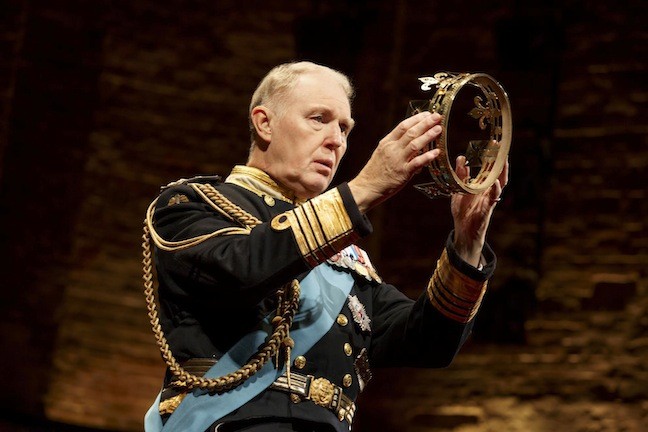
King Charles III (***1/2) — Not so long ago, Queen Elizabeth II became the longest serving monarch in the history of the British Crown. With bard-like presumption, playwright Mike Bartlett peeps into the future and divines what will happen when the longest-tenured heir apparent to the throne finally gets his hands around that precious circle of gold.

Bartlett models his drama on the tragedies and histories of Shakespeare, so we haven’t had to swallow this much blank verse in a contemporary Broadway play since the heyday of Maxwell Anderson. Except for the fact that he’s getting a crown in his declining years rather than yielding it, Tim Pigott-Smith as Charles III is often very Lear-like in his quixotic dealings with his family and Parliament. Somehow in his dotage, Charles has latched onto the notion that being the King of England and assorted remnants of the British Empire ought to count for something in determining how his nation is ruled.

Crowned and presented with a bill that would curb the intrusions of the press into his own royal family, Charles refuses to sign, urging the MPs to reconsider before he does. Such regal arrogance does not go down well with Mr. Evans, the sitting Prime Minister, and we suspect that the support Charles gets from Mr. Stevens, the leader of the opposition, is based less on principle than on political opportunism.

And of course, the cantankerous King is beset by thankless children – and haunted by the ghost of Diana. Yes, there is a conspicuous falling off between the saintly Diana (Sally Scott) who seraphically haunts Buckingham Palace by night and the frumpy Camilla (Margot Leicester), particularly since Charles’s second wife has been afforded the luxury of aging.

Things grow royally trashy when we cut away to the kids. Egged on by the former Kate Middleton, Prince William is quite capable of taking advantage of the growing constitutional crisis and snatching the crown for himself. Echoes of Lady Macbeth are unmistakable in the slim, sleek Lydia Wilson’s portrayal of Kate. With better makeup, a more fashionable wardrobe, she’s a cover girl even in her mourning dress.

William’s resistance to Kate’s rapacious hunger for power is rooted in his keen understanding of the innocuousness demanded of a modern monarch. If he is to prevail, it will be through sheer charm and vapid glamor. Oliver Chris wields all these scepters as if he’s born to it. We just don’t hear this urbane scoundrel very clearly because, like Adam James as the PM, he’s too intent on making Bartlett’s verse sound like everyday chitchat. Sadly, they succeed.

There’s a touch of Hamlet in Charles’s vacillations and in his haunting by Diana, but much the same can be said about little brother Richard Goulding as Harry, who thinks about chucking the whole royal scene for the real world. Goaded in that direction by Tafline Steen as Jess, Harry’s latest flame, the family screw-up gets a taste of an anti-Kate. Goulding offers us the Prince Hal aspects of Harry’s peccadillos, striking me as a younger version of Kenneth Branagh’s Henry V, while Steen is deliciously instinctive, principled, and rough around the edges.

Plagued by a toxic Congress, we may be more sympathetic to this steely Charles III than his countrymen might be. Make no mistake, in Bartlett’s prognostications for the future, he is very much dissecting and eviscerating the present. Doing it in Shakespearean style just underscores how far we’ve fallen. (Through January 31)

Allegiance (***1/4) — With xenophobia running amuck across our republic, perhaps even deciding the upcoming presidential election, there could hardly be a more opportune moment for exploring the shameful time in our history when we herded Japanese Americans into concentration camps in response to the attack on Pearl Harbor. We haven’t reacted to 9/11 with quite the same fevered paranoia, but after the recent terrorist attacks in Paris, there were ominous echoes in Donald Trump’s stump speeches – and tweets! – when this new musical opened in November.

Unfortunately, as we’ve seen recently when Birds of a Feather opened at Spirit Square, each time playwright Marc Acito touches a hot topic or issue, his script devoutly avoids stirring up emotions with advocacy. In the aftermath of the widespread censorship of And Tango Makes Three, Acito’s Birds managed to so thoroughly dilute the story of Roy and Silo, two gay Central Park penguins who inspired that banned children’s book, that both birds were satirically neutered.

Acito is collaborating on this timely project with Jay Kuo, who also wrote the score, and Lorenzo Thione. But it actually began in 2008, when Kuo and Thione met with George Takei, who stars as our reminiscing narrator, Sam Kimura. Best-known – and loved – for his role as Mr. Sulu in Star Trek, Takei and his family were among 120,000 Japanese Americans who were incarcerated in the camps during WW2, forcefully evacuated from his home in LA and sent to a relocation center in Arkansas.

Those events are replicated in retrospect, with Telly Leung sidling in as the young Sammy, opera singer Christòpheren Nomura providing substantial backbone as his father, and Lea Salonga – a Broadway star since opening night of Miss Saigon in 1991 – providing an interesting counterweight to the other Kimuras as Sammy’s older sister.

So instead of focusing on the wave of paranoia and bigotry, by Americans and their government, that robbed citizens like Takei of their liberty through most of their childhood, we lock in on the conflicting ways that the Kimuras chose to personify gaman, the Japanese concept of “endurance with dignity.” Tatsuo, Sammy’s father, stands up for his principles by refusing to capitulate to the loyalty questionnaire our government distributed to internees – demanding their pledge of allegiance in writing.

Sammy took the opposite path, not only filling out his questionnaire with the answers Uncle Sam expected but also enlisting in a special Army unit. Sammy is bent on demonstrating his willingness – and his people’s – to go into battle for America and to accept the most hazardous duty Uncle Sam can devise. The resulting family rift can never be healed.

Amid the semi-fictional Kimuras, I found myself intrigued by the one true-life character in Allegiance, Mike Masaoka, the national spokesman for the Japanese American Citizens League. From the safety of Washington, DC, he urged all Japanese Americans to cooperate with the government’s actions – and accept pennies-on-the-dollar offers for their property – rather than question the constitutionality of this Nazi-like roundup.

By the end of the evening, all the Kimuras despised Masaoka. Thanks to the scripted, pampered sleaziness by Greg Watanabe, I also grew to hate Masaoka more than anyone else I saw onstage. With all the unjust indignities heaped upon innocent Japanese citizens, I would rather that my outrage had been channeled toward some of the white bastards who were truly responsible. With the same obliquity of its title, Allegiance denounces their unconscionable actions by showing us the humanity, fortitude, and character of their victims. (Through February 14)
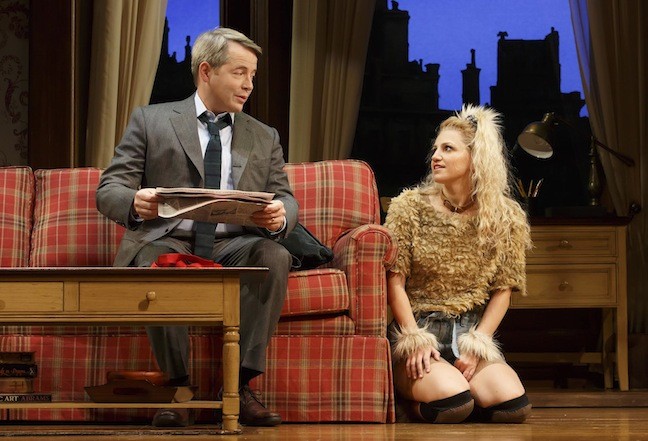
Sylvia (***) — A.R. Gurney’s frisky comedy has been mounted so many times in Charlotte that it can be considered a modern classic. Yet until last October, it hadn’t been done on Broadway. The original 1995 production, starring Sarah Jessica Parker in the title role, ran less than five months, and by the time I caught up with it, the late Jan Hooks of SNL fame had taken settled into the doggie leash.

So it’s quite possible that Parker’s husband, Matthew Broderick, logged more performances in Sylvia during the limited three-month engagement (including previews) that ended less than two weeks ago. Undoubtedly, more people saw Broderick as Greg, the disgruntled commodities trader who spirals into a midlife crisis after indulging and adulating a stray pooch that he picks up in Central Park. The Cort Theatre, where this revival was staged, has more than three times the capacity of the site where the Manhattan Theatre Club first birthed Gurney’s bedraggled part-poodle.

I can’t say that the upsizing does Gurney any favors – aside from allowing him to charmingly record the pre-show cautions about candy wrappers and cell phones. The larger stage allows David Rockwell the opportunity to create a set design encompassing a large swath of the park with imposing luxury hotels in the background. It’s also cool to see Greg’s apartment drop out of the flyloft while the bosky cityscape remains visible through its windows.

But I like Greg better in a small theater where I feel like I’m intruding on his space. On the Broadway stage, Greg is in our larger space – diminished because Broderick is too much the artist to upsize him into theatricality. Annaleigh Ashford takes fierce hold of that job as the mouthy, doggie lead. She can only have gained in stature and confidence since she first won my heart during the summer of 2013 in Kinky Boots. Last season, she snagged a Tony for her role in the You Can’t Take It With You revival.

Under Daniel Sullivan’s direction, Ashford seemed to be straining at times to carry the comedy on her haunches. On the other hand, Julie White as Greg’s increasingly stressed – and jealous – wife Kate seemed exactly the right size, striking a wonderful tone that discarded the shrewishness I’ve seen from other actresses in favor of a very literate exasperation. The lady quotes Shakespeare, after all.

Robert Sella took on the three juicy cameos, but only one of them scored well. Working as Ashford’s foil, Sella was hilarious as Kate’s friend Phyllis, increasingly alarmed by Sylvia’s physical attentions to the point where her visit ended abruptly in panic. Encounters with Tom, the manly owner of the dog who deflowers Sylvia, failed to detonate as well as any of the Charlotte productions I’ve seen. Late in Act 2, both Sullivan and Sella seemed to miss the point of Leslie, the neurotic therapist of indeterminate gender who presumes to offer counseling to Greg and Kate – even though she’s clearly more unstable than either of them.

It was toward the end, when the action became dramatic, that the rapport between the three leads jelled most effectively. The aftershow was also charming, with pictures of audience members’ pets projected on the upstage wall, submitted via social media.

The Lullaby Off-Broadway

By Perry Tannenbaum

Hir (***3/4) – Taylor Mac and I have a history. When I first saw him at Spoleto Festival USA in 2008, the highlight of his one-man Be(a)st of Taylor Mac came when he donned a ginormous set of singing boobs to deliver one of his greatest hits, “The Revolution Will Not Be Masculinized.” Three years later, it got more personal. Now it was his festival, bitches, renamed the Stiletto Festival. Mid-performance, he stopped to ask me why I was writing. Mac not only found my answer cool, he called me “Honey”!

So as I planned my latest New York pilgrimage, when I learned that Mac had penned a new play — and that he and his ukulele were not in it — I was intrigued and a little skeptical. As Mac himself freely admits in his illuminating essay included in the Playwrights Horizons playbill, Hir is a totally new kind of venture for him, a plunge into the mainstream.

He’s riffing on the hopeless environment he grew up in — Stockton, California — “one of those places where the American dream got stuck in an American reality.” The family situation; Mom and Dad living in their starter home for 30 years, raising two boys who are now fully grown; echoes Mac’s own upbringing. But the realism pretty much stops there.

What we see at curtain rise is no less disturbing than the explosive ending Mac has in store, just more strangely comical. The living room/dining room/kitchen is chaotic — with a willful vengeance, a tacky mess-terpiece by set designer David Zinn.

In the corner, by the side door (the front door has been sacrificed to a mound of junk), a man adorned with clown wig and makeup lives and sleeps in a cardboard box. He’s still in his nightgown — and his diaper may need changing.

Enter our returning war vet, Isaac, a Marine who has served the past three years in Mortuary Affairs, doing what must be done with body parts retrieved from combat. What he sees blows his mind, for the man is Isaac’s father, Arnold, debilitated from a massive stroke during his son’s absence. His formerly meek mother, Paige, not only condones her husband’s degraded condition, she forcibly insists on it. This is her ghoulish retribution for the years that she suffered abuse at Arnold’s hands. Same thing with the epic clutter. Don’t you dare clean that disgusting sink!

A bigger surprise emerges from the bedroom. Isaac’s younger sister, Maxine, is now transgendered as Max, a walking new New Testament of thou-shall-nots. Ze is the pronoun that must replace he or she, and from now on, him or her are off-limits when referring to Max. It’s hir. Ze also would have us acknowledge Mona Lisa’s true gender and discard the Old Testament, due to the gender bias evident in the Noah’s Ark story.

Beyond seeing his baby sis sprouting a beard, future shock besets Isaac, who presumably never got the memo that trannies are no longer content with mere tolerance and equality. But instead of staying focused on Max, Hir becomes a pitched battle over how Arnold should be treated and whether order should return to Isaac’s home.

The chief reason why this dark comedy worked so well, despite somewhat betraying its title, was the astounding Kristine Nielsen as Paige, more frightfully eccentric than she was in Vanya and Sonia and Masha and Spike and just as funny despite all her sadism. No less colorful in his nearly silent role, Daniel Oreskes as Arnold ably bestrides the pitiful invalid he is now and the brute he once was.

The brothers, less traveled than the true theatre vets, were also very fine. Under Niegel Smith’s deft direction, Cameron Scoggins gradually allows us to see the upside of Isaac’s spit-and-polish temperament. And in so many ways, Tom Phelan is the antithesis of Mac as Max. Despite a certain amount of brashness and defiance, we can see that Max is sensitive, vulnerable, and normal. There are no sequins in his makeup kit. All in all, Max may be the most wholesome person we see, the Medium Mac of Mac’s uniquely twisted Fun Home.

While his preoccupation with Paige strays from the subject promised in his title, Hir doesn’t stray from its main theme. It’s a question, really: how far can we go in redressing past abuses before we become the abusers? You can bet we’ll see a Charlotte company address that question as soon as it can get the production rights. Much of what’s wrong with today’s world is wrapped up in that explosive question.That’s exactly right. I’m accusing Taylor Mac of profundity. (Closed on January 3)

Colin Quinn: The New York Story (***1/4) — It’s interesting to observe how Quinn has flipped his basic thesis since his previous off-Broadway hit of 2011, Long Story Short. In that story of world history, ranging from the days of the Greek and Roman Empires right up to the just-completed economic summit in Davos, Switzerland, Quinn debunked the notion that humanity had progressed and evolved. All you needed to do was pick up a copy of today’s newspaper, and you’d find such presumptions of evolution decisively refuted.

Now, he’s telling the story of New York from the opposite perspective, showing us how the characteristics we now associate with New Yorkers are the result of successive waves of immigrants washing onto the shores of Manhattan, beginning with the original Dutch settlers. So why are New Yorkers so pushy, so blunt, so cynical, so rude, so snobbish and so cultured? The answers lie in the cavalcade of nationalities that didn’t altogether melt into the city’s melting pot: Dutchmen, Germans, Irish, Jews, Italians, Blacks, Greeks, Chinese, Russians, Dominicans, Arabs and East Indians.

Some of these groups were already in Quinn’s crosshairs back in 2011, when he also had some choice quips about the French, the Israelis, and Indians. But if you haven’t heard any good Polish jokes lately — or if you’ve been a bit freaked about how Mexicans, Muslims and Syrians are being mentioned in political discourse — you might share my notion that times have changed as radically as Quinn’s historical perspective.

Ethnic humor isn’t as innocent and carefree as it was just five years ago. Perhaps that’s the reason why Quinn, who only seemed nervous when his show began in 2011 (in a performance that was filmed by HBO), displayed some nervousness spasmodically for the entire 67 minutes. The SNL alum is sharper than ever in his analysis, but he’s more keenly aware that he must tread carefully. (Through January 31)

 nutcracker_rouge.jpg

Nutcracker Rouge (***) – Fin de siècle decadence was already in full swing when Tchaikovsky joined choreographer Marius Petipa in producing a new yuletide ballet in December 1892. Perhaps it was the lack of decadence in this sugary adaptation of E.T.A. Hoffman’s The Nutcracker and the Mouse King that caused it to fail. While orchestras retained their affection for the Nutcracker Suite, gleaned from the score’s greatest hits, the ballet didn’t gain traction until the San Francisco Ballet made it a holiday tradition in 1944 and George Balanchine’s New York City Ballet followed suit a decade later.

So can we say that Company XIV’s radical alteration of the now-beloved ballet–making it bluer, raunchier, and more acrobatic — is simply bringing us what The Nutcracker should have been all along? Nah. Director/choreographer Austin McComick only begins by relocating Marie-Claire’s sugarplum discoveries from the Land of Sweets to a land of hedonistic abandon. He and our burlesque hostess, zaftig Shelly Watson as Madame Drosselmeyer, also take us far beyond the bounds of Tchaikovsky’s music.

I knew that this wicked confection would be for 16-and-over audiences only, but I was surprised to discover that photography was not only permitted but also encouraged. Tweet your naughtiest shots during the show if you wish, nobody will mind. Luckily, I had my camera with me, for the orgy of picture-taking that I indulged in would have surely exhausted my cell phone’s battery.

Yes, I watched a goodly portion of Nutcracker Rouge through the 3-inch monitor of my Canon G15, and it did occur to me that this might be somewhat unprofessional. But how else could I plumb the true depths of this voyeuristic experience?

There were orgiastic ensembles complete with simulated copulation, an artsy pole dance, an S&M-lesbian episode, a cross-dressing stag party and a kick line of man-poodles. There were also lyrical moments, particularly when Marcy Richardson soared above us into star-studded blackness on an aerial hoop, singing an operatic arrangement of Sia’s “Chandelier.” There may be a few messages from Cirque du Soleil on Richardson’s voicemail. Vegas beckons!

Straddling the gulf between kinkiness and lyricism, Laura Careless as Marie-Claire shed her hoop skirt and corset — and nearly everything else — to dance Tchaikovsky’s climactic “Grand Pas de Deux.” Steven Trumon Gray, wearing nothing more than a florid military coat and a thong, was her Nutcracker Cavalier. Careless has made the sexual awakening of Marie-Claire into her signature role over the course of six years with Company XIV, and she owns it with an expressiveness worthy of the best dancers we’ve had here in the Charlotte Ballet.

Inevitably, Careless’s awakening isn’t as vernal as it once must have been. There’s an unstated conspiracy now between the innocent ballerina and her expectant audience. We all understand that her ignorance, innocence, and shock are all artfully shammed, which gives her fantastical adventure an extra jolt of witchery. (Through January 17)

 ruthless.jpg

Ruthless! (**1/2) – Written and directed by Joel Paley, with music by Marvin Laird, this high-energy spoof, billed as “The Stage Mother of All Musicals,” first stormed onto the off-Broadway scene early in 1992 and snagged the 1993 Outer Critics Circle Award. When it arrived here in 1995, Ruthless! pretty much swept CL’s Charlotte Theatre Awards, including our Show of the Year, encouraging Vance Theatrical Organization to reprise their production in 1996.

Precocious child actress Tina Denmark is the main attraction. Tina can pout impressively, toss a tantrum, or even sob unconvincingly. When these ploys let her down, there’s murder. Tina will literally kill for a role at her school’s upcoming Pippi Longstocking. “But not just any role,” she protests. “The lead!”

Sylvia St. Croix becomes Tina’s manager and agent, hiding the fact that she’s actually her grandmother, the shattered Ruth Del Marco, slain by a critic’s sarcastic review. Believing that Ruth had committed suicide because of her review, the guilt-ridden critic adopted Judy, never letting her know her true origins. So while there’s murder, deception, and violence lurking in the Del Marco/Denmark gene pool, there’s also — talent!

As you might expect in a stage mother spoof, Gypsy is a prime target, but only one of many. Paley recommends that the entire production team should also familiarize themselves The Bad Seed, All About Eve, The Women and Valley of the Dolls. Back then, you might have also found hints of Mame, Cats, A Chorus Line, Mommie Dearest and A Star Is Born, plus a string of long-forgotten Broadway and Hollywood drivel.

So what went wrong in the current revival, also directed by Paley? A couple of things leap to mind. First, he decided to streamline the show to 90 minutes, ditch the intermission, and quicken the pace. Why? So many of those titles in the catalogue above may be too forgotten, 24 years later, to remain ripe targets for mockery. Updating those sharp attacks within the Ruthless framework would have been a mighty challenge. Yet the streamlined result seems thin and hurried. The bang-bang finish that once was so wildly absurd and hilarious is now little more than a blur.

Perhaps more to the point, Paley has continued to maintain that Ruthless is an all-woman show and that the only reason why the over-the-top stage grandmother Sylvia St. Croix is traditionally played by a man is because a man, Joel Vig, gave the best audition for the premiere production. So it would seem that Paul Pecorino, who has replaced Peter Land, is playing Sylvia as an actor disguised as a woman – with little of the effeminate bravura that would gush forth from an authentic drag queen.

Back in 1995, it never occurred to me that Steve Bryan’s diva rendition of Sylvia was better than Vig’s. But it should have, because he was certainly better then than Pecorino is now. Way better. The rest of Paley’s new cast does measure up, beginning with Tori Murray as Tina, a beauty contest belter with an insane evil streak. Kim Maresca as her mother Judy is as perfect a housekeeper as Tina is an ingénue — with similar schizoid tendencies.

Yet Rita McKenzie as theatre critic Lita Encore upstages her daughter in the big show-stopping song, “I Hate Musicals.” This is preternatural, Ethel Merman-sized hatred for a critic’s daily bread, and McKenzie nearly does it as brashly and robustly as dear Deborah Rhodes did it here in ’95 and ’96. God bless ’em both. (Through April 2)

50 Ways to Leave Your Sofa: the Best of Charlotte Theatre in 2015

There really was a time when I could legitimately claim to have seen every theatre production that Charlotte had to offer. So when I tell you that I saw 67 comedies, dramas, and musicals during 1988 — the first full calendar year that the Loaf was dispensed in our ugly green boxes — well, that’s pretty close to all there was, folks. Even among that manageable number of productions, a few from Concord, Davidson, Winthrop, and UNC Charlotte padded the total.

Nowadays, I can’t really keep up with it all. When the ball drops in Times Square later this week, I will have seen upwards of 85 events in the Metrolina area that exhibited the spark of live theatre. And I will have missed at least 46 more — not counting productions in Concord, Winthrop, and UNC Charlotte.

On rare occasions, I get the feeling that quality of local presentations has grown as lushly as quantity. Just after Labor Day, when the 2015-16 season unofficially launched, our most professional adult company in town, Actor’s Theatre of Charlotte, was running The Patron Saint of Losing Sleep, winner of their second nuVoices New Play Festival competition. It was arguably no better than the fourth-best homegrown show opening that week, behind Theatre Charlotte’s La Cage aux Folles, Queen City Theatre Company’s The Money Shot, and — up yonder in Cornelius — The Warehouse’s Wonder of the World.

The latter three are among my picks for the 50 Best Charlotte Theatre Productions of 2015 that you’ll find posted online at our website. We need not shed crocodile tears for Actor’s Theatre as their lease on Stonewall Street lapses, for you’ll find four or five of their other productions on that list, with strong candidates for top comedy, drama, and musical among them.

But when have we ever been able to say the same thing about Theatre Charlotte, CPCC Theatre, and Children’s Theatre of Charlotte all in the same year? Yup, 2015 was pretty historic hereabouts for its theatrical excellence.

Sure, these companies are filling the voids left by the implosions of Charlotte Repertory Theatre in 2005 and CAST in 2014. But they’re just part of the story.

Rep was the resident company at Booth Playhouse while they were twisting in the last throes of their death spiral. In the years since they left, Blumenthal Performing Arts has dramatically augmented their theatrical offerings. While top-tier tours are playing at Belk Theater in their longstanding Broadway Lights series, the Blumenthal is increasingly importing Off-Broadway attractions to their smaller venues, including the Booth, whose exterior often sports an authentic Broadway vulgarity these days.

50 Shades! The Musical Parody, Dixie’s Tupperware Party, Menopause the Musical Survivor Tour, Evil Dead The Musical and Love, Loss, and What I Wore are among the pint-sized theatricals that Blumenthal brought to us in 2015. Meanwhile, they’ve grown more proactive in other performing arts, most notably in jazz and dance. Although their Jazz Room series is already in full swing, Blumenthal PA’s biggest jazz splash is yet to come, with the debut of the new Charlotte Jazz Festival set for April 22-23.

With visits from Martha Graham Dance Company, Momix, and this week’s Hip Hop Nutcracker, you might infer that Blumenthal has designs on establishing Charlotte as a hub for modern dance, anchored by our own Charlotte Ballet. But when they staged the first Breakin’ Convention at Levine Avenue of the Arts and Knight Theater for two days in October — with commitments to reprise the Sadler’s Wells import twice more through 2017 — we could heartily declare a mission accomplished.

Up in NoDa, where CAST left its void, the scenario has been subtler. When we broke the story of how another rogue theater board of directors wimped their way to oblivion — on the same real estate where Rep’s administrative offices and rehearsal space had stood — we recapped the final hours when CAST founder Michael Simmons had reached out to UpStage impresario Michael Ford. Simmons’ scheme to partner with Ford in leasing the 2424 N. Davidson St. site never came to fruition.

Yet the overflow demand for bookings at UpStage, fueling Ford’s interest in extra space at CAST’s multiple stages, didn’t evaporate. How could Appalachian Creative Theatre, Charlotte’s Off-Broadway, Citizens of the Universe, FroShow Productions, Innate Productions, PaperHouse Theatre, Quixotic Theatre, TAPROOT, Three Bone Theatre, and XOXO all create in peace and harmony in the spacious grunge of Ford’s trendy NoDa landmark?

Even with the formation of the League of Independent Theatres (LIT), such coordination was impossible. The overflow of booking demand took a migratory turn, and the geographical overflow irrigated sites in NoDa and the surrounding area that hadn’t hosted theatre before or recently. Led by visionary eccentric James Cartee, Citizens of the Universe (COTU) did most of the groundbreaking. First they tilled 100 Gardens on 36th Street, transplanted one of their staples to Tommy’s Pub in Plaza-Midwood, took a Beowulf detour to Spirit Square, overran NoDa’s streets in a second annual pursuit of Jack the Ripper, and occupied NoDa’s signature consignment shop, Salvaged Beauty, for a suitably retro Halloween.

Other explorations were auspicious. Nicia Carla took Oscar Wilde to the vintage Frock Shop on Central Avenue, Brianna Smith’s TAPROOT and Caroline Renfro’s FroShow reclaimed the 1212 Studio on E. 10th St., and Donna Scott Productions revived the Charlotte Art League in SouthEnd as a theatre destination. Finally, the COTU odyssey weighed anchor in the desolation of 2424 N. Davidson. Yes, The Woolgatherer was staged on the same property where CAST had decamped. Actually, their most recent effort played out at the 28th Street entrance to the site, where the lobby to Charlotte Rep’s offices had once been. How’s that for tying the essence of 2015 into a neat little bow?

I’ll do the same by naming my choices for best comedies, dramas, and musicals for 2015. Winners are shown in bold with Show of the Year in caps.

Comedies: Bad Jews (Actor’s Theatre), Boeing Boeing (CPCC), The Book of Liz (Donna Scott Productions), Lilly’s Purple Plastic Purse (Children’s Theatre), The Money Shot (Queen City), A Woman of No Importance (PaperHouse), Wonder of the World (The Warehouse)

Dramas: Detroit (Actor’s Theatre), 4000 Miles (Three Bone), Jackie & Me (Children’s Theatre), Joe Turner’s Come and Gone (CPCC), The Lion in Winter (COTU), The Normal Heart (Theatre Charlotte), Seven Guitars (On Q Performing Arts)

Musicals: Chicago (Davidson Community Players), Ella’s Big Chance (Children’s Theatre), La Cage aux Folles (Theatre Charlotte), The Phantom of the Opera (CPCC), Rock of Ages (Actor’s Theatre), Spunk (On Q), Young Frankenstein (CPCC)

And what about those touring productions that invaded Belk Theater? The best were Newsies, Pippin, and Kinky Boots. The winner is pretty obvious, since the Kinky Boots is back at the Belk this week.


50 WAYS TO LEAVE YOUR SOFA: Roll the Credits!

Here are the best shows Charlotte theater companies had to offer in 2015, listed alphabetically by company. Where more than one show is listed for a company, shows are given chronologically.

Actor’s Theatre of Charlotte

Caesar’s Blood [staged reading]

Stick Fly

*Detroit

*Rock of Ages

*Bad Jews

Appalachian Creative Theatre

Sylvia

Children’s Theatre of Charlotte

Mike Mulligan and His Steam Shovel

*Lilly’s Purple Plastic Purse

*Jackie & Me

Coraline

*Ella’s Big Chance

‘Twas the Night Before…

Citizens of the Universe

1984

*The Lion in Winter

Beowulf

The Woolgatherer

CPCC Theatre

*Joe Turner’s Come and Gone

Oliver!

Anything Goes

*Boeing Boeing

*Young Frankenstein

The Trip to Bountiful

*The Phantom of the Opera

Davidson College

What You Will

Davidson Community Players

Ordinary People

*Chicago

Donna Scott Productions

Shiloh Rules

*The Book of Liz

FroShow Productions

Grounded

Innate Productions

Three Tall Women

On Q Performing Arts

*Seven Guitars

*Spunk

PaperHouse Theatre

*A WOMAN OF NO IMPORTANCE

Queen City Theatre Company

Buyer & Cellar

*The Money Shot

Quixotic Theatre

The Pillowman

Shakespeare Carolina

Henry V

The Picture of Dorian Gray

Theatre Charlotte

Harvey

*The Normal Heart

Jesus Christ Superstar

*La Cage aux Folles

Dracula

The Avant Guardians

Bull

The Playworks Group

Lunch at the Piccadilly

The Warehouse

Barrymore

*Wonder of the World

Three Bone Theatre

2 Across

*4000 Miles

Two Rooms

* – category nominees

Bold – category winners

Bold caps – Show of the Year.

Imagining a More Inclusive Yule @ ImaginOn

Children’s Theatre looks beyond Christmas

Scratch the wreath from a Starbuck’s cup design and you get an uproar: they’re defiling religion and steamrolling Christianity into oblivion! As usual, the silent majority is loud enough to drown out the opposing viewpoint — that the ever-expanding commercializing and mythologizing of Christmas is numbingly repetitive and downright offensive to those of us who believe differently. A few of us don’t welcome the sound of jingling bells and jolly Santas from mid-October through late December. And some of “us” could be Christians.

Long, long ago, it was past time to push back. So, it’s nice to hear that freedom of religion isn’t a mere shibboleth at Children’s Theatre of Charlotte. Not only are they daring to program a non-Christmas show at one of their two theaters at ImaginOn this December, they’re revamping the remaining Christmas show so it yields space to Chanukah and Kwanzaa.

As daring as this undertaking is, it’s even more ambitious. The non-Christmas show is Ella’s Big Chance: A Jazz Age Cinderella, and the Yuletide offering is ‘Twas the Night Before. Both of these productions are spanking-new world premieres, both commissioned by Children’s Theatre. On top of that, Ella is also a musical. Adapted from Shirley Hughes’ children’s book by Joan Cushing, Ella is a formidable project all by itself.

So, the first question I needed to ask artistic director Adam Burke, who’s directing Ella, was when did you lose your mind, shepherding two premieres to ImaginOn at the same time? But that struck me as a bit hostile, so I bumped it down to my second question.

“I’m surprised that you are the first person to ask me that!” Burke confessed. One thing that has made this double-plunge feasible is the confidence that Children’s Theatre has in Cushing, who previously premiered a new musical, A Christmas Doll, back in 2007, before Burke arrived in Charlotte. Besides that piece, numerous other Cushing musicals have enjoyed success at ImaginOn, including Junie B. Jones and the wickedest Red Riding Hood adaptation you’ll ever see, the Cajun-spiced Petite Rouge.

Make no mistake, Ella Cinders is a thoroughly modern Cinderella. She’s a London dressmaker serving her apprenticeship in her father’s shop during the Jazz Age, the Roaring Twenties. To their credit, Ella’s new stepmom and stepsisters turn Dad’s humble shop into a fashion hotspot — leaning heavily on our heroine’s toil. Do not think of them as clones of Carly Fiorina. The focus remains primarily on Ella.

“The traditional Cinderella tells us that we need to find and marry Prince Charming and he will make us happy,” Burke observes. “Ella discovers that she is in control of her choices, and her choices will determine her own happiness. That distinction is clear and important.”

Besides the opportunity to collaborate with Cushing, a prime attraction of this jazzy Cinderella was its feminist thrust. It may also be possible for a wonder-working godmother to be a picture of elegance rather than a bumbling Disney biddy babbling “Bibbidi-Bobbidi-Boo.” Burke promises that Ella will be jazzy.

“We have a fabulous orchestra, and Joan Cushing has been working hard with Keith Tittermary and music director Drina Keen to include lots of fun horns etc.,” Burke says. “[Choreographer] Ron Chisholm has been tirelessly working on Jazz Age dances like the Grizzly Bear, the Turkey Trot, the Bunny Hug and more.”

Providing a hip fairytale alternative to Christmas fare is certainly welcome, but the sharper edge of this two-pronged overhaul of December programming is ‘Twas the Night Before, written and directed by April Jones. A commanding force on the local scene before leaving Charlotte in 2005 to care for her father and grandmother up in Buffalo, New York, Jones won eight of the Loaf‘s most prestigious Theatre Awards over a three-year span. These included a Director of the Year and Theaterperson of the Year double in 2000 and again in 2002, when she also won Best Original Play honors.

Nearly all of Jones’s award-winning exploits were at Children’s Theatre in its pre-ImaginOn days on Morehead Street. She acted in Ramona Quimby when it won Show of the Year honors in 1997 and directed Boundless Grace when it took the prize in 2000. Jones has been back in Charlotte for just over a year, currently a visiting lecturer on acting at UNC Charlotte.

“I had to get out of Buffalo,” Jones confides. “My artistic spirit was being crushed, and job opportunities wereÊpractically nonexistent. I had a terminal degree but was working in retail. I came back to Charlotte because it feels like home, and I knew that I would find some degree of artistic food to feed my soul.”

Burke also teaches at UNC Charlotte, and in conjunction with his Theatre for Young Audiences class, has brought a couple of Children’s Theatre plays to the university for development, calling upon actors in the theatre department for help. With Jones stationed in the same department, Burke was able to bring ‘Twas the Night to his class with the playwright close at hand.

To Burke’s mind, Jones was a perfect fit for the project. “The first time I met April,” Burke recalls, “we had a great and heated discussion about diversity and faith. I knew then that I wanted to in some way support her as an artist so that she can better explore her beliefs and bring that conversation to life. So when the opportunity presented itself, I reached out to her in order to bring her ideas to the table.”

Writing for a young audience, with just the four actors of Children’s Theatre’s Resident Touring Company at her disposal, Jones found it challenging to shape a simple and meaningful tale that freshly embraces three different traditions. Respecting and understanding the less-familiar holidays was also fundamental.

“I felt is was important to tell about the origins of Chanukah, because some people seem to think it’s a Jewish form of Christmas, even though it predates Christmas,” Jones says. “In writing this play, I often reflected on the seven principles of Kwanzaa, because I believe that, at their core, these three holidays are about family, community and faith. Some people dismiss Kwanzaa as an African American form of Christmas, which it is not, or discount it as being a ‘made up holiday,’ but aren’t all holidays made up?”

Paradoxically, Jones struggled most with Christmas, the most familiar holiday. If you skirt the Nativity, you’re missing the essence of the holiday, yet the story has been told over and over — to the point that you’re repeating, not really telling anything. Research didn’t help here. Creativity took over, leading Jones to a new theme.

“Ultimately, I decided to craft a story about an anthropomorphic star named Bethlehem, or Beth for short,” Jones reveals. “There is an Adinkra symbol in the Ghanaian culture that means ‘unity is diversity.’ This truth was a significant part of why I wanted to write this play. Another theme that revealed itself to me was the idea of passing light from one holiday to another, from one person to another, from one culture to another, so that we all may be enlightened as we celebrate our differences and embrace our similarities.”

Call it secularism or diversity, these bold Children’s Theatre initiatives aren’t the impulses of a few rogue artists.

“This comes from the whole team — from the board, staff and lead by the artistic team,” Burke says, “It is an effort to be more inclusive. We recognize that not everyone believes and celebrates the same thing. So we used this as an opportunity to expand the meaning of the holiday season.”

It couldn’t come at a better time.

“The Book of Liz”: A Bifocal Satire of Life in the Heartland

By Perry Tannenbaum

Life on the prairie in small towns is pretty much how Garrison Keillor has been describing it for so long on NPR, except in university towns scattered across the Midwest and the occasional religious enclave. I sampled both during my sojourn at the U of Iowa in Iowa City, visiting the nearby Amana Colonies on a couple of boring weekends. Breaking the monotony of one of my drives back from a winter break, I also took a tip from my mom and looked in on the Amish in Pennsylvania.

Those humble years in America’s heartland came back vividly last week as I watched The Book of Liz, the second piece that Donna Scott Productions has performed at the Charlotte Art League. If you’re familiar with the other pranks by the playwriting siblings who conspired on this script in 2001, Amy and David Sedaris, you’ll readily guess that laughter far outweighed my nostalgia.

A stern ascetic strain is readily apparent in the Sedarises’ portrait of the Squeamish who live in the seclusion of Clusterhaven. Yet the script steers deftly around religion, aiming its satire primarily at the stodgy sexist patriarchs who rule the colony and their absorption with Clusterhaven’s prime product: cheese balls, traditional or smoky.

Both varieties of the colony-sustaining cheese balls are crafted by Sister Elizabeth Donderstock, following her own secret recipes. Reverend Tollhouse doesn’t seem to appreciate Liz’s kitchen artistry, and when young Brother Brightbee arrives in town, he sternly decrees that Liz hand over the cheese ball recipes – and all of the manufacturing responsibilities – to the sparkish newcomer. Already suffering from a profuse sweating problem, the redeployment sends Liz into crisis. She not only leaves the recipes behind in the community kitchen, she abandons the colony entirely and sets off into the real world.

The odyssey that follows is as circumscribed as Liz’s experience, education, and audacity. Even if she doesn’t get as far as Chicago – or even the Quad Cities! – we see the outside world, its zaniness and insularity, colored through the lens of Liz’s inner purity. It’s a picaresque journey or a bifocal satire; take your pick.

On the road, the first person she runs into is dressed as a Planter’s Peanut, trying to offer samples to passing motorists. We instantly get the idea that Liz’s adventure will juxtapose her with an outré character or two, and Oxana, the woman inside the ginormous peanut shell doesn’t disappoint us even when she sheds her costume, a Ukrainian immigrant with an English accent dwelling in a trailer with husband Yvone.

Thanks to Liz’s innate kindness, both women soon find new jobs. The situation – and the costumes – are slightly less outrageous as Liz comes to work at Plymouth Crock, a Pilgrim-themed restaurant that just might be trading off the proximity and cachet of Clusterhaven. Purposely or not, Liz’s new world resembles her old world in the way Oz resembled Kansas, and so does its effect.

Any temptation to take all this too seriously is quickly defused by director Glynnis O’Donoghue and her mischievous cast. Costumer Luci Wilson spares all expense in outfitting Reverend Tollhouse and Brother Brightbee with their beards, attaching them with crude elastic. The Pilgrim finery at the restaurant and Oxana’s peanut shell provide additional roasting as we move along.

Matthew Corbett begins double-underlining Rev Tollhouse’s starchiness and pomposity before anyone joins him onstage, offering some oddly phrased praises to his savior as he prays. A mercifully inserted blackout sweeps us along to the 38th of these “compliments” before Liz enters, with Tonya Bludsworth double-underlining her naïveté and her squirming diffidence from the outset. With Corbett’s imposing size, they’re instantly feeding off one another in a comedy symbiosis that dates back to Laurel & Hardy.

All isn’t quite as the Sedarises intended. Field Cantey enters with a perfectly calibrated excess of self-regard as Brother Brightbee, but it is Scott as Sister Butterworth, Liz’s associate, who is salivating in a subsequent scene at the very thought of seeing the heralded newcomer. Scott is also dialed in, since nasty, petty busybodies are her longtime specialties. What’s curious is the lack of reaction from Liz, a more natural indifference from our heroine if she were 20 years older than Bludsworth, as the playwrights prescribed – but this age misalignment only becomes glaring in the Act 2 denouement.

Corbett, Cantey, and Scott all reappear in multiple guises after Liz flees Clusterhaven, their slipshod costume changes adding further fizz to the story – but not before we come upon Tania Kelly, clearly the ideal nut topping for this cheese ball comedy. I’ve been raving about Kelly’s comedy prowess for nearly eight years, and she still never fails to delight and surprise. Here she makes up for her tardy arrival by taking on four varied roles.

During her travels, we wonder if Liz will find a cure for her sweating disorder – and whether reconciliation at Clusterhaven and appreciation from the Squeamish will be possible. The resolution isn’t likely to be exactly as you imagine, which is why you’ll probably be happy to find that the whole story turns out to be very much like a secret recipe revealed.


Hollywood Brings out a Sunnier Neil Labute

The Money Shot and Diana Grisanti’s The Patron Saint of Losing Sleep (nee Inc.)

https://i0.wp.com/media2.fdncms.com/charlotte/imager/u/zoom/3678994/artfeature.jpg

By Perry Tannenbaum

More than a couple of Neil LaBute plays have waltzed through Charlotte in the past dozen years, including Fat Pig, Reasons to Be Pretty, The Mercy Seat, Autobahn, Some Girl(s), and the suite of Mormon one-acts, Bash, that introduced the BYU grad to the Queen City in 2003. They aren’t teeming with admirable heroes — or even evil folk we might acknowledge as rogues. In Fat Pig, Reasons to Be Pretty, and Some Girl(s), LaBute was chiefly adept at showing what boorish, sexist assholes men can be. Comedy rarely intruded in LaBute’s world. When it surfaced, in a brief two-hander that was part of the Autobahn suite, results were quite tepid.

No, LaBute was funniest when he shocked us with how unabashedly crass and unapologetically cruel his boors could be. I’ve never seen LaBute as bent on comedy as he is in The Money Shot, the newest of his plays to hit town in a smart Queen City Theatre Company production at Duke Energy Theater.

With three women and just one guy in the cast, the demo has altered somewhat in this latest LaBute effort, but what triggers the playwright’s newfound comic vein are his decisions to amp up their egos while tamping down their intelligence.

Although outnumbered here at co-star Karen’s plush home, Steve wields the most clout and drives the plot. He’s a former Sexiest Man Alive and a bona fide Hollywood action hero, but his career desperately needs a reboot. So he has reached out to a trendy European director, hoping to bring new artsiness to his image by way of a new film that Steve will be executive producing.

If you are already familiar with what a “money shot” is in the realm of porn flicks, then you already have a good idea why Steve and his glam gold-digging wife Missy are calling upon Karen and her butch partner Bev, an established film editor. Otherwise, you would need to wait until we’re fairly deep into this 108-minute production — or have read some pre-publicity or this review — before Steve and Karen broach the point of this get-together.

So, there will definitely be drama here, but not until we’ve crossed plenty of comical character-study terrain aimed at taking down Hollywood’s pretenses of sophistication and culture. The key specimens are the co-stars. Steve follows in the footsteps of LaButean louts, but with his wealthy arrogance — compounded by his ignorance of the location of Belgium, the lineage of David Crosby, and the western march of civilization — he brings a unique suavity to the loutish breed, its aura further magnified by his bimbo wife’s worship.

Karen’s vapidity seems to have a more specific target: the shameless self-promotion of Hollywood celebs through branded products, business enterprises and endorsements. She already has a restaurant, a fashion line and a website extending her marketability. After the upcoming film, Karen has visions of launching her own line of sex toys! So yes, if you haven’t already guessed, it’s a raw sex scene — not a simulated one, mind you — that will crown the upcoming Steve-Karen hook-up with artistic legitimacy.

Missy is already enthusiastically on board with her husband’s scheme, giddy over the prospect of soon reaching their first anniversary (with the assistance of their marriage counselor). But beware, Missy has artistic aspirations of her own, and you will be obliged to endure a portion of her capabilities, as she reprises an episode from her role in a high school production of The Crucible.

Bev is the only true obstacle in the way of Steve and Karen copulating onscreen, since she’s hard-working, intelligent and saddled with a modicum of modesty and decency. There probably wouldn’t be quite as much friction within this foursome if Steve weren’t so boorishly tactless and homophobic, except that Bev brings so much righteous political correctness to the table that she’s almost as irritating as he is. Furthermore, Bev’s petulance toward Karen is so toxic that, at one point, even the dimwitted Missy can see that her marriage counselor might be helpful.

How all this plays out is pretty wild and delicious, thanks to an energetic cast directed by Glenn T. Griffin, who keenly amplifies the effervescent comedy. You may not think that J.R. Adduci is old enough to be pretending he’s only 45, but once we’re rolling, that hardly seems to matter. He brings such charm to Steve that he personifies the Hollywood paradox: a pantheon of demigods we worship while fully grasping their shallowness. As Adduci sat there on the couch, desperately googling on his cell to back up his contention that Belgium is not in Europe, I found myself feeling sorry for the schmuck.

Michelle Fleshman captures even more of the pathos of Hollywood’s fading stars, brilliantly brittle as Karen, especially poignant as she affirms her bisexuality to her sneering guests. You’ll also like Karen’s assorted meltdowns when she fails at mediation and conciliation. In so many ways, Iesha Nyree’s steely portrayal of Bev brings uneasiness to the piece. She’s sufficiently abrasive to make us wish that Steve and Karen will have their way, and when the gloves come off, she convincingly emerges as the alpha predator.

Nobody comes off nearly as shallow as Karen Christensen in her exuberantly silly portrait of Missy. Many of Griffin’s directorial excesses are lavished on this bleached blonde, whether she’s shamelessly spooning with her new husband on the hosts’ couch or when she finally turns on him in the denouement.

The ills of Hollywood may be crass and clichéd. Yet they pepped up David Mamet’s work when he wrote Speed-the-Plow — and they’re ministering a similar therapy here for the misanthropic LaBute. This may be the sunniest piece he ever writes.

https://i0.wp.com/media1.fdncms.com/charlotte/imager/u/zoom/3669927/top10-4_28.jpg

Playwright Diana Grisanti won first prize again for a staged reading of her new script at last winter’s NuVoices festival, so Actor’s Theatre is bringing The Patron Saint of Losing Sleep (nee Inc.) back to Stonewall Street for its fully-staged world premiere. I wasn’t among the judges who thought Inc. was the best script at NuVoices, but I thought it was distinctively better than Grisanti’s previous winner, River City, which premiered here last September.

Unfortunately, Grisanti’s rewrite has degraded her product — particularly her title heroine, Ada, who might be described as the patron saint of catastrophic interventions. Back at divinity school, Ada intervened on behalf of a college pal, who was fielding some sexual harassment from her advisor. Memories of this intervention, which merely resulted in Ada’s dismissal from school, are dredged up when she stages a more harmful intervention while working at a customer service phone bank.

Nicia Carla gives us a vivid account of Ada as she deals with the insomnia stemming from her misdeeds; and her supporting cast, meticulously directed by Elissa Goetschius, stir up a lively mix of comedy and drama. But Grisanti has botched her formula and lost moral focus, making Ada less savory while tilting the overall tone toward comedy. Just because Ada pierces (stigmatizes?) her hands with a fork, Grisanti and the college chum seem to be granting the meddlesome sinner forgiveness for causing the death of an unborn child.

Nope, I wasn’t cool with that.

CPCC Theatre Bests Broadway in Beautifully Steering “The Trip to Bountiful”

By Perry Tannenbaum

BWW Review: CPCC Theatre Bests Broadway in Beautifully Steering THE TRIP TO BOUNTIFULNow nearly qualifying for senior citizenship, Horton Foote‘s quirky 1953 idyll, The Trip to Bountiful has always been a delicate little shrub. Imprisoned in a three-room Houston apartment, where she’s watched over by her sickly weak-willed son Ludie and her temperamental daughter-in-law Jessie Mae, Carrie Watts yearns to revisit her ancestral home in Bountiful, Texas, just a short liberating bus ride away. Stymied in previous attempts to fly the coop by train, the pensioner’s dearest wish is finally achieved, largely through the kindness of strangers – who perceive virtues in Carrie that her family has grown blind to.

It’s a rather bland tale that challenges a director to perk up the drama, which threatens to vanish once we must pull away from the close-ups on Carrie that TV and movies so readily provide. In the current CPCC Theatre production at Pease Auditorium, Charles LaBorde has a more satisfying way with the script than Michael Wilson did in the recent Broadway revival.

Casting is crucially important, for both of the Watts women’s roles are tasty. It was Jo Van Fleet who won the first Bountiful Tony Award as Jessie Mae. But the lead role has long since asserted trophy dominance, with Geraldine Page taking the Oscar for the 1985 film adaptation, Lois Smith taking multiple awards in the 2005 off-Broadway revival, and – inexplicably to me, since I witnessed her performance – Cicely Tyson winning the Tony when Bountiful returned to Broadway in 2013.

Corlis Hayes gives us an autumnal Carrie, far more lively and likable than Tyson’s wintry rendition, which was chronically underpowered and often unintelligible. There is a beautiful distillation of frailty and determination from Hayes that continuously sparks this Carrie on the rocky road to her little victory, so we see more readily what the helpful strangers – a small-town sheriff and a fellow bus passenger – are finding so appealing.

Wilson’s idea of perking up Foote’s script called for turning Cuba Gooding Jr. as Ludie into a wheedling henpecked husband, yielding with barely a whimper to the beauty queen vanity and near-S&M tyranny of Vanessa Williams as Jessie Mae. Carrie and Ludie both seemed to be suffering under the same oppressive regime, except that Gooding seemed to be playing his subservience for laughs.

Jonavan Adams gives us a different kind of weakness. We not only get more of the sense that Ludie is still on the mend after a long convalescence, we also get the idea that his apparent weakness is less a fear or worship of his wife than his touchy walking-on-eggshells position as the eternal peacemaker between his warring wife and mother. Nor is Tracie Frank quite the implacable goddess that Williams made out of Jessie Mae. Frank is more petulant and resentful than domineering in asserting control over Ludie, and except for Jessie Mae’s insistence upon going to the beauty parlor weekly, she pretty much discards the Broadway vanity.

All of these adjustments make a significant difference after Carrie reaches her ruined ancestral home, both in the climactic confrontation between the two women and in the ultimate message of Carrie’s story. On Broadway, Carrie seemed to capitulate entirely to Jessie Mae, and when Jessie Mae made her concessions to Ludie afterwards, they seemed like crumbs she could afford to toss his way once she had triumphed.

Here there is a richer sense that Carrie has really gotten all she wanted and needed when she beheld her childhood home one last time. In this production, I can also believe her claim that she has no more reason to rebel against Jessie Mae. And when she sees her son making demands upon his wife, LaBorde and Adams craft a moment that reminds me of A Raisin in the Sun, when Lena sees her son coming into his manhood in the denouement.

So instead of the dark takeaway in the Broadway revival that intimated a parallel between the disintegration and extinction of small towns and the slow dying away of the good people who came out of that simple prairie life, we’re left with something far sunnier and personal. It’s an argument between Ludie and Carrie that’s decided in Mom’s favor: while it might be morbid to wallow in the past, it’s better to keep connecting with your past and your roots from time to time than to be eternally trying to deny and sever yourself from your heritage.

Supporting players radiate their sympathy toward Carrie without oozing it. Amy Wada as Thelma is Carrie’s first enabler when she meets her at the bus station attempting her getaway. Foote is resourceful in getting Thelma to warm to Carrie, sending Jessie Mae to the bus station hot on her prisoner’s heels, and it’s delightful to watch Wada picking up these cues and evolving Thelma’s attitude.

A couple of obstacles that Foote tosses in Carrie’s path after she boards the bus will make her more pitiful, yet there’s a nice restraint to the sympathy that she gets from Al England as Roy, the station manager, when she debarks in the middle of the night at the Harrison station – because the bus no longer stops at Bountiful. Contrasting with England’s cracker-barrel geniality is Tom Scott‘s crustiness as the Harrison sheriff, so when he yields to Carrie’s entreaties to take her the rest of the way to Bountiful, his softening is all the more affecting.

Of course, Scott has a lot more reason to be accommodating, for on the threshold of completing her journey, Hayes is far more willing to surrender her dignity and beg for the sheriff’s help than Tyson was. When it came down to that crucial moment, the Tony Award winner wasn’t willing to go that far, even if that was closer to where 1953 Texas truly was for an African American.

Spare and weathered, James Duke’s set design for Bountiful – nicely illuminated by Duke’s sunny lighting – is pure poetry compared to the bumper-car set pieces that cast and crew roll around the Pease stage as we journey from the Wattses’ apartment to the Houston bus station. Noticeably simpler, the Harrison depot strikes us as an apt halfway point in this retro TRIP.

Jamie Varnadore’s costume designs seem most dignified when we reach the old crumbling homestead, wordlessly making a point that the Broadway revival labored so hard at. That rickety porch and the home beyond it were places where we could be most human, most ourselves. We lose something of our essence cooped up in a tenement or herded together – and segregated – at a Greyhound terminal.

Constantly Under Siege, Hurston’s Heroines Retain Their Admirable “Spunk”

👤By Perry Tannenbaum

Growing up in an all-black Florida town, Zora Neale Hurston faced – and distilled – hardships in her youth that weren’t about race. So in the canon of black literature, Hurston has had to wait her turn for the full value of her strong, understated feminism to be appreciated. By 1990, a full 30 years after she was buried in an unmarked grave, Hurston’s star had risen sufficiently that George C. Wolfe, already prominent at New York’s Public Theatre, adapted three of her sauciest tales for a production at the Public Theatre’s New York Shakespeare Festival that he called Spunk (actually the title of a fourth Hurston story), complemented with a blues score by Chic Street Man.

Hurston’s career actually shuttled between literature and anthropology, with stints as a folklorist before one of her last documented jobs, a substitute drama teacher at North Carolina College in Durham. If you read her most-anthologized story, “The Gilded Six Bits,” which is among the three Wolfe adapted, you’ll notice some shuttling in her style. As a narrator, Hurston is a precise detached observer with only a sliver of idiom impinging on her prose. Once her characters begin to speak, however, she’ll fracture grammar and spelling as zestfully as Mark Twain ever did.

“It is suggested,” Wolfe says in his intro to the published playscript, “that the rhythms of the dialect be played, instead of the dialect itself. A subtle but important distinction. The former will give you Zora. The latter, Amos and Andy.”

In the current On Q Performing Arts production at Spirit Square, director Jermaine Nakia Lee and his ebullient cast aren’t altogether intent on heeding Wolfe’s warning. Masks and puppets that appear in “Sweat” make no attempt to evoke Africa rather than minstrelsy. Jelly and Sweet Back, the hilarious self-pimping gigolos in “Story in Harlem Slang,” may be better dressed and better spoken, but they could still pass for Amos and Andy’s cousins. And while Shar Marlin as Blues Speak Woman cuts a figure very much like her previous onstage incarnations as Bessie Smith and Shug Avery, we have to take in Gabriel Jules as Guitar Man through the filters of a boater hat and a painted gray beard. Grayface?

Set in Hurston’s childhood home of Eatonville, “Sweat” is about the torments that Sykes Jones inflicts upon his wife Delia – parading a mistress around town, bombarding Delia with verbal abuse, and bringing a venomous snake home just because it terrifies her. Physical abuse might have been added to that list if Delia hadn’t gotten her hand around a frying pan. While outfitting the townspeople with masks and puppets further telegraphs to us that Sykes’ tyranny will be short-lived, the cracker-barrel flavor of the narrative is as much Uncle Remus as it is fairytale.

Lee’s style, flirting with downright offensiveness, is actually quite edgy, taking up the idea that, if whites can mock their country cousins as trash or rednecks, Northern blacks can claim the same liberties with their Southern brothers. In this respect, “Harlem Slang” has the same viewpoint as the opening story. Before fully rejecting the flatteries of Jelly and Sweet Back, with a scream worthy of a white woman, the Harlem washwoman (same profession as Delia) unmasks the two oozing sponges as Southerners who have moved North so they can sweet-talk their way through life instead of holding a job.

Fortunately, our savvy washerwoman takes her time rebuffing Jelly and Sweet Back, for they are quite the comedy combo vying for her favor. Omar El-Amin and Quentin Talley have been honing their onstage rapport for over seven years, mostly as the title protagonists of Miles & Coltrane, but this little one-act with its Jelly-Sweet Back foppery is the funniest they’ve been.

They remain antagonists after intermission, yet Hurston is flipping the geography thematically when we return to Eatonville for “The Gilded Six Bits.” All the false glitter comes from Chicago in the form of Otis D. Slemmons, played by Talley, who comes to town and opens up an ice cream shop, dazzling Missy May with his sweet talk and his rich façade.

As moody and nasty as El-Amin was as Sykes in “Sweat,” that’s how moody and virtuous he is as Missy May’s husband Joe in “Six Bits” – sufficiently stung by her infidelity to leave her, yet loving her deeply enough for there to be a path to forgiveness. There’s a naïveté to Nicole Watts’s portrayal of Missy Mae that puts me in mind of Nora, flitting around in her gilded cage as The Doll’s House begins, an innocence that has carried over into marriage. But she’s pathetic, melodramatic, and saccharine enough in her guilt to remind me of the smarmy urban fairytales of O’Henry.

Combined with the grim grit Watts brings to her earthy Delia and the sassy ripostes she tosses off eluding her pursuers in “Harlem Slang,” there’s enough variety and spunk from Watts to match up well with El-Amin and Talley – maybe enough to establish her two washwomen and a mostly dutiful housewife as authentic feminist heroines. But the style Lee brings to the production doesn’t completely commit to placing Hurston and her protagonists up on that high pedestal. Remembering how Wolfe had lovingly lambasted the pieties of A Raisin in the Sun in his Colored Museum, I suspect some lingering ambivalence was exactly what the playwright slyly intended.

The blues songs that suffuse the storytelling, rooted in sadness and suffering yet somehow bursting with joy as Marlin sings, underscore this rich gumbo of conflicting moods. It takes blues, grit, pain, spit, and spunk to “Git to the Git,” the song that frames the evening. From a revolutionary’s perspective, celebrating the struggle may be copping out, but Wolfe lets Blues Speak Woman interpolate some remarks into her swinging intro that explain Hurston’s viewpoint. These three stories, she says, “celebrate the laughin’ kind of lovin’ kind of hurtin’ kind of pain that comes from bein’ human.”

Sounds about right.

Ich Bin ein Beethoven! 

Opera Carolina’s Fidelio Upstages Children’s Theatre’s Creepy Coraline

By Perry Tannenbaum

The advantages for relying on readily recognized plays, novels, myths, or historical events for operatic storylines become quickly apparent in conventional productions of Beethoven’s Fidelio. When the title character appears in a prison courtyard, we already know that the jailer’s young daughter, Marzelline, is dizzily in love with Fidelio, having rejected Jaquino, the jailer’s assistant, as emphatically as she knows how. So why is Marzelline’s dreamboat, heartily endorsed by her dad, a soprano?

It’s tempting to presume that the difficulties in grasping what’s going on in Fidelio have multiplied since Beethoven’s day. Ludwig’s only opera, initially premiered during the French occupation of Vienna in 1805, was set at a fortress in Seville during the previous century, though its political aspirations were intended to resonate with the French Revolution.

True enough, the work was originally named Leonore after the masquerading Fidelio’s true name, but that name wasn’t spoken until the third and final act. Subsequent revisions trimmed the work to its current two-act format. Rocco doesn’t even know the name of the prisoner he’s starving in his deepest dungeon – the husband Leonore secretly seeks though he’s presumed to be dead. So the name of the dissident Florestan isn’t spoken until his nemesis, Don Pizarro, arrives on the scene.

In that dim light, the radical changes in Opera Carolina’s new production, under the stage direction of Tom Diamond, only do favors for Beethoven’s opera that the re-revised libretto by Joseph Sonnleithner and Georg Friedrich Treitschke cries out for. While maestro James Meena conducts the Charlotte Symphony Orchestra in the stirring overture, we’re getting some very important information on the transparent scrim as the Belk Theater curtain rises.

Maria Katzarava first appears in her starring role with long hair under a stage right spotlight and “Leonore” flashes onto the scrim in front of her. Then with the aid of her friends, acting with revolutionary purposefulness, she undergoes a strategic makeover. By the time the overture has ended, she has emerged with short hair. Putting on a man’s military jacket, she stands under a stage left spotlight as her undercover name flashes onto the scrim.

More context comes our way in a title projected onto the gray cinderblock wall of Dejan Miladinovich’s parsimonious set design. We’re in East Germany on November 8, 1989, a day before the fall of the infamous Berlin Wall. A recorded excerpt from JFK’s “Ich bin ein Berliner” speech gives us more Cold War flavoring – surely a more spot-on echo of Beethoven’s spirit than some obscure intrigue in 18th century Seville – and you can bet on hearing Reagan’s challenge to Gorbachev before the night is done.

Names of key characters have also been changed to enhance the East German ambiance. The implacable governor who spitefully imprisons Florestan, Don Pizarro, has become the East German head of state, Walter Ulbricht, the man who prevailed upon the Soviets to build the wall. Florestan is now listed in the program booklet as Kurt Wismach, a laborer who famously heckled Ulbricht, calling for free elections. His ultimate liberator, the beneficent Don Fernando, is reincarnated as Walter Momper, the first mayor of reunified Berlin.

Historical accuracy may be tossed out the window by linking Momper with the others, but the additions fill in some gaping narrative holes, giving Katzarava something to sing about in Act 1 as she drops hints about her motives. The soprano sings powerfully and beautifully but without sufficient urgency in Act 1, so the strange Fidelio-Marzelline-Jaquino triangle matters a little more than it should. What ignites Katzarava – and indeed this entire production – is Andrew Richards’ soulful portrayal of Florestan.

From Florestan’s first famished outcry as we behold the shackled prisoner for the first time, we ascend to a loftier level, even if Richards’ highest notes aren’t completely secure. Katzarava rises to the occasion with him. This is a man who has lived purely, idealistically, and after trifling with Mazellina and Rocco, Leonore is purified in his presence.

After an auspicious outing earlier this month at Opera Carolina’s Art • Poetry • Music over in CPCC’s Halton Theater, Raquel Suarez Groen was underpowered in the larger Belk hall as Marzellina, barely audible over the orchestra at times, and drowned out in the Act 1 vocal ensembles. What we did hear from the soprano was quite sweet, and her fainting spell in the final scene, upon learning the truth about her fiancé, was the comic highlight of the evening.

Otherwise, the supporting cast was strong and satisfying. Andrew Funk gives a rich account of the obedient, good-hearted Rocco, his copper-colored suit an island of color amid the drab costume designs of the opening act. Kyle Pfortmiller strikes terror from the moment he enters as the imperious Ulbricht, sporting a spiky bass that the notoriously squeaky voiced real-life Ulbricht could only dream of. Funk is suitably shaken when the despot first appears, but Pfortmiller’s confrontation with Florestan and Leonore in the denouement is even more electric.

Along with the robust Opera Carolina chorus, two locals round out the cast. Earnestly courting Marzelline, tenor Brian Arreola as Jaquino gives Leonore ample reason to feel guilty over her deceptions, and baritone Dan Boye is warmly authoritative meting out justice as Momper in the final scene. The conclusion is often cited as a harbinger of the “Ode to Joy” that ends Beethoven’s Choral Symphony with unmatched exhilaration. But having seen the public acclamation of Hans Sachs earlier this year at the Metropolitan Opera, I’d say that the praise showered upon the brave Leonore also prefigures the wondrous final scene of Die Meistersinger by Richard Wagner.

Beethoven takes about three hours less to reach his happy ending, an achievement that should endear him to Opera Carolina’s abstemious subscribers.

Coraline ON SALE NOW!

No doubt about it, the current Children’s Theatre production of Coraline at ImaginOn is the thinking family’s alternative to the purely visceral Scarowinds – and the insanely long lines of traffic to get there. The surreal scenic design by Tom Burch, with its gnarled tree and outsized moon, is nicely calibrated to the strange creepshow adapted by David Greenspan from Neil Gaiman’s novel. Costumes and puppets by Magda Guichard, ranging from zombie paleness to nightmarishly over-colorful clownishness, will have you wondering whether your toddler can keep it together.

And perhaps eeriest of all, the music! – delivered by a ghostly trio at electric keyboards and guitar, directed by Mike Wilkins. Also conspiring in the creepiness are sound designer Benjamin Stickels and Moving Poets choreographer Till Schmidt-Rimpler.

So I probably would have enjoyed Coraline if I’d been able to hear more than 70 percent of it. Stonefaced Parker Mullet was often inaudible as Coraline, but she was clarity itself compared to the three ghost children who help our hero find her true parents and escape the clutches of her evil Other Mother – in the parallel twisted universe beyond her closet door. Why Coraline was collecting marbles was far clearer to the kids around me who knew the book or saw the movie than it was to me.

Even the adults onstage could be difficult to understand when they weren’t singing alone, so I was often equally mystified about the lyrics Stephin Merritt had written to complement his music. But Nicia Carla and Grant Watkins are superb as the button-eyed Other Parents, proving there can be different paths to scariness, and before we reach their spectral domain, Devin Clark is a delight as the Cat.

Directing this colorful spookfest, Mark Sutton only lets us down by not ensuring that we hear it. I strongly suspect he would have achieved far more satisfying results moving the show from the Wells Fargo to the larger McColl Theatre. All the actors could have been outfitted with mics there, lighting designer Eric Winkenwerder and his cohorts could have unleashed a more powerful barrage of tech artillery, and when Carla made her grand exit, a trapdoor could have whisked her to the infinite void.

COTU Gives “Nosferatu” the Silent Treatment

 photo Nosferatu-Remix-art-Recovered_zps8s0k50qk.jpg

By Perry Tannenbaum

Recent rumblings have reached me hinting that Citizens of the Universe may soon be taking its last lap around the track. As Nosferatu was opening last week, it was certainly disconcerting to hear that Charlotte’s most unique theatre company may soon announce a final season. Yet a possible flame-out is not out of character. Founded just over six years ago, COTU has always personified the restless energy, creativity, and eccentricity of its artistic director, James Cartee.

Hunter Thompson himself would have gasped in astonishment at Cartee’s hyper-caffeinated portrait of him in his one-man paranoid fantasia, Gonzo: A Brutal Chrysalis, COTU’s signature production. Cartee & Co. ranged from Beowulf to Eternal Sunshine of the Spotless Mind, from Uncle Vanya to Reservoir Dogs, and from Titus Andronicus to The Princess Bride. No less restless than the range of Cartee’s interests is the range of venues he has taken his company to – surely unprecedented in Charlotte theatre history.

The fact that there are no real theaters on Central Avenue or in Plaza-Midwood has never discouraged Cartee. COTU’s guerilla invasions have targeted The Graduate, Studio 1212, Snug Harbor, the defunct Story Slam, and a warehouse loading dock on Central Avenue. Cartee’s explorations in NoDa have been no less pioneering, including UpStage, the Chop Shop, Seeds 100, and an epic tour of NoDa restaurants, bars, and coffee houses – in pouring rain – chasing down Jack the Ripper. The Beowulf at Duke Energy this past July was an out-of-body experience for COTU followers. We were all in seats you couldn’t budge!

No, Cartee hasn’t settled in there – or at any other place aside from Story Slam where he could become acclimated to the equipment. So COTU’s new NoDa foray, outdoors in the loading area of Salvaged Beauty, the community’s “music and art collective,” is almost as technically plagued as its maiden voyage into musicals, The Rocky Horror Show, was at Seeds back in May.

But it really doesn’t matter that much in Nosferatu. You wanted to hear what Brad, Janet, and their assorted tormentors were saying and singing in Rocky Horror, but in turning to silent film for the first time, Cartee mostly gives the silent treatment to Friedrich Wilhelm Murnau’s 1922 classic.

Henrik Galeen’s screenplay was an unauthorized adaptation of Bram Stoker’s Dracula, with all the names changed and the ending deftly condensed. Cartee’s stage adaptation adds a smattering of spoken narrative, but it is not from Thomas Hutter, nee Jonathan Harker in Stoker’s novel. Through strings of journal entries and letters home to his dear fiancée, Harker was the purported author of our tourguide to Transylvania.

At Salvaged Beauty, it’s Professor Bulwer, the crucifix-swinging Van Helsing in Stoker’s original, who occasionally creeps across our field of vision, reading snatches of an eerie narration. Among local actors, JC Kingsley is only eclipsed by Tom Scott and Brett Gentile for the sheer loudness of his voice, so my usual preference for sitting as close as possible to the action – especially for outdoor productions – could be confidently tossed by the wayside.

The more compelling reason to move away from the playing area is the wide vista of the action, which encompasses about half of Salvaged Beauty’s considerable depth. While titles flow downwards from the top of a closed garage door at the side of the building, action is usually staged off one of the sides, near front one of the adjoining entrances. Even when I withdrew from the rows of seats at floor level to the platform behind, keeping track of the titles and the action was often like watching a tennis match.

At the macabre ruins of Carolina Theatre, where Cartee originally intended to present his Halloween saturnalia, the whole concept could have worked far more effectively, with titles projected above the action – or below it, if the rickety old stage has been rehabilitated. But the main problem with the titles on opening night was that they were totally out of sync with the action, falling awkwardly behind the dialogue or leaping even more awkwardly ahead. Worst of all, when the titles were allowed to languish too long, catch-up was accomplished at the expense of watching whole chunks of dialogue and connecting narrative scroll by at an impossibly blurry speed.

Mandy Kendall as Hutter’s wife, Ellen, takes the brunt of this technical glitch in scene after scene fretting over Thomas’s return from Count Orlok’s horrid castle and reacting to his bizarre correspondence. As Thomas, Bryan Green hardly needs any supertitles to fortify the purity, idealism, and astounding naïveté of our hero. We can see him absently cutting himself with a knife at Orlok’s castle and his host’s ravenous response to the sight of blood. Likewise, Thomas’s discovery of Orlok in his coffin, his fainting, his comatose days, and his delirium are all visually explicit.

Thanks to the make-up wizardry Kendall, Kingsley, and Cartee, Justin Mulcahy doesn’t need to emote extensively to plumb the evil depths of Orlok, nee Count Dracula. Oh, but he does anyway! Joseph Tenney gets a similar pass as Knock, Orlok’s man in Hutter’s hometown, though there’s already a craziness in his eyes worthy of the insect-eating Renfield, Stoker’s most oddball creation.

The exhilaration that an unabashed surrender to silent screen hamming can bring us is probably best exemplified by the minor players, all of whom get to dig into multiple roles. Whether warning Thomas of the perils of Orlok’s castle, tending to our hero in the hospital, or protecting his hometown against the onset of plague, you can count on Ervin Green, Michelle Lampley, and Mirachol Carroll to inject some levity into the ghoulish story, either as dimwits or incompetents.

Aboard the ghost ship that carries Orlok to his new HQ across the street from the Hutters, the levity comes from an excess of Halloween melodrama by the Captain and the First Mate – or it will when the titles roll properly. The interplay between the Innkeeper and his servant is already slapstick gold.

In fact, once the big tech snafus are solved, all the problems of COTU’s Nosferatu are likely to vanish, except for one: the nagging annoyance of Kingsley’s pronunciation of the title. Emphasize and elongate the third syllable and you readily evoke the horror of vampires and the nocturnal fright of Transylvania. Transfer that emphasis to the second syllable, as Kingsley does over and over, and it sounds like we’re dealing with some milk company in New Jersey.