Category Archives: Theatre

“Violet” Comes from Country in a Musical Teeming with Blues and Gospel

Review: Violet at Theatre Charlotte

By Perry Tannenbaum

So here’s something we’ve learned over the past month on the Charlotte theatre scene. There are two schools of thought on how to portray a horrifically scarred woman onstage. Back in late February, Carolina Actors Studio Theatre took the cinematic approach at the original Mint Museum on Randolph, painstakingly applying makeup to their leading lady, Zoe Matney, before every performance of Alabaster, down the entire left side of her body from head to ankle.

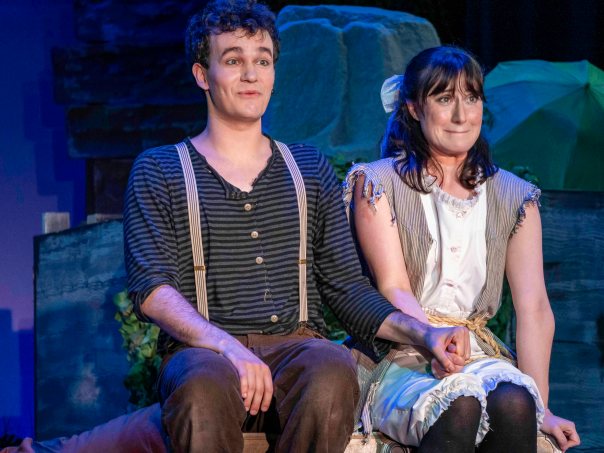
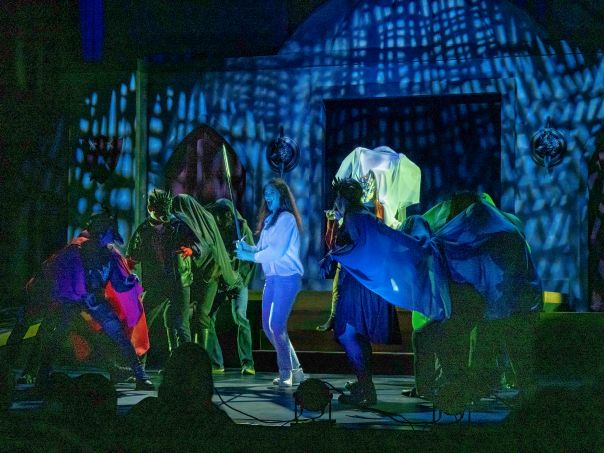
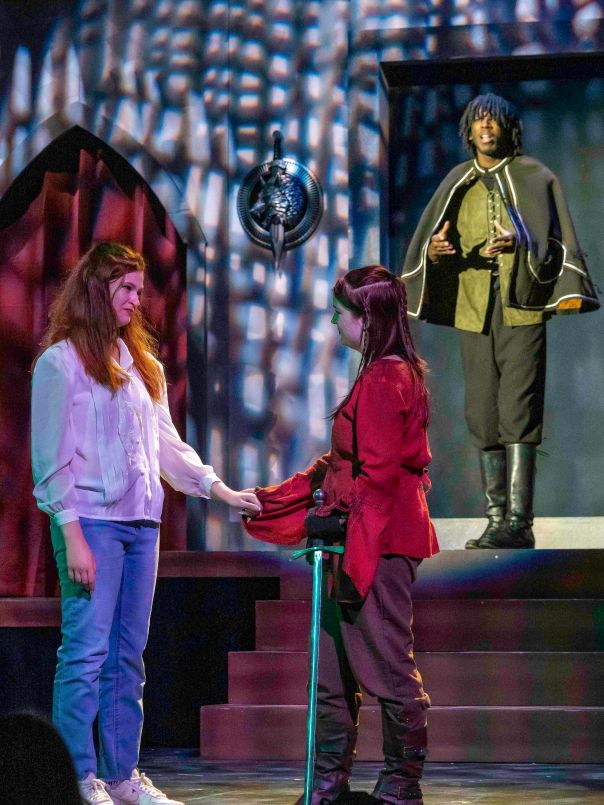
Now we have the Violet approach at Theatre Charlotte, where Destiney Wolfe stars in the title role with a hideous scar that looks more like a fine line drawn with a red ballpoint pen than a shocking horror. So it was – minus the fine red line – when Lauren Ward originated the role in 1997 on Broadway and when Sutton Foster revived it there in 2014.

Besides the risk of an Emperor’s New Clothes moment from an innocent child (“But Mommy, Violet doesn’t have any scar!”), it figures to be more effortful to watch Wolfe without the scar everybody onstage is talking about and constantly having to imagine a scar we are not seeing. That’s different from reading “The Ugliest Pilgrim” by Doris Betts, the short story that this Jeanine Tesori-Brian Crawley musical is based on.

Until the fourth page, the scar isn’t explicitly mentioned. Once the word is seen, it quickly becomes the center of the story – the reason why Violet is on a bus from Spruce Pine, NC, to Tulsa, where she ardently believes a venerated TV preacher will heal her terrible affliction. Nothing on the remaining 25 pages contradicts the image engraved in our imaginations.

Within the blissful two dimensions of a book, we don’t need to keep imagining what isn’t. Perhaps more subtly, as demonstrated by Matney’s portrayal of June in Alabaster,we can gradually get used to the disfigurement, look past it, and see the person. Along the way, we could also find plenty of relief looking at June’s unscathed side.

Notwithstanding her terrible scar and her pathetic reliance on Oral Roberts – oops, I mean the famed Oklahoma preacher – Violet is clearsighted enough to grasp her most valid reason for boarding the bus. Spruce Pine is a very small-minded town. Her elders stare at her in pity and her peers are worse, shunning her, mocking her, and pranking her.

As the saying goes, she needs to get out and meet people. Spruce Pine isn’t the place for it.

Betts had Violet saying that in a more biblical way: “Good people have nearly turned me against you, Lord. They open their mouths for the milk of human kindness and boiling oil spews out.”

Told objectively by Crawley rather than in first-person by Betts’s Violet, we see the townsfolk clearly sooner rather than judging them on a single casual quote. Scarred or not, Crawley and Betts agree on one key point: Violet is way too thin-skinned.

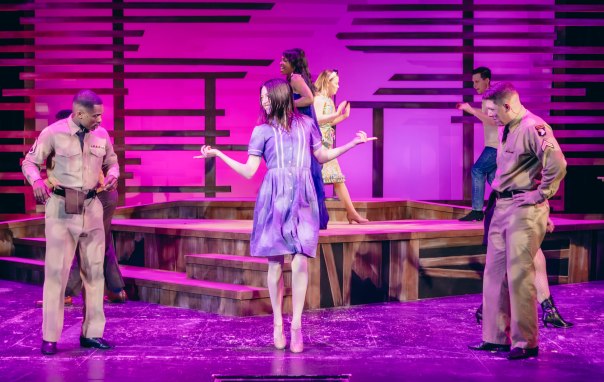
Meanwhile, reasons for dismissing Violet’s self-pity – and doubting her self-awareness – are multiplying. Before the bus reaches Arkansas, she has hooked up with two military men who are quickly captivated by her. Both of them, one black and one white, are eager to show their ardor on a stopover in Memphis, where they spend a night out together.

So the necessity of imagining that hideous scar becomes more urgent for us.

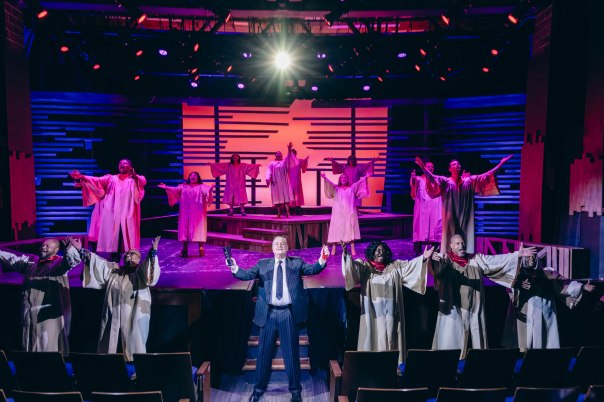
Thankfully, the Memphis sojourn allows Tessori to naturally widen her musical palette, welcoming us to the blues along with the Beale Street underbelly of town. Violet’s dream of healing and her actual Oklahoma encounters with the Preacher are welcome prompts for Tessori to branch out further into righteous, stomping, spirit-of-the-Lord gospel.

A five-piece band led from the keyboard by Danielle Barnes Hayes leaned into the gospel music at the Preacher’s revival meeting as lustily as the more countrified tunes that had gone before. Our eagerness to hear those gospel strains was certainly piqued and primed last Saturday when a seven-voice choir greeted us in the lobby of the old Queens Road Barn, accompanied by a wee electric keyboard, singing hymns and shouts for a half hour before showtime.

While director Stuart Spencer skimps on makeup design, he is deeply attuned to the material, having been part of the Davidson Community Players cast when Violet had its regional premiere in 2010. Was it a makeup job on Cassandra Howley Wood that gave me such a favorable impression of her local debut and the show? Or was it simply the intimacy of Armour Street Theatre, bridging the gap between first-person narrative and Broadway musical?

At the bus station where Violet embarks on her odyssey, at the Memphis music hall where Asley Benjamin belts a couple of songs, and at the Tulsa TV revival, a bigger stage is surely better. More space for more people and more decibels! More opportunities for lighting designer Gordon Olson to colorize costumer Sophie Carlick’s shiny robes for the Preacher’s hallelujah choir – and to add pizzazz to Sharlie Duncan’s choreography!

To their credit, neither of the soldier boys seriously believes that Violet will look any better after her Oral rendezvous in Tulsa when she reboards her Greyhound bus, heads back home to Spruce Pine, and stops off in Arkansas for another meet-up. With Sean Bryant as Flick and Ethan Vatske as Monty, the interracial relationship and rivalry between the soldiers occasionally becomes more compelling and suspenseful than Violet’s cosmetic quest.

Bryant gets the advantage of a more instructive interracial relationship between Flick and Violet. On the way to learning that her inner scars are more debilitating – and curable – than her outer ones, it’s necessary for her to appreciate that there are other, more serious skin problems in life. Beginning with pigment. In the Betts story, there’s one other huge hurdle in Violet’s spiritual growth that we don’t hear about onstage: her use of the N-word. More of Spruce Pine needs to be exorcized from her soul than she realizes.

On top of that, this thin-skinned Violet is stubborn, too. As dynamic as Wolfe’s vocals are, her adamant refusal to believe that anyone besides her daddy could love her is the most startling aspect of Violet we must encounter. We recognize this trait in people we’ve met, maybe in ourselves. Violet’s stubbornness goes so irrationally deep that it not only prolongs her path to enlightenment, it obliges Crawley to pile on a flashback recalling a cruel prank that was played on her by her schoolmates.

Counterbalancing Bryant’s shyness and vulnerability as Flick, Vatske draws the luxuries of being the more cocksure and aggressive Romeo. Just sitting down to play poker with Flick and Violet softens us up to Monty, and confident as he is, Vatske keeps us a little in suspense about with whether he’s playing with the lass or serious. The way Vatske is playing him, you’re not sure whether Monty is sure himself.

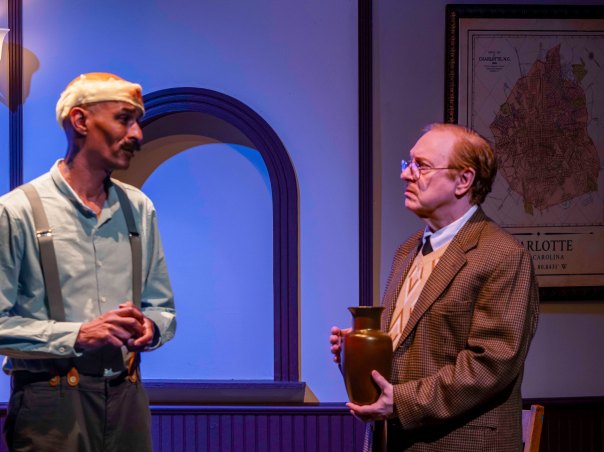
This upsized Violet is a special boon for Henk Bouhuys, who draws two plum roles, the sometimes surly, sometimes avuncular Bus Driver and the charismatic Preacher. Never mind that that the Preacher is surrounded by a fervid Gospel Choir, both in the TV flashback and in Tulsa, Bouhuys dominates the stage with his fiery motormouth exhortations.

It’s awesome enough to make his backstage powwows with this pilgrim unexpectedly tender and poignant – a quietly dazzling reality check – and allows Wolfe to enlarge upon Violet’s devotional and delusional traits.

Unfortunately, on a big musical stage, Bouhuys’s dazzle and the decadence of Memphis nightlife tend to cast the flashback scenes between Young Vi and her Father into comparatively dreary shadow. To put it bluntly, when Tessori worked with the multiple Allisons of Fun Home in 2015, she had a superior book and lyrics from Lisa Kron.

So Spencer, Abigail Sharpe as Young Vi, and Nick Southwick as her dad are doing the best they can with the weak hand they are dealt here. It’s heartwarming to see the widower dad teaching Young Vi how to play poker in order to jumpstart her math skills. “Luck of the Draw,” blending this flashback with Violet’s cardplaying triumph over Monty and Flick, puts Sharpe and Southwick to their best use.

But these flashbacks, before and after the catastrophic accident that scars Violet, are also the best reason why we never see that scar on the face of either protagonist. It would need to be applied to Young Vi during the show, a fearsome hurdle for a makeup artists and stage managers.

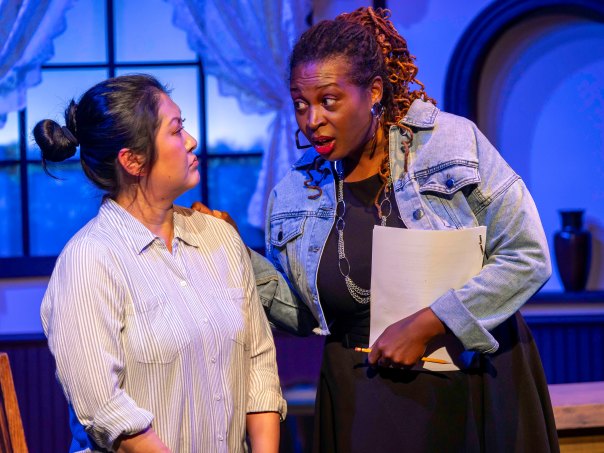
The script and the dumpy cardigan sweaters the Violets wear supply a wonderful way to differentiate between the two. When we first see Wolfe huddled at the bus station and boarding her bus, she looks more homeless than scarred. It’s only after dark in Memphis, when she’s escorted to the music hall by two strapping soldiers, that Wolfe tosses her cardigan aside and shows signs of full-blooded womanhood.

Miracle of miracles, she becomes flirty!

Shouldn’t Gardner’s “A Small and Humble Erasure” Be Retitled – and Replayed?

Review: A Small and Humble Erasure at Davidson Community Players

By Perry Tannenbaum

As playwright Tracy Letts knows well, there are unpleasant truths at the heart of American life and the American Dream. “Sometime tonight, when the temperature of your home drops to a specific mark and you hear the heater come on because that’s what you’ve programmed it to do, remember that you live in a cocoon of comfort and safety because a lot of people who came before you weren’t afraid to get their hands dirty.”

Those clear-eyed, merciless words were delivered by the Mayor Superba of Big Cherry at the climax of The Minutes, Letts’ unexpectedly savage and sensational 2017 drama. The Metrolina premiere was presented last month at the Armour Street Theatre as Volume 1 of Davidson Community Players’ Sacred Places project. With a no less of an innocuous title, the world premiere of Stephanie Gardner’s A Small and Humble Erasure is completing DCP’s project – with a sacred place that hits closer to home.

Gardner has actually customized her script for Armour Street and for the members of the cast, directed by Michelle Medina Villalon. While Letts located his drama at a fictitious City Hall built on the blood of slaughtered Native Americans, Gardner’s piece reminds us that Theatre Charlotte is built on more sacred ground, over a cemetery consecrated for African American slaves.

And she tells us, naming names, just how this cemetery was “deconsecrated” and who was responsible. Mayor Ben Douglas and numerous councilmen are in the room where it happened, all of them white men from respected Charlotte families: Baxter, Hovis, Albea, and Wilkinson – with mischievous colorblind and gender-blind inroads in Villalon’s casting. Starting with the famed Mayor whose name is perpetuated on the QC’s international airport.

A future councilman, attorney John Small, introduces the motion at a City Council meeting in 1936, nine years after Theatre Charlotte had been founded as the Charlotte Drama League and five years before the Old Queens Road Barn celebrated its housewarming. By this time, Tom Humble had settled into his role as Little Theatre of Charlotte’s artistic director.

So the workings of this Small & Humble alliance give Gardner’s title a clever double entendre. Humble, at least, is haunted by the fact that his new fixture in Charlotte’s cultural life was built on the backs and graves of Southern slaves. Big Cherry, on the other hand, leans into their past desecrations after the truth is painstakingly revealed to them by a rogue councilman. Their actions are sensationally horrifying, while Gardner’s white folk are more decorously rueful.

Of course, there’s considerable satirical bite to Gardner’s concept, above and beyond the casting vengeance she takes on all the benign and virulent segregationists who are culpable for this sacrilege. An African American, Andrew C. Roberts, portrays both Mayor Douglas and plutocrat Harold Dwelle, and Amy Wada, an Asian American, is our narrator!

She brings us into the Myers Park homes of these benefactors, the Dwelles and the Myerses themselves, delving into the petty maneuverings of their estates. These include the hallowed cemetery and the adjoining Cherry neighborhood. Yes, DCP executive director Steve Kaliski & Co. could have easily called their pairing “The Cherry Project.” Interestingly enough, both Cherrys have insulting and racist slurs associated with their names as well as complicit Mayors in their dramas.

Making Amy Wada our personable and slightly stressed narrator is obviously an entertaining choice. But I’m not always aboard with the idea of actors behind her frequently breaking character and interrupting her – perforating and undermining the seriousness of her narrative, threatening to trivialize the history.

Getting Hank West, indisputably one of Charlotte’s best, to play Tom Humble is a similarly two-edged sword. Villalon and Gardner must have been sure that West gave the best audition, and he impeccably balances the Indiana native’s haughty elitism, his ambitions for the Queen Road Barn, and his conscience. But for those of us who have seen West’s work over the last four decades, it’s a bit of a hurdle disliking his Humble in the artist’s worst moments.

Clean-cut with mature Everyman looks, Mark Ariail is a fine complement to West as the conniving Small, the lubricant that connects Humble and Myers Park to the Charlotte City Council. We have a hard time labeling him as evil despite the obvious earmarks. Little Theatre was little, after all, and Queens Road was the closest the fledgling company could hope to get to the QC’s high-priced Uptown real estate.

Gardner seems willing to allow that the upstanding Charlotte citizens of the 1930s were shaped by their times and less eager than Letts to condemn and ridicule them for their actions and customs. But she does provide a second backdrop to the unfolding Small & Humble “erasure”: black folk who set the plutocrats’ tables and black folk who were buried beneath them.

Roberts is neither of these, but he’s useful in Gardner’s concept beyond his key roles as Dwelle and Mayor Douglas. He’s also “new” to the cast, so Wada can be explaining the history – and the colorblind casting – to him as well as us. Lowell Lark, when he removes the enslaved Harvey Foster’s bloody bandage from his head, becomes a somewhat comical Councilman Baxter when the Theatre Charlotte ordinance is passed, returning years and years later to haunt Humble and become part of Queens Road lore. When that happens, it no longer seems amiss that he doesn’t strictly conform with Gardner’s description of him as a 17-year-old when he died.

Myneesha King as Johnsie Foster, the Dwelle family housemaid, gets to be a sometimes-acerbic conscience for the great white benefactors of Myers Park – and she’s pretty sassy toward Amy, so it isn’t a demeaning role. King is also significant the living descendant of the buried and betrayed slave population distilled into the voice and wounded image of Harvey Foster.

Briefly, King can relish returning as Barbara Burke, the first African American to appear in a Little Theatre production in 1970. It’s Wada, though, who points out that this was three years after Humble retired. Then we hear the vanilla quote in our newspaper’s coverage straight from King’s lips: “If the whole world would say people are people and not what color you are, it would be a wonderful place.”

We do get along here in Charlotte, don’t we? Ironically enough, Gardner reminds us that the first play produced at the new Little Theatre, once the gravestones were cleared away, was Moss Hart & George S. Kaufman’s George Washington Slept Here. Talk about a whitewash!

The white women of Myers Park, bless their hearts, are at least ambivalent about what’s going on over at the top of Queens Road. Pam Coble Newcomer as family matriarch Mary Rawlinson Myers insists that the Negro Cemetery should belong to the Cherry community in perpetuity, but has neglected to ensure that her wishes are legally airtight.

Along with King as Johnsie, we empathize with Mary the most, especially since she’s confined to her deathbed. Newcomer is liberated from her bedclothes for two comical turns, becoming Councilman Albea and Little Theatre actor Jack Knell. Jack’s wife, Dorothy Knell, is also in the cast of the first show presented at the new theater in 1941, so Cat Rutledge completes the amusing little gender-blind episode.

Rutledge, like Newcomer, also gets to have fun at City Hall as Councilman Wilkinson, one of our proud city’s banking visionaries. (Is the notorious boulevard named after him? Yup.) She also comes out as perhaps the meanest meanie onstage at Armour Street, jousting with both Mary and Johnsie as Mary Myers Dwelle – or Mary II – as she helps push the Little Theatre initiative through City Council.

Perhaps because she also pushed through the first art museum in the state, The Mint, Myers’ aristocratic daughter is allowed to luxuriate in regrets similar to Humble’s. Aw, cut them some slack, Gardner seems to say. Better to simply mention The Mint, IMHO.

Volume 2 isn’t speckled with shameful or diabolical celebrations like The Minutes, last month’s Volume 1. Nor does it chill us like Mayor Superba’s cynical admonition, cited above. The best Humble can do is “I don’t know how to fix it.” Honest enough. Mary Dwelle is more pragmatic and resolute, asking us “Why should we have to leave town for our culture? We’ll build it here!”

Ninety years later, the QC is teeming with theatre artists who believe Charlotte shouldn’t be the largest city in the country without a regional professional company. They’re still waiting for that same Myers Park/Banktown resolve to lead somewhere.

Maybe Roberts, the newbie to A Small and Humble Erasure, has drawn Gardner’s most devastating line. “Excuse me,” he asks Amy, “am I playing a white guy??”

His disdain and disgust speak volumes.

Needless to say, it was a bit awkward to be driving back home on I-77 through Charlotte after this bold show in Davidson. If DCP’s collaborator, Anne Lambert & Charlotte’s Off-Broadway, could contrive to bring Small and Humble to this side of Lake Norman, it might find a bigger audience at the right place. With the potential of reaching the right audience and getting the right proactive reaction. I’d suggest a peppier title, like The Small & Humble Desecration, when that happens.

Davidson Community Players now performs at three different venues, adding Davidson College and the Cain Center in Cornelius to their portfolio over the years. What do you have, Charlotte?

It’s like this on the QC’s pitiful theatre landscape: Since DCP’s Sacred Places began last month, two modest professional productions have opened in the QC, by CAST and Charlotte Conservatory Theatre – both of them at The Mint Museum. Yeah, that’s how much local theatre building we’ve done in the last 90 years.

Risen from the Dead, CAST’s Alabaster Is All About Artists in Crisis

Review: Alabaster at The Mint Museum

By Perry Tannenbaum

Google and Alexa will tell you if you ask: it’s a little bit more than a 17-mile drive from Bessemer to Alabaster, Alabama. Every source I’ve checked also confirms that Gip’s Place, the last backyard juke joint in America, was in Bessemer until its blues guitarist founder, Henry “Gip” Gipson, passed away in October 2019 at the age of 99. It’s useful to know that when we meet Weezy, the first character to speak at the Mint Museum – in the first Carolina Actors Studio Theatre production anywhere since its 2014 NoDa demise.

Weezy tells us that she lives at a small farm “right near” Gip’s Place in Alabaster.

True, we have ample reason to question Weezy’s veracity from the get-go, since she also introduces herself as a goat. Titling her comical drama Alabaster,playwright Audrey Cefaly could coyly blame her geographical inaccuracy on this cantankerous barnyard beast she created. But the choice, invoking the special malleability of a stone that has been reshaped by sculptors and artisans for millennia, is clearly an artist’s choice.

As we continue to follow the scrappy encounter between two artists in backwoods Alabama, one a celebrated photographer of celebrities and the other an unknown painter, we often find that Weezy – among other things – is Cefaly’s surrogate. In one meta moment you can look out for, Weezy even delivers a message from the playwright to one of our protagonists.

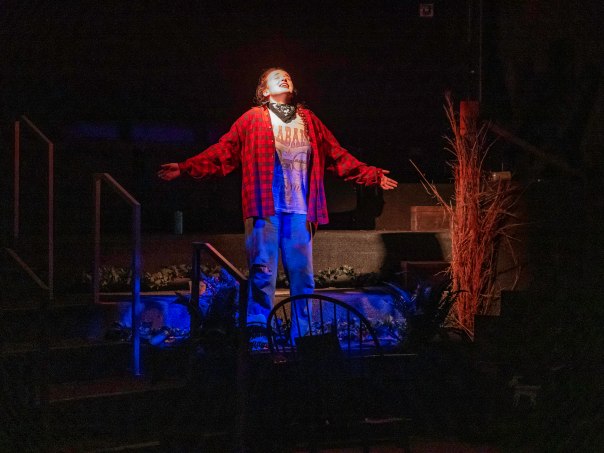
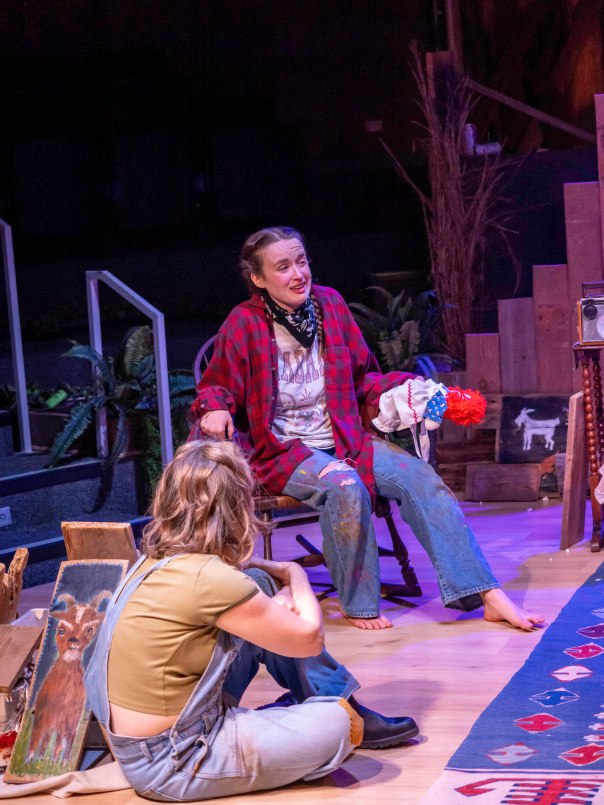
Mostly, Weezy serves as an irascible Jiminy Cricket for June, the one human survivor on the farm. When she isn’t offering up prompts and explanations channeled from Cefaly, she becomes June’s better self, the self that is wishing to break free of her self-imposed isolation and artistic obscurity. When sweet optimism sours into clear-eyed skepticism and cynicism, Weezy becomes the painter’s inner voice: June’s worst critic.

And sometimes, she’s a goat, caring for her ailing mama. Weezy is fluent in English and goat. Occasionally, she’s also clairvoyant.

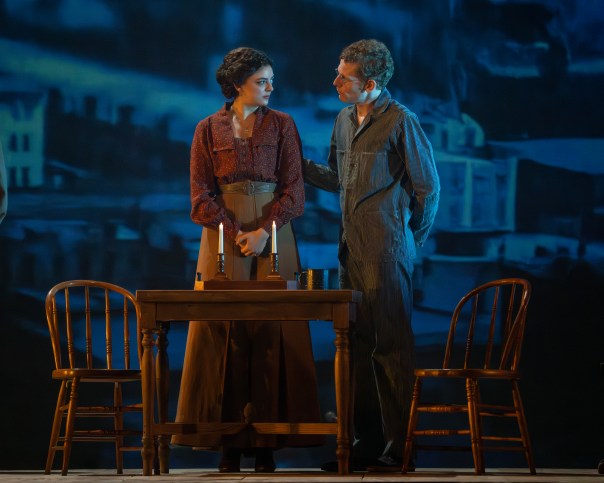
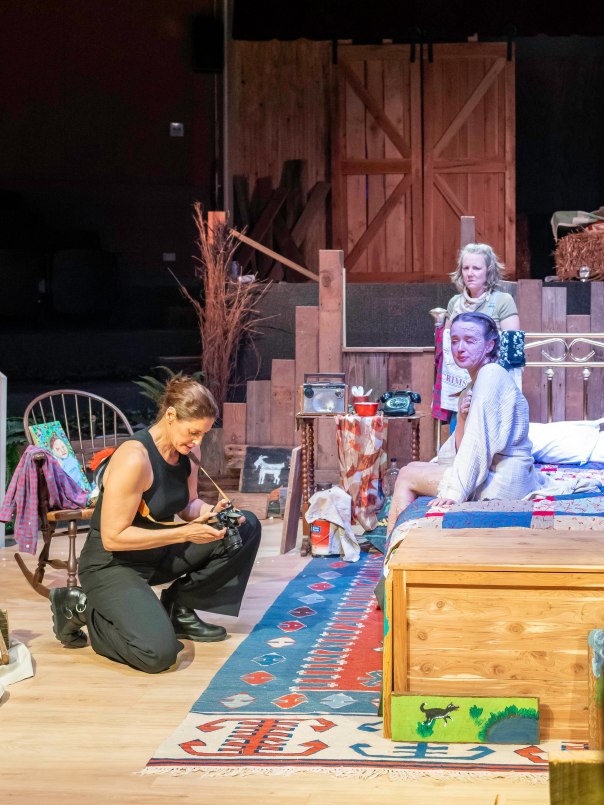
Both Bessemer and Alabaster are prone to tornadoes. Cefaly’s tornado has radically reshaped June, demolishing her farm and turning the entire left side of her body into a relief map of scars, patches, pocks, and swirling melty skin. Playing the role of June, Zoe Matney has a l-o-o-o-o-ng pre-show routine, for she must spend much more time than usual backstage getting director/makeup designer Michael Simmons’ concept applied – front and back, from torso upwards – with help from assistant director/makeup artist Dee Abdullah.

Then she is onstage as the audience arrives, long before lights dim and Weezy enters.

If Weezy weren’t there, we must also remember, we wouldn’t have a reason to hear from June, though her first response to the goat’s prodding is no more than a well-chosen finger. Fortunately, we are quickly liberated from the confines of an inner dialogue by June’s distingué visitor, Alice.

Acquainted, you can bet, with Annie Leibovitz and no further than a light meter’s distance from Demi Moore, Alice’s career has recent taken a hairpin turn to the scarred-women project she’s working on now. June is her seventh subject, and Alice works in multiple media. Trying to reach the traumatized inside of her subjects – all women – while finding the dignity and beauty mixed with the deformity outside, Alice documents them in video interviews and, when the time and light are right, by snapping coffee-table-quality portrait photos.

Are these scars a form of artwork?

A fresh aspect of artist’s choice comes into play with Cynthia Farbman Harris as Alice. Alabaster premiered in December 2019, just two months after Gip’s passing, in Fort Myers, Florida – the first stop in a “Rolling World Premiere” presented at 11 member companies of the National New Play Network, a rollout spanning from New Jersey to Oregon. The QC had a company in that Network, Actor’s Theatre of Charlotte, which had rolled with some of these co-op premieres before.

When asked about the switch away from glamor assignments, Alice deflects at first. She only gives herself away slightly when asking June about her “accident” – a word more apt for her own trauma – and when, egged on by June’s questioning, she scrolls back far enough among places she’s been before Alabaster to her rehab.

So it shouldn’t be too surprising to learn that Actor’s Theatre was scheduled to premiere Alabaster in the latter half of its 2022-23 season, just over two years ago. More of you will remember that Actor’s Theatre did not make it to the end of 2022, planting its gravestone among the most honored companies in Charlotte’s theatre cemetery before the halfway point of its 34th year.

For Harris, who auditioned for that abortive ATC production, it was a matter of not forgetting. She had worked with Simmons at CAST, with a variety of other stints at Moving Poets, Queen City Theatre, and Theatre Charlotte – including a pair of diva roles, Maria Callas in Master Class and Blanche DuBois in A Streetcar Named Desire. If the role of Alice stuck with her after ATC’s demise, there must have been plenty of meat on the bone.

With an eye toward reviving the edgy theatre vibe that reigned while ATC, CAST, and QC Theatre were all up and running, Cynthia and her husband, actor Michael Harris, have founded Actors Collaborative Theatre to help make it happen. The new ACT is an associate producer of Simmons’ rebirth, while Moving Poets and Charlotte Contemporary Theatre are among the companies listed in the digital playbill on CAST’s thank-you list.

If you know how long ago Harris starred as Blanche, then you know Alice is bit of a stretch, no matter how much she wanted it. We’re not just talking about the yoga scene. With Abdullah serving as intimacy director, June’s master bedroom becomes more than an artist’s studio. Scars and all, June brashly inquires whether Alice is gay, before we learn the photographer’s full backstory.

Somehow, Matney and Harris make their love-hate relationship work altogether naturally and spontaneously. It only becomes a little more cerebral than Cefaly imagined it. They lean into the age difference a little instead of pretending it doesn’t exist. But they do traverse the long, rugged terrain to the primal mode. The two artists debate whether their meeting is like The Bridges of Madison County or not. Yet they could also debate whether they are both hostile animals locked in cages of their own making – while the liberating keys are always in their hands.

Actually, they do talk about that.

Matney’s performance is every bit as stunning as Harris’s, if for no other reason than June is so moody and mercurial. Ambivalent about having her paintings exposed to outside world, June is living with desperate intensity in her present isolation, hoping for a sunnier future – she has invited Alice here, though she is wary – while repeatedly tortured by her past trauma.

Something as trivial as the beep of Alice’s camera can trigger flashbacks to the worst. Adding to the inner psychological circuitry are the stresses of fresh lightning and thunder – plus the partial nudity at the start of the photo session. Matney calibrates her various disturbances well when her hurting is raw, and she channels energy convincingly into compensatory actions when June is striving to appear calm and well-adjusted. She also leaves room for just the right amounts of flirtation and coquetry.

Kelly Mizell, who plays Weezy, can tell you how long ago Harris sashayed into Nawlins as Blanche, for she was an outstanding Stella Kowalski in that same Theatre Charlotte Streetcar way back when. Given the opening entrance, this talking goat decisively demonstrates that she can still command a stage before discreetly receding into the background, sometimes as a handy guide, sometimes as an annoyance, and sometimes as a mind-reader.

Mizell gets to show Weezy’s tender side caring for Bib, her mostly pallet-of-hay-ridden “Mmaaahaaaahaaaa… maaaaaah!” You can see Harris wanting to play Alice enough to partly bankroll and publicize a production, but with so much stage time and so little spotlight (or vocabulary) as this old goat, Debbie Swanson had to really want this Mama Bib role. She’s wonderful when her moment comes.

Otherwise, there are remarkably few signs that Simmons and the Harrises are doing all this on a shoestring. Lighting design by Dave Meeder easily ranks with the best we’ve seen at the Original Mint’s Van Every Auditorium on Randolph Road. Tim Baxter-Ferguson, another name we fondly associate with a bygone era, installs a marvelously rusticated twin-level set design that simultaneously gives off vibes of woodsiness, springtime color, and irreversible damage.

Sophie Carlick’s costumes don’t have to be lavish, but they enable June, Weezy, and Alice to radiate an outdoorsy aura. Cleverly enough, June’s bedroom outfit hides her preoccupation with painting as decisively as her splotched overalls proclaim it, but the goat costumes also strike a perfect note. So do the many artworks fashioned for June’s artistic oeuvre on barnwood, to be auctioned off when Alabaster completes its run.

Simmons’ sound design and special effects are on-point, but I wish they had impacted more: louder, with more lightning crackle and windy sweep. Nor was the ringtone on Alice’s cell as ugly as Cefaly intended. As a photographer, I had to chuckle at the sadly unprofessional equipment we were seeing, including a camera with an onboard flash. Yet I could empathize with Harris – and admire her all the more – when she had to keep that lame videocam running and the still camera showing snaps on its screen.

When Alice instructs June on how to use a smart phone, when she shows her how to trip the shutter, and how to review the photo portraits on the wee screen… Quiet moments like these resonate with us, because they are part of a bonding process, two healing processes intertwining. Two resurrections. Three if you count the rehab June and Alice join in on with those barnwood scraps.

Good reasons to smile as we left the Mint. Along with the resurrections of CAST and a vital drama Actor’s Theatre never got to present.

“The Play That Goes Wrong” Fits Perfectly at The Barn

Review: The Play That Goes Wrong at Theatre Charlotte

By Perry Tannenbaum

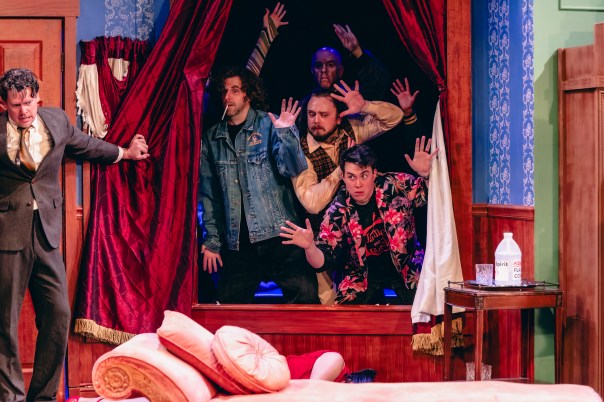
Every time Inspector Carter declares his determination to solve “The Murder at Haversham Manor,” lights at Theatre Charlotte suddenly turn a lurid red to triple-underline the melodrama. This may be the only technical element that consistently goes right in The Play That Goes Wrong, now running – and decomposing before our very eyes –through February 23.

The mantelpiece over the fireplace in Charles Haversham’s study remains a work-in-progress long after the master is murdered. The painting above the mantle – clearly the wrong painting – doesn’t stay where it belongs, and a pesky door stubbornly resists efforts to unlock it when it isn’t wandering off its hinges. In similar disrepair, we may count the phone, the intercom, the elevator leading up to the second-floor office, and the walls themselves.

It is a precisely flimsy set, lovingly put together by Theatre Charlotte artistic director Chris Timmons, so precisely flimsy that it must conform to approximate dimensions to accommodate the cast. So active that the set predictably won the Tony and Drama Desk Awards for best scenic design in its 2017 Broadway debut. Like Michael Frayn’s famed Noises Off, another British play-within-a-play that goes comically wrong and wronger – but on a stage that revolves a full 180ᵒ – the set is like a machine. It could be packaged like an Ikea kit.

Written by Henry Lewis, Jonathan Sayer & Henry Shields, The Play That Goes Wrong nestles more naturally at the Old Queens Road Barn than at Knight Theater, where the national tour touched down in the QC six Novembers ago. The basic concept is that a small-time community theatre, perennially understaffed and underfunded, has suddenly received a grant that will finally enable it to present a full-fledged production.

No longer will Chekhov’s classic Three Sisters be reduced to Two Sisters at the Cornley University Drama Society. Nor will Lloyd Webber’s resplendent Cats be shrunk to Cat. It’s the birth of a new era!

But unfortunately, the new era hasn’t ushered in an influx of fresh acting talent and technical know-how. Dennis struggles with her lines and usually mispronounces the tough words written on her hands. Jonathan repeatedly re-enters the action before he’s supposed to. Sandra has an unfortunate knack of being in the wrong place at the wrong time; and her understudy, Annie, after subbing for Sandra when she’s knocked unconscious, reads terribly. Yet she refuses to yield back her role when Sandra revives.

Props aren’t reliably placed in their assigned locations by the incompetent crew. When they are properly placed or deployed, like the stretcher needed to carry the corpse through the finicky front door, they may not function properly. The Duran Duran CD, sought after by lighting-and-sound man Trevor before the play begins, will turn up inconveniently onstage deep into Act 2.

Which reminds me: even though those redlight cues are absolutely reliable, the portentous sound cues accompanying them are not.

Tonya Bludsworth directs all this carefully calibrated chaos with an able assistant director, Brian Lafontaine. Together, they and Brandon Samples as Chris bring out a key point that didn’t strike home for me as forcefully when I saw the touring version in 2019. Chris not only plays the plum role of Inspector Carter in The Murder at Haversham Manor, but he also serves as the stage director, prop maker, box office manager, and PR rep – totally responsible for this catastrophe, and obviously overstretched.

On the smaller Theatre Charlotte stage, Samples is closer to us and we can focus on him more sharply than if his flop sweat were dripping down at Knight Theater. Makes a difference when one protagonist seems to be especially invested in the worsening outcome, valiantly trying to cover up the metastasizing miscues, and gaping at the sheer scale of his own mismanagement and incompetence.

For me, Sample’s visible struggles – from his nervous shit-faced grins on up to his hissy fits – made Chris a little more poignant for me. Here is a man who cares so much about theatre, and he’s watching all his multiple shortfalls in artistry and management implode so spectacularly. We can feel for the rest of this woeful team, but not nearly as much.

Lee Thomas earns a distant second place in our sympathies just for the physical punishment he takes as Charles Haversham, the stepped-on, sat-on, and mishandled murder victim. Or for the dismal ratio of abuse absorbed to dialogue delivered. When he finally does speak, maybe for the first time at Theatre Charlotte since 2020, it is as an actor of mind-boggling incompetence, eclipsing nearly all of his castmates. Thomas is rather good at looking quietly embarrassed, confused, and discombobulated.

Jenn Grabenstetter as Sandra starts off in a sympathetic slot, cast as Florence Colleymore, the murder victim’s bride-to-be. Our empathy for her slackens when we learn that Charles’s brother, Cecil Haversham, is Florence’s true love. Or when we see how stylized Sandra is as a performer. Or when she skips ahead one line, answering Inspector Carter’s questions before he asks them. But we feel for her – a little bit, anyway – when the front door flattens her and her castmates prop her up inside a clock. When Florence revives, she has to battle Annie to reclaim her role with some fine screwball fight choreography by Allison Collins.

The character arc for Rachel Mackall as Annie is even more transformational, for her Florence starts off in a near-catatonic monotone until she does the first of her pratfalls, scattering the pages of her script and maybe dislodging a contact lens. That raises Annie’s energy level, leading to the subsequent miracle where, battling Grabenstetter for the spotlight, she suddenly has her lines memorized while becoming a vicious gladiator.

More WWWF-style action would not have been amiss, but there’s still plenty.

Like Selsdon in Noises Off, Dennis’s prime reason for existing in The Play That Goes Wrong is to roundly muck things up. Lewis, Sayer & Shields seem to be indicating that he’s inept, miscast, or over-the-hill. What the hell, Bludsworth casts a woman in the role, the venerable Andrea King, who may have actually portrayed more women on QC stages than men and describes herself like a cute puppy for sale in the digital playbill.

With so much incompetence surrounding the Haversham Murder production, it’s a bit cruel to arraign her as the sole culprit for substituting turpentine when a decanter of adult beverage is served to guests at the Manor. Or it is when that happens for the first time. It’s on her when the screwup is repeated, sparking a prolonged series of spit-takes because she has also forgotten a line that would propel the action forward instead of casting it into a never-ending loop.

King maintains a cheery insouciance no matter what kind of havoc she causes, enabling Cody Robinson as Robert to become king of the spit takes as the bride-to-be’s brother, Thomas Colleymore. With a preternatural Joe Belushi energy, Robinson demonstrates that Robert’s distaste for “White Spirit” can actually increase with each sip! When we think Robinson’s frustration and rage have peaked or even exceeded expectations, he still turns it up a couple of notches.

Adam Peal as Robert and Roman Michael Lawrence as Trevor fill out the roster of actors implicated in the murdering of The Murder at Habersham Manor. Robert is not only amateurish but also a carefree hambone, so naturally Chris gives him two roles to botch. Initially, Peal appears as Cecil Haversham, Charles’s scheming brother and Florence’s true love. But there’s more to butcher when Robert resurfaces as Arthur the gardener, laying on some eyewitness evidence.

Did I mention that Trevor, after losing track of his Duran Duran treasures, must abandon his functions as lighting and soundman when Annie, replacing Sandra, is also stricken? That script-scattering pratfall was just the beginning of her misadventures. While Lawrence has already shown us – and will continue to show us – how badly Trevor performs at his chosen specialties, we can brace ourselves for his slaughter of Florence Colleymore, postponed only by his reluctance to play the role.

On my second viewing, it was possible to pay more attention to the convoluted mystery plot by “Susie H. K. Brideswell.” Now I can confidently proclaim that Habersham Manor is a masterpiece of implausibility. Doesn’t work at all.

Woefully, Theatre Charlotte doesn’t seem to have experienced a financial windfall that parallels Cornley University’s. That would have enabled them to append a faux playbill for the Habersham Manor production to the conventional Play That Goes Wrong program. Then we could learn the last names of the players and the Habersham roles they play with less fuss and bother. A few tidbits about the players also enriched the experience of the touring production.

Apparently, when the playwrights founded their Goes Wrong franchise (Peter Pan and The Nativity are among the spin-offs), they must have been focused on crafting three of the roles for themselves to perform in London and Broadway – and meshing with Nigel Hook, their mad genius set designer. So they didn’t insist that their faux playbill must be printed to accompany the show.

That lack of detailing serves to emphasize where The Play That Goes Wrong doesn’t measure up to Noises Off! Frayn’s work fleshes out relationships between the actors onstage when they’re backstage and, with its first-act rehearsal scene, gives us a more vivid idea of how the play-within-a-play is intended to go. For that reason, despite all the hilarity that Lewis, Sayer & Shields deliver, I’d hesitate to recommend The Play That Goes Wrong to anyone who is new to theatre – or hasn’t experienced a play that goes right.

But for sheer fun in frightening times, this show is welcome medicine for everyone else. TikTok & Friends may have brought nostalgia for America’s Home Videos to a screeching halt, but this latest romp at the Queens Road Barn revives the special pleasure – and laughter – of similar train wrecks large and small running right at us, non-stop, on a live stage.

Joe Turner’s Come and Gone, directed by Corlis Hayes, last came and went at Central Piedmont Community College in 2015. Back then, the production demonstrated how ill-suited even a renovated Pease Auditorium was for the best of August Wilson’s dramas. Panoramic Pease has now been demolished, so it will be interesting to see Hayes come back again to the CP campus, along with Jonavan Adams reprising his role as Herald – at a real theater in the fledgling Parr Center. Dominic Weaver, also in the mix ten years back, gets a juicier role this time as Bynum, the conjuring root doctor.

Turner, the second play in Wilson’s decade-by-decade traversal of the 20th century, The Pittsburgh Cycle, is set at a Pittsburgh boarding house in 1911. Rather than hinting at WW1 later in the decade, the drama hearkens back to slavery, the Civil War, and their aftermath, both glorious and sad.

“Every character has a story, and every story has a song,” says Hayes. “The play explores African American identity, healing from trauma, and the power of community and self-discovery. More significantly the play is an examination of Black people in transition during The Great Migration.”

This weekend only!

“Bright Star” Shines Zestfully in Matthews

Review: Bright Star at Matthews Playhouse

By Perry Tannenbaum

Though it never settles down here in the QC, it’s nice to know that Steve Martin’s beautifully crafted Bright Star, while tracing its graceful decades-longstory, carves a North Carolina oval around Charlotte. Crisscrossing between Asheville and Raleigh with stopovers in Hayes Creek and Zebulon. Martin’s music leans pleasantly westward, delivering bluegrass and mountain flavors, brightly flecked with sounds of the comedy polymath’s signature banjo. Nor in transporting the original “Iron Mountain Baby” story to the Blue Ridge Mountains, does Martin neglect the rhythm of the rails, for a train traveling over a river is pivotal to the plotline.

So of course, this genial musical, which stopped at Belk Theater on its national tour in 2018, is a perfect match for Matthews Playhouse (and its nearby depots) as it arrives for a richly deserved revival. Newly crowned last month with the 2024 North Carolina Theatre Conference Community Theatre Award, headquartered at the Matthews Community Center, this company is perfectly poised to deliver the authentic vibe.

Under the meticulous direction of Paula Baldwin, it does. Her design team, also leaning mountainward, delivers a rusticated look overall, with Yvette Moten’s varied costume designs pushing gently back against the drift of scenic designer Marty Wolff’s driftwood-and-tree-trunk set. Even when we’re at the Asheville Southern Journal, where Alice Murphy passes judgment on manuscripts by Carl Sandburg and Tennessee Williams, the fancy signage over the office is painted on wood. This buttoned-up office is no less rusticated than Jimmy Ray Dobbs’ porch at the mayoral mansion in Zebulon, way over past Raleigh.

And the music! Nestled in an upstage shed framed by the timbers, musical director Ellen Robinson leads a zesty septet from the keyboard, with Nelson Frazier on the banjo. Edie Brickell’s lyrics ain’t no great shakes, but he had a hand in composing the music, so we’ll give him a pass.

Shuttling across the Tarheel State, we also shuttle between 1923 and 1946, when Alice decides to tell us her story. Although I loved the tale when I first set sight on it over six years ago, it wasn’t until I revisited it last week that I experienced its full power. Part of the revelation came from the alchemy of gradually remembering the Bright Star story as it unfolded anew inside Fullwood Theater – knowing what was coming a few minutes before it happened – and part of it came from Baldwin and her company simply doing a better job.

It seemed like the director of the touring production, whose name I didn’t mention in my review, cast his Alice solely on the basis of how well she personified the spinster-like stickler editor of 1946 rather than how well she evoked the vivacious and vulnerable underage victim of 1923. But Hilary Powell is consistently flesh-and-blood in spanning the wide gap between her prim present and her more primal past.

Powell decisively makes these Alices different people when we finally get to see the lass who captivated Jimmy Ray, the mayor’s son. Her smiles are like a sudden outpouring of sunshine on a previously rainy day. When we first saw her as a formidable editor, still aggrieved by her ancient breakup, we could hardly guess how it all had ended. As open and joyous as she once was, the prestigious editor is now largely inscrutable. Was her dear Jimmy Ray cruel and alive or devoted and dead?

Turns out there’s another possibility when we delve into Alice’s past, meet Jimmy Ray, and revisit their illicit romance. Lit up by Powell, Nick Culp as her beau brings us more radiance, eclipsing the touring portrayal we saw in 2018 as charismatically as his paramour does.

While we’re time-traveling out in Asheville and over in Zebulon, the story in Hayes Creek moves steadily forward from 1945, when Billy Cane returns from WW2, apparently unscathed, undecorated, and unkissed. He’s an aspiring writer with many stories to tell about his hometown, so it’s natural that the owner of Margot’s Bookstore is the first to greet him – clearly more chastely than she’d like. Billy’s heart is set on Asheville, where he hopes to publish his first works in the Southern Journal.

Not above a little subterfuge, Billy pens a letter of recommendation from Thomas Wolfe to bring along with his manuscripts to the Journal office. Gatekeepers Lucy and Daryl find Billy’s presumptions ludicrous, blithely tossing the unknown’s precious manuscript in the trash before his eyes. Fortunately, Alice happens by and, knowing that Wolfe has been dead these seven years, finds herself impressed by Billy’s duplicitous audacity.

We can presume that Billy knew enough about Wolfe’s connection to Asheville to accurately gauge how a recommendation from him would resonate there. Conveniently enough for Martin’s purposes, Wolfe’s Asheville home – a boarding house really, if you remember Look Homeward Angel – wasn’t turned into a memorial landmark until 1949. Sandburg’s home in Flat Rock, as you may know, is also a National Historic Site.

Billy sheepishly realizes that he’s been busted by the person he most wishes to impress, which only enhances his naïve charm. Alice keeps one of the manuscripts, not to publish but because she sees promise. Subsequently, she puts Billy under Daryl’s tutelage as his personal editor and sounding board. Robert Allen isn’t too swishy as Daryl but gay enough, and he provides a cosmopolitan contrast to Joshua Brand’s wide-eyed innocence as Billy.

I’m willing to entertain the idea that Brand is fulfilling the role of a drop-dead dreamboat, but it’s Hannah Daniels as Lucy who cements his magnetism, coming on to Billy after his first tastes of alcohol. Brand is hit-and-miss in rendering Billy’s reactions, overacting more than once, but I’ll admit that made him more unpolished and adorable for me.

Truth is, the augmented professionalism of Theatre Charlotte and Matthews Playhouse – in the absence of big Equity companies across the Metrolina region – makes me miss community theatre. Yet I also found the exaggerated greenhorn aspects of this Billy to be very complementary to the dark, melodramatic side of Martin’s yarn. Softened only by his contrite drunkenness deep in Act 2, Darren Spencer was absolutely fiendish as Mayor Josiah Dobbs, more like the ketchup Trump we’ve never seen than the eating-cats debater who is merely hilarious TV.

Jimmy Ray’s dad was a man who could stuff a newborn baby in a satchel, board a train, toss his grandson in a river, and inspire a lurid folksong. Spencer revels in the moment and Baldwin makes a point of triple underlining it. She also makes sure that Culp and Murphy don’t mute their reactions to the loss of their child and the atrocity.

Of course, in this retelling, the satchel dropping doesn’t become notorious. Alice keeps seeking to discover the whereabouts of her adopted son and her parents nurse their regrets, dad for signing the papers and mom for letting him. Compared to Mayor Dobbs, John West as Daddy Murphy and Liz Waller as Mama are benign, eventually earning our empathy with their years of suffering, estrangement from their daughter, and remorse. Even at his worst, West contrasts meaningfully with the diabolical mayor, rejecting his grandson out of wrongheaded righteousness rather than self-interest.

Back in Hayes Creek, Daddy Cane and Margot eagerly follow Billy’s progress over in Asheville. Looking at Todd Basinger as the dad, you can easily see where Billy’s simplicity and goodness came from. And if Gabriella Gonzalez as Margo seems conspicuously more experienced as an actress than Brand, that also plays beautifully. Remember, she’s a successful bookstore owner. Like Alice, she knows good writing when she sees it.

Daddy Cane has a big secret, but in a moment that reverberates back to Ulysses’ scar in The Odyssey, the secret gives itself up without him. Aristotle himself would have been delighted to see how Baldwin brought his concept of anagnorisis – the moment of recognition – to life. That heart-stopping revelation brought me close to tears, mostly because I saw it coming.

A Near-Sellout Crowd Proves “Some Like It Hot” Has Staying Power

Review: Some Like It Hot at Belk Theater

By Perry Tannenbaum

More than a decade before Cabaret, Tootsie, Victor Victoria, The Birdcage, and Kinky Boots pushed harder and harder against Hollywood’s crossdressing taboo, Billy Wilder’s SOME LIKE IT HOT smashed through in 1959. This was a deliciously adult film, and with Marilyn Monroe and Tony Curtis as the leads, deliriously appealing to hordes of teens who cherished the stars as their heartthrobs and hormone stirrers. Because of the sleeping cars and backstage dressing rooms tightly woven into singer Sugar Kane’s roving lifestyle, there was an extra edge of voyeurism for Marilyn to innocently exploit in close quarters.

True to its outlaw spirit, the story yanked us back to the days of Prohibition, legendary mobsters, and big band jazz – the speakeasy trinity. Any other kind of music in a musical adaptation of this comedy would be a turn-off for me. Listening to the sound of violins in the overture of Sugar, the first Broadway musical adaptation of Wilder’s screenplay, with music by Jule Styne and orchestrations by Phil Lang, my ears recoiled and my gorge rose as soon as the strings got involved with tremolos and sugary transitions.

No cocktails, please. Even Sugar drank hard liquor in the film. From a flask she stashed in her stocking.

Though many will question the liberties Matthew Lopez and Amber Ruffin take with Wilder’s storyline, they follow a more natural path with Marc Shaiman’s jazzier 2022 score than their 1972 predecessors. Predictably, as the current touring version confirms, they choose a more progressive PC path as well.

As soon as Sugar follows her boss, Sweet Sue, into the spotlight at Belk Theater, movie mavens and dilettantes will surely notice her radical Lopez/Ruffin makeover: Sugar isn’t lily white like the players in Wilder’s cast. Or dumb. Or objectified.

Now Marilyn wasn’t so dumb that she would pass up the chance to seduce a millionaire (it’s in the background checking that she faltered), but director/choreographer Casey Nicholaw has his leading lady, Leandra Ellis-Gaston, easing off a little when she presses that pedal. There are plenty of other places in this yarn where the comedy can be broadened.

The guys that Wilder’s risqué trailer called Marilyn’s “bosom buddies” get some subtler remodeling. Jerry still plays bass like Jack Lemmon, but he and bandleader Sue are now Black musicians. No less important, Tavis Kordell is going to take more readily to drag than his ‘50s counterpart, with a more profound and nuanced appreciation of womanhood than even Dustin Hoffman achieved as the more cerebral Tootsie. After a while, Jerry feels like he is Daphne, a transition that Kordell, a non-binary Raeford native and a UNC-Greensboro grad, is pleasingly at home with.

As Curtis did, Joe still blows the saxophone before and after he crossdresses, transforms into Josephine, and joins Sweet Sue and her Society Syncopators Band. But since Christian Borle was nearly 50 when he opened on Broadway in the role, the former Black Stache (Peter and the Starcatcher)and rockstar Shakespeare (Something Rotten!) was repeatedly chided for being old. So unlike the suave matinee idol of the film, when Matt Loehr whips off his blonde wig and reverts from Josephine to Joe, his hair is more salt than pepper.

Ranging further from the original, both Josephine and Daphne double their showbiz talents as an amazing tapdance duo – so the oldster has drawn a high-energy role. If Loehr is at pains to keep in step with Kordell and Ellis-Gaston, his huffing and puffing can only augment the comedy. Somewhat fiendishly, Nicholaw delights in giving all three leads a workout, even embracing the absurdity that all the Syncopators can become ace tapdancers – along with the waiters and bellmen they meet on the way.

Of course, when the tap duo is in disguise, they dance in high heels.

Momentum for the story – and the guys’ motivation to sequester themselves in drag – pushes from Chicago, where mobster Spats Columbo initially hires Jerry and Joe to perform. The production saves on scenery and props by keeping Spats’s killings indoors while arming him and his henchmen with pistols instead of machine guns. But Scott Pask’s scenery economies go too far.

Evidently, Pask never received the memo that all touring shows playing the Belk must be able to hit audiences in the eye with the production logo from a distance of 50 yards. Some Like It Hot not only lacks a logo on its faux curtain and proscenium, it’s missing any trace of color! Worse, the stage-filling motif is recycled over and over in various scenes, occasionally acquiring the hues of purple and turquoise. With the aid of smart bulbs, a quartet of chandeliers also reappears over and over during the band’s odyssey, as if they are stowaways on their voyage.

Hotel rooms, ballrooms, Spats’s office, and Osgood’s millionaire yacht are even more cheaply evoked. They do succeed in making Gregg Barnes’s costume designs look even more resplendent in relief, enhancing their Tony Award-winning aura.

Pity poor Devon Goffman as Spats – too resplendent! If the gangleader could only be more raffish and déclassé, Lopez and Ruffin might have armed him with a larger gang and Shaiman might have begrudged him a song. Goffman draws a disappointingly clean-shaven and corporate image, too seldom onstage to tighten the dramatic tension.

Nicholaw doesn’t seem to mind the void at all. Instead, he feasts on the show’s two big chases, choreographing them for their comedic flavor while evoking one of the most beloved trademarks of silent film. Ironically, we witness much of the touring Some Like It Hot as if it were a silent film because the sound at the Belk is as muffled and foggy as ever. We’d love Tarra Conner Jones as the irascible and ebullient Sweet Sue so much more if we could decipher what she’s belting so lustily. We can be thankful, too, when Ellis-Gaston gets to vamping, for her body communicates to us more completely than her larynx.
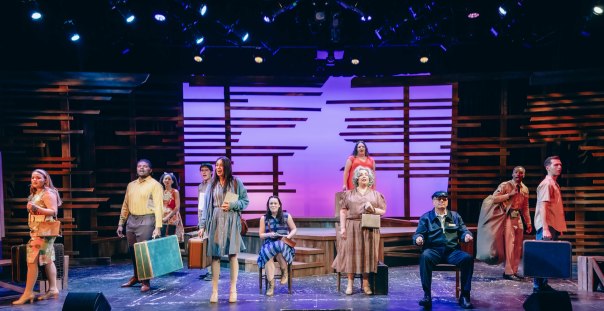
Only Edward Juvier consistently pierces through the sonic fog as the millionaire Osgood in his screwball pursuit of Daphne. Gather round him, fellow cast members, and let him preach unto ye the gospel of enunciation.

Ultimately, Lopez and Ruffin succeed in elevating the resolution between Joe and Jerry, diversifying the love match between Joe and Sugar, and crafting a more evolved relationship between Jerry and Osgood. Shaiman had the more formidable task in concocting his score, which is probably why his Some Like It Hot often feels so effortful onstage. They’re all striving so hard to create what the film so naturally was in the first place: a road musical with cherrypicked hits for Marilyn Monroe to croon, including “Runnin’ Wild,” “I Wanna Be Loved by You,” and “I’m Thru With Love.”

You can stream the original soundtrack online and judge for yourself. With a little extra diligence, you can search out Marilyn’s rare single recording of “Some Like It Hot” and see how it measures up to Shaiman’s title song, written with lyricist Scott Wittman. Pretty well, I’d say.

Christmas at Pemberley Gets a Gendered Makeover

Review: Miss Bennet: Christmas at Pemberley @ the Cain Center

By Perry Tannenbaum

If it weren’t for all the adaptations we hear about on TV and in movies, we could say that it required supreme audacity for Lauren Gunderson and , to tread in Jane Austen’s footsteps and pen a sequel to Pride and Prejudice, her wittiest and most beloved novel. But despite the obvious commercial bent of Miss Bennet: Christmas at Pemberley, Gunderson and Melcon have aimed to capture Austen’s essence and bring fresh life to her characters.

As you’ll find up at the Cain Center in Cornelius, no small thanks to the audacious direction of Steve Kaliski, the script sprinkles a bit of modern perspective on the Bennet sisters and their beaus – occasionally forcing us to recognize that Austen’s times are not so different from our own. Elizabeth Darcy, the heroine of the novel, still retains enough decorum not to call Fitzwilliam Darcy by his first name. Even in the privacy of their own home!

Likewise, elder sister Jane and her beloved Charles address each other as Mr. And Mrs. Bingley. “Happy Christmas” rather than “Merry Christmas” is the greeting norm, and the Christmas tree tradition has yet to take root in England in December of 1815. It’s Elizabeth’s audacity that brings this German custom to the Pemberley drawing room with its attached library.

In some ways, history has circled back. Back in college, my professor instantly drew our attention to the epistolary nature of Pride and Prejudice. The story is largely driven by letter writing. A chief turning point in the story is contained in a letter from Darcy addressed to Elizabeth, debunking her previous prejudices against him!

The prevalence of letter writing astonished us then – and felt alien. Ancient. Forty-plus years later, the sight of Mary Bennet, her sister Lydia, and Arthur de Bourgh exchanging billets-doux while under the same roof has to remind me of today’s texting, Instagramming youth, perpetually thumbing their cellphones. Buttressed by books, these youngsters can put quill to paper.

With Kitty off in London, not expected to arrive until Christmas Day with her parents, Mary is the only Miss Bennet we see and unexpectedly the leading lady. Arthur is an entirely new character, rivalling Mary in his bookishness. Resigned to spinsterhood, Mary is shocked to find that they’re hitting it off.

The forward-looking Gunderson and Melcon, proclaiming that Austen is for everyone, encourage diverse casting. But Kaliski and his Davidson Community Players go further, bringing us an all-female/non-binary cast. It’s an added semicircle backwards to Elizabethan days when only boys and men were permitted to perform onstage.

All three of these transpositions – Brooke McCarthy as Darcy, Rhianon Chandler as Bingley, and Jennifer Adams as De Bourgh – add a fresh patina of mirth and comedy. As for the playwrights, they inject plenty of wit and sparkle of their own. Speaking to Darcy before we see that Jane is seven-months pregnant, Elizabeth broadly hints she is arriving “safely and enormously.” Lizzy is more tactful when the expectant mother enters and they exchange greetings:

Lizzy: Look at you! You’re radiant.

Jane: I’m as large as a cottage.

Lizzy: And exactly as a cottage, you are warm, filled with life, and lit from within.

Although McCarthy plays him with some florid gestures, we soon see that he is richly endowed with breeding and tact. When the punctilious Mary presumes to correct Bingley, by informing him that the tree standing before them is a spruce and not a fir, Darcy pointedly intervenes. Before any dispute can begin, he proposes that he and his longtime chum exit for a brandy.

The ladies can now rebuke Mary, if they wish. They do, while gradually discovering that their younger sister has more charm and talent than previously suspected. Arthur’s admiration for her shocks them as much as it shocks Mary herself. As it turns out, Lizzy and Jane better be witty and perceptive, for Mary and Arthur are the plumiest roles. Fortunately, with the arrival of Lydia, the silly sister with the sham marriage, Lizzy and Jane can redirect their sharpest barbs.

Arthur is the heir to the nearby Rosings estate, but he is a distant nephew of the late Lady Catherine and has never lived there. There is some juicy history at that estate, left over from Pride and Prejudice,chiefly the presumption that Darcy would marry Milady’s daughter and not the comparatively lowborn Lizzy. Not to worry, Pemberley gracefully catches us up if we don’t remember Austen’s original.

What makes the role of Arthur so appealing is that he has no clue how to run an estate – and no solid experience with other men, women, or people. Adams carries a book around with her as if it were Arthur’s security blanket. Without one, Adams seems at a loss for what to do with her hands and arms, so we see Arthur almost perpetually in a scholarly or supplicating pose.

Attempting a billet-doux, Adams as Arthur reminded me of Christian in Cyrano de Bergerac, only he has nobody to help him out. When Arthur learns that his cousin Anne, after getting jilted by Darcy, now presumes she is betrothed to him, Adams’ awkwardness and shyness veer toward desperation and panic. When bliss is achieved, Adams’ glow is mesmerizing.

Crippled by a similar lack of self-esteem, Sahana Athreya as Mary is no more experienced and no less shy than Arthur – so she can range from being pedantic and irritating to heartbroken and pitiful to vivacious and adorable. Athreya can also freely gesticulate with her arms and sit down regally at the pianoforte.

The central triangle is further complicated by Destiney Wolfe as the compulsively silly Lydia. Glossing over her troubled marriage doesn’t inhibit Lydia from flirting shamelessly with Arthur, giving us extra tastes of how unaccustomed he is to such attentions. Nor does Kaliski bar Wolfe from being as irritating as Mary at her worst. On the contrary. Wolfe, when she isn’t pouncing, is often prancing.

At the center of all the overtures from Mary and Lydia – and the strict orders from Agatha Emma as the imperious Anne – Adams gets to be meaningful as well as stressed and sympathetic. For Mary and Lizzy, in the face of Arthur’s inclination to yield to Anne, are at considerable pains to remind him that he has what women don’t: a choice.

Of course, when Gunderson and Melcon wrote their merry comedy in 2016, they had no inking that “Your body, my choice” would be staging a comeback. But the playwrights are far from declaring that women were powerless. Even before her Christmas awakening, Mary is strong enough to proclaim that she would rather wed a plant than an unsuitable man.

Caring about their sisters, Lizzy and Jane sustain their relevance, Skylar Schock as Lizzy warming up to Mary and Emma Kitchin as the Jane becoming Lydia’s tactful benefactor. Christmas can even be celebrated by Emma, for it turns out that there’s kindness in Lydia beneath her silly, meddlesome surface.

Kaylen Gess’s scenic and lighting design complement each other handsomely, with Caleb Sigmon’s projections adding an extra festive luster. I’d imagine that Gunderson and Melcon would have envisioned a much larger, more intrusive tree at Pemberley. But as a Tannenbaum, I’m probably prejudiced.

The tree outside Cain Center, let me add, is big and bright enough for anyone.

Harlem Gets Braided at Jaja’s

Review: Jaja’s African Hair Braiding at The Arts Factory

By Perry Tannenbaum

My dear old Mom was born and raised in Harlem over a century ago, when a massive African-American cultural and literary Renaissance named for Harlem had already begun, long after the fabled Manhattan district with its storied 125th Street had been a major destination for Northern Migration after Lee surrendered to Grant. Even then, it would hardly be respectful to change Harlem’s name to Little Africa after all these years.

Yet playwright Jocelyn Bioh in her 2023 drama, Jaja’s African Hair Braiding,set on the corner of 125th Street, had me considering whether Bioh would rather call her Harlem – or at least this salon – Little Africa. The vibe and culture of Jaja’s, in Three Bone Theatre’s outstanding QC premiere at The Arts Factory, had me feeling that I was in another country while it was unmistakably my own.

Staffed and patronized by locals who hail from Senegal, Ghana, Nigeria, and Sierra Leone, neither Harlem nor Africa were the best places for Jaja’s craftswomen to be on a hot summer day of 2019 when Bioh’s action takes place. Aside from a breakdown in the braiding shop’s air conditioning, ICE lurks in the background as another of the women’s worries. Our own US President, the most powerful man on Earth, has bunched their homelands into the dismissive category of “shithole countries.”

Jaja’s daughter Marie, a brilliant bundle of chaotic energy, is running the salon today because Mom is getting married later this afternoon to an unpopular landlord who will provide her – and Marie – with the shelter of citizenship. That will free Marie, a valedictorian at her high school using a borrowed identity, to apply to an Ivy League school worthy of her energy, talent, and potential.

From the deluge of Marie’s opening monologue onwards, we realize that Jaja’s is a place bustling with life. Music is in the air, sometimes compelling the women to dance. There’s bickering, jealousy, hostility, vanity, teasing, and earthy humor. Not a murderer or a rapist in sight among the immigrants. Not even a pet eater.

About the only big mistake we can accuse director Donna Bradby of making is not helping us to observe Bioh’s signposts – via a wall clock and/or projections – of the time of day and the specified year this long, hot workday unfolds. Otherwise, Jennifer O’Kelly’s scenic design, Toi Aquila R.J.’s costumes, and Rod Oden’s lighting immerse us completely in Jaja’s humdrum-yet-exotic world for all of the show’s 95 minutes.

A clock on the wall, for instance, would help us to appreciate how long young Jennifer, an aspiring reporter, is willing to sit at Miriam’s station in order for the patient artisan to outfit her with a full head of microbraids. And how long does the bossy, rude Vanessa fall asleep at Aminata’s stand before waking to her new look?

The visible excellence of Bradby’s cast is matched by the variety of Deborah Whitaker’s pre-, post-, and mid-weave hair designs. When blackouts happen between scenes, stage manager Megan Hirschy must have a huge chore in the small Arts Factory space helping the scurrying players reappear with the right hair when the lights come back up. We never just sit there tapping our feet during transitions. They’re almost lightning-quick.

Nor does it trouble Bradby that it’s impossible to keep track of who’s from Senegal, Ghana, or Sierra Leone. Venecia Boone was assigned the task of dialect coach anyway, a really nice touch.

Of Ghanaian descent and native to nearby Washington Heights, Bioh obviously knows her characters as much as she loves them. She is also a performer, so Deity Brinson as Marie will not be the last of her players to be gifted with a juicy monologue. Like Marie and the braiders, we will wait a long time before Myneesha King appears as Jaja – in wedding white, of course, with a queenly crown of braids – and delivers the most powerful monologue of all.

Meanwhile, it’s Valerie Thames as Bea, the most fashionable and contentious of Jaja’s employees who fuels the liveliest action, seemingly able to hatch a new grudge at the drop of a spray bottle. The salon was her idea, not Jaja’s. Should have been a full partner in the biz. Refugee newcomer Ndidi is stealing her customers rather than customers just dropping Bea. Thames seethes, fumes, and makes scenes with a steely righteous dignity that sets us up for the turnabout that reveals her deep-down goodness and sense of community.

Until then, the human warmth of the shop emanates from Kellie Williams as Miriam and Vanessa Robinson as Aminata. Williams, rightly stationed upstage at the Arts Factory black box, is mostly distanced from the main sparring during her morning-to-night transformation of Jennifer’s tresses. But there’s a distant man on Miriam’s mind throughout her labors, and she’s spending enough time in Jennifer’s hair to become quite chummy with the 18-year-old by evening’s end.

While her bestie and gossip buddy Bea seethes and sneers, Robinson mostly effervesces as Aminata. She knows that she doesn’t have the patience for a daylong immersion in microbraiding, so she’ll have none of Jennifer despite her youthful sunniness. But EJ Williams as Vanessa riles her almost to the point of losing her cool, a comical series of shticks that begins with the pushy customer objecting to house rules that require her to step outside the shop to negotiate Aminata’s fee. Then Vanessa insists that she be braided with the implements and spray she has brought from home.

Aminata’s man troubles are nearer-to-hand than Miriam’s, for her wayward ne’er-do-well husband James only circles back to the nest to take advantage of her. Righteously divorced, Bea insists that Aminata drop this loser, dismissing the love factor that keeps her from following through with her resolve. Can’t help it when Graham Williams as James drops by and pushes his wife’s buttons.

So these skirmishes between Thames and Robinson, before and after James’s invasion, are the most delicious that we witness. Aside from her dreamer worries, Brinson as Marie is occasionally thrust into the middle of disputes, laying down the law for the prissy Vanessa and stepping into the middle of Bea’s various tussles with Ndidi, Aminata, and her defecting customer, Michelle. At one point, Marie even exiles the incorrigible Bea to the street!

The younger folk are calmer and more acclimated to post-truth America than their diva elders. Before we know it, Aminata is asking Marie how to tune the smart TV to YouTube. Sarah Oguntomilade as Ndidi, the highest-grossing braider in the shop, is especially cool – thoughtfully equipped by Bioh with headphones and loud music to tune out Bea’s accusations and tirades. There’s a really nice interlude when Graham fawns over and flatters her as the Jewelry Man, lavishing her with freebies. This Nigerian cameo as Olu was at least as crowdpleasing as his subsequent turn as the roguish Ghanaian, James.

Graham’s most impactful role is as Eric, the DVD man, who serves as the caring eyes and ears of the community. But it would be cruel to divulge any more.

Things happen quickly at Jaja’s. Notwithstanding the oppressive summer heat, each new character changes the temperature in the shop. Less obtrusively than Graham, Germôna Sharp brings in a variety of flavors as three different customers. The most dramatic of these is the diffident Michelle, who thought she would be switching to Ndidi when Bea wasn’t there. Most comical is Sharp as Chrissy, wanting braids that will make her look like Beyoncé.

As if.

“The Humans” Is More Haunting Than Ever

Review: The Humans @ Armour Street Theatre

By Perry Tannenbaum

Thanksgiving in Chinatown, in the shadow of the fallen Twin Towers – Stephen Karam’s spooky, mystifying, and hilarious The Humans hands us a world teeming with paradox. For an afternoon in a creaky old two-story apartment, newly rented by Brigid Blake and her boyfriend Richard Saad, her family gathers to celebrate, the whole lot of them nursing open wounds – and their Alzheimer’s-stricken elder, “Momo” – trying to heal from recent setbacks.

First staged in the QC at Knight Theater in a 2018 touring production starring Richard Thomas as family patriarch Erik Blake, Davidson Community Players brings us a downsized reprise in the first locally-produced staging, with the venerable Hank West in the lead.

Haunted by his return to the vicinity of Ground Zero and by his recent misdeeds, tormented by a deadly mix of sleeplessness and nightmares, Erik vies with elder daughter Aimee for which of the Blakes is suffering the most. Since last Thanksgiving, Aimee has come down with ulcerative colitis and taken major hits to her love life and her career as a Philadelphia lawyer – with major surgery looming on the horizon.

Yet Erik fires a wicked one-liner at Brigid, whose gripe, like his wife Deirdre’s, barely hovers above the “suck it up” level compared with his own. “If you’re so miserable,” he asks the health food fanatic, “why are you trying to live forever?” Inside negativity, Karam can be equally trenchant and funny when Aimee philosophizes about her recent breakup: “Maybe loving someone long-term is more about deciding whether to go through life unhappy alone or unhappy with someone else.”

Only Deirdre and Erik have an agenda for the afternoon, subtly suggested in a couple of brief dialogues. We’re mostly watching Karam’s keen observations of family interactions – their bonds, their tensions, their little quirks, and their tectonic divides. These appear all the more chaotic because dialogue often overlaps and action is happening simultaneously upstairs and in the more commodious basement.

Knight Theater probably gave us an oversized impression of Brigid and Richard’s love nest, while DCP’s Armour Street can’t help look both height- and space-challenged. Remarkably, Evan Kinsley’s more cramped set design lessens the struggle of viewing multiple tracks of action and family intrigue. Yet Karam and director Glynnis O’Donoghue are still able to provide enough compelling distraction at a key moment to allow the aged Momo to disappear without our noticing.

Even without two-story height, Kinsley’s set has an alleyway leading to an elevator shaft to accommodate the wheelchair-bound Momo’s transit between the two floors. The slice of set that serves as the upstairs somehow has enough space for the front door, an entrance to a bathroom (Aimee’s frequent retreat), and the only window looking out on the city. When the apartment’s oddities need to impact, Kinsley’s set and Sarah Provencal’s sound design deliver.

The divides between the Blakes will be familiar to anyone who has grown up in a family of siblings. Although Brigid would never consider living in Philly, the geographical divide is as important here as the generational difference, for neither of the daughters would ever think of moving back to Scranton, PA – except to a summer home that Erik tells us can move towards construction once there’s a sewer system near their pristine plot.

Those anticipated PA pilgrimages will not bring either of the sibs back into the bosom of the holy church. Nor will it erase the fact that these country folks’ children are irremediably citified, one a lawyer and the other an aspiring composer. Safety, religious, and lifestyle concerns plague the homespun parents. Ahead of their Thanksgiving visit, Deirdre has sent a care package that includes a statue of the Virgin to protect Brigid’s new home. Meanwhile, Aimee can expect an email any time a lesbian commits suicide.

Karam provides plenty for the Blakes to discuss in their near and distant back histories, with a handful of stunning updates. If things get dull, he serves up a choice collection of singularly awkward moments that would instantly embed themselves in family lore ever after, lovingly and mockingly retold at holiday dinners and special celebrations.

There’s even a “pig smash” ritual unique to Blake Thanksgivings, a nice spotlight for Richard. Often the aspiring social worker serves as our ears in his role as outsider, giving the Blakes the chance to explain all that is long-known among themselves.

These moments reverberate warmly within us, but the most haunting vibes, from Erik’s dreams and experiences, touch us all, nonchalantly invoking 9/11 and Superstorm Sandy – specters of terrorism and climate change. Over and over, whether Deirdre wheels Momo around or Aimee summons an Uber with her cell, we hear an eerie, insistent whisper from the playwright emanating from his vivid, painstakingly detailed dream: this is how we live.

On Davidson’s compacted stage at Armour Street, the natural flow of The Humans, the lack of powerhouse confrontations that shake us to the core when we witness such American classics as August: Osage County, Who’s Afraid of Virginia Woolf? or The Little Foxes, reminds us of Chekhov’s more placid classics. Rich and funny and touching as all the action is, we will likely struggle to discern a solid plot until Erik’s big reveal.

Inexperienced theatergoers are therefore advised to ignore any FOMO anxieties they may be experiencing and surrender themselves to the many delights, laughs, shocks, and epiphanies that West and his castmates deliver.

On the page, Karam’s script doesn’t pop out at you with the color and verve that O’Donoghue gets from this ensemble. West actually comes onstage with a couple of key advantages over Richard Thomas. We more readily accept West as an ordinary janitor-turned-equipment-manager, and he can bring out a curmudgeonly edge to Erik that I’d never noticed before.

No less surprising is the bubbly, goofball likability that Breanna Suarez brings to Brigid, though she is often the family contrarian and party-pooper in the script. The vibrant energy she exudes somehow turns pure negativity into simple immaturity, emphasizing Brigid’s spoiled qualities. As our genial hostess, Suarez tunes in on Brigid’s side hustle as a bartender, so she’s the life of the party while subtly fueling the true plot, endearingly committing a faux pas for the ages along the way.

Portraying West’s wife for the first time since 2005, when they both earned best actor honors in Coyote Ugly, Anne Lambert makes the wait worthwhile. Although Citizen Trump famously descended his escalator in June 2015, between the time that The Humans opened Off-Broadway and when it reappeared on Broadway with a completely new cast and director, Deirdre likely struck the late-2015 Broadway crowd as a MAGA maniac.

Interestingly, Karam could have taken Hillary Clinton as his model if he had written his tragicomedy 20 years earlier, but Lambert still strikes me as a MAGA nutjob even if that couldn’t have been the playwright’s intent. The religious zeal, the paranoia, and the constant moralizing are almost non-stop, so thanks to Lambert’s implacable disapproval, Deirdre winds up ennobling Erik and humanizing her daughters – just by enduring her. Yet there is an unmistakable sincerity to this steely, troubled soul.

Deirdre’s relatively spurious sufferings also brighten Aimee’s halo. Her woes are certainly the most tangible, so Alyssa Whitting has the freedom to add some hard edges to her performance, aiming her best zingers at Brigid with an assortment of barbs for the rest of the fam. Ascending and descending DCP’s imaginary staircase for extended poops, Whitting makes a pungent impression when she’s with us. She’s the slick urban professional among the Blakes, getting better reception on her cell than Dad and handling all the key calls.

Preoccupied with the cooking, Ryan Miles as Richard is also frequently on-leave from the family flow, but he’s a fine audience surrogate when we need things explained. Without fuss or bravado, Miles keys into the fact that Richard is the most laid-back, financially secure person in the room – the one lifelong New Yorker – in between Brigid’s age and Erik’s, accentuating his unique perspective.

Momo’s lines are annoyingly repetitive and approximately 85% gibberish to my ear, meticulously transcribed by Karam word-by-nonsensical-word. So if Wandy Fernandez is accurately delivering Momo’s babblings as written without considerable improvisation, she has performed one the most prodigious feats of memory in the history of theatre. There is wonderful variety in her performance with a lovely little miracle in the middle, which of course gratifies Erik and Deirdre the most. Words or not, the woman can also throw a fit.

The cryptic ending of The Humans, where the thin thread of Karam’s plot crystallizes, was clearer to me the second time around. Along the way, it’s helpful to note the circular shape of the Blakes’ history, the dream Erik divulges stage by stage, and the explanation Richard offers. Erik’s worries, sadly enough, are suddenly more topical in the Carolinas than ever before. After Sandy, the fact that Chinatown was a Zone A flood zone was fearfully real. Now that Asheville is isolated, adrift from interstate highways until next year, we can legitimately wonder what zone is not a flood zone after all the climate damage humans have done.

Richard says it succinctly, recalling a comic book he loved as a kid: “horror stories for the monsters are all about humans.”

“Girl from ther North Country”: A Dream Dispelled

Review: Girl from the North Country at Belk Theater

By Perry Tannenbaum

When it premiered in 2017 at The Old Vic in London, Girl from the North Country must have seemed like the fruition of a musical theatre dream team. The original book would be by acclaimed Irish playwright Conor McPherson, who would freely roam amidst the vast catalogue of music and lyrics by Bob Dylan, the 2016 Nobel Prize Laureate, to choose his songlist. By most surviving accounts and reviews, Girl from the North Country was must-see theatre in two successive London productions, Off-Broadway in 2018, and on Broadway in 2020.

Previous peeps at the show on the road, chronicled in regional sections of BWW, have only been slightly less enthusiastic. So opening night at Belk Theater earlier this week was a massive shock when the national tour touched down here for the 28th of its 30 scheduled stops.

The first stunner was the sparsity of the crowd. Often sold out on opening night for brand-name shows, the Belk was less than half-filled for the Charlotte premiere. Traffic to the Uptown was no lighter than usual, and blackouts had already been a non-factor for previous events I had covered in Plaza Midwood and Davidson. Were fervid Dylan fanatics, among the most loyal anywhere, diverted by the WNBA Playoffs? Were they glued to their TV sets, watching the Walz-Vance debate?

Whatever reason the stay-aways may have had, the biggest shocker was that the no-shows were so right. The dream team is merely a mirage on the road, though the esteemed playwright is still listed as the stage director.

As much as we both love Dylan – my wife Sue and I held hands when the mighty “Hurricane” was sung – Girl from the North Country never fully connected with us. The boxer and escaped convict in McPherson’s script is Joe Scott, we’re in 1934 Duluth (three years before Rubin “Hurricane” Carter was born), and when Warren Nolan Jr.* plunges into the song, he must segue into “All Along the Watchtower” long before the tale of the framed boxer reaches its epic, cumulative power and intensity.

This is not the story of the Hurricane. Yet the connection of this suddenly anachronistic song, unlike the decisively irrelevant “Watchtower” or “Idiot Wind” that complete the medley, is stronger than nearly all the others we hear. At its worst, the beginning of Act 2 at Nick Laine’s dingy Duluth boarding house devolves into a chaotic Dylan concert with no forward-moving drama at all, the most inert and aimless musical theatre I’ve seen since Cats purred back from its intermission.

Action revolves around the innkeeper, his bipolar wife Elizabeth Laine, his alcoholic and artistic son Gene, and his adopted black daughter Marianne, five months pregnant. Curiously, Nick is the musical eye of this stormy family, the only member who never gets a solo to sing. John Schiappa is devoted to his demented wife, whom he dutifully feeds though she might slap the plate out of his hands, but he cares more for his longtime boarder, Carla Woods as Mrs. Neilsen, a possible financial lifeline if her late husband’s ever gets out of probate.

As Elizabeth, Jennifer Blood gets the most outré actions from McPherson – even when she’s brooding at an upright piano – and a royal gem from the Dylan songbook at the end of each act, “Like a Rolling Stone” followed “Forever Young.” These briefly sounded like echoes from the days of Janis Joplin reign as rock’s blues queen. Days of mad incense and love. Elizabeth has more reasons to be jealous of her admirably stable and ruggedly handsome husband than justifications for her relentless resentfulness and orneriness.

Yet even this most powerful of McPherson’s roles never quite bridges the gap between the footlights and our hearts. My most generous theories for why this was so on opening night are the sheer size of the Belk, double the seating capacities of the houses where North Country played London and New York, and the wretchedness of the sound, a chronic Blumenthal ailment.

Come back to us, MJ! – or at least send your sound crew.

Sharaé Moultrie gives a velvety smooth voice to Marianne and, despite her precarious position as an unwed mother-to-be, enough serenity for us to occasionally suspect that her conception was immaculate. She gets her share of solos, if not the choicest harvest. Dramatically, Marianne is the calm center of a vortex, with love and affection swirling around her from at least three different men.

Concerned about her future, Nick seeks to wed her to the financially secure – but elderly – Mr. Perry, portrayed by Jay Russell with humility, gentleness, and heart. Manuel as Joe is almost immediately smitten by Marianne, no doubt imagining himself as her redemption and she as his. She has reason to be impressed, for when he was challenged to a fight by her drunken brother Gene, Joe reluctantly yielded to the challenge and floored Gene with a single blow.

Prodded by Nick to get a job to help steady the Laines’ finances and avert foreclosure on the guesthouse, Aidan Wharton* as Gene sees his hopes of becoming a writer fading away. More sorrows to drown in drink are triggered by his ladylove, Chiara Trentalange as Kate Draper, when she announces that she is already engaged to be more pragmatically married. The ensuing Wharton-Trentalange duet on “I Want You” was probably the most dramatically apt of the evening.

Might have been more impactful in a smaller house with cleaner sound.

McPherson puts plenty of life onstage that never quite projects to Belk’s empty upper balconies. Aside from Mr. Perry; a wild bible salesman with a frayed clerical collar arrives with Joe, Jeremy Webb as Reverend Marlowe; and our sometime narrator, Alan Ariano as Dr. Walker, pops up periodically at the boarding house, making his rounds. Of the two, Webb as Marlowe is far more dangerous – almost dramatic – for his fugitive status and his poverty make his sales pitches aggressively hard-sell and his fingers tend to get sticky when he thinks nobody is looking.

With so many plots already brewing in Duluth, McPherson thoughtfully adds a family from the outside world that tends to add variety to the inbred local atmosphere of seediness and decay. The well-dressed Burkes are a fallen uppercrust family, as iconic during the Great Depression as the downtrodden wanderers crossing the Dust Bowl to sunny California.

Both Mr. Burke, who lost his business during the Great Crash, and Mrs. Burke, who lost a chunk of her patrician trust and self-confidence as a result, are on the lookout for new opportunities, not necessarily with each other. Both David Benoit and Jill Van Velzer, playing the elder Burkes, also sit down occasionally to play the drums, adding a new musical level to the evening while expanding the social context of North Country. Benoit gets to be more decadent, proposing to manage a ring comeback for Joe.

The couple’s son Elias has some sort of learning problem, so D’Marreon Alexander* gets a breakout moment in Act 2 – parallel to Blood’s with “Rolling Stone” in Act 1 – when Elias suddenly emerges from his cognitive cocoon with “Duquesne Whistle.” Doubly surprising for me, for “Duquesne” hurtles forward with the drive of Dylan’s best work and because I’d never heard the 2012 composition before. Wow.

I wish I could praise any of McPherson’s dramatic moments as highly. We’re not likely to experience a theatre week such as the current one for ages to come. Two living playwrights who have translated works by Anton Chekhov – and do not hesitate to use his methods – have pieces running simultaneously in Metrolina. Arguably, McPherson’s book, repeatedly stressing the consequences of inaction, has more of the Russian master’s most distinctive flavor.

But Stephen Karam’s The Humans, set in post-9/11 and post-Hurricane-Sandy Chinatown, will rock your world. Anyone torn between the two would be best-advised to bypass the Broadway Lights production at the Belk and head up Interstate 77 to Davidson, where Karam’s masterwork is playing at the Armour Street Theatre.

*Note: On opening night, Wharton, who normally portrays Elias, replaced Ben Biggers (sick all week ) as Gene. Alexander replaced Wharton as Elias and Nolan Jr. subbed for Matt Manuel.