Review: The Flick at Theatre Charlotte and Independent Picture House
By Perry Tannenbaum
From time to time, it’s nice to see Theatre Charlotte showing greater confidence in its audience and extra audacity in its programming. Recent seasons have seen increased excursions beyond bankable fare, such as A Christmas Carol, Misery, Murder on the Orient Express, and Rumors, to more daring and provocative frontiers such as Violet, Every Brilliant Thing, I and You, and Detroit ’67.
God of Carnage is on deck for next month.
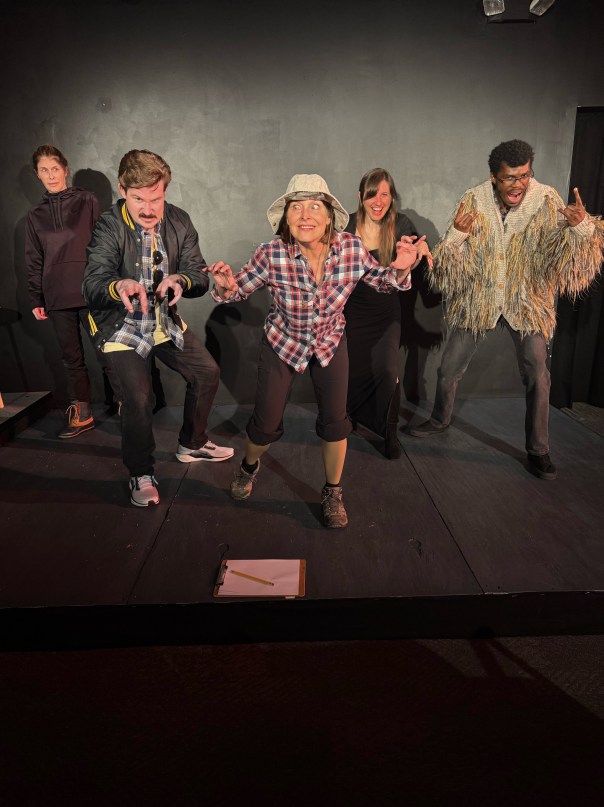
Now we’re in the midst of a run that’s even more daring and experimental than their 2016 concert version of Caroline, or Change, which was staged out in the lobby of the Queens Road barn. The current production of Annie Baker’s THE FLICK, directed by Kyle J. Britt, goes even further out on a limb.
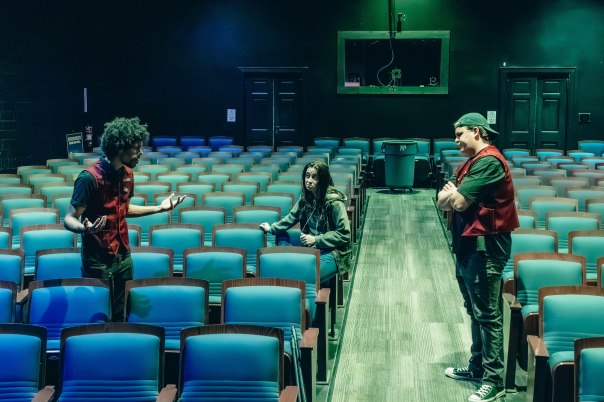
It’s very high-concept, for now we go past the theater doors leading to the front and rear of the orchestra, entering instead through the stage door. Instead of heading backstage, we hang a right – and take our seats onstage, looking out into the orchestra where we usually sit and the light booth beyond.
Tonight, that orchestra is the stage and the light booth is a projection room aiming blinding light at us, for Baker’s notorious Pulitzer Prize winner takes place in a movie theater, one of the last in America that still shows movies made on 35mm celluloid. Famed for its epic length, sustained pauses, and glacial pace, The Flick had premiered Off-Broadway in 2013 at Playwrights Horizons and revived, with the original cast, at the Barrow Street Theatre, where I reviewed it in 2015. Avenging myself on that production at my computer turned torture into a bit of a picnic.
Without that mischievous consolation, I presumed that my wife Sue was sufficiently traumatized not to wish to see this faithful sketch of the quotidian a second time. Wrong. Until midway into the second act, she had totally forgotten The Flick.
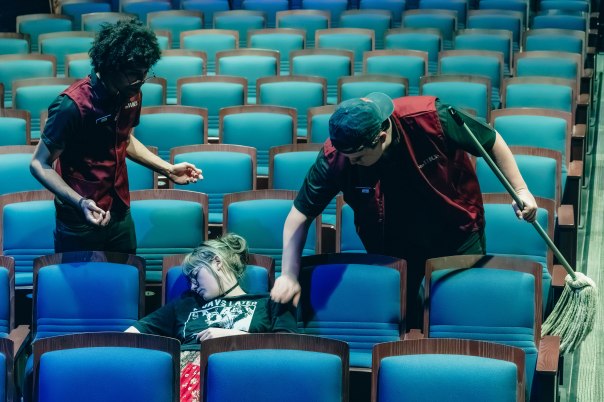
Nightmare City. Properly braced for the epic slog, I found myself charmed by the Theatre Charlotte version, for Britt goes the extra mile – recalling the greatest Carolina Actors Studio Theatre forays into experiential theatre – in making The Flick a moviegoing adventure. An elegant ramp bordered by chrome railing is slung over the couple of humble steps that normally lead you backstage at the Old Barn.
The new entranceway is draped in black curtains and discreetly spotlit, duplicating the ambiance at a multiplex when you leave its indoor boulevard and plunge into the darkness of one of the theaters. If you’ve seen the movie posters promoting this special Theatre Charlotte presentation, you’ll already be impressed by Britt’s ability to capture the deathless noir flavor of the Pulp Fiction movie poster.
Seeing this sly Tarantino homage, perfectly sized and displayed in that spotlit alleyway, adds a wonderful frisson to the evening. For those who weren’t as thoroughly braced as I was for the inaction and inertia to come – or less advantageously seated than we were – that evening grew very long. In the heart of Greenwich Village in the summer of 2015, I troubled to time the show: playing time clocked in at 2:54 plus a 19-minute intermission.
We can further admire Britt for speeding up the action to narrowly beat those Off-Broadway timings. He’s actually bucking the odds.
Brilliant concepts can start to crumble when they collide with reality. When David Zinn designed the set for the legendary Barrow Street, he could take liberties. His theater could be four rows and achieve reasonable verisimilitude, but Britt must play the hands he is dealt. That’s 13 rows of seats at the Queens Road barn, and if you want your actors within reasonable proximity of the stage, you’ll need them to traverse seven or eight rows to replicate the same intimacy we had at Barrow Street.
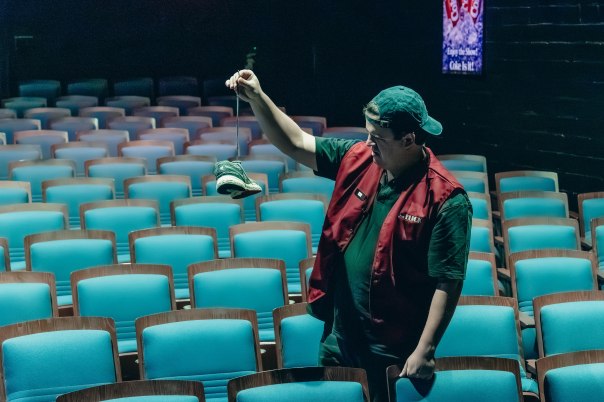
Each exit between Baker’s many scenes must traverse that extra distance, threatening to further lengthen our playing time. When we first see Aedan Coughlin, as Sam, schooling John Felipe, as Avery, in the finer points of cleaning up theater trash between ushering stints, Britt wisely spaces them at opposite sides of the aisle. So it’s plausible that both men must raise their voices to be heard.
Even so, Coughlan, as the disgruntled senior usher, is the more consistently audible, showing the newbie the ropes and schmoozing with Felipe. That gap didn’t narrow significantly as Sam continued his chattering and coaching toward the front seats. Avery does seem to emphasize the names of Hollywood stars, compared to the relatively garbled names of the films they were linked to when showing off his cinema geekiness.
Otherwise a bit shy and withdrawn, Avery boasts that he can connect any two Hollywood stars you name in six-degrees-of-Kevin-Bacon style. For all of Sam’s repeated efforts, Avery always makes good on his boasts. While it is likely that Sam begrudges Avery his more substantial education and his more promising future, that’s not where the friction between them peaks.
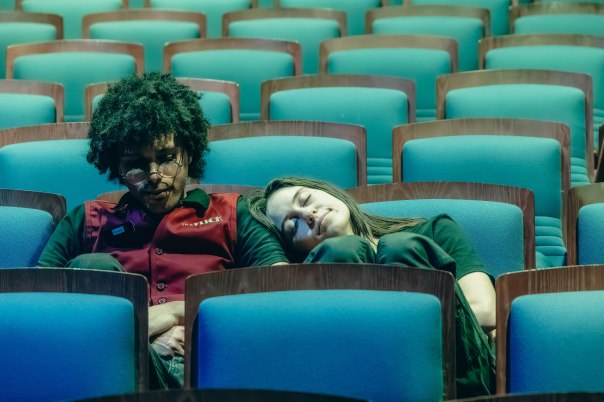
Enter Destiney Wolfe as Rose: younger, savvier, and sexier than any of her co-workers. So sexy that Sam tells Avery that she’s a lesbian – to clear his lane to Rose. If he ever summons up sufficient courage to make a move. Wolfe isn’t full of herself as Rose, but she’s coolly self-assured. After getting passed over while Rose snagged the promotion to projectionist, Sam may rightly believe that this talented young lady is out of his league.
To look at Coughlin, you would not instantly agree. While not as erudite as Avery – or as snobbish – Sam can propose numerous worthy candidates when the college guy boldly declares that Pulp Fiction (1994) was the last great American film.
Among those candidates, Avatar (2009) draws the most scorn from Avery and is one of Felipe’s best moments before intermission. Thematically, the comparison between classic noir celluloid and digital fantasy gets us to the heart of Baker’s yarn. The Flick, doubling as the name of Baker’s movie house, is an endangered species, treasured by Avery as an analog monument, one of the last-standing rear guards against the onrush of digitality that isn’t film at all.
Surrendering, we shall see, without a fight.
The location of this landmark is in Worcester County, Mass., allowing Coughlan to add on another layer of excellence, intermittently capturing the Southie brand of a Boston accent. As the scholar in the group, Felipe is hardly obligated to attempt the working-class accent, but Wolfe doesn’t even try.
At least, I don’t think she does. Hearing anything she says without her calling across the theater was a pretty rare experience. What really crash-burned Britt’s concept, beyond the usual acoustic difficulties we’re familiar with at the Old Barn, were the problematic sightlines of the temp seating onstage. Further back than a couple of rows, there was no way to hear or see all the action. The lip of the Theatre Charlotte stage got in the way when the actors moved all the way up front because of the problematic sightlines.
Since so much was so hard to take in before the lights came up for intermission, I felt obligated to issue a spoiler to my companions, telling them there was drama on the near horizon. Shit will begin to hit the fan – not at a blinding velocity – when Sam returns from attending his brother’s wedding and discovers that Rose has taught Avery how to work the projector, a favor (not the only one) that Sam has been denied.
Other members of the opening night audience simply defected.
Now the show, fully chastened, continues its run at the Independent Picture House this weekend. Prospects are better at Raleigh Street for fuller enjoyment. None of the movie theaters there has more than 12 rows, almost all are considerably narrower, and none are saddled by an overhanging stage compromising an audience’s sightlines.
One of these houses even allows actors to slickly enter the space behind the fourth row of seats. The express route!
Review: Over the River and Through the Woods at Theatre Charlotte
By Perry Tannenbaum
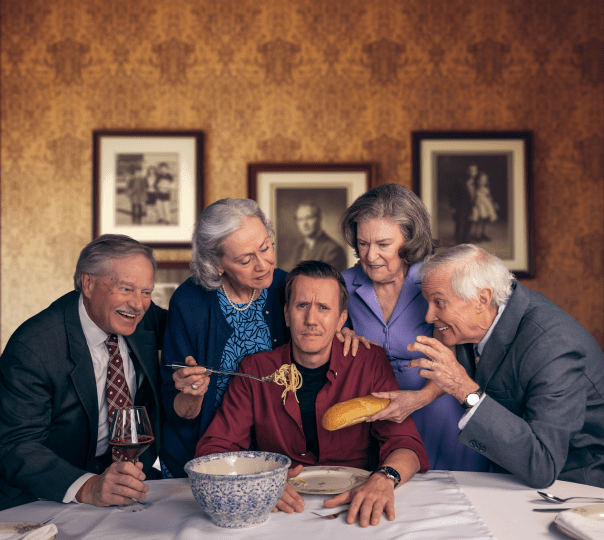
Back in the days of Woodstock and hippies, my generation spoke solemnly, defiantly, or even sarcastically about the Generation Gap. For a long time, it was sincerely believed to be the most telling division in our country. With the return of JoeDiPietro’s Over the River and Through the Woodsto Theatre Charlotte after previous runs in 2002 with Rock Hill Community Theatre, 2004 with Charlotte Rep, 2013 at Fort Mill Community, 2014 with CPCC Summer Theatre, and 2016 with Davidson Community, it’s rather shocking to realize how recently that belief has become so quaint and outdated.
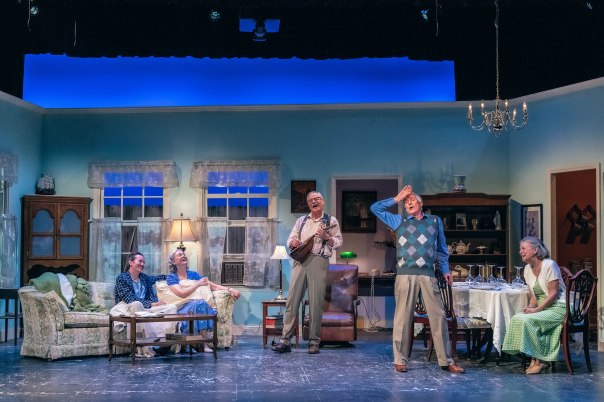
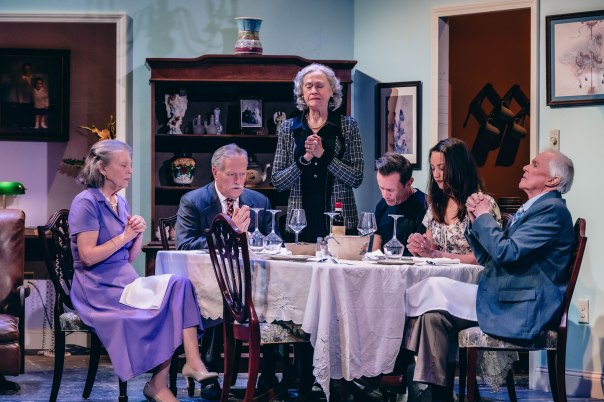
Good thing, then, that Over the Woods is mostly a comedy that doesn’t take itself seriously – for the gap is huge. Our floundering Nick Cristano, career success and social schlub, is two generations younger than his Hoboken elders. The gap is further multiplied by the aggregation of both sets of grandparents, Nunzio and Emma Cristano coming over for Sunday dinner every week chez Frank and Aida Gianelli.
For added zest, the gulf between the grands and the hopelessly outnumbered Nick is more than a little exaggerated. A game of Trivial Pursuit plays a little like an Abbott & Costello shtick, capped by an epic global route to Nunzio’s single correct answer.
In fact, the two scenes we see before intermission at the Queens Road Barn would not feel out-of-place if we encountered them as sketches on classic TV variety shows, ranging from Sid Caesar’s Show of Shows to Saturday Night Live. The first is Nick’s hilariously arduous attempt to break some big news to the grandfolk.
Whether it’s a glib interruption, a conversational detour, a remembered anecdote, a temporary defection to another room, or Aida’s never-ending blandishments of irresistible Italian home cooking, one obstacle after another keeps Nick’s news on perpetual back order until we’ve had to question if it will ever make it off the runway.
Hitting Broadway a year before The Sopranos cemented the connection between Italians and New Jersey, Over the River overflows with ethnicity, thanks to director Elizabeth Sickerman and dialect coach Marilyn Carter. Nor is this pure and delicate spring water. It’s an aromatic sludge with the consistency of Grandma’s legendary marinara. Two dominant flavors: Italiano and Joisey.
More cringeworthy is the folk medicine cure that the elders concoct in the wake of Nicky’s stunning disclosures. Enter Caitlin O’Hare, a nice local Irish girl unafflicted by any ethnic accent and hopefully alluring enough to keep Nick from straying too far from Hoboken. It’s a brash set-up that catches poor Nick unawares, an impromptu first date with unabashed interruptions, interrogations, and interferences from the well-intentioned seniors.
So here is where everything becomes so quaint, halcyon, and naïve. Both of the Gianellis that Caitlin finds so adorable are Italian immigrants. We find ourselves reacting in the same wayto both of the elder couples, no matter how far Emma overreaches with her matchmaking and her prying or how much excessive food Aida lavishes upon her young guests, including veal for a vegetarian.
They are truly personable. Speaking directly to the audience before anybody picks up a dinner napkin, Frank genially tells us that he arrived in America with just 200 lira in his pocket (about $10.50 US back in 1930), along with the Hoboken address of a cousin who had already moved to “a faraway land called Brooklyn.” And 65 years or so after reaching our shores, reminiscing about living under a Hudson River pier for six weeks, he’s still speaking with an accent!
“Tengo famiglia!” he and his grandson declaim, the taste of their Italian roots still sweet to their lips.
Before even saying grace, Frank has already checked three of the immigrant boxes that 47 would label as garbage. Yet there’s more ICE bait: Emma remains as proud of her husband as she is of the family she raised here, proud to describe him as a laborer. After all, he built this house with his bare hands!
Ironically, when DePietro was prefacing his 1998 comedy with Frank’s migrant memories, he probably wasn’t trying to score a political point. “What point?” he might have asked. On the day after our Republic’s 288th birthday, when I last saw Over the River at Pease Auditorium, my reaction was likely aligned with the playwright’s.
My 2014 review, “Matchmaking With Veal and Provolone”? Not a single mention of politics or immigration.
That was the first time we encountered Gerald Colbert’s portrayal of Nunzio, the weightiest counterbalance to DiPietro’s comedy. As a second-generation American, Colbert’s Nunzio, with his gray hair slicked down traditionally, tracked extremely close to my dad, who had passed away less than two years earlier, and my Uncle Abe – often mistaken for Dad’s identical twin – who had died just five days earlier.
Looking so much like them that day added to the weight of the mortality that Nunzio was staring in the face, in the grips of terminal cancer and grappling with the question of whether he should weaponize his condition to keep Nicky in Hoboken. Both of my elder Tannenbaums reached their nineties, so there’s plenty of gap left for Colbert to navigate, but his affinity with and empathy toward Nunzio have noticeably deepened.
Nunzio’s climactic valedictory dialogue with Nicky was especially heartbreaking for me, but it also offers new dimensions of topicality for all.
As the lovingly coddled and embattled Nicky, Timothy Hager is almost too perfectly cast. A walking bundle of ambivalence and insecurity, Hager is also sufficiently tall, stooped, and slender to be viewed as crying out to Aida to feed and overfeed him again and again so dear Nicky can finally take shape. He does make an awful impression on Caitlin with his defensiveness, but his awkwardness – and gawkiness – keep him a bit lovable in his discomfiture.
He’s aware that he’s a mess: a work-in-progress.
Quaint and manipulative as these harpies are in their quest to tie Nicky down in Hoboken, they need to be ambivalent because they honestly love him – and because they have previously allowed their sons and daughters to fly the coop. Paula Baldwin isn’t taking on the toughest challenge of her career with Aida, the Einstein of pasta, but she handles the matriarch’s ignorance with a zest that brings fresh life to the g-mama stereotype.
If we hadn’t seen the like with so many stage husbands before, we could say that Baldwin pairs amazingly well with Henk Bouhuys as Frank Gianelli. Can we agree, though, that he delivers the tangiest Italian accent? He must also navigate a preternatural ignorance that matches the blank that Aida draws on vegetarians, for Frank doesn’t know where Seattle is. Notwithstanding Frank’s humble beginnings – and the accent – Bouhuys consistently radiates the well-to-do dignity of an octogenarian enjoying his golden years.
DiPetro’s subtlest move is making sure that Nunzio and Emma Cristano are second-generation Americans with urban accents. This isn’t as crucial for Colbert as Nunzio as it is for Kasey Lathem as Emma. Hers will be the only familiar face that Caitlin expects to see when, politely bearing a bottle of wine, she knocks on the Gianellis’ door.
Lathem must be glib and modernized enough to be a supermarket buddy of Karisa Maxwell McKee as Caitlin O’Hare. Offsetting her laudable sociableness, Emma must also be tactless and tone-deaf enough to introduce this chum to everyone as “the unmarried niece of my canasta partner.” Nunzio and Frank can be counted on to immediately join in with the same high level of unsubtlety.
Sensing the gauntlet that she will have to run, McKee gets to show considerable backbone as Caitlin, though DiPietro would have been more imaginative if he had made her something other than a nurse. Her ultimate effect on Nick, dispensing her objective opinion on his behavior vis-à-vis his grandparents’, is not at all medicinal. She becomes a timely barometer in gauging how much growing Nick still needs to do in his thirties – and paradoxically, how urgent it is for him to strike out on his own.
We’re sort of circling back to Frank getting on that boat with 200 lira, aren’t we? In her digital program intro, Sickerman rightly targets the immigration themes lurking in this script, linking us to a Library of Congress page on “Immigration and Relocation in U.S. History.”
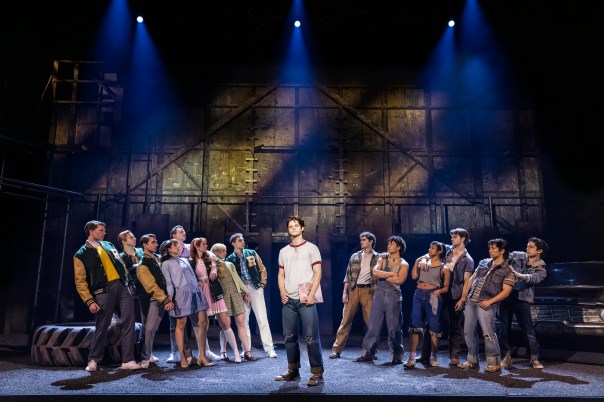
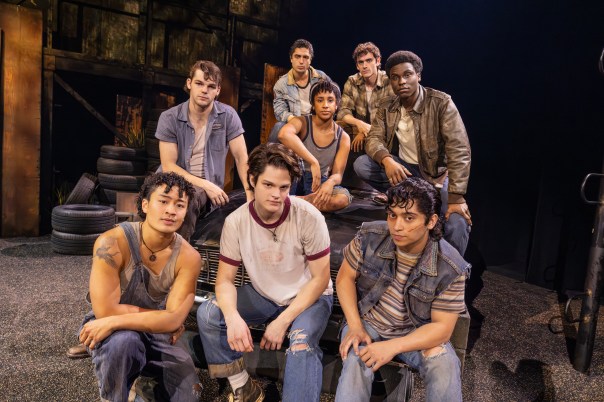
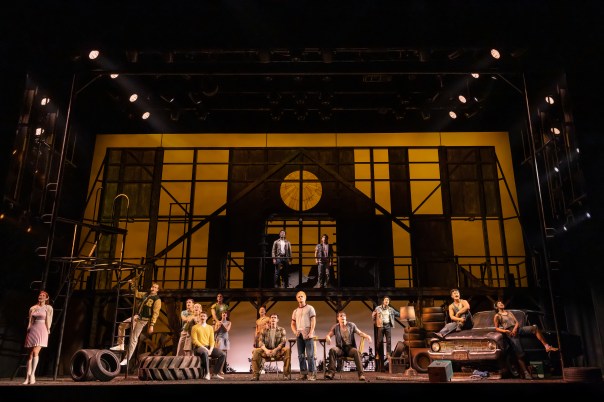
Belk Theater will likely still be rockin’ for days after the national tour of THE OUTSIDERS strikes its deceptively simple set and rolls on up to Chicago for a two-week run. If it weren’t Charlotte Symphony already booking the space next weekend, this gritty, steady rocker could have easily played a second week here without losing momentum. And possibly more.
Opening night was an eye-opener for anyone who had never been swept up in the rite-of-passage tidal wave generated by S.E. Hinton’s 1967 novel and Francis Ford Coppola’s 1983 film adaptation. Traffic to the College Street parking garage was so intense that, when we finally found a place on Level 8 to park, we needed to take a down elevator to exit at the bridge across to the Bank of America tower, where Blumenthal PAC has its performing spaces.
Usually, we hit the up button to go two or three floors up to Level 6.
After pausing to validate my parking stub in the lobby, we found that we were just in time as we saw the usher close the theater door behind us. It was only when we took our seats that we realized that the place wasn’t just packed… it was a sell-out. So an usher confirmed when I ambled up to the front of the house, turned around, and beheld eager theatergoers all the way up to the uppermost rows of the top balcony.
This was near-Hamilton fervor, eclipsing the receptions we’ve recently seen for such recent Tony Award-winners as Kimberly Akimbo, The Band’s Visit, Moulin Rouge, and even Hadestown. While we can all quibble and passionately argue which of these distinguished visitors should win a tournament of champions playoff, the production quality of The Outsiders was definitely top-tier, from Cody Spencer’s tight sound design to Jeremy Chernick and Lillis Meeh’s splashy special effects.
While some of the buzz that I was hearing about this Tulsa tale likened the animosities between the Greasers and the Socialites, or Socs, to the Jets and the Sharks of West Side Story, Ponyboy Curtis and his fellow Greasers are far more déclassé than their Hispanic counterparts, let alone the Montagues of Shakespeare’s Romeo and Juliet. There are no Greaser girlfriends in this grim picture, an apt barometer of these dudes’ hopelessness.
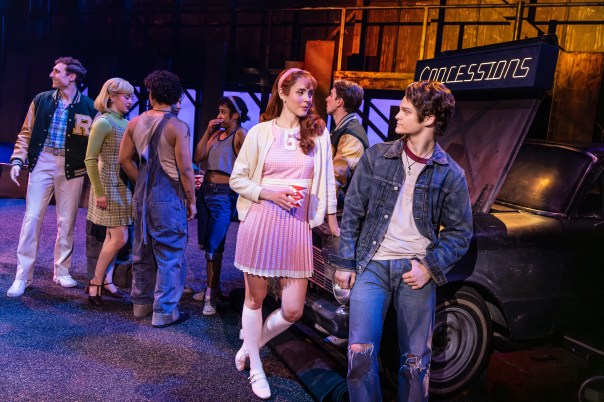
Nor is Ponyboy actually poaching on one of the Soc girls. After taking a beating for watching a movie on Soc turf, he escorts the Alpha Soc girl, Cherry, to a concession stand at a drive-in movie on neutral ground. They strike up a long conversation, enjoy each other’s company, but there’s no petting or romance.
Even so, this crosses the line for Cherry’s ultra-possessive boyfriend, Bob, and his chums. They gang up on Ponyboy and his bestie, Johnny Cade, not realizing that Dallas Winston – the Greasers’ spiritual leader and an ex-con – had recently gifted Johnny with a switchblade and taught him how to use it. Like Romeo before him, Ponyboy and Johnny Cade must flee town to avoid the law, Dallas acting as their Friar Lawrence.
The score by Jamestown Revival and Justin Levine is as consistently intense and authentic as Leonard Bernstein’s, but not nearly as varied. Nor with Levine’s arrangement for guitars, keyboard, cello, bass, violin, reeds, and drums, does it aspire to the same amplitude and agony as West Side Story. That’s about right: Amid the gloom and despair of Greaserdom, there’s a glimmer of hope emanating from Ponyboy, who has read Robert Frost and Great Expectations.
After Johnny Cade’s exhortation to “Stay Gold” in the face of Frost’s “Nothing Gold Can Stay,” Ponyboy’s favorite poem, that glimmer is not extinguished.
Unlike the Coppola movie, Nolan White as Ponyboy doesn’t sport the has-it-made Hollywood looks of C. Thomas Howell or the future superstar hunks – Matt Dillon, Patrick Swayze, Rob Lowe, and Emilio Estevez, for starters – surrounding him. More like Micky Dolenz of Monkees fame. That gives this stage version, directed by Dayna Taymor, about a million-mile head start on the film.
The other homies are no less homely (except the stunning Corbin Drew Ross as Sodapop Curtis), which is a good thing. Bonale Fambrini as Johnny Cade and Tyler Jordan Wesley as Dallas never look like they’re slumming. They sing and act as if they’re to-the-gutter-born, dressed accordingly by costume designer Sarafina Bush.
We can also gush over the glamor and drama that Emma Hearn and Mark Doyle bring to Cherry and preppy Bob. Or the family struggles, sacrifices, frustrations, and domesticity that Travis Roy Rogers brings to the action as one-time pro football hopeful Darrel, Ponyboy’s eldest brother.
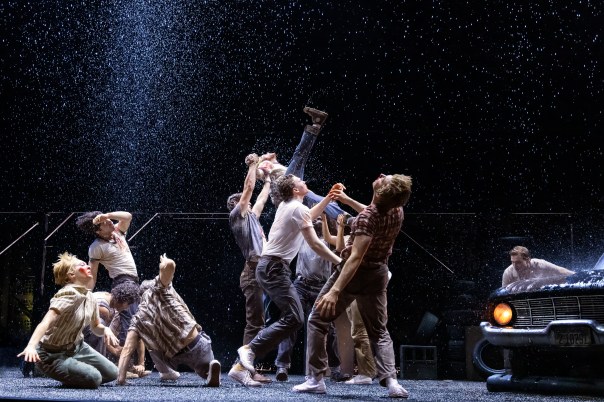
But as good as Adam Rapp’s book is at capturing the striated inertia of Hinton’s Tulsa, the propulsive electricity of The Outsiders comes from its score and the flair of Rick & Jeff Kuperman’s jagged choreography. Even this isn’t enough for Taymor. The hoofers send up bursts of plastic pellets from the floor, and the climactic rumble between the gangs brings down storm showers from above. Once all of these elements began cranking up, the fanaticism of the pre-sold audience was irresistibly contagious. I listened to the acclaimed original cast album when I returned home, but it wasn’t nearly as exciting as the live
If you love cats, you already know the open secret of their appeal: they are all wild thangs. Yes, we can declaw them or inflict various mutilations on their genitalia to superficially tame them. But they will still swat at things floating in the air, still hiss when cornered, still religiously stalk, crouch, bide their time, creep stealthily closer to their prey, and pounce.
And they purr.
In Jen Silverman’s Wink, there is no purring. Now in transit from its opening weekend at Booth Playhouse to the comparably compact Warehouse PAC in Cornelius, Wink may be tough to catch in the wake of its positive word-of-mouth. Reactions at the Booth to the sight gags rank with the loudest, most vociferous, and gob-smacked I’ve heard in the QC.
Spearheading this flawless Charlotte Conservatory Theatre production – at an admirably brisk pace – director Marla Brown has cast real-life husband and wife Steven Levine and Shawnna Pledger as Sofie and Gregor, the caretakers of the title feline. The couple has radically opposing views on Wink. Sofie adores her AWOL pet, while Gregor strives to veil his murderous antagonism.
The unscientific ploy that Sofie uses to partially pierce Gregor’s defenses in this staid opening scene is unmistakably feminine and devastatingly clever. Such fancifulness, heterodoxy, and cleverness suffuse this 75-minute gem.
It’s not glaringly obvious in the sedate, passive-aggressive early moments, but Gregor and Sofie could likely benefit from some top-notch marriage counseling. It’s already too late. Separately, with complete confidentiality, they are seeing the same psychologist, the profoundly lonely and disciplined Dr. Frans, beautifully calibrated by Dan Grogan.
He’s a perfect fit for both Sofie and George. Perhaps too perfect, since the remedy he insists upon for both their ills is the same: tamp down and conquer your outré impulses. Oh, and go on vacation with your spouse as a healthier release of your tensions. It’s a prescription for George and Sofie to go on doing what they’ve done for their entire adult lives.
Played with an edgy insouciance by Nathaniel Gillespie, Wink also goes to see Doc Frans, but not as a patient. Every word from Wink, and every move, indicates that he is – or was – purr-fectly comfortable in his own skin. Out of his skin, Wink remains a hunter, but now, like a snake, he’s a coil of vengeance, poised to lash out.
But what is Wink at this point? Answers at this point will vary among audience members, who may see him as a projection of Gregor’s guilt, a Doc Frans nightmare, a monstrous cat succubus, or a surreal Saturday morning cartoon. Maybe a Saturday night cartoon, since Silverman is delivering a dark comedy and Gillespie can never be mistaken for a comedian.
If I haven’t pussyfooted sufficiently around Silverman’s plot, my apologies for the spoilers. At about this point, I looked at reviews of previous productions and discovered they disclose less, zeroing in on each of the humans’ problems, and not always troubling to include Wink as a character or how he’s portrayed. That’s pretty much how Charlotte Conservatory’s press release handled it, so I was expecting a breezy little comedy, maybe a Sylvia Redux with breeds and genders switched on the title pets.
It would be interesting to hear Silverman’s advice on how much to divulge. In her playscript, she lets the cat out of the bag in her character descriptions, before the action even begins. There’s plenty more electricity to come.
The script is not bossy, very spare in its stage directions, so the shtick we encounter in the opening scene is Brown’s. One thing you’d only detect in the script is its layout, occasionally abandoning its prosaic paragraphs and laying out like poetry – but only after Wink makes his first sinewy and sensational entrance.
How much of the Booth Playhouse audience expected to see Wink? If you caught Gillespie’s photo on Facebook, on a lobby poster, or downloaded the playbill from the posted QR code soon enough, you would know. For those savvy few, the costume design by Allison Collins (and “Group Effort”) provides the needed extra jolt when the spotlight hits him.
The hits keep coming as Sofia and Gregor transform in sudden lurches, arriving at a kind of Peanuts absurdity. With wine. Set design by Chris Tyer, with the unblissful couple’s house at stage left and the doc’s office at stage right, should compress neatly enough at the renovated Warehouse PAC, but somebody will need to confirm for me whether the gratuitous use of the Booth flyloft will be replicated up in Lake Norman. Modifications could also dawn on David M Fillmore, Jr.’s shrewd lighting design.
At its essence, Wink explores what can happen when we rashly, spontaneously, and completely yield to our impulses. It wouldn’t be so frightening – or so much hilarious fun – if we didn’t have a conscience about it all, if we didn’t recoil from our own audacity. On balance, Gregor’s and Sofie’s cover-ups are funnier than their crimes, and both Levine and Pledger play it that way. Silverman layers on additional new obsessions for Gregor and new deceits for Sofia that ironically show us how similar they are as they drift apart.
Are they losing their minds or becoming more self-aware? Silverman has provided a double edge here.
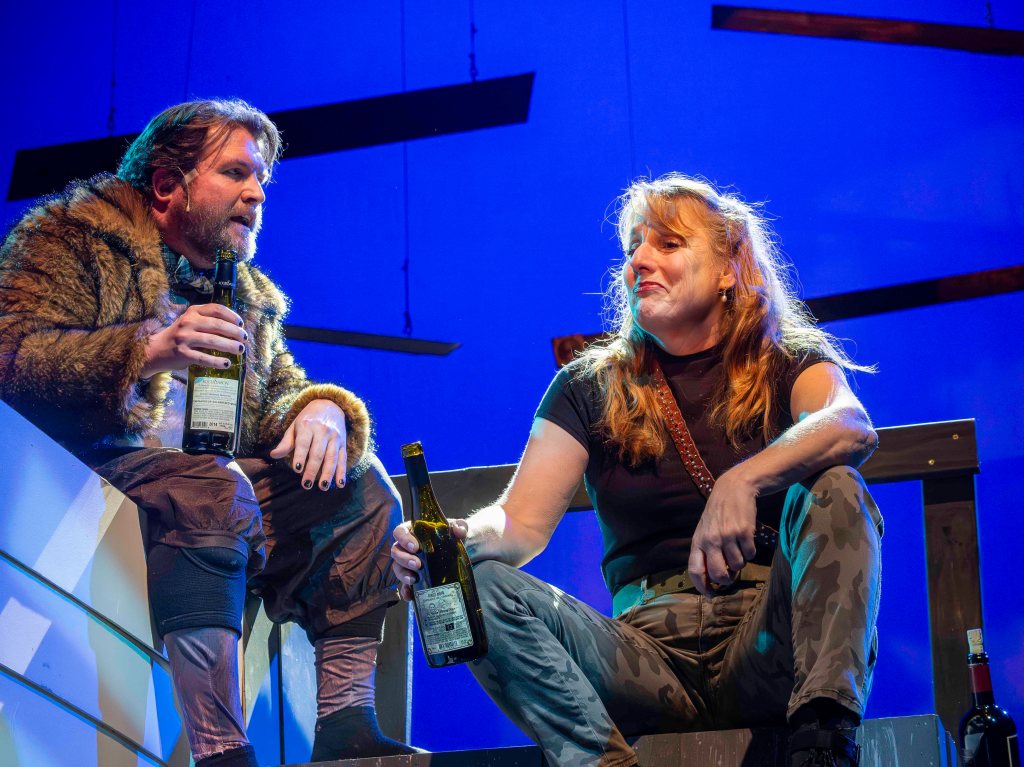
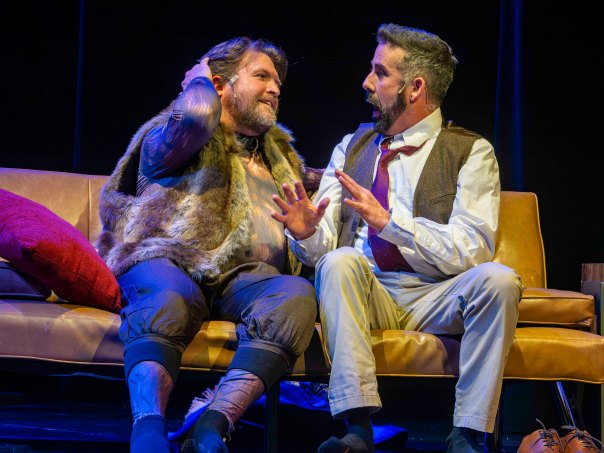
The evolution between Wink and Doc Frans is vastly quieter and quirkier, though there are playful moments. Gillespie and Grogan can play at teaching and learning from each other. Since there’s always a couch to our right, Brown yields briefly, unbidden by the script, to the temptation of redefining their doctor-patient relationship – with Frans reclining on the sofa.
With all the hairpin twists, sudden surprises, and belly laughs, you can reach the end of this whirlwind evening asking yourself, “What did I just see?”: a rare and thrilling experience at the theater. There’s so much wrong with Doc Frans’ preachings of discipline and such excesses in Sofia’s and Gregor’s escalating impulses that we can easily imagine that Silverman wants us to be dizzily ambivalent.
She probably does. It’s the kind of “You just gotta see this” reaction a playwright lives for.
Take a few extra moments, then, to consider Wink as a role model. His hunting routine, repeated more than once, is a blend of discipline and savagery, keen calculation and patience before taking your shot.
Expect that of a dog? Their lack of self-control and stealth is why they hunt in packs. You can train a dog to stop on a dime when it gets a first sniff of its prey, but then it just dopily points its nose in the air towards your quarry. Still imprecisely.
There may be nothing happier than a contented dog; that’s true. Give the enlightened Wink a bottle of wine, and he’s still cool. Cheers!
Review: The Winter’s Tale at Armour Street Theatre
By Perry Tannenbaum
Yes, Davidson Community Players’ executive director Steve Kaliski certainly had a point this past weekend when he declared, “My kingdom for The Autumn’s Tale!” DCP had invited Shepherd Shakespeare Company, which normally performs outdoors at The Barn on Monroe Road, to perform THE WINTER’S TALE indoors at the Armour Street Theatre, out of the cold winter.
Unfortunately, winter weather pursued the troubadours, who also bring a variety of repertoire to local elementary and high schools, up the highway to Davidson, forcing the postponement of performances scheduled for the second weekend of Winter’s Tale at Armour. Ill-starred as the engagement may have proven, it enabled me to see SSCO in action for the first time, outside of their customary morning-and-afternoon cocoon in prime evening hours.
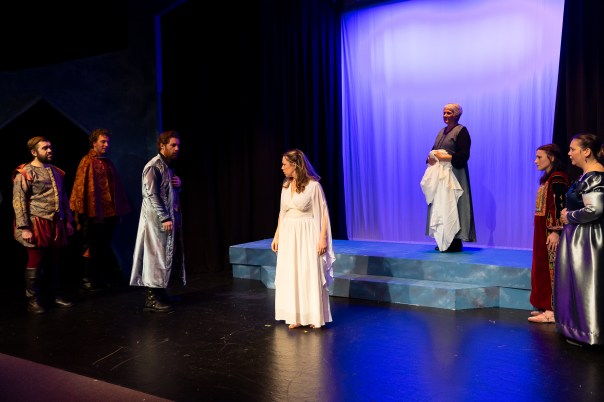
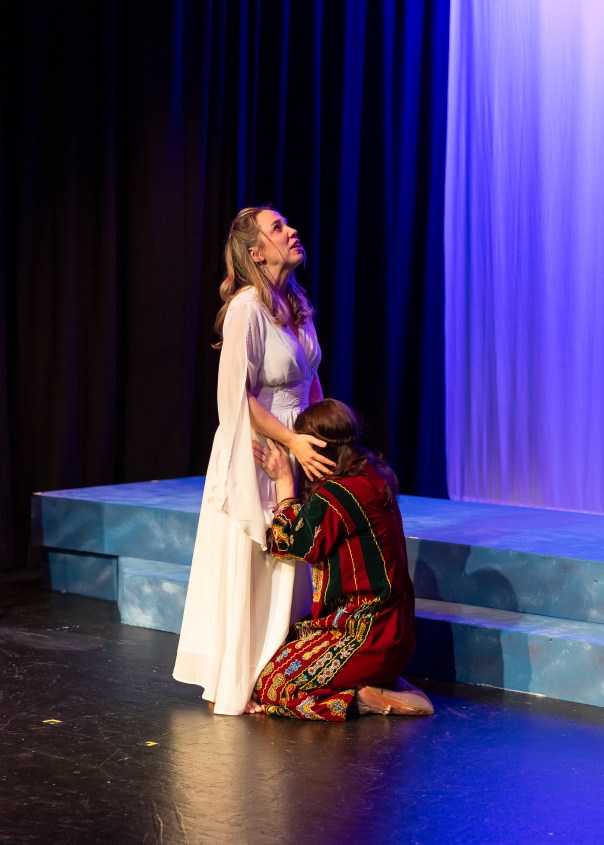
Katy and Chester Shepherd, co-founders of the touring company, are often at the forefront of their productions. But here, they are behind-the-scenes – and they have, artistically, split up. Chester is handling the stage direction and scenic design, while Katy has designed and constructed the costumes. Another blissfully theatrical couple, Brandon and Rachel Dawson, portray the jealousy-crossed leads, Leontes and Hermione, the King and Queen of Sicilia.
Brandon, as Leontes, falls prey like Othello to the green-toothed monster, but he’s also haunted by his own inner Iago, needing no outside help to compromise and convict his innocent Queen of shameful adultery. What happens in the tragic first scene is nearly as simple and grand as Lear. The visiting King Polixenes of Bohemia, after sojourning in Sicilia for nine months, announces that he will leave on the morrow.
The Sicilia monarch tries to persuade Polixenes to lengthen his visit but cannot shake his boyhood friend’s resolve. Rachel, as Hermione remains silent – until Brandon, as her King, asks her to assist. Hermione’s attempts are wittier, more lighthearted, more charming, more insistent, and more sustained. There are no stage directions in the text during Hermione’s pleadings that indicate any physical contact with the esteemed visitor, but in Shepherd’s direction, that is not a prohibition.
Chester and Rachel have reached a key accord, without Shakespeare’s expressed consent, when Hermione playfully suggests taking the Bohemian monarch as her prisoner. Yet when Polixenes is won over, fulfilling Leontes’ wishes, and Hermione has gained her husband’s admiration, Shakespeare does add a stage direction that decrees physical contact right after she declares Bohemia to be her newly-earned friend: “Gives her hand to Polixenes.”
This is enough to spark Leontes’ jealousy and fan it into flames. Everything dearest to Leontes must be destroyed: wife, son, newborn daughter, and Polixenes, who learns the perils of a nine-month visit through grim experience. The damage that Leontes capriciously wreaks on his kingdom will take 20 years to repair, and the repair will not be complete.
Hermione’s imagined betrayal in the presence of the king’s son, Mamillius, his most trusted confidante, Lord Camillo, and numerous attendants at his Sicilia palace, so an eerie formality hovers over the DCP production’s opening scene (an introductory scene elsewhere in the palace is cut) until the king explodes. First to be targeted by Leontes’ wrath is Polixenes, genially portrayed by Jeremy Cartee, with a touch of mischief that he keeps on back order until he returns home.
Torn between loyalty and common humanity, Savannah Deal as Camillo decides not to slay Polixenes but to advise him to flee. Understanding that disloyalty to the deranged Leontes could spell death for Camillo, Polixenes rewards his honesty by bringing Camillo into his service before they depart.
We won’t hear any more of them for 20 years. Meanwhile, Act 2 applies a fairytale patina to the action as Leontes, dissuaded from burning his newborn daughter by Lord Antigonus, dispatches milord to abandon the babe in a faraway place to the mercy of the elements. We last see Andre Braza as Antigonus at the end of Act 3, sent offstage with Shakespeare’s most famous stage direction, “Exit, pursued by a bear.”
Not to worry, Braza resurfaces in Scene 3 of Act 4 as the roguish Autolycus. The remaining members of the core troupe, mostly with prior SSCO experience, also shuffle multiple roles and costumes backstage – with a couple of players besides Deal flipping genders. Most prominently, these include Iesha Nyree morphing from one of Hermione’s ladies to the Old Shepherd who parents Perdita, the sequestered newborn, and Emma Brand, becoming the grown-up foundling after a stint as Lord Cleomenes.
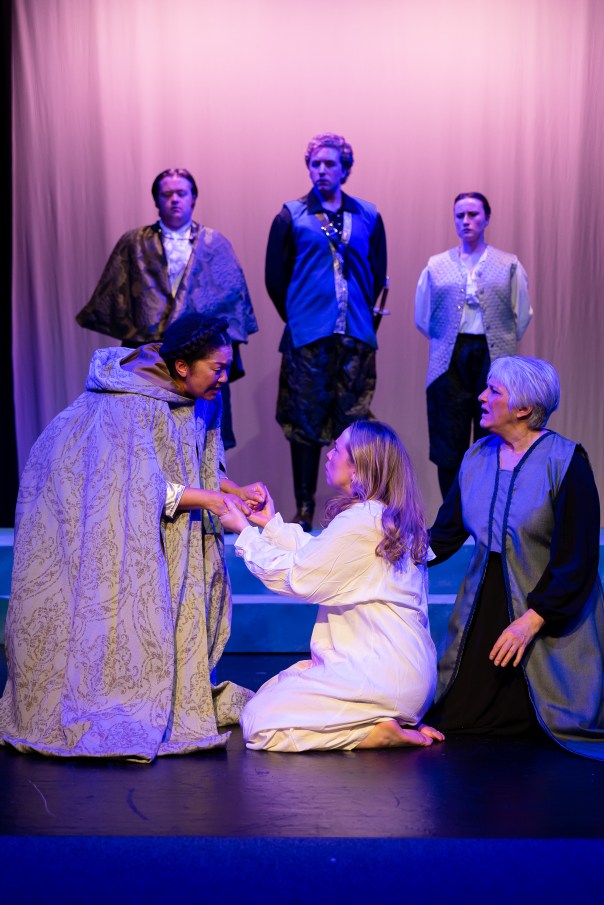
Really, the only faux pas in this production is the casting of Mamillius, the king’s blameless heir. No matter how cute, we need to hear the lad. Best of the rest is Joanna Gerdy, who likely knows Shakespeare’s plays nearly as well as the Bard himself, having acted in and directed so many. Here, as Paulina, Gerdy gets to fearlessly scold Leontes, engineer Hermione’s escape, and emcee the queen’s long-deserved restoration. It’s a powerful, authoritative performance that almost rivals the Dawsons’ majesties. Note: In lieu of the cancelled performances on 1/31 and 2/1, a make-up show has been added for Wednesday, 2/4, at 7:30pm. Stay tuned for other possible added s
Review: Rudolph the Red-Nosed Reindeer at ImaginOn
By Perry Tannenbaum
November 22, 2025, Charlotte, NC – Okay, so Christmas erudition isn’t my thing. Thanks to the Gospels of Matthew and Luke, my familiarity with the biography of Jesus, from the Anunciation to the Resurrection, is sufficiently sketched out, though not nearly as complete as my knowledge of Moses and Joseph. My familiarity with Christmas and the Nativity comes mostly from network TV, the annual inundation of all media, neighborhoods, and supermarkets with the holiday spirit when the season comes around, various musical and movie masterworks such as Messiah and The Christmas Carol, and very infrequent visits to Christians’ homes when their trees were decorated.
All of this is to say that, until a couple of days ago, my ignorance of Rudolph the Red-Nosed Reindeer was quite profound. Silly me, I thought “Rudolph the Red-Nosed Reindeer” was simply a hit song recorded by singing cowboy Gene Autry that has haunted the airwaves and shopping malls since 1949. It wasn’t until Children’s Theatre of Charlotte premiered this past weekend at McColl Family Theatre in ImaginOn that I found out that Rudolph the Red-Nosed Reindeer was also a well-known story – and has been since the original song by Johnny Marks and story by Robert L. May was adapted for an animated TV special by Marks and scriptwriter Robert Penola in 1964.
Sam the Snowman, Hermey the elf, Mrs. Donner, Clarice the doe, Yukon Cornelius, snow monster Bumble, Boss Elf, Coach Comet, and the Misfit Toys were all new to me as the Children’s Theatre Rudolph unfolded. Only later was I informed that my own stepchildren had grown up on all of them. Maybe my daughter, too! Sadly, all this nostalgic family info arrived too late to sway my affections toward what I had just seen onstage. As much as I’ve always adored the Rudolph song – or perhaps because of that longtime adoration – I found that I disliked this precious and sugary musical.
Let’s begin with the costume designs by Kahei Shum McRae, so lovingly faithful to the original TV art. That’s a huge problem for me. Since cartoons and animation were defined for me in my childhood by what they delivered, ranging from Snow White and Batman to Bugs Bunny, Bullwinkle, and Hanna-Barbera, the advent of Claymation, Animagic, and stop-motion – whatever you call it – seemed like a clumsy step backward to me. Sure, the small-scale props and dolls cast 3D-like shadows, but they were as immobile and expressionless as dolls or puppets, plopping you awkwardly back into the real world.
Though McRae successfully recreates the feel of the old TV evergreen, he is hamstrung by that objective and all its cuddly clunkiness. Sam the Snowman seems to truly roll across the McColl stage inside his snowy skirt and plaid vest, and the puppeteers who team up to form Bumble are barely more terrifying than a jellyfish of similar size. To the rescue come youth and adult actors who can visibly inhabit McCrae’s costumes and give them energy and spontaneity.
Woke objections that have been raised against the tale didn’t faze me, though they likely dulled the edginess that director Christopher Parks could have brought to this production if he had defied them. Au contraire: Amp up Santa’s rejection of Rudolph’s shiny nose, the other reindeer’s bullying, Donner’s male chauvinism, and the fearsomeness of Bumble (a name change might also help) so that our hero’s sufferings are more in line with those we find in our favorite fairy tales.
Politically correct or not, triumphs over mighty evils are more satisfying than triumphs over muted evils that fade away as soon as they’re opposed. Forbidden to associate with his sweetheart Clarice and banished from his reindeer team and their games, Rudolph runs away instead with Hermey, the misfit elf who would rather become a dentist than build toys. Vance Riley has the perfect elfin look as Hermey, with a resemblance to Will Ferrell that plays well into the misfit’s wackiness.
But it’s Tilly McDaniel as Rudolph who best models why this live theatre Red-Nosed Reindeer, vapid as it may be,is so much finer to me than the TV travesty. Under her adorable reindeer jumpsuit, McDaniel is recognizably human – or venison – rather than clay. When the lovely Julia Straley, as Clarice, comes on to him with praises galore, Rudolph’s reaction is a cosmic blush: Rudolph’s nose suddenly glows, and McDaniel flies up into the air. There’s genuine emotion here, notwithstanding the slaughterhouse hoist..
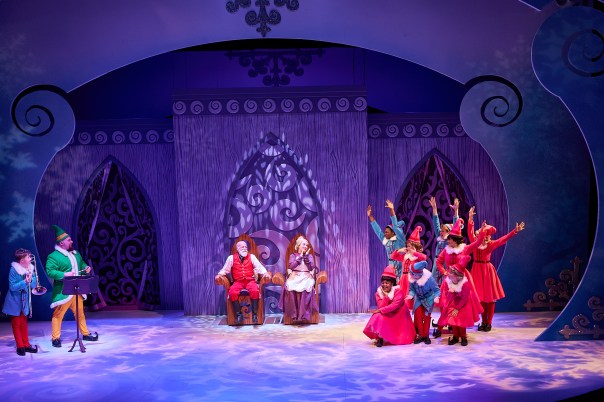
On the other hand, I subjected myself to all of the Animagic version I could find on this side of the $8.99 paywall. Everything I saw struck me as painfully primeval and lifeless – you’d have to pay me far more than nine bucks to watch it all. Only a few snippets of Santa can be found in the clips and trailer I sampled, enough to firm my conviction that John DeMicco as Santa and Allison Snow Rhinehardt as Mrs. Claus are far more rewarding than their Claymation counterparts. Rhinehardt even adds some grace notes that give the impression that Mrs. C is pushing back against Santa’s grumpiness and prejudice.
Likewise, Carlos Nieto and Ericka Ross convince us that Rudolph’s parents, Mr. and Mrs. Donner, have real souls instead of clay molds. You can feel that they’re genuinely worried about their cute little oddball offspring. Our host and narrator, Brandon J. Johns as Sam the Snowman, was geniality itself, establishing a fine rapport with the matinee audience and delivering “A Holly Jolly Christmas” with nearly as much avuncular jollity as its originator, Burl Ives.
Moonlighting from multiple puppeteer exploits, including the bodacious Bumble, Alex Manley gets his face time as the Boss Elf, so sunny that you never believe he really opposes Hermey’s dentist dreams in his heart of hearts. Richard Edward III drew two chauvinist bucks to portray: Coach Comet, Clarice’s intimidating dad, and Yukon, the flamboyantly superfluous gold-digger that Rudolph and Hermey meet in their travels. Kids of all ages seemed to delight every time Edward wielded his prospector’s pick-axe, particularly when we learned – or at least I did – that he wasn’t hunting for gold.
Reviews: Eureka Day at The Arts Factory and Vanya and Sonia and Masha and Spike at the Cain Center
By Perry Tannenbaum
Although conflict and chaos onstage oftentimes shock and alarm us, they can also be the springboards to comedy and satire. On balance, that is likely how you will experience the two new productions that opened last weekend, one at The Arts Factory on the JCSU campus and the other at the Cain Center up in Cornelius. On the heels of its Best of the Nest triumphs, Three Bone Theatre brought Jonathan Spector’s Eureka Dayto the QC for its Metrolina premiere.
Higher degrees of carefully crafted chaos here. And degrees of relevance the playwright himself never dreamed of.
Adding to Three Bone’s winning momentum, Eureka Day won the 2025 Tony and Drama Desk Awards on Broadway for Best Revival of a Play. Critics agreed on the revival category because it had tiptoed into NYC 6 years earlier at a 65-seat black-box theatre after its 2018 world premiere in Berkeley, California. More, much more about Berkeley in a minute…
Leaning on some Tony Award mojo of its own, Davidson Community Players has brought Christopher Durang’s Vanya and Sonia and Masha and Spiketo the Cain. Durang’s valedictory was a Tony and Drama Desk Award winner back in 2013 – and a smash for Actor’s Theatre of Charlotte and its quondam artistic director Chip Decker in 2014. Decker, we will see, is the bridge between DCP and ATC’s Stonewall Street days.
A far wider spectrum of conflicts here, sprinkled with stretches of wistful ennui, and peppered with a mighty eruption. Hold tight.
For all of its QC Nerve glory, Three Bone did not fill the Factory on West Trade Street for its champagne premiere last Thursday. A bit of a black eye, methought. But the effervescence of the Eureka Day School principal and his executive committee under the stage lights easily equaled the bubbly that awaited us after the show.
Living in perhaps the left-est part of the Left Coast, principal Don and his Berkeley committee cohorts, all parents of enrolled students, can be expected to “model” an especially welcoming brand of wokeness. Their conversations will be properly framed, non-judgmental, viewable through multitudinous lenses, devoid of racist stereotyping and gendered pronouns, with plenty of spitballing and so much to unpack at every turn. Feeling seen and not being othered are watchwords for their woke happiness.
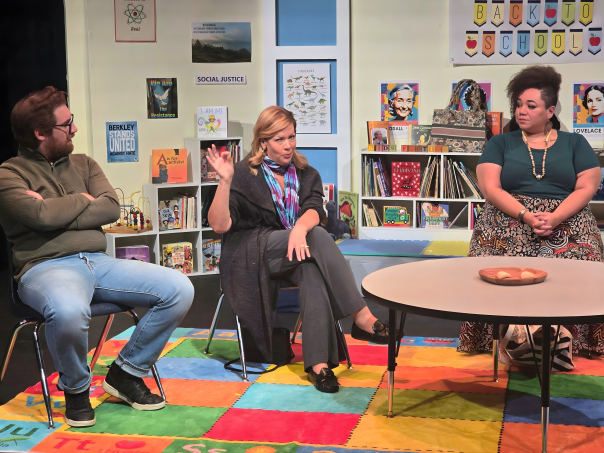
As the 2018-2019 school year begins, the committee is meeting in the vacated elementary school’s library, blithely colored with shelves full of books and proudly decorated, even during the first Trump presidency, with trendy progressive slogans. We join them near the end, when the plate full of scones is almost gone. All five of these adults in this kiddie-flavored environment are too energetic and engagé to be afflicted with malaise, except for the placid Meiko, who is perpetually knitting.
Yet they’re deliberating on a question that would seem to lack urgency now that the new school year has begun. Should the dropdown menu where prospective parents indicate their nationalities be changed on the admission form – or is it OK?
On such weighty issues, the consensus decreed by the executive committee’s bylaws is easily attainable. But outside this quaint kiddie nook, where adults look comically oversized, a crisis is brewing in the homes of two committee members that will tear the committee apart, along with the progressive free-thinking community around it.
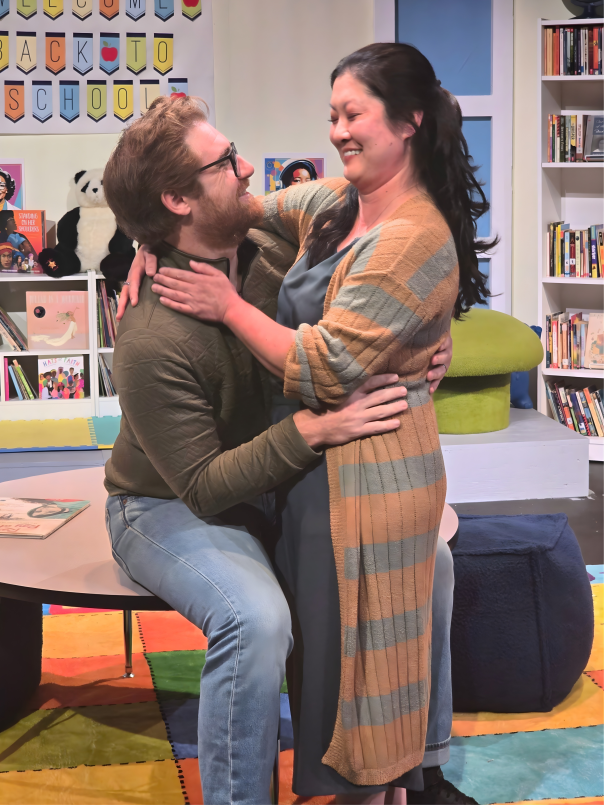
Consensus or not, Eli is the most important member of the group, since he is Eureka Day’s chief financial backer. He is also, we quickly learn, carrying on a lukewarm extramarital affair with Meiko, veiled by their children’s playdates if their respective spouses are not around.
The secrecy of this romantic liaison is discreetly maintained, but the consequences are about to break loose when a mumps outbreak hits the school. Neither of the playdate children has received an MMR vaccination: Eli’s son because he was on a slow vaccination schedule, and Meiko’s daughter because she’s a staunch anti-vaxxer.
Meiko’s views align with those of board president Suzanne, while Eli’s align with newcomer Carina’s, this year’s revolving board member. The pathologically open-minded Don is childless, so he has no skin in the game when the committee reconvenes. A consensus trainwreck looms as the committee deliberates over whether to keep Eureka Day open and how. The pressure is on: a letter from the Alameda County Health Department goes out to all parents tonight.
Considering that the original Eureka Day premiered in Berkeley more than 18 months before the onset of COVID, Spector’s original script – deftly updated for its 2024 Broadway opening – was remarkably prescient. To vaxx or not to vaxx had not become a burning national debate during the 2017-2018 school year of the original script. That perspective is not altered in the 2024 revision, but what remains visionary is how principal Don and his committee decide to address their impasse.
Years before most of us had ever heard of ZOOM or attended an online meeting, Eli proposes a Community Activated Conversation livestream headquartered in the school library. As the committee huddles around a MacBook, we’ll notice that the “Welcome to Your 2018-19 School Year” sign has come down from the upstage wall, leaving a blank space for projecting the text messages from parents who have checked into the live chatline.
Eli and Don have envisioned all this as a wholesome Town Hall meeting where consensus will descend upon them all like a divine nimbus. Instead, some of the most hilarious chaos I’ve ever witnessed anywhere. Not only have Robert’s Rules been tossed into the nearest dumpster, but parents are not all compelled to remain on-task or on-topic. Dignity, decorum, restraint, self-censorship in Berkeley? Wrong address.
If you think we might have a problem tracking two media and two disjointed conversations at once – a problem compounded when two or three committee members are speaking at the same time – think about what director Tanya Bludsworth, lightboard operator Amanda Liles, and the cast have to deal with. On top of the intricately crafted chaos of Spector’s script (text balloon captions coupled with the committee’s dialogue through over 140 precisely placed footnotes), there’s an unpredictable downpour of audience reaction as the chaos intensifies.
Even without an audience, these are rough seas to navigate. Add us, and we had conditions that were impossible to simulate in rehearsals before opening night. Those of us who were there experienced – and participated in – something truly unique.
The unanticipated assault on the actors’ expectations didn’t seem to faze them at all. Although Spector appends special instructions in his script about how to present his amazing Scene 3, warning the production team in various ways against burdening the audience with sensory overload, when done right, the audience actually adds to the spontaneity of the performances we see.
If the actors can allow the surprises and shocks of the audience’s reactions to feed into the shocks and surprises they’re supposed to project at a Town Hall meeting where consensus has gone colossally wrong.
As moderator, mediator, Rumi fanatic, and deep breath/consensus advocate, Rob Addison, as the relentlessly conciliatory Don, draws the juiciest assignment as the hilarity peaks, totally losing control of his ideal modeling of community and redefining futility in his attempts to restore order and civility. Considering how pathologically woke and ecumenical this principal is, I’ll confess to harboring extreme schadenfreude when Addison’s sweet Utopia shattered.
Spector’s prime target remains consensus, and delightful to watch Addison in the crosshairs. But in a new episode added for the Broadway revival, we can see more emphatically that the Eureka Day principal has learned his lesson… and done his homework.
And whom would we rather see get her comeuppance than Donna Scott, Charlotte’s baddie diva as Suzanne? Yet it was likely Suzanne’s counterbalancing empathy, conscience, and vulnerability that drew Scott to this superbly nuanced role. Suzanne’s microaggressive bossiness and Don’s preternatural open-mindedness inspire the pushback that often brings the other committee members’ roles most vividly to life.
As Carina, Vanessa Robinson has the most uphill battle against Suzanne: newbie newcomer versus committee prez and Afro versus white. What juices up Robinson’s role, beside Carina’s zingers, is the opportunity for her to form a paradoxical intimacy with Scott, for Suzanne and Carina both misperceive each other. One of the supreme crowns of womanhood is their ability to apologize.
Notwithstanding her philosophical agreement with Suzanne, we see very early in Amy Wada’s rendition of Meiko that the board prez perpetually rubs her the wrong way. On the other hand, despite the wavering passion she feels for Eli, she is doubly in his debt. Righteous indignation and self-reproach obviously coexist at the heart of Berkeley life, and Wada has plenty of both to project. She seems to know how to knit, too.
After his luminous performance two years ago as Prior Walter in the QC Concerts production of Angels in America, you could rightly presume that Eli would be a piece of cake for Brandon Dawson. And it is. We get all the contours of Eli from Dawson, the conscientious benefactor, the adulterous lover, and the person who suffers most as a guilt-ridden father.
Eureka Day was a fairly lighthearted comedy in 2018. Recent history has helped it to gain considerable urgency, relevance, and weight.
In the long run, Durang’s Vanya and Sonia and Masha and Spike may turn out to be less of an evergreen than Eureka Day. Much of the comedy and impact mustered by the indolent Vanya depend on the contrasts between his elder Boomer generation; brought up on hula hoops, Howdy Doody, Snow White, and Davy Crockett; and millennialsbrought up on video games, cellphones, Avatar, and the Kardashians.
Vanya and his sister Sonia have basically tossed away their lives caring for their dearly departed professorial parents, who named them after Chekhov characters. Years and decades have passed them by, as they continue to vegetate and lapse into ever more laughable ennui.
Ironically, they replicate the chronic ills of the Good Doctor’s most famous tragicomedies, The Seagull, The Cherry Orchard, and Three Sisters. Will the blue heron appear on the pond today? There isn’t much excitement or suspense in the siblings’ daily lives, and they know it.
Thank heavens, there will be visitors, visitors as colorful as the siblings are drab. First to enter will be Cassandra, the family’s longtime soothsaying cleaning lady – and cook, if she’s in the mood. If you don’t know the Greek myth of Cassandra, Durang obligingly has Vanya explain it. The many prophecies and platitudes that Cassandra spouts seem to strike her by surprise in the daffy portrayal by Wandy Fernandez.
So even she can’t explain all she prophesies, chiefly “Beware of Hootie Pie.” He, she, or it is not listed in the cast. Nor can Cassandra pinpoint who must heed her warning.
In the middle of a languid reminiscence, Sonia suddenly remembers that her elder sister, Masha, is on her way. Unlike her homebound sibs, Masha has ventured out into the world and become a fabulous Hollywood success. Her career may be on the wane after being tethered to a wildly acclaimed action franchise, but her celebrity arrogance remains intact.
For those who remember the theatrical entrances designed to greet theatre legends with lusty ovations, this was one of them. Durang custom-tailored the role of Masha on Broadway for Sigourney Weaver, who was roundly snubbed by the Tony Award and Drama Desk critics despite her excellence.
Masha certainly doesn’t suffer the indignity of arriving alone. At her heels is Spike, her current boy-toy after five failed marriages, dispatched to retrieve Masha’s Snow White costume from the car.
At this point, it’s necessary to realize that we’re in Bucks County, Pennsylvania, down the road from the farmstead where Dorothy Parker had lived for about 20 years. An “extremely wealthy woman” has taken over the place and invited Masha to an exclusive costume party designed to acquaint her with the famous, literary, and important people in the area.
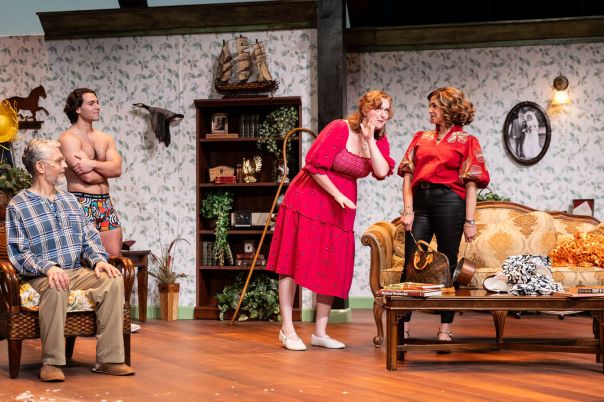
In her great benevolence, Masha has secured additional invitations for her interesting siblings and, of course, for Spike, who will lead Snow’s entourage as Prince Charming. The large garment bag that Spike has brought in – the man is ripped and, within minutes, stripped down to his tight undershorts – also contains Disney costumes ideally tailored for the future princess’s retinue: two of his best-remembered dwarves.
To Masha’s surprise, neither Vanya nor Sonia is flattered by the costumes provided by Hootie Pie. Aha! The prophecy! Meanwhile, Masha quickly has cause for further discontent. Near-naked Spike has been spotted down at the pond, dallying with a pretty woman who is decades closer to his age.
Nina, as forewarned by Cassandra, will pose a threat, but she turns out to be an aspiring actress who worships Masha, totally thrilled to meet her. How can they not bring her along to the costume party?
DCP director Caroline Bower gives Decker his second chance to design the Bucks County cottage, and he does not fritter away the opportunity to enlarge his concept for the wider, deeper Cain venue. This cottage, far more than the one on Stonewall Street, is worthy of neighboring Dorothy Parker’s acreage. It boasts a dimension usually overlooked in Charlotte set design: height.
Aside from the Old Barn on Queens Road, when was the last time you saw roof beams at a local theatre production in the QC?
The Davidson Community acting performances are also up to the high bar set by Theatre Charlotte, particularly William Reilly as Vanya. He absolutely blisters the climactic monologue when Spike proves inattentive to his new experimental play. Till then, Reilly is remarkably serene and stoical, gazing slightly upwards with the pleading look of a martyred saint.
If Vanya is wistfully regretting his unlived life, Valerie Thames as his younger adopted sister Sonia is loudly bemoaning and bewailing hers, more of a blatant riff on Chekhov’s suffering sisters. I’m not sure anyone has spoken more deliciously absurd lines since the days of Oscar Wilde. Without the slightest trace of self-awareness, Sonia declares that she has too much time to spare for reading.
At her exquisite worst, Thames has a spontaneous moaning contest with Masha, cleverly framed as an acting lesson in tribute to the celeb’s fading glory. It takes a lot of energy to compete with Masha’s self-absorption.
As the celebrated Masha Hardwick, Debra Allebach can’t share her siblings’ woeful regrets over their lost youths. Instead, she is desperately striving to regain hers via storybook or Hollywood tabloid romance with Spike. Yes, you can still have abundant energy in your fifties, blithely asserting you’re still in your early forties, and acting even younger.
But we can’t simulate actual youth. We’ve all seen some pretty grotesque facelifts that prove my point. That’s the agony Allebach must face up to. It’s rather sad when Vanya’s mighty monologue wakes her up. Until then, what a bitch!
Portraying – or is it modeling? – Spike, Vic Kuchmaner gets to prance around in the cloud where many of his generation reside, disregarding what’s happening around him to the extent of rarely logging in to real life. Reminds me so much of the self-proclaimed “teen idol” who portrayed Lloyd Weber’s Joseph at Central Piedmont ages ago.
Spurning Spike and latching onto Vanya as devotedly as to Masha, Nina is a sweet counterbalance to Spike and his charismatic superficiality. Emma Kitchin endows the nymph with a luminous simplicity that helps to clarify Durang’s deepest intentions. On the surface, it does ultimately appear that the playwright is siding with crotchety old Vanya in decrying the mindlessness of modernity and longing for the good old days with all their faults.
Kitchin’s enthusiastic attachment to Vanya and his work opens our eyes to another contrast that’s getting roasted: Hollywood at its worst matched against Broadway at its best.
Whether you head for The Arts Factory or Cain Center to get your comedy fix this weekend, you won’t go wrong.
Review: Charlotte Symphony Plays Respighi’s Pines of Rome
By Perry Tannenbaum
November 14, 2025, Charlotte, NC – Neither Maurice Duruflé nor Ottorino Respighi would rank high among composers that Charlotte Symphony subscribers most wish to hear. The orchestra’s previous two music directors, Christopher Warren-Green and Christof Perick, never performed Respighi as part of the orchestra’s classics series – he remained the province of guest conductors – and the Duruflé Requiem, after concerts by the old Oratorio Singers and Carolina Voices early in the century, hadn’t surfaced at all locally since 2007.
So a pairing of Duruflé’s most highly regarded work with two Respighi favorites, The Pines of Rome and The Fountains of Rome, didn’t figure to fill Belk Theater with rabid enthusiasts. Yet the sheer scale of the Requiem, calling forth the Charlotte Master Chorale under Kenney Potter’s leadership, made the Belk an obvious choice over the snugger Knight Theater.
Although our current music director, Kwamé Ryan, brought us Respighi’s Roman Festivals last spring, a guest conductor was once again on the podium for these more beloved Roman delights by the Italian icon. While a Duruflé-Respighi pairing will never be boffo box office, starting with the Requiem – which likely drew hundreds of the choristers’ family members to these performances – made the host of Master Chorale choristers onstage before intermission available to swell the audience for the Fountains and Pines afterwards. Adding to the electricity in the house, guest maestro Francesco Lecce-Chong deployed two groups of brass players upstairs to opposite sides of the grand tier for the final “Appian Way” section of The Pines.
Based on Gregorian themes from the Mass of the Dead, the Requiem sounded like the oldest piece on the program, though it was the newest. Fortifying that impression was the dominant role of the Chorale compared to the two soloists, mezzo-soprano Megan Samarin and baritone Eleomar Cuello. Most of us likely felt that Cuello’s noble bearing and vocals in the “Domine Jesu Christe” section were all too brief: even there, the choir had the larger share of the singing.
Samarin’s conquest in the middle “Pie Jesu” section, an ethereal solo, also seemed too fleeting, though here the Chorale was silent. Sampling recorded versions of the Requiem on Spotify and Apple, you’ll probably conclude that the orchestral version performed at the Belk packs more wallop than the organ scoring, which was probably the version that Carolina Voices chose 18 years ago at the Friendship Missionary Baptist Church. Another reason for the guest vocalists to make a more muted impression this time.
The fourth section, the “Sanctus,” decisively upstaged Cuello as Lecce-Chong rallied the forces of the orchestra and the Chorale together, but the baritone returned for a second cameo during the first half of climactic “Libera Me,” fueling the fires of the choral “dies irae” that followed. Somehow, the sublimity of the concluding “In Paradism” doused those fires. The beatific loveliness of the women’s voices certainly made for a heavenly arrival, yet the men miraculously eclipsed them in their visionary entrance, truly a mystic chorus of angels.
Instrumental excellence peeped in occasionally during the Requiem, chiefly in Timothy Swanson’s oboe obbligato for the “Kyrie” section, in bassoonist AJ Neubert’s “Lux Aeterna” intro, and in the exquisite welcome to “In Paradisium” from yet another principal, harpist Andrea Mumm Trammell. Even more play was afforded to the players in the Respighi pieces with all their resplendent colors and shadings.
Memories of hearing Respighi are invariably more sugary to me than the actual music, which under Lecce-Chong’s baton, especially in The Fountains of Rome, was refreshing and exhilarating – and, of course, effervescent. Neubert probably made an even stronger impression on oboe in his lovely, languid sketching for “The Fountain of Valle Giulia at Dawn,” with principals Taylor Marino on clarinet, Jon Lewis on cello, and Victor Wang on flute following eloquently in the same opening section.
The sunnier middle sections, depicting “Triton Fountain” and “The Fountain of Trevi,” were more impressively orchestral and brassy, Triton’s horn issuing an early proclamation at the beginning of his section and a rampage of brass, chiefly trombones, heralding midday at Trevi, Rome’s most majestic fountain. No doubt the audience was a bit surprised by the delicacy of the Fountains finale, “The Villa Medici Fountain,” and its sprinkling of percussion, celesta, and soft chimes, simulating a distant church at twilight.
My mind had first been changed on Respighi way back in 1997 when Daniele Gatti had led the London Royal Philharmonic into town with diva pianist Alicia de Larrocha. His rendition of The Fountains with the Londoners was sufficiently revelatory for me to place a rush order for Gatti’s recording of Respighi’s complete Roman trilogy, where additional revelations awaited: Roman Festivals and Pines of Rome were both more powerful, varied, and grand. Though The Pines had popped up on my calendar at the dearly departed Eastern Music Festival in 2011, this was my first opportunity to hear – and compare – Fontane di Roma and Pini di Roma in the same live concert.
With a feel as sure for Respighi as Gatti’s, Lecce-Chong’s performance was worth the long wait. “The Pines of the Villa Borghese” had a marvelous orchestral bustle before principal trumpeter Alex Wilborn was dispatched to the wings for the signature eerie effect in the solemn “Pines Near a Catacomb.” Even more quietude came with “The Pines of the Janiculum” as piano, clarinet, cellos, and a soft oboe anthem enhanced the magic. But the epic build and variety of “The Pines of the Appian Way,” seasoned with prerecorded nightingale chirruping and crowned, at the end of a satisfyingly long and majestic crescendo, with the outbreak of brass from the balcony, surpassed the grandeur of the Respighi we had heard before and joined the peaks of the Master Chorale as the pinnacles of the evening.
Review: Murder on the Orient Express at Theatre Charlotte
By Perry Tannenbaum
We can thank the Brits for the notion that passenger trains should run with absolute timeliness and precision. Now that Ken Ludwig’s meticulous adaptation has opened at the Queens Road Barn, we can also thank Agatha Christie, Britain’s most avidly read mystery writer, for her Murder on the Orient Express. Layer on Jill Bloede’s bubbly direction – and dialect coaching – and the treacherous trip rattles along with a savory continental flavor.
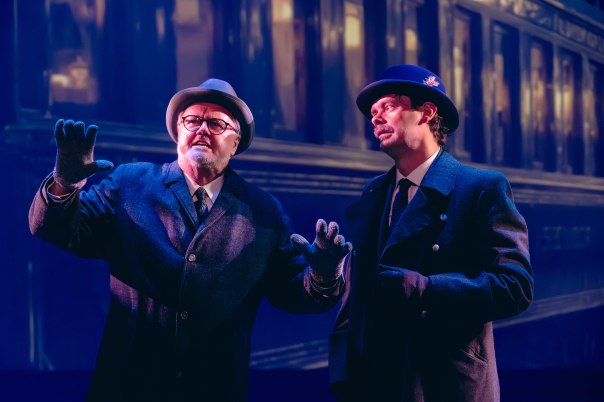
That soupçon of glitter and effervescence is greatly enhanced by Theatre Charlotte artistic director Chris Timmons’ fleet and fluid set design, an art deco wonder that transitions delightfully from an Istanbul hotel to a smoky train depot to the luxe interiors of the Orient Express. Since the landscape and snowscape outside the legendary train are also moodily conveyed by projections, it’s difficult to draw a precise borderline between Timmons’ scenic exploits and his lighting design.
While the paucity of professional theatre companies in the QC continues to account for the plethora of professional-grade acting talent we behold at the Barn, so does the opportunity to appear in opulent costumes such as those designed by Sophie Carlick – for hotel waiters, train conductors, and various glitterati who can afford a first-class sleeping compartment on a luxury transcontinental train.
Speed is beneficial in a murder mystery, especially as it plods along, contrary to real life, when we’re introduced to a multitude of suspects who have sufficient motive to commit the cold-blooded crime. Anyone who grew up watching the Perry Mason series on TV (or has binged on it more recently) knows the classic drill: the murder victim antagonizes a slew of enemies. So many enemies that we’re unsure who might have done the deed and more than mildly uncaring about the victim, no matter how brutally they were killed.
Ludwig admirably singles out our obnoxious victim-to-be and all the antagonisms he can spark while introducing us to Christie’s heroic protagonists, Constantine Bouc, owner of the Orient Express line, and peerless detective Hercule Poirot. There will be debate about Bloede’s decision to shitcan Poirot’s mustache wax and twirls in favor of a more conventional groom, but Brandon Samples’ initial entrance as the Belgian is star quality.
There’s a bit of aristocracy to Samples’ bearing that allows Poirot to fit in with his fellow passengers, including a princess, a countess, and a colonel. While Timothy Hager zestfully cements his repulsiveness as Samuel Ratchett, it’s also important for us to see that Poirot has sufficient dignity, discernment, and assets to reject Ratchett’s crass job offer.
Poirot also offers Samples a few brief episodes of befuddlement, for the culprit he is hunting leaves a blizzard of clues.
Unlike all of those complacent Perry Mason victims destined for the morgue and a court-ordered autopsy, Ratchett is keenly aware that he is being hunted. He’s willing to retain Poirot for a fabulous amount of money to protect him. Perry, you’ll remember, doesn’t arrive on the scene until after the wrong suspect is accused and arraigned. Here, Poirot is directly involved while the victim is alive. So when Samples shows no guilt or remorse for not accepting Ratchett’s offer after he is murdered, we’ll need further reasons for despising the playboy.
Christie piles them on and, in doing so, makes the bizarre solution to her mystery more plausible, for Ratchett is far more monstrous than he first seems to be.
Yet the elegance, hauteur, and glamor of the leading ladies would seem to instantly eliminate them from suspicion – or any close acquaintance with the vulgar victim. To think that Paula Baldwin as the Russian Princess Dragomiroff would deign to inflict eight stab wounds on the repellent Ratchett seems like sacrilege.
Likewise, Julia Howard as the serene and mysterious Countess Helena Andrenyi from Hungary seems worlds away from the slain playboy. The ethereal Gretchen McGinty as English governess Mary Debenham, also a smashing beauty, seems to live in an entirely different sphere, more involved with Scottish Colonel Arbuthnot (Ben Allen with a brash brogue) than the slain American.
As for Kathryn Stamas, as an esteemed actress traveling under the assumed name of Helen Hubbard, she is sufficiently brash, loudmouthed, and inconsiderate for us to worry whether Ratchett, trying to get some sleep next door and stewing with rage, will burst into her room and murder her. Murdering him would ruin her delight in riling him with her late-night singing.
However laudable it might be to murder Ratchett, three acts of God will prevent the ghoulish plan from eluding discovery: the unexpected arrival on board of legendary unraveller Hercule Poirot, the serendipitous intervention of Orient Express owner Constantine Bouc in securing a first-class compartment for Poirot, adjacent to the victim’s room. After these pieces are in place, with Bouc ready to serve as Poirot’s loyal sidekick, comes the fortuitous storm that halts the regal train in a snowbank out in the wilderness, giving Poirot sufficient time to investigate.
Bouc is obviously a key prong in Christie’s plotcraft, allowing Poirot to board the Orient Express and vesting him with the authority to investigate. Otherwise, our mustachioed sleuth wouldn’t be able to scan all our suspects’ passports or rummage through their luggage. Dramatically, he enables Poirot to interview all the suspects, another ritual of the mystery genre, corresponding to Perry Mason cross-examinations, that cries out for swift pacing.
The venerable Dennis Delamar would seem ideal for bestowing the requisite bonhomie on our gracious host and eager sidekick, except… for all his wholesome triumphs as Henry Higgins, Grandpa Vanderhoff, Kris Kringle, John Adams, Hucklebee, Jacob the Patriarch, and many more, has he ever done a French accent before? Maybe that was the question Delamar was asking himself on opening night when he uncharacteristically stumbled over a few of his opening lines.
Even for a semi-pro like me, those are lines you should be able to say in your sleep. Of course, Double D never broke character during his difficulties, so to neophytes in the audience, it may have seemed like the garrulous pensioner was stumbling over his English. Delamar’s imperturbability in this brief crisis only made Bouc more charming when he righted himself – and real panic was safely in reserve when the unsolved murder, right under his nose, threatened the image and prestige of his company.
Bouc also serves as a buffer between Poirot and the petty annoyances presented by our suspects, allowing Delamar to display his comedic chops. Samples, on the other hand, gets to revel in flipping over innocent façade after innocent façade in revealing the secret underbellies of his artful gallery of suspects. The parade of skeletons emerging from closets can’t help but add to our merriment.
So most of the actors on stage need to be adept not only in erecting their respective façades, but also in carrying off those deliciously satisfying moments when they are so disconcertingly exposed. Joshua Brand as Ratchett’s querulous secretary seems particularly innocent and above suspicion, while Emma Brand as the Princess’s trembling missionary ward is even further above. So pleasant when they fall.
Climb aboard this fatal train, and you’re likely to find the ride more fun than you expect.
A vampire visits a comely maiden dressed bewitchingly in black for Halloween. A werewolf goes to a special summer camp for monsters. A strange woman with a cloven head conspires with a mouse to murder an angel. These are among the seasonal dainties served up by Concord-based Post Mortem Players in Laugh ‘Til You Die, their second annual invasion of the QC, continuing at The VAPA Center through October 12.
Subtitled “A Night of Spooky Sketches & Songs,” this Charlotte’s Off-Broadway production is even more freewheeling and fragmented than last month’s Meet and Greet medley of one-acts at the VAPA Black Box. Eleven sketches and songs paraded across the cramped stage on opening night, but that number figures to fluctuate as the second weekend of the run rolls in.
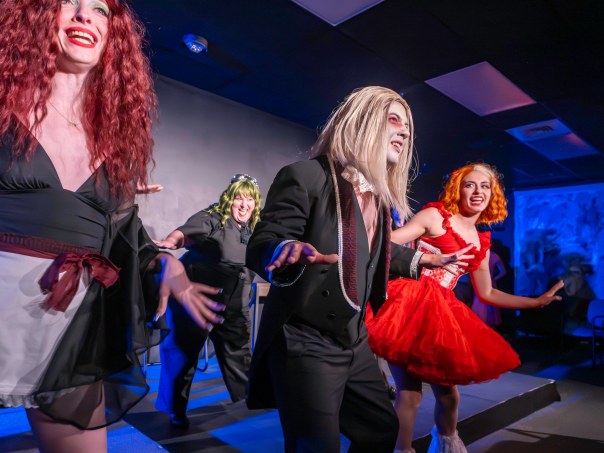
That’s because the musical chores are handled by a revolving roster of guest artists. Last weekend, these included Cole Thannisch, Myles Arnold, and cast members from Post Mortem’s upcoming production of The Rocky Horror Show. Rocky, Magenta, Frank-N-Furter, Columbia, and Riff Raff will all be on hand to torment Brad and Janet up yonder in Concord, when the full Rocky premieres on October 23 at the Old Courthouse Theatre’s new Wilson Family Black Box.
Meanwhile, enough of the gang showed up in full costume to fill the VAPA stage for two of the ghoulish musical’s signature numbers, the dreamy “Science Fiction Double Feature” and the imperishable “Time Warp” dance orgy. The young lions and lionesses will return for two of the three remaining Charlotte performances. More adventurous and exhibitionistic theatergoers will likely opt for the Rocky visitation at the Saturday night special, which amps up the macabre mischief with a costume contest.
Most lamentably revolving out of the guest rotation will be Arnold’s rousing rendition of the “Oogie Boogie Song” from The Nightmare Before Christmas, a charming amalgam of Cab Calloway, Fats Waller, and The Grinch. Thannisch yielded nothing to Arnold’s exploits in terms of charisma, smoothest and most urbane in his golden jacket as the evening’s first vampire.
Director Alli B. Graham mostly had Thannisch and Arnold singing to members of her sketch cast, so the shuttling back and forth between sketch and song flowed quite naturally. Because Nicole Cunningham wrote three of the five Laugh ‘Til You Die blackouts – each of the three a screwball parody – there was a stylistic consistency as well.
After serving as a very willing recipient for Thannisch’s vampire advances, staged far too chastely by Graham for a Charlotte audience, Cunningham cunningly continued as a witch named Laura in “Cry Witch,” strewn with references and quotes from Arthur Miller’s The Crucible. Laura seemed to be a Halloween witch rather than the real thing, married to Ryan: Dalton Norman dressed up as a fiery red devil.
The hellish secret they share is a piña colada-flavored pair of edible panties that was very unfortunately misplaced. Christine Hull, skilled at overacting in the grand Saturday Night Live manner, is the community’s moral watchdog and grand inquisitor, sending Norman and Cunningham into a nicely frothed panic. So refreshing to see a genuine witch hunt, isn’t it?
In a nicely gauged solo, Cunningham – in a costume that reminds us of an airline stewardess – welcomes us aboard a cruise along the River Styx with wonderfully plastic cheer in “Onboarding.” Since Gretchen isn’t getting off at Hades like the rest of us, maybe because she’s been there and back, she allows herself a certain amount of smug superiority mixed with her peppiness toward those of us who will stay the course. The rest of us, she serenely predicts, will jump ship. Not a preferable option.
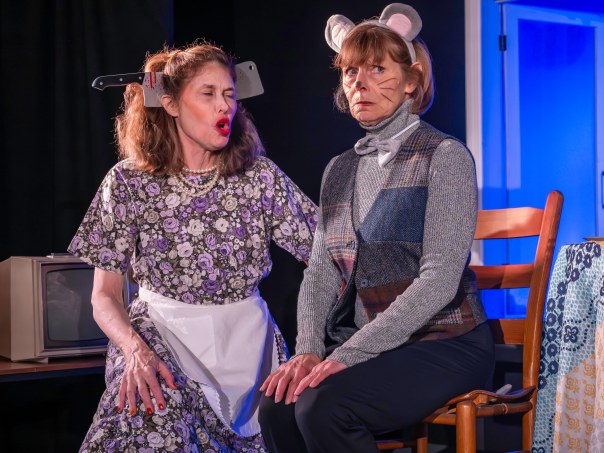
Zaniest of all, Cunningham has penned the surreal “Cilantro and Old Lace,” where we encounter Hull once again as a cutesy mouse named Michelle and the creepy Bobbi Hawk as the cloven June, a somehow embittered woman with a meat cleaver embedded across her head. Whether or not it has anything to do with the blood-spattered cleaver, June holds some kind of grudge against the angel (or fairy?) Rhea, a precious and catty Norman in drag.
Yes, Rhea is irritating, but maybe not to the extent that she should fall victim to the deranged June taking advantage of her nemesis’s cilantro allergy. Cilantro doesn’t exactly replace the arsenic in the familiar – and similarly off-kilter – Arsenic and Old Lace. Cunningham serves the more iconic poison as a side dish.
The remaining skits are written by Andrew Pippin and Mortem marketing manager Kimberly Saunders. “Final Girl” by Saunders has arguably the least Halloween aroma of all the Laugh ‘Til You Die segments, though its ends with a fairly creepy twist. Dave Gilpin is both boss and job interviewer as Mr. Smith, eventually allowing himself to be coaxed into giving his own assistant – Hull already in her mousey mode – a crack at the opening.
Neither Cunningham as Candidate 1 nor Steve Harper as Candidate 2 earns an on-the-spot job offer from Mr. Smith before Hull gets her chance to shine in the spotlight. Harper charmed me more as the also-ran, so efficiently toting his portfolio and handing Mr. Smith his résumé. Graham must have been equally charmed in her director’s chair, for she brought Harper back for an encore immediately afterwards, clutching his portfolio for dear life as Arnold slayed in his Oogie Boogeyman showstopper.
Pippin’s “Camp Amamonsta” has as much Halloween seasoning as “Cry Witch,” with a pinch more plotting, swift pacing, and a delicious ending, though Graham’s staging is a bit stagnant. Hull is at her most fulsome as Kate, the camp counselor welcoming all her monster campers to their first day – fulsome enough for us in the audience to feel included in the welcome.
The opening day lineup includes Hawk as Vampire Bella, Norman as Jackula III, Marcella Pansini in the thankless sheet-over-her-head role as a banshee ghost, and the wondrous Harper as Harry the Werewolf, though you might perceive a lick of Cowardly Lion. Into this idyllic bliss, a scorned outsider will intrude: Gilpin as Dave. A human being!
Hull retains an all-you-kids-play-nicely airiness amid the hullabaloo as Kate when it turns out that Bella is carrying on a forbidden romance with Dave. Like the rest of us, Dave is confident that his beloved merely has cosplay friends rather than fearsome monsters. Truth is, the bully among the campers, Jackula seems more likely to chugalug a beer than gobble up Dave. Harry? He’ll probably follow Jack’s lead. Whatever.
To avoid all these threats, Bella manages to talk Dave into pretending he’s a new camper rather than an outsider. Dave, however, doesn’t discard his insouciance, playing along rather than realizing he’s in peril. Yes, Pippin’s playlet actually has a setup that he could extend as long as he wishes.
At present, that isn’t too long, though we encourage Pippin to have second thoughts. Meanwhile, there’s a nifty ending in his hip pocket.
If you put the full Concord production of Rocky Horror on your calendar, you will be treated to multiple helpings of the leggy Lindsey Litka-Montes as the Popcorn Usherette and Magenta. She vamped me pretty good in “Science Fiction Double Feature,” camping next to me in the front row before making her rounds among the paying customers.
I confess to finding her even more tempting than the popcorn.




















 Art on My Sleeve