Category Archives: Concert

Black Lives Really Do Matter in Spoleto’s Stirring Counter-Crusade

Review: Opera, Chamber, and Orchestral Music @ Spoleto Festival USA

By Perry Tannenbaum
Dive In by Leigh Webber leighwebber.com

Recognition of the #BlackLivesMatter Movement and the We See You White American Theatre manifesto (issued by a coalition of BIPOC artists in 2020) were certainly on Nigel Redden’s mind when he decided that the 2021 Spoleto Festival USA would be his last as general director. White and long-tenured at the Charleston arts fest, Redden saw himself personifying what needed to be changed, not merely in American theatre but across the nation’s arts.

Yet that wasn’t to say that Spoleto was backward in infusing diversity into its programming or in embracing contemporary, cutting-edge work in its presentations of music, theatre, and dance – which made Redden’s swan song, at a Festival that constricted and hamstrung by Covid-19, all the more poignant. But all Redden’s work was not truly done, even after he officially stepped down last October, for there was one grand project of his that had yet to be completed. Spoleto’s commission of Omar, the much-anticipated new opera by Rhiannon Giddens and Michael Abels would at last be unveiled after being shelved for two years.Dive In by Leigh Webber leighwebber.com
Based on the slim autobiography of Omar Ibn Said, the only known narrative by an American slave written in Arabic, Giddens’ new work was appropriately co-commissioned by the University of North Carolina, for Omar’s servitude began in Charleston before he escaped to a more benign slaveholder up in Fayetteville, NC. Rather than letting this world premiere stand as an isolated testament to Redden’s legacy – or a belated rebuke targeting the infamous Muslim ban of 2017 – incoming general director Mena Mark Hanna has emphatically made Omar the tone-setting centerpiece of his first Spoleto.

Predictably enough, Giddens and Abels sat for a public interview with Martha Teichner on the afternoon following the premiere, just a few hours before she and her husband, Francesco Turrissi, appeared in an outdoor concert at Cistern Yard. Five days after the world premiere at Sottile Theatre, the principal singers from Omar and the choir resurfaced at Charleston Gaillard Center for a “Lift Every Voice” concert, further affirming Black Lives. But that theme, as well as Ibn Said’s African origins and Islamic faith, suffused the Festival’s programming more deeply than that.2022~Spoleto-142
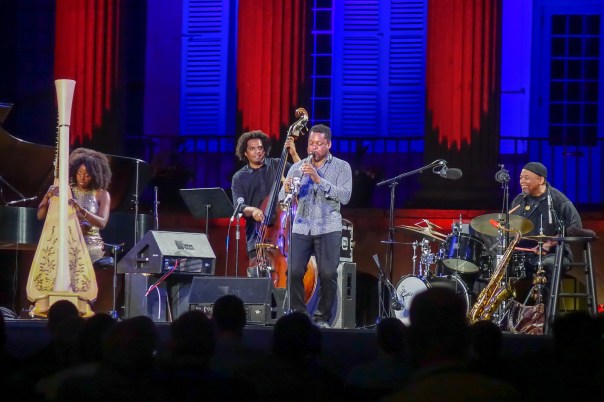
In the jazz sector, for example, two African artists were featured with their ensembles at the Cistern on successive night after Giddens’ concert, Senegalese singer Youssou N’Dour and his orchestra followed by South African pianist Nduduzo Makhatini and his quartet. More importantly, saxophonist Ravi Coltrane, three years after participating in a Geri Allen tribute, paid homage to his distinguished mom, harpist/organist/composer Alice Coltrane and her 1971 Universal Consciousness album, a spiritual landmark that defined Indocentric jazz, laced with flavorings of Africa, India, Egypt, and the Holy Land.Dive In by Leigh Webber leighwebber.com
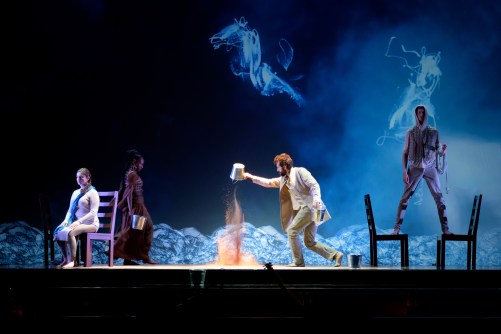
Unholy Wars was another Spoleto commission, with tenor Karim Sulayman as its lead creator, furthering the pro-Muslim thrust of the Festival’s opera lineup. Taking up Claudio Monteverdi’s Il combattimento di Tancredi e Clorinda, the 1624 opera that extracted its tragic love story from Torquato Tasso’s epic Jerusalem Delivered, Sulayman boldly flipped the First Crusade narrative. Sulayman, a first-generation American born in Chicago to Lebanese immigrants, conceived a counter-Crusade, attempting to render vocal compositions by Monteverdi, Handel, and others through the perspective of those defamed and marginalized by the prevailing white Western narrative.Dive In by Leigh Webber leighwebber.com

Portraying the narrator, Sulayman chiefly championed the warrior woman Clorinda – who needed to be white-skinned and convert to Christianity for 17th century Europe to see her as worthy of Tancredi, the valiant Christian knight who mistakenly slayed his beloved in combat. Soprano Raha Mirzadegan as Clorinda outshone bass baritone John Taylor Ward’s portrayal of Tancredi, while dancer Coral Dolphin, devising her moves with choreographer Ebony Williams, upstaged them both. We could conclude, in stage director Kevin Newberry’s scheme of things, that Dolphin’s dancing silently represented the Black beauty that Clorinda was never allowed to be.

Known for directing such cutting-edge operas as Doubt, Fellow Travelers, and The (R)evolution of Steve Jobs, Newberry had no qualms about creating huge disconnects between his actors’ actions and the Italian they sang. Costume designer David C. Woolard was similarly liberated in attiring them, evoking Lawrence of Arabia more readily than Richard the Lion-Hearted. Water, sand, heavy rope, and four simple chairs supplanted onstage scenery at Dock Stage Theater, but Michael Commendatore’s steady stream of animated projection designs, coupled with the production’s supertitles, more than compensated for the sparseness onstage, keeping us awash in sensory overload. If you tried to keep pace with the supertitles on high, sometimes barely legible, you could easily be distracted from the action below.

Consulting your program booklet to determine what was being sung by which composer would only have compounded your confusion. Best to listen, look, and enjoy. For if this sensory-rich spectacle – laden with mysterious sand and water ceremony – strayed far from fulfilling Sulayman’s intentions, the music, the voices, and the dance yielded constant pleasure, wonder, and delight.Dive In by Leigh Webber leighwebber.com

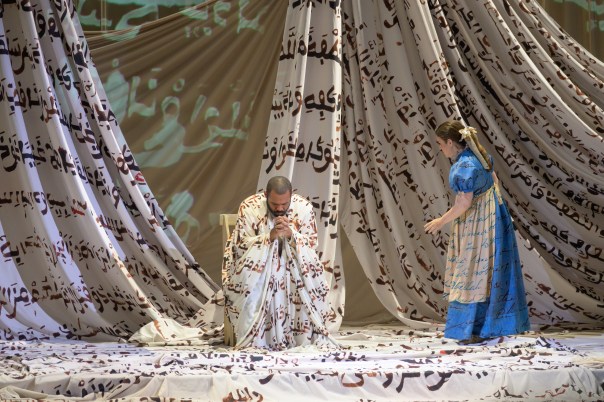
More touted and deliciously marketable, Giddens’ Omar proved to be more treasurable and on-task, providing tenor Jamez McCorkle with a career-making opportunity in the title role. Directing this stunning world premiere, director Kaneza Schall is laser-focused on the most pivotal event in Said’s life in America when, imprisoned in Fayetteville, he is released from jail and purchased by a benign master because of he has – miraculously, in the eyes of local yokels – written in Arabic script on the walls of his cell.

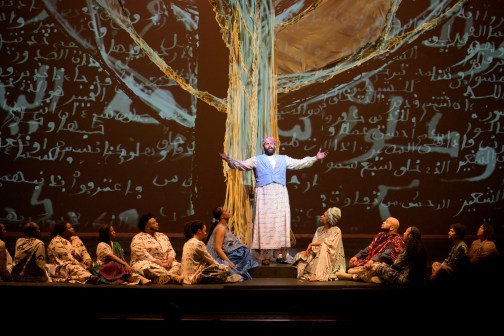
Written and printed language, from the floor upwards to the Sottile’s fly loft, is everywhere in Schall’s concept: dominant in Amy Rubin’s set, Joshua Higgason’s video, even permeating the costumes by April Hickman and Micheline Russell-Brown. If you ever believed the libelous presumption that Africans were all brought to America bereft of any literacy, maintained in their pristine backwardness by their benevolent masters, Schall’s vision of Omar was here to brashly disabuse you.Dive In by Leigh Webber leighwebber.com
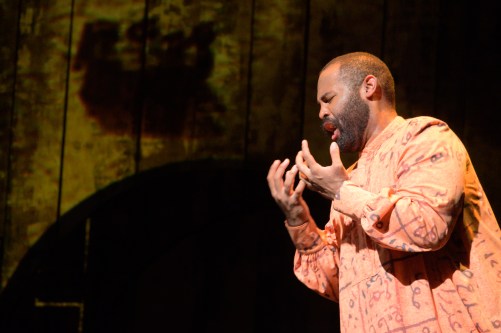
And if you were under the impression that Africans came ashore in Charleston without any coherent Abrahamic religion, their poor souls yearning to be redeemed by the beneficence of Christianity, Giddens labored lovingly to enlighten you, the beauty and spirituality of her score enhanced by Abels’ deft orchestrations. As a librettist, Giddens could have benefited from some discreet assistance – and the challenge of scoring somebody else’s text. Melodious and religious as it is, Omar could stand to be a more dramatic opera, and as a librettist, Giddens could have usefully been more detailed.

Stressing Said’s spirituality, Giddens neglects his intellect, never referencing the range of his studies or the full spectrum of his manuscripts. Nor is there a full fleshing-out of why Said was imprisoned in Fayetteville or how it could be that Major General James Owen could take him home without returning the fugitive slave to his previous master, described in The Autobiography as “a small, weak, and wicked man, called Johnson, a complete infidel, who had no fear of God at all.”Screenshot 2022-06-27 at 16-55-14 Spoleto Opera Honors An Extraordinary Slave Whose Life Mattered Classical Voice North America
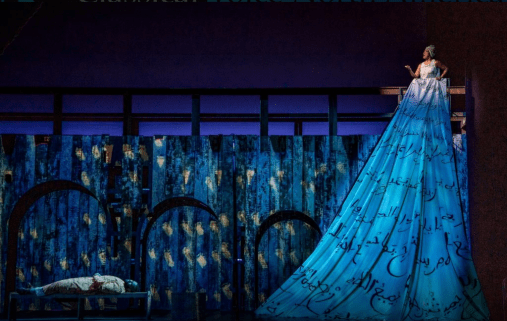
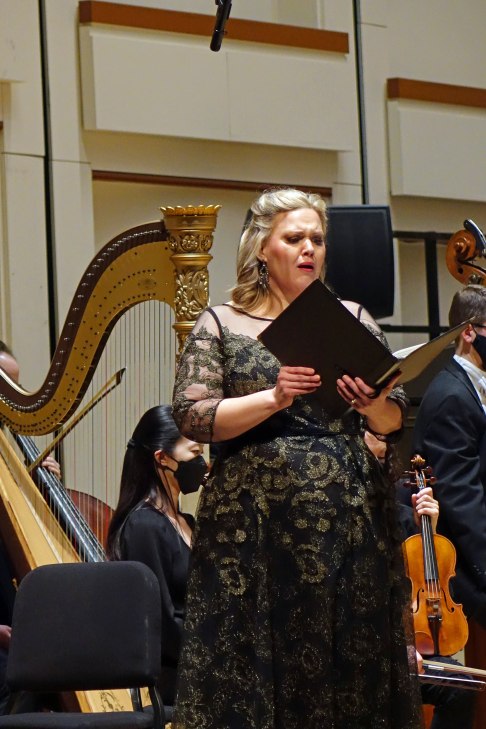
The embellishments that Giddens gives us are all gorgeous. Owen’s daughter, Eliza, has a beautiful aria sung by Rebecca Jo Loeb, entreating her dignified dad to see the providence in Omar’s coming to their city. Further mentoring our hero, soprano Laquita Mitchell was Julie, a fellow slave in Fayetteville who will vividly remember her previous meeting with Omar at a Charleston slave auction. More majestically, mezzo-soprano Cheryse McLeod Lewis is a recurring presence as Omar’s mother, Fatima. Long after she is slain by the marauders who enslave Omar, she comes back to her son in a dream, warning him that Johnson is fast approaching to murder him. Mitchell and Lewis subsequently team up to urge Omar to write his story, a summit meeting with McCorkle that is the clear musical – and emotional – high point of the evening.

Plum roles also go to baritone Malcolm MacKenzie, who gets to sing both of Omar’s masters, the cruel and godless Johnson before intermission and the benign, bible-toting Owen afterwards. The question of whether Said sincerely converts from Islam to Christianity is pointedly left open. Notwithstanding his utter triumph, we probably have not seen the full magnificence that McCorkle can bring to Omar, for he was hobbled in the opening performances, wearing a therapeutic boot over his left ankle that I, for one, didn’t notice until he resurfaced as the highlight of the “Lift Every Voice” concert, bringing down the house with a powerful “His Eye is on the Sparrow.”Dive In by Leigh Webber leighwebber.com

Scanning the remainder of Spoleto’s classical offerings, I’m tempted to linger in the operatic realm, for Yuval Sharon’s upside-down reimagining of La bohème at Gaillard Center, despite its time-saving cuts to Act 2, completely overcame my misgivings about seeing Puccini’s four acts staged in reverse order. Yet there were more flooring innovations, debuts, and premieres elsewhere.52126095047_f231ab5e32_o

Program III of the chamber music series epitomized how the lunchtime concerts have evolved at Dock Street Theater under violinist and host Geoff Nuttall’s stewardship. Baritone saxophonist Steven Banks brought a composition of his, “As I Am,” for his debut, a winsome duet with pianist Pedja Muzijevic. Renowned composer Osvaldo Golijov, a longtime collaborator with Nuttall’s St. Lawrence Quartet, was on hand to introduce his Ever Yours octet, which neatly followed a performance of the work that inspired him, Franz Joseph Haydn’s String Quartet, op. 76 no. 2.
2022~Spoleto-238.jpg

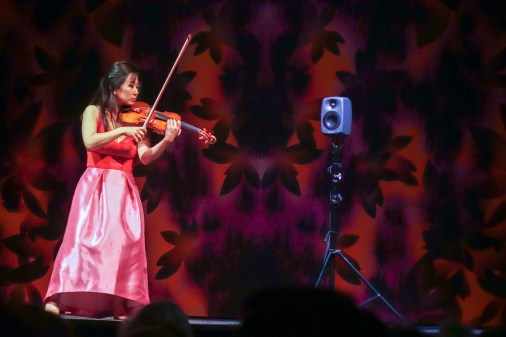
Upstaging all of these guys was the smashing debut of recorder virtuoso Tabea Debus, playing three different instruments – often two simultaneously – on German composer Moritz Eggert’s Auer Atem for three recorders and one player. Equally outré and modernistic, More or Less for pre-recorded and live violin was a new composition by Mark Applebaum, customized for Livia Sohn (Nuttall’s spouse) while she was recuperating from a hand injury that only allowed her to play with two fingers on her left hand. If it weren’t bizarre enough to see Sohn on the Dock Street stage facing a mounted bookshelf speaker, the prankish Applebaum was on hand to drape the speaker in a loud yellow wig after the performance was done.

On the orchestral front, two works at different concerts wowed me. Capping a program at Gaillard which had featured works by György Ligeti and Edmund Thornton Jenkins, John Kennedy conducted Aiōn, an extraordinary three-movement work by Icelandic composer Anna Thorvaldsdottir. Hatching a soundworld that could be massively placid, deafeningly chaotic, weirdly unearthly, or awesome with oceanic majesty, Aiōn decisively quashed my urge to slip away to The Cistern for Coltrane and his luminous harpist, Brandee Younger. We were forced to arrive a full 30 minutes after that religious rite began.2022~Spoleto-260
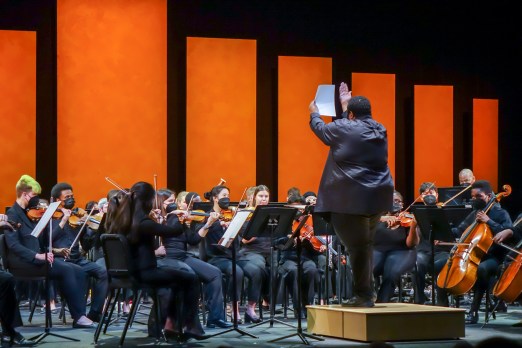
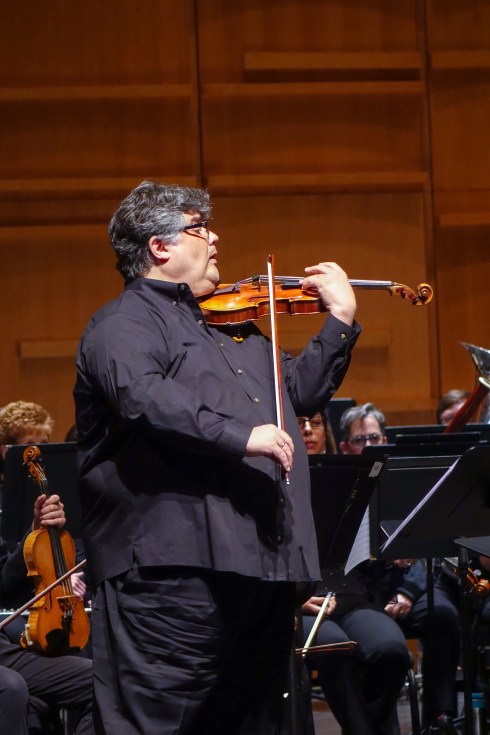
My final event before saying goodbye to Spoleto 2022 treated me to sights I’d never seen before. On an all-Tyshawn Sorey program, Sorey ascended to the podium at Sottile Theatre and took us all to a pioneering borderland between composition and improvisation that he titled Autoschiadisms. Instead of a baton, Sorey brandished a sharpie beating time, sheets of typing paper with written prompts, or simply his bare hands making signals. Sometimes Sorey simply allowed the Spoleto Festival USA Orchestra (splendid as usual) to run on autopilot while he huddled over his score, writing new prompts with his sharpie on blank pages before holding them high.2022~Spoleto-273

And the music was as wonderful as it was exciting, clearly an advance upon the other compositions on the bill, For Roscoe Mitchell and For Marcos Balter, conducted respectively by Kennedy and Kellen Gray. In the surreal aftermath of his triumphant premiere, Sorey had reason to linger onstage during a good chunk of the intermission. Musicians from the Orchestra swarmed him, waiting patiently for Sorey to autograph the sheets of paper that the composer had just used to lead them. The ink was barely dry where the MacArthur Genius of 2017 was obliged to write some more.

Warren-Green Bids Farewell With a Rousing Beethoven “Ode to Joy”

Review: Charlotte Symphony Plays Beethoven’s Ninth

 By Perry Tannenbaum

IMG_6604_dcoston

May 20, 2022, Charlotte, NC – Even back in the early ‘90s, when Charlotte Symphony struggled to sustain respectable mediocrity, the valedictory concert led by Leo Driehuys in 1993 proved that the orchestra could always rise to the occasion when called upon to perform Beethoven’s thrilling Ninth Symphony. Having heard the same ensemble bludgeon Beethoven’s “Eroica” to blandness just months earlier, it was hard for me to believe that the inspiration came solely from the composer. I struggled with the answer to this anomaly until I interviewed Driehuys’s successor, Peter McCoppin, shortly before his final season at the end of the millennium.

Not referencing Beethoven at all, but explaining why he enjoyed his years in Charlotte so thoroughly, McCoppin observed that the Queen City is incredibly fertile ground for choristers and choruses. You just had to count the churches around town to see his point. Not only had the Oratorio Singers of Charlotte brought extra spark to Beethoven’s “Choral Symphony,” they had also arguably sparked the Charlotte Symphony musicians they were partnering with.

The Oratorios have undergone numerous metamorphoses during the past three decades, at discreet intervals absorbed into Symphony, renamed the Charlotte Symphony Chorus, and eventually set free to seek their own gigs, rebranded once again as the Charlotte Master Chorale. Yet each time it was necessary to muster the instrumental and vocal artillery needed for Beethoven’s masterwork – indeed, classical music’s masterwork – the Chorale has admirably answered the call.

In a recent interview prefacing his valedictory concert as Symphony’s music director after 12 fruitful seasons, Christopher Warren-Green revealed that the chorus had been “one of the big incentives for me to come to Charlotte because of the great repertoire that was written for orchestra and chorus.” Little wonder, then, that Maestro Warren-Green has chosen to conclude his tenure by including the Master Chorale in his final “Ode to Joy” concert – or that he has already announced that, when he returns this coming December as Symphony’s music adviser and conductor laureate, the choir will be in the mix once more as he conducts Handel’s Messiah at Knight Theater.

There always seem to be extra layers of drama and excitement when the “Choral Symphony” returns to Belk Theater, never more than when Christof Perick made his 2001 debut as music director just 10 days after 9/11. Fast forward to the fourth Ninth that Symphony has programmed since then, and there was still a palpable sense of a special occasion in the hall. Symphony president and CEO David Fisk saluted Warren-Green before he made his grand entrance, greeted with a lusty standing ovation. Maestro then pooh-poohed all of Fisk’s accolades, paid tribute to four newly retired Symphony musicians, and – prior to a nifty and brief exit – exhorted the audience to keep supporting the CSO “or I’ll never forgive you.”

That was the last laugh of the evening as Warren-Green returned to the podium, signaled the Chorale to be seated, and presided over the Symphony as Beethoven brought them to a boil, quicker than a microwave oven, in his opening Allegro ma non troppo. Warren-Green’s Ninth would by a turbulent one, far more timely than timeless, discarding many chances for liquid lyricism in favor of alert and spirited rigor – almost militant but never quite lapsing into rigidity with the onset of its rousing quicker tempos. The incisiveness of Jacob Lipham’s timpani came upon us quickly, never allowing us to rest for long, while the affecting woodwinds and the lively strings offered eloquent counterweights.

When we reached the Molto vivace second movement, with its industrious bustle and perpetual overlapping, Warren-Green enabled us to hear early foreshadowings of the teeming humanity we’ll find in the epic fourth movement, struggling toward togetherness and brotherhood. Excitement in the overlaps between various sections of the orchestra was increased dramatically by spasmodic boosts in dynamics and the sharp whacks of the timpani. Also pushing against the flow of the violins and the warmth of the cellos were the percolating winds and the moaning French horns.

IMG_6891_dcoston

Between the second and third movements, the last true pause in this symphony, the guest soloists entered and took their seats at center stage: bass baritone Jordan Bisch, tenor Sean Panikkar, soprano Alicia Russell Tagert, and (substituting for Briana Hunter) mezzo-soprano Sarah Larson. The two little girls seated in front of my mom and me perked up expectantly at this point, only to be let down by the relatively tranquil Adagio molto e cantabile. The little girls weren’t as restless or fidgety during this lovely movement as you might expect little boys to be, but their attentiveness waned noticeably – despite the sweetness of the first violins, the affecting violas and second violins, and the mellifluous woodwinds and horns. Their adorable decorum was threatened most by the beautiful confluence between clarinet, horn, and flute as the penultimate movement faded into the concluding Presto.

IMG_6511_dcoston

Having this glorious score in front of you, with its magnificent build-up to the signature fireworks waiting to explode, must be so gratifying and fulfilling as a musical conductor stands on the podium, heading into the homestretch of his 12-year tenure. Surely, the musicians and choristers sensed the excitement and shared an eagerness to deliver. The first violins were certainly ardent and rich over the churning violas and second violins as the build-up began, yet as the gradual gravitation toward the brotherhood theme was beginning, I noticed that Warren-Green was doing something different and new. Instead of seating his cellos and double basses to our right, they were now spread in a long row, starting in front of the podium and reaching to the left edge of the stage in nearly a straight line.

So there was a little more than the usual edge as the journey to the brotherhood theme launched, continuing with dogged inevitability after the woodwinds mischievously flashed back to the agitations of the second movement. Violas layered onto the cellos and basses, adding to the smoldering sensation, and the violins accelerated the familiar strains until the brass made them soar. The little girls in front of us were completely re-engaged ahead of the next magnificent build. Bisch sounded stronger and more robust in his opening declaration, “O Freunde, nicht diese Töne! (Oh friends, not these sounds!),” culminating in the announcement of his Joy agenda (“Freude!”), than he did reprising the brotherhood refrain as he plunged into Friedrich Schiller’s “An die Freude (Ode to Joy).” More than a couple of bass baritones who have recorded these passages have fared the same. Perhaps that was Beethoven’s design, for ample reinforcements will emphatically arrive on the scene, first the soloists and then the phalanxes of choristers who were elevated over everyone upstage, ably representing Schiller’s millions.

At least a couple of regatherings follow, as all of us who love the Ninth well know. There’s a grand, brassy military march while the vocalists inhale for awhile and hold their fire, and then there are those sublime audible inhalations as Schiller’s lyrics, helpfully translated in supertitles above the Belk stage, took us “above the canopy of stars” in an ethereally protracted chord. When the Master Chorale reached peak tempo in the concluding Allegro assai vivace, like a herd of horses urged by Warren-Green to full gallop, one of the little girls turned to the other with an OMG expression on her face that her mom would have treasured until her dying day if she had seen it. At this moment, the greatest pleasure in watching kids experience this magnificent storm of sound for the first time is being able to say to yourself. “You ain’t heard nuthin’ yet!”

Originally published on 5/22 at CVNC.org

US Premiere Keynotes Symphony Concert, with Multiple Thrills and Triumphs to Follow

Review: Charlotte Symphony Plays Sibelius Symphony No. 2

 By Perry Tannenbaum

2022~Sibelius 2-21

April 22, 2022, Charlotte, NC – There had been no foretelling that five weeks ago, the Belk Theater stage would be splashed with the colors of Ukraine’s flag for a Charlotte Symphony concert. Nor could guest conductor Karen Kamensek, making her Charlotte debut, have predicted that the music she was bringing to Knight Theater would be so pertinent to this moment: a symphony by a Finnish composer written in response to Russian oppression in 1902, and two pieces written by Russian-born composers, one of them publicly condemned by the Stalinist regime in 1948. Sadly, these works by Jean Sibelius, Victoria Borisova-Ollas, and Dmitri Shostakovich have new life and fresh significance today as the world trembles, anticipating the full consequences of the horrific Russian aggression unleashed by its unhinged leader.2022~Sibelius 2-06

Written by Vladivostok native Borisova-Ollis, a longtime Swedish citizen, in 2008 for the 850th anniversary of Munich, Germany, Angelus had its long-overdue United States premiere. Nor was the Chicago-born Kamensek unworthy of the honor, having conducted the 2022 Grammy-Award winning recording of Philip Glass’s Akhnaten with the Metropolitan Opera. Although the upstage at Knight Theater wasn’t lit up with Ukraine’s colors, there certainly was an auspicious tableau – and a sense of occasion – as a phalanx of percussionists were spread across the rear of the orchestra, bells and drums and cymbals further brightened by the sounds of piano, celesta, and a pair of harps. The composer’s account of how she fulfilled the Munich Philharmonic Orchestra’s commission, reprinted in the digital program, lays heavy stress on the stroll she took through the city and the recordings she made of its church bells, so that aspect of the piece, underscored by Kamensek’s spoken intro was eagerly anticipated – a pacific, spiritual answer to Putin’s insane “de-Nazification” rallying cries.2022~Sibelius 2-25

What was surprising for me, especially in light of Borisova-Ollis’s description of the opening of her Angelus as “a hint of a Celtic chant,” was hearing principal violist Benjamin Geller playing a melody, over soft tremolos from the string section, that unmistakably resembled a traditional Passover song, one that I had heard in synagogue as recently as that morning. The predicted bells would eventually arrive in three or four waves, but not before we heard from the trumpet, the horns, the timpani, and the clarinet. Extending beyond 20 minutes, not at all a bonbon typically programmed at the beginning of concerts, the piece was studded with unusual instrumental effects – like a brief organ-tuba duet – and swirling, cresting climaxes. Even as she built to the first tolling of the tubular bells, Kamensek’s interpretation was more bustling and boisterous than Skari Oramo’s relatively quiescent recording for BIS with the Royal Stockholm Philharmonic. Since Kamensek lists one Borisova-Ollis’s operas, Dracula, among her credits, expect to hear more from this composer-conductor pairing in the future.

Shostakovich completed his first Violin Concerto just one month after his denunciation, but he and violinist David Oistrakh, for whom the work was dedicated, had to wait over two years after Stalin’s death – more than seven years in all – to respectively hear and perform the premiere. Although I own two of the Oistrakh recordings you can access on Spotify, I can only trace two prior occasions when I heard this epic piece performed live, once by the Charlotte Symphony in 2001, when young Caitlin Tully was hampered by the acoustics of the First United Methodist Church, and once at the Verbier Festival in 2006, when violinist Vadim Rapin conductor Yuri Temirkanov fired off all its burners with a student orchestra that was on a par with the Spoleto Festival’s.2022~Sibelius 2-11

Charlotte Symphony subscribers greeted concertmaster Calin Ovidiu Lupanu with an ovation that probably would have startled Repin himself, and the violinist seemed buoyed by the occasion. While Lupanu didn’t quite replicate the sublimity of the opening Nocturne in the 1956 recording by the Leningrad Philharmonic with Oistrakh and maestro Yevgeny Mravinsky, he came breathtakingly close, enough to earn another ovation between movements, and the slashing energy and brightness he brought to the ensuing Scherzo – coupled with the brio Kamensek drew from Symphony in this catchiest movement – earned an even more-deserved ovation afterwards.

Kamensek and the CSO met the grand challenge of the Passacaglia, infusing it with martial gravity, and Lupanu played with more eloquence and fire than I’ve ever heard from him, carrying forward a thrilling momentum into the Andante – Cadenza portion of that movement and, without an interval for the audience to express its enthusiasm, into the final Burlesque, the shortest section of the work. Cheated of the chance to explode after the Cadenza by the onset of timpani for the Burlesque, the audience redoubled its fervor at the rousing conclusion. Fortunately, Lupanu had an encore at-the-ready, a lovely Sarabande from Bach’s Partita No. 2, the first encore performed at a CSO concert since before the pandemic.

Of course, if you were among the legions who can’t get enough Sibelius, the Symphony No. 2 after intermission, while significantly statelier and more reposeful than the concerto, was anything but an anticlimax. However neatly the oppressed narrative might fit current anti-Russian sentiments, Kamensek seemed to take the quieter episodes of the opening Allegro as subdued rather than oppressed, with an incipient optimism ready to burst forth with ebullience or blossom into grandeur. The opening of the ensuing Andante, ma rubato can sound morose and grim on recordings, but at the Knight, where the pizzicatos of the basses and cellos could sound lighter and livelier, buoyancy lurked within the quietude, so transitions to anger and reflection sounded more natural. Once again, the two final movements were linked without an interval, punctuated by another brief timpani tattoo, but this time followed with trumpet heraldry and a grand orchestral flowering. Repeated lulls and swellings reaffirmed the triumph, beautifully calibrated and fervently delivered.

Originally published on 4/24 at CVNC.org

Jinjoo Cho and Joshua Gerson Make Impressive Belk Debuts

Review: Charlotte Symphony Plays Barber’s Violin Concerto

 By Perry Tannenbaum

2022~Barber Violin-20

March 25, 2022, Charlotte, NC – While Christopher Warren-Green’s tenure as music director at Charlotte Symphony winds down, as he transitions to the roles of conductor laureate and artistic adviser in seasons to come, the appearances of guest conductors at Belk Theater and Knight Theater are gaining an extra aura, an extra sparkle of excitement. For this stately parade of baton-wielders can now be construed as a prolonged set of auditions as audiences, Symphony execs, and orchestra musicians make up their minds on who should follow in maestro Warren-Green’s footsteps. Suddenly, everything going on behind the scenes at Symphony is freshly cloaked in intrigue.

Was the absence of Kwamé Ryan, listed on our own calendar as guest conductor, a last-minute indication that he is fielding offers elsewhere and withdrawing from candidacy? Was his replacement, Joshua Gersen from the New York Phil and the New World Symphony, a hot new prospect for our upcoming vacancy, or was Symphony’s substitution based on Gerson’s availability and preparedness for the planned program? With Jinjoo Cho slated to play Samuel Barber’s Violin Concerto as the headline piece, Gerson’s readiness needed to be on par with the musicians’ for that work, since they had presumably mastered their parts sufficiently to greet Cho and Gerson at rehearsals when they arrived.

No notice of the substitution came our way via email, but changes weren’t so last-minute that Symphony’s program booklet couldn’t be changed in time for Cho’s Charlotte debut with Gerson. Digital brochures, thankfully, can be altered more nimbly than printed editions, the pre-pandemic norm. Impressively enough, Gerson was able to conduct the preamble to Cho’s appearance, Errollyn Wallen’s Mighty River, a 2007 British piece that certainly isn’t standard rep. César Franck’s Symphony in D minor, however, had to be jettisoned, replaced after intermission by Robert Schumann’s “Rhenish” Symphony No. 3. Some of the answers about what was going on behind the scenes were answered – you have to pay attention, folks! – by the announcement of Symphony’s 2022-23 season earlier in the week. Ryan resurfaces as one of the 10 guest conductors who will continue the pageant of candidates, and Franck’s Symphony also resurfaces as part of next season’s classics playlist, but they are no longer linked on the same program.2022~Barber Violin-02

Subscribers who were not attuned to these program and performer shuffles probably didn’t notice any significant glitches. I’d have to say that Symphony’s musicians not only rose to the occasion but were energized by its challenges. If that didn’t happen before they assembled on the Knight Theater stage, then Gerson’s extended and enthusiastic introduction to the music could have provided the spark. As relaxed and genial as he was speaking to the audience, Gerson was as instantly intense when he faced away from us to his musicians.

Born in Belize in 1958, Wallen was commissioned to write a piece celebrating the bicentennial of the repeal of the Slave Trade Act. Since the British Parliament passed that landmark legislation on March 25, 1807, Charlotte Symphony’s first performance of the piece was a celebration in itself, staged exactly 215 years later. Principal French hornist Byron Johns, played no small part in assuring that the debut was a success, playing the affecting “Amazing Grace” melody that frames Wallen’s composition and often infuses it throughout. The title was Wallen’s affirmation of the flow of history toward freedom, driven by the yearning and pursuit of all who respond to their human instincts and nature’s law. Horns and strings wasted no time in percolating their evocations of that flow. Principal timpanist Jacob Lipham furnished the most distinctive landmarks along the way, with principal harpist Andrea Mumm Trammell adding vivid detail, supplemented by Erinn Frechette tweedling her piccolo. Wallen handed off solo honors to the oboe, flute, and other winds before handing it back to Johns, with principals Hollis Ulaky on the oboe and flutist Victor Wang making their colors count the most.2022~Barber Violin-19

We’ve seen both Joshua Bell and Elmar Oliveira playing the Barber concerto here in Charlotte over the past 25 years, so to say that Cho’s performance with Gerson eclipsed them both is no small claim. Head-to-head, Cho generated more electricity than Oliveira, and behind the glamorous violinist, Gerson and the Charlotte Symphony got out of her way more deftly than the Houston Symphony and Christoph Eschenbach were able to manage in 1998. Cho was sublime in the opening Allegro and seemed to summon a special ardor from Gerson and the orchestra in their response – I don’t think we ever did get enough of the catchy main theme.

In the hushed Andante that followed, Cho may have been even more magical, more transported by the score. The concluding Presto in moto perpetuo, rewritten according to Gerson to provide a greater challenge to the soloist, seemed to become a new and spontaneous challenge that Cho and the orchestra hurled back at each other. There actually was a pause for the native Korean to gather herself as the ensemble rushed on. After a visible deep breath, Cho’s fresh onslaught was even more fiery and swift.2022~Barber Violin-24

The power of the Barber drove a fellow critic and his spouse to the back of the hall after intermission, but the Schumann proved worthy of staying for, not at all an anticlimax. The zest and drive of the opening Lebhaft of the “Rhenish” were unlike anything I’d heard in live performances before – certainly better than anything on the complete set of Schumann symphonies by Roy Goodman and the Hanover Band, ballyhooed as the first complete recording on period instruments (and a complete RCA dud). No, you have to listen to the John Eliot Gardiner set on DGG, also on period instruments, to find an equal to the glories unfolded at Knight Theater by our Symphony.

Gerson didn’t quite achieve the lightning bolts you’ll hear from Gardiner in the opening movement, though he sustained a wondrous sense of expectancy in the relatively quieter section between the great pinnacles. The middle movements, culminating in the rich heraldry and solemnity of the penultimate Feirlich fourth movement, achieved parity with Gardiner’s benchmark recording for me. But it was the grand military Lebhaft finale where Gerson and Symphony surpassed what was previously on record, establishing a new highwater mark for the “Rhenish.”

Originally published on 3/27 at CVNC.org

Ukraine’s Colors Shine Through Charlotte Symphony Celebration

Review: Dona Nobis Pacem at Belk Theater

 By Perry Tannenbaum

2022~Dona Nobis Pacem-31

March 12, 2022, Charlotte, NC – When 57 musicians gathered at the Carolina Theatre on Tryon Street to present the inaugural Charlotte Symphony concert on March 20, 1932, none of them could have possibly predicted how the orchestra’s 90th anniversary would be celebrated in 2022. Three of the five pieces that Christopher Warren-Green conducted, nearing the end of his distinguished tenure as Symphony’s music director, hadn’t been written yet, and one of the composers hadn’t been born. Even last May, when CSO’s 2021-22 season was announced, Warren-Green himself couldn’t have predicted how grimly appropriate Ralph Vaughan Williams’ Dona Nobis Pacem would be for the occasion. As originally conceived, the program was an olive branch from England to America, three British composers conducted by one of the Crown’s finest, two of the pieces paying homage to Walt Whitman, our greatest poet.

A small dent in the all-English lineup turned up when Symphony’s Australian second trombone, Thomas Burge, finished enough of his to-be-continued “Charlotte Symphony Fanfare” for it to serve as a preamble to the orchestra’s celebration. What truly turned the tone of the anniversary festivities upside-down was Vladimir Putin’s horrific invasion of Ukraine, lending Dona Nobis Pacem – “Grant us peace” – unforeseen pertinence and meaning. With St. Patrick’s Day weekend revelers teeming along the sidewalks and spilling over onto Tryon and Fifth Streets, there was a dramatic contrast for concertgoers who became pedestrians shortly after hearing Williams’ Fantasia on a Theme by Thomas Tallis and the Dona Nobis at Belk Theater on Saturday night. The most festive of the night’s festivities were outside the hall.

Burge’s new composition will no doubt impress more when it takes its intended place at the launch of a future Symphony’s classics season and the composer’s showy post-pandemic staging can be realized: three brass choirs spread out across the Belk balcony. For the 90th, the brass battalion was confined behind the masked string sections, but the peep we had into the work-in-progress was sunny and glorious. Gustav Holst’s Walt Whitman Overture, a youthful piece completed in 1899 when the composer would turn 25, was arguably the most sustained celebration of the evening, though it might be somewhat deflating to learn that Holst had been dead for over 48 years when the piece was first performed in 1982. The transparent violins at the beginning, hovering over churning basses and cellos before flutes and brass peeped in, struck me more like Schubert than any American or British music. When the brass first broke through, however, there may have been a glint of Sousa, and the final swell of the piece was in a grand Victorian vein.

The Four Scottish Dances by Malcolm Arnold (1921-2006), premiered in 1957, were clearly the most winsome offering of the evening, shuttling between slow and fast tempos – not only between dances but sometimes within them. Inspired by Louis Armstrong more strongly than by Whitman, Arnold’s music displayed a more American élan, geniality, and broad humor than the other Brits’. If your head wasn’t spinning from the abrupt acceleration that Warren-Green called forth in the opening “Strathspey Pesante,” which ended with a pedestrian “shave and a haircut” phrase, then the slowdown in the ensuing Vivace (Reel), initiated by Joshua Hood galumphing on his bassoon, would certainly have caught your ear. And if that weren’t sufficient mischief, Warren-Green’s hambone slacking and slouching at the podium added a visual cue. Perish the thought that Maestro Warren-Green’s predecessor, Christof Perick, would ever have tainted himself with such levity.

After these pranks, which reminded me of the Western merriment in Copland’s folksier pieces, the work of principal harpist Andrea Mumm Trammell, principal flutist Victor Wang, and oboist Erica Cice was sublime in the penultimate “Hebridean Song,” shining through the shimmer of the strings. The concluding “Highland Fling” had as much Scottish flavor as the “Pesante,” rushing at us unabated with sudden shifts in volume, the tweedling of the high woodwinds answered by onrushes of orchestra colored with fiery alarms from the trombones.

If the customary programming conventions for galas were being observed, I’d strongly question the wisdom of delaying the comparatively solemn and serene Tallis Fantasia until after Arnold’s suite, which would have sent us off to intermission in a lighter mood. But Symphony president David Fisk had already solemnized the occasion by dedicating the concert “to Ukraine and the courage, strength, and resilience of its people,” a theme that would subsequently be echoed in the digital program and by Warren-Green, when he prefaced his performance of the Dona Nobis. By coincidence surely, Vaughan-Williams composed his 1910 Fantasia very similarly to Burge’s spanking new “Fanfare,” dividing his aggregation of strings into three parts, two string orchestras with a string quartet within the larger orchestra. Concertmaster Calin Ovidiu Lupanu had the last and most eloquent solo among those doled out to the four principal string players, but kudos should also go to principal violist Benjamin Geller, whose solo launched the memorable quartet episode.

What will stand out for me, however, was the extraordinary alchemy of this performance. Whether it has always been baked into Vaughan-Williams’ orchestration, maybe something special that Warren-Green was able to elicit from his musicians, or whether it was the unprecedented high placement of the small string orchestra on the platform where the Charlotte Master Chorale would soon sing, flush against the upstage vestigial pipes at the Belk… I could have sworn that there was a softly playing organ in the orchestral mix. Needless to say: amazing.2022~Dona Nobis Pacem-27

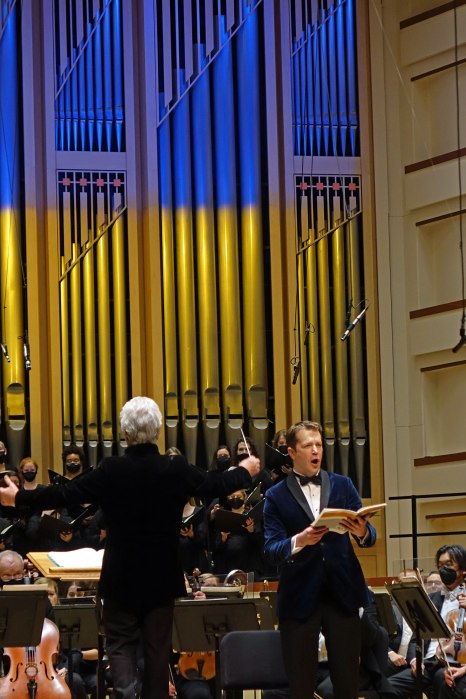
Those organ pipes were more verifiably involved in the culminating performance of the Dona Nobis Pacem, after more than 40 Master choristers filed in, followed by our two guest soloists: soprano Christina Pier and, in his Charlotte debut, bass-baritone Daniel Okulitch. It was then that Warren-Green dedicated this piece to the valiant, freedom-loving people of Ukraine. Between the moment that the maestro turned away from us and Symphony began to play, those silvery pipes, illuminated until then entirely in blue light, suddenly became halved into stripes of gleaming blue and yellow gold, the colors of the Ukrainian flag. A proud moment for us all.

Whether prescribed by COVID protocols, Warren-Green’s decree, or the unmasked singers’ personal preferences, Pier and Okulitch sat further apart than the vocal soloists we usually encounter at Symphony concerts. With Pier mostly singing the “Agnus Dei” refrain that contains the Latin title, and Okulitch confining himself in the middle movements in Walt Whitman’s English – and Old Testament translations in the Finale – the separation between the singers wasn’t awkward at all.

2022~Dona Nobis Pacem-24

Pier tended to sing with the orchestra and the choir, but there was an extended stretch where Okulitch, standing to Warren-Green’s right, was accompanied solely by Lupanu, seated to his left. So the tableau enhanced the intimacy of their duet. What was really unfortunate and compromising for us were the vast stretches of incomprehensible text from the chorus that Vaughan-Williams had scored so splendidly. If there had been supertitles above the stage or printed programs in our hands, the experience would have been even more powerful. Those of us who were able to download the digital program were adequately equipped, but the Blumenthal Performing Arts Center has had repeated problems with transmitting these copious, colorful, and informative materials.

In future performances where we’re expecting to follow along at the Belk, I will try to download the digital materials before I leave home. Clearest of all was the chorus’s mighty “Beat! Beat! Drums!” refrain from one of Whitman’s most metrical Civil War compositions. Even when we might be lost in the less familiar words of other war poems by the Good Gray Poet (“Reconciliation” and “Dirge for Two Veterans”), the music, the voices, and the colors of the fighting Ukrainians’ flag landed on us forcefully. It was thrilling.

Originally published on 3/14 at CVNC.org

New Faces, New Rep, and High Decibels Shake and Rattle the Belk

Review: Charlotte Symphony Plays Kabalevsky’s Cello Concerto No. 1

By Perry Tannenbaum

2022~Kabalevsky Cello-04February 25, 2022, Charlotte, NC – Theatre and music critics can be lulled into complacency – mixed with boredom – when called upon to review Shakespeare’s As You Like It or Tchaikovsky’s Nutcracker beyond the seventh time. So it’s gladdening and stimulating to see how recent social, political, and public upheavals have affected local programming in the Queen City. Though it constantly calculates years ahead, Charlotte Symphony has not been the slowest to react and evolve. Not at all: in the past four weeks, I’ve been compelled to remember the names of new guest soloists and conductors – and to read up on composers whose works I was hearing at Knight Theater and Belk Theater for the first time. When American composer John Corigliano is the best-known composer at a Symphony program in the Belk, you know we’ve wandered off the beaten path.

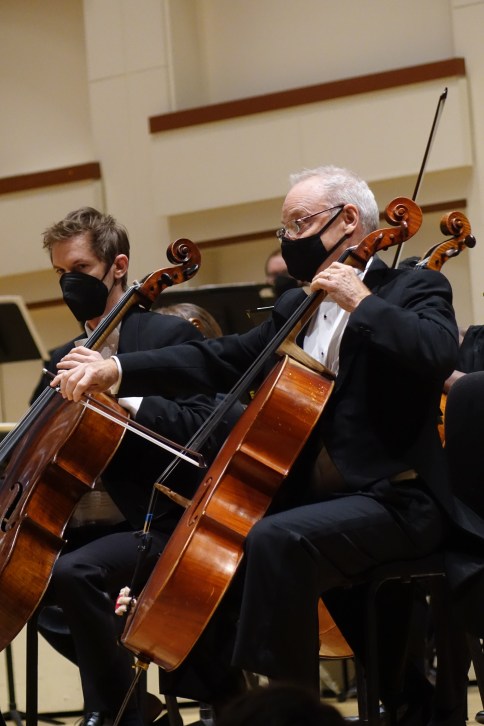
Apple Music and Spotify are both aware of Chilean-Italian guest conductor Paolo Bortolameolli and Mexican composer Gabriela Ortiz, but neither of their giant streaming catalogues contains the first piece that Bortolameolli performed with Symphony, Ortiz’s Téenek – Invenciones de Territorio. Obviously, our guest would need to have an inside track on this composition. As associate conductor of the Los Angeles Philharmonic, he did, for the LA Phil commissioned the piece and it was premiered under the baton of Gustavo Dudamel in 2017. The piece, divided into three sections, had glimmering textures and lively rhythms from south of the border, with celesta, tubular bells, and harp coming in the wake of the piece’s biggest climax and some mellow work from principal oboist Hollis Ulaky along the way.

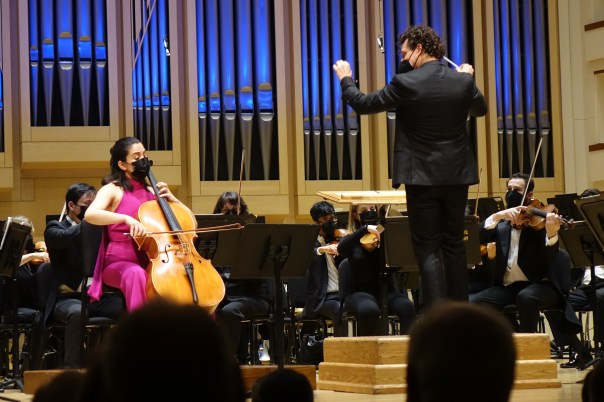
I was still struggling with the spelling of Russian composer Dmitri Kabalevsky’s last name in my driveway as I was tallying my mileage and parking in my expense app after the concert – and berating myself for forgetting his first. The deluge of new data I needed to process was happily compounded by an auspicious debut of Christine Lamprea, who soloed on the marquee piece, Kabalevsky’s Cello Concerto No. 1. Lamprea established another appealing trend, the second consecutive female soloist to clutter the Belk stage with a music stand and a musical score. That’s a byproduct of presenting a piece that the guest artist hasn’t played over and over around the country and the globe. Among the half dozen recordings that I tracked down, the best-known soloist to have played Kabalevsky’s Op. 49 is Yo-Yo Ma (Raphael Wallfisch, however, has recorded Concerto No.2, Op. 77), whose performance vies with Daniil Shafran’s, conducted by Kabalevky himself, as the definitive account.2022~Kabalevsky Cello-05

In a very personable intro to the evening’s program, Bortolameolli hinted that we might find an undercurrent of cynicism and sarcasm akin to Shostakovich beneath the sunny surface of Kabalevsky’s 1948 work – maybe a bit of a stretch, since the composer was widely recognized as an establishment figure from the days of Stalin onwards, serving behind the scenes and on-the-air with Soviet Radio, eventually becoming a leading Soviet musical ambassador in his travels abroad. Perhaps there was some empathy for Ukraine impinging on Bortolameolli’s objectivity? In keeping with Communist suspicions of radical modernist innovations, Kabalevsky hardly delivered any portentous jolts in his G minor concerto, nor did Lamprea, playing quite eloquently, seem to be on a quest for anything subversive in her interpretation. Over a marching beat of pizzicatos, her playing in the opening Allegro was rich and ardent, finishing the movement with a light and beguiling pizzicato cadenza.2022~Kabalevsky Cello-06

Nor did I detect any sardonic undercurrents in the ensuing Largo, molto espressivo, Kabalevsky’s tribute to the Soviet casualties of the World Wars. While there was more heart on Ma’s sleeve in the lyrical moments of this movement – and more daring hushed quietude on his CD in his lamenting cadenza – Lamprea was altogether earnest in her grieving, very affecting. Principal hornist Byron Johns certainly heightened the solemnity and sublimity of this movement backing up Lamprea. In the concluding Allegretto, the Colombian-American cellist convinced me that Kabalevky (1904-87) had written his Concerto after hearing Tchaikovsky’s Rococo Variations rather than before. The theme and variations, based on a Russian folk melody, have no less melodic appeal, even if they aren’t as technically demanding, and Lamprea brought out the kinship of the variations more clearly than any other version I’ve heard.

You’ll be very entertained by Bortolameolli’s pocket sized intro to Corigliano’s Symphony No. 1, timely again because it was written in 1988 in response to the AIDS epidemic and the toll it took on artists and friends he knew. But for a fuller analysis and exploration, you don’t want to miss the composer’s own introduction in the digital program booklet. No need for me to add more than this single word to that comprehensive, episodic description: LOUD!! In order to nearly replicate the 92dB reading I saw on my Apple Watch at the peak of the opening movement, Apologue: Of Rage and Remembrance, I had to turn my home stereo volume knob close to the 12 o’clock position, playing the landmark Chicago Symphony/Daniel Barenboim CD. At that point, my Apple Watch registered 90dB. At the same time, I activated the Sound Meter app on my iPhone for a more credible reading and recorded a max of 111.1dB.

Yes, it was louder at Belk Theater in Row J than that. “Behind the orchestra,” we read in Corigliano’s notes, “five trumpets are placed with the first trumpet in the center; fanning outwards around the orchestra are six French horns (three on each side), four trombones (two on each side), and, finally, one tuba on each end of the semicircle of brass.” No doubt my wife Sue and I were more comfy with the Remembrance episodes of this movement than the spasmodic blares of the Rage that the composer marked as “Ferocious.” In the more nostalgic moments, we heard an offstage piano playing Leopold Godowsky’s transcription of Isaac Albeniz’s Tango, with more piano – and pleasantly intensified orchestra – closing out the movement.

2022~Kabalevsky Cello-16We weren’t exactly danced around the hall in the ensuing Tarentella, for as Bortolameolli pointed out, the root word of this Italian dance is actually tarantula, and the dance was believed to cure victims of that spider’s bite from a rare form of dementia. So the composer had a schizophrenic and hallucinatory soundscape in mind, relentlessly accelerating into insanity. Most consoling and welcome, then, was the penultimate Chaconne movement, “Giulio’s Song,” written in memory of a friend who was an amateur cellist and inspired by tape recordings of improvisations Giulio and the composer played together. Principal cellist Alan Black was unforgettably showcased here, playing five lovely notes before a pause, then seven notes before another, before finally released into the song. Enhancing the loveliness, cellist Jeremy Lamb eventually joined in a soulful duet. Corigliano’s concluding Epilogue was a capsulized recap of the previous movements of his Symphony, hearkening back to its opening and shining a spotlight once again on Black, who played the last sustained note, tapering off into silence.

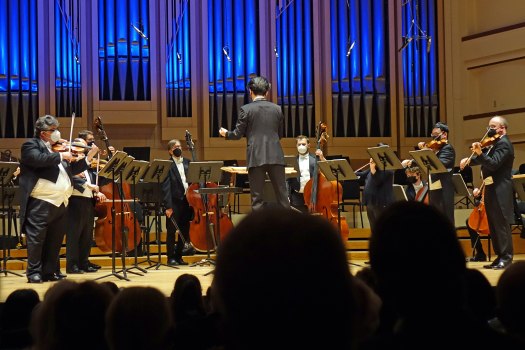
It was an A, like the grade I would give for the entire concert. Kudos as well to the audience, who greeted all this new rep, especially the Corigliano, with enthusiasm and gusto.

Originally published on 2/27 at CVNC.org

Clara, Kensho, and Clyne – New Names All – Ride in for Daring Charlotte Symphony Concert

Review: Tchaikovsky Symphony No. 6 “Pathétique”

By Perry Tannenbaum

2022~Tchaikovsky Pathétique-19 

February 11, 2022, Charlotte, NC – It was an evening for new faces at Belk Theater – and plenty of unfamiliar music – as Charlotte Symphony welcomed Sara Davis Buechner as guest soloist for Clara Schumann’s Piano Concerto, and Kensho Watanabe appeared for the first time at the podium. Drawing the largest Symphony audience we’ve seen since the start of the pandemic, Tchaikovsky’s ever-popular “Pathétique” Symphony No.6 was not merely the only familiar piece on the program, it was also the only music by a male composer. Even in the absence of music director Christopher Warren-Green, the audience seemed to delight in the balance of adventurous and beloved fare.2022~Tchaikovsky Pathétique-03

Watanabe helped put our minds at ease about Anna Clyne’s “Within Her Arms,” telling us that it was written as a memorial to the composer’s mother. A certain solemnity of the tableau we saw onstage – 15 string players, all standing except the three cellists – also led me to expect harmonies that were respectful and consoling rather than raucous. At the start, the tone actually seemed thin, wan, and weepy, rich with treble. When the lower strings began to assert themselves, the tone veered toward grief and hurt. Repeated six-note phrases briefly put me in mind of Samuel Barber’s funereal Adagio, but Clyne put more variety into her 2009 composition, breaking it into multiple sections.

None of them were at all sunny, but the piece eventually swelled to more passionate, anguished heights and collective grieving. Although concertmaster Calin Ovidiu Lupanu’s voice was the most frequently heard in this community, Clyne doled out poignant asides to other soloists, and her ensemble passages were a controlled combination of harmony, dissonance, and individual lines. In the absence of any tracks on Spotify or Apple, the only performances I could compare this one with were a couple of live videos on YouTube, and Watanabe clearly made more of the dynamic contrasts than I found in either of those.

Schumann’s concerto, written at the age of 14, over six years before her marriage to Robert Schumann, was temporarily known as the Clara Wieck Piano Concerto. It premiered in 1835 with the prodigy herself at the keyboard and Felix Mendelssohn wielding the baton. Buechner wasted little time in demonstrating how sensational Schumann needed to be in performance to play her own concerto. The musical voice of the composer seemed to be heavily influenced by Chopin in the opening Allegro maestoso, more when Buechner played than in the orchestral prelude.2022~Tchaikovsky Pathétique-04

That impression carried over into the ensuing Romanze, played without pause, where a nocturnal solo turned into an ardent cello sonata, Chopin’s preferred chamber music format. Principal cellist Alan Black played with admirably rich tone and expression, and only a couple of foreboding rumbles from principal timpanist Jacob Lipham were necessary to transition us to Schumann’s Allegro finale, probably the most individual of her three movements. Certainly it was the sunniest music of the evening so far, and gave Buechner her best opportunities to show us her power and finesse. A responsive exhilaration thundered back from the orchestra as Watanabe cued the heavy artillery.2022~Tchaikovsky Pathétique-26

Daniele Gatti and Charles Dutoit lead the list of notables who have presided over Tchaikovsky’s “Pathétique” in live Charlotte performances over the past 25 years, so there were plenty stellar quality comparisons that local music lovers could make between Watanabe and what they had heard live or on CD. With this touchstone of the classical repertoire, we could see that this American conductor was a stickler for detail, reveling in the sweep of phrases and subtle – or sudden – changes in dynamics. When Watanabe and Charlotte Symphony reached the sudden sforzando in Adagio-Allegro opening movement, they nearly punched my heart out as thoroughly as Dutoit had done when he led the Royal Philharmonic into Belk Theater in 2006. Aside from the meticulous detailing, pacing, and dynamics from Watanabe, the woodwind principals excelled, beginning with bassoonist Joshua Hood and culminating with Taylor Marino’s wondrous recap of the familiar “Summer Night” melody. The whole cello section gleamed, easing us into the luxurious Allegro con grazia second movement, gliding along in 5/4 tempo.

I had to worry that the wonderful Adagio-Allegro, so resplendently rendered, might draw a premature ovation from Symphony subscribers, but they managed to restrain themselves until the rousing penultimate Allegro molto vivace, which always garners a wild ovation. We could almost hear the march melody, which eventually becomes so overpowering and triumphant, bubbling up in little hints from near the beginning of the movement, so detailed was this performance – and Marino became more festive in his playing, adding some grain to his tone. Of course, the enduring shock and innovation of the “Pathétique” is its dark and somber final movement, a tenebrous descent that begins with three cellos and a tuba calling out; resolving lower, deeper, and softer with the cellos and basses; all treble a distant memory. Remarkable that Charlotte Symphony would program “Pathétique” and the similarly lugubrious Mahler Ninth less than a month apart, but they have now done well by both.

Originally published on 2/12 at CVNC.org

“Deadly Sins” Upstage Jazzy Ravel in Fun-Filled CSO Concert

Review: Charlotte Symphony Plays Ravel’s Piano Concerto

By Perry Tannenbaum

2022~Ravel Piano Concerto-07

January 28, 2022, Charlotte, NC – You could arguably call it a facelift. After Charlotte Symphony’s powerful performance of Mahler’s somber, morbid, mercurial, epic, and sometimes phantasmagorical Ninth Symphony, almost everything seemed changed two weeks later. A new conductor was onstage, Australia-born maestra Jessica Cottis, making her Queen City debut. All six guest artists were making their debuts in Symphony’s Classics Series, and even the site of their musicmaking was different, moving southward from Belk Theater at the Blumenthal PAC to Knight Theater at Levine Avenue of the Arts. Most transformative was the music, a kaleidoscopic multinational program connected by a distinct American thread.

The headliner on the program was Maurice Ravel’s Piano Concerto, last performed by Symphony in 2013 when the wondrous Pascal Rogé made his Belk Theater debut at the keyboard. Jesse Montgomery’s folksy, bluegrass-flavored Strum preceded the main event, when Canadian pianist Stewart Goodyear seated himself at the Steinway. Cottis had plenty more excitement in store for us after intermission, plunging into Igor Stravinsky’s Circus Polka, for a Young Elephant – actually written at choreographer George Balanchine’s request in 1942 for Ringling Brothers Barnum & Bailey’s massive troupe of not-yet-controversial young elephants. Uncannily, another Balanchine commission rounded out the program, Kurt Weill’s The Seven Deadly Sins (1932) with lyrics by Bertold Brecht – obviously written for people rather than pachyderms.2022~Ravel Piano Concerto-36

Nearly a year ago, Montgomery’s Starburst aptly keynoted a program that showcased Mozart’s Eine Kleine Nachtmusik (“A Little Night Music”). Longer and decidedly sunnier, Strum set the tone for CSO’s American evening as perfectly as the title readied us for a work written exclusively for strings. Reading Montgomery’s program notes, chronicling the various incarnations of the piece, we get the sense of experiencing its evolution as it unfolds, for it bounces around among three principal string players before beginning its breathtaking ascent to full power and beauty. Laying out the first pizzicatos, violist Benjamin Geller was soon joined by cellist Alan Black, strumming and then bowing. But it was concertmaster Calin Ovidiu Lupanu’s treacherous entrance that truly ignited the fray, triggering Montgomery’s ricochet effects and banjo-like strumming.

Honestly, the performance by CSO became a more massive, lovelier, and less ferocious thing than the studio version by the Catalyst Quartet on Montgomery’s 2015 Strum CD. With a full string orchestra came more majesty when the main melodies were revealed – and extra bite when the piece ended with a collective pizzicato. Nor are “folksy” and “bluegrass” any less flattering in describing Montgomery’s music here than they are in describing many of Aaron Copland’s signature works.2022~Ravel Piano Concerto-01

From the first time I saw him in 2017, playing all of Beethoven’s piano sonatas in a single day at Savannah Music Festival, Goodyear stamped himself in my mind as a prodigious talent. Prior to those three three-hour immersions, Goodyear’s distillation of Tchaikovsky’s The Nutcracker, on his 2015 solo CD, had clued me in. The soloist starts at a disadvantage in the Ravel Piano Concerto, having to follow the famed whipcrack that launches the opening Allegramente. Not to worry, Goodyear showed his mastery of the bluesy and jazzy licks of the movement soon afterwards, and harpist Andrea Mumm Trammell had a lovely interlude.

Inspired by Mozart’s Clarinet Quintet, Ravel’s middle movement drew absolutely mesmerizing lyricism from Goodyear, with English hornist Terry Maskin as stellar behind him as he was for Rogé. Yet everyone on the Knight stage seemed most inspired by the concluding Presto. Goodyear unleashed dazzling intensity and bravura, never easing up on the tempo, and the ensemble didn’t merely keep up: they seemed to be prodding their guest to play faster. Turbulence from the winds, brass, and percussion made the climax even more exhilarating.

Apparently, music for dancing elephant isn’t classified as ballet, since it doesn’t appear on The Robert Craft Edition of The Ballets on the notoriously completist Naxos label. Yet Stravinsky never disavowed his Balanchine bagatelle, conducting “Circus Polka” among his voluminous recordings of his own works, where it clocked in at a modest 3:27 on Columbia. Why this rambunctious crowdpleaser isn’t played more often as a concert appetizer is beyond me. While Cottis and the Symphony may have been a tad helter-skelter where Ravel called for more élan, they were marvelously attuned to Igor’s riotous absurdities, his brassy bombast, and the celebratory glee of his wild, galumphing jamboree. It seemed to start in mid-parade before the dainty spots hilariously evoked the pachyderm pixies.2022~Ravel Piano Concerto-31

The zaniness had hardly begun. Bass-baritone Reginald Powell, dressed in a flowery kitchen apron in order to portray the mother of our tempted/temptress heroine, led a barbershop quartet across the stage, sitting down at the end of their march behind a bank of microphones. Strange accessories for a classical concert. So Seven Deadly Sins was classical with a three-penny Kurt Weill twist. Nor was this an opera, though a cabaret table and some props were set in place before our chanteuse, soprano Lindsay Kesselman as Anna I + II, made her/their noire-ish entrance in a spymaster trench coat.2022~Ravel Piano Concerto-37

More than a hint of decadent vaudeville came with her, since each of the nine sections of Weill’s confection was heralded by an old-timey placard placed onto an easel. Prologue, Epilogue, Greed, and the gang were all embroidered with an apt skull-and-crossbones motif. Sad to say, much of this flavorful creativity was outweighed by Charlotte Symphony’s failure to provide supertitle projections once Anna I + II began vocalizing with her/their Family. A few audience members down with us in the orchestra section had the temerity to fire up their cellphones, where they had previously downloaded Symphony’s digital program, so they could follow along.

Not the best experience when you’re trying to keep up with columns of German and English on your iPhone while there is also action onstage to follow. The magnitude of this blunder would only be compounded if you returned home, flipped through the digital program, and discovered that the translation was written by life partners W.H. Auden & Chester Kallman, esteemed poets and librettists in their own rights – they worked on Stravinsky operas! Not only does their Deadly Sins translation rhyme, the syllable counts of every line meticulously match Brecht’s text. Learning that all five vocalists had North Carolina roots – and afterwards listening on Spotify to a recording with the Auden-Kallman lyrics – only deepened my incredulity.

Everyone at Knight Theater, singers and audience alike, could have been so comfortable, and all Brecht’s wit, irony, and satire could have been so clear!

Stepping up to one of mics, Cottis was helpful in her introductory remarks in laying out Brecht’s storyline, which is basically Anna’s odyssey across seven American cities on a mission to sustain her family back home in Louisiana, encountering one of the deadlies in each locale. Ideally, the Balanchine concept is fulfilled when Anna I is the soprano and Anna II is a sublime dancer. Part of the comedy that got lost when Kesselman was both Annas was in the lopsidedness of the dialogue between them. Anna II has very little to say.2022~Ravel Piano Concerto-28

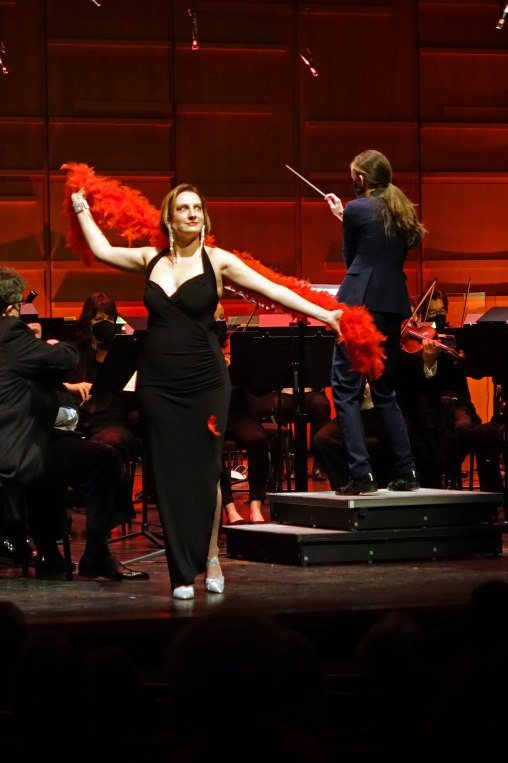
The staging helped this decadent Weill bauble to upstage Ravel’s merriment – or at least prevented it from being an anticlimax. Kesselman soon peeled off her trench coat, revealing an evening dress as the Family’s Sloth along the Mississippi River transitioned to Pride as Anna II took a job in Memphis as a cabaret dancer. Anna added a flaming red boa encountering Wrath in LA, and an uncredited lighting designer made a similarly lurid choice illuminating the Knight’s acoustic shell. Purple became apropos for Gluttony in Philly, a lighter pinkish red presided over Lust in Boston, and a dark golden hue settled in over Baltimore when she battled Greed. So I had to think that nobody wanted to offend New York during the Great Depression.

Need we say that when Anna’s journeying ended with Envy in San Fran, where Kesselman made her final grand entrance as a rich celeb, totally soused and brandishing a nearly empty bottle of vodka, that the stage was flooded in a deep dark green? Didn’t think so.

A wonderful ending to a melodious, fun-filled, and dance-filled evening. Even without dancers. Facelift and uplift.

Originally published on 1/30 at CVNC.org

Symphony Arrives at Sublimity, Amping Up Mahler to Heavy-Metal Decibels Along the Way

Review: CSO Plays Mahler’s Ninth Symphony

By Perry Tannenbaum

2022~CSO Mahler's Ninth-17

January 14, 2022, Charlotte, NC – When the new Compact Disc digital recordings were first heralded and released in the early 1980s, the mythic story began circulating from Sony and Philips that the dimensions and capacity of the new CD format were determined by its ability to present all of Beethoven’s Ninth Symphony on a single disc. Subsequent refinements to the technology increased the capacity of those discs from 74 minutes of music to 80, leaving Ludwig far out of the equation. The 80-minute capacity we see on today’s prerecorded discs and the recordable CD-Rs we might dub them onto is more suitable for containing Gustav Mahler’s Ninth Symphony – but only if conductor and orchestra are in a hurry. Only the very quickest of the many recordings of Mahler’s last completed orchestral work clock in at 79 or 80 minutes. Completing his Mahler Journey with the Charlotte Symphony Orchestra in his final season as music director, Christopher Warren-Green let it be known that his Ninth would be a more expansive 90-minute experience. There was no intermission at Belk Theater, and program booklets remain a strictly online affair.

Vaccination cards were scrutinized at both the outdoor entrances to the Blumenthal Performing Arts Center and at the indoor entrance from Founders Hall. My mom and I felt very comfortable with the social distancing downstairs in the orchestra section, but no such amenity was granted to subscribers who entered the hall from the lobby – in fact, I’ve never seen the Grand Tier more fully occupied, a gratifying affirmation of the Queen City’s Mahler enthusiasm. The balcony above looked similarly packed. Masking, of course, was compulsory, but ticketholders should chiefly be forewarned that vigilance was strictly enforced at the entrance to the orchestra section. Folks that were late for the first notes of the Mahler performance, between 7:35 and 7:40pm, were obliged to wait in front of TV monitors in the lobby until the conclusion of the opening Andante comodo movement at approximately 8:05.

Each of the outer movements, both preoccupied with mortality and dying, is as lengthy as the two inner movements combined. Only the second movement can be described as lighthearted, and all four are teeming with mood swings. Without adding audible gaps between episodes, recordings conducted by Leonard Bernstein and Herbert von Karajan with the Berlin Philharmonic are divided into 33 and 30 tracks respectively. Those seemed to be very conservative numbers when Warren-Green and Charlotte Symphony immersed themselves in the score, reveling in its seemingly countless contrasts. Emerging with the opening melody from a backdrop of cellos, basses, horns, and harp, the second violins emphatically signaled that all sections of the vast ensemble would have their chances to shine.

2022~CSO Mahler's Ninth-04

This was by far the most extensive instrumentation we had seen at either Belk Theater or Knight Theater since the beginning of the pandemic. From orchestra level, it was difficult to precisely count all the unmasked flute, clarinet, oboe, bassoon, French horn, and trumpet players arrayed behind the masked string sections. But the percussionists were plain enough when they stood up, either singly or as an ominous group, and there was additional space set aside, upstage and on the stage left wing, for the three trombones, two harps, and the tuba. Curving around stage right to the upstage was an armada that included timpani, a mighty bass drum, cymbals, a gong, snare drums, and tubular bells.

So the prospect of high-volume music was apparent before all the Symphony musicians were fully congregated. Yet when these expected Mahler explosions actually occurred, Mom and I were both taken aback by how loud they were. The difference between sitting at the rear of the grand tier late last spring and sitting in Row O below was compounded by the additional troops and artillery onstage. Earplugs weren’t quite necessary for these fortissimos, but rock-concert decibels weren’t far in the distance. Mom may have nodded off for a few seconds during Gershwin’s Lullaby last year or when Branford Marsalis luxuriated in the luscious Larghetto middle movement of Jacques Ibert’s Concertino da camera. Not this year. Onsets of trumpets, trombones, or percussion could be so sudden that, even if she didn’t revere Mahler, Mom wouldn’t dare close her eyes.

There were plenty of less aggressive surprises scattered across the lordly length of this symphony. In the epic Andante, the harpists reached out to pluck a bass line, and the mournful funereal dirge had the backbone of a military march, punctuated by the wan tubular bells. If you’re new to Mahler, the waltzing liveliness of the “Im Tempo eines gemächlichen Ländlers” (in the tempo of leisurely country dances) might catch you pleasantly off-guard – and what plan did the composer have for a triangle and cymbals playing in unison? The third movement Rondo-Burlesk was brimful of contrasts and contradictions as Warren-Green kept us on the lookout for the next twist. A busy, contrapuntal opening suggested a fugue with frolicsome and comical touches, but midway through this Burlesk, each of the orchestra’s sections seemed to have something soulful to say – not at all the path you would expect leading to a screaming conclusion.

2022~CSO Mahler's Ninth-15

Perhaps the biggest surprise of the evening came at the climax of the Adagio finale when a furious pounding of the big bass drum, topping off a majestic crescendo, suddenly gave way to – in the hushed blink of an eye – nearly total silence. This abrupt whisper of weepy violins, proved that Mahler’s precipitous subsidings can be almost as dramatic as his volcanic peaks. Most of Symphony’s principals distinguished themselves over the course of this epic evening, including oboist Hollis Ulaky, clarinetist Taylor Marino, cellist Alan Black, and concertmaster Calin Ovidiu Lupanu, but the final movement underscored the special praise earned by French horn principal Byron Johns and principal flutist Victor Wang. Even Johns’ one little wobble on the horn came at an ideally aching moment, and Wang was merely perfection in the sublime epilogue.

Originally published on 1/15 at CVNC.org

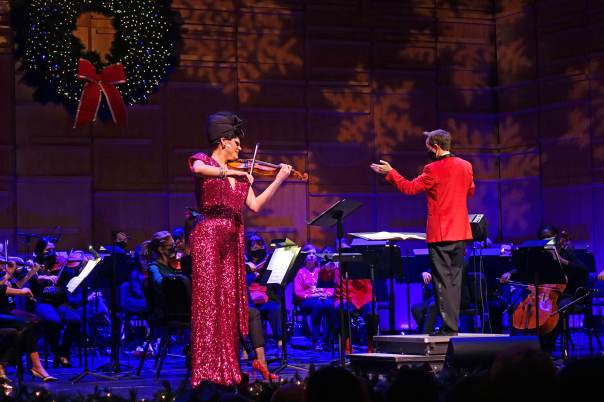
Thorgy Brings Plenty of Christmas Cheer – and Drag Artistry – to the Queen City

Review: Charlotte Symphony Premieres A Very Thorgy Christmas

By Perry Tannenbaum

2021~Thorgy Xmas-37

The first thing to know about Thorgy Thor, a distinguished alum from the eighth season of RuPaul’s Drag Race, is that she is outrageous. If political correctness is your passion, then the next thing to know is that I’ve chosen her pronouns after consulting the program for the world premiere of A Very Thorgy Christmas, performed with the Charlotte Symphony and resident conductor Christopher James Lees. The Wikipedia entry for Thor, née Shane Galligan, is a tossed salad of pronouns that doesn’t conclusively settle the question.

Headlining a Christmas show with a full symphony orchestra, Thorgy proved to have multiple talents. Not only did she serve as a guest violin soloist on three Christmas songs, she performed a standup monologue, screened a self-produced takeoff on an NPR podcast, presided like a gameshow host over a farcical giftwrap contest between four Symphony musicians, sang an autobiographical rewrite of “The 12 Days of Christmas,” and interviewed Lees a la late-night TV.2021~Thorgy Xmas-18

If Thorgy’s debut with Symphony in January 2020 had even half the variety and surprises of her Christmas extravaganza, it’s easy to understand why she was invited back so quickly – to basically do whatever she wished. The only restriction she acknowledged was an imposed limit of one f-bomb, and she certainly detonated that one with maximum impact. Lees and the ensemble began conventionally enough at Knight Theater for a very full house, launching into a merry rendition of “Joy to the World.” But the arrangement of this familiar carol soon became a mashup of several other carols and then an outright Christmas barrage – “Jingle Bells” and “Silent Night” at the same time? – before I began to wonder what few Christmas carols might be left over after this extravagant overture.

Unlike Jack Benny or Henny Youngman, the only other violinist comedians I can reference, Thorgy took herself seriously as she came on to play “O Holy Night.” Her tone was actually quite beautiful when she played, even though the arrangement and tempo didn’t demand impressive dexterity. “Carol of the Bells,” played just before intermission, required fleeter fingering, but even with this more energetic fare, Thorgy was flawless, unstressed, and only wisecracked once or twice over her performance. More of her freewheeling flamboyance came out when she put away the lumber and spoke out. This Very Thorgy Christmas was clearly a 2021 edition if Thor has any intentions of reprising her show as a Yuletide tradition. Not only was the new show silly, as Thorgy herself off-handedly remarked, it was also ephemeral.

Thorgy’s monologue was largely about her upcoming prospects and what she had done during the pandemic. Her pandemic shenanigans were plentiful enough, in fact, to supply prime fodder for her next two comical exploits prior to intermission. In the first, she went through the lowlights of her stint as a cameo celeb, that seemingly wholesome profession of producing customized video greetings for clients’ loved ones. As the smut piled on, we quickly realized that Thorgy didn’t attract a Hallmark Cards clientele. In the NPR video she showed us afterwards, Thorgy and a fellow drag queen, rather sedately dressed for this studio format, interviewed a comparatively blue-collar guy named Chef Schwetty. Judging by the varied colors of the samples he brought with him, I’d say Schwetty was a pastry chef. Without adding flavors or adjectives, Schwetty described his specialty as balls. Needless to say, the two gay interviewers feasted on the possibilities.

2021~Thorgy Xmas-36.jpgMore signals came after intermission that a 2022 edition of Thorgy Christmas would undergo drastic changes, for it was obvious that Thor revels in surprises. Dispensing with the customary concert preludes served up by her symphonic hosts, Thorgy burst onto the stage and kicked things off with a brash “Jingle Bells” spot. Of course, she had changed her outfit during intermission – from an ensemble highlighted by garish red-and-green-striped slacks to a fiery, glittery, fuchsia spectacular. She almost visually jingled in this one-piece caprice, and she discarded her dazzling Dolly Parton white wig in favor of a towering brunette bouffant. Thorgy is rather tall already.
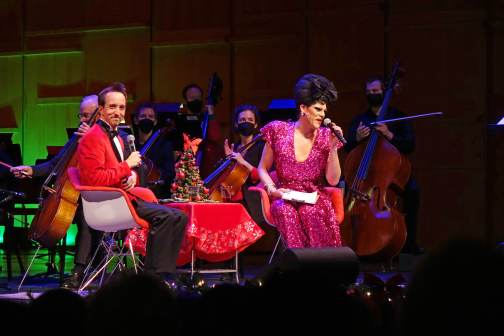
Genial, easygoing, and relaxed, Lees complemented his guest artist handsomely. After the opening overture pillaged a huge chunk of Christmas inventory, Lees allowed the orchestra to stray briefly from holiday fare with an excursion to Grieg’s “Hall of the Mountain King.” When he returned to the podium, after the screening of Thorgy’s cameos, he and his cohort basically coasted along with a couple of snatches from Tchaikovsky’s Nutcracker, rep that they play repeatedly for Charlotte Ballet every December. After Thorgy made her splash to open the second half, Lees engaged with the Knight Theater audience to help him out with the whipcracks in Leroy Anderson’s “Sleigh Ride.” A woman in a lower box seat happened to have a black fan that made a whippier sound than our claps when she opened it, adding to the fun (especially when she was late).

Although the Knight audience was heavily infused with RuPaul devotees, the “12 Days of Christmas” parody was too crammed with obscure references to Thorgy’s misadventures on Drag Race and its All-Stars spinoff – and often too unintelligible – to garner universal laughter. And of course, the repetitions built into the familiar song didn’t help, a lesson for Thorgy to learn for her 2022 edition. After this partial misfire, Thorgy came up with her most hilarious bit of the night, the giftwrap contest with four surprisingly smart-alecky Symphony musicians. With a connoisseur’s unerring judgment, Thorgy chose four gifts for wrapping that offered maximum opportunity for failure and embarrassment: a cluster of inflated balloons, an open umbrella (closing it was strictly forbidden), a toilet plunger, and a broom and dustpan combo.

Like those frenetic cookoffs you may have watched on TV, the four wrappers had to cope with a tight time limit, so Lees and the orchestra timed the competition by performing… something. The action was too engrossing for me to take heed, but the ending and Thorgy’s flamboyant flourish were emphatic enough to signal the sudden frantic finish. The cluster of balloons proved to be disappointingly wrappable and humdrum, but the unopened umbrella was such a colossal fail that I found myself howling with laughter.2021~Thorgy Xmas-29

On the other hand, the wrapping for the plunger, cunningly separated into two pieces, was an absolute triumph. But flutist Jill O’Neill ultimately won the night – via a plurality of audience applause – with her amazing wrapping for the broom and dustpan. Audaciously rolling the merchandise on the floor helped O’Neill execute her design, and I suspect that adopting a witch persona as soon as she first held the broom helped to sway the judges. I was actually impressed by the rapport that Thorgy developed with each of the four contestants as they displayed their handiwork.2021~Thorgy Xmas-31

We gracefully glided homeward after this high-energy highlight, as Thorgy sat down for her cozy interview with Lees, occasionally prompting principal cellist Alan Black to imbibe from a tumbler of alcoholic beverage during the course of the conversation. Things became unexpectedly revelatory when, after a very personal question, Lees suddenly asked his interrogator if they could continue their conversation backstage later on. Some marital history soon followed. Those hilarious moments prevented the sitdown with Thorgy from becoming overly anticlimactic after the madcap giftwrap – and it segued nicely into Thorgy’s closing performance on violin, a beautiful and heartfelt “Silent Night.”

Originally published on 12/25 at CVNC.org