Monthly Archives: September 2025

Three Women Empathize Historically With “Stabat Mater” on a Historic Night

Review: Pergolesi’s Stabat Mater at The Mint Museum

By Perry Tannenbaum

September 11, 2025, Charlotte, NC – With its stained-glass windows, high ceiling, and resonant wooden flooring, the Uptown Mint Museum proved to be an unexpectedly apt venue for Opera Carolina and Charlotte Symphony to join in commemorating mournful, horrific events with sacred music. Reflexively, we look to the past – and to religion – to express our feelings amid present woes, but neither of the musical organizations could have anticipated the extra layers of calamity earlier in the week that would pile onto their memorial to the victims and heroes of 9/11 on its 24th anniversary. The work they performed, Giovanni Battista Pergolesi’s Stabat Mater, has always had a tragical tinge. Pergolesi composed his most-performed work near the end of his life, all too suddenly ended in 1736 by the onset of tuberculosis at the age of 26.

The Italian was casting his eyes across the centuries in scoring his Latin text, which had already existed for four or five hundred years, depending on whether it was written by Jacopone da Todi, a Franciscan friar, or by Lotario de’ Conti di Segni, better known as Pope Innocent III. The “Stabat mater dolorósa” poem, 20 three-line stanzas written in trochaic tetrameter, meditates on the sorrows and sufferings of Jesus’ mother, more than a millennium further back in time, standing by her son during the agonies of crucifixion. While the Oxford Dictionary of Music describes the piece as originally written for male soprano, male alto, and orchestra, most of the vocalists on the 60 or so recordings of the work have been female sopranos and mezzos.

Marie Van Rhijn was the first woman to conduct a recording of Pergolesi’s chef d’oeuvre in 2021 on the Chateau de Versailles label, so Emily Jarrell Urbanek was almost a pioneer in adding her special empathy toward the grieving Virgin Mary as she stood on the podium leading the Charlotte Symphony Orchestra Ensemble. But wait: the Van Rhijn recording was done with two male vocalists! Samuel Mariño and Filippo Mineccia, listed on the album cover as the “deux costrats,” also perform the Vivaldi Stabat Mater on that release with Van Rhijn conducting. So together, Urbanek, soprano Corey Raquel Lovelace, and mezzo Leyla Martinucci may have been making feminist history after all.
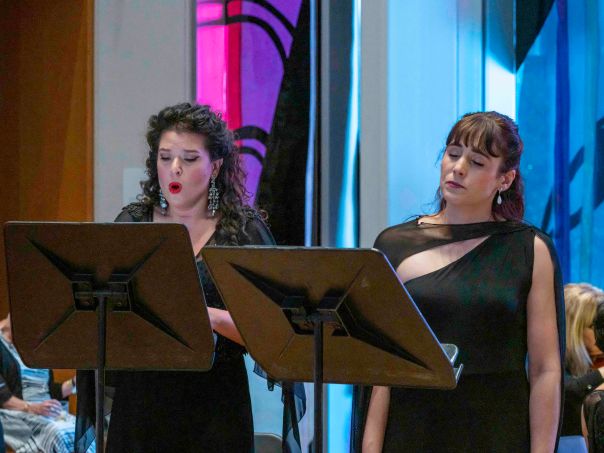
Of course, the Van Rhijn recording remains a great place to begin if you’re wishing to hear how Pergolesi’s Stabat Mater actually sounded at its premiere in Naples. Yet it didn’t take long for the first all-female version ever led by a woman in Charlotte – and the first Symphony concert we’ve heard at The Mint – to impress. Pergolesi divided the twenty-stanza text into 12 compositions, and the opening “Stabat Mater dolorosa” duet is by far the most beloved. While the orchestral intro was engaging enough, though recordings with an organ yield more heft, the blending of Martinucci’s voice with Lovelace’s was sublime.

The first five sections of Pergolesi’s Stabat Mater fully demonstrate the composer’s strengths in solo and duet writing, his lithe capacity for transitioning back and forth between those modes, and his perverse disregard for the stanza couplings of the text’s rhyme scheme. After hearing Lovelace and Martinucci, I sampled Van Rhijn’s recording, then a starry version with Anna Netrebko and Magdelena Kožená, and finally ancient music specialist Christopher Hogwood’s prestigious recording with Emma Kirkby and James Bowman. My admiration only grew for both Lovelace and Martinucci’s approach to the music. Less vibrato and ornamentation seemed more in keeping with the sacred music and the solemn occasion.

Martinucci was the more unique find overall because of the creamy richness of her sound, though Lovelace sang equally well and matched her purity. Not long after Martinucci’s luscious and revelatory “Quae moerebat et dolebat,” Lovelace’s most affecting solo was the “Vidi suum dulcem natum,” two sections later. Between them came Pergolesi’s fifth section, “Quis est homo qui non fleret,” perhaps the apex of the concert. Lovelace launched into this section at some length, so it briefly seemed like this was a solo and Martinucci had neglected to take her seat. But Martinucci had an equally gorgeous solo afterwards and Lovelace didn’t return to her seat, either. We would be ascending heavenwards once more when the two voices soon intertwined.

The tone of the special occasion was nicely prefaced with words from OpCarolina general director Shanté Williams and Profit Insight senior advisor Duncan MacNichol, who a tolled a bell for each of the four planes that crashed in 2001 when the Twin Towers fell. The only discernible shortcoming at the Mint Museum was the lack of supertitles keeping track of where we were in the text. Though Lovelace was often difficult to follow, Martinucci usually lost me. Better to luxuriate in her voice than to decode her Latin.

Laugh Your Butt Off at “Meet & Greet”

Review: Meet and Greet at The VAPA Center

By Perry Tannenbaum

Auditions are a kind of interview, and interviews are a kind of audition. You enter, drop a résumé on somebody’s desk, and minutes or hours later, you exit elated or deflated. Instant drama. Singularly human. A paradigm of life.

At the VAPA Center, auditions and interviews are the entire evening for three weekends in Meet & Greet, a themed set of three one-act comedies produced by Charlotte’s Off-Broadway in the COB Black Box. Yeah, from the outside looking in on aspirants and applicants who have stressed for weeks preparing, strategizing, dressing, and grooming for the big moment or trial by ordeal, the denouement can be quite entertaining.

We can laugh our heads off at these overinvested humans and empathize at the same time. Imagining we were them or grateful that we are not.

Of course, there are perils for playwrights working within these familiar templates. Skirting predictability is the keenest, particularly if your audience has been exposed to sketch comedy over and over.

You can rest assured that each of the playwrights featured at VAPA contrives to make the familiar ritual different from what we expect, concealing at least one twist and surprise. Neither Susan Lambert Hatem’s Hamilton Audition nor Don Zolidis’s The Job Interview far exceeds the length of a typical TV sketch, so opinions will likely vary on whether they transcend the streaming standard.

Both of them have yummy roles for multiple players, so transcendence becomes less of a factor if you’re seeking comedy simply for escape in these dark days. The incontestable headliner of the evening is the finale, Meet & Greet by Stan Zimmerman and Christian McLaughlin – in terms of length, number of histrionic roles, and prestige. Zimmerman’s fame rests chiefly upon his extensive writing credits, most notably the beloved Gilmore Girls and The Golden Girls.

Meet & Greet clocks in at more than twice the length of most sitcom episodes. Between laughs or afterwards, you may catch yourself pondering why.

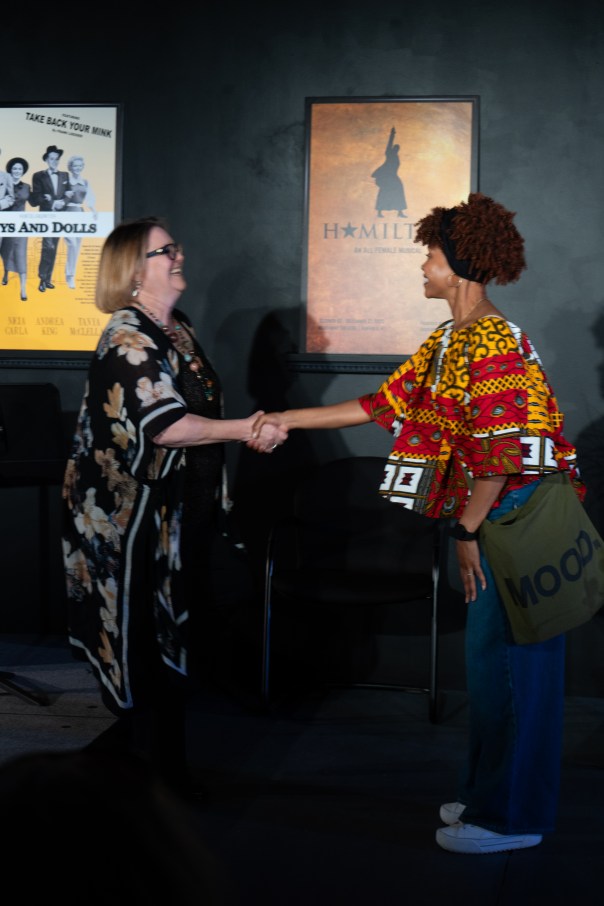
COB’s producing artistic director – and VAPA Center co-founder – Anne Lambert has her energetic hands all over this one-act hodgepodge, starring as The Director in her sister’s Hamilton Audition and (what else?) stage directing all that follows.

There may be an inside joke here. Do you really audition for the role of The Director in the play you have programmed by your sister at your own theatre? Do you think director Anna Montgomerie invited Lambert to play the role, or was the inviting done in the opposite… direction? Wouldn’t Lambert, not the shyest person on the Charlotte theatre scene, have leveraged some of her status – and experience – in determining how her character should be written and played?

We’ll never know, unless the saga of putting Hamilton Audition on its feet spawns another script. In the present instance, Lambert has invited the most prodigious voice in town to audition for the lead role in an all-female production of Hamilton, and the diva who has graciously consented is apparently the only person on the planet who has never heard of Lin-Manuel Miranda’s megahit.

More likely, people who come to see Hamilton Audition will not realize that Lambert was a co-founder of Chickspeare, which pioneered all-female productions of Shakespeare in the QC. It is not at all far-fetched to say that Lambert inspired the role she is playing as well as the play her sister has written. Posters on the rear wall touting fictional Chickspeare productions practically shout this in-joke out loud.

From appearances, you might conclude that Lambert is more out of her element directing a hip-hop musical than Nasha Shandri as Shondra Graves is auditioning for the role of Aaron Burr. Just you wait. Although she looks perfect for her dashing Founding Father role, Shondra gives a more atrocious hip-hop reading than you would dare to expect from The Director.

Comedy gold.

Amazingly, Shandri is supposed to be no less ignorant about rap than she is of Hamilton! Suddenly, the whole idea of a pioneering all-female version seems like a certain disaster… with fallout for females and minorities. It’s at this point that Graves and The Director probe the sexism that already lurks in the original gendered Hamilton. So yes, Hatem has put some meat on her hambone dialogue.

Whether or not Zolidis replicates that feat in The Job Interview is more open to question. The bio in the digital program, summoned by your QR code reader, states that Zolidis is one of the most prolific and produced playwrights in the world. Maybe the thuddingly generic blandness of this title explains why Zolidis was so previously unknown to me nonetheless.

Fortunately, his Job Interview playscript proves to be livelier and more imaginative. The basic premise, we will soon find, ensures that the sparks will fly. Both of the applicants waiting to be called into T.J.’s office, Chloe Shade as Marigold and Marla Brown as Emily, will be interviewed at the same time, adding the elements of confrontation and fierce female competition to the drama. For Emily, it’s already life-or-death.

If you’ve inferred that T.J. is eccentric and perhaps sadistic, you’re on the right track. Rahman Williams as T.J. doesn’t ask his applicants a scripted set of questions – or even the same questions. Deepening his aggression and moving us abruptly from interview to audition, he challenges Marigold and Emily to show him how they would handle specific on-the-job situations.

Not only might we say that the difficulty of the questions and roleplay challenges seems to be tipping the scales of fairness way off kilter, but we can also discern radical differences in the temperaments and preparedness of the two candidates. It would be impossible to find an aspect of Emily’s performance where she outscores her rival… aside from how desperately she needs this.

Now anybody interviewing for a job knows that he or she is already facing steep odds, but knowing that you’re outclassed during the interview is a special torture, one that permits Brown to go totally nuclear as Emily. On the other hand, Shade can play with the absurd and ballooning insult that Marigold, in all her perfection, is obliged to keep competing with this loser – and that the outcome still lies in the hands of this outrageous interviewer.

Rahman, in the meantime, gets to play with the disconnect between T.J.’s spit-and-polish military background and his high-level position at Build-a-Bear Toys. Three tasty roles, all well-done. During the run, Nicole Cunningham shares Shade’s chores.

Contrary to what you may be thinking while it plays out, Zimmerman & McLaughlin have aptly named their Meet & Greet. Take it in the same way that the four auditioning actresses do and ride the rollercoaster. To make it all tastier, two of the four have a history together, co-starring long ago during better days on a hit sitcom, Lane Morris as the embittered psycho Belinda and Stephanie DiPaolo as the bimbo Teri.

For my generation, I was thinking Joyce DeWitt and Suzanne Sommers from Three’s Company, but you might hear different echoes. Teri is the airhead who tends to spoil everything, or she is deeply misunderstood and cruelly typecast. Bubbling and pouting seem to be her main forms of expression. Also in the room before Teri’s majestic entrance is Marsha Perry as Desiree White, with some sort of acting experience as the star of the “Real Housekeepers of Palm Beach” reality show.

Contrasting nicely with Desiree and her leopard-skin bodysuit is Joanna Gerdy as the splendiferously monochromatic Margo Jane Mardsden, who has fallen from her regal perch as living Broadway legend due to a combo of drink and disgrace. Being among this gaggle, especially the déclassé Desiree, is already a devastating humiliation.

Yet as we can hear as they emerge from their auditions, both Desiree and Margo are spectacularly successful in their auditions for the role of Andrea, the leading lady of an upcoming series pilot. Leopard Skin draws uproarious laughter from the sanctum within before Diva Nun draws a thunderous ovation. Which one do the showrunners, producers, and writers inside actually prefer?

Every word that Tommy Prudenti utters as the Casting Assistant is a tantalizing clue to what the show and Angela will be, and there is a girlish coyness about him… and a deceptive servility. All through this epic catfight showdown, Zimmerman’s Golden Girls pedigree is on display in a blizzard of quips, taunts, and one-liners. We shall only divulge the maestro’s recipe for “sidewalk pizza” here: you jump out the window of a tall city building.

“Austen’s Pride” Also Captures Austen’s Heart – and Ours

Review: Austen’s Pride at Knight Theater

By Perry Tannenbaum

Depending on how well you adapt Jane Austen’s most beloved novel, Pride and Prejudice,the result on stage or screen can range from Hallmark saccharine to comedy grandeur. At their best, adaptations of recognized classics revel in their new media, rivaling Fiddler on the Roof onstage, High Society onscreen, or Mozart’s Marriage of Figaro at the opera house.

Results with P&P largely reflect how deeply a screenwriter or a playwright savors the perfections and delights of Austen’s narrative, dialogue, and wit… and how well he or she channels and tweaks the author’s temperament. What’s most daunting in 2025, more than two centuries after Pride and Prejudice was first published, is the sheer number of adaptations, good and bad, that already exist.

Back in the world of books, a welter of variants and sequels to Pride and Prejudice flourishes, from Austen copycats to audacious apostates who lavish fresh condiments, such as vampires and zombies, onto the original. Onstage and in musicals, the onslaught hasn’t been so fierce, but new acolytes have plenty of TV versions – around 25 – strewn onto their path to Broadway, which most recently had a musical based on the Austen classic, First Impressions, in 1959.

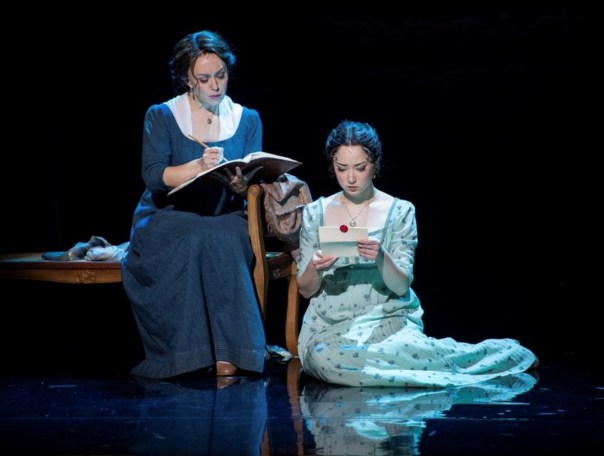
To their credit, Lindsay Warren Baker and Amanda Jacobs took a different path to retelling Pride and Prejudice in their new musical, AUSTEN’S PRIDE. Their visionary concept has Austen, prodded by her sister Cassandra, rewriting an earlier draft from years before, titled First Impressions, and turning it into her beloved chef d’oeuvre right before our eyes.

Recast into a theatrical idiom, with Austen’s characters also offering their input, the musical plays like the rehearsals and development of a new stage work. Austen, vivaciously played by Olivia Hernandez at the Knight Theater in Charlotte, becomes an active, sometimes hyperactive collaborator with characters onstage, like a director or a playwright with her players.

Since Baker & Jacobs have ordained that Austen herself evolves and develops during the process as much as the story itself, Austen supplants her sassy and superb Elizabeth Bennet as our protagonist. Or does she? Behind the scenes, director Igor Goldin decides how much time Hernandez spends onstage in close proximity with Delphi Borich as Elizabeth – and how often she will upstage her by reacting.

Hernandez gets a vast catalog of reactions to call upon: various smiles, gasps, and interactions with Austen’s manuscript, whether it’s jotting things down, feverishly crossing things out, or just pondering, hesitating, and deciding. It’s easy to become captivated with Hernandez’s full repertoire – and to welcome reprises of her greatest hits – but, churlish as it might be to say it, Goldin should be holding her back more than he is.

If you happen to love Austen’s masterwork, Hernandez’s presence infuses her creators’ concept with surprising magic. Example: as she stalked the big proposal scene in Act 1, where Darcy and Elizabeth approach each other from opposite wings, I found myself sobbing before their impassioned dialogue even began. Somebody on the Knight Theater stage seemed to be sharing my reverence for what was about to happen.

While Hernandez becomes a wee bit repetitious, we could definitely benefit from seeing a more fine-grained development of Borich’s evolution as Elizabeth from wit to wisdom. That would push back a little on Baker & Jacobs’ intentions, true enough, but it would also narrow the gap between the ceilings they have placed on Borich’s and Hernandez’s performances. Fine as Borich is in navigating Elizabeth’s misperceptions and epiphanies, Hernandez is diva class, exactly right for a midlife Austen seeing herself as a brilliant young Elizabeth in her rearview mirror, more beguiling but less mature.

Without pedantry, Elizabeth is teaching Austen while the author does the hard work: crafting Elizabeth and her world. Austen’s yearnings, worries, and epiphanies all get more urgency from Baker & Jacobs and more power from Hernadez’s glorious larynx. Her best notes pierce our hearts more than our ears.

Some of Pride’s impact derives directly from Austen’s text: the language of Elizabeth’s letters, the dialogue of Mr. Darcy’s first and second marriage proposals, and the most memorable snippets from Mom and Dad. But some of the deftness that Baker & Jacobs bring to the task of distilling the triple plot of P&P for the stage is discernible in the music they make together.

They bring out Kevyn Morrow as Mr. Bennet more than we expect in a musical with “Silly Girls,” a conspicuously Tevye-the-Dairyman moment, and they give Dan Hoy extended play as Fitzwilliam Darcy at precisely the right moments. Hoy not only finds the nuances of the nobleman’s arrogance and humanity with admirable exactitude, he reminds us that this role – and that of Heathcliffe – were deemed by Hollywood to be the rightful property of Laurence Olivier.

Yet there are elements of Austen’s Pride that are laudably free of pretension, leaning away from Broadway glitz toward chamber-music decorum and perfection. The pit band at this Knight Theatre production numbers only nine players, including music director Kerianne Brennan at one of the keyboards.

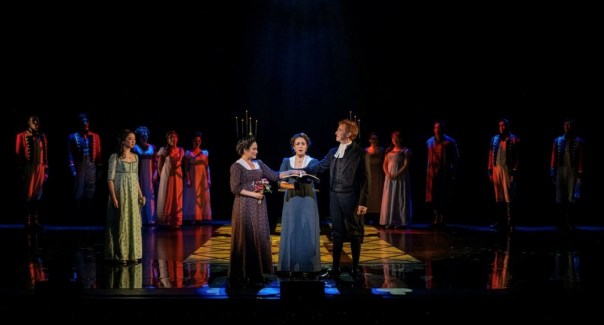
Scenery by Josh Zangen is equally elegant and spare. Windows in Austen’s study, accented simply with glowing potted flowers, fly upwards when we transition to her novel-in-progress. When we need to conjure up the splendor of Bingley’s Netherfield estate, a chandelier drops down to simulate his glittery ballroom.

Emily Rebholz not only makes Darcy and the dudes manly with her costume designs, she also distinguishes beautifully between the decorous Bennet sisters and the more matronly/professional Austens. When Kate Fahey, as the frivolous and flirtatious Lydia Bennet, attempts to tempt Darcy’s longtime acquaintance, dashing militiaman George Wickham, only four more redcoats need to be sewn to conjure up his regiment for “I Can’t Resist a Redcoat.”

The frilliest Rebholz creations are reserved for Austen’s most high-strung women, Elizabeth’s irrepressibly vulgar and mercenary mom and Lady Catherine de Bough, Mr. Darcy’s imperious aunt. Sally Wilfert makes a hearty meal of both of these delicious witches, as marmoreal and severe as Lady C as she is fidgety and flighty as Mrs. B., singing “My Poor Nerves” in her dopier chores.

Three other players fend off idleness by playing multiple roles, helping Rebholz to put further limits on her fittings. When not overshadowed by Lydia as her sister Kitty, Cali Noack transforms into Georgiana, Darcy’s younger sib. After shining as the hilariously awkward and pretentious Mr. Collins – whose marriage proposal to Lizzy must be declined without laughing in his clergyman’s face – Paul Castree radiates the dignity and urbanity of Mr. Gardiner.

Before strutting beside Castree as the decorous Mrs. Gardiner, Sarah Ellis has a couple of more provocative turns, first as Mary Bennet, the most bookish and moralizing of Lizzy’s sisters, and then as Caroline Bingley, notable for her three “My Dearest Jane” cameos to Elizabeth’s long-suffering elder sister – and the eye-popping color of that dress.

Jane isn’t the easiest or plumiest role to play, asking Addie Morales to be both modestly discreet and passionately adoring when Charles Bingley pays her his attentions. Morales tips the balance between these two postures so obviously that her amorousness can no doubt be seen from the balcony. While that does compromise the quality of Darcy’s perceptions on behalf of his friend, Cole Thompson endows Bingley with such wholesome and abundant cluelessness – and such lanky Ichabod Crane ungainliness – that their comedy works nicely.

Although the role is not included on the cast list or the who’s-who bios, Dianica Phelan gives us a fine, albeit brief, portrayal of the pragmatic Charlotte Lucas, who accepts her friend Lizzy’s discard, Mr. Collins, for her husband. Mostly, Phelan portrays Austen’s sister Cassandra. So after joining with Hernandez in “Choices,” the opening duet concerned with how to exhume First Impressions and follow up on the success of Sense and Sensibility, she’s there on two fronts to consider women’s choices in Austen’s life and in her signature novel.

The feminist tang so easy to overlook in Austen’s work gracefully surfaces as these circumscribed choices are doubly aired. While Charlotte and Elizabeth are discussing the merits of marrying for love against marrying for security, their author and her sister, Cassandra, are debating the matter with a little more heat and real-life experience.

That’s one of the reasons Austen’s Pride delivers extra boosts of relevance and drama in Baker & Jacobs’ adaptation, along with its tuneful novelty. This fresh take on Pride and Prejudice, deftly balancing comedy and romance, is ready for primetime and its Broadway aspirations, with room left over for further developing its scenic dimensions and tech adornments.

Xuefei Yang Thrusts Herself Into the Classical Vanguard

Review: Xuefei Yang at The Parr Center

By Perry Tannenbaum

It wasn’t until my third time around with the Shuman Public Relations press release that it hit me. A national solo tour by any classical guitarist – let alone a Chinese female guitarist – is a rather unique event. No other pre-publicity had registered on my radar, so my curiosity was doubly piqued. To my eagerness to determine whether Xuefei Yang would live up to the hype was added fresh worries.

What kind of audience do we have in Charlotte, NC, for classical guitar? Would people be able to find the Parr Center, the two-year-old venue that had only been used once before for classical music – by Opera Carolina over 18 months ago?

Timed to coincide with the release of her new Chapeau Satie album – itself chiming with the centennial of Erik Satie’s death – the Yang tour isn’t running on fumes. Yang is one of the first artists to be signed onto Apple’s Platoon label, another encouraging sign alongside lossless music files that Apple Music is committed to classical. Enough Yang videos are on YouTube to suggest that she is quite savvy about marketing.

Her Parr concert quickly dispelled my fears of an empty house. Because of Yang’s impressive technique, her winsome rapport with the audience, and her wide-ranging repertoire, the evening was a buoyant mix of retro intimacy and decorum counterbalanced by an open-armed diversity and eclecticism: classical, jazz, tango, and Tin Pan Alley. Gleaned from four continents.

Aside from the finely calibrated sound, the deep Apple pockets behind Yang’s tour were out of sight. No printed programs were handed out at the entrance, and no QR codes lurked in the house. No poster-sized signage for selfies loomed in the lobby, and no merch was on sale. The prerecorded announcement introducing the guitarist was as slick and primetime as Yang’s best videos, yet efficiently brief.

With nobody else onstage to greet her, Yang walked in from the wings, acknowledged the enthusiasm of what turned out to be a good-sized audience, sat herself down on an adjustable piano bench, and positioned herself – and a rather fluffy red skirt – on her foot rest. Though the applause was robust, there were no jumpers, no double-time clappers, and no whoopers in the crowd to indicate the presence of rabid fans.

Six minutes later, things would be different. Yang opened fire with Isaac Albeniz’s Asturias (Leyenda), a piece that you never forget once you’ve heard it. Nor do you have to see it being played to appreciate its rapidly compounding difficulties. It begins with a flamenco-styled bassline, layers on a trilling treble, and peaks with repeated strums stomping as the third layer – the fiercer, the better – as the bass and treble keep going, seemingly uninterrupted.

Or at least the flow sounds steady, undeflected by the ferocity, in the John Williams recording of 1974, which made me fall in love with the piece. Gradually, the sublimity of the slow middle section etches itself into memory after repeated hearings, the more so as you appreciate how perfectly it circles back to the opening bassline, trills, and strums.

At the Parr Center, Yang played better than she had in either of her 2022 studio recordings, first on the Decca label and then on a rushed and misjudged retake on Warner. She set the land speed record for the Asturias on Warner but surrendered her grasp of the argument. Now she was just a tad slower than Williams in the bravura sections, still in a thrilling groove, and only marginally swifter in the malagueña middle, her lucidity abounding and connecting both sections, with sublime harmonics perfectly timed.

An audacious beginning, to be sure. Now there were whoops aplenty, a couple of them uncomfortably close to my ears. Yang stood up with a bigger smile, holding her beautiful guitar in her open hands in a way that surely plays well at the seven churches on the 15-city tour. But she didn’t begin speaking to us until she reset herself and swiveled a second microphone her way.

We had begun our four-continent journey in Spain, she told us, and would continue to Paris with a couple of pieces from the new album. Again, these were transcriptions of pieces originally composed for piano that showed two sides of Satie, the spare and contemplative Gnossienne No. 3 and the unexpectedly frisky “La Diva de l’Empire.” Prepare for a cakewalk, Yang told us.

Of course, the cakewalk was the more adventurous Satie setting, especially since Yang is contriving on tour to replace vocalist Héloïse Werner, who sings with her on the recorded track. She soloed with a beautiful lilt, especially jaunty and supple where she was replacing Werner’s vocal.

Onward to Asia, where we were given a Japanese treat, an excerpt from Ryuichi Sakamoto’s Merry Christmas, Mr. Lawrence film score, my first gratifying discovery of the evening. You can actually check out the final track on Yang’s 2023 X Culture release and see how her version improves upon the composer’s soundtrack album – sadder, moodier, and poignant. To my ears, the Parr Center performance was even better, adding dimensions of foreboding as the tempo quickened, heartbreak and disillusion as the performance climaxed, crowned by a beautifully delicate coda.

Those in the audience who knew Sakamoto’s original could more fully appreciate the extras that Yang had imaginatively lavished upon it. For me, Yang’s excellence as a composer did not become apparent until she unveiled her own Xinjiang Fantasy. The tempo changes and the trilling treble might tell us of Yang’s desire for more pieces like Asturias in the repertoire – and perhaps more room for improvisation. Compared to the version she recorded on the same Decca album where her Asturias first appeared, the Parr version was more thoughtful, contemplative, and impressionistic, all of the percussive embellishments banished.

Perhaps because of the scarcity of flights from China to South America, Yang stopped over in Mexico for a couple of pieces by Manuel Ponce before crossing the equator. “Scherzino Mexicano” was an adorable departure from the broodings that had preceded, and “Estrellita” was like a sentimental homecoming, played ardently with touches of the sublime and Yang’s bell-toned harmonics.

The rest of our stay in the New World was more casual, relaxed, and jazzy. Astor Piazzolla chipped in one of his multitudinous tangos, “La muerte del ángel,” and Luiz Bonfá welcomed us to Brazil with his famed “Manhã de Carnaval” from Black Orpheus. We lingered in Brazil, in bossa nova, and in Black Orpheus with Antônio Carlos Jobim’s “A felicidade” before arriving at last in the USA.

So you can’t name a single piece written in America for classical guitar, right? Yang to the rescue with three superb transcriptions of tunes by Erroll Garner, Jerome Kern, and Billy Strayhorn. Garner’s “Misty” was the most innovative of the three, most adventurous in its bravura variations on the midsection (or bridge) of the familiar melody. Strayhorn’s “Take the A Train” was probably the most popular selection of the evening, delivering Duke Ellington’s familiar keyboard intro transposed to guitar, along with some of the familiar big band riffs. Nor did “Smoke Gets in Your Eyes” disappoint.

These American arrangements may indicate a new direction for Yang in upcoming releases, since there are no studio parallels to be found on Spotify or Apple Music. It’s tempting to think that Yang is also at the vanguard of a new wave of national tours by solo classical artists. That Apple and its new Apple Platoon label are at work preserving and recording classical music in higher fidelity and promoting live performance is as amazing as it is encouraging.

Watch for the Closing Door at CAST’s “Sunset Limited”

Review: The Sunset Limited at The Arts Factory

By Perry Tannenbaum

Would it rub you the wrong way to be solicited by a beggar selling candies outside your favorite theater? What if we add a tramp handing you your tickets, then a drunk, a druggie, a streetwalker, and a guy hawking fake Rolexes for six bucks lining the path to your seats? Welcome to experiential theatre at the Arts Factory on West Trade, where Cormac McCarthy’s THE SUNSET LIMITED is rounding the bend into its second weekend.

Or if you’re already fondly familiar with how Carolina Actors Studio Theatre means to do things, welcome back to the good old days.

CAST artistic director Michael Simmons doesn’t merely content himself with just these genial Skid Row stereotypes. No, no, no, for then your experience would normalize as soon you entered the theater.

Not so fast, for Simmons’ rather fiendish set design has at least six walls. After you enter the theater doorway, you need to wind around a cruddy corridor to reach another doorway that leads into the shithole apartment where McCarthy’s action takes place. This is absolute brilliance from Simmons, since the seediness of our host’s life helps to balance the to-be-or-not-to-be debates to come.

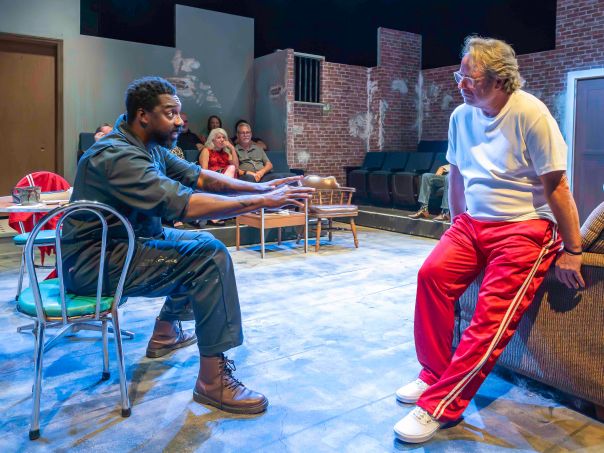
This point gets double-underlined when our host, a hulking Black ex-con, triple locks his front door behind his reluctant – and relatively puny – white guest. Subtly, something may click instinctively in us as we hear the clank of the locks. We are locked in this space for the duration of this debate, and the longer we linger, the more forceful White’s arguments become that Black’s life is cramped, sordid, and futile. We’ve gotten a taste.

It’s director Dee Abdullah who layers this emphatic entrance for Zach Humphrey onto the script, a nice touch. McCarthy also tips the balance of the debate in this harrowing direction, for Thom Tonetti as White is armed with more age, experience, education, wealth, and endowed with a professorial intellect.

In a jumpsuit designed by Abdullah, Humphrey appears to have more keys and tools dangling from him than locks on his doors – as if he’s a janitor or a subway worker. That’s where Humphrey saved Tonetti from jumping in the path of an oncoming train, catching him and carrying him home.

If Tonetti stays too long, his rescue becomes a kidnapping, and Humphrey seems to understand there’s a time limit on how long he can hold his suicidal guest against his will. His main intellectual artillery is the Holy Bible, bolstered by his faith, which he frequently brandishes if he’s not thumbing through it. Trying to preach this book to the local drunks, derelicts, and druggies hasn’t yielded any positive results – and he’s been at it long enough that The Greatest Book Ever Written engraving has worn off its cover.

Without a doubt, Humphrey has the more urgent, desperate, and anguished role, especially when Tonetti rubs his nose in his past and present failures – and the squalor surrounding them both. At his most fragile moments, we see Humphrey processing the devastating irony that he has admirably served his time, licked his wounds, and freed himself from one prison only to lock himself in another.

(McCarthy called his players Black and White in his 2006 script, subtitled “A Novel in Dramatic Form,” but those names are absent from the actual dialogue and the CAST playbill.)

One of the reasons we manage to like Humphrey more is his ability to admit, no offense to Jesus or Scripture, that he is intellectually overmatched. Teaching should trump preaching since it’s fortified with facts and knowledge. Won’t it simply hurt horribly when the Sunset Limited rams into him? No, Tonetti calmly responds, at 70mph, the train would outspeed his neurons.

If we press the pause button here, we can scrutinize a telling moment, for Tonetti – (and maybe McCarthy) has miscalculated. Trains don’t ever speed past train platforms at 70mph, needing to decelerate and accelerate before they’re gone. And if McCarthy had only had the luxury of a Google Hub a couple of decades ago, he could have ascertained that the max speed for MTA subway cars is 55mph.

So Tonetti has an extra psychological advantage: when he starts spouting facts – real, imagined, or fabricated – Humphrey will not contradict him. Yes, he does have all the time in the world to throw himself in front of the Sunset Limited, so he can remain calm and keep his cards close to the vest. If he maintains his resolve, whether combatively or cordially, he will prevail. He even realizes that he can spare the time for a cup coffee of and a bite to eat.

Heightened emotions from Tonetti spill out when he is most tellingly challenged and when he swerves to the counterattack. We may be hoping that Humphrey goads him sufficiently to spew out all the venom, hatred, resentment, and bitterness that lurks inside him, resulting in some sort of cleansing purgation. Or exorcism, since a dilapidated bible is ready-to-hand.

As it turns out, Tonetti has had too little connection with other humans for oceans of accumulated bile to come cascading out of him. Maybe he’s only metaphorically a professor! There is an enervated numbness to Tonetti that makes his sudden outbursts all the mightier.

It’s all a conspiracy, for we must factor in how Simmons has configured his black box into a thrust staging. The thrust of the compacted performance space, extending from Humphrey’s kitchen to his triple-locked door, implicates us all as it heightens our involvement.

When telling his gory prison tale of intense violence and grim survival, he was looking straight at Tonetti… and me right behind his left shoulder! And when I viewed both men sitting close to me in profile, I couldn’t help glimpsing how audience members in two other sections were reacting.

Yeah, it’s intense but sometimes a little comical. Face it, since the days of Socrates and Plato, any philosophical or existential dialogue will have its circular, tedious, or repetitive patches. You’ll be seeing smiles from other people across the way, some deeply pondering expressions, and the occasional blank wearied stare.

For me, that added to the experiential realism of my evening and enhanced my involvement.