Monthly Archives: July 2023

Walls and Borders Lurk Invisibly in “how to make an American Son”

Review: how to make an American Son at Barber Theatre

By Perry Tannenbaum
Beyond the first two capital letters ever used by playwright christopher oscar peña in any of his titles, peña injects a joke or two into his newest, how to make an American Son. Within a few minutes, we learn that Mando, the father of the title character, Orlando, doesn’t have the slightest interest in parenting. Mentoring or shaping Orlando as he journeys from childhood to adulthood seem to have been forgotten, replaced by a compulsion to provide him with the best that money can buy.

And then by setting limits on what the kid buys on Dad’s credit. Not so easy when you haven’t been concerned with parenting or tough love for the past 16 years.

We also learn that Mando, the founder/CEO of a successful janitorial firm, is a Honduran immigrant and his son was born in the US. So Orlando is an American! In the crudest sense, the fabrication of our young antihero was successfully consummated in dimly-lit intimacy.

Clearly, peña is working with a more nuanced definition of what an American truly is, pursuing a more nuanced answer on how one is made. Orlando is gay, piling fresh levels of challenge and difficulty on his quest to reach a feeling of belonging while making that quest more widely relatable to any member of a family with someone who has come out. Mom and Dad, to their credit, have accepted their son’s sexuality, though Mom (never seen) prefers that Orlando date Latinos.
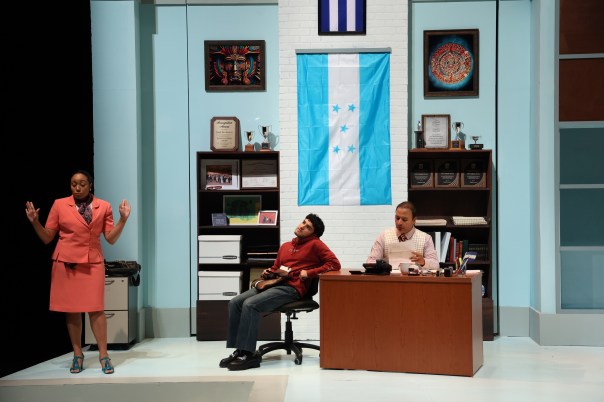
Whether or not he has been bolstered by his parents’ liberal leanings, Orlando is fairly strong-willed. Yet he also has that second-generation softness of suburban children who take their money and privilege for granted, never needing to stoop or get down on his knees to clean a toilet at home or at work. We get different perspectives as new characters take us from Mando’s office to Orlando’s elite school, the interior of a schoolmate’s car, and the lobby of Mando’s most valuable client.

Toss in a careful, diligently hard-working immigrant, who reflects Mando’s work ethic more faithfully than his son, and you can see why peña’s piece appeals so strongly to Common Thread Theatre Collective. Formed last summer by theatre faculty at Davidson College and North Carolina A&T University, the nation’s largest HBCU, Common Thread pushes back against the top-down power dynamic of most professional companies. The Collective seeks to include rather than exclude perspectives of women, LGBTQ+ artists, and artists of color while highlighting today’s most critical issues.

At Barber Theatre, on Davidson’s liberal arts college campus, it’s safe to say that immigration, class divisions, and homophobia fit the bill. White folks aren’t banned from this conversation, but they comprise only one-third of peña’s cast and get an even smaller cut of the stage time. There’s a breezy lightheartedness at the core of Mando’s attempts to check Orlando’s extravagances – a new leather bag for school, tickets to a Madonna concert, and an impulse purchase of Rage Against the Machine tickets to impress the white schoolmate he’s hoping to date.
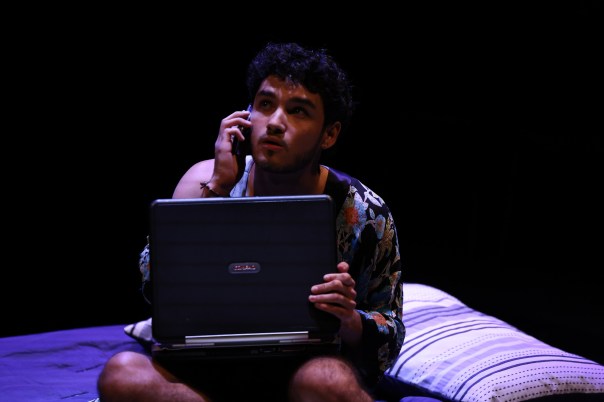
Comedy lurks in the details because Orlando can run circles around his dad with his tech savvy while he remains so self-centered and immature. A native Honduran who has assimilated more thoroughly than Mando, Rigo Nova brings a streetwise authenticity to this gruff businessman even though has chosen a more urbane path for himself. He makes Mando a juicy target for his son’s slights and barbs, only adding more to the impact of his own thrusts with his scarcely filtered vulgarity.

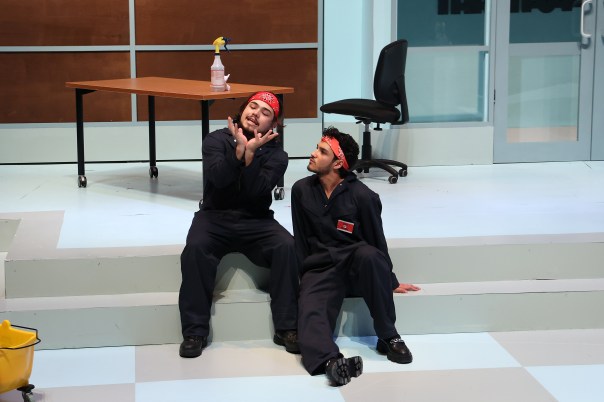
Directing this play in her Metrolina debut, Holly Nañes calls for a nicely calibrated mix of shock, resentment, curiosity, and cool from Nicolas Zuluaga as Orlando when his dad finally sheds his customary benevolence and test-drives the idea of punishment. There are no onsets of diligence, penitence, or heightened seriousness in Zuluaga’s demeanor as he dons a janitorial uniform for the first time in his life. Nor is there any childish pouting or seething resentment as he’s paired up with Rafael, the lowly immigrant.

That breeziness while playing with fire sometimes reminded me of Athol Fugard’s Master Harold in his insouciant superiority; at other times, when seducing Rafael, Curley’s wife from John Steinbeck’s Of Mice and Men came to mind – an undertow of foreboding as Orlando’s differences with Rafael mirror those he has with his dad. Zuluaga’s almost slothful dominance is nicely complemented by Richard Calderon’s wary and subdued debut as Rafael. He isn’t busting his butt either as he engages Orlando, but he’s working rather than slacking. We can see what Rafael has been through and that he knows the drill.

Striving to get over on Sean, the school jock and Rage Against fanatic, Orlando instinctively drops his cool superiority. We surely see that Logan Pavia as Sean is playing him, ruthlessly confident that he can get what he wants. Maybe Pavia’s audacity shocks you anyhow. The same sort of flipflop happens when Mando shows up Dick’s office, hoping his most-valued client will renew his contract.

We don’t see Rob Addison as Dick until late in the action, and it might have helped a little if we’d gotten to know the white plutocrat better. For this is Addison’s only scene, arguably the most explosive scene of the night as two generations of whites and Hispanics square off. A second blowup afterwards, registering somewhat less on the Richter scale, happens when Mando peeps in on his son and Rafael at precisely the wrong moment.

Stacy Fernandez as Mercedes, newly promoted to become Mando’s general manager, doesn’t witness either of these blowups – or Orlando’s humiliation in Sean’s car. That’s a double humiliation for Orlando because his dad has paused his promise to buy him a car. Without these contexts, Mercedes has a radically different perspective on how to make an American son than the one taking shape for Orlando and his dad. Fernandez gets the opportunity to express this bitter viewpoint in a blowup of her own, and she does not misfire – what she sees, we must acknowledge, is no less valid than what the men see.

Slick and antiseptic, Harlan D. Penn’s glassy set design thoroughly purges Mando’s office of any color, artifact, or furniture that might be regarded as ethnic. Even the bookcases are vacuously neutral, populated with trophies, plaques, correspondence, business records, and binders. As the script swiftly underscores, no books. One shelf is entirely devoted to cleaning liquids, always at the ready in case a fingerprint sprouts up on a glass window or a door.

We may yearn occasionally for less polished flooring to separate us from Mando’s desk and the full-size Honduran flag that hangs vertically behind him. The frequently mopped surfaces evoke a sterile lab or an ER lobby where dirt comes to die. Or with that flag perennially in the distance, we might view that empty space as the desert that Latinx immigrants have crossed to get here. Or the spanking clean desert they found when they arrived.

Peppered with a contemptuous sneer, what Mercedes would tell you in answer to peña’s prompt is that both father and son have effortlessly become Americans without even trying. The answer Mando and Orlando would give you is grimmer than that.

By the end of the evening, thanks to peña’s deft plotting, there are battle scars supporting both points of view. The Donald’s wall across our southern border is the worst by far, but peña methodically shows us that it isn’t the only one.

ILA Summer Fest Overachieves With Semi-Staged “Tales of Hoffmann”

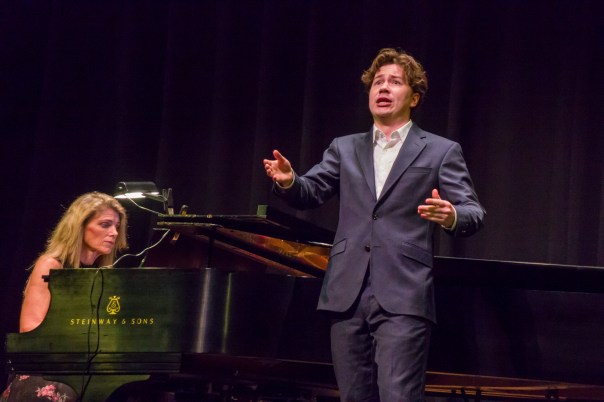
Review: The Tales of Hoffmann at the International Lyric Academy Festival

By Perry Tannenbaum

July 5, 2023, Charlotte, NC – Maybe Charlotte’s best-kept cultural secret ever, the 29th International Lyric Academy Summer Festival was officially announced by its partner, Opera Carolina, two days after it had actually begun! From as far away as Cape Town and Seoul, around 150 singers, teachers, accompanists, and conductors had converged on the Central Piedmont Community College to begin a transcontinental five-week program in the Queen City.

The Charlotte segment of this intensive training for young and emerging artists hopscotched from classrooms and rehearsal halls behind-the-scenes during ILA’s first week to CP’s grandest stage, the Dale F. Halton Theater, for the public performances marking the second week. Amid the hullabaloo, two of the College’s venues were discarded from the original festival announcement and poster art, Tate Recital Hall and the new Parr Center, adding to the impression of hurry, indecision, and feverish excitement during the ILA Festival’s opening nights.

Yet the performances I’ve seen have gone marvelously well, showcasing a wide-range of vocal talent and experience, affording us tantalizing glimpses of youngsters taking the stage for the first time and emerging artists well-poised to embark on professional careers. The opening holiday weekend featured two Florilegium concerts offering a potpourri of solo arias; a Mozart Marathon that provided arias from Don Giovanni, Cosi fan Tutte, The Magic, and generous foretastes of La Nozze di Figaro; and a sampling of opera scenes, often spotlighting multiple singers and occasionally venturing into the realm of Broadway musical theatre. Of course, as the middle week unfolded, we could look at the pocket-sized Festival Program and piece together where the singers who were performing in concert would fit into the lineups for the two opera productions that would highlight the final week of this Festival’s US premiere, a semi-staged The Tales of Hoffmann bookending a pair of fully-staged presentations of The Marriage of Figaro.

As the veil lifted from the quality of talent we would witness in the ILA Festival’s climactic week of opera productions, an aura of mystery still lingered over what the upcoming “semi-staged” Tales of Hoffmann might look like. Would it borrow the scenery from Figaro, which is taking over the Halton for the next two nights? Would there be any props, costumes, or furnishings onstage? Will the main singers be holding scripts for the dialogue or scores for the music? Reading stage productions by Charlotte’s theatre companies, I know very well, have taken many shapes over the years, sometimes as austere as actors dressed devoutly in black-and-white, delivering their lines behind music stands. Directors who stick to that format are heartless brutes in my eyes.

Opera lovers across the Metrolina area – and across the Carolinas – can rest assured that the ILA Summer Festival is for real, dispenses with scripts and scores, and delivers the goods. James Meena, Opera Carolina’s artistic director, has revealed that the process of advertising, taking applications, and auditioning for spots at the festival – in six different cities – began last July. However new the template was to Meena and the US, it has obviously proved tried-and-true in Rome, where ILA was founded, and in Vicenza where it resides today.

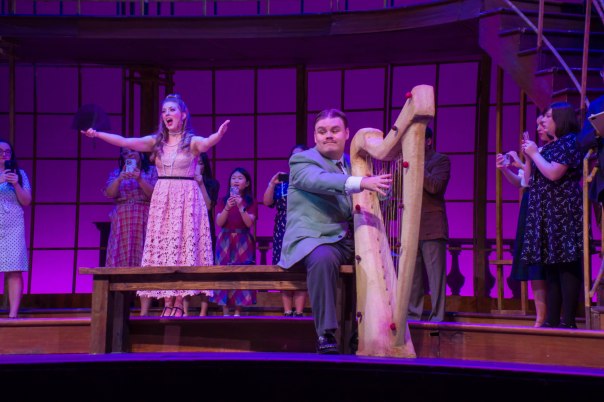
With Meena in the orchestra pit directing an ensemble of at least 20 musicians, and Peter Boon Koh stage directing a cast of 25 actors and choristers, the production looked very polished and not at all bare-boned. Koh deftly had most of the players in modern dress, many of them sporting cellphones in the crowd scenes in Acts 1 and 3. When Olympia winds down, soprano Amber Romero as the life-size automaton who enchants Hoffmann droops forward as usual, but instead of winding her back up with a conspicuous key, tenor Ethan Stinson as dollmaker Spallanzani simply waves a remote control at her while seated behind his garish cut-rate harp.

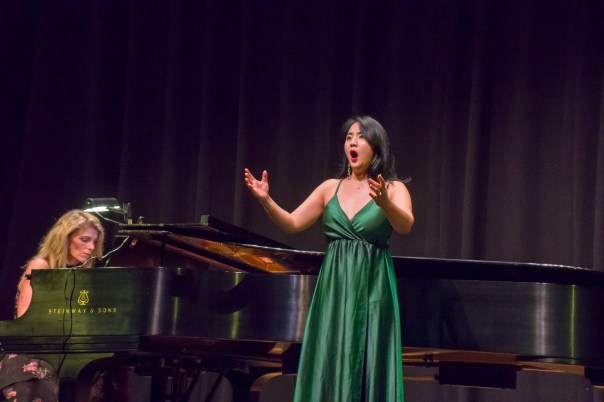
Meena and Koh have trimmed the opera, which runs between 130 and 140 minutes on recordings, to a sleek 90 minutes, cutting the Prologue and thus depriving South African tenor Luvo Maranti as Hoffmann of his most winsome aria, detailing the legend of Kleinzach, the hunchbacked court jester. We go straight into his misadventures with three iconic sopranos, Huiying Chen as the frail Antonia following Romero, and Ruijing Guo bringing ruination to Hoffmann as femme-fatale courtesan Giulietta. All of these voices exceeded expectations, but the most astonishing were Maranti, Romero, and baritone Zhenpang Zhang who slithered across the stage in three demonic roles as Hoffman’s perennial nemesis, mad scientist Coppelius, quack Doctor Miracle, and – most menacingly – the sorcerer Dappertutto.

The excellence did not stop there, for as Stinson was performing his comical exploits as the devious dollmaker, tenor Jonathan White was beginning his medley of comical turns as his servant Cochenille, culminating in his Act 2 showstopper as Frantz, the cruel and possessive Crespel’s blissfully deaf old servant. The skeletal scenery borrowed from Figaro has a winding staircase leading gracefully upwards to a balcony level, where the portrait of Antonia’s mother can come to life and the temptress Giulietta can begin her imperious and bewitching descent. Supertitles are shown on TV monitors flanking the stage, amply sized so your neck gets a good workout keeping up with the French.

With ticket prices topping out at $35, productions like this and the upcoming Figaro are as accessible as they are irresistible. The US festival concludes on Saturday night with the encore performance of the Offenbach after two consecutive nights of fully-staged Mozart at the same prices. For those who prefer the Broadway style, there’s a Saturday matinee, With a Song in My Heart, paying tribute to Richard Rodgers. Then ILA 29 takes flight to Vicenza, near Venice and Verona, for an additional two weeks of training and performances. Surely, Halton will be more crammed with young and old operagoers in years to come as the ILA Summer Festival continues to grow and word-of-mouth proclaims its high quality. Like Spoleto Festival USA, it’s another great coup for the Carolinas.

Charlotte Bach Fest Opens With Christmas-in-June Verve and Plenty of Brass

Review: Christmas Oratorio at Charlotte Bach Festival

By Perry Tannenbaum

June 10, 2023, Charlotte, NC – When Bach Akademie Charlotte artistic director Scott Allen Jarrett explains the oddity, it makes perfect sense. Nothing that Johann Sebastian Bach wrote is more perfectly suited for presentation at the Charlotte Bach Festival than his Christmas Oratorio, even though the Akademie’s festival is celebrated in June. Bach never intended this oratorio to be performed annually on just one occasion. No, each of the six parts of the Oratorio was to be performed on a different day of an extended Christmas celebration, extending to the Feast of Epiphany on January 6 and including New Year’s Day festivities on January 1, marking the Feast of the Circumcision and Naming of Jesus.
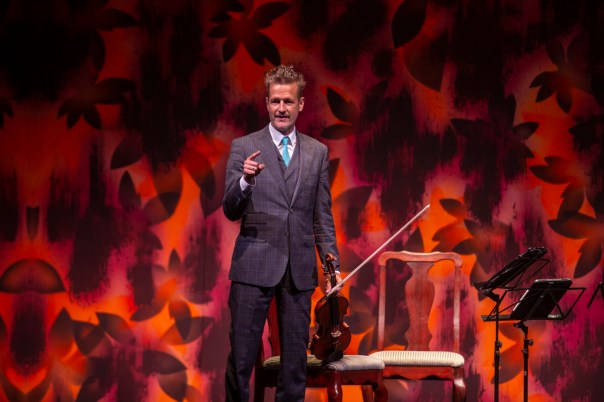
Similarly, Jarrett is dicing the six parts of the oratorio into four concerts, two evenings at Myers Park Presbyterian Church and two Bach Experience matinees at Myers Park United Methodist, spreading out Oratorio performances over a period of four days. Interspersed with these choral events, a harp recital at the Olde Mecklenburg Brewery, an Uptown organ recital at St. Peter’s Episcopal, and a vocal fellows recital give the five-day fest extra variety and reach.

Recordings of the complete Oratorio range in length from 2:15 to 2:45, and the timings listed in the wonderfully informative Festival Program Guide add up to 2:28, just below the median. If 148 minutes of music divvied into four concerts sounds like small portions, never fear. Each of the Oratorio concerts is fortified with at least one other Bach piece, and each concert is illuminated by a Jarrett intro or lecture, with demonstrations at the lunchtime Experiences. The opening concert at Myers Park Presbyterian began the cycle with Parts 1 and 2 of the Oratorio, “The Birth of Jesus” and “The Annunciation of the Shepherds.” These delights were followed after intermission by one of two Sanctus settings that will be presented at this year’s Festival, and a “Cantata for Christmas Day,” Christen, ätzet diesen Tag.

The opening Chorus of “The Birth,” with pounding timpani and three baroque trumpets triggering the ensemble’s proclamation of “this Day of Salvation,” brought back ancient memories. My first encounter with the Oratorio was in the late ‘80s when I borrowed it on a set of CDs from the Mecklenburg Public Library. There was a brilliant flash of familiarity moments after I pressed the play button, for I had previously dubbed a marvelous recording, by tenor/conductor Peter Schreier and soprano Edith Mathis, of two earlier Cantatas by Bach, BWV 213, and 214, both written to celebrate auspicious birthdays. It was the opening of the latter Cantata, written for the nobody less than the Queen of Poland, that leaped to mind as soon as the Christmas Oratorio began because the music and scoring are exactly the same. Only the text is changed. As Brett Kostrzewski’s program notes meticulously chronicle, both of the Cantatas on the Schreier recording (with the Berlin Chamber Orchestra) figure prominently in the first four parts of this Oratorio.
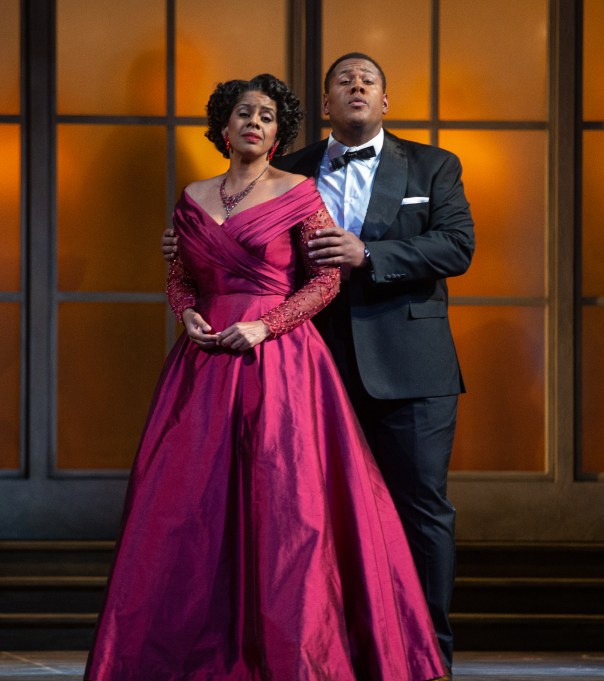
Looking up the recording on Spotify, you’ll find that the opening chorus of BWV 214 is by far the most popular track on the album, racking up more plays than the other eight sections of that Cantata combined. So Bach chose well, and the three baroque trumpets played live at Myers Park Presbyterian were far more thrilling than any recording can convey – and that’s before the éclat of the chorus layered on. When the 16 voices are trumpeting “this Day of Salvation,” they’re singing music that Bach previously set to “trumpets resound!” It was nothing short of thunder where I sat.

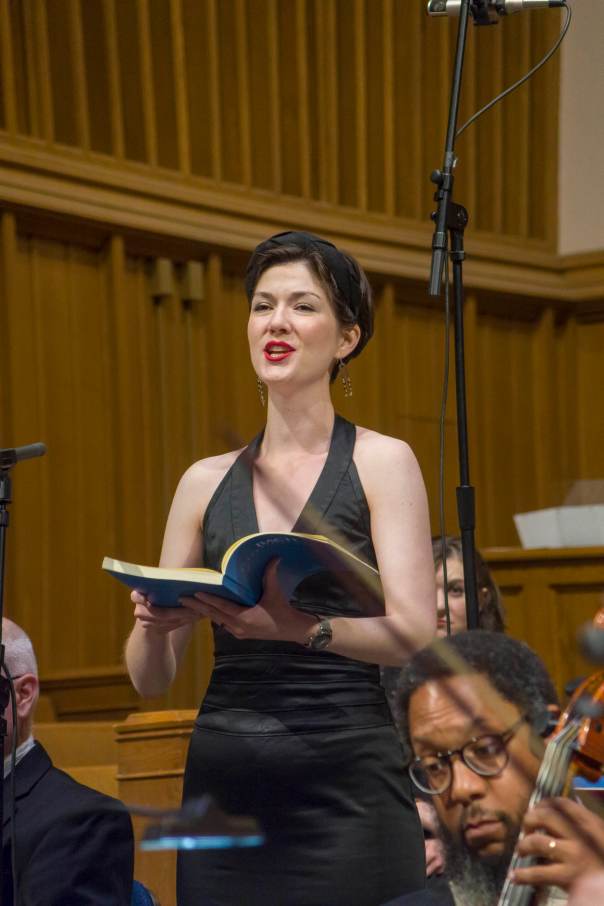
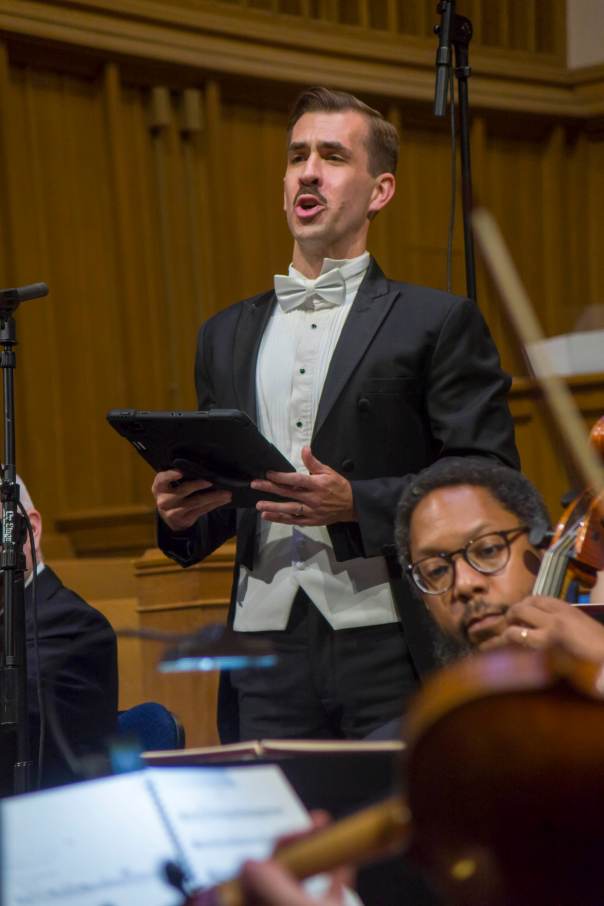
Tenor Gene Stenger was the Evangelist in both Parts 1 and 2, a warm and authoritative narrator. For anyone who hadn’t experienced the solo voices in the Bach Festival Chorus before, alto Sylvia Leith quickly established that they would be topnotch, with a creamy rendition of the “Prepare thyself, Zion” aria, preceded by a stirring recitative. Edmund Milly, singing the bass solos in the penultimate pair of movements before the concluding Chorale and the return of the trumpets, kindled and rekindled a dignified fire. There are full texts and translations in the Program Guide, so the German can be followed word by word and understood, but if you were simply satisfied with the translations, they were alertly – and legibly – projected on both sides of the stage for even more comfort amid the sonic excitement.

Though the trumpets temporarily retired, Part 2 was not at all anticlimactic, unfolding more gradually with a Sinfonia and another Evangelist pronouncement from Stenger before the onset of the full chorus. Stenger parleyed briefly with soprano Arwen Myers, portraying the Angel, who announced the birth of a savior, in the City of David, to the shepherds. Milly reappeared almost as much in Recitative as Stenger the Evangelist, with new voices taking on the Arias. “Happy shepherds” was a special treat as tenor Patrick Muehleise joined in a jocund duet with principal flutist Colin St-Martin.

After the intermission and the brief setting of the Sanctus (which has a very special place in the Jewish liturgy as well), we had to be impressed when Jarrett told us that Christen, ätzet diesen Tag was the only Bach piece he knew of that was scored for as many as four trumpets. Co-principals Josh Cohen and Perry Sutton, mainstays at Charlotte Bach since 2018 and 2019 respectively, were joined this year by Dillon Parker and a Charlotte Symphony recruit, principal trumpet Alex Wilborn, usually seen with a modern valved horn. Written a full 20 years before the Christmas Oratorio, the Cantata for Christmas Day showed off different colors and vocal configurations, and Jarrett chose vocal and instrumental soloists who hadn’t been featured before the break, adding to the freshness of the performance.

The heavy brass-and-drums artillery in the opening and closing sections of the earlier Cantata was as thumping as the bookends of the Christmas Day suite in Part 1of the Oratorio. Thank you, Jonathan Hess, for your verve on the timpani. No Evangelist or storyline appeared here, for this earlier Bach work was more prayerful and preachy in its celebration. Laura Atkinson sang the long alto recitative, stressing how the birth of Jesus is the fulfillment of Old Testament prophecy. After tenor Corey Shotwell extolled the newborn as a relief from the fear and sorrow that “poor Israel had been oppressed [with] unduly,” Atkinson joined him in a superb “Come and bring your prayers to heaven” duet.They were only slightly upstaged by the more leisurely paced duet that preceded them, “Lord how blest is thine ordaining,” the true centerpiece between the brassy bookends of the Cantata. Surely this was one of the highpoints of the evening. Principal oboist Margaret Owens shone in accompanying soprano MaryRuth Miller and bass Craig Juricka, ably embroidering the intervals between their vocals. The repose of this song beautifully combined the spirits of Christmas and thanksgiving.

Living Legends and Young Lionesses Featured in Spoleto Festival USA Jazz Lineup

Review: Brandee Younger, Henry Threadgill Zooid, Immanuel Wilkins Quartet, and Abdullah Ibrahim & Ekaya at Spoleto Festival USA

By Perry Tannenbaum

Respect for the elders in this year’s Spoleto Festival USA jazz lineup was gracefully counterbalanced by a hearty welcome to newer generations. It only felt fleetingly like the closing of the book on a previous era when South Africa’s iconic pianist-composer Abdullah Ibrahim returned to Charleston, one of the last – if not the very last – headliners booked for the canceled 2020 festival to make his belated post-pandemic appearance.

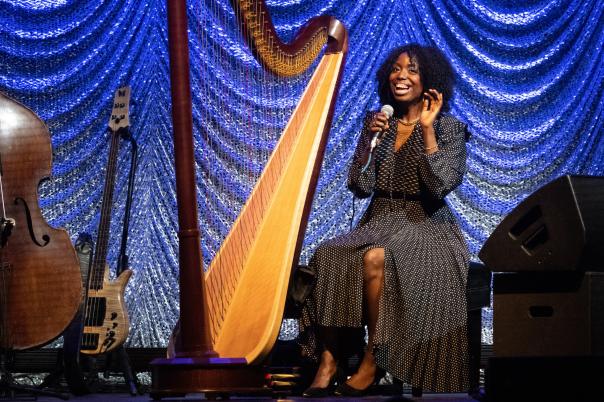
Henry Threadgill, the NEA Jazz Master and 2016 Pulitzer Prize winner for his In for a Penny, In for a Pound, was the other esteemed elder in the lineup, making his overdue debut at Spoleto. Festival jazz curator Larry Blumenfeld, who would have interviewed Ibrahim in 2020, had no difficulty shifting his Jazz Talks events – and venues – to Threadgill at the Riviera Theatre and harpist Brandee Younger at Queen Street Playhouse, two halls that had never been in play at Spoleto before.

Younger was announced as a substitution (for Courtney Bryan) just three weeks before Spoleto opened on May 26, adding to the luster of Blumenfeld’s agility – as a producer and as an interviewer. Other young lions and lionesses in the lineup included Charleston native Quentin Baxter, Kris Davis Diatom Ribbons, and the Immanuel Wilkins Quartet.

Ibrahim, absent from the festival for an epic 25 years, may have carved the largest arc of departure and return in Spoleto history, but others in the lineup had links with past festivals. Baxter appeared with Ranky Tanky in 2018 and as a concert host in other years, Diatom Ribbons included guitarist Julian Lage (2010) and NEA Master Terri Lyne Carrington (2019), and Younger was a gleaming feature of last year’s Universal Consciousness, Ravi Coltrane’s stunning tribute to his mom, Alice Coltrane.

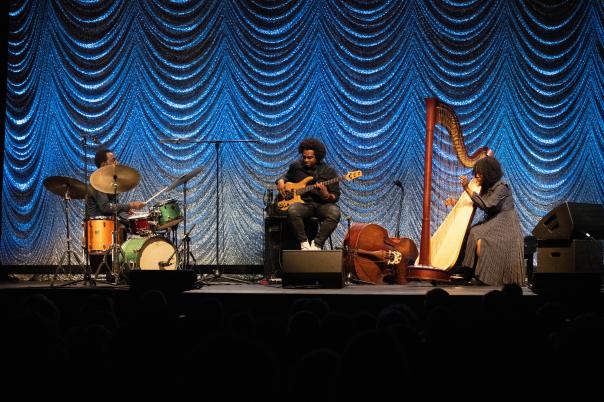
Rashaan Carter, Younger’s bassist, was also a holdover from Ravi’s tribute – and so, almost inevitably, were additional nods to Alice Coltrane in a well-chosen pair of compositions. The first of these, “Ghost Trane” from Coltrane’s Monastic Trio album of 1968, set a nifty precedent for the second nod to follow, “Turiya and Ramakrishna” from the imposing Ptah, The El Daoud release of 1970. Both were recorded by Coltrane on piano rather than behind her iconic harp, expelling any taint of imitation from Younger’s performances.

If you ever thought Alice couldn’t truly belong in a John Coltrane Quartet, or if you’ve thought of her strictly in terms of spirituality and ethereality, the original “Ghost Trane” track, with its groovy line and Coltrane’s finger-busting solo, will dispel your delusions. After an intro that subtly suggested the line to come, Younger made the lustrous, silky sound of her harp swing. Jumping off into her improvisations, riffing with wave after wave of invention, Younger almost dared anyone to say she is anything less than the McCoy Tyner of the harp. Yet it would be silly to pretend that any pianist could play as softly as Brandee did on her outro.

Nor would it be correct to imply that Younger allowed the sublimity of Alice Coltrane to be forgotten for long. “Love & Struggle” had a mixture of sublime Coltrane with a few flecks of soaring Carlos Santana fire, punctuated by a couple of fine Carter solos on acoustic bass. Fitfully, Younger’s harp can evoke the sound of a guitar or reverberate like a set of vibes – even within her harp timbre, she can veer away from the velvety, mesmerizing Coltrane idiom into the crisper sound Dorothy Ashby espoused.

“Unrest,” parts I and II, delivered without a pause, began with an extended meditative Younger solo before Allan Mednard, filling out the trio on drums, and Carter abruptly upshifted the tempo. Younger began comping chords behind her rhythm as Mednard steadily galloped until Carter briefly emerged as the dominant ingredient in the percolating stew, leaving space for Mednard to back away, restart, and take over with a palpitating solo. As in the previous piece, the drummer had the last word.

“Turiya and Ramakrishna” and “Spirit U Will” continued on this lofty plane. “Turiya” was the more exciting of the two because it revivified Coltrane’s piano version with virtuosic brio and it was the one title on this setlist that Younger hasn’t recorded. Taking us gracefully into a soft landing, Younger finished with two titles from her current Brand New Life release – a beautiful “If It’s Magic” solo that hushed the hall and a sweet trio version of “You’re a Girl for One Man Only” at a loping mid-tempo.

After Younger played Spoleto’s first jazz gig at the Queen Street, Threadgill turned a longtime theatre and dance venue, Sottile Theatre, back into a jazz hall for the first time since 2007, when Dino Saluzzi and Anja Lechner played there. Unluckily, Ibrahim was scheduled to reopen the Sottile to jazz in 2020, which would have been the largest jazz group to perform there since the Fred Hersch Ensemble, with Kurt Elling and Ralph Alessi, in 2004. Tyshawn Sorey put the classy old place into play at last year’s Spoleto in the capacity of a composer, when a concert of his classical works was performed at the Sottile in the wake of his jazz trio’s performance at TD Arena two nights earlier.

Acoustically, the idea worked well, as Threadgill and his oddly configured Zooid quintet played a set of six selections culled from releases stretching back to their This Brings Us To, Vol. 1 of 2009, plus a newborn to end the program. The lineup included, but did not overstress, Threadgill’s Pulitzer Prize winner, dipping more generously into his newer Poof outing with the group.

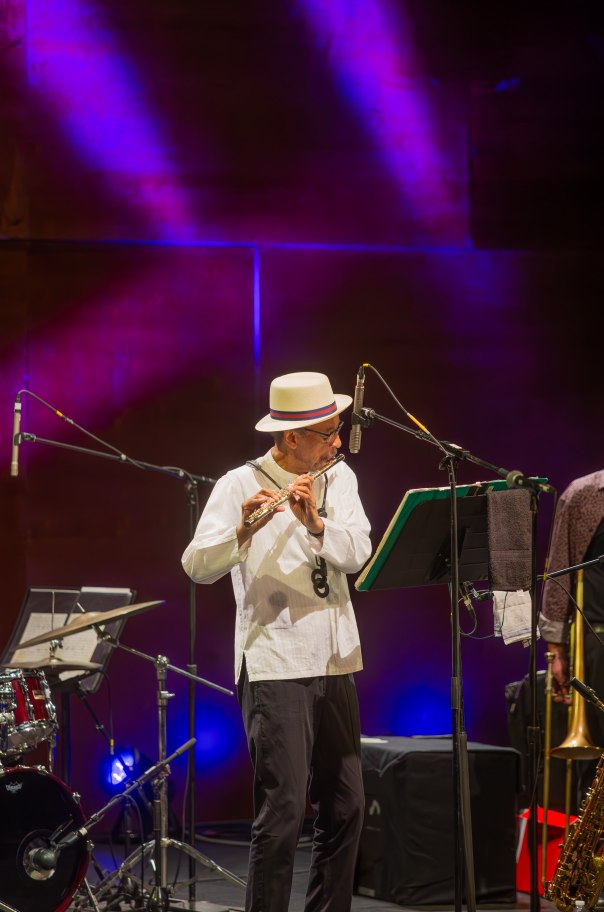
No matter how far the group hearkened back, they still looked and sounded cutting-edge, Threadgill starting out on flute for the first two compositions, “To Undertake My Corners Open” and “Beneath the Bottom,” before switching to his alto horn for “Chairmaster.” Jose Davila followed a parallel path, switching from trombone to tuba, playing the intro to “Chairmaster” over Christopher Hoffman’s cello until Threadgill entered with such rambunctiousness on alto that he briefly reminded me of Eric Dolphy. Hoffman then went into a bowed solo, further varying the sound palette.

Found more readily in a Google search than by scouring Threadgill’s discography, “Not the White Flag” was a special live treat, begun by Davila on tuba before Threadgill, Hoffman, and guitarist Liberty Ellman took a series of tasty solos. Continuing to blur the borderline between composition and improvisation, Threadgill returned with a mysteriously diffident coda.

The genial stridency of “Now and Then,” very much in an Ornette Coleman mold on Zooid’s recent Poof album, had more Hoffman cello beneath Davila’s tuba ramblings, a brief bluesy interlude in the middle, with Ellman’s guitar explorations moved to the end of the arrangement. “Off the Prompt Box” retained its astringency from the In for a Penny release with Hoffman’s bowed solo, yet it sprouted new sections before and after the cellist seized the spotlight, allowing Threadgill fresh opportunities to extemporize on alto, most notably after Chris slowed the tempo.

Threadgill’s new composition, “Fluoroscope,” was an apt closer for his Sottile set, not only affording ample space to showcase the members of the quintet but also bringing a rugged circularity to the concert. Zooid drummer Elliot Humberto Kavee, who began the concert so auspiciously with an extended solo on “Undertake My Corners” – playing his cymbals, toms, high-hat, and pedal rather than thrashing them – drew the spotlight three times in this final arrangement. Ellman and Threadgill hooked up in the final section of this impressive concert.

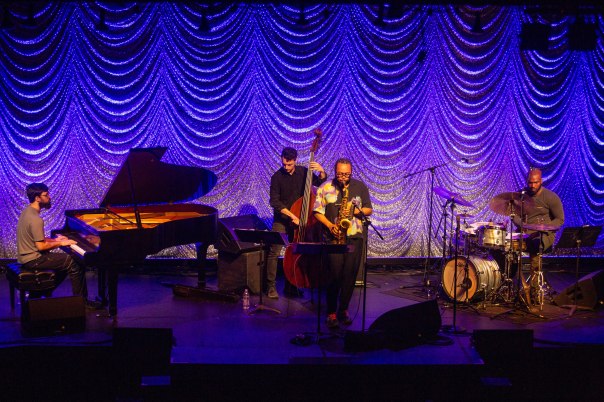
Starting off his five-show engagement at Queen Street, Wilkins plunged straight into a set of compositions he is readying for the studio, accessorized with some electronics that the altoist used sparingly and initially struggled with. Yet the minor difficulties never obscured the exquisite chemistry of this quartet, with Micah Thomas at the keyboard, Rick Rosato on bass, and Kweku Sumbry behind the drums. Wherever it was emanating from so softly, the synthesized vamp from Wilkins’ electronics barely intruded as he played the line and soloed on “The Big Country,” discreetly disappearing as Thomas held forth.

Detractors might have charged that the synthesized sounds interrupted the flow of music in “Apparition,” bridging the gap between the leader’s solo and the rhythm section’s takeover, while defenders might claim they personified the title. Wilkins himself seemed a bit dissatisfied, calling out to the soundbooth, and the next two numbers were acoustically sourced, mics working well though Immanuel’s monitor may have been a concern.

By shedding their electronic woes, Wilkins and the quartet reached higher altitudes with their music. Grooving into a mellow mid-tempo, “Dark Eyes Smile” was their most engaging piece so far, Wilkins introducing the line over Rosato’s bass, then sharing solo honors with Thomas before returning for the outchorus. The ascent continued to its zenith with “If That Blood Runs East,” where piano and alto harmonized on the melody before Sumbry kicked up the tempo behind the kit. Thomas mostly asserted himself afterward via a hypnotic ostinato while Wilkins soloed, ceding the spotlight back to Sumbry before re-entering for a moody landing.

“Blues Blood,” the closer, was no less exciting and even more varied, for Wilkins was emboldened to try out his electronics once more after he and Thomas had soloed. Before settling into a bluesy groove as Wilkins vamped, Thomas showed us he could swing as well, and as this winsome tune faded out, he sprinkled some gospel flavoring into his comping.

Wilkins’ engagement at Queen Street was fortuitously timed, so that he and the quartet could take in the Threadgill concert on the evening before their four-day engagement began and comfortably peep in on Ibrahim and Ekaya midway through his sojourn after his second performance. Ironically, Ibrahim’s timing turned out to be less fortunate. Bad weather prevented him from returning to Cistern Yard, one of the two festival sites where he played in 1998.

Instead, the concert was transplanted indoors to the TD Arena a couple of blocks away, where the sound is better than the lighting and the lawn seating can be faithfully replicated. Delayed by the rescheduling, Ibrahim’s arrival in the College of Charleston basketball arena was more solemn and dramatic in the dimmer light. Aside from introducing the members of Ekaya, the Zulu word for homeland, we heard little from Ibrahim, but it’s very likely that the Ekaya sextet heard – and saw – plenty of prompts from their leader.

The intricate tapestry woven by the ensemble included seven piano solos from Ibrahim, three trio performances, and six arrangements with the horns – 14 Ibrahim compositions doled out into seven music clusters – before the group returned after a feint toward the exit and covered Thelonious Monk’s “Skippy” in their encore. Most easily recognized among the Ekaya arrangements were “Tuang Guru” and “Nisa” from The Balance,the 2019 release where “Skippy” also appears.

After a trio entrance that was likely an abbreviated “Mindiff,” a chameleonic staple in Ibrahim’s discography that he has recorded in multiple forms, Cleave E. Guyton, Jr., jumped all over bassist Noah Jackson and drummer Will Terrill with his piccolo, the signature instrument of “Tuang Guru” in the studio version. Michael Pallas took a fine solo on trombone before Lance Bryant, a session mate with the rhythm section on The Balance, steered the arrangement toward solemnity with his tenor sax – and more massive scoring with the horns and piccolo.

Joshua Lee’s bodacious baritone sax solo was the most salient identifier when we segued from an Ibrahim solo, likely on “For Coltrane,” to an epic arrangement of “Nisa.” Guyton switched to flute on this piece, and there were succinct and tasty solos from Bryant and Jackson. In his ability to stamp his individuality and genius on a piece in the space of eight bars or less, Ibrahim reminded me here of Ellington in his concise regality after the tempo slowed to a stately march. Yet after the reeds and Jackson had distinguished themselves, Pallas emerged as the dominant force in this arrangement, soloing and leading the horns with his muted trombone, then opening up for a brilliant cadenza.

At age 88, Ibrahim still has impressive skills, a prodigious band, and enough venturesome spirit – and trust in his musicians – to continue tinkering with his arrangements. “Skippy” as an encore was notably different from the studio track, with Guyton switching back to flute and Jackson back to bowed cello, the weaponry they had used at the start of the concert, and without a clarinet solo from Guyton, a highlight of the 2016 Mukashi album, it was difficult to be sure where “Mississippi” occurred in the magnificent 80-minute concert.

So let’s prayerfully put it out there that four years is already too long since the most recent Ibrahim & Ekaya recording. Greedy though the request may be, we need to hear more.

Opera Carolina Takes Off on an International Flight

Preview: International Lyric Academy Summer Festival

By Perry Tannenbaum

Look up, look around, and look quick. There’s a new international music festival here in Charlotte, and it’s already in progress. Opera Carolina announced their new International Lyric Academy Summer Music Festival mid-week a week ago, two days after the 86 singers who will performing arrived in the Queen City to begin master classes and rehearsals. The first Festival event, a Florilegium concert, was staged on Wednesday night at Central Piedmont Community College.

Apparently, Charlotte was not caught by surprise. Both the Wednesday and Friday night performances of Florilegium were moved from the upstairs Tate Recital Hall in the Overcash Building to the larger Dale F. Halton Theater below, where the popular CP Summer Theatre resided in the good old days.

Founded in Rome and now based in Vicenza, Italy, the International Lyric Academy has staged 28 Summer Festivals since 1995, but the 2023 will be the program’s first festival in the US. So yeah, this is quite a coup for Opera Carolina and artistic director James Meena.

Singers in the opera program will perform two additional concert programs, a Mozart Marathon (June 29) and an Opera Scenes Program (July 3) before two operas take over the Halton stage for two performances each, a semi-staged Tales of Hoffman (July 5 and 8) and a fully-staged Marriage of Figaro (July 6-7). Meanwhile, 30 more singers are flying into Charlotte for the Broadway musical component of the ILA Summer Festival.

Before ILA’s first US festival concludes next Saturday with the evening performance of Tales of Hoffman, the musical theatre singers will sparkle on the Halton stage with a matinee tribute to Richard Rodgers, With a Song in My Heart. For the opera singers, the show will go on – to Vicenza, where they will reprise their US opera and concert performances.

“The whole company gets on a plane and we go to Italy for two weeks and do classes with different master teachers there and perform in the theater,” says Meena, who is ILA’s guest conductor in Italy. “Vicenza is between Venice and Verona. So basically, we take over the theater for two weeks. These emerging artists get to perform here, and then they actually get to perform in Italy. We’ve invited a handful of intendants [opera impresarios] from Italian theaters to come to the performances and hear the kids. So it’s an amazing opportunity for them.”

The new festival in Charlotte represents a quantum leap in Opera Carolina’s youth education program and a magnificent expansion of their resident company. Now that the pilot program has emerged from under the radar, Meena will be meeting with his board to decide whether they will authorize a complete integration of the Academy into Opera Carolina – or whether they will continue working as separate entities to produce future Summer Festivals.

Working with so many emerging artists at the same time clearly had Meena excited when we spoke. While he was in rehearsals getting ready to conduct next week’s performances of Jacques Offenbach’s The Tales of Hoffman, Stefano Vignati, ILA’s artistic director and founder, was readying the full-dress version of Mozart’s The Marriage of Figaro, a comedy masterwork that figures prominently in any serious discussion of the greatest operas ever written.

The breadth of the program is as breathtaking as its sudden arrival.

“Our education department all of a sudden becomes youth through young adults!” Meena exults. “So it’s really pretty audacious. No other company that I know of other than Chicago Lyric and the Met and San Francisco are providing professional opportunities like this for emerging artists. So it’s pretty cool. We’re pretty excited about it all.”

Advertisements to attract young artists to the program began last July, and the program already has a network of university instructors spreading the word – in Toronto, Cape Town, Seoul, LA, and other US locations. The audition process began virtually before the decisive live auditions in six different cities.

When you add up the 86 opera aspirants with the 30 musical theatre recruits, you have a youth program that begins to rival that of Spoleto Festival USA, the annual arts behemoth that takes over Charleston for 17 days. Meena doesn’t shy away from the comparison.

“If we do this well,” he says, “this can become different than Spoleto but on that scale.”

There’s certainly a niche for it, since Spoleto has never done Sweeney Todd or West Side Story – and CP Summer Theatre staged both of those Broadway classics in its long history before making a quiet exit last year. But the combination of opera and musical theatre, in programming or in pedagogy is nothing new.

“We’ve been blurring the lines between American music theater and opera for decades, really,” Meena explains, “since Beverly Sills first started the City Opera, when she did Brigadoon. So it makes sense for us to get music theater kids, teach them a bit about classical singing, which can only help their performing, and then work that curriculum, really, to add some more diversity to the performances. If we do this well, by 2024, the music theater program will be probably two weeks. The opera program would be four weeks.”

Not only a big deal but a great deal. Two of the ILA Summer Festival concerts are free, and ticket prices top out at $35 for the rest. Festival passports are also on sale.

“Six” Brings Back Henry’s Iconic Queens, Dressed to Slay

Review: Six The Musical at Blumenthal Performing Arts

By Perry Tannenbaum

Many of the people who know nothing more about King Henry VIII of England than the number of wives he married erroneously assume that he executed them all. Not so. Only twice did he behead a wife – no more often than he divorced or, more accurately, annulled one of their marriages – so four of the dears died of natural causes. Still a half dozen is a large portion of partners and death-do-us-part oaths for any grown man, especially one who lives out his life very much in the public eye.

You don’t earn a pass, even as a king, for summarily ordering your wife to be beheaded just because you refrained on other occasions. Nor is it a moral lapse if, three wives and six years later, you do it again after thinking it over.

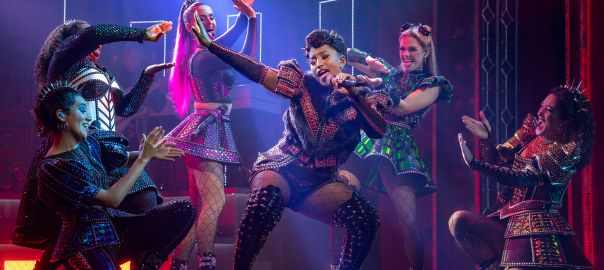
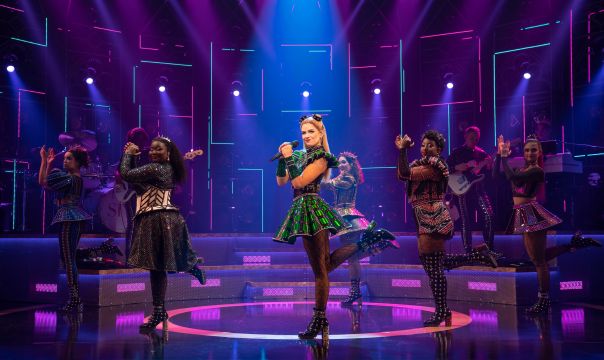
What’s important, then, is the solidarity of these wives as Toby Marlow & Lucy Moss bring them all back to us in SIX THE MUSICAL. No matter that the ladies’ villainous tormentor has been dead for 476 years – and barred from appearing this week at Belk Theater as the touring version, adorned with Tony Awards for best costume design and musical score, spends a holiday week in the Queen City. These resurrected queens are out for revenge.

Queen-spired by Beyoncé and Shakira, Lily Allen and Avril Lavigne, Adele and Sia, Nicki Minaj and Rihanna, Ariana Grande and Britney Spears, plus Alicia Keys and Emeli Sandé, they are here to SLAY!! Glittering in eye-popping skirts, dresses, and slacks worthy of hardcore heavy-metal thrashers. Dazzling tops, bustiers, shoulder plates, ruffles, collars, and sparkling sleeves ready for the battlefield Wicked platform shoes and boots. State-of-the-art hand mics.

Catherine of Aragon, Anne Boleyn, Jane Seymour, Anna of Cleves, Katherine Howard, and Catherine Parr are not here to play – not even with each other. They are here to ask us to decide, night after night, which of them suffered most under cruel King Henry’s hand. This is their battle, their consecrated competition.

If you are capable of biting your nails over the outcome of this high-stakes, high-decibel throwdown, then you’re likely to believe that I’m fully acquainted with all the inspirational pop queens I’ve just catalogued. Throngs of fanatics were no doubt pre-sold on Marlow &Moss’s handiwork before opening night at the Blumenthal Performing Arts Center, for their high-decibel responses often increased my difficulties in discerning what these dead queens were telling us.

A good portion of the screamers and shriekers had no doubt primed themselves by listening repeatedly to the cast album before the show or – like I did afterwards – by counting on Spotify and Apple to post the lyrics as it played. My recommendation would be to follow their example, though the sound crew’s performance on opening night was far better than average.

Intelligibility aside, as well as pertinence to the issue at hand, each of the six solos the queens sing has an unmistakable élan, and all six of the women onstage are powerhouses when the spotlight is most piercingly upon them. Of course, a Charlotte crowd is going to favor its own, and Amina Faye’s return to the Belk Theater stage as Jane Seymour, seven years after she took home a Blumey Award there for her stirring portrayal of Sarah in Ragtime – and a subsequent Jimmy Award up on Broadway – is already a triumph.

Clarity and intense emotion are already baked into “Heart of Stone,” so Faye is doubly set up for success with the Belk audiences. It’s the only song besides “I Don’t Need Your Love,” sung with searing urgency by Sydney Parra as Catherine Parr, that rises to the level of heartfelt testimony, a strange commonality for the two queens who have the least reason to feel aggrieved by Henry. Buoyed by this handicap, they are welcome counterweights to the prevailing glitz and silliness, and Faye is better to my ears than her cast album counterpart, Natalie Paris, who is comparatively plastic. Or pop plastic, if you don’t warm to that brand of singing.

Gerianne Pérez is surprisingly saucy as the senior – and longest reigning – among the royals, Catherine of Aragon, singing “No Way” in retelling how she rejected divorce and annulment from Henry. Nor does she fade into the background after taking the first solo, indisputably the most confrontational and contentious in the group. Her primary adversary, Zan Berube as Anne Boleyn, is by turns weird, wacky, lewd, and irreverent in “Don’t Lose Ur Head,” confiding that she lost her head only after giving some. Could be me, but it seemed like she was bragging, not gagging.

By the time we reached Terica Marie as Anna of Cleves and Aline Mayagoitia as Katherine, the idea that these badass queens were trying to point up their marital sufferings – or anything else besides telling their stories with varying degrees of attitude – was pretty much forgotten. Paradoxically, that made it easier to enjoy Marie’s “Get Down” as she went from down-low grooving to childish taunting. Anna seemed to be adopting Aragon’s playbook. Despising Mayagoitia’s all-men-are-alike messaging in “All You Wanna Do” came just as naturally as she narrated her way, chorus by chorus, to the hatchet man.

Interesting that the two women whom Henry beheaded get the most annoying songs. It’s a nice little hint from Marlow & Moss that the man was provoked. But then, so was the woman I heard complaining that, for 100 bucks a ticket, we should be able to understand the lyrics that these dead-queens-resurrected-as-rockstars are singing. Personally, I discarded such naïve notions at the last Avett Brothers concert I attended. At least at SIX, you can remain seated for the whole 80 minutes.

Still in Flux, Spoleto USA Runs Brash Gamut From Barber To Balloon Pops

Review: Spoleto Festival USA

By Perry Tannenbaum

Photo by Leigh Webber

It’s been a tumultuous year for Mena Mark Hanna in his second season as the new general manager at Spoleto Festival USA. Chamber music director Geoff Nuttall, the festival’s most recognizable personality – the charismatic violinist who convinced Hanna to come aboard at Spoleto – died in mid-October at the age of 56 while undergoing treatment for pancreatic cancer.

Amid all his antics and flamboyance, Nuttall never seemed to be that old.

Then as all the pieces of Spoleto 2023 fell into place, including the memorial concert for Nuttall scheduled on the opening holiday weekend, last year’s centerpiece, the world premiere of Omar, won the Pulitzer Prize for composers Rhiannon Giddens and Michael Abels. That opera, rooted in the festival’s Charleston home, would stand as the signature achievement of Nigel Redden, Hanna’s predecessor. Redden handed over final alterations and trimmings to the new GM, who piloted the grand project into port.

So this year’s festival will likely be remembered as Hanna’s first true lineup, though Scottish Ballet, mandolin sensation Chris Thile, and iconic jazz artist Abdullah Ibrahim will be the last holdovers to file into Spoleto from the 2020 event that never happened. Yet without a replacement for Nuttall, a key member of Hanna’s hiring committee as well as an engaging host and performer, there’s a feeling that the festival remains in flux.

Even as I spoke to Hanna, a week before this year’s Spoleto began, he wavered between declaring he was in no hurry to replace Nuttall and assuring me that considering his successor was definitely on his to-do list during the festival and in the summer ahead.

It’s safer to say that sustaining the momentum for opera is an urgent priority for Hanna. Programming Samuel Barber’s Vanessa in 2023 is certainly a major statement, since its strong libretto was written by Spoleto founder Gian Carlo Menotti, and for 2024, the festival is commissioning a new opera. Announced at the same time the curtain was rising for the final performance of Vanessa, the new piece, Ruinous Gods by composer Layale Chaker and librettist Lisa Schlesinger is ballyhooed as “another bold project with powerful themes” in the mold of Omar. Opera Wuppertal and Nederlandse Reisopera will be co-commissioners and co-producers of the new chamber opera.

Menotti hasn’t been regularly involved at Spoleto since 1993, when he stage-directed one of his weakest works, The Singing Child. True, there was a revival of Menotti’s most heralded opera, The Medium, in 2011, but that production has come to seem like an obligatory celebration of the composer’s 100th birthday. Twelve years later, Vanessa feels like a whole-hearted embrace: bolder and more contemporary with Rodula Gaitanou’s daring stage direction, more searching with Timothy Myers wielding the baton.

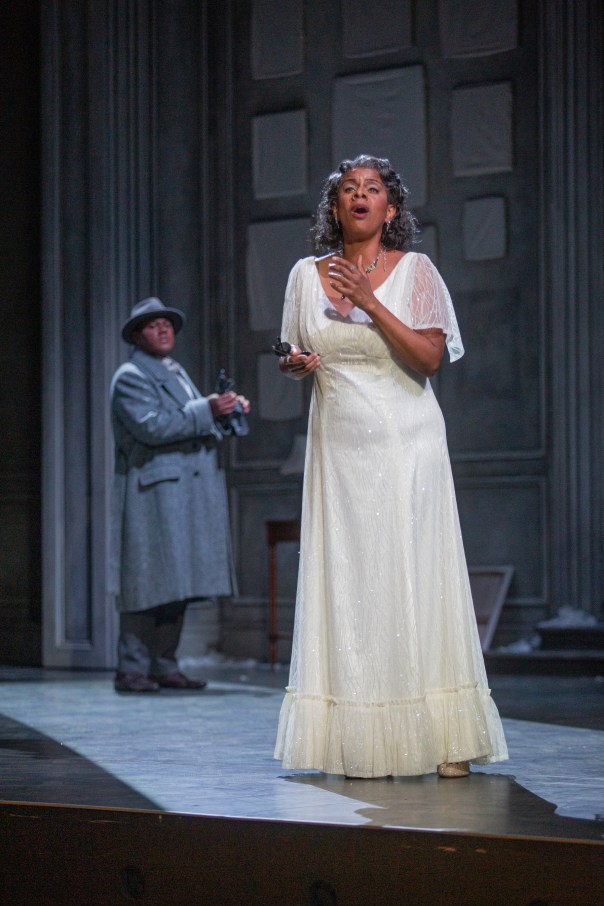
A long pandemic after Gaitanou’s vision of Vanessa was first presented in 2016, the loneliness and isolation of Vanessa resonated more keenly in its US premiere, the effect only enhanced because her icy-cold vigil is self-imposed. The entire household seems to be in suspended animation, The Old Baroness mother perpetually painting at her easel, daughter Vanessa faithfully awaiting her former lover’s return after 20 years, and Vanessa’s niece Erika as much on auto-pilot as the maids and butlers.

All the many paintings and mirrors on the walls are covered, adding to the surreal atmosphere. It’s as if Vanessa were protecting herself from a raging plague, or as if this were a summer home about to be abandoned until next year. The futile circularity of the Baroness painting pictures that will be covered up as soon as they are hung up on the wall subtly prefigures what will happen when Vanessa’s beloved Anton arrives.

As Hanna had promised, the cast was killer. Nicole Heaston brought a neurotic hauteur to Vanessa, a steely cold soprano in her rendering of the tense “Do Not Utter a Word” aria that weirdly echoed Rosalind Plowright’s iciness as the Baroness, a role that the English mezzo originated at the Wexford Festival premiere of this production – before she reprised the role at Glyndebourne in 2018 (available on DVD and Blu-Ray). Compared to the stony and unwavering Plowright, Heaston’s Vanessa proved to be vulnerable, capricious, malleable, and oblivious in a quietly disturbing way.

If Heaston personified the creepiness and the supernatural tinge of Menotti operas, mezzo Zoie Reams as Erika inclined more to Barber’s sad and wistful Romanticism. More emotion poured out of her in “Must the Winter Come So Soon” than on any of the full-length recordings this side of the original live recording conducted by Dmitri Mitropoulos in 1958. Heaston ably gets across to us that her attraction to the second-generation Anton is a rekindling of her youthful ardor, but Reams shows us that Erika’s love for Anton is a first flowering, with a more hormonal heat and fire.

Yet Erika never wears her heart on her sleeve. Perhaps because of her more precarious finances, there’s a secretive and withdrawn aspect to Reams’ performance that marks her as a member of the family. So self-denying and self-destructive are they all that it becomes richly ambiguous whether tenor Edward Graves as young Anton is a ruthless fortune hunter or an idealistic romantic. It was rather wonderful, when Graves engaged Heaston in the slowly cresting “Love Has a Bitter Core” duet, how Anton and Vanessa could be seen triggering spontaneous passion in each other.

The denouement was a walloping “To Leave, To Break, To Find, To Keep” quintet with baritone Malcolm MacKenzie, a welcome presence as The Old Doctor, completing the fugal fabric. It all sounded so present and powerful at Gaillard Center, the singing perfectly balanced with Myers’ ardent work in the pit, while ever-present, precisely synced supertitles projected above facilitated transmission of Menotti’s text.

For those of us who were fortunate to attend Vanessa and the big orchestral performances of Spoleto 2023 – John Kennedy conducting The Rite of Spring, Mei-Ann Chen navigating the New World Symphony, and Jonathon Heyward reveling in the Symphonie Fantastique – the Gaillard and its fine acoustics were arguably the center of the festival. Both the Spoleto Festival Orchestra and the Spoleto Chorus, recruited in nationwide auditions, are rather awesome. And fortunate: not only do they get to perform at the Gaillard, they individually and collectively get to perform edgy, outré, and contemporary pieces at other Spoleto venues that you’re unlikely to experience anywhere else.

Chen, the music director at Chicago Sinfonietta, dug into her wide-ranging repertoire to greet us with Florence B. Price’s Ethiopia’s Shadow in America, a three-movement work that likely begins a mile or two away with an Introduction and Allegretto depicting the arrival of slaves in America. The brief yet solemn middle movement vividly evoked the famous New World Largo we would hear later in the evening, and the concluding Allegro, “His Adaptation,” had the urbane Ellingtonian strut of the Jazz Age.

Delights and Dances, gleaned from Chen’s 2013 Cedille CD that gathered three different concertos for string quartet and the Sinfonietta, was a welcome dive into an earlier Abels work in the wake of his Pulitzer. Nor was it difficult for me to exit the Gaillard feeling that the New World was Antonín Dvořák’s fantastic symphony, for the onset of the trombones in the final movement brought on goosebumps.

The lesser-known Heyward, the music director designate at the Baltimore Symphony, was not to be upstaged – not by Chen, at any rate. A native of Charleston, Heyward received a hearty greeting from the hometown crowd that puzzled the out-of-towners sitting behind me. Heyward began his grand homecoming with the US premiere of Nymphéa, a 2019 work by Doina Rotaru inspired by Borin Vian’snovel, L’écume des jours, with a sprinkling of Duke Ellington’s “Chloe,” the namesake of Vian’s heroine.

What the music evokes, partly through a delicate combo of piano and muted trumpet that grows fearsome and awesome – embroidered by plentiful percussion – is the growth of a huge destructive water lily (nymphéa) inside Chloé. Call it a 19th-century tone poem written with a 21st-century quirkiness, with a rubbed oriental gong, a plucked Steinway, and a stray mallet head that accidentally bounced into the front row of the audience.

Yet all of this spookiness was upstaged in an instant by the return of another local musician, pianist Micah McLaurin. With a glittery, androgynous, and otherworldly David Bowie aura, the slender McLaurin strutted onstage to a huge ovation in a blinding fuchsia jumpsuit with a lowcut back and a single silver sleeve. He proceeded to pound out the opening chords of Grieg’s Piano Concerto once the startled crowd had quieted, working the pedals with platform shoes, which had only increased his considerable height and the éclat of his entrance.

The outer Allegro movements showed off McLaurin’s strengths better than middle Adagio. Even there, the soft and loud passages were gorgeously shaped until late in the movement when his tone grew too steely for maximum effect. But the latter stages of the final movement were irresistible, crackling with authentic thunder.

When he reached Hector Berlioz’s Symphonie, Heyward benefited from the luck of the draw in delivering a more consistently satisfying account than we had of the New World. All 100 members of the Festival Orchestra don’t appear together, and the principals who performed featured solos with Heyward outperformed Chen’s chosen.

Not only did Heyward send his principal oboist offstage in the wondrous countryside movement, he deployed tubular bells to the wings for the closing “Witches’ Sabbath” movement to chilling effect. The drumbeats and sforzandos in that movement and in the preceding “March to the Scaffold” were nothing short of electrifying. Audience buzz after the Fantastique was every bit as enthusiastic as it had been at intermission in the wake of McLaurin’s exit.

The other Spoleto venues were rich in talent and adventurous spirit. At Dock Street Theatre, countertenor Anthony Roth Costanzo performed an outrageous hybrid lark, Only an Octave Apart, with cabaret icon Justin Vivian Bond, nary a male outfit in their wardrobes. Otherwise, we could compile an epic review of the 11 lunchtime chamber music programs that rocked the Dock, though my wife Sue and I only witnessed seven – enough for us to see 11 different hosts standing in for Nuttall introducing 25 pieces (nine by living composers), including an original score by pianist Stephen Prutsman for 7 Chances, the most hilarious Buster Keaton film we’ve ever seen.

St. Matthews Lutheran Church and Sottile Theatre were both graced with concerts led by director of choral activities director Joe Miller. Surprisingly, the Festival Chorus program at the church, Density 40:1, was more secular than the one two blocks south, a precedent-breaking concept from beginning to end. Miller and his 32+8 voices all ascended to the organ loft in order to spread out over us and perform the 40 parts of Thomas Tallis’s Spem in alium. More earth-shattering, the choir did not perform “Danny Boy” or an encore. Instead, we all sang “Over the Rainbow” together.

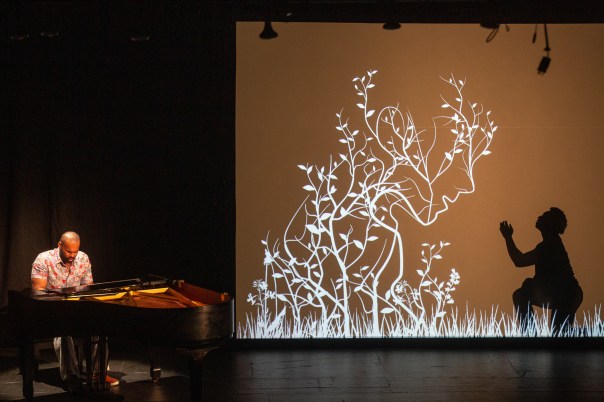
A new venue, the Queen Street Playhouse, was added to the Spoleto portfolio with mixed success. Artistically, A Poet’s Love was a resounding triumph for tenor Jamez McCorkle, powerfully following up his exploits of last season in the title role of Omar by singing Robert Schumann’s Dichterliebe – while accompanying the entire song cycle by himself at the piano. Designer and choreographer Miwa Matreyek made this a completely immersive experience with animated projections, shadow puppetry, and the movement she designed for Jah’Mar Coakley.

But the staging was badly bungled. Once McCorkle sat himself behind the Steinway, I never saw more of him than his scalp from my second-row seat. Fortunately, Matreyek and Coakley combined on a magnificent performance I didn’t miss.

After a rather bizarre foray at Festival Hall (formerly Memminger Auditorium) for his first Music in Time concert, Kennedy made better use of Queen Street Playhouse for Sanctum, a wild collection of contemporary pieces, concluding with the 2020 work by Courtney Bryan that gave the program its title.

That piece was decisively upstaged by Everything Else, a 2016 composition that I will likely never forget. For this novelty, 15 members of the Spoleto Festival USA Orchestra laid aside their instruments and drove the everyday concept of music to new frontiers most of us had never pondered before. One musician sat with a newspaper, turning the pages at leisurely intervals, another put on a jacket and zipped it up, three of the women passed around and munched a bag of chips, and another tapped obsessively on the keyboard of a laptop while, across the stage, another blew bubbles.

All of this low-volume action – and a multitude of louder acts – continued simultaneously. There were pennywhistles, a kazoo, somebody blowing on the rim of a bottle, two guys slapping cards down on a table in a game of war, and balloons blown up, shaped, and worn as comical crowns. Of course, there was the obligatory popping of balloons near a woman who insouciantly demonstrated how many different things can be done with a bottle of water without hardly making a sound.

Kennedy had seated himself with us in the audience so he could join us. Yet every musician onstage seemed to know exactly what to do onstage, when exactly it was time to launch into a new action, and when exactly to initiate interactions with other musicians. Anyone who thought about it had to wonder how such a multifarious sea of chaos could be taught, rehearsed, and performed – so precisely that the entire ensemble, without a conductor in front of them, stopped at the same instant.

I still can’t decide whether or not I wish to know.