Reviews: Aleko and Pagliacci

By Perry Tannenbaum
January 28, 2016, Charlotte, NC – Although Sergei Rachmaninov wrote some formidable vocal, choral, and orchestral music, his opera inventory was rather paltry compared with his gifts. Recent recorded sets of his complete operatic output – Aleko, Francesca de Rimini, and The Miserly Knight – are comfortably contained on three CDs. So it was surprising for me to discover that Rachmaninov’s first opera, Aleko, had never been given a fully professional production in the US with its original score. It must have surprised James Meena as well when he saw a reorchestrated version up at the Boston Early Music Festival in 2013, for Opera Carolina’s general director and principal conductor has rectified the oversight with admirable haste, truly championing the neglected work.
The US premiere at Belk Theater hasn’t merely introduced new repertoire to Opera Carolina subscribers. Members of the Charlotte Symphony Orchestra might have known some of the dance music at most; members of the Opera Carolina Chorus – total strangers to Russian except for the 2011 production of Eugene Onegin – certainly hadn’t set eyes on their parts before. It’s also likely that none of the far-flung featured players assembled for this production had ever sung these roles before. Paired with this unfamiliar fare is an old favorite with Charlotte operavores, Ruggero Leoncavallo’s Pagliacci, presented for the fifth time in the company’s history – with three of the same featured vocalists who learned Aleko for us.
The two operas, presented in one-act format (Pagliacci was composed in two), have numerous similarities. Both protagonists are jealous husbands who kill their adulterous wives and their illicit lovers – “Double feature. Double murders,” say the PR flyers. More intriguingly, these double murders are ghoulish alterations of stories we already know. In Canio’s case, it’s the commedia story he and his wife Nedda do on their vagabond tour, where she as Columbina meets with Harlequin and outwits Pagliaccio, the clown-face role Canio plays. But in the more rugged setting that Rachmaninov and librettist Vladimir Nemirovich-Danchenko take from The Gypsies, an Alexander Pushkin poem, the parallel story is told by Aleko’s father-in-law. By the nocturnal firelight, The Old Gypsy recalls how his true love, Mariula , deserted him for another, leaving behind their daughter, Zemfira, whom he has raised. Aleko is furious that the Old Man did not pursue his treacherous wife and take vengeance upon her and the man she had chosen.
Already tired of her husband – and attracted to a Young Gypsy – Zemfira has uncomfortable forebodings when she sees Aleko’s reaction to her father’s story. Both Aleko and Canio have unenlightened ideas about their prerogatives as wronged husbands, but they’re matched with wives who are not resigned to the notion of being diffident doormats. Zemfira forthrightly defies Aleko and his threats, a true spitfire, while Nedda’s defiance lasts until she receives her mortal wound, keeping Silvio’s name a secret until she involuntarily cries out to him in her agony.
With Aleko clocking in at 51 minutes and Pagliacci at 71, the main difference between the two pieces is the relative lack of plot and character development in Aleko. Nedda, you may remember, is pursued by the loathsome Tonio, who salves the wound of his rejection by bringing in Canio to watch his wife’s intimacy with Silvio. Two jealous guys figure in that scenario. Beyond expressing his torment in the famed “Vesti la giubba,” Canio also gives us the backstory of his relationship with Nedda in the tense moments before he kills her, adding to the clown’s complexity even if it doesn’t mitigate his crime. We had a representative Italian male point of view for 1892 – and long afterwards in the Opera Carolina version – but the conversation that needed to begin might be sparked by Pagliacci.
While the brevity of the libretto helped make it it possible for Rachmaninov to complete his Aleko score in 17 days (for a competition at the Moscow Conservatory), its thinness prevented the opera from remaining truly airborne. But what an exemplary beginning! Meena and the Charlotte Symphony gave the orchestral introduction a brooding propulsion as projections of snowy mountain ridges and forests fade-dissolved across the full expanse of the stage. The music softened as the scrim lifted on the Gypsy chorus, greeting us blithely as they sweetly extolled their freedom in harmonies that reminded me of Borodin’s “Polovtsian Dances.” Making a hairpin turn as the men supplanted the women as the dominant voice, they reignited the agitated turbulence we had heard in the orchestral intro. Then the beauty of the chorus trailed away for the vocal highlight of the Opera Carolina premiere, “The Old Gypsy’s Tale,” performed by Kevin Thompson in a magnificent Charlotte debut. Thompson’s rich bass conveyed the melancholy, the peasant nobility, and the sheer passionate broken-heartedness of the Old Gypsy more richly and beautifully than either the Chandos or the Deutsche Grammophon recordings I’ve referenced.
From there, the passions and drama of the younger trio replicating this bygone love triangle of their elders barely rise to that same level. In fact, they frequently dip below. Baritone Alexey Lavrov can’t be faulted for the power shortage. As Aleko, his disgusted reaction to the Old Gypsy’s passivity had plenty of snap. After absorbing Zemfira’s defiant mockery, there was gravitas aplenty in Aleko’s lonely midnight meditation at the sleeping Gypsy camp – but no tragic power. In her Charlotte debut, soprano Elizabeth Caballero didn’t seek sympathy as Zemfira, almost spitting her spite as she mocked her husband, not giving ground when Aleko found her on the verge of making her getaway with her new lover.
More than Aleko, the Young Gypsy seems to be caught in the cogs of a recurring cycle, and James Karn barely makes an impression in the role, though it’s a good one. In the wake of all the bloodshed, there is a reckoning. Once again, Thompson as the Old Gypsy is mysteriously powerful in these final sobering moments, more potent and resolute than Aleko had realized, his leadership affirmed by the Gypsy chorus.
Pagliacci offered a glimpse of what Aleko could have become if 20 minutes of muscle – and a hit tune – had been added to its bones. Stage director Michael Capasso was even more decisive here than he was with Rachmaninov, transporting the action to 1951 and decreeing a boxcar concept. The colorful logotype spanning the scrim during the lively, folksy overture was curved across a drawing of a brick-colored freight car, and when the scrim rose on the opening scene, a smaller version of that railroad car was already upstage. Eventually, that car opens up to become the stage where Columbina cheats on her Pagliaccio one last time. After considerable heraldry, Canio and Nedda arrive in a compact vehicle that might be described as a covered wagon tricycle, with hand lettering on the side of the canvas. Yes, it makes a comical barnstorming impression.
A somewhat heightened verismo seems to be what Capasso and Meena are after, and tenor Jeff Gwaltney, singing the title role, effectively obliged in his Opera Carolina debut. The moderation in the staging of the climactic “Vesti la giubba” typified the approach. Lights didn’t dim melodramatically, Canio didn’t drop down to one knee as if he were Al Jolson singing a showstopper to his mammy, and the broken-hearted clown’s sobs weren’t potted up to fortissimo. On the other hand, Gwaltney didn’t simply remain self-absorbed with his mirror and his makeup. He gradually made his way from a modest, makeshift dressing table off to stage left, winding up face down and sobbing in the centerstage area. Along the way, Gwaltney was at least as committed to Canio’s words as he was to the big tune.
He’s a strapping lad, to be sure, so Caballero isn’t straining credulity at all to be afraid of him as Nedda. The whole surprise of the commedia suddenly turning into a husband’s deadly vendetta gets beautiful play from the soprano, easily her best work of the night as she mixes terror and insolence into her final moments. Helping to make Nedda even more sympathetic is baritone Giovanni Guagliardo, easily the most chilling and repellent Tonio that I’ve ever seen.

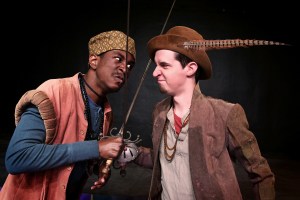 If you’re playing Rosencrantz or Guildenstern in Hamlet, you’re not exactly one of the Danish Prince’s most formidable adversaries. On the contrary, you’ve been specially chosen by King Claudius to spy on your old friend Hamlet, who sees through your treachery rather quickly. You’re not exactly peripheral, either: you come on early in Act 2, lurk fairly often onstage until late in Act 4, and the pair of you have nearly 5% of the tragedy’s lines.


 Art on My Sleeve