Tag Archives: Zach Linick

Let “The Drowsy Chaperone” Hypnotize You

Review: The Drowsy Chaperone at Theatre Charlotte

By Perry Tannenbaum

My advice for best enjoying The Drowsy Chaperone at Theatre Charlotte is to listen to the Man in the Chair – and yield to his pitch-dark hypnosis. Yes, before the lights even go up at the old Queens Road barn, he’s in his chair speaking to his audience and conjuring up what we should hope and pray for: “I just want to be entertained. Isn’t that the point?”

As the show unfolded, brilliantly directed by Billy Ensley with what must be the local cast of his dreams, I realized that, as a critic, I shou

ld heed that hypnotic suggestion devoutly. Discard my usual pointy critical and analytical tools. What’s more, I came to believe more and more strongly that, if actors and directors of previous Drowsy Chaperones I’d seen had followed that simple mantra, I would have fallen in love with the show long before last Friday night.

When the lights came up a few minutes deeper into the Man in Chair’s monologue, we saw him locking the front door of his humdrum apartment with four or five assorted deadbolts and chains. It’s a bit of an abrupt swerve, but we’re suddenly aware that this Broadway musical devotee is a recluse and a bit paranoid. Each time the phone rings, we’ll see that the Man in Chair fails to answer, yet another confirmation of these traits.
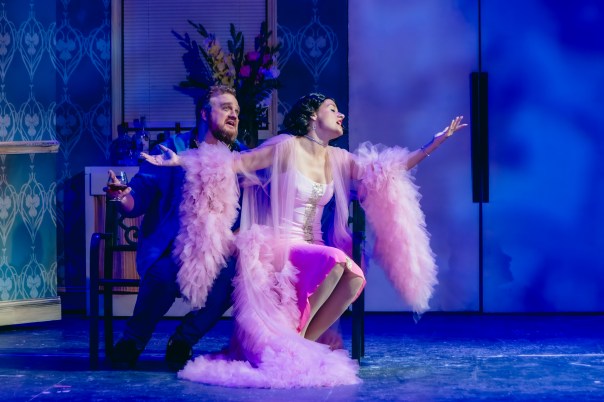
By the time the title character of the fictional “Drowsy Chaperone” is a few wobbly notes into her showstopping “As We Stumble Along,” we already should know that the Man in Chair is gay, which accounts for Lisa Smith Bradley delivering the song as a living fetishization of Ethel Merman and Judy Garland – Merman’s vibrato wedded to Garland’s glitter, slacks, and drug dependency.

Yet when we’re watching Kyle J. Britt as our genial host, we need not attribute his reclusiveness or paranoia to being a gay man. As a Broadway musical fanatic, this Man in Chair identifies more readily as a New Yorker with Innerborough hangups. Meanwhile, Bradley is sufficiently over-the-top as both gay icons – especially Merman – to be accused of impersonating a female impersonator.

We might say that Ensley & Co. have decided that being gay in 2024 isn’t nearly the leaden weight it was in 2006 when Drowsy Chaperone premiered in the Big Apple or in 1996 when Angels in America tore the QC apart and made us a laughingstock. Pretentiousness, solemnity, and subtlety really are inimical to this delicate relic. Britt handles it with audiophile care as removes the vinyl disc – a rare original cast recording of his favorite 1928 musical – from its LP sleeve and gives both sides a loving once-over with a Discwasher brush before lowering his treasure onto a turntable.

The same can be said of size and scale, which may also have muffled my enjoyment of productions at Belk Theater in 2007 and Halton Theater. There’s something so right about our little séance in the dark at the Old Barn on Queens Road that it cannot attain in a more modern and spacious hall where the Man in Chair must project his spell into a distant balcony. The homeliness of the Man’s urban dwelling also sits better on Queens Road than in the bowels of a bank building on Tryon Street.

To be honest, it’s Broadway Lights and the late CP Summer Theatre that should apologize for not matching the unpretentiousness of Josh Webb’s scenic design. Of course, it would be nice if Webb’s scenery could transform spectacularly into Broadway splendor when the stylus of our host’s turntable comes down – with its signature thump – onto the vinyl and the mythical “Drowsy Chaperone” comes to life. In the less-is-more world on Queens Road these days, these shortcomings are comedy assets, part of the overall charm.
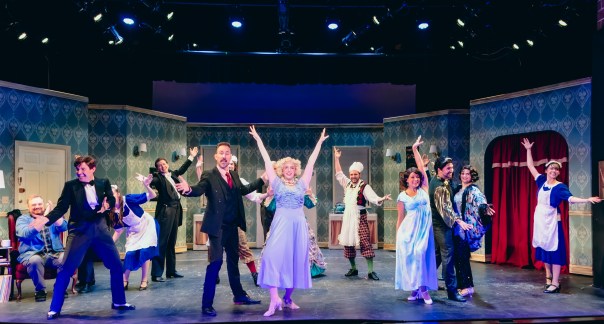
On the other hand, our time travels to 1928 get a softer landing thanks to the costumes by Beth Killion, notable for their flair, their formality, and their discreet dashes of color. We’re awaiting the wedding of Robert Martin and Janet van de Graaf, so there are actually multiple levels of time travel here, for Bob Martin actually co-wrote the Drowsy Chaperone book with Don McKellar – and starred in the original Broadway production as Man in Chair – while he was married to the real-life Van de Graaf.

In fact, this originally Canadian work, which eventually layered on music and lyrics by Lisa Lambert and Greg Morrison, was gestated at Martin’s stag party in 1997, nearly 70 years after these fictional nuptials. More reasons not to view this lark as a gay cri de cœur.

Rare as his vinyl treasure may be, Britt comes across less as a scholar or a critic than as a fanboy, occasionally panting like an eager puppy as he presumes to approach his fantasy idols more and more closely. More than once, the principals will obligingly freeze for him. Nor does this Man in Chair seem to favor the men over the ladies with his adoration, only tipping the scales just before the final bows. Charmingly enough, there are overtones of scholar and critic as he dishes tasty trivia about the fictitious “Drowsy” cast members or advises us to be on the lookout for some truly dreadful lyrics.

These glamorous, theatrical, servile, and criminal characters are all blissfully ignorant of the nerd who has conjured them up, preoccupied with their conflicting efforts to carry off the planned wedding or ruin it. The bride herself, Lindsey Schroeder as Janet, seems to be grandly ambivalent about becoming Robert’s wife, sacrificing her glittery stage career and the adoration of millions, while suppressing her basic instinct to “Show Off.” Love is at comical war with vanity. Carried away by the swiftness of this whirlwind romance, Andy Faulkenberry as Robert also has his doubts.

Aside from Janet’s drunken chaperone, politely labelled as Drowsy, there are a butler Underling, an eccentric Mrs. Tottendale, and Robert’s best man George shepherding the loving lambkins to the altar. Only Zach Linick as George seems to be afflicted with any degree of competence or reliability. More importantly, he and Faulkenberry make up a formidable tapdancing duo. (Thank-yous to choreographer Lisa Blanton.) Allison Rhinehart as a frilly, bustling Tottenham and Darren Spencer as the gray and starchy Underling are no less inevitably channeled toward blithe entertainment.

Counterbalancing the fragile determination of the bride and groom, compounded by the flimsy protection of their good friends, we have an exquisite mix of bumbling baddies trying to sabotage the wedding. These are led by Joe McCourt as Broadway producer Mr. Feldzeig (Feldzeig Follies ring a bell?), under pressure from his mobster backers, who consider Janet to be the cash cow of the Feldzeig franchise. The sneering McCourt is bedeviled by Gangster 1 and Gangster 2, armed emissaries – Titus Quinn and Taylor Minich – masquerading as hired chefs to ensure a catastrophe.

Ah, but it isn’t simply muscle aimed at swaying the maiden and returning her to showbiz. Somehow, a predatory Lothario is among the wedding guests – although he has never met anyone else there. Mitchell Dudas is this egotistical Adolpho, far more arrogant than Feldzeig, a mixture of Erroll Flynn and Bela Lugosi with a thick Iberian accent. Feldzeig has no trouble at all convincing Adolpho that he was born to seduce the bride-to-be.

Equally dumb, Autumn Cravens as Kitty is a ditzy chorine, constantly nagging her boss and wedding escort Feldzeig to let her fill Janet’s shoes in his next Follies. Effortlessly, Dudas will outperform Cravens in thwarting Feldzeig’s schemes. Love conquers all, but it would be a huge spoiler to say how many times when we reach this very happy ending.

Just one more wild card is needed to tie up all the festivities. Be on the watch for Trinity Taylor as Trix the Aviatrix, who descends from the skies at just the right moment with a voice of thunder. For a few moments, she even upstages Britt and Schroeder who are so fabulous.

It would be a mistake to miss the craftmanship lavished on this plot with its stock characters by Martin and McKellar, brought out so brilliantly by Ensley and his dream cast. For instance, think how perfectly 1928 was chosen: between Lindbergh’s transatlantic flight, Babe Ruth’s 60 homers, The Jazz Singer of 1927 and the Wall Street Crash of 1929. A brief last window of bliss before global misery. In the real world, the parade of yearly Ziegfeld Follies revues would be halted after 1927 – until 1931.

“Next to Normal” Is Alive at the Barn!

Review: Next to Normal at Theatre Charlotte

By Perry Tannenbaum

July 4, December 7, September 11, and October 7 are all dates we remember for their historic meaning to the nation and the world. A similar earthshaking significance can descend on a single day in the life of a relationship, a marriage, or a family that can reverberate for generations – whether you were at the event or even alive at the time.

That’s essentially what we’re watching in Brian Yorkey’s Next to Normal with music by Tom Kitt, winner of the Pulitzer Prize for Drama in 2010 after winning Tony Awards for Best Musical, Best Book, and Best Orchestrations the previous year. Instead of doing things the traditional way, setting up the location and the situation in a big opening number that stages or recaps the prime catastrophe, Yorkey fast-forwards us more than 17 years, when the original hurt in the Goodman family has marinated and metastasized – a fissionable maelstrom that will soon explode.

With a fresh set of seismic events.

Diana is at the vortex of the mushrooming crises, so it’s both interesting and wickedly deceptive that Yorkey brings us into her drugged and delusional mind for much of the opening action. We still see the basic outlines of the family turmoil clearly enough. Her husband, Dan, keeps trying to go with the flow of Diana’s bi-polar mood swings. She navigates a series of therapists, looking for either a therapeutic epiphany or the perfectly calibrated cocktail of meds.

Meanwhile, Diana’s teen daughter Natalie feels neglected and unappreciated, living in the shadow of Mom’s obsessive devotion to her older brother Gabe. Warily, Natalie navigates her self-worth issues as schoolmate Henry tries to get closer and establish a relationship. When Natalie overcomes her shame and allows Henry, after much hesitation, to meet her family, we seem to have arrived at a breakthrough.

It’s a brave move and all goes swimmingly at the Goodman dinner table between Natalie and Henry until Diana walks in with a birthday cake, all smiles, candles lit. Yorkey’s sleight-of-hand has worked so beautifully that we wonder which of the two teens is the target of the birthday surprise. Suddenly things are going downhill – off a high cliff.

Like we’ve been overdosing on the meds so far.

Yorkey is very good at these slow build-ups where we see budding new hopes dashed by a sudden disappointment and fresh Diana relapses. After portraying Dan, the long-suffering husband in Queen City Theatre Company’s fine production in 2013, Billy Ensley takes the reins at Theatre Charlotte’s slightly slicker version. His suffering, grimly stoical, was very different from Johnny Hohenstein’s unfiltered and uncontrolled anguish. It’s easier to breathe at the old Queens Road barn when emotions get a space to release.

On the other hand, the Broadway edition starring Alice Ripley in 2009 (which toured here with Ripley in 2011) took a dimmer, more skeptical view of psychiatry and pharmacology, giving those productions directed by Michael Greif a darker, satirical, mad scientist edge. Around the corner from a cluster of medical centers and hospitals, Josh Webb’s set design on Queens Road is easily the brightest and most antiseptic I’ve seen. The usual two-story scaffolding that adorns rock operas is outfitted with colorful fluorescent lighting, though some flickering occasionally marred the serene pastels (intentionally?) inside the translucent fixtures.

So in transit to Charlotte, the emphasis continues to shift more emphatically away from the quackery to the suffering. Hohenstein’s broadened performance now rivals Melissa Cook’s bipolarity as Diana, for he’s still a domesticated dad to Natalie and a cheerful host to Henry between bouts of stressing and losing it in private and with his wife. In its fits and starts, Hohenstein helps us to balance the toll mental illness takes on its victims and on their loved ones. Easily the best of Hohenstein that I’ve seen and the most intensely consistent performance of the night.

Cook’s performance as Diana is as genuine and riveting as any I’ve seen in Charlotte or on Broadway – except when it isn’t. Whether you call it resistance or retreat, there are whole songs where she is suddenly no longer a cri-de-coeur rock singer and becomes a more traditional Broadway belter: sweeter voice with noticeably less emotion and intelligibility. Suddenly, it isn’t about how sensationally Cook is acting but about the singing, likely more in her comfort zone.

I can’t say for certain that the duality was there from the start, but there should be no turning back after the big birthday reveal.

And the words here are important – I could almost hear Ensley stressing this at rehearsals – for we get the best sound in a musical production, local or touring company, since MJ stormed the Belk last September at the beginning of the season. Kudos to Ensley for his pertinacity and, if there was any acoustic work or equipment upgrades in the mojo, glory to the staffers involved in the push, beginning with artistic director Chris Timmons and managing director Scot P J MacDonald. The old barn is sounding better than ever.

It needed to. In contrast with Spirit Square’s more intimate Duke Energy Theatre, where Glenn Griffin directed Normal, a musical on Queens Road requires ample decibels to reach the back of the house. Keeping with Theatre Charlotte wisdom, music director Ellen Robison trims her rock band to six musicians while placing them behind the singers.

Instinctively, Ensley finds a perfect pathway for his cast to turn up the volume. As if inspired by grand opera, he dials up the melodrama past suburban proportions so that most of the characters are wearing their hearts on their sleeves. Craig Allen as Drs. Madden and Fine, allows himself to be callous and ghoulish for the blink of an eye when the script absolutely demands it. Otherwise, he is the throbbing soul of earnest concern – moonlighting as a rock star in Diana’s delusions.

As Natalie, the only lonely daughter, I found Cornelia Barnwell to be more shut-down and compulsive than Abby Corrigan was on her express route to stardom in 2013. Barnwell’s voice is purest rock, piercing as a poignard with no blade. She seems to be the studious type in her scenes at school or alone with Henry. But she can flip and go rogue as soon as she sings. Very appropriate for Natalie, so anti-meds at the beginning because she has seen the wreck of her mom – before following in her footsteps. At the same upstairs medicine cabinet.

If a stoner-slacker can be seen as an oasis of calm, then that’s how Zach Linick will appear as Henry, faithfully devoted, non-judgmental, discreetly giving Natalie her space. There aren’t too many laugh-out-loud moments on this bumpy road to tentative stability, but when Natalie, resistant at first to Henry’s weed, leapfrogs him into wanton pill popping, Linick’s reaction bears watching.

Melodramatic or not, Ensley’s read on Next to Normal is more in tune with our chaotic times than the 2013 original, when Yorkey likely turned to the mad laboratory aspects of pharmacology and electroshock therapy to provide a counterweight to the suffering and gloom. Everybody is wronged here as if the world were all MAGA malcontents, but the uplift and electricity of Kitt’s score have always been there to supply lightning, spirit, and zest. Ensley relies on Robison’s band to deliver and their chemistry with all the suffering Goodmans is fire.

It’s especially white-hot in the stunning performance of Joey Rising as the disembodied Gabe. What a wonderful nuisance he is, impervious to all who ignore him! Over and over, he quashes the best hopes of his mom and dad, and he’s hardly less devastating to our own. If you find it hard to imagine a mad-scientist horror movie strain in this musical, the chill of hearing Rising’s defiant, jubilant “I’m Alive” will convince you that Yorkey believes devoutly in melodrama after all.

We in audience become like the frenzied villagers in Frankenstein, collectively yearning for Gabe’s destruction while wondering at Rising’s fire. But after he beats a full retreat, he returns, fierier than before. And then he multiplies!

Ensley and Schroeder Check All the Beautiful Boxes in Matthews

Review: Beautiful The Carol King Musical at Matthews Playhouse

By Perry Tannenbaum

When you think of singer/songwriter Carole King and Broadway musicals, there’s an instant disconnect: the humble simplicity of King’s Tapestry album cover clashing with the glitz and blare of the Great White Way. So a Broadway musical about King’s career is more of a stylistic stretch than a biomusical about most rock stars, pop stars, or jazz & blues divas. Everyone involved behind the scenes of the original 2014 production of Beautiful The Carol King Musical seemed keenly aware of the dichotomy, including director Marc Bruni, orchestrator/arranger Steve Sidwell, and scriptwriter Douglas McGrath.

Their idea of coping with the problem was by leaning into it. Not too subtly, they conspired to make the early stages of King’s career seem crass and commercial, as if she were trapped in the dog-eat-dog maw of the pop music industry. King and her writing partner, lyricist Gerry Goffin, write the songs while producer Don Kirshner finds the singers and the groups who will cut the singles – the likes of Bobby Vee, Little Eva, The Drifters, and The Shirelles. Yet somehow the hierarchy is flipped in the famed Brill Building in NYC.

Carole and Gerry are slaving for Kirshner, a genial industry mogul and taskmaster, and the couple’s best early music loses a lot of its luster when it’s farmed out, especially when “Up on the Roof” falls into the hands of The Drifters and “Will You Still Love Me Tomorrow?” is butchered by The Shirelles, thanks to excessively ornate Sidwell arrangements that would be more at home on Broadway or Vegas than Motown. These excesses helped Jessie Mueller to shine all the more brightly in the original cast – and for her sister, Abby Mueller, to shine equally when the touring version hit the QC in April 2016.

So a downsized production, like the one currently running at Matthews Playhouse, actually has the potential to be better than the Broadway and touring versions – with the right personnel and sufficient pizzazz. With Billy Ensley directing and Lindsey Schroeder leading a heavyweight cast, both those boxes are checked. The Broadway ensemble sheds two of its three keyboards nestling into Matthews, one its two guitars, and one of its percussionists. The slimming helps. No longer smothered by their orchestrations, Neil Sedaka’s “Oh! Carol,” Gene Vincent’s “Be Bop a Lula,” and Little Eva’s “Loco-Motion” sound more like rock music and less like mockeries.

Ensley targets the megahit by the King-Goffin duo’s friendly rivals, Barry Mann and Cynthia Weil, for his most farcical treatment. Not only is the arrangement of “You’ve Lost That Lovin’ Feelin’” garishly distorted, amped up from the swampy-echoey-churchy vibe of the original single, but the gulf between the bass and tenor voices of the Righteous Brothers is greatly emphasized, exaggerated, and comically exploited by Johnny Hohenstein and Zach Linick.

McGrath’s book is most affecting when it deals directly with King, though there’s bold poetic license in his voodoo, historically speaking. Pressured by Kirshner to come up with a new hit overnight for The Shirelles (in real life, they only had one hit record so far), King writes the music and goes to bed with Goffin. Perfect setup. Wouldn’t you like to wake up in the morning and find the handwritten lyrics for “Will You Still Love Me Tomorrow” perched on your piano – and be the first person on Earth to read and sing them?

No disrespect to the great Bobby Vee, but we’ve suddenly ascended more than a few notches above “Take Good Care of My Baby.” This moment still grabs me, but there are more moments like this after intermission, when “You’ve Got a Friend” and “A Natural Woman” are unveiled, that choke me up even more – as King breaks away from the Brill Building and starts to do her own thing. Schroeder replicates the sandy sound of Carole’s voice from the beginning, but as she transforms from a demo singer behind an upright piano to a chart-topping performer, watch out.

Schroeder can not only belt – she can tear your heart out.

McGrath’s dramatization heightens the magic most memorably when “You’ve Got a Friend” is reframed as a not-quite-farewell song, when King embarks for her solo career in LA with Kirshner’s blessing, and both Barry and Cynthia gather round the old upright with her to sing this newborn masterpiece. The song didn’t really come out until her second album, but who’s counting, right?

Nick Southwick as Barry and Sophie Lanser as Cynthia (get that woman a more reliable mic!) deliver polished performances all evening long, but they also grow more gravitas after intermission. Lanser sheds the frivolity of a “Happy Days Are Here Again” parody and “He’s Sure the Boy I Love” and joins Southwick – previously mired in the silliness of “Who Put the Bomp” and the wrong-key version of “You’ve Lost That Lovin’ Feelin’ – in a heartfelt “Walking in the Rain” duet.

Then if you haven’t started weeping with Schroeder’s “It’s Too Late,” you’re at the mercy of “You’ve Got a Friend” when Lanser and Southwick join in on the quivering-lip goodbyes. After playing Kirshner with avuncular savvy throughout King’s formative years, Ryan Dunn sprinkles some welcome laughter into this maudlin scene with a (purposely) bad attempt at vocalizing.

I’d forgotten that Carole had Aretha’s 1967 hit in her hip pocket when she cut Tapestry out on the Left Coast in 1971, so I found myself suddenly suppressing sobs when “A Natural Woman” began. Here it felt very right that Sidwell’s arrangement brought added vocalists and brass to beef up the simplicity of King’s version – and freed Schroeder to narrow the gap between Carole and the Queen of Soul with some fervent belting.

Marty Wolff’s simple two-story set design, with four wide strips of stained-glass paneling running vertically upstage in front of the eight-piece band led by Ellen Robison from the keyboard, needs only JP Woodey’s lighting to give it a rockin’ modernistic zing. Lisa Blanton’s choreography is devout doo-wop, most praiseworthy for how well the groups stay in sync, and Chelsea Retalic likely cranked out between 75 and 100 costumes for this large cast – all of them, from the sleekest to the grungiest, on point.

And the wigs! The only misfire here, among dozens of triumphant coifs – several for Schroeder – was the oceanic profusion of waves that perched on Joe McCourt’s head as Gerry Goffin, making him virtually unrecognizable. McCourt, a musical mainstay in the QC since his debut in 2008 as the lead in Godspell, has suavity to spare to spare and, in contrast with Southwick’s quirky neuroses as Barry, gets a nice and bumpy character curve as the only troubled soul we see.

This image has an empty alt attribute; its file name is beautiful24-139.jpg

As for the Afro-American doo-woppers… my, oh my! By bringing Nehemiah Lawson aboard to take over “Some Kind of Wonderful” from Schroeder and McCourt and then to bring him back again and again to sing “Up on the Roof” and “On Broadway,” the latter one of Weil & Mann’s best, Ensley and Robison signal that they have no plans of dissing The Drifters. Meanwhile, two lead singers are embedded among Ensley’s Shirelles. As Janelle Woods, the Shirelle who denigrates “Will You Still Love Me” as “too country” before fronting the breakthrough single (first Billboard #1 for an African-American girls’ group), Brianna Mayo gets a chance to show that her acting chops are as strong as her singing skills.

Shortly afterwards, Raven Monroe emerges from the backup Shirelles to become Little Eva and ignite “The Loco-Motion.” Until then, she moonlights as King’s babysitter during the leading lady’s brief marriage to the restless Goffin.

There’s a formulaic circle to McGrath’s storytelling that’s not at all displeasing, starting and ending with King as a star behind a grand piano singing a song from Tapestry. We flash back to her youth in Brooklyn and eventually touch down at Carnegie Hall, surely a kind of Jerusalem for a humble Jewish girl. Alongside her at the beginning and at the end is Carol Weiner as Genie Klein, King’s mother. Both were abandoned by her no-good father, steeled by adversity. Along the way to Carnegie, Weiner peeps in with a couple of overprotective warnings, a few salty quips, and a proud Mama’s lie.

If McGrath can embellish a good story, why shouldn’t she