Tag Archives: Tom Burch

Make the Speech and Slam the Door – Again?

Review: A Doll’s House, Part 2 at The Mint Museum

By Perry Tannenbaum
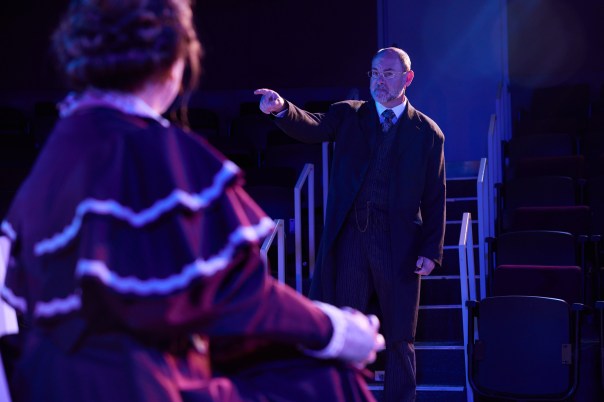
If you make a brief study of Henrik Ibsen’s original script – going beyond the Wikipedia write-up – you can get a good understanding of how playwright Lucas Hnath went about imagining his 2017 sequel, A Doll’s House, Part 2. Crack open the 1879 original, published the same year it was premiered, and you’ll find that Hnath plays fast-and-loose with the text, even before Ibsen’s characters speak. The architecture of the house is changed when Nora Helmer returns 15 years later to the place where she delivered the feminist “door slam heard around the world.” That iconic door is now emphatically displayed, rather than concealed, in Hnath’s reimagining of the scene where Nora liberated herself by simply walking out on her husband Torvald and their children.

This time, she knocks insistently rather than daintily ringing a doorbell offstage. Once she enters, received by her antique nanny Anne Marie, she notices several items are gone, including her piano, an old cuckoo clock, a cabinet with trinkets, and a portrait of Mom. But only the piano was actually there when Ibsen set the scene, and Hnath is treating Henrik’s stage directions as cavalierly as a modern stage director.
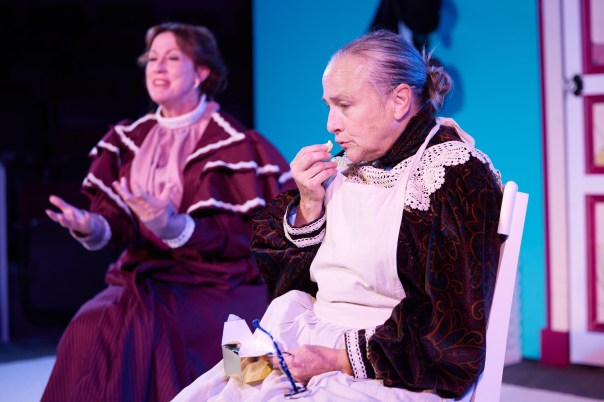
At the Mint Museum on Randolph, where Charlotte Conservatory Theatre is presenting the Queen City premiere, director Matt Cosper accurately gauges Hnath’s irreverence toward the papa of mod drama. But that doesn’t hinder Cosper from pushing the envelope a little further, by unleashing Gina Stewart to be the most skittish and hyper-fretful Anne Marie we can imagine – with a bit of hyperventilating slathered on. As the limping, desiccated nanny of yore becomes Nora’s sounding board once again, every juicy and exotic disclosure that Kellee Stall makes in the role about her tribulations and triumphs over the intervening 15 years becomes exponentially more scandalous, outre, and delicious by virtue of the old crone’s overreactions.

Cosper gives Stewart some extra business to accent her energy and curiosity, some laundry drudgery for starters as Nora is knocking on the door. Then as the wanderer opens up to her, Anne Marie is hungrily chewing on munchies or nibbling on the luxurious chocolate bonbon Nora has brought her, visibly devouring each scrap of news she hears. There’s a nibbling squirrel in both Ibsen’s Doll’s House and Hnath’s, but this time it isn’t Nora.

So exactly how has Nora thrived over these past years? For Stall arrives in a dress so resplendent, thanks to costume designer Beth Killion, that she evokes the majesty of a Macy’s Parade float or the Chrysler Building. Stretching the suspense, Nora asks Anne Marie to guess. This is fun, she remarks, bringing back more memories of Ibsen’s opening scene.

In Anne Marie’s first guess and in Nora’s subsequent revelation, we get keen glimpses into how deeply Hnath dived into Ibsen’s creation. Once you skim the Wikipedia write-up, after all, you realize that Nora is based on the marital turbulence of a writer, Laura Kieler, whom Ibsen knew well. By revealing Nora as a successful writer, Hnath is taking his cue from Ibsen, and by stealing Ibsen’s story, he exacts revenge on Kieler’s behalf, for the Norwegian novelist always resented the Norwegian playwright’s use of her story. (In real life, Mr. Kieler had his missus committed to an insane asylum.)

It’s kind of tasty.

Never guessing that her dear Nora had literary talent, Anne Marie guesses that she became an actress – a shrewd and prescient guess that will mirror Hnath’s thinking when Nora and Torvald thrash out their failed marriage. For the great fault – or fault-line – in Ibsen’s play has always been the wide gulf between the cheery and complaisant little magpie who charms Torvald in Acts 1 and 2 only to become an unbending and defiant crusader against her husband and society after the second intermission.

Famed New York Times theatre critic Walter Kerr pointed out this chasm in his analysis of the 1971 Broadway revival of the play, and he celebrated Claire Bloom’s approach to Nora as an effective way to bridge the gulf. What Kerr inferred from Bloom’s performance is pretty much what Hnath has Nora saying out loud in her final showdown with Torvald: the cheery, charming Nora that her husband remembers so fondly was largely a mix of playacting and manipulation, subterfuges that the new Nora disdains.

Shawn Halliday is as stodgy and respectable as the Torvald Helmer of old, but Hnath has given him fresh insights and self-delusions to play with – and to help Hnath in texturizing Nora a bit further. Ironically, the woman who went on to writing books that have espoused the end of marriage, inspiring other wives to walk out on their husbands, has soured Torvald on the idea of marriage simply by walking out and staying away.

“You sorta killed that for me,” he confesses.

There’s also 15 years of hurt for Halliday to harp on – and for Stall to coolly deflect. Cosper allows Halliday to play the victim card way past the brink of comedy as he turns his chair away from Stall, like a pouting child who will not speak until Nora explains why she has returned. With the exception of the elaborately decorated front door, Tom Burch’s simple set design veers as much toward hospital waiting room as it does toward a doll’s house. But when the two simple white chairs, seemingly stolen from a patio or a beach, come into the action on a matching white rug, the smallness of the Mint stage accents the husband-and-wife role reversal beautifully, especially Master Torvald’s regression.

Clearly, the best of Torvald’s grievances goes straight to her walkout. Disarmingly, he admits that Nora had made some good points before she left, but if they really hadn’t had a serious conversation on a serious subject during their whole marriage, it should have been imperative for them both to attempt to have an adult conversation right then, on the spot, aimed at building the marriage that should have been.

Nora doesn’t wish to have the what-about-the-kids conversation, but Hnath doesn’t let her off the hook. The passage of time allows him to bring Emma Helmer, Nora’s daughter, to maturity as essentially a fresh creation. It’s another plum role, and Laura Scott Cary makes a scintillating debut in it, offering Nora the most devastating pushback she gets all evening.
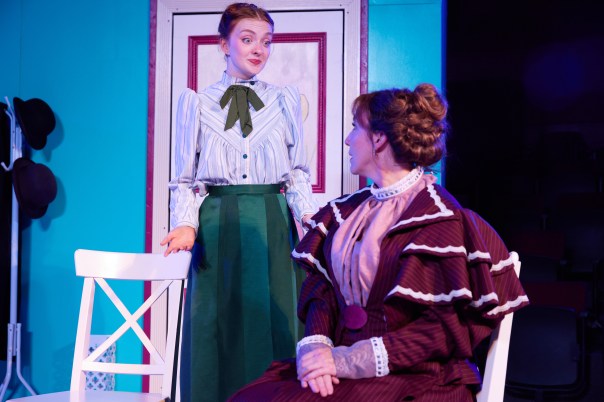
When Emma claims she bears no ill will toward her mom, Cary is so intelligent, poised, and tastefully dressed that we can’t be sure if she’s telling the truth. A wee bit doll-like? It would be easy to presume that Emma has been molded by the strictures Anne Marie and Torvald live by, perhaps processed through the smarts and spirit she inherited from Nora. Yet Cary lets us see with steely clarity that she is not intimidated by her notorious mom. Better yet, she lets Nora see that her absence, more than anything else, has cemented her daughter’s belief in the benefits of marriage and family.

Poof, Nora’s claim that marriage will be an extinct institution within 30 to 40 years, which instantly draws laughs from the audience as Hnath leverages history, now deflates before Nora’s eyes in the confines of her old doll’s house. Quite a supreme irony for someone who has picked up a torch on a mission to change society.

Every time somebody onstage lets loose with an f-bomb, we’re reminded that Hnath’s historical perspective fuels this dramatic comedy. Ibsen denied that he intended A Doll’s House as a feminist play, but Hnath hardly needs to bother making this claim. If anything, he might need to defend himself against the charge that, as exemplified by Anne Marie and Nora, he’s telling us that women don’t know what they want. No, you will not find the answer to why Nora returns in this review. The best way to find out what is driving Nora – and to experience all the shocks she delivers and receives – is to watch how Hnath’s rewarding sequel unfolds at the Mint Museum Randolph. Perhaps the better question to ask, after seeing this beautifully balanced Charlotte Conservatory Theatre production, is whether Nora will ever take yes for an answer

Newborn Charlotte Conservatory Conjures Theatre Magic – and Memories of Charlotte Rep – with “Witch”

Review: Witch from Charlotte Conservatory Theatre

By Perry Tannenbaum

Witch Photo

August 11, 2022, Charlotte, NC – Last April, when theatre was just beginning to emerge from its pandemic hibernation, would have the perfect moment for Charlotte Conservatory Theatre to spring to life with its first production, Jen Silverman’s Witch, now at Booth Playhouse. For the 2018 tragicomedy was based on The Witch of Edmonton, a lurid script written by William Rowley, Thomas Dekker and John Ford. All of that original play – all five acts, mostly in iambic pentameter – was written and readied for performance within the space of four months. That’s how long it had been since the true-life “witch” the play was based upon, Elizabeth Sawyer, was hanged for witchcraft on April 19, 1621. A year and four months after the quadricentennial of that execution, when our fears have shifted from death by COVID to inflation and monkeypox, the sardonic tear-it-all-down thrust of Silverman’s play may have blunted a little, but its fierce feminism remains intact.

Make no mistake, most of the gripping power of this evening at the Booth emanates from the white-hot Charlotte debut of Audrey Deitz as the lonely, defiant, and principled Elizabeth. But then there’s also the Charlotte debut of Stephen Kaliski as Scratch to bring out all of Dietz’s bewitching charisma, for his portrayal of the Devil has plenty of charisma to vie with Elizabeth’s. Kaliski was guileful, quick-witted, disarmingly frank, and surprisingly vulnerable on opening night. Here the Devil had met his match and more.

Such stunning simultaneous debuts of two experienced out-of-town actors with a local theatre company at Booth Playhouse are phenomena we haven’t enjoyed since the demise of Charlotte Repertory Theatre in early 2005. The regional professional aroma of that long-gone LORT company was sustained by the polish of the design team, led by scenic designer Tom Burch, whose previous local gigs I’ve praised at UNC Charlotte and Children’s Theatre. With their brushwork, scenic artist Lane Morris and portrait artist Eva Crawford clash a bit with Burch’s 17th century furnishings, echoing how Silverman pulls against the bygone era with her idiomatic dialogue. But Kellee Stall’s costume designs settle the matter, sort of. “Then-ish. But equally of our moment,” is Silverman’s dictate on the era of her work.

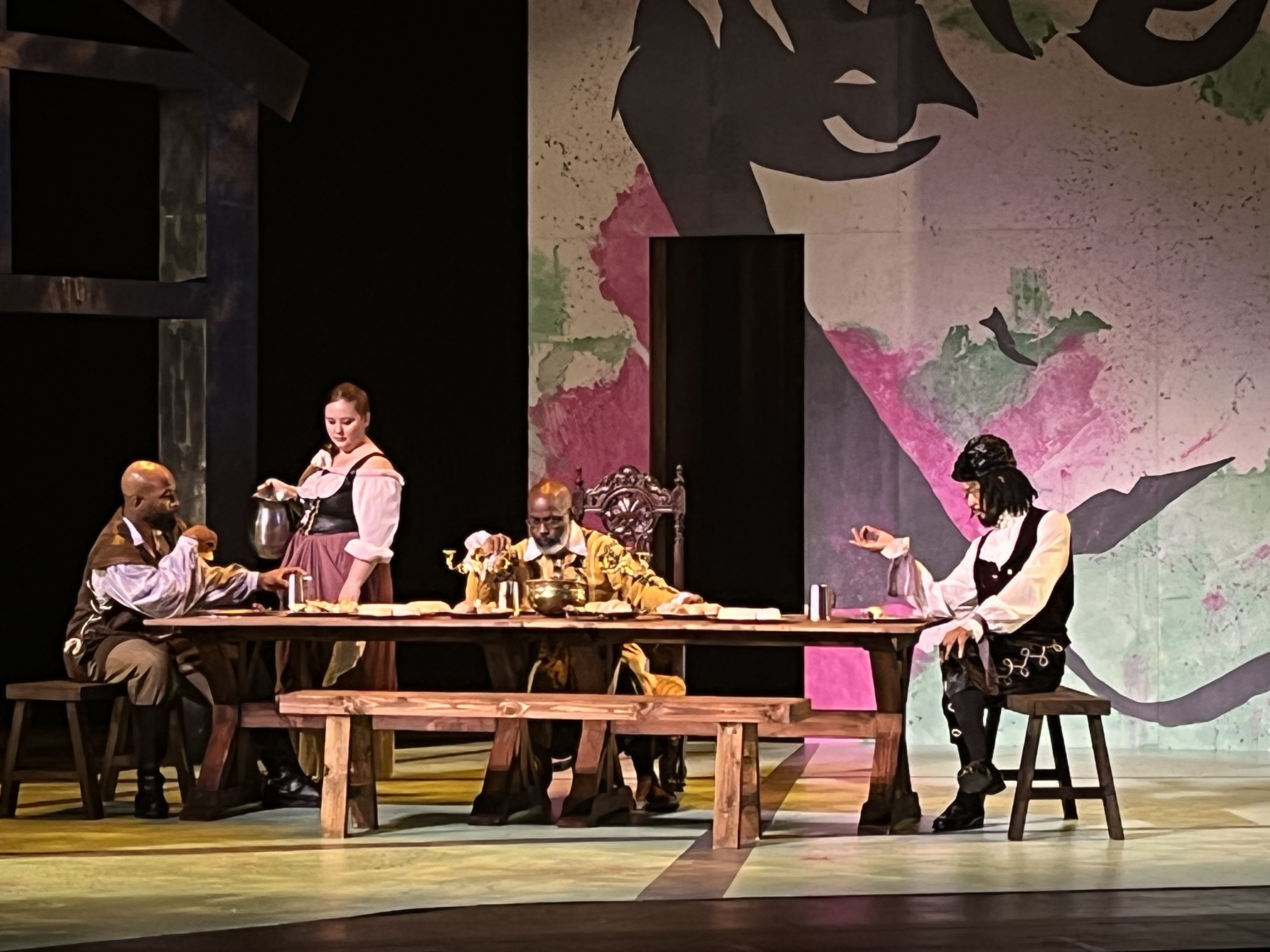
We see the “Then” most vividly in Stall’s costumes when we shuttle to Silverman’s other plotline at Sir Arthur Banks’s castle, which occupies most of the stage. After Elizabeth’s opening burn-it-all-down aria, delivered under a sharply brilliant spotlight, the other actors parade onstage, following the lead of Cuddy Banks, Sir Arthur’s foppish/effeminate son, who may be morris-dancing around Dad’s imposing dinner table. Anyway, he will soon tell Scratch that he performs in a morris-dancing troupe. What Silverman and Elizabeth seem to enjoy most about Scratch is that he’s selective.

So what Cuddy likes about Scratch, when he comes offering temptations in exchange for his soul, is that he’s coming to him before approaching either Elizabeth or the up-and-coming Frank Thorney. You see, Dad has taken Frank into his household and is now thinking about adopting the upstart, because Frank is clearly more likely to produce an heir. Robert Lutfy, who has been off our radar as a director for over a decade, makes an interesting alteration in how he sees Cuddy, pointing up his sexuality and discarding his shyness, handing a plum comical role to Jeremy DeCarlos, who feasts on it. What was easy to forget on opening night, amid DeCarlos’s prancing and his Percy Blakeney fopperies, was that Cuddy first considered asking for Winnifred, Dad’s servant, in exchange for his soul. Scratch short-circuits that request by pointing out that Winnifred is secretly married to Frank – a revelation that is doubly devastating to Cuddy. Even as he switches the bargain, exchanging his soul for Frank’s life, he is wildly in love with his manly, dashing nemesis.

If you’re scratching your head a little over Scratch’s objection to Winnifred, you will learn more intriguing details about Silverman’s concept of the tempter. He is not all to be confused with Satan or Lucifer – or with their supernatural omniscience. Instead, he’s like a traveling salesman, assigned to a specific territory, not exactly a rookie but lacking in past prestigious catches to boast of. Watching Witch at the Booth, I had the feeling that, after bagging Cuddy, Scratch moved on to Elizabeth and Frank because his bargaining with Cuddy yielded those leads. Dominic Weaver plays the confident and ambitious Frank with a hulking, self-assured swagger that contrasts perfectly with DeCarlos’s spindly fidgeting.

When Frank sets his price at becoming Sir Arthur’s heir, in exchange for his soul, Scratch’s answer is exactly the same as when Cuddy asked him to kill Frank: “I think we can make that work.” You might wonder how Satan’s Edmonton rep accommodates both rivals. Without explicitly answering, I’ll surmise that Silverman may have read Macbeth as profitably as she read The Witch of Edmonton. Fulfilling the devil’s work delivers some complications, of course, not the least of them are Winnifred’s flare-ups when she hears that her husband is yielding to Sir Arthur’s efforts to fix Frank up with a nobly-born wife.

It’s not just Elizabeth and Cuddy, then, who get their opportunities to sing their woes. From her multiple cares and troubles, Savannah Deal gets to deliver a fine aria – Silverman’s term for all the soliloquies she doles out to her players – touching us as she transcends her worldly status of peasant wench. Ron McClelland certainly gets multiple chances to humanize Sir Arthur, pouring his heart out to his deceased wife (the woman in the portrait) and agonizing over the future of his family name.

Witch Photo 2

Your only worry, as Silverman’s separate plotliness develop, is whether she will ever tie them together. It’s not a terrible concern, for Elizabeth’s destiny becomes as fascinating as the love triangle at the castle once Scratch becomes as besotted with Elizabeth as we are. Silverman offers the choice of casting the outcast witch as a woman from her 40s to her 60s, but after seeing the vibrancy of Dietz in the title role, I believed Lutfy made the ideal choice in going for the low end of that scale. Aside from one single bobbled line, the opening night performance was seamless, magical perfection. What an auspicious beginning for Charlotte Conservatory Theatre! May their future runs be longer than four days.

UNC Charlotte Drops a Russian Clown into the Cogs of Heiner Müller’s “Hamletmachine”

hamletmachine-360px

By Perry Tannenbaum

March 19, 2016, Charlotte, NC – More than with most scripts, it’s difficult to say what exactly Heiner Müller had in mind when he wrote Hamletmachine in 1977. Performances of Müller’s plays were banned in East Germany until the fall of the Berlin Wall, so the 1979 world premiere was presented – in translation – in Paris, and when Müller himself finally directed the piece for the first time in his homeland, it was as the play-within-a-play in a far larger 1990 production of Hamlet, presumably in his own translation since that what was what he had completed before embarking on his own.

Looking at this script, which occupies just three pages in The Wadsworth Anthology of Drama (4th ed.), I’d have to say it’s presumptuous to call it a play at all, for it doesn’t offer a list of characters and doesn’t actually assign any dialogue to anyone until the second of its five parts. We can hardly greet that as a clarifying moment when Müller writes, “Ophelia (Chorus/Hamlet): I am Ophelia.” Nor is the custom of attribution religiously observed afterwards in a text that often resembles T.S. Eliot’s The Waste Land in its stream-of-consciousness style and allusiveness. We should not be surprised that the current production at UNC Charlotte’s Robinson Hall, presented by the College of Arts + Architecture at the Anne R. Belk Theater, not only boasts three directors but also three Ophelias and four Hamlets in a production that clocked in at just under 38 minutes.

A wide latitude of interpretation is built into the text, which explains the fact that one Japanese production lasted 12 hours. That surely isn’t the outer limit, for Müller decrees “Snow. Ice Age,” after the executions of Marx, Lenin, and Mao at the end of Part IV. Yet I must say that the UNC Charlotte production follows the text far more closely – and recognizably – than the previous production I saw in Charlotte, presented by Off-Tryon Theatre Company as part of a double bill with Rosencrantz and Guilderstern Are Dead in 2005. Leading the all-female directing team, UNCC assistant professor Robin Witt has eliminated (among other things) the appearances of King Claudius, the striptease by Ophelia, and the gravestones or lecterns that should be the university of the dead in Part III. A whole motif involving Hamlet’s armor and his axe is altered beyond recognition, and the executions of the Communist trinity, which should have been done by Hamlet with that axe, are now done bloodlessly by hanging.

I’m not sure whether there was a malfunction in Benjamin J. Stickels’ sound design, but I never discerned the voices of Lenin, Mao, and Marx, though three are listed for them in the program booklet. Similarly, the men and women dressed in white by costume designer Beth Killion are all designated as Chorus in the playbill, so I wasn’t aware until later, when I’d revisited the script, that the segment choreographed by Alex Baesen was a ballet of the dead women. It looked more like a dance of angels to me, though the woman with the little stove around her head should have told me that she was a suicide or a Holocaust victim.

There are also additions to the script by Witt and her team, including Marc Smith as a German Speaker and, most conspicuously, Kineh N’Gaojia as a Russian Clown who beautifully sings Leon Russell’s “A Song for You” for no particular reason. Before her concluding monologue as Ophelia Wheelchair, Raven Monroe inserts Todd Rundgren’s “Can We Still Be Friends.” Of course, when she begins her monologue declaring, “This is Electra speaking,” and ends by vaguely alluding to the Manson Family and Sqeaky Fromme, it’s hard to be sure who Monroe is as the lights go down on her in her wheelchair.

The sinew of Müller’s text is given when Hamlet Flag (née The Actor Playing Hamlet) has his long monologue in Part IV, “Pest in Buda / Battle for Greenland.” I’d say that the upshot of this ramble, ably delivered by Matt Miller, is that the revolutionaries who had ushered in the triumph of Communism in Eastern Europe had succeeded so well that they had rendered the possibility of current and future revolutions extinct. Looking frankly at himself, the Actor Playing Hamlet asserts that the Hamlet who once was, the brooding assassin who engineered a coup d’état, no longer exists and can no longer exist. The executions that follow are merely wishful thinking – by a populace of Hamlets who remained too indecisive too long.

Jamie Gonzalez was my favorite among the Ophelias. Her heart is not visibly a clock as the text demands. Instead, she is wheeled onstage as Ophelia Bed to deliver her lurid monologue, giving her a kinship with the Ophelia Wheelchair to come. No such connections are attempted among the Hamlets, since all four of them parade in front of us at the outset. Noah Tepper seems like he will be dominant as Hamlet Skull, conversing with a puppet Horatio (Brittany White), but he is succeeded by Tykiique Cuthkelvin as Hamlet Book and Jennifer Huddleston as Hamlet Axe before Miller’s Flag takes over. The gender bending in Witt’s casting becomes plausible enough when Miller’s Hamlet announces, “I want to be a woman.” He gets his wish when the Chorus surrounds him and dresses him up as Ophelia, but he’s back in tacky 1970s leisure wear by the time he launches into his big monologue.

While the thrust of Müller’s script is unmistakably an outcry against living under totalitarianism, its production at UNCC paradoxically affirms the benefits of dictatorship. It’s not a total coincidence that the most admired production of this piece, the 1986 revival directed by Robert Wilson (even Müller preferred it to his own), was presented at another university, NYU. Not only can university professors ignore commercial viability when deciding what they present on their stages, they can lavish resources upon each project that leave the prudential considerations of capitalism deeper in the dust.

That is the true wonder to behold when comparing the staging at Robinson Hall to the Off-Tryon version I saw in 2005. Tom Burch’s scenic design lifts this production to a frightful level of gritty German expressionism that is simply phenomenal, mirrored by the imaginative artistry of the props and costumes. Primitive stairways lead up to a platform where the mutilated German Speaker can babble, and the wall behind that platform is large enough to project the titles of each of the five parts we’re watching. When the script alludes to a television, Burch can deploy four of them, each one broadcasting nothing more than white noise.

The obvious reward of such excess is a Hamletmachine that is vivid and engaging – but no less mystifying than it is on the page. No doubt the post-performance discussion following the Saturday evening performance was helpful for amazed and baffled audience members who remained afterwards, and another discussion is scheduled with the cast and designers after the March 21 performance. Otherwise, there’s plenty to be gleaned from dramaturg Jeanmarie Higgins’ program note and the handy Tumblr website she and her dramaturgy students have established online.

© 2016 CVNC + Perry Tannenbaum

Wizards of Winging It

Theatre Review: Journey to Oz

By Perry Tannenbaum

DONNA BISE

I’m not sure what the guidelines are on picture-taking at the new Children’s Theatre production of Journey to Oz, written and directed by Christopher Parks. Three or four kids in the audience read the pre-show announcements, and I must confess that I was so focused on how well they managed to talk into the microphones planted on the ears of various adult cast members that I didn’t pay much attention to what they were saying.

Whether or not photos are actually banned, I can report that, at last Saturday afternoon’s performance, there was a photo- and movie-taking orgy as the 75-minute fantasy unfolded. And I can’t say that I heard even one discouraging word from the staffers who were ushering. Children and parents were invited onstage to play a wide assortment of characters from L. Frank Baum’s Wizard of Oz: the Cowardly Lion, the Tin Man, the Scarecrow, and even the Mayor of Munchkinland.

And of course, multiple adorable Dorothys paraded down the aisles of the McColl Family Theatre. Considering that the contours of Tom Burch’s scenic design are the book stacks we might find at a public library – not Baum’s Kansas plains or his rainbow realm of Oz – I’d say that the iPhones gleefully chronicling the misadventures of children, husbands, and moms onstage added to the giddy mix of make-believe.

Oz erudition isn’t what it once was when Judy Garland sang “Over the Rainbow” every year on TV without ever aging. So the kids and parents fetched from the audience are far more likely to wander off script than they would have a couple of decades ago. Cast members eschew the subtle discrimination of asking for volunteers, so shyness and stage fright can also come into play.

Parks has his five-member cast primed for the unexpected, that’s for sure. A kid in the first row was called on to emulate Toto, but he repeatedly emitted a bark that was no louder than a purr. The dad chosen as Mayor couldn’t bother to try a high Munchkin voice or to offer any testimony at Dorothy’s criminal trial at the Witch’s castle. Cast members didn’t skip over these difficulties, persisted in efforts to get things right, but they never mocked the amateurs. We moved right along at just the right moment.

Opportunities for us to participate helped to sustain our goodwill. When the cyclone touched down in Kansas, we were the wind. When Dorothy landed in Oz, we were the Munchkins who welcomed her. And when the hapless Scarecrow was besieged by crows, we were rallied to be their caws. Perhaps the most magical participatory moment was when we arrived in the Emerald City and a mini-battalion of kids converged upon them from the wings, surreptitiously recruited to portray the Ozians.

Journey to Oz isn’t myopically focused on the foundational Wizard narrative. Over and over, the players insert little vignettes about Baum, newspaper reactions to his books, personal anecdotes, and tidbits on his times. It’s a little like an annotated edition. We also get a sense of the breadth of Baum’s Oz series, which Parks deftly keeps unobtrusive. Our only lengthy digression into the greater Oz opus comes when the players point out to us that the adventures invariably begin with a dramatic act-of-God cataclysm. The cyclone of The Wizard gave way to an earthquake to trigger one of the many Oz sequels, then an avalanche, and – weirdest of all – a “hurricane drizzle.”

When we got down to business, the upstage library shelves parted to simulate the prairie and subsequently, our arrivals in Muchkinland and the Emerald City. The bookshelves lining the wings never disappeared, forming the backdrop for the first encounter with the Scarecrow and the witness box for the trial. The Wicked Witch of the West actually entered through a bookcase, framed in appropriately spooky light and smoke, and a few paper-cut props – a beard, a lion’s mane, and Toto – fancifully originated from a large book spread out on a lectern.

The magic is resolutely low–tech here, and the classy costumes by Jennifer Matthews aim in a totally different direction from the last Wizard of Oz produced by Children’s Theatre, when the late Alan Poindexter directed and portrayed a singularly frightful Wicked Witch. This time, the hat worn by Nicia Carla in the same role looks like it was snatched from the Cat in the Hat’s closet.

Carla is spared from extensive emceeing chores, but she does confront a Dorothy or two during the drama, proving quite adept at modulating her menace. Tiffany Bear is vaguely dressed like Dorothy and wields the Toto wicker basket and puppet, but she’s more explicitly Glinda when she’s chaperoning the anklebiter Dorothys onto the stage, a very engaging emcee.

Of the three guys in the cast, Tommy Foster and Dan Brunson pitch in most often on the hosting chores. Chaz Pofahl aligns himself with Carla at the beginning and end of the show, starting out as Uncle Henry opposite her Auntie Em, and ending as her servile Flying Monkey Lawyer at Dorothy’s trial. In between, Pofahl has a nice stint as Scarecrow.

Foster is the most gregarious of the three guys, doing more of the audience interaction and morphing into the Cowardly Lion. Brunson’s fine physical work as the Tin Woodsman steals far more of the show than you usually see. His robotic shtick before and during his therapeutic lube job vies in hilarity with Carla’s melting – under a barrage of confetti water.