Tag Archives: Shawn Halliday

“Ripcord” Brings Mortal Combat to Senior Living

Review: Ripcord at Davidson College

By Perry Tannenbaum
We’ve had more than a couple of engaging David Lindsay-Abaire moments in the Charlotte metro over the years, beginning with the Actor’s Theatre production of Fuddy Meers in 2002. Wonder of the World continued the company’s love affair with Lindsay-Abaire in 2004, and when the playwright’s Rabbit Hole took the 2006 Tony Award and the 2007 Pulitzer, Actor’s Theatre took full custody for the 2008 Charlotte premiere.

Since then, the edgy Lindsay-Abaire has largely disappeared, along with – not coincidentally, I’d contend – Actor’s Theatre of Charlotte. The exception proved the rule when Carolina Actor’s Studio Theatre mounted a fine production of L-A’s Good People in 2013, for CAST made its exit years before ATC’s demise.

Tiding us over until the current run of Ripcord in a Davidson Community Players productionat Duke Family Performance Hall, Lindsay-Abaire has graced us with numerous softer, cuddlier visitations. For he wrote the book for the musicals that brought the animated Shrek to life in a trinity of darling fluff, beginning with Shrek the Musical before hatching its twin afterbirths, Shrek Jr. and Shrek TYA. A full-length revival was staged at ImaginOn by Children’s Theatre as recently as 2022.

With the touring edition of Lindsay-Abaire’s newest Tony Award winner, Kimberly Akimbo,due for a Knight Theater rendezvous next April, many Charlotte theatergoers may rightly feel that the time is ripe for catching up with this notably successful writer. They will find a very fine production at the Duke, nestled inside the Davidson College student center, although Ripcord isn’t Lindsay-Abaire at his edgiest.

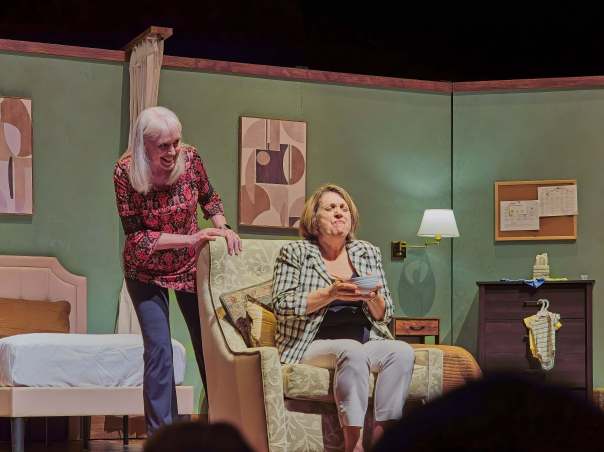
On the other hand, Ripcord isn’t nearly as humdrum as its main locale, Bristol Place Senior Living in New Jersey, would lead you to presume. That’s because roommates Abby and Marilyn have radically clashing temperaments, turning the apartment into a tinderbox. Fundamentally, Abby is misanthropic grouch who treasures her privacy – but instead of forking out the extra cash that would put her in a private apartment, she has pragmatically made herself impossible to live with.

Sunny, cheerful, and chatty, Marilyn is totally averse to the quiet and solitude Abby thrives on, breezing into the suite in a jogging outfit while her sedentary counterpart vegetates on an easy chair. She doesn’t see Abby as a mortal enemy. She’s oblivious to most of the insults that Abby hurls at her and impervious to the rest. Marilyn needs to play with others and blithely treats Abby’s hostility as playful banter.

Such insouciance totally flabbergasts and infuriates Abby, opening avenues to comedy and drama. Lindsay-Abaire slyly chooses both. So do director Matt Webster and his cast, decidedly tipping the scales toward comedy. You can easily despise both Pat Langille as the Pollyanna senior Marilyn and Karen Lico as her adversary.

Abby’s inability to dim Marilyn’s sunniness is frustrating enough for her to enlist the assistance of eager-to-please Scotty, the resident aide who cares most about the women. You can definitely empathize with Scotty when Abby confides in him and keeps pestering him to get Marilyn transferred to a single apartment that has become vacant downstairs.

Strangely enough, Scotty’s patience isn’t as boundless as the saintly Marilyn’s, which gives Lowell Lark some leverage to work with in the role. As a peacemaker, he gently informs Abby that she likes it upstairs, where it’s sunnier and there’s a nice view of the nearby park. As a dealmaker, he won’t commit to speaking to management on Abby’s behalf about moving out her roomie, but he could get in a word for her about serving up some chicken and dumplings – instead of the usual tasteless gruel – if she’ll buy a ticket and come to a show he’s acting in.
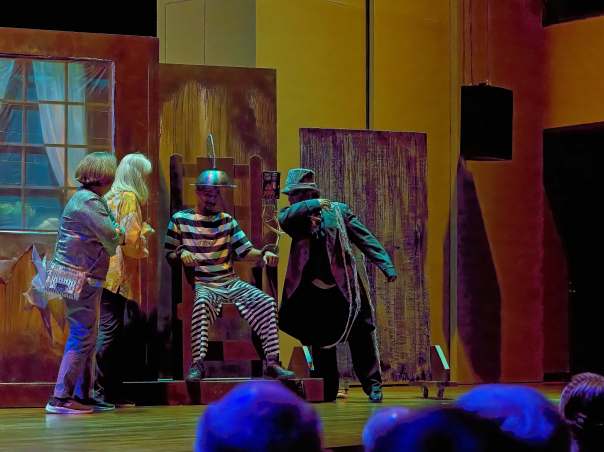
Actually, “Beelzebub’s Den” is a haunted house, liberating us from the ladies’ institutional humdrum bedroom and bath on an excursion to the first of three breakaway scenes, two of them obliging set designer Kaylin Gess to create living quarters that quickly stow away in the Duke’s commodious wings. Lots of work for the seven-person set crew. Doubling as DCP’s lighting designer, Gess gets to supply the phantasmagoria at Beelzebub’s while Beth Killion provides the outré costume designs. Technical director Shawn Halliday also gets in on the fun, here and in the signature skydiving scene.

There’s fun for us watching the haunted house antics, but Abby is neither impressed with Scotty’s acting nor scared by any of the spookiness. Abby matter-of-factly tells that she doesn’t scare. Period.

Enjoy the fun, then, but the prime takeaway from Beelzebub’s is Abby’s pride in her fearlessness. In the very next scene back at assisted living, Marilyn will insist with equal certitude that nothing Abby can do will make her angry. Resistant to all the previous bets her quirky roomie has proposed, including whether she can balance a slipper on her head, Abby sees a betting opportunity here. If Abby can make Marilyn angry, she wins. If Marilyn can scare Abby, victory!

The high stakes are predictable: if Abby wins, Marilyn leaves; if Abby loses, Marilyn gets to take over the coveted bed near the window. Game on!

And no holds barred. Lico and Langille aren’t at the high end of Lindsay-Abaire’s specified age range for their roles, so the patina of seeing ancient biddies acting like kiddies isn’t happening in Davidson. But it is definitely the playwright’s intent for Langille to exceed expectations with her imaginativeness and for Lico to shock us with her meanness and cruelty.

With stakes set this high, this is war, and the warfare escalates each time an attack fails. Bombarding your roomie with phone calls and fake messages or drugging your roomie are not out of bounds as the battles begin. Enlisting your relatives and pranking your opponents’ kin are also legit strategies as the Abby-Marilyn War escalates. The avenues of comedy and drama widen along the way.

Langille and Lico obviously revel in hatching their devilish schemes and flouting our presumptions of senior citizens’ dignity and decorum. So the Odd Couple comedy, seasoned with a half century of aging, works well. But there’s also a theme of bonding that Lindsay-Abaire plants deeply in his script from the moment his antagonists strike their bet. Reviews of the 2015 Manhattan Theatre Club premiere indicate that director David Hyde Pearce missed it with his sitcom reading, and Webster also misses some of the early hints.

Yeah, Scotty the peacemaker and dealmaker subtly evolves into the common enemy – inevitably, the uniter, if both women survive! – when Abby and Marilyn solemnly agree to keep their bet a secret from him. Lark has his best moments when he suddenly appears at an inopportune time, threatening to blow the renegade gamblers’ cover.

The deeper mojo is in the bond formed between the two combatants, a literary staple stretching past Robin Hood and Little John all the way back to the Homeric epics. We’ve all seen two boxers sincerely hugging one another after pummeling each other for 12 or even 15 rounds. That’s genuine emotion, the rawest kind, not ritual or fakery. It comes from a gradually growing appreciation of your opponents’ gifts and grit as the battle grinds on. At its keenest, the upswell of emotion also comes from the realization that your mortal enemy has pushed you to a level that you never believed possible – and that part of extra specialness of your opponents’ performance comes partly from you.
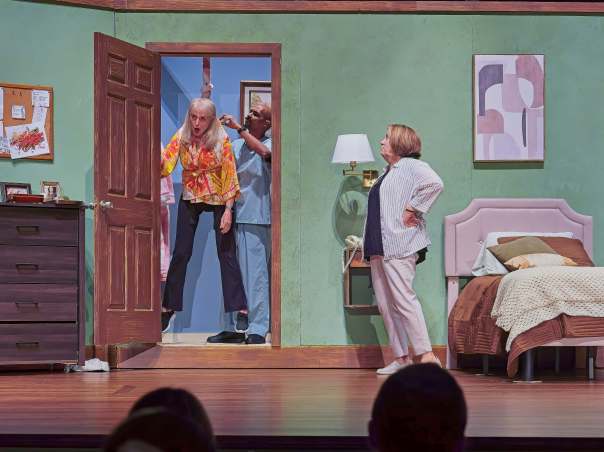
So there are many fine moments that Lico and Langille have once the game is on, though digging into them would disclose too many comical and dramatic spoilers. Equal to any one of them is the spot where, the bet having been won, the combatants begin praising each other for their devilish deeds. At that point, Webster, Lico, and Langille are all catching Lindsay-Abaire’s drift.

Supporting actors are also a treat, starting with Rigo Nova as the Zombie Butler, our host at Beelzebub’s. Transforming into Derek, Marilyn’s son-in-law, Nova is almost as surreal in his geniality and self-doubt. Victimized by one of Marilyn’s pranks, John Pace wears his victimhood well as Abby’s drifter son after donning a clown suit back at the haunted house.

Kimberly Saunders is also spectacularly silent at Beelzebub’s as the Woman in White, but her surprise appearance as Colleen, Marilyn’s daughter, is an immediate joy – for she is foiling Abby’s first wicked prank just by walking through the doorway. Soon she’ll be rubbing her hands with glee at the prospect of joining her Mom in some awesome payback. Mischief is more fun when the whole family is in on the plot.

Make the Speech and Slam the Door – Again?

Review: A Doll’s House, Part 2 at The Mint Museum

By Perry Tannenbaum

If you make a brief study of Henrik Ibsen’s original script – going beyond the Wikipedia write-up – you can get a good understanding of how playwright Lucas Hnath went about imagining his 2017 sequel, A Doll’s House, Part 2. Crack open the 1879 original, published the same year it was premiered, and you’ll find that Hnath plays fast-and-loose with the text, even before Ibsen’s characters speak. The architecture of the house is changed when Nora Helmer returns 15 years later to the place where she delivered the feminist “door slam heard around the world.” That iconic door is now emphatically displayed, rather than concealed, in Hnath’s reimagining of the scene where Nora liberated herself by simply walking out on her husband Torvald and their children.

This time, she knocks insistently rather than daintily ringing a doorbell offstage. Once she enters, received by her antique nanny Anne Marie, she notices several items are gone, including her piano, an old cuckoo clock, a cabinet with trinkets, and a portrait of Mom. But only the piano was actually there when Ibsen set the scene, and Hnath is treating Henrik’s stage directions as cavalierly as a modern stage director.

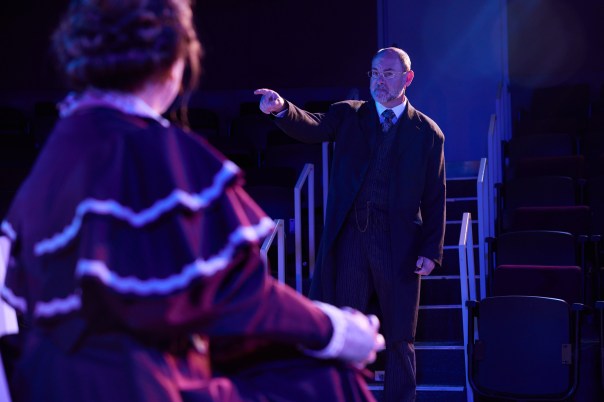
At the Mint Museum on Randolph, where Charlotte Conservatory Theatre is presenting the Queen City premiere, director Matt Cosper accurately gauges Hnath’s irreverence toward the papa of mod drama. But that doesn’t hinder Cosper from pushing the envelope a little further, by unleashing Gina Stewart to be the most skittish and hyper-fretful Anne Marie we can imagine – with a bit of hyperventilating slathered on. As the limping, desiccated nanny of yore becomes Nora’s sounding board once again, every juicy and exotic disclosure that Kellee Stall makes in the role about her tribulations and triumphs over the intervening 15 years becomes exponentially more scandalous, outre, and delicious by virtue of the old crone’s overreactions.

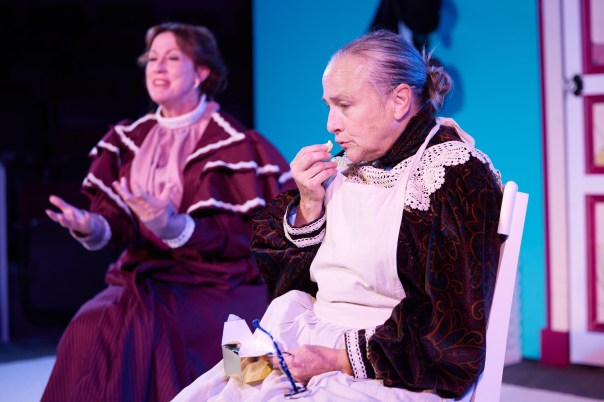
Cosper gives Stewart some extra business to accent her energy and curiosity, some laundry drudgery for starters as Nora is knocking on the door. Then as the wanderer opens up to her, Anne Marie is hungrily chewing on munchies or nibbling on the luxurious chocolate bonbon Nora has brought her, visibly devouring each scrap of news she hears. There’s a nibbling squirrel in both Ibsen’s Doll’s House and Hnath’s, but this time it isn’t Nora.

So exactly how has Nora thrived over these past years? For Stall arrives in a dress so resplendent, thanks to costume designer Beth Killion, that she evokes the majesty of a Macy’s Parade float or the Chrysler Building. Stretching the suspense, Nora asks Anne Marie to guess. This is fun, she remarks, bringing back more memories of Ibsen’s opening scene.

In Anne Marie’s first guess and in Nora’s subsequent revelation, we get keen glimpses into how deeply Hnath dived into Ibsen’s creation. Once you skim the Wikipedia write-up, after all, you realize that Nora is based on the marital turbulence of a writer, Laura Kieler, whom Ibsen knew well. By revealing Nora as a successful writer, Hnath is taking his cue from Ibsen, and by stealing Ibsen’s story, he exacts revenge on Kieler’s behalf, for the Norwegian novelist always resented the Norwegian playwright’s use of her story. (In real life, Mr. Kieler had his missus committed to an insane asylum.)

It’s kind of tasty.

Never guessing that her dear Nora had literary talent, Anne Marie guesses that she became an actress – a shrewd and prescient guess that will mirror Hnath’s thinking when Nora and Torvald thrash out their failed marriage. For the great fault – or fault-line – in Ibsen’s play has always been the wide gulf between the cheery and complaisant little magpie who charms Torvald in Acts 1 and 2 only to become an unbending and defiant crusader against her husband and society after the second intermission.

Famed New York Times theatre critic Walter Kerr pointed out this chasm in his analysis of the 1971 Broadway revival of the play, and he celebrated Claire Bloom’s approach to Nora as an effective way to bridge the gulf. What Kerr inferred from Bloom’s performance is pretty much what Hnath has Nora saying out loud in her final showdown with Torvald: the cheery, charming Nora that her husband remembers so fondly was largely a mix of playacting and manipulation, subterfuges that the new Nora disdains.

Shawn Halliday is as stodgy and respectable as the Torvald Helmer of old, but Hnath has given him fresh insights and self-delusions to play with – and to help Hnath in texturizing Nora a bit further. Ironically, the woman who went on to writing books that have espoused the end of marriage, inspiring other wives to walk out on their husbands, has soured Torvald on the idea of marriage simply by walking out and staying away.

“You sorta killed that for me,” he confesses.

There’s also 15 years of hurt for Halliday to harp on – and for Stall to coolly deflect. Cosper allows Halliday to play the victim card way past the brink of comedy as he turns his chair away from Stall, like a pouting child who will not speak until Nora explains why she has returned. With the exception of the elaborately decorated front door, Tom Burch’s simple set design veers as much toward hospital waiting room as it does toward a doll’s house. But when the two simple white chairs, seemingly stolen from a patio or a beach, come into the action on a matching white rug, the smallness of the Mint stage accents the husband-and-wife role reversal beautifully, especially Master Torvald’s regression.

Clearly, the best of Torvald’s grievances goes straight to her walkout. Disarmingly, he admits that Nora had made some good points before she left, but if they really hadn’t had a serious conversation on a serious subject during their whole marriage, it should have been imperative for them both to attempt to have an adult conversation right then, on the spot, aimed at building the marriage that should have been.

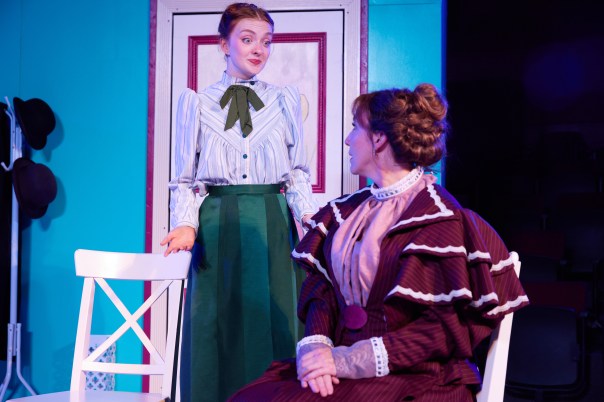
Nora doesn’t wish to have the what-about-the-kids conversation, but Hnath doesn’t let her off the hook. The passage of time allows him to bring Emma Helmer, Nora’s daughter, to maturity as essentially a fresh creation. It’s another plum role, and Laura Scott Cary makes a scintillating debut in it, offering Nora the most devastating pushback she gets all evening.

When Emma claims she bears no ill will toward her mom, Cary is so intelligent, poised, and tastefully dressed that we can’t be sure if she’s telling the truth. A wee bit doll-like? It would be easy to presume that Emma has been molded by the strictures Anne Marie and Torvald live by, perhaps processed through the smarts and spirit she inherited from Nora. Yet Cary lets us see with steely clarity that she is not intimidated by her notorious mom. Better yet, she lets Nora see that her absence, more than anything else, has cemented her daughter’s belief in the benefits of marriage and family.

Poof, Nora’s claim that marriage will be an extinct institution within 30 to 40 years, which instantly draws laughs from the audience as Hnath leverages history, now deflates before Nora’s eyes in the confines of her old doll’s house. Quite a supreme irony for someone who has picked up a torch on a mission to change society.

Every time somebody onstage lets loose with an f-bomb, we’re reminded that Hnath’s historical perspective fuels this dramatic comedy. Ibsen denied that he intended A Doll’s House as a feminist play, but Hnath hardly needs to bother making this claim. If anything, he might need to defend himself against the charge that, as exemplified by Anne Marie and Nora, he’s telling us that women don’t know what they want. No, you will not find the answer to why Nora returns in this review. The best way to find out what is driving Nora – and to experience all the shocks she delivers and receives – is to watch how Hnath’s rewarding sequel unfolds at the Mint Museum Randolph. Perhaps the better question to ask, after seeing this beautifully balanced Charlotte Conservatory Theatre production, is whether Nora will ever take yes for an answer

Common Thread Presents an Uncommonly Well-Constructed Racial Comedy

Review: Barbecue at Davidson College

 By Perry Tannenbaum

Common Thread Theatre Collective - Barbecue

July 15, 2022, Davidson, NC – There are plenty of questions to ask in Robert O’Hara’s Barbecue as two O’Mallery families – one white and one black – gather at the same park, both of them staging fake outdoor parties for the same kindly but devious purpose. These questions explode upon us as soon as the white O’Mallerys are replaced by the black O’Mallerys after the first blackout, wearing the same exact outfits we have just seen moments earlier, drinking the same beverages, and popping the same pills. Even their names are the same. Both Lillie Anns are prodding their reluctant kinfolk – husband James T. and sisters Adlean and Marie – to drape the same pavilion at the park in party decorations, to feign a joyous family celebration, and to confront family renegade Barbara and get her into a therapy program that Lillie Ann has specially chosen for her in faraway Alaska.

Mercifully, we gather that both of O’Hara’s O’Mallery families are on the same track because their scenes deftly overlap rather than tediously repeating. The checkerboard structure of the playwright’s comedy was a perfect vehicle for the new hybrid company that was presenting it at Barber Theatre on the Davidson College campus. Common Thread Theatre Collective is a joint venture between North Carolina A&T State University theatre faculty members and Davidson’s Department of Theatre. Established 131 years ago in Greensboro, A&T is the nation’s largest historically black university, with a student body that is currently less than 80% African American. Domestic students of color, according to Davidson’s website, are currently at 28% of the matriculated population – and an influx of 8% international students enhances the College’s diversity.Common Thread Theatre Collective - Barbecue

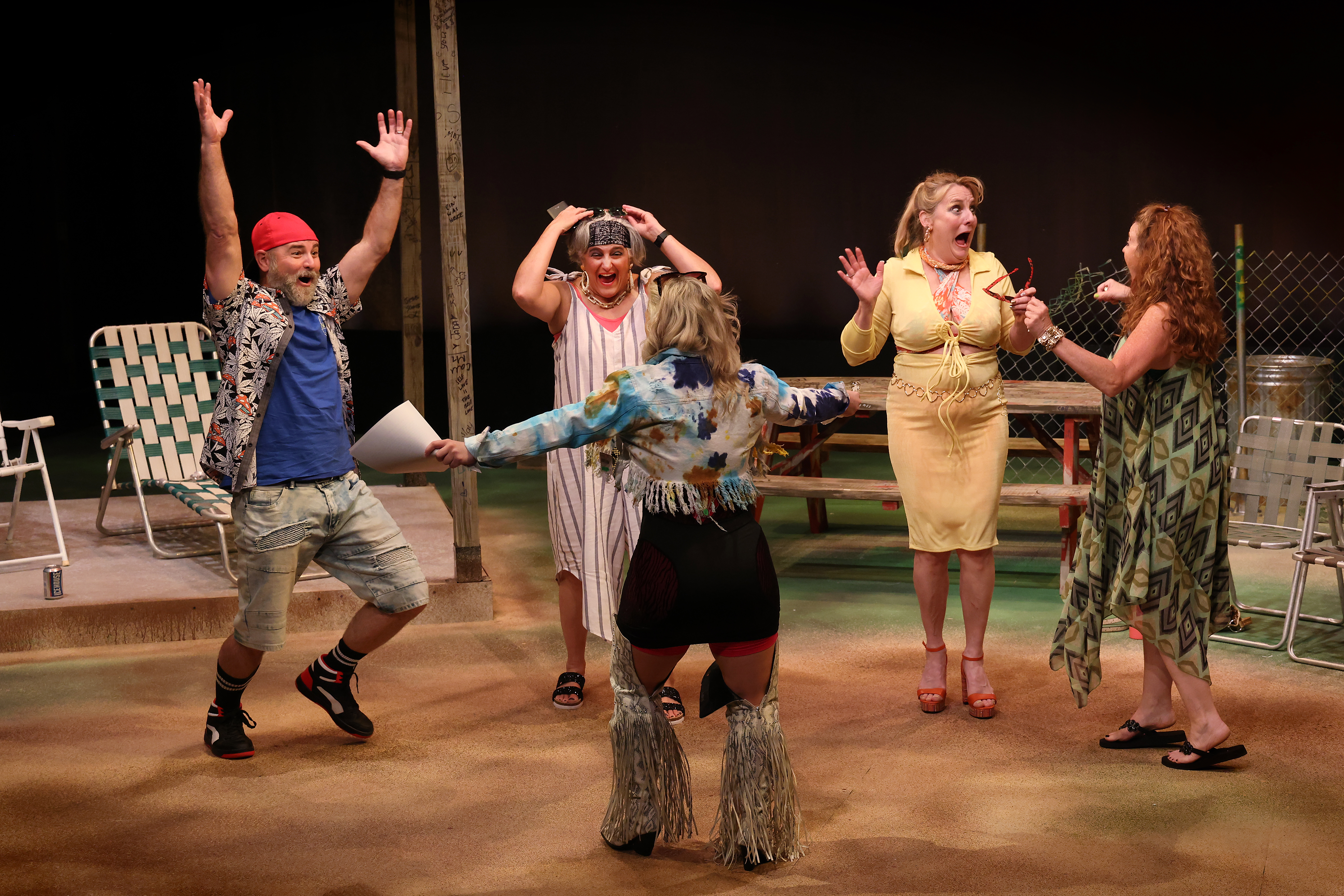
Predictably enough, the two O’Mallery families appear to be blissfully unaware of one another – until intermission. Directing the show, Donna Baldwin encourages skin color to make a difference in how James T’s Pabst-Blue-Ribbon trashiness, Adlean’s chain-smoking vulgarity, and Marie’s besotted Jack Daniel’s elegance play out onstage. Maybe I’m biased, but the trashiness, vulgarity, and besottedness of the white folk seemed more outsized to me than their counterparts’, which chimed well with O’Hara’s overall design. The two Lillie Anns were woefully lacking in vices as they masterminded their schemes and manipulated their interventions, but both were more controlling than they strictly needed to be, relishing their dominion. Here again, Joanna Gerdy gets to be just a little bit bossier, trashier, and more crotchety than Willa Bost, her black clone, even though she was basing her master scheme on some cliched TV series.

We began to understand what was going on with the abrupt break in the action that brought us to intermission. If that sudden jolt hadn’t made it all obvious, O’Hara double underlined his answer in a manner almost as surprising as his intermission reveal. For the first time, a black person and a white person spoke to one another – and it was the two Barbaras, Ava McAllister Smith and Jade Parker, who clarified the mysteries we had seen, two characters who had hardly spoken 10 words between them until now. Suddenly, what seemed to be a satirical dive into the crassness of American life, with subtle distinctions between the races, acquired new meta textures as the two Barbaras met at the park and negotiated. How this story should be told, who should tell it, and how much it should cost were all up for grabs as the Barbaras jousted over making a deal and setting a price.Common Thread Theatre Collective - Barbecue

Taking it all in, from the unseen moment when Lillie Ann was inspired by primetime TV to hatch her scheme, moving along to how one Barbara reshaped her rehab memoir before her counterpart Movie Star Barbara bought the rights, I came away with the following message from O’Hara: fueled by drugs, alcohol, and toxic righteousness, truth is what gets most thoroughly slaughtered and barbecued in American life. On the way home, another pleasant thought hit me. Thanks to an artful gap between scenes in Act 2, rehab Barbara may have actually lowballed the amount of money she was promised earlier from Movie Barbara when she confronted the other O’ Mallerys with Hollywood’s offer.

The presence of two Actors Equity performers, more than we see in most touring shows nowadays, testified to the professional-grade theatre that Common Thread has delivered, for neither of them stuck out uncomfortably among their local and intern castmates. Parker and Smith were nicely matched in the comedy’s one interracial faceoff, taking turns in holding the upper hand and smoldering nicely when they didn’t. As the only men we see before intermission, Shawn Halliday and Tyler Madden get to pop and stomp plenty of beer cans as the JT’s, taking heavy fire from the Lillie Anns all the while, but Halliday is the seedier of the two while Madden has the edge in timidity. La’Tonya R. Wiley was a formidable presence as Adlean no matter how many cigs she fired up or how many pills she gulped down, while Lane Morris made her Adlean more strung-out than anybody.

Gregory J. Horton has designed a set of costumes that likely inspired Baldwin-Bradby and her cast nearly as much as O’Hara’s canny script. At the opposite end of the spectrum from JT’s splashy mashup of baseball, soccer, and tennis outfits is the eye-popping elegance of the lemon dresses worn by our Maries. These citrus dresses are accessorized with high heels that are just as inappropriate for an outdoor barbecue, along with jugs of Jack Daniel’s large enough to sport handles for easy chugging and pouring. Of the two Maries, it was hard to say whether I most enjoyed the arc of Shawna Pledger taking Marie from swilling to passing out, or whether Xulee-Vanecia J subsequently surpassed her in Marie’s decorous revival.

Questions about Barbecue continued to assail me on the drive home. Foremost among these was how anyone could imagine a homespun, humdrum story like this winning an award. Sure enough, O’Hara had embedded an answer. You can bet it had nothing to do with honesty and everything to do with America.