Tag Archives: Sarah Molloy

Vampires and Trumpers

Reviews: Vampire Lesbians of Sodom and Thanksgiving: 2016

By Perry Tannenbaum

For devout upstanding citizens who had decided way back in the hippie ‘60s that Greenwich Village was an abominable den of sin, Charles Busch’s Vampire Lesbians of Sodom was a flaming and perverse poke in the eye. Or an argument clincher when it landed on Macdougal Street in 1985. The New York Times raved, the extravagant little trio of sketches became a cult obsession, and Vampire Lesbians had a five-year run.

Busch slipped away from his castmates when the review came out in the early morning after the Provincetown Playhouse premiere and had a good cry. Why did this diva desecrate his mascara? His career in theatre was now assured. He would write more outrageous comedies and send-ups that he, as the prima donna, could cross-dress and slay in, most famously Psycho Beach Party.

Vampire Lesbians made it to Charlotte at the Pterodactyl Club in 1991, after the slightly wholesomer Psycho Beach had paved the way during the previous year. George Brown directed this orgy of sacrilege with fiendish glee, while Innovative Theatre co-founder Alan Poindexter starred with Keith Bulla as the titular vamps.

With the Rev. Joe Chambers carrying the torch for fundamentalism in the wake of Jim Bakker’s disgrace, Banktown was still a very Christian place. It was my sacred duty to bring my daughter, not yet bat mitzvahed, to see Poindexter in all his counter-culture glory. After beholding the kinky wonders of Psycho Beach, my Ilana would have kissed Alan’s feet.

Flash forward to 2023. Poindexter is gone and the Pterodactyl Club, the one-time cultural capital of Freedom Drive, is goner. But thanks to Nicia Carla and her PaperHouse Theatre, Hollywood antagonists La Condesa and Madeleiné Astarté (a Succubus and a Virgin Sacrifice back in their Sodom days) are undead again!

Taking on Busch’s mantle, Carla directs and stars in this stunning revival at VisArt Video, tucked into the nether region of a strip mall on Eastway Drive – I’m trying to make this little suburban dive sound as risqué as the Pterodactyl! Walls are black as you walk inside, and hostesses in Goth attire and makeup are there to greet you. Whatever Google Maps has told you (it misled both me and my wife Sue on separate occasions), you can now be sure you’re in the right place.

Small as it is, the inner sanctum of VisArt is perfectly sized for Busch’s secret forbidden rites. The seats are soft enough to keep butt burnout at bay for 90 minutes, even if you don’t stretch for intermission and fall prey to the treats in the lobby. Yet sightlines are not ideal according to Sue’s scouting report.
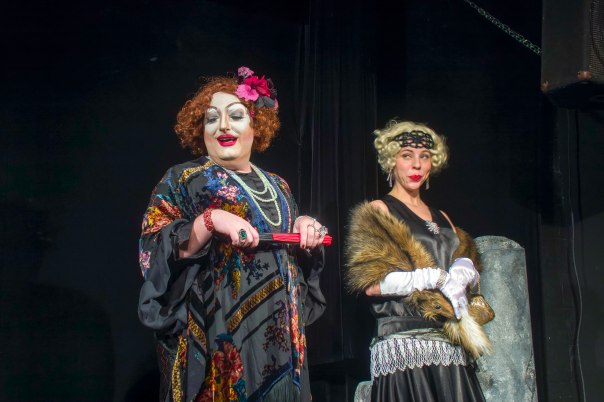
The PaperHouse cast multitasks even more than Busch’s original ensemble, just six players covering the 14 roles instead of seven. All six are battle-tested in madcap comedy, so this outrage is hardly outside their comfort zones. Nicia probably hasn’t had this much fun onstage since Poindexter directed her as The Witch in Hansel & Gretel. She minces and manipulates here as the Virgin Sacrifice, growing regal and stentorian as theatrical megastar Astarté as she assaults the Left Coast. Opposite her, Ashby Blakely is a steely, sneering diva bridging four millennia as The Succubus, aging gracefully into La Condesa and crossdressing in costume designer Beth Levine Chaitman’s most outré couture.

That isn’t to say that Josh Looney and Charlie Carla are anything less than visions of decadence as Sodomite musclemen Ali and Hujar in complementary S&M outfits and Wagnerian wigs. Nicia is already fairly slutty in the opening sketch despite her somewhat revealing white dress, willing to break her hymen with Ali or cut a deal with the cave monster Succubus. Subsequent scenes in Hollywood and Sin City climax in a couple of startling onstage costume changes, most improbably by Tanya McClellan who snoops into La Condesa’s boudoir as gossip columnist Oatsie Carewe.

Gosh, it’s good to see McClellan back onstage in manic comedy mode. Squinting her snoopiness, she sniffs out the ungodly acts performed by Nicia as Astarté on La Condessa’s protégée, luminous Sarah Molloy as flapper Renee Vain, and her meddlesome boy toy, Looney as matinee idol King Carlyle.

Hard times for a vampire? You’ll need to come back after intermission for Blakely’s final transformations. Andrea King’s choreography, on loan from Jane Fonda, elegantly shows off McClellan’s dancing prowess.

Anyone who reads advice columns or cruises social media at this time of year will have an accurate inkling of what Thanksgiving: 2016 might be about. Millions of Turkey Day hosts are wondering how they will keep opposing family factions from shouting their lungs out or coming to blows while the sharp cutlery is still on the table. Playwright Elaine Alexander smartly calculates that the situation is prime fuel for a dining room comedy – or tragedy – but the world premiere of Charlotte’s Off-Broadway production now at VAPA also reveals that the NC native had a tough time deciding which way to go.

Ground Zero for the annual onset of hosting panic was clearly in November 2016 when Hillary Rodham Clinton resoundingly won the popular vote for the US presidency while Donald Jefferson Trump won the Electoral College – and the White House – just as resoundingly. Liberals, Democrats, and rational folk are still in shock. Yet as Alexander deftly reminds us along the way, they are all blissfully unaware of the betrayals of good sense, rationality, rule of law, and democracy to come.

As the West family up in the liberal Northeast prepares to host young Eric’s girlfriend, riding up the highway from Alabama, the aroma of crisis already fills the suburban kitchen. Papa Harry, after diligently knocking on hundreds of doors crusading for Clinton, was hospitalized – either for a nervous breakdown or a heart attack – immediately after watching CNN declare Florida for Trump. The chief Turkey Day watchword from Harry’s physician is for wife and son to prevent the shell-shocked Hillary soldier from indulging his CNN addiction.
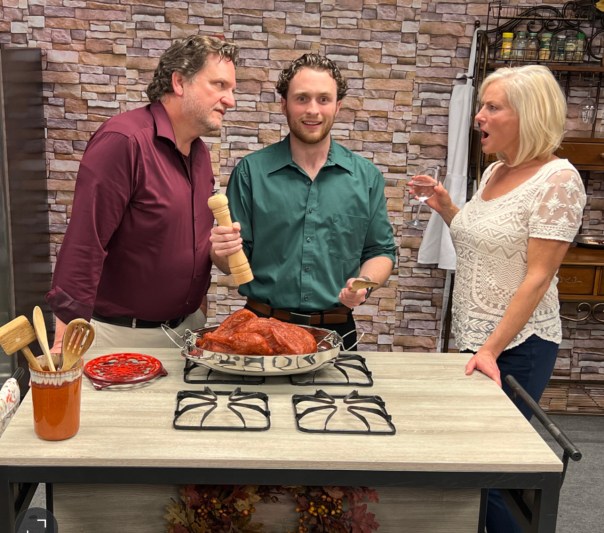
Taking to drink in the wake of her husband’s collapse, either out of worry or guilt, Renee has pretty much abandoned any serious intent to impress Brittany, the Southern belle she’ll be meeting for the first time. So it has fallen to young Eric to try to cook a luscious feast for his beloved, even though Mom hasn’t properly shopped for the occasion. Some improvising and substitution will need to be done. Worse, frozen will occasionally need to stand in for fresh.

Worst of all, Brittany voted for Trump, so Eric desperately hopes to keep talk of politics – the subject Dad is obsessed with and still agonizing over – away from the holiday dinner table. Harry has enough difficulty digesting that his son would date a girl from Alabama. Nor does Dad have enough self-awareness to realize that, in a reflexive action stemming from his years in community theatre, he mocks every Southern drawl he comes in contact with.

Finding out she’s a Trump voter could send him over the edge. Getting Dad to refrain from talking politics promises to be even tougher than steering him away from CNN. Finessing how to keep Brittany off the touchy subject is a bridge Eric hasn’t crossed yet.

As a director, Alexander casts father and son perfectly. Matthew Howie is a master of timorous anxiety as Eric. He can craft crescendos of panic and befuddlement while doing a hilariously awful job of warding off disaster with a shit-eating smile. Nor could we improve much on Tom Ollis as Harry. Since his 1997 debut at Theatre Charlotte in Arsenic and Old Lace, Ollis has grown into the most visible volcano on the Metrolina theatre landscape. Whether as Mr. Blonde in Reservoir Dogs, Sweeney Todd, or Titus Andronicus, Ollis is peerless at seething, suspecting, and erupting into towering, raving rages.

Since Harry is also a trial lawyer recently dismissed from his law firm because of his excessive zeal, Ollis can feast on numerous opportunities to cross-examine everyone in sight, bullying and browbeating every witness. Alexander’s women don’t get nearly as much scenery to chew, but her casting choices are nearly as impeccable.

Donna Norcross seemed to be battling opening night jitters early in Act 1 as Renee, but as Mom yielded to a multitude of wine refills, Norcross also relaxed, becoming quite powerful in the Act 2 denouement. Quite ripe for stereotyping, Michelle Strom as Renee entered the West home like a sudden ray of sunshine, without the preamble of a knock or a doorbell chime, her drawl as wide as the Mississippi. No, Dad could not restrain himself, nor could I blame him.

As you can imagine, the setup of Thanksgiving: 2016 is almost pure comedy – until the Trumper truth finally comes out, as an announcement rather than a shy confession, with the proud flourish of a cheerleader’s somersault. Looking from Strom to Ollis as we reach intermission, we can only wonder whether Dad will clutch his head or his heart.
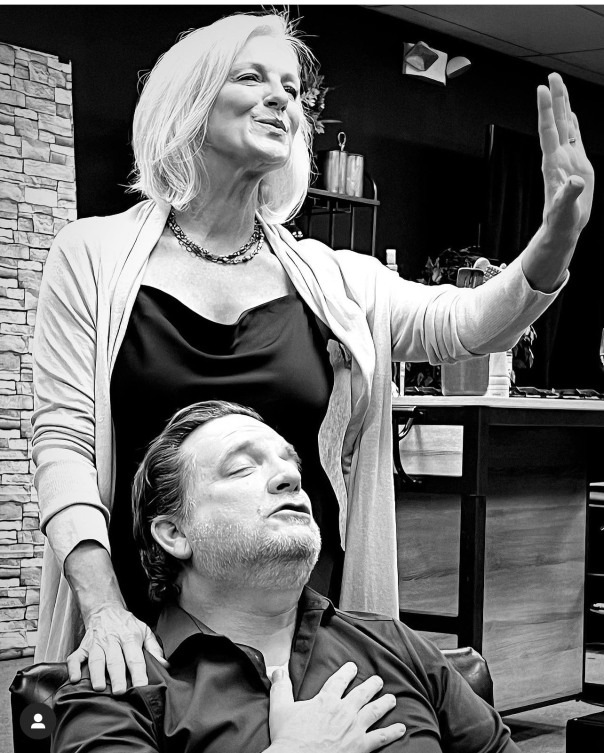
But what can come afterward from our host, our hostess, and from poor Eric? Admirably enough, Alexander lets her characters carry her along across Act 2. But her impulse to bludgeon Harry with more secrets and uncomfortable turns this comedy upside-down. We transition, not very gradually, from a Neil Simon comedy of futile secret -eeping to an impactful series of revelations that conjures up Sophocles’ Oedipus, Strindberg’s The Father, or Albee’s Virginia Woolf. Those revelations are topped off by a  couple of increasingly jaw-dropping ideological rebukes to Harry’s smug liberalism that might shake you up a bit.

We seem to fall over a cliff here, with too little before intermission to prepare us for the high drama afterward. By the time the cast is taking their bows, Renee has radically transformed from a borderline bimbo into a pieta resembling Steinbeck’s Rose of Sharon on the final pages of The Grapes of Wrath. Instead of dumping us off a high cliff, I’d advise Alexander to lay down more track that would guide us around the mountain: a sudden dramatic swerve – not too sudden – would be more satisfying than this swan dive.

A visit to VAPA for Thanksgiving: 2016 is still worth it, delivering hearty laughs and a gasp or two. By all means, dig in!

Pro-Grade “POTUS” at Booth Gets New Conservatory Run in Cornelius

Feature Review: Charlotte Conservatory Theatre’s POTUS Transfers to Cain Center

By Perry Tannenbaum

POTUS_Fenixfoto_Charlotte_5R4A2102

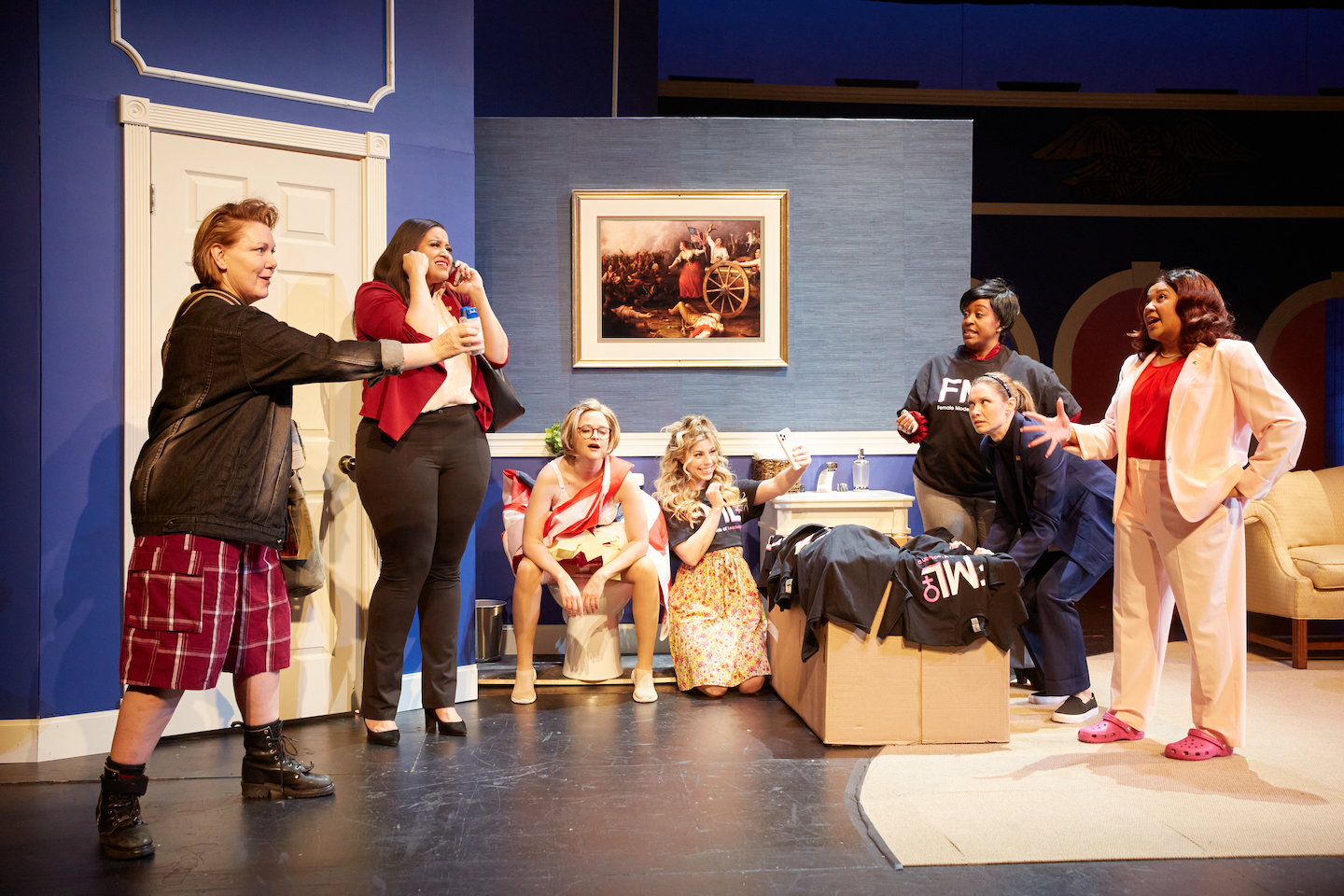
After the morning press conference, there’s China, an international meeting on nuclear proliferation, followed by a photo op with blinded-and-maimed Iraq War vets, and a much-anticipated endorsement of a gubernatorial candidate somewhere out in the Midwest. Pretty typical day at the White House.

But in Selina Fillinger’s frenetic presidential comedy, POTUS, neither the man in the Oval Office nor the playwright’s viewpoint is typical. Fillinger made that clear in her subtitle, Behind Every Great Dumbass are Seven Women Trying to Keep Him Alive. At opening night of Charlotte Conservatory Theatre’s production of this romp, seven frantic women directed by Stephen Kaliski had their audience laughing nearly non-stop at Booth Playhouse.

It was the second consecutive Conservatory production that reminded many of us of the last resident company at the Booth, Charlotte Repertory Theatre, which expired way back in 2005. Members of Actors Equity are back in the mix, along with members of Stage Directors and Choreographers behind the scenes. Other professional groups are involved, including the local IATSE union and United Scenic Artists. Kaliski and Conservatory Theatre co-founder Marla Brown also harbor the long-term ambition of ascending to the highest rung of regional companies and becoming Charlotte’s first LORT (League of Resident Theatres) company since Rep’s demise.

Kaliski wasn’t behind the scenes for Conservatory’s debut at the Booth last August. No, he was onstage as a rather charismatic devil named Scratch in a surprisingly amorous faceoff with Elizabeth Sawyer. Jen Silverman’s Witch was the playwright’s fresh 2018 spin on The Witch of Edmonton, first staged in 1621, and Sawyer was a dramatization of a real-life woman burned for witchcraft earlier that same year. Brown wasn’t onstage in that “then-ish” setting, but her inclination toward making Conservatory a classics-flavored company definitely was.POTUS_Fenixfoto_Charlotte_5R4A2210

With POTUS, it’s Brown who is taking the stage – nearly assuming the title role late in Act 2 as she prepares to take the place of her lookalike brother, the Prez, at a posh speaking engagement. Speaking with Brown for this story, I opined that the recent POTUS she most closely resembled was The Donald. Nope, she countered, it was Obama.

You can decide who’s right. For the Conservatory Theatre production, after closing at the Booth several weeks ago, reopens at the new Cain Center in Cornelius for another three-performance run on April 26.

Until her shocking transformation into formalwear, Brown as the drug-dealing presidential sib Bernadette looked to me like a punkish Rob Roy on the skids. Here Brown and I are in much closer agreement, since she has proclaimed, “I got that role because I can rock shorts that are hideous.”POTUS_Fenixfoto_Charlotte_5R4A2137

Yet Brown’s shorts may not be the most bizarre or hideous thing we saw at the Booth in POTUS. Iris DeWitt as Chris, a beat reporter fishing for a scoop, multitasked by sporting a pair of noisy breast pumps that reminded me of football fan craziness, helmets retooled to hold beer cans emptying into drinking straws. Katy Shepherd as presidential secretary Stephanie may be the queen oddball. After unwittingly sampling an overdose of Bernadette’s merchandise, Steph goes so far off the rails that, by intermission, she’s prancing around the West Wing dreamily with a pink swimming pool floating around her waist.

The zany, comical mayhem that brings POTUS to the end of Act 1, with all seven women in action and Chris somehow stealing focus from the ever-twirling-and-spacey Stephanie, is the closest equivalent I’ve seen in many years to the explosive circus that engulfs the stage at the second intermission of George S. Kaufman’s You Can’t Take It With You. And that fizzy moment was the only time in Fillingers’ comedy that I caught anything like a whiff of classical flavor.

Conservatory’s swerve from classicism has been both intentional and fortuitous in terms of POTUS coming here and moving up the road to Cornelius.

“We want to leave our options open in these early days,” Kaliski says, “so there was a consideration early on of, okay, we’ll always do something that has some sort of anchor in a classical story. Right now, the aesthetic we’re landing on is, you know, how can we be that company? The plays in New York that are either your non-touring Broadway shows or prestige Off-Broadway shows – we want to be the group that picks a lot of those off and brings them to Charlotte. And I think Actor’s Theatre filled this role.”

Yeah, it’s clear that the closure of Actor’s Theatre rocked this town – arguably harder than the shuttering of Rep, which left CAST (Carolina Actor’s Studio Theatre) and Actor’s Theatre in its wake. Now? We’ve devolved into a bunch of small black box theatre outfits, counterbalanced by the bigger BNS Productions. They all produce consistently fine work, but none of them can be called “that company.”

Actor’s and CAST hardly messed with the classics at all. BNS, when it isn’t producing works by its founder, Rory Sheriff, mostly does the classics by August Wilson. So there’s definitely a niche for a major company in Charlotte that plans to straddle recent hits and the classics. Or any major LORT company at all, since we’re probably the largest US market without one.

Even in its beginnings, Conservatory is flipping the script written by Queen City theatre behemoths that perished in the past. Whether suddenly or gradually, Rep, CAST, and Actor’s all disgorged their founders through actions of their boards of directors, who then proceeded to dissolve their companies – without alerting the public that they were in crisis, let alone appealing for aid.

Having founded The Warehouse up in Cornelius in 2009, Brown and her board have not liquidated her brainchild. Utilizing Warehouse’s non-profit 501c3 credentials, they have rebranded as Charlotte Conservatory, upsized their mission and ambition, and – here’s a twist – amicably disbanded their board.

“I love that space very much,” Brown still says of The Warehouse. “But I also knew that after ten years, if I continued to produce there, I would regret it. Because Charlotte has seen such a de-evolution of theatre since Rep’s demise, and such a de-evolution of our talent pool. Anybody who works on a professional level or who understands the craft either has to do it for very little money or they have to teach and then do it at theaters, other LORT companies at other cities, or they work for Children’s Theatre only.”

In the wake of COVID, which gave theatre companies plenty of time to pause and reflect; and in the wake of We See You, White Theatre, a scathing BIPOC indictment of American theatre companies’ lack of inclusivity; Conservatory Theatre is intent on being more open-ended – and more open-minded – as it continues to take shape.

Neither cliques nor permanent positions have formed as Conservatory blazes its new path.

“We didn’t start with, okay, here’s our artistic director and the managing director, and here’s our director of development, etc., etc.,” Kaliski explains. “We didn’t start with a typical organizational structure. We were kind of thinking, all right, we’re a collective in this room together, and we’re going to take it project by project to start, and each project can have its own set of showrunners, if you will, kind of like a TV show. And they’ll be in charge of that, and then we’ll kind of have a different group of showrunners or a different producing pod for the next one.”

That kind of inclusivity has allowed Kaliski and Brown to reach out, in Conservatory’s formative phase, to Matt Cosper, who still cranks out XOXO productions, and playwright/actor/director Brian Daye, a former member of the Warehouse board. Nor is this core group and others limiting their horizons to the Booth Playhouse and the Cain Center, especially since Conservatory doesn’t have the kind of sweetheart rental deal the would come with official residency at either venue.

Mint Museum, the Stage Door, and the new Parr Center are all in play for future reconnoitering and producing, along with whatever the epic renovation of Uptown’s Carolina Theatre winds up offering. Meanwhile at Cain Center, whose stage does not sport a fly loft, there’s a mutual feeling-out process as both newbie organizations find their bearings.

Both Brown and Kaliski were surprised and delighted that rights to perform POTUS became available so soon after the Broadway production closed last August. Many in their circle presumed there might be a national tour in the offing. But POTUS doesn’t make the most discreet or decorous entrance for a Cornelius audience, that’s for sure.

Brown had some trepidations when she approached Cain director Justin Dionne. “Okay, Justin,” she remembers thinking, “you understand that the first word is the C word. And I know you don’t want people coming and going, ‘This is not what we built the Cain center for.’” She squeals in a high falsetto, half-relishing this possibility.POTUS_CCT_Charlotte_Group_Fenixfoto15379 - 4

Yes, before Fillinger’s action even begins, POTUS has used this word at his morning presser – in describing the First Lady, no less. In her presence. He doesn’t know she’s there, due to a couple of additional plot points – one, we’ll learn, involving anal sex – so he explains her absence by saying, “She’s having a cunty morning.”

So Valerie Thames as chief of staff Harriet opens the show by storming onstage and exclaiming the offending adjective in its root form. Instantly radiating dignity, morality, and competence – qualities that will not be attributed to POTUS – Thames authoritatively dumps this crisis of the day in Jean’s relatively cool hands. Slim and conceivably serene, Jennifer Adams as POTUS’s beleaguered press secretary wastes little time in convincing us that poor Jean likely holds the most combustible burnout position in the West Wing.

Harriet and Jean are the women most seriously invested in keeping the dumbass alive and the most adept at getting the job done. This often involves prodding Stephanie, quite intelligent beneath her scared-rabbit exterior, into action. Bernadette, ankle monitor on her leg, is also very interested in keeping her brother alive, if for no other reason than her nefarious enterprises will ultimately require a presidential pardon.

“Harriet,” Jean memorably informs Bernadette, “is the number one reason this country continues to function.” By this time, Jean has perpetrated a monumental screw-up of her own.POTUS_Fenixfoto_Charlotte_0K9A1454

Wielding a blue slushy, Sarah Molloy makes an entrance as Dusty that rivals Harriet’s, rushing across the stage to vomit into a trashcan. Not the subtlest indication you’ll ever see that somebody is pregnant. Yet the West Wing brain trust struggles to put two and together. Bernadette sees it all rather quickly, though. You need to be truly family to understand POTUS.

Iesha Nyree as The First Lady sizes up Dusty nearly as quickly as his sister-in-law. Assailed by presidential insult and infidelity, Margaret is also complicit and invested in her dumbass husband’s political machinations. Never playing a victim card, Nyree makes Margaret formidable and conflicted. But while Fillinger flips the meaning of her subtitle upside down, hinting that impulsiveness and incompetence aren’t confined to POTUS or his gender, she spreads the inner conflict around: lurking among these ladies are two lesbians who will consider rekindling the old flames that once blazed secretly on the campaign trail.

“At least three of the characters must be women of color,” Fillinger prescribed in her script. “Actors can be cis or trans. Age is flexible. Beauty is subjective. So long as they’re fast, fierce, and fucking hilarious.”

Kaliski, Brown, and Charlotte Conservatory Theatre checked all of those boxes at the Booth. True, POTUS is a bit lightweight and more than a little over-the-top. But if you missed it in Charlotte, it’s worth the trip to follow this production up to the new Cain Center. Seeing how it all goes over with the Cornelius crowd might be an extra treat.

ATC’s Outdoor “Midsummer” Is Electrifying Fun

Review: Actor’s Theatre of Charlotte A Midsummer Night’s Dream

By Perry Tannenbaum

MSND 2

Aside from sporadic Chickspeare ventures in the NoDa Brewing parking lot and a tentative CPCC Shakespeare on the Green production up at their Cato campus two summers ago, we haven’t seen anybody commit to an annual series of outdoor Bard since the Queen City’s second Charlotte Shakespeare bit the dust in 2014. If you’ve been hankering for some good Shakespearean comedy under the moon, with a refreshing beverage in your beach chair’s cup holder and a trusty cooler at your side, the long drought is over.

Actor’s Theatre of Charlotte has made good on their promise, announced at the dawn of their new residency relationship with Queens University, that they would launch an annual Midsummer Nights @ Queens series, starting with the most logical choice, A Midsummer Night’s Dream. Now Shakespeare hasn’t exactly been in Actor’s Theatre’s wheelhouse during its first 30 years. Nor has any classic playwright dating further back than Edward Albee. Perhaps for that reason, ATC executive director Chip Decker tamped down expectations when he first unveiled his plans, saying this would likely be a cooperative effort featuring students in the Queens U theatre program.

2019~Midsummer @ Queens U-21

He lied. Directed by Chester Shepherd, this Midsummer is as professional as any homegrown Shakespeare production we’ve seen in the Metrolina area since the first Charlotte Shakespeare folded in the early ‘90s. Even though admission is free, production values are not at all cheap. Costume designs and props by Carrie Cranford are literally electrifying in a few instances and, while there isn’t any scenic design, Shepherd leads his players up and down, up and down, taking advantage of a bush here and a tree there, borrowing the stone stairway and entrance to campus building for the Athens scenes and kidnapping a toddler from the audience when we adjourn to the forest and the fairies.

That’s not to say that there aren’t some serious economies, but they don’t include forswearing playbills, which are handed out to audience members by wingèd ushers. Although the roles of Athens royals Theseus and Hippolita are often doubled with those of Oberon and Titania, the fairy king and queen, here we’re confronted with an orgy of doubling – nine actors in 18 roles. Except for Peter Finnegan as Bottom, all the mechanicals are moonlighting as Athenian nobles.

2019~Midsummer @ Queens U-12

So the looney lovers who are confounded and enchanted in the woods by the fairies cannot mock the mechanicals when they present their “Tragical History of Pyramus and Thisbe” – they’re performing it, you see. Their lines disappear with them, part of a shrinking process that yields a playing time of less than 100 minutes. That’s another economy. Anybody who has memorized the lines uttered by Peaseblossom, Cobweb, Moth, and Mustardseed will notice that these fairies have also been vaporized – or compressed into the generic Fairy played by Kerstin VanHuss.

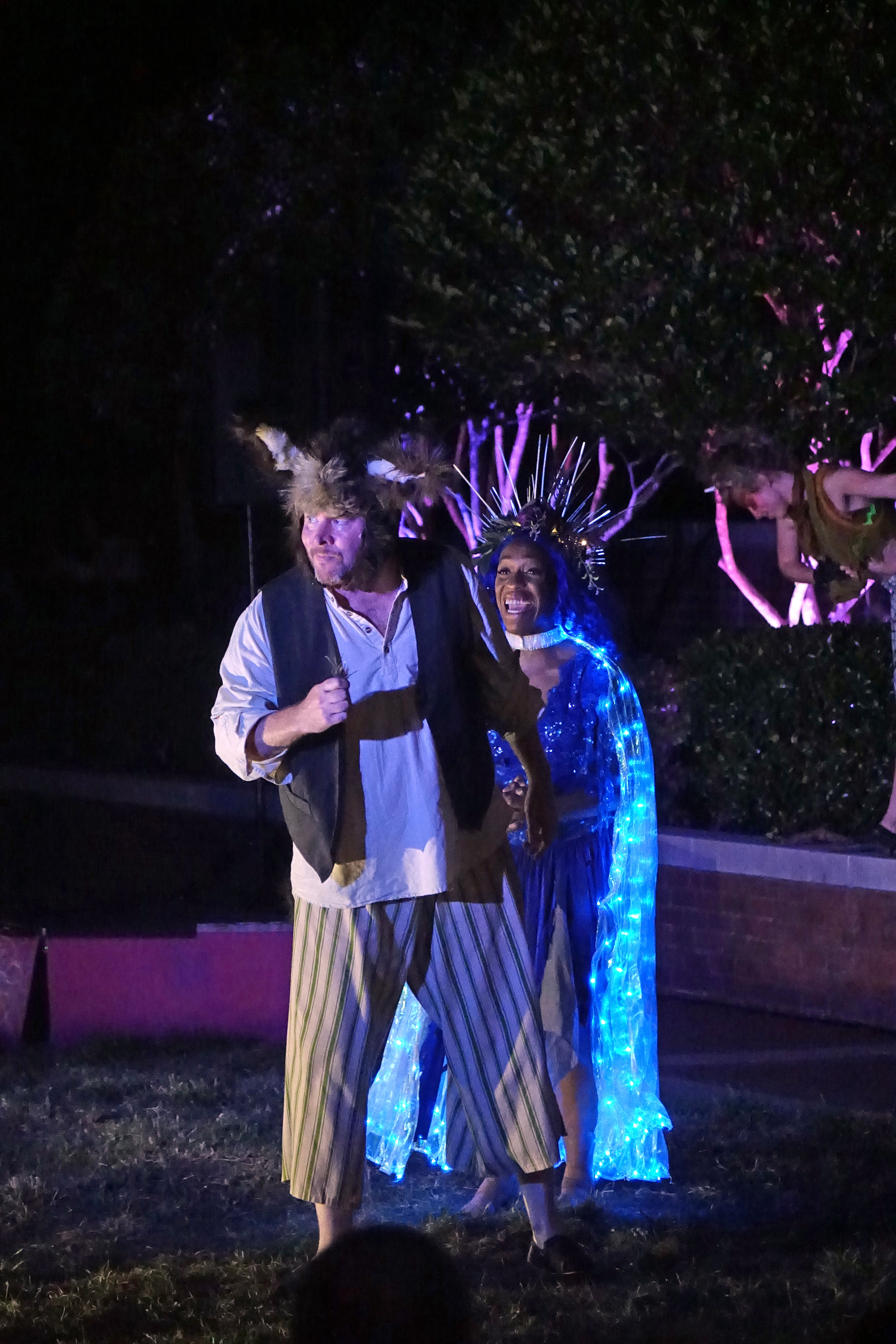
Steven Levine is certainly manly and commanding as Theseus and Oberon, but he is upstaged by the antics of Sarah Molloy as Puck and the misplaced amorousness of Nonye Obichere as Titania – not to mention their outré costumes. Obichere has only to swish her illuminated blue cape to dazzle us, and Molloy’s outfit is even wilder than Bottom’s. Of course, Finnegan’s hambone bravura must begin before Puck mischievously transforms Bottom into an ass, and we benefit from the minimalist design decision not to obscure the actor’s face when Titania plies her charms.

Finnegan really takes over when he stars as Pyramus for Theseus and Hippolita. More than one actor has made the death of Pyramus into a full meal. Finnegan aims for a banquet.

2019~Midsummer @ Queens U-36

Among the befuddled lovers, the women get the most comical opportunities. Iesha Nyree as Hermia and Anna Royal as Helena both make good on their mightily distressed episodes, and Shepherd hasn’t erred in stressing the height differential between them in his casting. With so much thunder stolen from their benighted partners, it’s actually fortunate that Adam Griffin and Jonathan Ford, Demetrius and Lysander respectively, get to moonlight as mechanicals, Griffin as Snout and Ford as Flute.

The caution that free insect repellent was available at the theater site proved to be unnecessary on Saturday night, but in the early part of the evening, I found it welcome to have some cold liquid at hand. Microphones consistently operated well, so you can expect audibility to be less of a challenge than Elizabethan English. The plenitude of physical comedy supplies ample translation.

A couple of real concerns: handicapped access begins on Selwyn Avenue, to the left of the Queens U traffic circle, not in the traffic circle itself. And counterintuitively, the worst seating is in the middle of the greensward facing the stage. The further you sit toward either side, the more easily you’ll see past obstacles in the center, namely a table, a slatted bench, a soundboard, and the technician standing over them.

Get there early, select a good sightline, and your Midsummer Night @ Queens should be quite dreamy.