Tag Archives: Peter Morgan

“The Falling and the Rising” Offers a Kaleidoscopic View of the Military Experience

Review: Opera Carolina Presents The Falling and the Rising

 By Perry Tannenbaum
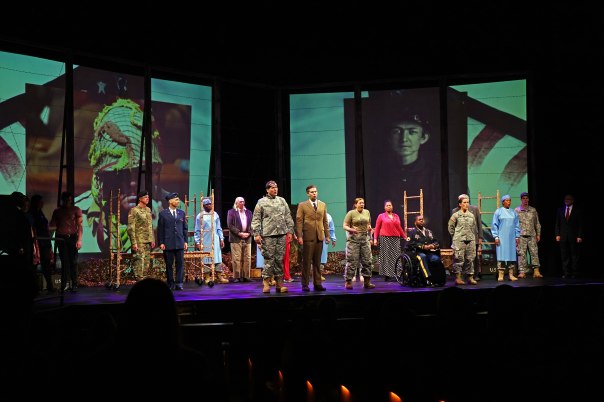
2022~Falling and Rising-24

March 11, 2022, Charlotte, NC – Four men give their lives to save just one woman soldier, a woman so severely injured that she must be placed in an induced coma to give her any chance of continued survival or even partial recovery. The math and the logic may not seem to add up unless you’ve served in the military or you’ve witnessed The Falling and the Rising, a fairly new opera by Zach Redler and Jerre Dye that may impact Opera Carolina audiences more freshly today than when it premiered in 2018.

Before COVID and Ukraine, when the White House was occupied by a grifter who labeled people who signed up for battlefield duty as “suckers,” the mentality passionately advocated by The Soldier protagonist – that military service is not only a commitment to give your life for your country but also a commitment to give your life for your soldiering comrades – may have seemed rabid, over-the-top, or naively gung-ho. After witnessing the bravery of so many healthcare workers routinely facing the perils of a deadly transmissible disease for the past two years and, more recently, the inspiring popular resistance of so many outgunned Ukrainians, we can likely view that military mentality – and those four soldiers’ sacrifice – as making more sense.2022~Falling and Rising-07

This brash Opera Carolina production, conducted by Emily Jarrell Urbanek and stage directed by Sam Mungo, brings the company to a new venue, the Sandra Levine Theatre in the gorgeously renovated Sarah Belk Gambrell Center, while it brings subscribers a radically different experience. Once the female Soldier is comatose, we’re carried along with her for the bulk of the opera on a kaleidoscopic cavalcade of dream sequences, so the military experience is conveyed to us not only by soldiers in battle and trauma, but also by dedicated doctors and anxious family.

The immersion begins in the Gambrell lobby, where you can pick up info on the Montford Point Marine Association and the Blue Star Mothers of Charlotte. You can also peep in on artworks and obtain a comprehensive coffee table book produced by Bullets & Bandaids, a non-profit veteran and civilian art project. Immersion couples with education at the Gambrell, so it’s fitting that the complex is on the Queens University campus, for the world premiere of The Falling and the Rising was also on academic soil at Texas Christian University, one of seven organizations that commissioned the piece.

A new work set in wartime might trigger a couple of red flags for traditional opera lovers averse to chaos and cacophony. But you’ll find that Redler’s score is comfortably tonal and melodic when soprano Melinda Whittington begins singing a birthday video into a laptop computer for her daughter’s upcoming thirteenth, apologizing and commiserating because they will not be together to celebrate. In fact, when Redler has Whittington pivoting to a shuffle beat, you might briefly wonder whether the composer has crafted a score that’s too casual and accessible.

The roadside IED explosion, with a striking video montage by designer Michael Baumgarten (lights/scenery/video), puts that worry permanently to rest. After the hospital huddle of doctors and a ZOOM consultation where the induced coma is prescribed, the opera is largely a series of extended arias and duets until we reach a closing paean to the men and women who serve, joined by a pre-chosen brigade of vets parading up to the stage from the audience.2022~Falling and Rising-23

Sound at the Levine is noticeably more resonant than the Belk Theater and marginally warmer than Knight Theater, halls where we normally hear Opera Carolina and Charlotte Symphony. Although directors might be tempted to mic student plays and musicals in this 1000-seat space, all of the soloists projected quite easily on opening night to Row M, where we were seated. Redler’s orchestration for 11 musicians balanced well with the singers, and Urbanek had no difficulty in coaxing a hearty variety of colors from her band, which included a French horn, clarinet, guitar, piano, two percussionists, and strings. There is an orchestra pit at the Levine, but it doesn’t protrude far – or impinge on the bond between audience and performer. When baritone Kenneth Overton as the Homecoming Soldier concluded his church sermon, seated in a wheelchair in front of a large wooden crucifix, it didn’t feel like he was calling across a wide gulf when he asked us for an “Amen!”2022~Falling and Rising-11

Gathered from interviews at Fort Myer, Fort Meade, and the famed Walter Reade Military Medical Center, Dye’s libretto was suffused with authenticity and often riveting. Mezzo-soprano Audrey Babcock exuded intensity as Staff Sergeant First Class Toledo, steely and tough as her nickname, which figures into the boot camp segment of her aria. Dominic Armstrong took us to the skies with his heroic tenor voice as Jumper, a First Sergeant who mixes hard-nosed honesty with patriotism as he readies Soldier for her first parachute jump. Parting words: “Don’t forget to pull the string!” After that uplift, bass-baritone Peter Morgan brought us back down to earth as Colonel, seen in civvies in his living room, hoping that his military wife will survive.2022~Falling and Rising-17

Each of these monologues was substantial enough to give Whittington a chance to rest her voice before she joined in duet, a mercy when you consider the extra decibels she can pour out. The most brutally honest testimony in this cavalcade came from Overton in his wheelchair as the Homecoming Soldier, ideally placed by Dye at the juncture of his libretto between the last of personal testimonies and our protagonist’s emergence from her coma. Also artful were the spins that Dye put on his title, for we quickly learned that The Falling and the Rising wasn’t simply, as we expected, about the traumas and dramas of battlefield injury and recovery. We first encountered “The falling and the rising” in the Soldier’s memories of her daughter, back when she was an infant and Soldier was simply a mom watching her baby’s breathing as she slept. Later it was the impending leap from an airplane, with all of its danger and exhalation.

So there is music and drama in this latest Opera Carolina production – and poetry as well.

Originally published on 3/13 at CVNC.org

A Fine Old-Timey “La Bohème” Comes Sprinkled With Youthful Energy and Fun

Review: La Bohème

By Perry Tannenbaum

200116_OPE_LAB_0097

Whether it’s tuberculosis or AIDS, Paris or Greenwich Village, La Bohème or Rent, 1896 or 1996, death and disease are intertwined in our imaginations with the struggling, impoverished lifestyles of Bohemian artists and intellectuals. What lifts these shivering, starving folk from seediness and squalor to the nobility of poetry, never upgrading their threadbare garments, is the music of Giacomo Puccini and his rock apostle, Jonathan Larson. Come to Belk Theater and the Opera Carolina production of Puccini’s seminal work and you may get an inkling of how inseparable the two composers’ works can become.

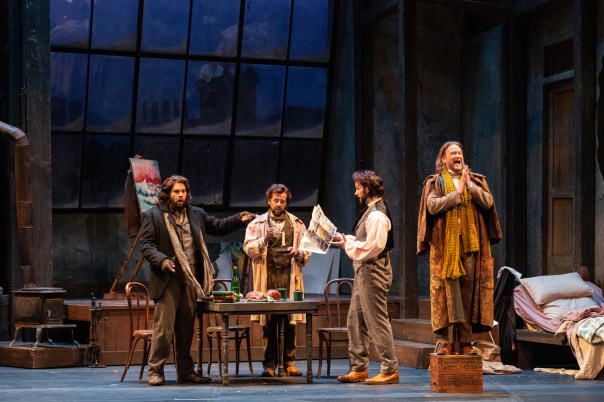
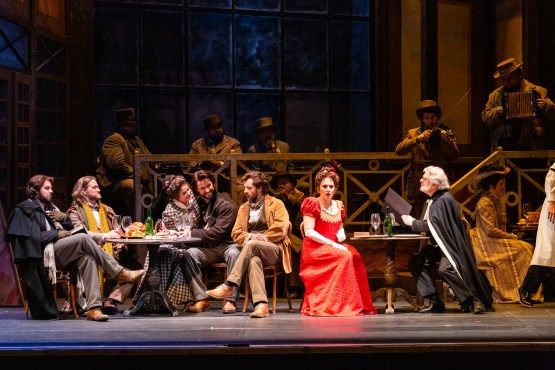
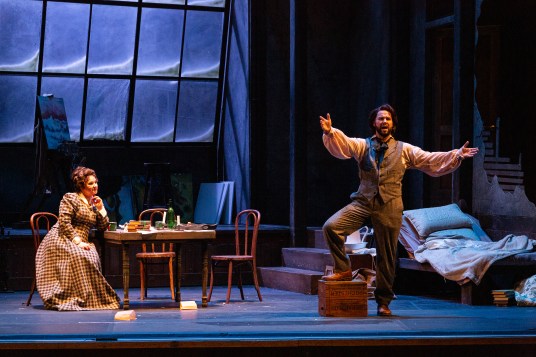
Scenic designer Peter Dean Beck has not updated the loft where we first meet the poet/playwright Rodolfo, his painter chum Marcello, musician Schaunard, and philosopher Colline. The boulevard bustle of the Latin Quarter and Café Momus is not on the awesome Franco Zefferelli scale of the beloved Metropolitan Opera production, but the spirit and colorfulness of Act 2 are also faithfully captured, where temptress Musetta and toyseller Parpignol highlight the broadened palette. Down in the pit, maestro James Meena and the Opera Carolina Orchestra are no less devoted to the shifting moods of the score, whether lovers are pining or Christmas-crazed children are running wild.

200116_OPE_LAB_0397

No, it’s director Aldo Tarabella in his Opera Carolina debut who bridges the gap between the 1830s, the actual setting specified in the Giuseppe Giacosa-Luigi Illica libretto, and the AIDs-plagued 1990s. From the outset through the intermission between Acts 2 and 3, Tarabella dispenses with subtlety in accenting the comedy of the first two scenes – the cavalier badinage between Rodolfo and Marcello as they cope with the cold, the successful conspiracy of the four tenants at the loft to thwart their landlord Benoit’s attempt to collect the rent, and the hoodwinking of Alcindoro, Musetta’s wealthy old sponsor, at Café Momus. There’s a certain amount of incorruptible idealism that infuses the Bohemians’ high spirits and deceptions, but with four performers making Charlotte debuts in this production, Tarabella also underscores the youthfulness of the Bohemians’ camaraderie and pranks.

Nor does Tarabella hold back when the mood shifts from mirth to tenderness, anguish, and heartbreak. When Alcindoro receives the bill at Café Momus after the Bohemian scamps have absconded, the old coot literally falls over backwards as the curtain comes down, and at the sad climax of Act 4, when Mimi has coughed her last, the impact on British tenor Adam Smith literally brings him to his knees as Rodolfo. In both instances, the direction is so flamboyant that we might feel like we’re watching a silent movie. Neither played like an overreach to the capacity crowd on opening night.

200116_OPE_LAB_0193

If Tarabella seemed to be persuaded by Rent of the efficacy of emphasizing the youthfulness of Puccini’s opera, then the singers onstage must certainly have exerted a persuasive power over youths in the Belk audience who were experiencing the source of Rent for the first time. Smith in particular didn’t merely touch your heart when he sang the famed “Che gelida manina (Your tiny hand is frozen)” to Mimi as he responded to her plea for him to light her candle. When Smith ascended to the blazing summit of this aria, his rich, full-bodied tenor sent a bloody stake through your heart. It would be an understatement to say that Smith equaled the Rodolfo of tenor Ramón Vargas when I reviewed him at the 1205th performance of Bohème at the Metropolitan Opera in December 2008. Vargas was past his 48th birthday when I saw him, and he could no more match Smith’s sheer vocal power than he could match his youth and freshness.

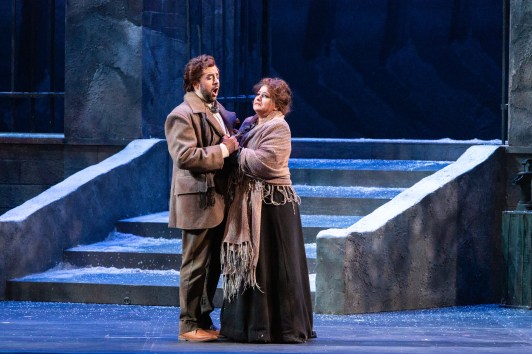
Smith’s singing ought to be sufficient incentive for snapping up what few tickets might be available for the remaining three performances of this Bohème, but he also delivered the frivolity and nerdiness of Rodolfo when needed. The other Charlotte debuts had more to recommend them than merely their youth. Italian soprano Stefanna Kybalova, though not ideally suited to the exquisite fragility of Mimi, poignantly delivered the seamstress’s consumptive weakness. Kybalova was more effective as a soloist in Acts 3 and 4, during Mimi’s final decline and when she repeated her signature “Mi chiamano Mimi (They call me Mimi)” theme, but the duets with Smith were always gorgeous, including the two fadeouts which seem to crystallize the whole opera.

200116_OPE_LAB_0534

Sicilian baritone Giovanni Guagliardo is considerably mellowed as Marcello compared with his previous Opera Carolina appearances as Tonio in Pagliacci and Sonora in La Fanciulla del West, joking and commiserating with Rodolfo in the loft scenes and sympathizing with the forlorn Mimi in the Act 3 snow scene. Yet he also flashed some fire dealing with the flirtatious, manipulative Musetta. The heat of their quarreling formed an effective counterpoint to Rodolfo and Mimi’s snowy reconciliation in the quartet that took us to the second intermission. For her part, soprano Corey Lovelace had all the sultry fire you could wish for in her Charlotte debut as Musetta, giving Guagliardo as much as he gave her in the fire department. She also had sufficient arrogant majesty to captivate us and dominate a stage full of people in front of Café Momus delivering “Musetta’s Waltz,” though Tarabella didn’t ask for Carmen-grade vamping from her.

200116_OPE_LAB_0848

Outside of the two main couples, I didn’t much notice bass baritone Peter Morgan’s debut as Colline – or, for that matter, Keith Harris’s return as Schaunard – until Act 4. But to help clear the stage for Mimi and Rodolfo’s last deathbed tête-à-tête, Puccini masterfully has Colline sing a tender valedictory to his coat, which he resolves to pawn in order to provide food and medicine for the invalid. Morgan gave the aria a near-Russian solemnity, yet the eccentricity of this episode still resonated with the more blithe and high-spirited action of the opening act, when Rodolfo made a similar sacrifice, feeding his playscript to the stove to keep the Bohemians warm. Not so comical after all, despite the jibes of his companions.

Before Meena took his place in the orchestra, there was a filmed fundraising appeal aimed at boosting contributions from 23 to 30 percent of the company’s budget. Explicitly occasioned by the failure of the Charlotte sales referendum on behalf of arts and parks last November, just two days before a poorly attended opening of Verdi’s Macbeth, the appeal was aptly timed. The production that followed, in front of a packed house, affirmed what Opera Carolina is capable of when it gets the robust support it deserves.