Tag Archives: Opera Carolina

The Passion of Mary Cardwell Dawson Brings a Neglected Pioneer Back into the Spotlight

Review: The Passion of Mary Cardwell Dawson at the Parr Center

By Perry Tannenbaum
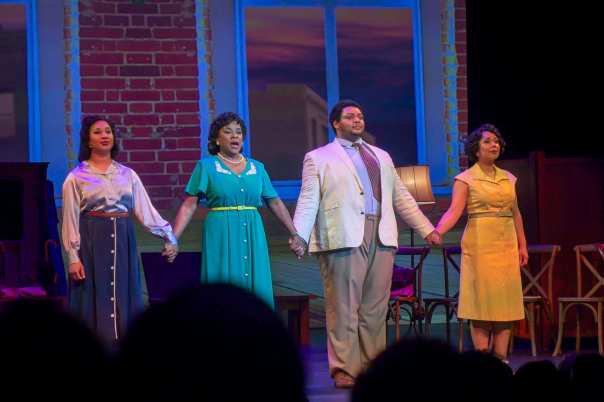
  February 15, 2024, Charlotte, NC – Commissioned by the Glimmerglass Festival and premiered there during the summer of 2021, The Passion of Mary Cardwell Dawson is a fascinating, informative, and inspiring hybrid. Part documentary, partly a new play by Sandra Seton with operatic arias composed by Carlos Simon, and partly an eye-opening “Building the Stage” exhibition, the new co-production by Opera Carolina and The Denyce Graves Foundation have found a perfect landing spot at the posh Parr Center on the CPCC campus.
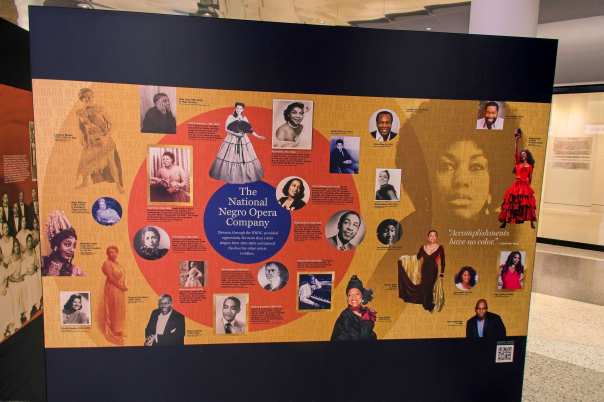
With numerous glitterati on hand from Charlotte’s African American community to celebrate opening night, Dawson, and Black History Month, the Parr Center lobby dazzled as never before. Just 15 minutes before the curtain was scheduled to rise, I encountered a roomful of beautiful people and formalwear; imposing billboard-sized exhibits of museum quality devoted to Dawson, the National Negro Opera Company she founded, and the luminaries of opera – and jazz – that she tutored; accessorized with video stretching from one entrance to the New Theater to the other. All the bells, whistles, and glamor you could want, with a live bass and alto sax duo playing Charlie Parker bebop in the background.

The production was certainly equal to the new hall. Accompanied solely at this point of its development by pianist Gregory Thompson, The Passion would seem smallish at Belk Theater with its cast of four and an orchestra of one. Unfortunately, the Seaton-Simon creation also struck me as too small for Dawson, its subject, and too small for Graves, its star. With a sympathetic director like Kimille Howard already on board, and Op Carolina’s set designer demonstrating fresh possibilities with his wonderful projections on the upstage wall, the avenues are certainly opened for a fuller exploration of Dawson’s talents and achievements.

Seaton places all of the action in Pittsburgh, mostly at the headquarters of Dawson’s company on Apple Street, in a studio upstairs from her husband Walter’s electric company. Her compressed timeline results in a format that wavers between masterclass and a professional rehearsal. On one side of the stage, Thompson presides at a Steinway, and at the other, we see three humble chairs that might be occupied by students in a Dawson masterclass. If the libretto were allowed to breathe a little, the curtain would rise on the three students we will see, either seated and ready to perform or engaged in conversation, giving Simon – composer-in-residence at the Kennedy Center in DC – a chance to begin penning some recitative, and giving Graves a grander entrance.

Alas, this is a rehearsal of Bizet’s Carmen on the day that the Negro Opera Company’s production is set to premiere on a floating outdoor stage by the shore of one of Pitt’s famed three rivers. This setup gets more improbable as the story unfolds, undercutting Dawson’s wisdom as a performing artist, an opera director, and a business person. Would an operatic director allow her performers to risk overtaxing their voices by rehearsing on the day they perform? Wouldn’t the entire cast be summoned to a last-minute rehearsal? Wouldn’t it be in full dress? Wouldn’t standard rep like Carmen be so far under the belts of professional-grade singers that their director wouldn’t feel compelled to instruct them on how to present Bizet’s music or penetrate to his protagonists’ cores?

By heightening her drama on the day of the opening, Seaton actually manages to be more unflattering to the Dawsons. A rainstorm is raging across Pittsburgh, threatening the cancellation of tonight’s outdoor performance and the ruination of Dawson’s company. Administrators at Spoleto Festival USA and ticketholders from around the globe would laugh out loud at the notion that a scheduled outdoor production would bring in national and international stars to Charleston without making contingency plans for bad weather beforehand. Not sound judgment for Dawson or her husband, who handled her company’s business end.

Of course, Seaton’s scheme makes it easier for The Passion to have legs, because the roles of Dawson’s singers – Isabelle as Micaela, Phoebe as Carmen, and Frank as Don José – only need to be versed in their presumably familiar Bizet music rather than having to learn anything written by Simon. Even so, Diana Thompson-Brewer as Isabella, Ladejia Tenille as Phoebe, and Johnnie Felder as Frank, are all forced to look and sound slightly amateurish at times during their lamentably brief moments in the spotlight. Howard helps them all out from her director’s chair, occasionally obliging Graves to be a bit fussier – and a lot more prudish – than Seaton may have imagined Dawson when she wrote the script.

I was most impressed by Felder in the tenor role, and wondered how much his superiority might have figured in Seaton’s concept or Howard’s casting. Most of Graves’ vocal coaching, after all, is reserved for the younger women onstage and the music she has excelled in all the way the Metropolitan Opera, Covent Garden, and the Vienna Staatsoper, to name a few – so it would be a pity not to hear Graves in this repertoire while we have her here and not perceive her superiority to Dawson’s protégées. The diva and the drama deserve that. Simon’s music, scant as it is, is also worthy of Graves. Those two arias, when Dawson is alone with her thoughts and later when her class/rehearsal is done, both have the qualities of the best arias sung at Spoleto’s production of Barber’s Vanessa last spring.

A fuller version of The Passion of Mary Cardwell Dawson would be a full-length opera with a fuller view of Dawson as a singer, teacher, and impresaria. Ideally, it would take us back to the North Carolina native’s childhood and the foundations of her love for music and opera, but we should at least cover the arc of Dawson’s founding of her company, a more substantial exploration of her teaching methods and philosophy, and a nicely drawn arc of her prize students’ development into professional opera singers that do full credit to Dawson and her pioneering company in their Carmen. A full opera company at the end – with a fuller orchestra – would bring the entire enterprise up to scale. Make no mistake, though, this handsome Opera Carolina production is an exciting coup for Charlotte and a compelling argument for Denyce Graves’ project to reach its fullest fruition.

Opera Carolina Finds New Balance in Mozart’s “Don Giovanni”

Review: Don Giovanni at Belk Theater

 By Perry Tannenbaum

220203_OPC_CON_1103

February 3, 2022, Charlotte, NC – Among the lovable scoundrels of Western world literature, surely Don Juan has proven to be the most lovable – Molière, Goldoni, Lord Byron, Shaw, and Mozart are just a few of the notables who have sung the Spanish Don’s sins over the past 400 years. His tale can be seen as a series picaresque escapades and comical conquests, or as a grim and grisly revenge tragedy, or as a stern moral lesson. Armed with a wondrous libretto by Lorenzo da Ponte, Mozart disdained to choose among these alternatives, daring to make his Don Giovanni all of the above. With so much to see and emphasize, it’s no wonder that each of the six productions I’ve reviewed since 1991 has been so different from the others – including a Czech National Theatre production at the Estates Theater in Prague, the venue where Mozart’s masterwork premiered in 1787.220201_OPC_DON_053

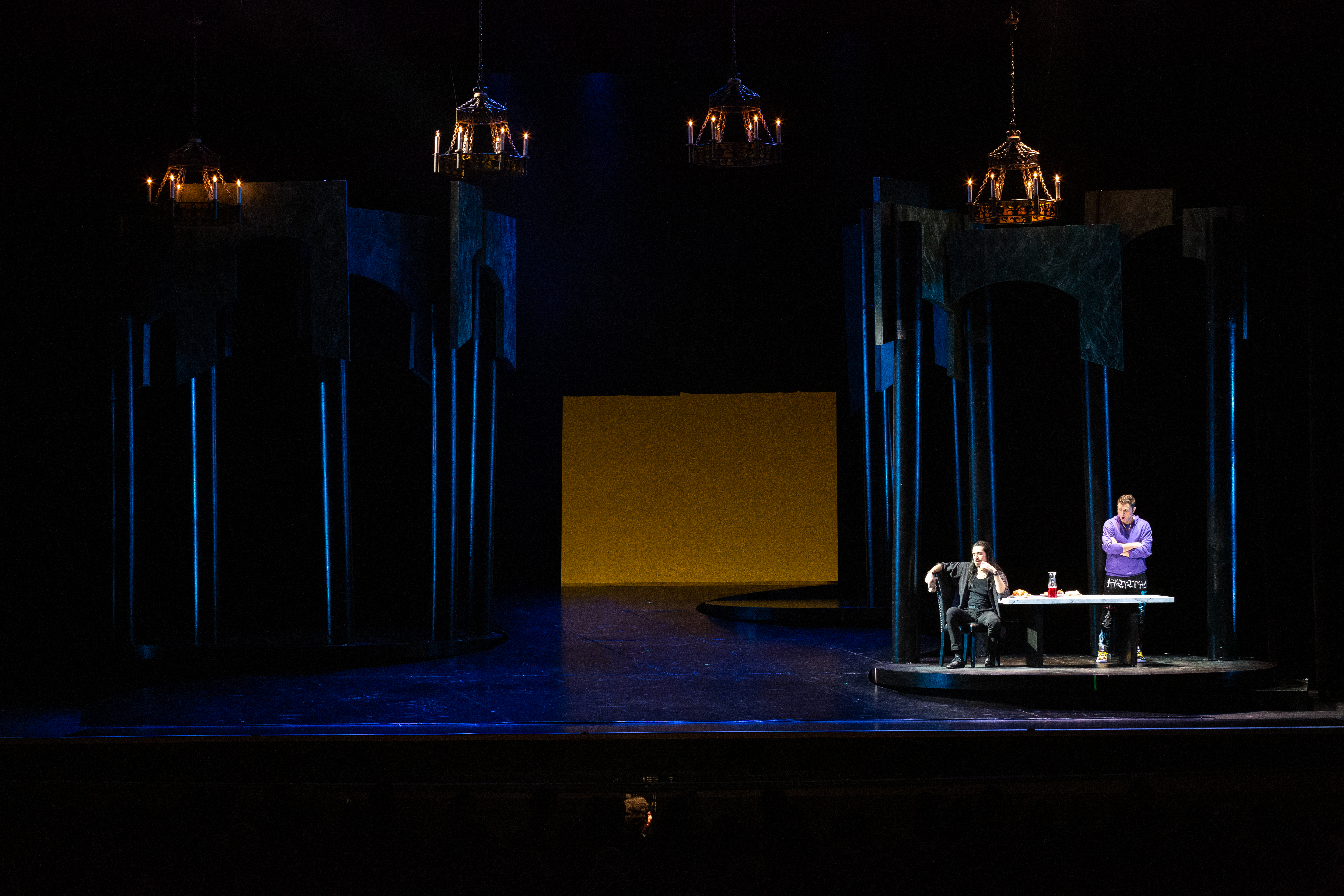
In her Opera Carolina debut, stage director Eve Summer pays little attention to scenery, relying on props and Whitney Locher’s costume designs to modernize the action. Donna Anna’s home doesn’t have a façade in the opening scene, where Giovanni flees after raping the noblewoman and is compelled to murder her father before he can escape. Nor is there an exterior, let alone an upstairs, at Donna Elvira’s lodgings in Act 2, when Giovanni serenades milady’s maidservant while Leporello, the Don’s servant masquerading as his master, creates a cunning diversion. Three revolving pods help simulate the places where the swift action unfolds, and Michael Baumgarten’s lighting designs signal the transitions and enhance the drama – especially in the denouement, when the Commendatore, Donna Anna’s murdered father risen from the dead, implacably gets his revenge.220201_OPC_DON_426

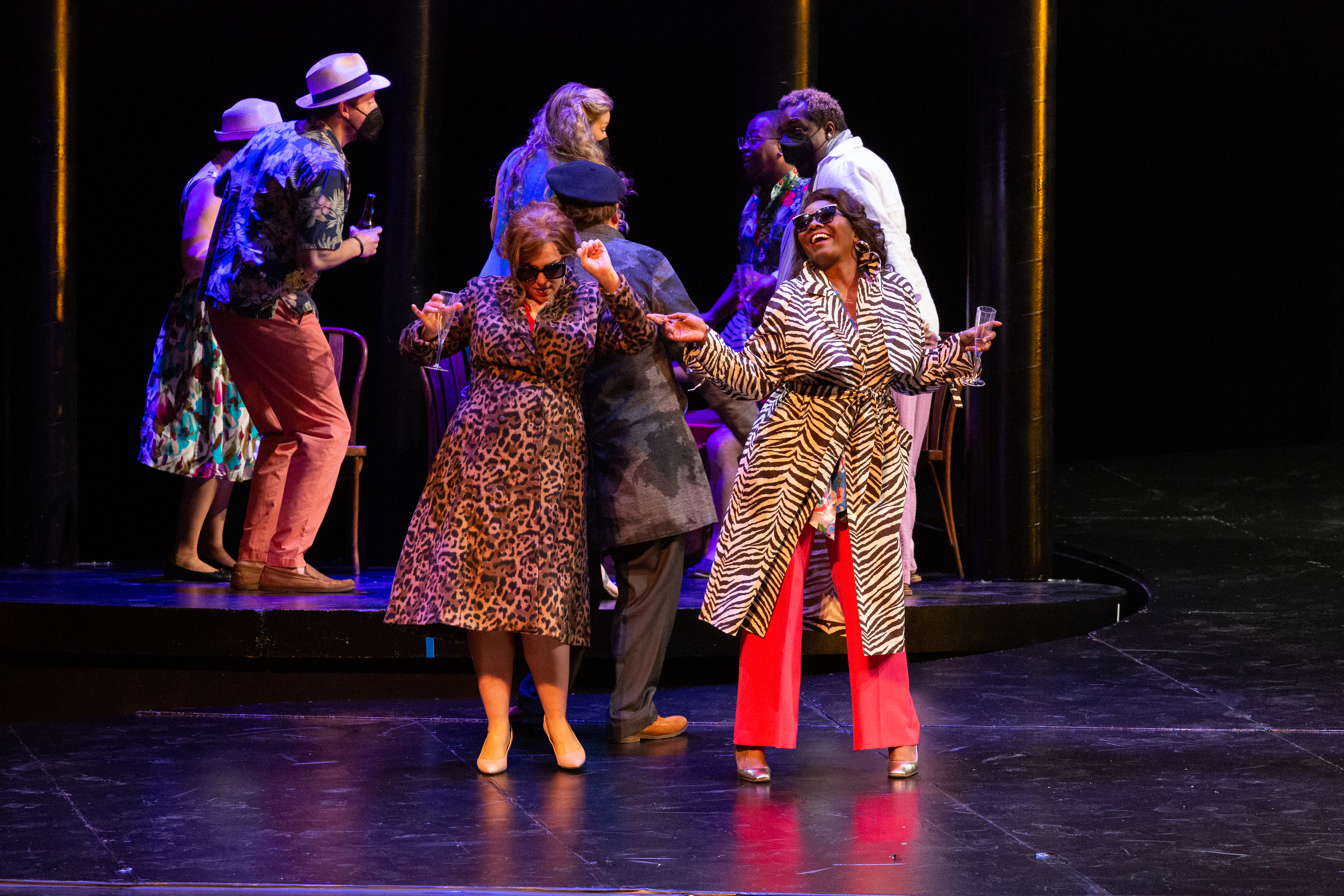
Summer hasn’t totally surrendered to modernity in her vision of Giovanni, for she surely could have gone further than equipping Elvira with contemporary luggage as she pursues the Don and turning the pages of Leporello’s book chronicling the rogue’s romantic conquests into an iPad that he scrolls. Balancing these modern touches are the curved tops of the revolving pods, evoking ancient arches, and the presence of harpsichordist Emily Jarrell Urbanak, seated at stage right throughout the evening. In a way, the singers also straddled different eras, always immersing themselves in Mozart’s music, yet the diversity of the casting – and a few of the dance moves they busted at Giovanni’s soiree – returned us to the new millennium. Most anachronistic were Sequina DuBose as Elvira, lugging her rolling stack of suitcases up a couple of stairs and down a ramp, and Alex Soare as Leporello, discarding his sensationally grungy attire only when he impersonated Giovanni (though Locher’s design here may have also been inspired by the Ghost of Christmas Future).220201_OPC_DON_170

Dashing, cruel, and overflowing with conceit, bass-baritone Richard Ollarsaba made a stunning debut as Giovanni, even if the mod dress deprived him of the opportunity to unsheathe a sword. His overtures to Elvira, her maid, and the peasant girl Zerlina were all lusciously seductive. Encounters with Leporello and Masetto, Zerlina’s fiancé, crackled with scornful superiority, sometimes snarling and sometimes nonchalant. The old Commendatore seemed to draw the very best from Ollarsada, cavalierly deferential to his age in resisting his challenges to combat in the opening scene, defiant and fatally unrepentant when Giovanni’s fate was sealed. As rich and appealing as Ollarsaba was when he sang, Alex Soare was startlingly convincing as Leporello when the servant was called upon to masquerade as his master. To bring out the servant’s comic flavor, moments when Leporello was marveling at the gullibility of Giovanni’s victims were underscored more boldly than the disillusion, disgust, and abject fear that the Don’s escapades put him through. Nor was bass-baritone Ashraf Sewailam chiefly onstage as Masetto to clownishly portray the peasant’s malleability, showing us far more of the hothead than the usual hayseed. In the same spirit, tenor Johnathan Stafford White as Don Ottavio, Anna’s staunch and patient fiancé, is more of a noble champion than a feckless chump.27sQMG5Q

Perhaps even more than the men, the excellence of the three sopranos cemented my suspicion that this was the deepest Opera Carolina cast I’ve seen. While Summer didn’t allow Rachel Mills quite as much risqué latitude as I saw in Prague in consoling her battered Masetto, this Zerlina was no less irresistible in her “Vedrai carino,” applying the balm of love on his bruises. Although there were slight chinks in DuBose’s vocal armor, there were no losses in sweetness when there were dips in volume as Elvira sang her woes, and DuBose is such a fine performer that I had second thoughts each time I steered my attention elsewhere – so many of her reactions are worth watching. Most revelatory was Melinda Whittington as Donna Anna, a role I’ve often found annoying in her chaste righteousness. Whittington amped up the feeling of this grieving rape victim while tamping down her outraged fervor. Summer allowed her to wear a color to the Don’s soiree instead of shrouding her in mourning, and those dance moves further humanized her.220203_OPC_CON_1197

The joyous epilogue, celebrating the triumph of justice over wickedness, is scrapped in this new Opera Carolina production. Somehow that enhances the impact of bass Jordan Bisch as the avenging Commendatore. Both at the cemetery accepting Giovanni’s dinner invitation and later at the Don’s banquet hall, Bisch resounds thrillingly as the voice of doom. After blasting my eardrums just three weeks earlier from the Belk Theater stage with Mahler’s Ninth, a discreetly reduced Charlotte Symphony sounded comparatively wan as it wafted the Giovanni overture out of the orchestra pit. But Opera Carolina artistic director James Meena had the ensemble perfectly calibrated for the occasion, and when the curtain rose, the blend of singing and playing gave constant pleasure. As I stepped onto the elevator with another couple, hurrying to beat the Belk crowd out of the parking lot, the husband couldn’t help gushing, “This is the first classical opera we’ve seen!” If future productions are as good as this Giovanni, they will be coming back again and again.

Originally published on 2/5 at CVNC.org

Tappin Music Carries the Night – at the Knight – in Opera Carolina’s I Dream

Review:  I Dream

By Perry Tannenbaum

Douglas Tappin has composed approximately half of a very fine rhythm-and-blues opera, an extensively revamped I Dream that originally premiered in 2010, honoring Rev. Martin Luther King in his hometown of Atlanta. The two-act work has now been revived serendipitously to coincide with the 50th anniversary of Dr. King’s assassination, premiering in Toledo at 7:01pm on April 4, the exact minute of the crime a half century earlier, and getting a reprise in Charlotte in an Opera Carolina production at Knight Theater.

Showcasing Tappin’s music, Opera Carolina is presenting its first fully-staged production at Knight Theater, a venue they have only used previously for special concert events.

The unfortunate thing is that Tappin also wrote the lyrics and the libretto for I DREAM. We’re saddled with a script that slinks its way circuitously through MLK’s last 36 hours, guided by a dubious premise and punctuated by flashbacks that aren’t always dramatic. This civil rights icon doesn’t merely have a premonition that longevity isn’t to be his; he has recurring dreams about the balcony where he will be shot.

In a bizarre twist, these specious dreams become the dream of Tappin’s title, because all of King’s famed oratory – his “I Have a Dream” speech and his “Mountaintop” prophecy – are never spoken. You better know who Ralph and Hosea are, too, for in steering far away from any copyright recriminations from King’s heirs, Tappin omits their full names. Coretta and Martin aren’t blessed with their last names on the cast listings, either.

And who are Martin’s historic adversaries in his heroic struggle for civil rights? Never anyone more important than an anonymous cop wielding a billy club.

Instead of DC or Memphis, Tappin takes us to Montgomery, Birmingham, and Selma. Prudent choices if we’re seeking action rather than copyrighted oratory, but Tappin’s libretto also takes us to Boston, where he met Coretta during his student days, and to a hospital bed, where a duet is sung over his recumbent form. Perhaps in a previous draft of the libretto, King was stabbed in the chest with a letter opener as he actually was at a 1958 book signing. Not anymore: here he simply collapses.

A better playwright would have tiptoed more skillfully through the copyright minefields and woven a more dramatic and compelling narrative. Tappin’s great strength is in his music. If Andrew Lloyd Webber learned profitably from the great operatic masters, I’d say that Tappin has learned profitably how to create a propulsive non-classical score from Lloyd Webber.

When we finally get to Birmingham and Selma in Act 2, the lunch counter arrest and the time in jail signal a melodic climb to King’s victory in Selma that is truly majestic and inspiring. Tappin sustains this momentum through the rendezvous with fate on the balcony of the Lorraine Motel and afterwards, when Coretta leads Martin’s people in mourning.

Although the steeply raked set design by Kevin Depinet, in placing the fatal balcony dead center, reminds me of a TV test pattern, stage director Daniel Goldstein keeps the action between scenes moving fluidly, and the singers have been more than sufficiently rehearsed to move surefootedly on the sloped surface. Musical director and orchestrator Carl Marsh seems to favor Broadway over the Metropolitan Opera in his instrumentation, including an electric guitar and electronic keyboards in the mix, but there is plenty classical heft in the 35-person ensemble with 13 musicians from Charlotte Symphony.

Opera Carolina’s frontline cast also straddles the realms of musical theatre and opera in their impressive résumés. Derrick Davis has sung an admirable range of baritone roles on Broadway and on tour, from Mufasa in Lion King to the title role in Phantom of the Opera, and his OC debut as MLK has moments of peacemaking mellowness and warrior ferocity.

Although the roles of Ralph Abernathy and Hosea Williams aren’t noteworthy for their historical accuracy or even their individuality, the voices we hear, both returning OC artists, bring the heat. Baritone Kenneth Overton as Ralph seems to be the voice of prudence and pragmatism, yet solid and formidable. As Hosea, Victor Ryan Robertson is the voice of passionate principle, his wild tenor bridling against the discipline of non-violence. The bi-play between Robertson and Davis in the jail scene is simply riveting.

Victimized by the static scenes in Boston and at the hospital, Laquita Mitchell is further disadvantaged by her divine soprano voice. I wouldn’t blame Jeremy J. Lee’s sound design or even Tappin’s libretto here, but to be understood, Mitchell needs supertitles more than anyone else onstage. As a result, mezzo Lucia Bradford upstages Coretta as Grandma in her Charlotte debut. Her maxim, movingly sung to Young Martin (Byas Yasan Monroe), ultimately becomes the most effective frame for King’s sequence of flashbacks.

With this powerhouse lineup of singers armed with Tappin’s consistently lively music, we easily weathered the lulls and inexplicable blind alleys of the composer’s script. The opening night audience for I Dream entered with plenty of enthusiasm for the legacy of Martin Luther King, the rhythm-and-blues idiom of Tappin’s opera, and Opera Carolina’s audacity in taking subscribers to new places – including Knight Theater for a refreshing change. From the buzz in the Knight lobby afterwards, I’d say the performance had clearly sustained the audience’s enthusiasm in all respects.

Best of Charlotte, 2017

Best of Charlotte, 2017

By Perry Tannenbaum

                                           Best ActorJeremy DeCarlos


Among local performers, there are strong candidacies from Brian Logsdon (Pride and Prejudice and Ragtime), Jonavan Adams (Ma Rainey’s Black Bottom and The Christians), Scott A. Miller (Stupid F@#%ing Bird and The Submission), Jermaine Gamble (A Raisin in the Sun and Jitney) and Tyler Smith (Ragtime and Memphis). All of them sparkled on multiple occasions. But the runaway victory goes to Jeremy DeCarlos, who laps the field – in range and productivity – with four scintillating outings. Draped in a braided Hussar jacket, DeCarlos just finished channeling his inner Jimi Hendrix as the devilish St. Jimmy in American Idiot. That was the last of his Actor’s Theatre gems over the past year, including some cross-dressing preaching in Bootycandy, his insouciant devotion in Stupid F@#%ing Bird, and his amazing transformation – from Jerry Lewis nerd to Incredible Hulk-ish monster – in The Toxic Avenger.

Best Actress – Shar Marlin

The field of contenders is larger among the ladies, but the roles were more thinly distributed, eliminating productivity as a decisive criterion. But which other benchmark should override all others? If it’s flesh-crawling menace, Sarah Woldum gets the edge, bringing Sheridan LeFanu’s Carmilla to life in She Who Watches. Leslie Giles was the funniest as the blind librarian in The Toxic Avenger, Lucia Stetson the most revelatory as Mother in Ragtime, and Allison Snow Rhinehart was better than her Broadway counterpart as Mama in Memphis. And how can I forget the sizzling dominatrix arrogance of Nonye Obichere as Whatsername in American Idiot? I’m turning instead to Shar Marlin for her sheer power and imperial dominance in Ma Rainey’s Black Bottom, a dramatic stunner that also showed Shar’s blues singing chops. Dignity in the face of exploitation and discrimination. Diva!

Best Comedy – Women Playing Hamlet


Theatre Charlotte’s You Can’t Take It With You and the Citizens of the Universe farewell, The Hitchhiker’s Guide to the Galaxy, were arguably the zaniest productions of the 2016-17, while the Chekhov knockoff from Actor’s Theatre, Stupid F@#%ing Bird, was surely the most poignant. And what about OnQ Productions’ A Brown Tale from James T. Alfred, maybe the funniest one-man show I’ve ever seen? All were worthy candidates, but I’m going to let Chickspeare split this prize with Donna Scott Productions for their joint production of Women Playing Hamlet. Glynnis O’Donoghue starred as the soap queen saddled with the lead role in the Mona Lisa of tragedies, and the galaxy of comediennes – all in multiple roles – offering her questionable advice included Tania Kelly, Andrea King, Vivian T Howell, and Sheila Snow Proctor.

Best Musical – Ragtime

Ragtime Promo Photos

Folks who confine their diet of musicals in Charlotte to touring productions at the PAC are missing out bigtime on the locally-produced blockbusters playing out at smaller venues around town. Actor’s Theatre scrambled to produce a marvelous Toxic Avenger at a storefront church because this city doesn’t have the vision to see the arts flourish on Freedom Drive without a needless morass of red tape. Still in exile, they just brought the noise of American Idiot to Queens University for a face-melting month. After reminding us how finely they can produce A Year With Frog and Toad, Children’s Theatre astonished with the world premiere of The Best Christmas Pageant Ever: The Musical. With more than one Broadway-level performance, Theatre showed us their mettle with Memphis, and CPCC re-emphasized that their musical excellence isn’t confined to summer anymore. Maybe it was sheer luck, but CP’s wintertime production of Ragtime was the most timely of the year, underscoring the sad fact that institutional racism, police brutality, and prejudice against immigrants aren’t quaint relics of the Jazz Age. As the martyred Coalhouse Walker, Tyler Smith’s impassioned “We are all Coalhouse!” reverberated through a city in turmoil.

Best Drama – Jitney

Early last season, PaperHouse Theatre proved that The Frock Shop on Central Avenue was the perfect site for a creepshow with a dazzling She Who Watches, and early this season, a legend made a comeback when Steve Umberger and his Playworks Group brought a sterling production of The Christians to Booth Playhouse. In between, as Charlotte was fully wakening to how badly we have neglected and mistreated our underclass, theatergoers may have finally been zonked by the realization that our city is exceptionally rife with African American acting and directing talent. Kim Parati made an auspicious directorial debut at Theatre Charlotte with a freshened-up Raisin in the Sun, but this was a vintage year for August Wilson – in two dramas directed by Corlis Hayes, Ma Rainey’s Black Bottom at CPCC and Brand New Sheriff’s Jitney at Spirit Square. Hayes brought out the best in John W. Price and Jermaine Gamble as the father-son antagonists in Jitney, with Gerard Hazelton adding a mix of comedy and poignancy as the gypsy cab company’s resident lush. Move over OnQ Productions, there really is a brand new black company in town – our second! – producing professional-grade work.

Best Night @ Symphony – Mahler’s “Resurrection”

While a well-played Beethoven symphony, a Rossini overture, a Strauss tone poem, or a Mozart concerto might be the secret sauce to get newcomers to become Charlotte Symphony subscribers, longtime concertgoers like me wish to dismount the warhorses and hear something off the beaten trail. There’s plenty out there that will please both camps: big, unfamiliar orchestral works that will instantly grab you by the lapels even if Symphony hasn’t reprised them within the last decade. Armed with an audacious orchestra and choir, plus two soloists who have sung with Opera Carolina, Davidson College showed the way with a rousing performance of Ralph Vaughan Williams’ A Sea Symphony, set to poetry by Walt Whitman. That’s the sort of daring we hope for from Charlotte Symphony’s British maestro, Christopher Warren-Green. We did get a British Isles-themed evening when pieces by Edward Elgar and Peter Maxwell Davies, spiced up with a bagpiper, were served with Mendelssohn’s “Scottish.” Utilizing the Symphony Chorus and distinguished guest vocalists, Warren-Green turned up the power with a pair of Bruckner chorales last November and Mendelssohn’s Elijah last March. If you wanted to sample the full capabilities of Symphony, their chorus, and the guest vocalists Warren-Green can summon to Belk Theater, you had to hear them introducing the wonders of Mahler’s “Resurrection” Symphony No. 2 to an astounded audience.

Best Night @ the Opera – The Girl of the West

Under maestro James Meena, Opera Carolina does the oldies better than ever, as their uproarious Barber of Seville and their vivacious, ultimately anguished La Traviata amply proved. There was even some audacity in the 2016-17 programming as OpCar partnered with Warehouse Performing Arts Center and the D9 Brewing Company to produce an evening of three short operas – including the world premiere of Scott Joiner’s “Connection Lost (The Tinder Opera)” – at the brewery in Cornelius. Yes, a world premiere on Treynorth Drive! But most exciting was the Charlotte premiere of Puccini’s The Girl of the West, as Meena collaborated with six other international companies, including New York City Opera and Teatro del Giglio in Lucca, Puccini’s hometown. Singing was exemplary, persuading me that this second-tier Puccini opera was actually a first-rate work, and staging was anything but stodgy or conservative: much of the scenery was animated and bold, with authentic relics evoking the Wild West supplied by our own dearly beloved Wells Fargo. An appreciable, if infinitesimal, atonement for all the bank’s Wild West chicanery.