
Still in Flux, Spoleto USA Runs Brash Gamut From Barber To Balloon Pops

April 28, 2023, Charlotte, NC – It’s time to admit that Charlotte Symphony has flipped the script. After a string of four consecutive concerts that I’ve reviewed in 2023, with four different guest conductors, every one of them immaculately played, I can no longer agree that CSO is in search of a new music director who will take the orchestra to the next level. The virtuosity and consistency are here, the responsiveness to varied composers and conducting styles is here, and the mastery of a multitude of musical styles can no longer be overlooked.
My moment of revelation came after the intermission in this week’s program at Belk Theater with guest conductor Lan Shui. Everything had been wonderful so far: Samuel Barber’s “Overture to The School for Scandal” had been colorful, cohesive, and melodious; the accompaniment of guest pianist Mari Kodama’s scintillating work on Mendelssohn’s Piano Concerto No. 1 had been as robust as the support Canadian soprano Alexandra Smither received on Benjamin Britten’s Les Illuminations with guest conductor Vinay Parameswaran on the podium.
My moment of realization came as the opening Largo-Allegro movement of Sergei Rachmaninoff’s Symphony No. 2 came to its finish – epic in its variety, impeccable in its flow, and utterly convincing in its pacing and drama. I had never appreciated how rich and gorgeous this music was. Repeatedly over the years, I have written about the low points in my CSO concertgoing experiences, when I needed to hurry home after performances of Beethoven’s Eroica and Copland’s Appalachian Spring to re-establish, via CDs in my collection, that I actually liked and admired this music. Finding out at Belk Theater what I’d missed on recordings I have heard before at home, as I did last night with Symphony’s Rachmaninoff, was a complete 180-degree turnaround.
Mei-Ann Chen’s exhortations that Charlotte should support their orchestra as much as it deserved weren’t tainted at all with pragmatic flattery as I had thought, it was plain honesty. The only reason she remains the top candidate among those I’ve heard after Shui’s equal triumph is that I still feel Chen will bring more youth and effort to the true tasks at hand – keeping CSO’s performance level at its admirable height, enlarging its numbers, and enhancing its reputation and touring opportunities. Nor should I leave what is implied here unspoken, that Christopher Warren-Green completed his mission of lifting Symphony’s quality to international standards by the time his tenure ended in 2022.

Triggering the lush and playful violins, principal oboist Hollis Ulaky and principal clarinetist Taylor Marino played beguiling solos. Pacing and dynamics were beautifully judged until the cycle repeated, the violins seeming to respond lower in the treble and Marino playing more challenging passages. The Mendelssohn that followed was Molto allegro from the start, Kodama’s febrile attack matched by Symphony’s zesty engagement. When we flowed into quieter interludes the transitions were utterly seamless, with lyricism spontaneous enough to foreshadow an ethereal rapturous treat when we reached the middle movement – so transporting that I need to rouse myself and realize we were already in that dreamy movement and that the orchestra had arrived there without a pause.

Kodama caressed the treble at times with her delicate right hand while cherishing it in her left hand with a closed fist, at other times, she leaned back and gazed almost directly upwards. Shui and the orchestra were far more emphatic in signaling the segue to the finale, a rousing Presto-Molto allegro. Early in the movement, Kodama wasn’t as crystalline in her fingering as Howard Shelley in his recording with the London Mozart Players, and I’m not sure she quite equaled the drama of the manic build at the very end that Stephen Hough achieved with the City of Birmingham Orchestra. Overall, though, the live Kodama-CSO performance matched them both.
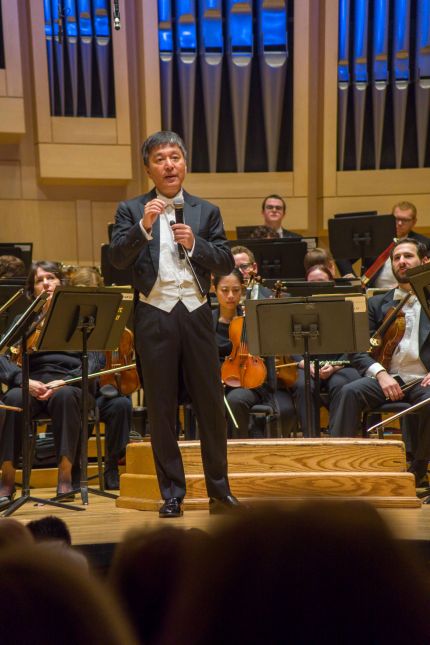
As the glory of Symphony’s performance of the Largo-Allegro moderato opening movement flowed so gorgeously from pinnacle to pinnacle, cogent and suffused with seething tension, it occurred to me that the orchestra’s immersions outside their mainstage classical offerings – in big band jazz charts and film scores – has paid off in handsome dividends. From measure to measure, like frame to frame at the movies, connections remained ironclad. Shui’s spoken intro was entertaining and informative, not above repeating some of the information in the digital program booklet, a practice that Warren-Green religiously avoided. He warned us of the hourlong length of the piece and had us on the lookout for Marino’s lovely clarinet spot at the beginning of the Adagio third movement. It emerged unforgettably out of a hush and took sad flight until the strings joined in the restless, aching keening, flowing into work’s biggest tune.
I couldn’t trace any previous CSO performances of this grand piece on my calendar or in my document dating back to 1994, so few if any of the musicians onstage were much more familiar with this gem than those of us in the audience marveling at its beauty. Shui has recorded all the Rachmaninoff symphonies with Singapore Symphony Orchestra, where he was music director from 1997 to 2019, so he has a special affinity for this music. Getting to hear his interpretation of the E minor No. 2 is a special gift for us.
 We’ve been hearing about numerous identified and unidentified flying objects in recent weeks, emanating from numerous sectors of the globe, crossing over our nation’s territorial waters and seeking all sorts of military and meteorological intelligence. Less mysteriously, there have been precise predictions in recent months of astral objects whistling through our solar system, one of them brushing closer to dear Earth than the moon.
But until now, not a word about the meteor that struck the Knight Theater in the heart of Uptown Charlotte. Her name is Mei-Ann Chen, and we can only hope that the guest conductor now in our midst is vying for the vacant music directorship at the Charlotte Symphony. It would be grossly unfair, no doubt, but it wouldn’t a bad idea to sign her up before she left town.
Chen’s impact on – and appeal to – the Symphony’s musicians and subscribers was nothing short of electric.
The orchestra had never performed Fanny Mendelssohn Hensel’s Overture in C Major before, yet they attacked the work zestfully, conveying its sharp contrasts and drama with unmistakable fervor. Flutist Amy Orsinger and principal oboist Hollis Ulaky excelled, jointly and separately, in the piece’s gentler moments. Although we had heard the CSO play the BRUCH VIOLIN CONCERTO as recently as 2016, Chen ignited the ensemble with fresh fire rather than receding to a subsidiary role behind concertmaster Calin Ovidiu Lupanu.
Instead of deferring to the soloist – or even seeking an agreeable balance between orchestra and violinist – Chen laid the gauntlet down to them both, so that Lupanu and Symphony spurred each other to greater heights vying for supremacy, achieving a higher level of parity through their combat. More adventurous now than I can recall, Lupanu was nearly note-perfect all the way through the treacherous terrain of the Allegro energico finale while his attack, confidence, and feeling were never better. His command was certainly impressive throughout the opening Allegro moderato, with a transition to the slow middle movement that was amorously smooth. Principal flutist Victor Wang helped to make this Adagio extra exquisite.
As the concerto climaxed, it might have been a toss-up to many in the audience whether Chen was inspiring the CSO or vice-versa. In respect for your colleagues, you’re not going to urge an orchestra too insistently to give us more during a performance – that has to have happened behind the scenes in rehearsal.
Our first glimpse of what that might have been like came right after the concerto, when Chen gestured to the audience to give Lupanu more love for his sterling performance. After the break, our impressions grew more vivid as Chen picked up a mic at the podium and greeted us. Not satisfied with our “Good evening!” Chen urged us to make a second try, somehow infusing this tired old emcee shtick with new energy and spontaneity – and getting results.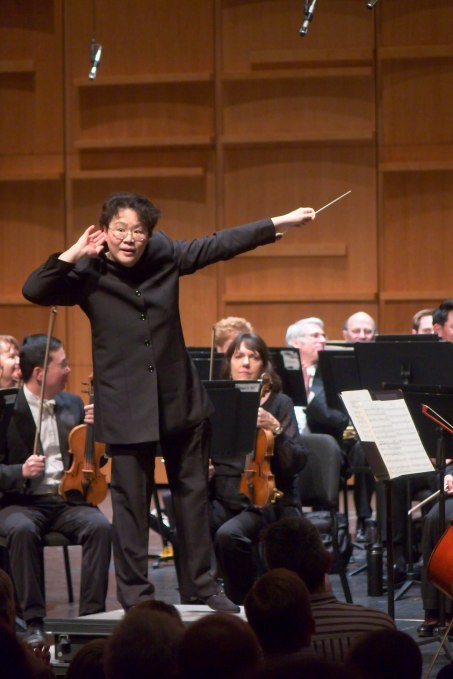
Speaking about the works on tonight’s program, Chen included info we could have gleaned from the program – a practice that Christof Perick and Christopher Warren-Green staunchly resisted – and made an effort to link the pieces together with a common theme. Faced with a crowd that was significantly more numerous than the crowd I’d seen three weeks earlier, but still significantly short of Knight’s capacity, Chen declared that Charlotte should be more supportive toward its Symphony.
That was a more compelling statement after delivering two examples of our musicians performing at their peak.
Chen rightly surmised that the main draw of the evening was the Bruch, since the César Franck Symphony in D minor, originally slated for its revival last March, hadn’t been heard in the Queen City since November 2003. Now that was a pitifully attended concert at Belk Theater, after striking CSO musicians had settled on a new contract and returned to work, so Symphony subscribers can pat themselves on the back for improving on that turnout.
The main link between the two Francks that I’ve seen was the fine work by Terry Maskin on the cor anglais solo in the middle Allegretto movement. In the outer Allegro movements, our brass proved its mettle once again, though we’ve surely seen a Chening of the guard during the intervening decades. Associate concertmaster Joseph Meyer distinguished himself in the early Lento of the opening and principal French hornist Byron Johns had outstanding moments when the music quickened.
Chen improved most on the Perick performance of 2003 in the Allegretto, livening the effect of Maskin’s soulfulness on the English horn with more standout work from Johns and Andrea Mumm Trammell’s delicacy on the harp. Before the brass brought the finale to its brash climax, CSO’s principal harpist bubbled up tellingly in the symphony’s last calming episode.
Obviously content with her musicians’ handiwork, Chen gave the audience opportunity after opportunity to show the appreciation she had previously asked for. With unmistakable cues, Chen called upon us – already giving them a standing O – to really let the musicians hear it as she prompted them individually and collectively to take their well-earned bows. We did.
[If you missed Mei-Ann Chen in Charlotte, you can catch up with her on June 7, when the Chicago Sinfonietta music director conducts Antonín Dvořák’s “New World Symphony” at Spoleto Festival USA.]
Photos by Perry Tannenbaum


 Art on My Sleeve