Tag Archives: Marty Wolff

“Bright Star” Shines Zestfully in Matthews

Review: Bright Star at Matthews Playhouse

By Perry Tannenbaum

Though it never settles down here in the QC, it’s nice to know that Steve Martin’s beautifully crafted Bright Star, while tracing its graceful decades-longstory, carves a North Carolina oval around Charlotte. Crisscrossing between Asheville and Raleigh with stopovers in Hayes Creek and Zebulon. Martin’s music leans pleasantly westward, delivering bluegrass and mountain flavors, brightly flecked with sounds of the comedy polymath’s signature banjo. Nor in transporting the original “Iron Mountain Baby” story to the Blue Ridge Mountains, does Martin neglect the rhythm of the rails, for a train traveling over a river is pivotal to the plotline.

So of course, this genial musical, which stopped at Belk Theater on its national tour in 2018, is a perfect match for Matthews Playhouse (and its nearby depots) as it arrives for a richly deserved revival. Newly crowned last month with the 2024 North Carolina Theatre Conference Community Theatre Award, headquartered at the Matthews Community Center, this company is perfectly poised to deliver the authentic vibe.

Under the meticulous direction of Paula Baldwin, it does. Her design team, also leaning mountainward, delivers a rusticated look overall, with Yvette Moten’s varied costume designs pushing gently back against the drift of scenic designer Marty Wolff’s driftwood-and-tree-trunk set. Even when we’re at the Asheville Southern Journal, where Alice Murphy passes judgment on manuscripts by Carl Sandburg and Tennessee Williams, the fancy signage over the office is painted on wood. This buttoned-up office is no less rusticated than Jimmy Ray Dobbs’ porch at the mayoral mansion in Zebulon, way over past Raleigh.

And the music! Nestled in an upstage shed framed by the timbers, musical director Ellen Robinson leads a zesty septet from the keyboard, with Nelson Frazier on the banjo. Edie Brickell’s lyrics ain’t no great shakes, but he had a hand in composing the music, so we’ll give him a pass.

Shuttling across the Tarheel State, we also shuttle between 1923 and 1946, when Alice decides to tell us her story. Although I loved the tale when I first set sight on it over six years ago, it wasn’t until I revisited it last week that I experienced its full power. Part of the revelation came from the alchemy of gradually remembering the Bright Star story as it unfolded anew inside Fullwood Theater – knowing what was coming a few minutes before it happened – and part of it came from Baldwin and her company simply doing a better job.

It seemed like the director of the touring production, whose name I didn’t mention in my review, cast his Alice solely on the basis of how well she personified the spinster-like stickler editor of 1946 rather than how well she evoked the vivacious and vulnerable underage victim of 1923. But Hilary Powell is consistently flesh-and-blood in spanning the wide gap between her prim present and her more primal past.

Powell decisively makes these Alices different people when we finally get to see the lass who captivated Jimmy Ray, the mayor’s son. Her smiles are like a sudden outpouring of sunshine on a previously rainy day. When we first saw her as a formidable editor, still aggrieved by her ancient breakup, we could hardly guess how it all had ended. As open and joyous as she once was, the prestigious editor is now largely inscrutable. Was her dear Jimmy Ray cruel and alive or devoted and dead?

Turns out there’s another possibility when we delve into Alice’s past, meet Jimmy Ray, and revisit their illicit romance. Lit up by Powell, Nick Culp as her beau brings us more radiance, eclipsing the touring portrayal we saw in 2018 as charismatically as his paramour does.

While we’re time-traveling out in Asheville and over in Zebulon, the story in Hayes Creek moves steadily forward from 1945, when Billy Cane returns from WW2, apparently unscathed, undecorated, and unkissed. He’s an aspiring writer with many stories to tell about his hometown, so it’s natural that the owner of Margot’s Bookstore is the first to greet him – clearly more chastely than she’d like. Billy’s heart is set on Asheville, where he hopes to publish his first works in the Southern Journal.

Not above a little subterfuge, Billy pens a letter of recommendation from Thomas Wolfe to bring along with his manuscripts to the Journal office. Gatekeepers Lucy and Daryl find Billy’s presumptions ludicrous, blithely tossing the unknown’s precious manuscript in the trash before his eyes. Fortunately, Alice happens by and, knowing that Wolfe has been dead these seven years, finds herself impressed by Billy’s duplicitous audacity.

We can presume that Billy knew enough about Wolfe’s connection to Asheville to accurately gauge how a recommendation from him would resonate there. Conveniently enough for Martin’s purposes, Wolfe’s Asheville home – a boarding house really, if you remember Look Homeward Angel – wasn’t turned into a memorial landmark until 1949. Sandburg’s home in Flat Rock, as you may know, is also a National Historic Site.

Billy sheepishly realizes that he’s been busted by the person he most wishes to impress, which only enhances his naïve charm. Alice keeps one of the manuscripts, not to publish but because she sees promise. Subsequently, she puts Billy under Daryl’s tutelage as his personal editor and sounding board. Robert Allen isn’t too swishy as Daryl but gay enough, and he provides a cosmopolitan contrast to Joshua Brand’s wide-eyed innocence as Billy.

I’m willing to entertain the idea that Brand is fulfilling the role of a drop-dead dreamboat, but it’s Hannah Daniels as Lucy who cements his magnetism, coming on to Billy after his first tastes of alcohol. Brand is hit-and-miss in rendering Billy’s reactions, overacting more than once, but I’ll admit that made him more unpolished and adorable for me.

Truth is, the augmented professionalism of Theatre Charlotte and Matthews Playhouse – in the absence of big Equity companies across the Metrolina region – makes me miss community theatre. Yet I also found the exaggerated greenhorn aspects of this Billy to be very complementary to the dark, melodramatic side of Martin’s yarn. Softened only by his contrite drunkenness deep in Act 2, Darren Spencer was absolutely fiendish as Mayor Josiah Dobbs, more like the ketchup Trump we’ve never seen than the eating-cats debater who is merely hilarious TV.

Jimmy Ray’s dad was a man who could stuff a newborn baby in a satchel, board a train, toss his grandson in a river, and inspire a lurid folksong. Spencer revels in the moment and Baldwin makes a point of triple underlining it. She also makes sure that Culp and Murphy don’t mute their reactions to the loss of their child and the atrocity.

Of course, in this retelling, the satchel dropping doesn’t become notorious. Alice keeps seeking to discover the whereabouts of her adopted son and her parents nurse their regrets, dad for signing the papers and mom for letting him. Compared to Mayor Dobbs, John West as Daddy Murphy and Liz Waller as Mama are benign, eventually earning our empathy with their years of suffering, estrangement from their daughter, and remorse. Even at his worst, West contrasts meaningfully with the diabolical mayor, rejecting his grandson out of wrongheaded righteousness rather than self-interest.

Back in Hayes Creek, Daddy Cane and Margot eagerly follow Billy’s progress over in Asheville. Looking at Todd Basinger as the dad, you can easily see where Billy’s simplicity and goodness came from. And if Gabriella Gonzalez as Margo seems conspicuously more experienced as an actress than Brand, that also plays beautifully. Remember, she’s a successful bookstore owner. Like Alice, she knows good writing when she sees it.

Daddy Cane has a big secret, but in a moment that reverberates back to Ulysses’ scar in The Odyssey, the secret gives itself up without him. Aristotle himself would have been delighted to see how Baldwin brought his concept of anagnorisis – the moment of recognition – to life. That heart-stopping revelation brought me close to tears, mostly because I saw it coming.

“Young Frankenstein” Delivers Excess, Glitz, and Glorious Shtick

Review: Young Frankenstein at Matthews Playhouse

By Perry Tannenbaum

July 12, 2024, Matthews, NC – Just turned 98, Mel Brooks has overachieved in every way possible, including longevity. Yes, he wrote the music and lyrics in adapting his own Oscar-winning script, The Producers, into a Broadway musical. If that 2001 megahit was the most prodigious and successful transformation of his career – already past 50 years as a writer, comedian, and actor – then his 2007 follow-up, Young Frankenstein, was the most natural.

Mel had already stolen Irving Berlin’s “Puttin’ on the Ritz” and Victor Herbert’s “Ah, Sweet Mystery of Life” to gild two of the most shining moments of the original film, shot in retro black-and-white. Composing his musical adaptation, Brooks stole some more, changing the ardent lyrics of “One Song” from Disney’s Snow White into a deliciously salacious “Deep Love” after the Broadway edition’s third coital climax.

There are some rather filthy connotations strewn throughout our horrific romp through Transylvania, enough for Matthews Playhouse to caution parents against bringing youngsters under 13 to the current production. But stage director Jill Bloede presents each granule of this glorious filth with bawdy, bodacious, and childish glee at Fullwood Theater. Scenic designer Marty Wolff, costume designer Yvette Moten, lighting designer Jeffrey Childs, and choreographer Emily Hunter are all let loose to fashion fresh layers of excess and glitz.

A whole second stage opens up behind the teeming downtown Transylvania downstage when we reach Victor Frankenstein’s secret laboratory hidden behind the mad scientist’s library – an installation that permits special effects designer Roy Schumacher to make the moments of creation and coition inside the lab more spectacular.

Brooks’s venerated comedy reputation and Bloede’s every-shtick-in-the-book approach have drawn a bounty of professional grade talent to this cast. Wearing a frizzy Gene Wilder hairdo, Neifert Enrique cements his elite credentials as Dr. Frederick Frankenstein, grandson of Mary Shelley’s “Modern Prometheus,” bringing a youthful wonderment to the role that makes all the lead women’s roles a little plumier. If you missed Nick Culp’s outdoor exploits as Columbia in The Rocky Horror Picture Show during the pandemic, one of Actor’s Theatre’s valedictory efforts, his Matthews debut as Igor will likely come as a revelation, though he looked way closer to Fester Addams than to a hump-backed Marty Feldman. Lungs of steel and a wicked comedy flair.

With Mary Lynn Bain as noli-me-tangere New York socialite Elizabeth Benning and Gabriella Gonzalez as Inga, the cheery and buxom Transylvania peasant, the contrast between “Please Don’t Touch Me” and “Roll in the Hay” is as radical as any horny Frankenstein could wish. Bridging this chasm is The Monster, endowed by Brooks with a super-virility that surely would have drawn a polite giggle from Ms. Shelley. Hulking Matthew Corbett, roaring and bellowing with the best, makes Elizabeth’s deflowering a special joy, for while he is melting Bain’s ice maiden inhibitions, Brooks cooly has him overcoming his fear of fire.

Now we easily can find on YouTube that Peter Boyle actually danced in the Hollywood version, but the “Ritz” extravaganza concocted by Hunter is arguably more demanding, with Moten outfitting a good chunk of the Transylvanian peasantry in white tuxes. Top hats and canes for all the gents! We can’t call him Bojangles just yet, but Corbett contributes handsomely to the tap segments.

With leading roles in The Producers, La Cage aux Folles, Cabaret, and Ruthless! over the past 30 years, the charismatic Steve Bryan is a bit of overkill for his cameo as the Hermit. Decked out like a medieval monk, with a wig worthy of Joan Crawford in her dotage, Bryan is perfection as The Monster’s blind and bumbling host, not a trace of a smirk as he scalds his starving guest with soup – a comical affirmation of the beast’s docility as we delight in Corbett’s bellowing. Typical of his elegance, Bryan didn’t milk the last drop of deathless pathos out “Please Send Me Someone” before Corbett’s on-cue arrival answered his lonely prayers. True, Bryan got down on his knees begging, but he never once cried out for his mammy. Maybe next week.

“Clue” Reaches New Heights of Silliness at Matthews Playhouse

Review: Clue at Matthews Playhouse of the Performing Arts

By Perry Tannenbaum

2023~Clue~18

Apparently, I didn’t have much of a clue about CLUE, a new comedy by Sandy Rustin based on the 80-year-old board game and its 1985 screen adaptation. I presumed that Matthews Playhouse would be staging the musical version that has periodically skulked around regional and community theatres after ignominiously posting its closing notice a week after it opened Off-Broadway in early December 1997.

Our playbill, listing “Original music composed by Michael Holland,” kept me in the dark a bit longer until the show began without an overture or an opening number. While we waited, we had the chance to fill out a form and predict which of the “usual suspects” would be revealed as the culprit – or culprits – at the end of the show. It’s a pretty simple form since, unlike the board game, we don’t have to sniff out where the murder takes place and which of six lethal weapons is used. Simpler than the movie, too, which was famously released with three different endings.2023~Clue~4

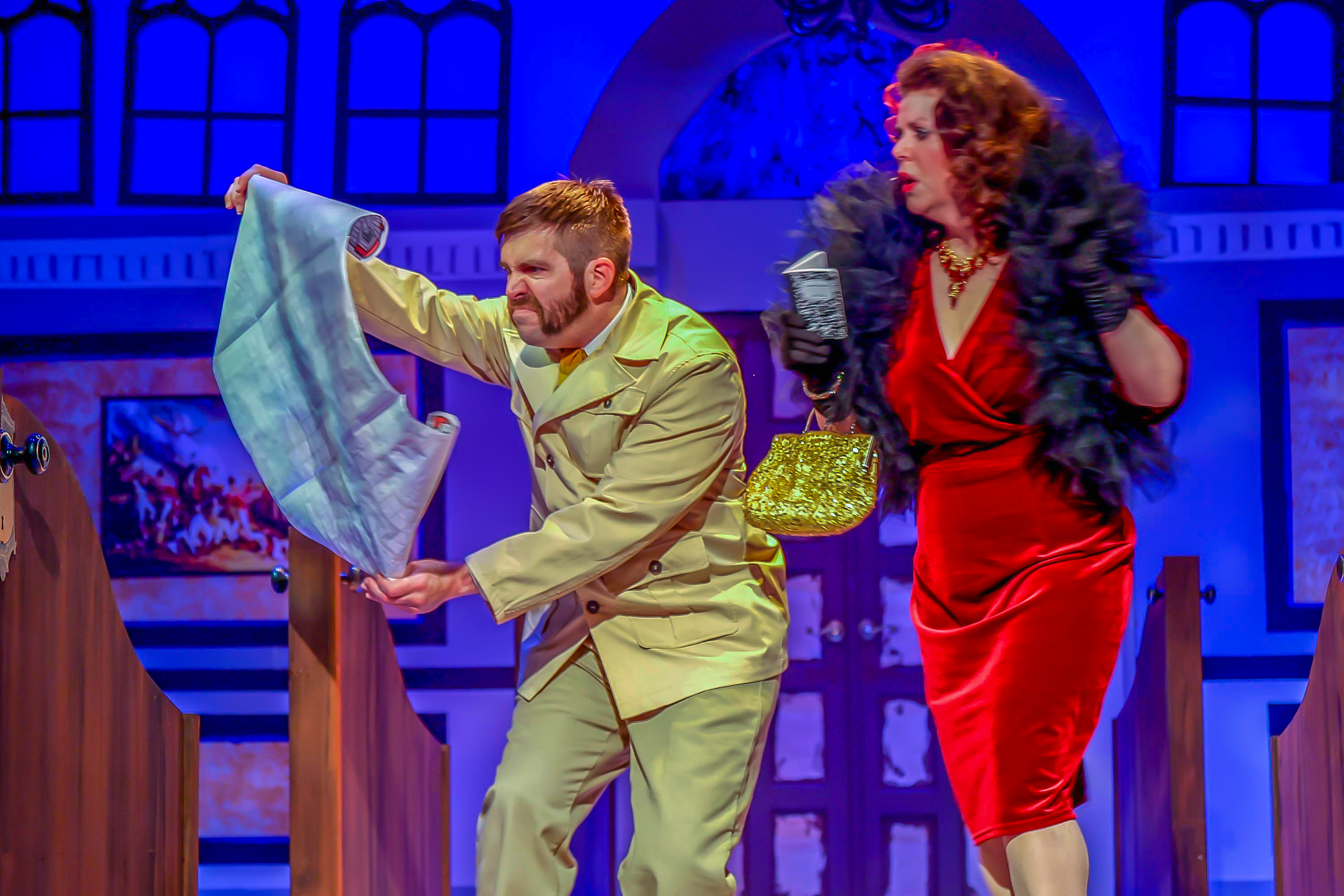
After directing a nearly sublime Book of Will at Belmont Abbey College back in February, Jill Bloede shows that she and her sure comedy instincts can lift up the utterly ridiculous in Matthews. She and set designer Marty Wolff aren’t going to let us forget that Clue is a board game. With sliding wood panels for walls and cunning little swinging gates for doors, we can see three rooms at a time on each side of the stage simultaneously, with a corridor representing the Boddy Mansion’s hallway completing the symmetry – seven of the nine rooms depicted (even more primitively) by the humble game board’s overhead view.

Flimsy as those thin walls may appear sliding in and out of view, they must be sturdy enough to accommodate the workings of secret panels that either flip their graphics or open and shut widely enough for the comings and goings of arms visibly wielding weapons. If your Clue erudition has stuck with you since childhood, you’ll remember that those weapons are a candlestick, a lead pipe, a monkey wrench, a dagger, a rope, and a revolver.

It’s with the entrance of our prime suspects that the plot of Jonathan Lynn’s screenplay and Rustin’s script, mimicking the film’s plot setup, swerve from the classic simplicities of the Parker Brothers’ game. Each of the six guests who have been invited to the Boddy Mansion is given one of the aliases bestowed on the iconic game pieces. Each now has a colorful – but compromising – back story that he or she is being blackmailed for. Serious enough misdeeds lurk beneath all our guests’ respectable facades for a murder motive, and their sophisticated enough for them to apply for membership among the avatars of more evolved adult board games.2023~Clue~19

So Colonel Mustard does have a military background, and Mrs. Peacock, a US Senator’s wife, has reason to be prideful. Mr. Green has a gay bent that could be costly as news of the McCarthy un-American hearings, circa 1954, seep through in radio broadcasts, and Miss Scarlet’s flame seems to be fueled by undercover stints as a high-priced madame. Professor Plum was apparently disgraced in another profession before finding refuge in academia, and Mrs. White… why is she dressed in black? Presumably because one or more of her late husbands could be the skeleton in her closet.

Now if you or I were anonymously blackmailing six evildoers with DC connections, you might think twice – or 700 times – before inviting even one of those cash cows for dinner, blowing your cover and, in a faraway secluded manor, endangering your own life. Ah, but the Lynn-Rustin silliness has just begun. Let’s distribute the six iconic murder weapons among the six color-schemed guests! And after all, if six possible murderers are gathered for an evening of killing and sleuthing – and dinner! – why limit the victims to just the ever-ready Mr. Boddy?2023~Clue~10

The whole Boddy household staff might be available to boost the body count: the maid, the cook, and the butler. Maybe we could liven (or deaden?) things up with a stranded motorist, a snoopy cop, or even a singing telegram girl? Hey, it’s a party!

With Allen Andrews as the suave and mysterious butler Wadsworth greeting mutton-chopped Jeremy Cartee as the pompous Colonel Mustard, the ball gets rolling nicely as the pair let us in on the rules of the game. Andrews as Wadsworth is so slick of a host greeting all of our suspects that he manages, through sheer brass and sliminess, to cast suspicion on himself. Cartee, meanwhile, must vie with longtime local diva Paula Baldwin as Mrs. Peacock for the distinction of being the most arrogant and pretentious of the suspects. Baldwin makes up for lost time by being the most outgoing, neurotic, and loquacious guest.2023~Clue~17

Clad in a screaming red dress, red hair garishly beribboned, and wrapped in a boa, Vanessa Davis as Miss Scarlet is the polar opposite of the cool Mary Lynn Bain as the semi-funereal Mrs. White. While Davis shoots seductive glances everywhere, Bain seems to be in perpetual mourning.

Yvette Moten’s costume designs are predictably color-coded, but they are not altogether studded with solid hues. While Andrew Pippin as the reserved Mr. Green gets to wear the most stylishly coordinated and urbane ensemble in harboring the deepest secret, Moten allows herself to go fairly wild over Johnny Hohenstein’s outfit as Mr. Plum: a cringeworthy maroon plaid jacket striped with deep purple and sky blue, a weirdly coordinated motley bowtie, and the loudest purple argyle sweater she could find.

Kathleen Cole is most notable for all the costumes – and phony eyebrows – that she wears, changing from the Cook to the Singing Telegram Girl before resurfacing as police backup. That glittery delivery girl outfit would liven any costume ball.2023~Clue~1

Bloede obviously takes much delight in maneuvering her game pieces. Sometimes they scurry around so swiftly that we lose track of them, and at other times, Wadsworth and staff parade them from room to room with a ceremoniousness that actually does evoke silly avatars moving around the squares of a game board. Yet there wasn’t a single missed beat during all the hectic scene changes at the Saturday matinees, never a missed cue, and never a flubbed line.

We seem to all get nine different rooms with all the back-and-forth of the sliding walls, so efficiently whisked in and out of sight from the wings. But I don’t remember seeing a ballroom, so I’m sure we don’t see more than eight.

Eight is enough.

Downsizing “Sister Act” Pays Big Dividends at Matthews Playhouse

Review: Sister Act at Matthews Playhouse

By Perry Tannenbaum

2022~Sister Act-11

A full flowering of onstage success has somehow scurried away from Iris DeWitt in recent years. Just last April, pandemic restrictions and a wretched recording rig trapped her inside a masked, malodorous production of Sense and Sensibility at Central Piedmont Community College. Patchy intelligibility also wrecked DeWitt’s previous outing in the badly-miked production of Chess in 2020. Until 2022 rolled in, you’d have to go back to 2019 if you wanted to claim to have seen DeWitt anywhere near her imposing potential, when she played prominent roles in Beehive and Little Shop of Horrors.

Neither of those CPCC Summer Theatre productions obliged DeWitt to show us much of her acting or dancing skills. Beehive was totally bereft of plot, and while Iris’s undeniable vocal power was manifest in Little Shop, no full flowering was evident there, either. We had to settle for the most memorable who-did-she-play performance in recent Charlotte history, for DeWitt was a flower in that musical, hidden in the cavernous depths of Audrey 2 in Little Shop.

This year, the script is flipping and momentum building as DeWitt has figured prominently in Ghosts of Bogota, when Actor’s Theatre returned to Queens University, and Love, Loss and What I Wore in the recent Theatre Charlotte production at Camp North End. Paula Baldwin, who directed that sloppily streamed S&S adaptation of Jane Austen last year, clearly retained enough confidence in DeWitt to see her as Deloris Van Cartier, the lead role in Sister Act. Ron Chisholm, choreographer for this Matthews Playhouse extravaganza at The Fullwood Theatre, probably also saw some potential waiting to blossom in DeWitt’s previously untested dancing feet.2022~Sister Act-10

We’re not so sure when we first see Deloris and her backup singers onstage. The vocals are sufficiently electric but not full voltage, while the doo-wop moves are nowhere near Supreme. I’m guessing that Baldwin and Chisholm have asked DeWitt to cool her jets on “Take Me to Heaven” because Deloris is nervous about auditioning for her paramour, Curtis, an intimidating mobster, at his club. But why on earth should Curtis, a man of highly questionable character, be even a little justified in thinking that Deloris and her crew aren’t ready for a recording contract and the bright lights?

Apparently, writers Cheri and Bill Steinkellner thought that their protagonist needed a crisis of confidence in the early stages of her spiritual journey, one that Paul Rudnick found unnecessary in his original screenplay for the 1982 movie starring Whoopi Goldberg. There, Deloris and crew had all the polish of the Supremes from the start, singing a doo-wop medley in the bowels of a Las Vegas casino owned by her mobster boyfriend, drawing two claps and a stare from a late-night audience of gamblers.

Now they’re in some undisclosed Philadelphia dive, where the only audience is Curtis, his three henchmen, and us. Curiously enough, the transfer from the glitz of Vegas to the dumps of Philly makes Sister Act more at home in a community theatre setting than on the big stages of London’s West End, Broadway, or at Ovens Auditorium – not to forget Halton Theater, where it was staged in yet another CP production back in January 2013.

As soon as Deloris and her crew began to regroup in “Fabulous, Baby!” we had our first glimpses of all that DeWitt can be onstage. My own realizations, beyond her trusty vocal powers, were split between her ability to dance – gliding disco or righteous gospel – around the stage she commanded and the thoroughly professional depth of her acting. Watch DeWitt’s reactions for a while and you eventually find it difficult to take your eyes off her until she makes an exit.

And don’t fret about any missed opportunity with “Take Me to Heaven”: DeWitt and most of the ensemble get a grand do-over at the end of Act 1.

After the additional indignity of being gifted with a garish hand-me-down fur coat previously owned by Curtis’s wife, Deloris has the misfortune of witnessing the club owner brutally gunning down a snitching henchman in cold blood. On the run from her ex, Deloris leaves Curtis in the lurch for the better part of the night as the saloon singer is placed in a witness protection program and sequestered in a midtown convent. That calls for a new counterweight for Deloris to provide the plot with some fresh friction, a call sternly answered by the convent’s Mother Superior, the role played by Maggie Smith opposite Goldberg in the film.2022~Sister Act-04

Oh, and by the way, Baldwin herself played that Maggie Smith role at CP in 2013, so she’s directing a show that she knows intimately from the inside. Maybe she already envisioned what I had yet to perceive in a smaller venue, that what the Steinkellners sought most earnestly in their adaptation of the movie was to make the story more character-driven and less of an action comedy. Building upon Mother Superior’s most familiar film epigram, “God sent you here for a reason – take the hint,” the Steinkellners, along with songwriter Alan Menken and lyricist Glenn Slater, team up to give greater voice to her spiritual crisis.

Both of Menken’s ballads for Mother Superior, “Here Within These Walls” and “I Haven’t Got a Prayer,” sit nicely in Carol Weiner’s vocal range and sternness is Weiner’s prime onstage métier, so she eclipses anything we’ve seen from her before, including her starchy turns in Big River, Bonnie and Clyde, and Oliver! There’s more than a hint of Menken’s “Beauty and the Beast” lurking inside of “Within These Walls,” and Weiner allows its warmth to radiate through Mother Superior’s gradual softening toward Deloris.2022~Sister Act-09

More personal crises are layered over the thinner movie scenario. Young apprentice nun Sister Marie Robert, beguiled in the film by the bar where Deloris finds refuge from the convent’s cheerless monotony, now questions whether she should be leaving the real world for a convent – netting Melissa Lozada two cracks at the novice’s power ballad, “The Life I Never Led.” The dreamboat cop who whisked Deloris out of town in the movie, not even letting his colleagues know where she was, is now the hesitant, self-doubting Sweaty Eddie, relegated to a desk job when he wouldn’t fire his gun out on the beat.Photo1 @ Tom Henderson Photography

Saddled with a lingering crush on Deloris that goes back to high school, Eddie draws “I Could Be That Guy” to cry out his anguish, slightly more comical than Lozada’s plaints but hardly less of a showstopper for Griffin Digsby, who swoops down into Barry White territory in voicing his romantic aspirations. Also going there, surprisingly enough, is Mike Carroll as Monsignor O’Hara, who presides over Sunday services and surprisingly turns out to be a Deloris groupie when she revamps the convent’s choir.

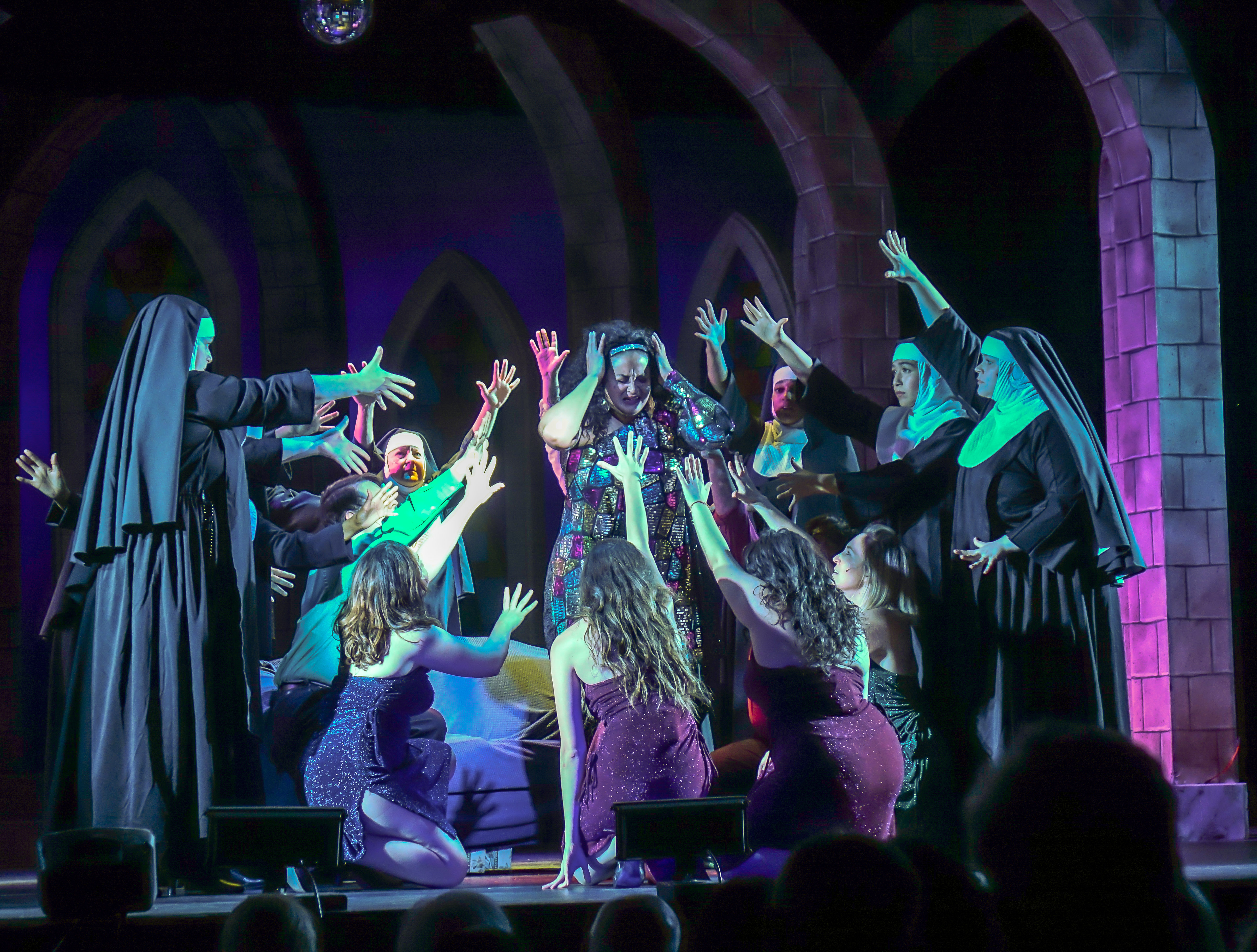
Baldwin and Chisholm not only draw strong players down in Matthews, but they also get strong design and technical backup. Debbie Scheu’s designs for the nuns’ habits grow more spangled and outré as the convent choir grows in prestige and popularity. The glossy, reflective dress Deloris wears in her Van Cartier persona complements the stained-glass backdrop that scenic designer Marty Wolff has provided for the church. Four sets of translucent arches that inch closer together as we move upstage change colors during the glitzier scenes climaxing the action, as Jeffrey Childs’ lighting design adds excitement to Chisholm’s choreography.

Amazingly, the only scene where downsizing doesn’t work at Fullwood Theatre is the squalid bar scene. The room is simply too small for Curtis’s henchmen not to notice three nuns when they enter – or for Deloris to overlook these motley thugs for more than five seconds. Then again, Menken had worked at least three Disney musicals before attempting SISTER ACT in 2011, so he hadn’t yet mastered the Harvey Keitel gravitas we might expect from real dons and heavies (A Bronx Tale would come more than five years later).Photo2 @ Tom Henderson Photography

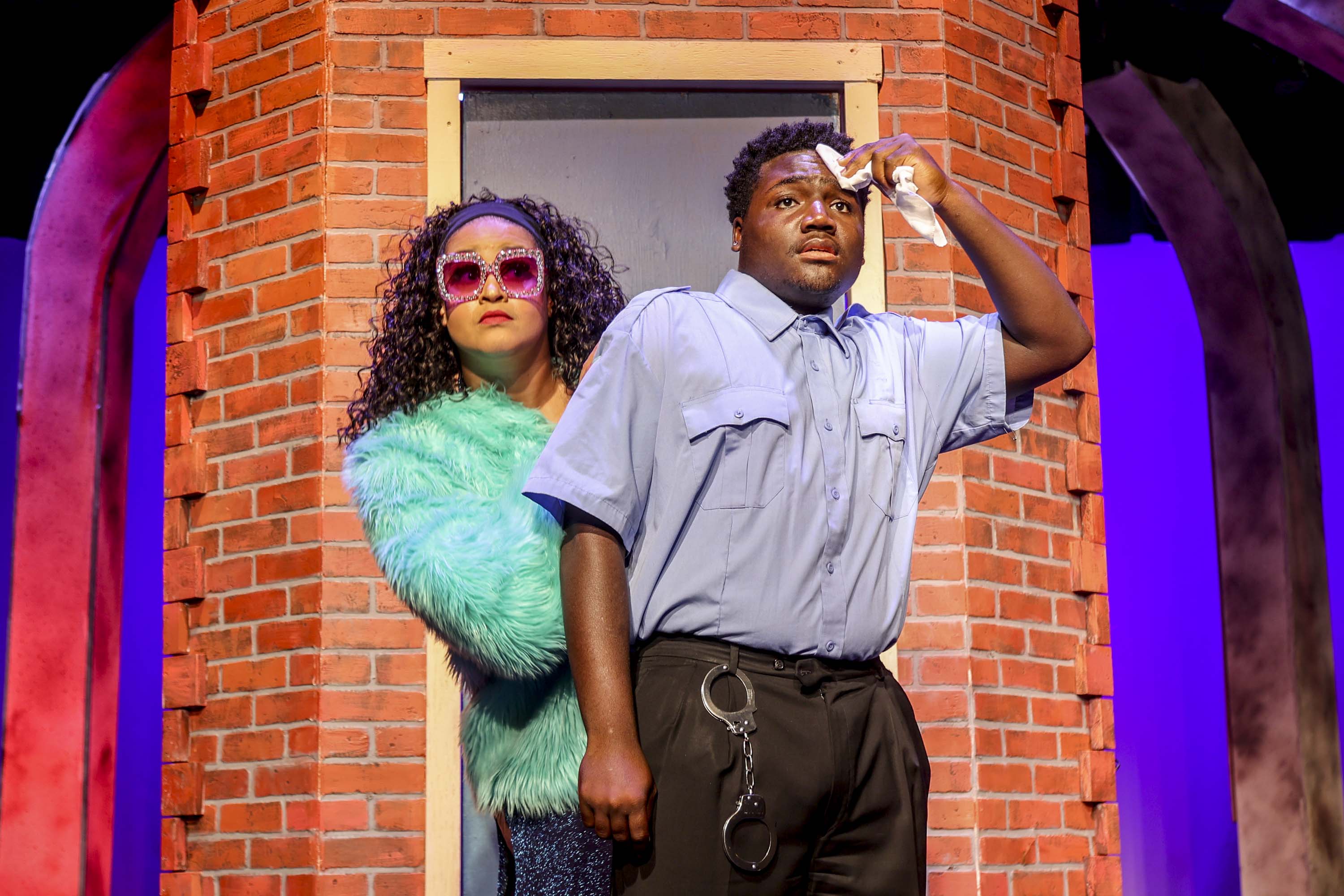
Jamaas Britton, Ra’Saun Elliott, and Neifert Enrique play these street urchins with all the menace of the Lion King hyenas. They get a spotlight – or a lava lamp – shortly after intermission, when they spar over the best way to romance a Sister in “Lady With the Long Black Dress,” Elliott explicitly espousing the Barry White approach. Edgier than his goons, Kristopher Loretz as Curtis gets to riff sardonically, in “When I Find My Baby,” on the penitent reconciliation serenades that scamps have been wooing women with for ages, replacing the customary promises of hugs and kisses with vows of knives and guns.

All of these bottom feeders are portrayed with the same assurance as the principals, to the delight of the Sunday matinee audience, who loudly gave them all a standing O. It was likely exciting for the energized crowd to be back at Matthews Playhouse watching a musical – and maybe amazing for them to see production values as high, or perhaps higher, than ever.