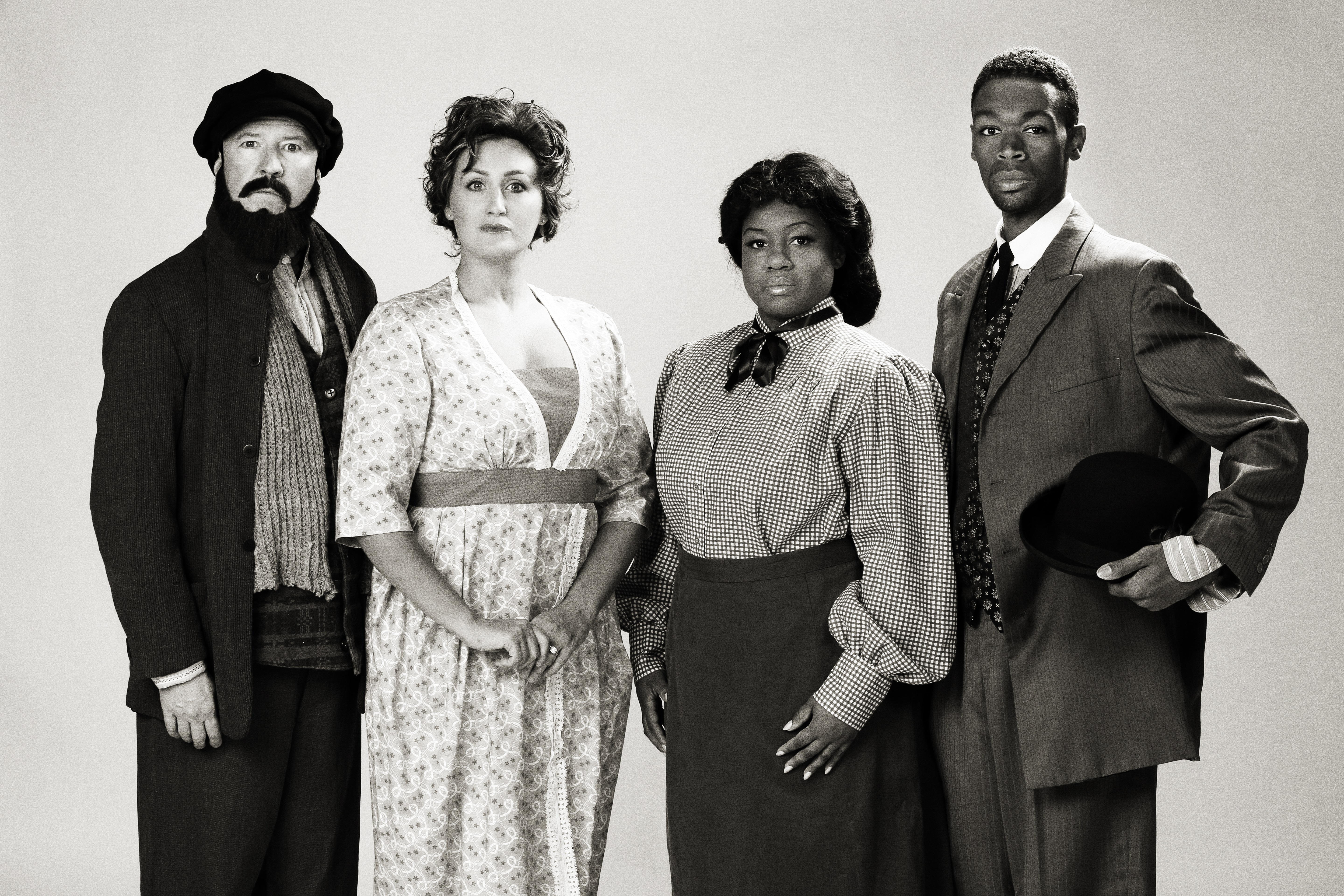
Tag Archives: Keith Logan

“One Year to Die” Is a Premiere to Be Proud of in Matthews

Review: One Year to Die at Matthews Playhouse

By Perry Tannenbaum
September 11 has been part of LaBorde family lore much longer than for nearly all other American families. On that date in 1943, the USS Rowan was sunk in Mediterranean waters by German torpedoes after delivering an arms shipment to Italy to combat the Nazis. Local actor/director/playwright/school principal Charles Laborde’s Uncle Joe was among those aboard the Navy destroyer lost on that day, along with 201 other officers and crew. Only 71 survived the attack, rescued by the USS Bristol.

Curiously enough, the official date of Uncle Joe’s death is listed as September 12, 1944 – still a full five years before Charles was born – because none of those 202 bodies was recovered. As the Naval Officer informs Charles’s grandma Edwina with full-dress formality in LaBorde’s new play, One Year to Die, Joe was officially “missing” after the Rowan was torpedoed until one year and one day had elapsed. Then the Naval Death Certificate would be issued.

The world premiere of LaBorde’s play opened last week at Matthews Playhouse and runs through September 29 at the Fullwood Theater.

While it’s intriguing to wonder how Charles’s grandparents, Oscar and Edwina, coped with this limbo year of unofficial death – maybe holding out hopes of a miracle for a few weeks or months – it’s hardly the stuff of sustained suspense and drama. To achieve these enhancements, LaBorde applies some research, imagination, and basic math.

Time-travelling back to his grandparents’ farm in Hessmer, Louisiana, which wasn’t big enough to be incorporated until 1955, LaBorde modestly multiplies the number of local families impacted by the Rowan’s sinking. Now two moms down in Cajun country are grieving over their lost sons, Edwina and Ella Broussard, an ailing black washerwoman who takes in laundry from the richer families in the region.

Everybody seems to know everyone else around town, so when the Naval Officer shows up on Edwina’s front porch to deliver his sad news, she can point him in the right direction toward the part of town where Ella presumably lives. The fact that LaBorde has invented her makes no difference. But it’s going to take far more resourcefulness from the playwright for him to even begin exploring the racial divisions and tensions that prevailed in the little town of Hessmer when the dark days of Jim Crow hadn’t been dispelled, even after African Americans were welcomed by our military.

No, for that to happen, LaBorde had to find a compelling reason for Ella to appear at Edwina’s doorstep. Indeed, to fully engage us and win our admiration for Ella, the mission driving her to Edwina’s farmhouse had to be compelling enough for her to knock on the LaBordes’ front door. Now you have an action sufficiently outré to set a little Jim Crow town in turmoil.

What on earth could be so important for Ella to commit such an effrontery?

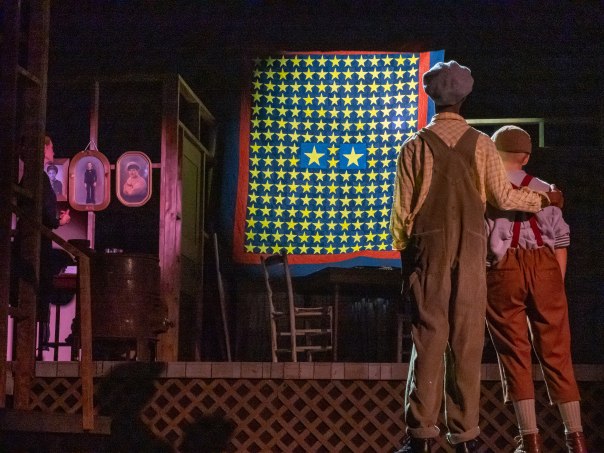
She has enough imagination and ambition to match her chutzpah, for she plans to pay tribute to both her son Lonnie and Edwina’s Joe – along with all the other 200 soldiers aboard the USS Rowan who perished fighting the Nazis. The tribute will be a quilt of 202 gold stars on a field of blue, with the two stars representing Lonnie and Joe conspicuously larger than the 200 others.

The project is worthy, and quilting 202 squares with 202 perfectly centered stars, along with a suitable border to frame it all, seems to be a sufficiently monumental task to occupy two women for the better part of a year – once the ladies have solved the math problem of how to symmetrically configure those 202 stars. Director Dennis Delamar certainly isn’t going to gloss over the problem of getting the math exactly right.

But that front door thing is key (even though Edwina is proud to say it’s unlocked) and obliges LaBorde’s family to be tested onstage in a manner they probably never faced in real life. To the playwright’s credit, neither of his kinfolk is perfect in receiving their surprise guest – who should, as everybody in Hessmer knows, be knocking at the back door.
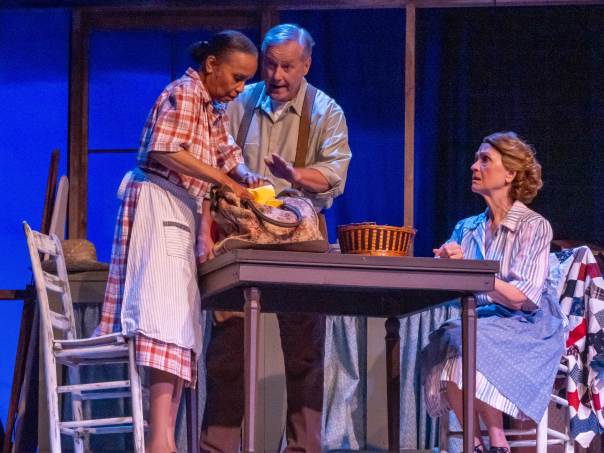
That is the attitude here from both Edwina and Oscar when they first encounter this unfathomable cheek. Just to double-underline the point that the LaBordes are not perfection, Edwina rebuffs Ella twice. Yet we soon see that they are willing to evolve, uniting with Ella’s cause once they’ve heard her out. Granting her the unique privilege of entering by the front door. But what about the rest of the town? Here is where LaBorde can inject suspense, drama, and a sprinkling of terror.

Joshua Webb’s set design, with its wood-burning stove and perpetual coffee pot centerstage, has a rusticity that allows for a wisp of primal danger and violence lurking beneath its humble domesticity. Both kitchens are lovingly dressed, but sightlines are a rather dreadful problem: unless you’re seated in the center or toward the right side of the Fullwood Theater audience, you might go home never knowing that Oscar had been visible building his stone wall – hidden by the Broussard kitchen to those of us sitting on left – in defiance of stone-throwing yahoos (or KKK) repeatedly breaking the LaBordes’ windows.

Complemented by Sean Ordway’s moody lighting design, which casts a spell even before the action begins, Yvette Moten’s costume designs have the timelessness of Norman Rockwell paintings on the covers of old-timey Saturday Evening Post magazines. It’s hard to resist the visual charm of this production as Delamar frames one memorable tableau after another. From the time we first see the spirits of Young Lonnie and Joe (Aaron Scott Brown and Bennett Thurgood in rather touching non-speaking roles) to the great starry quilt reveal, Delamar lavishes a series of freeze-frames that are a memorable slideshow within the show.

Some discreet subtraction is applied to LaBorde family history that results in somewhat awkward casting for the leading ladies, Paula Baldwin and Corlis Hayes. Nowadays, we’d expect moms of strapping young military enlistees to be in their forties or fifties, not 60+ – but the real Edwina had way more offspring than two sons, so she actually was aged 60 at the time of Joe’s death.

So sitting at her kitchen table, sustaining her renown as the county’s quilting queen, and looking rather matronly, Baldwin is exactly what LaBorde envisioned as Edwina. Life on the bayou does take its toll here, so Joe will merely be the beginning of Edwina’s ennobling griefs. Baldwin endures these crucibles like so many we’ve seen from her over her distinguished QC stage career, with signature stoicism. Neither Delamar nor LaBorde had any hesitation in casting her.

As for Hayes, I first encountered her at Johnson C. Smith in 1988 when she directed for colored girls at the tender age of “24” – just guesstimating here – so she’s also perfectly cast as Ella. Maybe the most heartwarming aspect of this production is the gift LaBorde has given her with a world premiere credit in this role. Confronted by both black and white folk, Ella is a far more nuanced and varied character than we normally see Hayes portray.

We instantly see the strong spine that brings her to Edwina’s door – twice – and we see her pragmatism in backing off the first time. She seethes back home and resolves to repeat her effrontery, still knocking at the front door. Then there’s the beautiful passive aggression when Edwina belatedly agrees to allow Ella over her front threshold. Hayes pointedly hesitates, referencing the insults she has previously absorbed and the dignity she maintains.
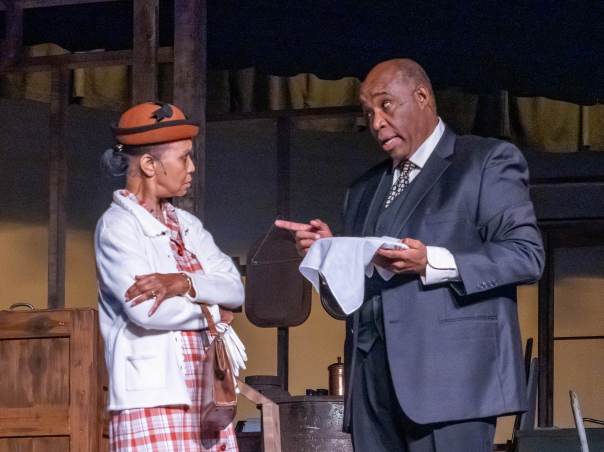
LaBorde has obviously labored over Ella, for she has her maintaining this steely dignity when confronted by her minister, Reverend Johnson, and even when she is complimented by white churchlady Nodie Ardoin, Edwina’s nemesis. Yet there’s one more telling Easter egg to be found in LaBorde’s script, that Hayes and Delamar brilliantly emphasize. As soon as Ella gets the first clear sign from Oscar that she might not be welcome in his kitchen, we see Hayes instantly cowering, clutching her pocketbook, and readying for a quick exit.

That’s the kind of good sense Ella has, for all of her sturdy spine. We can be thankful that this rich role has finally found Hayes.

If it weren’t obvious before, One Year to Die signals that Matthews Playhouse has joined the ranks of Metrolina community theatres that consistently present pro-grade work. The standard set by Hayes and Baldwin is met by the men who portray the Hessmer clergy, Steve Price as the soulful Father Morton only slightly upstaged by the charismatic Keith Logan as Rev Johnson. LaBorde would have done better by both of these religious leaders if he had refrained from broadly hinting that Catholic and Baptist ministers follow the exact same script when upbraiding wayward lady congregants.

Aside from Oscar, the other guys we see onstage are military, so we never sample the boorishness or the toxic philosophies of the town’s window breakers. The military cameos, however, are beautifully handled by Vic Sayegh as the Naval Officer who rocks the LaBordes’ world and Brian DeDora, who appears as The Sailor after the Normandy invasion.

Possibly, LaBorde dropped the idea of including the rock-slingers onstage, for Nodie bears the same last name as one of them. Robin Conchola as Nodie is actually the more benign of the “watchin’ committee” that darkens Edwina’s doorstep to register their condemnation, a lot more conflicted than Barbara Dial Mager as Sarah Jeansonne. It’s Conchola as Nodie who has the chance to be rebuffed by Hayes. Sarah is slower to evolve, so we can despise Mager longer, if only for her horrid wig.
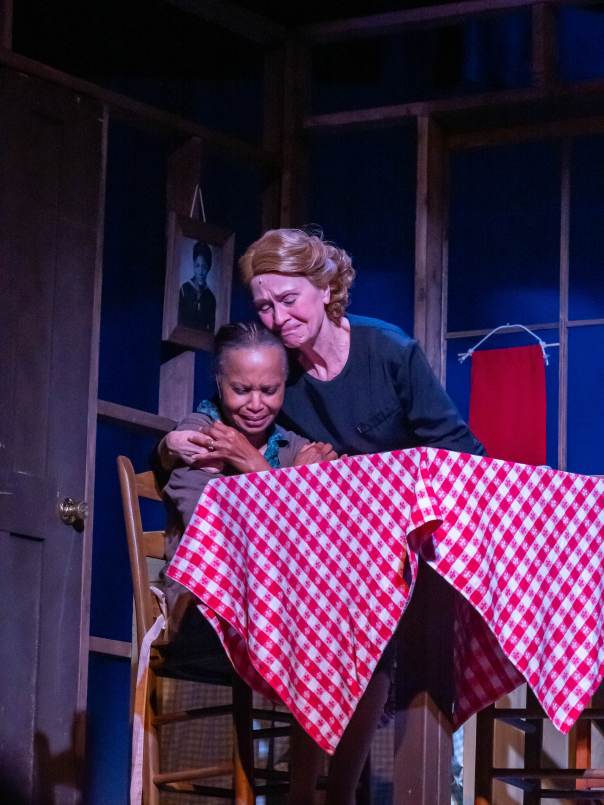
As Oscar, also aged 60 when Joe perished at sea, Henk Bouhuys is delightfully homespun, although there’s still enough Jim Crow ingrained in him to be shocked by the ladies’ audacity. Bouhuys continues to project ambivalence long after Oscar decides the memorial project is worth doing no matter how the rest of Hessmer may think. Once he gives Edwina his assent, his loyalty is as steadfast as his love.

Whether it was absent-mindedness or a directive from Delamar, Bouhuys only intermittently sounded Cajun on opening night – while the rest of the players hardly bothered with an accent. So it was startling when Oscar became full-out Cajun just before intermission after a cowardly attack on the LaBorde farmhouse. Out of nowhere, the accent was stunningly convincing, adding some sharp ethnic spice to the most fiery monologue of the night.

Photos by Perry Tannenbaum

Toni Stone’s Path to Glory Goes Beyond Winning and Losing

Review: Three Bone Theatre’ Toni Stone at The Arts Factory

By Perry Tannenbaum

202208173480315507725654890

Trivia questions: who replaced Hank Aaron when the future home run king moved up from the Indianapolis Clowns of the Negro American League to the majors? And who was the first woman to sign a professional baseball contract and play with a men’s team? The answer to both questions is Toni Stone, nee Marcenia Lyle Stone (1921-1996) – unless you’re a stickler for fact-checking and historical accuracy.

Then we need to face the truth that Hammerin’ Hank was already playing for the Braves’ farm club, the Eau Claire Bears, a season before Stone made her Negro League debut at second base with the Clowns. And before team owner Syd Pollock signed her to a Clowns contract, Stone had played in professional men’s leagues – if not the topmost major league – for 16 or 17 years, depending on which capsule biography you read.

Hearing all this for perhaps the first time, you’ll probably ask a truly important question, one that playwright Lydia R. Diamond surely asked after reading Martha Ackmann’s 2010 biography, Curveball: The Remarkable Story of Toni Stone the First Woman to Play Professional Baseball in the Negro League. Why haven’t we all heard about Toni Stone before, and why isn’t she more celebrated?

202208031526236485966839727

Amazingly enough, when Diamond’s Toni Stone premiered Off-Broadway in June 2019, the playwright didn’t blare out the answers that would become so glaringly obvious to everyone the following summer in the midst of #MeToo, #BlackLivesMatter, and our communal COVID hibernation. Diamond’s portrait of the pioneer nicknamed Tomboy during her childhood in St. Paul is more nuanced, diffuse, and detailed than it might be if she had begun sketching it after the cataclysms, polarization, and pandemic chaos of 2020. Or the nationwide schism of January 6.

Lucky us? In some ways, Three Bone Theatre’s production at The Arts Factory, meticulously directed by Dr. Corlis Hayes, reminds us how relatively dispassionate we were less than three years ago when we looked at neglected pathfinders and feminist icons. There’s a certain amount of useful calibration when Diamond seemingly steps aside and lets Toni tell us her story – and what she thinks of herself.

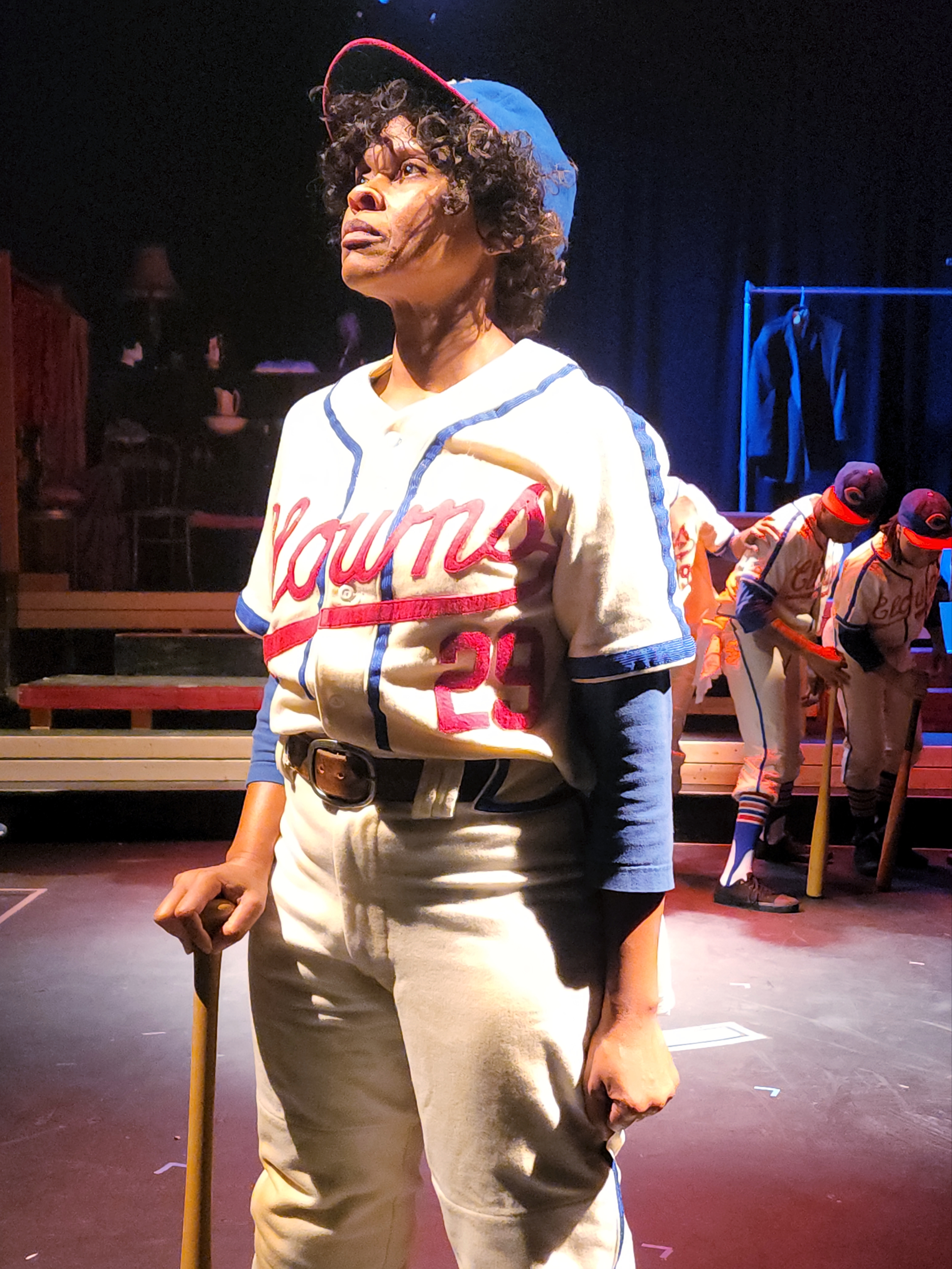
In her third standout outing of the year, Nasha Shandri immerses herself engagingly in all of Toni’s quirks, vulnerabilities, and strengths; candid rather than arrogant, sassy rather than seductive. Above all else, Toni loves baseball – the ball, the glove, the game. Both Diamond and Shandri make us believe it.

When she runs out of things to say, to us or her teammates, Toni will recite major league player stats, as if she’s collected and memorized every baseball card out there – as if the numbers have magic healing powers when she’s distressed. Diamond makes her so obsessed with baseball that romance and sexuality make her uncomfortable. Shandri has a mumbling recitation of stats at her disposal, or a Peter Pan aversion to being touched, whenever hormones begin flowing around her. She’s a natural, either way she goes.

202208174341351609522811290

An all-Black ensemble of eight men hustles around Jennifer O’Kelly’s appropriately seedy set, which packages a movable tavern, a ramshackle players’ dugout, and a dimly lit brothel, leaving most of the Arts Factory playing space free to fancifully, maybe laughably, serve as a baseball diamond. Eight men aren’t going to be enough to bring us all the mentors, parents, teammates, and romantic interests of multiple races and genders that Toni will deal with from her childhood through her baseball career (1936-1954). Props and costumes are stowed in the dugout as well as offstage to keep things flowing.

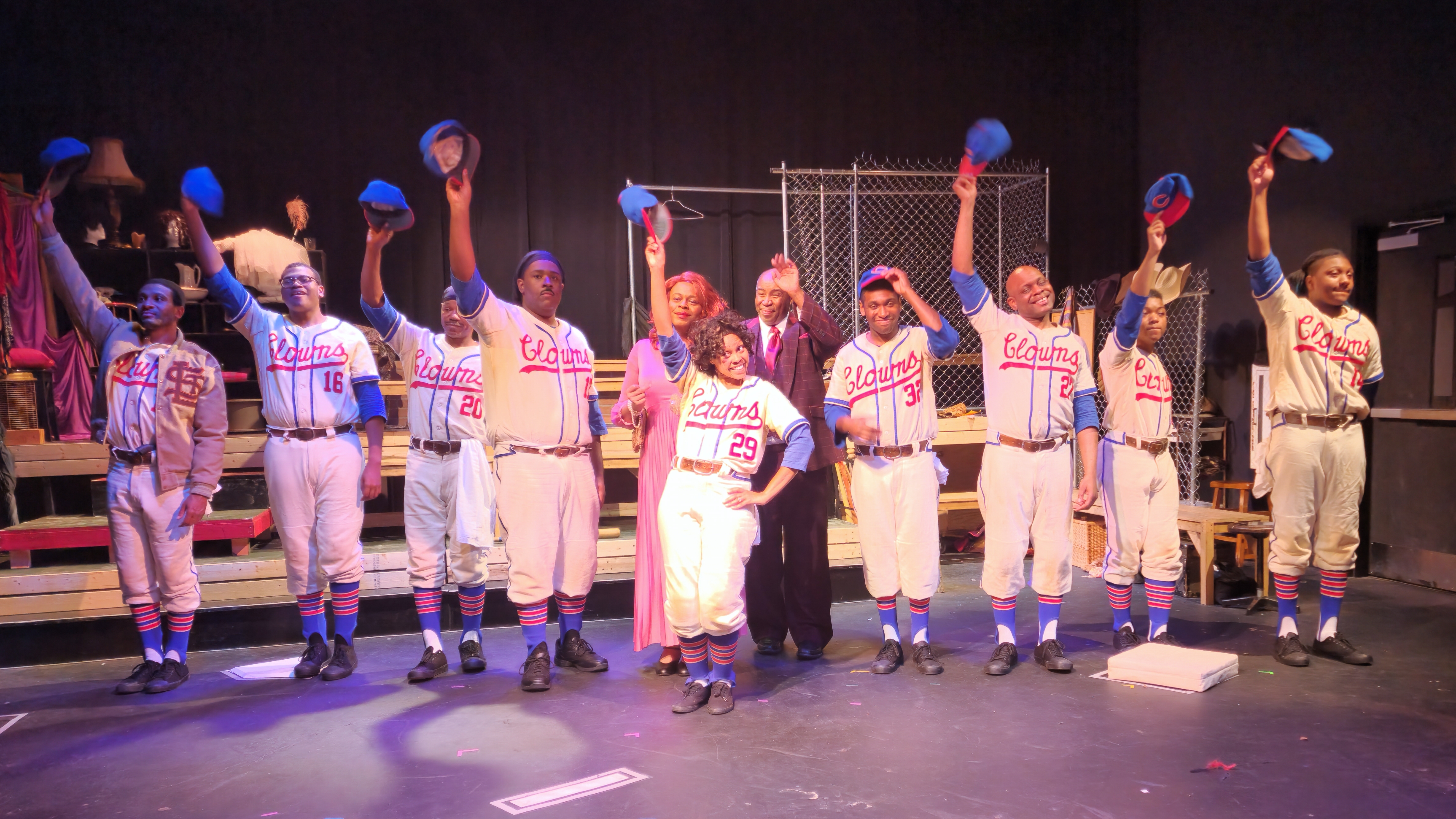
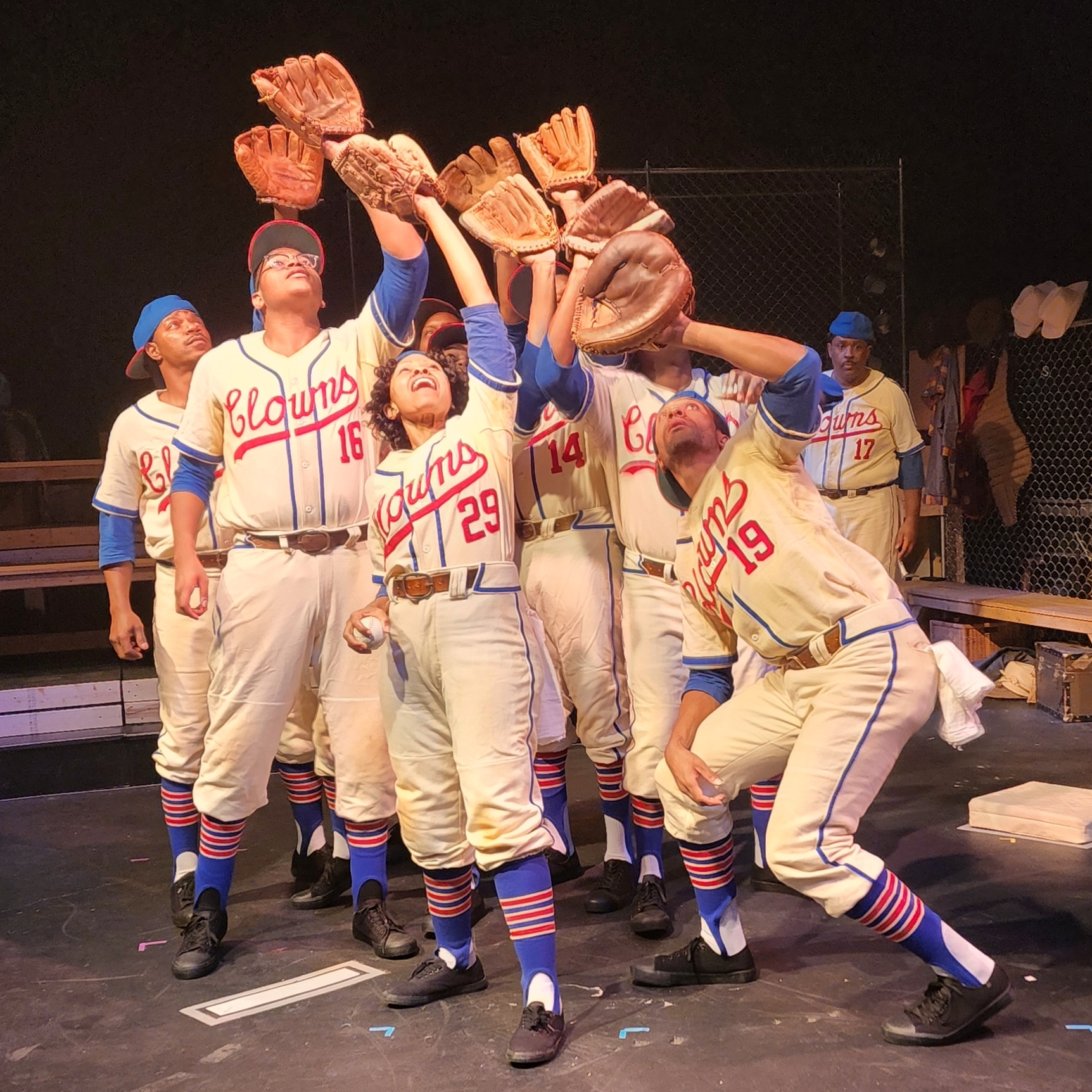
Cutting through much of the confusion, Diamond keeps the names, personalities, and fielding positions of Toni’s teammates as constant as the parks she plays in. All evening long, Shandri and her team wear the same Clowns uniforms, authentically rendered by costume designer Kara Harman. That way, Toni’s path comes across as less solitary while she moves from her early ballplaying days in a local church league to a series of American Legion and minor league teams in Minnesota, San Francisco, and New Orleans before her major-league apotheosis: a full year with the Indy Clowns in 1953, before she joined the famed Kansas City Monarchs for her final season.

Diamond and Hayes are both aware of the perils of allowing Toni and the shorthand differentiation of her crew to devolve into a wholesome replay of Snow White and the Seven Dwarfs. The playwright not only gives us frequent glimpses of the racism that dogs Toni’s progress, she also shows us the sexism and piggishness behind the scenes in the clubhouse, occasionally checked but never eradicated.

We also see that there are good reasons for the men’s resentments when Stone signs on with the Clowns. When Jackie Robinson broke the color barrier in 1947 and Larry Doby integrated the American League during the following season, the Negro Leagues began to crumble. By the time Aaron is signing with the Braves in 1952, the talent drain is on the verge of killing Negro League baseball, reducing its remaining teams to barnstorming roadshows.

Clowns owner Syd Pollock – nearly overacted here by James Lee Walker II – didn’t sign Stone to make his team better. Unlike previous owners, who signed Toni on her merit, Pollock signed her as a novelty to improve the marketability and entertainment value of the team, already baseball’s equivalent of the Harlem Globetrotters. In a notable confrontation between Shandri and Walker, Diamond shows us that Pollock isn’t interested in showcasing his new acquisition on a level playing field. To ensure his investment – not very much, if we’re talking about Toni’s salary – Pollock colludes with other owners to ease up on her in the middle innings, when their pitchers will throw her more hittable pitches.

Toni grudgingly keeps the secret, but her teammates aren’t as oblivious or dimwitted as Pollock presumes.  202208175826162527256458676

Hayes does her part, casting the other Clowns, so that Shandri doesn’t stick out uncomfortably as the smallest on the team. In particular, the other middle infielder is diminutive, in the vein of Phil Rizzuto, Jose Altuve, or Joe Morgan. On the other hand, Miles Thompson as Spec, the team intellectual, is not at all the dwarf that he was reputed to be. Along with Justin Jordan as Woody, the embittered teammate who is by far the most trouble for Toni, Thompson is quite an imposing figure.

More than one of the Clowns points up Toni’s sexual inexperience in their dugout and locker room banter. One whole scene, a rather bawdy little prank played on her with a baseball bat, more than emphasizes her naivete. It also heightens uncertainty among the men about Toni’s sexual orientation.

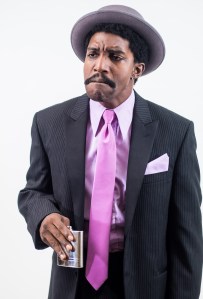
Clearly, Diamond wants to keep us guessing, too. The juiciest roles outside the clubhouse go to Robert Rankin as Millie, the madam of that brothel, and Keith Logan as Captain Aurelious Alberga, an elderly admirer who persistently pursues her at Jack’s Tavern, a San Francisco joint. Skittishly resisting Alberga’s initial advances, Shandri seems more attracted to Millie, whose sexual appeal is aimed at her teammates. Both Rankin and Logan give charismatic performances, worldly and mature, charismatic and confident.

Doubling as Drunk Willie when he dons his Clown uniform, Walker as Pollock is probably the best at marking those moments when white men enter the story. Hayes could have sharpened the portraiture a bit more when we meet the other white folk: Father Charles Keefe, the neighborhood parish priest who paves the way for Toni to play organized ball; and Gabby Street, nicely handled by Thompson, the former manager of the world champion St. Louis Cardinals, who yields to Toni’s repeated entreaties, making it possible for her to aim higher.

Melissa McDaniel Grisham’s choreography seems a bit toothless and pointless when the Clowns team goes into their pre-game shtick. From reviews I’ve read on the Off-Broadway production, the aim there was not just to show how athletic and entertaining the players were but also to show the degradation and of being clowns as well as ballplayers. There’s not even a hint of cringeworthiness here at The Arts Factory that critics had perceived in New York.

202206295146239102907529957

Yet the chemistry among the players has exactly the tang we want when they’re playing the game they love – under shabby, hateful conditions. Johnathan McKnight as the catcher Stretch exudes the authority of the team’s quarterback, and Devin Clark has the aloof dignity of Elzie, the Clowns’ pitching ace. Tito Holder energetically grins and pouts as Jimmy, the team dumbass, and Frank FaCheaux makes the most of the glimpse Diamond gives us of team comedian King Tut, whom Pollock dubbed “The Clown Prince of Negro Baseball.”

Toni Stone has a hazy mythic aura to it unlike most biographical baseball sagas. Intense nail-biting games down to the last pitch or the cumulative drama of a torrid pennant race are nowhere to be found. They are as irretrievable as the barnstorming Clowns’ won-lost records, batting averages, ERAs, and boxscores. What binds the roaming Clowns together like family, in spite of their frustrations and resentments, is the love they share with Toni – for the game.

Fire, Fury, and Painful Memories Drive Wilson’s “Jitney”

Review: Jitney


By Perry Tannenbaum

Allowing for inflation and cost-of-living increases since 1977, fares at Becker’s Car Service seem to be fiercely competitive – so competitive that the five cab drivers at the core of August Wilson’s Jitney all seem to be barely scraping by. The drivers’ lounge, adorned with a decaying Ali-Frazier poster, has a ramshackle look to it with a dust-colored couch held together by generous swaths of duct tape.

We never see whether the drivers’ jitneys (slang for gypsy cabs) are in any better repair than this crumbling HQ, but the idea seeps in that the struggling black customers in the Hill district of Pittsburgh are in no position to press the point. Early on in this fine BNS Productions effort at Spirit Square, director Corlis Hayes pushes the pace hard enough for us to assume that we’re in the midst of an urban rush hour.

These are men in a hurry – who aren’t necessarily getting anywhere. Pretty much the same can be said for Wilson’s story until Becker himself arrives. He takes off a fedora hat and lays down a satchel, signs that he’s better off than his employees, but he takes turns answering the phone – a pay phone – and giving rides. Still not rushing his story along in his flurry of driver entrances and exits, Wilson has Becker announcing two key strands of the plot.

After keeping it from his drivers a little longer than he should, Becker tells Doub, his steadiest driver, that the city has earmarked the property for urban renewal. The Car Service office will be boarded up in a matter of weeks. If that weren’t enough upheaval, Becker’s son Booster is getting out of the slammer after serving 20 years for murder. Becker never visited his son even once during his incarceration, so this does not figure to be a joyous reunion.

If you’ve seen Wilson’s Fences recently, you will likely find echoes of Troy Maxson in the elder Becker’s sternness and stubbornness. If anything, the father-son chemistry will prove even more important here. But Becker is more of a people person, as he would need to be in running a business, and he has a few soft spots beneath his tough hide.

We see one of those when he gives Fielding, a former tailor who has destroyed himself with drink, yet one more chance to come back on the job and straighten himself out. Becker also shows strength and courage defusing a heated confrontation between Vietnam War vet Youngblood and the gossipy Turnbo, who has meddled in the younger driver’s domestic affairs, frustrated at not stealing his girlfriend Rena.

There’s a fascinating range of personalities and back stories among the core quintet of drivers plus the boss’s son. Baring their souls – and their motives – everybody seems to get a monologue. Nor do Hayes and lighting designer Tony Wright veil the kinship between these monologues and long, lyrical jazz solos. Hayes usually directs her actors to blow their solos straight into the Duke Energy Theater audience, while Wright intensifies the light where they deliver.

During the passionate showdown between Youngblood and Rena, where both have been right and wrong, each of the combatants has a heartfelt monologue. Yet Wilson had even more pure audacity in a casual scene where the often-comical Fielding meets the tightly-wound Booster. The playwright brashly showcases his virtuosity by unleashing two consecutive monologues, one by the rueful Fielding recalling his better days when he tailored suits for Billy Eckstein and Count Basie, followed by Booster’s recollection of his first hard lesson in life when, as a child, he had a vivid dream about riding a red bicycle.

With so many monologues so evenly distributed, you need a cast that’s strong, deep and – when Wilson digresses – engaging. Hayes and producer Rory D. Sheriff have definitely produced with this ensemble. Though he isn’t given free enough rein in the opening scene as Fielding (we should be sure that the $4 he borrows from Doub will go toward refilling his whisky flask), Gerard Hazleton shoulders enough of the drunkard’s comedy without letting us lose our warm feelings toward him.

There’s a little more comedy squeezed from the gossipy Turnbo by Tim Bradley, probably because his sleaziness and nosiness are so outrageous, but he also forces us to take him seriously when he goes ballistic on Youngblood. More on the periphery, James Lee Walker II gives the local numbers runner, Shealy, a dandified flair though we still empathize with his romantic difficulties. On the other end of the cunning spectrum, Danius Jones makes Philmore a singularly quirky and clueless passenger, attaining full dopiness only when he returns in his bellhop uniform.

Partly because they subtly echo the central father-son relationship, Doub and Youngblood are closer to the heart of Wilson’s drama than the men who garnish it with comedy or the colorful aspects of city life. Both of them are war vets, but Youngblood – if not as senseless as Turnbo makes him out to be – has been slightly warped by his Vietnam experience. Doub, traumatized and shaken to his core in the Korean War, has retained a stone-cold outlook beneath his cheery, avuncular demeanor.

With Keith Logan delivering Doub’s Korea monologue, it becomes the warmest moment of the evening, transcending its payload of advice for Youngblood. In its tacit acknowledgement of Youngblood’s essential goodness – and his confidence in Youngblood’s ability to benefit from sound advice – he’s a perfect model of the parenting skills that Becker lacks. Ironically, there are times when Logan’s acting is similarly exemplary for Jonathan Caldwell. While Caldwell brilliantly projects Youngblood’s immaturity and confusion, he could use a tip or two on either quickening his cue pickup or timing his delayed reactions.

Caldwell’s occasional awkwardness may slightly mar Youngblood’s scenes with Doub and Turnbo, but it meshes very well with Juanita Green in the confrontations with Rena. Hayes decrees a more conciliatory rapport between the lovers when we last see them than you might find in other productions, but Green keeps this becalmed closure from becoming saccharine.

Although Becker isn’t quite the perfect boss, he deals empathetically with his drivers, so there needs to be a powerful reason why he is so cold and cruel toward his son. John W. Price provides it indelibly in the most electrifying monologue of the night. The fire and thunder from Price as he’s excoriating Booster are unlike anything I’ve seen or heard from him before, fueled by white-hot fury and pain.

It’s an earthquake, and you can see Jermaine Gamble as Booster trembling amid the seismic shock. We get the idea from Gamble that Becker’s boy has grown up, hardened by prison, a fully formed yet scarred individual. Booster does fire back at his dad, but Gamble acutely calibrates the restraint and the hope that are wrapped into his resentments, almost like he’s still an adolescent in his father’s presence. It’s simply respect – all the more moving for its futility.

Within the space of two weeks, we’ve heard from two playwrights, Jeff Talbott in The Submission and August Wilson in Jitney, who have ignited their peak moments with the N-word. This one is far more unexpected – and shattering.

Strong CP Cast Unleashes Newfound Power of “Ragtime”

Ragtime Promo Photos

Review: Ragtime The Musical

By Perry Tannenbaum

Like Fiddler on the Roof, another musical with wide vistas, Ragtime The Musical begins its voyage back to 1906 by introducing us to groups of people. The stage begins to fill with comfortable, well-mannered white folk. Oppressed black folk, struggling for dignity and survival, form a crowd at the opposite side of the stage. Immigrants, disoriented and bewildered in the Promised Land, fill in the divide. Social activists Booker T. Washington and Emma Goldman flank the groups, along with the celebrities who tower above them all, including Harry Houdini, Henry Ford, J.P. Morgan, and Evelyn Nesbit.

But while shtetl life in Czarist Russia remains quaint, picturesque, and old-fashioned with each new revival of Fiddler, the issues revisited in Ragtime – racial prejudice, women’s second-class citizenship, and intolerance toward immigrants – have bounced back in our faces with frightful new life. The superiority we could feel toward the injustice suffered by Coalhouse Walker Jr. has evaporated since the days when Ragtime was published by novelist E.L. Doctorow in 1975 and adapted by Terrence McNally for the 1998 musical. Trayvon Martin, Ferguson… the list goes on.

Women’s rights and the welcoming attitude symbolized by Lady Liberty are also threatened by the reactionary sentiments unleashed by the 2016 election, the odious barrage of anti-Muslim rhetoric, and the post-inauguration travel ban. So the current CPCC Theatre production of Ragtime is not only timely, but thanks to one of the best casts ever assembled on the Halton Theater stage, it’s also newly powerful.

Tyler Smith delivers the most scorching performance as Coalhouse, particularly in the ragtime pianist’s valedictory solo, “Make Them Hear You,” when he’s on the brink of martyrdom. It’s as devastating a Coalhouse as I’ve ever seen, including the original Broadway production and the first national tour. But the taunting and race-baiting that come at Coalhouse from Josh Logsdon as New Rochelle fire chief Will Conklin no longer seem to be clichéd. Where Brian Stokes Mitchell on Broadway might have asked himself “how would I have felt 90 years ago?” Smith is merely tapping into how he feels – and it’s very fierce and raw.

The voice and delivery are Broadway-worthy, so it’s not at all a slight when I say that Smith’s partner, Brittany Harrington, nearly reaches the same lofty level as Sarah. When they reconcile and introduce “Wheels of a Dream,” seated in front of their Model T roadster, Harrington reminds us that this dream belongs to them both. It’s a tribute to their combined power that director Tom Hollis nearly empties the stage of the entire ensemble when the song is reprised at the end as an anthem. Together, as the happy-ending segment of the cast strolls into the horizon, Smith and Harrington sing them off.

What struck me by surprise was how much more forcefully the peaceful Mother’s story resonates. It’s quite natural to think of Mother as one of the handy junctions in this artfully interlaced tale. She welcomes Sarah and her newborn baby into her New Rochelle home, drawing the abandoned Coalhouse in pursuit – before he even realizes that he is the father of her child. Younger Brother, a member of the same well-to-do household, has a string of idols, including Nesbit and Goldman, before joining Coalhouse after the bold seeker of justice has taken over J.P. Morgan’s Manhattan library.

Ragtime Promo PhotosWhile all this spectacle rages around her, Mother has begun to evolve, almost from the moment that Father sails off with Admiral Peary on his expedition to the North Pole. After welcoming Sarah and the newborn into the household, her empathy widens to Coalhouse. Smith exudes a Nat “King” Cole kind of savoir-faire at the keyboard, so we’re not surprised. Yet Grandfather (Brian Holloway) is horrified and, after he returns from his explorations, so is Father.

But in the intervening year after her audacious decision to open her doors to Sarah, Mother has discovered that she has a voice. Not a small revelation when it comes more than three presidential elections before she will get the vote.

So while Andy Faulkenberry has a fine revolutionary zeal as Younger Brother, while Megan Postle breathes Mosaic fire as Emma Goldman, and Patrick Ratchford is extraordinarily patrician and privileged as Father – one of his best-ever outings – it was Lucia Stetson as Mother who truly bowled me over. The arc of Stetson’s journey, from “What Kind of Woman” when she first meets Sarah to “Back to Before” when she realizes she cannot continue under Father’s restrictions, is stunning and inspiring. This is how much a person can evolve. To his credit, Ratchford lets us know that Father has also budged slightly from his bigotry when his brave stint as a hostage is done.

In a way, Billy Ensley personifies all immigrants as Tateh, who arrives at Ellis Island at precisely the moment when Father is embarking on his polar adventure. J.P. Morgan, Goldman, and Houdini are all wrapped into Tatah’s dreams of “Success” and disillusionment, but neither Doctorow nor McNally soft-pedal his Jewish heritage. Right before his wide-ranging fantasia, Ensley sings “A Shtetl Iz Amereke” in his first song, faring better with the Yiddish than the chorus of immigrants behind him.

Houdini, a circus-like attraction in Tim Eldred’s portrayal, likens achieving success to escaping from a cage, but it’s Goldman, a fellow Jew, who speaks home truths. When Tateh wraps his daughter (Annabel Lamm) in a prayer shawl to combat the cruel cold, Emma says his rabbi would approve. Tateh is indeed a role of Houdini tricksiness as he begins by cutting out silhouettes of celebrities, later toils and goes on strike at a Massachusetts textile mill, and finally becomes the quintessential American success story when he reinvents himself as an Atlantic City filmmaker, Baron Ashkenazy.

Against the sunniness that Ensley brings to this epic musical, Keith Logan as Booker T. Washington and John DeMicco as J.P. Morgan help to shape the dark tragedy at the Morgan Library. It seems so much more inevitable to me now than it did when I first saw the denouement in 1998. If we can’t trust policemen to hold fire in 2017 when a black man surrenders with his hands up, how could we expect that they’d behave otherwise before World War I?

“We are all Coalhouse,” the ensemble sings in the somber aftermath – with a fresh sting. These words now ring as true as yesterday’s headlines. Much more in this CP revival of Ragtime may strike you that way.