Tag Archives: Isabel Gonzalez

“Electricidad” Electra-fies!!

Review: Three Bone Theatre’s Electricidad at The Arts Factory

By Perry Tannenbaum

Maybe by now we’re numbed to the truth. You know how it is: 30 dead, 57,000 acres burned, 18,000 homes and buildings burned to the ground, and 200,000 people evacuated. Not enough problems already in California? Let’s call in masked men from ICE and the National Guard!!

The upheavals out West are almost enough to deflect our attention away from the all-important Jeffrey Epstein files. Los Angeles is on fire! And we shrug it off.

From what I’ve seen so far in Three Bone Theatre’s first two installments of The Greek Trilogy by Luis Alfaro, Mojada: A Medea in Los Angeles last August and Electricidad now, the plan is to keep the flames burning high and out of control from beginning to end. At peak visceral heat.

Alfaro grew up as a queer Chicano in LA and came of age before Rodney King and the infamous 1992 riots. Electricidad was actually the playwright’s first dip into Sophocles in 2003, six years after he won the MacArthur “Genius” Fellowship. So you might expect this youngest Greek modernization to be Alfaro’s angriest, fieriest, and most rebellious.

You would be right, but watch out: so far, Electricidad is also the funniest.

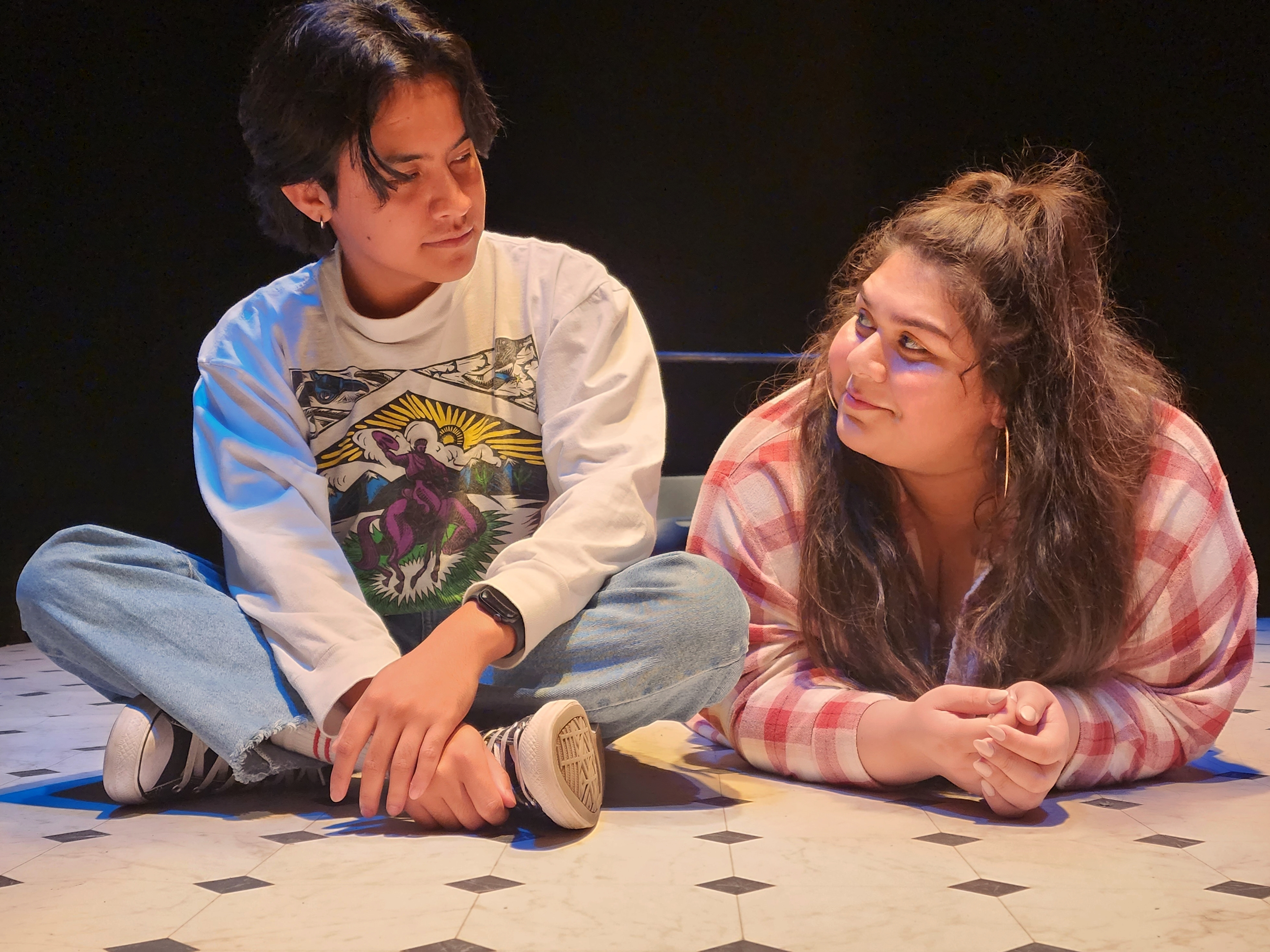
That can be a problem for director Glynnis O’Donoghue and her powerhouse cast at the intimate JCSU Arts Factory on West Trade. When Electricidad, Alfaro’s reincarnation of Sophocles’ Electra, describes her chola quarter of the LA barrio as the recognized pharmacy of the area, I was able to hear the air-quotes that surround the playwright’s text and laughed out loud.

Portraying the title princess, Melissa Lozada seemed a bit surprised and perturbed at the laughter. But her father, the venerated Agamenón (“El Auggie”), whose corpse lies enshrined in the front yard of Electricidad’s home, was the drug lord of the barrio. Her kingdom, which she plans to somehow usurp from her murderous mother, Clemencia, is built on drugs and community “protection.”

Or as one of the gossipy local Greek Chorus members puts it, “We don’t dial the 911 no more.”

More than in last year’s Mojada, the pretensions of our protagonists are repeatedly mocked and deflated. Ifigenia, E’s younger sister, is now a born-again Christian because she discovered that the meals served at her convent are far better than those she got in jail. Having taken over her abusive husband’s kingdom, Clemencia wants to sell rather than rule. She has Century 21 on speed dial and hopes to move to Pasa-fucking-dena.

In place of the ancient Greek gods, we have the modern monoliths: Target, Sears, 7-Eleven, Payless, and Oprah. Agamenón’s grieving mother, Abuela, exemplifies the warrior chola pride handed down through the generations, boasting that she pulled off her first shoplifting exploits from her baby carriage.

Brooding and vengeful, Electricidad stands apart from her family, even in her religiosity. You won’t find her praying to Jesus or the Blessed Virgin. To her, Auggie’s corpse is a sacred object, defiled by Forest Lawn, which would allow her father’s body to lie in state overnight with nobody watching.

She and Abuela whisked the body to the front yard, where she stands vigil, a squatter on her own property. E prays to her father’s spirit and talks to it, occasionally lifting her prayers to the severed head of ancient Aztec daughter Coyolxuahqui, better known as the moon.

No, Electricidad doesn’t think her devoted vigil, her seething rage, or any of her impassioned ravings are funny. Nor is she looking for a good laugh, even if her fanatical love for her father may be more than a little pathological. So Lozada’s glaring, combustible intensity is Electra, whether it’s Sophocles’, Hugo von Hofmannsthal’s, Jean Giraudoux’s, Jean Paul Sartre’s, or Eugene O’Neill’s. The laxity and corruption that surround her only increase Electricidad’s saturnine glow.

And a supremely hopeless mourning it is, for the bloody vengeance she is craving is unseemly for a woman – and Electicidad is as faithful to the old cholo ways as she is to her papá.She doesn’t realize that her brother Orestes, after being exiled to Las Vegas, where dear Clemencia ordered a hit on him, is still alive. His mentor, Niño, has thwarted the hit and is carrying on with his mission to toughen the kid up so he can take over the House of Atridas and continue in the king’s footsteps.

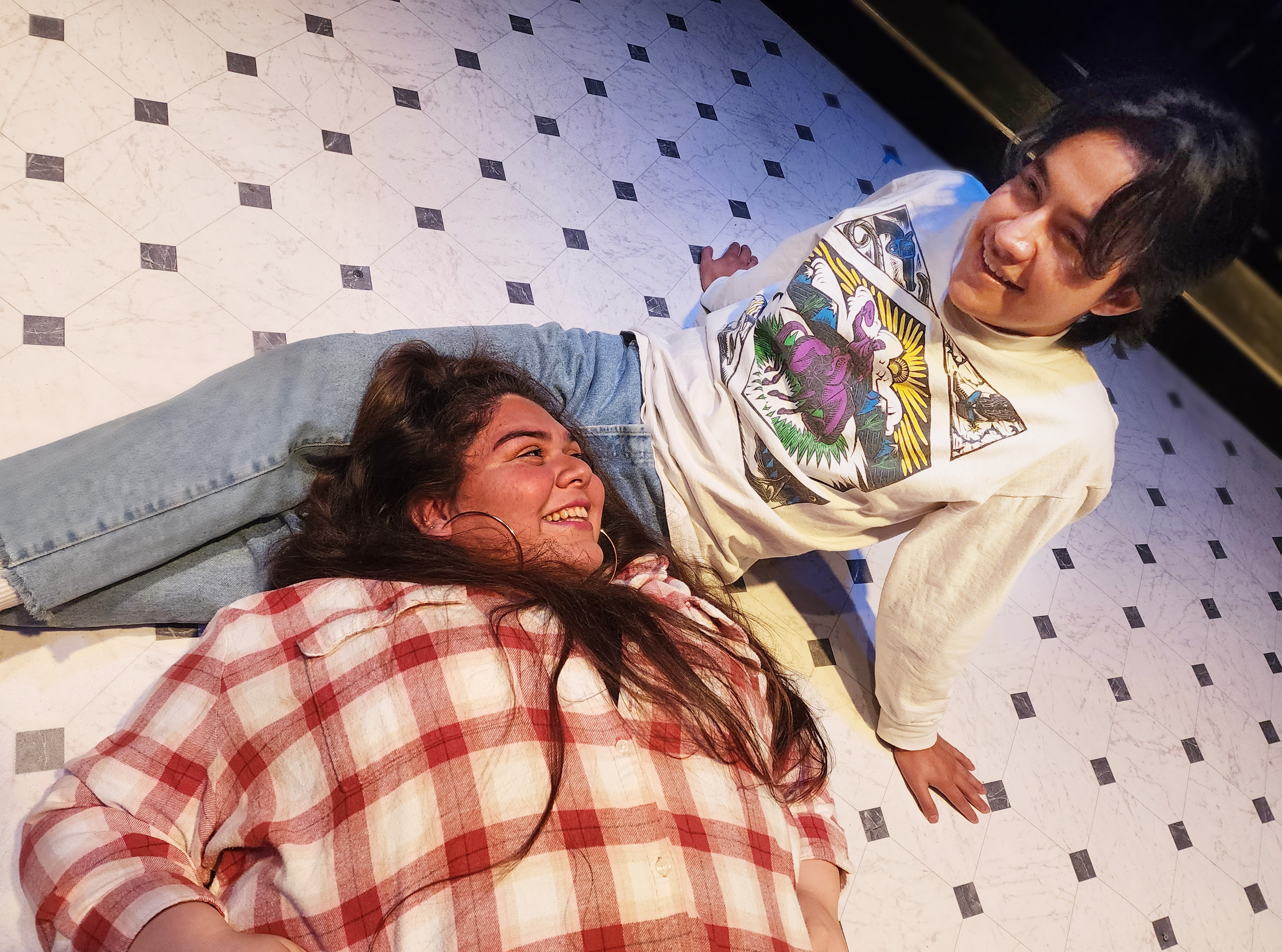
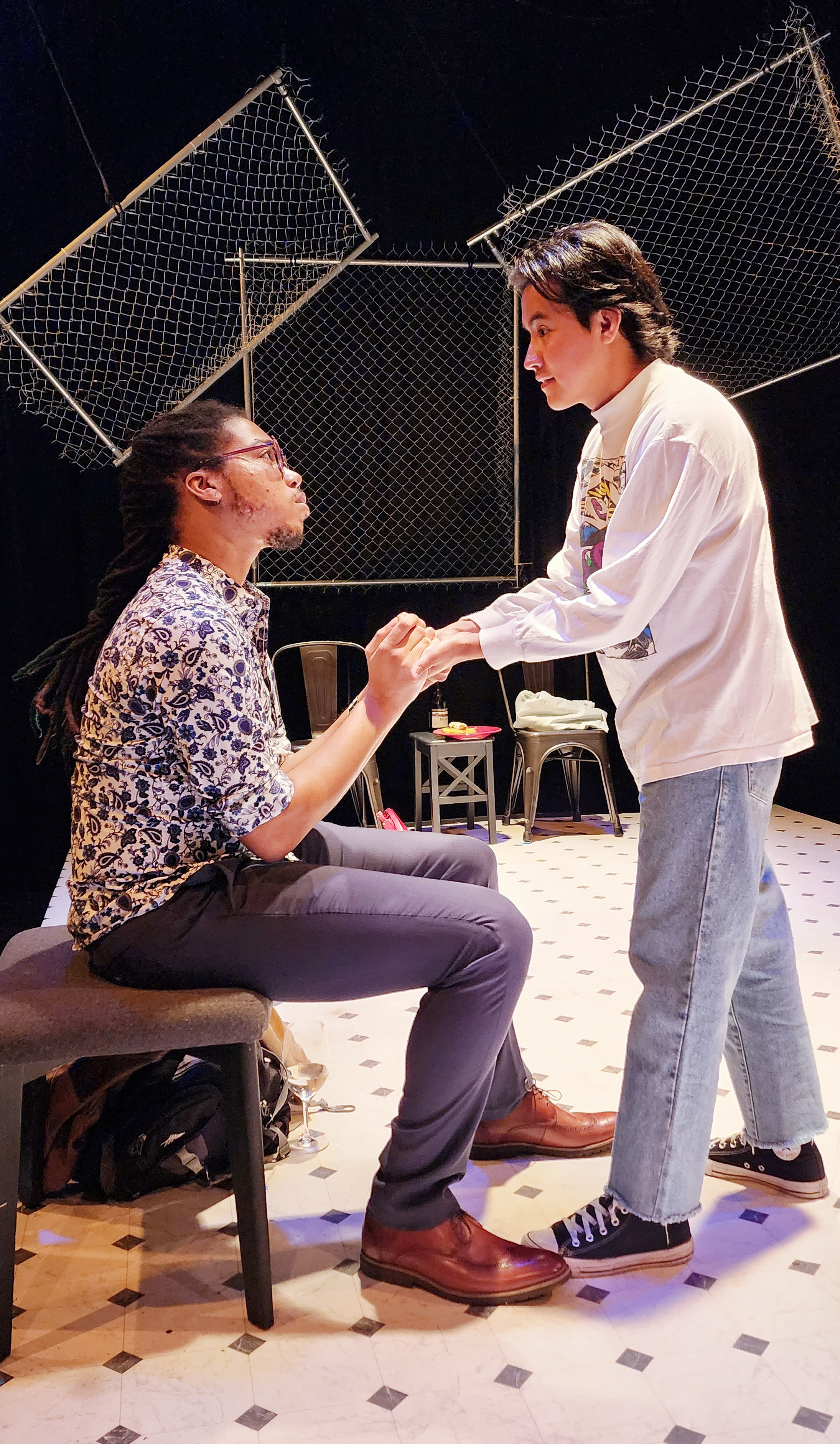
Although Jennifer O’Kelly’s lurid set design and projections combine with Madison King’s lighting to give the impression that LA’s el barrio is ablaze 24-7, the Arts Factory space is too limited to back up the idea that Clemencia’s check from Century 21 will be a huge fortune. It is Isabel Gonzalez as Clemencia who makes the House of Atridas formidable in a towering performance to savor every moment she’s onstage.

Even in the opening scene, as the speechless Electricidad dominates our attention sitting next to the shrine she has fashioned from Agamenón’s shrouded remains, Gonzalez lurks restlessly in the shadows in the corner of the room, a dynamo of nervous energy. The arrogance and majesty only emerge later when she paces the front room, caged in her own castle, chain-smoking, and unable to purge the terror squatting in her front yard.

Coming out to confront her sleek, gimlet-eyed daughter, Clemencia has a robust arsenal of tactics, from sweet cajoling and bribery to fierce, defiant, threatening, screaming, thundering rage. What a pair! For in retelling the fall of the House of Atreus, Alfaro has not only resurrected Agamemnon’s sacrificed daughter, Iphigenia, but he has also blotted out Aegisthus – Clytemnestra’s lover, protector, and partner in crime, ruler of Argos while the original Auggie was out of town, winning the Trojan War.

For feminists and progressives, Clemencia is unquestionably the strongest Clytemnestra of all that have been presented onstage since Aeschylus fathered the Greek rep that has survived the ages. When Gonzalez faces off against Lozada, as she did last week at the VIP dress rehearsal, we can also crown Alfaro’s Clemencia as the best of the Clytemnestras conceived for stage or opera (Hofmannsthal’s script became the libretto for Richard Strauss’s Elektra).

She certainly stands on higher moral ground than any of her predecessors, and if you hadn’t recognized Gonzalez as the diva of Hispanic actors in the QC until now, your mind will likely be changed by this hot gem. Lozada’s “Electra-fying” debut will stamp the Venezuelan spitfire no less convincingly as this year’s most exciting QC newcomer. Yes, there is spitting in el barrio.
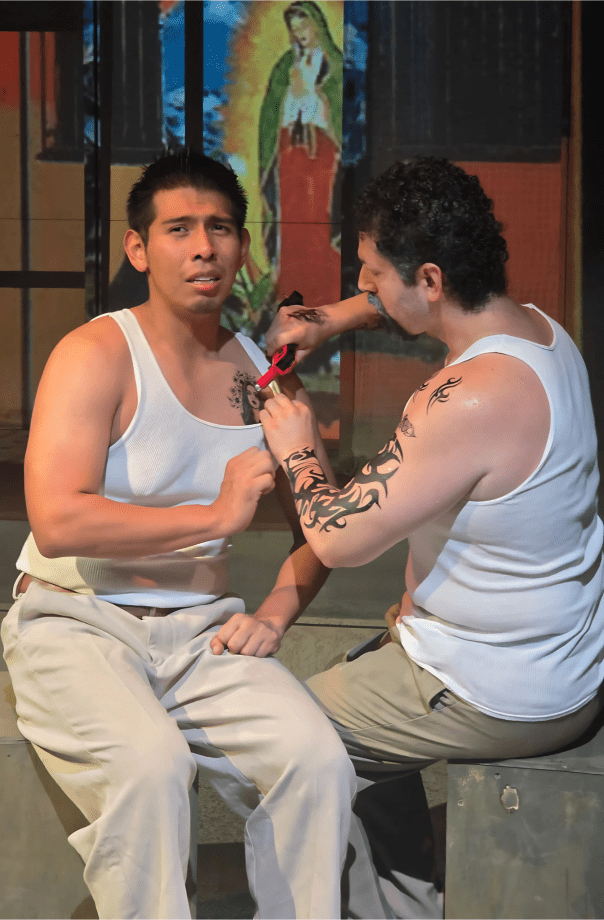
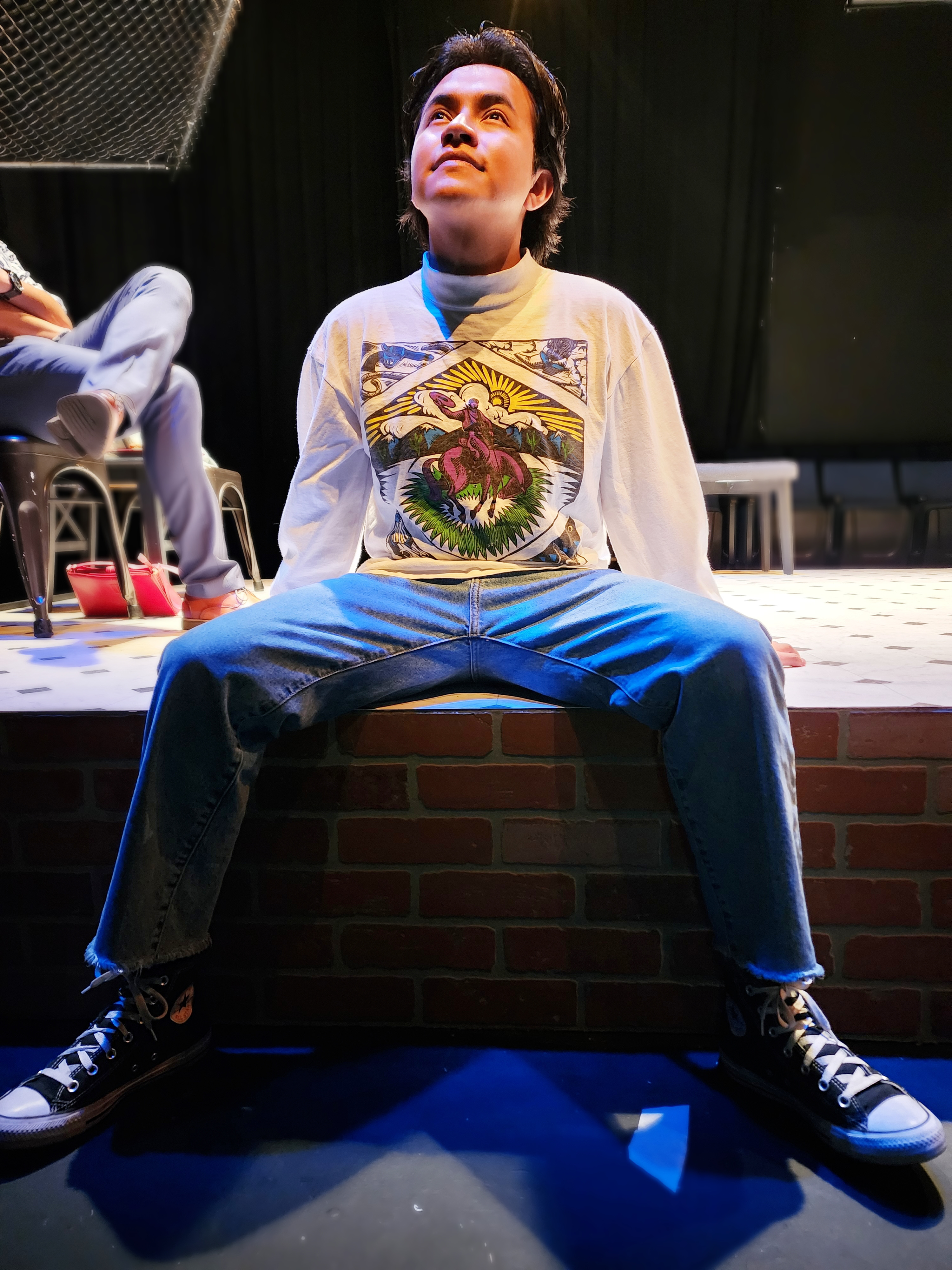
Just don’t overlook the quieter, nuanced magnificence of Eduardo Sanchez in capturing Orestes’ mix of innocence, steely nobility, and self-doubt – prodded along by Luis Medina’s sometimes proud, sometimes slightly exasperated Niño patiently punching and tattooing his pupil into manhood. Sanchez is more than soft enough when we first encounter him to justify his skepticism about filling his father’s shoes and wearing his crown.

Matricide?!? That’s a terrifying prospect when he returns from Vegas to LA and learns what’s what. Even Mom understands his hesitance, calling him “My most sensitive one.”

O’Donoghue was still tinkering with pacing on the night we attended. Too fast and you can miss Alfaro’s choicest quips, especially with Mariana Corrales, Allison Graham, and Marcella Pansini as the Chicano chorus of street sweepers, not the best players in the lineup. Slow it down, and the comedy threatens to take over.

But when it comes to the key moment, that spark-gap instant when Orestes becomes who he was destined to be, O’Donoghue nails it with hardly a single prompt from Alfaro’s script. It’s a kind of magic, a key superpower Alfaro also preserves from ancient times for his Medea in Mojada.

As Orestes returns to Clemencia’s living room, where mamá is smoking and watching TV, she begins chanting: “Find the courage. Find the rage. Find the darkness.” This chant becomes a background incantation as Celemencia deals with the shocking reunion and Orestes copes with the enormity of his mission.

Until Electricidad screams out. It’s as if the live-wire transformer decreed by Alfaro at the top of his script, humming and crackling in the background all evening long, bursts into flame. As if Electricidad is triggering Orestes’ actions by remote control.

There’s only scant proof for my theory about O’Donoghue’s concept. Aside from The Penguins’ “Earth Angel,” specified by name in the playscript, sound designer Neifert Enrique inserts Santana’s “Black Magic Woman” as a perfect foreshadowing. You did not live the ‘70s if you don’t know it.

The pesky and complaisant sister usually assigned to irritate Electra is most often named Chrysothemis, so Michelle Medina Villalon is drawing a fairly thankless role as Ifigenia. But Alfaro perks her up a bit as Ifi really is iffy to the core, trying to get her elder sister and her mom to make peace, let bygones be bygones, and trying out Christianity as an alternative to whatever kept landing her in jail. Still sporting vivid tattoos from her past, Ifi carries around a little statue of the Blessed Virgin as a security object: to pray to, to purify her living, and maybe to mark her territory if she decides to move back permanently.

Villalon also carries around a distinctively blank and traumatized look about her – maybe a prophecy of what Orestes and Electricidad will soon become. The earth here seems to be so scorched that both the sanitation department and the police stay clear. There’s no more likelihood that the siblings will face legal consequences for their crime than Clemencia faced for hers.

As one of the street sweeper gossips tells us, this is the wild, wild ouest. The only repercussions to assail the Atridas family for all their crimes are inward – the pains of guilt, regret, and that mark that has branded our species since the days of Cain. Drugs? Expelled from the equation.

Abuela remembers the good old days, reminiscing with Niño briefly upon his return before luring him to her place. With Banu Villadares embodying the tough and pragmatic Abuela, who didn’t weep at her son’s funeral because it would mar her makeup, we can understand why she is the only person on the planet who can make Electricidad laugh. Or momentarily rescue her from her own darkness.

You just gotta love her indomitable sass. Especially in a world that’s on fire.

DREAMers on Guard in Three Bone’s “Sanctuary City”

Review: Sanctuary City @ The Arts Factory

By Perry Tannenbaum

202211203709590007197567742

In the wake of the 9/11 attack on the Twin Towers, as lethal smoke and dust afflicted policemen, firemen, and medics who converged upon Ground Zero, a wave of xenophobia began to sweep across America. Muslims and air travel were the prime targets of paranoia and impulsive policy adjustments in the early days, with follies in Iraq and Afghanistan soon to follow. As Martyna Majok’s Sanctuary City demonstrates, the seismic shock of the attack and the insidious xenophobia it unleashed were keenly felt across the Hudson River in Newark, New Jersey, where her two teenage protagonists face uncertain futures as undocumented Latinx immigrants.

Adapting a thrust-stage configuration at the Arts Factory black box, director Caroline Bower places the audience close to the action – and to the hearts of Majok’s teens as they navigate their treacherous paths to adulthood and possible US citizenship. We may look down pityingly on the adolescent recklessness and naivete of B and G, the rather generic names our playwright assigns to her main characters. G has a litany of fictional excuses for her serial truancies at school, but she can still coach B on his math homework.

Yet there’s plenty here in this Three Bone Theatre production to rattle our smug complacency. Humble and ignorant as they may seem, both B and G often school us in the brambly terrain of daily life in a Sanctuary City and the vagaries of US immigration law. As we will see, their paranoia wasn’t over-the-top in 2001, when most of us would have been skeptical, and their fears proved prophetic 15 years later when MAGA morons began to dominate our national discourse.202211205681389164319280691

G needs to fabricate reasons for skipping school because the welts and bruises that keep appearing on her face and limbs might be noticed by teachers, prompting a home visit from social services, a check of her mom’s immigration papers, a disclosure that her work visa expired years ago – and a swift deportation. Instead, B must tell G’s teachers that she is bedridden with flu until her black eye has cleared up.

Nor does B have it easy just because his mother isn’t tyrannized by a drunken, sadistic SOB. He and his mom can be easily shortchanged on their wages, since they have no legal recourse unless they’re willing to risk deportation. Indeed, it’s B’s mom, not G’s, who gets collared and deported. Paradoxically, Northerners can be smug and complacent in their convictions that such deportations define the inhumanity of red border states in the South, and that heartless Immigration feds are to blame for cruelly separating Latinx families.

Wrong on both counts, Majok reminds us. By not seeking out Federal assistance in clearing out undocumented immigrants, Sanctuary Cities do not prevent the Feds from swooping in, and it’s federal immigration law that discriminates between parents and their children. When B learns that his mom has been nabbed, he must make the painful call on whether to board the plane with her.

Bad news or good news often arrives suddenly as G climbs up the fire escape to B’s bedroom after dark and he mimes a window to let her in. Or occasionally the simple Bunny Gregory set design transforms and B visits G’s place to bring her some urgent news. Neither B nor G has any furnishings until years after B’s mom has been deported and he’s forced to survive on his own.Gus Zamudio

Meanwhile, G’s mom evolves, after seeming to be a hopeless doormat according to her daughter’s early reports. She sheds her abuser, secretly studies for – and passes – her citizenship exam, and achieves the naturalization that eluded B’s mom. In the blink of an eye, G is a legal as well, able to pursue higher education beyond a Newark community college when she graduates high school. Just as suddenly, since both of them know the laws, G can help B reach the same goals. Citizenship plus education.

Isabel Gonzalez sparkles in the rapidfire scenes with Gus Zamudio that open Sanctuary City. Some are brief flashbacks and flash-forwards, others a series of riffs on recurring events, and still others are jump cuts between parallel events in the illegals’ lives. Zamudio, who lived out a real-life DACA deportation drama chronicled by local media in 2017, taken into ICE custody just before he graduated from Northwest School of the Arts, has no problems at all internalizing B’s plight – or still passing for 17.

Making her Charlotte debut last year, portraying 10-year-old Paloma in Children’s Theatre’s Tropical Secrets, Gonzalez doesn’t have to regress nearly as far to bring us all the adolescent vitality, anxiety, and ambivalence of G. Somehow, it’s through Gonzalez and her wary intimacy with her bestie that I began to grasp why Northerners and Southerners alike fathom so little about how immigrants live in citizenship limbo. They’re a secret – and secretive – society who can only truly trust each other.Grant Cunningham and Gus Zamudio(1)

When Grant Cunningham entered as Howard deep into the second half of this no-intermission production, more than a couple of notable shifts came into play, including two new plot twists and an abrupt change in pacing as Majok’s script settled into one extended closing scene. All three actors quickly rev up intensity as the cluster of revelations forces them to rapidly shift their perspectives on each other. You couldn’t help feeling impressed by the melee and how well Cunningham fit into it, and you couldn’t help smiling when you saw the blind spot they all shared, for we have seen the social and political progress that can happen in less than two decades.

Howard, the first character we encounter here with a full name also comes equipped with a fuller character. Yes, he seems far more confident that he belongs here, and as a law student, far more definite about who he is and what he aspires to be. Gradually, he brings out one of the playwright’s salient points, that B’s plight not only focuses him sharply on the niceties of immigration law and enforcement, it makes him adept at attaching himself to people he can use to help his cause.

But really, I didn’t think arriving at that point was as important as the basic heartbeat of what Majok leaves us to speculate about: what specifically are these DREAMer hopefuls’ dreams? What aspirations stir their souls as they struggle to emerge from the shadows into full American lives?

A little more of that kind of intimate disclosure would have helped the emotional magnitude of Sanctuary City to align better with its cerebral clout. Even the dimwitted Lenny in Of Mice and Men had his rabbits to break our hearts. So even a Lin-Manuel Miranda bodega would help Majok’s taut drama – with a few stray spritzes of comedy – to sprout a little more Latinx color. And we shouldn’t have to Google a New York Times review or call upon Three Bone Theatre’s playbill to inform us that the drama is happening in Newark.20221111578320097703585702

More urban and aspirational detail would certainly make Majok’s brew more combustible, but Gonzalez, Zamudio, and Cunningham deliver plenty of firepower. Sarandon Shindon steps in to play G at the Wednesday and Thursday performances, with Gonzalez returning to close out the run on Friday and Saturday.

Sensory-Friendly Theatre, or “How can I help you be you?”

Preview: Tropical Secrets: Holocaust Refugees in Cuba

By Perry Tannenbaum

2021~Ilana Visits-02

Tyler made a surprising and daring decision at ImaginOn before attending the Sunday matinee of My Wonderful Birthday Suit. His mom, Ilana, had been sure that Tyler would want to wear noise-cancelling headphones at the performance, so I had to assure her that Children’s Theatre would be offering them prior to the show. Otherwise, she would need to pack his set of phones before they flew in from El Paso and make sure he had them when they left their hotel.

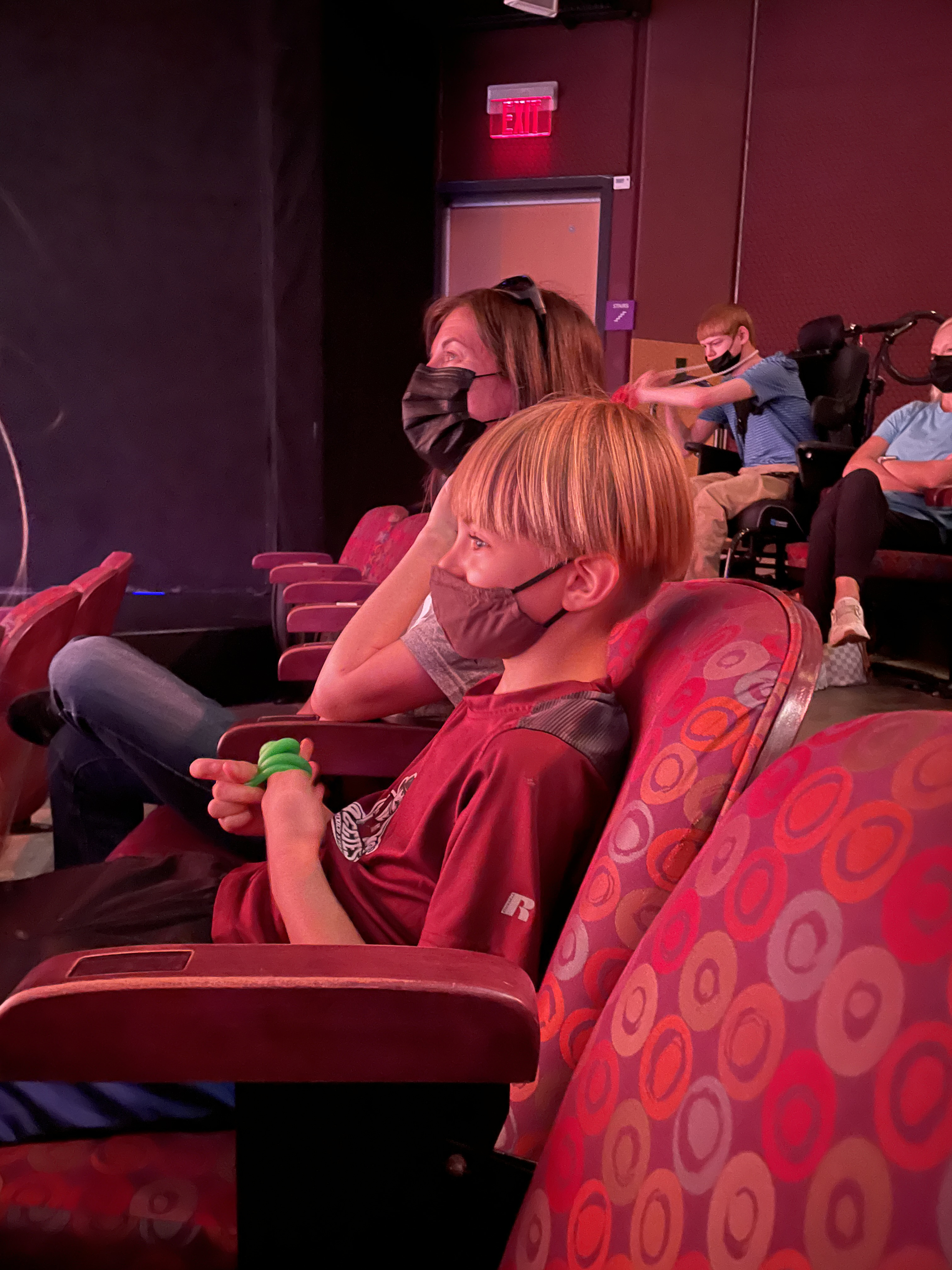
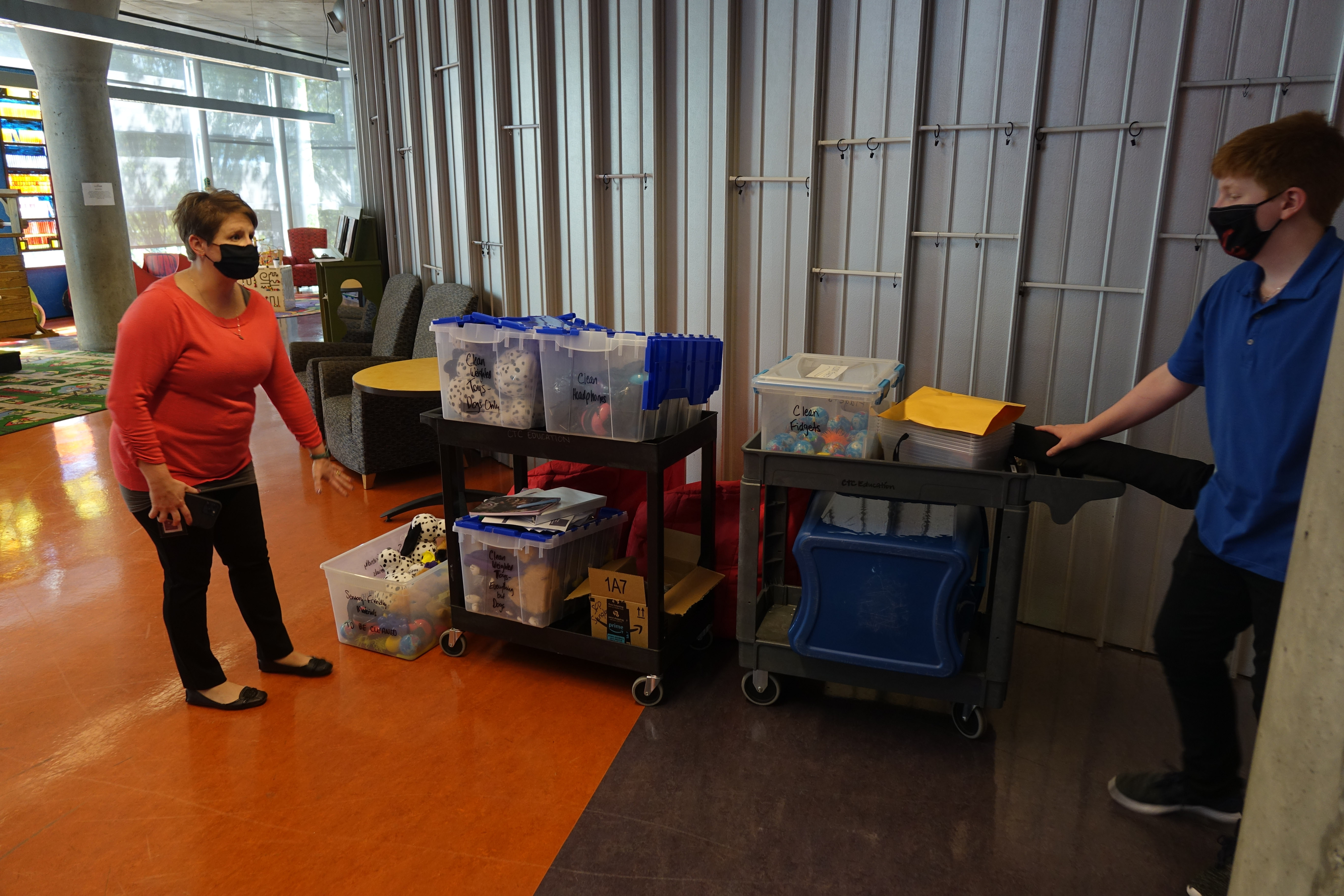
But Tyler refused the headphones that were available – in a really cool variety of colors, it should be mentioned – at the entrance of McColl Family Theatre. Instead, he chose a day-glo green worm, about eight inches long, from a wide array of fidgets and weighted cuddles on display. His younger sister, Brynn, chose a spotted little Dalmatian doggie that weighed five pounds. More surprises.2021~Sensory Friendly Theatre-01

Tyler had to live with his choice. Now when Oobladee and Oobladah, best friends on this side of Moonbeam, started blowing up balloons for the surprise birthday party they were planning for Shebopshebe, Oobladee’s bestie from the other side of Moonbeam… Tyler covered his ears with both hands, dreading the moment when a balloon would suddenly explode.

Yet he didn’t cower or turn away. He didn’t run for cover. His beautiful blue eyes remained glued to the stage.2021~Sensory Friendly Theatre-12

I was sure that none of the balloons would explode. Even if I hadn’t seen this show before, I could see that, sitting in front of the stage, “Tree” (resident teaching artist Kaitlin Gentry) hadn’t raised her two green glow sticks, the signal that “sensory rich” moments were around the corner. Anybody who had downloaded the Parent’s Guide from the Children’s Theatre of Charlotte website would also know that the balloons were “being blown up and let go, but they do not pop or make much sound.”

Tyler’s attention never wavered after the balloon scare, but he didn’t remain completely quiet. Gloria Bond Clunie’s script becomes heavier and more emotional. When Shebopshebe shows up from the other side of the rainbow, Oobladah is shocked to discover that Oobladee’s other best friend is brown. From the start, when he points at Shebopshebe and says, “You’re brown!” it doesn’t sound at all like a description – and she hears that clearly.

The pointing and the tone get meaner, more hateful, overtly racist. “People say that brown skin is…,” Oobladah stammers, leaning over a ledge and pointing an accusing finger down at Shebopshebe. He’s heard whispers that “you know…” and finally he blurts out: “Together – we should not play!”2021~Sensory Friendly Theatre-03

You might think the two girls would be furious. Instead, they’re both rolling on the floor, laughing hysterically.

“On the Other Side of Moonbeam – we play all the time!” Shebopshebe will respond, once she and Oobladee have caught their breaths.

And this is where Tyler breaks his silence. In a voice loud enough for Mom sitting next to him to hear. It’s also loud enough for me – his grandpa – to hear, sitting two seats away, next to his sister.

“That’s NOT funny!” Tyler calls out.

Nobody turns around to shush him. Nobody glares. At all of Children’s Theatre’s Sensory-Friendly Performances, autistic nine-year-olds like Tyler are free to call out, fidget, roam around the theater, cower in a corner, or find refuge in a quiet room, where they can still watch and hear all the comedy and drama with their mom or dad.

That’s really the point: they’re free to be themselves without being judged.2021~Sensory Friendly Theatre-17

Julie Higginbotham of Precious Developments has been overseeing the Sensory-Friendly Performances at Children’s Theatre since 2016, when ImaginOn’s new project was still a pioneering rarity. Now every run of every mainstage production gets a Sensory-Friendly Performance at its closing Sunday matinee. That includes the upcoming Tropical Secrets: Holocaust Refugees in Cuba, opening this Saturday and running through November 14.

“It’s a big deal!” Higginbotham often says – because it’s so true in so many ways.

She’s preparing actors, directors, designers, technicians, and ushers for the special performance – as well as carefully preparing printed and online guides for protective parents and surprise-averse children. This involves meeting face-to-face with the stage manager, the stage director, the musical director, and the actors. Higginbotham also attends the designers’ run-through, dress rehearsals, and performances during the run of the show, where she scribbles over the Children’s Theatre director of production Steven Levine’s script, containing all the light and sound cues.

Where should the volume on the mics be turned down? Where should a scream be changed into a loud exclamation? Where should a live gunshot effect be changed into a muffled recording? Where must a scene with strobe effects – almost automatically a two-light-cue alert – be redesigned so that triggers that would be hazardous to seizure-prone kids are gone?

Amid the final tweaks to lights and sounds happening during the run of the show, Higginbotham takes hundreds of photos – because the Parent’s Guide and the Child’s Guide are also illustrated full-color scenarios that prepare audiences for what they will see. That’s helpful when a stage adaptation or a set design significantly departs from an original book that kids and their parents are already familiar with.

She also annotates the script for “Tree” so that she can closely follow and precisely time her one-light and two-light cues. Higginbotham remained involved in the last 90 minutes before the Sensory-Friendly Performance and even while “Tree” was upfront waving her traffic-control glow sticks.

Grandpa had to rise and shine a couple of hours earlier than Ilana and the grandkids to witness Higginbotham’s final preps for My Wonderful Birthday Suit – after getting buzzed in at the ImaginOn loading dock.2021~Sensory Friendly Theatre-24

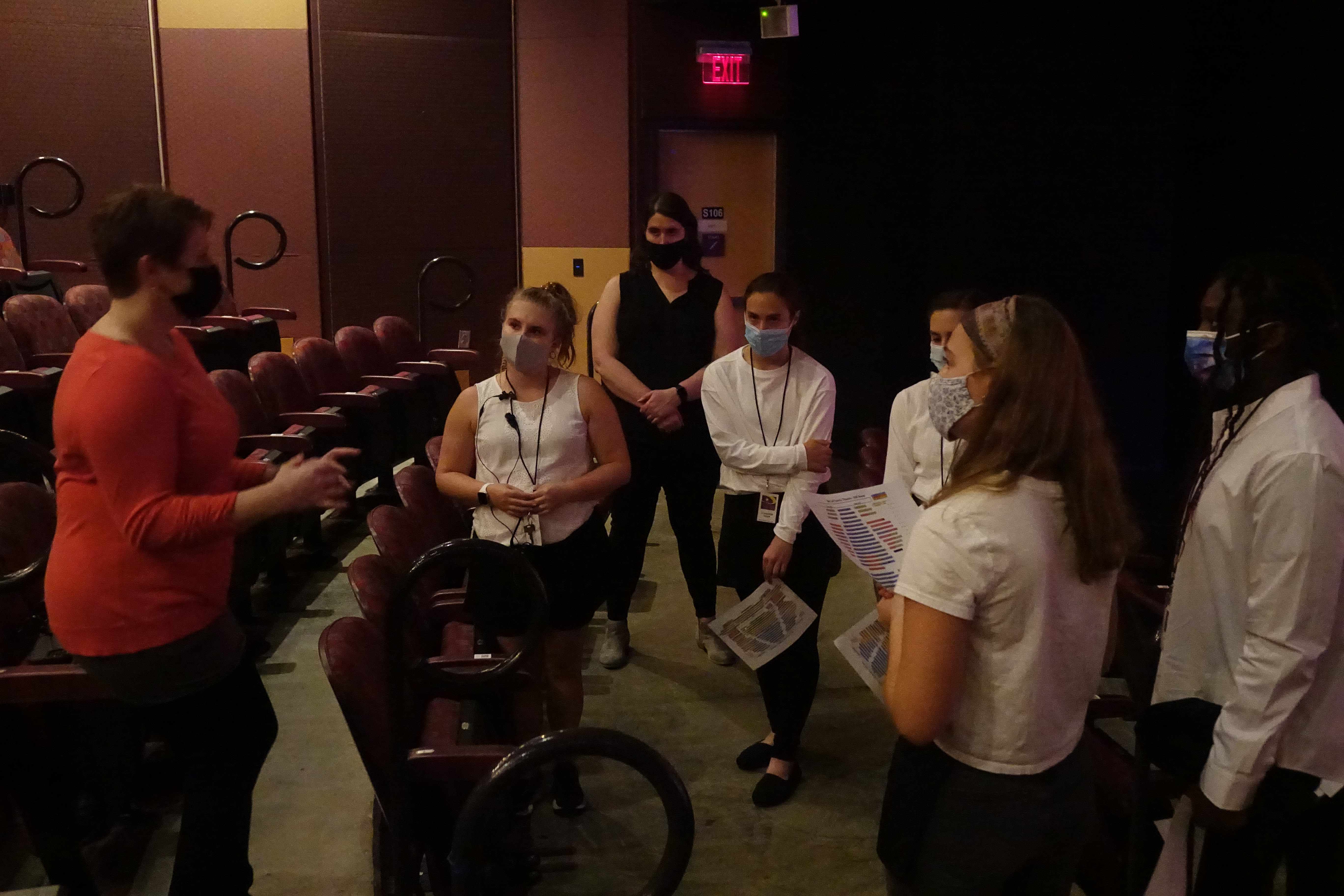
First came the final powwow with the actors, lighting crew, and “Tree.” Actors portraying Oobladee, Oobladah, and Shebopshebe all received Higginbotham’s final notes and reinforcements, with opportunities to air last-minute questions and concerns. Then the reconfigured “REWIND” scene – Shebopshebe’s brilliant and zany answer to the contrite Oobladah’s wish to “begin again” – was rehearsed and rerun without the strobes.

As the three actors exited and changed into their costumes, makeup, and matching masks (since ImaginOn is a public building, masks are worn by actors during performances), Higginbotham ascended the long lobby ramp to the top level of McColl Family Theatre. Time to prep the ushering staff, a mix of vets and newbies overseen by volunteer coordinator Louise Lawson.

Some ushering basics are turned on their head at Sensory-Friendlies. Ushers don’t simply show you to your seat, retreat to anonymity, and maybe sit back and enjoy the show themselves. They’re actively engaged in helping to ensure this special audience will enjoy their experience before the show and during the show.

Audience members don’t have a seat. With open, socially distanced seating, they have any seat. If say, they run up to the front of the house and find out that the sensory onslaught is too intense there, they can move back as far as they wish to any empty seat.

What ushers pay closest attention to is the kids’ needs. So my Tyler actually had extra backup during the little balloon scare that his mom may not have been aware of. Ushers were armed with the same fidgets, cuddly dogs, sunglasses, and headphones that Tyler was offered when he came in, standing at-the-ready, spread throughout the theater, instructed to come to his aid if they noticed he was constantly putting his hands over his ears and flinching.

“The biggest thing,” Higginbotham emphasizes to the volunteers, “is this: a lot of these families are overlooked, or they get stares. Our job is to actually see these folks, make eye contact, engage with everyone. If their communication style is one you don’t understand, that’s OK. Say, ‘Hello. We are really, really glad that you are here. What can we do for you? Can we show you to your seats? This is an amazing production, and we want to make sure you guys have a good time.’”

Any questions? Higginbotham is there to answer ushers’ concerns before and during the show, supervising the operation over a headset from the rear of the hall. Like a second stage manager.

Higginbotham’s meeting with Laura Beth Lee, the actual stage manager for Tropical Secrets, gave me a close-up view of how the Sensory-Friendly process begins – and a rewarding overview of the Precious Developments methodology.

2021~Tropical Secrets-18

The situation was somewhat surreal for this reviewer, since Higginbotham had not yet read the L M Feldman stage adaptation of Margarita Engle’s young adult verse novel. I’d covered the original webcast premiere back in March, but there were never live performances of the show and no Sensory-Friendly edition. The same cast, starring Adrian Thornburg as the Jewish boy Daniel and Isabel Gonzalez as Cuban native Paloma, are back with director David Winitsky. But Lee will be new to Cuba behind the scenes.

New wrinkles will confront everyone involved, however, since the production is moving from the McColl Theatre at the east side of ImaginOn to Wells Fargo Playhouse on the west, with a shrunken, more abstract set design customized for the new venue. Before Higginbotham and Lee powwowed in the “Lizard Room” on October 20, the returning cast had already rehearsed on the new set, likely because there hadn’t been a live show at the Wells since January 2020.

As the title indicates, Tropical Secrets is very much about this world – historical racism rather than the Moonbeam brand. With the 83rd anniversary of Kristallnacht falling on November 9, during the run of the show, Engle’s story will be very much in season. We really begin with that cataclysmic 1938 event in Nazi Germany, which prompts Daniel’s family to rush the 11-year-old onto an ocean liner bound for New York, where they all plan to reunite and live happily ever after.

Except that the USA turns the ship away from its ports – all of them – because there are Jews on board. Canada does the same. Hello, Havana! How in this wide world will Daniel’s family find their boy now?

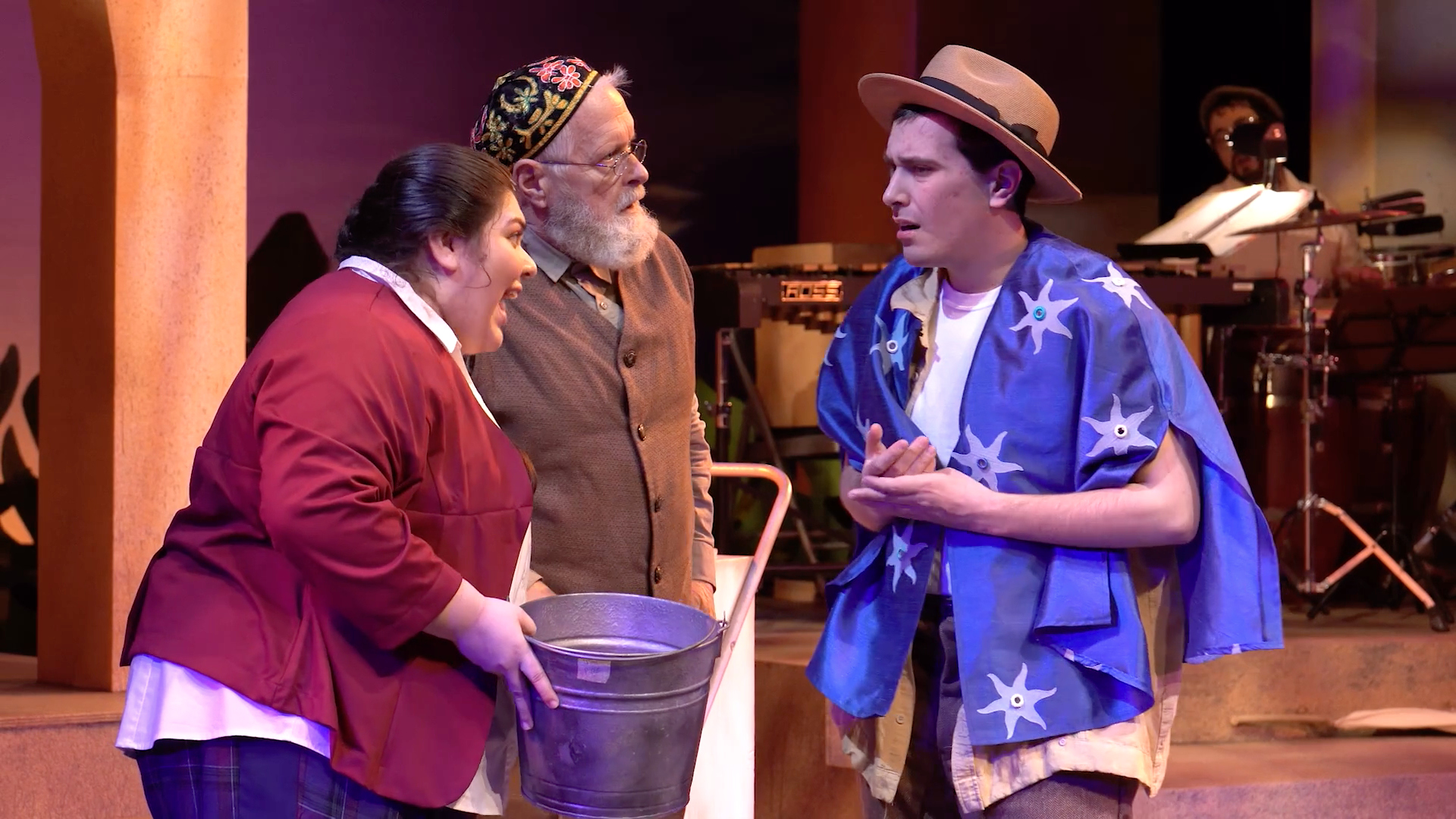
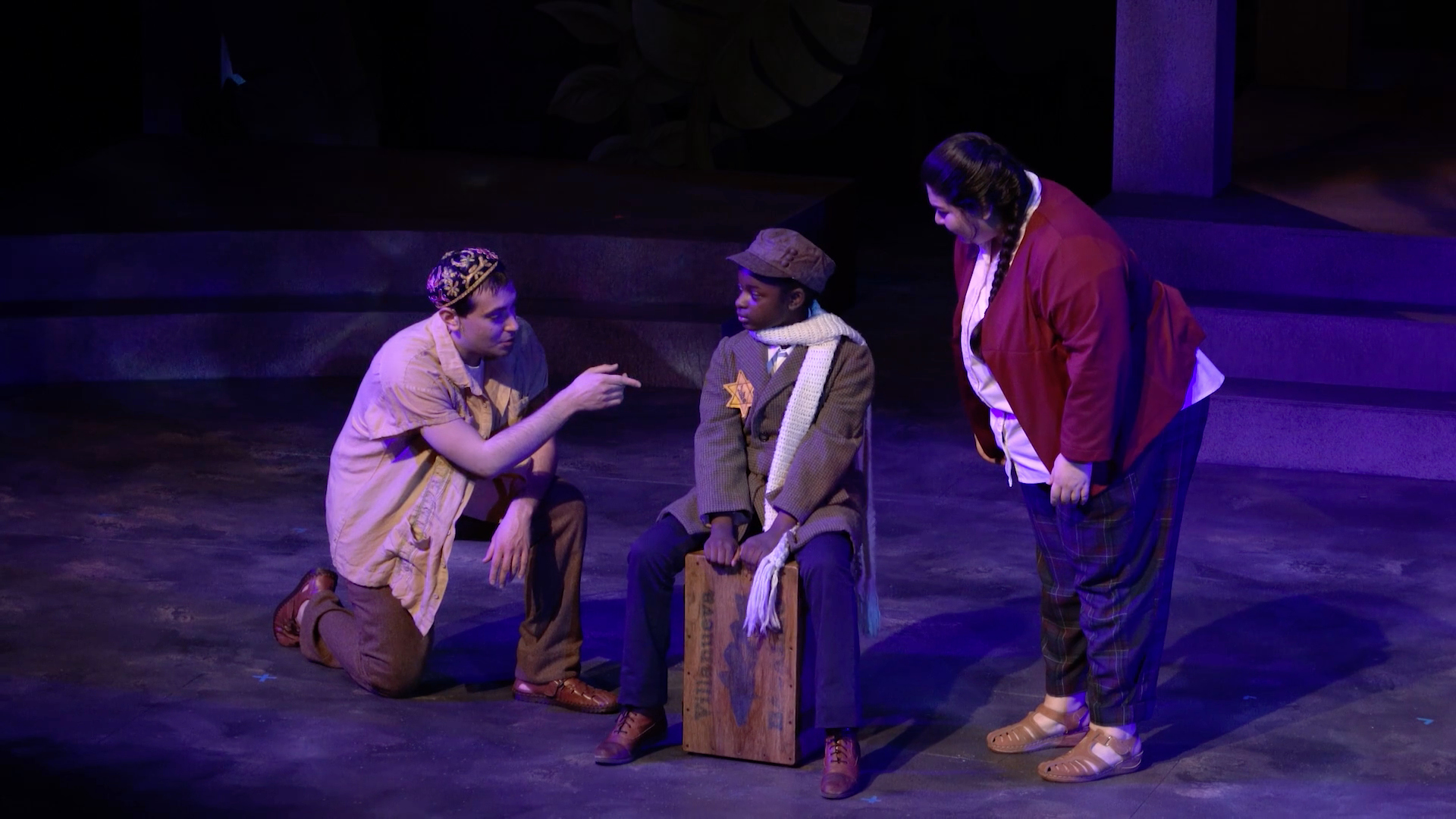
Miracles aren’t likely here, and you can rule out rewinds. Meanwhile, with little more than an overcoat and a flute, little Daniel must find ways to survive and fit in. Paloma and Daniel bridge the gap between languages and cultures far more easily than their elders, but Daniel finds a link to his heritage in crusty old David, played by Tom Scott, a Yiddish-speaking ice cream vendor who sports a gaudy yarmulke.

“It’s also a very emotional show,” Lee tells Higginbotham, “a Holocaust show, so you’ve got police officers who are bursting in and yelling, there’s scary emotional outburst moments, so I can definitely see that there are these big impactful things.”2021~Tropical Secrets-32

Together with our dip into Yiddish and repeated Judaic references, Paloma has her own story – and considerable depths. She is our gateway into Cuban culture and the Afro-Cuban beat. Daniel will discard his flute for a drum and jam with percussionist Raphael Torn, who will also play the vibraphone. Topping that outbreak of rhythm and dance, there’s a full-fledged carnival scene.

Yes, there is sensory richness aplenty in Tropical Secrets – and the kid protagonists are sharp. Explaining to Paloma what living Jewish was like back in Munich, Daniel says, “In Germany, you have to wear a star on your shirt, so everyone can know what you are and hate you for it.”

Paloma’s dad is El Gordo, played by Frank Dominguez, the notorious decider when it comes to which ships are allowed to dock in Havana and which are turned away. Defending his wartime profiteering, El Gordo schools his daughter: “The world runs on business!” With no less conviction, Paloma looks her dad straight in the eye and fires back, “The world runs on kindness!

Emotional.

Impactful as Tropical Secrets will be, part of Higginbotham’s job will be to prep the able actors onstage for what to expect from their ultra-sensitive, surprise-averse audience – especially when volume has been trimmed to 75% or less and houselights turned down to half. They will see their audience more clearly than they did at previous performances. There will be fewer kids out there, socially distanced and maybe moving around or fidgeting. It may be jarring to look out into the audience and see kids talking back to the actors or wearing headphones. Or holding their hands over their ears. Or not making eye contact.

They might not even clap.

Parents will need to show proof of vaccination to enter the Wells for Tropical Secrets, but they won’t need to bring doctor’s notes or medical records for the Sensory-Friendly finale. Nor will this be an entirely special-needs crowd.

“Some folks prefer the softer presentation,” Higginbotham explains. “Some parents feel it gives their kids more freedom, and some folks can only get tickets for the Sunday matinee!”

If all goes according to plan, Higginbotham’s guides for parents and children will go out to all ticketholders on November 8, giving families six days to prepare.

Ilana was impressed by both Birthday Suit guides, but she didn’t see them as particularly useful for her Tyler, whom she describes as falling in the mild-to-moderate range of the autistic spectrum. Medication also helps him in tolerating sensory irritants.2021~Ilana Visits-22

“I don’t think Brynn or Tyler would’ve benefited,” Ilana says of the illustrated guide, “and it may actually have detracted from their experience. In children’s theatre, anything that dampens the surprise and wonder of a performance wouldn’t be optimal for my kids. And the show itself didn’t have anything too jarring (sensory-wise) that we would’ve needed to warn him about.”

On the other hand, My Wonderful Birthday Suit was far more palatable to Tyler than his previous theatre experience at Sesame Street Live! in 2019.

“Brynn loved it, but it was too loud and glitzy for Tyler,” Mom recalls. “Crazy loud, confetti storm, etc. We had to buy him off with a snow cone to get him through it.”

Higginbotham points out that the guides aren’t merely handy in preparing kids for Sensory-Friendly Performances, they also help in revisiting and remembering what they’ve seen. That can happen soon after the theatre experience is over or before the next theatre experience, when parents want to pique their children’s interest and anticipation.

“I showed Tyler the Child’s Guide,” Ilana wrote me, “and he was very excited and asked if you had sent pictures of the stage. Then he asked if I could send him screenshots of his 3 favorite pictures. Why? ‘Because they’re beautiful!’”

Unforeseen as that reaction might be, it’s what Higginbotham aims for.

“People need the freedom to be exactly who they need to be,” she says, “and to be able to feel like they’re supported. And man, we can’t predict everything, but we try. They need a non-judgment zone that I defend to the death. How can I help you be you? That’s my job.”

“Tropical Secrets” Presents a Bittersweet Wartime Escape from Genocide

Review: Tropical Secrets: Holocaust Refugees in Cuba

By Perry Tannenbaum

2021~Tropical Secrets-16

Havana has never been the homeland of the Jewish people. Yet as we quickly learn in Tropical Secrets: Holocaust Refugees in Cuba, now streaming from Children’s Theatre of Charlotte, it was often more hospitable to Jewish refugees fleeing Nazi oppression, terror and genocide than most other nations – including the USA. If that surprises you, imagine how 11-year-old Daniel felt when he made this discovery in 1940.

In the wake of the infamous Kristallnacht terror across Germany, Daniel’s parents rush him onto an ocean liner bound for New York, promising to meet him there. The ship isn’t allowed into the harbor. They sail north. Knowing there are Jews on board, the Canadians also turn them away. Young Daniel, who was holding his grandfather’s hand when rioters shot him down on Kristallnacht in the middle of the street, is learning some of the cruelest lessons of the world on his own, cast adrift from his family.

Interestingly enough, Margarita Engle’s story, adapted for the stage by L M Feldman, is almost equally about the 10-year-old Paloma, nee Maria Dolorosa. From the outset, her problems are paralleled with Daniel’s. Paloma’s mom abruptly decides to leave Cuba for Europe. Needing to become closer to her dad in the wake of Mom’s abandonment, Paloma finds herself turned away. Seems like an unfair comparison at first, but Engle constantly asks us throughout this new 75-minute drama to re-examine our perspectives and our sense of proportion.

Moral certitudes are questioned during the turmoil of World War II as we watch Daniel acclimate to Cuba while still holding out hope that his parents will find him – or that he will find a way to New York. A huge flip in sentiment and loyalty happens across Havana when news reaches the island that Pearl Harbor has been bombed. Instead of marking him as fodder for the horrific Nazi deathcamps, the Yellow Star that Daniel had been forced to pin on his shirt back in Munich now becomes the badge that prevents him from being arrested as a German spy.2021~Tropical Secrets-37

As with many children’s classics, kids perceive basic truths more readily than their elders. Paloma’s father, known across the island as El Gordo, is the decider when it comes to which ships are allowed to dock in Havana and which are turned away. He tries to explain to little Paloma that he makes his decisions pragmatically rather than on principle. “The world runs on business!” he proclaims with conviction. Paloma looks her dad straight in the eye and tells him, “The world runs on kindness!” Engle’s kids also have depth, as when Daniel informs Paloma, “In Germany, you have to wear a star on your shirt, so everyone can know what you are and hate you for it.”2021~Tropical Secrets-65

Adults here aren’t perfect role models chiefly because of their practical struggles to survive and thrive. With most of the world turning the Jews away, El Gordo naturally feels pressure not to open the floodgates. Yup, immigration issues! And though Daniel’s mentor, David, staunchly wears a brightly embroidered yarmulke with pride, he also bends to practicality, peddling his ice cream in his little pushcart on the Sabbath. When Jews are suddenly perceived as friends and Germans suddenly become loathsome, suspicious, and targeted for arrest, David abruptly veers to the other end of the spectrum, opposed to allowing any foreign ship to dock in Havana until the war is over – even if Daniel’s parents happen to be on board. El Gordo, on the other hand, stands fairly firm – except for raising the price of entry.

In the shifting mists of these patriarchs’ outlooks, blown by the winds of war, Engle’s Havana takes on some of the ambiguities of Casablanca. We aren’t on the same exalted levels of politics, decadence, or romance, but you may find yourself identifying more deeply with the everyday humanity of her people. You may also experience more keenly the anguish of survivors who are left in suspense for months and years about whether those dearest to them are still alive – and empathize more keenly with those who are wracked with memories of those who have died.

Most poignant, the kids rise to heroism in acting out their natural beliefs when, after the universe flips with Pearl Harbor, they encounter a Jewish mother on the run. Why would Miriam, a German Jew, be so terrified now? Because her only living relative, daughter-in-law Marta, is a Christian. For Daniel and Paloma, it is axiomatic that both are equally entitled to live in peace. Marta and Miriam, on the other hand, wrestle with the question of how fully they should describe to their rescuers the full details of the horrors they have left behind.

Thankfully for parents wondering whether Tropical Secrets might become to heavy for their youngest, Engle takes us to precipice without jumping over. There’s plenty for her to show us about kids conquering the language barrier and bonding, and there’s plenty for the kids and their elders to teach us about Judaism, Yiddish, and carnival. Helping Feldman transform Engle’s poetry into engrossing drama, stage director David Winitsky has made a welcome return to Charlotte after a year’s absence, having hosted the Charlotte Jewish Playwriting Contest at Shalom Park for the previous three seasons.2021~Tropical Secrets-28

Two dramaturges, Carmen Pelaez and Wendy Bable, helped him and his cast get the history and the cultures across accurately. Anita J. Tripathi’s scenic design radiates hacienda elegance, but it was Robyn Warfield’s lighting that filled out the atmosphere and took us beyond the city when the story needed to travel, while Magda Guichard’s costumes deftly differentiated between the nationalities and the social classes.

Most gratifying after so many months of deprivation, isolation, and lockdown was watching such a professional all-adult cast captured so well in immaculately recorded audio and video. Because this world premiere was immediately headed for film, where kids are always kids, Adrian Thornburg and Isabel Gonzalez had the steepest obstacles to overcome as Daniel and Paloma. Thornburg’s path was to shrivel himself inwards with Daniel’s sullenness when we first see him, though Winitsky might have eased off a little on all our hero’s resentful turning away. Gonzalez’ regression moved in the opposite direction, outwards with an excess of energy and often with open arms. In less than a minute, I found myself returning to a familiar theatre world, where adults can pass as kids and be as tall – or taller than – their parents.

In Europe, on the ocean liner, and in Cuba, four other actors played multiple roles, at least one of them memorable for each player. Tom Scott as David had the dignity, tenacity, and flexibility of a time-tested Jewish survivalist, stretching himself more than usual to immerse himself in the ice cream peddler, while Frank Dominguez was stubbornly set in his ways as El Gordo, professionally urbane, gradually realizing how off-putting his pomposity has become. Paula Baldwin and Margaret Dalton complemented each other nicely as two different tandems, first as border guards who stole Daniel’s boots and broke his flute, later as the fugitives, Miriam and Marta. Baldwin as the suffering Miriam could be the most fearful, grieving, and overprotective, but Dalton as Marta delivered the best retort: “When things are ugly, you cannot help but speak it ugly.”2021~Tropical Secrets-79

Maybe the best secret in Feldman’s adaptation is the time taken to breath in the tropical air. Percussionist Raphael Torn and pianist Charlene Thomas bring the tang of rhythm and music to the street a couple of times. When Paloma takes Daniel to the festival, when she takes him to the beach at night, and when she brings him back to music again and again, fresh air infuses our hero’s life as he accepts the kindness of a friend. He tacitly acknowledges that after the bombs of world war and Kristallnacht, there is balm in Cuba – in the oranges, the coconuts, the drums, the Afro-Cuban beat, and in carnival.