Tag Archives: Gretchen McGinty

Old Barn’s “Orient Express” Is a Clue-ful Poirot Treat

Review: Murder on the Orient Express at Theatre Charlotte

By Perry Tannenbaum

We can thank the Brits for the notion that passenger trains should run with absolute timeliness and precision. Now that Ken Ludwig’s meticulous adaptation has opened at the Queens Road Barn, we can also thank Agatha Christie, Britain’s most avidly read mystery writer, for her Murder on the Orient Express. Layer on Jill Bloede’s bubbly direction – and dialect coaching – and the treacherous trip rattles along with a savory continental flavor.

That soupçon of glitter and effervescence is greatly enhanced by Theatre Charlotte artistic director Chris Timmons’ fleet and fluid set design, an art deco wonder that transitions delightfully from an Istanbul hotel to a smoky train depot to the luxe interiors of the Orient Express. Since the landscape and snowscape outside the legendary train are also moodily conveyed by projections, it’s difficult to draw a precise borderline between Timmons’ scenic exploits and his lighting design.

While the paucity of professional theatre companies in the QC continues to account for the plethora of professional-grade acting talent we behold at the Barn, so does the opportunity to appear in opulent costumes such as those designed by Sophie Carlick – for hotel waiters, train conductors, and various glitterati who can afford a first-class sleeping compartment on a luxury transcontinental train.

Speed is beneficial in a murder mystery, especially as it plods along, contrary to real life, when we’re introduced to a multitude of suspects who have sufficient motive to commit the cold-blooded crime. Anyone who grew up watching the Perry Mason series on TV (or has binged on it more recently) knows the classic drill: the murder victim antagonizes a slew of enemies. So many enemies that we’re unsure who might have done the deed and more than mildly uncaring about the victim, no matter how brutally they were killed.
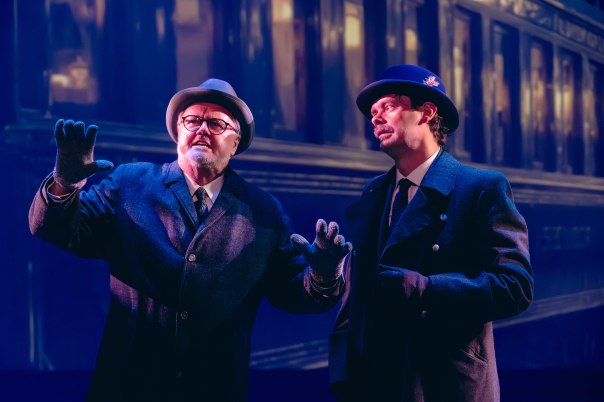
Ludwig admirably singles out our obnoxious victim-to-be and all the antagonisms he can spark while introducing us to Christie’s heroic protagonists, Constantine Bouc, owner of the Orient Express line, and peerless detective Hercule Poirot. There will be debate about Bloede’s decision to shitcan Poirot’s mustache wax and twirls in favor of a more conventional groom, but Brandon Samples’ initial entrance as the Belgian is star quality.

There’s a bit of aristocracy to Samples’ bearing that allows Poirot to fit in with his fellow passengers, including a princess, a countess, and a colonel. While Timothy Hager zestfully cements his repulsiveness as Samuel Ratchett, it’s also important for us to see that Poirot has sufficient dignity, discernment, and assets to reject Ratchett’s crass job offer.

Poirot also offers Samples a few brief episodes of befuddlement, for the culprit he is hunting leaves a blizzard of clues.

Unlike all of those complacent Perry Mason victims destined for the morgue and a court-ordered autopsy, Ratchett is keenly aware that he is being hunted. He’s willing to retain Poirot for a fabulous amount of money to protect him. Perry, you’ll remember, doesn’t arrive on the scene until after the wrong suspect is accused and arraigned. Here, Poirot is directly involved while the victim is alive. So when Samples shows no guilt or remorse for not accepting Ratchett’s offer after he is murdered, we’ll need further reasons for despising the playboy.

Christie piles them on and, in doing so, makes the bizarre solution to her mystery more plausible, for Ratchett is far more monstrous than he first seems to be.

Yet the elegance, hauteur, and glamor of the leading ladies would seem to instantly eliminate them from suspicion – or any close acquaintance with the vulgar victim. To think that Paula Baldwin as the Russian Princess Dragomiroff would deign to inflict eight stab wounds on the repellent Ratchett seems like sacrilege.

Likewise, Julia Howard as the serene and mysterious Countess Helena Andrenyi from Hungary seems worlds away from the slain playboy. The ethereal Gretchen McGinty as English governess Mary Debenham, also a smashing beauty, seems to live in an entirely different sphere, more involved with Scottish Colonel Arbuthnot (Ben Allen with a brash brogue) than the slain American.

As for Kathryn Stamas, as an esteemed actress traveling under the assumed name of Helen Hubbard, she is sufficiently brash, loudmouthed, and inconsiderate for us to worry whether Ratchett, trying to get some sleep next door and stewing with rage, will burst into her room and murder her. Murdering him would ruin her delight in riling him with her late-night singing.

However laudable it might be to murder Ratchett, three acts of God will prevent the ghoulish plan from eluding discovery: the unexpected arrival on board of legendary unraveller Hercule Poirot, the serendipitous intervention of Orient Express owner Constantine Bouc in securing a first-class compartment for Poirot, adjacent to the victim’s room. After these pieces are in place, with Bouc ready to serve as Poirot’s loyal sidekick, comes the fortuitous storm that halts the regal train in a snowbank out in the wilderness, giving Poirot sufficient time to investigate.

Bouc is obviously a key prong in Christie’s plotcraft, allowing Poirot to board the Orient Express and vesting him with the authority to investigate. Otherwise, our mustachioed sleuth wouldn’t be able to scan all our suspects’ passports or rummage through their luggage. Dramatically, he enables Poirot to interview all the suspects, another ritual of the mystery genre, corresponding to Perry Mason cross-examinations, that cries out for swift pacing.

The venerable Dennis Delamar would seem ideal for bestowing the requisite bonhomie on our gracious host and eager sidekick, except… for all his wholesome triumphs as Henry Higgins, Grandpa Vanderhoff, Kris Kringle, John Adams, Hucklebee, Jacob the Patriarch, and many more, has he ever done a French accent before? Maybe that was the question Delamar was asking himself on opening night when he uncharacteristically stumbled over a few of his opening lines.

Even for a semi-pro like me, those are lines you should be able to say in your sleep. Of course, Double D never broke character during his difficulties, so to neophytes in the audience, it may have seemed like the garrulous pensioner was stumbling over his English. Delamar’s imperturbability in this brief crisis only made Bouc more charming when he righted himself – and real panic was safely in reserve when the unsolved murder, right under his nose, threatened the image and prestige of his company.

Bouc also serves as a buffer between Poirot and the petty annoyances presented by our suspects, allowing Delamar to display his comedic chops. Samples, on the other hand, gets to revel in flipping over innocent façade after innocent façade in revealing the secret underbellies of his artful gallery of suspects. The parade of skeletons emerging from closets can’t help but add to our merriment.

So most of the actors on stage need to be adept not only in erecting their respective façades, but also in carrying off those deliciously satisfying moments when they are so disconcertingly exposed. Joshua Brand as Ratchett’s querulous secretary seems particularly innocent and above suspicion, while Emma Brand as the Princess’s trembling missionary ward is even further above. So pleasant when they fall.

Climb aboard this fatal train, and you’re likely to find the ride more fun than you expect.

Lady Bracknell Weathers Three Storms

Reviews of The Importance of Being Earnest and The Miraculous Journey of Edward Tulane

Jon Ecklund (John Worthing) and Lance Beilstein (Algernon Moncrieff) in The Importance of Being Earnest.

They were planning to open The Importance of Being Earnest on January 22 at Theatre Charlotte, where Oscar Wilde’s “Trivial Comedy for Serious People” hadn’t played since 2002. But the snow and sleet that were icing the roads hadn’t begun to melt away on the following evening, so opening night was transformed into an opening Sunday matinee. Even if I had been able to scale my icebound driveway, I was already booked for the opera at Belk Theater.

After all the reshuffling on my iCal, my wife Sue and I were finally able to catch up with Wilde’s menagerie of smart alecks at the second Sunday matinee, nine days after the originally scheduled opening. With so many other reshufflers in the crowd, the Queens Road barn was close to capacity. An extra performance has been slated for 2:30 this Saturday to help out other migrants.

The airy sophistication of Joshua Webb’s set design boded well for the blizzard of bon mots to come, but who were these Ernests opening up the action, Lance Beilstein as the roguish Algernon Moncrieff and Jon Ecklund as the deceitful John Worthing? Beilstein had briefly blipped on my radar last year when he was cast in a stage adaptation of Casablanca that didn’t happen. and Ecklund had never performed on a Charlotte stage before nailing his audition as Wilde’s protagonist.

Yet they instantly established a fine rapport, hinting early on that Algy and Ernest — as John calls himself in London — were not only great friends but kindred spirits.

There was a problem, however, even before the divine ladies arrived. Though their chemistry was sparkling, Beilstein’s cue pickup was razor sharp while Ecklund’s was erratic. Not a symptom you would expect from your lead at the end of your second week.

Ecklund’s symptoms became more serious during the scene change between Acts 2 and 3. In fact, he was taken to the hospital, reportedly suffering from dizziness, and didn’t reappear.

Johnny Hohenstein, who plays John’s butler at his country home, bravely substituted for Ecklund during the final 19 minutes, script in hand. That forced the imperious Lady Bracknell to announce herself when she triumphantly reappeared.

The waters were already troubled in Act 1 when Jill Bloede, amply bustled in a floor-length dress, first floated in like a majestic tugboat as Her Ladyship. It was she and she alone who must approve of Ernest as the prospective husband of Algy’s cousin, Miss Gwendolen Fairfax — a grim prospect, since her wicked nephew has already devoured all the cucumber sandwiches.

Lady B attempts to be judicious. Ernest’s income of seven to eight thousand pounds, the equivalent of $1 million annually according to the Norton Edition of the text, actually counts in his favor.

It’s Ernest’s lineage that is an insuperable stumbling block, for he cannot trace his family any further back than a leather handbag! My, how Bloede huffs when she repeats that fatal word, nearly adding an extra syllable to it each time she lingers on the first letter.

Lady Bracknell’s contempt was so hilariously absolute that when she exited, leaving Ernest and Gwendolen’s hopes of marital bliss in shambles, the audience erupted in lusty applause.

By the sort of insane coincidence that Wilde uses to resolve Ernest’s difficulties, Bloede’s name rhymes with Lady. So, after her current triumph, Jill is no more: she will no doubt have to suffer being called Bloede Bracknell for the rest of her days. You may revise my headline accordingly.

Needless to say, Bloede’s arrival calmed any worries that this production, directed by Tonya Bludsworth, would be anything less than a delight. Eleven years after starring in NC Shakespeare’s Twelfth Night, Gretchen McGinty’s professionalism still gleams with vitality and caprice as Gwendolen, irresistible despite her perverse silliness. She accepts Ernest, but only for the shallowest of reasons — she’s the perfect antithesis of Juliet.

Caprice continues to rule when we arrive at John’s country home for Act 2, where we meet his lovely ward, Cicely Cardew. Her requirements for a prospective husband are not merely similar to Gwen’s.

They are exactly the same, obliging both John and Algy to make christening appointments with the Rev. Canon Chasuble. Under the watchful eyes of Cicely’s governess, Miss Prism, Algernon has snuck into John’s home, pretending to be his fictitious brother Ernest, and swept Miss Cardew off her feet. That’s partly because Miss Prism’s eyes are devotedly affixed to the Reverend.

As we’ll learn in the denouement, it’s not the first time Miss Prism’s attention has wandered.

Further complicating John and Algy’s attempts to live double lives, Gwen follows her would-be fiancé into the country — with her mother barking at her heels. The running joke of Act 2, amid all the confusion of who’s really betrothed to Ernest, is the radical shifts of sisterly love and murderous hatred between Gwen and Cicely.

Mixed in with devout cynicism and decadence, punctiliousness and pomposity squandered over trivialities are the key ingredients of Wilde’s satire, and Bludsworth has her entire cast embracing it with the proper élan.

Emily Klingman is hormone-driven innocence in a lemon chiffon dress as Cicely, assiduously transcribing Algy’s marriage proposal into her teen diary, and Hank West bumbles quite sanctimoniously as Rev. Chasuble when he manages to recall where he is. Scrunched up like a squirrel, Stephanie DiPaolo is the essence of fretful and incompetent spinsterhood as Miss Prism.

Bludsworth also differentiates nicely between the servants. Ron Turek is urbane and dignified as Algy’s man, Lane; while Hohenstein, tasked to distraction by his temperamental superiors, is more apt to let his resentments play over his face as John’s butler, Merriman. Or he was until he was obliged to pick up Ecklund’s script and stand up to Bloede Bracknell.

Edward Tulane(C)Donna Bise 6686

Photo by Donna Bise

Not at all plagued by postponements, The Miraculous Journey of Edward Tulane opened at ImaginOn last weekend in as polished a production as you’ll ever see from Children’s Theatre. It’s a gem that will no doubt remind longtime subscribers of The Velveteen Rabbit, since the title character is a rabbit doll. Ah, but Edward is fashioned entirely of porcelain, except for his furry ears and tail (he prefers not to think about the origin of his whiskers).

Adapted by Dwayne Hartford from the novel by Kate DiCamillio, Edward’s story begins when he is given to 10-year-old Abilene Tulane on Egypt Street by her mysterious grandmother Pellegrina, the only human who knows his heart.

Unlike the Velveteen, Edward does not aspire to be real or human, but he is frustrated when Abilene doesn’t set him in a place where he can see the outdoors and the stars through her window.

Even before he is severely broken many years later in Memphis, Pellegrina perceives his flaws, and the inference is that he must suffer for them. But Edward’s sufferings and adventures will be epic ­— beyond human, to tell the truth.

Our protagonist remains the three-foot doll the DiCamillio created, but Mark Sutton is always close by to articulate his thoughts, shouldering and picking a banjo as Edward morphs into Susannahr, Malone, Clyde, and Jangles during his odyssey on land and under the sea.

Margaret Dalton figures most prominently as the bereft Abilene, but she resurfaces on numerous occasions during Edward’s journey, most notably as a frisky dog. Beginning as the semi-exotic Pellegrina, Allison Rhinehart ranges across multiple roles and genders, last seen as Lucius Clark, the sagely doll mender. Devin Clark rounds out the cast, shapeshifting from fisherman to hobo to handyman when he isn’t slyly inserting sound effects. Pure enchantment for 81 minutes.