Tag Archives: Emmanuel Barbe

Free Reign Presents a Trim and Syndicated “Tempest”

Review: The Tempest at The Gettys Center

By Perry Tannenbaum
 

Rarely mentioned among Shakespeare’s best comedies, let alone among his best works, The Tempest maintains an enviable popularity within the Bard’s celebrated canon. The current Free Reign Theatre presentation at the The Gettys Center in Rock Hill marks the seventh local production to appear in the Charlotte metro within the past two decades – Actors from the London Stage visited with an eighth in 2011 at UNC Charlotte.

Upstairs in the Getty courtroom turns out to be a perfect backdrop for this masterwork of measured retribution. In the misty annals of Shakespearean scholarship and criticism, The Tempest has often been singled out as the Bard’s final and most perfect work. More important to most theatergoers are the notions that Shakespeare places himself in the role of Prospero and that Prospero’s renunciation of the magic arts is the playwright’s farewell to theatre at the same time.

Under the direction of David Hensley, with costumes by Gina Brafford, it often looks like the retiring Bard had a notion to syndicate his valedictory work as an ancestor of Gilligan’s Island. Though Prospero was presumably shipwrecked in the Aegean or the Mediterranean, his most distinguished guest, King Alonso of Naples, seems to be outfitted with hand-me-downs that Gilligan or The Captain will don centuries later.

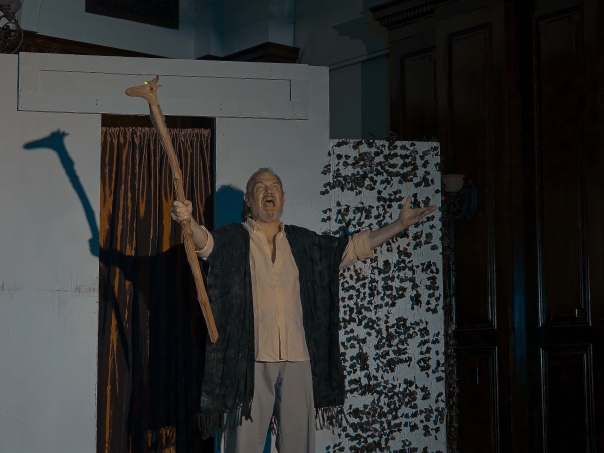
Not the first to impress upon his audience that Prospero is the main architect of the action that ensues on his tropic isle, Hensley has his protagonist, played by Russell Rowe, waving a magical illuminated staff to summon up the mighty winds, rains, and seas. Now we can adjourn to Shakespeare’s opening scene as a panicking Master and Boatswain stand on a ship’s deck trying to right their way in this tempest with a ridiculously puny captain’s wheel.

Prospero’s power on his island is vast, for he holds the fairy Ariel and the deformed monster Caliban as his slaves. Since all the action we see follows Prospero’s basic design, it’s not too outlandish for Victor Hugo to have claimed that through Caliban, Prospero rules over matter, and through Ariel, over the spirit. His sovereignty certainly extends beyond his island to the seas he sets in turmoil.

With Ariel’s help, Prospero can separate the arrivals of the servants from the shipwrecked seamen and the corrupt nobility of Naples and Milan from Prospero’s chosen heir, the virtuous Prince Ferdinand of Naples. He plans to match Ferdinand with his daughter, Miranda. On hand to help Ariel keep Prospero’s fugal design flowing smoothly are Juno, Ceres, Iris, and numerous other nymphs and spirits.

But omniscience is far from Prospero’s grasp, so Shakespeare can artfully engage us with wisps of drama and suspense. Prospero cannot be sure that Miranda and Prince Ferdinand will take to one another. Furthermore, Prospero must be on guard against Ariel and Caliban, both of whom chafe under his dominion – respectively capable of escape and rebellion.

Watch carefully, and you’ll notice how Shakespeare flips these prospects for suspense and drama into comedy.

Armed with Prospero’s vatic powers and steeled with the usurped Duke’s determination to restore rightful rule in distant Milan and Naples, Russell Rowe is slightly above the action, never clownish or fully mundane. He participates in the romantic comedy by scheming to inflame Miranda’s ardor for Ferdinand by subjecting the Prince to the humiliations of enchantment and daylong labor.

Smitten by each other almost as soon they meet, Hannah Atkinson as Miranda and KJ Adams as Ferdinand convincingly demonstrate the needlessness of Prospero’s stratagems – Ferdinand is promising to make Miranda the Queen of Naples less than 75 lines after he first appears. To be frank, the old magician, for all his learning and wisdom, has nearly forgotten his own youth. So the joke in also on him! Of course, it does take a little imagination to conjure up a virginal 15-year-old who has never seen any other man than her aging father and the “mooncalf” Caliban. As a result, Atkinson gets more unique traits to distinguish herself with.
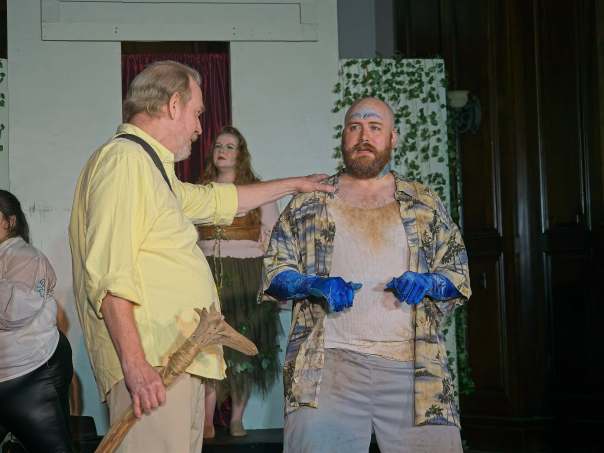
With Caliban, played by the versatile Robert Brafford, Prospero can take a more laid-back and confident attitude, relying on the weird mutant to make a fool of himself in his rebellion. Latching on with his blue paws to Bronte Anelli as the drunken jester Trinculo and Spirit Craig as the marginally more sober butler Stephano – and mooching an occasional gulp from their ample bottle of booze – Brafford wastes no opportunity to subtly reassure us that, despite his mighty grievances, Caliban is foredoomed to failure.

Ariel, the vivacious Rebecca Viscioni, does confound the help, pulling out an invisible voice imitation shtick that, to my mind, James Barrie poaches in Peter Pan. Regardless, it is curious to note that both Ariel and Peter were written for men and usually played by women.

The “airy spirit” has more urgent places to intervene after wrecking the ship and sorting its survivors. Chiefly, she is needed – seemingly more than Prospero knows – to keep things flowing properly among the shipwrecked royals. Complacent on his throne, which is now reduced to a collapsing chair with cupholders, Nathan Stowe as King Alonso seems blissfully unaware of the treachery up in Milan. Stowe’s discomfort and disorientation in Shakespearean pentameters adds a light patina of comedy to Alonso and helps us to believe that he’s oblivious to the lurking threat in his own family.
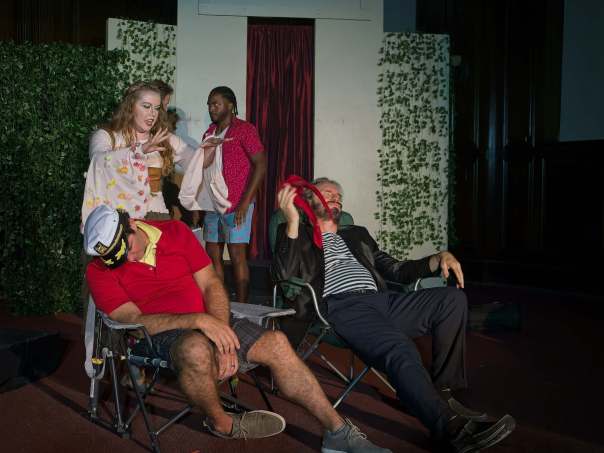
Adding very little to the comical aura of Alonso’s complacency, Ross Chandler as the King’s brother needs a bit of cajoling from Antonio, the usurping Duke of Milan, to act on his designs on the Neapolitan throne. Fortunately, David Eil has a superabundance of shiftiness and malignity, enough malignity to be noticed not only by Alonso but by every citizen from Naples to Milan. Or by satellite.

Also on board the foundering ship, fortunately enough, is Emmanuel Barbe as a rather slick Gonzalo – former councilor in service of Prospero, who supplied the usurped Duke with necessary provisions, plus the cream of his precious library, when Antonio cast him off to sea 12 years earlier. Rejoining him onshore, we see that Gonzalo now serves King Alonso, so Gonzalo is now ironically saving his own life as well as his monarch’s with those mystic books.

For Sebastian and the never-sated Antonio mean to slay them both, not with ancient sword blades drawn from waterlogged hilts but with a 9-iron and a wedge extracted from a golf bag, a bit more slapstick. Bludgeoning rather than stabbing or beheading seems to be the plan and we are in some suspense – less with golf clubs than with drawn swords – as to whether Prospero has foreseen this impromptu assassination plot.
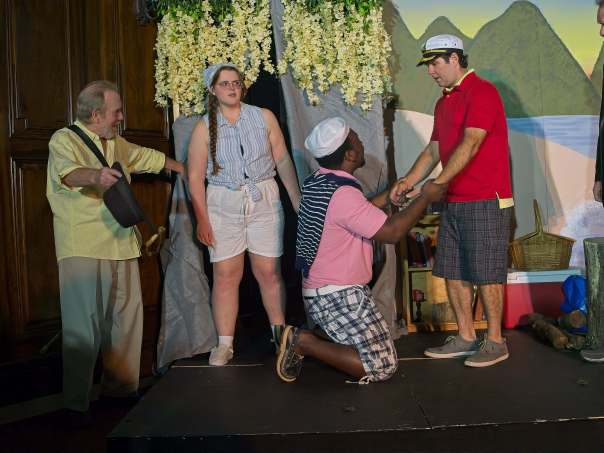
There is one whispering considerably earlier between the rightful Duke and Ariel in the unusually detailed stage directions, so if we’ve remembered that brief moment, there’s hope that help is on the way for the feckless King and Prospero’s loyal benefactor. But as those swords/clubs are held high over the sleeping heads of Alonso and Gonzalo, suspense mounts, thanks chiefly to Eil. So if Prospero doesn’t have the smarts to anticipate what’s happening, we must trust his Ariel to save the day.

The oft-hailed perfection of The Tempest is two-fold: aside from artistic perfection acclaimed by critics, it is also Shakespeare’s most perfectly preserved script, the lead-off play in the famed 1623 First Folio collection of 36 plays, meticulously edited by the Bard’s fellow actors, Philip Heminges and Henry Condell. Hence the unusual profusion of stage directions when you encounter the text.

Hensley and his cast do a fine job in making those generous stage directions disposable, and his careful cuts in the script, though occasionally robbing us of its full lyric pleasures, are laudably protective toward the multiple storylines. Having seen The Tempest five times before and having read/studied it more than once, I’m not bowled over by the blizzard. My worries are for those plunging into The Tempest for the first time. That little prelude with Prospero is helpful, but quite a deluge of entrances ensues.

So it was disappointing not to find any roles named in the printed program on opening night, only the alphabetized names of the actors. Clicking on the QR code is helpful, pairing faces with their roles, but again in alphabetical order – without the helpful capsule descriptions Shakespeare provided. Those would be valuable at intermission for newcomers who might still be struggling to sort out Alonso, Antonio, Sebastian, Gonzalo, and their positions at court.

Fortunately, the residents of this prehistoric Neverland or Gilligan’s Island are instantly differentiated, thanks to Gina Brafford’s florid costume designs – beginning with Atkinson wholesome Oklahoma farmgirl look as Miranda. Hard to say which is more outré, the winged Viscioni evoking the gladrags of the ‘60s or Robert Brafford as Caliban, looking like he’d been freshly belched from the belly of a whale.

Maybe the flowery Ariel outfit should get the nod because she’s so sassy and blithe all evening long. So: Calling on Hensley to give Viscioni a sassier final exit. She deserves it no less than Rowe, who asks for it in the touching Epilogue.

Free Reign’s “Saint Joan” Handsomely Shaves a Shavian Tragedy

Review: George Bernard Shaw’s Saint Joan

By Perry Tannenbaum

Saint Joan at Duke Energy in Charlott

Didacticism and verbosity are probably the chief reasons why George Bernard Shaw has fallen out of favor, even if those charges are often overblown and undeserved. The Anglo-Irish playwright’s works, faithfully presented each summer in rotation at the Shaw Festival in beautiful Niagara-on-the-Lake up in Ontario, can seem musty and intimidating compared to today’s snappy sitcom dialogue or yesteryear’s sleek Oscar Wilde epigrams.

Of course, the more didactic and verbose a GBS play might be, the less a director might feel she or he can reshape it. So there’s often a backstage disinclination to wrestle with Shaw’s once-revered scripts that conspires with the audience fear factor.

Maybe that explains why the last two Shaw productions I’ve seen, nearly five years apart, have both been Saint Joan. My first live encounter with Shaw’s only tragedy was at the Lynn Redgrave Theatre in New York in a lively Bedlam Theatre production. Almost instantly, I could see that this is one play where the playwright has loosened his tight grip on his stage characters. Here the story has a grip on him, and even before I found it confirmed in his humongous preface (more than half the size of the play), it was obvious that he not only deeply researched the exploits of Joan of Arc, but he had also meticulously studied the transcripts of her witchcraft trial.

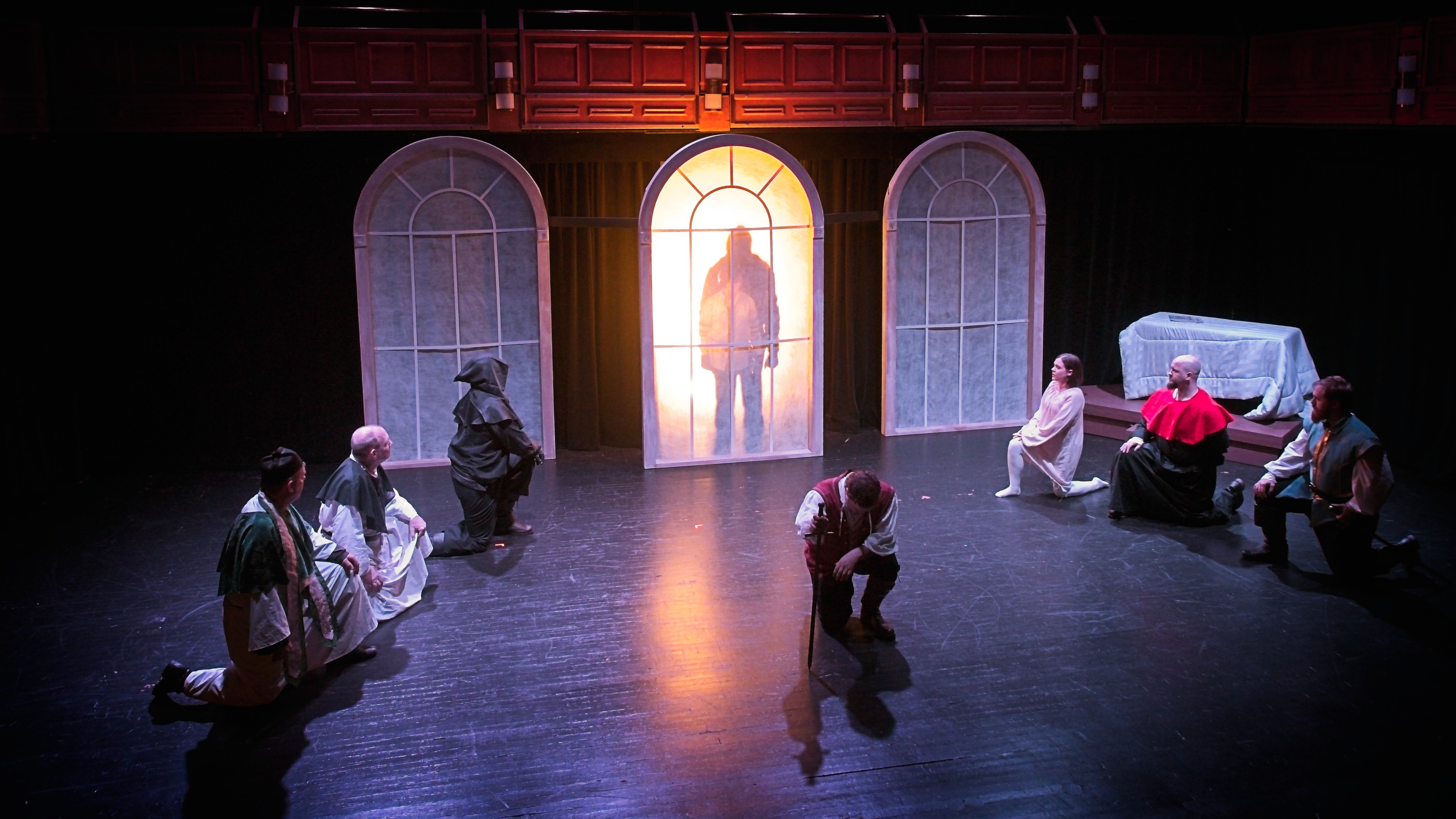
Saint Joan at Duke Energy in CharlottActor/director Eric Tucker and his Bedlam cast had a field day with the script, divvying up 25 roles among four actors. Shaw’s contention that there was no villain in the Maid of Orleans’ undoing came through vividly in an evening that mixed some fun into the high seriousness – but the evening was three hours long, hardly making a dent in GBS’s notorious loquacity. The new Free Reign Theatre production, currently at Spirit Square, brings Saint Joan more fully into the realm of accessibility. Director David Hensley noticeably shaves the Shavian discourse, and company founder Charles Holmes has free rein to ply his fight directing craft. Multiple episodes of spirited swordplay are sprinkled amid the wordplay.
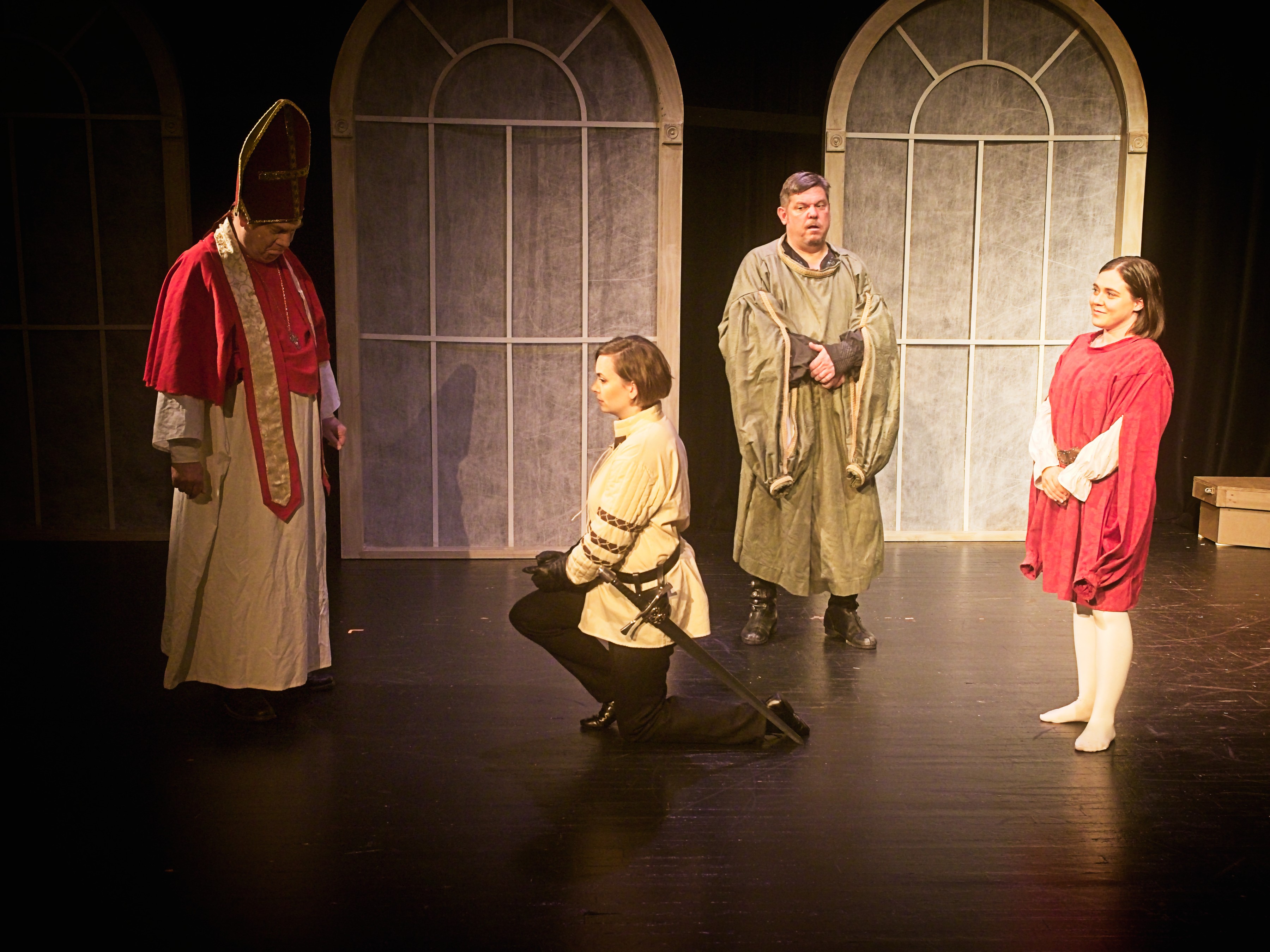
Hensley deploys four times as many actors on the drama, allowing it to breathe more naturally than Bedlam’s insane reduction, where one of the actors might actually change roles mid-sentence and reply to himself. A more benign form of such absurdity persists with Free Reign, where the same French faces we saw opposing and abetting Joan’s miraculous rise to military leadership suddenly transform into her enemies in the angry and confounded English camp.

In a role that has been mainly populated by the great dames of theatre history rather than precocious teens, Amy Cheek makes an amazing splash the first time I’ve seen her in Charlotte. There were times, over the course of the evening, a relatively svelte 2:15 at Duke Energy Theater, when I felt that her excellence was all that was necessary. There is, as her elders say repeatedly, something about her – an ardent belief that infuses a Peter Pan cocksureness yet never crosses over into presumptuous arrogance.Saint Joan at Duke Energy in Charlotte

At times, the light radiating from within, kindled for Joan by the voices of the warrior archangel Michael and Saints Margaret and Catherine, made me believe Cheek was the ideal age for this role. Predecessors have included the likes of Uta Hagen, Katharine Cornell, Sybil Thorndike, Judi Dench, and the aforementioned Redgrave.

It tickled me that most of the other Free Reign players did so well – and that Hensley decreed that they aren’t all men. Five women flit through this surprisingly nimble evening. Particularly delightful was the idea of having the pert and diminutive Alexandria Creech portraying the timorous Dauphin, the future King Charles VII of France. The holy coronation at Rheims Cathedral can only happen if Joan can prod him into standing up for himself and forcefully claiming his rightful throne. With Russell Rowe thundering as the Archbishop of Rheims, Holmes glowering as military commander-in-chief Monseigneur de la Trémouille, and both of them towering over Creech, chances for an upswell of valor from the Dauphin look slim.

Saint Joan at Duke Energy in CharlottCreech can not only hide behind her courtiers when the Dauphin stages his first audience with Joan, she can nearly disappear. But Cheek also towers over this Dauphin – a little bit – so it’s a nifty tug of war for the future king’s favor. Holmes retains his bellicosity when he briefly appears at the English encampment as the Black Prince, but he becomes slightly more sympathetic at the trial as Peter Cauchon, somewhat doubtful that La Pucelle is a witch but absolutely certain that she is the worst of heretics.
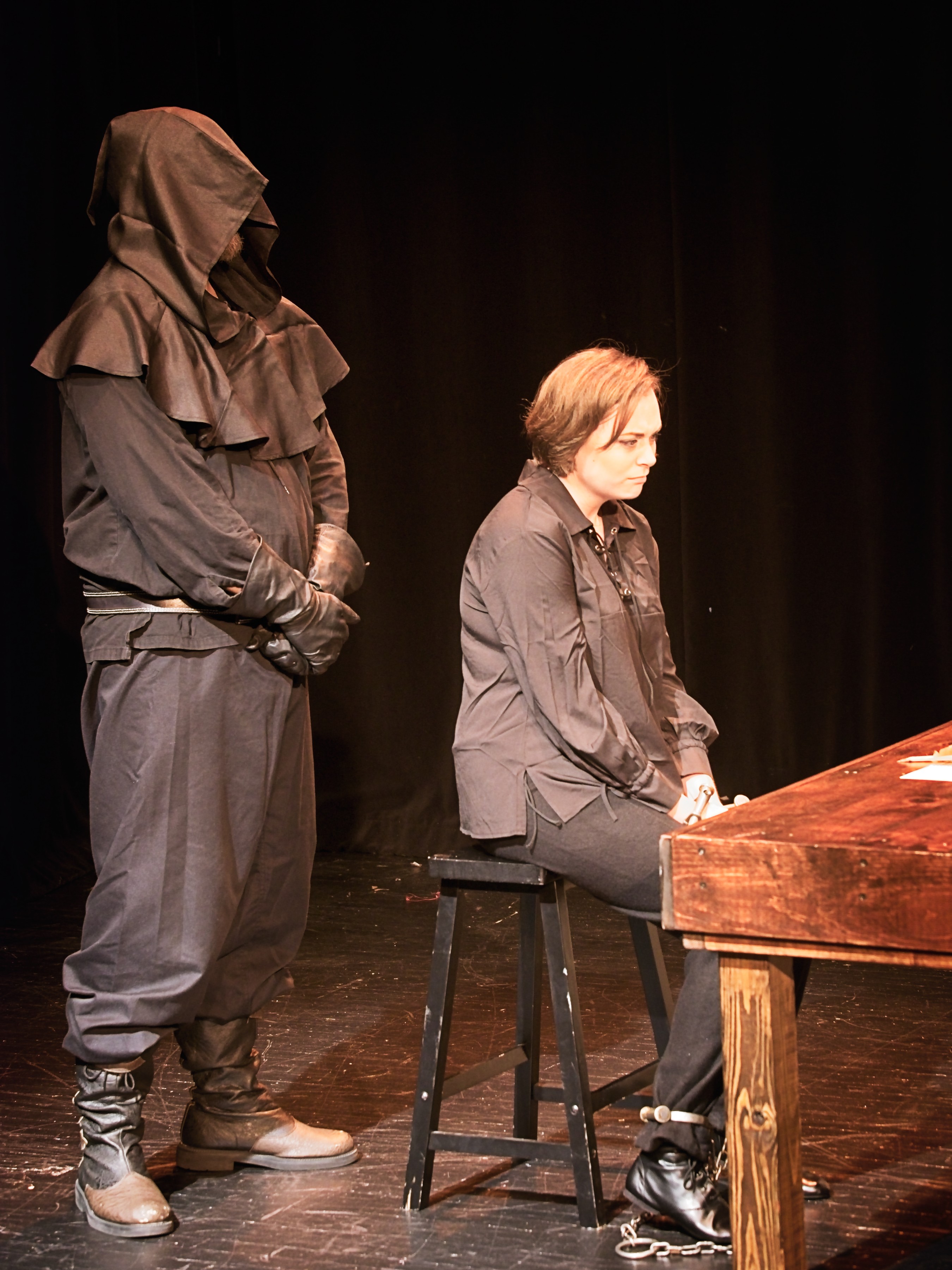
Rowe follows a more interesting arc when he changes into an Englishman, becoming the implacable and somewhat stupid Chaplain John de Stogumber, who believes so rabidly in Joan’s witchery that it’s alarming. At the trial, he appears to be a mashup of the Chaplain and the Canon de Courcelles, who zealously brings over 60 charges against The Maid to the bench. Stogumber seethes mightily when Cauchon trims those charges to a mere 12, violently advocating that Joan be burnt at the stake – until he actually sees her on fire. He was so shaken and chastened by the spectacle that I almost pitied him, a truly wrenching turnaround.Saint Joan at Duke Energy in Charlotte

The Maid attracts believers and followers along the way, of course, and the most impressive of these are the hulking David Hayes as Bertrand de Poulengey, Joan’s first champion, and Robert Brafford as the wily renegade Dunois, who shrewdly sizes up her military acumen. Hayes resurfaces at La Pucelle’s side in the pivotal battle scenes before drawing a fearsome, taciturn role as her Executioner. Brafford sheds his good heartedness but retains his craftiness when he becomes The Earl of Warwick. The coolest of Joan’s enemies, Warwick is willing to offer a bounty to anyone who betrays The Maid – not the most dramatic thrust in Shaw’s script, so I suspect the suave and calculating Brafford was the most victimized by cuts to the script.

Every now and then, as in Boeing Boeing, we get the treat of seeing Emmanuel Barbe in a French role. As Robert de Baudricourt, the first nobleman to be won over by Joan’s eloquence and spunk, Barbe helps to get things off to a flavorful start. By the end of the first scene and its exhilarating little coda – and miracle! – this Free Reign production had already captivated me. As Shaw well knew, Joan’s story has that power.


Actor’s Gym Unearths a Gem in “Fallen Angels”

Review: Fallen Angels

By Perry Tannenbaum

When a playwright puts the finishing touches on his or her latest comedy, it’s without any knowledge about how prevailing attitudes and expectations might change out in the audience over the next 93 years. No playwright has ever had the chance to look back that far, and that includes Noël Coward, whose Fallen Angels is playing at Duke Energy Theater in an Actor’s Gym production directed by Tony Wright.

Knowing Noël, I’d say he’d either gasp or laugh out loud. Opportunity knocks for Coward’s protagonists, Julia Sterroll and Jane Banbury, when their husbands head off on a golfing weekend just when an old flame of both ladies, Maurice Duclos, sends them billet-doux saying that he’ll be arriving back in London after an absence of many years –so many years that the husbands, Fred and Willy, have no idea of who Maurice is nor any knowledge of his torrid affairs with their wives.

After Fred’s departure, Julia is momentarily left alone with her new smarty-pants maid, Saunders. That’s when Jane arrives at the Sterrolls’, all aflutter with the news. Julia, who was just a few minutes earlier discussing with Fred exactly how much fire was left in their mellowing marriage, hadn’t yet read her note from Maurice. It quickly becomes evident, as the women discuss Maurice, that those flames still burn brightly, perhaps more brightly than ever. They’re a little scared.What will they do when he arrives?

Their first impulse is exactly what an audience would expect – in 1925: to flee as quickly as they can to protect their honor, which presumably cannot withstand Maurice’s irresistible charms. A mere 35 years after Oscar Wilde had declared, “The only way to get rid of temptation is to yield to it,” such an outlook was still wicked, irresponsible, and risqué.

Nowadays, coaxed by Madison Avenue, amoral leaders, social media, and longstanding American traditions of fierce individuality, we find ourselves – regardless of gender – inwardly urging Julia and Jane, Go for it! Whereas we’re taken aback in 2018 by the ladies’ knee-jerk-prissiness, their eventual decision to stay and face Maurice was immoral enough to give London’s censors pause before allowing Fallen Angels to be performed.

Once Julia and Jane have opted for what we perceive as the road-more-taken, you might expect that attitude adjustment becomes far less necessary. Yet in more subtle ways, the presumption of wickedness works its way deeply to the bones of Coward’s comedy. Instead of building his comedy upon Julia and Jane’s rekindled romances – and their wacky or delicious maneuverings to keep their husbands in the dark – we find an unexpected amount of time devoted to maintaining their wicked resolve. Here our complications arise from the women’s resorting to martinis and champagne to sustain their courage during their excited vigil.

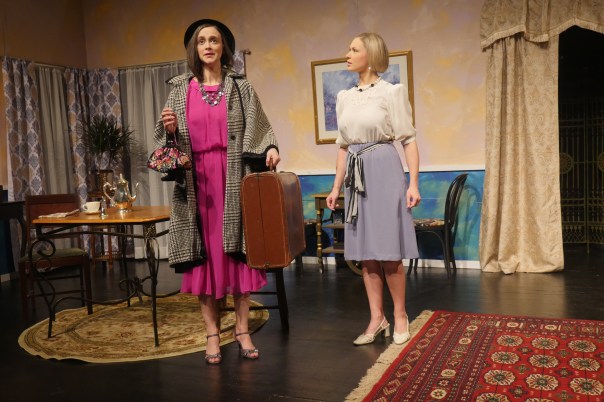
So it’s helpful that Tony Wright and his design team keep reminding us that the people onstage are living indifferent times. While Tim Baxter-Ferguson’s set design isn’t the ultimate in elegance, the requirements of a British drawing room are met, including a baby grand where Saunders will upstage Julia. Davita Galloway’s costumes, particularly the flapper-flavored outfits for the partying ladies as they sip their martinis, stamp the era most decisively.

The women must dominate this comedy,and Wright has found a marvelously varied trio. Originally played by Tallulah Bankhead, Julia is the formidable serenity that is serially agitated by Saunders, Jane, and Maurice to comical effect. Jennifer Barnette takes that serenity to a loftier, more angelic plane, slightly muting her discomfiture and giving more space for the eccentricities of Saunders and Jane to shine. Karina Caporino pounces on her opportunity as Jane with frenetic energy, more brittle and midlife than we’ve ever seen her, which easily makes Jane the most screwball of her trademark neurotics.

Erin Darcy as Saunders is possibly the most vivid period trimming in this whole confection, a servant who is more knowledgeable, widely traveled, and skilled than the mistress she serves, aware of her superiority and maybe a little bit haughty about it. Saunders’ sophistication lays bare the delusion that the Sterrolls or the Banburys are living lives of consequence. Perhaps it’s Darcy’s aplomb at the piano that gives Barnette her best episode of humiliation.

In this context, Emmanuel Barbe is a perfect choice as Maurice. He is suave and self-assured, with a savoir-fair that is unmistakably French, yet he doesn’t quite have the polish and youth that would make knees buckle in high society. Barbe’s down-market elegance is still more than enough to make David Hensley as Fred and Michael Anderson as Willy seem gullible, dimwitted, and humdrum. Hensley as Fred seems to be the sort who feels like he’s fulfilling his destiny by opening a newspaper at the breakfast table, while Anderson, once he reconciles with Fred and Jane, gives Willy exactly the smiling insouciance that Wright wants for his ending.

I have to go back to 2005 and The Tempest to find the last Actor’s Gym production I reviewed. It’s great to have Wright and his Gym back on the scene, especially when the Gym unearths a gem like this.


Albee’s Fantastic Day at the Beach

Theatre Review: Seascape

varwwwclientsclient1web2tmpphpoon8uj.jpg

By Perry Tannenbaum

Citizens of the Universe hasn’t announced the full details of its farewell season, but it has begun handsomely at “The Shell,” COTU founder James Cartee’s name for the suite on 2424 N. Davidson St. that CAST occupied in its latter days. The theater spaces where CAST often staged two productions at the same time have both been obliterated, stripped down to the original floors and walls, but the residue proves unexpectedly appropriate as a vast, bleak setting for Edward Albee’s Seascape, directed by S. Wilson Lee.

For awhile, the drama seems to revolve around Nancy and Charlie, a mid-life couple who bicker somewhat lethargically – compared with the titanic battles Albee staged between George and Martha in Who’s Afraid of Virginia Woolf? – about what they should do now and in the future. The weak grip this opening had on my attention was further weakened by Kylene T. Edson as Nancy, indistinctly audible when projecting her gripes over across the beach to her husband diagonally downstage. Lee would be advised to either energize Edson during these opening moments or bring her downstage more often.

Luckily, these difficulties evaporate when two ginormous lizards crawl ashore, frightening the humans as they scope them out. Since the sea is upstage, fright not only raises Edson’s energy level, it also drives her naturally toward us where she can be easily heard. Wariness is well-advised, but the lizards, Leslie and Sarah, aren’t foraging for food so much as they are reconnoitering the possibilities of life on land.

Amazingly, Leslie and Sarah speak English, if only the rudimentary kind you would expect from high school freshmen matriculating in Lancaster or Cabarrus County. There’s a lot for Nancy and Charlie to catch the reptiles up on, including the origin of the universe, the primordial soup, evolution, mammals, and the whole concept of emotions, beginning and ending with love. Shuttling between the urge to educate and the impulse to flee in terror, Nancy and Charlie might identify more with teachers in urban school districts.

The spark for this intriguing production comes largely from the extraordinary work Lee elicits from Emmanuel Barbe as Leslie, abetted by the phosphorescent glow of Kenya Davis’s makeup design. I’ve often struggled to penetrate through Barbee’s French accent when he battled against the Bard’s blank verse in Shakespeare Carolina productions. But here he is admirably slowed down by Lee – and often formidably booming. The physicality of him can be menacing enough as he advances toward you, but you really don’t want to broach the possibility that his species might lose their mighty tails during the next billion or so years of evolution. He’s attached to that tail.

By comparison, Brianna Merkel is a cute counterpart for Barbe as Sarah, as adorably clueless when she doesn’t understand concepts – matrimony, pregnancy, the list goes on – as Leslie is frustrated and antagonistic. We see a certain bond forming between Sarah and Nancy, peacemakers trying to calm their mates’ warrior instincts, and it’s here that Edson’s performance begins to blossom.

Brian Amidai is more consistently reliable as Charlie, very adept at the inertia of a husband who doesn’t wish to travel or repeat past adventures. He’s on a beach and just wants to relax, dammit, maybe get lost in a book. But Amidai’s transition between this beach potato and an instinctual protector rings viscerally true, and there’s a faint layer of comedy in the moments when he thinks he’s gone insane or died. Obliquely, I found him cuing my own reactions as this wild, mysterious fantasy unfolded.