Tag Archives: Emily McCurdy

“Raisin” Remains an Aspirational Reminder

Review: A Raisin in the Sun at Matthews Playhouse

By Perry Tannenbaum
Did somebody just say something about FREE SPEECH?? Yeah, about a billion times per second if you’re tracking social media, college campuses, nation’s capitals, and late night TV. Still no theatre critic we know would dare suggest in today’s torrid media climate that the subject generates too much heat and too little light – or that babble about free speech serves as a black hole for time and breath better spent discussing other freedoms.

Addressing the US Congress in 1941, Franklin Delano Roosevelt looked forward to “a world founded on four essential freedoms.” Useful, breathtaking, and a better way to spend January 6 than a subsequent US President chose. When I was graduating junior high more than a half century ago, those four freedoms were still on the curriculum, and my entire class wrote essays about them.

For the record, I wrote about FDR’s Freedom #4, Freedom from Fear.

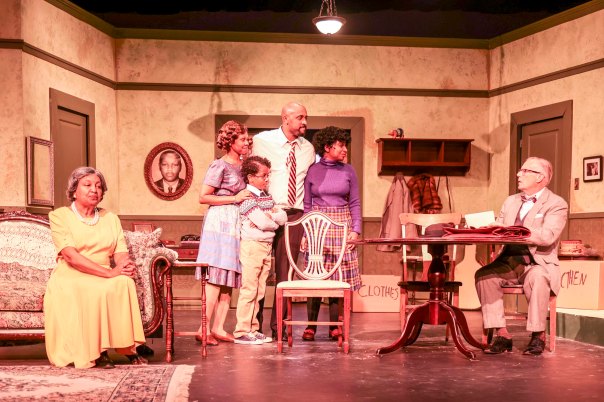
One of the things we love about Afro-American literature is that their writers show us that freedoms worth prizing are as numerous as personalities – that those dearest to us are an uphill struggle to achieve. In Lorraine Hansberry’s A Raisin in the Sun, returning to the Metrolina area for at least the sixth time this century, every member of the Younger family knows the struggle from the moment they rise in the morning.

Now some of these struggles are fairly picayune, giving a homey warmth to Hansberry’s various yearnings for freedom that we easily empathize with. Take little Travis (Solomon Doleman), for instance, yawning himself awake with his mom’s help for another school day. The youngest Younger doesn’t have a room or a bed of his own, sleeping right before our eyes on the living room couch as the lights go up.

Hell, he doesn’t even have a regular bedtime, since we’ll soon learn that he cannot claim his place on the couch until Dad has finished scheming and schmoozing with his ambitious pals. Walter Lee and his son Travis may both be sleep deprived due to the drinking and scheming of the previous evening, but their first challenge of the day requires teamwork.

Otherwise, they won’t be able to visit the toilet or groom themselves for the day. As if out in the wild, the family must post a lookout on the hallway, so that they can seize control of the single bathroom that serves multiple families in their Chicago tenement. Then this treasured privacy must be passed along to another member of the clan. Yes, it’s a bit comical to watch so much family tension generated over so little. Yet this is part of the layout of the Youngers’ survival.

FDR’s Freedom #2, Freedom from Want, is also in the foreground as the Youngers’ successful capture of the bathroom plays out as a backbeat in opening scene. Looking at the Youngers’ apartment for the first time at Matthews Playhouse, we find that director Corlis Hayes and set designer Bob Croghan have pulled back a little in rendering the wear and weariness we should be seeing if Hansberry’s description of the kitchen-dining-living room were followed to the letter. “Cracking walls”? Didn’t see them.

Throughout the evening, there’s a similar shift away from the groaning and wailing tones you might remember from the last time you saw Raisin. That suffering patina has been natural for Raisin since it premiered as the first drama by an African-American female playwright to reach Broadway in 1959. The weight of ancestors hung in the Ethel Barrymore Theatre on opening night, and the fate of the race seemed tethered to the audience’s response.

Likely, at the tender age of 29, Hansberry didn’t view her rise to prominence with such solemnity. The heritage of her family and its struggles, including her father’s fight against a restrictive Chicago housing covenant, are in the annals of the Supreme Court and resulted in a Hansberry v. Lee victory in 1940. As seething, cautionary, and defiant as Raisin often seems, we can look at all the Youngers and see them as positive, determined, and aspirational.

Her banner is Langston Hughes’s 1951 poem, “Harlem,” and its main subject, “a dream deferred.” Hughes offers half a dozen prognostications of what might happen to it. Next to sugaring over, drying like a raisin would seem to be the most benign outcome.
Walter Lee’s dream of opening a liquor shop can hardly be deferred for more than a day, when his mama Lena expects a $10,000 check from his late father’s life insurance. Before he even has his necktie on properly, Walter Lee is lobbying his wife Ruth to soften Lena up so he can calmly present his business plan to his god-fearing mama. Ruth has other concerns: on the surface, it’s feeding her guys breakfast and getting them out the door.

Deeper, and still hidden from everyone else, Ruth is also considering the future of her family from her perspective as a mother.
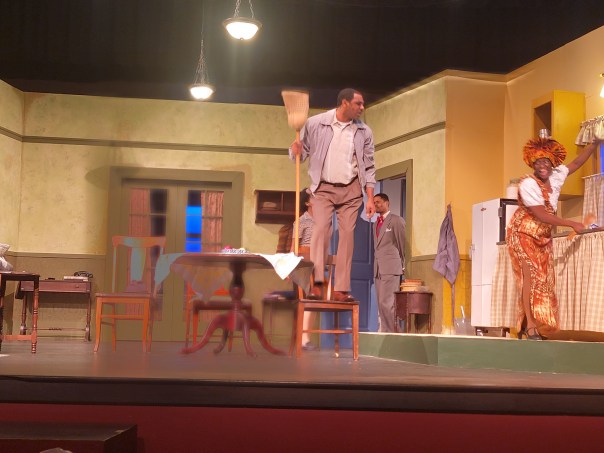
Ruth’s worries and dreams do not align with her husband’s at all – aside from wishing him success. Two other dreams vie for priority in the family. The comparatively breezy Beneatha wants to go to medical school. But not right now. First, Walter Lee’s younger sister wants to start guitar lessons. Or to see what new revelations from Africa come her way from her new Nigerian acquaintance, Joseph Asagai, who clearly aspires to supplant Beneatha’s current beau, the starchy and monied George Murchison.

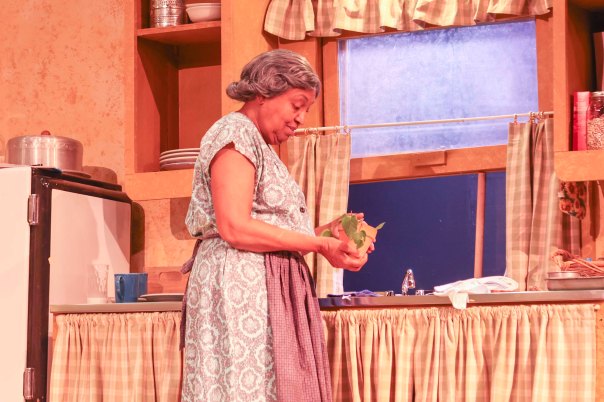
But the $10,000 check will be in Lena’s name, so what does she want? Here the BNS Productions’ dingy set is absolutely true to Hansberry’s spirit, for Croghan only provides a sliver of a window to allow any light in from the outdoors. It’s barely enough for Lena’s scraggly little houseplant, propped up with wee splints, to survive. Hardly big enough for more than a couple of Youngers to gaze out at the street.

Lena isthe Younger who cherishes the dream of Carl Augustus Hansberry, the playwright’s father, to live in a house that can accommodate all her family – along with a little plot for her to maybe grow a garden. If the best value for her money happens to be in Clybourne Park, a whites-only subdivision, fine: her family will certainly not trouble anyone else’s.

Such a rock! Yet Lily Oden plays Lena with a maternal softness, speaking her mind clearly, but never thundering like a prophet on a mountaintop. She does come off as old-fashioned in her confrontation with the godless Beneatha. The slap is still there, life-sized rather than the hand of God. While it may serve to compromise her moral authority, it emphasizes the intensity of her dream, coloring it with a determination to somehow repair and unify her crumbling family.

Along the way, we can feel that Oden has her recognizing that slapping and bullying aren’t always the best paths. That’s especially true in this Playhouse version where BNS mainstay Jonavan Adams is Walter. The way Adams gazes out at us as he articulates his dreams is a bit drier and wearier than most Walters we’ve seen, needing less of a gap to close before shedding his supplicating impulses and coming into manhood.

It appears as if he may let us down in the crunch, but Hayes gives him a life raft at a key moment in his planned capitulation to the white homeowners’ representative: a portrait of Walter’s father, “Big Walter,” hanging on an upstage wall. We see this – and Lena’s insistence that Travis remain in the room – working on Adams at his tipping point.

Unless you’ve seen Renee Welsh-Noel and her wackier exploits at Children’s Theatre of Charlotte, you might not fully appreciate all the nuance and texture she brings to Ruth and her strained position among the Youngers. She’s the bad cop tasked with prodding the menfolk awake, getting them fed, and off to work and school on time… the responsible parent who must deny Travis his 50¢ for school because the family can’t afford it.

Over and over, she is overruled by Walter and Lena, who can point proudly to Beneatha as the outcome of their spoiling. It’s almost as if Ruth doesn’t have aspirations anymore – until the breaking point when her yearnings and her resolve gush forth.

About the only flaw I found in the Regal cast (a second, overlapping Grove cast takes on all the morning and afternoon performances) was K. Alana Jones’s portrayal of Beneatha. I like how Jones plays and exploits the two men who are dating B, and the relationship with Walter is pitch-perfect. But Jones doesn’t seem to get how brainy and rad Beneatha is for a Southside Chicago co-ed in the ‘50s – or how full of herself and entitled she feels as such a progressive try-everything visionary.

The boyfriends for this BNS-Matthews Playhouse production are exactly as you remember them. Sha’Heed J. Brooks is delightfully starchy as George, the snobbish plutocrat who looks down upon Beneatha’s kin, particularly Walter, to his peril. By contrast, Dionte Darko as Asagai wonderfully captures both the exotic and the naïve aspects of the foreign exchange student. Yet with a worldly urbanity mixed with ancient wisdom, Asagai can effortlessly put Beneatha on the defensive.

With brisk pacing – and maybe some deft cutting – the production speeds by, the three original acts performed with one intermission. Yet Hayes somehow squeezes in the visit from the Youngers’ neighbor, Mrs. Johnson, whose scene and character has been dropped from every Raisin production to reach Broadway, including the revivals that featured Phylicia Rashad in 2004 and, ten years later, Denzel Washington.

Ericka Ross is quite obnoxious and brassy as Johnson, chiding Lena for buying into a white neighborhood and forecasting doom, even if she won’t convince everyone that the scene should stick. Bobby Tyson as Bobo and Henk Bouhuys as Karl Linder stand on firmer ground – and draw more dramatic assignments.

Nattily dressed in one of costume designer Emily McCurdy’s most stylish creations, Tyson is the only person during the whole liquor store scheme who doesn’t merely phone in. He has the guts to come by and deliver the bad news to his crony in person … and the moxie to show his irritation when Walter doesn’t immediately grasp how thoroughly they’ve both been screwed.

You’ll notice an awkward exit or two from guests at the Younger abode but none more heated or satisfying than the retreats of Mr. Linder, the Clybourne Park emissary. Bouhuys endows him with all the patronizing pomposity you might expect from an upper level Wells Fargo executive. Hayes strips Linder’s scenes of the buffoonery we may remember in past productions, where it might have seemed proper to boo and hiss his every word.

Bouhuys doesn’t bumble, but he does seem doubly non-plussed. He really cannot grasp why the Youngers won’t defer their dream any further when faced with the absurdity of moving into a neighborhood where they are not wanted – so not wanted that community has banded together to buy them out. Don’t they understand the arithmetic? By accepting Clybourne Park’s offer they could make a profit!

Or at least they could negotiate. Who are these maniacs that refuse to cash in?

What’s often overlooked in the onrush of the great Raisin in the Sun climax is how pivotal Walter Lee’s most humiliating moments are in triggering his turnaround. Yes, he stoops to Stepin Fetchit minstrelsy in furiously declaring his determination to ask Linder back and accept his offer, rightfully drawing Beneatha’s disgust. But Adams shows us that Walter has also seen the spectacle he has made of himself.

Shakespeare, Airplanes, and Jazz in CP’s “Twelfth Night”

Review: Twelfth Night at the Parr Center

By Perry Tannenbaum

Shakespeare’s best comedies are bursting with multiple plots, and two of the most perfect – A Midsummer Night’s Dream and Twelfth Night – are the most dizzying and delightful. It is quite likely that the latter, later work was first performed on Twelfth Night of 1601 to celebrate the newborn century on January 5 (with a singing clown suggestively named Feste). Yet time, scholarship, and heavy-handed dramaturgy have tended to darken many modern-day productions.

That’s why the current Central Piedmont Theatre version at the Parr Center, adapted and directed by Elizabeth Sickerman, is so refreshing. Twelfth Night has at least four main plots: Viola’s separation and reunion with her twin brother Sebastian, Duke Orsino’s unrequited love for the widowed Countess Olivia (seconded by Sir Andrew Aguecheek), Viola’s crush on Orsino while disguised as his manservant, and the wicked prank concocted by Aguecheek, Sir Toby Belch, Feste, and Maria to send Olivia’s ambitious and party-pooping steward, Malvolio, to the madhouse.

Of these, the most dominant plot should be the Viola-Orsino mess, for it sprouts so many delicious complications. Acting as Caesario, Orsino’s servant, Viola is dispatched to to Countess Olivia’s manor to plead on behalf of the Duke – only to have the Countess fall in love with her. Olivia’s inclinations toward Viola/Caesario not only enflame Orsino’s jealousy, they also lead to an absurd duel with fellow coward Sir Andrew. Meanwhile, she encounters Sebastian’s close friend, Antonio, who puts all his money in Viola’s care, mistaking her for her twin. You can easily imagine what happens when Sir Andrew makes the same mistake.

Ultimately, the mistaken identities reach the giddy point where Olivia cannot recognize her own husband just hours after their marriage. Ah, a honeymoon to remember.

So to tip the balance toward empathizing with Malvolio, simply because he is incidentally berated as “a kind of puritan,” is rather perverse. Elsewhere, I’ve seen the steward outfitted with a Puritan’s hat. Far more stupidly, I’ve heard a theatre sage say Malvolio was modeled on Lord Protector Oliver Cromwell, born in 1599. Thomas Cromwell, Earl of Essex (1485-1540), instrumental in the English Reformation, is a more feasible candidate. Sickerman not only discards such nonsense, she transports the action from ancient Illyria, at the heel of Italy’s boot, to a coastal town immersed in the Jazz Age.

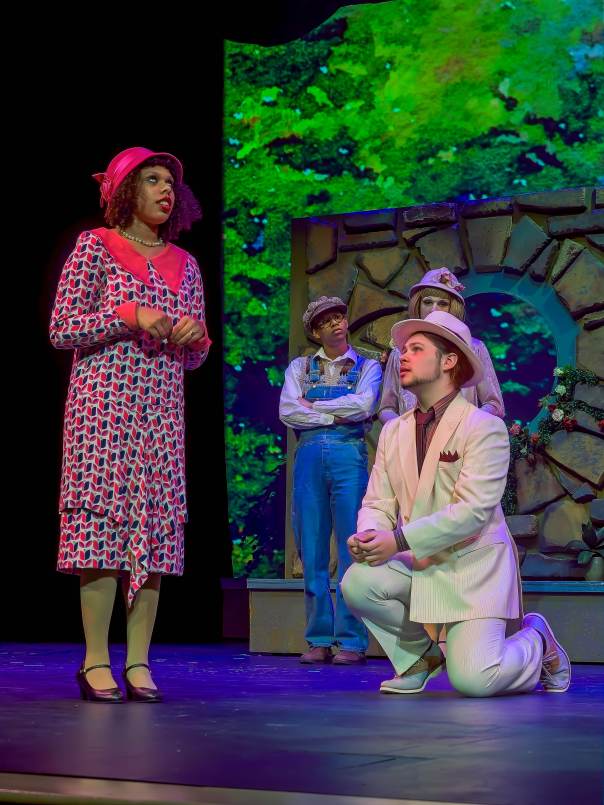
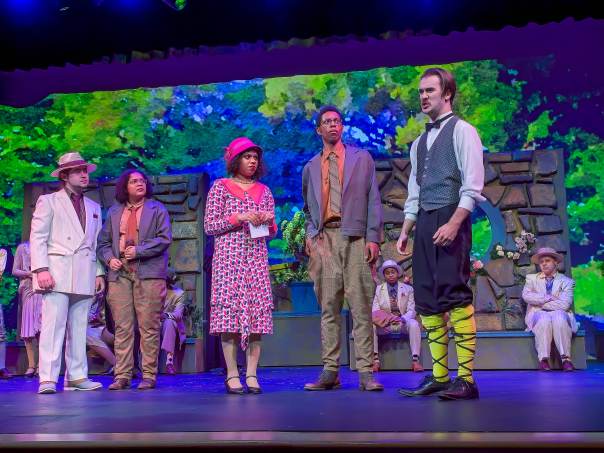
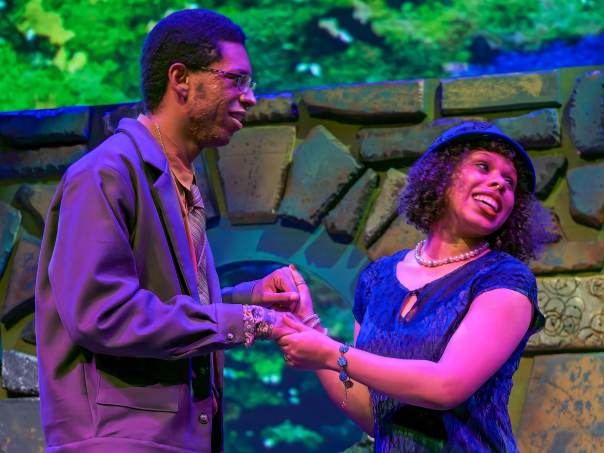
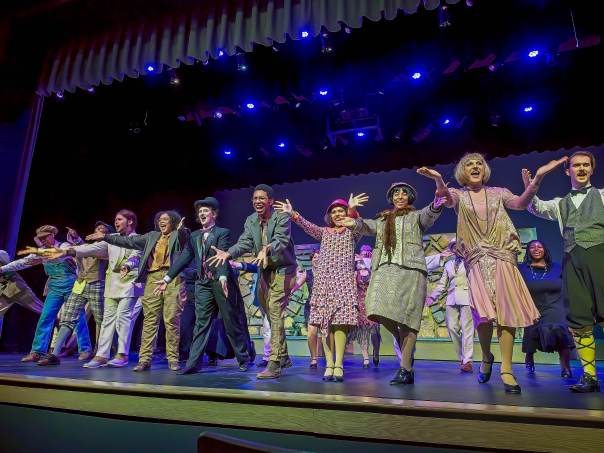
Costume designer Emily McCurdy certainly goes with the Roaring 20’s flow. Orsino and Olivia could easily pass for the recently reprised Gatsby and Daisy Buchanan on Broadway, surrounded by flappers and jazzy gallants galore. The moving pieces and projections of Jennifer O’Kelly’s scenery, more evocative of summer than winter, have enough classic detailing for Viola to sit at the foot of an Ionian pillar when describing herself sitting like “Patience on a monument.”

Nor does the music veer from the vintage of Prohibition days. Montavious Blocker has choice cuts of Duke Ellington and Sidney Bechet in his soundtrack, and just a few bars of music arranger Matt Postle’s chart for “Come Away, Death,” transformed from a lover’s lament into a jivey jump tune, are enough to conclusively vanquish melancholy, injecting Feste’s song for the lovesick Orsino with catchy mischief. The debris downstage suggests an Amelia Earhart plane crash rather than Shakespeare’s original shipwreck, and Charles Lindbergh could have inspired Sebastian and Viola’s matching outfits. Except for the tacky slacks.

If you’ve seen Twelfth Night before, Sickerman cordially adds to the Bard’s dizzying layers of identity, cutting some expositional text and casting females in key roles. Not one of them is a Chickspeare alum. Saskia Lewis as Feste, Rhianon Chandler as Antonio, and Kameal Brown as the recklessly unknighted Dame Toby Belch are all QC newcomers to me. If only Aryana Mitchell, portraying Viola, had an identical twin sister to take on Sebastian!

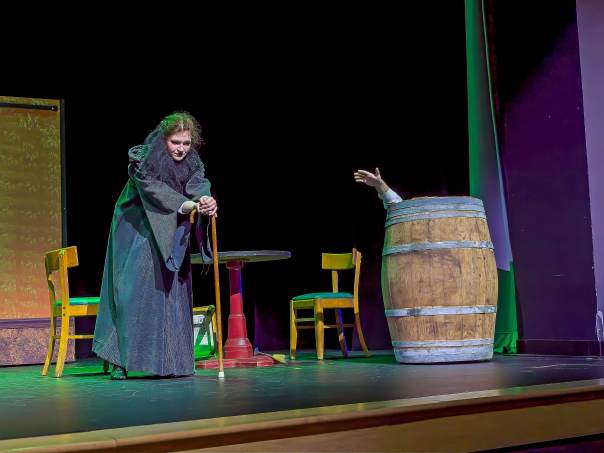
We are centuries away from the Protestant Reformation or the English Restoration, although Sickerman seems to beach the sibs closer to the Pilgrims’ beloved Plymouth Rock than to the Adriatic coast. Such oceanic distancing frees Malvolio from a dungeon of scorn when Central Piedmont’s plotters and nobles plunk their preening steward into a humble barrel to punish his prudery.

He isn’t the clown among the comical group, but Sickerman allows Truman Grant as Malvolio to loosen up, so that his usual rigidity is now almost elegance, mockable now as uppity pretense. Another sign of Sickerman’s lighthearted touch: her pick for the incredulous Sebastian is Timothy Snyder, who is at least a foot taller than his “twin.”

The disparity was so great, that I didn’t catch on at first. Brown’s outfit as Dame Toby, more like Miss Marple than a Falstaffian drunkard, compounded my early confusion, making me feel like newbie to the comedy while I got oriented. Struggling to remember a single instance when the euthanized CPCC Summer Theatre ever presented such a challenging comedy, I stumbled upon another reason why this excellent production was so refreshing.

All the cast was youthful, like the summer college grads who swarmed to Charlotte during CP summers to launch their pro careers. Not one old-timer in the bunch!

As a result of coping with all the period, costume, and gender changes, my disorientation was dispelled at the same time that I was learning to trust the youngbloods performing at CP’s New Theater, which has thankfully replaced panoramic Pease Auditorium but lamentably failed to showcase nearly as much CP talent. The mental training wheels that I had doled out to all these student efforts quickly flew away.

But along with a lightened, more secular and decadent Malvolio, there was newfound pleasure in the other creatures onstage who no longer needed to orbit around the self-absorbed steward. The Malvolio miasma that I’d felt since my first encounter with Twelfth Night in a college Shakespeare seminar, taught by a professor victimized by the prevailing obsession with the “puritan,” finally evaporated.

Twelfth Night, or What You Will has always been an awesome comedy for me. Now it was fun. I’d barely appreciated the bounty of fascinating character sketches that the Bard serves up here.

Now Viola is the patient, softspoken eye of the storm, and Mitchell is keenly sensitive, alternately anguished and bemused by all the passion and folly that surround her. Mitchell’s discreet takes, shared with us, make her a sort of co-emcee with Feste, though Sickerman asks too many eyerolls from her. Fitz Fitzpatrick is only slightly over-the-top with the lovesick gushings of Orsino, chiming well with a lounging Duke or a mob boss. Yes, that sleek robe has a Godfather aura before we see Fitz in the Gatsby threads.

As Olivia, Arianna Zappley does not yield at all to Fitzpatrick in regal dopiness. The two are as perfect a matching pair as the twins, made for each other, yet both are insanely lucky to land one of the sibs. Rounding out the symmetry of the two couples as Sebastian is the disproportioned Snyder, who does manage to nearly equal the calm of his diminutive twin – even though the Illyrians mistake him for her over and over. Playing Sebastian’s closest friend, the wrongly arrested Antonio, Chandler helps the prisoner to emerge as a neat counterweight to Malvolio, who is rightfully chastised for his presumption, though the penalty is too harsh.

There’s a little more slapstick flavor to the motley crew who bedevil Malvolio – and a bit more spice. Evelyn Ovall as Olivia’s waiting-gentlewoman Marie, who forges her mistress’s handwriting in the billet-doux that entraps the detested steward, is destined to marry Brown as Dame Toby. I’d like to think Ellington and his orchestra would have consented to play at the wedding reception, but I’m not sure.

Dopiest of the conspirators and clearly the least self-aware is Salim Muhammad as Sir Andrew, usually exiting with an absurdly military goosestep. In his challenge to Caesario/Viola, Muhammad now dons boxing gloves instead grabbing a sword, magnifying his ineffectuality with his effeminate pawing as he briefly combats the well-matched Mitchell.

Lewis effortlessly steals nearly every scene she appears in as Feste, convincing me along the way that this clown was intended to upstage all others. Not only does Feste sing lyrically and wittily – compared to the other lovers who barely stammer their effusions – she proves to be a better actress than the leading lady, Viola. Visiting Malvolio at the mouth of a barrel he believes is dark hell, Feste gives bravura performances as Sir Topas, a parson supposedly sent to determine how mad this lunatic is, interspersed with imitations of a sincere jester. Lewis cackles and coos this cruel vaudeville as bewitchingly as she swings death, ranging further than anyone else.

Photos by Perry Tannenbaum

“Sunlight and Solstice” Balances Seasons, Continents, and Testaments

Review: CP Dance Theatre’s Sunlight and Solstice

 By Perry Tannenbaum

2022~Sunlight and Solstice-06

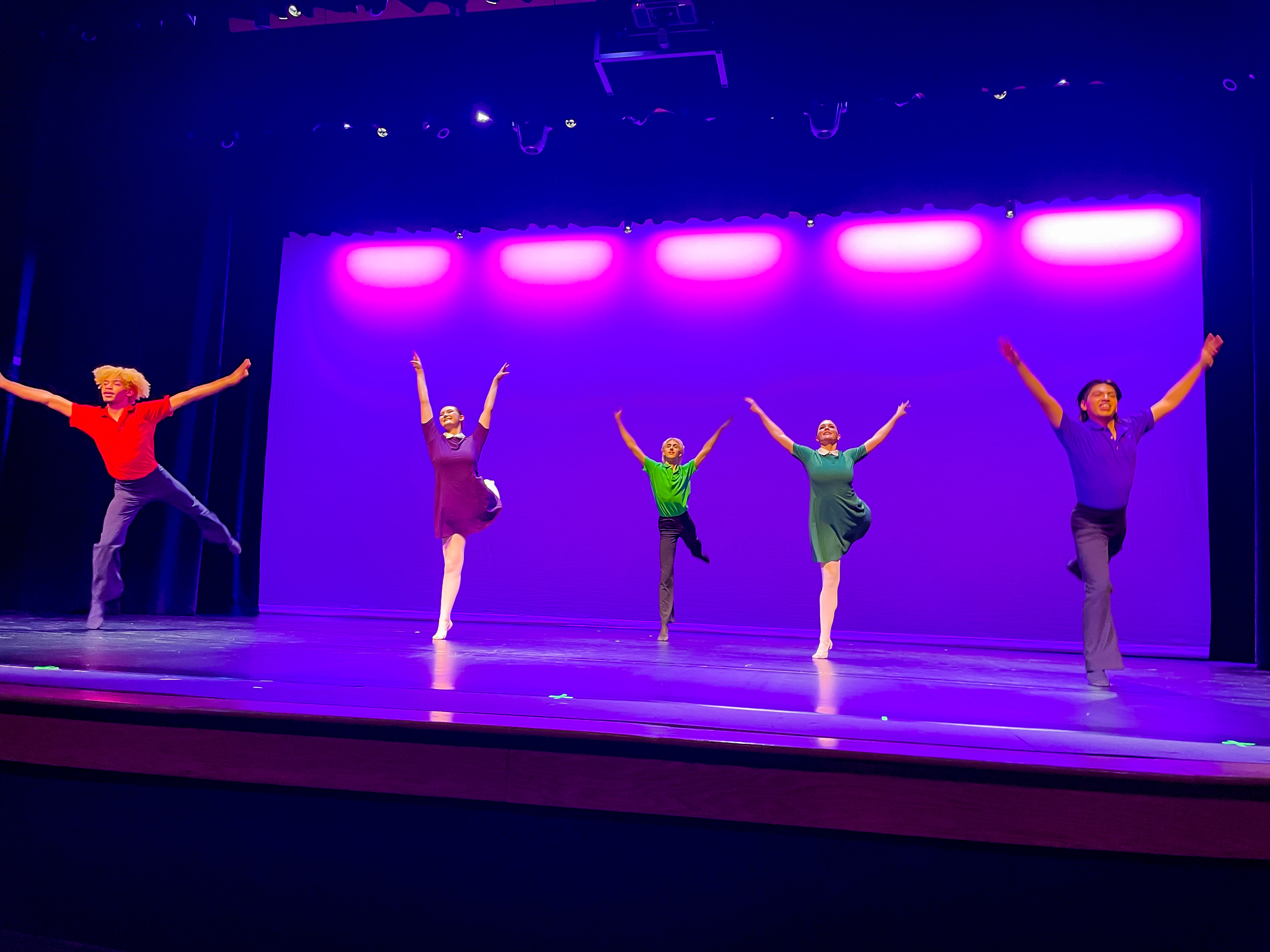
December 2, 2022, Charlotte, NC – Compared with Charlotte Youth Ballet’s annual production of Tchaikovsky’s beloved Nutcracker, Central Piedmont Dance Theatre’s fall presentation, Sunlight and Solstice, drew only a small fraction of the huge crowd that converged on the CP Community College campus for the second weekend of the 2022 holiday season. Yet the few of us who chose the less-ballyhooed event were rewarded with more new things to see, for Sunlight and Solstice delivered plenty of new choreography in its bouquet of seven dance pieces, and the program was staged at The New Theatre – in the spanking new Parr Center complex. Dance faculty members Clay Daniel and Tracie Chan each created three pieces for the auspicious event, working with their students to synchronize and refine their performances.2022~Sunlight and Solstice-08

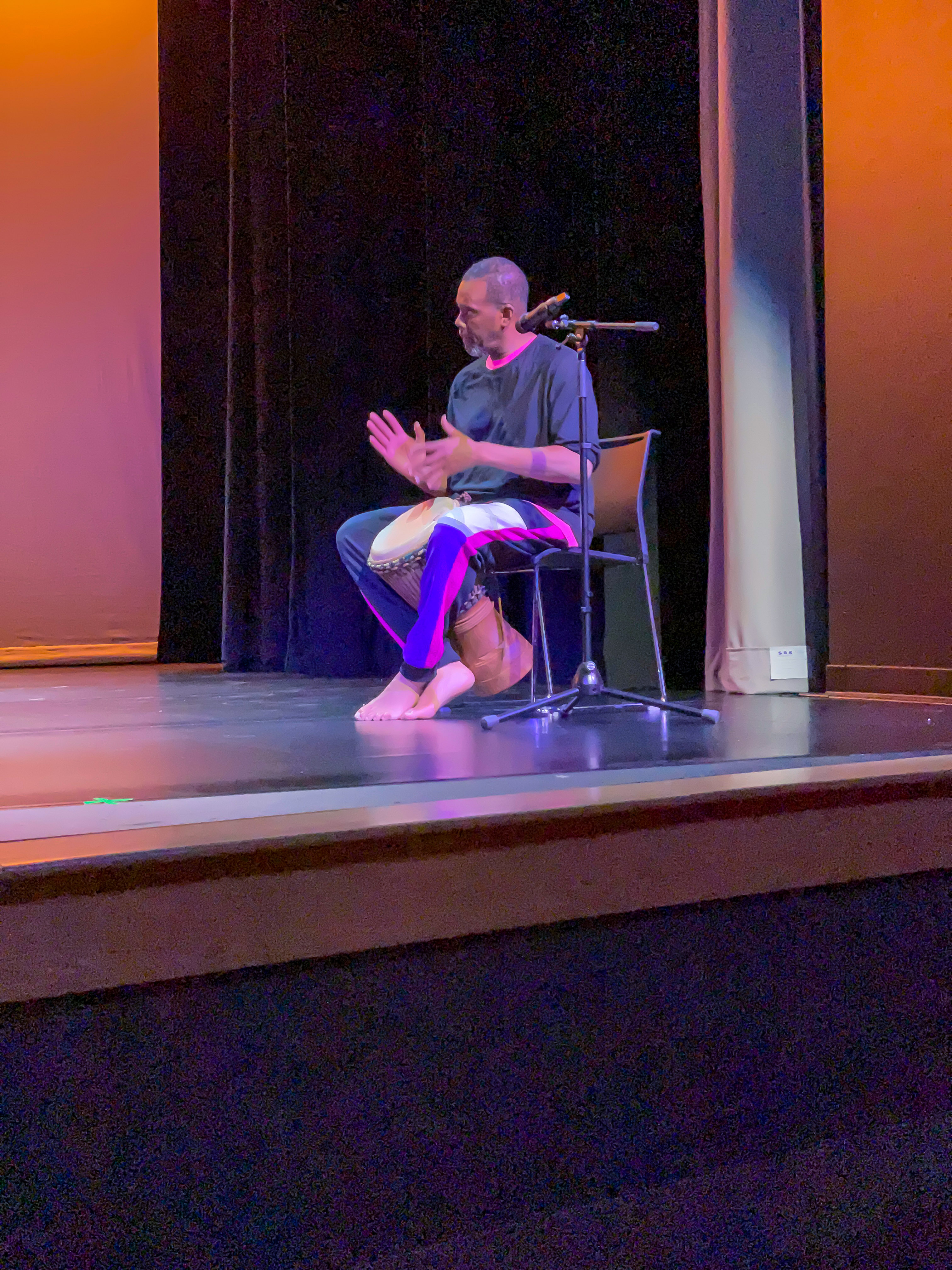
The program closed with a guest appearance from the Chris Thompson Cultural Ensemble, with live singing and drumming by their leader.

Sadly, the newness of the venue was underscored by the fewness of the audience. That increased my admiration for Daniel, who maintained his poise and geniality in handling his hosting chores. Without a printed program in our hands, you could say that Daniel’s intros were godsends, and as our host candidly disclosed, they also spread a convenient veil over the time needed backstage for costume changes between dances. Daniel was no less savvy in choosing his own 2014 settings for Shel Silverstein’s A Light in the Attic to start us off, for they provided a satisfying variety of little nuggets from the 1985 recording while introducing us to a wide swath of CP’s dance corps. Among the ten different vignettes, a couple as brief as 18 or 19 seconds, my favorites were “Bear in There,” “Homework Machine,” and “Monsters I’ve Met,” but all of these were decisively upstaged by “Eight Balloons,” which featured a helium balloon (an unbeatable prop) and an engaging array of dancers and movement.2022~Sunlight and Solstice-02

My first audition of the New Theatre’s sound system was a letdown after the brilliant impression made by the hall, the seats, and the sightlines. Silverstein’s poems should have been louder and clearer. Even more ominously, the backup music promised by Daniel was rarely audible. Replay at home on Spotify was necessary for me to confirm it was actually there.2022~Sunlight and Solstice-04

Nor was there instant redemption or revelation when the soundbooth cued up Camille Saint-Saëns’ Danse macabre for “Cadence,” the first of two Chan pieces that followed. Impact of the music was tepid rather than electrifying. The men who launched the dance were freer to move around than the more balletic women who came afterward, so the best of the work’s three segments was the last, when both groups joined together and movements emphasized leaps more than en pointe work. “Hannah” was an even more delightful piece, though I refuse to believe that Chan chose the best recording of “Hard-Hearted Hannah” she could find. On the other hand, Chan did choose Aubrey Conrad, her best and most alluring dancer, to portray the Vamp of Savannah, GA. Costumer Emily McCurdy dressed her in a tight, eye-popping red outfit to make sure we noticed. Backups (aged 17-69 as Daniel pointed out) were in slacks, their black tops besprinkled with coppery spangles.

A couple of interestingly varied Daniel pieces ensued, with music by JS Bach and Mark O’Connor. Their titles, Art of the Fugue and Appalachian Waltz, were sufficient to distinguish who composed what. Once again, Daniel’s programming was on-the-money, following the splashy éclat of “Hannah” with a piece for three men – Carson Fullwood, Dawsyn Ransome, and Nicolas Hare – more quietly titled “Prelude.” This agreeable trio also provided Conrad with extra time for a breather as well as the costume change she needed to reappear as the soloist in “Moonlit,” the dreamiest piece of the night.2022~Sunlight and Solstice-11

The perkiest piece of the night was undoubtedly Chan’s “Winter’s Frolic,” set to three choice cuts by the Vince Guaraldi Trio. Or maybe two choice cuts would be more accurate, since the choreographer’s musical taste could be questioned once again when she chose Guaraldi’s take on Beethoven’s “Für Elise” as the middle piece in her three-piece suite – not wintry, not frolicsome, and not typically Guaraldi, with no redeeming Christmas or Halloween spirit. The icy skating motif established by the dancers in “Skating” was stopped cold, thankfully returning with Chan’s finale. Somehow, Conrad managed another costume change to slip in among the six dancers, but it was Rieonna Weldon and Carson Fullwood who were featured.

2022~Sunlight and Solstice-09

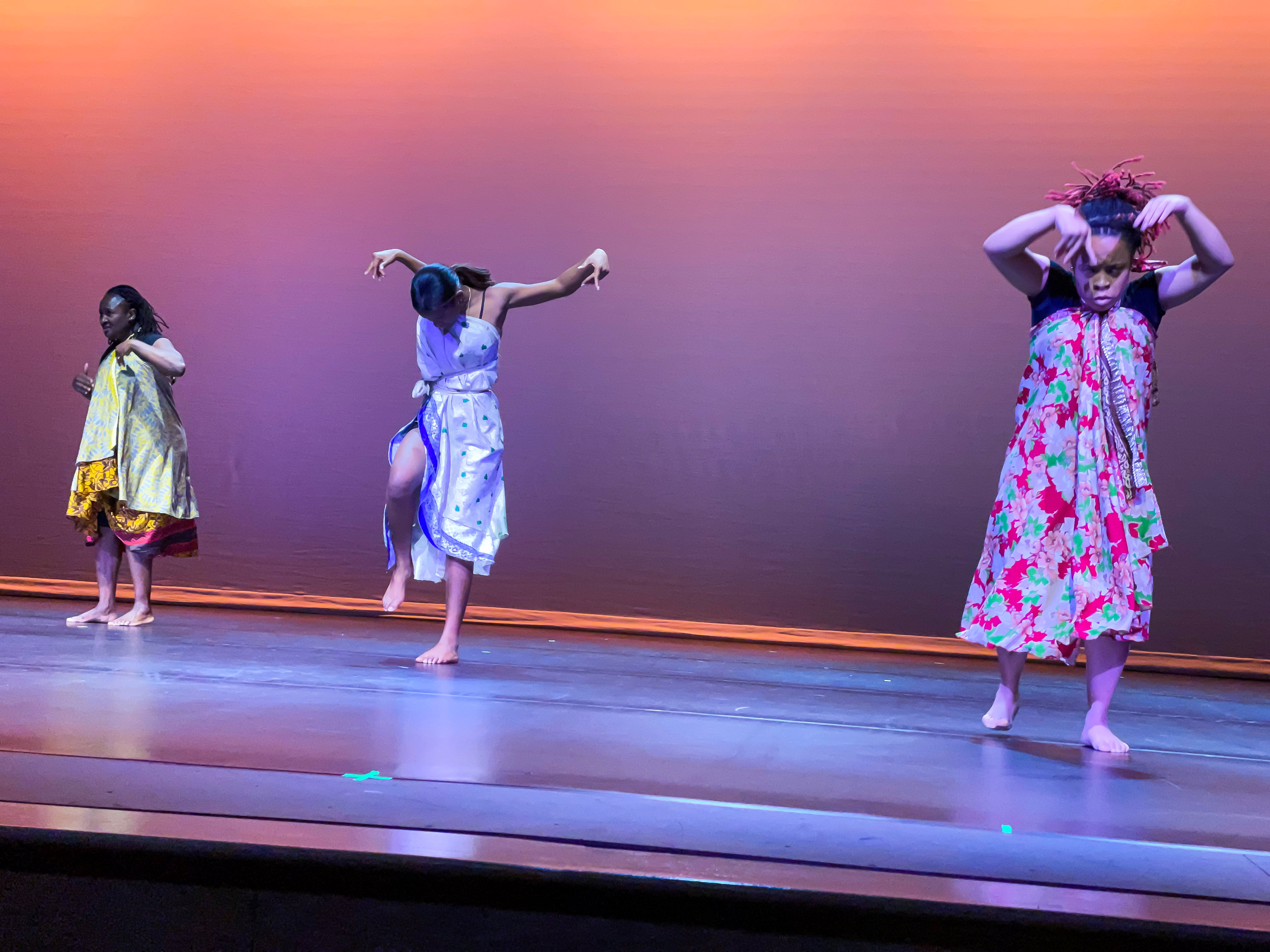
Whether it was the African style of clothing Chris Thompson’s dancers wore or the lighting shift behind them from the rich violet of “Winter’s Frolic” to a peachy sunset hue, “Rivers of Babylon” brought on the most sunshine of the evening and reminded us that there are two solstices. With Thomson beating out rhythm on his drum, we could readily feel transported from winter to summer as his three dancers – Micheline Ruffin, Erika Guzman, and Briana Hubbard – moved gracefully onto the brightly-lit stage. Then it all came together as Thompson sang the reggae song: summer meshed with winter, one solstice followed another, and the words of an Old Testament song were sung in the season of the New Testament’s most joyous holiday.

Spacious Setting at Halton Theater Creates Fresh Perspective for “You Can’t Take It With You”

Review: You Can’t Take It With You

By Perry Tannenbaum

THEA2021-DLV-0923-4498

Picking up our tickets for You Can’t Take It With You in the Overcash lobby outside Halton Theater, I was asked how many times I had seen this comedy by George S. Kaufman and Moss Hart before. Reflexively, I answered four or five times – discovering, to my surprise, that I was replying without a groan. My later researches proved my estimate to be correct, for I have now seen local productions on at least five occasions dating back to 1990, including presentations by Charlotte Shakespeare, Old Courthouse Theatre (1991), and two at Theatre Charlotte (2001 and 2016), along with the current Central Piedmont Theatre effort. Over the years, I’ve gradually warmed to the script, perhaps because it’s better-respected now than when the 1937 Pulitzer Prize winner was turned into a star-studded screwball extravaganza in the 1938 Oscar-winning film.

Each time I’ve beaten back my resistance to reviewing You Can’t Take It on recent occasions, I’ve found myself taking away something new. The last time I saw the comedy, just days after the 2016 election, I found myself imagining how in tune with public sentiment the Kaufman-Hart concoction must have seemed when it first premiered – after the 1936 election. Hardly shocked or even surprised anymore by the cavalcade of eccentricity in the Sycamore family and their outré circle, I found myself newly fascinated by patriarch Martin Vanderhof’s anti-government stance and the playwrights’ decidedly anti-Wall Street sentiments. Of course, I had no idea at that time how much I could come to loathe a President who boasted about not paying his income taxes.

Nearly five years later, the similarities – and dissimilarities – between Martin and The Donald have popped into sharper focus, creating a provocative tension. What struck me most forcefully this time around was how much You Can’t Take It With You is about the classic clash of New York values, the free-thinking Bohemian chaos at the Vanderhof home, around the corner from Columbia University, and the stuffy, moneyed callousness of Wall Street, the planet’s financial capital, still wobbling after the crash. Maybe the other thing that struck me with new force was also a result of the Trump Effect. This play is absolutely crawling with Russian influences: emigres, ballet, socialism, Stalinism, Trotskyism, and blintzes. No wonder at all why the place gets raided by G-Men.

Kaufman and Hart would have no doubt delighted in Jennifer O’Kelly’s vast set design, for they described this expanse as an “every-man-for-himself room,” where every member of the household has the freedom – and space – to do whatever he or she pleases. “For here,” they added, “meals are eaten, plays are written, snakes collected, ballet steps practiced, xylophones played, printing presses operated – if there were room enough there would probably be ice skating.” With admirable restraint, there is no Zamboni in sight under Paula Baldwin’s deft direction, and the wide vista of the O’Kelly’s set encourages players to move quickly to answer the front door at stage left, to step lively in reaching centerstage, and to speak loudly so that all might hear. Baldwin was also spied at the back of Halton Theater on a couple of occasions, perhaps after hovering near the soundboard, for the sound from body mics onstage was exceptionally problem-free. Sound design by Ismail Out, including cuts of Johnny Mercer’s “Goody Goody” from 1936, was also on-target.

THEA2021-DLV-0923-4527

The plot revolves around the possible nuptials between Alice Sycamore, Martin’s granddaughter, and her Wall Street boss, Tony Kirby. As Alice sees it, the multitudinous eccentricities of the Vanderhof household are an insuperable barrier between her and the ultra-respectable Kirbys. Obviously, Alice is conflicted about her family, loving them all while seeing them with the clarity of the only household member in daily contact with the outside world. Tony, as it turns out, is no less attuned to the shortcomings of his own family, so he pushes for a meeting with Alice’s family and then for the inevitably explosive rendezvous between his folks and hers. Did we mention that Alice’s dad, Paul, fashions fireworks with his faithful assistant, Mr. De Pinna? No, because all of those chemical reactions happen down in the cellar, out of view.

THEA2021-DLV-0923-4629

Having to move so quickly across O’Kelly’s arena seems to endow all the residents of the Vanderhof home with an enthusiastic complacency, so engrossed are they all in their eccentricities. Pam Coble Newcomer is the restless artist of the family as Martin’s daughter, Penny Sycamore, working on a couple of her 11 unfinished playscripts as we watch, until she decides it’s time to resume work on painting a portrait of Mr. De Pinna posing in a Grecian tunic that she abandoned years ago. Abigail Adams is Penny’s eldest daughter, Essie, the perennial ballet student who also makes candies, and Braden Asbury is her husband, who mostly splits his time between the xylophone and the printing press in his nook. He also likes to make masks and serves as Essie’s candy seller and the family pamphleteer. Busy fella. So you’ll notice that Kaufman and Hart enjoy piling multiple enthusiasms on their characters.

THEA2021-DLV-0923-4561.jpg

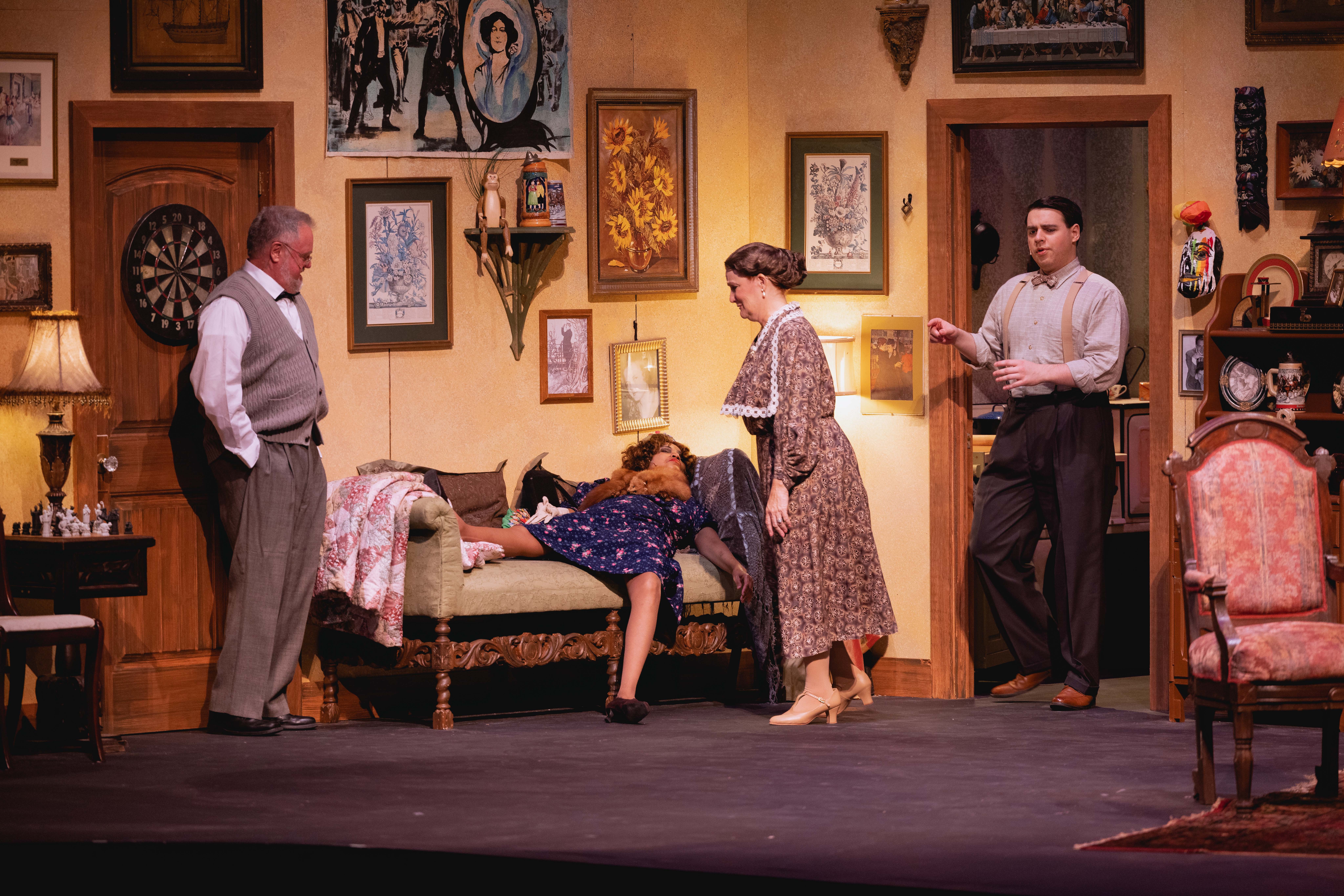
Contrasts can be extreme, sometimes with a zany logic. As Boris Kolenkhov, Essie’s ballet teacher, John Sexton can beat a taskmaster’s cane on the floor in perpetual frustration, since Essie shows no promise whatsoever, and then, at the most inopportune moment, reveal his zest for wrestling. It’s a lot for the Kirbys to digest all at once, but other weirdos like Mr. De Pinna are likely to show up on the Vanderhof doorstep and never leave. Weirdest of these may be Corlis Hayes as Gay Wellington, a flamboyant actress who would steal every scene if she weren’t spending so much time passed out on the settee from excess drink. Of course, cameos from those government raiders and an overnight stay in jail didn’t improve the Kirbys’ first impressions of Alice’s family. Nor do the fireworks down in the cellar remain inert. As the elder Kirbys, Rick Taylor and Pamela Thorson were as starchy as can be, but Thorson was especially regal in taking affront.

THEA2021-DLV-0923-4325In the face of such humiliating catastrophe, Alice wished to exile herself to the Adirondacks, but Charlie Grass managed even here not to be overly annoying in her shame and mortification as the one “normal” member of her family. Love and practicality are nicely mixed in this Alice. Serene and optimistic as ever, Martin, Penny, and Paul are able to laugh off the misadventures of the previous night. Newcomer as Penny, Jeremy Cartee as Paul, and Dennis Delamar as Martin became especially endearing from this moment forward, maintaining their equanimity after this buffeting of adversity. Galumphing and awkward in the early going, in and out of his mad scientist coveralls, Cartee showed some touching solicitude toward the wife and daughter when crisis struck. Delamar, in his second go-round as Martin, has thoroughly mastered his dignity and glow, aided by Emily McCurdy’s costume design and James Duke’s lighting.

Whether or not Baldwin was looking for a James Stewart type in replicating the onscreen chemistry between Alice and Tony (judge for yourself when you see Grass’s hair), Timothy Hager brings some of the same height and charming gawkiness to the role. Although O’Kelly does her best to clutter up her set, there is never the sense that Tony is slumming because the space is so expansive. That spaciousness also tends to dilute whatever humble, homespun quality you might have associated with Vanderhof and his clan in past viewings.

THEA2021-DLV-0923-4455

With Baldwin’s staging, you’ll likely find that the wide-open space enhances Delamar’s eloquence when he delivers Martin’s signature monologue in the final act. If you can tear your eyes away from Delamar, you’ll notice that Newcomer has been deployed far to stage right, leaning forward on the sofa in rapt attention, beaming and proud of her daddy. Most other family members have been spread out around a stage that has more than a couple of times been teeming with tumult. All eyes are Grandpa, all the family are respectfully still, radiating pride and content. It gives a special moment an extra aura.

Flouting History and Scholarship, “Shakespeare in Love” Reveals How the Bard Became the Bard

Review: Central Piedmont Theater’s Shakespeare in Love

By Perry Tannenbaum

THEA2019-DLV-0926-0018

For centuries, theatergoers and scholars have mulled over the question of how William Shakespeare became the magisterial genius he was, how as a poet and playwright he came to know so much, write with such a honeyed tongue, and move so many so deeply. In 1998, screenwriters Marc Norman and Tom Stoppard tackled that question with Shakespeare in Love, taking a new approach and attitude. Discarding the usual methods of textual study and meticulous historical investigation, Norman and Stoppard wove a new fabric, some of it out of whole cloth and some of it stitched together from familiar scraps of information and familiar quotes.

THEA2019-DLV-0926-0027.jpg

Two operative principles preside over their work, normalizing Shakespeare as a writer. You will certainly come away from playwright Lee Hall’s stage adaptation of Shakespeare in Love, currently at Halton Theater in a handsome Central Piedmont Theatre production, with the notion that the Bard of Avon wrote about what he personally experienced and that he was a magnificent and insatiable sponge, absorbing everything that was said to him and sublimating it into magnificent verse and poetry. In the words of Henry James, repeatedly intoned in graduate level writing programs across America, Shakespeare was “one upon whom nothing is lost.”

You can also choose to be outraged by the shambles Norman and Stoppard make of actual history, beginning with the notion that the story of Romeo and Juliet is a Shakespeare original. Even undergrad lit majors know better. But you’ll likely be won over by the fun-filled attitude of Norman and Stoppard as they put together a story with sufficient romance, theatre and court intrigue, comedy, and tragedy to inspire not only Romeo and Juliet but also armloads of Shakespearean treasure afterwards. With Stoppard on the team, a genuine theatre insider, there’s a theatre-making perspective that adds to the excitement of the multiple plots that keep us scrambling to follow the action. Under the direction of Tom Hollis, the energy and enthusiasm of this teeming yarn were quite contagious for its Saturday evening audience.

THEA2019-DLV-0926-0128.jpg

Before Will meets Viola De Lesseps, who will inspire the playwright to change his frivolous “Romeo and Ethel” comedy into the tragedy we all know – and serve as model for the heroine of Twelfth Night – a hectic stew of rivalry, antagonism, and desperation is boiling around him. Assailed by writer’s block, Will is already past the time when he promised to finish new scripts for Philip Henslowe’s Rose Theatre and Richard Burbage’s Curtain Theatre. Henslowe’s need is particularly acute because he owes money to Fennyman, a shark who employs henchmen and torture to ratchet up his coercion. Christopher “Kit” Marlowe, Shakespeare’s greatest contemporary, is a friend here, helping Will toward shaping the plot of Romeo and feeding him lines for his most famous sonnet.

All of this desperation and streetfighting are a perfect backdrop for the luminescence of Viola. A beautiful noblewoman smitten by the theatre and Shakespeare’s verse, she disguises herself as Thomas Kent in order to audition for the role of Romeo, performing a speech from the Bard’s first hit, Two Gentlemen of Verona, as a sampling. (Audience members who don’t know that women were forbidden to act onstage during the Elizabethan Era will be deftly brought up to speed.) Until Viola shows up, Will hasn’t seen much to encourage him that he’ll be able to cast “Romeo and Ethel” if he ever finishes writing it. When Kent flees the audition after flubbing some kissing business, Will pursues, only to come face-to-face with Viola. So now it’s Will’s turn to be flustered.

THEA2019-DLV-0926-0295.jpg

Once Viola is on the scene, romance enters to dispel Will’s writer’s block and the world of Shakespeare in Love widens to include nobility, government, and royalty. Lord Essex, aspiring to Viola’s hand and fortune, is Will’s chief romantic obstacle, having obtained daddy’s permission – and Queen Elizabeth herself will also need to approve. If Viola does achieve her ambition and appear publicly onstage, the Master of the Revels, Edmund Tilney, stands in the wings, empowered to instantly stop the performance and shut down the theatre.

Jennifer O’Kelly’s set design, with its Globe Theater arches and balcony, emphatically reinforces the notion that the action we’re watching in Will’s life is the stuff of Shakespearean drama. Pre-recorded music composed by Paddy Cunneen, infused with the sounds of flutes and lutes, helps in the transitions from theaters and taverns to noble and palatial surroundings. With plenty of input from companies and theatre departments as far away as Greensboro, costume designer Emily McCurdy splendidly outfits a cast of 23 playing 60 different roles – though it might be pointed out that the Queen of England should have more than one dress. Choreography by Clay Daniels, when we reach the iconic Romeo ballroom scenes in real life and in rehearsal, meshes with the music simply and authentically.

Best of all, the key roles were aptly cast. Morgan Wakefield had an abundance of breathless energy and theatre enthusiasm that never seemed nerdy and – since she was the inspiration for Juliet as well as Viola – a total lack of vanity staining her beauty. While Wakefield’s energy largely fueled the pulsing effervescence of this performance, Jack Stanford was no less on point as Shakespeare. He walked a similar tightrope between pragmatic calculation and youthful impulse that Wakefield trod, never becoming too cerebral. As lines from Shakespeare’s future works showered him from all directions throughout the evening, I always sensed from Stanford that Will was absorbing rather than stealing them.

THEA2019-DLV-0926-0366.jpg

The nobles all sounded very polished, beginning with Jonathan Stephens as the pushy, valorous and conceited Essex and Pat Heiss as the sternly regal Queen Elizabeth – with a broad vein of worldliness. Jim Greenwood as Tilney was exactly the kind of prig you would want to cram into a trapdoor, costumed puritanically to make it obvious that he inspired Malvolio in Twelfth Night; and Anne Lambert bustled about officiously enough as Viola’s Nurse to make it obvious that Juliet should have one, too.

Out in the London jungle where the Rose Theatre struggled for survival, inexperience only occasionally peeped out among the players. Jeff Powell infused Fennyman with menace, convincingly shifting his attitude once the moneylender became stagestruck, and while Larry Wu could be downright bizarre as the tortured Henslowe, his intensity was endearing. A little more confidence and individuality would help Blake Williams in his portrayal of Kit Marlowe, but there was abundant stage presence from Bryce Mac as Ned Allyn, the star actor who took on the role of Mercutio, and from Brian Holloway as the predatory, opportunistic Burbage.

Chemistry between Stanford and Wakefield in the Will/Viola romance will sufficiently captivate groundlings new to the world of Shakespeare. But the more you’ve experienced of the Bard, the more you will be delighted by the quotes from Twelfth Night, Macbeth, and Lear that also creep in. Where the intended allusions and echoes ended and where unintended parallels began was sometimes hard to discern. When Elizabeth told Viola that even she could not dissolve an ordained marriage, was this a foreshadowing of what Theseus had to tell Hermia in A Midsummer Night’s Dream? While Romeo and Juliet was virtually writing itself before my eyes, it was reassuring to recall that genuine monarchs can understand the limits of their power.