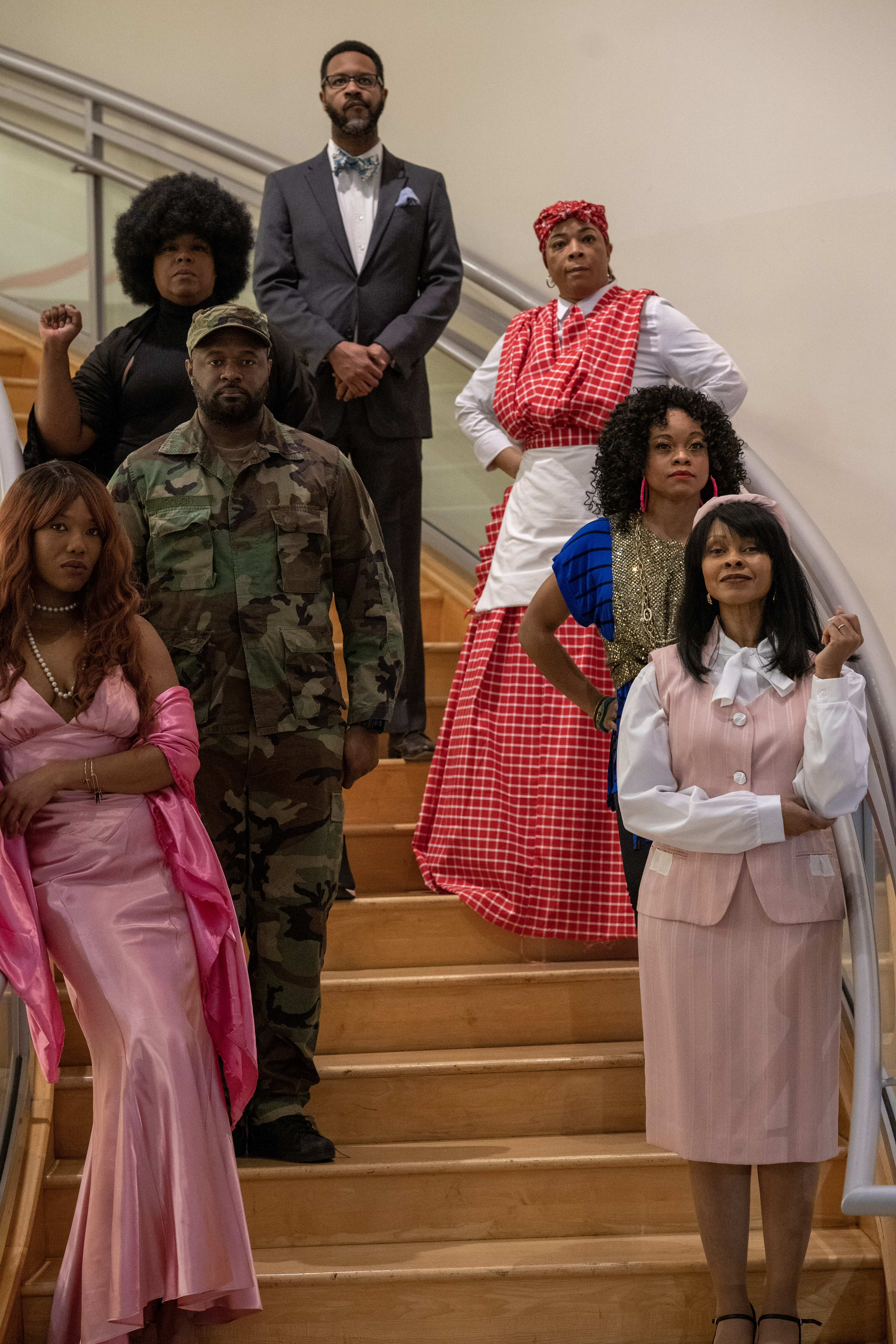
Tag Archives: Dee Abdullah

Watch for the Closing Door at CAST’s “Sunset Limited”

Review: The Sunset Limited at The Arts Factory

By Perry Tannenbaum

Would it rub you the wrong way to be solicited by a beggar selling candies outside your favorite theater? What if we add a tramp handing you your tickets, then a drunk, a druggie, a streetwalker, and a guy hawking fake Rolexes for six bucks lining the path to your seats? Welcome to experiential theatre at the Arts Factory on West Trade, where Cormac McCarthy’s THE SUNSET LIMITED is rounding the bend into its second weekend.

Or if you’re already fondly familiar with how Carolina Actors Studio Theatre means to do things, welcome back to the good old days.

CAST artistic director Michael Simmons doesn’t merely content himself with just these genial Skid Row stereotypes. No, no, no, for then your experience would normalize as soon you entered the theater.

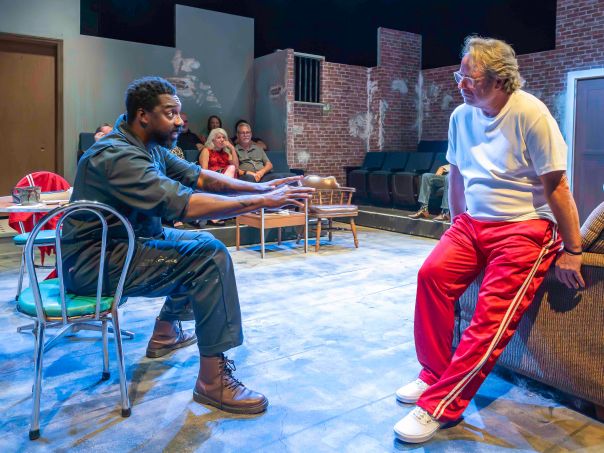
Not so fast, for Simmons’ rather fiendish set design has at least six walls. After you enter the theater doorway, you need to wind around a cruddy corridor to reach another doorway that leads into the shithole apartment where McCarthy’s action takes place. This is absolute brilliance from Simmons, since the seediness of our host’s life helps to balance the to-be-or-not-to-be debates to come.

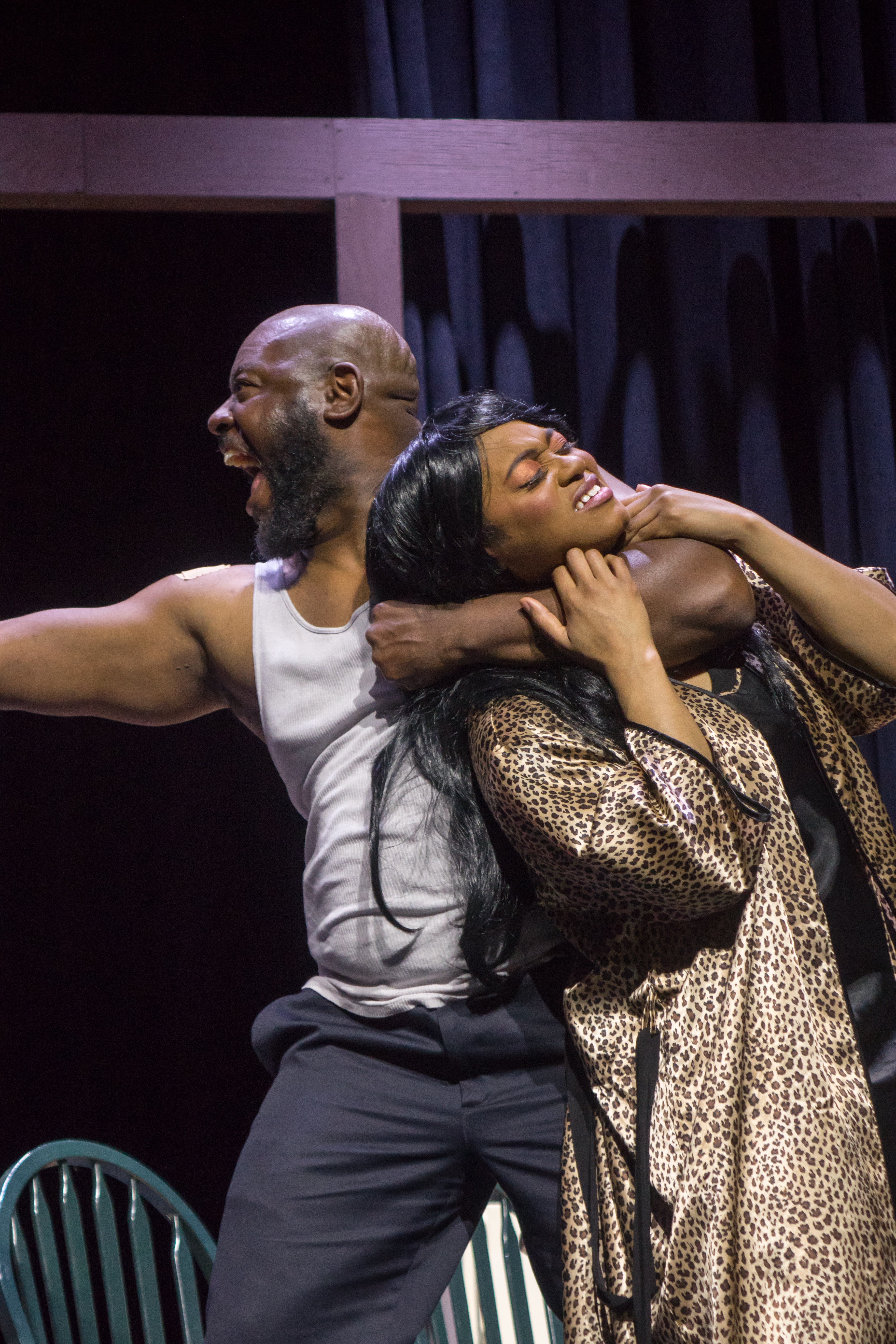
This point gets double-underlined when our host, a hulking Black ex-con, triple locks his front door behind his reluctant – and relatively puny – white guest. Subtly, something may click instinctively in us as we hear the clank of the locks. We are locked in this space for the duration of this debate, and the longer we linger, the more forceful White’s arguments become that Black’s life is cramped, sordid, and futile. We’ve gotten a taste.

It’s director Dee Abdullah who layers this emphatic entrance for Zach Humphrey onto the script, a nice touch. McCarthy also tips the balance of the debate in this harrowing direction, for Thom Tonetti as White is armed with more age, experience, education, wealth, and endowed with a professorial intellect.

In a jumpsuit designed by Abdullah, Humphrey appears to have more keys and tools dangling from him than locks on his doors – as if he’s a janitor or a subway worker. That’s where Humphrey saved Tonetti from jumping in the path of an oncoming train, catching him and carrying him home.

If Tonetti stays too long, his rescue becomes a kidnapping, and Humphrey seems to understand there’s a time limit on how long he can hold his suicidal guest against his will. His main intellectual artillery is the Holy Bible, bolstered by his faith, which he frequently brandishes if he’s not thumbing through it. Trying to preach this book to the local drunks, derelicts, and druggies hasn’t yielded any positive results – and he’s been at it long enough that The Greatest Book Ever Written engraving has worn off its cover.

Without a doubt, Humphrey has the more urgent, desperate, and anguished role, especially when Tonetti rubs his nose in his past and present failures – and the squalor surrounding them both. At his most fragile moments, we see Humphrey processing the devastating irony that he has admirably served his time, licked his wounds, and freed himself from one prison only to lock himself in another.

(McCarthy called his players Black and White in his 2006 script, subtitled “A Novel in Dramatic Form,” but those names are absent from the actual dialogue and the CAST playbill.)
One of the reasons we manage to like Humphrey more is his ability to admit, no offense to Jesus or Scripture, that he is intellectually overmatched. Teaching should trump preaching since it’s fortified with facts and knowledge. Won’t it simply hurt horribly when the Sunset Limited rams into him? No, Tonetti calmly responds, at 70mph, the train would outspeed his neurons.

If we press the pause button here, we can scrutinize a telling moment, for Tonetti – (and maybe McCarthy) has miscalculated. Trains don’t ever speed past train platforms at 70mph, needing to decelerate and accelerate before they’re gone. And if McCarthy had only had the luxury of a Google Hub a couple of decades ago, he could have ascertained that the max speed for MTA subway cars is 55mph.

So Tonetti has an extra psychological advantage: when he starts spouting facts – real, imagined, or fabricated – Humphrey will not contradict him. Yes, he does have all the time in the world to throw himself in front of the Sunset Limited, so he can remain calm and keep his cards close to the vest. If he maintains his resolve, whether combatively or cordially, he will prevail. He even realizes that he can spare the time for a cup coffee of and a bite to eat.

Heightened emotions from Tonetti spill out when he is most tellingly challenged and when he swerves to the counterattack. We may be hoping that Humphrey goads him sufficiently to spew out all the venom, hatred, resentment, and bitterness that lurks inside him, resulting in some sort of cleansing purgation. Or exorcism, since a dilapidated bible is ready-to-hand.

As it turns out, Tonetti has had too little connection with other humans for oceans of accumulated bile to come cascading out of him. Maybe he’s only metaphorically a professor! There is an enervated numbness to Tonetti that makes his sudden outbursts all the mightier.

It’s all a conspiracy, for we must factor in how Simmons has configured his black box into a thrust staging. The thrust of the compacted performance space, extending from Humphrey’s kitchen to his triple-locked door, implicates us all as it heightens our involvement.

When telling his gory prison tale of intense violence and grim survival, he was looking straight at Tonetti… and me right behind his left shoulder! And when I viewed both men sitting close to me in profile, I couldn’t help glimpsing how audience members in two other sections were reacting.

Yeah, it’s intense but sometimes a little comical. Face it, since the days of Socrates and Plato, any philosophical or existential dialogue will have its circular, tedious, or repetitive patches. You’ll be seeing smiles from other people across the way, some deeply pondering expressions, and the occasional blank wearied stare.

For me, that added to the experiential realism of my evening and enhanced my involvement.

Risen from the Dead, CAST’s Alabaster Is All About Artists in Crisis

Review: Alabaster at The Mint Museum

By Perry Tannenbaum

Google and Alexa will tell you if you ask: it’s a little bit more than a 17-mile drive from Bessemer to Alabaster, Alabama. Every source I’ve checked also confirms that Gip’s Place, the last backyard juke joint in America, was in Bessemer until its blues guitarist founder, Henry “Gip” Gipson, passed away in October 2019 at the age of 99. It’s useful to know that when we meet Weezy, the first character to speak at the Mint Museum – in the first Carolina Actors Studio Theatre production anywhere since its 2014 NoDa demise.

Weezy tells us that she lives at a small farm “right near” Gip’s Place in Alabaster.

True, we have ample reason to question Weezy’s veracity from the get-go, since she also introduces herself as a goat. Titling her comical drama Alabaster,playwright Audrey Cefaly could coyly blame her geographical inaccuracy on this cantankerous barnyard beast she created. But the choice, invoking the special malleability of a stone that has been reshaped by sculptors and artisans for millennia, is clearly an artist’s choice.

As we continue to follow the scrappy encounter between two artists in backwoods Alabama, one a celebrated photographer of celebrities and the other an unknown painter, we often find that Weezy – among other things – is Cefaly’s surrogate. In one meta moment you can look out for, Weezy even delivers a message from the playwright to one of our protagonists.

Mostly, Weezy serves as an irascible Jiminy Cricket for June, the one human survivor on the farm. When she isn’t offering up prompts and explanations channeled from Cefaly, she becomes June’s better self, the self that is wishing to break free of her self-imposed isolation and artistic obscurity. When sweet optimism sours into clear-eyed skepticism and cynicism, Weezy becomes the painter’s inner voice: June’s worst critic.

And sometimes, she’s a goat, caring for her ailing mama. Weezy is fluent in English and goat. Occasionally, she’s also clairvoyant.

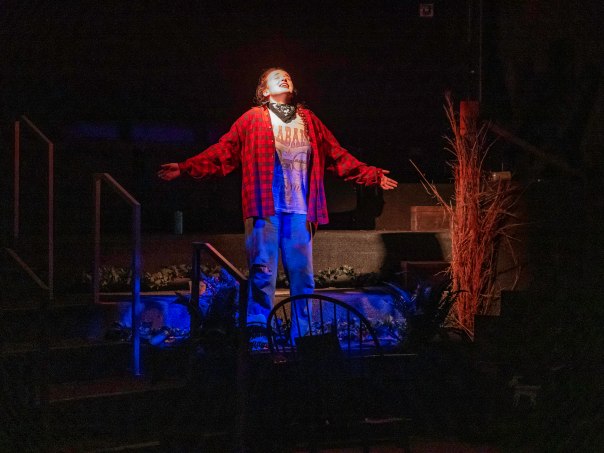
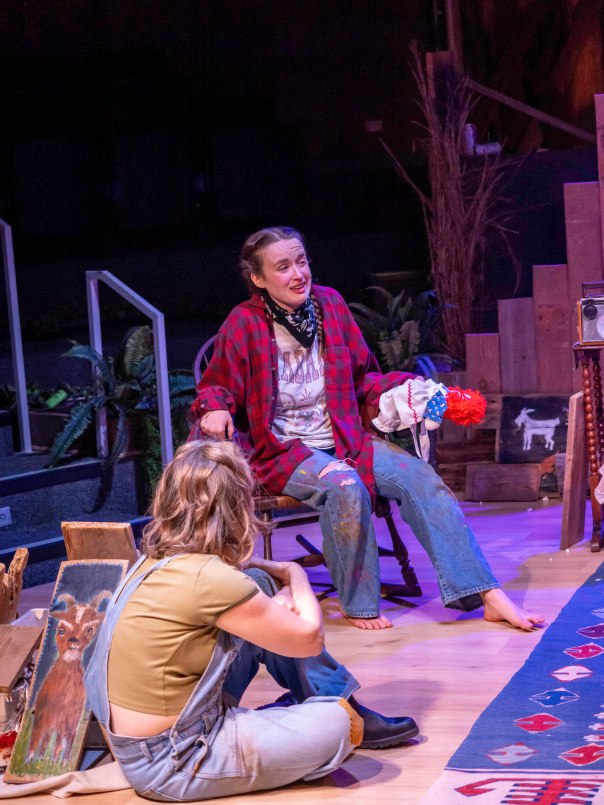
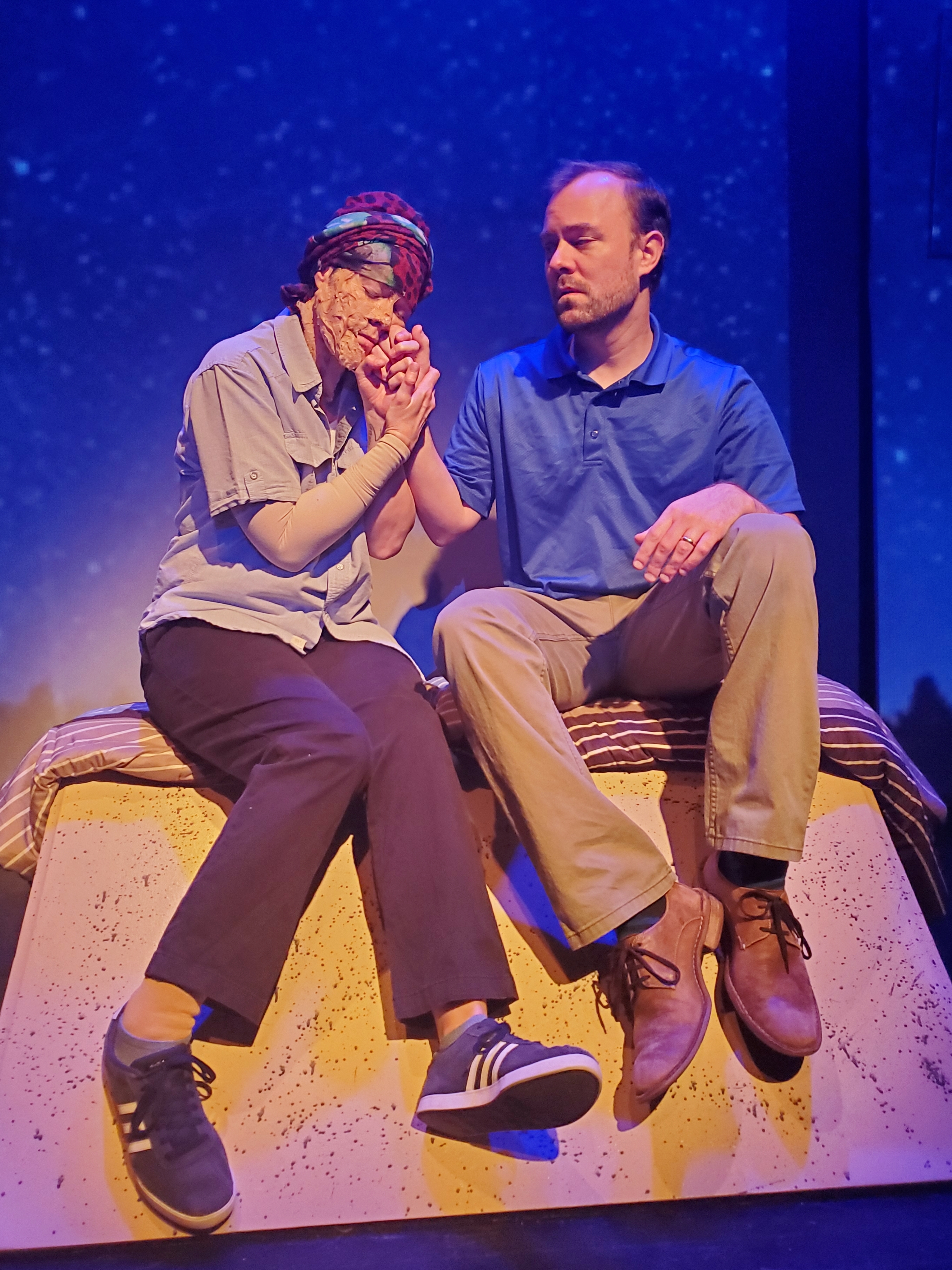
Both Bessemer and Alabaster are prone to tornadoes. Cefaly’s tornado has radically reshaped June, demolishing her farm and turning the entire left side of her body into a relief map of scars, patches, pocks, and swirling melty skin. Playing the role of June, Zoe Matney has a l-o-o-o-o-ng pre-show routine, for she must spend much more time than usual backstage getting director/makeup designer Michael Simmons’ concept applied – front and back, from torso upwards – with help from assistant director/makeup artist Dee Abdullah.

Then she is onstage as the audience arrives, long before lights dim and Weezy enters.

If Weezy weren’t there, we must also remember, we wouldn’t have a reason to hear from June, though her first response to the goat’s prodding is no more than a well-chosen finger. Fortunately, we are quickly liberated from the confines of an inner dialogue by June’s distingué visitor, Alice.

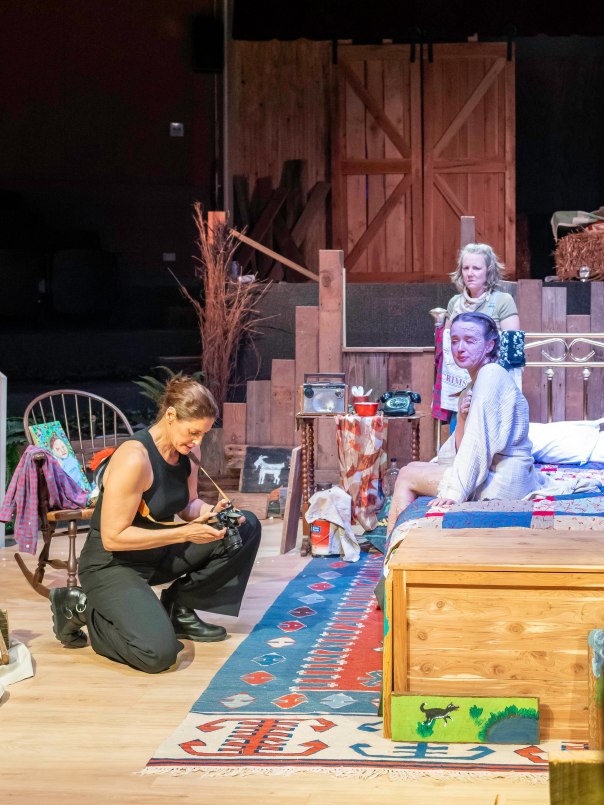
Acquainted, you can bet, with Annie Leibovitz and no further than a light meter’s distance from Demi Moore, Alice’s career has recent taken a hairpin turn to the scarred-women project she’s working on now. June is her seventh subject, and Alice works in multiple media. Trying to reach the traumatized inside of her subjects – all women – while finding the dignity and beauty mixed with the deformity outside, Alice documents them in video interviews and, when the time and light are right, by snapping coffee-table-quality portrait photos.

Are these scars a form of artwork?

A fresh aspect of artist’s choice comes into play with Cynthia Farbman Harris as Alice. Alabaster premiered in December 2019, just two months after Gip’s passing, in Fort Myers, Florida – the first stop in a “Rolling World Premiere” presented at 11 member companies of the National New Play Network, a rollout spanning from New Jersey to Oregon. The QC had a company in that Network, Actor’s Theatre of Charlotte, which had rolled with some of these co-op premieres before.

When asked about the switch away from glamor assignments, Alice deflects at first. She only gives herself away slightly when asking June about her “accident” – a word more apt for her own trauma – and when, egged on by June’s questioning, she scrolls back far enough among places she’s been before Alabaster to her rehab.

So it shouldn’t be too surprising to learn that Actor’s Theatre was scheduled to premiere Alabaster in the latter half of its 2022-23 season, just over two years ago. More of you will remember that Actor’s Theatre did not make it to the end of 2022, planting its gravestone among the most honored companies in Charlotte’s theatre cemetery before the halfway point of its 34th year.

For Harris, who auditioned for that abortive ATC production, it was a matter of not forgetting. She had worked with Simmons at CAST, with a variety of other stints at Moving Poets, Queen City Theatre, and Theatre Charlotte – including a pair of diva roles, Maria Callas in Master Class and Blanche DuBois in A Streetcar Named Desire. If the role of Alice stuck with her after ATC’s demise, there must have been plenty of meat on the bone.

With an eye toward reviving the edgy theatre vibe that reigned while ATC, CAST, and QC Theatre were all up and running, Cynthia and her husband, actor Michael Harris, have founded Actors Collaborative Theatre to help make it happen. The new ACT is an associate producer of Simmons’ rebirth, while Moving Poets and Charlotte Contemporary Theatre are among the companies listed in the digital playbill on CAST’s thank-you list.

If you know how long ago Harris starred as Blanche, then you know Alice is bit of a stretch, no matter how much she wanted it. We’re not just talking about the yoga scene. With Abdullah serving as intimacy director, June’s master bedroom becomes more than an artist’s studio. Scars and all, June brashly inquires whether Alice is gay, before we learn the photographer’s full backstory.

Somehow, Matney and Harris make their love-hate relationship work altogether naturally and spontaneously. It only becomes a little more cerebral than Cefaly imagined it. They lean into the age difference a little instead of pretending it doesn’t exist. But they do traverse the long, rugged terrain to the primal mode. The two artists debate whether their meeting is like The Bridges of Madison County or not. Yet they could also debate whether they are both hostile animals locked in cages of their own making – while the liberating keys are always in their hands.

Actually, they do talk about that.

Matney’s performance is every bit as stunning as Harris’s, if for no other reason than June is so moody and mercurial. Ambivalent about having her paintings exposed to outside world, June is living with desperate intensity in her present isolation, hoping for a sunnier future – she has invited Alice here, though she is wary – while repeatedly tortured by her past trauma.

Something as trivial as the beep of Alice’s camera can trigger flashbacks to the worst. Adding to the inner psychological circuitry are the stresses of fresh lightning and thunder – plus the partial nudity at the start of the photo session. Matney calibrates her various disturbances well when her hurting is raw, and she channels energy convincingly into compensatory actions when June is striving to appear calm and well-adjusted. She also leaves room for just the right amounts of flirtation and coquetry.

Kelly Mizell, who plays Weezy, can tell you how long ago Harris sashayed into Nawlins as Blanche, for she was an outstanding Stella Kowalski in that same Theatre Charlotte Streetcar way back when. Given the opening entrance, this talking goat decisively demonstrates that she can still command a stage before discreetly receding into the background, sometimes as a handy guide, sometimes as an annoyance, and sometimes as a mind-reader.

Mizell gets to show Weezy’s tender side caring for Bib, her mostly pallet-of-hay-ridden “Mmaaahaaaahaaaa… maaaaaah!” You can see Harris wanting to play Alice enough to partly bankroll and publicize a production, but with so much stage time and so little spotlight (or vocabulary) as this old goat, Debbie Swanson had to really want this Mama Bib role. She’s wonderful when her moment comes.

Otherwise, there are remarkably few signs that Simmons and the Harrises are doing all this on a shoestring. Lighting design by Dave Meeder easily ranks with the best we’ve seen at the Original Mint’s Van Every Auditorium on Randolph Road. Tim Baxter-Ferguson, another name we fondly associate with a bygone era, installs a marvelously rusticated twin-level set design that simultaneously gives off vibes of woodsiness, springtime color, and irreversible damage.

Sophie Carlick’s costumes don’t have to be lavish, but they enable June, Weezy, and Alice to radiate an outdoorsy aura. Cleverly enough, June’s bedroom outfit hides her preoccupation with painting as decisively as her splotched overalls proclaim it, but the goat costumes also strike a perfect note. So do the many artworks fashioned for June’s artistic oeuvre on barnwood, to be auctioned off when Alabaster completes its run.

Simmons’ sound design and special effects are on-point, but I wish they had impacted more: louder, with more lightning crackle and windy sweep. Nor was the ringtone on Alice’s cell as ugly as Cefaly intended. As a photographer, I had to chuckle at the sadly unprofessional equipment we were seeing, including a camera with an onboard flash. Yet I could empathize with Harris – and admire her all the more – when she had to keep that lame videocam running and the still camera showing snaps on its screen.

When Alice instructs June on how to use a smart phone, when she shows her how to trip the shutter, and how to review the photo portraits on the wee screen… Quiet moments like these resonate with us, because they are part of a bonding process, two healing processes intertwining. Two resurrections. Three if you count the rehab June and Alice join in on with those barnwood scraps.

Good reasons to smile as we left the Mint. Along with the resurrections of CAST and a vital drama Actor’s Theatre never got to present.

“Clyde’s” Serves Up a Delicious Seize-the-Food Message

Review: BNS Presents Clyde’s at the Parr Center

By Perry Tannenbaum

September 13, 2024, Charlotte, NC – Over a lazy Duke Ellington piano riff that becomes indelible almost as soon as you hear it, John Coltrane layers on the melody of “In a Sentimental Mood,” recorded 62 Septembers ago. Although we’re in a kitchen at a truck stop that doesn’t look nearly that old, somewhere along the highway in Berks County PA, it’s a fitting intro to the new BNS production of Clyde’s. Along with the mean and sassy owner of this diner, Clyde, we meet her star employee, the zen-like Montrellous, also described by two-time Pulitzer Prize winning playwright Lynn Nottage as “the John Coltrane of sandwich making.”

Nottage’s newest comedy-drama originally premiered in Minneapolis as Floyd’s in 2019, less than a full year before George Floyd was killed by local police – so it was prudent to change the title before the Broadway opening in 2021. Yet a police state haze still hovers over the action, since all the employees at Clyde’s are ex-convicts or parolees, including the owner. She’s not a criminal now, but something or someone has clearly hardened her. Montrellous believes that Clyde’s could be a smashing success if it served up extraordinary sandwiches. She wants to stick to basics, lay low, keep a low profile, and lower her costs on the ingredients her drones drop between two slices of bread.

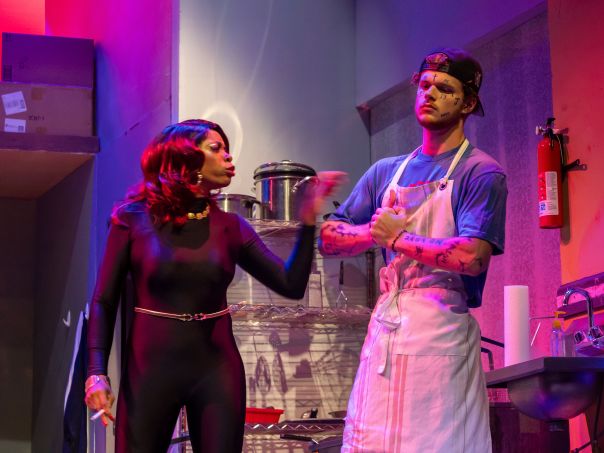
Limiting ourselves on food analogies, let’s say Clyde is one tough cookie, tightly wound to match the tight-fitting outfits costume designer Aneesah Taylor has tailored for her. You do not smile around Clyde, Montrellous warns newbie Jason, a recent parolee. He doesn’t listen. To his distress, he will learn the hard way that Clyde is the Captain Bligh or Queeg aboard this ship. Ah, but there is deeper wickedness to this boss: there is a Jezebel gene in her DNA, for Clyde is a toxic temptress. On a couple of occasions, the owner’s forays into her kitchen reminded me of Curley’s luscious wife sashaying among the farmhands in John Steinbeck’s Of Mice and Men.

The mice here mostly get to play when the boss isn’t peeping through the pickup station, hanging a barely legible order on a little carousel, and banging a bell. Director Dee Abdullah has her kitchen staff reveling in those moments when they aren’t wrapped up in a food prep frenzy. transforms the place. For him, sandwich making should never be drudgery. It is more like a mission, a calling, a crusade, an artform…or a lifelong quest for the perfect sandwich. Suffering and anger can seep into the food you make.

This ministry is not for Montrellous exclusively. When the pace in the kitchen slackens, all four workers lean over their prep stations and take turns chanting the ingredients of sandwiches never built before, swooning collectively over their imaginary deliciousness. In these moments, the kitchen is more like a studio or a writers’ room as the creators brainstorm ideas. And when the coast is really clear, Montrellous reaches into a low cabinet upstage center and extracts his latest masterwork, placing it reverently in the exact middle of the three prep stations. Since James Dukes’ lighting design accentuates the gleam of the Saran wrap around Montrellous’ newborn brainchild, the radiance turns Clyde’s kitchen into a holy temple of sorts. Epicures looking at the three stations centerstage at the Parr Center can be excused if they’re reminded of the Last Supper by Jennifer O’Kelly’s set design.

With this sacred imagery in mind, it’s hardly surprising that Montrellous’s precepts begin to transcend food preparation as we get to know more about him and about Clyde, Jason, slicer-and-dicer Letitia, and the man with the pans at the stove, Rafael. As much as Montrellous wants to convince Clyde to be more enterprising and adventurous – and less dogmatic and stingy – the adoring and adorable Rafael wants Letitia, forever stressed by her infant and her ex, to just give him and chance. Really, this romantic subplot occupies more space and time than the overarching struggle between Clyde and Montrellous, so we don’t think we’re watching supporting players when we see Lisandro D. Caceres-Zelaya in action as Rafael propositioning and wooing Toi Aquila R.J. as Letitia.

“Not enough salt, the flavor doesn’t come out; too much salt, it’s inedible,” Montrellous pronounces. Both women, taught by their past experiences, fend off new ideas and intimacies, fearing all because they’ve had too much before. Both are skeptical that being asked out could be motivated by any other reason than sexual exploitation, whether tender or forceful. Fortifying her resistance to anything Montrellous creates, Dominica Ivey as Clyde turns down every simple invitation to give it a taste. She wields her ever-present cigarette like a dagger, and her every exit is a devastating kiss-off, somewhat comical because she’s so decisive. You begin to wonder whether Ivy has any empathy for her ex-cons: maybe Clyde hires them because they can be bought cheaply.

To be sure, Ivy can string any male along in her wanton mode, but it’s Aquila as Letitia who gives off the most bi-polar vibes. When she isn’t sullenly brooding or crazily hacking lettuce as if she were Lizzie Borden, Aquila is shaking some fine booty and boogeying, reminding us of the charisma she radiated as Eartha Kitt last September. We have no difficulty understanding what Rafael sees in her, and Caceres-Zelaya lights up the stage with his sunny energy, evoking for me the irrepressible verve of Usnavy in Lin Manuel Miranda’s In the Heights.

When he isn’t presiding over the sacrament of sandwich making – and his apostles’ efforts to reach his lofty level – Zach Humphrey as Montrellous is largely a peacemaker. He intervenes with calm authority when Clyde and Jason come close to blows, and he’s a guiding light for both Letitia and Rafael as they gravitate toward one another. “Trust your ingredients,” he sagely says more than once. Everyone is different. People’s possibilities are as infinite as the varieties of sandwiches you can imagine.

Making his professional debut, Anthony Lonzo as Jason presents special challenges that audience members might struggle with, for the tats on his face and spew barbarity and hatred. Onstage, the tats are chiefly repellent to Latitia, but since Jason doesn’t speak much at first, we also need to delve beyond skin depth to grasp what he’s all about. Nottage gives each of the kitchen workers a juicy monologue to reveal what’s inside and in their rearview mirrors, and we’ll likely remember Lonzo’s nearly as vividly as Humphrey’s. But an unspoken maxim sprung to mind as Duke’s lighting finally sanctified Clyde in her memorable epiphany. It’s a wonderful little saying from the Psalms of David that I first learned from a book title by Denise Levertov: O Taste And See. At times the lesson is merely culinary. But ultimately, the message is experiential, about adopting an empirical attitude instead of hardening our prejudices. Above all, it’s an injunction to fully live our lives.

Photos by Perry Tannenbaum

Kennedy’s Bridge Circle Meets Its Quota of Quips – and More

Review: The Thursday Bight Bridge Circle at Theatre Charlotte

By Perry Tannenbaum

Since 1987, the last time I watched a live performance at St. John’s Baptist Church, I haven’t cut a deck, played a hand, won a rubber, or even bid a single No Trump – I’ve even lost track of my copy of Charles H. Goren’s Point Count Bidding. But since that night when PlayWorks staged The Octette Bridge Club at St. John’s, I haven’t needed much knowledge about the game of bridge or its culture. My last brushes with the game were in Sunday columns I would read in the arts section when The Charlotte Observer was a traditional newspaper.

So it was a little concerning, when I sat down at Theatre Charlotte for the premiere of Ray Kennedy’s The Thursday Night Bridge Circle, that I found no less than four bridge teachers were credited in the playbill for their contributions. My concerns were thankfully unfounded. Visitors to the Queens Road barn will not be assailed with bridge terminology, the intricacies of bidding, or even extensive card play.

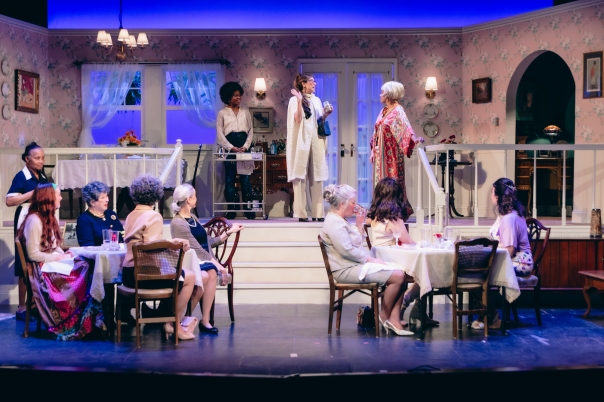
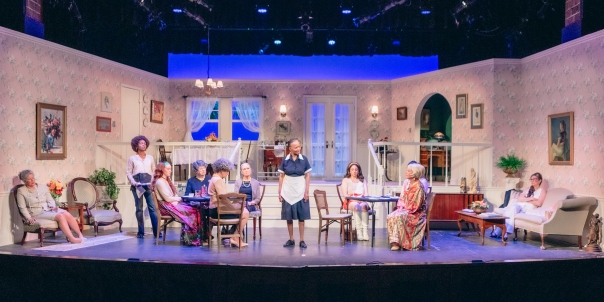
Louise Kennedy’s circle is a looser agglomerate than P.J. Barry’s octet, which was an unwavering group of eight sisters. And it’s only Louise’s circle tonight because hostess chores hopscotch from member to member on successive Thursdays. Nor are participants constant, we learn, as Louise welcomes us to her cheery, symmetrical, split-level living room – two tables flanked by two sofas – a luxe scenic design by Tim Parati that gives us peeps at the garden and the foyer.

Tonight, for example, Louise’s college co-ed daughter, Mary Carter Kennedy, is in town to play one of the hands, to be partnered with Louise’s mother-in-law, Mrs. Kennedy, who has earned a risqué reputation in LaGrange, North Carolina, as a liberal. Since one of the regulars can’t make it this week, dear Louise is bracing herself for the arrival of Miss Virginia, who will likely be roaring drunk as soon as she can guzzle sufficient booze. Excitement is ratcheted up further by a new player that only our host knows, Carmella, feared to be a judgmental Yankee – and to have a profession!

Imagine that!

The two tables are filled out by Bootsie and Cluster, gals from Louise’s generation, and two more elders, Miss Caroline and the eternally disapproving Mrs. Coltrane, Louise’s mom. You can bet there will be plenty to rouse Mom’s umbrage, beginning with the fact that housemaid Margaret and her daughter Bernice will be mixing drinks, pouring beverages, and preparing the hors d’oeuvres. Mary Carter also has a truckload of disclosures that will disconcert her granny.

Hosting such an exhilarating event is so intricate, complex, and daunting that Louise – or anyone who hosts the circle – cannot be expected to participate in the cardplaying. The standard of perfection is too high for a hostess to divide her attention. Tables must be carefully set, partners thoughtfully chosen, and place cards placed exactly so at every chair.

Sadly, Carmella hasn’t chosen the best night for her first sampling of Southern hospitality – or the best year. It’s 1970, LBJ is midway through his second term and the backwater of LaGrange still has separate black and white schools, bathrooms, and post offices. “It’s always been that way,” Miss Caroline complacently declares, and none of the LaGrange ladies except the liberal Mrs. Kennedy seems to suspect that Margaret or Bernice might be discontented with the racist status quo.

Needless to say, Kennedy has concocted a comical time bomb that is primed to explode before our eyes. Desegregation has arrived and Louise’s mom and husband have decided to send their imperiled offspring to military school – a betrayal of Louise’s bestie, Bootsie, who was counting on her public-school solidarity. Nor will Mary Carter, an activist at school, take this well, while Carmella and Mrs. Kennedy will be reliably alarmed. Toss in a stray N-word from Virginia when she’s sufficiently lubricated and you may conclude that a polite evening of bridge has been scuttled.

Before his fictional kindred took the stage on opening night, the playwright Kennedy spoke to us about his autobiographical work and introduced us to the real-life Mary Carter, proudly sitting in the third row. So when Tonya Bludsworth entered as Louise, it was a bit like a continuation of the playwright’s monologue, except that the hostess was giddier with excitement and nervousness because she didn’t know how the evening would go.

Sketching each lady who would sit in each bridge chair, the intro was a bit draggy despite Bludsworth’s fretful charm, particularly since the playwright doubles down on his intros by granting Louise mystical foresight into who is arriving at her front door – tripling down when she greets them by name. Most people will be delighted with Kennedy’s style, which endows most of his characters with the ability to come up with a Southern-fried quip or a salty simile in nearly every sentence.

Almost by magic, Kennedy is able to differentiate between his ladies anyway, thanks to the big family squabble and the political, class, and age divides. Dennis Delamar’s stage direction is as handsome as Parati’s set, elegantly accessorized by “props team” Lea Harkins and Lois Marek. No doubt Delamar’s successes are facilitated by the presence of at least three more actor-directors in his cast, Corlis Hayes as Margaret, Paula Baldwin as Mrs. Kennedy, and Bludsworth as the fourth ace. Assistant director Dee Abdullah is no slouch, either, as a dramaturge.

Kennedy’s lapses into logorrhea may be the result of his not realizing the full power of his script, which bursts forth with terrific force on Queens Road, first when Hayes reacts to the bombshell dropped by Kathryn Stamas late in Act 1 as the soused Virginia (which Grace Ratledge as Mary Carter and Ashley Benjamin as Bernice refuse to let go) and then a stunner by Ann Dodd as Mrs. Coltrane when she is unexpectedly confronted deep in Act 2.

Costume designer Angeli Novio accepts the challenge of making the hotsy-totsy New York lawyer, Stephanie DiPaolo as Carmella, stand out among the local LaGrange fashionistas in her haute couture. DiPaolo does her Long Island accent lightly enough to maintain her stature as an evolved Yankee outsider, but instead of leaning more into her legal expertise and feminist superiority, the playwright lets her devolve into an excuse to more thoroughly introduce us to the natives.

No matter how charmingly Jenn Grabenstetter as Bootsie and Amy Pearre Dunn as Cluster expound on the origin of their Dixie nicknames, I just don’t care, even if it did incentivize them to audition. Let’s get to the juicy stuff quicker! And when we do get there, let Baldwin have more space to bemoan and bewail how her son could conspire with Mrs. Coltrane to send her dear grandson off to a boarding school. It’s a glaring plot point that needs to be addressed – and weren’t we in the middle of a war in 1970?

Regardless of how much more meat Kennedy could pile onto our plates (and how much candy he could discreetly remove), Hayes makes an enduring impression in her climactic monologue, deftly calibrated by the playwright not to become a tirade. Ginger Heath, anointed my first Best Actress many years ago, get surprisingly little to sink her teeth into here despite her imposing wig, but that only spotlights the exploits of the newbies all the more.

Benjamin absolutely commands the stage when she unexpectedly returns in Act 2 as Bernice, a bit of a surprise after her badly miked debut as Tinman last September. That leads to a rather memorable sequence of assertiveness, contrition, and reconciliation begun by Dodd in her QC debut as the formidable Mrs. Coltrane. I didn’t expect to weep after intermission, but I did, even while the quips kept landing.

“Detroit ’67 Spins Motown Into History

Review: Detroit ’67 at Theatre Charlotte

By Perry Tannenbaum

Baked into many great American plays is the notion that dreaming big, striving for the golden apple of success, is a kind of latter-day hubris – sure to be tragically quashed and beaten down. Walter Lee Younger in Lorraine Hansberry’s A Raisin in the Sun was a grim example of such a tragic hero, dreaming of owning a liquor store in Chicago during the 1950s. It was hard for me not to think of Walter Lee’s beatdown – and paradoxically, the soaring success of Sidney Poitier, the breakthrough actor who portrayed him – as Dominique Morisseau’s Detroit ’67 unfolded at Theatre Charlotte.

Tautly directed by Ron McClelland and superbly designed by Chris Timmons, Morisseau’s work is darker and bloodier than Hansberry’s classic but emphatically more hopeful. Even with the background of the Detroit race riots of 1967, the pride of Black culture never leaves our eardrums for long as a clunky old record turntable, replaced by a slicker 8-track player and a pair of bookshelf loudspeakers, cranks out the hits of Motown’s famed music machine.

Come on, David Ruffin! The Temptations! Smokey Robinson and The Miracles. Mary Wells. Martha and the Vandellas. The Four Tops. Gladys Knight and the Pips. Marvin Gaye.

Morisseau’s protagonist, Lank, and his sister Chelle are trying to upgrade their unlicensed basement bar so that it will become more competitive with other after-hours speakeasies – when Sly, Lank’s best friend and a numbers runner, offers him an opportunity to buy into a legit bar. History lesson: a police raid on one of the unlicensed bars Lank and Chelle are seeking to emulate triggered the Detroit riots, the worst in 20th century America until another shining example of policing, the Rodney King riots in LA, eclipsed them in 1992.

While the riots rage and Michigan guv George Romney is calling in the National Guard, Lank and Sly are striving to scout out their hoped-for property and close on a deal – against Chelle’s wishes. Meanwhile, a second hubris slowly develops as Lank shelters a lovely white woman, Caroline, who has been battered and is mysteriously linked with the white underworld. She’s actually in more mortal danger than Lank.

Despite mutual suspicions, Caroline and Lank are drawn to each other. But they bond over Motown music, and they are both capable of busting a dance move.

The rioting in the Motor City was a prelude to the Black Power demonstrations at the Mexico City Olympics in 1968. We can also view them as a precipitating factor leading to the pride-filled Summer of Soul celebrations in Harlem and the rapprochement between the races on the musical scene that accelerated at the gloriously chaotic and inspiring Woodstock Festival of 1969, for so many of us the decade-defining event of the ‘60s.

So Detroit ’67 not captures a city in turmoil, it echoes the prime crosscurrents of that era, the struggle of Black people for their legitimate rights, the backlash from white people and government, and the mainstreaming of Motown as it breaks into pop culture. And by the way, Sidney Poitier’s To Sir With Love and Guess Who’s Coming to Dinner were both released in 1967. The question of whether Blacks were making significant progress, suffice it to say, was very much up in the air as we watch this action at the Queens Road barn.

Running an underground business together, Lank and Chelle are more advanced in their autonomy, street smarts, and connections than Walter Lee and his sister Beneatha were, still living under their mother’s roof with Walter Lee’s wife and child. Pushback against Lank’s feasible but difficult dream comes entirely from Chelle, who can realize deep down that continuing to run an illegal operation is also a risky choice.

Morriseau, McClelland, and Shinitra Lockett, making her acting debut as Chelle, all seem to have made this same calculation. So Lockett seems noticeably more vehement in her opposition toward Lank’s romance with Caroline than in her objections toward his business venture with Sly. On the business end, Sly’s persistence and charm in pursuit of Chelle’s affections bodes well for his deal-making prospects, another softening factor, for Lockett occasionally shows us that the slickster is making headway.

Because we see Graham Williams is so composed and self-assured as Sly, we can begin to see Lank as acting audaciously and responsibly. Yet there’s enough shiftiness mixed with Williams’ confidence for us to retain Walter-Lee misgivings about their venture, especially when the riots and the National Guard are thrown into the mix. Devin Clark, one of Charlotte’s best and most consistent performers for more than nine years, gives Lank a stressed and urgent edge. He’s not as regal and commanding as he was portraying Brutus last summer, but he’s far more spontaneous and charismatic.

Chandler Pelliciotta, in their Theatre Charlotte debut, brings a bit of shy diffidence to Caroline that meshes well with her story. Her worldly swagger has obviously been dealt a severe blow as she wakens, bruised and disoriented, in the basement of a Black man’s home she has never seen before. While Lank is drawn to her and wishes to protect her – we aren’t always sure which of these impulses is in play – Chelle has a couple of good reasons to wish her gone.

Not the least of these is the trouble Caroline is in with people who have battered her with impunity. The trouble might pursue her and find her at this fledgling underground speakeasy. It’s an awkward position tinged with risqué allure, but Pelliciotta’s performance leans more into the awkwardness, their glamor far less in the forefront than their fearfulness – for Caroline herself and for her protectors.

You can probably name 15 Black sitcoms that have characters like Chelle’s mismatched chum, Bunny: sexy, flirty, quick-witted, and imperturbable. Germôna Sharp, in her bodacious Charlotte debut, takes on her life-of-the-party role with gusto and sass. Sharp makes sure we’re not getting a PG-17 version of Bunny: slithery, regal, carnal, and militantly unattached. She will dance with anybody – Lank, Sly, or Chelle – but not for long, totally neutral amid the sibling fray.

Costume designer Dee Abdullah helps turn on the glam, more flamboyant for Sharp and more elegant for Pelliciotta. Morriseau withholds from her characters any sententious awareness that they are standing at Ground Zero of anything historic, now or in the future, but she clearly wishes that awareness on us. A distinctive black fist is prominently painted on one of the basement walls, right above the record player and the 8-track, and its presence is meaningfully explained.

Nor should we consider evocations of Hansberry’s classic urban drama as accidental. Morriseau’s script tells us that her protagonist’s name, Lank, is short for Langston. It cannot be a coincidence that the poet Langston Hughes wrote “Harlem,” the iconic poem from which Hansberry drew the title of her masterwork, A Raisin in the Sun.

BNS Conquers Adversity in Opening of Speakeasy, Shining at the New Parr Center

Review: Speakeasy by Rory D. Sheriff

 By Perry Tannenbaum

2023~Speakeasy-15

February 17, 2023, Charlotte, NC – Quick adaptation and a be-ready-for-anything state of mind are key survival tools for any performer who ventures into the minefield of live performance. But as opening night for BNS Productions’ Speakeasy inched closer, booked for this weekend at the new Parr Center – where no local theatre company has performed before – Charlotte’s preeminent black repertory company stepped on an explosive they couldn’t avoid. Just before the three-day run was scheduled to begin, one of their lead players came down with COVID.

Rory D. Sheriff, the author of the new script and founding artistic director of BNS, was forced to shuffle his cast, elevating Marcus Looney from a minor role to leading man while stepping into the vacated role himself. Both of these actors appeared on opening night, turning what would ordinarily be termed a workshop production into a rather fancy reading stage effort, enhanced by the scenery and lighting (also by Sheriff) we would expect in a full production, with six of the eight cast members off-book.

A couple of the main themes in Sheriff’s new work, starting over and working together to save the day, mesh well with the behind-the-scenes tumult. After leaving her abusive husband, Virginia is hoping to make a new life for herself – without a man, for a change – back at her dead parents’ home in 1978 Reading, Pennsylvania. Doing this her way is hindered by her wanton sister Marge, who is tirelessly “pimping” the newly-available Virginia around town, and the inevitable pursuit of men who have heard about the breakup.

The most aggressive of these is Percy, the horny neighborhood cable guy. On top of that, while leering at Marge, the mailman delivers an alarming formal letter informing Virginia that her parents left their property taxes unpaid for over 10 years. She must quickly come up with over $1000 or get out. Older brother Roosevelt, a starchy preacher man, would much rather sell the place than provide her sister with the balance.

Well, if you already have a cable guy and a mailman knocking at your door and salivating, Marge proposes that Virginia do the next best thing to prostituting herself: jointly turning the family homestead into a speakeasy, where local men can pay out to enjoy the sisters’ company in exchange for alcoholic beverage, assorted snacks, and free cable TV, courtesy of Percy. Prohibition hasn’t returned to Pennsylvania, but the sisters can’t legally peddle booze without a state license.2023~Speakeasy-09

A volatile triangle develops before intermission as Percy feels entitled to take further advantage of Virginia, spending the night and tiptoeing out the back door with the speakeasy’s take. Hard to report a crime like that to police. Virginia might have a white knight willing to champion her cause, a Winston-Salem refugee named Horse who has fallen hard for her, but she keeps pushing him away even after he wins Marge’s sincere endorsement. Cecilia McNeill has taken on a very conflicted role in Virginia, earning our empathy with her troubles while drawing our impatience – and occasionally our annoyance – with her negativity and her deafness to what Marge, Horse, and her own heart are telling her about her new beau.

McNeill carried it all off rather brilliantly in her auspicious debut if you consider how little time she had been given to acclimate to Looney as her co-star and how often her true love had to gaze downwards at his script. It was hugely helpful that Looney was off-book when he made his first entrances through the back door to the sisters’ speakeasy, and that after intermission, when he always had his script with him, he prioritized memorizing those lines where Horse should be gazing most intently at Virginia instead of the script. Otherwise, the role never appeared to be beyond Looney’s depth. A lingering photo at the BNS website of Jonathan Caldwell, originally cast as Horse, made me think that Virginia’s worries about him tossing her over would be more credible if he were there. If it were Caldwell standing up to Tim Bradley as Percy when the action peaked, I also suspect that it would have looked more like an equal match and not as brave or quixotic.2023~Speakeasy-12

Such alterations are always the byproduct of casting different actors in the same role. Sheriff can make peace with them or he could possibly like them better, but I’m sure that he would hate to discard Bradley with his imposing presence and his boisterous vulgarity. Horse the outsider and Percy the loose cannon are the two men that remind me most readily of the American Century drama cycle by August Wilson, an inspiration that Sheriff candidly acknowledges. Having appeared in three different BNS productions of Wilson’s dramas – and importing an extra roar from the title role in Sheriff’s Be a Lion – Bradley straddles those two realms magnificently, a lowlife rascal who can be quite formidable and menacing.

Alana Jones, Bradley’s slinky consort in Lion, is a bit over-directed and overly frisky here as Marge, her broad comedy projecting far beyond the stage and hall to faraway Gaston County. But the audience adored her, so Jones will likely continue mincing around her speakeasy like a cartoon cat. The contrast is certainly effective when she becomes candid and caring with Virginia. A bit of a clothes horse, Jones is my prime suspect for slowing down scene changes, for costume designer Dee Abdullah’s ample wardrobe has her feverishly changing costumes whenever she’s not sashaying onstage. I’d be surprised if she wears less than five get-ups, but the guys also have multiple outfits.

All the guys are nicely seasoned and excellent, providing additional Wilson flavoring. Dominic Weaver as Roosevelt puts a nice soft spot for Virginia in the middle of his sanctimonious hauteur that we can see from the beginning, when the upright minister is difficult, obstinate, and stingy. In his BNS debut, Andrew C. Roberts gives us some meaty civil-rights-movement context in a powerfully delivered monologue, although it seems to come from nowhere. James Lee Walker, II, has done so many uniquely stylish roles for BNS and other companies around town that I was not at all surprised to see him shine – in one scene literally shine in a glittery shirt.

A bit of the stilted dialogue we heard an opening night will likely vanish as Sheriff refines his script, and more variety in how extended monologues are staged and lit will likely materialize in the hands of a defter director. For starters, the guys might explicitly confirm what card game they’re playing at the speakeasy and which Ali fight they’re watching on TV. Feedback that Sheriff receives from this workshop edition will likely help him to sharpen his characters’ sparring and deepen their drama. He and BNS are off to a great start at their new venue.

Brooklyn Grace Receives a Classic Museum

Review: BNS Productions Presents The Colored Museum

By Perry Tannenbaum

CCC02899

In every decade since it premiered Off-Broadway at the Public Theater in 1986, George C. Wolfe’s The Colored Museum has had a homegrown revival here in Charlotte. GM Productions premiered it up in the Attic Theatre at the old Afro-Am Cultural Center on 7th Street in 1993, and Carolina Actors Studio Theatre brought it to their C.A.S.T. location out in Plaza-Midwood ten years later. On Q Productions finally smuggled Wolfe’s 11 vignettes – or “exhibits” – into an Uptown site at Spirit Square in 2011.

Now BNS Productions has brought Colored Museum to its unlikeliest location, the Brooklyn Grace Venue, alias the Grace AME Zion Church on S Brevard Street. Each new revival more fully cements Wolfe’s satire as a classic – Winthrop U and UNC Charlotte have also chimed in with productions since 2009 – and each new resurrection that I see strikes me as fresh and hilarious as the first.

Of course, nothing compares with the edge and impact of your maiden encounter. Wolfe hurls a few choice barbs at white folk, mostly mocking their bland cruelty, but armed with an all-Black cast, it’s African-Americans and their culture that he assails with the most conspicuous gusto. All Colored Museum casts get to feast most hilariously on the sufferings and posturings of the Younger family in Lorraine Hansberry’s A Raisin in the Sun. Walter Lee’s wailings against “the man” in this “Last Mama-On-The-Couch Play” take a detour into Beau Willie Brown’s barbarity in Ntozake Shange’s for colored girls.CCC02756

Familiarity with those two stage gems helps you to savor Graham Williams, Sr.’s over-the-top brilliance as Walter-Lee-Beau-Willie, but his reappearance, immediately after intermission, as The Man only magnifies his triumph. For Wolfe delights especially in depicting the disfigurements that black people inflict upon themselves to survive and succeed in white America. The Kid, played by Jonathan Caldwell, must now disown and discard his Afro-comb, dashiki, autographed Stokely Carmichael photo, Afro-sheen, Jimi Hendrix and Sly Stone recordings, along with Eldridge Cleaver’s Soul on Ice – replaced, The Man tells him, by The Color Purple.

Black Power and protest must be tossed into the trashcan along with slavery if you wish to get to the top. The Kid is dismayed, incredulous, and beside himself when The Man reaches for… The Temptations Greatest Hits! Yes, if The Man is to feel totally comfortable in his black business suit and fully acclimate to white blandness, even “My Girl” must bite the dust.CCC02782

Women also get choice bits from Wolfe, beginning with Nasha Shandri as our prim stewardess, Miss Pat, welcoming us aboard Celebrity Slaveship and inviting us to fasten our shackles as we cross the Atlantic to Savannah. Dancing in the aisles seems to be allowed during our voyage – as long as we keep our shackles on – but “No drums!” Of course, we will get a bluesy cooking lesson from Sandra Thomas as Aunt Ethel, teaching us, with abundant historical ingredients, how to cook up “a batch of Negroes.” Uncanny Aunt Jemima resemblance here.

Shandri and Thomas both reappear in “The Last Mama-On-The-Couch,” with Thomas in the title role switching from cheery to grumpy and Shandri upbraiding Walter-Lee-Beau-Willie (and cataloguing her own sufferings) as Medea Jones, a subtle reminder that white folk are also known to drop babies from great heights. Most of this skit targets Raisin, of course, with Toi Aquila R.J. as Lady in Plaid serving as Shange’s leading Colored Girls emissary.

Meanwhile James Lee Walker, II, has a tasty role as our narrator, bestowing an Oscar-like statuette upon one actress after a heart-rending monologue and then ripping it out of her grasp when the next actress tops her.CCC02580

Walker has already topped himself as the regal, finger-snapping drag queen who imparts “The Gospel According to Miss Roj.” Revisiting Wolfe’s Museum, director Dee Abdullah limits herself to the crossdressing that’s in the script. In 2003, by contrast, Aunt Ethel and Last Mama were also done in drag. But Abdullah brings back Chris Thompson from the CAST production, so the West African choreography at Brooklyn Grace – and the forbidden drumming – have the same sparkle.CCC02717-1

Acoustically, the Grace isn’t ideal for theatre, nor is the place outfitted for professional-grade lighting design. But Abdullah, Sandra Thomas, and Shacana Kimble compensate, teaming up for an admirable array of costumes, from the frumpiness of Last Mama to the imperious splendor of Roj – and on the other side of intermission, the voguish gown of LaLa Lamazing Grace, an expatriated Josephine Baker wannabe done with slaying disdain by Jess Johnson. Until her down-home roots are exposed.CCC02449

In “Hairpiece,” Shandri plays a woman who has literally burnt her roots. Or as Johnson puts it as LaWanda, “She done fried, dyed, and de-chemicalized her shit to death.” All to please the man that Shandri is now dumping. LaWanda is actually a talking wig stand, facing us on a makeup table (and presumably Shandri as well in a fourth-wall mirror). She’s debating whether her owner should be shaking her hot-pressed tresses back and forth when she irately gives her boyfriend the ax, or whether Janine, the Afro wig contemptuously advocated by LaTonya Lewis, should be the fearsome choice to make him shrivel.

While the wigs are debating whether Shandri is most powerful in her natural or chemicalized crown, it’s easy to forget the satirical barb that Wolfe has tossed toward the menfolk. The finally-dispensable boyfriend was a “political quick-change artist,” Janine dishes. Every time “he changed his ideology, she went and changed her hair to fit the occasion.”

Style is important, that’s for sure. Aside from Raisin, the most sacred cow that Wolfe takes down is Ebony Magazine, the barbershop bible of African-American life. Lewis and Williams are the supermodel couple of “The Photo Shoot” who have given away their lives to be beautiful and wear fabulous clothes month after month. Relentlessly smiling and feeling no pain.

Perhaps the wisest thing about Wolfe’s Museum – the good, the bad, the ugly, and the absurd – is that it’s simply there. Do with it as you wish.

“The ultimate questions from Wolfe apply with a fierce pertinence to all oppressed peoples,” I wrote in response to Abdullah’s 2003 production with CAST. “How do we carry the baggage of the past into the future without hampering and crippling ourselves? And how do we leave this baggage behind without discarding key parts of our culture, our heritage, and our identity? These grim questions go unanswered, but watching this energized ensemble wrestling with them will likely double you over with laughter.”

Can’t improve very much on those observations – unless I compress them for 2022 into Wolfe’s words. At the beginning of our journey and again at evening’s end, our stewardess, Miss Pat, tells us: “Before exiting, check the overhead as any baggage you don’t claim, we trash.”

That’s the key choice Wolfe aims to leave us with.

A Disfigured War Vet Struggles to Find – and See – Herself

Review: Ugly Lies the Bone

By Perry Tannenbaum

Jess-Kacie-Mom

When Jess returns to her Florida hometown from her third deployment in Afghanistan, there are multiple obstacles littering her path to reintegrating into family and community life. Mentally, she’s suffering from PTSD. Physically, she’s tormented by the aftereffects of injuries inflicted by an exploding IED: she gets around – slowly – with help from a walker, her face is disfigured by burns and skin grafts, and she’s constantly in excruciating pain from burns and grafts all over her body.

That’s just the beginning in Lindsey Ferrentino’s Ugly Lies the Bone, now at Spirit Square in a Three Bone Theatre production. There’s a certain amount of friction between Jess and her sunny sister, Kacie, that reads like ingratitude for all the help and care Kacie is trying to give her. Jess also reflexively despises Kacie’s vulgar, tactless, and boisterous boyfriend, Kelvin, and she doesn’t express that feeling daintily. Nor does it help that Jess’s former boyfriend, Stevie, didn’t religiously wait for her to come back home. Instead, he went on with his life and got married.

Located near Cape Kennedy, Jess’s hometown of Titusville offers additional challenges. Not only do the sands on the nearby beaches trigger Jess’s PTSD, so will the earthshaking tremors from rocket launches at the Kennedy Space Center. True, NASA’s space shuttle program is about to end, minimizing the obstacles posed by future launch events. But layoffs have already struck the Space Center, reducing job opportunities in the citywide. Stevie was one of the impacted NASA workers, and Jess finds him behind the counter at a local gas station, making change, selling lottery cards, and wearing a dopey space beanie.

But wait a second. Jess had to run and conquer obstacle courses just to earn the dubious privilege of being deployed to Afghanistan in the first place, right? This nasty, bitter, and disfigured woman has grit. We also get hints from both Kacie and Stevie that, once upon a time, Jess had vitality and appeal. And notwithstanding all her current pain, disability, and orneriness, Ugly Jess gets meaningful help.

Jess2

The most intriguing – and theatrical – form of help is a form of VR therapy that Ferrentino tells us, in a program note, was actually the inspiration for her play. You can google “Snow World” therapy and find that its use with severely injured soldiers dates back to 2008, though it seemed pretty cutting-edge to me. Each time Andrea King as Jess puts on her VR goggles and immerses herself in a fabricated 3D snow-world, the Duke Energy Theater fills with dreamy projection designs by Ryan Maloney – so we’re fairly immersed as well.

Since the theory of the therapy is as much sensory bombardment as fantastical escape, the second ingredient of the treatments is music. Jess gets to choose between patriotic soldiering music and Paul Simon. The treatment is curiously impersonal: we never see Jess’s therapist; we only hear her voice. Amid the sensory overload, Jess’s sufferings subside sufficiently for the therapist to prompt her to move her legs through the snowdrifts and lift her arms – movements that would normally exacerbate her terrible pain by stretching her newly grafted skin.

For us as well as for Jess, these dreamy cinematic episodes are oases of calm that punctuate the stresses and occasional comedy of her readjustment to civilian life. She momentarily abandons her walker as she grabs the videogame controls, almost straightens up, and we find ourselves relaxing with her in the dimmed light.

Jess-Kelvin

Perverse as it was, I enjoyed the oafishness of Peter Finnegan as Kelvin and the nerdiness of Scott Tynes-Miller as Stevie. Anyone who saw Finnegan last summer as he feasted on the role of Bottom in the outdoor production of A Midsummer Night’s Dream at Queens University will need no further incentive to behold his Kelvin, which is nearly that far south of normal. And who better for director Dee Abdullah to turn to than Tynes-Miller for the wishy-washy, conflicted, and adorably humbled Stevie? We’ve watched his auditions for years.

Abdullah can allow both Finnegan and Tynes-Miller to go slightly overboard in making asses out of Kelvin and Stevie because Ferrentino eventually brings them back to conscience and virtue. Becky Schultz as Jess’s sister Kacie may seem too wholesome at first to go the distance with Kelvin. With only a trace of trashiness from Schultz, Finnegan’s loutishness startles us all the more, so we tend to empathize with Jess a little bit when she explodes on him early – and later on when she harbors darker suspicions.

Jess-Stevie1

Before singing King’s praises as Jess, I’d be remiss if I didn’t insert some prefatory kudos to makeup designer Gregory Hewett and makeup artist Natasha Kay, unsparing in showing us what Jess is dealing with. You don’t need to imagine much of the pain when King slowly makes her first entrance with her walker. The pain really does seem to permeate every inch of her as she struggles to move and the endure the ocean of ache. When King declares that three operations were necessary to restore one eyelid, you believe it. Vulnerability, bitterness, anger, need, and an all-powerful doggedness course through her, slackened only when Jess dons those transporting goggles, or when she joins Stevie – again in relative darkness – for their climactic rooftop rendezvous.

We get to know Debbie Swanson as the voice of the therapist strictly from her performance up in the Duke’s soundbooth, so it’s gratifying to see her at last when she doubles as Jess and Kacie’s mom as the drama concludes. Swanson’s disembodied voice isn’t tough love so much as clinical care for Jess at the VR sessions. Sometimes soothingly, she patiently counsels Jess to move forward instead of looking back, following procedures with firm military precision.

Eventually, the voice from the booth warms up to Jess just enough to bend the rules. All this time, even before she appears, mom is adding to Jess’s stress and our suspense. Suffering from dementia, Mom may not recognize her own daughter anymore, another devastating blow for Jess. Or she might recognize Jess and freak out, which would hurt them both.

For Jess, avoidance of that confrontation brings little relief. Looking into the mirror, Jess is struggling to recognize herself.

BNS “Lion” Keeps Roaring and Romancing

Review: Be A Lion

By Perry Tannenbaum

DSC05325

Without much fanfare or marketing knowhow, Rory Sheriff and his Be A Lion arrived on the local scene in 2014. The musical sequel to The Wiz has been produced here five more times since then, has drawn 12 nominations for excellence from the Metrolina Theatre Association at their recently revived annual awards, and was successfully produced at the 2019 Atlanta Black Theatre Festival, where Sheriff was honored with the Best Director prize. So the time was ripe for me to catch up with this triumphant production. Something must have clicked for Brand New Sheriff Productions for Be a Lion to have been reprised so frequently and lauded so widely.

Sure enough, I found plenty to enthusiastically recommend at Spirit Square last Friday Night. Music and lyrics by Sheriff and five others are clearly ready for prime time, costume design by Dee Abdullah and Shacana Kimble is an absolute joy, and choreography by Toi Phoenix Reynolds consistently hits the sweet spot. Perhaps most exceptional among the show’s technical and design attractions is Gbale Allen’s makeup creations, a category that isn’t adjudicated in Metrolina or Atlanta – or even on Broadway. Lion, Scarecrow, Tin Man, and Damneesha – the hellspawn of wicked witch Evilline – are merely highlights in the gallery of Allen’s splendid handiwork.

f1f6ae4a6746c91b636ceb3f8a6f3ad1.jpeg[4]

Yet overall, I was underwhelmed. Aspects of Lion were surprisingly rudimentary for a company staple that has been so extensively developed and presumably rethought, particularly Jennifer O’Kelly’s scenic design and Sheriff’s book.

Without the blandishments of fade-dissolves, the scenery is a series of projections on a massive sheet that doesn’t stay still. Nor am I awed by the graphics, which never come close to matching Sheriff’s Broadway aspirations. When you can count the bricks on the famed Yellow Brick Road – and it twists more than a couple of times before terminating at approximately shoulder level – you aren’t seeing much of a road.

More disheartening are the lingering weaknesses in Sheriff’s script, which testify to a lack of tough, honest criticism more than to a lack of talent. Action throughout Act 1 simply drags, relieved only by the splashy costumes and the bravura singing. Really, it’s like nobody has suggested a rewrite in five years across the six-plus BNS productions here and elsewhere. As Lion rounds up the old gang with drop-ins on Tin Man and Scarecrow, encouraged by Miss One (formerly Glinda) to travel to Emerald City and claim his rightful kingdom, Sheriff fails to establish any dramatic urgency for his mission.efd8703eb37b1c8e19b483746e1d6515.jpeg[8]

The hybrid offspring of Evilline and a Flying Monkey, Damneesha knocks off her daddy and summons an army of Flying Crabs to muster behind her evil intent. The upshot of this fiendish mobilization? Who knows. We dally instead at a carnival where Tin Man presides, henpecked by wife Teenie, and at a school established by Scarecrow, where she teaches. These are the respective humdrum outcomes of being granted a heart and a brain. Not exactly dramatic substitutes for cutaways to Emerald City, where citizens could be cowering under Damneesha’s tyrannical rule and Gotham City-like chaos could break out as the oppressed masses cry out for a hero.

Not only isn’t there urgency to Lion’s quest, there’s too little drama for Sheriff to build to a big finish and emphatically announce the break. Instead, a prerecorded PA announcement tells us it’s intermission. Axiomatically, that means trouble.1c0906c97b0deab102cd3ec5f253f8c4.jpeg[8]

Somehow, Sheriff mostly finds himself in Act 2 – and we find that the writer-director-producer can also sprinkle plenty of comedy and wit in his script while revving up the drama. Damneesha and her Flying Crabs finally do get aggressive, good ole Dorothy is transported – from Harlem in a cute yellow taxi – to Oz and becomes one of the witch’s kidnap victims, and Lion comes up with a clever stratagem to save the day. Oh yeah, there’s definite evidence that Act 2 has been manicured. The Emerald City masses remain out of the picture, and Dorothy doesn’t have much to contribute, but there’s hope here that Be a Lion could evolve into a truly marketable property.

Although I can trace complete turnover in the cast since the last time Queen City Nerve editor Ryan Pitkin covered BNS in a previous life, the talent onstage now at Duke Energy Theater is exemplary, beginning with Melody Williams as the ultra-wicked Damneesha and Frank “Facheaux” Crawford as Cheetah, her hapless dad. Nikki Dunn could pass for a female impersonator as Miss One, she’s so over-the-top and outrageously dressed; and Danius Jones as Miles, Lion’s obsequious mouse servant, has a bit of weasel mixed into has DNA – and a newfound worship of Michele Obama.DSC05462[4]

At the center of Sheriff’s story, for better or worse, are Tim Bradley as Lion and K. Alana Jones as Ladawn, with the producer (and choreographer) dipping perilously deep into The Lion King in crafting their romance. Lion and Ladawn are a mushy, overlong detour from the cataclysm shaking the Oz kingdom, but the chemistry between Bradley and Jones, fueled by how well she sings and how lithely she moves, keeps them watchable. Bradley never reverts to the big cowardly clown we remember before his audience with The Wizard, but every so often, slight lapses in courage and fortitude add to his texture.

Yet I’m so glad when Lion and Ladawn quarrel and break up, allowing the Oz story to breathe.3c5332bf0b172f337626fc5c9d4f4064.jpeg

While they aren’t as cleverly integrated into Sheriff’s denouement as they were in the classic 1939 Wizard film, you will still enjoy Tin Man and Scarecrow heartily. Graham Williams as Tin Man and Jessika Johnson as Scarecrow not only get the benefits of smashing costumes and makeup, they’re both accessorized with new characters they associate with. For Williams, it’s Shar Marlin playing the termagant ball-and-chain wife Teenie to the hilt. Even better, Johnson gets two Crows to teach, Trinity Muse as Leroy Crow and Cecilia Mitchell as Walter Crow, detonating the Act 2 comedy.

Muse and Mitchell moonlight as minions of the evil Damneesha, Flying Crab #1 and Flying Crab #2. Together, they are her whole army!


Straddling Broadway, Black Panther and Black Diamond

Preview: Eclipsed

By Perry Tannenbaum

Few writers who have brought a script to the Broadway stage have also had a major acting role in a major Hollywood film. Mae West, Orson Welles, Sam Shepard, Mel Brooks, Maya Angelou, and Woody Allen have legit claims. Perhaps the stealthiest addition to this very short list happened this summer when Danai Gurira emerged in the Marvel universe as Okoye, the spear-wielding generalissimo of Wakanda in The Black Panther. You’ll look long and far for a review that reminds us that Gurira’s Eclipsed not only came to Broadway in 2016, it scooped up six Tony Award nominations, including one for Best Play.

Of course, the record was set straight when Panther became a megahit and Gurira, already a star of The Walking Dead series on AMC, rose even higher in the firmament. Feature stories about Gurira consistently cited Eclipsed among her accomplishments. Additional light reflected back on Eclipsed from Lupita Nyong’o, the glam spy of Panther. Nyong’o was nominated for a Tony as the leading lady in Gurira’s play after her Oscar-winning performance in 12 Years a Slave.
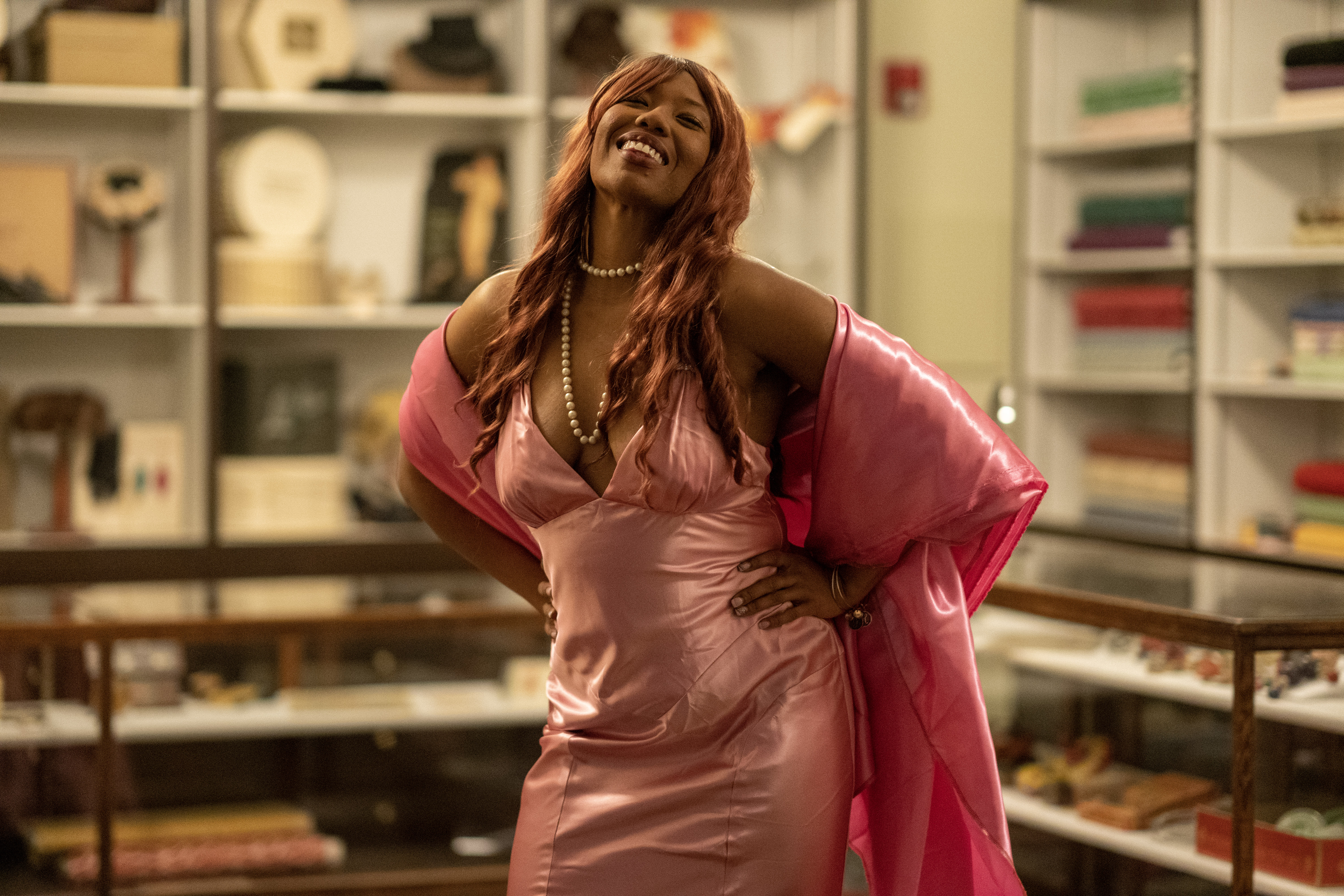
Gurira’s rare achievement is definitely drawing the spotlight now that Eclipsed is making its rounds among regional theatres. Bringing Eclipsed to Spirit Square this week, Brand New Sheriff Productions certainly isn’t ignoring the playwright’s Walking Dead and Panther connections as it spreads the word.

You won’t find any zombies at Duke Energy Theater, but connections between Black Panther and Eclipsed are substantial. Both dramas are set in Africa. While Wakanda is a fantastical high-tech kingdom in Marvel geography, Gurira’s Liberia is quite real – but no less dramatic. After spending a good chunk of her childhood in Zimbabwe, Gujira returned to the continent on a grant from the prestigious Theatre Communications Group in 2007 and interviewed more than 30 women who had been victimized by Liberia’s civil war.

Among these women – some of whom were serially raped, others whose daughters had been kidnapped and turned into sex slaves – Gujira took four of their names for her characters. Three are wives of the unseen Commanding Officer, a brutal rebel leader against president Charles Taylor, and the other is a peace activist seeking to bring the war to an end.

The fifth woman, at the heart of this drama, is unnamed. “The Girl” is CO’s most recent captive, and two of his wives, Helena and Bessie, are hoping to shield her from him.

Yes, Eclipsed was the first play to hit Broadway with an all-black female cast. Just don’t get the idea that Gujira’s script is all about victimhood and peacemaking. CO’s other wife, Maima, is a freedom fighter with the Liberian rebels, and she returns from the battlefield with some serious weaponry strapped to her shoulder.

Maima is not only an action figure vaguely akin to Okoye in Black Panther, she’s modeled after Col. Black Diamond, a female Liberian freedom fighter. Guijira saw a picture of the warrior in a New York Times feature in 2003, the year that the Second Liberian Civil War ended. Black Diamond was the inspiration for Gujira’s mission to Liberia – and for Eclipsed. The way Maima sees it, men aren’t going to rape you if you’re toting an AK-47.

That’s where actress Tracie Frank comes in. A self-confessed blerd, she knew about Marvel and Black Panther long before she knew about Eclipsed, and she knew Gujira as Okoye before she realized that the film’s action hero was also playwright. She has done major roles around town in A Trip to Bountiful and the title role of Caroline, or Change. But nothing like Wife #2, Maima.

“Truthfully, I didn’t even see myself in that role when it did come along,” Frank admits. “As I read the script to prep for the audition, I decided to read for the two ‘motherly’ roles. I remember absently thinking, ‘wow, whoever plays Maima will have to be tough!’”

Director Dee Abdullah thought differently, handing Maima’s lines to Frank after her first reading.

“I was surprised,” Frank recalls, “but I went out and read her again – not as an impartial observer, but as a version of myself… and I knew it was right. I guess I feel like Wife #2 chose me.”

Well, so did Abdullah after a hiatus from directing of five full years. A co-founder of Carolina Actors Studio Theatre with Ed Gilweit, Abdullah was no longer at the core of CAST when the company folded in 2014, but she was devastated by the loss. Corlis Hayes shoved a life raft towards her when she directed August Wilson’s Jitney for BNS last summer, asking Abdullah to design the costumes.

That gig positioned her for Eclipsed. Another BNS blerd, Abdullah has been on board as a Black Panther fan before the film but only slightly acquainted with Eclipsed because of the Nyong’o connection. After researching the story, she knew this was the project to get her back into directing.

“As you might remember,” Abdullah says, “I am not one to shy away from difficult subject matter. This play gave me all the complications a human spirit could endure and still survive. It is about women and their courage to survive under the worst circumstances that life could hand them. It is also based on real stories of the Liberian civil wars, which made it more compelling for me.”

Away from the scene for five years, Abdullah had grown out of touch with the local talent that would show up for auditions. Three of her five choices – Toni Oliver as Helena, Racquel Ena Mae Nadhiri as Bessie, and Gbale Allen as The Girl – are new to the Charlotte scene. Aside from Frank, Ruby Edwards as Rita, the peace negotiator, will be the only familiar face.

“All of the women had a special quality about them that make me want to look at them on stage,” Abdullah recalls. “Tracie has a power that came across much more grounded than the others. Her character makes a choice that takes her on a much more difficult journey than the other women – I needed someone who could convey that energy while staying grounded in truth. The Girl is the only character that goes through a transformation during the course of the play. Gbale gave the innocence as well as the confident toughness that this character needed to pull this role.”

Getting the roles was just the beginning of this ensemble’s journey. Casting by Abdullah was done four months in advance, with rehearsals beginning in late April, so the performers could research the culture, learn the civil war history, bond with one another and learn a Liberian accent. Oh yeah, there’s also some footage online of Frank and Allen wielding their firearms.

“Dee has been quite unique,” Frank affirms, “and I can’t imagine anyone else directing this play. She’s intuitive and observant – she sees what’s under the surface – and that’s vital in a story like this one.”

Abdullah is pleased with the dedication her cast has put into their work, and Frank believes the results will show.

“There’s a natural rhythm to our interactions,” she explains, “one that comes from knowing each other, caring for each other, being annoyed by one another! We’ve formed a sisterhood that won’t end when the [show] closes on September 1st. We’ve learned and experienced so much over this spring and summer. It has been unforgettable.”