Tag Archives: David Winitsky

Boom and Bust With the Lehman Brothers

Review: The Lehman Trilogy @ The Arts Factory

By Perry Tannenbaum

Even when histories are epic in length, like Gibbons’ Decline and Fall or Churchill’s Second World War, what we read at a seemingly slogging pace is a severe abridgement of what actually happened. Onstage, we move so much more swiftly in so-called histories as dramatists bring familiar and obscure people back to life, give them lively dialogue, and select even more narrowly among many actions, events, and consequences.

So the effect of The Lehman Trilogy at the Arts Factory, in a brilliant Three Bone Theatre production directed by David Winitsky, will likely be a revelation to anyone who might dread spending over three hours with a family of Jewish merchants, traders, and bankers. The chronicle stretches more than three generations and 160 years, from 1844 to 2008. Our ultimate landing site is nearly four decades after the last Lehman stood at the helm of Lehman Brothers, when the mighty financial services behemoth collapsed into bankruptcy, triggering a worldwide market meltdown.

Played by just three actors, including a woman for the first time, The Lehman Trilogy moves like greased lightning. Even after reading – and enjoying – the entire script, I was shocked by how swiftly it moved onstage and how well it played.

Maybe we’ve been conditioned by historical miniseries on HBO, Netflix, Prime, and Hulu that parade a life story or a notable family history over weekly episodes that span months and spill over into seasons. Thanks to MSNBC, CNN, C-Span, Fox News, and Donald Trump, we also share a visceral understanding of how excruciatingly slowly real history actually moves. The 2024 election seems ages away because we are inching toward it with so much nuance and detail, amid echo chambers of daily polling and social media blather.

And the sleek three-hour edition now at West Trade Street, adapted by translator Ben Powers, is itself an abridgement of the original Stefano Massini script that premiered eight years ago in Milan, Italy – clocking in at a full five hours. What might a sloppier, more comprehensive Lehman Trilogy include with two more hours? On the positive side of the ledger, we might hear more about Governor Herbert Lehman and his key role in implementing the New Deal with FDR, or the considerable philanthropic exploits of the Lehman family, especially Robert, the last of the Wall Street line.

On the negative – or infamous – side of the Lehman account sheet, Massini’s play delves into how the family cornered the Southern cotton trade before the Civil War, but it almost completely glosses over how their great fortune was built on the exploitation of African-American slave labor.

Steering clear of ethics, politics, racism, and philanthropy, Massini maintains a lean laser focus on how, stage by stage, the Lehmans built their fortunes, keeping their eyes open, seizing opportunities, rolling with the punches, and changing with the times. Along the way, there are literal business signposts marking the new directions and expansions of the Lehman Brothers’ store in Montgomery, Alabama, and later at their offices and various corporate HQs in New York.

Condensed into the space of three hours, these changes come at us so quickly that wet paint on the newest sign the Lehmans put up would never get a chance to dry before a newer one must be freshly lettered. Signage updates are one of the few pauses or detours that slow the onrush of time and good fortune that implacably moves the Lehmans and their Lehman Brothers trademark to the heart of the global economy and its cyclical collapses.

Occasionally, there are comedic detours into courtships by the Lehman men, each one unique and bizarre until the script is finally flipped when we reach Robert or “Bobby,” whose seduction by Ruth Lamar begins elegantly at an unnamed racetrack where his horse has just won. More frequently, the naked moneymaking is paused, flavored, or otherwise cloaked with Jewish holidays and observances, Jewish wisdom, Jewish expressions, or references to Talmud and the Old Testament: Shabbat, Shiva, Chanukah, Sukkot, a housewarming mezuzah, a Reform-style bar mitzvah, Noah and the flood, the Ten Plagues, the Golden Calf, and the ultimate blueprint for insane capitalism, the Tower of Babel.

While the steadily increasing wealth of the Lehmans cannot help but uphold negative tropes about Jewish character, Massini’s explicit evocations of Jewish culture and tradition are a telling countercurrent. Especially in the manner that succeeding generations observe the Shiva ritual in mourning the deaths of their patriarchs, Massini shows us how the Lehmans are drifting away from the core traditions and values of their religion. Over the course of the Trilogy, it becomes clearer and clearer that the Lehmans’ business is based on a different kind of belief.

So much of what we hear is exposition or monologue aimed directly at the audience that my chief worry on opening night, entering the Arts Factory, was how well this dialogue-starved script would play. Ironically, all my worries evaporated before there was even a chance for true dialogue to happen.

Arriving in America with a single suitcase at the Port of New York at 7:25 AM on September 11, 1844, Kevin Shimko as Henry Lehman, nee Hayim Lehmann, not only speaks to us all, he seems to freshly inhabit every word. He catalogues the changes that have come over him during the ocean voyage and re-enacts them – all the skills he has picked up, the temperaments of nationalities he has encountered – so that America is no longer a pure dream when he arrives but an explosion of the wonders and variety he has already experienced enroute.

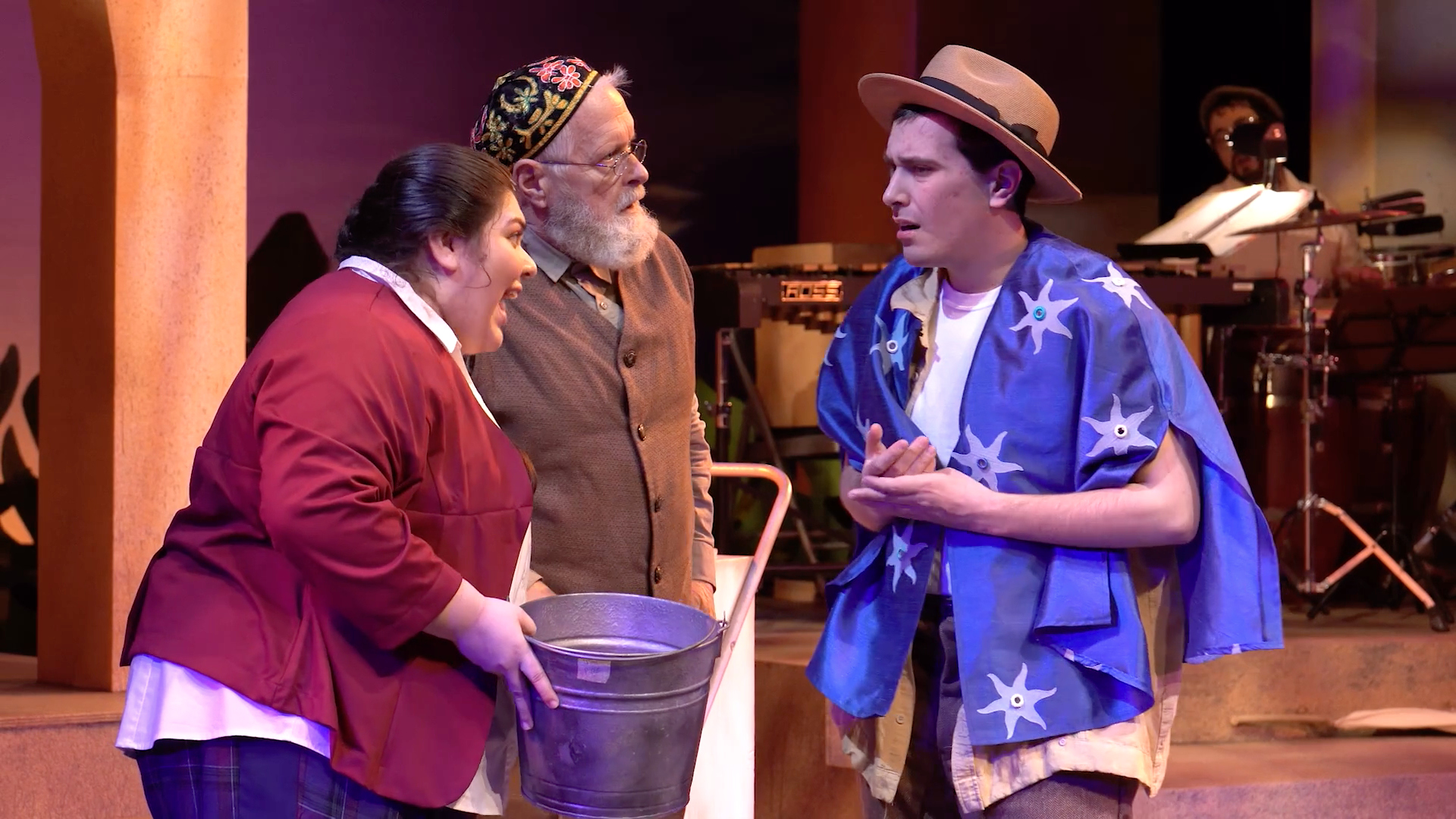
Keeping the peace between them is the mission of Scott Tynes-Miller as Mayer, the youngest Lehman and the last to arrive in Montgomery. Meek and obliging at first, Mayer eventually proves to be capable of ideas as pioneering as Henry’s and to have skills that are no less impressive than Emanuel’s. On a couple of occasions, Mayer is a bit of a miracle, far transcending his brothers’ labeling of him as a potato. Tynes-Miller’s face lights up in an utterly spontaneous, winsome, and irresistible smile on those special occasions.

Worthington and Tynes-Miller have impressed us many times before, in Three Bone productions and beyond. So it wasn’t a complete shock to see Worthington assume the full intellectual and moral authority of young Herbert Lehman as he intimidates his own rabbi by questioning the Ten Plagues. Nor will we marvel at Tynes-Miller’s ability to discard the meek winsomeness of Mayer to assume, a generation later, the cocksure sovereignty of plutocrat Philip Lehman. He’s done it before, and he does it with ease.

The revelations came from Shimko and Winitsky. Since his 2017 local debut in an ensemble piece, Eat the Runt, at the old Charlotte Art League location on Camden Road, Shimko has been off our radar. He has lurked in the cast of an Actor’s Theatre production that was short-circuited by COVID and the company’s demise – and in the ensemble of a subsequent Children’s Theatre production. Co-founder and artistic director of Comedy Arts Theater of Charlotte on South Boulevard, Shimko re-emerged briefly in theatre circles earlier this year when he directed the first theatrical event at CATCh, Sister Mary Ignatius Explains It All, and served as both emcee and the title nun’s monkish supplicant.

If you haven’t seen Shimko toiling in improv comedy at his club, his Henry Lehman and a slew of other characters old and young – of both genders – will be an ample, eye-opening intro. Winitsky’s work has been on view at Shalom Park, where he brought the Charlotte chapter of the nationwide Jewish Plays Project for a few exciting years, and at ImaginOn, where he twice directed the Children’s Theatre of Charlotte production of Tropical Secrets: Holocaust Refugees in Cuba, during and after the pandemic lockdown.

So a play that has been accused of antisemitism is in perfect hands here, but the jaw-dropping surprise is Winitsky’s attention to detail, his infusion of fresh life into so many moments: steering his actors through the often-lyrical text, rolling furniture back and forth across the black box stage, reconfiguring the space between acts, and even doubling down on audience involvement.

Sure, Shimko’s Hebrew pronunciation is still a work-in-progress, Some projections up on the Arts Factory walls might have let us in on Massini’s nifty chapter titles and helped us keep better track of the years. But Winitsky’s approach, bringing us Massini’s sprawling script as if it were intended for a teeny off-Off-Broadway space, disdains such high-tech luxuries. Anitra Tripathi’s set design is chiefly an endless clockface painted on the floor that spirals backwards from the perimeter in ever-smaller Roman numerals towards an off-centerstage beginning.

The only Arabic numerals along the way are key years in the journey where each of the three Trilogy “books” starts out. Above us, echoing the clockface below, clocks galore are hung from everywhere. More like an antique shop than a music box, but with three bankers scurrying around before us for three hours in three-piece suits, it’s a perfect look.

Even in a little back box, The Lehman Trilogy feels big. Through war and peace, boom and bust, trains, planes, movies, computers, and whatever derivatives are, this Jewish story cumulatively becomes a quintessential American story. It’s the thrill, the struggle, and the hard-won triumph of immigration – repurposed into an ups-and-downs rollercoaster ride, as only Americans can do.

Sensory-Friendly Theatre, or “How can I help you be you?”

Preview: Tropical Secrets: Holocaust Refugees in Cuba

By Perry Tannenbaum

2021~Ilana Visits-02

Tyler made a surprising and daring decision at ImaginOn before attending the Sunday matinee of My Wonderful Birthday Suit. His mom, Ilana, had been sure that Tyler would want to wear noise-cancelling headphones at the performance, so I had to assure her that Children’s Theatre would be offering them prior to the show. Otherwise, she would need to pack his set of phones before they flew in from El Paso and make sure he had them when they left their hotel.

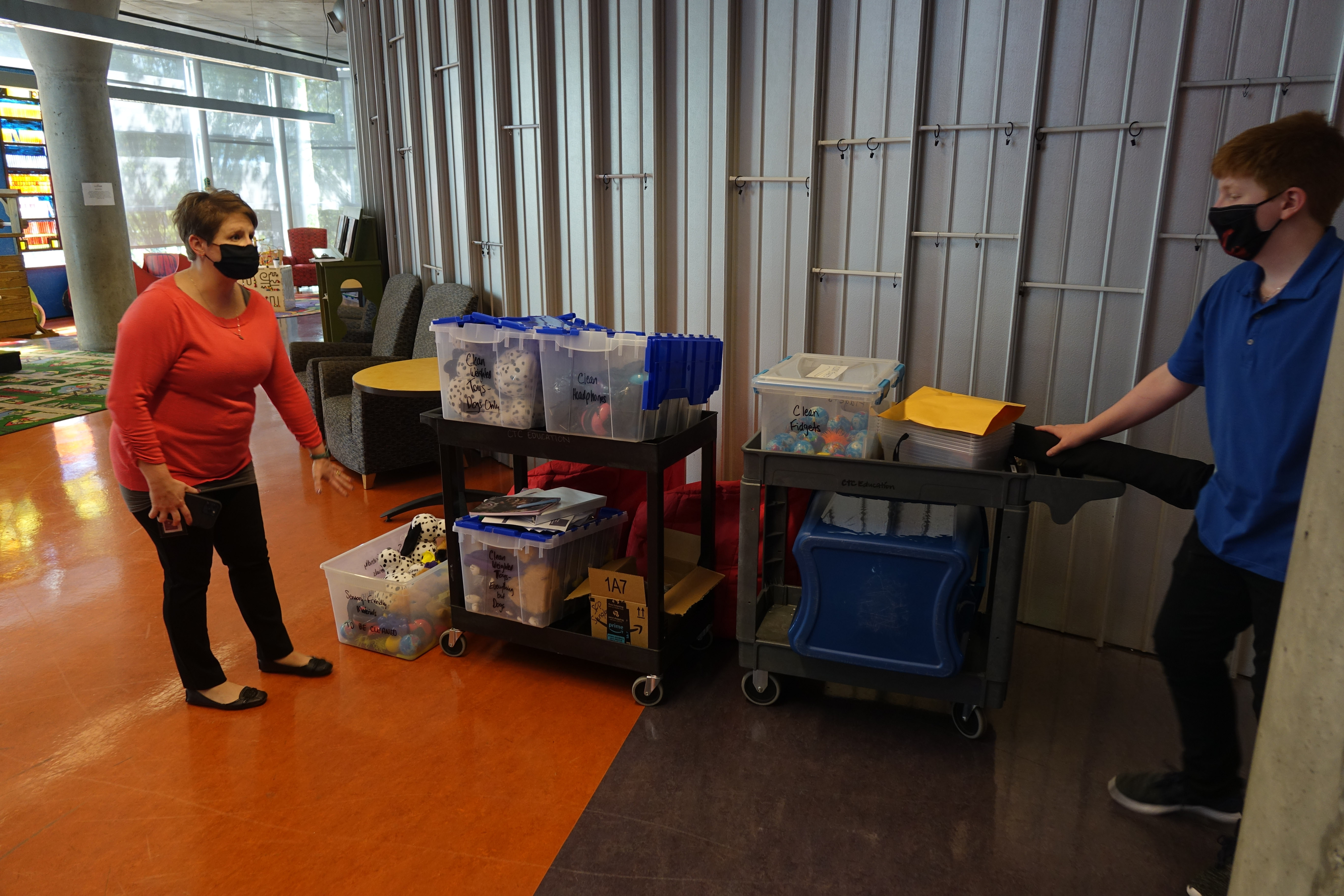
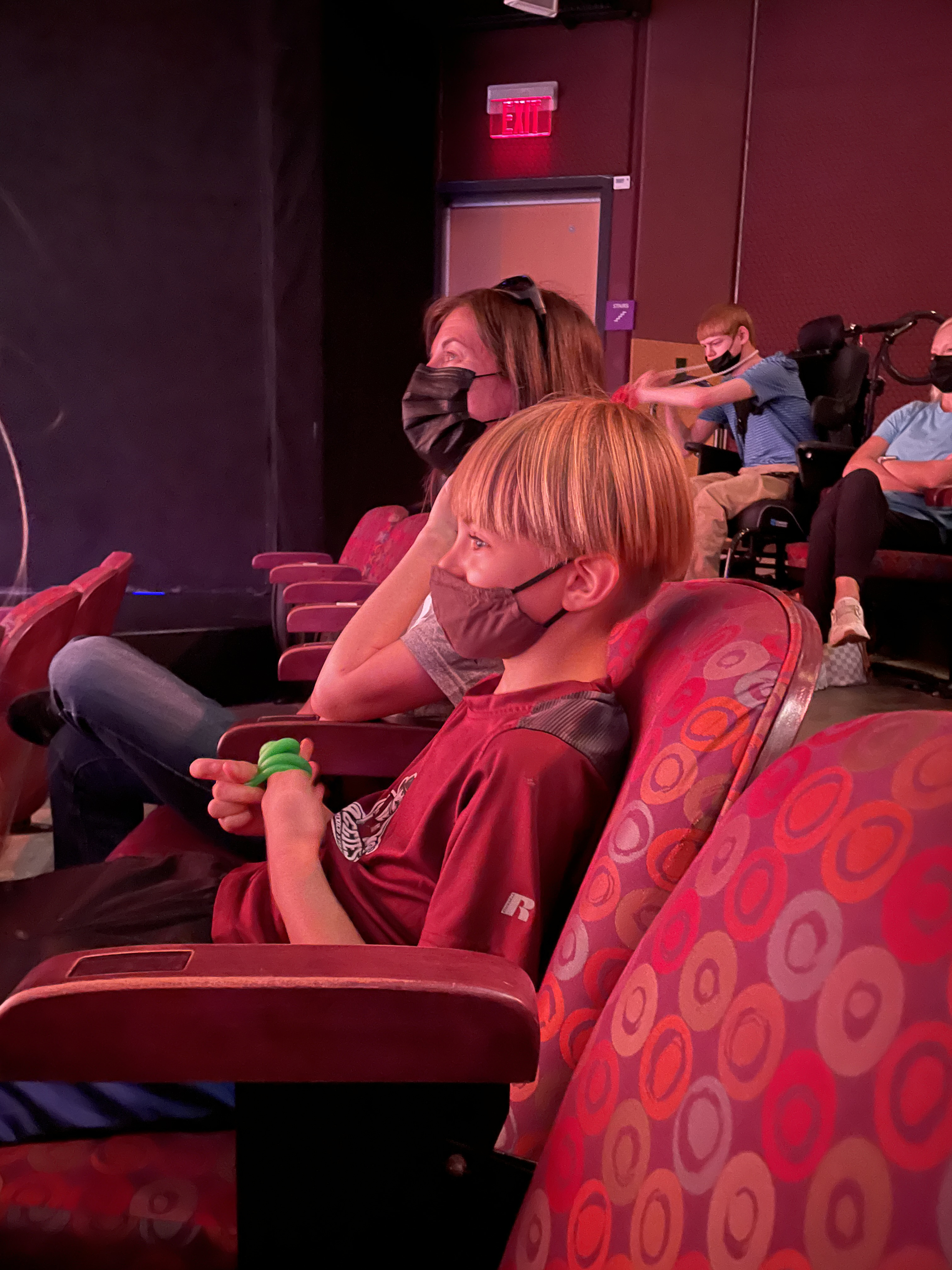
But Tyler refused the headphones that were available – in a really cool variety of colors, it should be mentioned – at the entrance of McColl Family Theatre. Instead, he chose a day-glo green worm, about eight inches long, from a wide array of fidgets and weighted cuddles on display. His younger sister, Brynn, chose a spotted little Dalmatian doggie that weighed five pounds. More surprises.2021~Sensory Friendly Theatre-01

Tyler had to live with his choice. Now when Oobladee and Oobladah, best friends on this side of Moonbeam, started blowing up balloons for the surprise birthday party they were planning for Shebopshebe, Oobladee’s bestie from the other side of Moonbeam… Tyler covered his ears with both hands, dreading the moment when a balloon would suddenly explode.

Yet he didn’t cower or turn away. He didn’t run for cover. His beautiful blue eyes remained glued to the stage.2021~Sensory Friendly Theatre-12

I was sure that none of the balloons would explode. Even if I hadn’t seen this show before, I could see that, sitting in front of the stage, “Tree” (resident teaching artist Kaitlin Gentry) hadn’t raised her two green glow sticks, the signal that “sensory rich” moments were around the corner. Anybody who had downloaded the Parent’s Guide from the Children’s Theatre of Charlotte website would also know that the balloons were “being blown up and let go, but they do not pop or make much sound.”

Tyler’s attention never wavered after the balloon scare, but he didn’t remain completely quiet. Gloria Bond Clunie’s script becomes heavier and more emotional. When Shebopshebe shows up from the other side of the rainbow, Oobladah is shocked to discover that Oobladee’s other best friend is brown. From the start, when he points at Shebopshebe and says, “You’re brown!” it doesn’t sound at all like a description – and she hears that clearly.

The pointing and the tone get meaner, more hateful, overtly racist. “People say that brown skin is…,” Oobladah stammers, leaning over a ledge and pointing an accusing finger down at Shebopshebe. He’s heard whispers that “you know…” and finally he blurts out: “Together – we should not play!”2021~Sensory Friendly Theatre-03

You might think the two girls would be furious. Instead, they’re both rolling on the floor, laughing hysterically.

“On the Other Side of Moonbeam – we play all the time!” Shebopshebe will respond, once she and Oobladee have caught their breaths.

And this is where Tyler breaks his silence. In a voice loud enough for Mom sitting next to him to hear. It’s also loud enough for me – his grandpa – to hear, sitting two seats away, next to his sister.

“That’s NOT funny!” Tyler calls out.

Nobody turns around to shush him. Nobody glares. At all of Children’s Theatre’s Sensory-Friendly Performances, autistic nine-year-olds like Tyler are free to call out, fidget, roam around the theater, cower in a corner, or find refuge in a quiet room, where they can still watch and hear all the comedy and drama with their mom or dad.

That’s really the point: they’re free to be themselves without being judged.2021~Sensory Friendly Theatre-17

Julie Higginbotham of Precious Developments has been overseeing the Sensory-Friendly Performances at Children’s Theatre since 2016, when ImaginOn’s new project was still a pioneering rarity. Now every run of every mainstage production gets a Sensory-Friendly Performance at its closing Sunday matinee. That includes the upcoming Tropical Secrets: Holocaust Refugees in Cuba, opening this Saturday and running through November 14.

“It’s a big deal!” Higginbotham often says – because it’s so true in so many ways.

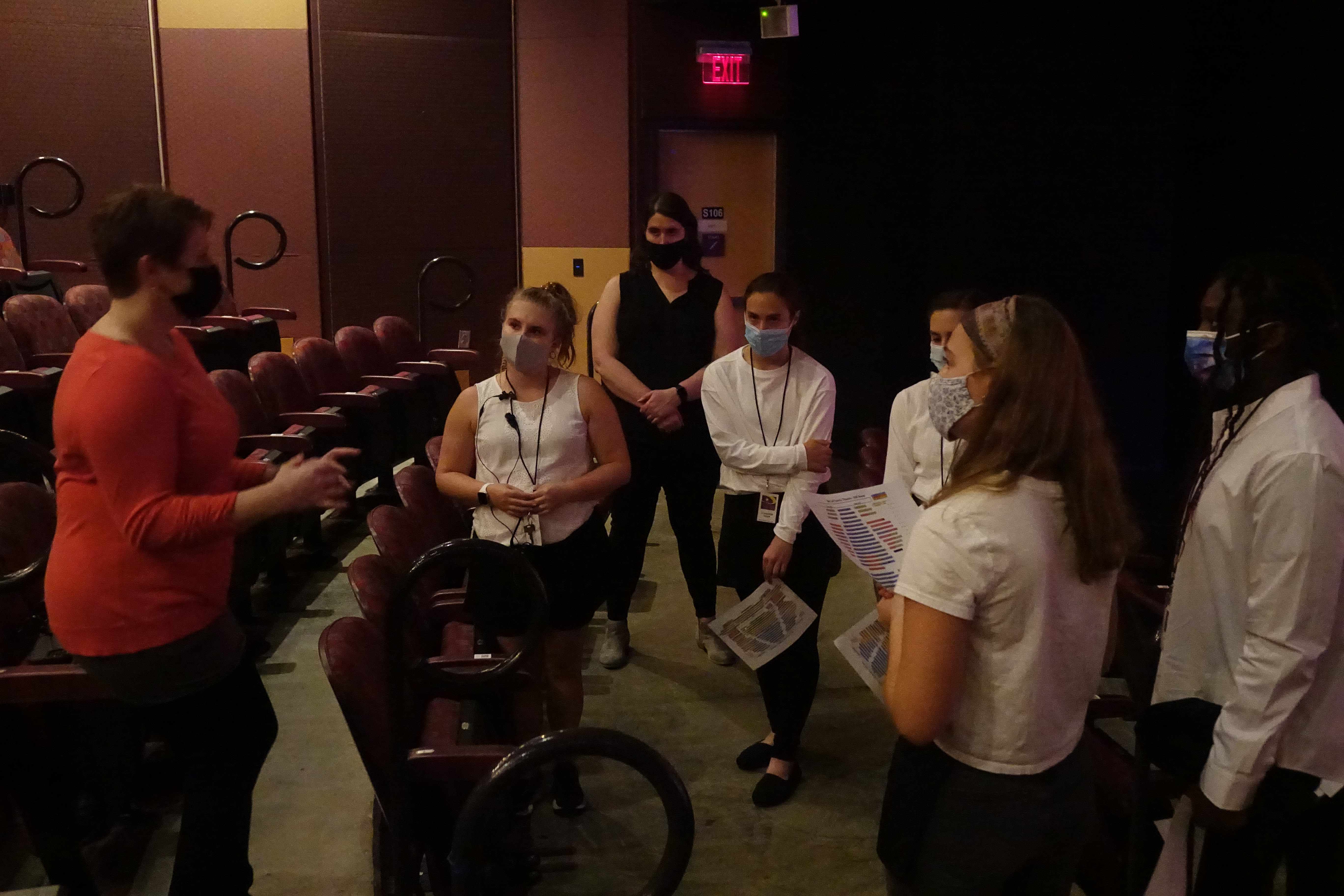
She’s preparing actors, directors, designers, technicians, and ushers for the special performance – as well as carefully preparing printed and online guides for protective parents and surprise-averse children. This involves meeting face-to-face with the stage manager, the stage director, the musical director, and the actors. Higginbotham also attends the designers’ run-through, dress rehearsals, and performances during the run of the show, where she scribbles over the Children’s Theatre director of production Steven Levine’s script, containing all the light and sound cues.

Where should the volume on the mics be turned down? Where should a scream be changed into a loud exclamation? Where should a live gunshot effect be changed into a muffled recording? Where must a scene with strobe effects – almost automatically a two-light-cue alert – be redesigned so that triggers that would be hazardous to seizure-prone kids are gone?

Amid the final tweaks to lights and sounds happening during the run of the show, Higginbotham takes hundreds of photos – because the Parent’s Guide and the Child’s Guide are also illustrated full-color scenarios that prepare audiences for what they will see. That’s helpful when a stage adaptation or a set design significantly departs from an original book that kids and their parents are already familiar with.

She also annotates the script for “Tree” so that she can closely follow and precisely time her one-light and two-light cues. Higginbotham remained involved in the last 90 minutes before the Sensory-Friendly Performance and even while “Tree” was upfront waving her traffic-control glow sticks.

Grandpa had to rise and shine a couple of hours earlier than Ilana and the grandkids to witness Higginbotham’s final preps for My Wonderful Birthday Suit – after getting buzzed in at the ImaginOn loading dock.2021~Sensory Friendly Theatre-24

First came the final powwow with the actors, lighting crew, and “Tree.” Actors portraying Oobladee, Oobladah, and Shebopshebe all received Higginbotham’s final notes and reinforcements, with opportunities to air last-minute questions and concerns. Then the reconfigured “REWIND” scene – Shebopshebe’s brilliant and zany answer to the contrite Oobladah’s wish to “begin again” – was rehearsed and rerun without the strobes.

As the three actors exited and changed into their costumes, makeup, and matching masks (since ImaginOn is a public building, masks are worn by actors during performances), Higginbotham ascended the long lobby ramp to the top level of McColl Family Theatre. Time to prep the ushering staff, a mix of vets and newbies overseen by volunteer coordinator Louise Lawson.

Some ushering basics are turned on their head at Sensory-Friendlies. Ushers don’t simply show you to your seat, retreat to anonymity, and maybe sit back and enjoy the show themselves. They’re actively engaged in helping to ensure this special audience will enjoy their experience before the show and during the show.

Audience members don’t have a seat. With open, socially distanced seating, they have any seat. If say, they run up to the front of the house and find out that the sensory onslaught is too intense there, they can move back as far as they wish to any empty seat.

What ushers pay closest attention to is the kids’ needs. So my Tyler actually had extra backup during the little balloon scare that his mom may not have been aware of. Ushers were armed with the same fidgets, cuddly dogs, sunglasses, and headphones that Tyler was offered when he came in, standing at-the-ready, spread throughout the theater, instructed to come to his aid if they noticed he was constantly putting his hands over his ears and flinching.

“The biggest thing,” Higginbotham emphasizes to the volunteers, “is this: a lot of these families are overlooked, or they get stares. Our job is to actually see these folks, make eye contact, engage with everyone. If their communication style is one you don’t understand, that’s OK. Say, ‘Hello. We are really, really glad that you are here. What can we do for you? Can we show you to your seats? This is an amazing production, and we want to make sure you guys have a good time.’”

Any questions? Higginbotham is there to answer ushers’ concerns before and during the show, supervising the operation over a headset from the rear of the hall. Like a second stage manager.

Higginbotham’s meeting with Laura Beth Lee, the actual stage manager for Tropical Secrets, gave me a close-up view of how the Sensory-Friendly process begins – and a rewarding overview of the Precious Developments methodology.

2021~Tropical Secrets-18

The situation was somewhat surreal for this reviewer, since Higginbotham had not yet read the L M Feldman stage adaptation of Margarita Engle’s young adult verse novel. I’d covered the original webcast premiere back in March, but there were never live performances of the show and no Sensory-Friendly edition. The same cast, starring Adrian Thornburg as the Jewish boy Daniel and Isabel Gonzalez as Cuban native Paloma, are back with director David Winitsky. But Lee will be new to Cuba behind the scenes.

New wrinkles will confront everyone involved, however, since the production is moving from the McColl Theatre at the east side of ImaginOn to Wells Fargo Playhouse on the west, with a shrunken, more abstract set design customized for the new venue. Before Higginbotham and Lee powwowed in the “Lizard Room” on October 20, the returning cast had already rehearsed on the new set, likely because there hadn’t been a live show at the Wells since January 2020.

As the title indicates, Tropical Secrets is very much about this world – historical racism rather than the Moonbeam brand. With the 83rd anniversary of Kristallnacht falling on November 9, during the run of the show, Engle’s story will be very much in season. We really begin with that cataclysmic 1938 event in Nazi Germany, which prompts Daniel’s family to rush the 11-year-old onto an ocean liner bound for New York, where they all plan to reunite and live happily ever after.

Except that the USA turns the ship away from its ports – all of them – because there are Jews on board. Canada does the same. Hello, Havana! How in this wide world will Daniel’s family find their boy now?

Miracles aren’t likely here, and you can rule out rewinds. Meanwhile, with little more than an overcoat and a flute, little Daniel must find ways to survive and fit in. Paloma and Daniel bridge the gap between languages and cultures far more easily than their elders, but Daniel finds a link to his heritage in crusty old David, played by Tom Scott, a Yiddish-speaking ice cream vendor who sports a gaudy yarmulke.

“It’s also a very emotional show,” Lee tells Higginbotham, “a Holocaust show, so you’ve got police officers who are bursting in and yelling, there’s scary emotional outburst moments, so I can definitely see that there are these big impactful things.”2021~Tropical Secrets-32

Together with our dip into Yiddish and repeated Judaic references, Paloma has her own story – and considerable depths. She is our gateway into Cuban culture and the Afro-Cuban beat. Daniel will discard his flute for a drum and jam with percussionist Raphael Torn, who will also play the vibraphone. Topping that outbreak of rhythm and dance, there’s a full-fledged carnival scene.

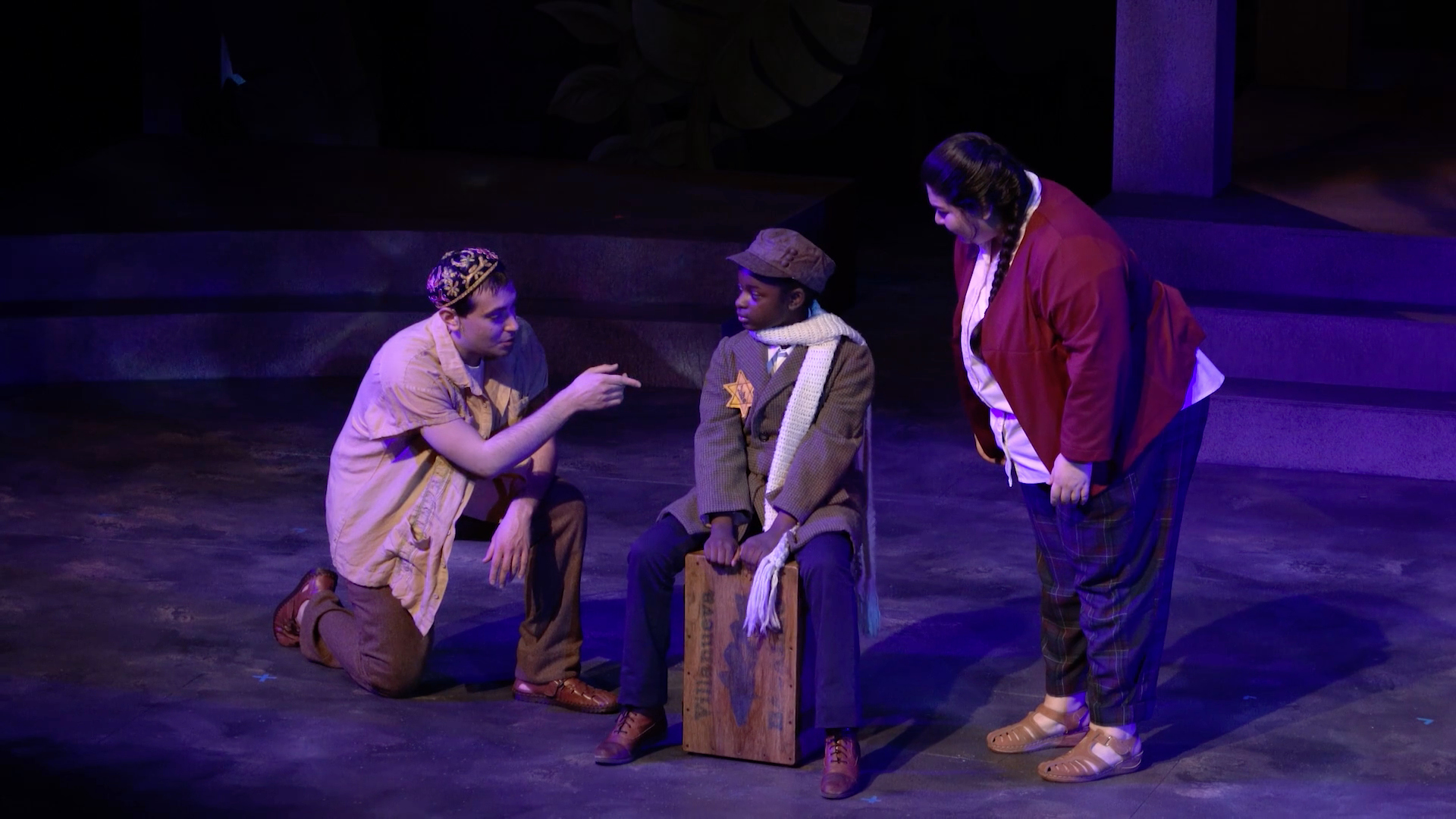
Yes, there is sensory richness aplenty in Tropical Secrets – and the kid protagonists are sharp. Explaining to Paloma what living Jewish was like back in Munich, Daniel says, “In Germany, you have to wear a star on your shirt, so everyone can know what you are and hate you for it.”

Paloma’s dad is El Gordo, played by Frank Dominguez, the notorious decider when it comes to which ships are allowed to dock in Havana and which are turned away. Defending his wartime profiteering, El Gordo schools his daughter: “The world runs on business!” With no less conviction, Paloma looks her dad straight in the eye and fires back, “The world runs on kindness!

Emotional.

Impactful as Tropical Secrets will be, part of Higginbotham’s job will be to prep the able actors onstage for what to expect from their ultra-sensitive, surprise-averse audience – especially when volume has been trimmed to 75% or less and houselights turned down to half. They will see their audience more clearly than they did at previous performances. There will be fewer kids out there, socially distanced and maybe moving around or fidgeting. It may be jarring to look out into the audience and see kids talking back to the actors or wearing headphones. Or holding their hands over their ears. Or not making eye contact.

They might not even clap.

Parents will need to show proof of vaccination to enter the Wells for Tropical Secrets, but they won’t need to bring doctor’s notes or medical records for the Sensory-Friendly finale. Nor will this be an entirely special-needs crowd.

“Some folks prefer the softer presentation,” Higginbotham explains. “Some parents feel it gives their kids more freedom, and some folks can only get tickets for the Sunday matinee!”

If all goes according to plan, Higginbotham’s guides for parents and children will go out to all ticketholders on November 8, giving families six days to prepare.

Ilana was impressed by both Birthday Suit guides, but she didn’t see them as particularly useful for her Tyler, whom she describes as falling in the mild-to-moderate range of the autistic spectrum. Medication also helps him in tolerating sensory irritants.2021~Ilana Visits-22

“I don’t think Brynn or Tyler would’ve benefited,” Ilana says of the illustrated guide, “and it may actually have detracted from their experience. In children’s theatre, anything that dampens the surprise and wonder of a performance wouldn’t be optimal for my kids. And the show itself didn’t have anything too jarring (sensory-wise) that we would’ve needed to warn him about.”

On the other hand, My Wonderful Birthday Suit was far more palatable to Tyler than his previous theatre experience at Sesame Street Live! in 2019.

“Brynn loved it, but it was too loud and glitzy for Tyler,” Mom recalls. “Crazy loud, confetti storm, etc. We had to buy him off with a snow cone to get him through it.”

Higginbotham points out that the guides aren’t merely handy in preparing kids for Sensory-Friendly Performances, they also help in revisiting and remembering what they’ve seen. That can happen soon after the theatre experience is over or before the next theatre experience, when parents want to pique their children’s interest and anticipation.

“I showed Tyler the Child’s Guide,” Ilana wrote me, “and he was very excited and asked if you had sent pictures of the stage. Then he asked if I could send him screenshots of his 3 favorite pictures. Why? ‘Because they’re beautiful!’”

Unforeseen as that reaction might be, it’s what Higginbotham aims for.

“People need the freedom to be exactly who they need to be,” she says, “and to be able to feel like they’re supported. And man, we can’t predict everything, but we try. They need a non-judgment zone that I defend to the death. How can I help you be you? That’s my job.”

“Tropical Secrets” Presents a Bittersweet Wartime Escape from Genocide

Review: Tropical Secrets: Holocaust Refugees in Cuba

By Perry Tannenbaum

2021~Tropical Secrets-16

Havana has never been the homeland of the Jewish people. Yet as we quickly learn in Tropical Secrets: Holocaust Refugees in Cuba, now streaming from Children’s Theatre of Charlotte, it was often more hospitable to Jewish refugees fleeing Nazi oppression, terror and genocide than most other nations – including the USA. If that surprises you, imagine how 11-year-old Daniel felt when he made this discovery in 1940.

In the wake of the infamous Kristallnacht terror across Germany, Daniel’s parents rush him onto an ocean liner bound for New York, promising to meet him there. The ship isn’t allowed into the harbor. They sail north. Knowing there are Jews on board, the Canadians also turn them away. Young Daniel, who was holding his grandfather’s hand when rioters shot him down on Kristallnacht in the middle of the street, is learning some of the cruelest lessons of the world on his own, cast adrift from his family.

Interestingly enough, Margarita Engle’s story, adapted for the stage by L M Feldman, is almost equally about the 10-year-old Paloma, nee Maria Dolorosa. From the outset, her problems are paralleled with Daniel’s. Paloma’s mom abruptly decides to leave Cuba for Europe. Needing to become closer to her dad in the wake of Mom’s abandonment, Paloma finds herself turned away. Seems like an unfair comparison at first, but Engle constantly asks us throughout this new 75-minute drama to re-examine our perspectives and our sense of proportion.

Moral certitudes are questioned during the turmoil of World War II as we watch Daniel acclimate to Cuba while still holding out hope that his parents will find him – or that he will find a way to New York. A huge flip in sentiment and loyalty happens across Havana when news reaches the island that Pearl Harbor has been bombed. Instead of marking him as fodder for the horrific Nazi deathcamps, the Yellow Star that Daniel had been forced to pin on his shirt back in Munich now becomes the badge that prevents him from being arrested as a German spy.2021~Tropical Secrets-37

As with many children’s classics, kids perceive basic truths more readily than their elders. Paloma’s father, known across the island as El Gordo, is the decider when it comes to which ships are allowed to dock in Havana and which are turned away. He tries to explain to little Paloma that he makes his decisions pragmatically rather than on principle. “The world runs on business!” he proclaims with conviction. Paloma looks her dad straight in the eye and tells him, “The world runs on kindness!” Engle’s kids also have depth, as when Daniel informs Paloma, “In Germany, you have to wear a star on your shirt, so everyone can know what you are and hate you for it.”2021~Tropical Secrets-65

Adults here aren’t perfect role models chiefly because of their practical struggles to survive and thrive. With most of the world turning the Jews away, El Gordo naturally feels pressure not to open the floodgates. Yup, immigration issues! And though Daniel’s mentor, David, staunchly wears a brightly embroidered yarmulke with pride, he also bends to practicality, peddling his ice cream in his little pushcart on the Sabbath. When Jews are suddenly perceived as friends and Germans suddenly become loathsome, suspicious, and targeted for arrest, David abruptly veers to the other end of the spectrum, opposed to allowing any foreign ship to dock in Havana until the war is over – even if Daniel’s parents happen to be on board. El Gordo, on the other hand, stands fairly firm – except for raising the price of entry.

In the shifting mists of these patriarchs’ outlooks, blown by the winds of war, Engle’s Havana takes on some of the ambiguities of Casablanca. We aren’t on the same exalted levels of politics, decadence, or romance, but you may find yourself identifying more deeply with the everyday humanity of her people. You may also experience more keenly the anguish of survivors who are left in suspense for months and years about whether those dearest to them are still alive – and empathize more keenly with those who are wracked with memories of those who have died.

Most poignant, the kids rise to heroism in acting out their natural beliefs when, after the universe flips with Pearl Harbor, they encounter a Jewish mother on the run. Why would Miriam, a German Jew, be so terrified now? Because her only living relative, daughter-in-law Marta, is a Christian. For Daniel and Paloma, it is axiomatic that both are equally entitled to live in peace. Marta and Miriam, on the other hand, wrestle with the question of how fully they should describe to their rescuers the full details of the horrors they have left behind.

Thankfully for parents wondering whether Tropical Secrets might become to heavy for their youngest, Engle takes us to precipice without jumping over. There’s plenty for her to show us about kids conquering the language barrier and bonding, and there’s plenty for the kids and their elders to teach us about Judaism, Yiddish, and carnival. Helping Feldman transform Engle’s poetry into engrossing drama, stage director David Winitsky has made a welcome return to Charlotte after a year’s absence, having hosted the Charlotte Jewish Playwriting Contest at Shalom Park for the previous three seasons.2021~Tropical Secrets-28

Two dramaturges, Carmen Pelaez and Wendy Bable, helped him and his cast get the history and the cultures across accurately. Anita J. Tripathi’s scenic design radiates hacienda elegance, but it was Robyn Warfield’s lighting that filled out the atmosphere and took us beyond the city when the story needed to travel, while Magda Guichard’s costumes deftly differentiated between the nationalities and the social classes.

Most gratifying after so many months of deprivation, isolation, and lockdown was watching such a professional all-adult cast captured so well in immaculately recorded audio and video. Because this world premiere was immediately headed for film, where kids are always kids, Adrian Thornburg and Isabel Gonzalez had the steepest obstacles to overcome as Daniel and Paloma. Thornburg’s path was to shrivel himself inwards with Daniel’s sullenness when we first see him, though Winitsky might have eased off a little on all our hero’s resentful turning away. Gonzalez’ regression moved in the opposite direction, outwards with an excess of energy and often with open arms. In less than a minute, I found myself returning to a familiar theatre world, where adults can pass as kids and be as tall – or taller than – their parents.

In Europe, on the ocean liner, and in Cuba, four other actors played multiple roles, at least one of them memorable for each player. Tom Scott as David had the dignity, tenacity, and flexibility of a time-tested Jewish survivalist, stretching himself more than usual to immerse himself in the ice cream peddler, while Frank Dominguez was stubbornly set in his ways as El Gordo, professionally urbane, gradually realizing how off-putting his pomposity has become. Paula Baldwin and Margaret Dalton complemented each other nicely as two different tandems, first as border guards who stole Daniel’s boots and broke his flute, later as the fugitives, Miriam and Marta. Baldwin as the suffering Miriam could be the most fearful, grieving, and overprotective, but Dalton as Marta delivered the best retort: “When things are ugly, you cannot help but speak it ugly.”2021~Tropical Secrets-79

Maybe the best secret in Feldman’s adaptation is the time taken to breath in the tropical air. Percussionist Raphael Torn and pianist Charlene Thomas bring the tang of rhythm and music to the street a couple of times. When Paloma takes Daniel to the festival, when she takes him to the beach at night, and when she brings him back to music again and again, fresh air infuses our hero’s life as he accepts the kindness of a friend. He tacitly acknowledges that after the bombs of world war and Kristallnacht, there is balm in Cuba – in the oranges, the coconuts, the drums, the Afro-Cuban beat, and in carnival.

Jewish Playwriting Contest Dramatically Involves Charlotte Audience in Selecting a New Play for a New York Production

Review: The Jewish Plays Project

By:  Perry Tannenbaum

The Jewish Plays Project, currently in its ninth season, seeks to recognize and develop new plays that freshly address contemporary Jewish life. In their annual Jewish Playwriting Contest, plays that peddle stock Jewish humor or deal directly with the Shoah are graciously discouraged. Like other playwriting contests, it solicits scripts that haven’t received professional productions and welcomes playwrights of all ethnicities. Of course, an expert panel is part of the selection process, but unlike the Pulitzers, the Tonys, or the Steinberg Awards, the JPP panel only screens the hundreds of entries and winnows them down to a group of finalists.

Cunningly, JPP invites theatre communities around the country to engage with the scripts, winnow them down to a Top 3, perform the Top 3 publicly in abbreviated staged readings, and have the live audience vote for their winner. In the 2019 cycle, Charlotte is the first of seven cities to complete its participation in the process, so the ultimate winner won’t be announced until after the Palo Alto readings on May 1 – moving on to a full production in New York this September.

The seven finalist scripts were emailed to us back in November, and I can proudly say that our reading panel in Charlotte had the most listed members, edging out Houston and New York, sharing the honor for the most populous panel with Chicago. Our panelists met at the Levine Jewish Center for a dinner powwow during the last week in January. After spirited discussions of each script, we wound up choosing In Every Generation by Ali Viterbi, The Shabbos Goy by Cary Gitter, and Dox Modern Middle by Megan Pope for the public event at Gorelick Hall, the J’s theater facility.

Last year’s national winner, Summer Night with Unicorn by David Rush, had been produced by the Levine Cultural Arts department’s JStage at the Gorelick in November, so there were people in the audience – and onstage – who had experienced last year’s playoffs and/or seen its fruit. This was the third year that Charlotte had participated in the annual contest, my second year of participating on the community panel, and my first time at the competitive readings. I was a bit taken aback by the robust turnout. Word has gotten around.

Unlike the staged reading festivals presented in the past by Actor’s Theatre of Charlotte and the defunct Charlotte Rep, the Levine’s Jewish Playwriting Contest maintained its professionalism without stuffiness or excessive formality. If you were an actor, you weren’t warned against the impropriety of wearing a color or dressing for your part, but you did lay your script on a lectern as you performed. If you bought a ticket, you could grab a free nosh at the back of the hall and schmooze with your fellow cognoscenti before David Winitsky, the founder and director of JPP, moved up front to issue welcomes and thanks. Then he explained the JPP and the Contest before testing the technology that would be used for the individual playwright intros and the voting. Directing all three entries, he also read the stage directions during the readings.

Old schoolers could vote on paper ballots as God intended, or if you had a smart phone, you could text your vote to a prescribed number. My first two test votes, before and after the first play reading, were for macaroons and Bernie (who lost to Midge). While writing this review, I texted “LEAVE” to the number we had been given and received an answer, my first real assurance that my votes had counted. So the technology worked, the format for the evening had been exhilarating, and theoretically, my vote may have been decisive. Yet I did not drive home feeling that the format had been completely fair.

Gitter’s The Shabbos Goy led off the readings, probably the easiest of the three to summarize. Seth, a divorced Orthodox Jew, has a crisis of faith because he has fallen in love with Angie, an Italian-American art gallery curator who recently moved into an apartment down the hall. Not knowing she had moved in, Seth had knocked on her door, thinking he would call on his Shabbos goy to do something for him that Orthodox Jews are forbidden to do on the Sabbath – like turning on a lamp or an oven. Angie readily agrees to help this nerdy knish maker. He’s such an unlikely candidate for her affections that, when he asks her out, she doesn’t immediately grasp what he’s doing, by which time he’s apologizing.

Seth’s sister Rachel, his partner in the Lower East Side knish store, is more devoutly opposed to her brother’s wishes – she’s not Jewish! – but Sophia, Angie’s folksy grandmother, has an open mind. In the scenes excerpted for the reading, Seth (Jordan Ellis) told Angie (Karina Caporino) about his spiritual crisis. His confession went better than Fitzwilliam Darcy’s, acting as an aphrodisiac. Afterwards, Angie had a couple of heart-to-hearts with Sophia (Jackie Fishman) and Rachel (Susan Cherin Gundersheim).


If the allusion strikes home, you’ll already know that Viterbi’s In Every Generation has something to do with Passover. Not only is the Passover seder the instrument of fulfilling the biblical commandment of telling your children about the exodus from slavery in Egypt, it is the gateway for fulfilling man’s obligation “to see himself as if he personally went out of Egypt.” Viterbi divides her play into four parts, a very apt number for Passover, and links three generations of a family across three seders, beginning with 2018 in LA, then flashing back 65 years to 1953, and then zipping forward to 2048. After three seders with this family, Viterbi thinks we’re ready to visualize her family in 1416 BCE after leaving Egypt, celebrating Passover and yearning for the Promised Land.

In the first excerpted scene, we saw all three generations gathered at the 2018 seder. Drawing most of our attention were two squabbling siblings, Yael Katz (Caporino) and her adopted Chinese older sister, Devorah (Vivian Howell Tong), who is studying to be a rabbi. It is she, therefore, who expounded on the number four in the Passover Haggadah. Their mom, Valeria (Stephanie DiPaolo), tried to keep order, but her difficulties were compounded by her octogenarian parents, Davide Levi (David Catenazzo), who coukd no longer speak due to ALS, and Paola (Fishman), who kept lapsing into Italian. Our second excerpt took us to 1953, shortly after Davide and Paola had immigrated to America. Davide could talk at that seder – smoothly enough to convince Paola that Passover might be a great time to start their squabbling unborn family.

Reduced to a bare-bones 20-minute sampling, In Every Generation had to shed its last two parts – and the English subtitles that are supposed to help us understand Paola’s Italian when she arrived in LA back in 1953. Shabbos Goy suffered to a lesser extent from Winitsky’s radical abridgement, losing one of its characters, a dashing young artist whose work Angie would love to display at her gallery. Young and sexy Blake, Angie’s arrogant quarry, expected to combine business with pleasure. Pope’s Dox Modern Middle was perhaps the most disadvantaged by Winitsky’s excerpting. It would have been helpful, for starters, if the playwright, the director, or the reading had explained what the title meant.

Amid some healing chanting and a spectral appearance of Fathermother, representing her parents and her Orthodox Jewish heritage, the excerpt began with 17-year-old Raphaela (Arella Flur) arriving in Israel. She was greeted by her Aunt Caroline (DiPaolo), a longtime Israeli who knew more about Raphaela than the girl thought. Caroline already knew, for instance, that her upfront 16-year-old neighbor Gil (Rixey Terry) would be the perfect companion to show Raphaela around – because he is gay, she is lesbian, and that’s why she was sent away from Brooklyn by her “Dox” parents. In later excerpts, we learned that there’s an LGBTQ nightclub in Jerusalem that will welcome both Gil and Raphaela, with queerness to burn. A quartet of glittery queens emerged from the audience, voguing and preening. More seriously, the club’s bartender, Pop Tart Girl, took an interest in Raphi, evoking memories of Ani (Caporino in both roles), her previous paramour back in Brooklyn.

When the votes were tallied, Winitsky announced that The Shabbos Goy had been our audience favorite. Audience members who have become attached to Seth and Angie, rooting for their romance, can go to JewishPlaysProject.org and see how Gitter’s romantic comedy is doing in the standings. With the two points that Shabbos Goy earned at the Charlotte playoffs, it is now tied with In Every Generation for first place. Next in the standings, trailing the leaders by two points, is Dox Modern Middle. As exciting as the contest was, I’d be more comfortable if the readings were extended to 40-45 minutes each. Lacking that, audiences should get a full summary of each contestant. That’s what I’m voting for.