Tag Archives: Cornelia Barnwell

“Next to Normal” Is Alive at the Barn!

Review: Next to Normal at Theatre Charlotte

By Perry Tannenbaum

July 4, December 7, September 11, and October 7 are all dates we remember for their historic meaning to the nation and the world. A similar earthshaking significance can descend on a single day in the life of a relationship, a marriage, or a family that can reverberate for generations – whether you were at the event or even alive at the time.

That’s essentially what we’re watching in Brian Yorkey’s Next to Normal with music by Tom Kitt, winner of the Pulitzer Prize for Drama in 2010 after winning Tony Awards for Best Musical, Best Book, and Best Orchestrations the previous year. Instead of doing things the traditional way, setting up the location and the situation in a big opening number that stages or recaps the prime catastrophe, Yorkey fast-forwards us more than 17 years, when the original hurt in the Goodman family has marinated and metastasized – a fissionable maelstrom that will soon explode.

With a fresh set of seismic events.

Diana is at the vortex of the mushrooming crises, so it’s both interesting and wickedly deceptive that Yorkey brings us into her drugged and delusional mind for much of the opening action. We still see the basic outlines of the family turmoil clearly enough. Her husband, Dan, keeps trying to go with the flow of Diana’s bi-polar mood swings. She navigates a series of therapists, looking for either a therapeutic epiphany or the perfectly calibrated cocktail of meds.

Meanwhile, Diana’s teen daughter Natalie feels neglected and unappreciated, living in the shadow of Mom’s obsessive devotion to her older brother Gabe. Warily, Natalie navigates her self-worth issues as schoolmate Henry tries to get closer and establish a relationship. When Natalie overcomes her shame and allows Henry, after much hesitation, to meet her family, we seem to have arrived at a breakthrough.

It’s a brave move and all goes swimmingly at the Goodman dinner table between Natalie and Henry until Diana walks in with a birthday cake, all smiles, candles lit. Yorkey’s sleight-of-hand has worked so beautifully that we wonder which of the two teens is the target of the birthday surprise. Suddenly things are going downhill – off a high cliff.

Like we’ve been overdosing on the meds so far.

Yorkey is very good at these slow build-ups where we see budding new hopes dashed by a sudden disappointment and fresh Diana relapses. After portraying Dan, the long-suffering husband in Queen City Theatre Company’s fine production in 2013, Billy Ensley takes the reins at Theatre Charlotte’s slightly slicker version. His suffering, grimly stoical, was very different from Johnny Hohenstein’s unfiltered and uncontrolled anguish. It’s easier to breathe at the old Queens Road barn when emotions get a space to release.

On the other hand, the Broadway edition starring Alice Ripley in 2009 (which toured here with Ripley in 2011) took a dimmer, more skeptical view of psychiatry and pharmacology, giving those productions directed by Michael Greif a darker, satirical, mad scientist edge. Around the corner from a cluster of medical centers and hospitals, Josh Webb’s set design on Queens Road is easily the brightest and most antiseptic I’ve seen. The usual two-story scaffolding that adorns rock operas is outfitted with colorful fluorescent lighting, though some flickering occasionally marred the serene pastels (intentionally?) inside the translucent fixtures.

So in transit to Charlotte, the emphasis continues to shift more emphatically away from the quackery to the suffering. Hohenstein’s broadened performance now rivals Melissa Cook’s bipolarity as Diana, for he’s still a domesticated dad to Natalie and a cheerful host to Henry between bouts of stressing and losing it in private and with his wife. In its fits and starts, Hohenstein helps us to balance the toll mental illness takes on its victims and on their loved ones. Easily the best of Hohenstein that I’ve seen and the most intensely consistent performance of the night.

Cook’s performance as Diana is as genuine and riveting as any I’ve seen in Charlotte or on Broadway – except when it isn’t. Whether you call it resistance or retreat, there are whole songs where she is suddenly no longer a cri-de-coeur rock singer and becomes a more traditional Broadway belter: sweeter voice with noticeably less emotion and intelligibility. Suddenly, it isn’t about how sensationally Cook is acting but about the singing, likely more in her comfort zone.

I can’t say for certain that the duality was there from the start, but there should be no turning back after the big birthday reveal.

And the words here are important – I could almost hear Ensley stressing this at rehearsals – for we get the best sound in a musical production, local or touring company, since MJ stormed the Belk last September at the beginning of the season. Kudos to Ensley for his pertinacity and, if there was any acoustic work or equipment upgrades in the mojo, glory to the staffers involved in the push, beginning with artistic director Chris Timmons and managing director Scot P J MacDonald. The old barn is sounding better than ever.

It needed to. In contrast with Spirit Square’s more intimate Duke Energy Theatre, where Glenn Griffin directed Normal, a musical on Queens Road requires ample decibels to reach the back of the house. Keeping with Theatre Charlotte wisdom, music director Ellen Robison trims her rock band to six musicians while placing them behind the singers.

Instinctively, Ensley finds a perfect pathway for his cast to turn up the volume. As if inspired by grand opera, he dials up the melodrama past suburban proportions so that most of the characters are wearing their hearts on their sleeves. Craig Allen as Drs. Madden and Fine, allows himself to be callous and ghoulish for the blink of an eye when the script absolutely demands it. Otherwise, he is the throbbing soul of earnest concern – moonlighting as a rock star in Diana’s delusions.

As Natalie, the only lonely daughter, I found Cornelia Barnwell to be more shut-down and compulsive than Abby Corrigan was on her express route to stardom in 2013. Barnwell’s voice is purest rock, piercing as a poignard with no blade. She seems to be the studious type in her scenes at school or alone with Henry. But she can flip and go rogue as soon as she sings. Very appropriate for Natalie, so anti-meds at the beginning because she has seen the wreck of her mom – before following in her footsteps. At the same upstairs medicine cabinet.

If a stoner-slacker can be seen as an oasis of calm, then that’s how Zach Linick will appear as Henry, faithfully devoted, non-judgmental, discreetly giving Natalie her space. There aren’t too many laugh-out-loud moments on this bumpy road to tentative stability, but when Natalie, resistant at first to Henry’s weed, leapfrogs him into wanton pill popping, Linick’s reaction bears watching.

Melodramatic or not, Ensley’s read on Next to Normal is more in tune with our chaotic times than the 2013 original, when Yorkey likely turned to the mad laboratory aspects of pharmacology and electroshock therapy to provide a counterweight to the suffering and gloom. Everybody is wronged here as if the world were all MAGA malcontents, but the uplift and electricity of Kitt’s score have always been there to supply lightning, spirit, and zest. Ensley relies on Robison’s band to deliver and their chemistry with all the suffering Goodmans is fire.

It’s especially white-hot in the stunning performance of Joey Rising as the disembodied Gabe. What a wonderful nuisance he is, impervious to all who ignore him! Over and over, he quashes the best hopes of his mom and dad, and he’s hardly less devastating to our own. If you find it hard to imagine a mad-scientist horror movie strain in this musical, the chill of hearing Rising’s defiant, jubilant “I’m Alive” will convince you that Yorkey believes devoutly in melodrama after all.

We in audience become like the frenzied villagers in Frankenstein, collectively yearning for Gabe’s destruction while wondering at Rising’s fire. But after he beats a full retreat, he returns, fierier than before. And then he multiplies!

Shakespeare Is a Thieving Magpie in Theatre Charlotte’s “Something Rotten!”

Renovated Queens Road Barn is ready for its closeup

By Perry Tannenbaum

Something Rotten

 We are all stupid and silly – and we all love smart-ass musicals that tell us so. That’s the deep message of Something Rotten! Theatre Charlotte’s brash, big-ass extravaganza that’s raising the curtain for the grand reopening of the iconic Queens Road barn.

Yeah, it’s been awhile since a musical opened at our venerable community theatre’s home. That was early September 2019, when Oliver! launched what would have been the 2019-20 season. But COVID-19 shut everything down in early March, before auditions or rehearsals could even begin for Dreamgirls, scheduled to open in late spring. Then a latenight fire in the waning hours of 2020 gouged a huge hole in the theater floor, smoked the ceilings, and fried all the precious electronics – lights, audio, AC, computers – and kicked the company out of their house.

For over two years, while more than $1 mil in repairs, renovations, and new equipment requisitions could be authorized and completed, artistic planning continued while navigating insurance adjustments and jumping municipal hurdles. While the new 501 Queens Road gestated and marinated for more than two years, the company hit the road, resuming production in September 2021 and hopscotching the city to keep Theatre Charlotte alive in Charlotte. The Palmer Building, Halton Theater at CP, and the Great Aunt Stella Center were the first three stops on the season-long 2021-22 road trip.

Now there have been five or six shows at the old barn, in play or concert format, since Oliver! closed back in 2019, including two iterations of A Christmas Carol, a Theatre Charlotte gotta-do-it tradition. But nothing short of a musical, one with an authentic exclamation point yelling out its title, can truly show off a theater’s brand-new bells and whistles – or put them to their ultimate test.

Of course, there had to be some extra drama, an extended drumroll, before Something Rotten! could give the renovated Queens Road barn its much-anticipated relaunch. Scheduled for its closeup last October, the revamped site wasn’t going to be ready for opening night. The 2022-23 season had to be reshuffled, and the wondrous Shakespearean mashup of a musical was postponed.

A construction project. In Charlotte! Can you believe it wasn’t finished on time??

Billy Ensley, after directing the first little musical away from TC’s home, The Fantasticks, now pilots the first leviathan since the company’s return. Three of his mates from that Palmer Building gem back in 2021 are on board with Ensley for this new voyage, all of them playing major roles and all of them delivering.

I was fairly bowled over by the brash irreverence of Something Rotten! when I first encountered this Karey and Wayne Kirkpatrick concoction on Broadway in 2016. You might wonder if the Kirkpatricks had the zany antics of The Compleate Wks of Wllm Shkspr (Abridged) on their minds when they decided to take aim at the Bard of Avon and musicals.

Certainly the methods of their madness can be traced to the Reduced Shakespeare Company – with genetic material from Forbidden Broadway and The Producers also in the DNA. The Kirkpatricks discard the merely dubious ideas that Shakespeare’s works were written by someone else, or that his awesome greatness was only fully appreciated after he died. They ignore the reality that there’s only faint, sketchy traces of the man over the course the grand Elizabethan Era.

No, all those tropes are toast. The Kirkpatricks, with John O’Farrell collaborating on the book went full-bore misinformation and alternate reality. Months before The Donald descended the Trump Tower escalator.IMG_2969-2

Shakespeare is no longer a dim peripheral figure on the Elizabethan cultural scene. He’s a full-blown superstar, recognized and wildly adored wherever he goes. Mobbed by his rabid fans, he gives outdoor spoken-word concerts to sustain the mass hysteria.

The secret of the Bard’s genius is revealed. Like the Reduced Shakespeares, Forbidden Broadway, and the Kirkpatricks after him – not to mention The Donald – the real Shakespeare was a thieving magpie. Not only did he steal from ancients like Plutarch and Ovid, predecessors like Chaucer and Boccaccio, and contemporaries like Christopher Marlowe, he cribbed from unknown wannabes and the man or woman on the street.

Case in point: after defecting from Nick Bottom’s struggling theatre company, Will takes his former boss’s name with him and dumps it into A Midsummer Night’s Dream. Another case in point: Sniffing out the possibility that Nick is working on something revolutionary for the stage, Shakespeare embeds himself in his former company, where he swipes the complete manuscript of Hamlet from its true author, Nigel Bottom. Because big brother Nick has astutely told him that “to be or not to be” is trash. Not to be.IMG_2417

A hapless mediocrity, Nick is our hero. In his crazed search for the next new thing in theatre, Nick seeks out a soothsayer to look into the future, a rather Shakespearean ploy. The eccentric soothsayer that Nick picks, Nostradamus, turns out to be a genuine visionary, but his inner crystal ball seems to be afflicted with astigmatism. Skipping over the breakthrough artform of opera on the near horizon, soon to be birthed in Italy, Nostradamus is himself amazed to see… a musical!

So powerful is this concept that Nostradamus cannot even say the word without a vatic, conjuring sweep of his right arm. He wants Nick – and us – to see it clearly, too. Nick, poor thing, doesn’t have as juicy a role as the raving Nostradamus, who must convince his skeptical client that such an impossibility can be created, believed, and become universally popular. He’ll be able to bring my play to a complete stop and have my speaking characters suddenly start singing? And he’ll be able to interrupt this blatant interruption with a whole crowd of people dancing? Tap dancing?IMG_2703

Yes, yes, and yes, Nostradamus prophesies, and audiences will lap it up. We do see, for we were living proof of this seeming insanity at the Queens Road barn, just like I was at the St. James Theatre in 2015.

Over and over, the Kirkpatricks reinforce the idea that the road from brilliant concept to acclaimed masterwork is strewn with pitfalls. Nick begins with a colossal misstep, an upbeat number called “The Black Death,” which strives to match Mel Brooks’ “Springtime for Hitler” in utter tastelessness.

So Nick hurries back to his soothsayer. What will Shakespeare’s greatest triumph be, he asks, determined to beat the Bard to the punch. Pushing away invisible cobwebs between him and the future, Nostradamus proclaims, Omelet, the Musical is the future, confident he’s setting Nick on the right track.

With creditors and prudish censors dogging his way, Nick has ample complications to overcome. The backbreaker is Nigel’s resistance. Instead of sticking to the yolks and the big egg picture, Nigel is spouting useless lines like “To thine own self be true.”

Another Shakespearean device comes into play with little brother, the double plotline. While tasked with writing the world’s first libretto, Nigel is smitten by Portia, the lovely daughter of Brother Jeremiah, the most sanctimonious and censorious Puritan in London. Avid admirers of Shakespeare, both Portia and Nigel can see the parallel between their star-crossed plight and the tragedy of Romeo and Juliet, their idol’s newest hit.IMG_3812

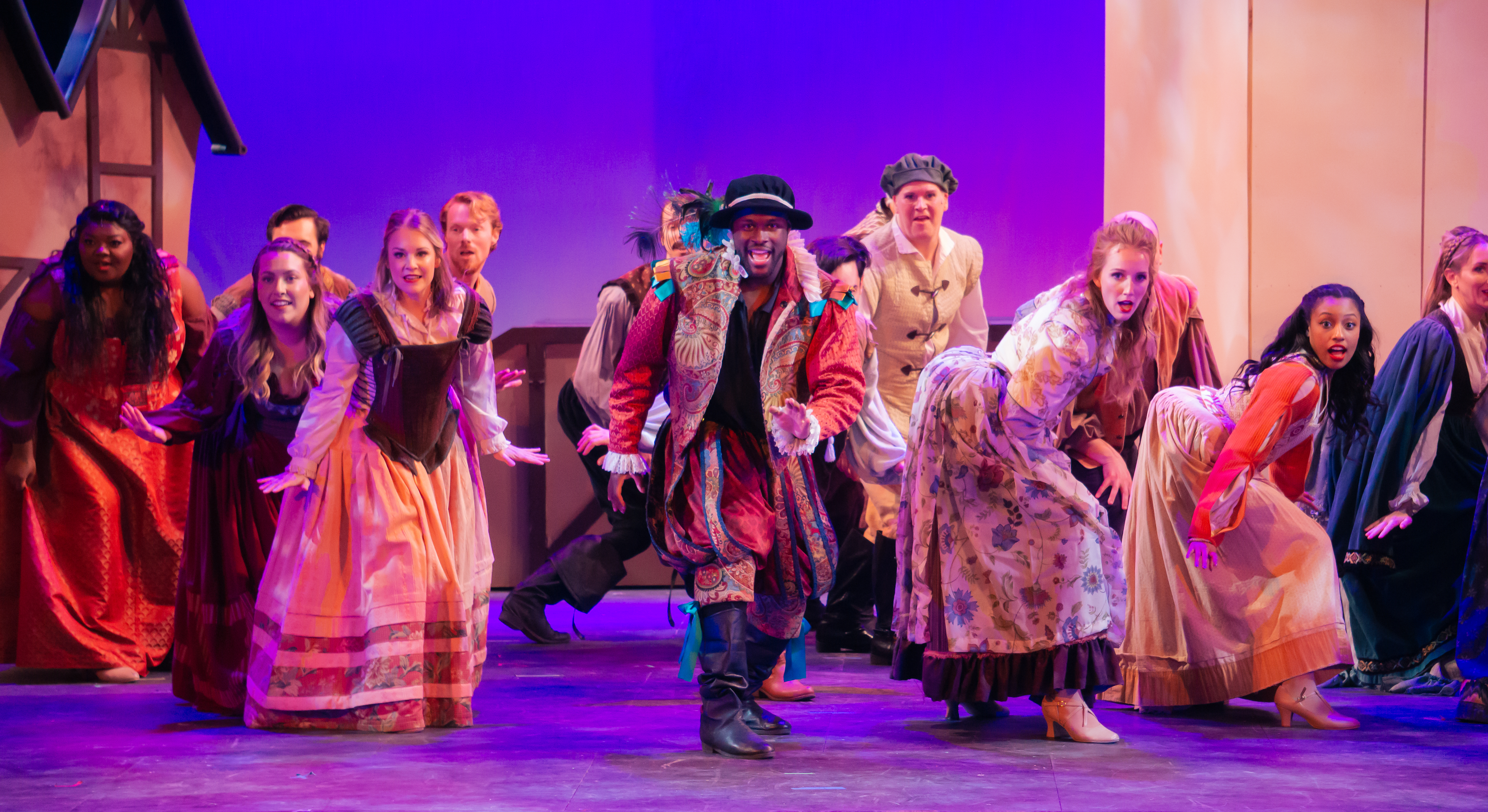
Ensley’s eager, able, well-drilled cast of 25 can seem like a teeming city in the confines of a barn, heartily welcoming us to two Renaissances, really, with Nehemiah Lawson as the Minstrel leading the ensemble’s bustling greeting – to the refurbished theater and olden days – when the curtain rises. They can form a credible mob around Will when he struts upon his stage.

Along with such teeming scenes, Ensley and choreographer Lisa Blanton and headshot sketch artist Dennis Delamar can pour in numerous references to familiar, beloved musicals we all know. Explicit references to Phantom, Les Miz, Cats, Sound of Music, and Chess are in the Kirkpatrick-O’Farrell script, but what about the sly nods to Annie, A Chorus Line, The Producers, and West Side Story?

There are more Broadway allusions than I’ve mentioned and still more that I may have missed. Ensley keeps the pace brisk.

Twice cast as Jesus at Theatre Charlotte in past seasons; along with leads in Rent, Memphis, and Arsenic and Old Lace; Joe McCourt steers us through Nick’s sea of troubles. Folks out in Matthews would remember McCourt’s exploits in Bonnie and Clyde more vividly, his first team-up with Ensley. The Arsenic and Old Lace agitation as Mortimer, when McCourt strayed from musicals into comedy, served as a nice precedent for his work here. When he leans away from straight-man chores opposite Will and Nostradamus, and into Nick’s showpieces, McCourt flashes his confident charisma – with comical seasoning – when he fumes “God, I Hate Shakespeare.”

McCourt is no less in command when he brings down the curtain for intermission with “Bottom’s Gonna Be on Top,” though his best soufflé may rise when he greets his troupe for the first Omelet rehearsal, absurdly exclaiming “It’s Eggs!” Yet this wannabe turn is decisively upstaged by the conceited rockstar and the wild-eyed prophet.

Perfectly cast at the Palmer in The Fantasticks, Mitchell Dudas and Kevin Roberge are even more smashing now. Dudas was a wonderfully swashbuckling El Gallo, the beguiling Fantasticks narrator, but he’s far slicker and more self-absorbed here, shining in his wicked showpieces, “Will Power” and “Hard to Be the Bard.” And the sheer arrogance of him when Dudas flashes his Shakespearean smile! You expect little LEDs to twinkle at the edges of his teeth.

Since “The Black Death” is an ensemble slaying, it’s Roberge who gets the killer solo of the night, “A Musical,” indoctrinating McCourt so thoroughly that the conjuring sweeps of Nick’s arm become nearly as prophetic. After his portrait of the more blustery Fantasticks dad, Roberge turns up his leonine energy more than a few notches. And the hair! Far more eccentric than the Einstein in Verizon ads. Think Charlton Heston on top of Sinai in The Ten Commandments.

Matt Howie, the naïf swain from Ensley’s Fantasticks, and Cornelia Barnwell mesh beautifully as the confidence-challenged Nigel and the overprotected Portia. But they’re overshadowed by a slew of quirkier characters who don’t sing nearly as much. Who comes first? Maybe Lindsey Schroeder as Bea, Nick’s proto-feminist wife, who fills out the contours of Shakespeare’s Portia in a memorable courtroom scene.

Certainly Hank West vies for the honor of favorite minor character as the shifty and resourceful Shylock, who remains a moneylender in Shakespeare’s world but transforms into the first theatre producer in Nick’s troupe and the New World. Delamar, our sketch artist and longtime Theatre Charlotte idol, gets props here for portraying a pair of pomposities: Lord Clapham, Nick’s skittish financial backer, and the Judge who must sentence Nick for his trumped-up crimes.

If there’s space for a feminist, a theatre producer, and a rockstar in this Renaissance makeover, there’s also room for a gay preacher and an outré transvestite. J. Michael Beech’s homosexuality as Brother Jeremiah is hardly latent at all as he strives to keep himself closeted with indifferent success, and we can presume that Paul Reeves Leopard as Robin gets the pick of the women’s roles in the Bottoms’ troupe, perennially dressed and simpering for the part.

Brave New World!

If the players I’ve named thus far decided to form a professional theatre company, I’d only be mildly surprised by their audacity. The new Old Barn made them all look good, first with the opulence of Chelsea Retalic’s period costumes – and the stark anachronism of Shakespeare’s glitter. Chris Timmons’ set designs didn’t look like he was working on a shoestring budget, either, indoors or out.

Better yet, the renovated 501 Queens Road facility has remained true to itself, in its lobby and its theater space. In the lobby, there are new, more modern-looking ceiling fans, which sit admirably flush to the upgraded ceiling. There were still extensive lines to the restrooms, so my inspections of the toilet – and the new backstage – must await visits to come.

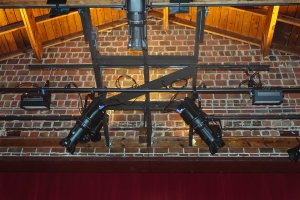
In the theatre hall, the skeleton of the new scaffolding isn’t fleshed out at all with sheetrock, so the roofbeams are visible all the way to the bricks that meet it at the proscenium wall. More like a beloved old barn than ever! Artistic director Timmons, wearing his second hat as acting executive director, told me that the renovations made it possible to raise the stage proscenium. Yet there was a shower of confetti to climax the finale, where the “Welcome to the Renaissance” melody completes its last rebirth as “Welcome to America.”

Can’t remember the last time, if ever, that I had seen evidence of a functional fly loft at the Queen Road barn.

Best of all, there was a profusion of theatre lights shining in many colors, along with strategically spaced audio speakers. All are discreetly black, of course, so I couldn’t resist taking flash photos to confirm that all this equipment is spanking new. Everything worked flawlessly, including Theatre Charlotte’s soundboard. Nor did I notice any coughing or humming from the heating system. All was bliss, best feet forward, with nothing rotten except the show’s title.

Don’t be shocked to find that Something Rotten! is sold out for the rest of its current run. The show, the production, and the newborn theater are all that good. Timmons & Co. may need to add performances to meet the well-deserved demand.