Tag Archives: Chelsea Retalic

The More Things Change, the More Confederates Shocks and Delights

Review: Confederates at The Arts Factory

By Perry Tannenbaum
Symmetry, parallelism, continuity, and evolution are intricately interwoven throughout Confederates, Dominique Morriseau’s comical and sometimes farcical drama of 2022. The Charlotte premiere, now at the Arts Factory, comes to us less than two years after its Off-Broadway premiere in a highly polished, smartly aware Three Bone Theatre production.

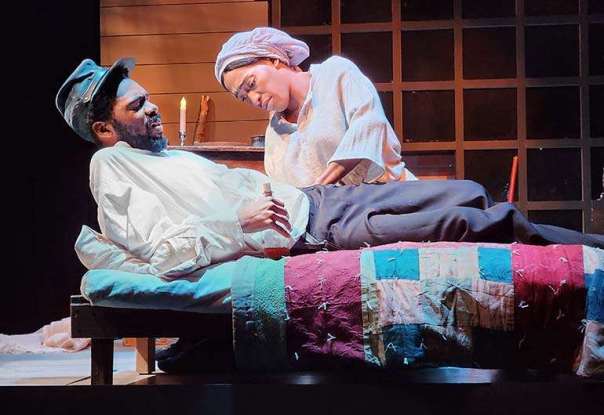
Morriseau’s symmetry isn’t subtle: it hits us straight in the eyes the first time we see Zachary Tarlton’s scenic design. Split down the middle, the Arts Factory stage gives two eras and two institutions equal play in an intimate black box format. One side evokes Civil War slavery on a Southern plantation, while the other half introduces us to contemporary academia.

We alternate between settings, starting with Sandra, a modern tenured Black professor, proclaiming her outrage and sense of violation in vivid terms – yet with the poise and sleekness of a contemporary college lecture accessorized with slides. From that peep into scandal in present-day academia, we flash back to the slave quarters of Sara as her brother Abner sneaks into her bedroom through a concealed trap door.

Sandra has been maliciously targeted by a student or teacher who pasted a demeaning old Civil War photo of a bare-breasted black wetnurse suckling a white baby – with Sandra’s face photoshopped to replace the original slave’s. Jumping to conclusions or instinctively making connections, we’re apt to immediately believe that Sara was that nurse. Abner has volunteered for the Union Army and has been wounded in battle, so as she sews up Abner’s wound, the subject of Sara’s nursing skills is inevitably addressed.

Sara’s skills and ambitions extend further. Dangerously. She has already learned how to read, breaking one terrible white taboo, and she wishes to nurse and fight for the Union alongside her brother – to learn how to fire a rifle right now. That’s a pill Abner can’t easily swallow.

Otherwise, the two women have separate storylines until Morisseau split-screens them together at the end. Portraying Abner in his Three Bone debut, Daylen Jones is the first subordinate character to cross the invisible line between pre-Emancipation Dixie and the hope and refuge of modern-day academia. Shedding his rags and his Union blue greatcoat, Abner becomes the aggrieved Malik in today’s world. He’s obviously a gifted student, and his gripe with Professor Sandra is that she grades his papers more harshly because he’s Black, protecting her immunity from being charged with favoritism.

Seeing that there are only Black females on faculty – and no men – Malik feels doubly oppressed by bias in academe: racial bias compounded by gender bias. Notwithstanding her starchy professional manner, Sandra is more of a crusading sociologist than a sober judge. So she may indeed have fallen prey to the trope heaped upon oppressed races and genders that says, “If you wish to be treated as an equal, you need to be better.” Pragmatic? Sure. But for a gifted scholarship student seeking to maintain his A average, cold comfort.

We eventually see that there are four characters on each side of the time divide, three of whom repeatedly change costumes to play double roles. Before and after we can tally all this, director DonnaMarie and sound designer Tiffany Eck place two snippets from Nina Simone’s “Four Women” at strategic spots in their playlist, layering on extra meaning – and mythic aura – during scene changes.

If Jones can be labeled as two provocatively different militants as he roams back-and-forth from opposite sides of the stage, then Holli Armstrong (also on my radar for the first time) can be regarded as two variants of an imperfectly enlightened white racist. She is most exaggerated and hilarious on the Southern plantation as Missy Sue, the master’s daughter, when she comes back home as an undercover born-again Abolitionist. It is Morisseau as much as DonnaMarie who is prompting Armstrong to bring a Gone With the Wind air-headedness to Missy Sue – and a twisted lesbian desire for Sara – and she obliges with fiddle-dee-dee gusto.

She offers Sara a perk in exchange for executing a dangerous mission: if Sara will transcribe and transmit Master’s battleplans, she gets to live in the big house while Sue delivers Dad’s secret intelligence across enemy lines. Sure, that’s an appreciable upgrade for Sara, but she’ll still be a slave doing Missy Sue’s dirty work.
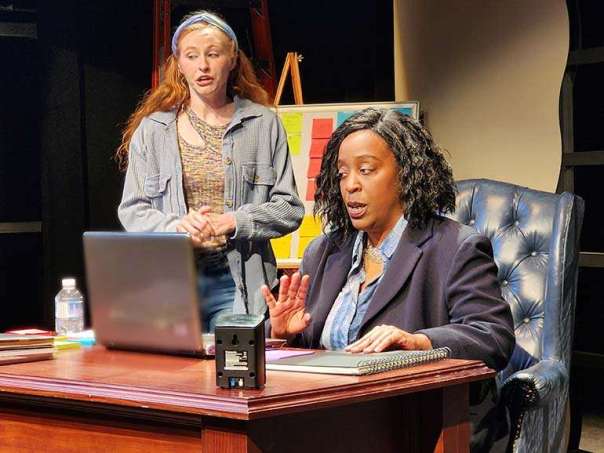
Armstrong discards Missy Sue’s pea-brained giddiness when she transitions to Candice, retaining her sycophant tendencies and much of her high energy as she haunts Professor Sandra’s office, working off her tuition debt and gathering gossip. Her true manipulativeness gradually emerges in successive office scenes, but Candice never becomes as juicy a role as Missy Sue is, for she somewhat downplays her suck-up moments with faculty.

Last to appear onstage, Jess Johnson draws the most balanced – and delicious – of the dual-role combos. As the master’s Black mistress, the opportunistic Luanne effortlessly sniffs out that Sara’s access to the master’s office and desk are coming at a price the newcomer must pay, possibly beyond accepting Missy Sue’s sexual advances. On the academic side, Johnson gets the most radical of costume designer Chelsea Retalic’s backstage makeovers when she becomes Jade. Professor Jade is more stylish and popular than Sandra because she’s chummier with her students and would never dream of hamstringing the Black ones.
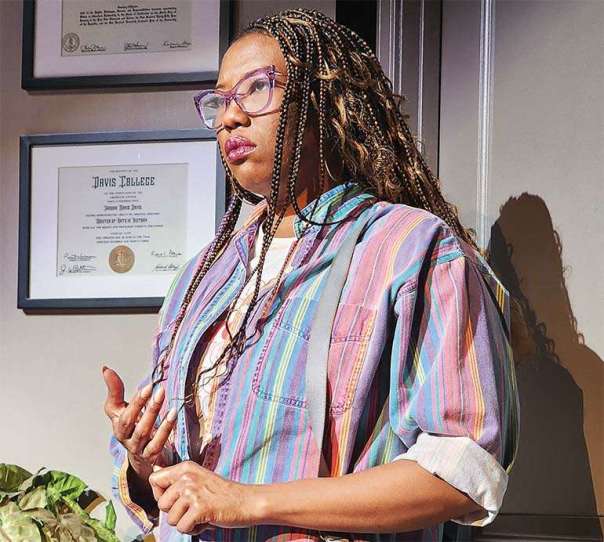
At both ends of the stage, Johnson gets to be a wily master of psychological warfare. Both Luanne and Jade want something vital from our protagonists. Luanne wants friendship from Sara and a path to freedom, but if Sara bars the way, she can work her charms on Abner. Needing Sandra’s endorsement, Jade doesn’t tiptoe around her differences with her superior, unleashing a torrent of scorn and chutzpah that took my breath away.

Indeed, Johnson unlocks Morisseau’s grimmest joke on her protagonists. Whether you’re at the bottom of the pecking order or at the top, you’re still the most oppressed person in the room. Times have changed, but not that much.

Sara is always being pulled at from multiple directions. Abner needs to be sewn back together, Missy Sue wants to recruit her as a spy, and Luanne wants her to plot an escape to freedom. Maybe that’s why the playwright stretched out Sara’s name to Sandra for the New Millennium! Our Professor is no less pressed upon, strongly urged to re-examine her grading philosophy, softly reassured that she is more admired than she really is, and arrogantly lobbied for tenure backing. Nobody seems to really care about the bare-breasted insult that was slapped on her office door.

Neither of these roles is fun-filled, but the challenges Sara and Sandra face allow them to grow in strength and stature before our eyes. Valerie Thames and Nonye Obichere are so fiery and authoritative in their separate roles that you can comfortably watch Confederates as two separate plays without constantly considering how meanings and brilliance bounce off the facets of the two gems. Not feeling compelled to track the finer points of Morisseau’s disquisition on racial or gender bias makes it all the easier for an audience to enjoy them.

Thames effortlessly takes on the self-assurance of an established TV guest whose knowledge and viewpoint are proven commodities, wearing Professor Sandra’s celebrity status with insouciant dignity. Just watch out when she bursts into flames! Maybe run for cover.

Although Sandra’s speeches frame the drama, Obichere gets to be a more physical presence as Sara – as nurse, spy, soldier, and lover – and she navigates a far wider character arc. Hers isn’t the funniest performance you’ll find this weekend at The Arts Factory. But it’s the most vivid, shocking, and memorable.

You may leave the theater convinced that both Sara and Sandra are depicted in that horribly racist slide. But it will mean more at the end than at the beginning. The magic of Morisseau and Photoshop are both at work.

Ensley and Schroeder Check All the Beautiful Boxes in Matthews

Review: Beautiful The Carol King Musical at Matthews Playhouse

By Perry Tannenbaum

When you think of singer/songwriter Carole King and Broadway musicals, there’s an instant disconnect: the humble simplicity of King’s Tapestry album cover clashing with the glitz and blare of the Great White Way. So a Broadway musical about King’s career is more of a stylistic stretch than a biomusical about most rock stars, pop stars, or jazz & blues divas. Everyone involved behind the scenes of the original 2014 production of Beautiful The Carol King Musical seemed keenly aware of the dichotomy, including director Marc Bruni, orchestrator/arranger Steve Sidwell, and scriptwriter Douglas McGrath.

Their idea of coping with the problem was by leaning into it. Not too subtly, they conspired to make the early stages of King’s career seem crass and commercial, as if she were trapped in the dog-eat-dog maw of the pop music industry. King and her writing partner, lyricist Gerry Goffin, write the songs while producer Don Kirshner finds the singers and the groups who will cut the singles – the likes of Bobby Vee, Little Eva, The Drifters, and The Shirelles. Yet somehow the hierarchy is flipped in the famed Brill Building in NYC.

Carole and Gerry are slaving for Kirshner, a genial industry mogul and taskmaster, and the couple’s best early music loses a lot of its luster when it’s farmed out, especially when “Up on the Roof” falls into the hands of The Drifters and “Will You Still Love Me Tomorrow?” is butchered by The Shirelles, thanks to excessively ornate Sidwell arrangements that would be more at home on Broadway or Vegas than Motown. These excesses helped Jessie Mueller to shine all the more brightly in the original cast – and for her sister, Abby Mueller, to shine equally when the touring version hit the QC in April 2016.

So a downsized production, like the one currently running at Matthews Playhouse, actually has the potential to be better than the Broadway and touring versions – with the right personnel and sufficient pizzazz. With Billy Ensley directing and Lindsey Schroeder leading a heavyweight cast, both those boxes are checked. The Broadway ensemble sheds two of its three keyboards nestling into Matthews, one its two guitars, and one of its percussionists. The slimming helps. No longer smothered by their orchestrations, Neil Sedaka’s “Oh! Carol,” Gene Vincent’s “Be Bop a Lula,” and Little Eva’s “Loco-Motion” sound more like rock music and less like mockeries.

Ensley targets the megahit by the King-Goffin duo’s friendly rivals, Barry Mann and Cynthia Weil, for his most farcical treatment. Not only is the arrangement of “You’ve Lost That Lovin’ Feelin’” garishly distorted, amped up from the swampy-echoey-churchy vibe of the original single, but the gulf between the bass and tenor voices of the Righteous Brothers is greatly emphasized, exaggerated, and comically exploited by Johnny Hohenstein and Zach Linick.
McGrath’s book is most affecting when it deals directly with King, though there’s bold poetic license in his voodoo, historically speaking. Pressured by Kirshner to come up with a new hit overnight for The Shirelles (in real life, they only had one hit record so far), King writes the music and goes to bed with Goffin. Perfect setup. Wouldn’t you like to wake up in the morning and find the handwritten lyrics for “Will You Still Love Me Tomorrow” perched on your piano – and be the first person on Earth to read and sing them?

No disrespect to the great Bobby Vee, but we’ve suddenly ascended more than a few notches above “Take Good Care of My Baby.” This moment still grabs me, but there are more moments like this after intermission, when “You’ve Got a Friend” and “A Natural Woman” are unveiled, that choke me up even more – as King breaks away from the Brill Building and starts to do her own thing. Schroeder replicates the sandy sound of Carole’s voice from the beginning, but as she transforms from a demo singer behind an upright piano to a chart-topping performer, watch out.

Schroeder can not only belt – she can tear your heart out.

McGrath’s dramatization heightens the magic most memorably when “You’ve Got a Friend” is reframed as a not-quite-farewell song, when King embarks for her solo career in LA with Kirshner’s blessing, and both Barry and Cynthia gather round the old upright with her to sing this newborn masterpiece. The song didn’t really come out until her second album, but who’s counting, right?

Nick Southwick as Barry and Sophie Lanser as Cynthia (get that woman a more reliable mic!) deliver polished performances all evening long, but they also grow more gravitas after intermission. Lanser sheds the frivolity of a “Happy Days Are Here Again” parody and “He’s Sure the Boy I Love” and joins Southwick – previously mired in the silliness of “Who Put the Bomp” and the wrong-key version of “You’ve Lost That Lovin’ Feelin’ – in a heartfelt “Walking in the Rain” duet.

Then if you haven’t started weeping with Schroeder’s “It’s Too Late,” you’re at the mercy of “You’ve Got a Friend” when Lanser and Southwick join in on the quivering-lip goodbyes. After playing Kirshner with avuncular savvy throughout King’s formative years, Ryan Dunn sprinkles some welcome laughter into this maudlin scene with a (purposely) bad attempt at vocalizing.

I’d forgotten that Carole had Aretha’s 1967 hit in her hip pocket when she cut Tapestry out on the Left Coast in 1971, so I found myself suddenly suppressing sobs when “A Natural Woman” began. Here it felt very right that Sidwell’s arrangement brought added vocalists and brass to beef up the simplicity of King’s version – and freed Schroeder to narrow the gap between Carole and the Queen of Soul with some fervent belting.

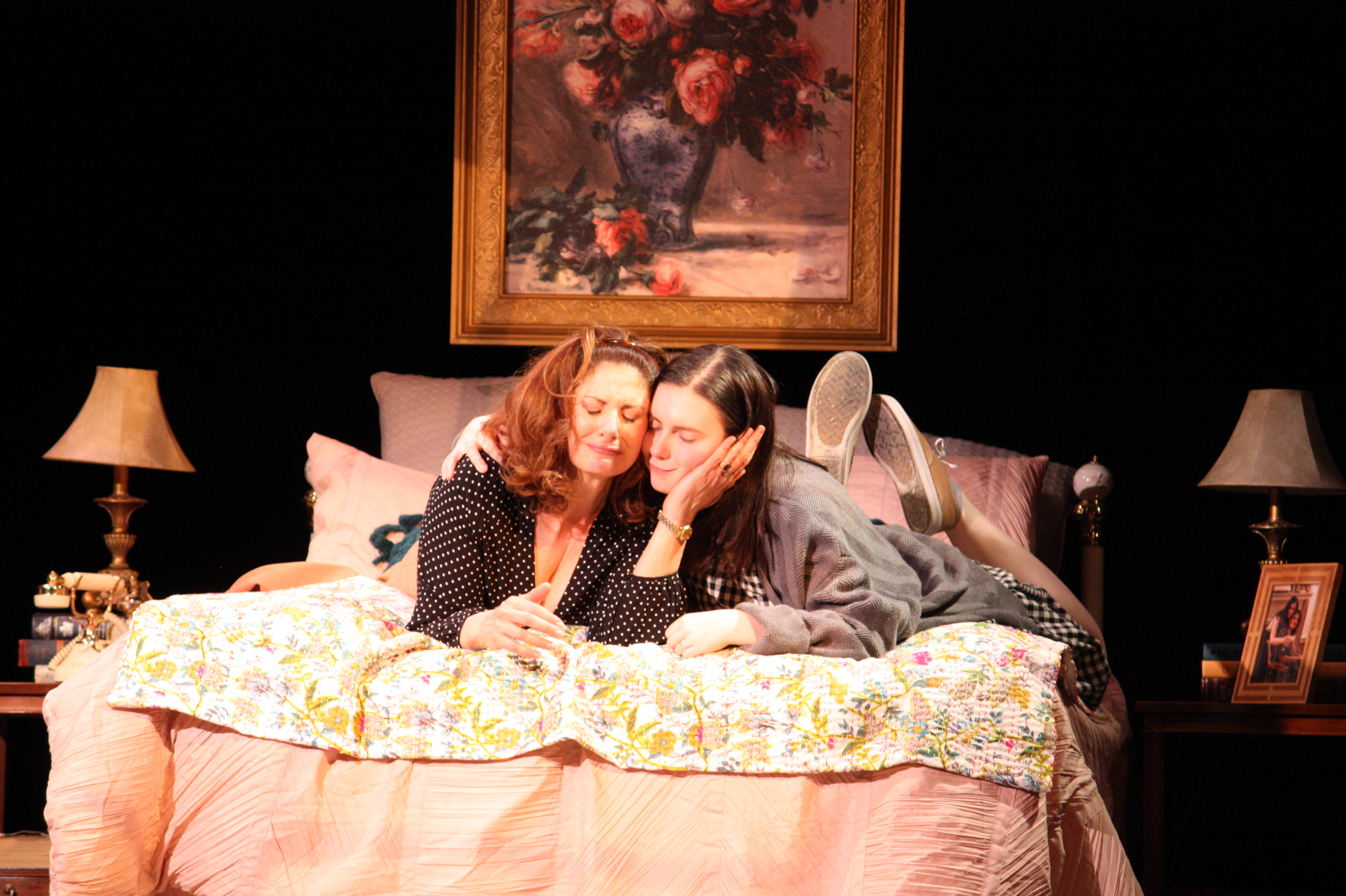
Marty Wolff’s simple two-story set design, with four wide strips of stained-glass paneling running vertically upstage in front of the eight-piece band led by Ellen Robison from the keyboard, needs only JP Woodey’s lighting to give it a rockin’ modernistic zing. Lisa Blanton’s choreography is devout doo-wop, most praiseworthy for how well the groups stay in sync, and Chelsea Retalic likely cranked out between 75 and 100 costumes for this large cast – all of them, from the sleekest to the grungiest, on point.

And the wigs! The only misfire here, among dozens of triumphant coifs – several for Schroeder – was the oceanic profusion of waves that perched on Joe McCourt’s head as Gerry Goffin, making him virtually unrecognizable. McCourt, a musical mainstay in the QC since his debut in 2008 as the lead in Godspell, has suavity to spare to spare and, in contrast with Southwick’s quirky neuroses as Barry, gets a nice and bumpy character curve as the only troubled soul we see.

This image has an empty alt attribute; its file name is beautiful24-139.jpg

As for the Afro-American doo-woppers… my, oh my! By bringing Nehemiah Lawson aboard to take over “Some Kind of Wonderful” from Schroeder and McCourt and then to bring him back again and again to sing “Up on the Roof” and “On Broadway,” the latter one of Weil & Mann’s best, Ensley and Robison signal that they have no plans of dissing The Drifters. Meanwhile, two lead singers are embedded among Ensley’s Shirelles. As Janelle Woods, the Shirelle who denigrates “Will You Still Love Me” as “too country” before fronting the breakthrough single (first Billboard #1 for an African-American girls’ group), Brianna Mayo gets a chance to show that her acting chops are as strong as her singing skills.

Shortly afterwards, Raven Monroe emerges from the backup Shirelles to become Little Eva and ignite “The Loco-Motion.” Until then, she moonlights as King’s babysitter during the leading lady’s brief marriage to the restless Goffin.

There’s a formulaic circle to McGrath’s storytelling that’s not at all displeasing, starting and ending with King as a star behind a grand piano singing a song from Tapestry. We flash back to her youth in Brooklyn and eventually touch down at Carnegie Hall, surely a kind of Jerusalem for a humble Jewish girl. Alongside her at the beginning and at the end is Carol Weiner as Genie Klein, King’s mother. Both were abandoned by her no-good father, steeled by adversity. Along the way to Carnegie, Weiner peeps in with a couple of overprotective warnings, a few salty quips, and a proud Mama’s lie.

If McGrath can embellish a good story, why shouldn’t she

Shakespeare Is a Thieving Magpie in Theatre Charlotte’s “Something Rotten!”

Renovated Queens Road Barn is ready for its closeup

By Perry Tannenbaum

Something Rotten

 We are all stupid and silly – and we all love smart-ass musicals that tell us so. That’s the deep message of Something Rotten! Theatre Charlotte’s brash, big-ass extravaganza that’s raising the curtain for the grand reopening of the iconic Queens Road barn.

Yeah, it’s been awhile since a musical opened at our venerable community theatre’s home. That was early September 2019, when Oliver! launched what would have been the 2019-20 season. But COVID-19 shut everything down in early March, before auditions or rehearsals could even begin for Dreamgirls, scheduled to open in late spring. Then a latenight fire in the waning hours of 2020 gouged a huge hole in the theater floor, smoked the ceilings, and fried all the precious electronics – lights, audio, AC, computers – and kicked the company out of their house.

For over two years, while more than $1 mil in repairs, renovations, and new equipment requisitions could be authorized and completed, artistic planning continued while navigating insurance adjustments and jumping municipal hurdles. While the new 501 Queens Road gestated and marinated for more than two years, the company hit the road, resuming production in September 2021 and hopscotching the city to keep Theatre Charlotte alive in Charlotte. The Palmer Building, Halton Theater at CP, and the Great Aunt Stella Center were the first three stops on the season-long 2021-22 road trip.

Now there have been five or six shows at the old barn, in play or concert format, since Oliver! closed back in 2019, including two iterations of A Christmas Carol, a Theatre Charlotte gotta-do-it tradition. But nothing short of a musical, one with an authentic exclamation point yelling out its title, can truly show off a theater’s brand-new bells and whistles – or put them to their ultimate test.

Of course, there had to be some extra drama, an extended drumroll, before Something Rotten! could give the renovated Queens Road barn its much-anticipated relaunch. Scheduled for its closeup last October, the revamped site wasn’t going to be ready for opening night. The 2022-23 season had to be reshuffled, and the wondrous Shakespearean mashup of a musical was postponed.

A construction project. In Charlotte! Can you believe it wasn’t finished on time??

Billy Ensley, after directing the first little musical away from TC’s home, The Fantasticks, now pilots the first leviathan since the company’s return. Three of his mates from that Palmer Building gem back in 2021 are on board with Ensley for this new voyage, all of them playing major roles and all of them delivering.

I was fairly bowled over by the brash irreverence of Something Rotten! when I first encountered this Karey and Wayne Kirkpatrick concoction on Broadway in 2016. You might wonder if the Kirkpatricks had the zany antics of The Compleate Wks of Wllm Shkspr (Abridged) on their minds when they decided to take aim at the Bard of Avon and musicals.

Certainly the methods of their madness can be traced to the Reduced Shakespeare Company – with genetic material from Forbidden Broadway and The Producers also in the DNA. The Kirkpatricks discard the merely dubious ideas that Shakespeare’s works were written by someone else, or that his awesome greatness was only fully appreciated after he died. They ignore the reality that there’s only faint, sketchy traces of the man over the course the grand Elizabethan Era.

No, all those tropes are toast. The Kirkpatricks, with John O’Farrell collaborating on the book went full-bore misinformation and alternate reality. Months before The Donald descended the Trump Tower escalator.IMG_2969-2

Shakespeare is no longer a dim peripheral figure on the Elizabethan cultural scene. He’s a full-blown superstar, recognized and wildly adored wherever he goes. Mobbed by his rabid fans, he gives outdoor spoken-word concerts to sustain the mass hysteria.

The secret of the Bard’s genius is revealed. Like the Reduced Shakespeares, Forbidden Broadway, and the Kirkpatricks after him – not to mention The Donald – the real Shakespeare was a thieving magpie. Not only did he steal from ancients like Plutarch and Ovid, predecessors like Chaucer and Boccaccio, and contemporaries like Christopher Marlowe, he cribbed from unknown wannabes and the man or woman on the street.

Case in point: after defecting from Nick Bottom’s struggling theatre company, Will takes his former boss’s name with him and dumps it into A Midsummer Night’s Dream. Another case in point: Sniffing out the possibility that Nick is working on something revolutionary for the stage, Shakespeare embeds himself in his former company, where he swipes the complete manuscript of Hamlet from its true author, Nigel Bottom. Because big brother Nick has astutely told him that “to be or not to be” is trash. Not to be.IMG_2417

A hapless mediocrity, Nick is our hero. In his crazed search for the next new thing in theatre, Nick seeks out a soothsayer to look into the future, a rather Shakespearean ploy. The eccentric soothsayer that Nick picks, Nostradamus, turns out to be a genuine visionary, but his inner crystal ball seems to be afflicted with astigmatism. Skipping over the breakthrough artform of opera on the near horizon, soon to be birthed in Italy, Nostradamus is himself amazed to see… a musical!

So powerful is this concept that Nostradamus cannot even say the word without a vatic, conjuring sweep of his right arm. He wants Nick – and us – to see it clearly, too. Nick, poor thing, doesn’t have as juicy a role as the raving Nostradamus, who must convince his skeptical client that such an impossibility can be created, believed, and become universally popular. He’ll be able to bring my play to a complete stop and have my speaking characters suddenly start singing? And he’ll be able to interrupt this blatant interruption with a whole crowd of people dancing? Tap dancing?IMG_2703

Yes, yes, and yes, Nostradamus prophesies, and audiences will lap it up. We do see, for we were living proof of this seeming insanity at the Queens Road barn, just like I was at the St. James Theatre in 2015.

Over and over, the Kirkpatricks reinforce the idea that the road from brilliant concept to acclaimed masterwork is strewn with pitfalls. Nick begins with a colossal misstep, an upbeat number called “The Black Death,” which strives to match Mel Brooks’ “Springtime for Hitler” in utter tastelessness.

So Nick hurries back to his soothsayer. What will Shakespeare’s greatest triumph be, he asks, determined to beat the Bard to the punch. Pushing away invisible cobwebs between him and the future, Nostradamus proclaims, Omelet, the Musical is the future, confident he’s setting Nick on the right track.

With creditors and prudish censors dogging his way, Nick has ample complications to overcome. The backbreaker is Nigel’s resistance. Instead of sticking to the yolks and the big egg picture, Nigel is spouting useless lines like “To thine own self be true.”

Another Shakespearean device comes into play with little brother, the double plotline. While tasked with writing the world’s first libretto, Nigel is smitten by Portia, the lovely daughter of Brother Jeremiah, the most sanctimonious and censorious Puritan in London. Avid admirers of Shakespeare, both Portia and Nigel can see the parallel between their star-crossed plight and the tragedy of Romeo and Juliet, their idol’s newest hit.IMG_3812

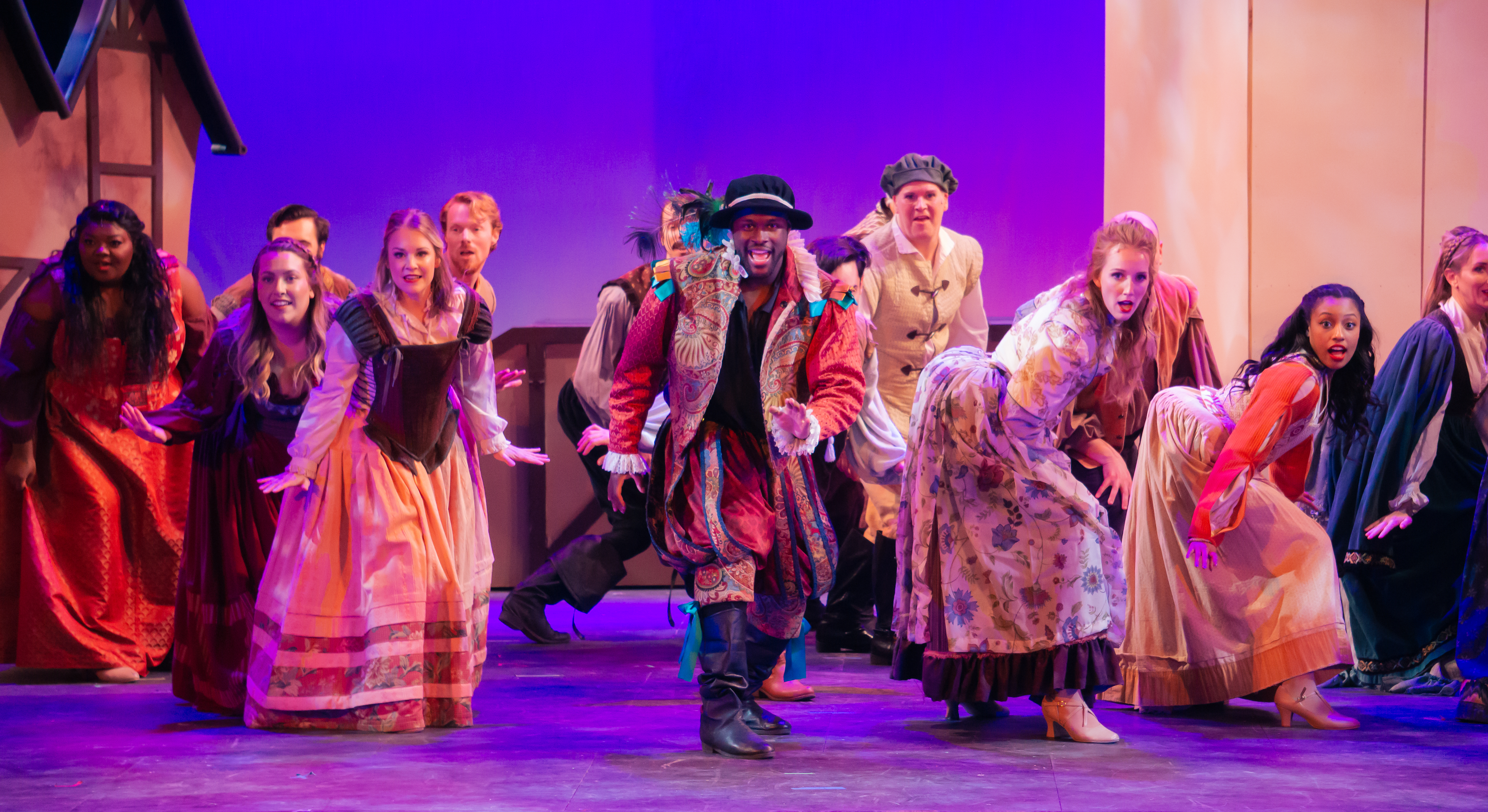
Ensley’s eager, able, well-drilled cast of 25 can seem like a teeming city in the confines of a barn, heartily welcoming us to two Renaissances, really, with Nehemiah Lawson as the Minstrel leading the ensemble’s bustling greeting – to the refurbished theater and olden days – when the curtain rises. They can form a credible mob around Will when he struts upon his stage.

Along with such teeming scenes, Ensley and choreographer Lisa Blanton and headshot sketch artist Dennis Delamar can pour in numerous references to familiar, beloved musicals we all know. Explicit references to Phantom, Les Miz, Cats, Sound of Music, and Chess are in the Kirkpatrick-O’Farrell script, but what about the sly nods to Annie, A Chorus Line, The Producers, and West Side Story?

There are more Broadway allusions than I’ve mentioned and still more that I may have missed. Ensley keeps the pace brisk.

Twice cast as Jesus at Theatre Charlotte in past seasons; along with leads in Rent, Memphis, and Arsenic and Old Lace; Joe McCourt steers us through Nick’s sea of troubles. Folks out in Matthews would remember McCourt’s exploits in Bonnie and Clyde more vividly, his first team-up with Ensley. The Arsenic and Old Lace agitation as Mortimer, when McCourt strayed from musicals into comedy, served as a nice precedent for his work here. When he leans away from straight-man chores opposite Will and Nostradamus, and into Nick’s showpieces, McCourt flashes his confident charisma – with comical seasoning – when he fumes “God, I Hate Shakespeare.”

McCourt is no less in command when he brings down the curtain for intermission with “Bottom’s Gonna Be on Top,” though his best soufflé may rise when he greets his troupe for the first Omelet rehearsal, absurdly exclaiming “It’s Eggs!” Yet this wannabe turn is decisively upstaged by the conceited rockstar and the wild-eyed prophet.

Perfectly cast at the Palmer in The Fantasticks, Mitchell Dudas and Kevin Roberge are even more smashing now. Dudas was a wonderfully swashbuckling El Gallo, the beguiling Fantasticks narrator, but he’s far slicker and more self-absorbed here, shining in his wicked showpieces, “Will Power” and “Hard to Be the Bard.” And the sheer arrogance of him when Dudas flashes his Shakespearean smile! You expect little LEDs to twinkle at the edges of his teeth.

Since “The Black Death” is an ensemble slaying, it’s Roberge who gets the killer solo of the night, “A Musical,” indoctrinating McCourt so thoroughly that the conjuring sweeps of Nick’s arm become nearly as prophetic. After his portrait of the more blustery Fantasticks dad, Roberge turns up his leonine energy more than a few notches. And the hair! Far more eccentric than the Einstein in Verizon ads. Think Charlton Heston on top of Sinai in The Ten Commandments.

Matt Howie, the naïf swain from Ensley’s Fantasticks, and Cornelia Barnwell mesh beautifully as the confidence-challenged Nigel and the overprotected Portia. But they’re overshadowed by a slew of quirkier characters who don’t sing nearly as much. Who comes first? Maybe Lindsey Schroeder as Bea, Nick’s proto-feminist wife, who fills out the contours of Shakespeare’s Portia in a memorable courtroom scene.

Certainly Hank West vies for the honor of favorite minor character as the shifty and resourceful Shylock, who remains a moneylender in Shakespeare’s world but transforms into the first theatre producer in Nick’s troupe and the New World. Delamar, our sketch artist and longtime Theatre Charlotte idol, gets props here for portraying a pair of pomposities: Lord Clapham, Nick’s skittish financial backer, and the Judge who must sentence Nick for his trumped-up crimes.

If there’s space for a feminist, a theatre producer, and a rockstar in this Renaissance makeover, there’s also room for a gay preacher and an outré transvestite. J. Michael Beech’s homosexuality as Brother Jeremiah is hardly latent at all as he strives to keep himself closeted with indifferent success, and we can presume that Paul Reeves Leopard as Robin gets the pick of the women’s roles in the Bottoms’ troupe, perennially dressed and simpering for the part.

Brave New World!

If the players I’ve named thus far decided to form a professional theatre company, I’d only be mildly surprised by their audacity. The new Old Barn made them all look good, first with the opulence of Chelsea Retalic’s period costumes – and the stark anachronism of Shakespeare’s glitter. Chris Timmons’ set designs didn’t look like he was working on a shoestring budget, either, indoors or out.

Better yet, the renovated 501 Queens Road facility has remained true to itself, in its lobby and its theater space. In the lobby, there are new, more modern-looking ceiling fans, which sit admirably flush to the upgraded ceiling. There were still extensive lines to the restrooms, so my inspections of the toilet – and the new backstage – must await visits to come.

In the theatre hall, the skeleton of the new scaffolding isn’t fleshed out at all with sheetrock, so the roofbeams are visible all the way to the bricks that meet it at the proscenium wall. More like a beloved old barn than ever! Artistic director Timmons, wearing his second hat as acting executive director, told me that the renovations made it possible to raise the stage proscenium. Yet there was a shower of confetti to climax the finale, where the “Welcome to the Renaissance” melody completes its last rebirth as “Welcome to America.”

Can’t remember the last time, if ever, that I had seen evidence of a functional fly loft at the Queen Road barn.

Best of all, there was a profusion of theatre lights shining in many colors, along with strategically spaced audio speakers. All are discreetly black, of course, so I couldn’t resist taking flash photos to confirm that all this equipment is spanking new. Everything worked flawlessly, including Theatre Charlotte’s soundboard. Nor did I notice any coughing or humming from the heating system. All was bliss, best feet forward, with nothing rotten except the show’s title.

Don’t be shocked to find that Something Rotten! is sold out for the rest of its current run. The show, the production, and the newborn theater are all that good. Timmons & Co. may need to add performances to meet the well-deserved demand.

2020 or Not 2020

Review: A Half-Masked Christmas Carol at Theatre Charlotte

By Perry Tannenbaum

2020~A Christmas Carol-28 

Luckily, the Ghost of Christmas Present in Charles Dickens’ A Christmas Carol, so friendly and jolly with his glowing torch, was more than 175 years removed from 2020 when he made his first oxymoronic appearance in print. Christmas of 1843 may not have been the best ever as it greeted Dickens’ original readers, but it had to be more festive than 2020, the gloomiest in centuries.

While it’s possible to retreat into the nostalgia of numerous movie and TV adaptations of the Yuletide classic, Charlotte is one of hundreds of cities where watching live theatrical adaptations has become a holiday tradition. So it’s fascinating, even revelatory to see how Theatre Charlotte is adapting to the unprecedented circumstances of 2020 in presenting its 14th annual production of A Christmas Carol.

It’s a remarkable chameleon, adapted by Julius Arthur Leonard and co-directed by Stuart Spencer and Chris Timmons. This is truly a to-be-or-not-to-be effort: Live and virtual, at Theatre Charlotte on Queens Road and not, set in Dickens’ London in the 19th century and unmistakably invaded by COVID-19 and the constraints of the pandemic. 2020 or not 2020.

2020~A Christmas Carol-21

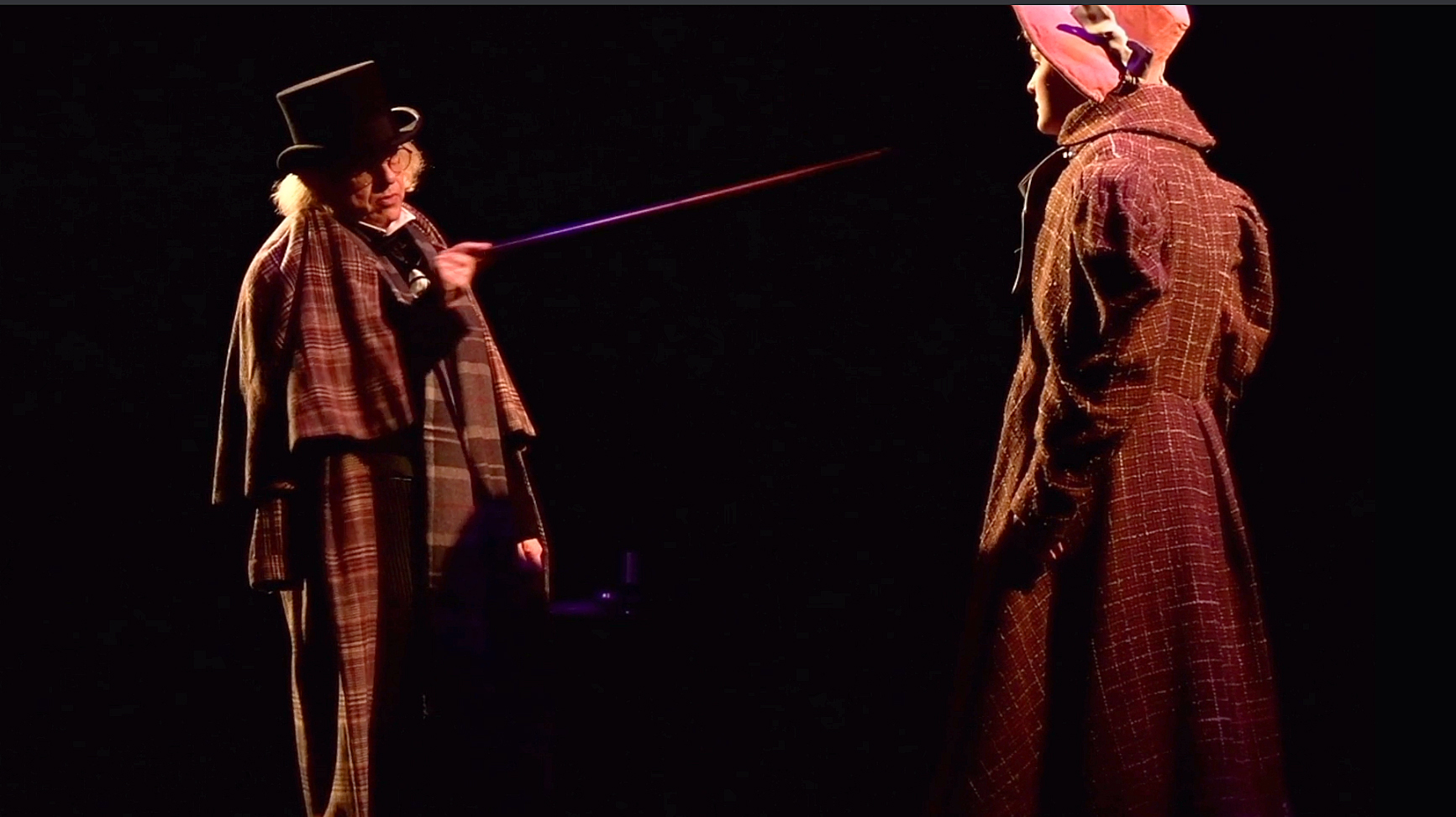
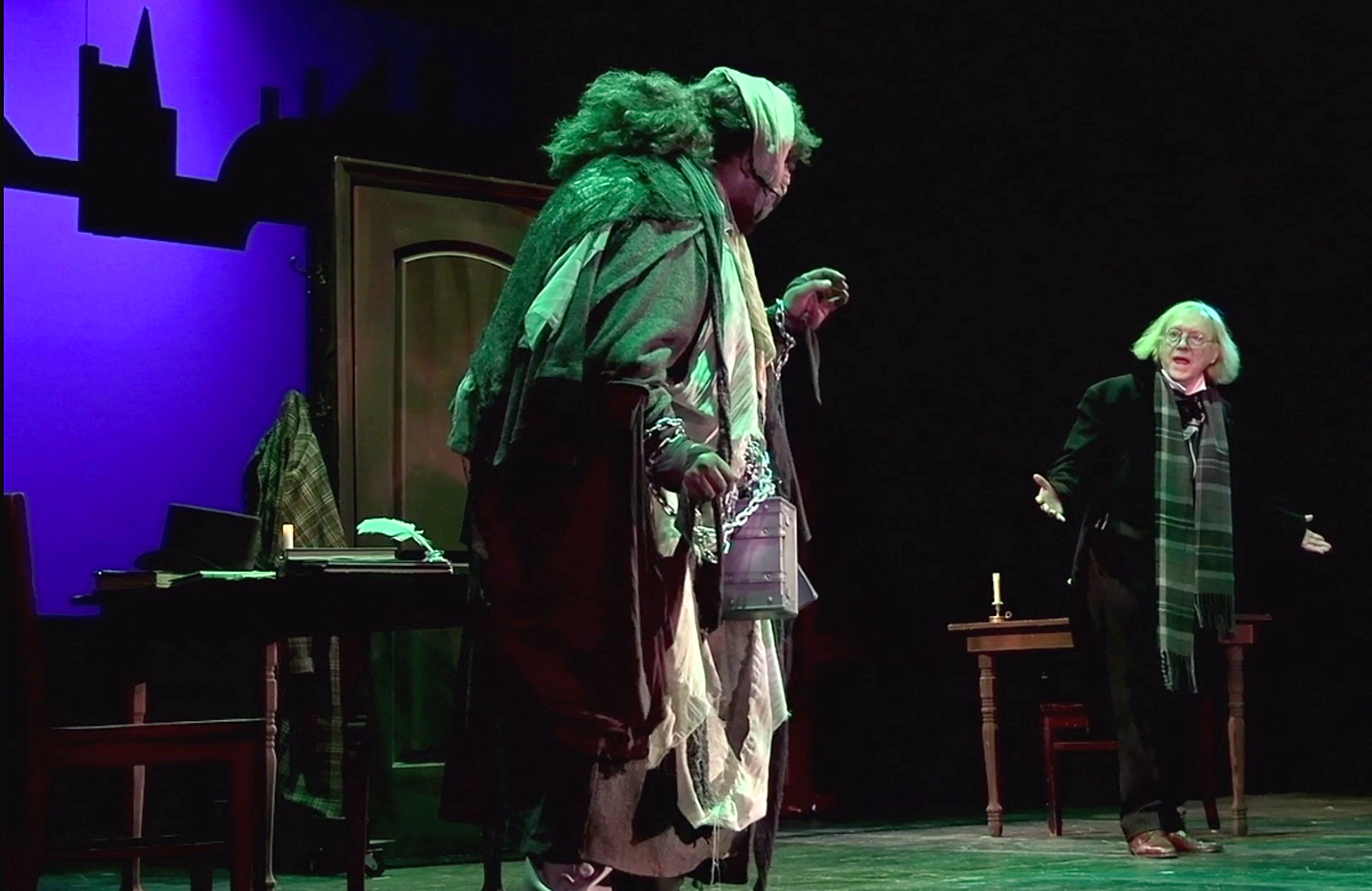
Watching the virtual version recorded at the Queens Road barn, I was surprised to find how Dickens’ characters, in period costumes designed by Chelsea Retalic, replicated daily life today. While Marley and the three famous Christmas Ghosts wore masks, others – including Scrooge, his nephew, and the Cratchits – did not. No wonder poor Tiny Tim is dying!

Live outdoor performances of Theatre Charlotte’s pandemic edition of Dickens premiered at Christ South’s Old Dairy Farm in Waxhaw on Reid Dairy Road, which may account for some of the anomalies we see when we tune in to the indoor version. Outdoors, winter is upon us, so Spencer and Timmons may not have wished their Scrooge to change into his jammies. Besides that, an outdoor shift in scene from the Scrooge & Marley counting house to Ebenezer’s bedroom may have been unwieldy out on the farm.

So all of the action, aside from the Ghosts’ travels, is confined to Scrooge’s office until he sallies forth on Christmas day. To achieve this economy and consistency, Spencer and Timmons alter the plot just a little, sending Scrooge outdoors for dinner and having him realize that he has forgotten his pocket watch at his office. That’s where Marley and the Ghosts will now do their haunting. Nor do our directors forget about Ebenezer’s watch or his watch chain, elegantly transforming it into a fresh plot point without changing any of the dialogue.

IMG_0654

The uncredited set design, likely by Timmons, is very spare, silhouettes of city and government buildings in the background, connected to the Scrooge & Marley firm by a stunted staircase and a front door. No walls or windows obscure our view of the sidewalk outside the office or the silhouetted figures that traverse it. Inside, we never need more at Scrooge’s HQ than desks for Ebenezer and his oppressed drone Bob Cratchit. Bedtime is never observed, so there’s no longer any need for a bed. When we visit the Cratchits or Scrooge’s nephew Fred, as much as a cushioned chair and a wee table are necessary, so that Fred’s wife may have a glass of wine and a decanter nearby, but that is all.

Sound design by Timmons and Vito Abate only blunders with the opening and closing of Scrooge’s front door. Opening it lets in a hullabaloo of street sounds and closing it silences the noise – except we can clearly hear the footsteps of whoever departs on the sidewalk. Grander and more successful are the sounds heralding the supernatural entrances of Marley and the three Christmas Ghosts, while lighting by Rick Wiggins brashly suggests that all three of Scrooge’s guides have celestial origins.

2020~A Christmas Carol-07

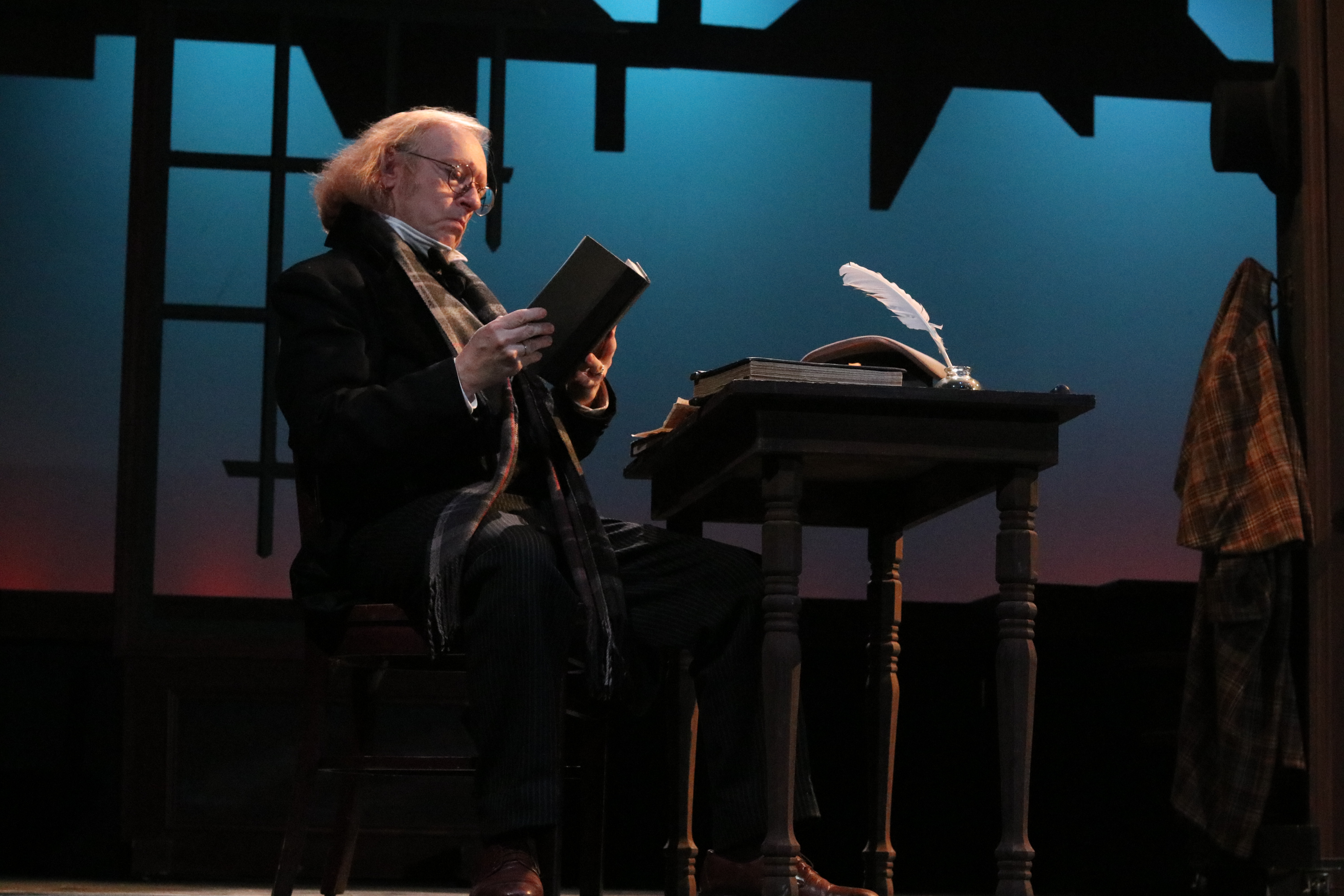
Hank West, mostly prized around town for his comedy exploits, is not a complete stranger to mean roles, having portrayed the Marquis de Sade in 2003. There’s nothing missing of Scrooge’s flinty cantankerousness in the opening scene. West’s rebuffs of a charitable solicitor (just one this year instead of two) and his nephew Fred are even more repellent than his tyranny and resentment toward Cratchit. It’s when we approach West’s comedic wheelhouse where we find him woefully hamstrung. Deprived of Scrooge’s bedclothes and his dopey nightcap – the lone accessories that make Ebenezer vulnerable or adorable through five-sixths of the story – West must accompany the Ghosts in business attire.

Worse than that, West must give us a Scrooge who dances with glee, realizing that he hasn’t missed Christmas morning, dressed up like an adult going to work rather than as a child waking from – and to – a fabulous holiday dream. Missing this parcel of Dickens’ visual genius, we can appreciate it more, for the nightcap and bedclothes are also as indispensable to the distinctive flavor of Scrooge’s supernatural journeys as the Ghosts’ personalities.

2020~A Christmas Carol-39

West’s comedy isn’t totally eclipsed, peeping out in his retorts to Cratchit and the Solicitor, in his timing of remarks after visitors exit, and in his sunny sallies around town making his many amends. Of course, the final prank on Cratchit when he comes in late on the 26th is handsomely done, though I was a little surprised by West’s decision to underplay Scrooge’s mischievousness and glee as he did Ebenezer’s playacting.

More women than men are seen onstage here, with Andrea King tipping the balance as Bob Cratchit. At work, she is purely deferential toward Scrooge, and King’s entrance on the 26th has a stealth worthy of Chaplin or Lucille Ball. We probably notice that at home, King’s Cratchit as a husband and a father comes off as less of a patriarch than we’re accustomed to. Can’t say that I minded much – am I becoming too evolved?

2020~A Christmas Carol-11

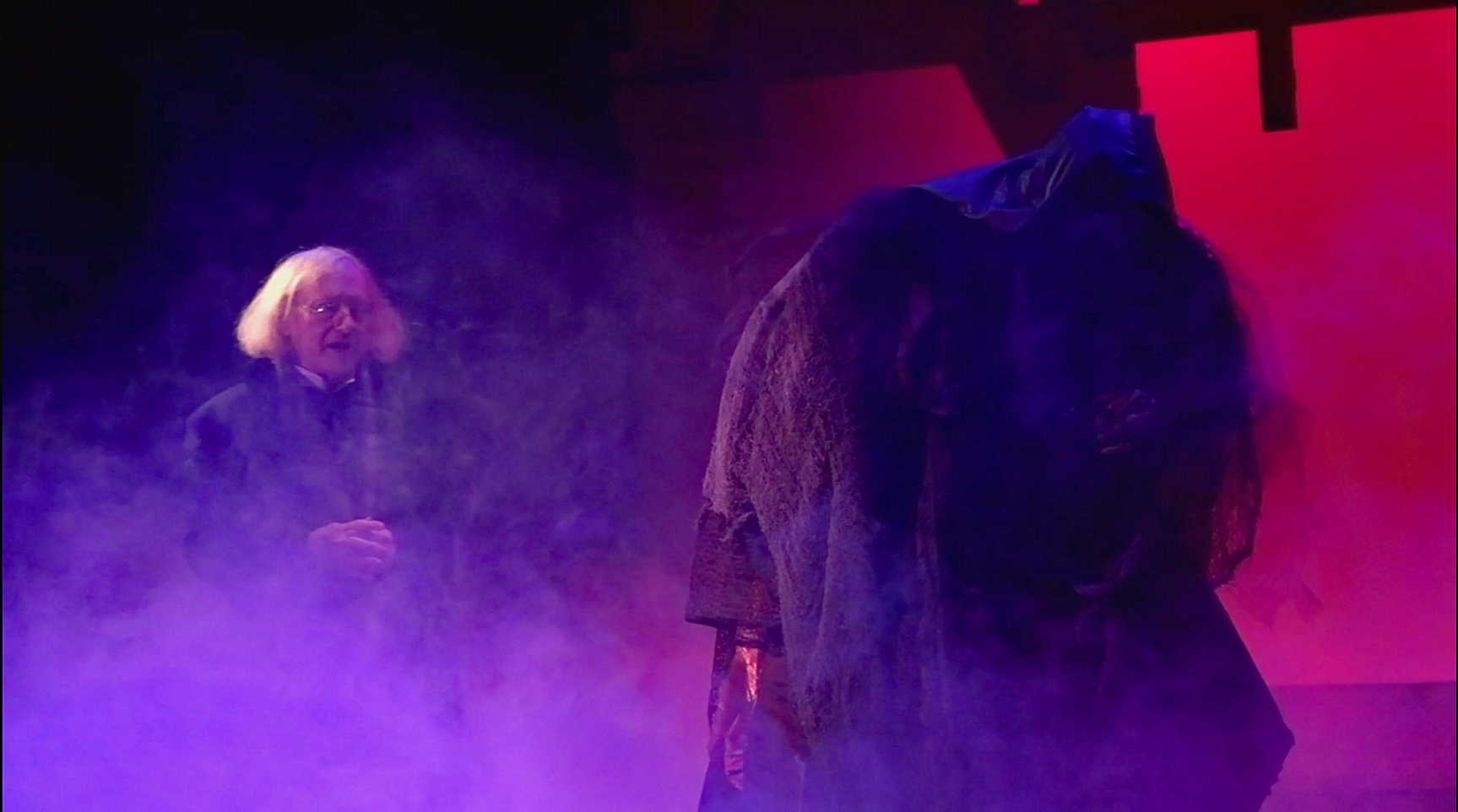
Seeing both Allen Andrews as Christmas Yet to Come and Josh Logsdon as Marley’s Ghost wearing masks hardly detracted from their portrayals. Logsdon’s mask had an orifice that seemed rimmed with teeth, he was bundled up with enough rags under his chains to look like a leper, and a huge gray wig affixed to his head with a shroud-like kerchief made him even more loathsome. Notwithstanding Scrooge’s doubts, when Logsdon bemoaned his fate and issued Marley’s warnings, there was far more grave than gravy in this ghost.

More noticeable were the alterations that masks imposed on the women Ghosts. Reprising her role as Christmas Past, Anna McCarty had a veiled look in her gleaming white gown, Arabian or ecclesiastical in its modesty. Yet when she needed to be strong and authoritative, McCarty didn’t disappoint, even though she seemed more socially-distanced than her castmates. Lechetze Lewis as Christmas Present was free to mingle more in her garrulous London tour. Her lively interaction with Fred and his wife, Andrews and Mary Lynn Bain, offered the most spectacular display of Retalic’s costume designs this side of Marley.

Andrews’ entreaties that Uncle Scrooge come dine with Fred were nearly as foundational in establishing the Christmas spirit on Queens Road as Cratchit’s sufferings and goodwill. Bain was also more impactful when she doubled as Belle, Scrooge’s sweetheart in the flashback, particularly when she returns her engagement ring, releases Ebenezer from his obligations, and decries his worship of Mammon.

2020~A Christmas Carol-22

Little moments like this, Cratchit applauding Fred’s advocacy of Christmas, and the perfect view we get of Cratchit sneaking in late after the holiday are among the many testaments we get to the work of Megan Shiflett and Nick Allison behind the cameras – delivering the best angles from the best distances. Theatre Charlotte may not have the resources that CPCC can boast in video gear, but they’re outstripping every live video I’ve seen from the college, because Spencer and Timmons are so deftly cuing their cameras where to be and when.

Amid the special hardships of 2020, local theatre companies are substantially sharpening their video techniques and their cinema savvy, good tidings that will pay dividends when COVID-19 is conquered.

With Jill Bloede executing the Narrator’s role in such a ceremonious British style, and with the likes of Tom Ollis and Rebecca Kirby as the Fezziwigs, quality runs deep in this cast – as deep as you’d expect with productions running twice the five performances this one is getting. There’s plenty of mileage left in the virtual version, which continues its on-demand run through January 2.

“And Then There Were None” Keeps Us Guessing as the Body Count Mounts

Review: Dame Agatha Christie’s And Then There Were None

By Perry Tannenbaum

IMG_1656

Theatre audiences love mysteries. Action, intrigue, plot twists, murder, and maybe a jolt of romance – they deliver an intoxicating brew and demand your heightened attention. Yet there aren’t nearly enough theatre mysteries to satisfy audience demand. The big names in the field are Christie and the Holmeses – Sherlock and Rupert. Either purloined from Arthur Conan Doyle’s stories or cynically refashioned and rebranded for commercial consumption, Sherlock is the mystery detective personified. Rupert Holmes has had the chutzpah to craft two mystery musicals, Drood and Curtains, as well as two mystery dramas that premiered here in Charlotte, Accomplice and Thumbs.

Whether onstage or in bookstores, Dame Agatha Christie is the unchallenged queen of mysteries. A trio of Christie titles are constantly making the rounds: The Mousetrap, renowned as the longest-running stage production of all time since 1952; Witness for the Prosecution, especially after Billy Wilder’s Oscar-nominated film in 1957; and, first presented as Ten Little N-Words back in 1943, And Then There Were None.

Christie’s zero-sum mystery is based on the most beloved of her 72 novels and one of the six best-selling novels of all time. There’s absolutely no problem with name recognition at Theatre Charlotte, where few seats were left on opening night. Nor was there any sign that director Dave Blamy had any difficulty attracting sufficient local talent to fill his cast of 10 suspects/victims who arrive on Soldier Island, all claiming to have been invited by the same person they’ve never met. An eleventh cast member ferries the guests, the butler, and the maid from the mainland and then departs.

Or does he?

Whoever sent out the invitations was selective, choosing only people who were responsible for other people’s deaths. They will all be victims, in the killer’s mind, who deserve to die. A recording that the butler has been instructed to play calls out each of the guests’ names and tells the group whose death he or she is responsible for. Justice is to be meted out to them all, for there is no escaping to the mainland.IMG_1674

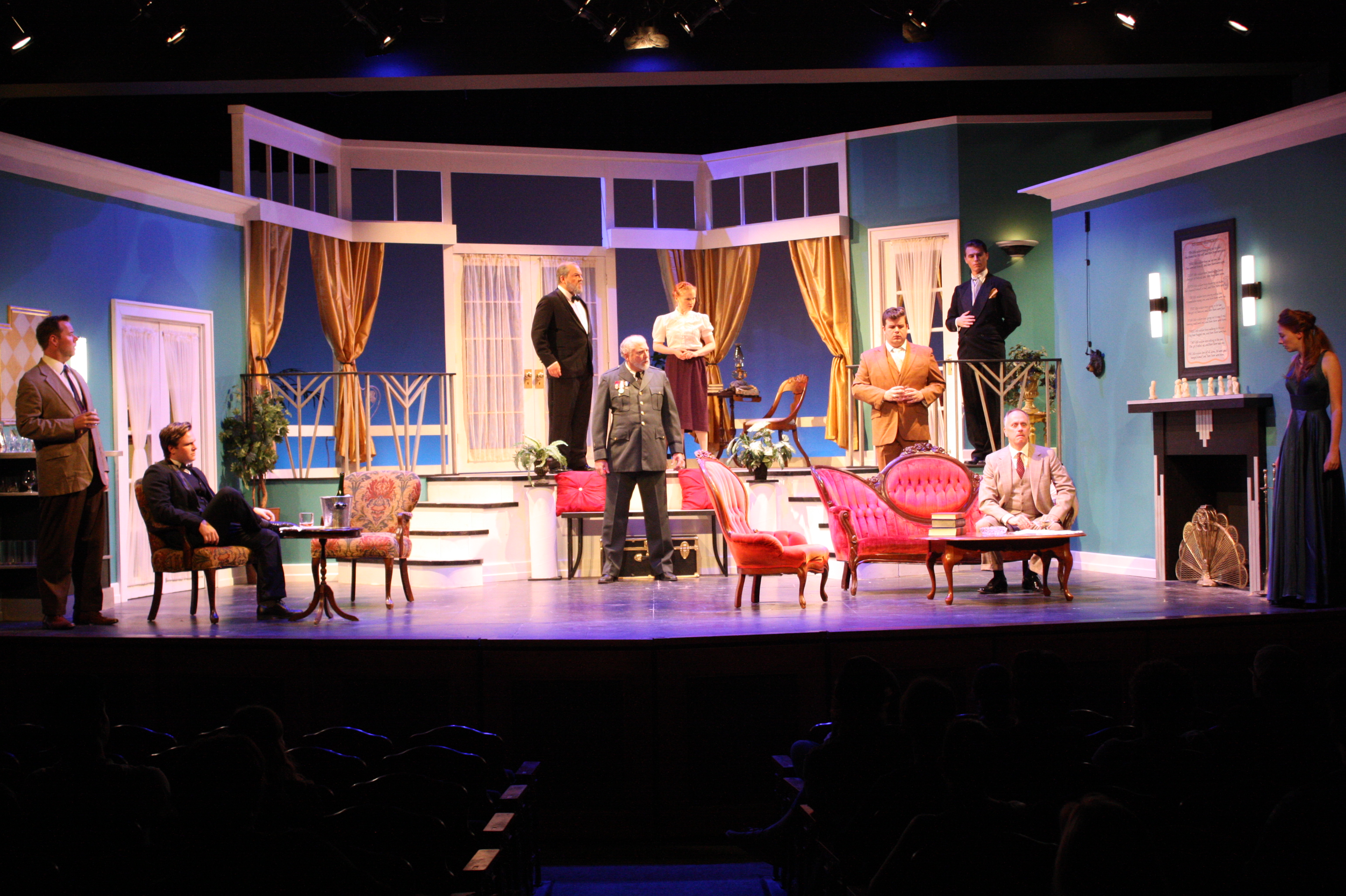
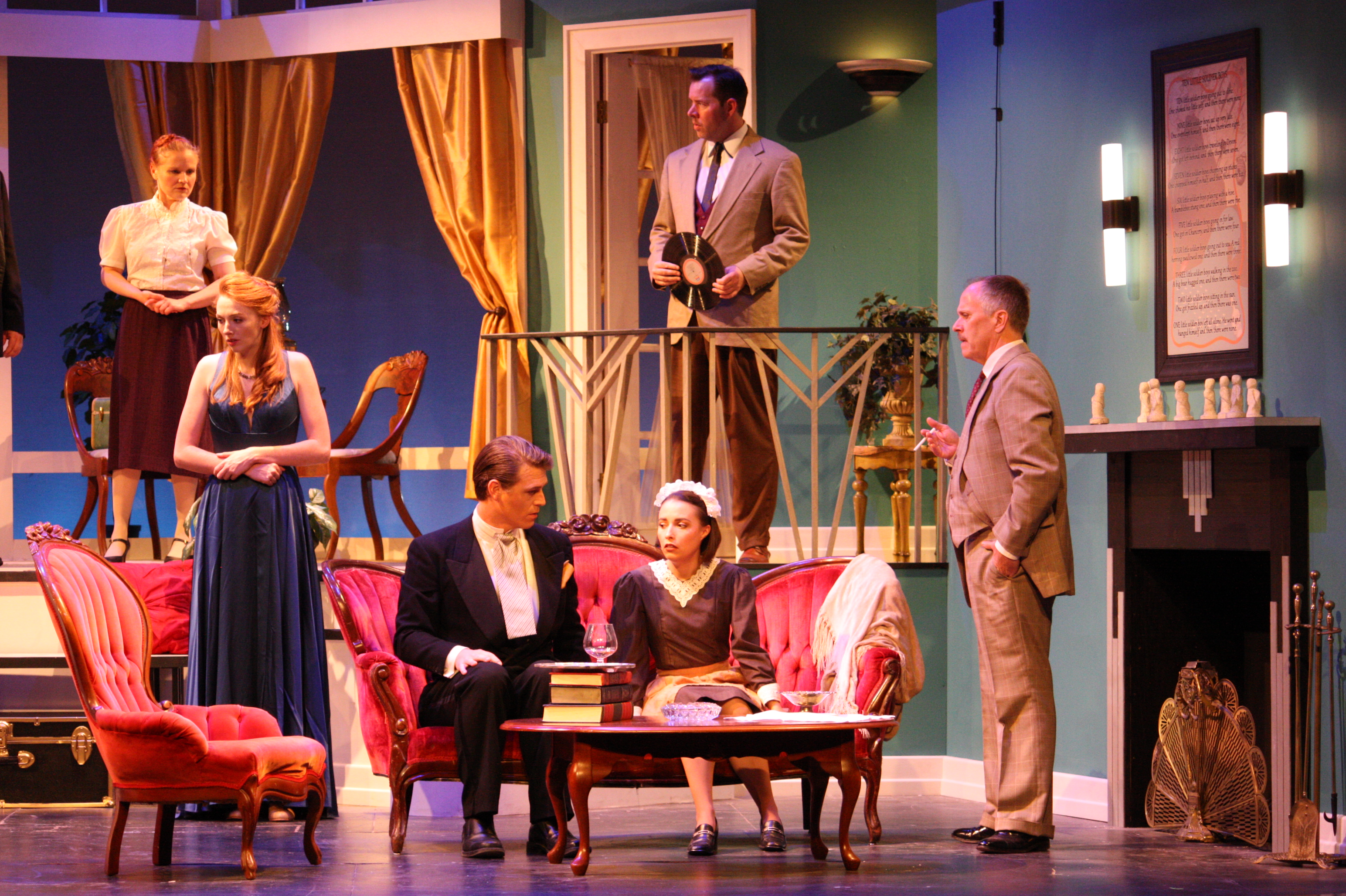
That only begins to describe the fiendishness and arrogance of the killer who is on the loose, probably hiding in plain sight. Hanging over the mantle – and printed as an insert in our programs – is a poem, “Ten Little Soldier Boys,” chronicling how the group dwindled until “there were none.” As the dwindling survivors of the murderous rampage soon figure out, the poem has become a template for how the killer will snuff out each of them, following the order of the poem. The first “choked his little self,” the second “overslept himself,” the third “got left behind,” and so on.

Each time one of the guests is murdered, a soldier boy figurine sitting on the mantle disappears or falls to the floor.

It’s an elegant touch, an impressive sleight-of-hand, another affirmation that the killer is in control and always one or two steps ahead of his victims – another way he or she is toying with the ineffectual survivors who remain, mocking their efforts. And ours.

Chris Timmons’ set design, one of the best and most beautiful he has built during his 13-year tenure at the Queens Road barn, has four exits on its two levels, allowing a certain amount of bustle and confusion as we track the whereabouts of our chief suspects. We’re also rubbernecking where the next victim is, for we never know who that will be until late in the game – this is a diabolical game, right? – and only vaguely how the next murder will be done.IMG_1668

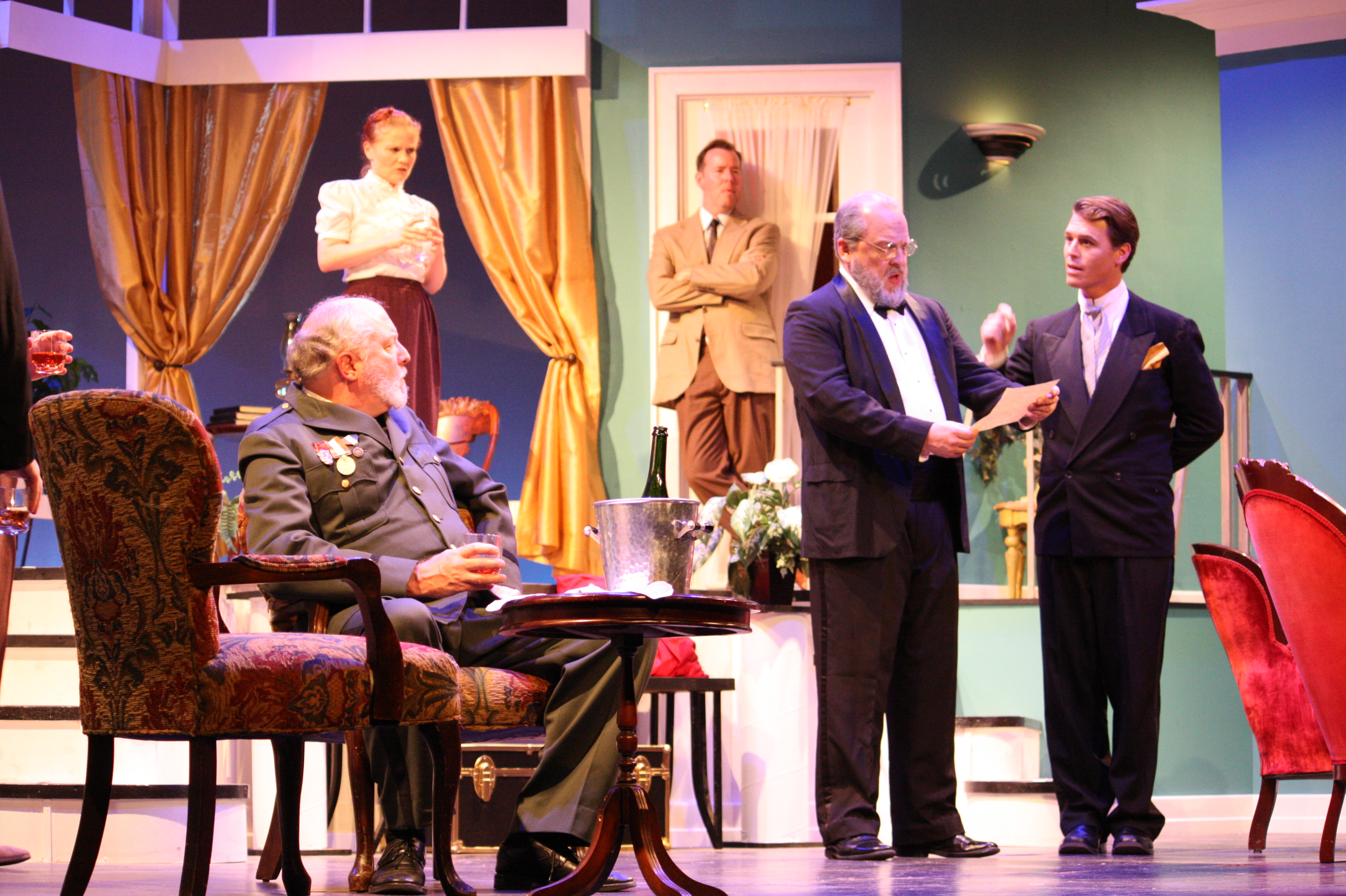
Blamy keeps the action flowing masterfully, varying his pacing, and getting Christie’s suspects to engage with each other intensively. Once the game is afoot, we must believe that each one’s demeanor – suave, artless, judgmental, analytical, scientific, or dignified – hides the heart of a maniacal murderer.

The Theatre Charlotte veterans are as reliable as we expect them to be. Caryn Crye drips piety and primness as spinster Emily Brent, saving her most severely moralizing barbs for young Vera Claythorne, whom she views as scandalously immodest. Johnny Hohenstein, not always on his best form on opening night, was sleazy and obnoxious as retired policeman William Blore when he hit his stride, both deceitful and maybe a little stupid. Timothy Huffman was actually a little less commanding than we’ve seen him before as retired General Mackenzie, perhaps too overcome by guilt and senility to be a serious threat.

On the other hand, Philip Robertson emerges as a natural leader and investigator as Sir Lawrence Wargrave, a retired judge who gets all the guests to respond to the crimes they’re accused of, rousing suspicions and animosities among the group. Thanks to him, we see the rogues’ gallery we’re dealing with fairly clearly.

Among the Queens Road newcomers, Peter Finnegan takes top-of-the-class honors as adventurer Philip Lombard. After a startling local debut as Bottom in Actor’s Theatre’s Midsummer Night’s Dream in August, Finnegan turns the pistol-toting Lombard from a semi-romantic hero into an Indiana Jones rascal, absorbing multiple rejections and altering the chemistry between him and Vera. Jonathan Stevens’ breakout performance at CPCC came even more recently as Lord Wessex in Shakespeare in Love. Some of that same aristocratic conceit and bearing transfers well to Rogers the butler, and his toxic superiority to Mrs. Rogers also has a familiar ring.

IMG_1662

As Mrs. Rogers, Cadie Pittman comes closer to a breakout role, giving the overworked maidservant a nice resentful edge. We keep guessing about Vera and her past because newcomer Quincy Stanford keeps her so unpredictable as she establishes bumpy relationships with both Lombard and Emily. It’s hard to surpass Finnegan for reckless swagger, but newcomer Carson Edwards gives it a try as inconsiderate daredevil Anthony Marston. He’s somewhat thwarted by the playboy outfit designed for him by costumer Chelsea Retalic, more apt to drink champagne than bourbon, and too carefree to carry a gun.

Rounding out our primary suspects, Will Lampe makes an interesting study as Dr. Armstrong. He might be a truly timorous, harmless, and useful physician, but Lampe’s fearfulness could be a façade if he’s furtively dealing out death with his medicinal syringes. Then he disappears! Dead? Lurking? The tension ratchets up suspensefully as we puzzle out whether he’s the “red herring” in the “Ten Little Soldier Boys” poem or the latest addition to the body count.


Butchering a Tearjerker

Review: Terms of Endearment

By Perry Tannenbaum 

IMG_0406

In spite of its Academy Awards and critical acclaim, I’ve never much wanted to see Terms of Endearment. Reading the old Roger Ebert review of the film does a far better job of changing my mind than the current stage adaptation at Theatre Charlotte, I can say that. My working theory on tearjerkers is that I already know it’s sad when good people die young, sad that people allow petty differences to stand in the way of enjoying one another, and that sorrows and pointless conflicts are redeemed by moments – too few moments – of sweetness and laughter. Watching the 129-minute Hollywood version of these self-evident truths still doesn’t entice me.

The stage adaptation by Dan Gordon trims James L. Brooks’ 1983 screenplay, based on the novel by Larry McMurtry, to a mere 108 minutes at the Queens Road barn. No doubt some butchery was involved, for I can’t find serious fault with Chris Timmons’ cheery and versatile scenic design, Mitzi Corrigan’s direction, or the efforts of her cast. Can’t find the characters played by John Lithgow or Danny DeVito, either. Maybe McMurtry and Brooks were better judges of their worth.

Gordon starts with a scene so cinematically short that I couldn’t see its connection with the rest of the story. It’s useful for you to notice that the newborn Aurora Greenway is screaming at in the cradle is Emma. The next time we see Emma onstage, she’s being played by Gabriela Celecia and she’s at least 20 years older. Cynthia Farbman Harris as Aurora cannot age so radically so quickly, helping me to miss the passage of two decades. What Harris can do very well is retain Aurora’s imperious prissiness, her total self-absorption, and her industrial-strength vanity.

These are wonderful traits for Celecia to play against as the normal wife and mother of three who hopscotches from one Midwestern locale to another with Flap, her college teaching husband. Suffering the slings and arrows of Aurora’s patrician superiority, Maxwell Greger makes good on his scant chances to fire back. He’s also an effective Middle America edition of Don Juan. If James Dean ever became so humdrum that his utmost rebellion against propriety were sneaking kisses with one of his students, that Dean would look very much like Greger’s Flap.

But the juiciest pushback against Aurora’s dominion comes from Garrett Breedlove, a former astronaut whose ego outstrips his fading celebrity. He’s as open about his profligate ways as Flap is furtive and delights in offending Aurora’s elegance with his vulgarity. Why not? He still has the goods in the sack. Kicking, screaming, and sputtering, Aurora is putty in his hands.

In an auspicious Theatre Charlotte debut, Vince Raye mixes charisma and conceit into this aging moonwalker – with a chunk of tenderness that took me by surprise. At his most impressive, Raye took up Garrett’s revelation that he still boasted friends in high places. If not, he certainly showed he could bluff a weak poker hand at a championship level.

By the time this happened, the drama had seemingly dragged on for seven hours, Emma had been diagnosed with Stage 7 cancer, and the only chance she had at survival was to be admitted to a special clinical trial that was already closed to new applicants. Only Dr. Maise, the head of the hospital could make that happen, and Maise had no intention of being cowed by a mere astronaut with VIP connections.

To guard the gates against Emma’s last chance, Corrigan chose the formidable Tim Huffman, who has chewed and spit out scenery as Capt. Slank in Peter and the Starcatcher and as the thunderous Deputy Governor Danforth in The Crucible. This was quite a heavyweight confrontation, Raye’s celebrity cool as Breedlove pitted against Huffman’s towering dignity as Maise. I’m not sure which delighted me more, watching Raye coolly assailing Dr. Maise with Breedlove’s vicious threats or Huffman’s trembling capitulation.

Ah, but after that clash, the very sweet and likable Celecia had miles to go before Emma slept. Farbman had to absorb additional rebuffs and regrets as Aurora and learn additional lessons before she grieved. Let it be noted that costume designer Chelsea Retalic dresses Farbman beautifully during all her changes. When Breedlove leers at her, it is not for naught. There are also lighter moments between Aurora and Emma that allow Farbman respites from her hauteur and Celecia respites from her wholesome bland forbearance. Maybe three of them.

“The Philadelphia Story” Bides Its Time Before Detonating

Review:  The Philadelphia Story

By Perry Tannenbaum

One of the wonderful things about Philip Barry’s The Philadelphia Story is that, yes, it really is about class distinctions and peculiarities, but the playwright remains ambivalent and tolerant of them all. Beneath their upper or lower crust exteriors, all of these Philadelphians – young and old – are recognizably human. You rarely see so many fully-fleshed characters onstage in the course of a single evening. I wouldn’t be terribly surprised to see a premier professional company repeatedly reviving this witty, effervescent comedy, but it’s absolutely astounding that Theatre Charlotte, our community theatre, has revived Philadelphia Story twice in the new millennium, now and back in 2000.

Both productions showed the pitfalls. The cast needs to be nine deep, alert to the amount of polish and roughness Barry expects of them, and aware of the energies and pacing required at each point of Barry’s intricate plot. The story revolves around “virgin goddess” socialite Tracy Lord – as you might expect, since Katharine Hepburn, the original Tra on Broadway and on celluloid, matched the 25% investment that the playwright plowed into the original production. Tracy is sensibly engaged to the cold and ambitious George Kittredge, impetuously divorced from the dapper C.K. Dexter Haven, and estranged from her father, whose indiscretions have brought the Lords unwanted publicity.

While Tracy is resolving these relationships, her brother is focused on suppressing a magazine exposé that will be published about their wayward father, dangling the prospect of exclusive access to the wedding as an enticing alternative for the publisher. The reporter and the photographer assigned to the Kittredge-Lord nuptials, Mike Conner and Liz Imbrie, bring another level of complications to the scene. She’s been secretly carrying a torch for him for years, but when spirits rise and champagne flows on the night before the wedding, Mike finds that he has fallen – hard – for Tracy, a prelude to their both enjoying an illicit, drunken midnight dip together in the Lords’ swimming pool.

While Barry is at work on how the wedding, the magazine story, and multiple alienated affections – past and present – will ultimately resolve, director Tonya Bludsworth and her cast must deal with all of the reactions and repercussions along the way. Making all of this bubbly complexity even harder for Bludsworth and Theatre Charlotte to achieve is the relative lack of enthusiasm for the project. Turnout for auditions was likely as tepid as audience turnout. Compared with opening night for Peter and the Starcatcher in September, there were conspicuously more empty seats at the back of the house – and a bit less confidence onstage.

Ten of the 14 cast members are new to Theatre Charlotte, including most of the key characters. We started off strong back in 2000 with a Tracy who had the look, the patrician manner, and sometimes even the sound of Hepburn, but that newcomer’s imperial highness never became sufficiently ruffled when the plot thickened. In Bella Belitto, we have another newcomer as Tracy, and on opening night, her serene highness was conspicuously lacking in the early going and – like others onstage – she was often underpowered and inaudible.

Without that serene aura and grace, the splintering of Tracy’s goddess élan isn’t as poignant as it should be in Belitto’s account of her re-education. Yet when she’s assailed by complications, catastrophes, and intensifying adoration, she faces it all very convincingly, her spirits and energies rising. Waking up on the climactic morning after, her decibel level also crescendos spontaneously. We feel that she is learning her lesson and actually benefiting from the indiscretions that brought on her fall – and that the lesson runs deep to her core. Her epiphany detonated effectively for me.

A lot of that depends on Nick de la Canal radiating a rakish upper-crust urbanity as Dexter with enough of that crust trimmed away to make room for tolerance and forgiveness – the two key qualities Tracy needs to acquire. De la Canal’s insouciance also contrasts nicely with the stuffiness that Will Millwood brings to George Kittredge. Barry doesn’t completely hide his disdain for George’s commercial outsider status, so Millwood makes a prudent choice in stressing his judgmental bent.

Dexter also comes off finer than Mike Conner, but by a significantly smaller margin. Here the nuanced class distinctions are no less telling. Christopher Long reminds us that Mike starts out fairly judgmental himself before Tracy bewitches him, but we indulge his pre-judgments more readily in the same spirit that we’re inclined to forgive his boyish, impulsive trespasses. Our best verdict on him vis-à-vis George is much like Barry’s: he’s more deserving, in spite of his depressed finances, of being called a gentleman.

What gives The Philadelphia Story its screwball slant is that everybody up onstage and down in the audience seems to know who the best fit for Tracy is – except for the goddess herself. This includes her mischievous younger sister, Dinah, who attempts some telephone matchmaking. Helena Dryer makes little sis pesky and likable in the right proportions. She’ll be an utter triumph once she makes herself consistently intelligible.

Tracy’s mom isn’t the most pivotal role here, though Margaret does point the way for her daughter in forgiving her husband’s infidelity. What makes Heather Place’s debut so auspicious as Margaret Lord is her clear bubbly delivery and her effortless projection of warmth and class, richly portending her reconciliation with the dashing, slightly over-the-hill Seth Lord. Victor Sayegh is mildly and earnestly supplicating toward Margaret and his disapproving daughter, as befits a Philadelphia patriarch, another cue for Tracy to accept people’s imperfections, including her own.

Sayegh and Place draw two of Chelsea Retalic’s most stylish costume designs in evoking high society elegance, but it’s an uphill battle to project prosperity amid Josh Webb’s drab and dour set design. Two Ionian columns fail to provide uplift, and there’s no longer a visible hint of the swimming pool in the wings. Portraying the eccentric Uncle Willie in a delightful debut, Dan Kirsch gets my nod as the plutocrat most at home in this down-market mansion, lovable for all his pomposity.

Fresh from his crossdressing exploits in Starcatcher, Johnny Hohenstein is mostly responsible, as Tracy’s scheming brother Sandy, for the PR intrigue that lurks beneath the romantic comedy. Good luck following – or caring about – all the Act 2 twists in that sector of the plot. For that reason, Anna Royal as Liz turns out to be more important for me. Ultimately, she’s modeling the patience, forbearance, and forgiveness toward Mike that Tra should have toward Dex. Royal gives Liz just enough edge to update her and elevate above the cliché she must have been in 1939 when THE PHILADELPHIA STORY first hit Broadway.

Here she isn’t just a working-class woman who knows her place, meekly deserving Tracy’s discards. Wielding her Contax camera, she’s Mike’s professional partner, biding her time for a natural upgrade.

Much of the Ambiance Is Trimmed from “A Time to Kill,” but the Mississippi Murder Trial Still Sizzles

Review:  A Time to Kill

By Perry Tannenbaum

Rupert Holmes has built a distinguished theatre career – and carved out his own special niche – by crafting mysteries for the Broadway stage. His Accomplice won an Edgar Award from the Mystery Writers of America when it played on Broadway in 1990, and after his Thumbs premiered successfully in Charlotte, it seemed Broadway-bound in 2001. Holmes’ most unique accomplishments are his two mystery musicals, The Mystery of Edwin Drood, adapted from Charles Dickens’ unfinished novel, and Curtains, a Holmes original. So it’s not at all surprising that Holmes would be the first playwright to adapt a John Grisham bestseller for the stage when he brought A Time to Kill to the Great White Way in 2013. As the current Theatre Charlotte production demonstrates, adapting Grisham’s first novel for the stage was a tall order.

Admitting that film would be a more comfortable medium for this story, director Dave Blamy conspires with set and lighting designer Chis Timmons to wedge in some clips, prefacing the action with evocations of a horrific rape of a 10-year-old girl and, deep in the story, flashing the handiwork of the Ku Klux Klan on the darkened upstage wall. From the outset, you can presume that Timmons’ design for Judge Edwin Noose’s Mississippi courtroom isn’t going anywhere. It is so sturdy and stately that you may be tempted to rise when the judge enters to launch Act 1. But Timmons manages to swivel the entire courtroom 90° during intermission, adding a sidecar to the judge’s bench that serves – somewhat shakily – as a witness box. When we adjourned to the judge’s chamber, other parts of the courthouse, or defense attorney Jake Brigance’s home, there were discreet furniture shifts while the lights were dimmed. They worked well enough.

Unfortunately, Grisham’s canvas is larger. Though we watch Billy Ray Cobb and Pete Willard confess to the rape and attempted murder of little Tonya in vivid Mississippi detail, we never see her father, Carl Lee Hailey, taking vengeance upon these perverts. Thanks to Christy Edney Lancaster’s sound design, we can hear the chants of protesters outside the courthouse when Carl Lee goes on trial for murder, but we cannot see the mob’s fury. When hostilities break out between black supporters of the defendant and KKK racists, we’re shielded from the riot, and when the National Guard moved in… I wasn’t sure that was even mentioned in the script.

Clocking in at a hefty 2:17, plus a 20-minute intermission, the production won’t seem skimpy at all. Instead of any prolonged attention to the KKK, Holmes takes us more intently into Jake’s defense efforts behind the scenes, bringing extra emphasis to whip-smart legal assistant Ellen Roark, disbarred attorney Lucien Wilbanks, and the pillar of the defense’s case, Dr. W.T. Bass. The psychiatrist is recruited for the purpose of confirming that Carl Lee committed the double murder while suffering from temporary insanity, but it quickly became apparent that Wilbanks had made Bass’s acquaintance in a barroom during one of his frequent sprees. For better and worse, suspense and thrills now rest on the outcome of the trial, not on the survival of Carl and Jake in the face of KKK mob mentality. We’re also called upon to hate district attorney Rufus Buckley a little bit more, for his smarmy courtroom confidence and his undisguised political ambitions.

A slick, relatively bloodless package like this would have worked better if it were performed more slickly. Blamy pushes in that direction, but Grisham’s main characters are defined by their back-stories, and their development is further hampered by the formality that legal proceedings – arraignments, pleadings, motions, and trials – impose on dialogue. All combined, the length, formality, and pervasive legalese of A Time to Kill may account for the fact that actors were stumbling over their lines more frequently on this opening night than at any show I can remember at Theatre Charlotte.

Best at handling it was Jim Greenwood, who managed to add a bumbling element to Judge Noose’s crusty old persona. The opposing attorneys, both superbly cast, didn’t break character when struggling for their next phrases, but I could detect definite cracks. Tasked with sustaining a villainous patina, Conrad Harvey was more afflicted by these lapses as the DA, but all was well when he hopped back onto the rails and he flashed his Trumpian smile to the jury. Wonderfully loathsome. Costume designer Chelsea Retalic probably had Atticus Finch in mind when she drew up Jake’s courtroom attire for Tim Hager and the analogy was often apt when Hager grew simply eloquent. But he’d be better off drawing upon Jake’s fallibility when he falters.

Hager was at his best when Jake in maneuvering behind the scenes. Wheeling and dealing are not his style. Steadfast in his beliefs, Hager seemed to get that Jake wasn’t as comfortable in his skin as those surrounding him. As the brainy, beautiful, and ambitious Roark, Jennifer Barnette knew exactly what the legal assistant wants from her gig with Jake and why she finds him attractive. Both Tom Schrachta as Lucien and Rick Taylor as Dr. Bass projected their dissoluteness without too much exaggeration – but more than enough to merit Jake’s alarm – and both of them get tasty opportunities to sober up. Neither of them missed the comical lagniappe that came with their changes.

With so much of the Mississippi ambiance trimmed away like so much gristle, it was a godsend that the black players were all so right. Ronald Jenkins registered Sheriff Ozzie Walls’ conflicted loyalties beautifully, as committed to protecting Carl Lee and seeing that justice is done as he was to keeping his prisoner in custody. As a vengeful father, thoughtless husband, and a somewhat immature man, Jonathan Caldwell had a lot of different feelings to navigate as Carl Lee, from savage rage to sheepish regret, but he wisely stayed steadfast in his belief that murdering those two bragging racists was the right thing. Yet there was deep understanding in Tracie Frank’s portrayal of Gwen Hailey, Carl’s wife. Carl defies her when he chooses Jake to defend him instead of the NAACP, who are willing to come in and do it without a fee. Frank was out there alone to give Carl Lee’s defiance substantial weight. Without Frank’s steely strength, Jake’s victory – and Carl Lee’s vindication for choosing him – wouldn’t have been as sweet. Her quiet acknowledgement seals the verdict.

Soot of Sodom Chases the Joads in “The Grapes of Wrath”

Review: The Grapes of Wrath @ Theatre Charlotte

By Perry Tannenbaum

If you’ve ever read John Steinbeck’s sprawling masterwork, The Grapes of Wrath, you know that it’s framed with a seething anger as a picture of America’s unfulfilled promises, the cruel exploitation of the poor, and the undiminished aspirations of the Joad family. These dispossessed and determined Oklahoma sharecroppers believe in the dream.

But the Okies are tested before they reach the Promised Land of California and once they’ve arrived. Like the Israelites in the Old Testament, they must cross burning desert. Clutching onto the printed handbills promising work and honest wages, they must resist the report of a broken, disillusioned man who found California to be nothing like the handbills’ hype. They must endure attacks from anti-labor thugs who fear the latent strength of worker groups.

Perhaps most difficult of all, they must strive to hold together despite forces of attrition from within – disagreements, defections, and death. Manna doesn’t shower down upon them from heaven to ease the journey.

We easily presume, with their consuming hope of a Promised Land, that the Joads’ journey is an exodus, a liberation from the landowners who have burdened them with sufferings. Another biblical parallel suggests itself on Queens Road, where Frank Galati’s stage adaptation of Steinbeck’s novel is making its local debut at Theatre Charlotte – a mere 37 years in the wilderness after winning the 1980 Tony Award for Best Play.

Since vile bankers and beancounters cannot loom as large on the stage as they do on the vast canvas of Steinbeck’s pages, another biblical parallel emerges clearly. Under Ron Law’s direction, with severely weathered scenery by Chris Timmons, and stark, pitiful costume designs by Chelsea Retalic – Okie clothing and faces equally sooty – I couldn’t help sensing echoes of the destruction of Sodom and Gomorrah in this depiction of Dust Bowl devastation.

One faint echo is the drugging of Grampa Joad when he resists leaving, a parallel to how Lot’s daughters bamboozled their dad. The loudest echo came from Ma Joad, proving that she’s the antithesis of Lot’s Wife. You’ll recall that when Lot’s family was commanded not to look back while God was raining fire and brimstone on the sinful cities, Lot’s wife disobeyed and paid a famous price.

As the Joads embark, one of Ma’s kinfolk asks if she is going to take one last look back. Her no in response, with the aid of modest embroidery, is so emphatic that we take it as a philosophy. Ma Joad looks forward and moves forward. She lives by doing what needs to be done.

It’s an outlook that she successfully hands down to her daughter, Rose of Sharon, in the poignantly perverse pieta that ends the epic story.

With a performance like Paula Baldwin’s as Ma, we readily grasp that Steinbeck wished us to see her as the steadying bedrock of the family. The jut of Baldwin’s jaw and the tightened sinews of her neck were unlike anything I’d seen from her in her numerous leading roles. She’s unrelentingly purposeful, sternly nurturing, with all the patience and endurance of the ground she stands on.

Standing firm isn’t all that simple on the raked stage that Timmons has built. His pared-down design must accommodate campfires, a riverbank, and a ramshackle jalopy able to accommodate the whole clan. The skin-and-bones truck is altogether worthy of the ridicule it draws. Inspiration taken from the Little Engine That Could? You decide.

Vying with Ma for the right to be called the backbone of the family is the second-eldest son, Tom Joad, a volatile straight-shooter who is coming home from prison after serving his time for murder. It is so telling – about Tom and his fellow Okies – that everyone seems disappointed that Tom didn’t break out of jail. Easy to rile when he or his family is threatened, Tom is a seeker of truth, curious to learn how the system works.

Max Greger subordinates Tom’s volatility to his heartland wholesomeness in a promising Charlotte debut, holding his own when he shares the spotlight with Baldwin or the wild-eyed Andrew Tarek, who shambles brilliantly about as Jim Casy, a former preacher who feels like he has lost the calling. Yet in the same way that Tom is branded as an outlaw after killing in self-defense, Casy is branded as a holy man despite his renunciation – with Steinbeck’s approval, we presume, since four gospels were written about a man with the same initials.

Amid a dust cloud of bleakness and hopelessness, these running gags slightly lift the gloom.

And though there are strong unionist sympathies in the framework of Steinbeck’s yarn, you will also find an all-American emphasis on teamwork, which Law’s cast underplays enough to keep us from smelling Hollywood. Chris Melton has an adolescent randiness as Al Joad that augurs trouble and a shotgun marriage, but he also has a way with cars, performing the marvel of getting the Joads’ jalopy going. Between bouts of guilt, discouragement, and drinking sprees, Victor Sayegh as Uncle John often struck me as the most fatherly in the clan with a generous spirit.

With a cast of 23 trafficking back and forth on the sloped stage, Law needed to shape a deep ensemble that bonded together while divvying up two hours and 15 minutes of running time. Nor could he rely on the top tier of players to deliver all the little crevasses of comedy and poignancy that lurk in the wide tapestry.

Annette Gill and Rick Taylor are largely responsible for getting us off to a rousing start as the ever-bickering oldsters, Granma and Grampa Joad, portraying them as loud and slightly doddering. We get an interesting take on Pa Joad from Ryan Dunn, who doesn’t seem broken by his family’s rude displacement but rather gladly retired from the responsibility of it all, a bit dazed by the turn of events.

Zach Radhuber goes light on the simplemindedness of Noah Joad, yielding a touching moment when he sets off on his own, and Cole Pedigo gives a nerdy edge to the befuddlement of Connie Rivers, Rose of Sharon’s husband. In some ways, Ailey Finn represents the best of the new generation as “Rosasharn,” but it’s suffering that strengthens and ennobles her, and the mysterious smile that ends the novel can’t be incorporated into a stage adaptation.

Law keeps the concept of incidental music from the Broadway version but discards the content, switching from a Tin Pin Alley songlist to a folksy Woody Guthrie flavor. “California, Here I Come” steps aside for “This Land Is Your Land.” Strumming an appropriate guitar, Tom Schrachta attacks the material a bit harshly with his robust voice, but I grew fond of that discord. Schrachta also drew the acting chore of donning a rumpled trench coat (a hint of the spy parallel in the biblical exodus story) and delivering the bad news about California to the Joads.

That same harshness remained in Schrachta’s voice. Yet now it was mixing grief, discouragement, futility, and rage – very much what Steinbeck felt about the ruinous actions of America’s bankers when he wrote The Grapes of Wrath.

Forget All That Money Stuff and Be Happy

Review:  You Can’t Take It With You

By Perry Tannenbaum

When it first came to Broadway, just after the 1936 election, Moss Hart and George S. Kaufman’s You Can’t Take It With You was steeped in the Great Depression – and a deep suspicion of the efficacy of government. Twenty elections later, as the audience favorite returns to Theatre Charlotte yet again in a truly sharp production directed by Mitzi Corrigan, the anti-government sentiments of the Sycamores and family patriarch Martin Vanderhof may strike some longtime subscribers as more virulently right wing than they remember.

Previous revivals of the show that I’ve seen tended to portray the whole extended family – except for Alice, who has ambitions and craves normality – as lovably eccentric, even borderline daffy. With the pandemonium that cuts loose at the end of the first two acts, that’s certainly a major part of the impression that Kaufman & Hart sought to convey.img_5635But the wonderfully avuncular Dennis Delamar as Grampa Vanderhof has a bit of an edge to him when an IRS agent comes calling about those income taxes he has never paid. There’s a “government of the people” tinge to his reaction as he demands to know how his money will be spent, but there’s also a saintly element of renunciation – for he has willfully abandoned the hustle-and-bustle of capitalism outside his home and devoted himself completely to doing as he pleases in and about his own roost.

Although there’s plenty of hustle-and-bustle inside the home, all except Alice fit the same mold: busy and industrious though they are, none of them has a job. How pleasant and agreeable such a bunch must have seemed to Depression Era Americans! Not only aren’t they competing with anybody in the jungle of a desperately shrunken job market, they’re genially and energetically coaxing us to toss aside all our anxieties about getting and spending. Forget all that stuff and be happy.

Corrigan softens the usual daffiness just enough for us to see the eccentricities of the Sycamore household winking at us as the sunny side of American individualism rather than principled silliness. This puts Alice in a somewhat different light, more akin to the disagreeable hetero son in La Cage aux Folles than we usually see. Cora Breakfield takes nicely to these fresh shadings of her role, subtly aided by costume designer Chelsea Retalic. The dresses she changes into for dates with her beau Tony Kirby are darkly elegant, but the clothes she wears coming home from work are less flattering.

Set design by Chris Timmons is uncommonly handsome, further discouraging our impulse to view the household as a clown car. Della Knowles is less outré as Essie, Alice’s hopelessly bad ballet dancing sister, and Stephen Peterson is mellower than most versions of their father Paul, the fireworks enthusiast. Johnny Hohenstein mostly lurks contentedly in the background as Paul’s lab assistant, Mr. De Pinna, briefly taking the spotlight when he models for Penny Sycamore’s long-unfinished painting of a Greek athlete.

These finely judged touchups allow Alice’s mom, Penny, and Russian dance teacher Boris Kolenkhov to emerge more emphatically from the general hullaballoo. When Tony’s parents unexpectedly arrive to meet their prospective daughter-in-law’s family, these emphases pay off. It’s Penny, after all, who scandalizes Mrs. Kirby by declaring spiritualism an obvious fake, shortly before Boris shocks Mr. Kirby by wrestling him to the ground.

Jill Bloede makes Penny a blithe short-attention-span spirit, while Frank Dominguez turns Boris into a spectacularly bellicose poseur – with some brash assistance from costumer Retalic. The Kirbys are nicely matched to absorb these indignities, John Price as the orchid-cultivating plutocrat and Corlis Hayes as the delicate Mrs. Kirby. Price especially traces a graceful character curve, ultimately receptive to Vanderhof’s soft sermon – and itching for a rematch with Boris! Armie Hicks cuts a fine figure as Tony, well mannered yet susceptible to the charms of both Alice and her family.

Standing out among the unwelcome intruders, Mike Carroll brings a starchy persistence to the IRS agent, while Rick Taylor layers on a New York vulgarity to the Head G-Man. The aging waifs that the Sycamores embrace during this farce are closer to caricature and more delectable. Zendyn Duellman has a regal tipsiness to her as the soused actress who wanders into the scene, and Suzanne Newsom is superbly compromised as the Russian royal, Olga Katarina, exiled to waiting tables at a Child’s restaurant.

I waited and bussed tables at multiple Child’s locations around Times Square during one memorable summer break. There were 45s by the Four Tops playing on the jukebox and no aristocrats sitting down for dinner. So I can personally vouch for Olga’s humiliation.