Tag Archives: Calin Ovidiu Lupanu

Listen! Charlotte Symphony Has Launched Its 94th Season With a Truly Musical Logo

Review: Charlotte Symphony Plays Shostakovich Symphony No. 5

By Perry Tannenbaum
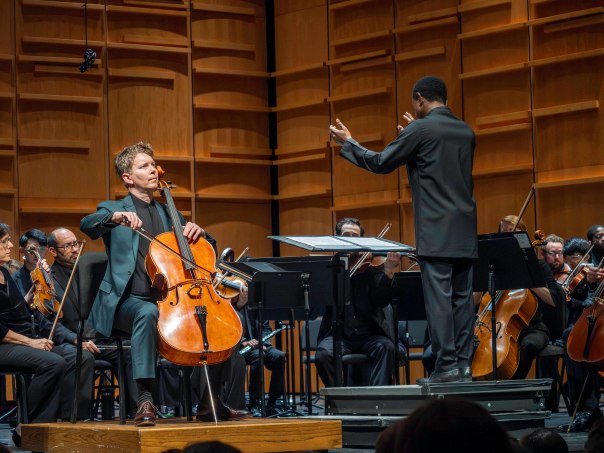
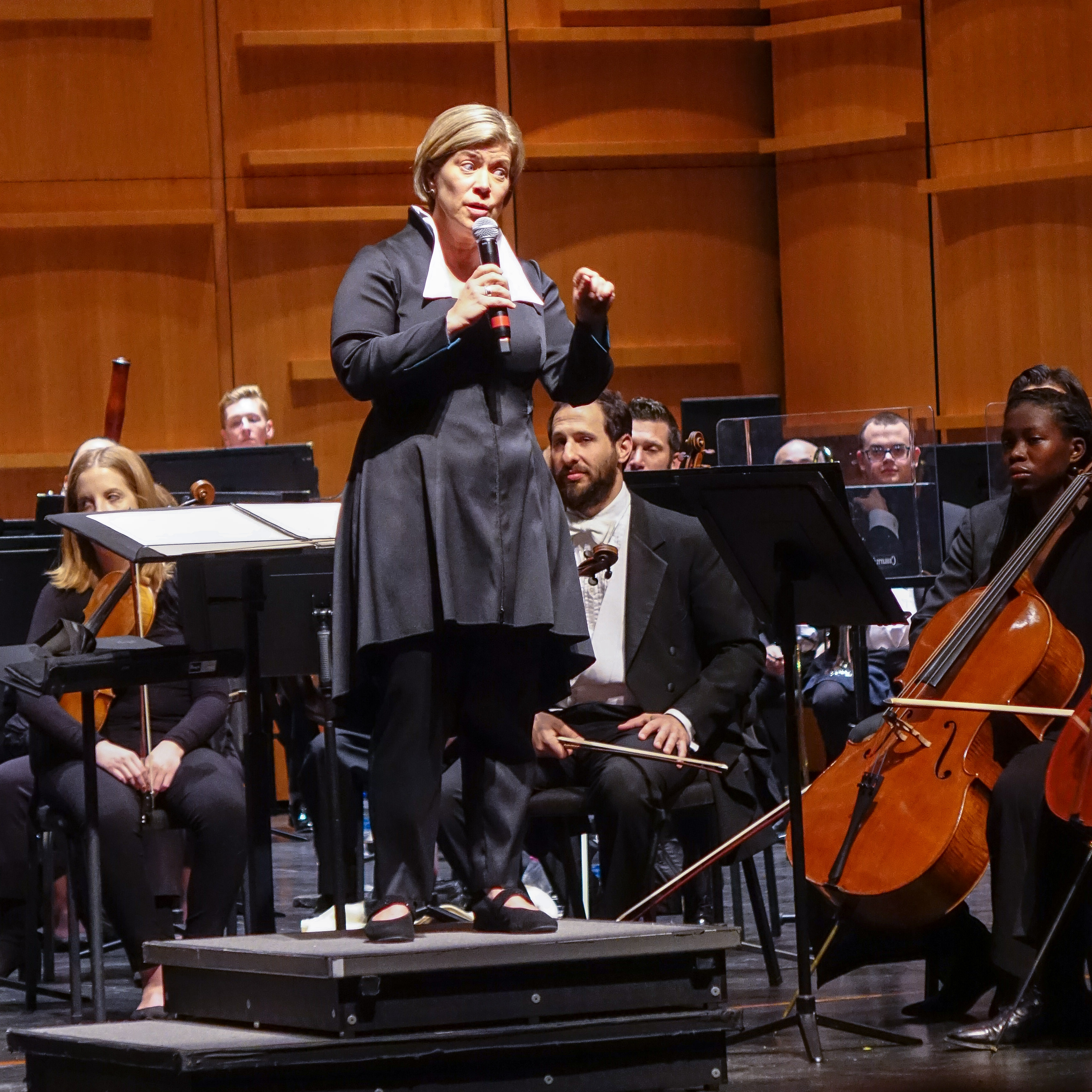
October 10, 2025, Charlotte, NC – It’s a bit of a mind-bending concept, so after launching Charlotte Symphony’s 94th season by leading his orchestra and audience in the National Anthem, music director Kwamé Ryan needed to take a couple of minutes to explain what exactly a musical logo is. Symphony also has a new conventional logo, a graphic see-through C with a top seraph that reminds one of a bass clef. But Symphony’s musical or sonic logo, Ryan explained, is akin to the six notes you hear on your iPad when you get a fresh sports bulletin from ESPN or the sonic boom that blasts you off your couch when you sign in to Netflix.

Ryan joked that Symphony had gone to John Williams to write the new theme but he wasn’t available. So he settled for Mason Bates, the second most-performed living composer (by American orchestras), who accepted the commission. The timing was auspicious, for Bates’s acclaimed new opera, The Adventures of Kavalier & Clay, opened at the Met less than a month ago.

Ryan proceeded to lead his orchestra in two versions of the new logo, the world premiere of an extended concert version followed by the abbreviated five-second version concertgoers could expect to hear in the Knight Theater lobby, summoning us back from intermission. Tell me I’m wrong, but Bates also seemed to have Williams in mind, in a heraldic vein, when he fulfilled his commission. And if musical or sonic logos become a thing among orchestras, Bates, Ryan, Symphony, and its subscribers can all claim to have been on the ground floor at the Knight.

Bates also took honors for composing the first piece to appear on our printed programs for the new season, Attack Decay Sustain Release. Premiered 12 years ago on the Left Coast, this lively five-minute appetizer was written, Ryan revealed, in 7/4-time. Bates’s title was likely onomatopoetic, describing the flow of his primary melody, for the seven beats often ended with a sustained crescendo. In its multiple episodes, the five-minute piece also boasted plenty of space for highlighting Symphony’s strings and brass section, sprinkled with an assortment of woody and frond-y percussion.

The remainder of the evening would be devoted to Dmitri Shostakovich, if our printed programs were to be trusted. In greeting us, however, Symphony president David Fisk told us to expect an extra musical moment after intermission. Surprises galore! Maybe the biggest went unmentioned by Fisk and Ryan: the turnout at the Knight. Compared with the “disappointing” turnout I reported last November for Shostakovich’s Ninth, the first and only previous occasion that Shostakovich topped the bill of a Symphony program, our 2025 crowd for the composer’s Fifth was robust, few empty seats across the orchestra section and seats sold in the balcony to the uppermost row.

Guest soloist Joshua Roman may not have been apprised of the surprisingly enthusiastic crowd awaiting him, appearing slightly wary as he seated himself for Shosty’s Cello Concerto No. 1. With good reason. The piece, written for Mstislav Rostropovich in 1959 is bold and daring from the brash onset of its opening Allegretto movement, not at all a timid or apprentice composition. Roman’s part in the Allegretto was precociously modern; so driving, repetitive, and mechanical that it seems to antedate the minimalism of Philip Glass and John Adams. The comical interjections from brass and clarinet upstaged the soloist somewhat in my first live audition of this piece.

Roman could have told himself to be patient about winning us over, for his role became more complex and impressive after the only pause in the piece, when he tackled the cluster of three final movements, delivered without further pause. At the heart of this cluster, between a soulful Moderato and a joyous Allegro con moto, Ryan and his orchestra observed a reverential silence as Roman played the Rostropovich-worthy third movement cadenza. There were bowed sections featuring a melody and a bassline simultaneously and, deeper into the virtuosic display, interludes of counterpoint where he bowed with his right arm on open strings while plucking a second melody line with his left hand. You couldn’t miss the difficulties here even if you closed your eyes. Nor was the final movement anticlimactic, featuring the return of the orchestra and a more decorative and colorful return of the march motif from the opening movement.

Undoubtedly, the audience perceived the military triumph they had witnessed, rising for a lusty standing ovation. This triggered a final pre-intermission surprise, for after being cheered back onstage a couple of times, Roman sat himself down for an encore and, before the tumult died down, launched into the Prelude to J.S. Bach’s Cello Suite No. 1, maybe the most familiar solo he could possibly offer.

Pure negligence prevented me from sampling the sounding of the musical logo prompting our return after intermission for our most touching surprise, played in tribute to three dearly departed members of the Charlotte Symphony family. Thankfully, it wasn’t Samuel Barber’s Adagio but rather a piece that necessitated some fresh sculpting and rehearsal, Arvo Pärt’s Cantus in memoriam Benjamin Britten. Beautiful!

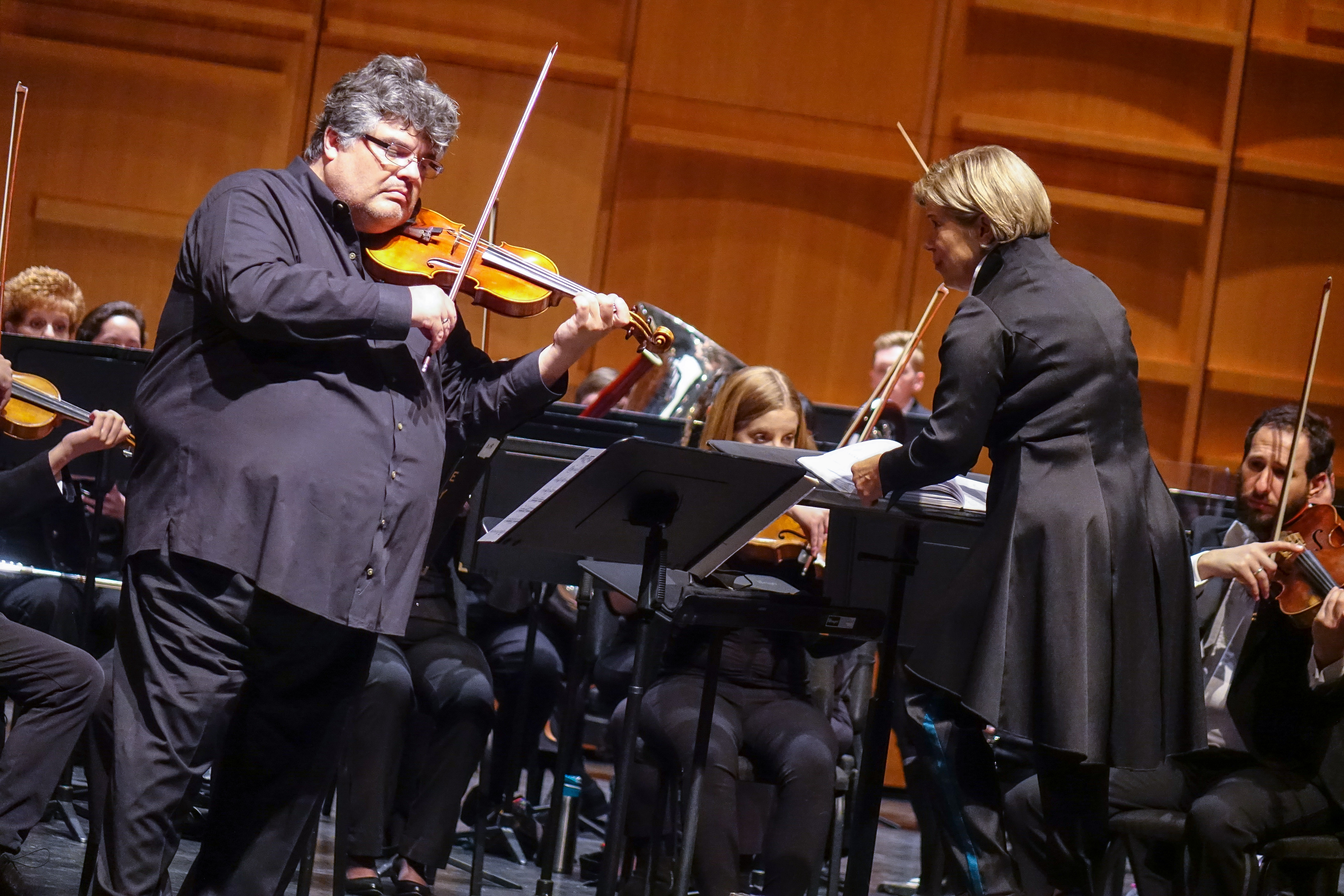
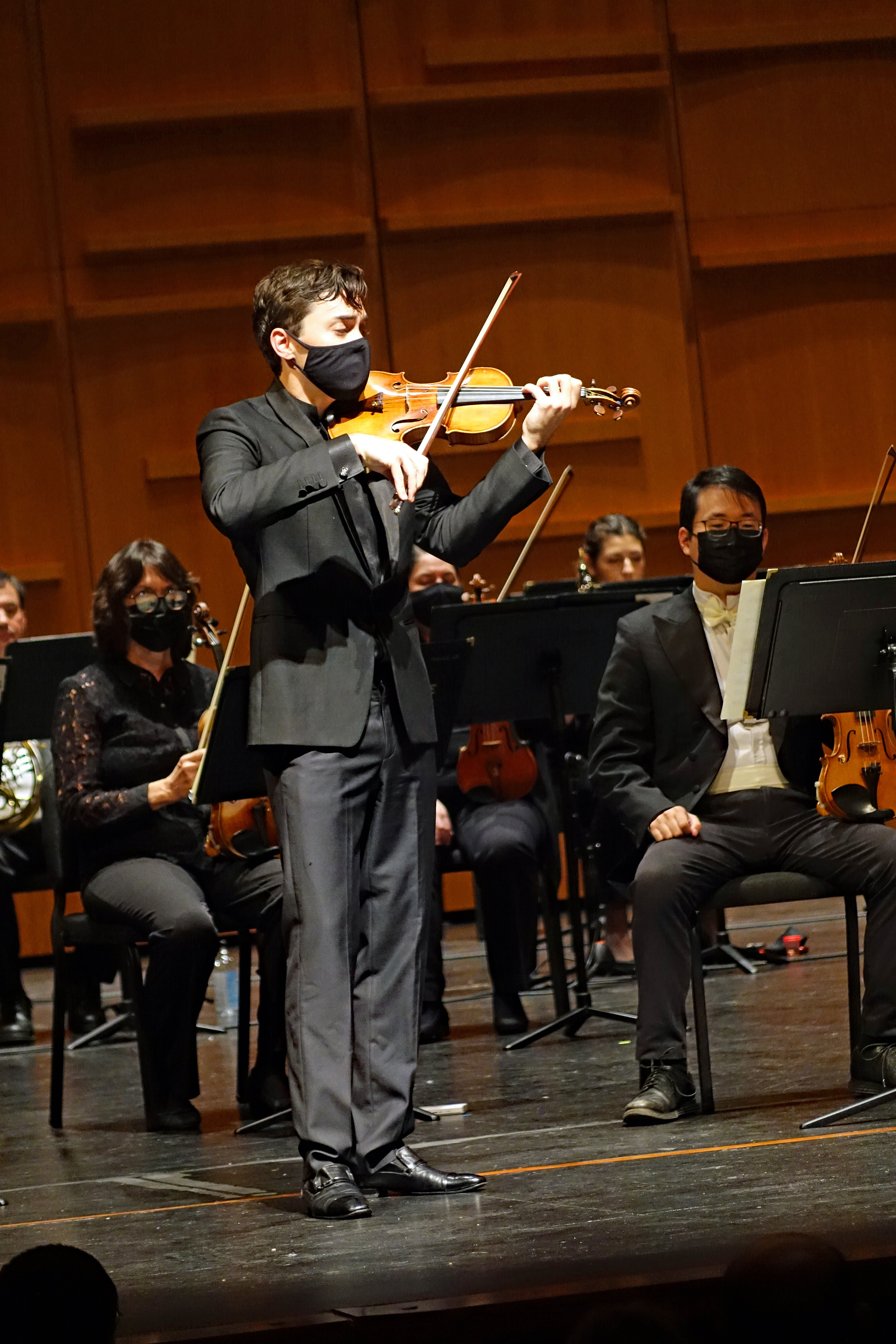
We’ve heard a lot from Ryan in recent years, though many Symphony subscribers might say we should have heard much more. In preparing what Shostakovich subtitled “A Soviet Artist’s Practical Creative Reply to Just Criticism” – from renowned music critic Josef Stalin – Ryan trampled on the notion that Symphony No. 5 was in any way servile, apologetic, or conciliatory. All the true moods of Shosty’s 1937 portrait of Soviet Russia were vividly rendered, beginning with the bleak, haunting, and ultimately aching qualities of the epic opening Moderato. This battlefield desolation was not altogether relieved by the comical marching of the ensuing Allegretto, which combined sourness with merriment, along with a delicious dancing interlude from concertmaster Calin Ovidiu Lupanu. The Largo reverted to the weepy and misty grumblings and dyspepsia of the opening movement. Then we transitioned wonderfully – especially in ghoulish October – to the surreal, manic phantasmagoria of the concluding Allegro non troppo. My happy memories of Christopher Warren-Green conducting this work have faded since 2013, so I offer no comparisons. But this was no doubt the finest performance I

Elgar and Olga Headline a Sparkling Euro Evening at Symphony

Review: Elgar’s Enigma Variations at Belk Theater

By Perry Tannenbaum

February 14, 2025, Charlotte, NC – Russian-born pianist Olga Kern has now played in Charlotte at least five times, making her one of our most popular and welcome guest artists. Yet, it wasn’t exactly inevitable that she would someday sit before us in a Charlotte Symphony program headlined by the music of Edward Elgar. We’ve had distinguished artists here playing Elgar concertos, including violinist Nigel Kennedy and cellist Alisa Weilerstein, but Sir Edward’s fame has never rested upon his scant keyboard output, though his piano quintet is a masterpiece.

More predictable, perhaps, was the pairing of German-born guest conductor Ruth Reinhardt, the music director designate at the Rhode Island Philharmonic, with Elgar’s Enigma Variations (1899) – or with Robert Schumann’s Piano Concerto, since it was premiered in 1842 with Clara Schumann, the composer’s wife, at the keys.

Better yet, Reinhardt brought a piece with her by Josef Suk, a Czech composer we rarely hear in the Queen City. Suk was Antonín Dvořák’s most prized student, and his Pohádka (Fairy Tale) premiered as incidental music for Julius Zeyer’s play, Radúz and Mahulena, less than eight months before he became Dvořák’s son-in-law on his mentor’s silver wedding anniversary in 1898. Adding to the poignancy of this very romantic and dramatic music, Dvořák and Otilka would both die less than a year apart before Suk could ever celebrate his seventh wedding anniversary.

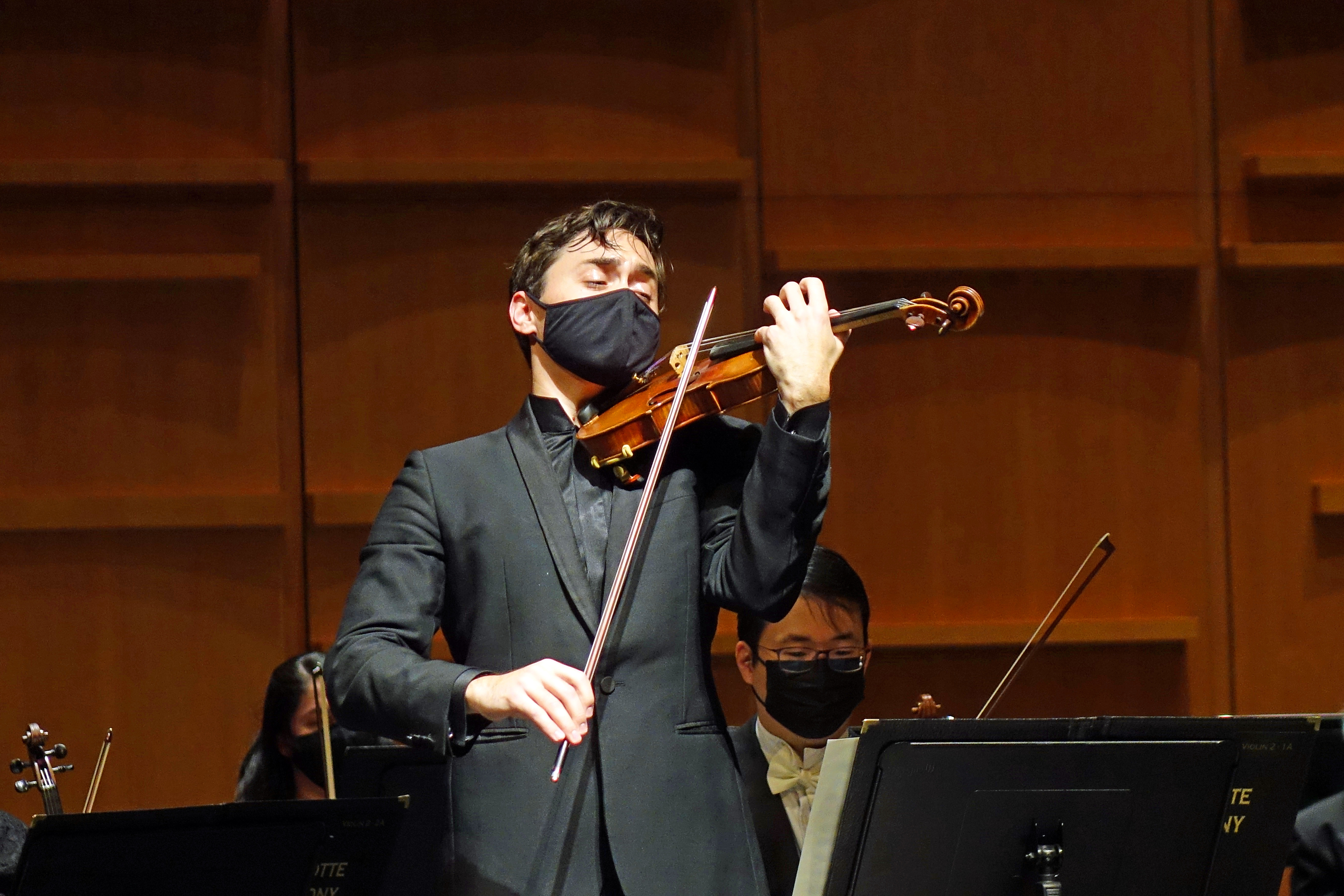
The opening movement, “The True Love of Radúz and Mahulena and Their Sorrows,” rearranged from Acts I and III, swept in with the warm cellos, dominating until the high winds and then the violins entered. CSO concertmaster Calin Ovidiu Lupanu had a lovely pair of solos sandwiched around the two sorrowful orchestral swells, the first triggered by the timpani and the second by the French horn. Since Suk was also a violinist, co-founder of the famed Czech String Quartet, it might be possible to imagine Lupanu as the composer serenading his bride-to-be with the Princess Mahulena’s theme, “Lovely Maiden with the Violin,” when the spotlight fell on the concertmaster.

Plenty of scurrying sounds sketched the “Game of Swans and Peacocks” intermezzo, apparently a game played by the young lovers (duck and goose, anyone?). The liveliness crested grandly into hints of massive carnival joy, bounced by the percussion, winds, and brass. While the printed program omitted the “Intermezzo” labeling from the ensuing movement, “Funeral Music,” you’ll find it preserved in the gorgeous digital program, where useful glosses on each section of the Enigma Variations also appear. Even before the twin tragedies would befall Suk, he a had natural talent for this lugubrious solemnity, initiated by the cellos and basses. There’s a uniquely queasy sound from the winds at this funeral that I jotted down as “nauseating” at first blush.

“The True Love” was long enough to elicit applause from audience members who weren’t following in their programs, but even though a percussionist pointedly rose at the end of “Funeral March” and readied his cymbals to launch the finale, more applause splurted forth to provide an extra gap before “Runa’s Curse and Victory of Love.” Subtitles above the stage cuing the beginning of movements could have prevented or muted these outbursts, which seem smilingly tolerated by the musicians rather than welcomed. The juicy story of Runa’s curse and the lovers’ escape, since Zeyer’s play will not likely ever be seen again, would have been a nice topping to the rising and falling episodes of the music, raucous in the wake of the cymbals before receding into a mellow calm with a lovely spot for clarinetist Taylor Marino.

Runa’s curse, the program or supertitles could have told us, turns the lovely Mahulena into a poplar tree and erases Radúz’s memory. Yet love – or fabulous luck – conquers all! The tragical Radúz somehow decides to chop down the poplar. Out pops Mahulena, breaking Runa’s curse and killing the witch. The last graceful decrescendo glided into a valedictory solo from concertmaster Lupanu evoking the Princess.

To be fair, adding supertitles to Reinhardt’s finely sculpted performance of Fairy Tale wouldn’t have come to mind if supertitles hadn’t proven to be such an enjoyable extra in CSO’s Enigma Variations, last given in 2010 with Christopher Warren-Green at the podium in an all-Elgar program – the program that featured Weilerstein’s Charlotte Symphony debut. Even if you had read the 15 blurbs from the digital program, occasionally condensed on the projections, you might not remember them all while the music was playing. As early as the second section, where the opening Andante slides smoothly into Variation I – (C.A.E.) L’istesso tempo, dedicated to his wife, you could lose track of where we were.

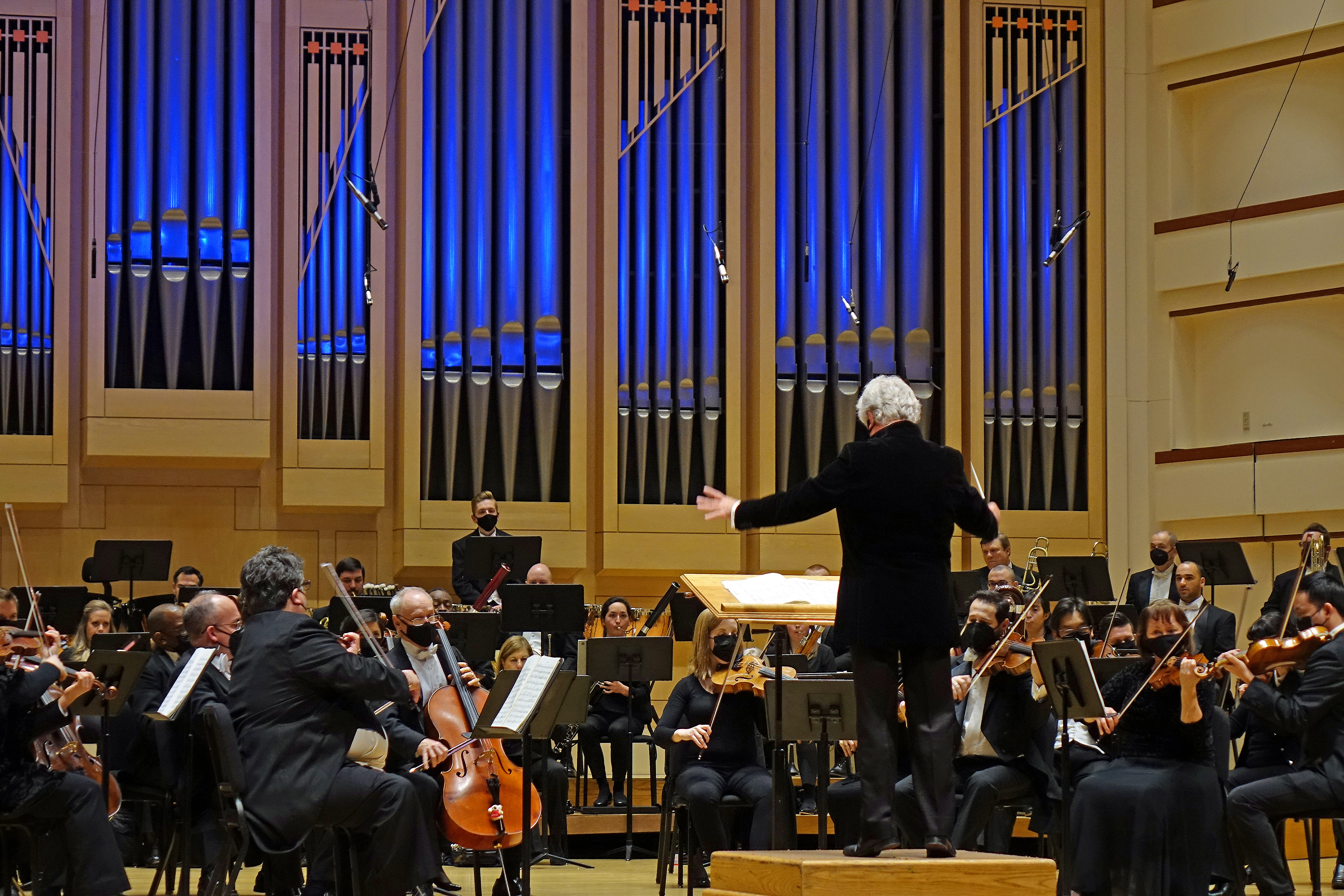
When we reached Variation XI (G.R.S.), for example, we could more fully be in the moment knowing that the piece wasn’t really about organist George Robertson Sinclair but about his bulldog plunging into a river. No doubt Elgar was purposely (needlessly?) cryptic in his Enigma dedications, as in the penultimate Variation XIII, dedicated to (***) rather than Lady Mary Lygon or a previous fiancée. The last, dedicated to himself, is initialed E.D.U. Word of warning: though this towering finale should be crowned with an obbligato organ, the impressive array of upstage organ pipes have never made a peep at Belk Theater since it opened in 1992. Temper your expectations if they’re on a Westminster Abbey scale.

Warren-Green always had a wonderful touch with programmatic music, usually engaging and helpful when he lent his bass-baritone to witty and concise spoken intros. Reinhardt had no less sensitivity or success with the music, so the supertitles added zest, flavor, and purpose to the music. But she never spoke to us, missing the opportunity to shape the occasion or even briefly add extra coherence to the program. This was Valentine’s Day, and all of the listed works were inspired by a wife or a fiancée.

Kern certainly personified the theme, playing the grand work inspired by its first soloist, Clara Schumann. It’s easy to forget the Cliburn Competition winner’s first appearances in Charlotte when she pounded Rachmaninoff to raucous submission before her Symphony debut. Carolinas Concert Association subscribers were absolutely besotted with her beauty and power in 2006 and 2007. Only when Alan Yamamoto reined her in on the Rach 2 later in 2007 could I jump onto the bandwagon. In the outer Allegro movements of the Schumann, she was certainly the powerhouse that Stephen Hough was when he gave the concerto here in 2014 with Warren-Green, and almost equaled his magical finesse in the beguiling middle movement Andantino. Two dazzling encores, immediately smashing the evening’s Valentine motif with the first, Gershwin’s “Fascinating Rhythm,” ensured that the devotion of her Charlotte fanbase would endure.

Breathtaking Perfection Makes Charlotte Ballet’s “Swan Lake” Premiere a Dazzler

Review: Swan Lake at Knight Theater

By Perry Tannenbaum

May 3, 2024, Charlotte, NC – For generations, budding ballerinas around the globe have aspired to be a member of the gaggle who dance to the primeval strains of Pyotr Ilyich Tchaikovsky’s Swan Lake. The best of them dare to dream of dancing the roles of Odette, Queen of the Swans, and her evil, seductive doppelganger, Odile. Yet more than 50 years elapsed in the life of Charlotte Ballet before the company brought Odile, Odette, and Swan Lake to the Queen City. To many, including millions of those budding ballerinas, Swan Lake and ballet are synonymous. So in a town that has a reputation of resisting the new and clinging blindly to proven classics, you have to wonder why this premiere – a quite glorious one at Knight Theater – has taken so long to happen.

Although scenery, costumes, and props are on loan from the ballet troupes of Cincinnati, Arizona, and Atlanta, the mélange is quite impressive. Choreography by Ib Anderson, based on the definitive 1895 overhaul by Marius Petipa and Lev Ivanov, and the work of CharBallet dancers, Charlotte Ballet II, members of the pre-professional program, and students of the Ballet Academy are more than enough to stamp this marvel as homegrown. Extra freshness and vivacity rose from the orchestra pit as the Charlotte Symphony, directed by Gavriel Heine, performed the full score for the first time – with the ardor of an orchestra that has been waiting over 90 years for a living, breathing ballet corps to partner with on this mammoth venture.

Those little-girl aspirations are freshly recalled by the glittery merch in the Knight lobby, so the anticipation in the audience before curtain-rise was akin to the excitement that greets the CharBallet-Symphony collaboration each December as Belk Theater fills up for The Nutcracker. Even after opening night, you are at a special event. While the Cincinnati scenery can be improved upon (rather easily, I’m afraid); especially in and around Prince Siegfried’s castle; the courtiers, the servers, and the ladies in waiting regally create a teeming spectacle that fulfills expectations in Act 1. Oliver Oguma, the first of three leading men who will rotate during the 12-performance run, is a soulful Prince Siegfried with a bonus of brawn. Some heavy lifting lies ahead, but before lifting Odile up high Oguma had to be able to shine solo in the opening scene, where he basically rejects every eligible maid in the kingdom. The Queen Mother is royally chagrined – a triumphant comeback for Ayisha McMillan Cravotta, more beautiful than ever.

Anderson discreetly subtracts some courtiers from the Petipa scenario, but there’s enough dazzle remaining for them not to be terribly missed. The dozen courtiers beguile us in varying configurations, and the pas de trois sequence with Bridget Fox, Humberto Ramazzina, and Samantha Riester is endearing elegance and charm. Dancing the Page’s solos, Academy student Russell Abel struck me as a prodigy, able to leap and land squarely on the beat. Yet as the act climaxed, viewers who are accustomed to seeing Prince Siegfried flanked by noble chums might feel that Oguma gradually becomes excessively forlorn in spite of all his solo exploits.

Yet it’s justified to view the sparsity of plot and companionship in the opening scene as a perfect way to magnify the éclat of Act 2, where the evil sorcerer Von Rothbart and his enchanted flock finally take the stage – a bevy of 24 Cygnets and Swans plus one sublime Queen. You might even be tempted to laugh at the triteness of the choreography that precedes Odette’s first entrance – until you realize that Ivanov and Swan Lake likely fashioned the familiar template that Hollywood, Broadway, TV, and Vegas have turned to ever after in innumerable dancing build-ups to the entrances of their stars. James Kopecky, in a spectacularly hideous bird costume of his own – with poles to extend his wingspan – is magnificently malign in his various poses and flourishes, adding magic and menace to the big moment.

Evelyn Robinson was more than equal to it. She was divine perfection: fearlessness, symmetry, balance, musicality, and supple flow were all absolute to an inhuman degree. Only the little expressive flutters of her head and face subtly reassured us that a tortured soul hovered above her pluperfect point work. Later, when Robinson invaded Prince Siegfried’s surprisingly drab ballroom as Odile, you kind of wondered whether she would dramatically vary or eclipse what has gone before. Seemingly responding to more spellbinding sorcerer gestures from Kopecky, a bit like a taunting pro wrestling baddie in his taunts, Robinson softened ever so slightly. Her seductiveness trickled naturally from her added liquidity, and her expressions became more worldly and knowing, like a Vogue supermodel shoot. Or Melania.

In sum, Robinson was all I could hope for and occasionally more. But the swans! I hadn’t even begun to imagine what they can be in live performance. Whether it was the composer’s masterstroke in the original 1877 score premiered by the Bolshoi or the brainchild of ballet specialist Riccardo Drigo, who revised the score for its successful 1895 resuscitation in St. Petersburg, the music hushes so much that the en pointe work of flock is clearly audible – not only audible but a chief element of the music’s fluttery percussion. Over the course of the 2 hour 17 minute epic, it wasn’t only principal harpist Andrea Mumm who excelled. Concertmaster Calin Ovidiu Lupanu came to the fore with some fine solo work in Act 3 and acting principal oboist Erica Cice was gold all evening long on the haunting big tune.

What floored me most, after watching Charlotte Ballet ever since it arrived here (from Winston-Salem) as North Carolina Dance Theatre in 1990, was the unprecedented synchronicity of this bevy of fluttering Swans. For decades, the individuality of each NC or Charlotte dancer was the company’s trademark. Let Miami and what’s-his-name do synchronicity! Yet here in an instant, the phenomenon of a perfectly calibrated ensemble of 24 women, dancing on point to the same heartbeat, had arrived in Charlotte, North Carolina. It was eerie and breathtaking. Historic.

Will CharBallet fully possess Swan Lake in the future with their own scenery, props, and costumes? Hope so. This is one you’ll want to see again.

Mei-Ann Chen Rocks the Knight in CSO Debut

Review: Bruch’s Violin Concerto with Charlotte Symphony

By Perry Tannenbaum

2023~Bruch Violin-18We’ve been hearing about numerous identified and unidentified flying objects in recent weeks, emanating from numerous sectors of the globe, crossing over our nation’s territorial waters and seeking all sorts of military and meteorological intelligence. Less mysteriously, there have been precise predictions in recent months of astral objects whistling through our solar system, one of them brushing closer to dear Earth than the moon.

But until now, not a word about the meteor that struck the Knight Theater in the heart of Uptown Charlotte. Her name is Mei-Ann Chen, and we can only hope that the guest conductor now in our midst is vying for the vacant music directorship at the Charlotte Symphony. It would be grossly unfair, no doubt, but it wouldn’t a bad idea to sign her up before she left town.

Chen’s impact on – and appeal to – the Symphony’s musicians and subscribers was nothing short of electric.2023~Bruch Violin-09_Export

The orchestra had never performed Fanny Mendelssohn Hensel’s Overture in C Major before, yet they attacked the work zestfully, conveying its sharp contrasts and drama with unmistakable fervor. Flutist Amy Orsinger and principal oboist Hollis Ulaky excelled, jointly and separately, in the piece’s gentler moments. Although we had heard the CSO play the BRUCH VIOLIN CONCERTO as recently as 2016, Chen ignited the ensemble with fresh fire rather than receding to a subsidiary role behind concertmaster Calin Ovidiu Lupanu.

Instead of deferring to the soloist – or even seeking an agreeable balance between orchestra and violinist – Chen laid the gauntlet down to them both, so that Lupanu and Symphony spurred each other to greater heights vying for supremacy, achieving a higher level of parity through their combat. More adventurous now than I can recall, Lupanu was nearly note-perfect all the way through the treacherous terrain of the Allegro energico finale while his attack, confidence, and feeling were never better. His command was certainly impressive throughout the opening Allegro moderato, with a transition to the slow middle movement that was amorously smooth. Principal flutist Victor Wang helped to make this Adagio extra exquisite.

As the concerto climaxed, it might have been a toss-up to many in the audience whether Chen was inspiring the CSO or vice-versa. In respect for your colleagues, you’re not going to urge an orchestra too insistently to give us more during a performance – that has to have happened behind the scenes in rehearsal.

Our first glimpse of what that might have been like came right after the concerto, when Chen gestured to the audience to give Lupanu more love for his sterling performance. After the break, our impressions grew more vivid as Chen picked up a mic at the podium and greeted us. Not satisfied with our “Good evening!” Chen urged us to make a second try, somehow infusing this tired old emcee shtick with new energy and spontaneity – and getting results.2023~Bruch Violin-23

Speaking about the works on tonight’s program, Chen included info we could have gleaned from the program – a practice that Christof Perick and Christopher Warren-Green staunchly resisted – and made an effort to link the pieces together with a common theme. Faced with a crowd that was significantly more numerous than the crowd I’d seen three weeks earlier, but still significantly short of Knight’s capacity, Chen declared that Charlotte should be more supportive toward its Symphony.

That was a more compelling statement after delivering two examples of our musicians performing at their peak.

Chen rightly surmised that the main draw of the evening was the Bruch, since the César Franck Symphony in D minor, originally slated for its revival last March, hadn’t been heard in the Queen City since November 2003. Now that was a pitifully attended concert at Belk Theater, after striking CSO musicians had settled on a new contract and returned to work, so Symphony subscribers can pat themselves on the back for improving on that turnout.2023~Bruch Violin-10_Export

The main link between the two Francks that I’ve seen was the fine work by Terry Maskin on the cor anglais solo in the middle Allegretto movement. In the outer Allegro movements, our brass proved its mettle once again, though we’ve surely seen a Chening of the guard during the intervening decades. Associate concertmaster Joseph Meyer distinguished himself in the early Lento of the opening and principal French hornist Byron Johns had outstanding moments when the music quickened.

Chen improved most on the Perick performance of 2003 in the Allegretto, livening the effect of Maskin’s soulfulness on the English horn with more standout work from Johns and Andrea Mumm Trammell’s delicacy on the harp. Before the brass brought the finale to its brash climax, CSO’s principal harpist bubbled up tellingly in the symphony’s last calming episode.

Obviously content with her musicians’ handiwork, Chen gave the audience opportunity after opportunity to show the appreciation she had previously asked for. With unmistakable cues, Chen called upon us – already giving them a standing O – to really let the musicians hear it as she prompted them individually and collectively to take their well-earned bows. We did.

[If you missed Mei-Ann Chen in Charlotte, you can catch up with her on June 7, when the Chicago Sinfonietta music director conducts Antonín Dvořák’s “New World Symphony” at Spoleto Festival USA.]

Photos by Perry Tannenbaum

US Premiere Keynotes Symphony Concert, with Multiple Thrills and Triumphs to Follow

Review: Charlotte Symphony Plays Sibelius Symphony No. 2

 By Perry Tannenbaum

2022~Sibelius 2-21

April 22, 2022, Charlotte, NC – There had been no foretelling that five weeks ago, the Belk Theater stage would be splashed with the colors of Ukraine’s flag for a Charlotte Symphony concert. Nor could guest conductor Karen Kamensek, making her Charlotte debut, have predicted that the music she was bringing to Knight Theater would be so pertinent to this moment: a symphony by a Finnish composer written in response to Russian oppression in 1902, and two pieces written by Russian-born composers, one of them publicly condemned by the Stalinist regime in 1948. Sadly, these works by Jean Sibelius, Victoria Borisova-Ollas, and Dmitri Shostakovich have new life and fresh significance today as the world trembles, anticipating the full consequences of the horrific Russian aggression unleashed by its unhinged leader.2022~Sibelius 2-06

Written by Vladivostok native Borisova-Ollis, a longtime Swedish citizen, in 2008 for the 850th anniversary of Munich, Germany, Angelus had its long-overdue United States premiere. Nor was the Chicago-born Kamensek unworthy of the honor, having conducted the 2022 Grammy-Award winning recording of Philip Glass’s Akhnaten with the Metropolitan Opera. Although the upstage at Knight Theater wasn’t lit up with Ukraine’s colors, there certainly was an auspicious tableau – and a sense of occasion – as a phalanx of percussionists were spread across the rear of the orchestra, bells and drums and cymbals further brightened by the sounds of piano, celesta, and a pair of harps. The composer’s account of how she fulfilled the Munich Philharmonic Orchestra’s commission, reprinted in the digital program, lays heavy stress on the stroll she took through the city and the recordings she made of its church bells, so that aspect of the piece, underscored by Kamensek’s spoken intro was eagerly anticipated – a pacific, spiritual answer to Putin’s insane “de-Nazification” rallying cries.2022~Sibelius 2-25

What was surprising for me, especially in light of Borisova-Ollis’s description of the opening of her Angelus as “a hint of a Celtic chant,” was hearing principal violist Benjamin Geller playing a melody, over soft tremolos from the string section, that unmistakably resembled a traditional Passover song, one that I had heard in synagogue as recently as that morning. The predicted bells would eventually arrive in three or four waves, but not before we heard from the trumpet, the horns, the timpani, and the clarinet. Extending beyond 20 minutes, not at all a bonbon typically programmed at the beginning of concerts, the piece was studded with unusual instrumental effects – like a brief organ-tuba duet – and swirling, cresting climaxes. Even as she built to the first tolling of the tubular bells, Kamensek’s interpretation was more bustling and boisterous than Skari Oramo’s relatively quiescent recording for BIS with the Royal Stockholm Philharmonic. Since Kamensek lists one Borisova-Ollis’s operas, Dracula, among her credits, expect to hear more from this composer-conductor pairing in the future.

Shostakovich completed his first Violin Concerto just one month after his denunciation, but he and violinist David Oistrakh, for whom the work was dedicated, had to wait over two years after Stalin’s death – more than seven years in all – to respectively hear and perform the premiere. Although I own two of the Oistrakh recordings you can access on Spotify, I can only trace two prior occasions when I heard this epic piece performed live, once by the Charlotte Symphony in 2001, when young Caitlin Tully was hampered by the acoustics of the First United Methodist Church, and once at the Verbier Festival in 2006, when violinist Vadim Rapin conductor Yuri Temirkanov fired off all its burners with a student orchestra that was on a par with the Spoleto Festival’s.2022~Sibelius 2-11

Charlotte Symphony subscribers greeted concertmaster Calin Ovidiu Lupanu with an ovation that probably would have startled Repin himself, and the violinist seemed buoyed by the occasion. While Lupanu didn’t quite replicate the sublimity of the opening Nocturne in the 1956 recording by the Leningrad Philharmonic with Oistrakh and maestro Yevgeny Mravinsky, he came breathtakingly close, enough to earn another ovation between movements, and the slashing energy and brightness he brought to the ensuing Scherzo – coupled with the brio Kamensek drew from Symphony in this catchiest movement – earned an even more-deserved ovation afterwards.

Kamensek and the CSO met the grand challenge of the Passacaglia, infusing it with martial gravity, and Lupanu played with more eloquence and fire than I’ve ever heard from him, carrying forward a thrilling momentum into the Andante – Cadenza portion of that movement and, without an interval for the audience to express its enthusiasm, into the final Burlesque, the shortest section of the work. Cheated of the chance to explode after the Cadenza by the onset of timpani for the Burlesque, the audience redoubled its fervor at the rousing conclusion. Fortunately, Lupanu had an encore at-the-ready, a lovely Sarabande from Bach’s Partita No. 2, the first encore performed at a CSO concert since before the pandemic.

Of course, if you were among the legions who can’t get enough Sibelius, the Symphony No. 2 after intermission, while significantly statelier and more reposeful than the concerto, was anything but an anticlimax. However neatly the oppressed narrative might fit current anti-Russian sentiments, Kamensek seemed to take the quieter episodes of the opening Allegro as subdued rather than oppressed, with an incipient optimism ready to burst forth with ebullience or blossom into grandeur. The opening of the ensuing Andante, ma rubato can sound morose and grim on recordings, but at the Knight, where the pizzicatos of the basses and cellos could sound lighter and livelier, buoyancy lurked within the quietude, so transitions to anger and reflection sounded more natural. Once again, the two final movements were linked without an interval, punctuated by another brief timpani tattoo, but this time followed with trumpet heraldry and a grand orchestral flowering. Repeated lulls and swellings reaffirmed the triumph, beautifully calibrated and fervently delivered.

Originally published on 4/24 at CVNC.org

Ukraine’s Colors Shine Through Charlotte Symphony Celebration

Review: Dona Nobis Pacem at Belk Theater

 By Perry Tannenbaum

2022~Dona Nobis Pacem-31

March 12, 2022, Charlotte, NC – When 57 musicians gathered at the Carolina Theatre on Tryon Street to present the inaugural Charlotte Symphony concert on March 20, 1932, none of them could have possibly predicted how the orchestra’s 90th anniversary would be celebrated in 2022. Three of the five pieces that Christopher Warren-Green conducted, nearing the end of his distinguished tenure as Symphony’s music director, hadn’t been written yet, and one of the composers hadn’t been born. Even last May, when CSO’s 2021-22 season was announced, Warren-Green himself couldn’t have predicted how grimly appropriate Ralph Vaughan Williams’ Dona Nobis Pacem would be for the occasion. As originally conceived, the program was an olive branch from England to America, three British composers conducted by one of the Crown’s finest, two of the pieces paying homage to Walt Whitman, our greatest poet.

A small dent in the all-English lineup turned up when Symphony’s Australian second trombone, Thomas Burge, finished enough of his to-be-continued “Charlotte Symphony Fanfare” for it to serve as a preamble to the orchestra’s celebration. What truly turned the tone of the anniversary festivities upside-down was Vladimir Putin’s horrific invasion of Ukraine, lending Dona Nobis Pacem – “Grant us peace” – unforeseen pertinence and meaning. With St. Patrick’s Day weekend revelers teeming along the sidewalks and spilling over onto Tryon and Fifth Streets, there was a dramatic contrast for concertgoers who became pedestrians shortly after hearing Williams’ Fantasia on a Theme by Thomas Tallis and the Dona Nobis at Belk Theater on Saturday night. The most festive of the night’s festivities were outside the hall.

Burge’s new composition will no doubt impress more when it takes its intended place at the launch of a future Symphony’s classics season and the composer’s showy post-pandemic staging can be realized: three brass choirs spread out across the Belk balcony. For the 90th, the brass battalion was confined behind the masked string sections, but the peep we had into the work-in-progress was sunny and glorious. Gustav Holst’s Walt Whitman Overture, a youthful piece completed in 1899 when the composer would turn 25, was arguably the most sustained celebration of the evening, though it might be somewhat deflating to learn that Holst had been dead for over 48 years when the piece was first performed in 1982. The transparent violins at the beginning, hovering over churning basses and cellos before flutes and brass peeped in, struck me more like Schubert than any American or British music. When the brass first broke through, however, there may have been a glint of Sousa, and the final swell of the piece was in a grand Victorian vein.

The Four Scottish Dances by Malcolm Arnold (1921-2006), premiered in 1957, were clearly the most winsome offering of the evening, shuttling between slow and fast tempos – not only between dances but sometimes within them. Inspired by Louis Armstrong more strongly than by Whitman, Arnold’s music displayed a more American élan, geniality, and broad humor than the other Brits’. If your head wasn’t spinning from the abrupt acceleration that Warren-Green called forth in the opening “Strathspey Pesante,” which ended with a pedestrian “shave and a haircut” phrase, then the slowdown in the ensuing Vivace (Reel), initiated by Joshua Hood galumphing on his bassoon, would certainly have caught your ear. And if that weren’t sufficient mischief, Warren-Green’s hambone slacking and slouching at the podium added a visual cue. Perish the thought that Maestro Warren-Green’s predecessor, Christof Perick, would ever have tainted himself with such levity.

After these pranks, which reminded me of the Western merriment in Copland’s folksier pieces, the work of principal harpist Andrea Mumm Trammell, principal flutist Victor Wang, and oboist Erica Cice was sublime in the penultimate “Hebridean Song,” shining through the shimmer of the strings. The concluding “Highland Fling” had as much Scottish flavor as the “Pesante,” rushing at us unabated with sudden shifts in volume, the tweedling of the high woodwinds answered by onrushes of orchestra colored with fiery alarms from the trombones.

If the customary programming conventions for galas were being observed, I’d strongly question the wisdom of delaying the comparatively solemn and serene Tallis Fantasia until after Arnold’s suite, which would have sent us off to intermission in a lighter mood. But Symphony president David Fisk had already solemnized the occasion by dedicating the concert “to Ukraine and the courage, strength, and resilience of its people,” a theme that would subsequently be echoed in the digital program and by Warren-Green, when he prefaced his performance of the Dona Nobis. By coincidence surely, Vaughan-Williams composed his 1910 Fantasia very similarly to Burge’s spanking new “Fanfare,” dividing his aggregation of strings into three parts, two string orchestras with a string quartet within the larger orchestra. Concertmaster Calin Ovidiu Lupanu had the last and most eloquent solo among those doled out to the four principal string players, but kudos should also go to principal violist Benjamin Geller, whose solo launched the memorable quartet episode.

What will stand out for me, however, was the extraordinary alchemy of this performance. Whether it has always been baked into Vaughan-Williams’ orchestration, maybe something special that Warren-Green was able to elicit from his musicians, or whether it was the unprecedented high placement of the small string orchestra on the platform where the Charlotte Master Chorale would soon sing, flush against the upstage vestigial pipes at the Belk… I could have sworn that there was a softly playing organ in the orchestral mix. Needless to say: amazing.2022~Dona Nobis Pacem-27

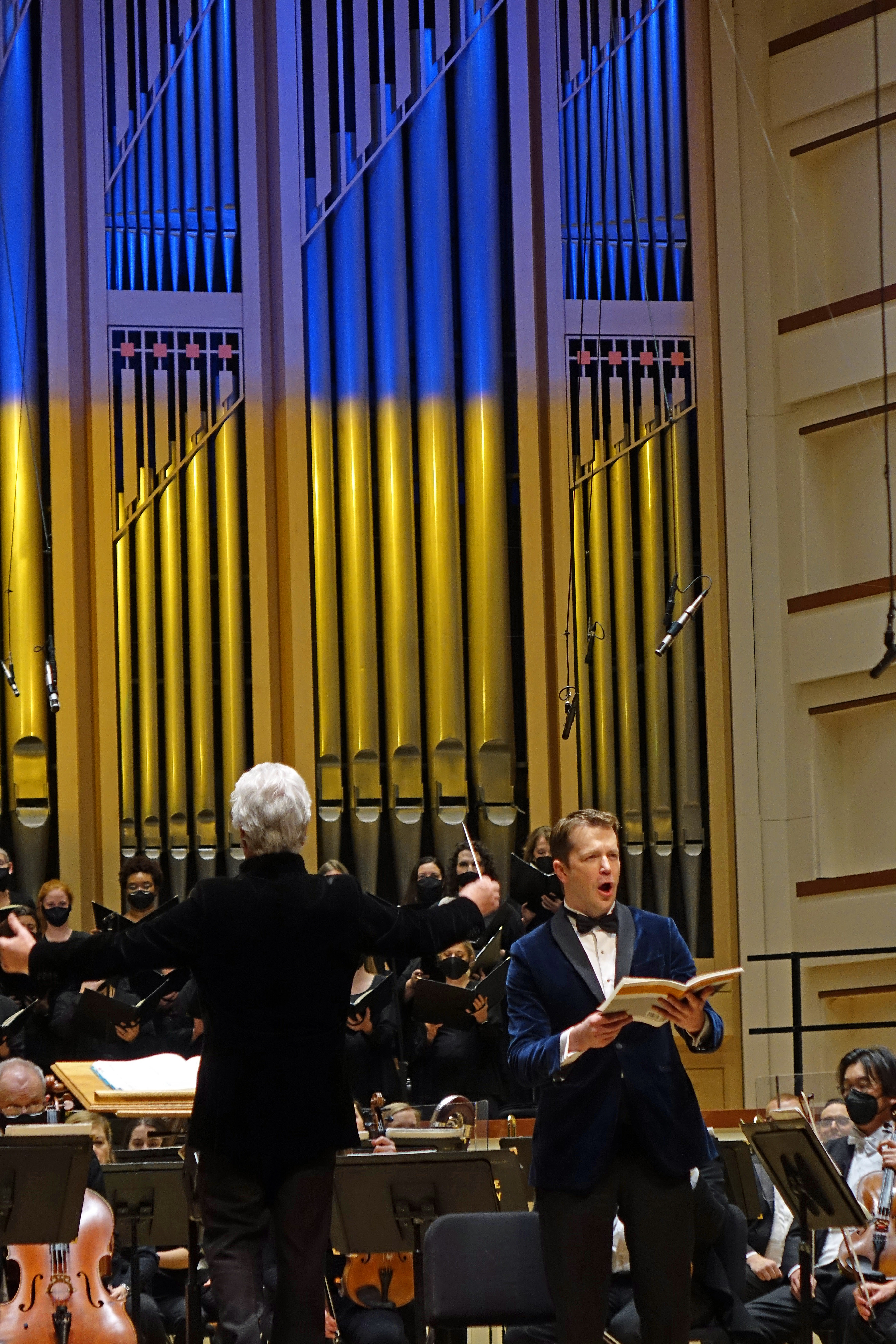
Those organ pipes were more verifiably involved in the culminating performance of the Dona Nobis Pacem, after more than 40 Master choristers filed in, followed by our two guest soloists: soprano Christina Pier and, in his Charlotte debut, bass-baritone Daniel Okulitch. It was then that Warren-Green dedicated this piece to the valiant, freedom-loving people of Ukraine. Between the moment that the maestro turned away from us and Symphony began to play, those silvery pipes, illuminated until then entirely in blue light, suddenly became halved into stripes of gleaming blue and yellow gold, the colors of the Ukrainian flag. A proud moment for us all.

Whether prescribed by COVID protocols, Warren-Green’s decree, or the unmasked singers’ personal preferences, Pier and Okulitch sat further apart than the vocal soloists we usually encounter at Symphony concerts. With Pier mostly singing the “Agnus Dei” refrain that contains the Latin title, and Okulitch confining himself in the middle movements in Walt Whitman’s English – and Old Testament translations in the Finale – the separation between the singers wasn’t awkward at all.

2022~Dona Nobis Pacem-24

Pier tended to sing with the orchestra and the choir, but there was an extended stretch where Okulitch, standing to Warren-Green’s right, was accompanied solely by Lupanu, seated to his left. So the tableau enhanced the intimacy of their duet. What was really unfortunate and compromising for us were the vast stretches of incomprehensible text from the chorus that Vaughan-Williams had scored so splendidly. If there had been supertitles above the stage or printed programs in our hands, the experience would have been even more powerful. Those of us who were able to download the digital program were adequately equipped, but the Blumenthal Performing Arts Center has had repeated problems with transmitting these copious, colorful, and informative materials.

In future performances where we’re expecting to follow along at the Belk, I will try to download the digital materials before I leave home. Clearest of all was the chorus’s mighty “Beat! Beat! Drums!” refrain from one of Whitman’s most metrical Civil War compositions. Even when we might be lost in the less familiar words of other war poems by the Good Gray Poet (“Reconciliation” and “Dirge for Two Veterans”), the music, the voices, and the colors of the fighting Ukrainians’ flag landed on us forcefully. It was thrilling.

Originally published on 3/14 at CVNC.org

“Deadly Sins” Upstage Jazzy Ravel in Fun-Filled CSO Concert

Review: Charlotte Symphony Plays Ravel’s Piano Concerto

By Perry Tannenbaum

2022~Ravel Piano Concerto-07

January 28, 2022, Charlotte, NC – You could arguably call it a facelift. After Charlotte Symphony’s powerful performance of Mahler’s somber, morbid, mercurial, epic, and sometimes phantasmagorical Ninth Symphony, almost everything seemed changed two weeks later. A new conductor was onstage, Australia-born maestra Jessica Cottis, making her Queen City debut. All six guest artists were making their debuts in Symphony’s Classics Series, and even the site of their musicmaking was different, moving southward from Belk Theater at the Blumenthal PAC to Knight Theater at Levine Avenue of the Arts. Most transformative was the music, a kaleidoscopic multinational program connected by a distinct American thread.

The headliner on the program was Maurice Ravel’s Piano Concerto, last performed by Symphony in 2013 when the wondrous Pascal Rogé made his Belk Theater debut at the keyboard. Jesse Montgomery’s folksy, bluegrass-flavored Strum preceded the main event, when Canadian pianist Stewart Goodyear seated himself at the Steinway. Cottis had plenty more excitement in store for us after intermission, plunging into Igor Stravinsky’s Circus Polka, for a Young Elephant – actually written at choreographer George Balanchine’s request in 1942 for Ringling Brothers Barnum & Bailey’s massive troupe of not-yet-controversial young elephants. Uncannily, another Balanchine commission rounded out the program, Kurt Weill’s The Seven Deadly Sins (1932) with lyrics by Bertold Brecht – obviously written for people rather than pachyderms.2022~Ravel Piano Concerto-36

Nearly a year ago, Montgomery’s Starburst aptly keynoted a program that showcased Mozart’s Eine Kleine Nachtmusik (“A Little Night Music”). Longer and decidedly sunnier, Strum set the tone for CSO’s American evening as perfectly as the title readied us for a work written exclusively for strings. Reading Montgomery’s program notes, chronicling the various incarnations of the piece, we get the sense of experiencing its evolution as it unfolds, for it bounces around among three principal string players before beginning its breathtaking ascent to full power and beauty. Laying out the first pizzicatos, violist Benjamin Geller was soon joined by cellist Alan Black, strumming and then bowing. But it was concertmaster Calin Ovidiu Lupanu’s treacherous entrance that truly ignited the fray, triggering Montgomery’s ricochet effects and banjo-like strumming.

Honestly, the performance by CSO became a more massive, lovelier, and less ferocious thing than the studio version by the Catalyst Quartet on Montgomery’s 2015 Strum CD. With a full string orchestra came more majesty when the main melodies were revealed – and extra bite when the piece ended with a collective pizzicato. Nor are “folksy” and “bluegrass” any less flattering in describing Montgomery’s music here than they are in describing many of Aaron Copland’s signature works.2022~Ravel Piano Concerto-01

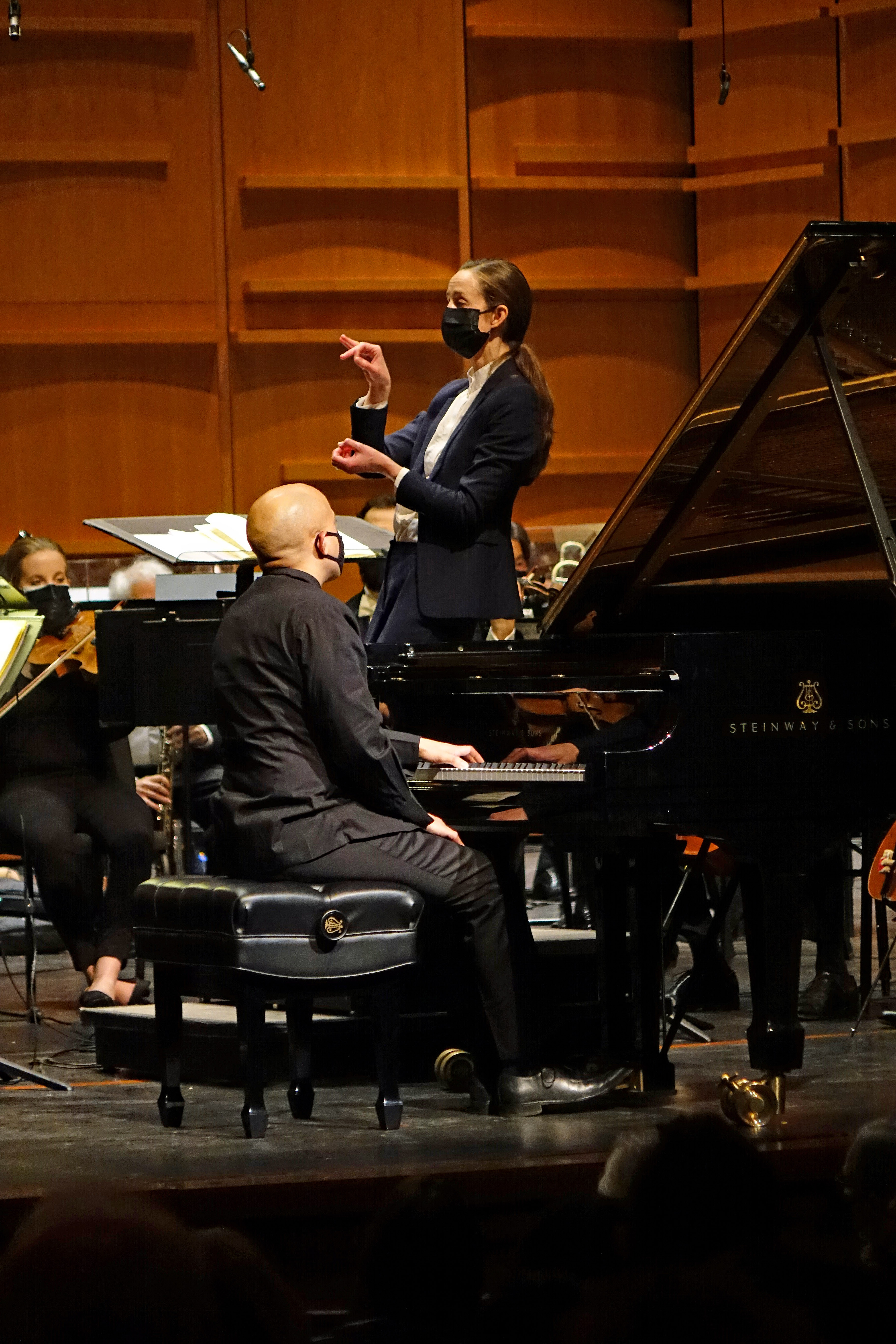
From the first time I saw him in 2017, playing all of Beethoven’s piano sonatas in a single day at Savannah Music Festival, Goodyear stamped himself in my mind as a prodigious talent. Prior to those three three-hour immersions, Goodyear’s distillation of Tchaikovsky’s The Nutcracker, on his 2015 solo CD, had clued me in. The soloist starts at a disadvantage in the Ravel Piano Concerto, having to follow the famed whipcrack that launches the opening Allegramente. Not to worry, Goodyear showed his mastery of the bluesy and jazzy licks of the movement soon afterwards, and harpist Andrea Mumm Trammell had a lovely interlude.

Inspired by Mozart’s Clarinet Quintet, Ravel’s middle movement drew absolutely mesmerizing lyricism from Goodyear, with English hornist Terry Maskin as stellar behind him as he was for Rogé. Yet everyone on the Knight stage seemed most inspired by the concluding Presto. Goodyear unleashed dazzling intensity and bravura, never easing up on the tempo, and the ensemble didn’t merely keep up: they seemed to be prodding their guest to play faster. Turbulence from the winds, brass, and percussion made the climax even more exhilarating.

Apparently, music for dancing elephant isn’t classified as ballet, since it doesn’t appear on The Robert Craft Edition of The Ballets on the notoriously completist Naxos label. Yet Stravinsky never disavowed his Balanchine bagatelle, conducting “Circus Polka” among his voluminous recordings of his own works, where it clocked in at a modest 3:27 on Columbia. Why this rambunctious crowdpleaser isn’t played more often as a concert appetizer is beyond me. While Cottis and the Symphony may have been a tad helter-skelter where Ravel called for more élan, they were marvelously attuned to Igor’s riotous absurdities, his brassy bombast, and the celebratory glee of his wild, galumphing jamboree. It seemed to start in mid-parade before the dainty spots hilariously evoked the pachyderm pixies.2022~Ravel Piano Concerto-31

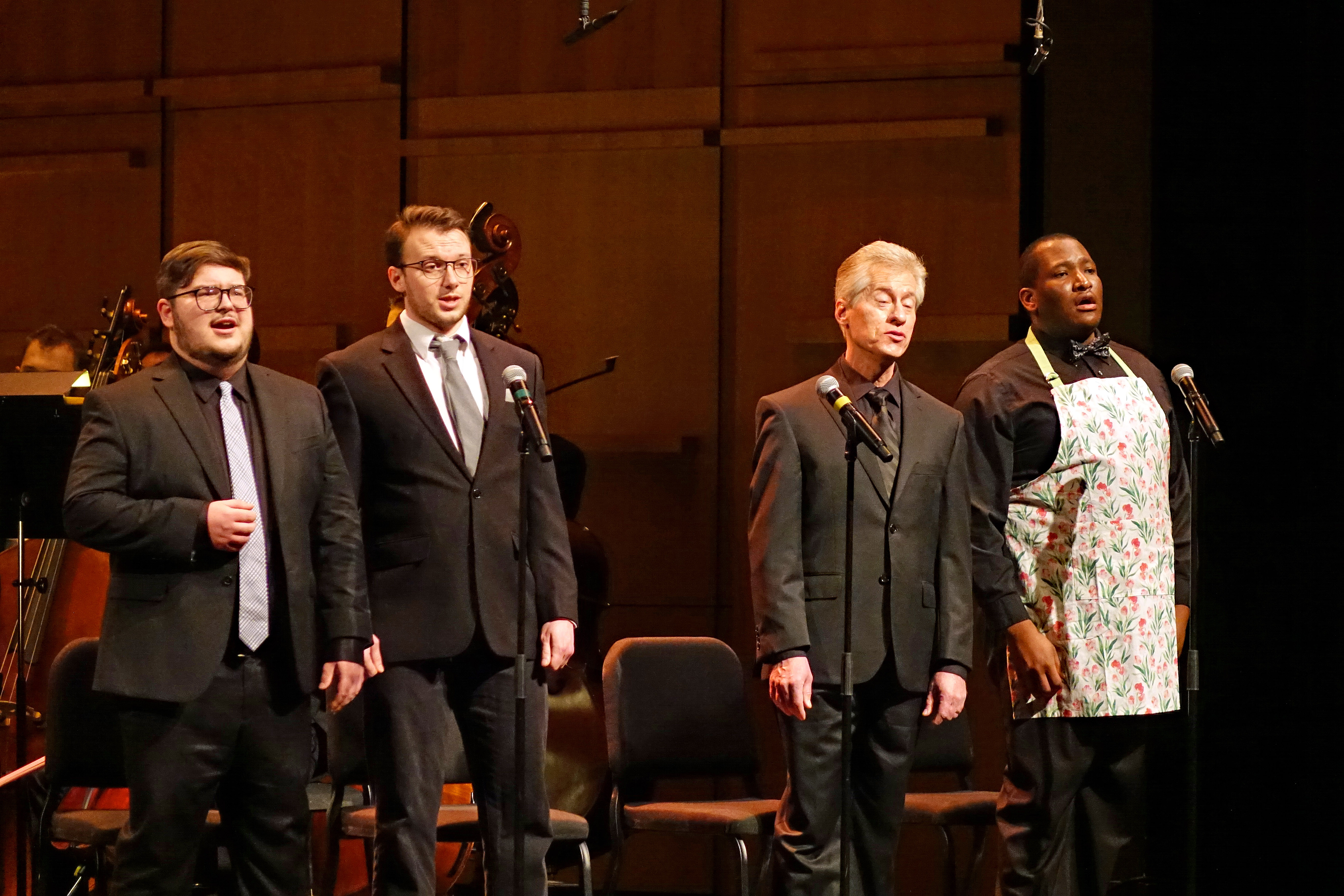
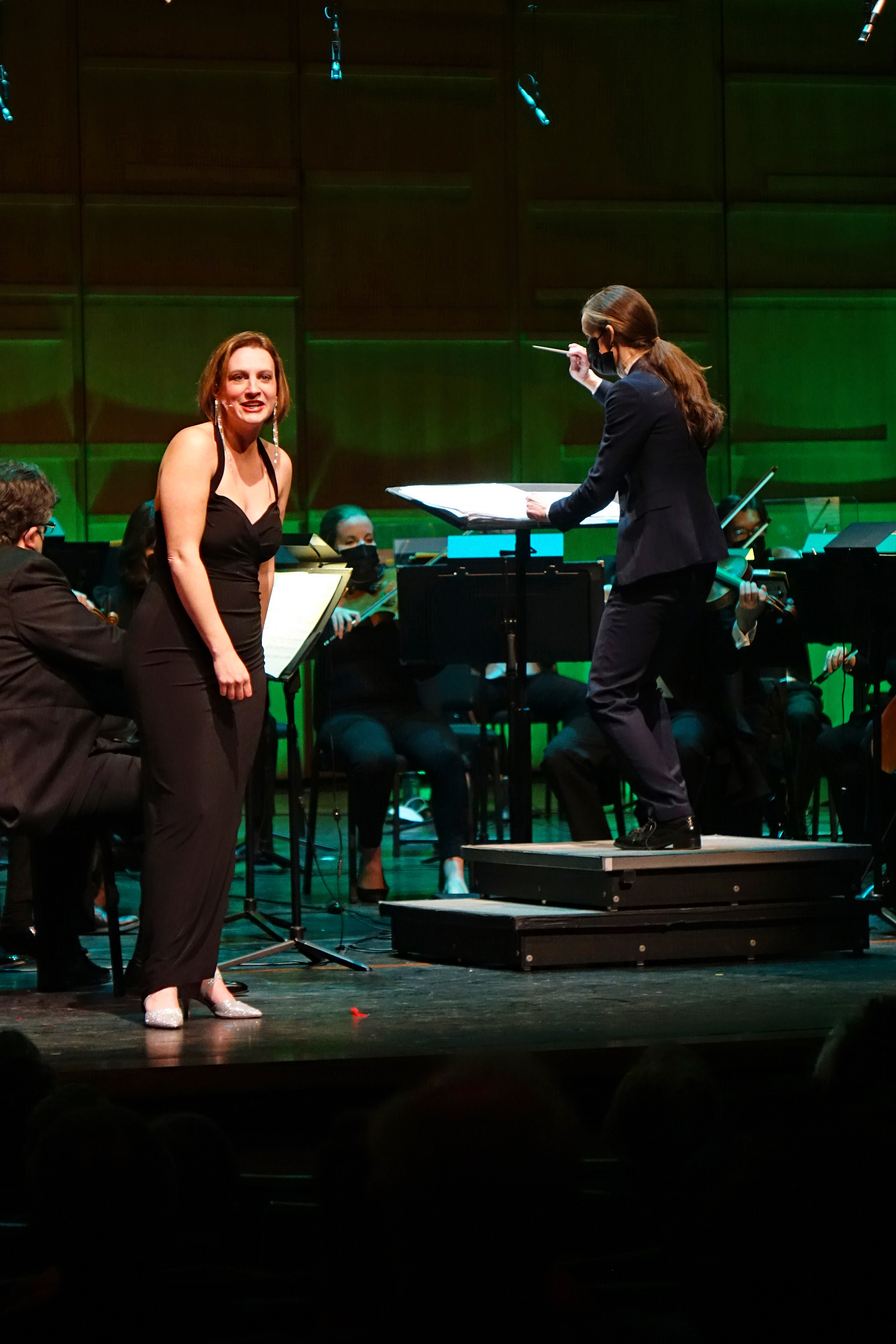
The zaniness had hardly begun. Bass-baritone Reginald Powell, dressed in a flowery kitchen apron in order to portray the mother of our tempted/temptress heroine, led a barbershop quartet across the stage, sitting down at the end of their march behind a bank of microphones. Strange accessories for a classical concert. So Seven Deadly Sins was classical with a three-penny Kurt Weill twist. Nor was this an opera, though a cabaret table and some props were set in place before our chanteuse, soprano Lindsay Kesselman as Anna I + II, made her/their noire-ish entrance in a spymaster trench coat.2022~Ravel Piano Concerto-37

More than a hint of decadent vaudeville came with her, since each of the nine sections of Weill’s confection was heralded by an old-timey placard placed onto an easel. Prologue, Epilogue, Greed, and the gang were all embroidered with an apt skull-and-crossbones motif. Sad to say, much of this flavorful creativity was outweighed by Charlotte Symphony’s failure to provide supertitle projections once Anna I + II began vocalizing with her/their Family. A few audience members down with us in the orchestra section had the temerity to fire up their cellphones, where they had previously downloaded Symphony’s digital program, so they could follow along.

Not the best experience when you’re trying to keep up with columns of German and English on your iPhone while there is also action onstage to follow. The magnitude of this blunder would only be compounded if you returned home, flipped through the digital program, and discovered that the translation was written by life partners W.H. Auden & Chester Kallman, esteemed poets and librettists in their own rights – they worked on Stravinsky operas! Not only does their Deadly Sins translation rhyme, the syllable counts of every line meticulously match Brecht’s text. Learning that all five vocalists had North Carolina roots – and afterwards listening on Spotify to a recording with the Auden-Kallman lyrics – only deepened my incredulity.

Everyone at Knight Theater, singers and audience alike, could have been so comfortable, and all Brecht’s wit, irony, and satire could have been so clear!

Stepping up to one of mics, Cottis was helpful in her introductory remarks in laying out Brecht’s storyline, which is basically Anna’s odyssey across seven American cities on a mission to sustain her family back home in Louisiana, encountering one of the deadlies in each locale. Ideally, the Balanchine concept is fulfilled when Anna I is the soprano and Anna II is a sublime dancer. Part of the comedy that got lost when Kesselman was both Annas was in the lopsidedness of the dialogue between them. Anna II has very little to say.2022~Ravel Piano Concerto-28

The staging helped this decadent Weill bauble to upstage Ravel’s merriment – or at least prevented it from being an anticlimax. Kesselman soon peeled off her trench coat, revealing an evening dress as the Family’s Sloth along the Mississippi River transitioned to Pride as Anna II took a job in Memphis as a cabaret dancer. Anna added a flaming red boa encountering Wrath in LA, and an uncredited lighting designer made a similarly lurid choice illuminating the Knight’s acoustic shell. Purple became apropos for Gluttony in Philly, a lighter pinkish red presided over Lust in Boston, and a dark golden hue settled in over Baltimore when she battled Greed. So I had to think that nobody wanted to offend New York during the Great Depression.

Need we say that when Anna’s journeying ended with Envy in San Fran, where Kesselman made her final grand entrance as a rich celeb, totally soused and brandishing a nearly empty bottle of vodka, that the stage was flooded in a deep dark green? Didn’t think so.

A wonderful ending to a melodious, fun-filled, and dance-filled evening. Even without dancers. Facelift and uplift.

Originally published on 1/30 at CVNC.org

Symphony Arrives at Sublimity, Amping Up Mahler to Heavy-Metal Decibels Along the Way

Review: CSO Plays Mahler’s Ninth Symphony

By Perry Tannenbaum

2022~CSO Mahler's Ninth-17

January 14, 2022, Charlotte, NC – When the new Compact Disc digital recordings were first heralded and released in the early 1980s, the mythic story began circulating from Sony and Philips that the dimensions and capacity of the new CD format were determined by its ability to present all of Beethoven’s Ninth Symphony on a single disc. Subsequent refinements to the technology increased the capacity of those discs from 74 minutes of music to 80, leaving Ludwig far out of the equation. The 80-minute capacity we see on today’s prerecorded discs and the recordable CD-Rs we might dub them onto is more suitable for containing Gustav Mahler’s Ninth Symphony – but only if conductor and orchestra are in a hurry. Only the very quickest of the many recordings of Mahler’s last completed orchestral work clock in at 79 or 80 minutes. Completing his Mahler Journey with the Charlotte Symphony Orchestra in his final season as music director, Christopher Warren-Green let it be known that his Ninth would be a more expansive 90-minute experience. There was no intermission at Belk Theater, and program booklets remain a strictly online affair.

Vaccination cards were scrutinized at both the outdoor entrances to the Blumenthal Performing Arts Center and at the indoor entrance from Founders Hall. My mom and I felt very comfortable with the social distancing downstairs in the orchestra section, but no such amenity was granted to subscribers who entered the hall from the lobby – in fact, I’ve never seen the Grand Tier more fully occupied, a gratifying affirmation of the Queen City’s Mahler enthusiasm. The balcony above looked similarly packed. Masking, of course, was compulsory, but ticketholders should chiefly be forewarned that vigilance was strictly enforced at the entrance to the orchestra section. Folks that were late for the first notes of the Mahler performance, between 7:35 and 7:40pm, were obliged to wait in front of TV monitors in the lobby until the conclusion of the opening Andante comodo movement at approximately 8:05.

Each of the outer movements, both preoccupied with mortality and dying, is as lengthy as the two inner movements combined. Only the second movement can be described as lighthearted, and all four are teeming with mood swings. Without adding audible gaps between episodes, recordings conducted by Leonard Bernstein and Herbert von Karajan with the Berlin Philharmonic are divided into 33 and 30 tracks respectively. Those seemed to be very conservative numbers when Warren-Green and Charlotte Symphony immersed themselves in the score, reveling in its seemingly countless contrasts. Emerging with the opening melody from a backdrop of cellos, basses, horns, and harp, the second violins emphatically signaled that all sections of the vast ensemble would have their chances to shine.

2022~CSO Mahler's Ninth-04

This was by far the most extensive instrumentation we had seen at either Belk Theater or Knight Theater since the beginning of the pandemic. From orchestra level, it was difficult to precisely count all the unmasked flute, clarinet, oboe, bassoon, French horn, and trumpet players arrayed behind the masked string sections. But the percussionists were plain enough when they stood up, either singly or as an ominous group, and there was additional space set aside, upstage and on the stage left wing, for the three trombones, two harps, and the tuba. Curving around stage right to the upstage was an armada that included timpani, a mighty bass drum, cymbals, a gong, snare drums, and tubular bells.

So the prospect of high-volume music was apparent before all the Symphony musicians were fully congregated. Yet when these expected Mahler explosions actually occurred, Mom and I were both taken aback by how loud they were. The difference between sitting at the rear of the grand tier late last spring and sitting in Row O below was compounded by the additional troops and artillery onstage. Earplugs weren’t quite necessary for these fortissimos, but rock-concert decibels weren’t far in the distance. Mom may have nodded off for a few seconds during Gershwin’s Lullaby last year or when Branford Marsalis luxuriated in the luscious Larghetto middle movement of Jacques Ibert’s Concertino da camera. Not this year. Onsets of trumpets, trombones, or percussion could be so sudden that, even if she didn’t revere Mahler, Mom wouldn’t dare close her eyes.

There were plenty of less aggressive surprises scattered across the lordly length of this symphony. In the epic Andante, the harpists reached out to pluck a bass line, and the mournful funereal dirge had the backbone of a military march, punctuated by the wan tubular bells. If you’re new to Mahler, the waltzing liveliness of the “Im Tempo eines gemächlichen Ländlers” (in the tempo of leisurely country dances) might catch you pleasantly off-guard – and what plan did the composer have for a triangle and cymbals playing in unison? The third movement Rondo-Burlesk was brimful of contrasts and contradictions as Warren-Green kept us on the lookout for the next twist. A busy, contrapuntal opening suggested a fugue with frolicsome and comical touches, but midway through this Burlesk, each of the orchestra’s sections seemed to have something soulful to say – not at all the path you would expect leading to a screaming conclusion.

2022~CSO Mahler's Ninth-15

Perhaps the biggest surprise of the evening came at the climax of the Adagio finale when a furious pounding of the big bass drum, topping off a majestic crescendo, suddenly gave way to – in the hushed blink of an eye – nearly total silence. This abrupt whisper of weepy violins, proved that Mahler’s precipitous subsidings can be almost as dramatic as his volcanic peaks. Most of Symphony’s principals distinguished themselves over the course of this epic evening, including oboist Hollis Ulaky, clarinetist Taylor Marino, cellist Alan Black, and concertmaster Calin Ovidiu Lupanu, but the final movement underscored the special praise earned by French horn principal Byron Johns and principal flutist Victor Wang. Even Johns’ one little wobble on the horn came at an ideally aching moment, and Wang was merely perfection in the sublime epilogue.

Originally published on 1/15 at CVNC.org

Anthem, Summer, and Winter Bring Enthusiastic Charlotte Symphony Audience to Its Feet

Review: CSO Plays Vivaldi’s Four Seasons

 By Perry Tannenbaum

2021~CSO Four Seasons-12-1

Charlotte Symphony had plenty to celebrate as their 2021-22 Classical Series began: they were playing on the Knight Theater stage for the first time since February 2020, they were beginning what is expected to be their first full season since 2018-19, it’s their 90th season, and it’s maestro Christopher Warren-Green’s farewell season as CSO’s musical director. Happy as Warren-Green and all the musicians appeared to be, there was no hiding that the return was not altogether smooth. The disconnect between what brochures in the lobby said the orchestra would be playing and the reality was fairly dramatic. All three of the selections originally scheduled in the “Russian Masters” program – including a Shostakovich symphony, a Glinka overture, and Tchaikovsky’s Violin Concerto, featuring Paul Huang – were dropped. Now we were three-quarters Italian, with works by Ottorino Respighi, Pietro Mascagni, and Heinrich von Biber served up before intermission and Huang switching off to Antonio Vivaldi’s beloved Four Seasons after the break.

When last season belatedly opened back in May at Belk Theater, in front of a socially-distanced audience, I wondered whether Warren-Green would honor Symphony’s tradition of playing our National Anthem to mark the first live concert. He declined then, and it seemed quite possible that he would hold off yet again, since the vaccinated audience, masked but no longer distanced, would be obliged to stand and sing together. But the mood was different now. Concertmaster Calin Ovidiu Lupanu preceded the maestro to the stage, gesturing so victoriously that you would have thought the orchestra had won the Super Bowl. After Warren-Green told us how glad he and his orchestra were to be playing to a live audience once again, he indeed turned sideways to cue the drumroll for the Anthem. As we stood together singing, rounding into the final eight bars, Warren-Green’s previous hesitance felt justified. For after the onset of the COVID-19 pandemic and the January 6 invasion of the nation’s Capitol, the affirmation that “our flag was still there” was more vivid now in a closely bunched crowd, suddenly fresh and renewed.

2021~CSO Four Seasons-02-1

All of the pieces that Warren-Green followed up with were musically descriptive in some fashion. Respighi chose three masterworks by Renaissance painter Sandro Botticelli for his Trittico botticelliano. The first, “La Primavera (Spring),” offered a tasty comparison with the opening Vivaldi concerto, light and airy with little solo passages that reintroduced us to the orchestra’s worthy principals playing French horn, trumpet, celesta, glockenspiel, flute, and reeds. Beauty and liveliness were nicely counterpoised in the steady, brisk tempo until the strings imposed their serenity. “L’Adorazione dei Magi (The Adoration of the Magi)” belied its expected bustle and ecstasy as it began, dark and solemn as acting principal Joshua Hood began on the bassoon and principal oboist Hollis Ulaky layered on. After some lovely runs by principal flutist Victor Wang, the middle of this movement did become more hectic and dramatic, keyed by harp and percussion, with a gently quickened tempo as the strings asserted themselves. Wang returned to the forefront at the start of the climactic “La nascita di Venere (The Birth of Venus),” surely Botticelli’s greatest hit, but the slow massing and building of the judiciously trimmed string section, forcefully topped by the violins, was the prime wonder in this satisfying ending.

2021~CSO Four Seasons-03-1

With unerring instinct, Warren-Green programmed Mascagni’s “Intermezzo from Cavelleria Rusticana” between the more substantial Respighi and Biber compositions so the three-minute piece for strings and harp played like an interlude as originally intended. The throbbing harp gave this lyrical gem a heartbeat, while the singing strings made it affecting like an aria. Now it was time for some fun as Warren-Green reveled in introducing Biber’s Battalia à 10, an eight-part evocation of warfare with some astonishing quirks. Most of these were novel ways that the musicians were called upon to replicate percussion instruments, beginning with the entire ensemble stamping their feet. Fingerboards of the basses and cellos were wrapped in paper and rapped with bows to simulate marching drums in the “Mars” section while Lupanu impersonated the piper on his violin. “Bartók slaps” were inflicted on the basses to mimic canon fire in the climactic “Battle” section, made more bizarre when the cellists turned their instruments sideways like guitars – with added mock drama when the harpsichordist fainted comically over her keyboard. Vying with this spectacle for the most memorable aspect of Battalia – and certainly the most modernistic – was the Bohemian composer’s second movement, “The lusty society of all types of humor.” Evoking the drunkenness of a teeming tavern, Biber split his little ensemble into four parts, each one playing a different song and blithely oblivious to the others. Warren-Green half-turned to us during this unspeakable cacophony and gave a little shrug.

2021~CSO Four Seasons-11-1

Returning to Charlotte for the first time since his Symphony debut two years ago, when he played the Dvořák Violin Concerto, Huang did not pale at all in comparison with the charismatic Aisslinn Nosky when she played – and conducted – The Four Seasons in 2018, the last time it had been presented here. The magnificent tone Huang achieved on his coveted 1742 “ex-Wieniawski” Guarneri del Gesù instrument was nearly as impressive as his fleet-fingered virtuosity and intensity. Even on normal occasions, recordings do not nearly capture the excitement of a live Four Seasons performance. On opening night, the pent-up hunger of this audience was palpable enough for the soloist, the musicians, and Warren-Green to feed off, and in the most turgid moments of these four familiar concertos, there was a feverish frenzy to the onset of the wind and storms that Vivaldi brings on. After the final notes of “Summer,” the crowd sprang to their feet, either electrified by Huang’s bravura or convinced that nothing could possibly follow what they had just heard. There are 12 movements, after all, so any confusion was easily forgiven – and the string players also joined the ovation, tapping their bows.

Yet there was more to come, including some nifty double bowing from Huang in the first movement of “Autumn” and a sprinkling of “Bartók slaps” from the upright basses in the last. Nor was “Winter” at all anticlimactic as Huang reached hyperintensity once again as Sirocco and Boreas engaged in windy combat. The final standing ovation was no less deserved than the previous outburst, and it lasted longer.

Cox and Beilman Play the Changes, Guesting with CSO

Review: Charlotte Symphony Plays Wagner, Mozart, and Brahms

 By Perry Tannenbaum

2021~CSO Brahms Serenade-03

Holding our collective breaths, subscribers can hope that the current Charlotte Symphony program represents the last retreats from the fare originally announced for the 2021-22 season. Although Richard Wagner’s Siegfried Idyll replaced Zoltan Kodály’s Dances of Galánta and Johannes Brahms’ Serenade No. 2 replaced his Symphony No. 3, we still had guest conductor Roderick Cox and guest soloist Benjamin Beilman, though Beilman needed to be as flexible as the orchestra, switching from the Charlotte premiere of Samuel Coleridge-Taylor’s Violin Concerto to Mozart’s “Turkish” Violin Concerto No. 5. Of course, Brahms himself might have laughed out loud at the hasty substitution, since he had been so famously averse to attempting a symphony while Beethoven’s shadow still loomed so large. Compounding the hilarity, the Serenade No. 2 may have been historic, possibly the first closing piece at a Symphony Classics Series concert to be played without violins onstage.

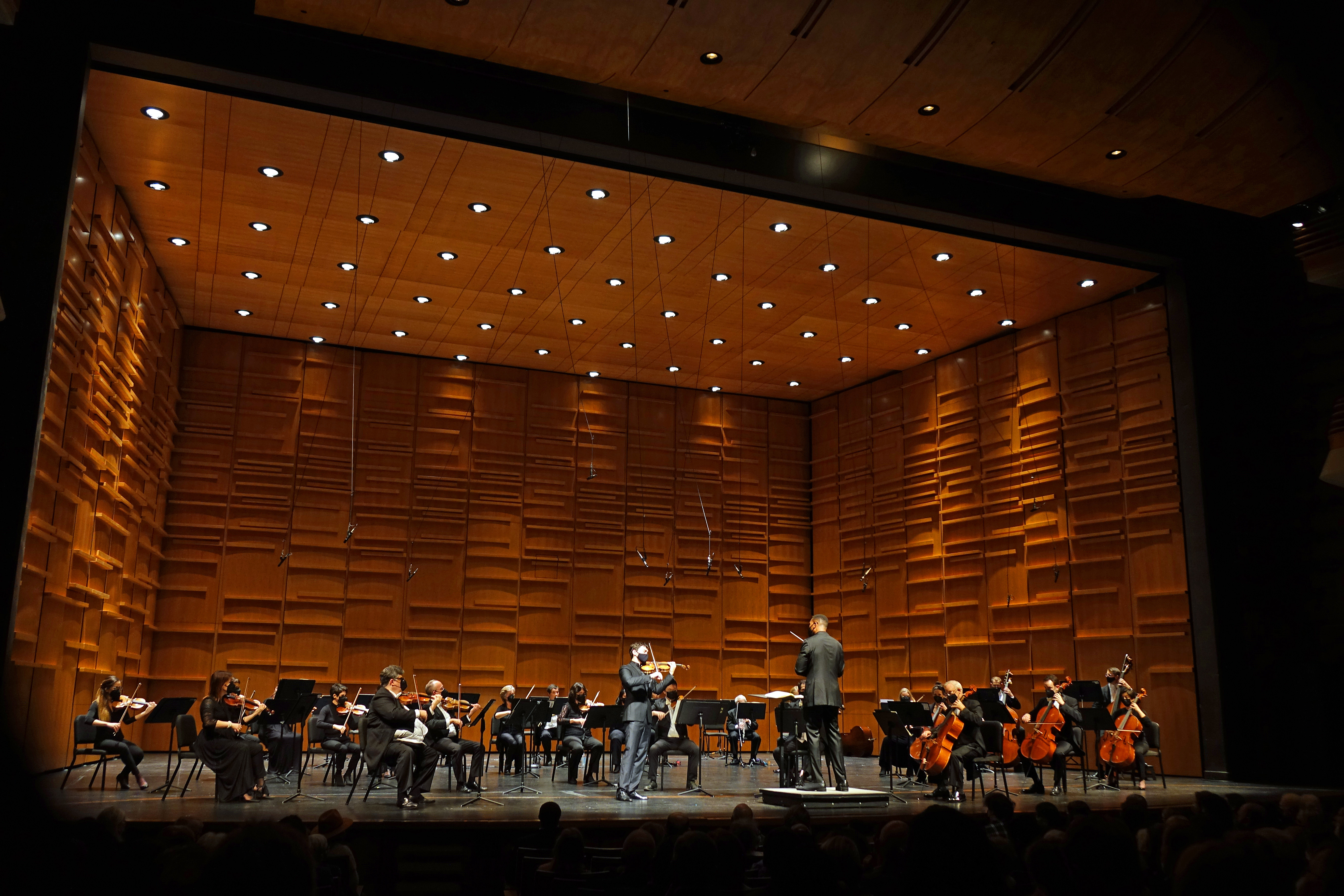
Written for his wife, Cosima, in 1870 and later dedicated to their son upon publication, Wagner’s Siegfried Idyll isn’t extracted from any of his operas, though the music sometimes smacks of themes from The Ring cycle, especially Siegfried. It begins intimately enough, with a quiet string quartet, comprised of principals from the string sections, with concertmaster Calin Ovidiu Lupanu unmistakably the lead voice. So audience members at Knight Theater could easily imagine the romantic story of the music’s informal premiere, when Wagner stealthily placed his little orchestra (just 13 on that morning) on the stairway leading to Cosima’s bedroom while she was still sleeping – gradually awakening her as the music swelled. A couple of French horns and a trumpet eventually added force and volume to the composition, and principal oboist Hollis Ulaky played memorably in numerous spots.

2021~CSO Brahms Serenade-02

Beilman seemed to be even better matched with the Mozart than he had been with the Beethoven in his 2017 Charlotte debut. Hearing a live performance at this level was more rewarding than listening to my favorite recordings by Arthur Grumiaux, David Oistrakh, and Julia Fischer. By this time, it was quite obvious that Cox had taken the eleventh-hour changes in programming totally in stride, for the introductory orchestral passages of first two movements of the Mozart, an Allegro aperto followed by an Adagio, had a bloom that rivaled the most sublime passages in the Wagner, with no less polish. Beilman’s highest notes had admirable muscle, his pianissimos in that stratosphere were ethereal, and his midrange was as burnished as I had remembered from the Beethoven. The closing Rondeau showed us how truly ingratiating Beilman can be as he genially swayed us in a waltzing 3/4 tempo – then suddenly jerked us out of our comfort zone as he and Cox conspired, nearly halfway in, to bring extra drama to the sudden lurch into the “Turkish” section of this movement and its lively duple tempo. Try counting this section any other way than 1-2, 1-2, 1-2… I couldn’t.

2021~CSO Brahms Serenade-07

Unlike so many of the serenades inflicted on us – there, I’ve said it! – during the pandemic, Brahms didn’t limit either of his to strings alone. The Serenade No. 2 includes a full complement of woodwinds and a pair of French horns. Bassoonists Joshua Hood and Naho Zhu were unusually prominent in the reedy opening measures of the Allegro moderato, with flutists Victor Wang and Amy Orsinger Whitehead soon afterwards coming to the forefront. Violins over plucked cellos and basses heightened the intensity and made a pathway for Ulaky on oboe to shine again. Rigidly on-the-beat handling his stick, Cox made the ensuing Scherzo: Vivace more march-like than the acclaimed Michael Tilson Thomas recording, but the rhythmic thrust and liveliness remained unmistakable.

2021~CSO Brahms Serenade-09

Audience members should have noticed by this time that Brahms intended his clarinetists to switch between A, C, and B-flat clarinets over the course of this Serenade. Churning lower strings (remember, there weren’t any violins) ushered in the middle Adagio non troppo movement, but principal woodwind players had sufficient time to leave their imprints, including Ulaky, Wang, and – far in the treble – clarinetist Taylor Marino. With Cox taking a notably sprightly take, the penultimate Quasi menuetto was more of a trinket than the Scherzo had been, Ulaky and Wang excelling once again. Discarding all remaining restraint and tenderness that we might have expected from a Serenade, Cox and Symphony made the closing Rondo a rollicking romp from the first bars, clearly taking aim at compensating for the lack of a symphony on the program. Oboes, clarinets, and horns led the charge, with the low strings high-stepping right behind them. Erinn Frechette finally had chances to tweedle on her piccolo as the winds reached their maximum effervescence, but the congregation of strings eventually had their say, building to a satisfying ending.