Tag Archives: Brandon Samples

Old Barn’s “Orient Express” Is a Clue-ful Poirot Treat

Review: Murder on the Orient Express at Theatre Charlotte

By Perry Tannenbaum

We can thank the Brits for the notion that passenger trains should run with absolute timeliness and precision. Now that Ken Ludwig’s meticulous adaptation has opened at the Queens Road Barn, we can also thank Agatha Christie, Britain’s most avidly read mystery writer, for her Murder on the Orient Express. Layer on Jill Bloede’s bubbly direction – and dialect coaching – and the treacherous trip rattles along with a savory continental flavor.

That soupçon of glitter and effervescence is greatly enhanced by Theatre Charlotte artistic director Chris Timmons’ fleet and fluid set design, an art deco wonder that transitions delightfully from an Istanbul hotel to a smoky train depot to the luxe interiors of the Orient Express. Since the landscape and snowscape outside the legendary train are also moodily conveyed by projections, it’s difficult to draw a precise borderline between Timmons’ scenic exploits and his lighting design.

While the paucity of professional theatre companies in the QC continues to account for the plethora of professional-grade acting talent we behold at the Barn, so does the opportunity to appear in opulent costumes such as those designed by Sophie Carlick – for hotel waiters, train conductors, and various glitterati who can afford a first-class sleeping compartment on a luxury transcontinental train.

Speed is beneficial in a murder mystery, especially as it plods along, contrary to real life, when we’re introduced to a multitude of suspects who have sufficient motive to commit the cold-blooded crime. Anyone who grew up watching the Perry Mason series on TV (or has binged on it more recently) knows the classic drill: the murder victim antagonizes a slew of enemies. So many enemies that we’re unsure who might have done the deed and more than mildly uncaring about the victim, no matter how brutally they were killed.
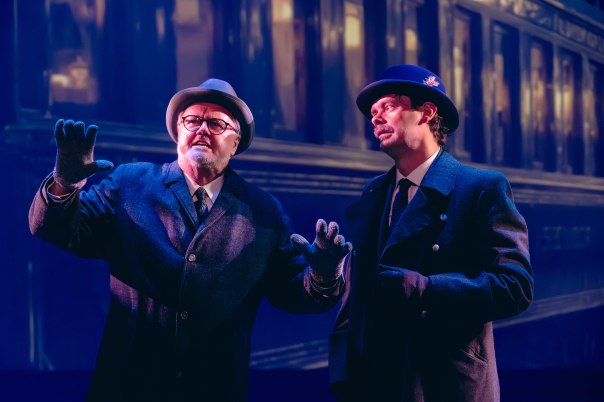
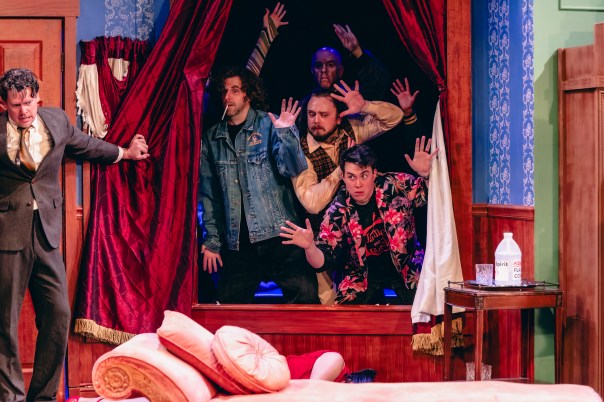
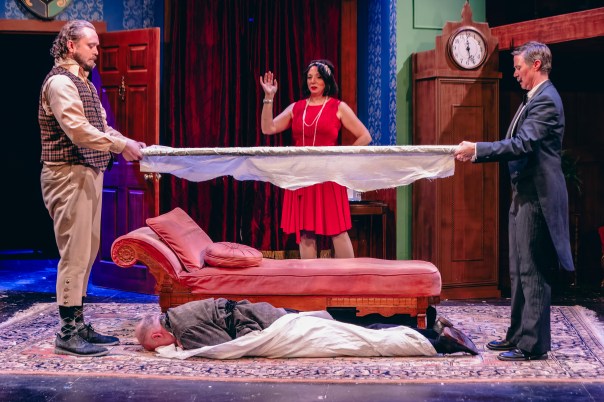
Ludwig admirably singles out our obnoxious victim-to-be and all the antagonisms he can spark while introducing us to Christie’s heroic protagonists, Constantine Bouc, owner of the Orient Express line, and peerless detective Hercule Poirot. There will be debate about Bloede’s decision to shitcan Poirot’s mustache wax and twirls in favor of a more conventional groom, but Brandon Samples’ initial entrance as the Belgian is star quality.

There’s a bit of aristocracy to Samples’ bearing that allows Poirot to fit in with his fellow passengers, including a princess, a countess, and a colonel. While Timothy Hager zestfully cements his repulsiveness as Samuel Ratchett, it’s also important for us to see that Poirot has sufficient dignity, discernment, and assets to reject Ratchett’s crass job offer.

Poirot also offers Samples a few brief episodes of befuddlement, for the culprit he is hunting leaves a blizzard of clues.

Unlike all of those complacent Perry Mason victims destined for the morgue and a court-ordered autopsy, Ratchett is keenly aware that he is being hunted. He’s willing to retain Poirot for a fabulous amount of money to protect him. Perry, you’ll remember, doesn’t arrive on the scene until after the wrong suspect is accused and arraigned. Here, Poirot is directly involved while the victim is alive. So when Samples shows no guilt or remorse for not accepting Ratchett’s offer after he is murdered, we’ll need further reasons for despising the playboy.

Christie piles them on and, in doing so, makes the bizarre solution to her mystery more plausible, for Ratchett is far more monstrous than he first seems to be.

Yet the elegance, hauteur, and glamor of the leading ladies would seem to instantly eliminate them from suspicion – or any close acquaintance with the vulgar victim. To think that Paula Baldwin as the Russian Princess Dragomiroff would deign to inflict eight stab wounds on the repellent Ratchett seems like sacrilege.

Likewise, Julia Howard as the serene and mysterious Countess Helena Andrenyi from Hungary seems worlds away from the slain playboy. The ethereal Gretchen McGinty as English governess Mary Debenham, also a smashing beauty, seems to live in an entirely different sphere, more involved with Scottish Colonel Arbuthnot (Ben Allen with a brash brogue) than the slain American.

As for Kathryn Stamas, as an esteemed actress traveling under the assumed name of Helen Hubbard, she is sufficiently brash, loudmouthed, and inconsiderate for us to worry whether Ratchett, trying to get some sleep next door and stewing with rage, will burst into her room and murder her. Murdering him would ruin her delight in riling him with her late-night singing.

However laudable it might be to murder Ratchett, three acts of God will prevent the ghoulish plan from eluding discovery: the unexpected arrival on board of legendary unraveller Hercule Poirot, the serendipitous intervention of Orient Express owner Constantine Bouc in securing a first-class compartment for Poirot, adjacent to the victim’s room. After these pieces are in place, with Bouc ready to serve as Poirot’s loyal sidekick, comes the fortuitous storm that halts the regal train in a snowbank out in the wilderness, giving Poirot sufficient time to investigate.

Bouc is obviously a key prong in Christie’s plotcraft, allowing Poirot to board the Orient Express and vesting him with the authority to investigate. Otherwise, our mustachioed sleuth wouldn’t be able to scan all our suspects’ passports or rummage through their luggage. Dramatically, he enables Poirot to interview all the suspects, another ritual of the mystery genre, corresponding to Perry Mason cross-examinations, that cries out for swift pacing.

The venerable Dennis Delamar would seem ideal for bestowing the requisite bonhomie on our gracious host and eager sidekick, except… for all his wholesome triumphs as Henry Higgins, Grandpa Vanderhoff, Kris Kringle, John Adams, Hucklebee, Jacob the Patriarch, and many more, has he ever done a French accent before? Maybe that was the question Delamar was asking himself on opening night when he uncharacteristically stumbled over a few of his opening lines.

Even for a semi-pro like me, those are lines you should be able to say in your sleep. Of course, Double D never broke character during his difficulties, so to neophytes in the audience, it may have seemed like the garrulous pensioner was stumbling over his English. Delamar’s imperturbability in this brief crisis only made Bouc more charming when he righted himself – and real panic was safely in reserve when the unsolved murder, right under his nose, threatened the image and prestige of his company.

Bouc also serves as a buffer between Poirot and the petty annoyances presented by our suspects, allowing Delamar to display his comedic chops. Samples, on the other hand, gets to revel in flipping over innocent façade after innocent façade in revealing the secret underbellies of his artful gallery of suspects. The parade of skeletons emerging from closets can’t help but add to our merriment.

So most of the actors on stage need to be adept not only in erecting their respective façades, but also in carrying off those deliciously satisfying moments when they are so disconcertingly exposed. Joshua Brand as Ratchett’s querulous secretary seems particularly innocent and above suspicion, while Emma Brand as the Princess’s trembling missionary ward is even further above. So pleasant when they fall.

Climb aboard this fatal train, and you’re likely to find the ride more fun than you expect.

“The Play That Goes Wrong” Fits Perfectly at The Barn

Review: The Play That Goes Wrong at Theatre Charlotte

By Perry Tannenbaum

Every time Inspector Carter declares his determination to solve “The Murder at Haversham Manor,” lights at Theatre Charlotte suddenly turn a lurid red to triple-underline the melodrama. This may be the only technical element that consistently goes right in The Play That Goes Wrong, now running – and decomposing before our very eyes –through February 23.

The mantelpiece over the fireplace in Charles Haversham’s study remains a work-in-progress long after the master is murdered. The painting above the mantle – clearly the wrong painting – doesn’t stay where it belongs, and a pesky door stubbornly resists efforts to unlock it when it isn’t wandering off its hinges. In similar disrepair, we may count the phone, the intercom, the elevator leading up to the second-floor office, and the walls themselves.

It is a precisely flimsy set, lovingly put together by Theatre Charlotte artistic director Chris Timmons, so precisely flimsy that it must conform to approximate dimensions to accommodate the cast. So active that the set predictably won the Tony and Drama Desk Awards for best scenic design in its 2017 Broadway debut. Like Michael Frayn’s famed Noises Off, another British play-within-a-play that goes comically wrong and wronger – but on a stage that revolves a full 180ᵒ – the set is like a machine. It could be packaged like an Ikea kit.

Written by Henry Lewis, Jonathan Sayer & Henry Shields, The Play That Goes Wrong nestles more naturally at the Old Queens Road Barn than at Knight Theater, where the national tour touched down in the QC six Novembers ago. The basic concept is that a small-time community theatre, perennially understaffed and underfunded, has suddenly received a grant that will finally enable it to present a full-fledged production.

No longer will Chekhov’s classic Three Sisters be reduced to Two Sisters at the Cornley University Drama Society. Nor will Lloyd Webber’s resplendent Cats be shrunk to Cat. It’s the birth of a new era!

But unfortunately, the new era hasn’t ushered in an influx of fresh acting talent and technical know-how. Dennis struggles with her lines and usually mispronounces the tough words written on her hands. Jonathan repeatedly re-enters the action before he’s supposed to. Sandra has an unfortunate knack of being in the wrong place at the wrong time; and her understudy, Annie, after subbing for Sandra when she’s knocked unconscious, reads terribly. Yet she refuses to yield back her role when Sandra revives.

Props aren’t reliably placed in their assigned locations by the incompetent crew. When they are properly placed or deployed, like the stretcher needed to carry the corpse through the finicky front door, they may not function properly. The Duran Duran CD, sought after by lighting-and-sound man Trevor before the play begins, will turn up inconveniently onstage deep into Act 2.

Which reminds me: even though those redlight cues are absolutely reliable, the portentous sound cues accompanying them are not.

Tonya Bludsworth directs all this carefully calibrated chaos with an able assistant director, Brian Lafontaine. Together, they and Brandon Samples as Chris bring out a key point that didn’t strike home for me as forcefully when I saw the touring version in 2019. Chris not only plays the plum role of Inspector Carter in The Murder at Haversham Manor, but he also serves as the stage director, prop maker, box office manager, and PR rep – totally responsible for this catastrophe, and obviously overstretched.

On the smaller Theatre Charlotte stage, Samples is closer to us and we can focus on him more sharply than if his flop sweat were dripping down at Knight Theater. Makes a difference when one protagonist seems to be especially invested in the worsening outcome, valiantly trying to cover up the metastasizing miscues, and gaping at the sheer scale of his own mismanagement and incompetence.

For me, Sample’s visible struggles – from his nervous shit-faced grins on up to his hissy fits – made Chris a little more poignant for me. Here is a man who cares so much about theatre, and he’s watching all his multiple shortfalls in artistry and management implode so spectacularly. We can feel for the rest of this woeful team, but not nearly as much.

Lee Thomas earns a distant second place in our sympathies just for the physical punishment he takes as Charles Haversham, the stepped-on, sat-on, and mishandled murder victim. Or for the dismal ratio of abuse absorbed to dialogue delivered. When he finally does speak, maybe for the first time at Theatre Charlotte since 2020, it is as an actor of mind-boggling incompetence, eclipsing nearly all of his castmates. Thomas is rather good at looking quietly embarrassed, confused, and discombobulated.

Jenn Grabenstetter as Sandra starts off in a sympathetic slot, cast as Florence Colleymore, the murder victim’s bride-to-be. Our empathy for her slackens when we learn that Charles’s brother, Cecil Haversham, is Florence’s true love. Or when we see how stylized Sandra is as a performer. Or when she skips ahead one line, answering Inspector Carter’s questions before he asks them. But we feel for her – a little bit, anyway – when the front door flattens her and her castmates prop her up inside a clock. When Florence revives, she has to battle Annie to reclaim her role with some fine screwball fight choreography by Allison Collins.

The character arc for Rachel Mackall as Annie is even more transformational, for her Florence starts off in a near-catatonic monotone until she does the first of her pratfalls, scattering the pages of her script and maybe dislodging a contact lens. That raises Annie’s energy level, leading to the subsequent miracle where, battling Grabenstetter for the spotlight, she suddenly has her lines memorized while becoming a vicious gladiator.

More WWWF-style action would not have been amiss, but there’s still plenty.

Like Selsdon in Noises Off, Dennis’s prime reason for existing in The Play That Goes Wrong is to roundly muck things up. Lewis, Sayer & Shields seem to be indicating that he’s inept, miscast, or over-the-hill. What the hell, Bludsworth casts a woman in the role, the venerable Andrea King, who may have actually portrayed more women on QC stages than men and describes herself like a cute puppy for sale in the digital playbill.

With so much incompetence surrounding the Haversham Murder production, it’s a bit cruel to arraign her as the sole culprit for substituting turpentine when a decanter of adult beverage is served to guests at the Manor. Or it is when that happens for the first time. It’s on her when the screwup is repeated, sparking a prolonged series of spit-takes because she has also forgotten a line that would propel the action forward instead of casting it into a never-ending loop.

King maintains a cheery insouciance no matter what kind of havoc she causes, enabling Cody Robinson as Robert to become king of the spit takes as the bride-to-be’s brother, Thomas Colleymore. With a preternatural Joe Belushi energy, Robinson demonstrates that Robert’s distaste for “White Spirit” can actually increase with each sip! When we think Robinson’s frustration and rage have peaked or even exceeded expectations, he still turns it up a couple of notches.

Adam Peal as Robert and Roman Michael Lawrence as Trevor fill out the roster of actors implicated in the murdering of The Murder at Habersham Manor. Robert is not only amateurish but also a carefree hambone, so naturally Chris gives him two roles to botch. Initially, Peal appears as Cecil Haversham, Charles’s scheming brother and Florence’s true love. But there’s more to butcher when Robert resurfaces as Arthur the gardener, laying on some eyewitness evidence.

Did I mention that Trevor, after losing track of his Duran Duran treasures, must abandon his functions as lighting and soundman when Annie, replacing Sandra, is also stricken? That script-scattering pratfall was just the beginning of her misadventures. While Lawrence has already shown us – and will continue to show us – how badly Trevor performs at his chosen specialties, we can brace ourselves for his slaughter of Florence Colleymore, postponed only by his reluctance to play the role.

On my second viewing, it was possible to pay more attention to the convoluted mystery plot by “Susie H. K. Brideswell.” Now I can confidently proclaim that Habersham Manor is a masterpiece of implausibility. Doesn’t work at all.

Woefully, Theatre Charlotte doesn’t seem to have experienced a financial windfall that parallels Cornley University’s. That would have enabled them to append a faux playbill for the Habersham Manor production to the conventional Play That Goes Wrong program. Then we could learn the last names of the players and the Habersham roles they play with less fuss and bother. A few tidbits about the players also enriched the experience of the touring production.

Apparently, when the playwrights founded their Goes Wrong franchise (Peter Pan and The Nativity are among the spin-offs), they must have been focused on crafting three of the roles for themselves to perform in London and Broadway – and meshing with Nigel Hook, their mad genius set designer. So they didn’t insist that their faux playbill must be printed to accompany the show.

That lack of detailing serves to emphasize where The Play That Goes Wrong doesn’t measure up to Noises Off! Frayn’s work fleshes out relationships between the actors onstage when they’re backstage and, with its first-act rehearsal scene, gives us a more vivid idea of how the play-within-a-play is intended to go. For that reason, despite all the hilarity that Lewis, Sayer & Shields deliver, I’d hesitate to recommend The Play That Goes Wrong to anyone who is new to theatre – or hasn’t experienced a play that goes right.

But for sheer fun in frightening times, this show is welcome medicine for everyone else. TikTok & Friends may have brought nostalgia for America’s Home Videos to a screeching halt, but this latest romp at the Queens Road Barn revives the special pleasure – and laughter – of similar train wrecks large and small running right at us, non-stop, on a live stage.

Joe Turner’s Come and Gone, directed by Corlis Hayes, last came and went at Central Piedmont Community College in 2015. Back then, the production demonstrated how ill-suited even a renovated Pease Auditorium was for the best of August Wilson’s dramas. Panoramic Pease has now been demolished, so it will be interesting to see Hayes come back again to the CP campus, along with Jonavan Adams reprising his role as Herald – at a real theater in the fledgling Parr Center. Dominic Weaver, also in the mix ten years back, gets a juicier role this time as Bynum, the conjuring root doctor.

Turner, the second play in Wilson’s decade-by-decade traversal of the 20th century, The Pittsburgh Cycle, is set at a Pittsburgh boarding house in 1911. Rather than hinting at WW1 later in the decade, the drama hearkens back to slavery, the Civil War, and their aftermath, both glorious and sad.

“Every character has a story, and every story has a song,” says Hayes. “The play explores African American identity, healing from trauma, and the power of community and self-discovery. More significantly the play is an examination of Black people in transition during The Great Migration.”

This weekend only!

Off-Course “Noises Off !” Eventually Malfunctions Like Clockwork

Review: Noises Off! by Davidson Community Players

 By Perry Tannenbaum

Noises-116[4]_edited-1

July 21, 2022, Davidson, NC – I’m not sure that a single American comedy has been produced as often in the Metrolina area in recent years as Noises Off, the wild door-slamming farce by Britisher Michael Frayn. What makes this particularly astounding is the monumental effort needed to mount this insanely high-energy, fast-paced work – and the time and effort it requires from audiences, stretching out to over two hours in length with two intermissions. There are folks in my family circle who groan at the prospect of one intermission. The sheer height, size, sturdiness, and swivel-ability of the scenic design – none of which can be compromised – make the comedy virtually impossible to stage at some venues.

Yet the adamantine laws of physics have not deterred some of our local companies from giving Noises Off a go. The production at Central Piedmont’s Halton Theater in 2012, for example, was penance for an ill-advised effort at panoramic Pease Auditorium in 1994. Likewise, it would have been foolhardy for Davidson Community Players to even attempt this two-story Everest of a comedy back in 2010 – or now in their encore – if they had been confined to their customary HQ at Armour Street Theatre. Fortunately, DCP had the good sense on both occasions to indulge their ambitions in the summertime, when Duke Family Performance Hall is available to them on the Davidson College campus. A ramp takes you up to the balcony level of the Duke if you arrive at the front entrance of the five-floor Knobloch Campus Center, which also houses the Alvarez Student Center. The fly loft of the theater extends to the full height of the building, so director Matt Webster can decree that the stage curtain be lowered halfway for a spectacular culminating technical gaffe.

Of course, theatre gaffes are the coin of the realm as this comedy-within-a-comedy unfolds so delightfully badly, starting with a calamitous dress rehearsal of “Nothing On” that extends past midnight into the morning of the day when it’s scheduled to open. Gleeful Instagrams and Facebook posts were broadcast to the wide world web by elated audience members at the Duke who were able to take cellphone pix of real printed programs after a hiatus of more than two years. It might be deflating, then, to recall that in the old days, we received additional fake programs from “Nothing On” with side-splitting fake bios of Lloyd Dallas, Dotty Otley, and the gang. With a charming ad for sardines, the most important of props. That’s part of a dizzying confusion we experience as we simultaneously track what’s happening in the badly-performed “Nothing On” – in a calamitous rehearsal and two calamitous performances – and the whirl of intrigue and contretemps between these endearing incompetents and their despairing director.

How do we see the personal trials, attachments, and antagonisms of these actors while they rehearse and perform a play? This is the riddle that Frayn solves so brilliantly. Because dress rehearsal is so epically bad, there are numerous pauses when the actors, stagehands, and director can interact or gossip. Then after the first intermission, Frayn obliges everyone who stages Noises Off to revolve their mammoth two-story sets a full 180 degrees so we can witness the last moments of the run-up to a second performance of “Nothing On” two months later and the performance itself – from backstage, where our actors interact as “themselves.”

Noises-274

From the opening words of Act 1, when we could barely hear the venerable Jill Bloede as Dotty, it was obvious that opening night could turn into a harrowing misfire. Brandon Samples as Lloyd was usually far more audible to us, but that may have been because, in directing this dress rehearsal of “Nothing On,” Lloyd was sitting amongst us in the audience, mostly on our side of the hall. When Andrew Pippin entered from upstage as real estate agent Roger Tramplemain, and Tate Clemons followed as Vicki, the incredibly seducible girl he’s trying to seduce, my worst fears threatened to come true. Clemons was usually more audible than Pippin, but her Vicki was totally unintelligible as well. It would be hard to overstate how thankful I was, as five more performers made their fitfully audible appearances, that I had seen Noises Off at least six times before.

For newbies, welcome relief came during intermission, when I spotted empty seats and ruthlessly moved to the front row. What else happened during the break to salvage the evening cannot be reported conclusively. Surely, with a judicious visit backstage, stage director Webster would be a prime suspect in perpetrating the onset of fresh energy throughout Acts 2 and 3. Or maybe Samples, after playing Lloyd throughout Act 1, sounded the alarm backstage when he couldn’t hear his castmates during the poor director’s rambles around the hall. My wife Sue, loyal to her ticket stub and Row F, confirmed that audibility improved markedly back there for the rest of the evening.

Of course, the full benefits of increased volume don’t occur in Noises Off until Act 3. With so much of the wondrous Act 2 happening backstage, behind a monumentally delayed live performance on “Nothing On” that proceeds on the other side of the set, the principals we see are religiously hushed, adhering to actors’ etiquette. So most of the communication in Act 2 – whether amorous, angry, stealthy, jealous, urgent, frustrated, or diabolically mischievous – is delivered in earnest, energetic pantomime. You not only marvel at the synchronization between the torrid action backstage and the unseen staging of “Nothing On” which we can still hear droning and faintly exclaiming in the background, but in the precision of the hubbub in front of us as flowers, a whiskey bottle, a menacing fire axe and more keep moving in blurry rapidity across the stage, in and out of sight. Webster has all this mayhem malfunctioning like clockwork.

Most of what was missing in Act 1 arrived most emphatically in the final act, where we watch a performance of “Nothing On” some 10 weeks into its travels – discipline gone, tempers worn to a frazzle, animosities fully ripened, and the set itself needing repairs. Bloede was back on top of her game as the disillusioned and despairing Dotty, who can let all her grudges and inebriation run roughshod over her performance as Cockney housemaid Mrs. Clackett, since she is the producer bankrolling this stinkbomb.

Pippin and Clemons also showed marked improvement. All we needed from Pippin, it turns out, was a little more energy and clarity to sharpen the self-important dopiness of his Garry Lajeune and the starchy amorality of his Roger, now frazzled by too many jealousies to keep track of. Clemons is only marginally more intelligible than before as she continues her adventures with the slutty squeakiness of Vicki while attempting – probably attempting – a British accent. But we don’t need to really know what Vicki is saying anymore to appreciate the comedy of Brooke’s maddening insouciance, never varying from Vicki’s scripted lines and never thinking to improvise no matter how things have changed and disintegrated all around her.

Justin Thomas is absolutely disarming as the frail and squeamish Frederick Fellowes, the actor who portrays tax dodger Philip Brent, owner of the property that realtor Roger is seeking to rent. If there was ever even an attempt by Thomas of an English accent, I’ll confess that I missed it, and his dual role in “Nothing On” as the sheikh seeking to rent Brent’s hideaway was too brief for me to say how he handled it. We could be thankful that neither of his shticks, nosebleeds and dimwittedness, demanded an accent. Amanda Pippin doesn’t get a proportional share of the comedy as the cast gossip, Belinda Blair, the least frazzled and dysfunctional member of the troupe and their show. As Philip’s wife Flavia, Pippin does reliably abscond with various props and wardrobe, most notably Vicki’s dress.

Noises-15

This allows Vicki to bustle around the two-story set and its eight doors in her underwear through most of the staged action we see. This wantonness gave us the notion that Vicki would ultimately become the title character of the “Nothing On” we never see, while justifying the aging Lloyd Dallas’s enduring backstage lust and devotion toward Brooke Ashton. He’s supposed to be away somewhere in Act 2 rehearsing Richard II, but he returns to see his dear nymphet. Emerging from hiding, Lloyd is outraged and distracted by all the chaos of the production. Then he becomes the excruciating victim in one of the most comical climaxes we’ll ever see. Much of Samples’ pantomimed sufferings are caused by Lloyd’s traveling stage crew, Jack Bruce as the inept and overworked handyman, Tim Allgood, and Jenna Tyrell as Poppy, the competent and frowzily attractive stage manager who doesn’t realize she’s been dumped by Dallas.

This oddball trio of Allgood, Poppy, and Dallas unite surprisingly in the comedy climax of Act 3 when Fellowes performs his crowning feat of dimwittedness. Suffice it to say that Jonathan Ray as the aging alcoholic actor, Selsdon Mowbray, is supposed to make a surprise appearance in “Nothing On” as a septuagenarian burglar. But he’s too deaf to reliably catch his cue line – and too frequently soused to reliably be there, ready to break in. The hilarious catastrophe far exceeds even a doomsayer’s expectations. You might be surprised to learn that I auditioned for Selsdon way back in 1992, when Theatre Charlotte brought Noises Off to town. That’s too long ago for me to remember how I intended to play Selsdon, but I suspect that my performance would have more soused, more crotchety, and more devious than what you will behold at Duke Family Performance Hall. Maybe that’s why I found myself cherishing Ray’s mellower, more natural portrayal.