Tag Archives: Billy Ensley

Let “The Drowsy Chaperone” Hypnotize You

Review: The Drowsy Chaperone at Theatre Charlotte

By Perry Tannenbaum

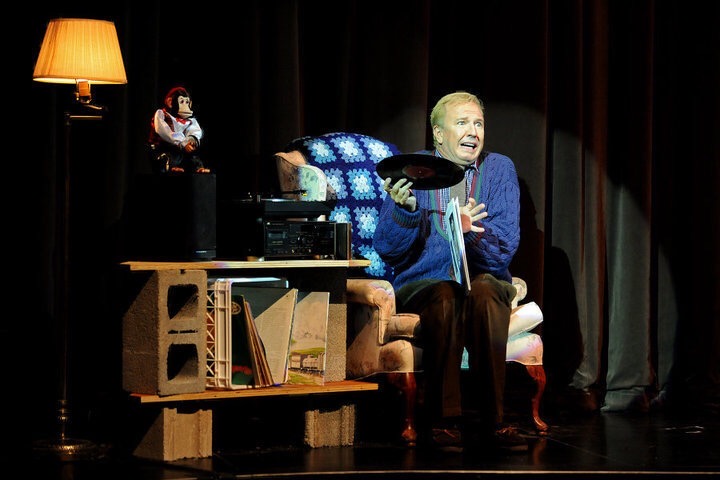
My advice for best enjoying The Drowsy Chaperone at Theatre Charlotte is to listen to the Man in the Chair – and yield to his pitch-dark hypnosis. Yes, before the lights even go up at the old Queens Road barn, he’s in his chair speaking to his audience and conjuring up what we should hope and pray for: “I just want to be entertained. Isn’t that the point?”

As the show unfolded, brilliantly directed by Billy Ensley with what must be the local cast of his dreams, I realized that, as a critic, I shou

ld heed that hypnotic suggestion devoutly. Discard my usual pointy critical and analytical tools. What’s more, I came to believe more and more strongly that, if actors and directors of previous Drowsy Chaperones I’d seen had followed that simple mantra, I would have fallen in love with the show long before last Friday night.

When the lights came up a few minutes deeper into the Man in Chair’s monologue, we saw him locking the front door of his humdrum apartment with four or five assorted deadbolts and chains. It’s a bit of an abrupt swerve, but we’re suddenly aware that this Broadway musical devotee is a recluse and a bit paranoid. Each time the phone rings, we’ll see that the Man in Chair fails to answer, yet another confirmation of these traits.
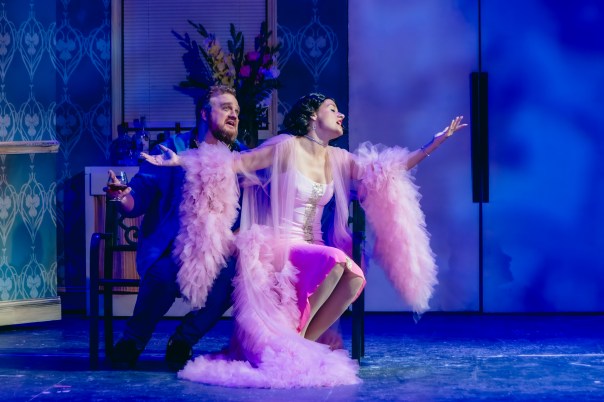
By the time the title character of the fictional “Drowsy Chaperone” is a few wobbly notes into her showstopping “As We Stumble Along,” we already should know that the Man in Chair is gay, which accounts for Lisa Smith Bradley delivering the song as a living fetishization of Ethel Merman and Judy Garland – Merman’s vibrato wedded to Garland’s glitter, slacks, and drug dependency.

Yet when we’re watching Kyle J. Britt as our genial host, we need not attribute his reclusiveness or paranoia to being a gay man. As a Broadway musical fanatic, this Man in Chair identifies more readily as a New Yorker with Innerborough hangups. Meanwhile, Bradley is sufficiently over-the-top as both gay icons – especially Merman – to be accused of impersonating a female impersonator.

We might say that Ensley & Co. have decided that being gay in 2024 isn’t nearly the leaden weight it was in 2006 when Drowsy Chaperone premiered in the Big Apple or in 1996 when Angels in America tore the QC apart and made us a laughingstock. Pretentiousness, solemnity, and subtlety really are inimical to this delicate relic. Britt handles it with audiophile care as removes the vinyl disc – a rare original cast recording of his favorite 1928 musical – from its LP sleeve and gives both sides a loving once-over with a Discwasher brush before lowering his treasure onto a turntable.

The same can be said of size and scale, which may also have muffled my enjoyment of productions at Belk Theater in 2007 and Halton Theater. There’s something so right about our little séance in the dark at the Old Barn on Queens Road that it cannot attain in a more modern and spacious hall where the Man in Chair must project his spell into a distant balcony. The homeliness of the Man’s urban dwelling also sits better on Queens Road than in the bowels of a bank building on Tryon Street.

To be honest, it’s Broadway Lights and the late CP Summer Theatre that should apologize for not matching the unpretentiousness of Josh Webb’s scenic design. Of course, it would be nice if Webb’s scenery could transform spectacularly into Broadway splendor when the stylus of our host’s turntable comes down – with its signature thump – onto the vinyl and the mythical “Drowsy Chaperone” comes to life. In the less-is-more world on Queens Road these days, these shortcomings are comedy assets, part of the overall charm.
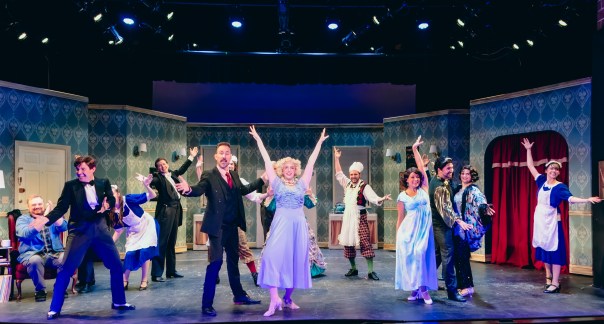
On the other hand, our time travels to 1928 get a softer landing thanks to the costumes by Beth Killion, notable for their flair, their formality, and their discreet dashes of color. We’re awaiting the wedding of Robert Martin and Janet van de Graaf, so there are actually multiple levels of time travel here, for Bob Martin actually co-wrote the Drowsy Chaperone book with Don McKellar – and starred in the original Broadway production as Man in Chair – while he was married to the real-life Van de Graaf.

In fact, this originally Canadian work, which eventually layered on music and lyrics by Lisa Lambert and Greg Morrison, was gestated at Martin’s stag party in 1997, nearly 70 years after these fictional nuptials. More reasons not to view this lark as a gay cri de cœur.

Rare as his vinyl treasure may be, Britt comes across less as a scholar or a critic than as a fanboy, occasionally panting like an eager puppy as he presumes to approach his fantasy idols more and more closely. More than once, the principals will obligingly freeze for him. Nor does this Man in Chair seem to favor the men over the ladies with his adoration, only tipping the scales just before the final bows. Charmingly enough, there are overtones of scholar and critic as he dishes tasty trivia about the fictitious “Drowsy” cast members or advises us to be on the lookout for some truly dreadful lyrics.

These glamorous, theatrical, servile, and criminal characters are all blissfully ignorant of the nerd who has conjured them up, preoccupied with their conflicting efforts to carry off the planned wedding or ruin it. The bride herself, Lindsey Schroeder as Janet, seems to be grandly ambivalent about becoming Robert’s wife, sacrificing her glittery stage career and the adoration of millions, while suppressing her basic instinct to “Show Off.” Love is at comical war with vanity. Carried away by the swiftness of this whirlwind romance, Andy Faulkenberry as Robert also has his doubts.

Aside from Janet’s drunken chaperone, politely labelled as Drowsy, there are a butler Underling, an eccentric Mrs. Tottendale, and Robert’s best man George shepherding the loving lambkins to the altar. Only Zach Linick as George seems to be afflicted with any degree of competence or reliability. More importantly, he and Faulkenberry make up a formidable tapdancing duo. (Thank-yous to choreographer Lisa Blanton.) Allison Rhinehart as a frilly, bustling Tottenham and Darren Spencer as the gray and starchy Underling are no less inevitably channeled toward blithe entertainment.

Counterbalancing the fragile determination of the bride and groom, compounded by the flimsy protection of their good friends, we have an exquisite mix of bumbling baddies trying to sabotage the wedding. These are led by Joe McCourt as Broadway producer Mr. Feldzeig (Feldzeig Follies ring a bell?), under pressure from his mobster backers, who consider Janet to be the cash cow of the Feldzeig franchise. The sneering McCourt is bedeviled by Gangster 1 and Gangster 2, armed emissaries – Titus Quinn and Taylor Minich – masquerading as hired chefs to ensure a catastrophe.

Ah, but it isn’t simply muscle aimed at swaying the maiden and returning her to showbiz. Somehow, a predatory Lothario is among the wedding guests – although he has never met anyone else there. Mitchell Dudas is this egotistical Adolpho, far more arrogant than Feldzeig, a mixture of Erroll Flynn and Bela Lugosi with a thick Iberian accent. Feldzeig has no trouble at all convincing Adolpho that he was born to seduce the bride-to-be.

Equally dumb, Autumn Cravens as Kitty is a ditzy chorine, constantly nagging her boss and wedding escort Feldzeig to let her fill Janet’s shoes in his next Follies. Effortlessly, Dudas will outperform Cravens in thwarting Feldzeig’s schemes. Love conquers all, but it would be a huge spoiler to say how many times when we reach this very happy ending.

Just one more wild card is needed to tie up all the festivities. Be on the watch for Trinity Taylor as Trix the Aviatrix, who descends from the skies at just the right moment with a voice of thunder. For a few moments, she even upstages Britt and Schroeder who are so fabulous.

It would be a mistake to miss the craftmanship lavished on this plot with its stock characters by Martin and McKellar, brought out so brilliantly by Ensley and his dream cast. For instance, think how perfectly 1928 was chosen: between Lindbergh’s transatlantic flight, Babe Ruth’s 60 homers, The Jazz Singer of 1927 and the Wall Street Crash of 1929. A brief last window of bliss before global misery. In the real world, the parade of yearly Ziegfeld Follies revues would be halted after 1927 – until 1931.

“Next to Normal” Is Alive at the Barn!

Review: Next to Normal at Theatre Charlotte

By Perry Tannenbaum

July 4, December 7, September 11, and October 7 are all dates we remember for their historic meaning to the nation and the world. A similar earthshaking significance can descend on a single day in the life of a relationship, a marriage, or a family that can reverberate for generations – whether you were at the event or even alive at the time.

That’s essentially what we’re watching in Brian Yorkey’s Next to Normal with music by Tom Kitt, winner of the Pulitzer Prize for Drama in 2010 after winning Tony Awards for Best Musical, Best Book, and Best Orchestrations the previous year. Instead of doing things the traditional way, setting up the location and the situation in a big opening number that stages or recaps the prime catastrophe, Yorkey fast-forwards us more than 17 years, when the original hurt in the Goodman family has marinated and metastasized – a fissionable maelstrom that will soon explode.

With a fresh set of seismic events.

Diana is at the vortex of the mushrooming crises, so it’s both interesting and wickedly deceptive that Yorkey brings us into her drugged and delusional mind for much of the opening action. We still see the basic outlines of the family turmoil clearly enough. Her husband, Dan, keeps trying to go with the flow of Diana’s bi-polar mood swings. She navigates a series of therapists, looking for either a therapeutic epiphany or the perfectly calibrated cocktail of meds.

Meanwhile, Diana’s teen daughter Natalie feels neglected and unappreciated, living in the shadow of Mom’s obsessive devotion to her older brother Gabe. Warily, Natalie navigates her self-worth issues as schoolmate Henry tries to get closer and establish a relationship. When Natalie overcomes her shame and allows Henry, after much hesitation, to meet her family, we seem to have arrived at a breakthrough.

It’s a brave move and all goes swimmingly at the Goodman dinner table between Natalie and Henry until Diana walks in with a birthday cake, all smiles, candles lit. Yorkey’s sleight-of-hand has worked so beautifully that we wonder which of the two teens is the target of the birthday surprise. Suddenly things are going downhill – off a high cliff.

Like we’ve been overdosing on the meds so far.

Yorkey is very good at these slow build-ups where we see budding new hopes dashed by a sudden disappointment and fresh Diana relapses. After portraying Dan, the long-suffering husband in Queen City Theatre Company’s fine production in 2013, Billy Ensley takes the reins at Theatre Charlotte’s slightly slicker version. His suffering, grimly stoical, was very different from Johnny Hohenstein’s unfiltered and uncontrolled anguish. It’s easier to breathe at the old Queens Road barn when emotions get a space to release.

On the other hand, the Broadway edition starring Alice Ripley in 2009 (which toured here with Ripley in 2011) took a dimmer, more skeptical view of psychiatry and pharmacology, giving those productions directed by Michael Greif a darker, satirical, mad scientist edge. Around the corner from a cluster of medical centers and hospitals, Josh Webb’s set design on Queens Road is easily the brightest and most antiseptic I’ve seen. The usual two-story scaffolding that adorns rock operas is outfitted with colorful fluorescent lighting, though some flickering occasionally marred the serene pastels (intentionally?) inside the translucent fixtures.

So in transit to Charlotte, the emphasis continues to shift more emphatically away from the quackery to the suffering. Hohenstein’s broadened performance now rivals Melissa Cook’s bipolarity as Diana, for he’s still a domesticated dad to Natalie and a cheerful host to Henry between bouts of stressing and losing it in private and with his wife. In its fits and starts, Hohenstein helps us to balance the toll mental illness takes on its victims and on their loved ones. Easily the best of Hohenstein that I’ve seen and the most intensely consistent performance of the night.

Cook’s performance as Diana is as genuine and riveting as any I’ve seen in Charlotte or on Broadway – except when it isn’t. Whether you call it resistance or retreat, there are whole songs where she is suddenly no longer a cri-de-coeur rock singer and becomes a more traditional Broadway belter: sweeter voice with noticeably less emotion and intelligibility. Suddenly, it isn’t about how sensationally Cook is acting but about the singing, likely more in her comfort zone.

I can’t say for certain that the duality was there from the start, but there should be no turning back after the big birthday reveal.

And the words here are important – I could almost hear Ensley stressing this at rehearsals – for we get the best sound in a musical production, local or touring company, since MJ stormed the Belk last September at the beginning of the season. Kudos to Ensley for his pertinacity and, if there was any acoustic work or equipment upgrades in the mojo, glory to the staffers involved in the push, beginning with artistic director Chris Timmons and managing director Scot P J MacDonald. The old barn is sounding better than ever.

It needed to. In contrast with Spirit Square’s more intimate Duke Energy Theatre, where Glenn Griffin directed Normal, a musical on Queens Road requires ample decibels to reach the back of the house. Keeping with Theatre Charlotte wisdom, music director Ellen Robison trims her rock band to six musicians while placing them behind the singers.

Instinctively, Ensley finds a perfect pathway for his cast to turn up the volume. As if inspired by grand opera, he dials up the melodrama past suburban proportions so that most of the characters are wearing their hearts on their sleeves. Craig Allen as Drs. Madden and Fine, allows himself to be callous and ghoulish for the blink of an eye when the script absolutely demands it. Otherwise, he is the throbbing soul of earnest concern – moonlighting as a rock star in Diana’s delusions.

As Natalie, the only lonely daughter, I found Cornelia Barnwell to be more shut-down and compulsive than Abby Corrigan was on her express route to stardom in 2013. Barnwell’s voice is purest rock, piercing as a poignard with no blade. She seems to be the studious type in her scenes at school or alone with Henry. But she can flip and go rogue as soon as she sings. Very appropriate for Natalie, so anti-meds at the beginning because she has seen the wreck of her mom – before following in her footsteps. At the same upstairs medicine cabinet.

If a stoner-slacker can be seen as an oasis of calm, then that’s how Zach Linick will appear as Henry, faithfully devoted, non-judgmental, discreetly giving Natalie her space. There aren’t too many laugh-out-loud moments on this bumpy road to tentative stability, but when Natalie, resistant at first to Henry’s weed, leapfrogs him into wanton pill popping, Linick’s reaction bears watching.

Melodramatic or not, Ensley’s read on Next to Normal is more in tune with our chaotic times than the 2013 original, when Yorkey likely turned to the mad laboratory aspects of pharmacology and electroshock therapy to provide a counterweight to the suffering and gloom. Everybody is wronged here as if the world were all MAGA malcontents, but the uplift and electricity of Kitt’s score have always been there to supply lightning, spirit, and zest. Ensley relies on Robison’s band to deliver and their chemistry with all the suffering Goodmans is fire.

It’s especially white-hot in the stunning performance of Joey Rising as the disembodied Gabe. What a wonderful nuisance he is, impervious to all who ignore him! Over and over, he quashes the best hopes of his mom and dad, and he’s hardly less devastating to our own. If you find it hard to imagine a mad-scientist horror movie strain in this musical, the chill of hearing Rising’s defiant, jubilant “I’m Alive” will convince you that Yorkey believes devoutly in melodrama after all.

We in audience become like the frenzied villagers in Frankenstein, collectively yearning for Gabe’s destruction while wondering at Rising’s fire. But after he beats a full retreat, he returns, fierier than before. And then he multiplies!

Ensley and Schroeder Check All the Beautiful Boxes in Matthews

Review: Beautiful The Carol King Musical at Matthews Playhouse

By Perry Tannenbaum

When you think of singer/songwriter Carole King and Broadway musicals, there’s an instant disconnect: the humble simplicity of King’s Tapestry album cover clashing with the glitz and blare of the Great White Way. So a Broadway musical about King’s career is more of a stylistic stretch than a biomusical about most rock stars, pop stars, or jazz & blues divas. Everyone involved behind the scenes of the original 2014 production of Beautiful The Carol King Musical seemed keenly aware of the dichotomy, including director Marc Bruni, orchestrator/arranger Steve Sidwell, and scriptwriter Douglas McGrath.

Their idea of coping with the problem was by leaning into it. Not too subtly, they conspired to make the early stages of King’s career seem crass and commercial, as if she were trapped in the dog-eat-dog maw of the pop music industry. King and her writing partner, lyricist Gerry Goffin, write the songs while producer Don Kirshner finds the singers and the groups who will cut the singles – the likes of Bobby Vee, Little Eva, The Drifters, and The Shirelles. Yet somehow the hierarchy is flipped in the famed Brill Building in NYC.

Carole and Gerry are slaving for Kirshner, a genial industry mogul and taskmaster, and the couple’s best early music loses a lot of its luster when it’s farmed out, especially when “Up on the Roof” falls into the hands of The Drifters and “Will You Still Love Me Tomorrow?” is butchered by The Shirelles, thanks to excessively ornate Sidwell arrangements that would be more at home on Broadway or Vegas than Motown. These excesses helped Jessie Mueller to shine all the more brightly in the original cast – and for her sister, Abby Mueller, to shine equally when the touring version hit the QC in April 2016.

So a downsized production, like the one currently running at Matthews Playhouse, actually has the potential to be better than the Broadway and touring versions – with the right personnel and sufficient pizzazz. With Billy Ensley directing and Lindsey Schroeder leading a heavyweight cast, both those boxes are checked. The Broadway ensemble sheds two of its three keyboards nestling into Matthews, one its two guitars, and one of its percussionists. The slimming helps. No longer smothered by their orchestrations, Neil Sedaka’s “Oh! Carol,” Gene Vincent’s “Be Bop a Lula,” and Little Eva’s “Loco-Motion” sound more like rock music and less like mockeries.

Ensley targets the megahit by the King-Goffin duo’s friendly rivals, Barry Mann and Cynthia Weil, for his most farcical treatment. Not only is the arrangement of “You’ve Lost That Lovin’ Feelin’” garishly distorted, amped up from the swampy-echoey-churchy vibe of the original single, but the gulf between the bass and tenor voices of the Righteous Brothers is greatly emphasized, exaggerated, and comically exploited by Johnny Hohenstein and Zach Linick.

McGrath’s book is most affecting when it deals directly with King, though there’s bold poetic license in his voodoo, historically speaking. Pressured by Kirshner to come up with a new hit overnight for The Shirelles (in real life, they only had one hit record so far), King writes the music and goes to bed with Goffin. Perfect setup. Wouldn’t you like to wake up in the morning and find the handwritten lyrics for “Will You Still Love Me Tomorrow” perched on your piano – and be the first person on Earth to read and sing them?

No disrespect to the great Bobby Vee, but we’ve suddenly ascended more than a few notches above “Take Good Care of My Baby.” This moment still grabs me, but there are more moments like this after intermission, when “You’ve Got a Friend” and “A Natural Woman” are unveiled, that choke me up even more – as King breaks away from the Brill Building and starts to do her own thing. Schroeder replicates the sandy sound of Carole’s voice from the beginning, but as she transforms from a demo singer behind an upright piano to a chart-topping performer, watch out.

Schroeder can not only belt – she can tear your heart out.

McGrath’s dramatization heightens the magic most memorably when “You’ve Got a Friend” is reframed as a not-quite-farewell song, when King embarks for her solo career in LA with Kirshner’s blessing, and both Barry and Cynthia gather round the old upright with her to sing this newborn masterpiece. The song didn’t really come out until her second album, but who’s counting, right?

Nick Southwick as Barry and Sophie Lanser as Cynthia (get that woman a more reliable mic!) deliver polished performances all evening long, but they also grow more gravitas after intermission. Lanser sheds the frivolity of a “Happy Days Are Here Again” parody and “He’s Sure the Boy I Love” and joins Southwick – previously mired in the silliness of “Who Put the Bomp” and the wrong-key version of “You’ve Lost That Lovin’ Feelin’ – in a heartfelt “Walking in the Rain” duet.

Then if you haven’t started weeping with Schroeder’s “It’s Too Late,” you’re at the mercy of “You’ve Got a Friend” when Lanser and Southwick join in on the quivering-lip goodbyes. After playing Kirshner with avuncular savvy throughout King’s formative years, Ryan Dunn sprinkles some welcome laughter into this maudlin scene with a (purposely) bad attempt at vocalizing.

I’d forgotten that Carole had Aretha’s 1967 hit in her hip pocket when she cut Tapestry out on the Left Coast in 1971, so I found myself suddenly suppressing sobs when “A Natural Woman” began. Here it felt very right that Sidwell’s arrangement brought added vocalists and brass to beef up the simplicity of King’s version – and freed Schroeder to narrow the gap between Carole and the Queen of Soul with some fervent belting.

Marty Wolff’s simple two-story set design, with four wide strips of stained-glass paneling running vertically upstage in front of the eight-piece band led by Ellen Robison from the keyboard, needs only JP Woodey’s lighting to give it a rockin’ modernistic zing. Lisa Blanton’s choreography is devout doo-wop, most praiseworthy for how well the groups stay in sync, and Chelsea Retalic likely cranked out between 75 and 100 costumes for this large cast – all of them, from the sleekest to the grungiest, on point.

And the wigs! The only misfire here, among dozens of triumphant coifs – several for Schroeder – was the oceanic profusion of waves that perched on Joe McCourt’s head as Gerry Goffin, making him virtually unrecognizable. McCourt, a musical mainstay in the QC since his debut in 2008 as the lead in Godspell, has suavity to spare to spare and, in contrast with Southwick’s quirky neuroses as Barry, gets a nice and bumpy character curve as the only troubled soul we see.

This image has an empty alt attribute; its file name is beautiful24-139.jpg

As for the Afro-American doo-woppers… my, oh my! By bringing Nehemiah Lawson aboard to take over “Some Kind of Wonderful” from Schroeder and McCourt and then to bring him back again and again to sing “Up on the Roof” and “On Broadway,” the latter one of Weil & Mann’s best, Ensley and Robison signal that they have no plans of dissing The Drifters. Meanwhile, two lead singers are embedded among Ensley’s Shirelles. As Janelle Woods, the Shirelle who denigrates “Will You Still Love Me” as “too country” before fronting the breakthrough single (first Billboard #1 for an African-American girls’ group), Brianna Mayo gets a chance to show that her acting chops are as strong as her singing skills.

Shortly afterwards, Raven Monroe emerges from the backup Shirelles to become Little Eva and ignite “The Loco-Motion.” Until then, she moonlights as King’s babysitter during the leading lady’s brief marriage to the restless Goffin.

There’s a formulaic circle to McGrath’s storytelling that’s not at all displeasing, starting and ending with King as a star behind a grand piano singing a song from Tapestry. We flash back to her youth in Brooklyn and eventually touch down at Carnegie Hall, surely a kind of Jerusalem for a humble Jewish girl. Alongside her at the beginning and at the end is Carol Weiner as Genie Klein, King’s mother. Both were abandoned by her no-good father, steeled by adversity. Along the way to Carnegie, Weiner peeps in with a couple of overprotective warnings, a few salty quips, and a proud Mama’s lie.

If McGrath can embellish a good story, why shouldn’t she

Shakespeare Is a Thieving Magpie in Theatre Charlotte’s “Something Rotten!”

Renovated Queens Road Barn is ready for its closeup

By Perry Tannenbaum

Something Rotten

 We are all stupid and silly – and we all love smart-ass musicals that tell us so. That’s the deep message of Something Rotten! Theatre Charlotte’s brash, big-ass extravaganza that’s raising the curtain for the grand reopening of the iconic Queens Road barn.

Yeah, it’s been awhile since a musical opened at our venerable community theatre’s home. That was early September 2019, when Oliver! launched what would have been the 2019-20 season. But COVID-19 shut everything down in early March, before auditions or rehearsals could even begin for Dreamgirls, scheduled to open in late spring. Then a latenight fire in the waning hours of 2020 gouged a huge hole in the theater floor, smoked the ceilings, and fried all the precious electronics – lights, audio, AC, computers – and kicked the company out of their house.

For over two years, while more than $1 mil in repairs, renovations, and new equipment requisitions could be authorized and completed, artistic planning continued while navigating insurance adjustments and jumping municipal hurdles. While the new 501 Queens Road gestated and marinated for more than two years, the company hit the road, resuming production in September 2021 and hopscotching the city to keep Theatre Charlotte alive in Charlotte. The Palmer Building, Halton Theater at CP, and the Great Aunt Stella Center were the first three stops on the season-long 2021-22 road trip.

Now there have been five or six shows at the old barn, in play or concert format, since Oliver! closed back in 2019, including two iterations of A Christmas Carol, a Theatre Charlotte gotta-do-it tradition. But nothing short of a musical, one with an authentic exclamation point yelling out its title, can truly show off a theater’s brand-new bells and whistles – or put them to their ultimate test.

Of course, there had to be some extra drama, an extended drumroll, before Something Rotten! could give the renovated Queens Road barn its much-anticipated relaunch. Scheduled for its closeup last October, the revamped site wasn’t going to be ready for opening night. The 2022-23 season had to be reshuffled, and the wondrous Shakespearean mashup of a musical was postponed.

A construction project. In Charlotte! Can you believe it wasn’t finished on time??

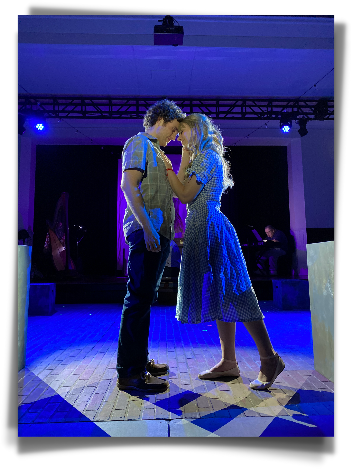
Billy Ensley, after directing the first little musical away from TC’s home, The Fantasticks, now pilots the first leviathan since the company’s return. Three of his mates from that Palmer Building gem back in 2021 are on board with Ensley for this new voyage, all of them playing major roles and all of them delivering.

I was fairly bowled over by the brash irreverence of Something Rotten! when I first encountered this Karey and Wayne Kirkpatrick concoction on Broadway in 2016. You might wonder if the Kirkpatricks had the zany antics of The Compleate Wks of Wllm Shkspr (Abridged) on their minds when they decided to take aim at the Bard of Avon and musicals.

Certainly the methods of their madness can be traced to the Reduced Shakespeare Company – with genetic material from Forbidden Broadway and The Producers also in the DNA. The Kirkpatricks discard the merely dubious ideas that Shakespeare’s works were written by someone else, or that his awesome greatness was only fully appreciated after he died. They ignore the reality that there’s only faint, sketchy traces of the man over the course the grand Elizabethan Era.

No, all those tropes are toast. The Kirkpatricks, with John O’Farrell collaborating on the book went full-bore misinformation and alternate reality. Months before The Donald descended the Trump Tower escalator.IMG_2969-2

Shakespeare is no longer a dim peripheral figure on the Elizabethan cultural scene. He’s a full-blown superstar, recognized and wildly adored wherever he goes. Mobbed by his rabid fans, he gives outdoor spoken-word concerts to sustain the mass hysteria.

The secret of the Bard’s genius is revealed. Like the Reduced Shakespeares, Forbidden Broadway, and the Kirkpatricks after him – not to mention The Donald – the real Shakespeare was a thieving magpie. Not only did he steal from ancients like Plutarch and Ovid, predecessors like Chaucer and Boccaccio, and contemporaries like Christopher Marlowe, he cribbed from unknown wannabes and the man or woman on the street.

Case in point: after defecting from Nick Bottom’s struggling theatre company, Will takes his former boss’s name with him and dumps it into A Midsummer Night’s Dream. Another case in point: Sniffing out the possibility that Nick is working on something revolutionary for the stage, Shakespeare embeds himself in his former company, where he swipes the complete manuscript of Hamlet from its true author, Nigel Bottom. Because big brother Nick has astutely told him that “to be or not to be” is trash. Not to be.IMG_2417

A hapless mediocrity, Nick is our hero. In his crazed search for the next new thing in theatre, Nick seeks out a soothsayer to look into the future, a rather Shakespearean ploy. The eccentric soothsayer that Nick picks, Nostradamus, turns out to be a genuine visionary, but his inner crystal ball seems to be afflicted with astigmatism. Skipping over the breakthrough artform of opera on the near horizon, soon to be birthed in Italy, Nostradamus is himself amazed to see… a musical!

So powerful is this concept that Nostradamus cannot even say the word without a vatic, conjuring sweep of his right arm. He wants Nick – and us – to see it clearly, too. Nick, poor thing, doesn’t have as juicy a role as the raving Nostradamus, who must convince his skeptical client that such an impossibility can be created, believed, and become universally popular. He’ll be able to bring my play to a complete stop and have my speaking characters suddenly start singing? And he’ll be able to interrupt this blatant interruption with a whole crowd of people dancing? Tap dancing?IMG_2703

Yes, yes, and yes, Nostradamus prophesies, and audiences will lap it up. We do see, for we were living proof of this seeming insanity at the Queens Road barn, just like I was at the St. James Theatre in 2015.

Over and over, the Kirkpatricks reinforce the idea that the road from brilliant concept to acclaimed masterwork is strewn with pitfalls. Nick begins with a colossal misstep, an upbeat number called “The Black Death,” which strives to match Mel Brooks’ “Springtime for Hitler” in utter tastelessness.

So Nick hurries back to his soothsayer. What will Shakespeare’s greatest triumph be, he asks, determined to beat the Bard to the punch. Pushing away invisible cobwebs between him and the future, Nostradamus proclaims, Omelet, the Musical is the future, confident he’s setting Nick on the right track.

With creditors and prudish censors dogging his way, Nick has ample complications to overcome. The backbreaker is Nigel’s resistance. Instead of sticking to the yolks and the big egg picture, Nigel is spouting useless lines like “To thine own self be true.”

Another Shakespearean device comes into play with little brother, the double plotline. While tasked with writing the world’s first libretto, Nigel is smitten by Portia, the lovely daughter of Brother Jeremiah, the most sanctimonious and censorious Puritan in London. Avid admirers of Shakespeare, both Portia and Nigel can see the parallel between their star-crossed plight and the tragedy of Romeo and Juliet, their idol’s newest hit.IMG_3812

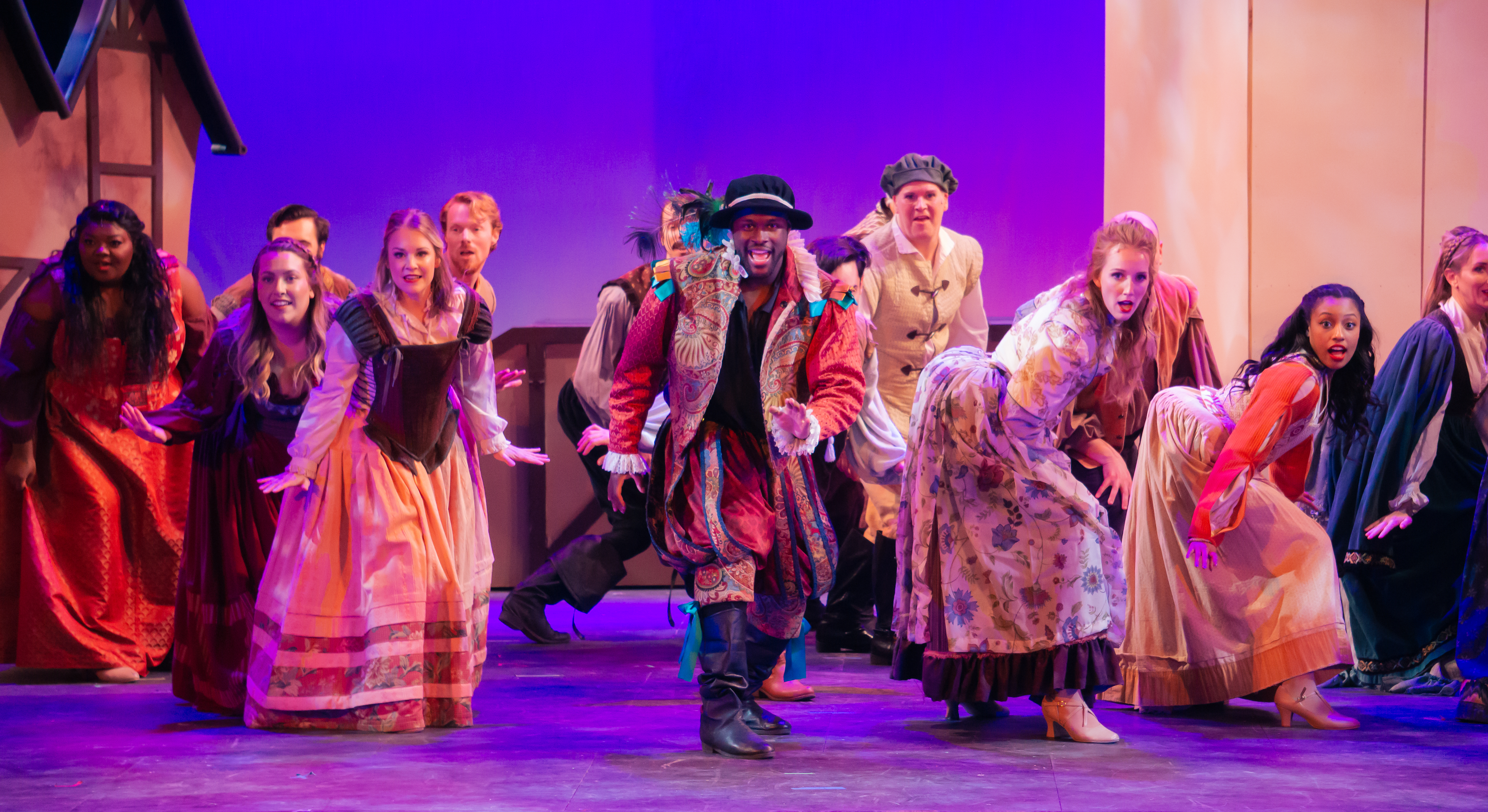
Ensley’s eager, able, well-drilled cast of 25 can seem like a teeming city in the confines of a barn, heartily welcoming us to two Renaissances, really, with Nehemiah Lawson as the Minstrel leading the ensemble’s bustling greeting – to the refurbished theater and olden days – when the curtain rises. They can form a credible mob around Will when he struts upon his stage.

Along with such teeming scenes, Ensley and choreographer Lisa Blanton and headshot sketch artist Dennis Delamar can pour in numerous references to familiar, beloved musicals we all know. Explicit references to Phantom, Les Miz, Cats, Sound of Music, and Chess are in the Kirkpatrick-O’Farrell script, but what about the sly nods to Annie, A Chorus Line, The Producers, and West Side Story?

There are more Broadway allusions than I’ve mentioned and still more that I may have missed. Ensley keeps the pace brisk.

Twice cast as Jesus at Theatre Charlotte in past seasons; along with leads in Rent, Memphis, and Arsenic and Old Lace; Joe McCourt steers us through Nick’s sea of troubles. Folks out in Matthews would remember McCourt’s exploits in Bonnie and Clyde more vividly, his first team-up with Ensley. The Arsenic and Old Lace agitation as Mortimer, when McCourt strayed from musicals into comedy, served as a nice precedent for his work here. When he leans away from straight-man chores opposite Will and Nostradamus, and into Nick’s showpieces, McCourt flashes his confident charisma – with comical seasoning – when he fumes “God, I Hate Shakespeare.”

McCourt is no less in command when he brings down the curtain for intermission with “Bottom’s Gonna Be on Top,” though his best soufflé may rise when he greets his troupe for the first Omelet rehearsal, absurdly exclaiming “It’s Eggs!” Yet this wannabe turn is decisively upstaged by the conceited rockstar and the wild-eyed prophet.

Perfectly cast at the Palmer in The Fantasticks, Mitchell Dudas and Kevin Roberge are even more smashing now. Dudas was a wonderfully swashbuckling El Gallo, the beguiling Fantasticks narrator, but he’s far slicker and more self-absorbed here, shining in his wicked showpieces, “Will Power” and “Hard to Be the Bard.” And the sheer arrogance of him when Dudas flashes his Shakespearean smile! You expect little LEDs to twinkle at the edges of his teeth.

Since “The Black Death” is an ensemble slaying, it’s Roberge who gets the killer solo of the night, “A Musical,” indoctrinating McCourt so thoroughly that the conjuring sweeps of Nick’s arm become nearly as prophetic. After his portrait of the more blustery Fantasticks dad, Roberge turns up his leonine energy more than a few notches. And the hair! Far more eccentric than the Einstein in Verizon ads. Think Charlton Heston on top of Sinai in The Ten Commandments.

Matt Howie, the naïf swain from Ensley’s Fantasticks, and Cornelia Barnwell mesh beautifully as the confidence-challenged Nigel and the overprotected Portia. But they’re overshadowed by a slew of quirkier characters who don’t sing nearly as much. Who comes first? Maybe Lindsey Schroeder as Bea, Nick’s proto-feminist wife, who fills out the contours of Shakespeare’s Portia in a memorable courtroom scene.

Certainly Hank West vies for the honor of favorite minor character as the shifty and resourceful Shylock, who remains a moneylender in Shakespeare’s world but transforms into the first theatre producer in Nick’s troupe and the New World. Delamar, our sketch artist and longtime Theatre Charlotte idol, gets props here for portraying a pair of pomposities: Lord Clapham, Nick’s skittish financial backer, and the Judge who must sentence Nick for his trumped-up crimes.

If there’s space for a feminist, a theatre producer, and a rockstar in this Renaissance makeover, there’s also room for a gay preacher and an outré transvestite. J. Michael Beech’s homosexuality as Brother Jeremiah is hardly latent at all as he strives to keep himself closeted with indifferent success, and we can presume that Paul Reeves Leopard as Robin gets the pick of the women’s roles in the Bottoms’ troupe, perennially dressed and simpering for the part.

Brave New World!

If the players I’ve named thus far decided to form a professional theatre company, I’d only be mildly surprised by their audacity. The new Old Barn made them all look good, first with the opulence of Chelsea Retalic’s period costumes – and the stark anachronism of Shakespeare’s glitter. Chris Timmons’ set designs didn’t look like he was working on a shoestring budget, either, indoors or out.

Better yet, the renovated 501 Queens Road facility has remained true to itself, in its lobby and its theater space. In the lobby, there are new, more modern-looking ceiling fans, which sit admirably flush to the upgraded ceiling. There were still extensive lines to the restrooms, so my inspections of the toilet – and the new backstage – must await visits to come.

In the theatre hall, the skeleton of the new scaffolding isn’t fleshed out at all with sheetrock, so the roofbeams are visible all the way to the bricks that meet it at the proscenium wall. More like a beloved old barn than ever! Artistic director Timmons, wearing his second hat as acting executive director, told me that the renovations made it possible to raise the stage proscenium. Yet there was a shower of confetti to climax the finale, where the “Welcome to the Renaissance” melody completes its last rebirth as “Welcome to America.”

Can’t remember the last time, if ever, that I had seen evidence of a functional fly loft at the Queen Road barn.

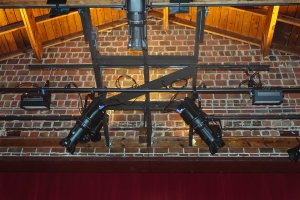
Best of all, there was a profusion of theatre lights shining in many colors, along with strategically spaced audio speakers. All are discreetly black, of course, so I couldn’t resist taking flash photos to confirm that all this equipment is spanking new. Everything worked flawlessly, including Theatre Charlotte’s soundboard. Nor did I notice any coughing or humming from the heating system. All was bliss, best feet forward, with nothing rotten except the show’s title.

Don’t be shocked to find that Something Rotten! is sold out for the rest of its current run. The show, the production, and the newborn theater are all that good. Timmons & Co. may need to add performances to meet the well-deserved demand.

Remembering in September – While Building Back Better

Review: The Fantasticks at the Palmer Building + Theatre Charlotte Update

By Perry Tannenbaum


Screenshot 2021-09-19 at 21-13-57 Fantasticks Playbill

You don’t need to try very hard to remember why Theatre Charlotte is beginning its 94th season at the Palmer Building. Built on East 7th Street in the late 1930s as part of FDR’s signature Works Progress Administration (WPA) initiative, the place itself gives you a hint. It was built and landscaped by firefighters to be the best training academy in the country and served that purpose for firemen who came after them for over 30 years.

2021~Burnt Theatre Charlotte-18

Late last December, on a slow news night, fire struck Theatre Charlotte’s beloved HQ, nicknamed “the Queens Road barn.” Ignited by the facility’s wayward HVAC system, the fire gouged a sizable trench into the right side of the auditorium. Slammed by COVID lockdowns, scrambling to reconfigure a full season without live performances and sustain their bond with actors and subscribers, Theatre Charlotte had the ground literally taken out from under them by the late-night fire.

One last indignity at the end of a grim 2020 that would already live on in infamy.

2021~Burnt Theatre Charlotte-02

When January dawned, it was clear that the initial damage estimates of $50,000 by fire officials – not trained at the Palmer Building – were far off the mark. Although the exterior at 501 Queens Road looks relatively unscathed from the street, a brief peep inside shows the full toll of the devastation.

2021~Burnt Theatre Charlotte-03

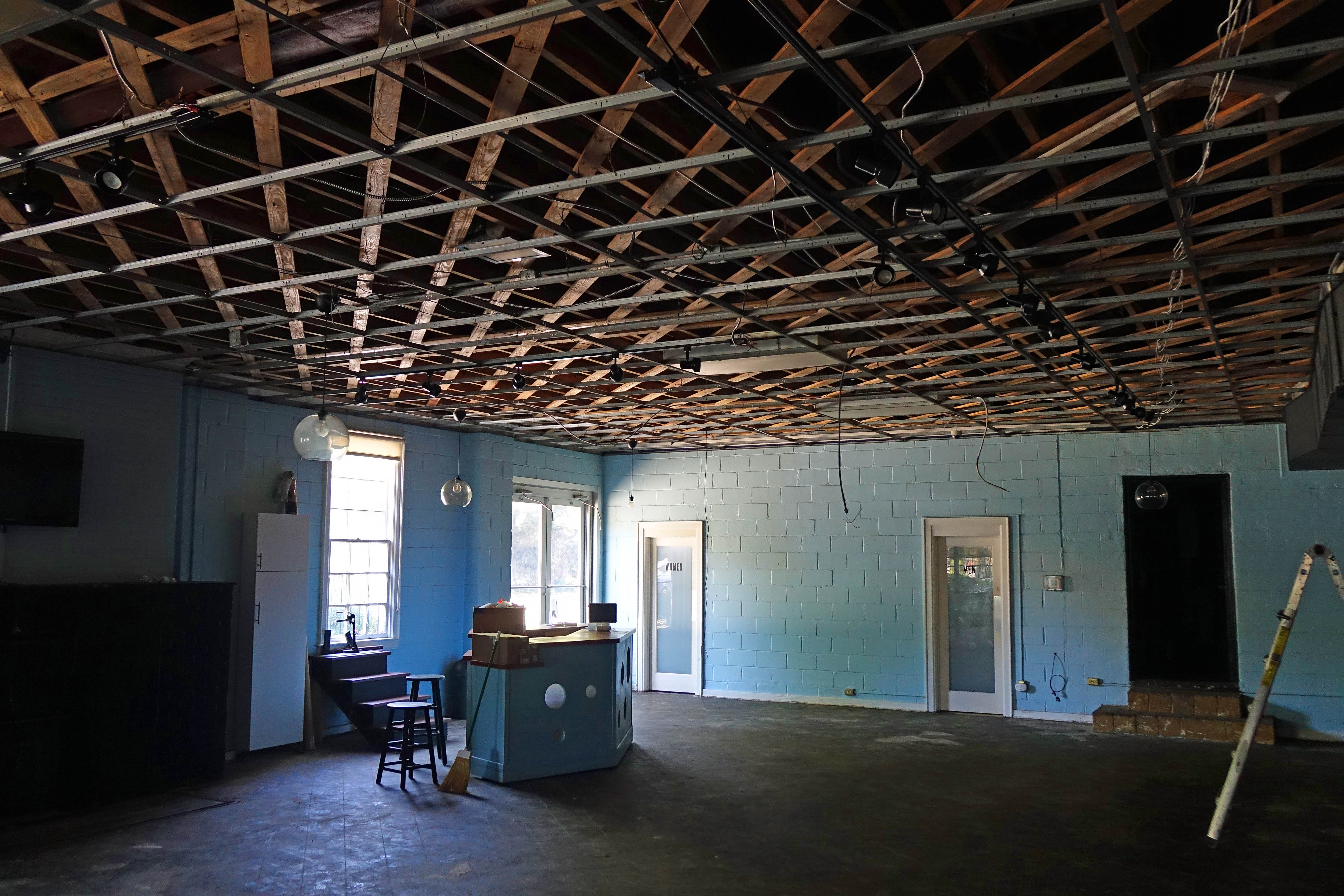
Walls that marked off the box office and administrative quarters from the lobby have been punched away, with only their wooden framework remaining. Looking across the lobby, into the auditorium, and backstage, you won’t find any ceilings, just more woodwork, metalwork and lighting fixtures that the fire’s flames and smoke failed to fry or destroy.

Cleanup took between three and four months, acting executive director Chris Timmons tells me. Not only was the HVAC toast, but so were all the theater’s precious electronics. That $50,000 estimate didn’t come close.

2021~Burnt Theatre Charlotte-07

“Our entire sound and lighting systems were lost, and those items alone total well over six figures,” Timmons reckons. “The latest number we tracked for complete restoration to the building ‘as it was pre-fire’ was in excess of $1 million. Because of some likely unknowns, such as damage not visible and county code requirements, we expect those numbers to change.”

So in recalibrating their 2021-22 season, Theatre Charlotte’s board and staff not only knew that they would need to take their productions on the road, they knew they had none of their old sound and lighting gear to bring with them.

That turns out to be okay when we see The Fantasticks, directed by the venerable Billy Ensley, at the Palmer Building. It’s a well-known title, famously the longest running show in American history. Perhaps more importantly, the show travels light.

Scenery has always been minimal since the musical, written by Tom Jones and composed by Harvey Schmidt, opened off-Broadway at the Sullivan Street Playhouse in May 1960. Instrumentation of the original score was positively gossamer, just a piano and a harp. Not the sort of thing that would work at Belk or Ovens.

Screenshot 2021-09-19 at 21-03-04 Fantasticks Playbill

As Theatre Charlotte’s admirable digital playbill points out, startlingly more informative and colorful than their printed programs from past seasons, The Fantasticks started out with nine players, but the cast was winnowed to eight – when a Handyman was no longer needed to come onstage during intermission to fix the lights. Ensley restores the original count by doubling the role The Mute.

Two are arguably better than one when it’s time for The Mute to act as the wall between the homes of lovebirds Matt and Luisa (built by their wily, matchmaking dads, Hucklebee and Bellomy). It also doubles the number of women Ensley can present onstage.

Although I haven’t reviewed a show at the Palmer since 2007, when the now-extinct Pi Productions presented The Guys there, Ensley is likely familiar with the space, since Theatre Charlotte has staged numerous soirees and fundraisers there in the intervening years. What struck me most was the strength of the voices in Ensley’s cast – exactly what is needed if you’re presenting a musical at the Palmer without microphones. Despite the sparse orchestration, there were moments that sounded like we were at the opera.

So you think that’s outlandish? Opera Carolina produced The Fantasticks during the summer of 1994, and Queens University Opera Theatre followed suit in 2004.

Screenshot 2021-09-19 at 21-02-41 Fantasticks Playbill

The score is front-loaded with its best music, two of its most familiar songs, “Try to Remember” and “Much More,” starting us off. It doesn’t take long for us to discover how fine and robust all these voices are. Matthew Howie and Jocelyn Cabaniss are the lovestruck teens, open and credulous, while Kevin Roberge and Phil Fowler handle the comedy as their manipulative dads, pretending to feud so that their kids will be all the more drawn together.

Ah, but how shall Hucklebee and Bellomy reconcile so that the two feuding households may live happily ever after? This is where that swashbuckling rogue, El Gallo, comes in. He will abduct Luisa and allow Matt, against all odds and reason, to rescue her. Actually, Mitchell Dudas as El Gallo has been there from the beginning, presiding over the action as our narrator, preening like a latter-day Fabio with flicks of his long hair when the dads hire him, and reminding us – almost exactly 19 years since CPCC brought The Fantasticks to Pease Auditorium – how perfectly suited to the season it is.

It’s El Gallo, after all, who repeatedly sings, “Try to remember the kind of September when life was slow and oh so mellow…” And it’s all the other players who chime in, “Then follow, follow, follow, follow, follow.”

Howie is likely the most familiar youngblood here, having proven his acting skills up in Davidson as the lead in The Curious Incident after an eye-opening turn at Theatre Charlotte as Seymour in Little Shop of Horrors. When Matt boasts of all his heroism in rescuing Luisa from the clutches of El Gallo and his bumbling henchmen, it isn’t nearly as irritating as Hucklebee finds it – so Howie has gauged it perfectly.

Dudas and Cabaniss have lurked more on the periphery in recent years, but Ensley directed Spring Awakening at the Queens Road barn in 2018, so he’s well aware of Cabaniss’s powers. They show out most memorably when she passionately sings “Much More.” Granted, there isn’t much special in watching a guy kiss a girl on the eyes. The magic that Jones tapped into when he wrote this song was Luisa’s aspiration to be that girl. Cabaniss also shines in her climactic duets with Howie, especially the beguiling “Soon It’s Gonna Rain” before intermission.

If Howie and Cabaniss aren’t always as carefully paced, audible, and intelligible when they speak as they are when they sing, rest assured that their elders always are. Roberge and Fowler make a nicely balanced comedy team as the dads – perfect if you conclude that a prime aim of Jones and Schmidt was to juxtapose flamboyance and bluster with simplicity and sincerity. This little stage seems far too small for Roberge and his leonine energy, yet Fowler, more physically imposing, seems perpetually inclined to shrink out of sight.

Reserve and restraint, on the other hand, seem totally alien to Geof Knight and Tim Huffman, both of whom are bluster personified as Henry and Mortimer, El Gallo’s Shakespearean thugs. Watching Huffman perform his multiple dyings, you will likely realize how much, along with Jones’s wall antics, this book leans on the mechanicals and the closing scene of A Midsummer Night’s Dream.

Yet there’s also Act 2, where all the fairytale “Happy Ending” that’s frozen at intermission is exploded – when lies, fantasies, and perfect bliss collide with the real world. Here we can see that The Fantasticks was not merely derivative but also, very likely, a prime inspiration for Stephen Sondheim’s Into the Woods.

After the rousing opening performance, Ensley consented to an email exchange where he shared his on-the-road experiences and views. Auditions and early rehearsals for The Fantasticks, he disclosed, had to be transplanted from Queens Road to Dilworth United Methodist Church. An empty Pier One store in Ballantyne subsequently became Theatre Charlotte’s “permanent” rehearsal space for the current season – which will see stops at Dilworth United, The Halton Theater at Central Piedmont, and The Great Aunt Stella Center before Love, Loss, and What I Wore hopscotches between four locations, including the Palmer, next spring.

Screenshot 2021-09-19 at 21-01-43 Fantasticks Playbill

Cast and crew arrived at the Palmer for final tech and rehearsals on Sunday, just four days before The Fantasticks opened. Ensley had indeed accounted for the special challenges of the site.

“The Palmer Building only affected casting in that we cast the strongest singers possible, which we would do as a matter of course anyway,” Ensley observes. “The primary thing was to project and enunciate. Also, to adhere to their blocking very closely for lighting purposes as we had limited equipment and flexibility. I feel our lighting designer J.P. Woodey did a great job in a very short amount of time with limited equipment.”

Kudos should likewise go out to Christine VanArsdale at the harp and musical director John Smith at the keyboard. To my great relief, we found staff and audience to be pandemic-diligent. Proof of vaccination or recent COVID testing was required outside the site before we were admitted, touchless electronic ticketing was in place, and your program is a single piece of paper with a QR Code you scan with your smartphone to access the digital playbill. Everyone in the hall (except the performers, of course) wore masks from beginning to end.

“We impressed upon the cast from the very beginning how important the success of this show was and how much Theatre Charlotte valued their talent and their personal commitment to bringing the community live theatre,” Ensley says. “Chris has been wearing a lot of hats and I have been impressed with how well he and the TC staff have been keeping everything going and in a positive and determined way.”

2021~Burnt Theatre Charlotte-21

Topping the company’s priorities are returning to Queens Road for the 2022-23 season and, ultimately building back better. The timetable is only beginning to narrow, for Timmons estimates that, once the reconstruction actually commences, it will take 6-8 months. While Timmons and his wife Jackie Timmons, who serves as director of marketing and development for Theatre Charlotte, are hoping that insurance will cover everything, donations have spontaneously poured in from across the country and through a special Save My Seat Theatre Relief Fund.

Many of the contributors who checked in from far and wide had formative, life-changing experiences at the Queens Road barn.

“Knowing how so many people in the industry were struggling because of the pandemic and receiving support from them at the time of the fire was humbling,” Chris says. Yet the disaster struck at a time when the arts were not only reeling from COVID but also undergoing a Black Lives Matter, We-See-You-White-American-Theatre reckoning.

Timmons doesn’t plan for Theatre Charlotte to be behind the curve in reacting.

“We are taking time to plan for the long-term future of the building,” he says, “how it operates and can better serve our community, and we are looking at enhanced safety and accessibility improvements that may be phased in over the next several years. We don’t want to simply put a fresh coat of paint on the walls and new carpet on the floor and call it a day. We want our facility to be better suited for community partnerships and engagement opportunities that we haven’t been able to accommodate in the past, and we want to showcase more of the creatives who need a voice in our community.”

2021~Burnt Theatre Charlotte-17

Standing about a yard from a partially broken window at 501 Queens Road, a pane framed by countless layers of cracked and gouged paint, Jackie focuses on the near-term, striking a more urgent tone. When I ask about a possible second season on the road beginning next September, she doesn’t hesitate.

“We have to open here next year,” she says. “Finding other venues is too exhausting!”


Matthews Mamma Mia! Mixes Summer Romance and Autumn Regret

Review: Mamma Mia! is playing this ABBA hit parade

By Perry Tannenbaum

Promo.1

There’s typical teenybopper inanity – and melodrama – in the lyrics of ABBA tunes that infiltrated the pop charts during the glam rock supergroup’s heyday, 1974-82. It’s all about desire, baby, followed by intense workouts on the hormonal treadmill of adolescence. Prospecting for ABBA gold, you’re rewarded with the age-old cycle of blissful acceptance or bitter ejection, romantic pleasure and conflict, burnout and breakup, cynicism and regret, all rendered in the elegantly engineered shorthand of a Top-40 hit.

Something interesting happened in 2001, after even the youngest member of ABBA had turned 50 and the quartet’s jukebox faves were cunningly transformed into a hit Broadway musical. You can feel it at Matthews Playhouse of the Performing Arts, where Mamma Mia! is playing through February 9. Writing the book for this ABBA hit parade, Catherine Johnson gave most of the songs to characters we could presume were nearly her own age, almost 44 on opening night. Old enough to have teenybopper kids of their own.

When a teenybopper pout is transformed into a midlife lament, regret takes on a whole new coloration in the title song as Donna Sheridan sings:

Yes, I’ve been brokenhearted,

Blue since the day we parted.

Why, why did I ever let you go?

The “day we parted” isn’t two melodramatic weeks ago. Not anymore. It’s over two decades ago, long enough for Donna to be experiencing the autumnal chill of lost youth. But hold on, Donna! You’re on a colorful Greek Isle, with lively cabana studs serving your taverna’s drinks, bikini-clad nymphs frolicking everywhere, dazzling eternal sunshine – and your darling daughter Sophie is getting married tomorrow!

It was easier to see Mamma Mia! from Sophie’s point of view in its Broadway days, pre-Meryl Streep, for Sophie really kickstarts the plot by prying into Mom’s secret diary and inviting all three of her possible dads to her wedding. Imagine if your three exes showed up unexpectedly for your daughter’s wedding. Sophie might as well have hired a skywriter to spell it all out: MOM, I READ YOUR SECRET DIARY AND INVITED ALL THREE OF MY POSSIBLE DADS TO MY WEDDING. Donna probably wouldn’t have looked up and noticed.

Promo.3

Presumably, Mamma is preoccupied with wedding preparations, but Donna compounds her distractions by inviting two of her old chums, Tanya and Rosie, to the festivities. Plenty of catching up to do, but conveniently, the three women were a glam rock vocal trio back in their salad days, Donna and the Dynamos, so they can provide the party entertainment. With this makeshift guest list and its ‘90s setting, the prevailing outlook of the story shifts emphatically toward the baby boomers, ABBA’s perennial demographic.

Directing the show, Billy Ensley clearly gets the boomer drift, and more than a couple of seasoned Charlotte musical stars ride the wave with him to the Matthews Playhouse stage. With a richly detailed scenic design by John Bayless and a sumptuous array of costumes by Lisa Altieri – including a surprise set of glam rock duds for the dads – it’s likely that all of these vets appreciated the warmth of their welcome.

We don’t need to wait around for all these elders to gather in the Mediterranean sun before the excitement begins, for Ensley has found newcomer Alexis Thomas to ignite the action as the nubile Sophie. Thomas quickly proves she’s a precocious belter, bookending Act 1 with lead vocals on “Honey, Honey” and “The Name of the Game.”

Having deceptively invited her three possible dads – Sam, Bill, and Harry – using Mom’s letterhead, Sophie must also subject each of the candidates to an impromptu paternity test, inviting all three to give her away at tomorrow’s wedding. The hurried brevity of these scenes would make any self-respecting playwright blush, but Thomas carries them off as if they were hallowed Broadway formalities, codified as cliché. Which they are. Spencer Ellis doesn’t get nearly as much opportunity to shine as Sky, Sophie’s fiancé, but he makes his big moment in Act 2 count, letting Sophie know that he feels her quest for her true dad is a bigger thing to her than their wedding.

Of course, the ABBA songs, stirred by island breezes and mixed with the celebratory vibe of the oncoming nuptials, become a cocktail that takes all six of the mid-lifers sip by sip from the tipsiness of nostalgia to the full inebriation of regression and reawakening. The women are the most intoxicated here, each arriving at her own pace. Burdened with a mother’s cares and saddled with the bitterness of a jilted sweetheart, Lucia Stetson as Donna travels the longest path – though the magic is there from the moment she sees Sam.

Promo.4

Stetson staunchly deals with the fact that Donna is prone to some truly stupid-ass choices, flexing the same regal star-quality insouciance that carried her through the title role of Evita a couple of summers back. Notwithstanding the baggy overalls she wears early on, we’re not surprised that she’ll soon emerge as a “Dancing Queen” and a “Super Trouper” – singing lead vocals, of course. You wonder a bit at first about Lisa Smith-Bradley, sporting a pair of mousy eyeglasses as Rosie, a far cry from the charismatic Mama Rose she brought to Theatre Charlotte seven years ago.

Never fear, Ensley and Smith-Bradley are cooking up a startling mouse-to-tigress rejuvenation as Rosie sets her sights on Bill, sinking her slinky claws into him in their “Take a Chance on Me” duet. Lisa Blanton talks like the bawdiest woman onstage as Tanya, but is it all talk? No, it is definitely not as we watch Blanton’s cougar rampage on “Does Your Mother Know?” Blanton pulls double duty at Matthews, doubling as the production’s choreographer, captaining her own carnivorous showcase with obvious gusto.

Aside from Thomas, a young talent to watch, the most promising of the young Greeks is Adrian White as Pepper, prime target for Tanya’s predations in “Does Your Mother Know?” – agile and slightly bewildered. He’s the dancing king here, for none of his elders, aside from Blanton, was chosen for hoofing prowess.

We’ve seen all the middle-aged guys before in Charlotte, Bob Mauney most recently starring in The Music Man at Theatre Charlotte, Steven B. Martin in Evita and Bridges of Madison County, and Patrick Ratchford in anything he has ever auditioned for over the last 25+ years, most recently 1776, Ragtime, and Charlotte Squawks! The Ratchford voice is still in peak condition, mostly held in reserve until Sam’s “S.O.S.” duet with Donna in Act 2, an all-out cri de Coeur in the top-40 world. Those smooth baritone tonsils also wrap themselves around two other hit singles, “Knowing Me, Knowing You” and – spoiler alert – the climactic “I Do, I Do, I Do, I Do, I Do” duet.

Sam isn’t the most comical of Donna’s exes, just the most interesting: the last he heard from her before Sophie’s faux invite was that she didn’t want to see him again. Understandably, he’s a bit uncomfortable and ambivalent when Sophie admits the subterfuge, but like the other guys who are also residually fond of Donna in various degrees, the possibility of being Sophie’s father keeps him hanging around in hopes of closure – and maybe making amends.

Martin as Harry and Mauny as Bill follow parallel tracks, not called upon to do much singing. Neither squanders his opportunity, Martin in a nostalgic “Our Last Summer” duet in Donna’s bedroom (here we go again?) and Mauny as Rosie’s willing prey in their “Take a Chance on Me” tête-à-tête. Bill claims to be an adventurer, so a tigress should be just right up his Aussie alley.

Dancing in the Aisles for 36 Years

Interview: Billy Ensley

By Perry Tannenbaum

image001

Call him Mister Versatility. To find anyone else in the Charlotte theatre scene who has been celebrated for excellence in so many different areas as Billy Ensley, you would have to summon up the memory of Alan Poindexter, the wunderkind who came out of the UNC Charlotte theatre program and won accolades as an actor, director, and sound designer. Ensley’s awards, a total of 16 from Creative Loafing and the Metrolina Theatre Association, have been for his work as an actor, director – in musicals, comedies, and dramas – and as a choreographer.

Song and dance were Ensley’s calling cards from the beginning, and they remain handy skills as he directs the upcoming Matthews Playhouse production of Mamma Mia! – the fifth musical that he has directed there. We interviewed Ensley about his evolution as an artist, the enduring popularity of Mamma Mia! and the vital importance of our community theatres.

QC Nerve: Take us back to the early days. Outside of school productions, what was your first appearance on a Charlotte stage? Can you tell us how you felt about theatre at that time and the part it would play in your life?

My first appearance on a Charlotte stage after school was in Seesaw (1983) at Theatre Charlotte [then known as Little Theatre of Charlotte]. At that time, I was moving into theatre as a result of having dance training throughout my youth. Male dancers were in demand, and therefore I was able to make that transition and learn acting and singing as well. While performing on Charlotte stages in my 20’s, I regularly got work in professional theatres, some of which include The Blowing Rock Stage Company, Opera Carolina, Busch Gardens, and Cook/Loughlin productions at Spirit Square.

IMG_6979

I wanted to dedicate my life to the theatre arts, but I also had a strong desire to own a home and be self-sufficient. I worked for over a decade as the director of office operations for the Robinson, Bradshaw & Hinson law firm. After a couple of years in the travel industry, I went to work for Rexus Corporation, a national background screening company, where I am their chief operations officer for 15+ years.

By the time I first saw you back in the late 80s, in House of Blue Leaves and The 1940s Radio Hour, you were well on your way to establishing yourself as Charlotte’s pre-eminent triple threat. How committed were you at that time to accomplishing that goal, and how did you hone your acting, singing, and dancing skills?

At the time, I was not aware that I was establishing myself in any way actually. I was merely doing what I loved and what I was driven to do. Of course, it helped that I was receiving good reviews in the local press and support from the theatre community. That was positive reinforcement to keep working basically two full time jobs.

IMG_6589

Through the support and training of many people in Charlotte – including Tom Vance, Tom Hollis, Ron Chisholm, Terry Loughlin, Steve Umberger, to name a few – I was fortunate enough to work in the theatre almost constantly. I received a lot of my acting and singing training by being in productions, but I also continued to take dance classes, study voice with Joyce Marshall and study acting privately.

What role did our community theatre play in launching your career in theatre? How do see Theatre Charlotte and Matthews Playhouse figuring in the local scene today?

Theatre Charlotte often had the best directors and performers in the region. I was surrounded by some of the best and, as a result, I almost always got a paying gig from that exposure in community theatre. In addition, I was getting excellent hands-on training from them.

IMG_6982

Theatre Charlotte and Matthews Playhouse figure prominently in the local scene today, attracting good directors and seasoned performers as well as exciting new talent. In addition to cultivating new talent, they both are providing a venue for professional performers to have the opportunity to perform roles that may not be possible otherwise, due to the fact that Charlotte still struggles with sustaining many theatre companies.

You’ve made a couple of dramatic changes to reignite your career. First, you stopped doing musical after musical and took on a major role in a straight play, You Should Be So Lucky, in 1997. Then in 2003-04, we suddenly found you directing local productions of Evita, Bat Boy, and Hedwig and the Angry Inch. What motivated you in each of these instances to break out of your previous mold – were there practical considerations involved, or was it all about self-fulfillment?

For me, it was a combination of both. As a dancer, you learn pretty early in life that the thing you have been training for, performing and loving, must eventually come to an end, or at least morph considerably. The same applies to playing the young male leads in musical theatre. I knew that I wanted the theatre to remain in my life, and I wanted to continue growing in other ways so that I could facilitate that.

IMG_6981

As a youngster, I marveled at performers that were always reinventing themselves – David Bowie comes to mind, actually – and I thought that was a great way to remain relevant. I also did not want to be pigeonholed in musical theatre, which I felt I clearly was. I wanted the challenges of dramatic acting like McDonagh’s The Pillowman (2007), in which I was lucky enough to play the lead, Katurian, in the Actor’s Theatre of Charlotte production.

As for directing, that was a slow and methodical process, and not an easy career to break in to. I started choreographing and directing in theatres outside of Charlotte like Belmont Abbey College and Wingate University. Eventually, the executive director at Theatre Charlotte, Candace Sorensen, offered me my first directing job in Charlotte with Sweet Charity (2002). After a few Charlotte shows, I got a great deal of support from Dan Shoemaker and Chip Decker at Actor’s Theatre of Charlotte.

Tell us about your history with Matthews Playhouse and what you have experienced there in terms of the quality of their facilities, staff, and talent pool.

I have directed Shrek, Joseph and the Amazing Technicolor Dreamcoat, Bonnie & Clyde and Grey Gardens for Matthews Playhouse. Matthews Playhouse is an excellent example of a successful and vibrant community theatre. Under the leadership of June Bayless, they have an excellent staff, a remarkable youth training program, combined with a very nice auditorium and excellent technical staff.

Who are the familiar audience favorites and the hot new discoveries that are going to make your Mamma Mia! a smashing success? Who are the scenic design, costume design, and choreographer aces on the case?

IMG_6570Lucia Stetson and Lisa Blanton are audience favorites. Lucia having played Maria in The Sound of Music and Lisa Blanton having played Little Edie in Grey Gardens. Our two young romantic leads both qualify as hot new discoveries. They are Alexa Thomas and Spencer Ellis as Sophie and Sky. Lisa Blanton agreed to pull double duty for this show by both choregraphing and playing the role of Tanya. Lisa Altieri is handling costumes and Emmy Award-winning John Bayless is the scenic designer. His work is amazing and his talents run very, very deep.

What do you continue to find in Mamma Mia! that keeps us from getting tired of it?

Well, ABBA of course! The music is familiar and well loved; bringing back lots of memories of love and romance for us middle-aged folk. The women characters in the show are strong and independent, the male characters are sensitive and compassionate. Like other jukebox musicals, it is fun to watch a scene that evolves into a song that most of us know at least some of the lyrics to. It is a show where the audience should come in with their hair down, their troubles stowed away, and perhaps their inhibitions stowed away as well – in favor of singing along or dancing in the aisles!


Sometimes Predictable, “The Legend of Georgia McBride” Is a Raunchy, Rockin’ Delight

Review:  The Legend of Georgia McBride

By Perry Tannenbaum

While there may be “Good Rockin’ Tonight” when Elvis impersonator Casey steps up to the microphone at Cleo’s Club down in the Florida Panhandle, there isn’t a big hunk o’ love emanating from the audience. On some nights, there isn’t even an audience, except for Eddie, the super low-key club owner. As we begin Matthew Lopez’s The Legend of Georgia McBride with a bumbling, subdued curtain speech from Eddie, we’re keenly aware that both Casey and his boss are in sore need of makeovers. Our sympathies are mostly invested in Casey in this lip-syncing comedy presented by Actor’s Theatre of Charlotte. He’s younger, and the odds are against him, especially when Casey’s wife Jo informs him that his paycheck from Cleo’s has bounced once again, and they’re behind on the rent. No big surprises on the next complications that Lopez serves up to Jo and Casey’s dismay: Casey has just shelled out considerable dough on a new Elvis jumpsuit, Jo’s home pregnancy kit has just tested positive, and Eddie has been trying to work up the nerve to fire his headliner.

Seedy comedy and outré musicals have become the irreverent essence of the Actor’s Theatre brand. With Lizzie in August revisiting the sensational Lizzie Borden murders to a live heavy metal groove and now with this Georgia McBride jukeboxer, ATC has launched its 30th season – and their first full season as resident company at Queens University – by playing solidly to their strengths. Chip Decker’s set design is hardly wider than those we routinely saw at Actor’s in its old Stonewall Street location, with three distinct spaces side by side. Jo and Casey’s living room and kitchen flanks the Cleo’s proscenium on one side with the club’s dressing room on the other. What the Hadley Theater at Queens also allows is a nice thrust stage performing space where the entire cast can eventually perform Sister Sledge’s “We Are Family” for their curtain calls.

Yes, as Lopez’s title telegraphs, that’s where we’re heading. Obeying what his ledger is telling him rather than his own personal inclinations, Eddie brings in a pair of drag queens to strut his stage. Casey can stay on if he’ll tend bar, take it or leave it. Symptomatic of his sunny passivity, Casey takes it rather than daring to blaze his own trail. The new gals, Tracy Mills and Anorexia Nervosa are both more diva-like in standing up for themselves. From the moment they enter the dressing room, you expect that at least one of them will go Bette Davis on us and proclaim, “What a dump!” Rexy is the more temperamental and imperious of the two – when he isn’t so drunk that he can’t stand up. One night, when Rexy cannot be revived – let alone hoisted upon his roller skates – Casey is called on to fill in. Either he dresses up as Edith Piaf, or Eddie really will fire him.

This setup for The Legend offers more than merely the bawdiness of drag. We get to enjoy bad drag and bad lip-syncing as Casey wrestles with a bra, pantyhose, and the French language for the first time in his life. Prodded to forge his own identity in dragdom, Casey swivels his new Georgia McBride persona away from the drag trinity of Judy Garland, Piaf, and Liza Minelli. Cutting up his Elvis jumpsuit to fit his newly bolstered tush, the freshly inspired Casey adds female rockers to the customary Broadway-cabaret drag spectrum, including Connie Francis, Madonna, and numerous others beyond my ken. But even when Cleo’s begins to prosper, the sunny go-with-the-flow Casey still doesn’t have the guts to tell Jo about the transformation that has changed his fortunes. Warning: some very predictable scenes ensue between Casey and Jo.

Under the astute direction of Billy Ensley, Georgia McBride transcends this hackneyed marital turmoil with a cavalcade of winsome and hilarious performances on the Cleo’s stage. They are the springboard for tacky, butch, and saccharine creations from costume designer Carrie Cranford ranging from Nazi leather to Busby Berkeley chiffon. The inspired choreographer goes inexplicably uncredited – but I suspect some needless modesty from Ensley himself, a preeminent triple threat back in his acting days.

Judging from reviews of past productions, I’m confident that Lopez left plenty of latitude in his script for characterizations and song selections. If history is a judge, Elvis can drag either country or rock into drag, and both Eddie and Jo can be more loud, nasty and assertive than they were here. I cannot remember when James K. Flynn was funnier than he was on opening night, inconspicuously evolving from a terse mumbling rube to a glittering ebullient emcee – and beyond. Nor did Juanita B. Green rub me wrong as Jo, improbably remaining slightly adorable even when she threw her husband out. I got the idea that only a preternaturally compliant soul like Casey’s would comply.

Ensley’s casting choices for his drag queens are just as brilliant, especially since two of the three are making their debuts with the company. Over the years, Ryan Stamey has conspired on many of ATC’s wildest musicals as an actor, music director, and instrumentalist, so it wasn’t at all surprising to see him making a grand entrance as Rexy in full diva mode, on heels high enough to require a dismount. Stamey actually did multiple dismounts from those heels, doubling as Casey’s put-upon landlord, Jason, and executing bodacious changes in makeup and costumes. As Rexy, he strengthened the impact of Casey’s climactic crisis with his confessional monologue on what he has suffered to pursue his art form, a topic that Lopez should have explored more deeply. I also suspect that Stamey had a hand in formulating the eclectic playlist. I just wished that Rexy had performed more of those drag numbers.

With his elegant serenity and his razor-sharp zingers, Paul Reeves Leopard’s performance as Tracy reminded me of Coco Peru and Charles Busch, two supreme queens I’ve been fortunate enough to see live. In the midst of Casey’s crisis, he also gets a nice moment of truth at Tracy’s front door, answering Casey’s pathetic apologies and entreaties with makeup, dress, and wig discarded for the night – bathrobe-and-hairnet deglamorized, with all his steely maturity on display. Everybody seemed stronger and more mature than Casey, thanks to the sunny optimism and gentle humility Sean Riehm brought to the role. Anybody, man or woman, would let him be his or her teddy bear! Physically, Riehm is well-sculpted but not intimidating, with legs that can inspire a woman’s jealousy. Riehm’s lithe movements underscore the logic of the Elvis-to-Georgia transition: in and out of the jumpsuit, those swiveling hips are very much a part of his job description. Another warning: if you sit in the front row at the Hadley, you are a prime target for a lap dance from a drag queen. Mine was a first for me, the most memorable moment of a fun evening. You won’t be able to experience that when Jim Parsons plays Tracy in the upcoming Fox 2000 film.

Confused and Abused Teens – With Unmistakable Talent

Preview:  Spring Awakening

By Perry Tannenbaum

For over a century, playwright Frank Wedekind was best remembered as the creator of Lulu, the libertine protagonist in two of his erotically charged dramas, Earth Spirit (1895) and Pandora’s Box (1904). Alban Berg combined the two works into one Lulu (1937), an opera that stands as one of the sexiest of the 20th century.

Then came 2006.

Wedekind’s notoriety was refueled for a new millennium when Steven Sater adapted the German’s first script, Spring Awakening, for an off-Broadway production. If Lulu was risqué and amoral, Spring Awakening was angry, raw, and a bit shocking – teen chaos rather than salon decadence. The score, composed and orchestrated by Duncan Sheik, certainly wasn’t opera. It was a wicked mix of sensuous, anguished ballads like “Touch Me” and “The Word of Your Body” juxtaposed with raging frenetic rockers like “The Bitch of Living,” “My Junk,” and “Totally Fucked.”

Schoolkids standing up rebelliously on their desks, dancing and stomping catatonically. Vilifying parents and teachers. Ecstatically screwing just before intermission. Even liberal newspapers had to tiptoe around the song titles, lyrics, and actions.

The Atlantic Theatre Company production was an instant sensation, picking up an armful of awards before transferring to Broadway that same year. Eleven Tony nominations and eight Tony Awards were added to the haul, including Best Musical. Somehow the Victorian repression, the withholding of sex education, and the perils of unprotected sex, backstreet abortions, and teen suicide of Wedekind’s 1891 script had leapfrogged into the 21st century in a theatrical triumph – with no mealy-mouthed concessions whatsoever to the older generation.

Underscoring the generic, unsympathetic nature of Wedekind’s adults, all 14 of them were portrayed by one male and one female actor. This was not merely a tragedy of star-crossed lovers. It was an explosively presented nightmare scenario of what can go wrong when adults refuse to discuss sex with their children.

And now this scorching musical hits Charlotte this Friday, barreling into our community theatre for a three-week run – including three Sunday matinees and two Saturday performances on June 1 at 8:00 and 11:30pm. Somebody at the Queens Road barn believes they’re going to sell a whole bunch of tickets. Nobody seems worried that we’ll experience a repeat of the Angels in America uproar that rocked the city in 1996, with aftershocks that ultimately capsized Charlotte Repertory Theatre in 2003.

“We have no trepidation about Spring Awakening being a bridge too far,” says executive director Ron Law. “Many young performers and audience members have lobbied for it, and it has always performed strongly in our show selection survey.”

Touring versions of the show came here in 2010 and 2011, but of course, these weren’t shows with local artists funded by local dollars. The feeling was, even then, that the city had changed and audiences had matured since the Angels debacle. But there is likely another factor at work. Theatre Charlotte has better prepped its audience than Rep.

Oleanna, Falsettos, and Miss Evers’ Boys were as far as Rep pushed the envelope before fielding Tony Kushner’s gay fantasia. At 501 Queens Road they’ve pushed further with its more diverse audience, bringing us The Full Monty, Rent, Hair, and La Cage aux Folles in recent years. One way or another, the unholy trinity – nudity, foul language, and homosexuality – have all been addressed.

“All those shows were huge box office successes for Theatre Charlotte, with little pushback,” Law reports. “For this show, we even offered season ticket buyers the opportunity to buy a package that did not include Spring Awakening. A very small number took us up on this.”

Caution was not altogether thrown to the winds in scheduling this potential powder keg. Some niceties were also observed on the production end, beginning with auditions for the roles of the kids crossing the threshold of puberty. Nobody was allowed to audition unless he or she would be 18 on opening night.

“There were many disappointed 15 and 16 year olds who love the show and couldn’t audition,” Law confirms.

Most of the teens who did audition were savvy theatre students, according to Law. Some have participated in Theatre Charlotte’s youth-oriented summer stock productions, and others have been groomed in the robust theatre programs of our local high schools.

Nominated for the prestigious Blumey Awards for high school musicals across metro Charlotte, three of the major players in Spring Awakening are so accomplished that they put a major crimp in director Billy Ensley’s rehearsal schedule.

Seniors at NW School of the Arts, Renée Rapp (Best Actress), Liam Pearce (Best Actor), and Maya Sistruck (Best Supporting Actress) all earned Blumey Award nominations for their work in the school’s presentation of Big Fish, which is nominated for Best Musical honors. As finalists, all three were spirited away to Belk Theater, rehearsing for multiple segments of last Sunday night’s award ceremonies, where they performed individually and together.Rapp first landed a role at Theatre Charlotte when she was 10 and transferred to Northwest in her junior year. “They are both truly such talented and good-hearted human beings,” she says of Pearce and Sistruck. “Working amongst them all these years has helped me grow as a performer watching the dedication they put into what they do. We have so much love amongst the three of us that even in this especially stressful time with the Blumeys, Spring Awakening and graduation, they make every day and every rehearsal feel like a celebration for me.”

As Wendla Bergmann, Rapp launches the horrific scenario of Spring Awakening when she asks her mom how babies are made and gets a bogus answer. The only teen around who seems to have the lowdown is Melchior Gabor, a voracious reader who quietly shares the news with his shy neurotic bestie, Moritz Steifel – with explicit illustrations and written descriptions. But the atheistic, amoral Melchior does not share the facts of life with Wendla before he deflowers and impregnates her.

Dire consequences all around.

“Melchior has many layers to him,” says Pearce of this charismatic troublemaker. “He clearly wants to experience all of these activities he has read about but may not necessarily be ready to deal with the aftermath of what they may lead to. While he is extremely intelligent, he is still a teenager who has not completely grasped all of the knowledge he needs to be a functioning adult in society.”

Pearce isn’t altogether sure why he landed this plum role, but he has worked with Ensley – and choreographer Lisa Blanton – before at Theatre Charlotte in Jesus Christ Superstar. Ensley saw Pearce as a clear choice at his auditions, both as a singer and as an actor.

“Melchior needed to be a double threat actor singer,” Ensley says, “who could understand the commanding ‘big man on campus’ ego and the broken-hearted lover.”

In love with the misfit Moritz and abused by her father, Martha Bessell takes us to other dark regions of Wedekind’s story. “I always thought that her character arc was one of the strongest and most complex of the girls in the show, and I thought it’d be a wonderful challenge for me to take on,” Suskind says of Martha. “As for being nominated for Blumeys, it was quite nice to be able to link up our busy schedules and have a little ‘buddy’ looking out for any missed rehearsals or information. We were always on the same page.”

All three are also on the same page about delving into their troubled teen characters. They all give props to Ensley. Rapp offers the most detailed insights.

“I have heard countless people tell me how amazing working with Billy is,” she begins, “but it wasn’t until I had a one-on-one with him that I truly understood the depth of what they meant. He puts his heart into this production 100%, and that is so evident and inspiring for me. We sat and talked about myself and my character, and he really helped me break down what this show will mean. His direction is unmatchable. He works and tweaks things with such a specific eye, and I absolutely love it.”

Update: Renée Rapp took honors for Best Actress at the Blumey Awards on Sunday night, winning a trip to Broadway with Ethan Holtzman from Charlotte Latin School for a chance the national Jimmy Award on June 25. So who else won? Check it out here. Ceremonies will be rebroadcast on WTVI on May 29 at 8:00pm.


Celebrity Pistol-Packing Rogues Deliver Guilty Pleasures in “Bonnie & Clyde”

Review: Bonnie & Clyde

By Perry Tannenbaum

Since the days of his greatest successes, with Jekyll & Hyde (1997-2001) and The Scarlet Pimpernel (1997-2000), most of Frank Wildhorn’s Broadway musicals haven’t run more than a month. That includes a revival of Jekyll, Wildhorn’s longest-running show, in 2013 and Bonnie & Clyde, which somehow couldn’t make it through the end of December – the highest grossing month of the year – in 2011. Hearing that the short-lived Bonnie & Clyde was coming to Matthews Playhouse of the Performing Arts roused a morbid curiosity for me: how could a notorious story that won six Oscars in 1968, including Best Picture, flame out so spectacularly in a musical adaptation? Knowing that Billy Ensley, one of Charlotte’s best, would be directing sealed my resolve to investigate.
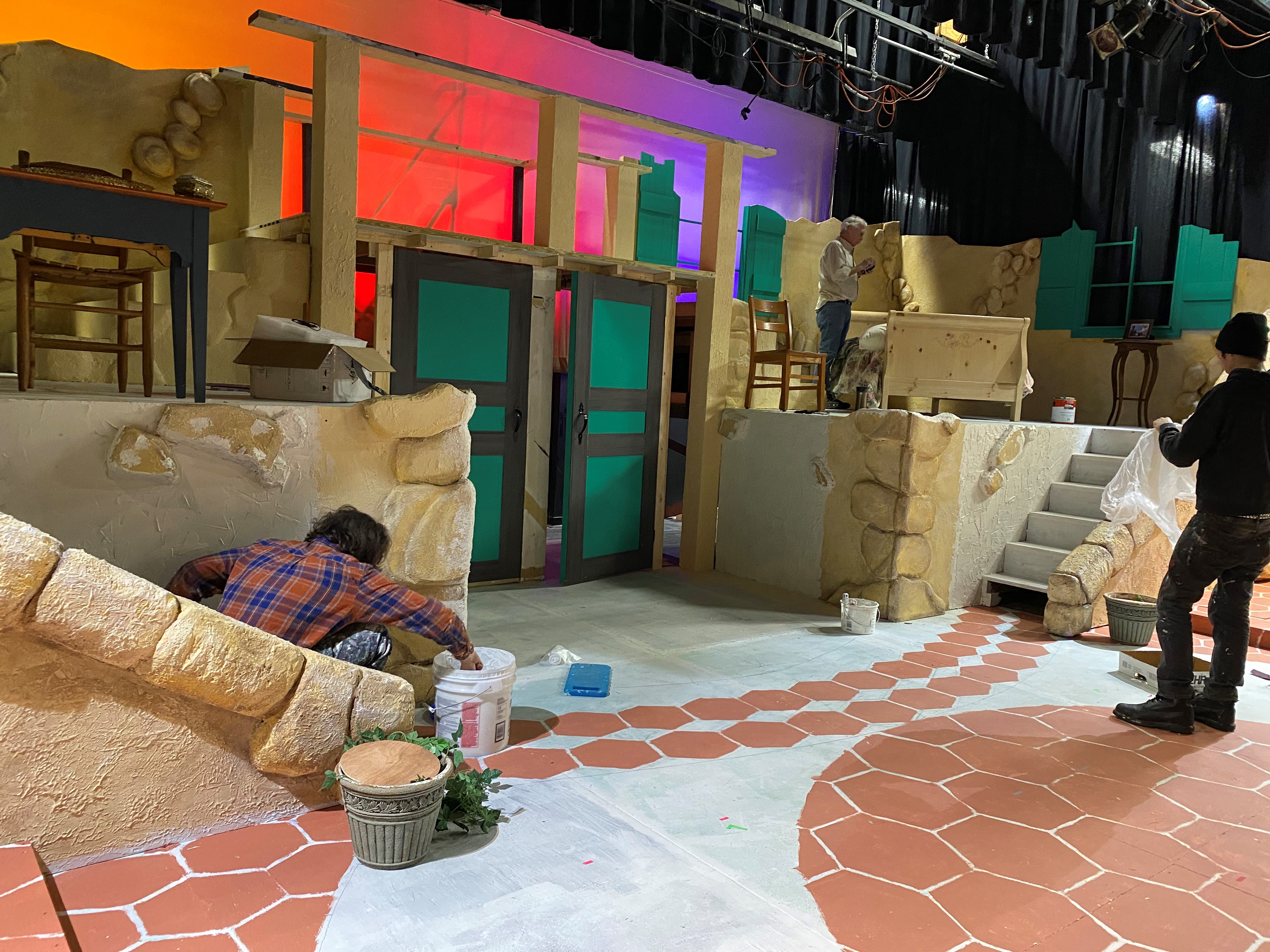
With the appearance Bonnie Parker and Clyde Barrow as children at the top of the show, it quickly became apparent that Ivan Menchell’s book was not an adaptation of the sensational film. Unlike the Bonnie portrayed by Faye Dunaway, Menchell’s is a ravishing redhead rather than a blond. There’s never really a Barrow Gang, and though this Clyde aspires to fancy clothes, his dream didn’t come true in Matthews. Most puzzling of all, we don’t see Bonnie and Clyde snapping photos of each other – their most modern trait! – although the authentic period projections go way beyond mugshots. So it’s plausible to me now that the Broadway version of this musical didn’t strictly flop on its merits. Boomers expecting to see the style and gore of the iconic film were disappointed, while it’s very likely that younger theatergoers had never even heard of Bonnie and Clyde.

Armed with a reported $6 million budget, there were presumably more costume changes up in New York than Matthews designer Lisa Altieri provides for Bonnie, but with 20 people in the cast, four of them in multiple roles, Altieri is far from idle and contributes some very fine work. What really made this community theatre effort look like a million bucks was the scenic team of designer John Bayless and scenic change artist Beth Aderhold. Weathered wooden slats span the Fullwood Theatre stage, trisected by two sturdy vertical beams. The columns of slats can be raised like window shades, keeping the flow of action going cinematically as the slats rise to reveal new scenes – or slide back downwards to serve as rustic screens for the old-timey projections, mostly of newspaper headlines, mugshots, and snapshots of our celebrity public enemies. At critical moments, a two-seat jalopy showed up in the middle of it all, no less realistic than the photos I’ve seen of the Broadway roadster.

Not only did Ensley brilliantly contrive to keep the action moving, he brought ace talent to the lead roles and beyond. Joe McCourt, who plays Clyde’s vacillating older brother, Buck Barrow, has starred in numerous musicals at Theatre Charlotte in recent years, including Memphis and Avenue Q. Embittering Buck’s every breath, Emily Witte is his very Christian wife Blanche, after playing a similar spoiler role as Amneris in the Disney Aïda at Theatre Charlotte last fall. This bickering pair would have upstaged the title players if Ensley hadn’t found such strong protagonists as Steven Buchanan and Lindsey Schroeder.

Buchanan was definitely in his comfort zone performing edgier fare, for he played prominent roles in Queen City Theatre Company’s The Pride and Actor’s Theatre of Charlotte’s American Idiot last year. Here he sported a hairdo that was halfway between Hitler and punk, looking lean, Brando mean – in a tank top undershirt – and dangerous. Scene work with Bonnie is a tasty mix of tender and raw, but Buchanan is somewhat monochromatic under arrest or during his larcenous, murderous rampage, barking his commands and forsaking the Warren Beatty charm offensive of the film. Ensley should have occasionally reined him in a bit and reminded him that he’s wearing a microphone as well as a pistol.

Opening in the ensemble of Evita at CPCC Theatre the weekend after her last performance as Bonnie Parker, Lindsey Schroeder is the one new find among the principals. She takes to every aspect of Parker, most especially to her thrill-seeking, her narcissism, and her lust for Hollywood and pinup fame. Schroeder can belt too, so watch out for “How ‘Bout a Dance” and “Dyin’ Ain’t So Bad.” Overall, Wildhorn’s score wasn’t nearly as bothersome as you’d expect from an epic Broadway flop, but there are noticeable stretch marks on its beauty. Witte does a fine job on behalf of homebodies with “That’s What You Call a Dream,” but Blanche’s Christianity opens up a whole new sector of Gospelized expression that I didn’t recall from the movie. Church scenes are essentially extraneous to the main storyline, but it gave Wildhorn an excuse to widen the variety of his score. Off my radar since 2009, Phil Fowler came to the rescue for a couple of doses of “God’s Arms Are Always Open.” Even if it was a narrative detour, it was a rousing showstopper in the positive sense of the word.

Holiday Grow and Donavan Abeshaus were both excellent in introducing us to the young Bonnie and Clyde. Carol Kelly and Scott C. Reynolds were winsome as Clyde’s rusticated parents, and Carol Weiner was prim yet warm as Bonnie’s mom, quietly urging her daughter to come to her senses – and choose the hometown sheriff who clearly adores her. Andrew Tarek plays that role beautifully, with seething jealous fury toward Clyde and tender hat-holding deference toward Bonnie. I found myself hating this Sheriff Hinton without a good reason why, and I surprised myself once again by rooting for Bonnie and Clyde here almost as fervently as I did in the 1967 film, despite the trail of crime and bloodshed they insouciantly left in their wake. Celebrity pistol-packing rogues are likely unique to America, more to our shame than our glory.