Tag Archives: Barber Theatre

Walls and Borders Lurk Invisibly in “how to make an American Son”

Review: how to make an American Son at Barber Theatre

By Perry Tannenbaum
Beyond the first two capital letters ever used by playwright christopher oscar peña in any of his titles, peña injects a joke or two into his newest, how to make an American Son. Within a few minutes, we learn that Mando, the father of the title character, Orlando, doesn’t have the slightest interest in parenting. Mentoring or shaping Orlando as he journeys from childhood to adulthood seem to have been forgotten, replaced by a compulsion to provide him with the best that money can buy.

And then by setting limits on what the kid buys on Dad’s credit. Not so easy when you haven’t been concerned with parenting or tough love for the past 16 years.

We also learn that Mando, the founder/CEO of a successful janitorial firm, is a Honduran immigrant and his son was born in the US. So Orlando is an American! In the crudest sense, the fabrication of our young antihero was successfully consummated in dimly-lit intimacy.

Clearly, peña is working with a more nuanced definition of what an American truly is, pursuing a more nuanced answer on how one is made. Orlando is gay, piling fresh levels of challenge and difficulty on his quest to reach a feeling of belonging while making that quest more widely relatable to any member of a family with someone who has come out. Mom and Dad, to their credit, have accepted their son’s sexuality, though Mom (never seen) prefers that Orlando date Latinos.
Whether or not he has been bolstered by his parents’ liberal leanings, Orlando is fairly strong-willed. Yet he also has that second-generation softness of suburban children who take their money and privilege for granted, never needing to stoop or get down on his knees to clean a toilet at home or at work. We get different perspectives as new characters take us from Mando’s office to Orlando’s elite school, the interior of a schoolmate’s car, and the lobby of Mando’s most valuable client.

Toss in a careful, diligently hard-working immigrant, who reflects Mando’s work ethic more faithfully than his son, and you can see why peña’s piece appeals so strongly to Common Thread Theatre Collective. Formed last summer by theatre faculty at Davidson College and North Carolina A&T University, the nation’s largest HBCU, Common Thread pushes back against the top-down power dynamic of most professional companies. The Collective seeks to include rather than exclude perspectives of women, LGBTQ+ artists, and artists of color while highlighting today’s most critical issues.

At Barber Theatre, on Davidson’s liberal arts college campus, it’s safe to say that immigration, class divisions, and homophobia fit the bill. White folks aren’t banned from this conversation, but they comprise only one-third of peña’s cast and get an even smaller cut of the stage time. There’s a breezy lightheartedness at the core of Mando’s attempts to check Orlando’s extravagances – a new leather bag for school, tickets to a Madonna concert, and an impulse purchase of Rage Against the Machine tickets to impress the white schoolmate he’s hoping to date.
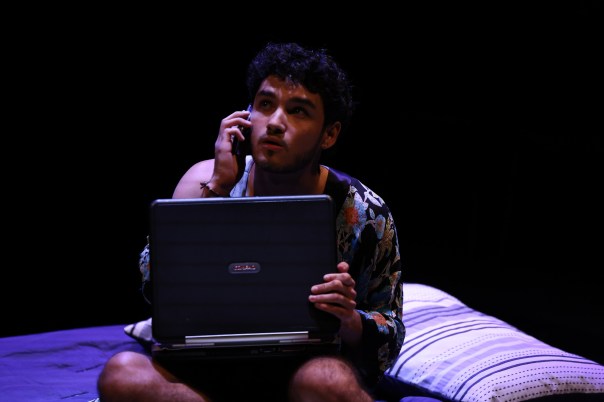
Comedy lurks in the details because Orlando can run circles around his dad with his tech savvy while he remains so self-centered and immature. A native Honduran who has assimilated more thoroughly than Mando, Rigo Nova brings a streetwise authenticity to this gruff businessman even though has chosen a more urbane path for himself. He makes Mando a juicy target for his son’s slights and barbs, only adding more to the impact of his own thrusts with his scarcely filtered vulgarity.

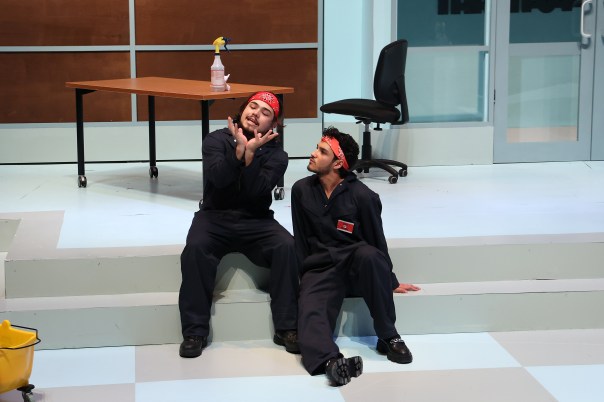
Directing this play in her Metrolina debut, Holly Nañes calls for a nicely calibrated mix of shock, resentment, curiosity, and cool from Nicolas Zuluaga as Orlando when his dad finally sheds his customary benevolence and test-drives the idea of punishment. There are no onsets of diligence, penitence, or heightened seriousness in Zuluaga’s demeanor as he dons a janitorial uniform for the first time in his life. Nor is there any childish pouting or seething resentment as he’s paired up with Rafael, the lowly immigrant.

That breeziness while playing with fire sometimes reminded me of Athol Fugard’s Master Harold in his insouciant superiority; at other times, when seducing Rafael, Curley’s wife from John Steinbeck’s Of Mice and Men came to mind – an undertow of foreboding as Orlando’s differences with Rafael mirror those he has with his dad. Zuluaga’s almost slothful dominance is nicely complemented by Richard Calderon’s wary and subdued debut as Rafael. He isn’t busting his butt either as he engages Orlando, but he’s working rather than slacking. We can see what Rafael has been through and that he knows the drill.

Striving to get over on Sean, the school jock and Rage Against fanatic, Orlando instinctively drops his cool superiority. We surely see that Logan Pavia as Sean is playing him, ruthlessly confident that he can get what he wants. Maybe Pavia’s audacity shocks you anyhow. The same sort of flipflop happens when Mando shows up Dick’s office, hoping his most-valued client will renew his contract.

We don’t see Rob Addison as Dick until late in the action, and it might have helped a little if we’d gotten to know the white plutocrat better. For this is Addison’s only scene, arguably the most explosive scene of the night as two generations of whites and Hispanics square off. A second blowup afterwards, registering somewhat less on the Richter scale, happens when Mando peeps in on his son and Rafael at precisely the wrong moment.

Stacy Fernandez as Mercedes, newly promoted to become Mando’s general manager, doesn’t witness either of these blowups – or Orlando’s humiliation in Sean’s car. That’s a double humiliation for Orlando because his dad has paused his promise to buy him a car. Without these contexts, Mercedes has a radically different perspective on how to make an American son than the one taking shape for Orlando and his dad. Fernandez gets the opportunity to express this bitter viewpoint in a blowup of her own, and she does not misfire – what she sees, we must acknowledge, is no less valid than what the men see.

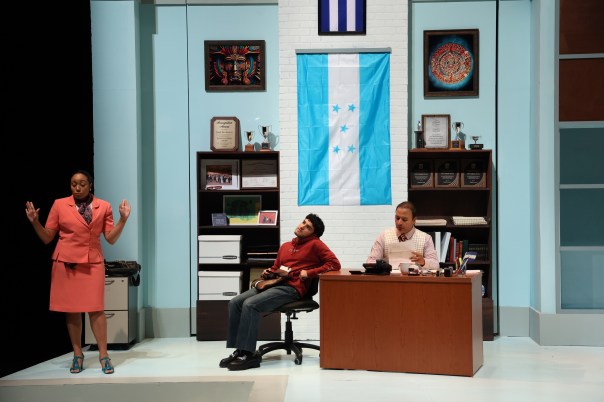
Slick and antiseptic, Harlan D. Penn’s glassy set design thoroughly purges Mando’s office of any color, artifact, or furniture that might be regarded as ethnic. Even the bookcases are vacuously neutral, populated with trophies, plaques, correspondence, business records, and binders. As the script swiftly underscores, no books. One shelf is entirely devoted to cleaning liquids, always at the ready in case a fingerprint sprouts up on a glass window or a door.

We may yearn occasionally for less polished flooring to separate us from Mando’s desk and the full-size Honduran flag that hangs vertically behind him. The frequently mopped surfaces evoke a sterile lab or an ER lobby where dirt comes to die. Or with that flag perennially in the distance, we might view that empty space as the desert that Latinx immigrants have crossed to get here. Or the spanking clean desert they found when they arrived.

Peppered with a contemptuous sneer, what Mercedes would tell you in answer to peña’s prompt is that both father and son have effortlessly become Americans without even trying. The answer Mando and Orlando would give you is grimmer than that.

By the end of the evening, thanks to peña’s deft plotting, there are battle scars supporting both points of view. The Donald’s wall across our southern border is the worst by far, but peña methodically shows us that it isn’t the only one.

Common Thread Presents an Uncommonly Well-Constructed Racial Comedy

Review: Barbecue at Davidson College

 By Perry Tannenbaum

Common Thread Theatre Collective - Barbecue

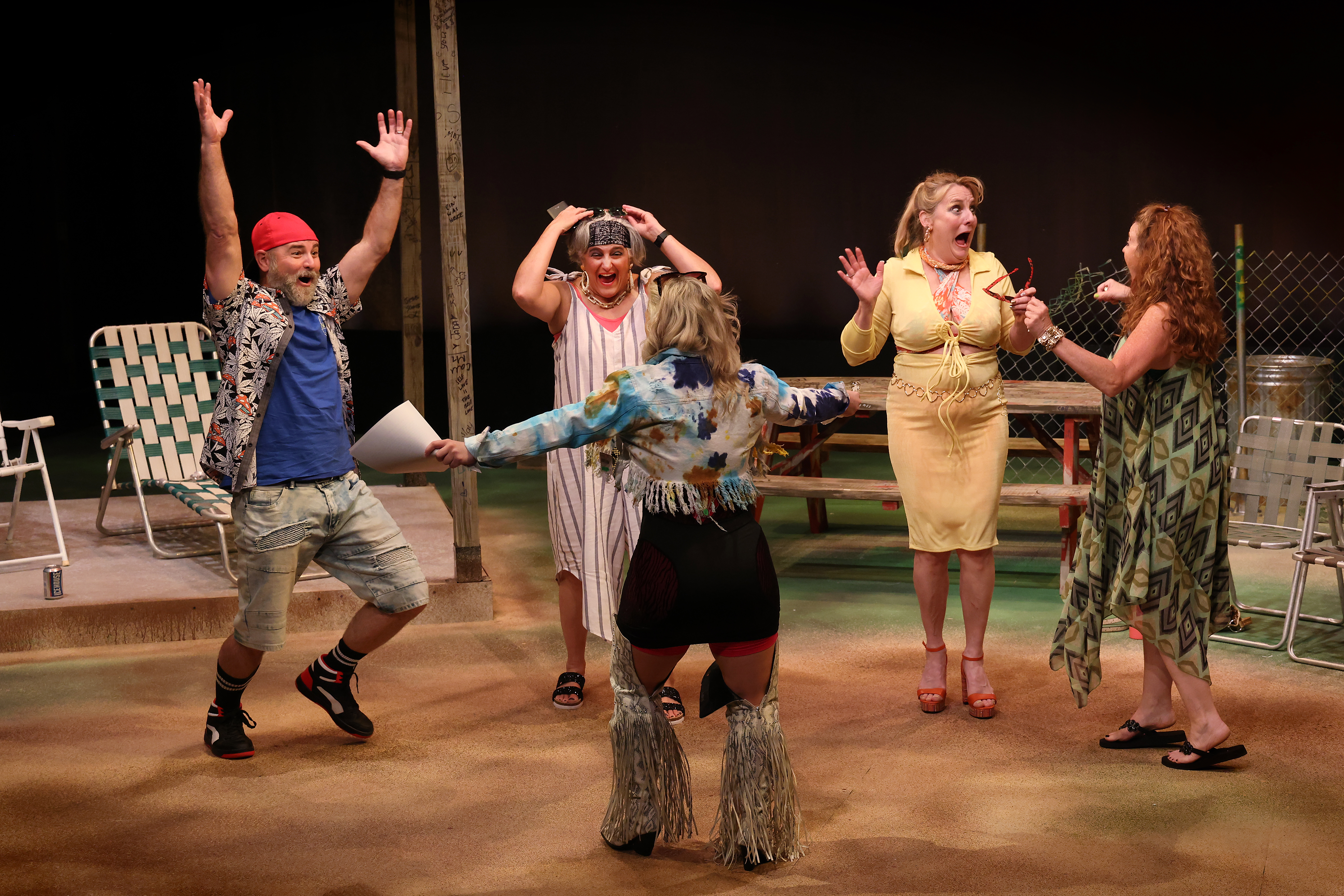
July 15, 2022, Davidson, NC – There are plenty of questions to ask in Robert O’Hara’s Barbecue as two O’Mallery families – one white and one black – gather at the same park, both of them staging fake outdoor parties for the same kindly but devious purpose. These questions explode upon us as soon as the white O’Mallerys are replaced by the black O’Mallerys after the first blackout, wearing the same exact outfits we have just seen moments earlier, drinking the same beverages, and popping the same pills. Even their names are the same. Both Lillie Anns are prodding their reluctant kinfolk – husband James T. and sisters Adlean and Marie – to drape the same pavilion at the park in party decorations, to feign a joyous family celebration, and to confront family renegade Barbara and get her into a therapy program that Lillie Ann has specially chosen for her in faraway Alaska.

Mercifully, we gather that both of O’Hara’s O’Mallery families are on the same track because their scenes deftly overlap rather than tediously repeating. The checkerboard structure of the playwright’s comedy was a perfect vehicle for the new hybrid company that was presenting it at Barber Theatre on the Davidson College campus. Common Thread Theatre Collective is a joint venture between North Carolina A&T State University theatre faculty members and Davidson’s Department of Theatre. Established 131 years ago in Greensboro, A&T is the nation’s largest historically black university, with a student body that is currently less than 80% African American. Domestic students of color, according to Davidson’s website, are currently at 28% of the matriculated population – and an influx of 8% international students enhances the College’s diversity.Common Thread Theatre Collective - Barbecue

Predictably enough, the two O’Mallery families appear to be blissfully unaware of one another – until intermission. Directing the show, Donna Baldwin encourages skin color to make a difference in how James T’s Pabst-Blue-Ribbon trashiness, Adlean’s chain-smoking vulgarity, and Marie’s besotted Jack Daniel’s elegance play out onstage. Maybe I’m biased, but the trashiness, vulgarity, and besottedness of the white folk seemed more outsized to me than their counterparts’, which chimed well with O’Hara’s overall design. The two Lillie Anns were woefully lacking in vices as they masterminded their schemes and manipulated their interventions, but both were more controlling than they strictly needed to be, relishing their dominion. Here again, Joanna Gerdy gets to be just a little bit bossier, trashier, and more crotchety than Willa Bost, her black clone, even though she was basing her master scheme on some cliched TV series.

We began to understand what was going on with the abrupt break in the action that brought us to intermission. If that sudden jolt hadn’t made it all obvious, O’Hara double underlined his answer in a manner almost as surprising as his intermission reveal. For the first time, a black person and a white person spoke to one another – and it was the two Barbaras, Ava McAllister Smith and Jade Parker, who clarified the mysteries we had seen, two characters who had hardly spoken 10 words between them until now. Suddenly, what seemed to be a satirical dive into the crassness of American life, with subtle distinctions between the races, acquired new meta textures as the two Barbaras met at the park and negotiated. How this story should be told, who should tell it, and how much it should cost were all up for grabs as the Barbaras jousted over making a deal and setting a price.Common Thread Theatre Collective - Barbecue

Taking it all in, from the unseen moment when Lillie Ann was inspired by primetime TV to hatch her scheme, moving along to how one Barbara reshaped her rehab memoir before her counterpart Movie Star Barbara bought the rights, I came away with the following message from O’Hara: fueled by drugs, alcohol, and toxic righteousness, truth is what gets most thoroughly slaughtered and barbecued in American life. On the way home, another pleasant thought hit me. Thanks to an artful gap between scenes in Act 2, rehab Barbara may have actually lowballed the amount of money she was promised earlier from Movie Barbara when she confronted the other O’ Mallerys with Hollywood’s offer.

The presence of two Actors Equity performers, more than we see in most touring shows nowadays, testified to the professional-grade theatre that Common Thread has delivered, for neither of them stuck out uncomfortably among their local and intern castmates. Parker and Smith were nicely matched in the comedy’s one interracial faceoff, taking turns in holding the upper hand and smoldering nicely when they didn’t. As the only men we see before intermission, Shawn Halliday and Tyler Madden get to pop and stomp plenty of beer cans as the JT’s, taking heavy fire from the Lillie Anns all the while, but Halliday is the seedier of the two while Madden has the edge in timidity. La’Tonya R. Wiley was a formidable presence as Adlean no matter how many cigs she fired up or how many pills she gulped down, while Lane Morris made her Adlean more strung-out than anybody.

Gregory J. Horton has designed a set of costumes that likely inspired Baldwin-Bradby and her cast nearly as much as O’Hara’s canny script. At the opposite end of the spectrum from JT’s splashy mashup of baseball, soccer, and tennis outfits is the eye-popping elegance of the lemon dresses worn by our Maries. These citrus dresses are accessorized with high heels that are just as inappropriate for an outdoor barbecue, along with jugs of Jack Daniel’s large enough to sport handles for easy chugging and pouring. Of the two Maries, it was hard to say whether I most enjoyed the arc of Shawna Pledger taking Marie from swilling to passing out, or whether Xulee-Vanecia J subsequently surpassed her in Marie’s decorous revival.

Questions about Barbecue continued to assail me on the drive home. Foremost among these was how anyone could imagine a homespun, humdrum story like this winning an award. Sure enough, O’Hara had embedded an answer. You can bet it had nothing to do with honesty and everything to do with America.

Orpheus Isn’t Calling the Tunes in Sarah Ruhl’s “Eurydice,” Told for Once from a Feminist Perspective

By Perry Tannenbaum

February 17, 2016, Charlotte, NC – The story of Orpheus and Eurydice didn’t start off as a particularly misogynistic myth. When Vergil told their story, he said it was the queen of the Underworld, Persephone, who decreed the conditions under which Eurydice was to be returned to life: that she follow behind Orpheus on the trek back to the living and that Orpheus not look back on his wife until they reached the light. After all of his musical exploits; charming the guardians, inhabitants, and rulers of the Underworld; it’s Orpheus who causes Eurydice’s second death by looking back – without the slightest provocation from her. Ovid’s subsequent retelling is even more benign, for he never states whether it was Pluto or Persephone who imposed the conditions that Orpheus violated.

In the annals of opera, the story has a hallowed place, sparking the first masterworks by Monteverdi (1607) and Gluck (1762). It’s only in Gluck’s Orfeo ed Euridice where we might find some truly cringe-worthy traces of misogyny. Not knowing the conditions of her salvation, Euridice insists upon the two things Orpheus cannot do – look back or explain – with excruciating persistence until he gives in. But after that catastrophe, Orpheus grieves so eloquently that Eurydice is revived for a second time by the God of Love and all ends happily. So why did playwright Sarah Ruhl decide to drastically revise the myth in Eurydice, her 2003 play now at the Cunningham Theatre Center on the Davidson College campus? If the impulse is feminist, it’s likely because Ruhl wished to tell the story from Eurydice’s perspective for once.

Nor is Ruhl’s tone angry, for there is plenty of whimsy in her updates and alterations. Orpheus now plays a violin instead of plucking a lyre, and Eurydice calls more of the tunes. Taking a couple of breaks from her wedding celebration, she encounters a Nasty Interesting Man who lures her with the promise of something important – a letter sent to her from the Underworld by her dead father. Rather than dying from a snakebite as she flees a lecherous pursuer, the mod Eurydice dies in the act of recovering what belongs to her, an intrepid action rather than a fainthearted one. This Davidson College Theatre Department effort, student directed by Matthew Schlerf, remains timely without any militant edges.

Scenic designer Chris Timmons brilliantly utilizes the Barber Theatre stage, dividing the action into three distinctive levels. Floor level will be the Underworld, but we begin on a broad platform high above that, where Orpheus proposes and the nuptials are celebrated. Further above, a permanent upstage stairway to the studio’s catwalk arches over the Nasty Man’s lair, offering the highest point possible for Eurydice’s fatal plunge. Death is a downer, to be sure, but Eurydice certainly isn’t chastened or humbled by her fall. Impervious to the indignity of the shower that greets her at the gateway – she has come prepared with a handy umbrella – Eurydice expects to be shown to her living quarters even though a chorus of stones has told her that there aren’t any. Not to worry, Eurydice’s father dutifully shows up to pick up her empty suitcase, guide her to her room, and begin teaching her all that she forgot in the River Lethe. I can’t say how Dad is supposed to build Eurydice’s room in Ruhl’s script, but here he weaves his magic with a rainbow-colored ball of twine threaded through eyelets on the floor and the stage-left wall, forming a gleaming cat’s cradle.

By introducing Eurydice’s father into the mythic mix, Ruhl gives her heroine a reason to linger down below and feel some ambivalence about obediently following in Orpheus’s wake. On the other hand, Dad’s pre-nup letter to his daughter becomes a precedent after her untimely death, for Orpheus dispatches a letter to his vanished beloved, relying on the worms for delivery – and Eurydice has no less confidence that what worked for her dad will work for her. The eternal comfort of this system of family correspondence is spoiled by just one thing: the Lord of the Underworld, who reeks of the Nasty Man’s unsavoriness (they’re played by the same actor), wants to make Eurydice his bride. One more reason to go with Orpheus when he finally comes knocking.

Schlerf casts judiciously, using players who are mostly sophomores but not younger. As the lovebirds, senior Cy Ferguson as Orpheus and sophomore Savannah Deal in the title role pair up magnificently. He’s good-hearted, undoubtedly vulnerable, and the perfect antithesis of his nasty rivals. Deal is up to the spoiled, imperious figure she cuts entering the Underworld, but we never catch her trying to come across any older than she is. This is a natural Eurydice, not a flawless one. That approach may not be as ideal for Collin Epstein as Father or Ryan Rotella as the nasties above and below ground. Costumes by Carolyn Bryan help Epstein as Dad and Rotella as the Godfather-like Nasty put on a few years perhaps. But both speak as naturally as Deal does, a welcome change if you’ve ever been irritated by young actors straining to look older with the aid of makeup, hair coloring, or false beards. Once we adjourn to the Underworld, Rotella is purposely portrayed as childish when he appears as Lord of this domain, wearing a dopey beanie and pedaling a trike. And if this isn’t a punitive, hellfire Underworld, why can’t Dad be any age he likes while spending eternity there? Ruhl mischievously makes up her own rules as she spins her old yarn, twisting it enough to make it new and genially provocative. There’s even a beguiling touch of mystery when we reach the ending.

© 2016 CVNC