Tag Archives: Andy Faulkenberry

Let “The Drowsy Chaperone” Hypnotize You

Review: The Drowsy Chaperone at Theatre Charlotte

By Perry Tannenbaum

My advice for best enjoying The Drowsy Chaperone at Theatre Charlotte is to listen to the Man in the Chair – and yield to his pitch-dark hypnosis. Yes, before the lights even go up at the old Queens Road barn, he’s in his chair speaking to his audience and conjuring up what we should hope and pray for: “I just want to be entertained. Isn’t that the point?”

As the show unfolded, brilliantly directed by Billy Ensley with what must be the local cast of his dreams, I realized that, as a critic, I shou

ld heed that hypnotic suggestion devoutly. Discard my usual pointy critical and analytical tools. What’s more, I came to believe more and more strongly that, if actors and directors of previous Drowsy Chaperones I’d seen had followed that simple mantra, I would have fallen in love with the show long before last Friday night.

When the lights came up a few minutes deeper into the Man in Chair’s monologue, we saw him locking the front door of his humdrum apartment with four or five assorted deadbolts and chains. It’s a bit of an abrupt swerve, but we’re suddenly aware that this Broadway musical devotee is a recluse and a bit paranoid. Each time the phone rings, we’ll see that the Man in Chair fails to answer, yet another confirmation of these traits.
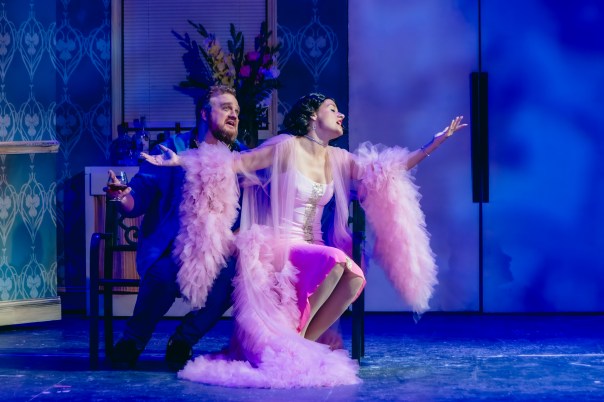
By the time the title character of the fictional “Drowsy Chaperone” is a few wobbly notes into her showstopping “As We Stumble Along,” we already should know that the Man in Chair is gay, which accounts for Lisa Smith Bradley delivering the song as a living fetishization of Ethel Merman and Judy Garland – Merman’s vibrato wedded to Garland’s glitter, slacks, and drug dependency.

Yet when we’re watching Kyle J. Britt as our genial host, we need not attribute his reclusiveness or paranoia to being a gay man. As a Broadway musical fanatic, this Man in Chair identifies more readily as a New Yorker with Innerborough hangups. Meanwhile, Bradley is sufficiently over-the-top as both gay icons – especially Merman – to be accused of impersonating a female impersonator.

We might say that Ensley & Co. have decided that being gay in 2024 isn’t nearly the leaden weight it was in 2006 when Drowsy Chaperone premiered in the Big Apple or in 1996 when Angels in America tore the QC apart and made us a laughingstock. Pretentiousness, solemnity, and subtlety really are inimical to this delicate relic. Britt handles it with audiophile care as removes the vinyl disc – a rare original cast recording of his favorite 1928 musical – from its LP sleeve and gives both sides a loving once-over with a Discwasher brush before lowering his treasure onto a turntable.

The same can be said of size and scale, which may also have muffled my enjoyment of productions at Belk Theater in 2007 and Halton Theater. There’s something so right about our little séance in the dark at the Old Barn on Queens Road that it cannot attain in a more modern and spacious hall where the Man in Chair must project his spell into a distant balcony. The homeliness of the Man’s urban dwelling also sits better on Queens Road than in the bowels of a bank building on Tryon Street.

To be honest, it’s Broadway Lights and the late CP Summer Theatre that should apologize for not matching the unpretentiousness of Josh Webb’s scenic design. Of course, it would be nice if Webb’s scenery could transform spectacularly into Broadway splendor when the stylus of our host’s turntable comes down – with its signature thump – onto the vinyl and the mythical “Drowsy Chaperone” comes to life. In the less-is-more world on Queens Road these days, these shortcomings are comedy assets, part of the overall charm.
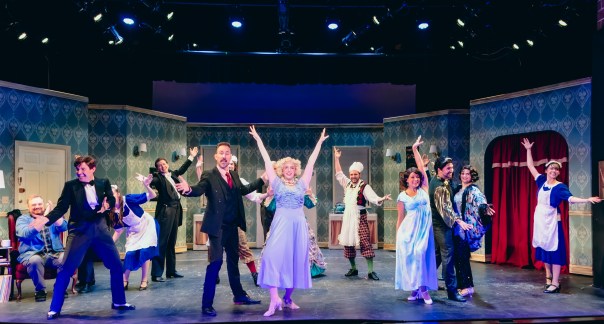
On the other hand, our time travels to 1928 get a softer landing thanks to the costumes by Beth Killion, notable for their flair, their formality, and their discreet dashes of color. We’re awaiting the wedding of Robert Martin and Janet van de Graaf, so there are actually multiple levels of time travel here, for Bob Martin actually co-wrote the Drowsy Chaperone book with Don McKellar – and starred in the original Broadway production as Man in Chair – while he was married to the real-life Van de Graaf.

In fact, this originally Canadian work, which eventually layered on music and lyrics by Lisa Lambert and Greg Morrison, was gestated at Martin’s stag party in 1997, nearly 70 years after these fictional nuptials. More reasons not to view this lark as a gay cri de cœur.

Rare as his vinyl treasure may be, Britt comes across less as a scholar or a critic than as a fanboy, occasionally panting like an eager puppy as he presumes to approach his fantasy idols more and more closely. More than once, the principals will obligingly freeze for him. Nor does this Man in Chair seem to favor the men over the ladies with his adoration, only tipping the scales just before the final bows. Charmingly enough, there are overtones of scholar and critic as he dishes tasty trivia about the fictitious “Drowsy” cast members or advises us to be on the lookout for some truly dreadful lyrics.

These glamorous, theatrical, servile, and criminal characters are all blissfully ignorant of the nerd who has conjured them up, preoccupied with their conflicting efforts to carry off the planned wedding or ruin it. The bride herself, Lindsey Schroeder as Janet, seems to be grandly ambivalent about becoming Robert’s wife, sacrificing her glittery stage career and the adoration of millions, while suppressing her basic instinct to “Show Off.” Love is at comical war with vanity. Carried away by the swiftness of this whirlwind romance, Andy Faulkenberry as Robert also has his doubts.

Aside from Janet’s drunken chaperone, politely labelled as Drowsy, there are a butler Underling, an eccentric Mrs. Tottendale, and Robert’s best man George shepherding the loving lambkins to the altar. Only Zach Linick as George seems to be afflicted with any degree of competence or reliability. More importantly, he and Faulkenberry make up a formidable tapdancing duo. (Thank-yous to choreographer Lisa Blanton.) Allison Rhinehart as a frilly, bustling Tottenham and Darren Spencer as the gray and starchy Underling are no less inevitably channeled toward blithe entertainment.

Counterbalancing the fragile determination of the bride and groom, compounded by the flimsy protection of their good friends, we have an exquisite mix of bumbling baddies trying to sabotage the wedding. These are led by Joe McCourt as Broadway producer Mr. Feldzeig (Feldzeig Follies ring a bell?), under pressure from his mobster backers, who consider Janet to be the cash cow of the Feldzeig franchise. The sneering McCourt is bedeviled by Gangster 1 and Gangster 2, armed emissaries – Titus Quinn and Taylor Minich – masquerading as hired chefs to ensure a catastrophe.

Ah, but it isn’t simply muscle aimed at swaying the maiden and returning her to showbiz. Somehow, a predatory Lothario is among the wedding guests – although he has never met anyone else there. Mitchell Dudas is this egotistical Adolpho, far more arrogant than Feldzeig, a mixture of Erroll Flynn and Bela Lugosi with a thick Iberian accent. Feldzeig has no trouble at all convincing Adolpho that he was born to seduce the bride-to-be.

Equally dumb, Autumn Cravens as Kitty is a ditzy chorine, constantly nagging her boss and wedding escort Feldzeig to let her fill Janet’s shoes in his next Follies. Effortlessly, Dudas will outperform Cravens in thwarting Feldzeig’s schemes. Love conquers all, but it would be a huge spoiler to say how many times when we reach this very happy ending.

Just one more wild card is needed to tie up all the festivities. Be on the watch for Trinity Taylor as Trix the Aviatrix, who descends from the skies at just the right moment with a voice of thunder. For a few moments, she even upstages Britt and Schroeder who are so fabulous.

It would be a mistake to miss the craftmanship lavished on this plot with its stock characters by Martin and McKellar, brought out so brilliantly by Ensley and his dream cast. For instance, think how perfectly 1928 was chosen: between Lindbergh’s transatlantic flight, Babe Ruth’s 60 homers, The Jazz Singer of 1927 and the Wall Street Crash of 1929. A brief last window of bliss before global misery. In the real world, the parade of yearly Ziegfeld Follies revues would be halted after 1927 – until 1931.

Strong CP Cast Unleashes Newfound Power of “Ragtime”

Ragtime Promo Photos

Review: Ragtime The Musical

By Perry Tannenbaum

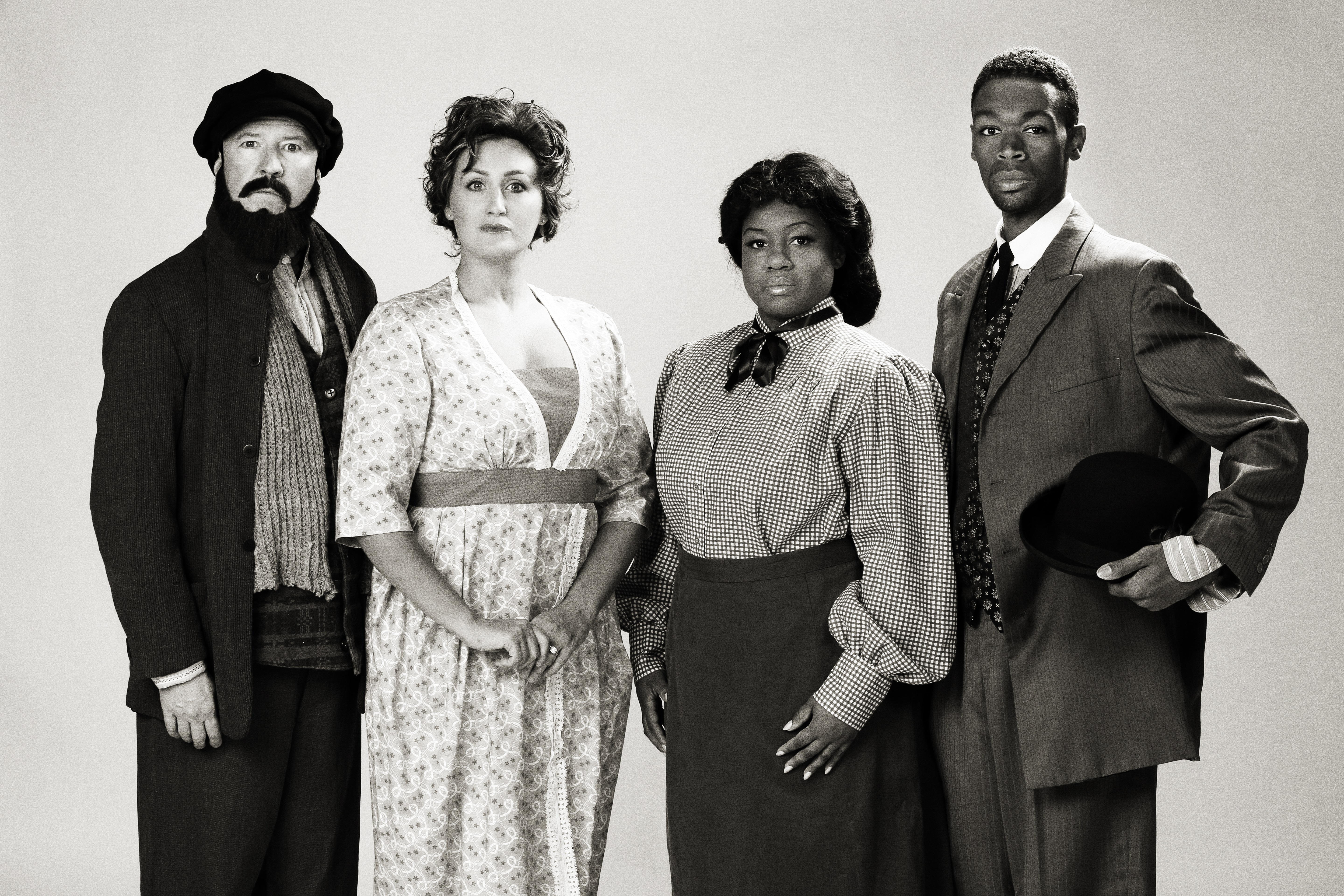
Like Fiddler on the Roof, another musical with wide vistas, Ragtime The Musical begins its voyage back to 1906 by introducing us to groups of people. The stage begins to fill with comfortable, well-mannered white folk. Oppressed black folk, struggling for dignity and survival, form a crowd at the opposite side of the stage. Immigrants, disoriented and bewildered in the Promised Land, fill in the divide. Social activists Booker T. Washington and Emma Goldman flank the groups, along with the celebrities who tower above them all, including Harry Houdini, Henry Ford, J.P. Morgan, and Evelyn Nesbit.

But while shtetl life in Czarist Russia remains quaint, picturesque, and old-fashioned with each new revival of Fiddler, the issues revisited in Ragtime – racial prejudice, women’s second-class citizenship, and intolerance toward immigrants – have bounced back in our faces with frightful new life. The superiority we could feel toward the injustice suffered by Coalhouse Walker Jr. has evaporated since the days when Ragtime was published by novelist E.L. Doctorow in 1975 and adapted by Terrence McNally for the 1998 musical. Trayvon Martin, Ferguson… the list goes on.

Women’s rights and the welcoming attitude symbolized by Lady Liberty are also threatened by the reactionary sentiments unleashed by the 2016 election, the odious barrage of anti-Muslim rhetoric, and the post-inauguration travel ban. So the current CPCC Theatre production of Ragtime is not only timely, but thanks to one of the best casts ever assembled on the Halton Theater stage, it’s also newly powerful.

Tyler Smith delivers the most scorching performance as Coalhouse, particularly in the ragtime pianist’s valedictory solo, “Make Them Hear You,” when he’s on the brink of martyrdom. It’s as devastating a Coalhouse as I’ve ever seen, including the original Broadway production and the first national tour. But the taunting and race-baiting that come at Coalhouse from Josh Logsdon as New Rochelle fire chief Will Conklin no longer seem to be clichéd. Where Brian Stokes Mitchell on Broadway might have asked himself “how would I have felt 90 years ago?” Smith is merely tapping into how he feels – and it’s very fierce and raw.

The voice and delivery are Broadway-worthy, so it’s not at all a slight when I say that Smith’s partner, Brittany Harrington, nearly reaches the same lofty level as Sarah. When they reconcile and introduce “Wheels of a Dream,” seated in front of their Model T roadster, Harrington reminds us that this dream belongs to them both. It’s a tribute to their combined power that director Tom Hollis nearly empties the stage of the entire ensemble when the song is reprised at the end as an anthem. Together, as the happy-ending segment of the cast strolls into the horizon, Smith and Harrington sing them off.

What struck me by surprise was how much more forcefully the peaceful Mother’s story resonates. It’s quite natural to think of Mother as one of the handy junctions in this artfully interlaced tale. She welcomes Sarah and her newborn baby into her New Rochelle home, drawing the abandoned Coalhouse in pursuit – before he even realizes that he is the father of her child. Younger Brother, a member of the same well-to-do household, has a string of idols, including Nesbit and Goldman, before joining Coalhouse after the bold seeker of justice has taken over J.P. Morgan’s Manhattan library.

Ragtime Promo PhotosWhile all this spectacle rages around her, Mother has begun to evolve, almost from the moment that Father sails off with Admiral Peary on his expedition to the North Pole. After welcoming Sarah and the newborn into the household, her empathy widens to Coalhouse. Smith exudes a Nat “King” Cole kind of savoir-faire at the keyboard, so we’re not surprised. Yet Grandfather (Brian Holloway) is horrified and, after he returns from his explorations, so is Father.

But in the intervening year after her audacious decision to open her doors to Sarah, Mother has discovered that she has a voice. Not a small revelation when it comes more than three presidential elections before she will get the vote.

So while Andy Faulkenberry has a fine revolutionary zeal as Younger Brother, while Megan Postle breathes Mosaic fire as Emma Goldman, and Patrick Ratchford is extraordinarily patrician and privileged as Father – one of his best-ever outings – it was Lucia Stetson as Mother who truly bowled me over. The arc of Stetson’s journey, from “What Kind of Woman” when she first meets Sarah to “Back to Before” when she realizes she cannot continue under Father’s restrictions, is stunning and inspiring. This is how much a person can evolve. To his credit, Ratchford lets us know that Father has also budged slightly from his bigotry when his brave stint as a hostage is done.

In a way, Billy Ensley personifies all immigrants as Tateh, who arrives at Ellis Island at precisely the moment when Father is embarking on his polar adventure. J.P. Morgan, Goldman, and Houdini are all wrapped into Tatah’s dreams of “Success” and disillusionment, but neither Doctorow nor McNally soft-pedal his Jewish heritage. Right before his wide-ranging fantasia, Ensley sings “A Shtetl Iz Amereke” in his first song, faring better with the Yiddish than the chorus of immigrants behind him.

Houdini, a circus-like attraction in Tim Eldred’s portrayal, likens achieving success to escaping from a cage, but it’s Goldman, a fellow Jew, who speaks home truths. When Tateh wraps his daughter (Annabel Lamm) in a prayer shawl to combat the cruel cold, Emma says his rabbi would approve. Tateh is indeed a role of Houdini tricksiness as he begins by cutting out silhouettes of celebrities, later toils and goes on strike at a Massachusetts textile mill, and finally becomes the quintessential American success story when he reinvents himself as an Atlantic City filmmaker, Baron Ashkenazy.

Against the sunniness that Ensley brings to this epic musical, Keith Logan as Booker T. Washington and John DeMicco as J.P. Morgan help to shape the dark tragedy at the Morgan Library. It seems so much more inevitable to me now than it did when I first saw the denouement in 1998. If we can’t trust policemen to hold fire in 2017 when a black man surrenders with his hands up, how could we expect that they’d behave otherwise before World War I?

“We are all Coalhouse,” the ensemble sings in the somber aftermath – with a fresh sting. These words now ring as true as yesterday’s headlines. Much more in this CP revival of Ragtime may strike you that way.


Selling Elegance, Spirit, and History for Just a Song

Theatre Reviews: I Love a Piano: The Music of Irving Berlin and The (curious case of the) Watson Intelligence

CPCCILoveAPiano6[7]

After its most lavish and extravagant production ever, last November’s The Phantom of the Opera, what was CPCC Theatre going to do to follow up? Well, since the laws of mathematics and the logic of budgets still apply on Elizabeth Avenue, the answer was simple: economize! Rolling into the parking garage, where the second story was unusually unoccupied, I was worried the audience for I Love a Piano: The Music of Irving Berlin would be as drastically reduced as CP’s expenditures.

Not to worry, I didn’t find that many more empty seats at Halton Theater last Saturday night than I saw at last February’s How to Succeed. More importantly, considering the relative merits of Berlin and Andrew Lloyd Webber, the show attracted a competitive enough turnout at auditions to yield a cast that is worthy of the music — including holdover Ryan Deal, who you may recall in the title role of The Phantom.

Like the audience, the orchestra isn’t reduced quite as much as the funding, a quintet led by music director Ellen Robison from the keyboard. They’re a busy bunch, accompanying the cast — all six of them triple threats to various degrees — through a songbook that includes 53 different titles. A few of these songs are reprised, and at one point, when Andy Faulkenberry’s “The Girl That I Marry” is juxtaposed with Corinne Littlefield’s “Old Fashioned Wedding” — while J. Michael Beech and Megan Postle are teaming up on the counterpoint of “You’re Just in Love” — there are four different vocalists onstage singing four different melodies simultaneously.

Conceived by Ray Roderick and arranger Michael Berkeley, Love a Piano never says Berlin’s name out loud. But the 11 scenes, beginning with Tin Pan Alley in 1910 and ending in a summer stock revival of Annie Get Your Gun in the late 1950’s, take us chronologically through the composer’s career. Or roughly so: “Old Fashioned Wedding” was written for the 1966 revival of Annie Get Your Gun, and you can bet the anachronisms don’t stop there.

With a generous portion of poetic license, the show sketches a musical portrait of a composer who was consistently able to mirror his times. The title tune, “A Pretty Girl Is Like a Melody,” and “Alexander’s Ragtime Band” take us back to a sepia-tinted era when rags roamed alongside sentimentality. As we cut from band shell to speakeasy, “Pack Up Your Sings and Go to the Devil” and “Everybody’s Doing It” evoke the wicked carefree spirit of the Roaring ’20s during Prohibition.

Two scenes are devoted to the ’30s, “Blue Skies” and “I’ve Got My Love to Keep Me Warm” offering consolation during the onset of the Great Depression. Then a suite of dance tunes, including “Top Hat, White Tie and Tails” and “Cheek to Cheek,” evokes the elegance of Fred Astaire and Ginger Rogers. Thanks to Mel Brooks, the audience failed to take “Puttin’ on the Ritz” altogether seriously.

For some reason, Roderick — or perhaps CP’s director and choreographer, Ron Chisholm — bounced the heyday of dance marathons from the 1930s to the 1940s, sketching that lugubrious phenomenon with “Say It Isn’t So” and “How Deep Is the Ocean.” When we authentically reached the World War II era, it was quite obvious that Berlin more than reflected the hopes, the pride, and the humor of the times. He simply was these things, with a flowering of songs that included “Oh, How I Hate to Get Up in the Morning,” “This Is the Army,” “Any Bonds Today,” and “Count Your Blessings Instead of Sheep.”

Even those left plenty of room to bring down the first-act curtain with two of Berlin’s most enduring songs, “White Christmas” and “God Bless America.” A more judicious dividing line would have been the beginning of WW2 toward the end of the ’30s. As it stands, Roderick drops a bunch of CARE packages on the 1950s, including “Easter Parade” from 1933 and everything attached to Berlin’s sharpshooting homage to Annie Oakley, which premiered in 1946.

I Love A Piano

Photos by Chris Record

James Duke’s scenic and lighting design, relying heavily on period slides and Berlin show posters projected onto three screens, move us gracefully from era to era. But it’s Debbie Scheu who most colorfully clinches the deal with her cavalcade of costume designs. Chisholm’s choreographic demands certainly tax his cast, with Littlefield and Faulkenberry negotiating their steps with the most apparent ease. On the other hand, while Postle and Beech looked like they might not be up to their challenges, both of them surprised me with their hoofing.

Deal and Kayla Ferguson were the remaining couple, most memorable in their “Blue Skies” duet. All six of the singers proved to be quite capable, not at all fazed by the spotlight, but Deal and Littlefield were my favorite soloists. The ensembles were often very lively and charming, but a special pinch of conflict was added in the summer stock tableau when Ferguson, Littlefield, and Postle all auditioned to be Annie opposite Faulkenberry’s Frank Butler.

“Anything You Can Do,” usually a comical face-off between Frank and Annie, is set up as an audition piece. So the comedy is reborn — as a rollicking showdown between three aspiring Annies.

Eliza and Watson 3

Time and reality bend in curious ways in The (curious case of the) Watson Intelligence, now at UpStage in NoDa through February 21. But so does playwright Madeleine George’s title, so what else would you expect?

Three rather curious Watsons that we’ve already heard of are trotted out and shuffled in Three Bone Theatre’s production, directed by Robin Tynes. The first of these is a relative, shall we say, of the Watson computer that defeated its human opponents on Jeopardy in 2011. Eliza, who collaborated with IBM on the victorious Watson, is now in her living room, working independently on a new android that sports a far more human body.

We travel back to the 19th century for the other two Watsons that we know. The first of these is the Watson summoned to Alexander Graham Bell’s side when Pa Bell invented the telephone, his assistant Thomas A. Watson. But we don’t really see him, either, on that historic day in 1876. Instead, it’s Alex repeatedly calling for him in brief blackout vignettes between other scenes. No, we must wait until 1931, when Watson goes on record at Bell Labs, insisting that what his boss really said was, “Mr. Watson — come here — I want you.”

The third or fourth Watson, depending on how you tally the computer chips, is more in control of his narrative, for this is the Dr. John H. Watson who ostensibly chronicles nearly all of the Conan Doyle adventures of Sherlock Holmes. You’ll find that Watson Intelligence is all about connections Ð personal and electrical — and vague connections between the android and Sherlock’s sidekick are established by a fifth Watson, a tech dweeb hired by Eliza’s ex-husband to spy on her.

Compounding the absurdities, Tynes has chosen a black actor, Devin Clark, to play the whitest sidekick in the history of literature. What’s more, Clark is perfection as all the Watsons, human and robotic, plus a special set of scenes where he dons Sherlock’s deerstalker cap. Chesson Kusterer-Seagroves crystallizes Watson’s role as the archetypal listener, pouring out her heart to the robot and the tech dweeb in modern times and bringing an intriguing mystery to Watson at Baker Street in Sherlock’s absence.

Ken Mitten rounds out the cast as Bell and the two Merricks who cause their Elizas so much distress. He’s a powerful stage presence, but I’m sure he’ll be even better when he’s more secure with his lines and cues.