
“Eureka” and “Vanya” Agreeably Disagree

As playwright Tracy Letts knows well, there are unpleasant truths at the heart of American life and the American Dream. “Sometime tonight, when the temperature of your home drops to a specific mark and you hear the heater come on because that’s what you’ve programmed it to do, remember that you live in a cocoon of comfort and safety because a lot of people who came before you weren’t afraid to get their hands dirty.”
Those clear-eyed, merciless words were delivered by the Mayor Superba of Big Cherry at the climax of The Minutes, Letts’ unexpectedly savage and sensational 2017 drama. The Metrolina premiere was presented last month at the Armour Street Theatre as Volume 1 of Davidson Community Players’ Sacred Places project. With a no less of an innocuous title, the world premiere of Stephanie Gardner’s A Small and Humble Erasure is completing DCP’s project – with a sacred place that hits closer to home.
Gardner has actually customized her script for Armour Street and for the members of the cast, directed by Michelle Medina Villalon. While Letts located his drama at a fictitious City Hall built on the blood of slaughtered Native Americans, Gardner’s piece reminds us that Theatre Charlotte is built on more sacred ground, over a cemetery consecrated for African American slaves.

And she tells us, naming names, just how this cemetery was “deconsecrated” and who was responsible. Mayor Ben Douglas and numerous councilmen are in the room where it happened, all of them white men from respected Charlotte families: Baxter, Hovis, Albea, and Wilkinson – with mischievous colorblind and gender-blind inroads in Villalon’s casting. Starting with the famed Mayor whose name is perpetuated on the QC’s international airport.
A future councilman, attorney John Small, introduces the motion at a City Council meeting in 1936, nine years after Theatre Charlotte had been founded as the Charlotte Drama League and five years before the Old Queens Road Barn celebrated its housewarming. By this time, Tom Humble had settled into his role as Little Theatre of Charlotte’s artistic director.
So the workings of this Small & Humble alliance give Gardner’s title a clever double entendre. Humble, at least, is haunted by the fact that his new fixture in Charlotte’s cultural life was built on the backs and graves of Southern slaves. Big Cherry, on the other hand, leans into their past desecrations after the truth is painstakingly revealed to them by a rogue councilman. Their actions are sensationally horrifying, while Gardner’s white folk are more decorously rueful.
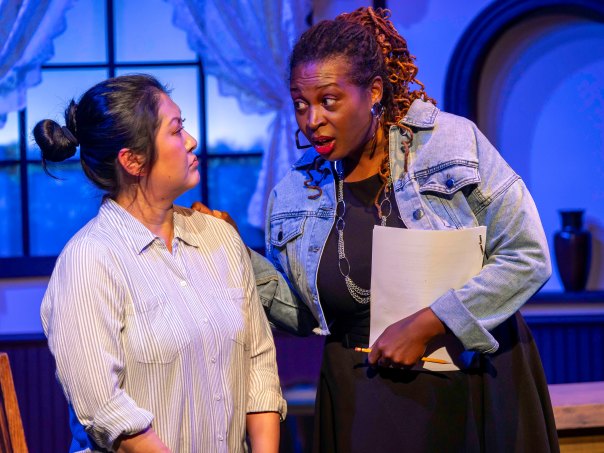
Of course, there’s considerable satirical bite to Gardner’s concept, above and beyond the casting vengeance she takes on all the benign and virulent segregationists who are culpable for this sacrilege. An African American, Andrew C. Roberts, portrays both Mayor Douglas and plutocrat Harold Dwelle, and Amy Wada, an Asian American, is our narrator!
She brings us into the Myers Park homes of these benefactors, the Dwelles and the Myerses themselves, delving into the petty maneuverings of their estates. These include the hallowed cemetery and the adjoining Cherry neighborhood. Yes, DCP executive director Steve Kaliski & Co. could have easily called their pairing “The Cherry Project.” Interestingly enough, both Cherrys have insulting and racist slurs associated with their names as well as complicit Mayors in their dramas.
Making Amy Wada our personable and slightly stressed narrator is obviously an entertaining choice. But I’m not always aboard with the idea of actors behind her frequently breaking character and interrupting her – perforating and undermining the seriousness of her narrative, threatening to trivialize the history.
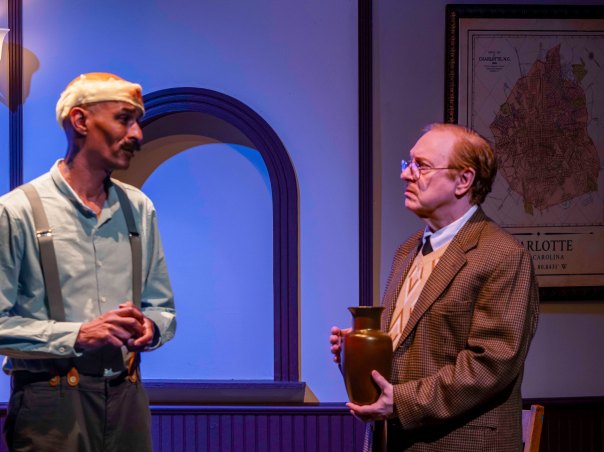
Getting Hank West, indisputably one of Charlotte’s best, to play Tom Humble is a similarly two-edged sword. Villalon and Gardner must have been sure that West gave the best audition, and he impeccably balances the Indiana native’s haughty elitism, his ambitions for the Queen Road Barn, and his conscience. But for those of us who have seen West’s work over the last four decades, it’s a bit of a hurdle disliking his Humble in the artist’s worst moments.
Clean-cut with mature Everyman looks, Mark Ariail is a fine complement to West as the conniving Small, the lubricant that connects Humble and Myers Park to the Charlotte City Council. We have a hard time labeling him as evil despite the obvious earmarks. Little Theatre was little, after all, and Queens Road was the closest the fledgling company could hope to get to the QC’s high-priced Uptown real estate.

Gardner seems willing to allow that the upstanding Charlotte citizens of the 1930s were shaped by their times and less eager than Letts to condemn and ridicule them for their actions and customs. But she does provide a second backdrop to the unfolding Small & Humble “erasure”: black folk who set the plutocrats’ tables and black folk who were buried beneath them.
Roberts is neither of these, but he’s useful in Gardner’s concept beyond his key roles as Dwelle and Mayor Douglas. He’s also “new” to the cast, so Wada can be explaining the history – and the colorblind casting – to him as well as us. Lowell Lark, when he removes the enslaved Harvey Foster’s bloody bandage from his head, becomes a somewhat comical Councilman Baxter when the Theatre Charlotte ordinance is passed, returning years and years later to haunt Humble and become part of Queens Road lore. When that happens, it no longer seems amiss that he doesn’t strictly conform with Gardner’s description of him as a 17-year-old when he died.
Myneesha King as Johnsie Foster, the Dwelle family housemaid, gets to be a sometimes-acerbic conscience for the great white benefactors of Myers Park – and she’s pretty sassy toward Amy, so it isn’t a demeaning role. King is also significant the living descendant of the buried and betrayed slave population distilled into the voice and wounded image of Harvey Foster.

Briefly, King can relish returning as Barbara Burke, the first African American to appear in a Little Theatre production in 1970. It’s Wada, though, who points out that this was three years after Humble retired. Then we hear the vanilla quote in our newspaper’s coverage straight from King’s lips: “If the whole world would say people are people and not what color you are, it would be a wonderful place.”
We do get along here in Charlotte, don’t we? Ironically enough, Gardner reminds us that the first play produced at the new Little Theatre, once the gravestones were cleared away, was Moss Hart & George S. Kaufman’s George Washington Slept Here. Talk about a whitewash!
The white women of Myers Park, bless their hearts, are at least ambivalent about what’s going on over at the top of Queens Road. Pam Coble Newcomer as family matriarch Mary Rawlinson Myers insists that the Negro Cemetery should belong to the Cherry community in perpetuity, but has neglected to ensure that her wishes are legally airtight.

Along with King as Johnsie, we empathize with Mary the most, especially since she’s confined to her deathbed. Newcomer is liberated from her bedclothes for two comical turns, becoming Councilman Albea and Little Theatre actor Jack Knell. Jack’s wife, Dorothy Knell, is also in the cast of the first show presented at the new theater in 1941, so Cat Rutledge completes the amusing little gender-blind episode.
Rutledge, like Newcomer, also gets to have fun at City Hall as Councilman Wilkinson, one of our proud city’s banking visionaries. (Is the notorious boulevard named after him? Yup.) She also comes out as perhaps the meanest meanie onstage at Armour Street, jousting with both Mary and Johnsie as Mary Myers Dwelle – or Mary II – as she helps push the Little Theatre initiative through City Council.
Perhaps because she also pushed through the first art museum in the state, The Mint, Myers’ aristocratic daughter is allowed to luxuriate in regrets similar to Humble’s. Aw, cut them some slack, Gardner seems to say. Better to simply mention The Mint, IMHO.
Volume 2 isn’t speckled with shameful or diabolical celebrations like The Minutes, last month’s Volume 1. Nor does it chill us like Mayor Superba’s cynical admonition, cited above. The best Humble can do is “I don’t know how to fix it.” Honest enough. Mary Dwelle is more pragmatic and resolute, asking us “Why should we have to leave town for our culture? We’ll build it here!”
Ninety years later, the QC is teeming with theatre artists who believe Charlotte shouldn’t be the largest city in the country without a regional professional company. They’re still waiting for that same Myers Park/Banktown resolve to lead somewhere.
Maybe Roberts, the newbie to A Small and Humble Erasure, has drawn Gardner’s most devastating line. “Excuse me,” he asks Amy, “am I playing a white guy??”
His disdain and disgust speak volumes.
Needless to say, it was a bit awkward to be driving back home on I-77 through Charlotte after this bold show in Davidson. If DCP’s collaborator, Anne Lambert & Charlotte’s Off-Broadway, could contrive to bring Small and Humble to this side of Lake Norman, it might find a bigger audience at the right place. With the potential of reaching the right audience and getting the right proactive reaction. I’d suggest a peppier title, like The Small & Humble Desecration, when that happens.
Davidson Community Players now performs at three different venues, adding Davidson College and the Cain Center in Cornelius to their portfolio over the years. What do you have, Charlotte?
It’s like this on the QC’s pitiful theatre landscape: Since DCP’s Sacred Places began last month, two modest professional productions have opened in the QC, by CAST and Charlotte Conservatory Theatre – both of them at The Mint Museum. Yeah, that’s how much local theatre building we’ve done in the last 90 years.
By Perry Tannenbaum

Somewhere in China, either forgotten in the innards of a few cellphones and computer hard drives or hanging up proudly framed on living room walls, are photos of my wife Sue and me taken in front of the fabled Great Wall, posing with a couple of families who had never seen Westerners before. For a few fleeting moments during our 2016 travels, we could have empathized – a little – with Afong Moy, the teenager imported from Canton City in 1834 by traders Nathaniel and Frederick Carne and put on display. “To be stared at, for half a dollar a head,” according to a disapproving New York Mirror editorial.
But we hadn’t heard of Afong Moy, and our ignorance remained intact until last Friday evening when Lloyd Suh’s The Chinese Lady had its local premiere at The Arts Factory in an affecting Three Bone Theatre production. Directed by Three Bone co-founder Robin Tynes-Miller and starring Amy Wada, Suh’s 2018 script repeatedly reminds us that we’re merely witnessing a performance – not really hearing Moy’s voice or even her words and not really seeing her body.
For in the great tradition of American aggrandizement, the original Moy’s body wasn’t her own, either. It was purportedly on loan to the Carne Brothers from Moy’s dad for two years, a deal that the Americans found easy enough to break, setting the precedent for Madame Butterfly and other dealings Uncle Sam and her upright citizens have had with the Far East. As for the absurdity of it all, we can easily perceive sweet revenge for Moy as Wada introduces us to such exotic fundamentals as brewing tea, holding chopsticks, and actually managing to walk with her tiny bound feet.
We can almost hear that lusty voice of P.T. Barnum himself proclaiming, “Ladies and Gentlemen, you are being patronized!” Yes, after the novelty began to wear off, the exhibition at Peale’s Museum in Philadelphia and an ensuing national tour having run their course, Moy becomes a sideshow at Barnum’s traveling circus. Running parallel to that deepening degradation, Stephen West-Rogers is Atung, Afong’s translator. Since Moy never speaks a word of Cantonese to us, the modern surrogates for The Chinese Lady’s actual audiences, Atung is stoically aware of his irrelevance from the start.
West-Rogers bickers with Wada when he isn’t serving her or bossing her, no need for his translation services except in one climactic scene. At the height of her celebrity, Moy gets to see “America’s emperor,” President Andrew Jackson, at the White House. Suddenly, Atung is the only person in the room who can tell us everything that was said. It’s a feast for West-Rogers who gets to play the lascivious Old Hickory with a thick cowboy drawl only to spring out of his regal easy chair to portray Atung cunningly and diplomatically mistranslating key parts of the conversation – if that’s the proper word.

Wada plays a more nuanced set of multiple roles. At times, she’s channeling Moy and at other moments she has become Suh’s mouthpiece, for Moy is merely Exhibit A in an extensive list of atrocities, prohibitions, and indignities inflicted by Americans upon Asians since she arrived here as a tender 14-year-old – and the playwright is not letting them slide. Nor should he, since our widespread ignorance of Chinese and Asian travails in the US goes far beyond not knowing about Afong Moy.
More than likely, the players who deliver Suh’s sad drama are also learning and digesting some of this history. There’s still another dimension to Afong in her early years here, for her purposes were not strictly educational. The Carne Brothers had merch to sell to their captivated audiences via their exotic spokeswoman: maybe the chopsticks Moy was eating with for starters, maybe the quaint tea sets and trays that Atung officiously carries in from the wings.
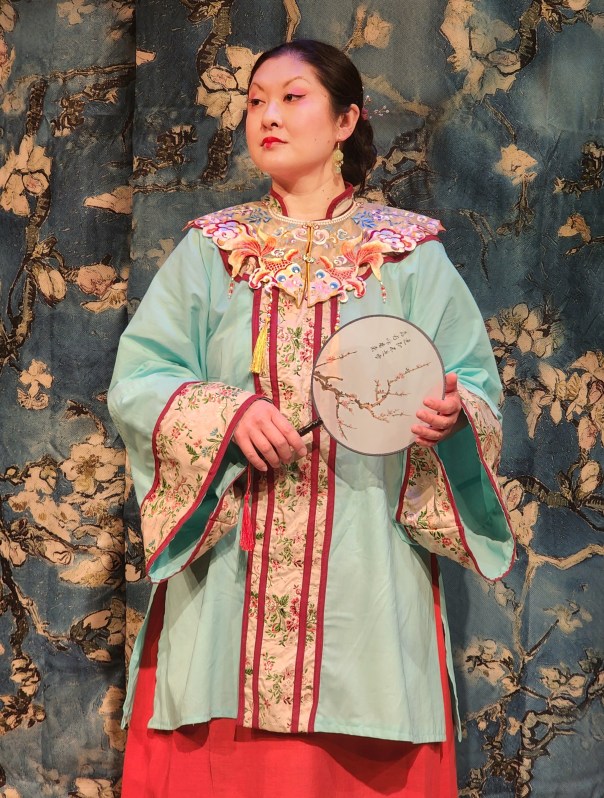
Afong is surrounded, of course, by decorative furnishings, vases, fabrics, draperies, and – at the whim of set designer Chip Davis – an elegant wooden birdcage that may have been unloaded from the same ship she sailed in on. Our Chinese Lady simply models many of these items without saying a word, the Carne Brothers merely scripting her actions. But at other times, Moy was an actress dutifully mouthing words that were not her own, words of gratitude to her benefactors and words directing our attention to the Carne Brothers’ merch on sale nearby.
It’s bittersweet, then, when Barnum has relieved her of her commercial obligations and transformed her into one of many sideshow attractions. As she becomes more authentically herself and gradually learns the language of her new homeland, Afong becomes less unique, less celebrated, less valuable to her employer, and more degraded and disposable.

Just one altercation between Afong and Atung, when he attempts to draw the curtain closed around her little performing space, is enough to remind us that her comings and goings are not voluntary. Each closing of the curtain propels the action at last a year closer to our time. While Suh doesn’t spend much effort in dramatizing Moy’s increased mastery of her second language during those years – and partial forgetting of her first – he diligently opens her eyes to how we proceeded to exploit the influx of Chinese immigrants that came after her.
It wouldn’t have been a pretty sight even if Moy had lived past 1850, when history loses track of her. The first great wave of Chinese immigration was triggered by the California Gold Rush of 1849. By the time the Golden Spike completed Transcontinental Railroad in 1869, there were 12,000 Chinese in the construction crew that completed its western leg, working for the Central Pacific Railroad.
Sketching our great nation’s appreciation for Chinese labor, Suh’s Afong catalogs a few of the hideous slaughters of miners and laborers that Asians were treated to. Then in 1882, our US House of Representatives had their first opportunity to express their gratitude to the immigrants by voting down the Chinese Exclusion Act, which would stop immigration in its tracks for the next 10 years. But guess what. Our Congress passed the heinous restrictions overwhelmingly, the first such action Congress had taken against any nation, and 10 years later, they passed an extension of the Exclusion Act for another 10 years.
Then in 1902, our wise and magnanimous Congress said enough is enough. This time, they made the law permanent.
Now I can’t recall learning any of this back in my school days, no doubt a comfort to many framers of school curricula today who worry so devoutly about disturbing their fragile offspring. Lucky for them, The Chinese Lady was written before the COVID-19 pandemic rekindled widespread hatred and violence toward Asians. Tynes-Miller refrains from layering on any additional references to the re-emergence of this ugly bigotry, a kindness that was not granted by last year’s New York revival at the Public Theatre.
Still, Suh’s play won’t appeal to the haters or the educational censors who redline uncomfortable highlights of American history. Big green light, though, for those of you who feel like we should all know our history as fully and fairly as possible. You will be rewarded with new insights and an extraordinary pair of performances by both Wada and West-Rogers.
Two years ago, when The Mermaid Hour first came to town as a reading stage production at Actor’s Theatre of Charlotte, the David Valdes Greenwood script seemed fresh, urgent, and dramatic. In the binary world of 2016, the 12-year-old child at the heart of this story, Vi, née Victor, was pressuring her parents to let her start taking hormone blockers, the first step in transitioning to womanhood. Coping with a transgender child felt like heavy stuff for Vi’s parents, Bird and Pilar, working-class Bostonians. Freaking out seemed a reasonable reaction when your child, dressed as a mermaid, launches a YouTube video that gets 20,000 views.
Today, it’s a world where binary and non-binary gender concepts coexist, and while there’s a good chance that you haven’t quite gotten the new terminologies down, you’ve probably gotten a helpful memo or two – and very likely gotten the drift. Sexual freedom doesn’t merely imply a wider latitude of accepted actions, it also signifies identifying as each of us sees fit.
So in a beautifully designed full production by Actor’s Theatre of Greenwood’s drama, it’s not surprising to discover that the 9th grader playing Vi, Toni Reali, is a non-binary actor who prefers they as their pronoun of choice. That will be a lot for many who are seeing The Mermaid Hour for the first time to wrap their heads around. But for those like me who have already accomplished that, I’m not sure that the expiration dates for the story’s peak freshness, urgency, and drama haven’t already passed.
It’s fortunate, then, that the Actor’s Theatre reprise directed by Laley Lippard layers on so much visual lyricism, a magical mix of set and sound design by Chip Decker, costumes by Carrie Cranford, and lighting by Hallie Gray. Adults and even Vi’s best friend Jacob look comparatively humdrum, and so do their surroundings. But when we ascend to Vi’s bedroom, the aqua colors glow and the mermaid couture glitters – worn by both Vi and her hermaphroditic online inspiration, Merperson/Crux.

Merperson seems to float in a rainbow ether as they declaim the “Mermaid Hour” podcasts that enflame Vi’s ambitions, taking up the space of what ordinarily would be the child’s window onto the outside world. Of course, Vi’s bedroom is also the studio where she records her YouTube manifesto, her mermaid outfit more basic and makeshift than the splendor that Alex Aguilar gets to model as Merperson.
Part of the impression the podcast star and their prodigy make is a shared aspiration to transcend everyday life. The exotic, the outrageous, the risqué, and the enchanting are in exquisite balance in these scenes, but the consternation caused by the 20,000 views garnered by Vi’s video now strikes us as an overreaction. When YouTube, Twitter, Facebook, and crowdfunding sensations regularly make the Nightly News, Vi’s surprise that her video would elicit such a massive response seems just as yesterday as her parents’ shock.

Though Decker could probably pot down his microphone a couple of notches, Aguilar strikes an important balance of his own, clearly connecting with Vi over the web with his urgings and yearnings yet adult and archly artificial in ways she couldn’t understand. Reali heightens this dimension of the mermaids’ chemistry with a wonderful lack of artifice, so spontaneous and unaffected that Crux’s protectiveness toward them late in the show seems perfectly natural, even though the mermaid reemerges on a city street dressed in leather.

Two of my fave Charlotte performers disappointed me a little as Vi’s confounded folks. Adyana de la Torre-Brucker had to shoulder the burden of being the most stubborn obstacle to Vi’s urges, but her take on Pilar’s irritation at discovering that maybe she didn’t quite rock being a mother struck me as too energetic. A little more heart and a little less stressing would work wonders. Meanwhile, Jeremy DeCarlos, who has previously demonstrated the ability to be cast as anything, was flunking working class cluelessness as Bird – sorry, the man radiates too much savvy – until he fairly nailed a lengthy monologue toward the end, earning a respectable grade.
As Jacob’s mom, Mika, Amy Wada had a clearer, more interesting path to credibility. What alarms Mika is that her Asian relatives across the Pacific now know about Vi’s video – and that their grandson is adored by a pink-haired boy who identifies as a mermaid. Laughing off your elders isn’t so easily done in ancient civilizations, and Wada carries off her globalized dilemma well.
With a cast this diverse, I doubt anyone will mind that nobody has a New England accent, despite the fact that Bird’s monologue makes it clear they’ve resided in Beantown for quite a while. At the calm center of all this specious uproar is Alec Celis as Jacob, the gay object of Vi’s adulation. He firmly tells Vi that they can be friends, nothing more, but doesn’t give her grief over the video. The fact that he and Vi have exposed themselves to each other in his bedroom hardly earns a shrug when Mama Mika freaks. What ticks him off – mildly – is when Mika tells him that he and Vi can’t associate.
By default, Jacob may be the best role model we see onstage, because he rolls with the post-binary gender tide rather than pushing either way. Anyone expecting high excitement from The Mermaid Hour might do well to follow his example. Although Greenwood’s script doesn’t sizzle with drama, it provides powerful affirmation for trans and non-binary people in the audience who don’t often see themselves portrayed onstage. It also injects some remedial education into theatergoers who have slept on their trans neighbors’ existence or their worth until now. With some fabulous color and lighting.

You can certainly find subtler, more poetic titles than The Actress, a bittersweet comedy by Peter Quilter – with judicious snatches of Chekhov – now at Spirit Square. We follow storied actress Lydia Martin into her dressing room as she gives her farewell performance in The Cherry Orchard, electing to retire from the stage while makeup can still mask her flaws and she can still remember her lines.
With two dips into Lydia’s onstage performance and an intermission sandwiched in between, all framed by her arrival at the theater and an impromptu post-performance celebration in her dressing room, we have a neatly symmetrical five-part structure. Quilter adds a nice little wrinkle at the end as Lydia and her ex-husband adjourn to the darkened stage for a final communion. In Ryan Maloney’s set design, about a third of the Duke Energy Theatre is set aside for the Chekhov action, but I could easily imagine how beautifully this last scene would flow on a revolving set. Maloney’s lighting design recovers some of that magic.
Until that point, I found a curious lack of theatre magic and specificity. Although the Three Bone Theatre playbill specifies 1933 as the time of the action, the script doesn’t seem to help director Charles LaBorde to establish a time or a place for Lydia’s farewell. Oddly, the backstage action isn’t theatrical enough to convince me that this is a particularly momentous show. There are no acting colleagues or mentors slipping in to send her off, no reporters or photographers, not even Cherry Orchard castmates before or after the performance.
The only other person involved in the production is the director’s sedulous emissary, Margaret, who relays the unseen director’s notes to Lydia – a patently needless exercise, since it’s doubly impossible that the star will ever make use of them. Yes, there are congratulatory flowers all over the place, some from colleagues and others from admirers, but her dresser, Katherine, still finds it necessary to mist the room with perfume before Lydia enters. Amy Wada digs into Katherine’s uncertainty about whether she means anything to Lydia after a long, long business relationship, but Corlis Hayes seems to accept Margaret as a royal waste of time, mostly motivated by the prospect of leaving with a collectible memento.

Everyone else is a visitor, except perhaps for Harriet, Lydia’s agent. With Lydia retiring, Harriet doesn’t have any business with her client but she does have something to say. When Harriet is persistently shushed and ignored at the little afterparty – while drinking more and more of Lydia’s best brandy, not the swill that she presented as a token gift – whatever she had intended to say is horribly twisted, one of the most dramatic spots in this production. Zendyn Duellman, consistently irritating with her high sycophantic energy as Harriet, becomes even more memorable here.
The rest of the backstage story is largely comedy. Lugging an industrial-strength decrepitude up the stairs to Lydia’s door, Hank West is able to unleash a mighty volley of coughs and wheezes when he gets there as Lydia’s rich fiancé, Charles. Whisking Lydia off to his native Switzerland seems laughably ambitious for someone so old and easily winded, but amid his bodacious wheezing, West endows Charles with a forbearance and determination that ultimately make him a bit endearing.

Ex-husband Paul has considerably more energy behind his persistence, and neither verbal rebuffs nor physical slaps from Lydia discourage his overtures. Bob Paolino definitely tunes into the love-hate relationship between these former intimates, and despite his conspicuous lack of appreciation for the theatre and Lydia’s artistry, brings us a redeeming softness and fatherliness when her career officially ends.
I wasn’t convinced that Paula Baldwin could wholeheartedly throw herself into Lydia’s ambivalent reaction to Paul’s forcible advances. When he called for a 1933 setting, LaBorde may have had those Hollywood films in mind where a leading man might respond, “you can hit harder than that,” to a slap in the face and manfully take it as a woman’s encouragement. That’s definitely the drift here as both Lydia and Paul get mussed up in a physical comedy interlude while the actress keeps her audience waiting.
Trouble is, when Lydia’s daughter Nicole walks through the door, Lydia has an aversion to her smoking – and a guilt about sneaking a cig for herself – that are 60 years ahead of their time. So the demands on Baldwin go beyond ambivalence. She’s actually best in Act 2, when her past faults as a wife, mother, and person come into clearer focus and a warmer, more down-to-earth side of her surfaces. She also manages to convince us that it’s not all about money with Charles.

Nicole isn’t severely messed up or resentful in Robin Tynes’ perky portrayal. We get the idea from Tynes that Nicole is a gentle reminder of Lydia’s past lapses as a wife and parent – also a counterweight against those plans to flit off to Switzerland. But once he puts her before us, Quilter doesn’t invest nearly enough into Nicole. I didn’t detect the English accent that might make her objections to Mom’s proposed move to Switzerland seem petulant and selfish. Sounding totally American, Tynes gave me the impression that Mom’s displacement would be transoceanic. Sure, she seems unsettled, but not enough to be profoundly unhappy.
More substance to Nicole would add more definition to her ambivalence – and Quilter’s serpentine script does wind up being very much about ambivalence. Ultimately, Lydia finds herself choosing between career and domestic comforts, between love and sex, and between familiar family and a new kind of life. So Quilter’s title is subtler than he probably intended. Notwithstanding its setting and the sterling Three Bone Theatre performances that make it come alive, The Actress is hardly about theatre at all.

Three Bone Theatre has mostly been a fringe group during its first four seasons, starting out at UpStage in NoDa and performing there as recently as a year ago. For 2016-2017, Three Bone has taken it up a notch, settling in at Duke Energy Theatre as one of Spirit Square’s three resident companies, with more of a mainstream look and plenty more seats to fill.
Starting off with Theresa Rebeck’s Seminar in August and following up with Heidi Schreck’s Grand Concourse in November, Three Bone proved they were ready to make the UpStage-to-Uptown leap. With their upcoming production of Love/Sick coinciding with Valentine’s Day, they’re doing it with marketing savvy as well.
“The placement of Love/Sick in the season was definitely intentional,” says Three Bone artistic director Robin Tynes. “Everyone loves romantic comedies that end happily. This piece questions that a little bit and tells the sweet and the sour of relationships. What’s so great about the show is that it is enjoyable for couples and singles alike. The show has an awesome blend of hilarity and sucker-punches. Relationships are hard and these quirky stories offer something for everyone.”
Playwright John Cariani, who also starred in the 2015 off-Broadway premiere of Love/Sick, is better-known for Almost, Maine, one of the most frequently produced comedies across America in 2009-11. That’s when it jumped around the Metrolina area, with productions in Davidson, Ballantyne, and CPCC.
Pam Coffman was in that CP presentation and comes back to Cariani as one of the 10 cast members at Duke Energy. She knows the territory well. Instead of introducing us to a single pair of loving – or unloving – protagonists, Cariani presents us with a cavalcade of couples. Almost, a fantastical town in northernmost Maine that “doesn’t quite exist,” was the unifying geography of the earlier set of playlets. In Love/Sick, we’re in a surreal suburbia – less whimsy and no Northern Lights.
“All of the stories take place at the same time in the same town, with the town’s Super Center as the common thread throughout the play,” Coffman explains. “While the themes are also very similar – the quest for love, falling in love, maintaining love, loss of love – Cariani presents these themes in a darker, perhaps even cynical way. If Almost, Maine is a Moscato, then Love/Sick is a Cabernet Sauvignon – truly enjoyable, with a little bite on the end.”
Cariani’s suburbia is also a little more orderly than his Almost, for the scenes in Love/Sick aren’t merely different couples at the same time. This parade represents different stages of romantic relationships, presented in sequential order. Within this pattern and loose cohesion, there can also be wide variety.

Like most of the other cast members, Amy Wada appears in multiple vignettes, once as Celia on the threshold of marriage and later as Abbie, a weary stay-at-home mom. Like Coffman, Wada appeared in Almost at CP in 2011, so Love/Sick for her is a Cariani déjà vu.
“The main difference between the two plays for me is how each scene ends,” says Wada. “In Almost, Maine, there is always some sort of closure to the relationship. The couples don’t always end up happy or together, but there’s some sort of punctuation at the end of each scene. In Love/Sick, Cariani leaves the status of the future of each couple’s relationship up in the air and for me, as an audience member, makes it more interesting.”
Coffman and her scene partner, John Xenakis, are the only members of the Love/Sick cast who don’t have multiple scenes. Furthermore, they don’t appear until the closing scene. So until last week, when they moved from their rehearsal space to Spirit Square, the actors really didn’t see each other perform – or experience a conventional run-through. When you’re in scenes that are essentially self-contained and disconnected from the rest, you can expect a director (Sean Kimbro, in this case) to run rehearsals out of sequence to respect his actors’ time.
The concluding scene, however, is somewhat different from those that precede. While Cariani might leave the future of his couples open-ended, he’s a bit tidier with his overall design. As Emily, we see Coffman as a woman who is wandering around the surreal suburbia’s supermarket by accident, stranded there just temporarily because she missed her connecting flight.
“She happens upon her ex-husband who now lives there,” Coffman says. “As the scene unfolds, they realize they are both single again, and begin to wonder if destiny has brought them together. The beauty of this scene is that, because these characters have lived longer and experienced more life, they are able to explore all of the love themes that have been touched on in the previous vignettes. The result is a bittersweet compilation of the many roads love can take, and hopefully, the desire to ‘do love’ better.”
In the process of this meeting – maybe a fresh beginning? – Emily and her ex become the vehicle that circles us back to the opening scene. If we haven’t realized it before, or if we’ve allowed ourselves to forget, all of Cariani’s scenes were occurring simultaneously.
Do the whimsy and brevity of the scenes take away from their impact? Not for Wada: “Even though the situations aren’t always realistic, what’s actually going on and the feelings the characters are experiencing are truthful and raw. The length of the pieces doesn’t affect the arc of each story. We can relate because we’ve all been somewhere along the spectrum of these relationships.”
Part of the fun for couples on a date night, perhaps a belated Valentine’s Day celebration, will come from the special connection that Three Bone is making with their community partner du jour, the 100 Love Notes Foundation. Established more than a year ago by Charlotte assistant city manager Hyong Yi in memory of his wife, Catherine Zanga, Yi went around town passing out his love notes celebrating the relationship that ended when she died of ovarian cancer.
The idea, the celebration, became an Internet phenomenon and then a foundation. Last week, Three Bone took to the streets and handed out a fresh batch of lunchtime love notes. According to Tynes, there will be more of “spread the love” opportunities at each performance of Love/Sick and more acts of random kindness on the streets.
“In such an anxiety-ridden and divisive time,” Tynes says, “we could all use a little more love. We will have the opportunity for our audience members to contribute their own love notes, with the possibility of their notes appearing in a slideshow before each performance.”
Or after? There were some tweets from God recently before Queen City Theatre Company’s Act of God at Duke Energy Theatre, but the 2015 Broadway revival of Sylvia took it a step further with the help of photo text messages from audience members transmitted during intermission. When the cast took their final bows, an adorable slideshow of audience doggie photos began right behind the actors.
How appropriate, then, that Three Bone Theatre’s production for Valentine’s Day will feature a similar embrace of their audience!


 Art on My Sleeve