Tag Archives: Alan Poindexter

“Irma Vep” Brings Giddiness to VisArt

Review: The Mystery of Irma Vep – A Penny Dreadful at VisArt Video

By Perry Tannenbaum
My first hints that PaperHouse Theatre’s new production of The Mystery of Irma Vep would be truly unique came when I glanced at a hidden nook of the set and saw a little half-hidden bar napkin that read “Homo Sweet Home.” Shortly before or afterwards, my first peep at the playbill revealed that there were more directors on this project than players. Two more.

Then before intermission, the aluminum loading dock closure at VisArt Video was raised by the entire cast of two, Nicia Carla and Andrea King, while we joined them on the other side, exiting through the front door to the outside alleyway – the al fresco part of the store. The final Egyptian scene was played out on a second stage, facing out to a few seats, under the shadow of a Wicked Weed Brewing sign. With a nifty little Egyptian tapestry and a fairly gaudy, full-sized sarcophagus.

What really clinched it for me was rolling pin in Act 2 – deployed for a purpose you’d never dream of. That settled it: the new Irma Vep, a Charles Ludlum gem not seen in Charlotte since 1993, is far more than a loving revival. Far more than a couple of hambone actors led by an unusually comical director.

No, this is pure out-of-this-world madness, a starburst of hysteria fueled by a team of four directors feverishly brainstorming in the merciless grip of writer’s room giddiness. Who can possibly care about a three-inch square napkin? Who would conceive of taking the one underground scene in Vep outdoors? And the rolling pin: I can barely imagine the uproarious laughter when that touch was unveiled. Perfect.

Some of the zaniest futzing could have happened spontaneously during rehearsals, since Carla and King, splitting eight roles between them, are also part of the directorial team, joined by Kevin Lorms and Chaz Pofahl. So scenic designer Kel Wright may have lavished so much attention on her precious sarcophagus that she didn’t notice when that homo napkin got slipped into the wicker basket back at Mandacrest.

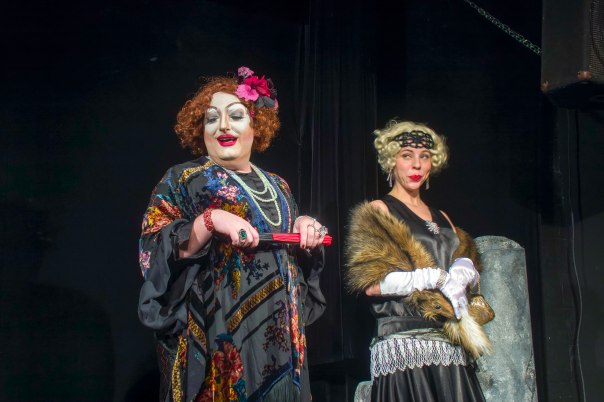
That’s where theatre legend Lady Enid Hillcrest, newly married to Lord Edgar Hillcrest, will feel oddly ill-at-ease in the library as a portrait of her predecessor, Milady Irma Hillcrest, stares down at her. Greeting her as maidservant Jane Twisden, King ought to be scornful and sepulchral, since she is replicating Judith Anderson’s role as Mrs. Danvers in Rebecca opposite Carla while she resurrects the Joan Fontaine naif.

Yet by the time Lady Enid sashays into view, numerous other parodies have already been set into motion in Ludlam’s wicked mockery of the “penny dreadful” style of Victorian England. Sleuthing, sarcophagi, werewolves, vampires, witches, and a Wuthering Heights heath are all mixed into this undeadly brew. Plus the obligatory mummy. So why not give King the freedom to jubilantly shatter the Dame Judith mold, sporting a bright red wig and occasionally breaking a smile?

Anderson may never have even slightly bared her teeth before she set Hitchcock’s Manderley ablaze.
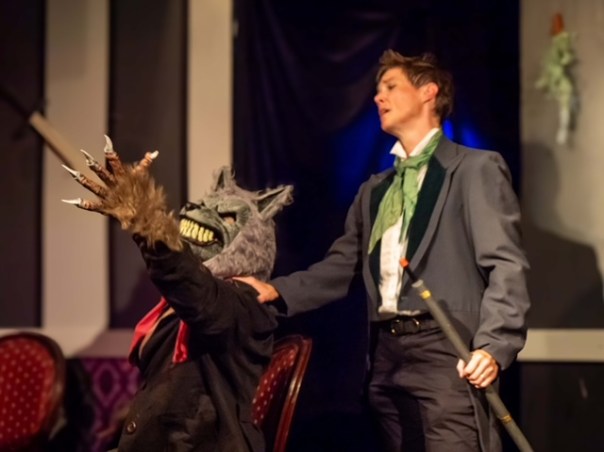
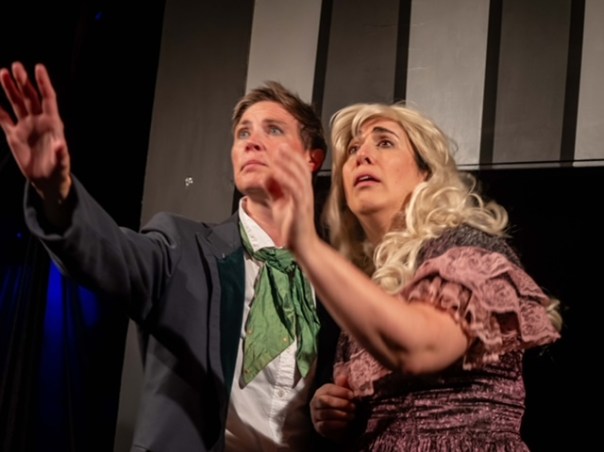
Squinting her eyes like a savvy sleuth in the opening scene, Carla as the swineherd Nicodemus quickly references the nearby heath and his determination to hunt down the werewolf suspected in the death of Lord Edgar’s son. As the action speeds up and the creepy creatures proliferate (inspiring Carla’s more outré costume designs), we need to be watchful in keeping track, not only with who’s who but with who’s what. Once the thunder stops, the full moon will have its effect, so we can be on the lookout for the kindred of Lon Chaney, Bela Lugosi, Sir Laurence Olivier, Lady Macbeth, and Edgar Allen Poe.

Ludlam wrote all the roles that Carla plays in this quick-change romp for himself and the others for Everett Quinton, his partner in the Ridiculous Theatrical Company and in life. And Ludlam also directed the 1984 premiere. Small wonder, then, that legendary actor/director Alan Poindexter was actually dissatisfied with Innovative Theatre’s storied 1993 production at the fabled Pterodactyl Club – for he merely starred in that historic riot. He told me in 1995 that he was itching to revisit the script.

Where he didn’t say, but presumably, Poindexter yearned to act and direct next time around, the dual roles that both Carla and King are fulfilling now. The fun they’re having with it was unmistakable almost from the start last Friday. Those many costume changes certainly quicken the heartbeat and release the adrenalin when these gifted players are switching outfits backstage – often speaking lines of dialogue while they do.

It’s gotta be dark back there, so in a small space where so many costumes are parked, Lorms must be especially adept as he switches hats and takes on the stage managing. If there’s an additional person hanging up the hastily discarded clothes, it must really be mayhem back there!

While Carla is shuttling between her Nicodemus and Lady Enid costumes, King is shedding her maidservant uni – and that wig – whenever the Lord Edgar returns from his various adventures. Tortured soul! After losing his ex to a vampire and his son to a werewolf, noble Edgar tasks himself with tracking down both supernatural monsters, with only Nicodemus for backup. Poor choice.

Leaving a beautiful lady alone on a lonely manor; especially near moors, heaths, mists, and hail; is never a good idea, confirmed by even a smattering of familiarity with Hollywood horror. After discovering that an Intruder has left telltale teeth marks around his beloved’s jugular, Lord Edgar proves that he has learned his lesson by immediately traipsing off to Egypt to solve this mystery. Thoughtfully, he checks Lady Enid into a sanatorium.
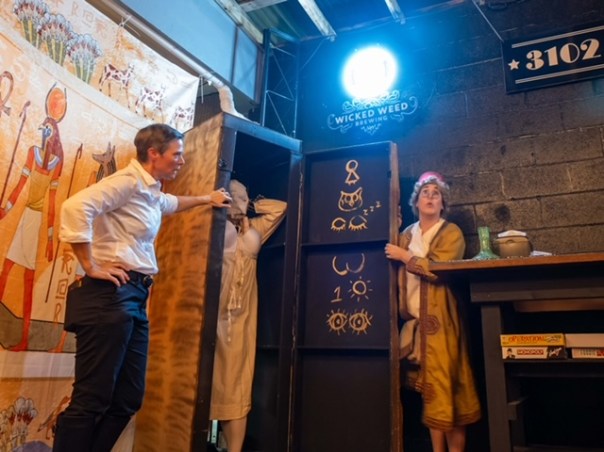
While Milady convalesces, Carla can transform into two Egyptians, Lord Edgar’s turbaned guide and his royal quarry, the remarkably well-preserved Princess Pev Amri. More hilarity for us; more heartbreak for Lord E.

An easier mystery for us to solve was why the Egyptian scene was moved back from the beginning of Act 2 to the end of Act 1. That sarcophagus appears on both stages, so Carla and King can rely on outside help in schlepping it. In its wake, we’re left facing a handy cantina where we can line up for refreshment during intermission.

No doubt the respite is a godsend for Carla, King, and the hidden crew as they regroup, relax, and hydrate. Action is noticeably more frenetic after the break. Masks appear more frequently, and we’re treated to cameos by vampires and various werewolf body parts, far eclipsing the wolf’s carcass tossed into Act 1. In the hurly-burly, all the mysteries and who’s-whats are solved – but you’d better be alert if you want to catch all the solutions.

By then, you may have been laughing too hard to care.

Vampires and Trumpers

Reviews: Vampire Lesbians of Sodom and Thanksgiving: 2016

By Perry Tannenbaum

For devout upstanding citizens who had decided way back in the hippie ‘60s that Greenwich Village was an abominable den of sin, Charles Busch’s Vampire Lesbians of Sodom was a flaming and perverse poke in the eye. Or an argument clincher when it landed on Macdougal Street in 1985. The New York Times raved, the extravagant little trio of sketches became a cult obsession, and Vampire Lesbians had a five-year run.

Busch slipped away from his castmates when the review came out in the early morning after the Provincetown Playhouse premiere and had a good cry. Why did this diva desecrate his mascara? His career in theatre was now assured. He would write more outrageous comedies and send-ups that he, as the prima donna, could cross-dress and slay in, most famously Psycho Beach Party.

Vampire Lesbians made it to Charlotte at the Pterodactyl Club in 1991, after the slightly wholesomer Psycho Beach had paved the way during the previous year. George Brown directed this orgy of sacrilege with fiendish glee, while Innovative Theatre co-founder Alan Poindexter starred with Keith Bulla as the titular vamps.

With the Rev. Joe Chambers carrying the torch for fundamentalism in the wake of Jim Bakker’s disgrace, Banktown was still a very Christian place. It was my sacred duty to bring my daughter, not yet bat mitzvahed, to see Poindexter in all his counter-culture glory. After beholding the kinky wonders of Psycho Beach, my Ilana would have kissed Alan’s feet.

Flash forward to 2023. Poindexter is gone and the Pterodactyl Club, the one-time cultural capital of Freedom Drive, is goner. But thanks to Nicia Carla and her PaperHouse Theatre, Hollywood antagonists La Condesa and Madeleiné Astarté (a Succubus and a Virgin Sacrifice back in their Sodom days) are undead again!

Taking on Busch’s mantle, Carla directs and stars in this stunning revival at VisArt Video, tucked into the nether region of a strip mall on Eastway Drive – I’m trying to make this little suburban dive sound as risqué as the Pterodactyl! Walls are black as you walk inside, and hostesses in Goth attire and makeup are there to greet you. Whatever Google Maps has told you (it misled both me and my wife Sue on separate occasions), you can now be sure you’re in the right place.

Small as it is, the inner sanctum of VisArt is perfectly sized for Busch’s secret forbidden rites. The seats are soft enough to keep butt burnout at bay for 90 minutes, even if you don’t stretch for intermission and fall prey to the treats in the lobby. Yet sightlines are not ideal according to Sue’s scouting report.

The PaperHouse cast multitasks even more than Busch’s original ensemble, just six players covering the 14 roles instead of seven. All six are battle-tested in madcap comedy, so this outrage is hardly outside their comfort zones. Nicia probably hasn’t had this much fun onstage since Poindexter directed her as The Witch in Hansel & Gretel. She minces and manipulates here as the Virgin Sacrifice, growing regal and stentorian as theatrical megastar Astarté as she assaults the Left Coast. Opposite her, Ashby Blakely is a steely, sneering diva bridging four millennia as The Succubus, aging gracefully into La Condesa and crossdressing in costume designer Beth Levine Chaitman’s most outré couture.

That isn’t to say that Josh Looney and Charlie Carla are anything less than visions of decadence as Sodomite musclemen Ali and Hujar in complementary S&M outfits and Wagnerian wigs. Nicia is already fairly slutty in the opening sketch despite her somewhat revealing white dress, willing to break her hymen with Ali or cut a deal with the cave monster Succubus. Subsequent scenes in Hollywood and Sin City climax in a couple of startling onstage costume changes, most improbably by Tanya McClellan who snoops into La Condesa’s boudoir as gossip columnist Oatsie Carewe.

Gosh, it’s good to see McClellan back onstage in manic comedy mode. Squinting her snoopiness, she sniffs out the ungodly acts performed by Nicia as Astarté on La Condessa’s protégée, luminous Sarah Molloy as flapper Renee Vain, and her meddlesome boy toy, Looney as matinee idol King Carlyle.

Hard times for a vampire? You’ll need to come back after intermission for Blakely’s final transformations. Andrea King’s choreography, on loan from Jane Fonda, elegantly shows off McClellan’s dancing prowess.

Anyone who reads advice columns or cruises social media at this time of year will have an accurate inkling of what Thanksgiving: 2016 might be about. Millions of Turkey Day hosts are wondering how they will keep opposing family factions from shouting their lungs out or coming to blows while the sharp cutlery is still on the table. Playwright Elaine Alexander smartly calculates that the situation is prime fuel for a dining room comedy – or tragedy – but the world premiere of Charlotte’s Off-Broadway production now at VAPA also reveals that the NC native had a tough time deciding which way to go.

Ground Zero for the annual onset of hosting panic was clearly in November 2016 when Hillary Rodham Clinton resoundingly won the popular vote for the US presidency while Donald Jefferson Trump won the Electoral College – and the White House – just as resoundingly. Liberals, Democrats, and rational folk are still in shock. Yet as Alexander deftly reminds us along the way, they are all blissfully unaware of the betrayals of good sense, rationality, rule of law, and democracy to come.

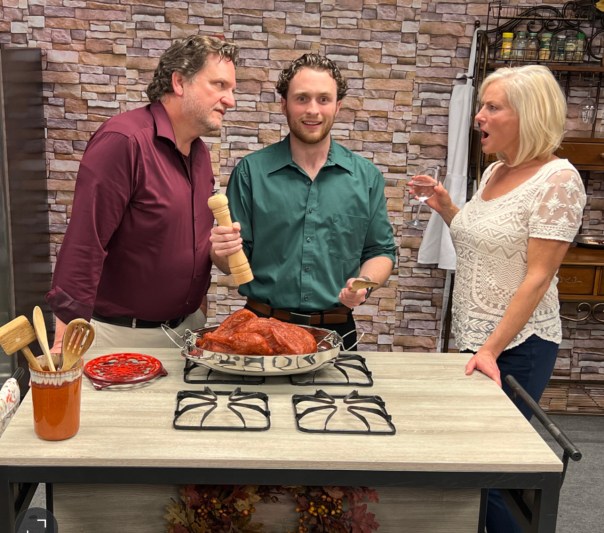
As the West family up in the liberal Northeast prepares to host young Eric’s girlfriend, riding up the highway from Alabama, the aroma of crisis already fills the suburban kitchen. Papa Harry, after diligently knocking on hundreds of doors crusading for Clinton, was hospitalized – either for a nervous breakdown or a heart attack – immediately after watching CNN declare Florida for Trump. The chief Turkey Day watchword from Harry’s physician is for wife and son to prevent the shell-shocked Hillary soldier from indulging his CNN addiction.

Taking to drink in the wake of her husband’s collapse, either out of worry or guilt, Renee has pretty much abandoned any serious intent to impress Brittany, the Southern belle she’ll be meeting for the first time. So it has fallen to young Eric to try to cook a luscious feast for his beloved, even though Mom hasn’t properly shopped for the occasion. Some improvising and substitution will need to be done. Worse, frozen will occasionally need to stand in for fresh.

Worst of all, Brittany voted for Trump, so Eric desperately hopes to keep talk of politics – the subject Dad is obsessed with and still agonizing over – away from the holiday dinner table. Harry has enough difficulty digesting that his son would date a girl from Alabama. Nor does Dad have enough self-awareness to realize that, in a reflexive action stemming from his years in community theatre, he mocks every Southern drawl he comes in contact with.

Finding out she’s a Trump voter could send him over the edge. Getting Dad to refrain from talking politics promises to be even tougher than steering him away from CNN. Finessing how to keep Brittany off the touchy subject is a bridge Eric hasn’t crossed yet.

As a director, Alexander casts father and son perfectly. Matthew Howie is a master of timorous anxiety as Eric. He can craft crescendos of panic and befuddlement while doing a hilariously awful job of warding off disaster with a shit-eating smile. Nor could we improve much on Tom Ollis as Harry. Since his 1997 debut at Theatre Charlotte in Arsenic and Old Lace, Ollis has grown into the most visible volcano on the Metrolina theatre landscape. Whether as Mr. Blonde in Reservoir Dogs, Sweeney Todd, or Titus Andronicus, Ollis is peerless at seething, suspecting, and erupting into towering, raving rages.

Since Harry is also a trial lawyer recently dismissed from his law firm because of his excessive zeal, Ollis can feast on numerous opportunities to cross-examine everyone in sight, bullying and browbeating every witness. Alexander’s women don’t get nearly as much scenery to chew, but her casting choices are nearly as impeccable.

Donna Norcross seemed to be battling opening night jitters early in Act 1 as Renee, but as Mom yielded to a multitude of wine refills, Norcross also relaxed, becoming quite powerful in the Act 2 denouement. Quite ripe for stereotyping, Michelle Strom as Renee entered the West home like a sudden ray of sunshine, without the preamble of a knock or a doorbell chime, her drawl as wide as the Mississippi. No, Dad could not restrain himself, nor could I blame him.

As you can imagine, the setup of Thanksgiving: 2016 is almost pure comedy – until the Trumper truth finally comes out, as an announcement rather than a shy confession, with the proud flourish of a cheerleader’s somersault. Looking from Strom to Ollis as we reach intermission, we can only wonder whether Dad will clutch his head or his heart.

But what can come afterward from our host, our hostess, and from poor Eric? Admirably enough, Alexander lets her characters carry her along across Act 2. But her impulse to bludgeon Harry with more secrets and uncomfortable turns this comedy upside-down. We transition, not very gradually, from a Neil Simon comedy of futile secret -eeping to an impactful series of revelations that conjures up Sophocles’ Oedipus, Strindberg’s The Father, or Albee’s Virginia Woolf. Those revelations are topped off by a  couple of increasingly jaw-dropping ideological rebukes to Harry’s smug liberalism that might shake you up a bit.

We seem to fall over a cliff here, with too little before intermission to prepare us for the high drama afterward. By the time the cast is taking their bows, Renee has radically transformed from a borderline bimbo into a pieta resembling Steinbeck’s Rose of Sharon on the final pages of The Grapes of Wrath. Instead of dumping us off a high cliff, I’d advise Alexander to lay down more track that would guide us around the mountain: a sudden dramatic swerve – not too sudden – would be more satisfying than this swan dive.

A visit to VAPA for Thanksgiving: 2016 is still worth it, delivering hearty laughs and a gasp or two. By all means, dig in!

Chicklet Is Back – All Five of Her!!

Preview: Psycho Beach Party @ The Warehouse PAC

PsychoBeachParty5[5]

By Perry Tannenbaum

Odd juxtapositions like ketchup and cantaloupe don’t always work on your taste buds. But in comedy, the results can be spectacular. Ranging far beyond the incongruities of The Odd Couple, actor/playwright Charles Busch created a sea of contrasts and hairpin turns for himself, bridging the gap between Gidget and Alfred Hitchcock in Psycho Beach Party.

Combining the sunny surfboard innocence of Gidget with the multiple personalities that marked Marnie, the title character of a Hitchcock thriller, Busch became Chicklet in 1987, tossing flamboyant cross-dressing into the mix. Four years later, Alan Poindexter brought the role to Charlotte at the Pterodactyl Club under the direction of George Brown, a prime reason why the future artistic director of Children’s Theatre took CL’s Actor of the Year honors for 1991.

Fast-forward to 2017 as The Warehouse brings Psycho Beach to Cornelius for a three-week run starting on Friday. The most recent sighting of a Busch lampoon in Charlotte was The Divine Sister in 2013, preceded by Queen City Theatre Company’s Die Mommie Die in 2008. Psycho Beach hasn’t washed ashore anywhere in the Metrolina region since BareBones Theatre Group produced it – for a second consecutive season – in 2005.

Busch pretty much surrendered his enfant terrible status when he crafted a Broadway hit, The Tale of the Allergist’s Wife, in 2002. In an age when importance is gauged by what’s on people’s tongues and in their tweets, Busch’s trusty Hollywood targets – Gidget, Hitchcock, Psycho, Joan Crawford – have also lost traction.

You have to explain a lot of the once-familiar references to today’s audiences. Same goes for today’s actors. Jesse Pritchard, who takes on the role of Chicklet, admits to a learning curve.

“I was not familiar at all with the play,” he says. “It seemed funny, and so I wanted to try it out. I did have a bit of a brain blast looking into all of the different cultural references that the play portrays, but other than that, it all came over pretty well.”

PsychoBeachParty2[13]

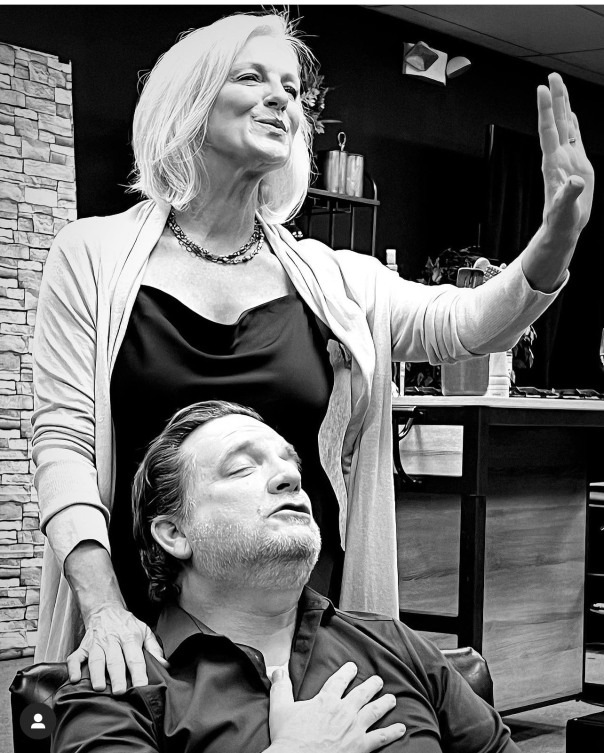
Chicklet is your basic beachcombing ingénue, innocent and wholesome, hoping to capture the eye of ace surfboarder Kanaka. Embedded within the demure Chicklet is the personality of dominatrix Ann Bowman, whose desires go far beyond The Great Kanaka, all the way to world dominance.

And there’s far more lurking inside of Chicklet, expanding the diva role.

“I don’t even think I know all her personalities yet,” Pritchard confides. “Tylene is a bit of a stretch, a strong black woman in a loving relationship. She may be the biggest stretch because it’s hard for me to embody her truthfully. Doctor Rose Mayer is like the mom of the group. The accent is a bit much, but I feel like I’ve made headway with her. Steve is also fun, the male model.”

Behind all this pathology? That’s where Joan Crawford gets layered on, channeled into Chicklet’s harpy mother, Mrs. Forrest. Two divas will dominate Warehouse’s diminutive storefront stage, with Mara Rosenberg taking on the Mommie Dearest allusions.

Presiding over the auditions, director Vito Abate liked Pritchard’s stage presence and his ability to capture Chicklet’s girlish innocence. But of course, the comedy needs to go nuclear.

“I was fortunate enough to have Mara and Jesse audition together,” Abate reveals, “and there were instant fireworks and a connection between them. I’ve had the pleasure of working with Mara before, as an actor and director. I knew she would be good fit for the role. She captured the passive-aggressive nature of Mrs. Forrest, and I knew she’d enjoy taking on the different ages and aspects of the character.”

A mainstay at Theatre Charlotte, where he originated the Just Do It series, Abate’s most recent wallow in trashiness came when he directed Sordid Lives at Spirit Square last fall. That production featured Ann Walker as LaVonda, reprising the role she played onscreen and in the TV series.

PsychoBeachParty3[14]

Both of those stages dwarf the storefront in Cornelius where Abate will be bringing his Beach. That suits him fine.

“The intimacy of the Warehouse really lends itself to the fluid nature of this show,” Abate insists. “Every time I see a production in this space, I have a sense of being part of something quite special happening between the actors and the audience, and it’s a unique theatre experience. The title of the play strongly suggests a party and that’s exactly what we plan on delivering!”

Abate got a taste of that intimacy as a performer when he appeared in Fuddy Meers three years ago. In the eight-year history of Warehouse Performing Arts Center, Fuddy Meers, along with Wonder of the World and Mr. Marmalade, has been as edgy as it gets. Red, Sylvia, Road to Mecca, Last of the Red Hot Lovers, and An Empty Plate at the Café du Grand Boeuf are the more customary style of wares at 9216-A Westmoreland Road.

Boomer nostalgia and the silly summer season may prove that the time – and the tide – are right for bringing the smuttiness and perversion of Psycho Beach to Cornelius. America has evolved so much in the 30 years since Busch introduced Chicklet & Co. that’s it’s likely politically incorrect to call anything in Psycho Beach smutty or perverted anymore.

“The first group sale [of tickets] was several weeks ago and it was from a senior community in Davidson!” says Abate. “It’s summertime and in my opinion it’s always time to laugh, and this is a perfect show for both. I’m sure many who come will be fans of the movie, some of Charles Busch, and others just out to see a comedy.”

Pritchard’s Charlotte debut back in February, as the Clybourne Park emissary in A Raisin in the Sun, didn’t exactly give him the chance to show off his comedic talents. But he feels like Chicklet is nearer to his wheelhouse than Karl Lindner. Down at Winthrop University, where he earned his Performing Arts degree, Pritchard did some cross-dressing as the sidekick in Leading Ladies, and he logged additional comic turns at Rock Hill Community Theatre, including Hillbilly Hankerin’.

He takes direction well, according to Abate. But there’s a reason for that: “Vito definitely has a vision and a keen eye to detail,” says Pritchard, “and so I’m working to make it just as he sees it.”

Abate has been very satisfied with his cast as opening night approaches, and he’s confident that his dueling divas will shine brighter afterwards. “I expect their chemistry to grow during the course of the run, with a mix of typical teenage mother-daughter relationship stuff with some severe psychological and behavioral problems thrown in.”

Wizards of Winging It

Theatre Review: Journey to Oz

By Perry Tannenbaum

DONNA BISE

I’m not sure what the guidelines are on picture-taking at the new Children’s Theatre production of Journey to Oz, written and directed by Christopher Parks. Three or four kids in the audience read the pre-show announcements, and I must confess that I was so focused on how well they managed to talk into the microphones planted on the ears of various adult cast members that I didn’t pay much attention to what they were saying.

Whether or not photos are actually banned, I can report that, at last Saturday afternoon’s performance, there was a photo- and movie-taking orgy as the 75-minute fantasy unfolded. And I can’t say that I heard even one discouraging word from the staffers who were ushering. Children and parents were invited onstage to play a wide assortment of characters from L. Frank Baum’s Wizard of Oz: the Cowardly Lion, the Tin Man, the Scarecrow, and even the Mayor of Munchkinland.

And of course, multiple adorable Dorothys paraded down the aisles of the McColl Family Theatre. Considering that the contours of Tom Burch’s scenic design are the book stacks we might find at a public library – not Baum’s Kansas plains or his rainbow realm of Oz – I’d say that the iPhones gleefully chronicling the misadventures of children, husbands, and moms onstage added to the giddy mix of make-believe.

Oz erudition isn’t what it once was when Judy Garland sang “Over the Rainbow” every year on TV without ever aging. So the kids and parents fetched from the audience are far more likely to wander off script than they would have a couple of decades ago. Cast members eschew the subtle discrimination of asking for volunteers, so shyness and stage fright can also come into play.

Parks has his five-member cast primed for the unexpected, that’s for sure. A kid in the first row was called on to emulate Toto, but he repeatedly emitted a bark that was no louder than a purr. The dad chosen as Mayor couldn’t bother to try a high Munchkin voice or to offer any testimony at Dorothy’s criminal trial at the Witch’s castle. Cast members didn’t skip over these difficulties, persisted in efforts to get things right, but they never mocked the amateurs. We moved right along at just the right moment.

Opportunities for us to participate helped to sustain our goodwill. When the cyclone touched down in Kansas, we were the wind. When Dorothy landed in Oz, we were the Munchkins who welcomed her. And when the hapless Scarecrow was besieged by crows, we were rallied to be their caws. Perhaps the most magical participatory moment was when we arrived in the Emerald City and a mini-battalion of kids converged upon them from the wings, surreptitiously recruited to portray the Ozians.

Journey to Oz isn’t myopically focused on the foundational Wizard narrative. Over and over, the players insert little vignettes about Baum, newspaper reactions to his books, personal anecdotes, and tidbits on his times. It’s a little like an annotated edition. We also get a sense of the breadth of Baum’s Oz series, which Parks deftly keeps unobtrusive. Our only lengthy digression into the greater Oz opus comes when the players point out to us that the adventures invariably begin with a dramatic act-of-God cataclysm. The cyclone of The Wizard gave way to an earthquake to trigger one of the many Oz sequels, then an avalanche, and – weirdest of all – a “hurricane drizzle.”

When we got down to business, the upstage library shelves parted to simulate the prairie and subsequently, our arrivals in Muchkinland and the Emerald City. The bookshelves lining the wings never disappeared, forming the backdrop for the first encounter with the Scarecrow and the witness box for the trial. The Wicked Witch of the West actually entered through a bookcase, framed in appropriately spooky light and smoke, and a few paper-cut props – a beard, a lion’s mane, and Toto – fancifully originated from a large book spread out on a lectern.

The magic is resolutely low–tech here, and the classy costumes by Jennifer Matthews aim in a totally different direction from the last Wizard of Oz produced by Children’s Theatre, when the late Alan Poindexter directed and portrayed a singularly frightful Wicked Witch. This time, the hat worn by Nicia Carla in the same role looks like it was snatched from the Cat in the Hat’s closet.

Carla is spared from extensive emceeing chores, but she does confront a Dorothy or two during the drama, proving quite adept at modulating her menace. Tiffany Bear is vaguely dressed like Dorothy and wields the Toto wicker basket and puppet, but she’s more explicitly Glinda when she’s chaperoning the anklebiter Dorothys onto the stage, a very engaging emcee.

Of the three guys in the cast, Tommy Foster and Dan Brunson pitch in most often on the hosting chores. Chaz Pofahl aligns himself with Carla at the beginning and end of the show, starting out as Uncle Henry opposite her Auntie Em, and ending as her servile Flying Monkey Lawyer at Dorothy’s trial. In between, Pofahl has a nice stint as Scarecrow.

Foster is the most gregarious of the three guys, doing more of the audience interaction and morphing into the Cowardly Lion. Brunson’s fine physical work as the Tin Woodsman steals far more of the show than you usually see. His robotic shtick before and during his therapeutic lube job vies in hilarity with Carla’s melting – under a barrage of confetti water.