Tag Archives: Aedan Coughlin

THE FLICK Flip-Flops Audience and Stage

Review: The Flick at Theatre Charlotte and Independent Picture House

By Perry Tannenbaum
From time to time, it’s nice to see Theatre Charlotte showing greater confidence in its audience and extra audacity in its programming. Recent seasons have seen increased excursions beyond bankable fare, such as A Christmas Carol, Misery, Murder on the Orient Express, and Rumors, to more daring and provocative frontiers such as Violet, Every Brilliant Thing, I and You, and Detroit ’67.

God of Carnage is on deck for next month.

Now we’re in the midst of a run that’s even more daring and experimental than their 2016 concert version of Caroline, or Change, which was staged out in the lobby of the Queens Road barn. The current production of Annie Baker’s THE FLICK, directed by Kyle J. Britt, goes even further out on a limb.

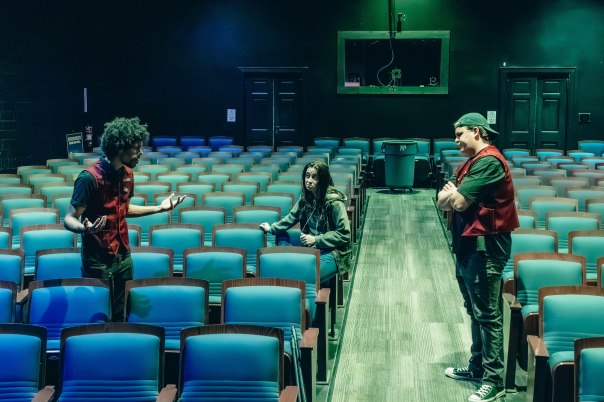
It’s very high-concept, for now we go past the theater doors leading to the front and rear of the orchestra, entering instead through the stage door. Instead of heading backstage, we hang a right – and take our seats onstage, looking out into the orchestra where we usually sit and the light booth beyond.

Tonight, that orchestra is the stage and the light booth is a projection room aiming blinding light at us, for Baker’s notorious Pulitzer Prize winner takes place in a movie theater, one of the last in America that still shows movies made on 35mm celluloid. Famed for its epic length, sustained pauses, and glacial pace, The Flick had premiered Off-Broadway in 2013 at Playwrights Horizons and revived, with the original cast, at the Barrow Street Theatre, where I reviewed it in 2015. Avenging myself on that production at my computer turned torture into a bit of a picnic.

Without that mischievous consolation, I presumed that my wife Sue was sufficiently traumatized not to wish to see this faithful sketch of the quotidian a second time. Wrong. Until midway into the second act, she had totally forgotten The Flick.

Nightmare City. Properly braced for the epic slog, I found myself charmed by the Theatre Charlotte version, for Britt goes the extra mile – recalling the greatest Carolina Actors Studio Theatre forays into experiential theatre – in making The Flick a moviegoing adventure. An elegant ramp bordered by chrome railing is slung over the couple of humble steps that normally lead you backstage at the Old Barn.

The new entranceway is draped in black curtains and discreetly spotlit, duplicating the ambiance at a multiplex when you leave its indoor boulevard and plunge into the darkness of one of the theaters. If you’ve seen the movie posters promoting this special Theatre Charlotte presentation, you’ll already be impressed by Britt’s ability to capture the deathless noir flavor of the Pulp Fiction movie poster.

Seeing this sly Tarantino homage, perfectly sized and displayed in that spotlit alleyway, adds a wonderful frisson to the evening. For those who weren’t as thoroughly braced as I was for the inaction and inertia to come – or less advantageously seated than we were – that evening grew very long. In the heart of Greenwich Village in the summer of 2015, I troubled to time the show: playing time clocked in at 2:54 plus a 19-minute intermission.

We can further admire Britt for speeding up the action to narrowly beat those Off-Broadway timings. He’s actually bucking the odds.

Brilliant concepts can start to crumble when they collide with reality. When David Zinn designed the set for the legendary Barrow Street, he could take liberties. His theater could be four rows and achieve reasonable verisimilitude, but Britt must play the hands he is dealt. That’s 13 rows of seats at the Queens Road barn, and if you want your actors within reasonable proximity of the stage, you’ll need them to traverse seven or eight rows to replicate the same intimacy we had at Barrow Street.
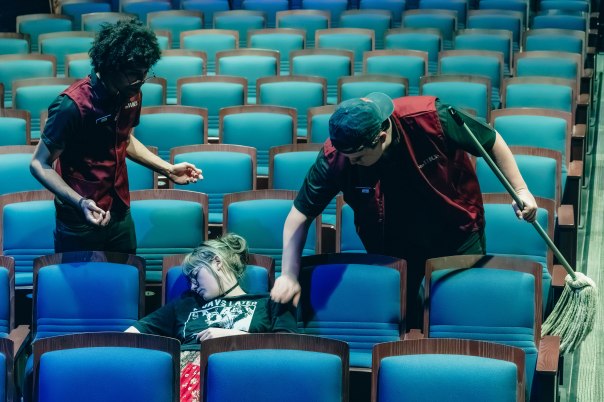
Each exit between Baker’s many scenes must traverse that extra distance, threatening to further lengthen our playing time. When we first see Aedan Coughlin, as Sam, schooling John Felipe, as Avery, in the finer points of cleaning up theater trash between ushering stints, Britt wisely spaces them at opposite sides of the aisle. So it’s plausible that both men must raise their voices to be heard.

Even so, Coughlan, as the disgruntled senior usher, is the more consistently audible, showing the newbie the ropes and schmoozing with Felipe. That gap didn’t narrow significantly as Sam continued his chattering and coaching toward the front seats. Avery does seem to emphasize the names of Hollywood stars, compared to the relatively garbled names of the films they were linked to when showing off his cinema geekiness.

Otherwise a bit shy and withdrawn, Avery boasts that he can connect any two Hollywood stars you name in six-degrees-of-Kevin-Bacon style. For all of Sam’s repeated efforts, Avery always makes good on his boasts. While it is likely that Sam begrudges Avery his more substantial education and his more promising future, that’s not where the friction between them peaks.

Enter Destiney Wolfe as Rose: younger, savvier, and sexier than any of her co-workers. So sexy that Sam tells Avery that she’s a lesbian – to clear his lane to Rose. If he ever summons up sufficient courage to make a move. Wolfe isn’t full of herself as Rose, but she’s coolly self-assured. After getting passed over while Rose snagged the promotion to projectionist, Sam may rightly believe that this talented young lady is out of his league.

To look at Coughlin, you would not instantly agree. While not as erudite as Avery – or as snobbish – Sam can propose numerous worthy candidates when the college guy boldly declares that Pulp Fiction (1994) was the last great American film.
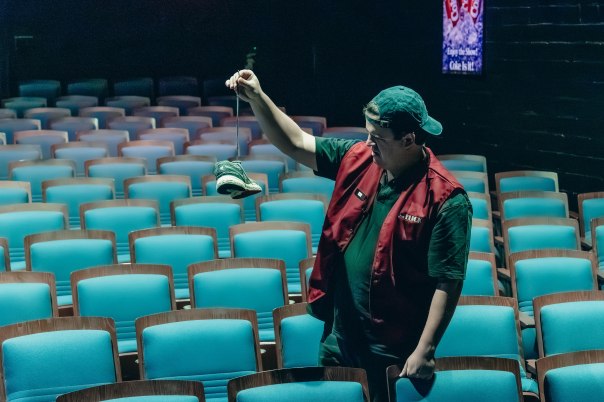
Among those candidates, Avatar (2009) draws the most scorn from Avery and is one of Felipe’s best moments before intermission. Thematically, the comparison between classic noir celluloid and digital fantasy gets us to the heart of Baker’s yarn. The Flick, doubling as the name of Baker’s movie house, is an endangered species, treasured by Avery as an analog monument, one of the last-standing rear guards against the onrush of digitality that isn’t film at all.

Surrendering, we shall see, without a fight.

The location of this landmark is in Worcester County, Mass., allowing Coughlan to add on another layer of excellence, intermittently capturing the Southie brand of a Boston accent. As the scholar in the group, Felipe is hardly obligated to attempt the working-class accent, but Wolfe doesn’t even try.

At least, I don’t think she does. Hearing anything she says without her calling across the theater was a pretty rare experience. What really crash-burned Britt’s concept, beyond the usual acoustic difficulties we’re familiar with at the Old Barn, were the problematic sightlines of the temp seating onstage. Further back than a couple of rows, there was no way to hear or see all the action. The lip of the Theatre Charlotte stage got in the way when the actors moved all the way up front because of the problematic sightlines.
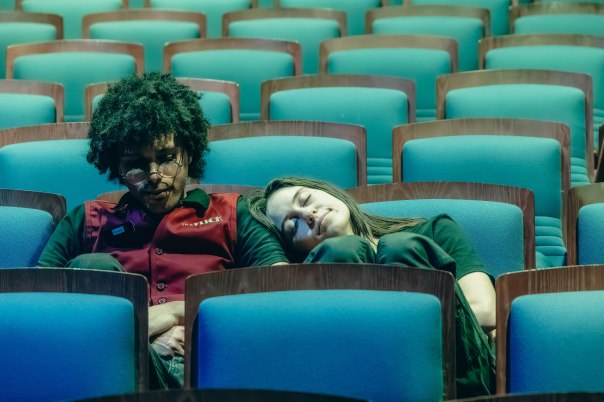
Since so much was so hard to take in before the lights came up for intermission, I felt obligated to issue a spoiler to my companions, telling them there was drama on the near horizon. Shit will begin to hit the fan – not at a blinding velocity – when Sam returns from attending his brother’s wedding and discovers that Rose has taught Avery how to work the projector, a favor (not the only one) that Sam has been denied.

Other members of the opening night audience simply defected.

Now the show, fully chastened, continues its run at the Independent Picture House this weekend. Prospects are better at Raleigh Street for fuller enjoyment. None of the movie theaters there has more than 12 rows, almost all are considerably narrower, and none are saddled by an overhanging stage compromising an audience’s sightlines.

One of these houses even allows actors to slickly enter the space behind the fourth row of seats. The express route!

The Road Gets Bumpy, but Theatre Charlotte’s “Christmas Carol” Prevails at CP

Review: A Christmas Carol at Halton Theater

 By Perry Tannenbaum

IMG_9668

Almost a year ago, fire struck the Theatre Charlotte building on Queens Road, gouging a sizable trench in its auditorium and destroying its electrical equipment. Repairs and renovations will hopefully be completed in time for the launch of the company’s 95th season next fall, but meanwhile, actors, directors, designers, and technicians are soldiering on at various venues for 2021-22, their year of exile cheerfully branded as “The Road Trip Season Tour.” Ironically enough, Theatre Charlotte’s Season 94 began in September with a downsized musical, The Fantasticks, at the Palmer Building, a facility that once served as a training ground for firefighters. For their 14th production of A Christmas Carol, Theatre Charlotte has moved along to Halton Theater, the permanent home of Central Piedmont Theatre.

Timing is a bit awkward on the campus of Central Piedmont Community College, where a new theater that will be friendlier to dramatic productions – replacing the demolished Pease Auditorium – is slated to open in April with The Diary of Anne Frank. Graced with a generous orchestra pit, the Halton is more hospitable to big splashy musicals (when its sound system responds favorably to our crossed fingers). In fact, this transplanted production of A Christmas Carol, in Julius Arthur Leonard’s adaptation of Charles Dickens’ iconic novella, reminds us how well-suited the old “Queens Road barn” was for such spooky and creepy fare. Not only were the ghosts of Christmases Past, Present, and Future at home there, but so were such confections as Arsenic and Old Lace, Assassins, Blithe Spirit, and To Kill a Mockingbird. The Halton occasionally seemed oversized when You Can’t Take It With You took up residence there at the beginning of Central Piedmont’s current season, and you can imagine how their spectacular 2015 Phantom of the Opera emphasized the grandness of Andy Lloyd Webber’s grand guignol.

Encountering the vastness of the Halton in transplanting Theatre Charlotte’s cozy Christmas Carol, director Jill Bloede has been characteristically resourceful in executing its many daunting scene changes. At times, we could see cast members whisking set pieces off to the wings in a smooth out-with-the-old, in-with-the-new routine. But there were occasions when changes of scenery necessitated a complete closing and reopening of the stage curtains. Veiling the tediousness of that maneuver, Bloede has summoned repeated parades of a small band of merry carolers, coached by Jim Eddings, to cross the stage while the curtains are closed – so you would probably be right in thinking there are more carols sung this year than in Christmases past on Queens Road. My welcome for the carolers on opening night veered toward the unredeemed Ebenezer Scrooge’s grumpy attitude as the evening progressed, yet opening night is destined to be enshrined in Theatre Charlotte lore as the night of the infamous doorknocker scene fiasco.

One of the first indications that Scrooge’s house will be haunted, after a ghostly “Ebenezer Scrooge!” exclamation blows in on the Halton’s sound system, is the brief scene at the threshold to Ebenezer’s home. Here is where Scrooge sees a fleeting glimpse of his deceased partner, Jacob Marley, bringing his doorknocker to life. The precision needed to carry off such a simple scene only became apparent when it went awry. Either the Halton curtains were tardy in arriving at their centerstage spots, where they would fully frame Scrooge’s front door, or the actor who was to lurk unseen behind that door arrived early – and was very clearly seen, garishly aglow. Portraying Scrooge, Hank West seemed sufficiently poised to extemporize while the stage curtains and the lurking Marley came into proper alignment. But the carolers took their cue and entered before West could properly proceed, and the panicked actor behind the door fled. West finished out the brief scene as well he could without any eerie lights beaming through the doorknocker, but the special effect was lost – the only real reason for that scene.

Legions of Theatre Charlotte veterans – and new initiates in years to come – will no doubt keep the memory of this snafu alive for generations, heartily laughing all the more at the incident because it didn’t typify the production. Scenic design by Chris Timmons and lighting by Gordon Olson didn’t expand quite enough to comfortably acclimate at the Halton, nor did the company splurge on smoke or fog effects during its financial woes, which might have deepened the spell of the spookier Marley and graveyard scenes. Don’t expect any snow to flutter down on the vast Halton acreage, either. With balmy temperatures likely to prevail throughout the opening weekend, it’s Beth Killion’s set of period costumes that most successfully instill a chill into the air.IMG_8525

We’ve seen some of this cast before, notably West as Scrooge, Chip Bradley as Christmas Present, and Mary Lynn Bain doubling as Fred’s wife Elizabeth in the present and Belle, Scrooge’s old flame, in the flashbacks. All of these enlarge on their past performances to some extent, maybe West most of all. His meanness is more startling in person than it was in last year’s video version, streamed online, and his sorrow and penitence are also magnified. The graceful arc of Scrooge’s redemption is only slightly bumpier this year with West’s adjustments to the new space, Bloede’s script edits for this intermission-free edition, and a body mic. Projected into a larger hall, Scrooge’s newly minted intentions needed to sound more like settled resolves and less like agonized pleas. Bradley enlarges to a similar degree upon Present’s outsized cheer, the more the merrier in his case – until he issues his climactic admonitions, now sharper in their contrast. Bain seems most content to let her mic do her amplification, but she is stronger this year in the climactic flashback scene when she returns Ebenezer’s engagement ring.IMG_8694_dcoston

All the newcomers to TC’s Carol are quite fine, a testament to Bloede’s ability to attract talent when she holds auditions. In contrast with the veiled youthful mystery of Anna McCarty last year, Suzanne Newsom brought a nostalgic melancholy to the Ghost of Christmas Past that was quite affecting in its serenity, while Mike Corrigan appeared for the first time as Bob Cratchit – very different with his more muted brand of meekness from Andrea King last year but no less kindly or comical. For richer or poorer, Josh Logsdon and Rebecca Kirby were a fine pairing for the Fezziwigs, Aedan Coughlin doubled well as Young Ebenezer and Ghost of Christmas Future, and Riley Smith brought all the optimism needed for the sanctity of Tiny Tim. With Mitzi Corrigan and Emma Corrigan on board as Mrs. Cratchit and daughter Belinda, there’s plenty of family authenticity around the humble Cratchit hearth – or there will be when Mitzi returns from personal leave due to a death in her real family. Vanessa Davis spelled ably for Corrigan as Mrs. Cratchit at the premiere performance, augmenting her regular role as Mrs. Dilbur.

Assuming that Thom Tonetti was already in character as Jacob Marley during the notorious doorknocker scene, I’ll say his opening night adventures most typified the Theatre Charlotte crew’s tribulations in acclimating to a new space. Marley’s entrance into Scrooge’s home wasn’t dramatized with smoke and lights, and Tonetti didn’t enjoy the benefit of having his prophecies and imprecations magnified with thunderous jolts from the soundboard. During the flashbacks, the actor certainly earned some sort of sportsmanship award, appearing as the younger Jacob opposite the truly younger Coughlin.IMG_8645_dcoston

Steadying this production and assuring that its professional polish never deteriorated into community theatre chaos for long, West ultimately triumphed over all missteps and obstacles, bringing us the compelling Scrooge we expect in all his goodness. It’s still a strong story, and 24 of its most ardent Theatre Charlotte believers are moonlighting at Central Piedmont, giving this 87-minute production the old college try. A drama within a drama, to be sure, both ending happily.

Originally published on 12/18 at CVNC.org