Vampires and Trumpers

Reviews: Vampire Lesbians of Sodom and Thanksgiving: 2016

By Perry Tannenbaum

For devout upstanding citizens who had decided way back in the hippie ‘60s that Greenwich Village was an abominable den of sin, Charles Busch’s Vampire Lesbians of Sodom was a flaming and perverse poke in the eye. Or an argument clincher when it landed on Macdougal Street in 1985. The New York Times raved, the extravagant little trio of sketches became a cult obsession, and Vampire Lesbians had a five-year run.

Busch slipped away from his castmates when the review came out in the early morning after the Provincetown Playhouse premiere and had a good cry. Why did this diva desecrate his mascara? His career in theatre was now assured. He would write more outrageous comedies and send-ups that he, as the prima donna, could cross-dress and slay in, most famously Psycho Beach Party.

Vampire Lesbians made it to Charlotte at the Pterodactyl Club in 1991, after the slightly wholesomer Psycho Beach had paved the way during the previous year. George Brown directed this orgy of sacrilege with fiendish glee, while Innovative Theatre co-founder Alan Poindexter starred with Keith Bulla as the titular vamps.

With the Rev. Joe Chambers carrying the torch for fundamentalism in the wake of Jim Bakker’s disgrace, Banktown was still a very Christian place. It was my sacred duty to bring my daughter, not yet bat mitzvahed, to see Poindexter in all his counter-culture glory. After beholding the kinky wonders of Psycho Beach, my Ilana would have kissed Alan’s feet.

Flash forward to 2023. Poindexter is gone and the Pterodactyl Club, the one-time cultural capital of Freedom Drive, is goner. But thanks to Nicia Carla and her PaperHouse Theatre, Hollywood antagonists La Condesa and Madeleiné Astarté (a Succubus and a Virgin Sacrifice back in their Sodom days) are undead again!

Taking on Busch’s mantle, Carla directs and stars in this stunning revival at VisArt Video, tucked into the nether region of a strip mall on Eastway Drive – I’m trying to make this little suburban dive sound as risqué as the Pterodactyl! Walls are black as you walk inside, and hostesses in Goth attire and makeup are there to greet you. Whatever Google Maps has told you (it misled both me and my wife Sue on separate occasions), you can now be sure you’re in the right place.

Small as it is, the inner sanctum of VisArt is perfectly sized for Busch’s secret forbidden rites. The seats are soft enough to keep butt burnout at bay for 90 minutes, even if you don’t stretch for intermission and fall prey to the treats in the lobby. Yet sightlines are not ideal according to Sue’s scouting report.

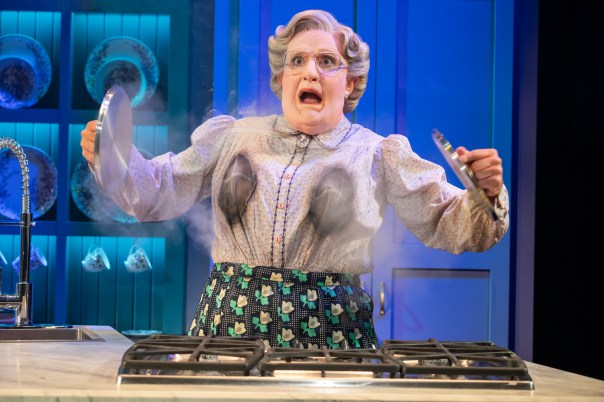
The PaperHouse cast multitasks even more than Busch’s original ensemble, just six players covering the 14 roles instead of seven. All six are battle-tested in madcap comedy, so this outrage is hardly outside their comfort zones. Nicia probably hasn’t had this much fun onstage since Poindexter directed her as The Witch in Hansel & Gretel. She minces and manipulates here as the Virgin Sacrifice, growing regal and stentorian as theatrical megastar Astarté as she assaults the Left Coast. Opposite her, Ashby Blakely is a steely, sneering diva bridging four millennia as The Succubus, aging gracefully into La Condesa and crossdressing in costume designer Beth Levine Chaitman’s most outré couture.

That isn’t to say that Josh Looney and Charlie Carla are anything less than visions of decadence as Sodomite musclemen Ali and Hujar in complementary S&M outfits and Wagnerian wigs. Nicia is already fairly slutty in the opening sketch despite her somewhat revealing white dress, willing to break her hymen with Ali or cut a deal with the cave monster Succubus. Subsequent scenes in Hollywood and Sin City climax in a couple of startling onstage costume changes, most improbably by Tanya McClellan who snoops into La Condesa’s boudoir as gossip columnist Oatsie Carewe.

Gosh, it’s good to see McClellan back onstage in manic comedy mode. Squinting her snoopiness, she sniffs out the ungodly acts performed by Nicia as Astarté on La Condessa’s protégée, luminous Sarah Molloy as flapper Renee Vain, and her meddlesome boy toy, Looney as matinee idol King Carlyle.

Hard times for a vampire? You’ll need to come back after intermission for Blakely’s final transformations. Andrea King’s choreography, on loan from Jane Fonda, elegantly shows off McClellan’s dancing prowess.

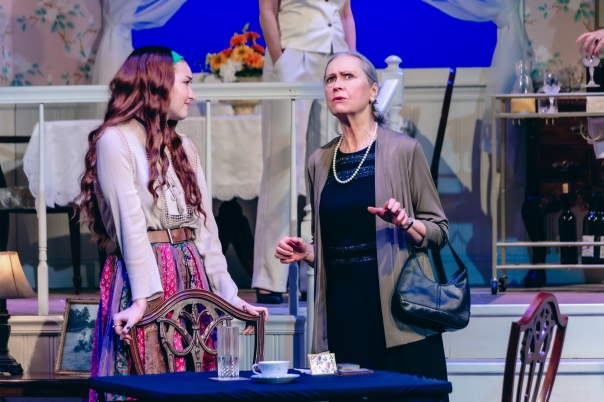
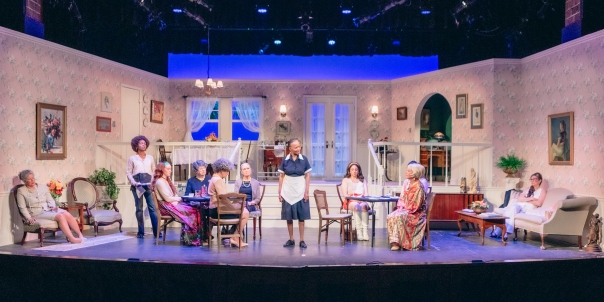
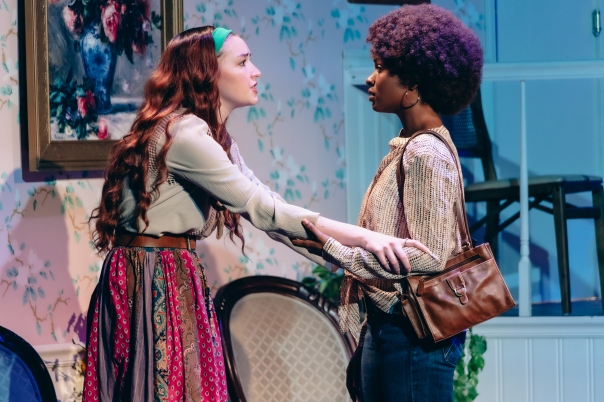
Anyone who reads advice columns or cruises social media at this time of year will have an accurate inkling of what Thanksgiving: 2016 might be about. Millions of Turkey Day hosts are wondering how they will keep opposing family factions from shouting their lungs out or coming to blows while the sharp cutlery is still on the table. Playwright Elaine Alexander smartly calculates that the situation is prime fuel for a dining room comedy – or tragedy – but the world premiere of Charlotte’s Off-Broadway production now at VAPA also reveals that the NC native had a tough time deciding which way to go.

Ground Zero for the annual onset of hosting panic was clearly in November 2016 when Hillary Rodham Clinton resoundingly won the popular vote for the US presidency while Donald Jefferson Trump won the Electoral College – and the White House – just as resoundingly. Liberals, Democrats, and rational folk are still in shock. Yet as Alexander deftly reminds us along the way, they are all blissfully unaware of the betrayals of good sense, rationality, rule of law, and democracy to come.
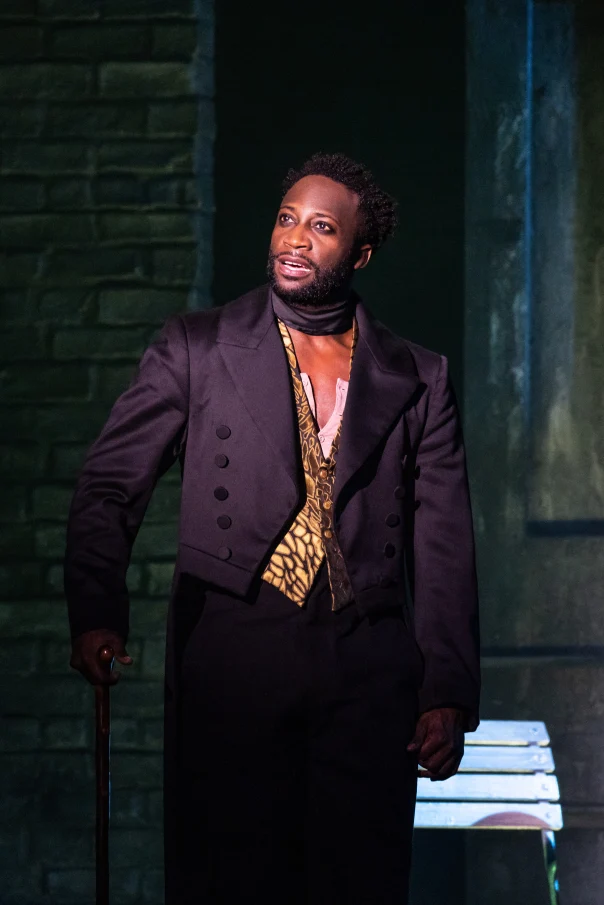
As the West family up in the liberal Northeast prepares to host young Eric’s girlfriend, riding up the highway from Alabama, the aroma of crisis already fills the suburban kitchen. Papa Harry, after diligently knocking on hundreds of doors crusading for Clinton, was hospitalized – either for a nervous breakdown or a heart attack – immediately after watching CNN declare Florida for Trump. The chief Turkey Day watchword from Harry’s physician is for wife and son to prevent the shell-shocked Hillary soldier from indulging his CNN addiction.

Taking to drink in the wake of her husband’s collapse, either out of worry or guilt, Renee has pretty much abandoned any serious intent to impress Brittany, the Southern belle she’ll be meeting for the first time. So it has fallen to young Eric to try to cook a luscious feast for his beloved, even though Mom hasn’t properly shopped for the occasion. Some improvising and substitution will need to be done. Worse, frozen will occasionally need to stand in for fresh.

Worst of all, Brittany voted for Trump, so Eric desperately hopes to keep talk of politics – the subject Dad is obsessed with and still agonizing over – away from the holiday dinner table. Harry has enough difficulty digesting that his son would date a girl from Alabama. Nor does Dad have enough self-awareness to realize that, in a reflexive action stemming from his years in community theatre, he mocks every Southern drawl he comes in contact with.

Finding out she’s a Trump voter could send him over the edge. Getting Dad to refrain from talking politics promises to be even tougher than steering him away from CNN. Finessing how to keep Brittany off the touchy subject is a bridge Eric hasn’t crossed yet.

As a director, Alexander casts father and son perfectly. Matthew Howie is a master of timorous anxiety as Eric. He can craft crescendos of panic and befuddlement while doing a hilariously awful job of warding off disaster with a shit-eating smile. Nor could we improve much on Tom Ollis as Harry. Since his 1997 debut at Theatre Charlotte in Arsenic and Old Lace, Ollis has grown into the most visible volcano on the Metrolina theatre landscape. Whether as Mr. Blonde in Reservoir Dogs, Sweeney Todd, or Titus Andronicus, Ollis is peerless at seething, suspecting, and erupting into towering, raving rages.

Since Harry is also a trial lawyer recently dismissed from his law firm because of his excessive zeal, Ollis can feast on numerous opportunities to cross-examine everyone in sight, bullying and browbeating every witness. Alexander’s women don’t get nearly as much scenery to chew, but her casting choices are nearly as impeccable.

Donna Norcross seemed to be battling opening night jitters early in Act 1 as Renee, but as Mom yielded to a multitude of wine refills, Norcross also relaxed, becoming quite powerful in the Act 2 denouement. Quite ripe for stereotyping, Michelle Strom as Renee entered the West home like a sudden ray of sunshine, without the preamble of a knock or a doorbell chime, her drawl as wide as the Mississippi. No, Dad could not restrain himself, nor could I blame him.

As you can imagine, the setup of Thanksgiving: 2016 is almost pure comedy – until the Trumper truth finally comes out, as an announcement rather than a shy confession, with the proud flourish of a cheerleader’s somersault. Looking from Strom to Ollis as we reach intermission, we can only wonder whether Dad will clutch his head or his heart.

But what can come afterward from our host, our hostess, and from poor Eric? Admirably enough, Alexander lets her characters carry her along across Act 2. But her impulse to bludgeon Harry with more secrets and uncomfortable turns this comedy upside-down. We transition, not very gradually, from a Neil Simon comedy of futile secret -eeping to an impactful series of revelations that conjures up Sophocles’ Oedipus, Strindberg’s The Father, or Albee’s Virginia Woolf. Those revelations are topped off by a  couple of increasingly jaw-dropping ideological rebukes to Harry’s smug liberalism that might shake you up a bit.

We seem to fall over a cliff here, with too little before intermission to prepare us for the high drama afterward. By the time the cast is taking their bows, Renee has radically transformed from a borderline bimbo into a pieta resembling Steinbeck’s Rose of Sharon on the final pages of The Grapes of Wrath. Instead of dumping us off a high cliff, I’d advise Alexander to lay down more track that would guide us around the mountain: a sudden dramatic swerve – not too sudden – would be more satisfying than this swan dive.

A visit to VAPA for Thanksgiving: 2016 is still worth it, delivering hearty laughs and a gasp or two. By all means, dig in!

Moulin Rouge! Welcome to the Megamix of Pops and Plots

Review: Moulin Rouge! The Musical! at Belk Theater

By Perry Tannenbaum

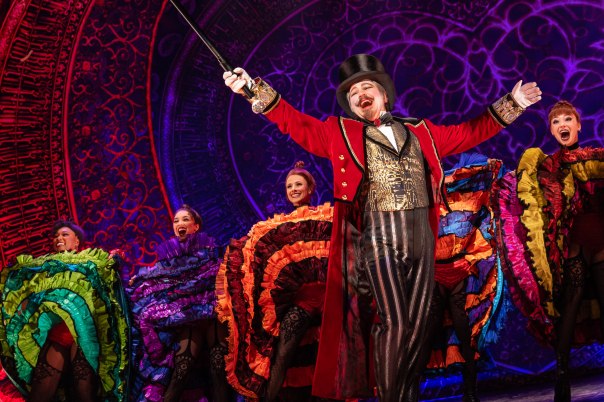
Even before the first downbeat, the musk of forbidden fruit fills the air at Belk Theater each night as Moulin Rouge! The Musical! readies to detonate. Against a scarlet backdrop and under a proscenium studded with vanity bulbs and panning red spotlights, scantily-clad chorines slink onstage, showing limbs and cleavages like ladies in Amsterdam’s red-light district slyly advertising their merch. Elegant tuxedoed gentlemen puffing on cigarettes enter at the opposite end, consumed by each other nearly as much as by the ladies’ legs.

The ban on taking photographs, policed by Belk’s ushers wielding official signage, is already in force as soon as the first glove and high-heeled shoe come into view.

Like our more raucous welcomes to Cabaret and La Cage aux Folles, what follows in leering silence is sexy and showbizzy,. The aroma of illicitness only increases when the music kicks in – unmistakably purloined from the Top 40 pops charts as soon as we hear “Voulez-vous couchez avec moi, ce soir?” for the first time. Why trouble to compose fresh tunes, like John Kander or Jerry Herman, when you can steal or lease pure gold from a multitude of hitmakers and hire a team of co-orchestrators led by arranger Justin Levine to stitch them together?

That’s what book writer John Logan has done in adapting and updating Baz Luhrmann’s gaudy 2001 film, with costume designer Catherine Zuber and choreographer Sonya Tayeh adding their sinful embroidery and panache. All of this talented team knows that mercenary greed is as much at the heart of Moulin Rouge as glitter and concupiscence. Labelle’s “Lady Marmalade” will soon be followed – inevitably – by Barrett Strong’s “Money (That’s What I Want).”

Our beautiful and consumptive heroine, Satine, wants to sell herself to the lecherous Duke of Monroth, but only because she mistakes the handsome young Christian, a budding songwriting genius from Ohio, for her buyer. Christian is no less smitten by Satine, but his prime motive for invading her boudoir, after witnessing her killer cabaret act, is to sell her on a musical show he has written with Henri de Toulouse-Lautrec and Santiago, a dashing Argentinian dude.

The nightclub glitz is interrupted by a detour to Bohemia, where we catch up on the Christian’s backstory with Toulouse-Lautrec, and preceded by the commerce behind-the-scenes between the two charismatics in the story – the predatory Duke and club owner Harold Zidler, our wicked emcee. Zidler, portrayed with garrulous savoir-faire by Robert Petkoff, hypes and sells his jewel’s charms, wheedling and boasting as he pimps. Since the financial fate of Moulin Rouge now depends on Satine’s success as a temptress, Zidler’s domineering mode is reserved for her.

Petkoff is marvelously matched with Andrew Brewer as the Duke. With a sinister sneer, Brewer aristocratically assesses and stalks his prey, hardly troubling himself to move around or give up his proprietary lounging position. Until he strikes like a snake when he takes his turn backstage in milady’s boudoir. In the wake of Satine’s onstage glitter – including “Diamonds Are Forever” morphing into “Diamonds Are a Girl’s Best Friend” before swerving into “Material Girl” – the Duke answers brutally with a Rolling Stones medley. Brewer pounces on “Sympathy for the Devil” and builds from there with “You Can’t Always Get What You Want” and a climactic “Gimme Shelter,” maybe the most savage and primal track in the history of rock.

If that weren’t enough contrast to dramatize the Duke’s first big splash, consider the sweetness of Christian Douglas as Christian, serenading Satine with Bizet, Offenbach, and “La Vie en Rose” during his pitch. That’s the business end of his visit after springing a new song on Satine that he has written just for her, Elton John’s “Your Song.” Christian is also a crack lyricist. Back in Montmartre, he’s doctoring a Toulouse throwaway into promising shape as “The Sound of Music.”

Lowered from the flyloft on a decorous trapeze after her extended build-up, Gabrielle McClinton gets every lift she could possibly need from director Alex Timbers’ staging to bedazzle the Duke, Christian, and her breathlessly salivating audience. To me, she’s a letdown in more ways than one. Given a megamix that evokes Marilyn Monroe, Madonna, and Beyoncé in a matter of minutes, Satine should be a goddess who commands the leading men’s adoration. But instead of mesmerizing, McClinton is… meh.

It would be hugely consoling to be able to report that McClinton’s tearjerking efforts as the dying Satine are any more riveting than her diva moments. But there’s a bit of a plot megamix going alongside the pop megamix, so McClinton’s opportunities to rouse our empathy don’t quite keep pace with Mimi’s in La Bohème or Violetta’s in La Traviata. Christian has framed what we’re watching as his story and Zidler wants everyone to care that the fate of the Moulin Rouge hangs by a thread.

Our wicked emcee is augmented by the lowlife charms of Nick Rashad Burroughs as Toulouse, Danny Burgos as Santiago, and Sarah Bowden as Nini, Satine’s sexy sidekick: reminding us that love and art desperately for sale. So there would be barely enough room for Satine to be both Mimi and Sally Bowles – or Violetta and Gypsy Rose Lee – even if there weren’t more than 70 songs on the playlist to navigate.

But there are more than 70 songs swirling at us, some on replays. Paradoxically that’s what saves this Moulin Rouge superstorm from itself despite the vacuum at its vortex. The fun is not only in the pacing, the spectacle, and the jets of confetti that that tops off Zidler and Luhrmann’s circus style of cabaret. It’s in our efforts as well, episode after twisted episode, to keep up with the anachronistic onslaught of melodies and lyrics that pelt us throughout the evening. By hearkening back to 19th century hits at one end of the spectrum and contemporary sounds at the other end, this epic playlist is cunningly engineered to confound.

Whether you are old or young, devoted to pop hits or the classics, whether or not you remember when rock was young or even have a clue what Tin Pan Alley was, you will face moments at Belk Theater when you’re asking yourself: have I ever heard this song before? and what the hell are they playing now? Because its score thrusts you far outside of how you normally absorb a musical, casting you out into the realm of memories, half memories, and speculation, Moulin Rouge succeeds at sucking you in. There’s no songlist in the playbill to cling to as you swim this ocean.

Even if you’re fully versed in Luhrmann’s film, you will likely be cast adrift or taken by surprise, for Logan and Levine haven’t stood pat. Not only Beyoncé, but also Pink, Sia, Lorde, Katy Perry, Britney Spears, Rihanna, Adele and others are mixed into the fresh brew. And Lady Gaga!?!

If you’re a Broadway or jukebox musical maven, there’s another sort of question you’ll be asking yourself. How did Elton John’s “Your Song” get in here when Sir E never had the chutzpah to put one of his megahits in any of his own musicals? Good grief, they actually got the rights to perform part of a Beatles song?

Teasing you out of thought on your drive home, you will likely continue pondering what you heard or may have missed inside the lacy valentine world of Moulin Rouge. Yes, Elvis and the Everly Brothers were covered, but what about Gershwin and Cole Porter, Charlie Chaplain and Fats Domino? Likely you’ll shuttle back to remembering that Nat King Cole and Whitney Houston were enfolded in this musical’s fond embrace. There were whiffs of Marilyn Monroe and Madonna.

That’s when you realize that Satine and the Moulin Rouge nightclub – the red windmill, if you need a translation – swept you away after all.

Normality Attacks a Serial Killer in Catch the Butcher

Review: Catch the Butcher with Post Mortem Players @ CATCh

By Perry Tannenbaum

Serial killers, wherever they prey on young defenseless women and girls, are universally detested, even by fellow criminals. Yet these monsters, vying with vampires in wickedness and cunning, surely have a captive audience that greatly outnumbers their victims. Identify one and he’s frontpage news, sure to draw breathless airtime on local and national TV. Invent one who is truly special and you may spawn a bestseller and even an Oscar winner.

Yes, the guilty pleasures of sopping up the gory conquests of killers at-large and thrilling in the hunt to stop and avenge their rampages are perverse addictions shared by millions. Our susceptibility to the lurid scent of butchery was more than enough license for playwright Adam Seidel to bring us Nancy, his sacrificial lamb in the grimly satirical Catch the Butcher.

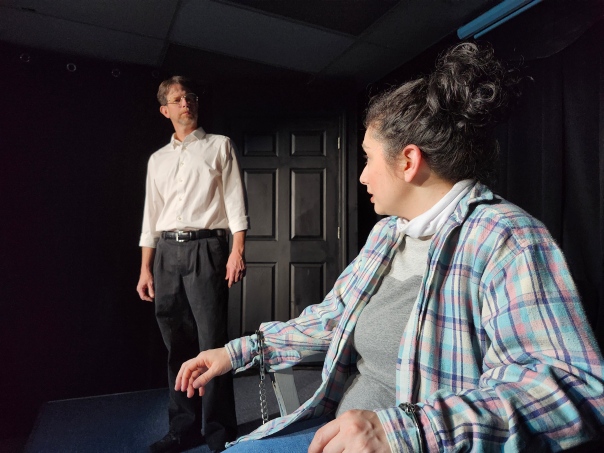
Nancy doubles down on the audience’s unspoken perversion: she wants to be abducted by “the butcher of Harbor Park.” Night after night, she sits alone on a park bench deep in the darkness of that dreaded landmark, fearing that she will be stalked and longing for it. As directed by Heather Wilson-Bowlby in the current Post Mortem Players production at CATCh, the company’s first sally into the QC, Nancy is almost advertising her yearning.

She’s reading The Stranger Beside Me, Ann Rule’s account of her friendship with serial killer Ted Bundy, a classic in the true crime genre. Heather-Bowlby’s mischievous touch, we will learn, is especially apt because the Harbor Park butcher dabbles a little in literature, dedicating a poem to each of his victims. Nancy’s fandom runs deep, admiring the fiend’s verse and feeling an unspoken kinship.

Parallel to this literary thread, the action of the early scenes is dark, silent, and animal until the Butcher pulls off his abduction. The silence of this lamb, as her killer circles ever more closely around her, is not merely evocative of a silent movie creepshow, begging for organ music in the background. We come to realize that it was also like a National Geographic documentary depicting a mating ritual in the wild.

Throughout Nancy’s bizarre captivity, Seidel has his fun juxtaposing the sophisticated with the primal and the drudgery of domesticity with our natural savagery – to shocking or comical effect. Numerous twists are in store as this butcher-victim pas-de-deux develops, including at least one complete flip-flop. And why not, seeing that Nancy and the butcher of Harbor Park were actually stalking each other?

If you don’t scan the QR code on Post Mortem’s flyer before the lights go down, gaining access to the full digital “Slaybill,” you won’t have any idea of where the silent opening scenes are happening, who we’re watching, or when the action takes place. That heightens our suspense and delays the onset of humor we’d expect at CATCh (Comedy Arts Theater of Charlotte). You’ll know most of the details if you’ve read the script beforehand, but Wilson-Bowlby flouts the playwright’s insistence that we’re in the present day, giving her star headphones instead of earbuds and a boombox instead of an iPhone.

We’re no further back than 1980, when The Stranger Beside Me was first published, but the copy that Jackie Obando Carter is clutching shows considerable wear and age. Costume designs by Carter were no more decisive to my eyes in designating the decade. More impressive were the design and execution of special effects that Carter and Hilary Powell collaborated on: one stabbing was particularly impressive since, at CATCh, my wife Sue and I were seated as close to the action as we would be watching a card trick.

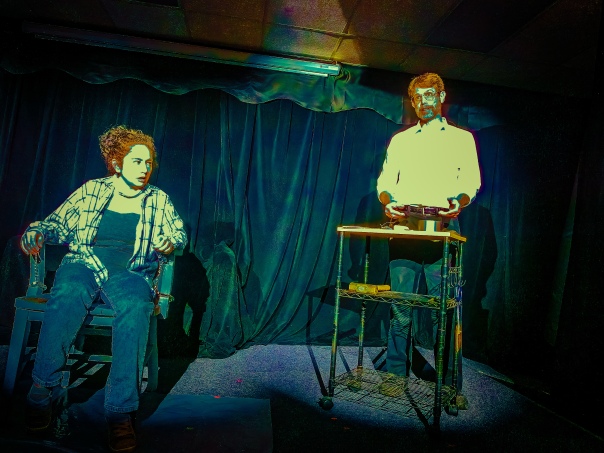
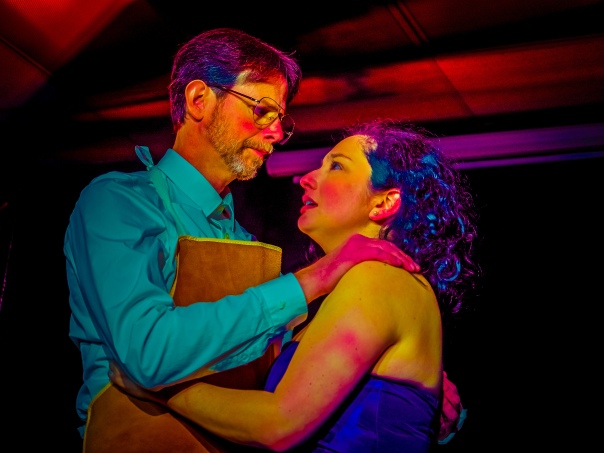
Carter’s chemistry with her abductor, Chuck Riordan as the Butcher, is deliciously volatile. The vibe is more spiced with sensuality on Carter’s end as Nancy tries to divert and charm Bill – revealing his name bares the first chink in the Butcher’s armor – as her survival instincts kick in. While Nancy is dazed and disoriented when she first awakens in the Butcher’s soundproofed dungeon, this is what she quested for during her previous vigils in the dark.

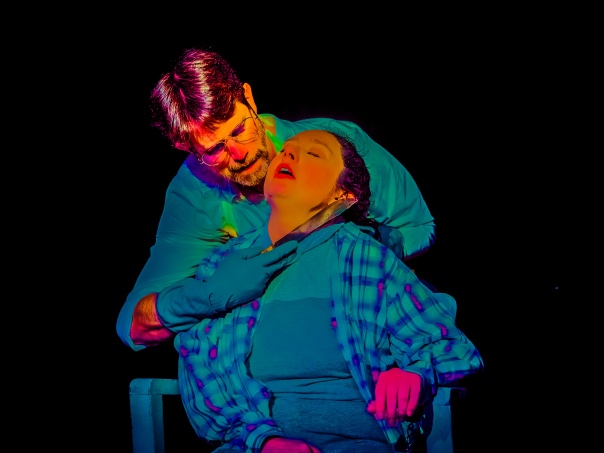
She is not like us. She needs prodding to scream her loudest and confirm Bill’s soundproofing. A knife at her throat as she sits helplessly handcuffed to a chair? Carter must calibrate the mortal terror that Nancy is experiencing with her fantasy fulfillment and delight. The more we realize how diligently Nancy has worked to be here, the more we appreciate the complexity of Carter’s performance.

Since she candidly lets out that the Butcher and his technique aren’t what she expected, Bill is also a bit disoriented as he realizes what he has stepped into. Being measured against the glamor and terror of Nancy’s dream serial killer begins to tilt his attitude toward defensiveness and appreciation. While maintaining his dominator role, he finds he must prove himself as a ruthless butcher and sustain the admiration his victim has professed toward his poetry.

Riordan, like Carter, is making his QC debut in a role that requires deft and sudden navigation. But he has significantly more leeway in how he portrays this monster as his vulnerabilities are exposed. He doesn’t get to be quite so sure of himself as the adventurous nothing-to-lose Nancy – deviations from glamor, savoir faire, and fearsome menace all redound in his favor as we see more beneath his façade. He’s an anti-villain, in a sense.

Riordon can thus roll with the moment and seem authentic so long as he doesn’t fumble his lines or visibly stumble in his actions. Especially in Bill’s domesticated scenes, Riordon can mute his paranoia and be altogether humdrum. There are key moments when Riordon is suddenly called upon to show a killer’s steel or a lover’s grace. He masters these with aplomb, and he’s strong on Bill’s telling trait: he wants to make his mark with his murders and his poetry, desperate for both notoriety and acclaim.

It would be heartless to give an even sketchy summary of how the story unfolds with Seidel’s unfailing logic. So let’s concentrate on a sequence that was pivotal for me.

To gain precious time, Nancy has convinced Bill that she wishes to hear the poem that was written about her. Bill not only picks up on the ploy, he notices that, compared with previous victims, Nancy isn’t as terrified when a knife is at her throat. She is not what he expected. He must consider the possibility that Nancy is a cop or an FBI agent, particularly after she escapes her handcuffs to use the toilet.

Fast forward a bit past some juicy action, one of them with French toast, and Bill has finished his new poem. We haven’t sampled the Butcher’s literary craft before, so we presumably know less about what we can expect than Nancy. “A Single Rose,” as Bill titles it, is recognizably dreadful – so dreadful that I initially suspected that the serial killer was laying a fiendish trap for our lady in distress, testing whether her esteem was worth having.

Asked for her reaction, Nancy comes back with an utterly hilarious, magnificently audacious response: “It’s not your best work.”

At this point, we had reached a realm of dark humor that was unfamiliar to me. In perfect style. From here, Seidel could take us wherever he wished – even upstairs, out of the Butcher’s dungeon, to a new household.

In the aftermath, we get to know the couple’s next-door neighbor, Joanne – a bubbling busybody portrayed by Jennifer Briere, yet another talented Post Mortem newcomer. She enters through the front door with a bundt cake, then a vase filled with freshly cut roses, seemingly well-acquainted with the welcoming-new-neighbors drill. Briere is especially precious when Joanne learns how Milwaukee, wherever that is, differs from Texas. You will see that all the audacity Nancy has shown us before is eclipsed the moment she dares to open the front door for Joanne, defying Bill’s stern commandment.

Reviews of Catching the Butcher sometimes cite Silence of the Lambs as an inspiration and inevitably Dexter, because the original Nancy in the 2015 Off-Broadway production, Lauren Luna Vélez, was a fixture in that series. If you’ll permit a more classical viewpoint, Seidel’s macabre comedy reminded me more of John Fowles’ The Collector, may favorite horror novel alongside Dracula. Bill is more of a scientist than Hannibal, less of a gourmand.

The household idyll we see blossoming after intermission, with its undercurrent of doom, took me back to prelapsarian Adam and Eve, with snoopy vivacious Joanne subtly installed as our Serpent. Wilson-Bowlby may have been feeling similar vibes as she staged the ending, giving it more of a wedding or honeymoon tang than Seidel could have imagined. Quite wonderful.

Kennedy’s Bridge Circle Meets Its Quota of Quips – and More

Review: The Thursday Bight Bridge Circle at Theatre Charlotte

By Perry Tannenbaum

Since 1987, the last time I watched a live performance at St. John’s Baptist Church, I haven’t cut a deck, played a hand, won a rubber, or even bid a single No Trump – I’ve even lost track of my copy of Charles H. Goren’s Point Count Bidding. But since that night when PlayWorks staged The Octette Bridge Club at St. John’s, I haven’t needed much knowledge about the game of bridge or its culture. My last brushes with the game were in Sunday columns I would read in the arts section when The Charlotte Observer was a traditional newspaper.

So it was a little concerning, when I sat down at Theatre Charlotte for the premiere of Ray Kennedy’s The Thursday Night Bridge Circle, that I found no less than four bridge teachers were credited in the playbill for their contributions. My concerns were thankfully unfounded. Visitors to the Queens Road barn will not be assailed with bridge terminology, the intricacies of bidding, or even extensive card play.

Louise Kennedy’s circle is a looser agglomerate than P.J. Barry’s octet, which was an unwavering group of eight sisters. And it’s only Louise’s circle tonight because hostess chores hopscotch from member to member on successive Thursdays. Nor are participants constant, we learn, as Louise welcomes us to her cheery, symmetrical, split-level living room – two tables flanked by two sofas – a luxe scenic design by Tim Parati that gives us peeps at the garden and the foyer.

Tonight, for example, Louise’s college co-ed daughter, Mary Carter Kennedy, is in town to play one of the hands, to be partnered with Louise’s mother-in-law, Mrs. Kennedy, who has earned a risqué reputation in LaGrange, North Carolina, as a liberal. Since one of the regulars can’t make it this week, dear Louise is bracing herself for the arrival of Miss Virginia, who will likely be roaring drunk as soon as she can guzzle sufficient booze. Excitement is ratcheted up further by a new player that only our host knows, Carmella, feared to be a judgmental Yankee – and to have a profession!

Imagine that!

The two tables are filled out by Bootsie and Cluster, gals from Louise’s generation, and two more elders, Miss Caroline and the eternally disapproving Mrs. Coltrane, Louise’s mom. You can bet there will be plenty to rouse Mom’s umbrage, beginning with the fact that housemaid Margaret and her daughter Bernice will be mixing drinks, pouring beverages, and preparing the hors d’oeuvres. Mary Carter also has a truckload of disclosures that will disconcert her granny.

Hosting such an exhilarating event is so intricate, complex, and daunting that Louise – or anyone who hosts the circle – cannot be expected to participate in the cardplaying. The standard of perfection is too high for a hostess to divide her attention. Tables must be carefully set, partners thoughtfully chosen, and place cards placed exactly so at every chair.

Sadly, Carmella hasn’t chosen the best night for her first sampling of Southern hospitality – or the best year. It’s 1970, LBJ is midway through his second term and the backwater of LaGrange still has separate black and white schools, bathrooms, and post offices. “It’s always been that way,” Miss Caroline complacently declares, and none of the LaGrange ladies except the liberal Mrs. Kennedy seems to suspect that Margaret or Bernice might be discontented with the racist status quo.

Needless to say, Kennedy has concocted a comical time bomb that is primed to explode before our eyes. Desegregation has arrived and Louise’s mom and husband have decided to send their imperiled offspring to military school – a betrayal of Louise’s bestie, Bootsie, who was counting on her public-school solidarity. Nor will Mary Carter, an activist at school, take this well, while Carmella and Mrs. Kennedy will be reliably alarmed. Toss in a stray N-word from Virginia when she’s sufficiently lubricated and you may conclude that a polite evening of bridge has been scuttled.

Before his fictional kindred took the stage on opening night, the playwright Kennedy spoke to us about his autobiographical work and introduced us to the real-life Mary Carter, proudly sitting in the third row. So when Tonya Bludsworth entered as Louise, it was a bit like a continuation of the playwright’s monologue, except that the hostess was giddier with excitement and nervousness because she didn’t know how the evening would go.

Sketching each lady who would sit in each bridge chair, the intro was a bit draggy despite Bludsworth’s fretful charm, particularly since the playwright doubles down on his intros by granting Louise mystical foresight into who is arriving at her front door – tripling down when she greets them by name. Most people will be delighted with Kennedy’s style, which endows most of his characters with the ability to come up with a Southern-fried quip or a salty simile in nearly every sentence.

Almost by magic, Kennedy is able to differentiate between his ladies anyway, thanks to the big family squabble and the political, class, and age divides. Dennis Delamar’s stage direction is as handsome as Parati’s set, elegantly accessorized by “props team” Lea Harkins and Lois Marek. No doubt Delamar’s successes are facilitated by the presence of at least three more actor-directors in his cast, Corlis Hayes as Margaret, Paula Baldwin as Mrs. Kennedy, and Bludsworth as the fourth ace. Assistant director Dee Abdullah is no slouch, either, as a dramaturge.

Kennedy’s lapses into logorrhea may be the result of his not realizing the full power of his script, which bursts forth with terrific force on Queens Road, first when Hayes reacts to the bombshell dropped by Kathryn Stamas late in Act 1 as the soused Virginia (which Grace Ratledge as Mary Carter and Ashley Benjamin as Bernice refuse to let go) and then a stunner by Ann Dodd as Mrs. Coltrane when she is unexpectedly confronted deep in Act 2.

Costume designer Angeli Novio accepts the challenge of making the hotsy-totsy New York lawyer, Stephanie DiPaolo as Carmella, stand out among the local LaGrange fashionistas in her haute couture. DiPaolo does her Long Island accent lightly enough to maintain her stature as an evolved Yankee outsider, but instead of leaning more into her legal expertise and feminist superiority, the playwright lets her devolve into an excuse to more thoroughly introduce us to the natives.

No matter how charmingly Jenn Grabenstetter as Bootsie and Amy Pearre Dunn as Cluster expound on the origin of their Dixie nicknames, I just don’t care, even if it did incentivize them to audition. Let’s get to the juicy stuff quicker! And when we do get there, let Baldwin have more space to bemoan and bewail how her son could conspire with Mrs. Coltrane to send her dear grandson off to a boarding school. It’s a glaring plot point that needs to be addressed – and weren’t we in the middle of a war in 1970?

Regardless of how much more meat Kennedy could pile onto our plates (and how much candy he could discreetly remove), Hayes makes an enduring impression in her climactic monologue, deftly calibrated by the playwright not to become a tirade. Ginger Heath, anointed my first Best Actress many years ago, get surprisingly little to sink her teeth into here despite her imposing wig, but that only spotlights the exploits of the newbies all the more.

Benjamin absolutely commands the stage when she unexpectedly returns in Act 2 as Bernice, a bit of a surprise after her badly miked debut as Tinman last September. That leads to a rather memorable sequence of assertiveness, contrition, and reconciliation begun by Dodd in her QC debut as the formidable Mrs. Coltrane. I didn’t expect to weep after intermission, but I did, even while the quips kept landing.

The Full Cerrudo Experience Is a Hit in Come to Life

Review: Charlotte Ballet’s Come to Life at Knight Theater

By Perry Tannenbaum

March 7, 2024, Charlotte, NC – Midway through his second full season as artistic director, we can now say that Alejandro Cerrudo has stamped Charlotte Ballet as his company. The corps looks fresh, peopled with more newbies we’re getting to know than trusted heirlooms who have long since proven their mettle. The choreography on their current Come To Life program at Knight Theater – Cerrudo’s Little mortal jump, Jiří Kylián’s Petite Mort, and the world premiere of Penny Saunders’ Beat the Clock – is beguilingly adventurous. Wow factor? Check.

For those of you who remember the 1950s, yes, Beat the Clock exhumes the classic TV game show hosted by the preternaturally vacuous Bud Collyer and sponsored by Sylvania. So at first, it wasn’t at all apparent that Saunders was targeting gender roles in those ancient days. But while the jackpot money was still flying gloriously above the dancers portraying the announcer, the host, the contestants, and the amped audience, we were cinematically fade-dissolving into a different scene as the shower of bills hit the ground.

This was a panel discussion where three women discussed the provocative question of whether housewives could benefit from additional education. Though it’s a godsend for the choreography, the discussion got heated, which may frustrate a few feminists in the audience. What frustrated me, however, was that Saunders’ sound design wasn’t as clearly audible for the panelists as it was for the archival gameshow track.

As the panelists’ hubbub subsided at stage right, there were a few moments of split screen as Michael Korsch’s lighting intensified at stage left for a briefer husband-and-wife scene, where both of the marrieds ended up feeling ignored and unvalued. Is this why we won the war? Sometimes, it felt this way. This brief microcosm gave way to two concluding community scenes, the first spotlighting the women and the finale embracing the entire 14-person ensemble.

Kerri Martinsen’s costume design had something to say about conformity in the outfits sported by the gameshow contestants and audience, later giving way to assorted nondescript outfits. Similarly, Maurice Mouzon Jr. as the announcer and James Kopecky as the host wore uniform outfits – with glittery silver blazers, to hell with historical accuracy. Back then, the em in emcee stood emphatically for master of ceremonies, so I suspected that Saunders and Martinsen were double-underlining their point.

After the first intermission, the repertoire flipped from cinematic to theatrical, with costume designer Joke Visser adorning Kylián’s men with gilt-edged cavalier attire that fit tightly and, for his women, the stiffest possible dresses. Suffice it to say that you’ve probably never seen women move laterally across the stage as these ladies in black do. Nor can it be doubted that these ladies – or their dresses – are the little deaths implied by Kylián’s Petite Mort title. Scored with slow movements from Mozart’s 21st and 23rd Piano Concertos, Mort both celebrates and lovingly skewers classic elegance – with a beautiful set of pas de deuxs between the ensemble segments and a couple of breathtaking transitions that require some nifty undercover choreography of their own.

The most eye-catching pairings among the six couples, for me, were Kopecky and Samantha Riester along with Raven Barkley and Rees Launer. Your mileage may vary, especially if you’re witnessing Charlotte Ballet for the first time, and the six couples will change from performance to performance (only Reister and Kopecky are constants, and they will be swapping out dances and partners). Just try not to gag on the relentless grace and symmetry.

If Kylián’s piece was a wry and perfect gem, then Cerrudo’s Little mortal jump, premiered by Hubbard Street Dance back in 2012, impacted like a coolly calculated over-the-top extravaganza. Korsch italicized the spectacle with his lighting design, principally when he aimed his beams at the audience and when he illuminated rows of vanity bulbs on cue. Branimira Ivanova’s costumes arguably upstaged Korsch’s lighting and Cerrudo’s choreography, literally stopping the show and putting two of Charlotte Ballet’s dancers in suspended animation, pinned to the scenery. Well before that, it was apparent that Cerrudo’s scenic design – massive movable boxes about as high as a school locker – was an integral part of his choreography. The movements of these huge boxes made transitions between scenes a constant source of excitement and surprise.

Ten pieces on Cerrudo’s playlist, listed alphabetically rather than sequentially in the program booklet, add to the kaleidoscopic swirl of his scenario and the giddy, stagey energy of the dancers. So his magical moment of suspended animation stands all the more dramatically apart from the hectic electricity that bookends this utterly unique pas de deux. Cerrudo’s piece, longer than the others, fit in well with them, maybe even eclipsing them a little. More comfortable in his leading role, his welcoming remarks were confident, for his invitation to support CharBallet’s 2024-25 season would soon be buttressed with a stunning program. The buzz in the house seemed to indicate that Cerrudo is winning over fervent new fans in his audience and onstage. As one ticketholder summarized, leaving the elevator that descends into the nearby parking garage: “Holy cow.”

Small Sizing Yields Big Rewards in DCP’s Fun Home

Review: Fun Home at Armour Street Theater

By Perry Tannenbaum

Across the way from the Gershwin Theatre, where Wicked has been running for over 20 years, you can find my favorite Broadway theater, Circle in the Square. At the other end of an underpass that connects the two venues – and two or three flights of stairs underground – you and 800+ plus patrons (less than half the Gershwin’s capacity) can have a theater-in-the-round experience in a space that’s like a wee oval basketball court or a hockey rink.

I’ve seen seven different productions at this underground stadium since 1999, most unforgettably the world premiere of Tennessee Williams’ Not About Nightingales that year and the visionary waterworld of Mary Zimmerman’s Metamorphoses in 2003. Right now, two other Circle gems are playing in Metrolina revivals, Lombardi at the Lee Street Theater in Salisbury and five-time Tony Award winner Fun Home at the Armour Street Theater in Davidson.

A couple of admirable versions of Jeanine Tesori’s musical have already run in the QC, a Broadway tour at Knight Theater and an Actor’s Theatre reprise on the Queens U campus, so the current Davidson Community Players production, directed by Danielle Melendez, has big shoes to fill. What strikes me most positively about DCP’s effort, however, is how small it is. If you’re sitting in the front row, as my wife Sue and I were last Saturday evening, some of the action will be right next to you. Or behind you.

From that vantage point, DCP is better than even the 2019 Actor’s Theatre production at Queens’s Hadley Theater in replicating the intimacy of the Circle in the Square experience. Set designer Chip Decker, who stage directed the Hadley production during his years at the helm of ATC, retains his bright visual concept – a departure from the more funereal Broadway and touring versions – in depicting the Bechdel Funeral Home, allowing Alison Bechdel’s cartoons free play on the translucent windows of the parlor.

Often, they’re animated, with Bechdel’s words and drawings blooming before our eyes.

As we watch Lisa Kron’s adaptation of Bechdel’s graphic novel unfold, there’s a nice little studio perch set aside at stage right for the full-grown Alison to narrate. Sometimes as Alison, Kel Wright insinuates herself into the action, lurking in the main playing space, sketchbook in hand, as Small Allison and Middle Allison act out her vivid memories of growing up at a Pennsylvania funeral home and coming out as a lesbian at Oberlin College.

The bright visual concept tracks better with Kron’s book, because darkness only gradually seeps into the story. Alison’s dad, Bruce, seems like a bookish, excessively neat and proper mortician at first, mainly because he and his dutiful wife Helen conspire to hush up his big secrets. When Small Alison and her brothers sing “Come to the Fun Home,” a faux commercial jingle for the funeral home, the childish glee is as contagious as an early Jackson 5 hit or something fresh from little Donny Osmond and his backups.

Bruce may discourage these boisterous outbursts, but he cannot suppress them. Similarly, when Small Alison wants to go to her school party in jeans and sweater, Bruce can temporarily impose his will by shaming his daughter into wearing a dress. It’s only in retrospect that we and the full-grown Alison realize that Bruce was mostly protecting himself, shielding the truth of his own sexuality rather than upholding propriety.

Ironically, the fulcrum begins to shift for Middle Alison at Oberlin College, where she discovers her own gayness. This is jubilantly proclaimed in “Changing My Major (to Joan),” a song that equals the joy of “Fun Home” and surpasses it in exuberant sensual comedy. Tesori is at her best in these chamber sized songs with their pop flavorings and their Avenue Q spice. Even at her peak in Caroline, or Change and Kimberly Akimbo, Tesori’s other acclaimed shows, there’s a little bit of Sesame Street mischief going on.

Having coped with Bruce’s escapades for decades, Helen understandably freaks out when her daughter informs her that she has come out. Alison can only see her mom’s distress through a haze of misperception. Yet we always like Alison because she not only observes herself and her family with her sketchbook, she perseveres on her path and eventually, if still hesitantly, confronts her problems.

Despite Dad’s disdain, she continues to opt for cartooning instead of “serious” art, continues to wears jeans instead of dresses. Faced with Joan’s advances, Middle Alison retreats… temporarily. She seems to hibernate and marinate after writing home about her gay epiphany, processing Dad’s puzzling evasiveness and Mom’s distress, but she elects to bring Joan home with her when she returns from Ohio on winter break.

Darkness falls gradually, but it falls hard.

Mortician, English teacher, preservationist, and molester of underage boys – there’s a lot to unpack, even for adults in the audience, as we try to understand and judge Bruce in the context of his times. Coming off his outré antics in Vampire Lesbians of Sodom,Ashby Blakely is as varied, complex, and nuanced as we’ve ever seen him as Bruce. At times, he roars in his tyrannical moments, overpowering the small house. Like all the other players, he’s miked, but thanks to Kathryn Harding’s exemplary sound design, there’s never any distortion, clipping, or dropouts to mar the show or its music.

The one major sacrifice for theatergoing purists is the lack of a live orchestra at Armour Street. Nevertheless, Harding contrives a surround effect by channeling the prerecorded soundtrack and the amplified voices from the rear speakers. It was a pretty unique front-row experience for me, rather enjoyable.

After her exploits at Booth Playhouse as Norma Desmond in Sunset Boulevard, Alison Rhinehardt had already convinced me that she could overpower Armour without a mic. As Helen, she predictably knocks her showpiece, “Days and Days,” out of the park with diva aplomb. Until then, she’s rather wholesome and humdrum, accentuating Mom’s breakout.

Nor is there any perceptible cratering when we scrutinize the less familiar names in this cast. Recently unveiling her directing chops in the Queen City Concerts premiere of Local Singles,Wright brings an exacting intensity to Alison that always captures the drama, even when she sings. “Caption,” she keeps barking in Kron’s script, so her valuation of le mot juste always seems foremost as her castmates take care of the graphics.

As the Bechdel brothers, Aiden Honeycutt as John and Grayson Flowers as Christian help turn Small Allison’s “Fun Home” promo into an exhilarating panorama. Bailey Fischer takes flight almost from the first moment we see her as Small Alison – goodness, energy, and precocity personified until her last “Flying Away” moment. That energy is formidable when Ann Schnabel must take over as Middle Alison, especially in the intimidating context of a matriculating college freshman. In a sense, then, her “Changing My Major” is as much a rebirth as it is an affirmation.

It’s the needed embrace of the real world that will ultimately help her in coming to terms with the truth about Dad.

Criminal law is far more confident than my feelings in determining who the forbidden fruit is among the remaining cast. As the revelatory Joan, Sierra Key seems healthy enough, her seductiveness sufficiently muted for a Midwest coed. At school and visiting the funeral home, Key hits all the notes that emphasize Joan’s savoir-faire and discretion without pounding them. As the Bechdels’ handyman, Bart Copeland struts and preens enough to convince us that he’s also a consenting adult.

When he switches roles and becomes a former student that Bruce picks up on his nocturnal rambles, Copeland calls upon the naivete that made his star turn as Pippin so compelling last spring at Theatre Charlotte. Topped with a mop-top wig, you’ll see he’s also a perfect fit for Tesori’s retro pop music.

Doubling the Fun

Okay, so maybe you weren’t duly impressed that two shows are now running in Metrolina that premiered at the same Broadway theater. We can do better. Weirder. This coming weekend boasts two different shows set at a funeral parlor! Yes, as Fun Home continues for two more weekends up in Davidson, down here at Booth Playhouse, Charlotte Conservatory Theatre is bringing us the world premiere of Nan-Lynn Nelson’s Leaving Watermaine, directed by the playwright.

It opens on leap day this Thursday, at the tail-end of Black History Month, for a four-day run. By the end of Act 1, we’re greeted with a busy weave of plot threads involving undertaker Werly Mainlodge, his three daughters, and their beaus – both beloved or unwanted. Which of the three young ladies will be leaving first? Elopement or honeymoon? Will the Klan intervene on the eve of the planned departure?

Has there been a KKK lynching or a passionate murder? Or is the presumed victim still alive? Mystery, racism, colorism, and comedy peep into what seems like a tragedy, so you’ll need to stick around after intermission to learn how the dangling threads sort out. Nelson seemed to have it all calculated, incorporating her own musical soundtrack into her sound design.

Dialing Up the Almighty in Memphis

Review: The Mountaintop at Theatre Charlotte

by Perry Tannenbaum

A stage with a particularly authentic – or imaginative – set design is a good start for a director who wishes to immerse you in the world of a play. Yet few productions surround you with the theatre experience, making you feel outside your own world and inside theirs. Sleep No More was dedicated to achieving this mission with a Macbeth makeover up in Manhattan’s Chelsea district at a spooky hotel, where I saw it in 2015. So was Then She Fell the following night in Brooklyn, where I was plunged into the imagination – and mental illness – of Lewis Carroll.

In Charlotte, such efforts have been comparatively infrequent, but not unknown: Chickspeare’s Fefu and Her Friends on Cullman Avenue in 2001, numerous “environmental” productions by Carolina Actor’s Studio Theatre (CAST) in their days on Clement Avenue, and Matt Cosper’s legendary Bohemian Grove of 2014 that was staged god-knows-where – you had to agree to be kidnapped in a van by The Machine at the Actor’s Theatre parking lot to attend.

They do make an impression, these hyper-immersive presentations.

Cut to the legendary Queens Road Barn for the latest Queen City experiment in environmental staging. Yes, that’s Theatre Charlotte – in Myers Park! – on the cutting edge with its new production of Katori Hall’s The Mountaintop. Directed by the ageless Corlis Hayes and designed by Chris Timmons – with a nine-person “Lobby Transformation” team – this is the first fully-staged drama my wife Sue and I have seen in the 501 Queens Road lobby since the spare and forlorn Waiting for GODot in 2007.

Together with invaluable help from David Gallo, set designer for the 2011 Broadway production, and props designer Brodie Jasch from Fayetteville’s Theatre Squared, Dr. Hayes and her production team aim to take us back to the Lorraine Motel in Memphis on the night of April 3, 1968. Rev. Martin Luther King, Jr., returns from the Mason Temple, where he has just delivered his eerily prophetic “I’ve Been to the Mountaintop” speech.

Every detail of the last room occupied by MLK has been replicated with meticulous authenticity – night tables and their contents, lamps, the chair and its fabric next to the window, the window curtains, the bed coverings – all the way down to the upside-down zero on the door to Room 306. With walls within walls, you must enter through this door to get your first view of the new theatre space in the lobby created for this production. Only the ceiling remains unaltered, with its fans and extinguished holiday lights. Explanations are appended in the digital program for those details which couldn’t be ascertained and those that would have conflicted with Hall’s script.

Since there is no intermission and all the usual concession outposts have been whisked away, they have thoughtfully made “Room Service” available to ticketholders via a QR code. In more ways than one, we are treated like kings at The Lorraine. Fun fact: the fateful motel was actually named after the hit 1928 song, “Sweet Lorraine,” popularized by jazz artists Teddy Wilson and Nat “King” Cole.

For all of Dr. Hayes’s reverent devotion to getting the look and feel of The Lorraine recreated as faithfully as she can, we soon see that it isn’t a shrine. Hayes is equally bent on getting to the heart of Hall’s pointedly irreverent drama. Hall provides ample time for solemnity and anguish at the end, but until then, she wants us to see the soon-to-be-martyred icon as a man, not a god, and not even as a holy man. The real Martin – or as God likes to call him, Michael – had his foibles, vices, and infidelities.

And notwithstanding the resounding valedictory declarations of the Memphis speech we’ve heard over and over – “So I’m happy, tonight. I’m not worried about anything. I’m not fearing any man” – Hall insists on reminding us that King did have worries and fears.

All obeisance to King’s saintly aura is swiftly discarded almost as soon as we see Justin Peoples taking on the role, before he walks through the audience to take a pee. Not only is he unkempt after his oratorical exertions and his walk through the rain, he has largely dropped his dignified public persona, at ease if not quite relaxed. Though he diligently examines his room’s rotary phone to make sure it isn’t bugged, we can hear that he has switched from formal to casual mode as soon as he speaks. It’s with an unmistakably Southern accent!

Immediately disarming. Neither the touring production by the famed Penumbra Theatre of Minneapolis that ran at Booth Playhouse in 2014, nor the homegrown Actor’s Theatre run of 2018 at Queens University, directed by April Jones, had quite the same spontaneous or undignified impact. The smallness of the lobby space at the Queens Road Barn certainly helps in establishing a closer intimacy with King and a sharper look at his vulnerabilities.

Maybe that folksy drawl would have been even more impactful if Peoples had held back on it until MLK had dialed room service after normal closing hours. The arrival of LeShea Stukes as the fetching Camae, a housemaid moonlighting as King’s waitress, would have been a good moment for Peoples to turn on the Southern charm. But for those of us who have seen The Mountaintop before, Stukes brings with her more than Camae’s sensual allure, more than her extra Pall Malls to satisfy King’s chain-smoking, and more than her working-class sass.

She now gives us solemn glances from behind King’s back, fully aware of the gravity of her true mission before she discloses it, morphing from pursued damsel to admonishing paramour to chum to messenger of God. None of these fresh wrinkles quite accounts for the marvelous voodoo or the juju that Hayes, Peoples, and Stukes have conjured up in creating the playful, poignant, and profound chemistry of this Camae and MLK.

Lighting designer Jennifer O’Kelly gently signals those moments when Camae might be contemplating why she’s there, foreshadowing the AV extravaganza that will accompany Stukes’ final mountaintop revelations. She will almost be speaking in tongues when we reach this visionary summit.

There’s little theology here, for when King dials up the Almighty, pleading his case for more time on this turbulent planet, she hangs up on him. Yet there just may be some deep dialectic in Hall’s scheme that narrows the gap that we might feel between God’s biblical judgment upon Moses at Mount Nebo and the judgment upon Martin in Memphis.

Moses was given a precise catalog of his greatest sins. Maybe in an afterlife he learned not to shatter any holy tablets or assault a boulder without God’s approval. But what was the great sin that deprived MLK of the Promised Land that awaited his people? The answer never comes explicitly in the play, but King’s sins – though relatively petty until we consider possible adultery – are graven in its marrow.

In an age when not a day goes by without yielding fresh images, outrages, and crimes committed by a lying orange buffoon, we might find ourselves shocked to be shoved towards such traditional moral moorings. Some of these values were written long ago in our marrow. Leading a people may still require adhering to a higher standard in God’s job description, not flouting the laws and proprieties that apply to everyone else.

Peoples and Stukes, with plenty of finely judged assistance, have found a way to make The Mountaintop more poignant, relatable, and human. Hall’s work becomes more touching, meaningful, and necessary each time I see it.

The Passion of Mary Cardwell Dawson Brings a Neglected Pioneer Back into the Spotlight

Review: The Passion of Mary Cardwell Dawson at the Parr Center

By Perry Tannenbaum

  February 15, 2024, Charlotte, NC – Commissioned by the Glimmerglass Festival and premiered there during the summer of 2021, The Passion of Mary Cardwell Dawson is a fascinating, informative, and inspiring hybrid. Part documentary, partly a new play by Sandra Seton with operatic arias composed by Carlos Simon, and partly an eye-opening “Building the Stage” exhibition, the new co-production by Opera Carolina and The Denyce Graves Foundation have found a perfect landing spot at the posh Parr Center on the CPCC campus.

With numerous glitterati on hand from Charlotte’s African American community to celebrate opening night, Dawson, and Black History Month, the Parr Center lobby dazzled as never before. Just 15 minutes before the curtain was scheduled to rise, I encountered a roomful of beautiful people and formalwear; imposing billboard-sized exhibits of museum quality devoted to Dawson, the National Negro Opera Company she founded, and the luminaries of opera – and jazz – that she tutored; accessorized with video stretching from one entrance to the New Theater to the other. All the bells, whistles, and glamor you could want, with a live bass and alto sax duo playing Charlie Parker bebop in the background.

The production was certainly equal to the new hall. Accompanied solely at this point of its development by pianist Gregory Thompson, The Passion would seem smallish at Belk Theater with its cast of four and an orchestra of one. Unfortunately, the Seaton-Simon creation also struck me as too small for Dawson, its subject, and too small for Graves, its star. With a sympathetic director like Kimille Howard already on board, and Op Carolina’s set designer demonstrating fresh possibilities with his wonderful projections on the upstage wall, the avenues are certainly opened for a fuller exploration of Dawson’s talents and achievements.

Seaton places all of the action in Pittsburgh, mostly at the headquarters of Dawson’s company on Apple Street, in a studio upstairs from her husband Walter’s electric company. Her compressed timeline results in a format that wavers between masterclass and a professional rehearsal. On one side of the stage, Thompson presides at a Steinway, and at the other, we see three humble chairs that might be occupied by students in a Dawson masterclass. If the libretto were allowed to breathe a little, the curtain would rise on the three students we will see, either seated and ready to perform or engaged in conversation, giving Simon – composer-in-residence at the Kennedy Center in DC – a chance to begin penning some recitative, and giving Graves a grander entrance.

Alas, this is a rehearsal of Bizet’s Carmen on the day that the Negro Opera Company’s production is set to premiere on a floating outdoor stage by the shore of one of Pitt’s famed three rivers. This setup gets more improbable as the story unfolds, undercutting Dawson’s wisdom as a performing artist, an opera director, and a business person. Would an operatic director allow her performers to risk overtaxing their voices by rehearsing on the day they perform? Wouldn’t the entire cast be summoned to a last-minute rehearsal? Wouldn’t it be in full dress? Wouldn’t standard rep like Carmen be so far under the belts of professional-grade singers that their director wouldn’t feel compelled to instruct them on how to present Bizet’s music or penetrate to his protagonists’ cores?

By heightening her drama on the day of the opening, Seaton actually manages to be more unflattering to the Dawsons. A rainstorm is raging across Pittsburgh, threatening the cancellation of tonight’s outdoor performance and the ruination of Dawson’s company. Administrators at Spoleto Festival USA and ticketholders from around the globe would laugh out loud at the notion that a scheduled outdoor production would bring in national and international stars to Charleston without making contingency plans for bad weather beforehand. Not sound judgment for Dawson or her husband, who handled her company’s business end.

Of course, Seaton’s scheme makes it easier for The Passion to have legs, because the roles of Dawson’s singers – Isabelle as Micaela, Phoebe as Carmen, and Frank as Don José – only need to be versed in their presumably familiar Bizet music rather than having to learn anything written by Simon. Even so, Diana Thompson-Brewer as Isabella, Ladejia Tenille as Phoebe, and Johnnie Felder as Frank, are all forced to look and sound slightly amateurish at times during their lamentably brief moments in the spotlight. Howard helps them all out from her director’s chair, occasionally obliging Graves to be a bit fussier – and a lot more prudish – than Seaton may have imagined Dawson when she wrote the script.

I was most impressed by Felder in the tenor role, and wondered how much his superiority might have figured in Seaton’s concept or Howard’s casting. Most of Graves’ vocal coaching, after all, is reserved for the younger women onstage and the music she has excelled in all the way the Metropolitan Opera, Covent Garden, and the Vienna Staatsoper, to name a few – so it would be a pity not to hear Graves in this repertoire while we have her here and not perceive her superiority to Dawson’s protégées. The diva and the drama deserve that. Simon’s music, scant as it is, is also worthy of Graves. Those two arias, when Dawson is alone with her thoughts and later when her class/rehearsal is done, both have the qualities of the best arias sung at Spoleto’s production of Barber’s Vanessa last spring.

A fuller version of The Passion of Mary Cardwell Dawson would be a full-length opera with a fuller view of Dawson as a singer, teacher, and impresaria. Ideally, it would take us back to the North Carolina native’s childhood and the foundations of her love for music and opera, but we should at least cover the arc of Dawson’s founding of her company, a more substantial exploration of her teaching methods and philosophy, and a nicely drawn arc of her prize students’ development into professional opera singers that do full credit to Dawson and her pioneering company in their Carmen. A full opera company at the end – with a fuller orchestra – would bring the entire enterprise up to scale. Make no mistake, though, this handsome Opera Carolina production is an exciting coup for Charlotte and a compelling argument for Denyce Graves’ project to reach its fullest fruition.

The More Things Change, the More Confederates Shocks and Delights

Review: Confederates at The Arts Factory

By Perry Tannenbaum

Symmetry, parallelism, continuity, and evolution are intricately interwoven throughout Confederates, Dominique Morriseau’s comical and sometimes farcical drama of 2022. The Charlotte premiere, now at the Arts Factory, comes to us less than two years after its Off-Broadway premiere in a highly polished, smartly aware Three Bone Theatre production.

Morriseau’s symmetry isn’t subtle: it hits us straight in the eyes the first time we see Zachary Tarlton’s scenic design. Split down the middle, the Arts Factory stage gives two eras and two institutions equal play in an intimate black box format. One side evokes Civil War slavery on a Southern plantation, while the other half introduces us to contemporary academia.

We alternate between settings, starting with Sandra, a modern tenured Black professor, proclaiming her outrage and sense of violation in vivid terms – yet with the poise and sleekness of a contemporary college lecture accessorized with slides. From that peep into scandal in present-day academia, we flash back to the slave quarters of Sara as her brother Abner sneaks into her bedroom through a concealed trap door.

Sandra has been maliciously targeted by a student or teacher who pasted a demeaning old Civil War photo of a bare-breasted black wetnurse suckling a white baby – with Sandra’s face photoshopped to replace the original slave’s. Jumping to conclusions or instinctively making connections, we’re apt to immediately believe that Sara was that nurse. Abner has volunteered for the Union Army and has been wounded in battle, so as she sews up Abner’s wound, the subject of Sara’s nursing skills is inevitably addressed.

Sara’s skills and ambitions extend further. Dangerously. She has already learned how to read, breaking one terrible white taboo, and she wishes to nurse and fight for the Union alongside her brother – to learn how to fire a rifle right now. That’s a pill Abner can’t easily swallow.

Otherwise, the two women have separate storylines until Morisseau split-screens them together at the end. Portraying Abner in his Three Bone debut, Daylen Jones is the first subordinate character to cross the invisible line between pre-Emancipation Dixie and the hope and refuge of modern-day academia. Shedding his rags and his Union blue greatcoat, Abner becomes the aggrieved Malik in today’s world. He’s obviously a gifted student, and his gripe with Professor Sandra is that she grades his papers more harshly because he’s Black, protecting her immunity from being charged with favoritism.

Seeing that there are only Black females on faculty – and no men – Malik feels doubly oppressed by bias in academe: racial bias compounded by gender bias. Notwithstanding her starchy professional manner, Sandra is more of a crusading sociologist than a sober judge. So she may indeed have fallen prey to the trope heaped upon oppressed races and genders that says, “If you wish to be treated as an equal, you need to be better.” Pragmatic? Sure. But for a gifted scholarship student seeking to maintain his A average, cold comfort.

We eventually see that there are four characters on each side of the time divide, three of whom repeatedly change costumes to play double roles. Before and after we can tally all this, director DonnaMarie and sound designer Tiffany Eck place two snippets from Nina Simone’s “Four Women” at strategic spots in their playlist, layering on extra meaning – and mythic aura – during scene changes.

If Jones can be labeled as two provocatively different militants as he roams back-and-forth from opposite sides of the stage, then Holli Armstrong (also on my radar for the first time) can be regarded as two variants of an imperfectly enlightened white racist. She is most exaggerated and hilarious on the Southern plantation as Missy Sue, the master’s daughter, when she comes back home as an undercover born-again Abolitionist. It is Morisseau as much as DonnaMarie who is prompting Armstrong to bring a Gone With the Wind air-headedness to Missy Sue – and a twisted lesbian desire for Sara – and she obliges with fiddle-dee-dee gusto.

She offers Sara a perk in exchange for executing a dangerous mission: if Sara will transcribe and transmit Master’s battleplans, she gets to live in the big house while Sue delivers Dad’s secret intelligence across enemy lines. Sure, that’s an appreciable upgrade for Sara, but she’ll still be a slave doing Missy Sue’s dirty work.

Armstrong discards Missy Sue’s pea-brained giddiness when she transitions to Candice, retaining her sycophant tendencies and much of her high energy as she haunts Professor Sandra’s office, working off her tuition debt and gathering gossip. Her true manipulativeness gradually emerges in successive office scenes, but Candice never becomes as juicy a role as Missy Sue is, for she somewhat downplays her suck-up moments with faculty.

Last to appear onstage, Jess Johnson draws the most balanced – and delicious – of the dual-role combos. As the master’s Black mistress, the opportunistic Luanne effortlessly sniffs out that Sara’s access to the master’s office and desk are coming at a price the newcomer must pay, possibly beyond accepting Missy Sue’s sexual advances. On the academic side, Johnson gets the most radical of costume designer Chelsea Retalic’s backstage makeovers when she becomes Jade. Professor Jade is more stylish and popular than Sandra because she’s chummier with her students and would never dream of hamstringing the Black ones.

At both ends of the stage, Johnson gets to be a wily master of psychological warfare. Both Luanne and Jade want something vital from our protagonists. Luanne wants friendship from Sara and a path to freedom, but if Sara bars the way, she can work her charms on Abner. Needing Sandra’s endorsement, Jade doesn’t tiptoe around her differences with her superior, unleashing a torrent of scorn and chutzpah that took my breath away.

Indeed, Johnson unlocks Morisseau’s grimmest joke on her protagonists. Whether you’re at the bottom of the pecking order or at the top, you’re still the most oppressed person in the room. Times have changed, but not that much.

Sara is always being pulled at from multiple directions. Abner needs to be sewn back together, Missy Sue wants to recruit her as a spy, and Luanne wants her to plot an escape to freedom. Maybe that’s why the playwright stretched out Sara’s name to Sandra for the New Millennium! Our Professor is no less pressed upon, strongly urged to re-examine her grading philosophy, softly reassured that she is more admired than she really is, and arrogantly lobbied for tenure backing. Nobody seems to really care about the bare-breasted insult that was slapped on her office door.

Neither of these roles is fun-filled, but the challenges Sara and Sandra face allow them to grow in strength and stature before our eyes. Valerie Thames and Nonye Obichere are so fiery and authoritative in their separate roles that you can comfortably watch Confederates as two separate plays without constantly considering how meanings and brilliance bounce off the facets of the two gems. Not feeling compelled to track the finer points of Morisseau’s disquisition on racial or gender bias makes it all the easier for an audience to enjoy them.

Thames effortlessly takes on the self-assurance of an established TV guest whose knowledge and viewpoint are proven commodities, wearing Professor Sandra’s celebrity status with insouciant dignity. Just watch out when she bursts into flames! Maybe run for cover.

Although Sandra’s speeches frame the drama, Obichere gets to be a more physical presence as Sara – as nurse, spy, soldier, and lover – and she navigates a far wider character arc. Hers isn’t the funniest performance you’ll find this weekend at The Arts Factory. But it’s the most vivid, shocking, and memorable.

You may leave the theater convinced that both Sara and Sandra are depicted in that horribly racist slide. But it will mean more at the end than at the beginning. The magic of Morisseau and Photoshop are both at work.

Ensley and Schroeder Check All the Beautiful Boxes in Matthews

Review: Beautiful The Carol King Musical at Matthews Playhouse

By Perry Tannenbaum

When you think of singer/songwriter Carole King and Broadway musicals, there’s an instant disconnect: the humble simplicity of King’s Tapestry album cover clashing with the glitz and blare of the Great White Way. So a Broadway musical about King’s career is more of a stylistic stretch than a biomusical about most rock stars, pop stars, or jazz & blues divas. Everyone involved behind the scenes of the original 2014 production of Beautiful The Carol King Musical seemed keenly aware of the dichotomy, including director Marc Bruni, orchestrator/arranger Steve Sidwell, and scriptwriter Douglas McGrath.

Their idea of coping with the problem was by leaning into it. Not too subtly, they conspired to make the early stages of King’s career seem crass and commercial, as if she were trapped in the dog-eat-dog maw of the pop music industry. King and her writing partner, lyricist Gerry Goffin, write the songs while producer Don Kirshner finds the singers and the groups who will cut the singles – the likes of Bobby Vee, Little Eva, The Drifters, and The Shirelles. Yet somehow the hierarchy is flipped in the famed Brill Building in NYC.

Carole and Gerry are slaving for Kirshner, a genial industry mogul and taskmaster, and the couple’s best early music loses a lot of its luster when it’s farmed out, especially when “Up on the Roof” falls into the hands of The Drifters and “Will You Still Love Me Tomorrow?” is butchered by The Shirelles, thanks to excessively ornate Sidwell arrangements that would be more at home on Broadway or Vegas than Motown. These excesses helped Jessie Mueller to shine all the more brightly in the original cast – and for her sister, Abby Mueller, to shine equally when the touring version hit the QC in April 2016.

So a downsized production, like the one currently running at Matthews Playhouse, actually has the potential to be better than the Broadway and touring versions – with the right personnel and sufficient pizzazz. With Billy Ensley directing and Lindsey Schroeder leading a heavyweight cast, both those boxes are checked. The Broadway ensemble sheds two of its three keyboards nestling into Matthews, one its two guitars, and one of its percussionists. The slimming helps. No longer smothered by their orchestrations, Neil Sedaka’s “Oh! Carol,” Gene Vincent’s “Be Bop a Lula,” and Little Eva’s “Loco-Motion” sound more like rock music and less like mockeries.

Ensley targets the megahit by the King-Goffin duo’s friendly rivals, Barry Mann and Cynthia Weil, for his most farcical treatment. Not only is the arrangement of “You’ve Lost That Lovin’ Feelin’” garishly distorted, amped up from the swampy-echoey-churchy vibe of the original single, but the gulf between the bass and tenor voices of the Righteous Brothers is greatly emphasized, exaggerated, and comically exploited by Johnny Hohenstein and Zach Linick.

McGrath’s book is most affecting when it deals directly with King, though there’s bold poetic license in his voodoo, historically speaking. Pressured by Kirshner to come up with a new hit overnight for The Shirelles (in real life, they only had one hit record so far), King writes the music and goes to bed with Goffin. Perfect setup. Wouldn’t you like to wake up in the morning and find the handwritten lyrics for “Will You Still Love Me Tomorrow” perched on your piano – and be the first person on Earth to read and sing them?

No disrespect to the great Bobby Vee, but we’ve suddenly ascended more than a few notches above “Take Good Care of My Baby.” This moment still grabs me, but there are more moments like this after intermission, when “You’ve Got a Friend” and “A Natural Woman” are unveiled, that choke me up even more – as King breaks away from the Brill Building and starts to do her own thing. Schroeder replicates the sandy sound of Carole’s voice from the beginning, but as she transforms from a demo singer behind an upright piano to a chart-topping performer, watch out.

Schroeder can not only belt – she can tear your heart out.

McGrath’s dramatization heightens the magic most memorably when “You’ve Got a Friend” is reframed as a not-quite-farewell song, when King embarks for her solo career in LA with Kirshner’s blessing, and both Barry and Cynthia gather round the old upright with her to sing this newborn masterpiece. The song didn’t really come out until her second album, but who’s counting, right?

Nick Southwick as Barry and Sophie Lanser as Cynthia (get that woman a more reliable mic!) deliver polished performances all evening long, but they also grow more gravitas after intermission. Lanser sheds the frivolity of a “Happy Days Are Here Again” parody and “He’s Sure the Boy I Love” and joins Southwick – previously mired in the silliness of “Who Put the Bomp” and the wrong-key version of “You’ve Lost That Lovin’ Feelin’ – in a heartfelt “Walking in the Rain” duet.

Then if you haven’t started weeping with Schroeder’s “It’s Too Late,” you’re at the mercy of “You’ve Got a Friend” when Lanser and Southwick join in on the quivering-lip goodbyes. After playing Kirshner with avuncular savvy throughout King’s formative years, Ryan Dunn sprinkles some welcome laughter into this maudlin scene with a (purposely) bad attempt at vocalizing.

I’d forgotten that Carole had Aretha’s 1967 hit in her hip pocket when she cut Tapestry out on the Left Coast in 1971, so I found myself suddenly suppressing sobs when “A Natural Woman” began. Here it felt very right that Sidwell’s arrangement brought added vocalists and brass to beef up the simplicity of King’s version – and freed Schroeder to narrow the gap between Carole and the Queen of Soul with some fervent belting.

Marty Wolff’s simple two-story set design, with four wide strips of stained-glass paneling running vertically upstage in front of the eight-piece band led by Ellen Robison from the keyboard, needs only JP Woodey’s lighting to give it a rockin’ modernistic zing. Lisa Blanton’s choreography is devout doo-wop, most praiseworthy for how well the groups stay in sync, and Chelsea Retalic likely cranked out between 75 and 100 costumes for this large cast – all of them, from the sleekest to the grungiest, on point.

And the wigs! The only misfire here, among dozens of triumphant coifs – several for Schroeder – was the oceanic profusion of waves that perched on Joe McCourt’s head as Gerry Goffin, making him virtually unrecognizable. McCourt, a musical mainstay in the QC since his debut in 2008 as the lead in Godspell, has suavity to spare to spare and, in contrast with Southwick’s quirky neuroses as Barry, gets a nice and bumpy character curve as the only troubled soul we see.

This image has an empty alt attribute; its file name is beautiful24-139.jpg

As for the Afro-American doo-woppers… my, oh my! By bringing Nehemiah Lawson aboard to take over “Some Kind of Wonderful” from Schroeder and McCourt and then to bring him back again and again to sing “Up on the Roof” and “On Broadway,” the latter one of Weil & Mann’s best, Ensley and Robison signal that they have no plans of dissing The Drifters. Meanwhile, two lead singers are embedded among Ensley’s Shirelles. As Janelle Woods, the Shirelle who denigrates “Will You Still Love Me” as “too country” before fronting the breakthrough single (first Billboard #1 for an African-American girls’ group), Brianna Mayo gets a chance to show that her acting chops are as strong as her singing skills.

Shortly afterwards, Raven Monroe emerges from the backup Shirelles to become Little Eva and ignite “The Loco-Motion.” Until then, she moonlights as King’s babysitter during the leading lady’s brief marriage to the restless Goffin.

There’s a formulaic circle to McGrath’s storytelling that’s not at all displeasing, starting and ending with King as a star behind a grand piano singing a song from Tapestry. We flash back to her youth in Brooklyn and eventually touch down at Carnegie Hall, surely a kind of Jerusalem for a humble Jewish girl. Alongside her at the beginning and at the end is Carol Weiner as Genie Klein, King’s mother. Both were abandoned by her no-good father, steeled by adversity. Along the way to Carnegie, Weiner peeps in with a couple of overprotective warnings, a few salty quips, and a proud Mama’s lie.

If McGrath can embellish a good story, why shouldn’t she