“The Humans” Is More Haunting Than Ever

Review: The Humans @ Armour Street Theatre

By Perry Tannenbaum

Thanksgiving in Chinatown, in the shadow of the fallen Twin Towers – Stephen Karam’s spooky, mystifying, and hilarious The Humans hands us a world teeming with paradox. For an afternoon in a creaky old two-story apartment, newly rented by Brigid Blake and her boyfriend Richard Saad, her family gathers to celebrate, the whole lot of them nursing open wounds – and their Alzheimer’s-stricken elder, “Momo” – trying to heal from recent setbacks.

First staged in the QC at Knight Theater in a 2018 touring production starring Richard Thomas as family patriarch Erik Blake, Davidson Community Players brings us a downsized reprise in the first locally-produced staging, with the venerable Hank West in the lead.

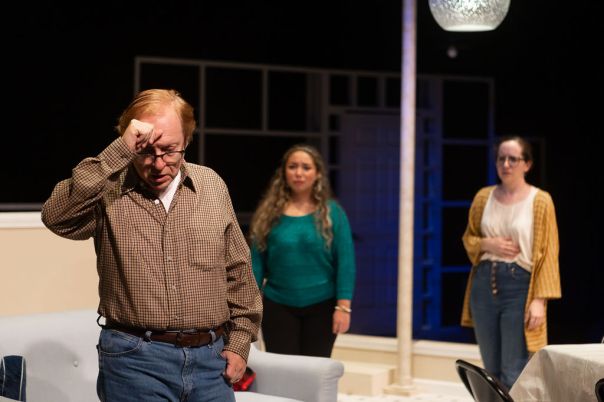
Haunted by his return to the vicinity of Ground Zero and by his recent misdeeds, tormented by a deadly mix of sleeplessness and nightmares, Erik vies with elder daughter Aimee for which of the Blakes is suffering the most. Since last Thanksgiving, Aimee has come down with ulcerative colitis and taken major hits to her love life and her career as a Philadelphia lawyer – with major surgery looming on the horizon.

Yet Erik fires a wicked one-liner at Brigid, whose gripe, like his wife Deirdre’s, barely hovers above the “suck it up” level compared with his own. “If you’re so miserable,” he asks the health food fanatic, “why are you trying to live forever?” Inside negativity, Karam can be equally trenchant and funny when Aimee philosophizes about her recent breakup: “Maybe loving someone long-term is more about deciding whether to go through life unhappy alone or unhappy with someone else.”

Only Deirdre and Erik have an agenda for the afternoon, subtly suggested in a couple of brief dialogues. We’re mostly watching Karam’s keen observations of family interactions – their bonds, their tensions, their little quirks, and their tectonic divides. These appear all the more chaotic because dialogue often overlaps and action is happening simultaneously upstairs and in the more commodious basement.

Knight Theater probably gave us an oversized impression of Brigid and Richard’s love nest, while DCP’s Armour Street can’t help look both height- and space-challenged. Remarkably, Evan Kinsley’s more cramped set design lessens the struggle of viewing multiple tracks of action and family intrigue. Yet Karam and director Glynnis O’Donoghue are still able to provide enough compelling distraction at a key moment to allow the aged Momo to disappear without our noticing.

Even without two-story height, Kinsley’s set has an alleyway leading to an elevator shaft to accommodate the wheelchair-bound Momo’s transit between the two floors. The slice of set that serves as the upstairs somehow has enough space for the front door, an entrance to a bathroom (Aimee’s frequent retreat), and the only window looking out on the city. When the apartment’s oddities need to impact, Kinsley’s set and Sarah Provencal’s sound design deliver.

The divides between the Blakes will be familiar to anyone who has grown up in a family of siblings. Although Brigid would never consider living in Philly, the geographical divide is as important here as the generational difference, for neither of the daughters would ever think of moving back to Scranton, PA – except to a summer home that Erik tells us can move towards construction once there’s a sewer system near their pristine plot.

Those anticipated PA pilgrimages will not bring either of the sibs back into the bosom of the holy church. Nor will it erase the fact that these country folks’ children are irremediably citified, one a lawyer and the other an aspiring composer. Safety, religious, and lifestyle concerns plague the homespun parents. Ahead of their Thanksgiving visit, Deirdre has sent a care package that includes a statue of the Virgin to protect Brigid’s new home. Meanwhile, Aimee can expect an email any time a lesbian commits suicide.

Karam provides plenty for the Blakes to discuss in their near and distant back histories, with a handful of stunning updates. If things get dull, he serves up a choice collection of singularly awkward moments that would instantly embed themselves in family lore ever after, lovingly and mockingly retold at holiday dinners and special celebrations.

There’s even a “pig smash” ritual unique to Blake Thanksgivings, a nice spotlight for Richard. Often the aspiring social worker serves as our ears in his role as outsider, giving the Blakes the chance to explain all that is long-known among themselves.

These moments reverberate warmly within us, but the most haunting vibes, from Erik’s dreams and experiences, touch us all, nonchalantly invoking 9/11 and Superstorm Sandy – specters of terrorism and climate change. Over and over, whether Deirdre wheels Momo around or Aimee summons an Uber with her cell, we hear an eerie, insistent whisper from the playwright emanating from his vivid, painstakingly detailed dream: this is how we live.

On Davidson’s compacted stage at Armour Street, the natural flow of The Humans, the lack of powerhouse confrontations that shake us to the core when we witness such American classics as August: Osage County, Who’s Afraid of Virginia Woolf? or The Little Foxes, reminds us of Chekhov’s more placid classics. Rich and funny and touching as all the action is, we will likely struggle to discern a solid plot until Erik’s big reveal.

Inexperienced theatergoers are therefore advised to ignore any FOMO anxieties they may be experiencing and surrender themselves to the many delights, laughs, shocks, and epiphanies that West and his castmates deliver.

On the page, Karam’s script doesn’t pop out at you with the color and verve that O’Donoghue gets from this ensemble. West actually comes onstage with a couple of key advantages over Richard Thomas. We more readily accept West as an ordinary janitor-turned-equipment-manager, and he can bring out a curmudgeonly edge to Erik that I’d never noticed before.

No less surprising is the bubbly, goofball likability that Breanna Suarez brings to Brigid, though she is often the family contrarian and party-pooper in the script. The vibrant energy she exudes somehow turns pure negativity into simple immaturity, emphasizing Brigid’s spoiled qualities. As our genial hostess, Suarez tunes in on Brigid’s side hustle as a bartender, so she’s the life of the party while subtly fueling the true plot, endearingly committing a faux pas for the ages along the way.

Portraying West’s wife for the first time since 2005, when they both earned best actor honors in Coyote Ugly, Anne Lambert makes the wait worthwhile. Although Citizen Trump famously descended his escalator in June 2015, between the time that The Humans opened Off-Broadway and when it reappeared on Broadway with a completely new cast and director, Deirdre likely struck the late-2015 Broadway crowd as a MAGA maniac.

Interestingly, Karam could have taken Hillary Clinton as his model if he had written his tragicomedy 20 years earlier, but Lambert still strikes me as a MAGA nutjob even if that couldn’t have been the playwright’s intent. The religious zeal, the paranoia, and the constant moralizing are almost non-stop, so thanks to Lambert’s implacable disapproval, Deirdre winds up ennobling Erik and humanizing her daughters – just by enduring her. Yet there is an unmistakable sincerity to this steely, troubled soul.

Deirdre’s relatively spurious sufferings also brighten Aimee’s halo. Her woes are certainly the most tangible, so Alyssa Whitting has the freedom to add some hard edges to her performance, aiming her best zingers at Brigid with an assortment of barbs for the rest of the fam. Ascending and descending DCP’s imaginary staircase for extended poops, Whitting makes a pungent impression when she’s with us. She’s the slick urban professional among the Blakes, getting better reception on her cell than Dad and handling all the key calls.

Preoccupied with the cooking, Ryan Miles as Richard is also frequently on-leave from the family flow, but he’s a fine audience surrogate when we need things explained. Without fuss or bravado, Miles keys into the fact that Richard is the most laid-back, financially secure person in the room – the one lifelong New Yorker – in between Brigid’s age and Erik’s, accentuating his unique perspective.

Momo’s lines are annoyingly repetitive and approximately 85% gibberish to my ear, meticulously transcribed by Karam word-by-nonsensical-word. So if Wandy Fernandez is accurately delivering Momo’s babblings as written without considerable improvisation, she has performed one the most prodigious feats of memory in the history of theatre. There is wonderful variety in her performance with a lovely little miracle in the middle, which of course gratifies Erik and Deirdre the most. Words or not, the woman can also throw a fit.

The cryptic ending of The Humans, where the thin thread of Karam’s plot crystallizes, was clearer to me the second time around. Along the way, it’s helpful to note the circular shape of the Blakes’ history, the dream Erik divulges stage by stage, and the explanation Richard offers. Erik’s worries, sadly enough, are suddenly more topical in the Carolinas than ever before. After Sandy, the fact that Chinatown was a Zone A flood zone was fearfully real. Now that Asheville is isolated, adrift from interstate highways until next year, we can legitimately wonder what zone is not a flood zone after all the climate damage humans have done.

Richard says it succinctly, recalling a comic book he loved as a kid: “horror stories for the monsters are all about humans.”

Bearde Crosses the Border With Ziad to Sublimity

Review: Jazz @ Theatree Bechtler with Nicolas Bearde

By Perry Tannenbaum

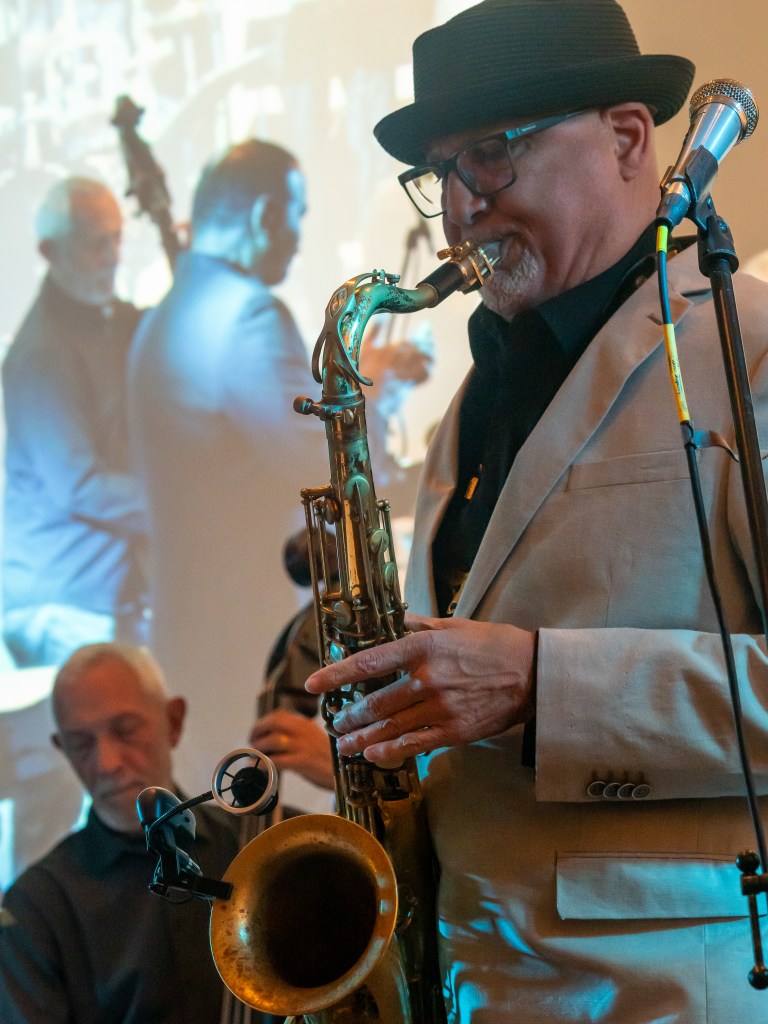
October 4, 2024, Charlotte, NC – As a listener and a sometime vocalist, my feeling is that a jazz singer backed by a piano trio can only verge on the sublime. Until a horn is added – saxophone, trumpet, or clarinet parlaying and intertwining with the vocalist – the divine nectar never quite sparkles with maximum effervescence. So it’s always a joy when the Jazz at the Bechtler series hosts a guest vocalist, for the leader of the house band, Ziad Rabie, always carries a tenor and soprano sax with him to fortify the artillery. Before Nicolas Bearde’s appearance on Friday, I hadn’t been to one of these bacchanals since Nnenna Freelon guested in May 2022, so I was behind the curve in terms of how the experience in the Bechtler Museum of Modern Arts lobby has been enhanced.

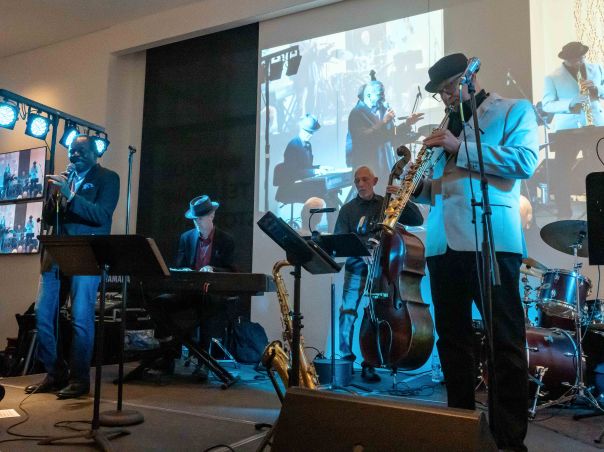
Perhaps influenced by Middle C Jazz over on Brevard Street, the Bechtler bandstand is now framed by large video monitors displaying a live feed of the concert – that is also projected as a larger-then-life backdrop upstage of the players. The effect of the live pastel projections is electrifying, especially if your sightline differs radically from the camera’s, and the projected images are helpful if your view of one of the musicians is obscured. A music stand downstage blocked my view of drummer Rick Dior sitting behind Rabie, but when I stood up briefly to snap a photo of him, I discovered that a second music stand right at his drum kit was still blocking my view. Luckily, the live feed up above him was available to us when he took a solo.

Bearde last sang in Charlotte at the tenth anniversary celebration of the Bechtler series staged at the adjoining Knight Theater in January 2022. That was my gateway to his discography, which certainly reinforced my notion that he agreed with me on jamming with a horn. There were plenty of Nat King Cole tracks online that were delightful to discover from his recent album on Spotify, along with a few Johnny Hartman gems on past recordings. He’s been around long enough, since before the turn of the millennium, to have accumulated two Spotify artist listings that do not overlap – and he still sounded like he’s at the top of his game. The two saxophonists who have played on Bearde’s last two albums, Eric Alexander and Vincent Herring, are both self-recommending – and they both supplied a sheaf of candidates for seamless transport to the Bechtler lobby and Ziad’s capable hands.

So did two of the songs Bearde sang in 2022, his own “Falling in Love Again” and Abbey Lincoln’s “Living Room,” both of which were reprised in more extended versions. The baritone began his set with the same song that began his 2016 album, Invitation,Burton Lane and Alan Jay Lerner’s “Come Back to Me.” Where Herring had inserted his alto, Ziad now blazed with his soprano sax, with extra space in the arrangement set aside for pianist Noel Freidline’s ruminations – all with the speed and verve of the lyric’s “turn the highway to dust, break the law if you must” spirit.

With “That Sunday, That Summer,” Bearde brought us the first of two tracks selected from his Nat Cole tribute album, both of which, not at all coincidentally, featuring Alexander on tenor sax. Bearde’s way with the song is jazzier than Cole’s 1963 saccharine hit – with its lush strings, full chorus, and glinting triangle – but I can’t say I like all the added syncopation he brings to the table. Best of the covers, to me, is a Sarah Vaughan version not to be found on Spotify. That revelation is online exclusively at Apple Music on her Jimmy Rowles Quintet album from 1974.

Bearde was entirely in his groove thereafter, beginning with his cha-cha inflected Burt Bacharach hit, “Close to You,” with some fine solos by both Ziad and Freidline – and a wonderful breakaway into 4/4 tempo in the middle of the vocal reprise – with some extra Beard/Ziad jamming afterwards. Lincoln’s “Living Room” was beautifully embroidered the second time around with an introductory Freidline fantasia intro from his electric keyboard and a regal solo from bassist Ron Brendle after Ziad’s tenor sax proclamation. Most unexpected and exciting was a new song, “Si Vous Saviez,” written by Rabie with Jennifer Shea. If you’ve heard John Coltrane’s Ballads album, you can begin to imagine the lovely sound of Ziad’s creamy, buttery intro on tenor sax, and Bearde took to the longish tune like he was seriously considering recording it on his next album.

The rest of the set included songs that Bearde has already taken to the studio, starting with the moody title tune from the Invitation release, which saw a fine intro and later solo from Ziad and, notwithstanding the comparatively mellow mood, a fine chunk of work from Dior on the solo I screened. Plucked from his Nat Cole tribute, “Thou Swell” actually began life as part of Rodgers & Hart’s A Connecticut Yankee in 1927, where its archaic language was perfectly apt. Both Ziad and Freidline contributed zippy, palate cleansing solos that readied us for the finale.

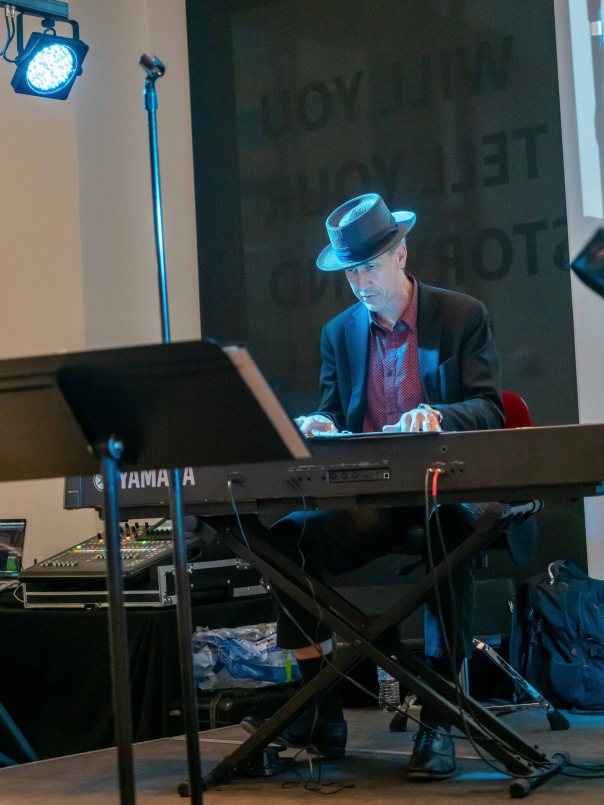
Once again it was “Falling in Love Again,” with Bearde elucidating on his composition at greater length before performing it this time. Further engaging us, he encouraged us in the audience to clap out the rhythm as Freidline, chided all through concert for his snazzy (and Sinatra-like) chapeau, pounded out a genial piano intro. Everybody was in great spirits by this point, and Ziad gave us one more reason to applaud with his screaming tenor sax.

Photos by Perry Tannenbaum

“Girl from ther North Country”: A Dream Dispelled

Review: Girl from the North Country at Belk Theater

By Perry Tannenbaum

When it premiered in 2017 at The Old Vic in London, Girl from the North Country must have seemed like the fruition of a musical theatre dream team. The original book would be by acclaimed Irish playwright Conor McPherson, who would freely roam amidst the vast catalogue of music and lyrics by Bob Dylan, the 2016 Nobel Prize Laureate, to choose his songlist. By most surviving accounts and reviews, Girl from the North Country was must-see theatre in two successive London productions, Off-Broadway in 2018, and on Broadway in 2020.

Previous peeps at the show on the road, chronicled in regional sections of BWW, have only been slightly less enthusiastic. So opening night at Belk Theater earlier this week was a massive shock when the national tour touched down here for the 28th of its 30 scheduled stops.

The first stunner was the sparsity of the crowd. Often sold out on opening night for brand-name shows, the Belk was less than half-filled for the Charlotte premiere. Traffic to the Uptown was no lighter than usual, and blackouts had already been a non-factor for previous events I had covered in Plaza Midwood and Davidson. Were fervid Dylan fanatics, among the most loyal anywhere, diverted by the WNBA Playoffs? Were they glued to their TV sets, watching the Walz-Vance debate?

Whatever reason the stay-aways may have had, the biggest shocker was that the no-shows were so right. The dream team is merely a mirage on the road, though the esteemed playwright is still listed as the stage director.

As much as we both love Dylan – my wife Sue and I held hands when the mighty “Hurricane” was sung – Girl from the North Country never fully connected with us. The boxer and escaped convict in McPherson’s script is Joe Scott, we’re in 1934 Duluth (three years before Rubin “Hurricane” Carter was born), and when Warren Nolan Jr.* plunges into the song, he must segue into “All Along the Watchtower” long before the tale of the framed boxer reaches its epic, cumulative power and intensity.

This is not the story of the Hurricane. Yet the connection of this suddenly anachronistic song, unlike the decisively irrelevant “Watchtower” or “Idiot Wind” that complete the medley, is stronger than nearly all the others we hear. At its worst, the beginning of Act 2 at Nick Laine’s dingy Duluth boarding house devolves into a chaotic Dylan concert with no forward-moving drama at all, the most inert and aimless musical theatre I’ve seen since Cats purred back from its intermission.

Action revolves around the innkeeper, his bipolar wife Elizabeth Laine, his alcoholic and artistic son Gene, and his adopted black daughter Marianne, five months pregnant. Curiously, Nick is the musical eye of this stormy family, the only member who never gets a solo to sing. John Schiappa is devoted to his demented wife, whom he dutifully feeds though she might slap the plate out of his hands, but he cares more for his longtime boarder, Carla Woods as Mrs. Neilsen, a possible financial lifeline if her late husband’s ever gets out of probate.

As Elizabeth, Jennifer Blood gets the most outré actions from McPherson – even when she’s brooding at an upright piano – and a royal gem from the Dylan songbook at the end of each act, “Like a Rolling Stone” followed “Forever Young.” These briefly sounded like echoes from the days of Janis Joplin reign as rock’s blues queen. Days of mad incense and love. Elizabeth has more reasons to be jealous of her admirably stable and ruggedly handsome husband than justifications for her relentless resentfulness and orneriness.

Yet even this most powerful of McPherson’s roles never quite bridges the gap between the footlights and our hearts. My most generous theories for why this was so on opening night are the sheer size of the Belk, double the seating capacities of the houses where North Country played London and New York, and the wretchedness of the sound, a chronic Blumenthal ailment.

Come back to us, MJ! – or at least send your sound crew.

Sharaé Moultrie gives a velvety smooth voice to Marianne and, despite her precarious position as an unwed mother-to-be, enough serenity for us to occasionally suspect that her conception was immaculate. She gets her share of solos, if not the choicest harvest. Dramatically, Marianne is the calm center of a vortex, with love and affection swirling around her from at least three different men.

Concerned about her future, Nick seeks to wed her to the financially secure – but elderly – Mr. Perry, portrayed by Jay Russell with humility, gentleness, and heart. Manuel as Joe is almost immediately smitten by Marianne, no doubt imagining himself as her redemption and she as his. She has reason to be impressed, for when he was challenged to a fight by her drunken brother Gene, Joe reluctantly yielded to the challenge and floored Gene with a single blow.

Prodded by Nick to get a job to help steady the Laines’ finances and avert foreclosure on the guesthouse, Aidan Wharton* as Gene sees his hopes of becoming a writer fading away. More sorrows to drown in drink are triggered by his ladylove, Chiara Trentalange as Kate Draper, when she announces that she is already engaged to be more pragmatically married. The ensuing Wharton-Trentalange duet on “I Want You” was probably the most dramatically apt of the evening.

Might have been more impactful in a smaller house with cleaner sound.

McPherson puts plenty of life onstage that never quite projects to Belk’s empty upper balconies. Aside from Mr. Perry; a wild bible salesman with a frayed clerical collar arrives with Joe, Jeremy Webb as Reverend Marlowe; and our sometime narrator, Alan Ariano as Dr. Walker, pops up periodically at the boarding house, making his rounds. Of the two, Webb as Marlowe is far more dangerous – almost dramatic – for his fugitive status and his poverty make his sales pitches aggressively hard-sell and his fingers tend to get sticky when he thinks nobody is looking.

With so many plots already brewing in Duluth, McPherson thoughtfully adds a family from the outside world that tends to add variety to the inbred local atmosphere of seediness and decay. The well-dressed Burkes are a fallen uppercrust family, as iconic during the Great Depression as the downtrodden wanderers crossing the Dust Bowl to sunny California.

Both Mr. Burke, who lost his business during the Great Crash, and Mrs. Burke, who lost a chunk of her patrician trust and self-confidence as a result, are on the lookout for new opportunities, not necessarily with each other. Both David Benoit and Jill Van Velzer, playing the elder Burkes, also sit down occasionally to play the drums, adding a new musical level to the evening while expanding the social context of North Country. Benoit gets to be more decadent, proposing to manage a ring comeback for Joe.

The couple’s son Elias has some sort of learning problem, so D’Marreon Alexander* gets a breakout moment in Act 2 – parallel to Blood’s with “Rolling Stone” in Act 1 – when Elias suddenly emerges from his cognitive cocoon with “Duquesne Whistle.” Doubly surprising for me, for “Duquesne” hurtles forward with the drive of Dylan’s best work and because I’d never heard the 2012 composition before. Wow.

I wish I could praise any of McPherson’s dramatic moments as highly. We’re not likely to experience a theatre week such as the current one for ages to come. Two living playwrights who have translated works by Anton Chekhov – and do not hesitate to use his methods – have pieces running simultaneously in Metrolina. Arguably, McPherson’s book, repeatedly stressing the consequences of inaction, has more of the Russian master’s most distinctive flavor.

But Stephen Karam’s The Humans, set in post-9/11 and post-Hurricane-Sandy Chinatown, will rock your world. Anyone torn between the two would be best-advised to bypass the Broadway Lights production at the Belk and head up Interstate 77 to Davidson, where Karam’s masterwork is playing at the Armour Street Theatre.

*Note: On opening night, Wharton, who normally portrays Elias, replaced Ben Biggers (sick all week ) as Gene. Alexander replaced Wharton as Elias and Nolan Jr. subbed for Matt Manuel.

“One Year to Die” Is a Premiere to Be Proud of in Matthews

Review: One Year to Die at Matthews Playhouse

By Perry Tannenbaum

September 11 has been part of LaBorde family lore much longer than for nearly all other American families. On that date in 1943, the USS Rowan was sunk in Mediterranean waters by German torpedoes after delivering an arms shipment to Italy to combat the Nazis. Local actor/director/playwright/school principal Charles Laborde’s Uncle Joe was among those aboard the Navy destroyer lost on that day, along with 201 other officers and crew. Only 71 survived the attack, rescued by the USS Bristol.

Curiously enough, the official date of Uncle Joe’s death is listed as September 12, 1944 – still a full five years before Charles was born – because none of those 202 bodies was recovered. As the Naval Officer informs Charles’s grandma Edwina with full-dress formality in LaBorde’s new play, One Year to Die, Joe was officially “missing” after the Rowan was torpedoed until one year and one day had elapsed. Then the Naval Death Certificate would be issued.

The world premiere of LaBorde’s play opened last week at Matthews Playhouse and runs through September 29 at the Fullwood Theater.

While it’s intriguing to wonder how Charles’s grandparents, Oscar and Edwina, coped with this limbo year of unofficial death – maybe holding out hopes of a miracle for a few weeks or months – it’s hardly the stuff of sustained suspense and drama. To achieve these enhancements, LaBorde applies some research, imagination, and basic math.

Time-travelling back to his grandparents’ farm in Hessmer, Louisiana, which wasn’t big enough to be incorporated until 1955, LaBorde modestly multiplies the number of local families impacted by the Rowan’s sinking. Now two moms down in Cajun country are grieving over their lost sons, Edwina and Ella Broussard, an ailing black washerwoman who takes in laundry from the richer families in the region.

Everybody seems to know everyone else around town, so when the Naval Officer shows up on Edwina’s front porch to deliver his sad news, she can point him in the right direction toward the part of town where Ella presumably lives. The fact that LaBorde has invented her makes no difference. But it’s going to take far more resourcefulness from the playwright for him to even begin exploring the racial divisions and tensions that prevailed in the little town of Hessmer when the dark days of Jim Crow hadn’t been dispelled, even after African Americans were welcomed by our military.

No, for that to happen, LaBorde had to find a compelling reason for Ella to appear at Edwina’s doorstep. Indeed, to fully engage us and win our admiration for Ella, the mission driving her to Edwina’s farmhouse had to be compelling enough for her to knock on the LaBordes’ front door. Now you have an action sufficiently outré to set a little Jim Crow town in turmoil.

What on earth could be so important for Ella to commit such an effrontery?

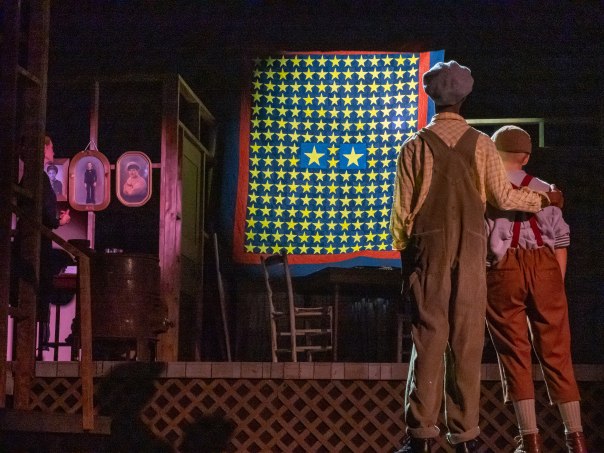
She has enough imagination and ambition to match her chutzpah, for she plans to pay tribute to both her son Lonnie and Edwina’s Joe – along with all the other 200 soldiers aboard the USS Rowan who perished fighting the Nazis. The tribute will be a quilt of 202 gold stars on a field of blue, with the two stars representing Lonnie and Joe conspicuously larger than the 200 others.

The project is worthy, and quilting 202 squares with 202 perfectly centered stars, along with a suitable border to frame it all, seems to be a sufficiently monumental task to occupy two women for the better part of a year – once the ladies have solved the math problem of how to symmetrically configure those 202 stars. Director Dennis Delamar certainly isn’t going to gloss over the problem of getting the math exactly right.

But that front door thing is key (even though Edwina is proud to say it’s unlocked) and obliges LaBorde’s family to be tested onstage in a manner they probably never faced in real life. To the playwright’s credit, neither of his kinfolk is perfect in receiving their surprise guest – who should, as everybody in Hessmer knows, be knocking at the back door.

That is the attitude here from both Edwina and Oscar when they first encounter this unfathomable cheek. Just to double-underline the point that the LaBordes are not perfection, Edwina rebuffs Ella twice. Yet we soon see that they are willing to evolve, uniting with Ella’s cause once they’ve heard her out. Granting her the unique privilege of entering by the front door. But what about the rest of the town? Here is where LaBorde can inject suspense, drama, and a sprinkling of terror.

Joshua Webb’s set design, with its wood-burning stove and perpetual coffee pot centerstage, has a rusticity that allows for a wisp of primal danger and violence lurking beneath its humble domesticity. Both kitchens are lovingly dressed, but sightlines are a rather dreadful problem: unless you’re seated in the center or toward the right side of the Fullwood Theater audience, you might go home never knowing that Oscar had been visible building his stone wall – hidden by the Broussard kitchen to those of us sitting on left – in defiance of stone-throwing yahoos (or KKK) repeatedly breaking the LaBordes’ windows.

Complemented by Sean Ordway’s moody lighting design, which casts a spell even before the action begins, Yvette Moten’s costume designs have the timelessness of Norman Rockwell paintings on the covers of old-timey Saturday Evening Post magazines. It’s hard to resist the visual charm of this production as Delamar frames one memorable tableau after another. From the time we first see the spirits of Young Lonnie and Joe (Aaron Scott Brown and Bennett Thurgood in rather touching non-speaking roles) to the great starry quilt reveal, Delamar lavishes a series of freeze-frames that are a memorable slideshow within the show.

Some discreet subtraction is applied to LaBorde family history that results in somewhat awkward casting for the leading ladies, Paula Baldwin and Corlis Hayes. Nowadays, we’d expect moms of strapping young military enlistees to be in their forties or fifties, not 60+ – but the real Edwina had way more offspring than two sons, so she actually was aged 60 at the time of Joe’s death.

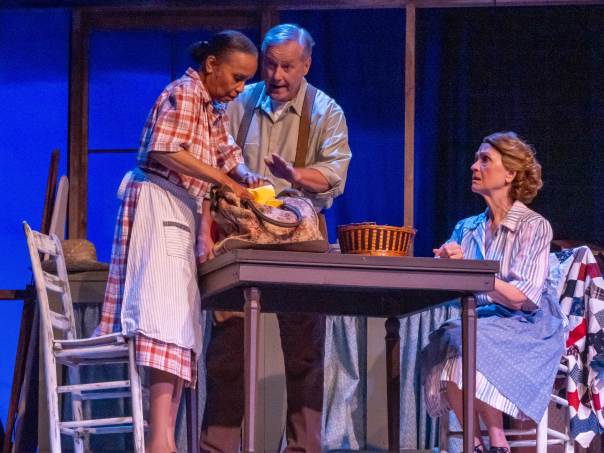
So sitting at her kitchen table, sustaining her renown as the county’s quilting queen, and looking rather matronly, Baldwin is exactly what LaBorde envisioned as Edwina. Life on the bayou does take its toll here, so Joe will merely be the beginning of Edwina’s ennobling griefs. Baldwin endures these crucibles like so many we’ve seen from her over her distinguished QC stage career, with signature stoicism. Neither Delamar nor LaBorde had any hesitation in casting her.

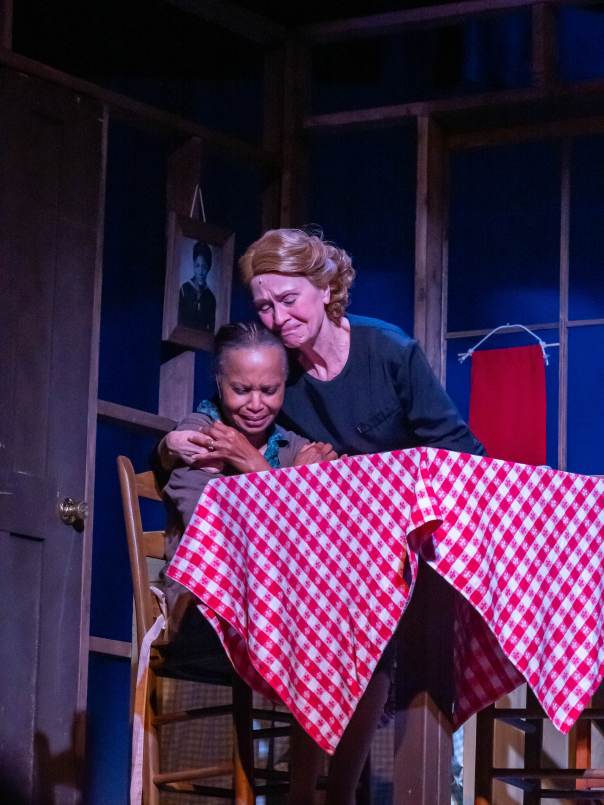
As for Hayes, I first encountered her at Johnson C. Smith in 1988 when she directed for colored girls at the tender age of “24” – just guesstimating here – so she’s also perfectly cast as Ella. Maybe the most heartwarming aspect of this production is the gift LaBorde has given her with a world premiere credit in this role. Confronted by both black and white folk, Ella is a far more nuanced and varied character than we normally see Hayes portray.

We instantly see the strong spine that brings her to Edwina’s door – twice – and we see her pragmatism in backing off the first time. She seethes back home and resolves to repeat her effrontery, still knocking at the front door. Then there’s the beautiful passive aggression when Edwina belatedly agrees to allow Ella over her front threshold. Hayes pointedly hesitates, referencing the insults she has previously absorbed and the dignity she maintains.

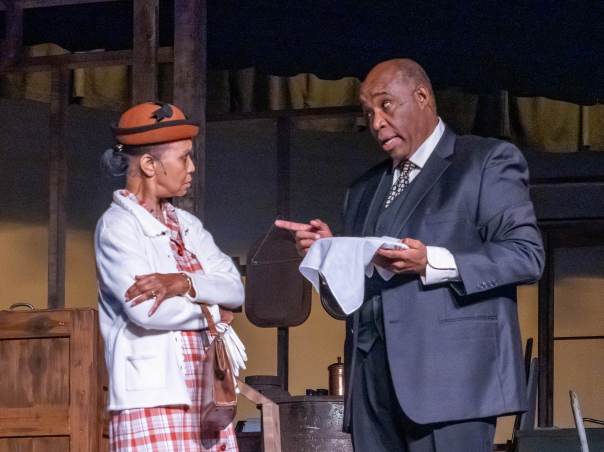
LaBorde has obviously labored over Ella, for she has her maintaining this steely dignity when confronted by her minister, Reverend Johnson, and even when she is complimented by white churchlady Nodie Ardoin, Edwina’s nemesis. Yet there’s one more telling Easter egg to be found in LaBorde’s script, that Hayes and Delamar brilliantly emphasize. As soon as Ella gets the first clear sign from Oscar that she might not be welcome in his kitchen, we see Hayes instantly cowering, clutching her pocketbook, and readying for a quick exit.

That’s the kind of good sense Ella has, for all of her sturdy spine. We can be thankful that this rich role has finally found Hayes.

If it weren’t obvious before, One Year to Die signals that Matthews Playhouse has joined the ranks of Metrolina community theatres that consistently present pro-grade work. The standard set by Hayes and Baldwin is met by the men who portray the Hessmer clergy, Steve Price as the soulful Father Morton only slightly upstaged by the charismatic Keith Logan as Rev Johnson. LaBorde would have done better by both of these religious leaders if he had refrained from broadly hinting that Catholic and Baptist ministers follow the exact same script when upbraiding wayward lady congregants.

Aside from Oscar, the other guys we see onstage are military, so we never sample the boorishness or the toxic philosophies of the town’s window breakers. The military cameos, however, are beautifully handled by Vic Sayegh as the Naval Officer who rocks the LaBordes’ world and Brian DeDora, who appears as The Sailor after the Normandy invasion.

Possibly, LaBorde dropped the idea of including the rock-slingers onstage, for Nodie bears the same last name as one of them. Robin Conchola as Nodie is actually the more benign of the “watchin’ committee” that darkens Edwina’s doorstep to register their condemnation, a lot more conflicted than Barbara Dial Mager as Sarah Jeansonne. It’s Conchola as Nodie who has the chance to be rebuffed by Hayes. Sarah is slower to evolve, so we can despise Mager longer, if only for her horrid wig.

As Oscar, also aged 60 when Joe perished at sea, Henk Bouhuys is delightfully homespun, although there’s still enough Jim Crow ingrained in him to be shocked by the ladies’ audacity. Bouhuys continues to project ambivalence long after Oscar decides the memorial project is worth doing no matter how the rest of Hessmer may think. Once he gives Edwina his assent, his loyalty is as steadfast as his love.

Whether it was absent-mindedness or a directive from Delamar, Bouhuys only intermittently sounded Cajun on opening night – while the rest of the players hardly bothered with an accent. So it was startling when Oscar became full-out Cajun just before intermission after a cowardly attack on the LaBorde farmhouse. Out of nowhere, the accent was stunningly convincing, adding some sharp ethnic spice to the most fiery monologue of the night.

Photos by Perry Tannenbaum
“Clyde’s” Serves Up a Delicious Seize-the-Food Message

Review: BNS Presents Clyde’s at the Parr Center

By Perry Tannenbaum

September 13, 2024, Charlotte, NC – Over a lazy Duke Ellington piano riff that becomes indelible almost as soon as you hear it, John Coltrane layers on the melody of “In a Sentimental Mood,” recorded 62 Septembers ago. Although we’re in a kitchen at a truck stop that doesn’t look nearly that old, somewhere along the highway in Berks County PA, it’s a fitting intro to the new BNS production of Clyde’s. Along with the mean and sassy owner of this diner, Clyde, we meet her star employee, the zen-like Montrellous, also described by two-time Pulitzer Prize winning playwright Lynn Nottage as “the John Coltrane of sandwich making.”

Nottage’s newest comedy-drama originally premiered in Minneapolis as Floyd’s in 2019, less than a full year before George Floyd was killed by local police – so it was prudent to change the title before the Broadway opening in 2021. Yet a police state haze still hovers over the action, since all the employees at Clyde’s are ex-convicts or parolees, including the owner. She’s not a criminal now, but something or someone has clearly hardened her. Montrellous believes that Clyde’s could be a smashing success if it served up extraordinary sandwiches. She wants to stick to basics, lay low, keep a low profile, and lower her costs on the ingredients her drones drop between two slices of bread.

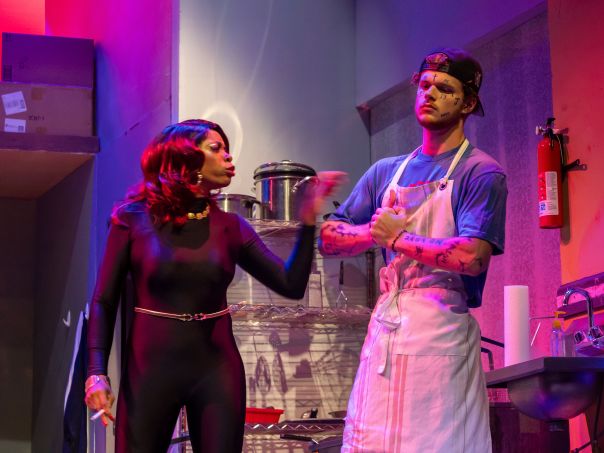
Limiting ourselves on food analogies, let’s say Clyde is one tough cookie, tightly wound to match the tight-fitting outfits costume designer Aneesah Taylor has tailored for her. You do not smile around Clyde, Montrellous warns newbie Jason, a recent parolee. He doesn’t listen. To his distress, he will learn the hard way that Clyde is the Captain Bligh or Queeg aboard this ship. Ah, but there is deeper wickedness to this boss: there is a Jezebel gene in her DNA, for Clyde is a toxic temptress. On a couple of occasions, the owner’s forays into her kitchen reminded me of Curley’s luscious wife sashaying among the farmhands in John Steinbeck’s Of Mice and Men.

The mice here mostly get to play when the boss isn’t peeping through the pickup station, hanging a barely legible order on a little carousel, and banging a bell. Director Dee Abdullah has her kitchen staff reveling in those moments when they aren’t wrapped up in a food prep frenzy. transforms the place. For him, sandwich making should never be drudgery. It is more like a mission, a calling, a crusade, an artform…or a lifelong quest for the perfect sandwich. Suffering and anger can seep into the food you make.

This ministry is not for Montrellous exclusively. When the pace in the kitchen slackens, all four workers lean over their prep stations and take turns chanting the ingredients of sandwiches never built before, swooning collectively over their imaginary deliciousness. In these moments, the kitchen is more like a studio or a writers’ room as the creators brainstorm ideas. And when the coast is really clear, Montrellous reaches into a low cabinet upstage center and extracts his latest masterwork, placing it reverently in the exact middle of the three prep stations. Since James Dukes’ lighting design accentuates the gleam of the Saran wrap around Montrellous’ newborn brainchild, the radiance turns Clyde’s kitchen into a holy temple of sorts. Epicures looking at the three stations centerstage at the Parr Center can be excused if they’re reminded of the Last Supper by Jennifer O’Kelly’s set design.

With this sacred imagery in mind, it’s hardly surprising that Montrellous’s precepts begin to transcend food preparation as we get to know more about him and about Clyde, Jason, slicer-and-dicer Letitia, and the man with the pans at the stove, Rafael. As much as Montrellous wants to convince Clyde to be more enterprising and adventurous – and less dogmatic and stingy – the adoring and adorable Rafael wants Letitia, forever stressed by her infant and her ex, to just give him and chance. Really, this romantic subplot occupies more space and time than the overarching struggle between Clyde and Montrellous, so we don’t think we’re watching supporting players when we see Lisandro D. Caceres-Zelaya in action as Rafael propositioning and wooing Toi Aquila R.J. as Letitia.

“Not enough salt, the flavor doesn’t come out; too much salt, it’s inedible,” Montrellous pronounces. Both women, taught by their past experiences, fend off new ideas and intimacies, fearing all because they’ve had too much before. Both are skeptical that being asked out could be motivated by any other reason than sexual exploitation, whether tender or forceful. Fortifying her resistance to anything Montrellous creates, Dominica Ivey as Clyde turns down every simple invitation to give it a taste. She wields her ever-present cigarette like a dagger, and her every exit is a devastating kiss-off, somewhat comical because she’s so decisive. You begin to wonder whether Ivy has any empathy for her ex-cons: maybe Clyde hires them because they can be bought cheaply.

To be sure, Ivy can string any male along in her wanton mode, but it’s Aquila as Letitia who gives off the most bi-polar vibes. When she isn’t sullenly brooding or crazily hacking lettuce as if she were Lizzie Borden, Aquila is shaking some fine booty and boogeying, reminding us of the charisma she radiated as Eartha Kitt last September. We have no difficulty understanding what Rafael sees in her, and Caceres-Zelaya lights up the stage with his sunny energy, evoking for me the irrepressible verve of Usnavy in Lin Manuel Miranda’s In the Heights.

When he isn’t presiding over the sacrament of sandwich making – and his apostles’ efforts to reach his lofty level – Zach Humphrey as Montrellous is largely a peacemaker. He intervenes with calm authority when Clyde and Jason come close to blows, and he’s a guiding light for both Letitia and Rafael as they gravitate toward one another. “Trust your ingredients,” he sagely says more than once. Everyone is different. People’s possibilities are as infinite as the varieties of sandwiches you can imagine.

Making his professional debut, Anthony Lonzo as Jason presents special challenges that audience members might struggle with, for the tats on his face and spew barbarity and hatred. Onstage, the tats are chiefly repellent to Latitia, but since Jason doesn’t speak much at first, we also need to delve beyond skin depth to grasp what he’s all about. Nottage gives each of the kitchen workers a juicy monologue to reveal what’s inside and in their rearview mirrors, and we’ll likely remember Lonzo’s nearly as vividly as Humphrey’s. But an unspoken maxim sprung to mind as Duke’s lighting finally sanctified Clyde in her memorable epiphany. It’s a wonderful little saying from the Psalms of David that I first learned from a book title by Denise Levertov: O Taste And See. At times the lesson is merely culinary. But ultimately, the message is experiential, about adopting an empirical attitude instead of hardening our prejudices. Above all, it’s an injunction to fully live our lives.

Photos by Perry Tannenbaum

Let “The Drowsy Chaperone” Hypnotize You

Review: The Drowsy Chaperone at Theatre Charlotte

By Perry Tannenbaum

My advice for best enjoying The Drowsy Chaperone at Theatre Charlotte is to listen to the Man in the Chair – and yield to his pitch-dark hypnosis. Yes, before the lights even go up at the old Queens Road barn, he’s in his chair speaking to his audience and conjuring up what we should hope and pray for: “I just want to be entertained. Isn’t that the point?”

As the show unfolded, brilliantly directed by Billy Ensley with what must be the local cast of his dreams, I realized that, as a critic, I shou

ld heed that hypnotic suggestion devoutly. Discard my usual pointy critical and analytical tools. What’s more, I came to believe more and more strongly that, if actors and directors of previous Drowsy Chaperones I’d seen had followed that simple mantra, I would have fallen in love with the show long before last Friday night.

When the lights came up a few minutes deeper into the Man in Chair’s monologue, we saw him locking the front door of his humdrum apartment with four or five assorted deadbolts and chains. It’s a bit of an abrupt swerve, but we’re suddenly aware that this Broadway musical devotee is a recluse and a bit paranoid. Each time the phone rings, we’ll see that the Man in Chair fails to answer, yet another confirmation of these traits.

By the time the title character of the fictional “Drowsy Chaperone” is a few wobbly notes into her showstopping “As We Stumble Along,” we already should know that the Man in Chair is gay, which accounts for Lisa Smith Bradley delivering the song as a living fetishization of Ethel Merman and Judy Garland – Merman’s vibrato wedded to Garland’s glitter, slacks, and drug dependency.

Yet when we’re watching Kyle J. Britt as our genial host, we need not attribute his reclusiveness or paranoia to being a gay man. As a Broadway musical fanatic, this Man in Chair identifies more readily as a New Yorker with Innerborough hangups. Meanwhile, Bradley is sufficiently over-the-top as both gay icons – especially Merman – to be accused of impersonating a female impersonator.

We might say that Ensley & Co. have decided that being gay in 2024 isn’t nearly the leaden weight it was in 2006 when Drowsy Chaperone premiered in the Big Apple or in 1996 when Angels in America tore the QC apart and made us a laughingstock. Pretentiousness, solemnity, and subtlety really are inimical to this delicate relic. Britt handles it with audiophile care as removes the vinyl disc – a rare original cast recording of his favorite 1928 musical – from its LP sleeve and gives both sides a loving once-over with a Discwasher brush before lowering his treasure onto a turntable.

The same can be said of size and scale, which may also have muffled my enjoyment of productions at Belk Theater in 2007 and Halton Theater. There’s something so right about our little séance in the dark at the Old Barn on Queens Road that it cannot attain in a more modern and spacious hall where the Man in Chair must project his spell into a distant balcony. The homeliness of the Man’s urban dwelling also sits better on Queens Road than in the bowels of a bank building on Tryon Street.

To be honest, it’s Broadway Lights and the late CP Summer Theatre that should apologize for not matching the unpretentiousness of Josh Webb’s scenic design. Of course, it would be nice if Webb’s scenery could transform spectacularly into Broadway splendor when the stylus of our host’s turntable comes down – with its signature thump – onto the vinyl and the mythical “Drowsy Chaperone” comes to life. In the less-is-more world on Queens Road these days, these shortcomings are comedy assets, part of the overall charm.

On the other hand, our time travels to 1928 get a softer landing thanks to the costumes by Beth Killion, notable for their flair, their formality, and their discreet dashes of color. We’re awaiting the wedding of Robert Martin and Janet van de Graaf, so there are actually multiple levels of time travel here, for Bob Martin actually co-wrote the Drowsy Chaperone book with Don McKellar – and starred in the original Broadway production as Man in Chair – while he was married to the real-life Van de Graaf.

In fact, this originally Canadian work, which eventually layered on music and lyrics by Lisa Lambert and Greg Morrison, was gestated at Martin’s stag party in 1997, nearly 70 years after these fictional nuptials. More reasons not to view this lark as a gay cri de cœur.

Rare as his vinyl treasure may be, Britt comes across less as a scholar or a critic than as a fanboy, occasionally panting like an eager puppy as he presumes to approach his fantasy idols more and more closely. More than once, the principals will obligingly freeze for him. Nor does this Man in Chair seem to favor the men over the ladies with his adoration, only tipping the scales just before the final bows. Charmingly enough, there are overtones of scholar and critic as he dishes tasty trivia about the fictitious “Drowsy” cast members or advises us to be on the lookout for some truly dreadful lyrics.

These glamorous, theatrical, servile, and criminal characters are all blissfully ignorant of the nerd who has conjured them up, preoccupied with their conflicting efforts to carry off the planned wedding or ruin it. The bride herself, Lindsey Schroeder as Janet, seems to be grandly ambivalent about becoming Robert’s wife, sacrificing her glittery stage career and the adoration of millions, while suppressing her basic instinct to “Show Off.” Love is at comical war with vanity. Carried away by the swiftness of this whirlwind romance, Andy Faulkenberry as Robert also has his doubts.

Aside from Janet’s drunken chaperone, politely labelled as Drowsy, there are a butler Underling, an eccentric Mrs. Tottendale, and Robert’s best man George shepherding the loving lambkins to the altar. Only Zach Linick as George seems to be afflicted with any degree of competence or reliability. More importantly, he and Faulkenberry make up a formidable tapdancing duo. (Thank-yous to choreographer Lisa Blanton.) Allison Rhinehart as a frilly, bustling Tottenham and Darren Spencer as the gray and starchy Underling are no less inevitably channeled toward blithe entertainment.

Counterbalancing the fragile determination of the bride and groom, compounded by the flimsy protection of their good friends, we have an exquisite mix of bumbling baddies trying to sabotage the wedding. These are led by Joe McCourt as Broadway producer Mr. Feldzeig (Feldzeig Follies ring a bell?), under pressure from his mobster backers, who consider Janet to be the cash cow of the Feldzeig franchise. The sneering McCourt is bedeviled by Gangster 1 and Gangster 2, armed emissaries – Titus Quinn and Taylor Minich – masquerading as hired chefs to ensure a catastrophe.

Ah, but it isn’t simply muscle aimed at swaying the maiden and returning her to showbiz. Somehow, a predatory Lothario is among the wedding guests – although he has never met anyone else there. Mitchell Dudas is this egotistical Adolpho, far more arrogant than Feldzeig, a mixture of Erroll Flynn and Bela Lugosi with a thick Iberian accent. Feldzeig has no trouble at all convincing Adolpho that he was born to seduce the bride-to-be.

Equally dumb, Autumn Cravens as Kitty is a ditzy chorine, constantly nagging her boss and wedding escort Feldzeig to let her fill Janet’s shoes in his next Follies. Effortlessly, Dudas will outperform Cravens in thwarting Feldzeig’s schemes. Love conquers all, but it would be a huge spoiler to say how many times when we reach this very happy ending.

Just one more wild card is needed to tie up all the festivities. Be on the watch for Trinity Taylor as Trix the Aviatrix, who descends from the skies at just the right moment with a voice of thunder. For a few moments, she even upstages Britt and Schroeder who are so fabulous.

It would be a mistake to miss the craftmanship lavished on this plot with its stock characters by Martin and McKellar, brought out so brilliantly by Ensley and his dream cast. For instance, think how perfectly 1928 was chosen: between Lindbergh’s transatlantic flight, Babe Ruth’s 60 homers, The Jazz Singer of 1927 and the Wall Street Crash of 1929. A brief last window of bliss before global misery. In the real world, the parade of yearly Ziegfeld Follies revues would be halted after 1927 – until 1931.

“Irma Vep” Brings Giddiness to VisArt

Review: The Mystery of Irma Vep – A Penny Dreadful at VisArt Video

By Perry Tannenbaum

My first hints that PaperHouse Theatre’s new production of The Mystery of Irma Vep would be truly unique came when I glanced at a hidden nook of the set and saw a little half-hidden bar napkin that read “Homo Sweet Home.” Shortly before or afterwards, my first peep at the playbill revealed that there were more directors on this project than players. Two more.

Then before intermission, the aluminum loading dock closure at VisArt Video was raised by the entire cast of two, Nicia Carla and Andrea King, while we joined them on the other side, exiting through the front door to the outside alleyway – the al fresco part of the store. The final Egyptian scene was played out on a second stage, facing out to a few seats, under the shadow of a Wicked Weed Brewing sign. With a nifty little Egyptian tapestry and a fairly gaudy, full-sized sarcophagus.

What really clinched it for me was rolling pin in Act 2 – deployed for a purpose you’d never dream of. That settled it: the new Irma Vep, a Charles Ludlum gem not seen in Charlotte since 1993, is far more than a loving revival. Far more than a couple of hambone actors led by an unusually comical director.

No, this is pure out-of-this-world madness, a starburst of hysteria fueled by a team of four directors feverishly brainstorming in the merciless grip of writer’s room giddiness. Who can possibly care about a three-inch square napkin? Who would conceive of taking the one underground scene in Vep outdoors? And the rolling pin: I can barely imagine the uproarious laughter when that touch was unveiled. Perfect.

Some of the zaniest futzing could have happened spontaneously during rehearsals, since Carla and King, splitting eight roles between them, are also part of the directorial team, joined by Kevin Lorms and Chaz Pofahl. So scenic designer Kel Wright may have lavished so much attention on her precious sarcophagus that she didn’t notice when that homo napkin got slipped into the wicker basket back at Mandacrest.

That’s where theatre legend Lady Enid Hillcrest, newly married to Lord Edgar Hillcrest, will feel oddly ill-at-ease in the library as a portrait of her predecessor, Milady Irma Hillcrest, stares down at her. Greeting her as maidservant Jane Twisden, King ought to be scornful and sepulchral, since she is replicating Judith Anderson’s role as Mrs. Danvers in Rebecca opposite Carla while she resurrects the Joan Fontaine naif.

Yet by the time Lady Enid sashays into view, numerous other parodies have already been set into motion in Ludlam’s wicked mockery of the “penny dreadful” style of Victorian England. Sleuthing, sarcophagi, werewolves, vampires, witches, and a Wuthering Heights heath are all mixed into this undeadly brew. Plus the obligatory mummy. So why not give King the freedom to jubilantly shatter the Dame Judith mold, sporting a bright red wig and occasionally breaking a smile?

Anderson may never have even slightly bared her teeth before she set Hitchcock’s Manderley ablaze.

Squinting her eyes like a savvy sleuth in the opening scene, Carla as the swineherd Nicodemus quickly references the nearby heath and his determination to hunt down the werewolf suspected in the death of Lord Edgar’s son. As the action speeds up and the creepy creatures proliferate (inspiring Carla’s more outré costume designs), we need to be watchful in keeping track, not only with who’s who but with who’s what. Once the thunder stops, the full moon will have its effect, so we can be on the lookout for the kindred of Lon Chaney, Bela Lugosi, Sir Laurence Olivier, Lady Macbeth, and Edgar Allen Poe.

Ludlam wrote all the roles that Carla plays in this quick-change romp for himself and the others for Everett Quinton, his partner in the Ridiculous Theatrical Company and in life. And Ludlam also directed the 1984 premiere. Small wonder, then, that legendary actor/director Alan Poindexter was actually dissatisfied with Innovative Theatre’s storied 1993 production at the fabled Pterodactyl Club – for he merely starred in that historic riot. He told me in 1995 that he was itching to revisit the script.

Where he didn’t say, but presumably, Poindexter yearned to act and direct next time around, the dual roles that both Carla and King are fulfilling now. The fun they’re having with it was unmistakable almost from the start last Friday. Those many costume changes certainly quicken the heartbeat and release the adrenalin when these gifted players are switching outfits backstage – often speaking lines of dialogue while they do.

It’s gotta be dark back there, so in a small space where so many costumes are parked, Lorms must be especially adept as he switches hats and takes on the stage managing. If there’s an additional person hanging up the hastily discarded clothes, it must really be mayhem back there!

While Carla is shuttling between her Nicodemus and Lady Enid costumes, King is shedding her maidservant uni – and that wig – whenever the Lord Edgar returns from his various adventures. Tortured soul! After losing his ex to a vampire and his son to a werewolf, noble Edgar tasks himself with tracking down both supernatural monsters, with only Nicodemus for backup. Poor choice.

Leaving a beautiful lady alone on a lonely manor; especially near moors, heaths, mists, and hail; is never a good idea, confirmed by even a smattering of familiarity with Hollywood horror. After discovering that an Intruder has left telltale teeth marks around his beloved’s jugular, Lord Edgar proves that he has learned his lesson by immediately traipsing off to Egypt to solve this mystery. Thoughtfully, he checks Lady Enid into a sanatorium.

While Milady convalesces, Carla can transform into two Egyptians, Lord Edgar’s turbaned guide and his royal quarry, the remarkably well-preserved Princess Pev Amri. More hilarity for us; more heartbreak for Lord E.

An easier mystery for us to solve was why the Egyptian scene was moved back from the beginning of Act 2 to the end of Act 1. That sarcophagus appears on both stages, so Carla and King can rely on outside help in schlepping it. In its wake, we’re left facing a handy cantina where we can line up for refreshment during intermission.

No doubt the respite is a godsend for Carla, King, and the hidden crew as they regroup, relax, and hydrate. Action is noticeably more frenetic after the break. Masks appear more frequently, and we’re treated to cameos by vampires and various werewolf body parts, far eclipsing the wolf’s carcass tossed into Act 1. In the hurly-burly, all the mysteries and who’s-whats are solved – but you’d better be alert if you want to catch all the solutions.

By then, you may have been laughing too hard to care.

Free Reign Presents a Trim and Syndicated “Tempest”

Review: The Tempest at The Gettys Center

By Perry Tannenbaum


Rarely mentioned among Shakespeare’s best comedies, let alone among his best works, The Tempest maintains an enviable popularity within the Bard’s celebrated canon. The current Free Reign Theatre presentation at the The Gettys Center in Rock Hill marks the seventh local production to appear in the Charlotte metro within the past two decades – Actors from the London Stage visited with an eighth in 2011 at UNC Charlotte.

Upstairs in the Getty courtroom turns out to be a perfect backdrop for this masterwork of measured retribution. In the misty annals of Shakespearean scholarship and criticism, The Tempest has often been singled out as the Bard’s final and most perfect work. More important to most theatergoers are the notions that Shakespeare places himself in the role of Prospero and that Prospero’s renunciation of the magic arts is the playwright’s farewell to theatre at the same time.

Under the direction of David Hensley, with costumes by Gina Brafford, it often looks like the retiring Bard had a notion to syndicate his valedictory work as an ancestor of Gilligan’s Island. Though Prospero was presumably shipwrecked in the Aegean or the Mediterranean, his most distinguished guest, King Alonso of Naples, seems to be outfitted with hand-me-downs that Gilligan or The Captain will don centuries later.

Not the first to impress upon his audience that Prospero is the main architect of the action that ensues on his tropic isle, Hensley has his protagonist, played by Russell Rowe, waving a magical illuminated staff to summon up the mighty winds, rains, and seas. Now we can adjourn to Shakespeare’s opening scene as a panicking Master and Boatswain stand on a ship’s deck trying to right their way in this tempest with a ridiculously puny captain’s wheel.

Prospero’s power on his island is vast, for he holds the fairy Ariel and the deformed monster Caliban as his slaves. Since all the action we see follows Prospero’s basic design, it’s not too outlandish for Victor Hugo to have claimed that through Caliban, Prospero rules over matter, and through Ariel, over the spirit. His sovereignty certainly extends beyond his island to the seas he sets in turmoil.

With Ariel’s help, Prospero can separate the arrivals of the servants from the shipwrecked seamen and the corrupt nobility of Naples and Milan from Prospero’s chosen heir, the virtuous Prince Ferdinand of Naples. He plans to match Ferdinand with his daughter, Miranda. On hand to help Ariel keep Prospero’s fugal design flowing smoothly are Juno, Ceres, Iris, and numerous other nymphs and spirits.

But omniscience is far from Prospero’s grasp, so Shakespeare can artfully engage us with wisps of drama and suspense. Prospero cannot be sure that Miranda and Prince Ferdinand will take to one another. Furthermore, Prospero must be on guard against Ariel and Caliban, both of whom chafe under his dominion – respectively capable of escape and rebellion.

Watch carefully, and you’ll notice how Shakespeare flips these prospects for suspense and drama into comedy.

Armed with Prospero’s vatic powers and steeled with the usurped Duke’s determination to restore rightful rule in distant Milan and Naples, Russell Rowe is slightly above the action, never clownish or fully mundane. He participates in the romantic comedy by scheming to inflame Miranda’s ardor for Ferdinand by subjecting the Prince to the humiliations of enchantment and daylong labor.

Smitten by each other almost as soon they meet, Hannah Atkinson as Miranda and KJ Adams as Ferdinand convincingly demonstrate the needlessness of Prospero’s stratagems – Ferdinand is promising to make Miranda the Queen of Naples less than 75 lines after he first appears. To be frank, the old magician, for all his learning and wisdom, has nearly forgotten his own youth. So the joke in also on him! Of course, it does take a little imagination to conjure up a virginal 15-year-old who has never seen any other man than her aging father and the “mooncalf” Caliban. As a result, Atkinson gets more unique traits to distinguish herself with.

With Caliban, played by the versatile Robert Brafford, Prospero can take a more laid-back and confident attitude, relying on the weird mutant to make a fool of himself in his rebellion. Latching on with his blue paws to Bronte Anelli as the drunken jester Trinculo and Spirit Craig as the marginally more sober butler Stephano – and mooching an occasional gulp from their ample bottle of booze – Brafford wastes no opportunity to subtly reassure us that, despite his mighty grievances, Caliban is foredoomed to failure.

Ariel, the vivacious Rebecca Viscioni, does confound the help, pulling out an invisible voice imitation shtick that, to my mind, James Barrie poaches in Peter Pan. Regardless, it is curious to note that both Ariel and Peter were written for men and usually played by women.

The “airy spirit” has more urgent places to intervene after wrecking the ship and sorting its survivors. Chiefly, she is needed – seemingly more than Prospero knows – to keep things flowing properly among the shipwrecked royals. Complacent on his throne, which is now reduced to a collapsing chair with cupholders, Nathan Stowe as King Alonso seems blissfully unaware of the treachery up in Milan. Stowe’s discomfort and disorientation in Shakespearean pentameters adds a light patina of comedy to Alonso and helps us to believe that he’s oblivious to the lurking threat in his own family.

Adding very little to the comical aura of Alonso’s complacency, Ross Chandler as the King’s brother needs a bit of cajoling from Antonio, the usurping Duke of Milan, to act on his designs on the Neapolitan throne. Fortunately, David Eil has a superabundance of shiftiness and malignity, enough malignity to be noticed not only by Alonso but by every citizen from Naples to Milan. Or by satellite.

Also on board the foundering ship, fortunately enough, is Emmanuel Barbe as a rather slick Gonzalo – former councilor in service of Prospero, who supplied the usurped Duke with necessary provisions, plus the cream of his precious library, when Antonio cast him off to sea 12 years earlier. Rejoining him onshore, we see that Gonzalo now serves King Alonso, so Gonzalo is now ironically saving his own life as well as his monarch’s with those mystic books.

For Sebastian and the never-sated Antonio mean to slay them both, not with ancient sword blades drawn from waterlogged hilts but with a 9-iron and a wedge extracted from a golf bag, a bit more slapstick. Bludgeoning rather than stabbing or beheading seems to be the plan and we are in some suspense – less with golf clubs than with drawn swords – as to whether Prospero has foreseen this impromptu assassination plot.

There is one whispering considerably earlier between the rightful Duke and Ariel in the unusually detailed stage directions, so if we’ve remembered that brief moment, there’s hope that help is on the way for the feckless King and Prospero’s loyal benefactor. But as those swords/clubs are held high over the sleeping heads of Alonso and Gonzalo, suspense mounts, thanks chiefly to Eil. So if Prospero doesn’t have the smarts to anticipate what’s happening, we must trust his Ariel to save the day.

The oft-hailed perfection of The Tempest is two-fold: aside from artistic perfection acclaimed by critics, it is also Shakespeare’s most perfectly preserved script, the lead-off play in the famed 1623 First Folio collection of 36 plays, meticulously edited by the Bard’s fellow actors, Philip Heminges and Henry Condell. Hence the unusual profusion of stage directions when you encounter the text.

Hensley and his cast do a fine job in making those generous stage directions disposable, and his careful cuts in the script, though occasionally robbing us of its full lyric pleasures, are laudably protective toward the multiple storylines. Having seen The Tempest five times before and having read/studied it more than once, I’m not bowled over by the blizzard. My worries are for those plunging into The Tempest for the first time. That little prelude with Prospero is helpful, but quite a deluge of entrances ensues.

So it was disappointing not to find any roles named in the printed program on opening night, only the alphabetized names of the actors. Clicking on the QR code is helpful, pairing faces with their roles, but again in alphabetical order – without the helpful capsule descriptions Shakespeare provided. Those would be valuable at intermission for newcomers who might still be struggling to sort out Alonso, Antonio, Sebastian, Gonzalo, and their positions at court.

Fortunately, the residents of this prehistoric Neverland or Gilligan’s Island are instantly differentiated, thanks to Gina Brafford’s florid costume designs – beginning with Atkinson wholesome Oklahoma farmgirl look as Miranda. Hard to say which is more outré, the winged Viscioni evoking the gladrags of the ‘60s or Robert Brafford as Caliban, looking like he’d been freshly belched from the belly of a whale.

Maybe the flowery Ariel outfit should get the nod because she’s so sassy and blithe all evening long. So: Calling on Hensley to give Viscioni a sassier final exit. She deserves it no less than Rowe, who asks for it in the touching Epilogue.

“Mojada” Gives the QC a Flaming Taste of Euripides

Review: Mojada: A Medea in Los Angeles at The Arts Factory

By Perry Tannenbaum
When Euripides took first place for the first time at the Dionysia Festival, Athens’ five-day playwrights showdown celebrating Dionysius, it was so long ago that theatre scholars aren’t sure whether he won an ivy wreath or a goat. Ten years later, when his Medea took third place, we can’t say what the Greek master took home as a reward. It wasn’t gold or bronze, but Olympic champions and runners-up back then didn’t win medals, either. Nor can anyone remember the titles of the tragedies that finished ahead of Euripides’ masterwork.

Now that Luis Alfaro’s Mojada: A Medea in Los Angeles has premiered in an excellent Three Bone Theatre production at the Arts Factory, we can say – 2455 years and five months later – that we are a giant step closer to seeing a premiere of Euripides’ white-hot spectacle in Charlotte. Until now, the closest approach of the charismatic adventurer Jason and his sorceress consort Medea to the Queen City was a 2004 Gardner-Webb U production in Boiling Springs.

That production, one might presume, came in the wake of the sensational 2003 Broadway revival of Medea starring Fiona Shaw. But was there also a connection between that Media and Alfaro’s?

Could be! For the Broadway sizzler also transported Euripides’ hellcat to Los Angeles. But there’s also a huge difference: Shaw’s Medea was a Hollywood superstar who capriciously craved a Garbo-like solitude. Alfaro’s is a mojada, or wetback, who needs to lay low because she’s an illegal – and mostly because, during their treacherous migration from Mexico, she suffered far more severe trauma than the rest of her family and their longtime viejita, Tita, who is always seething over the indignity of being considered a “housekeeper” in America.

She considers herself a curandera, a healer, so she tracks with the Nurse in Euripides’ tragedy. After winning the 1948 Tony Award for Medea – and recreating the role for a 1959 TV movie – Judith Anderson was content in 1982 to take on the role of the Nurse in another Broadway revival, earning a second Tony Award nomination with the same Robinson Jeffers adaptation.

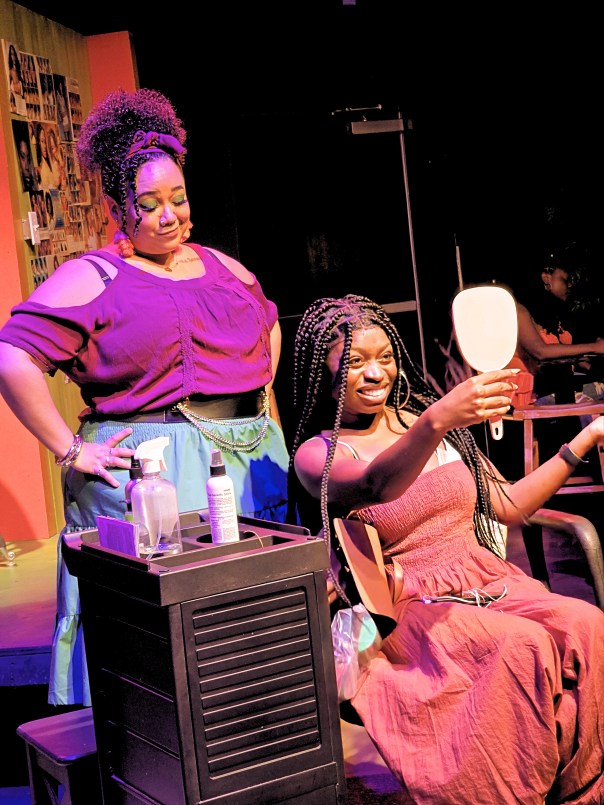
So you can expect Banu Valladares as Tita, Christian Serna as Hason, and Sonia Rosales McLoed as Medea all to have potent roles to play in Alfaro’s explosive retelling. Unlike Euripides, Alfaro flashes back to the treacherous journey that brought Hason and Medea to the Rio Grande, with enough hardships, suffering, and trauma to suggest a parallel to the Middle Passage from Africa. And of course, Medea’s barrio lifestyle also tracks with Langston Hughes’ “dream deferred” in Harlem – both of them pulsating toward an explosion.

Alfaro shakes up Euripides’ cast as well, replacing both kings, Creon and Aegeus – and the unnamed, offstage daughter Creon expects Jason to marry – with the sassy, bossy Armida, Hason’s employer and benefactor. We might also say that Alfaro has replaced the Euripides’ Chorus of Corinthian Women with Josefina, a bread-peddling gossip making her daily rounds.

Confronted with a rich mixture of Spanish and English, spoken with authentic Hispanic accents by an all-Latine cast, we may feel as disoriented in this Chicano world as Hason’s family are in LA. Seeing a quiet Medea, burdened by an oppressive workload and timidly tethering herself to her sewing machine, we further struggle to connect Alfaro’s protagonist with Euripides’. Back in Corinth, the royal Medea was outraged, suicidal, and wildly vengeful from the moment she first appeared, a volatile dynamo of shifting, fiery emotions.

Since we come into Alfaro’s story a little earlier, it will take a little while for his tragedy to overlap the Greek’s, even if you read it the night before. And if, like me, it’s been over 20 years since you’ve seen the work live or read a translation, you may miss some of what Alfaro has preserved from Euripides’ telling. For Euripides, it wasn’t such a big deal that Jason and Medea were immigrants, but they were. For me, I hardly noticed that Jason and Medea weren’t legally married, but they weren’t.

For Alfaro, these are central plot points. Just don’t think he’s changing those parts of the story. It’s really brilliant how they’re elevated to top-of-mind when we watch Mojada at the Arts Factory. Complementing their all-Latine cast, most of whom are making their first appearances with Three Bone, are directors Carlosalexis Cruz and Michelle Medina Villalon, also in their Three Bone debuts. They don’t always listen to their players with helpful Yankee or Dixie ears, but they deftly quicken the heartbeat of this drama as it climaxes.

More importantly, when they reach the spectacular ending, what they concoct – with Jennifer Obando Carter’s most unforgettable costume design – hits the spot. We could feel that viscerally on opening night.

Obviously, Latine theatre wants to happen in the Queen City. With Three Bone committed to producing Alfaro’s complete Greek Trilogy, Electricidad next August and Oedipus El Rey slated for 2026, it’shappening.

Because Alfaro is messing with both the story and Euripides’ character, those who know the Medea myth can experience the suspense at nearly the same high intensity as audience members who have never come across this Mom-of-the-century before, in Greece or in this LA rewrite. Over and over, as memories of the Euripides’ came flooding on me from past encounters with the live Shaw, the TV Anderson, and the text, I found myself wondering, Is he really going all the way?

After all, part of the reason Euripides’ Medea hasn’t played in Charlotte for at least the 37 years that I’ve been on the beat could be that Queen City theatre companies were protecting us from its full barbaric force. Could be some blowback in Bank Town.

Thanks in large measure to the harrowing flashback sequence, McLoed is able to traverse the wide gulf between the semi-catatonic Medea we confronted at the beginning of the evening and the flaming red raptor we see at the end. That’s Medea!? I found myself wondering during Scene 1, so the development arc from there is nothing less than astonishing. There’s a haunting connection between the catatonia we see at the beginning and the vengeful glare that comes some 90 minutes later. She’s actually relatable most of the time!

Precisely because this LA Medea lacks the fire and wicked glamour of her Corinthian counterpart in the early scenes, we can effortlessly empathize with Serna’s ambitious Hason as he pursues the American Dream. She won’t leave the house! Family outings with their son cannot happen, she’s too traumatized for sex even when she’s in the mood, and. He wants to get ahead while his Medea is a poster girl for inertia.

And considering the huge difference between an immigrant’s status in modern-day America and his relative safety in ancient Corinth, Hason has many pragmatic reasons to accept the predatory Armida’s business and marriage proposals, no matter how much he may still love Medea. Giving us earlier access to the story – before the breakup – not only allows Alfaro to add fuel to the drama, it allows him to show us that there is fault on both sides.

Serna’s performance isn’t quite as wide-ranging as McLoed’s, but it is no less nuanced, for he is navigating this new American world and trying to provide for his family’s future. We see that he’s a far better parent to his son, Acan, than Medea, and it’s not just because he kicks a soccer ball around with him in the front yard. Citizenship for him, no matter how heartlessly he betrays Medea, will mean citizenship for the boy.

In her venomous cameo, delivered with a wondrous mix of elegance and malignity, Marianna Corrales is magnificently resistible as Armida, Hasan’s childless employer and Medea’s implacable landlord. Hard to say whether Armida wants Acan as a son more than she wants Hasan as a husband, but with knowledge of Medea’s immigrant and marital status, she knows she is invincible and will have her way. Corrales is cool. Ice.

Alfaro not only gives Leo Torres more to say and do in his story as Acan than any of Jason’s children have ever had before, he makes him a key part of the tale. Torres will not only tell his mom about visiting Armida’s swank house with Dad, he will also – huge new dramatic irony – suggest that she make the rich lady a dress.

Further igniting Medea’s suspicions and jealousy is Isabella Gonzalez as Josefina, bringing her signature vitality along with her cartful of bread as she shares gossip with Tita. Yet she is also eager to make friends with Medea, especially if a certain amount of freebie loaves will convince the artful seamstress to make her a smashing new outfit. So it makes sense, out of friendship, that she tells Medea what the buzz is around town about Hason and Armida.

We never learn how long Hason has actually been married – or how far custody proceedings have gone – when Medea gets the newsflash. This point in Alfaro’s LA comes late in the drama, but in Corinth all this has happened before we first see the sorceress. No wonder the rest of the evening was such a feverish whirl.

In hindsight, after dipping back into the original 431 B.C. playscript, methinks it was far crueller that Alfaro’s Medea sends Tita – instead of Jason and the child – to deliver her bridal gift. Cruel as it is to make the viejita a witness, it gives Valladares a monologue that even Judith Anderson would have loved to sink her teeth into. As the eternally griping Tita, Valladares seems to hate everybody, beginning with us, whom she addresses directly after Alfaro’s incantatory opening.

But she has crossed rivers, faced outlaws and starvation, because of her loyalty to Medea, the one person she adores. And now Medea sends her off with a giftbox to Armida and tells her that she herself is a second gift for Hason’s benefactor. Discarded like an old rag!

Plenty of steam to work with. Valladares does not misfire. Nor does McLoed, though we hear an ominous helicopter overhead.

EMF’s Symphonic Triptych Overflows With Virtuosity and Enthusiasm

Review: Symphonic Triptych at Eastern Music Festival

By Perry Tannenbaum

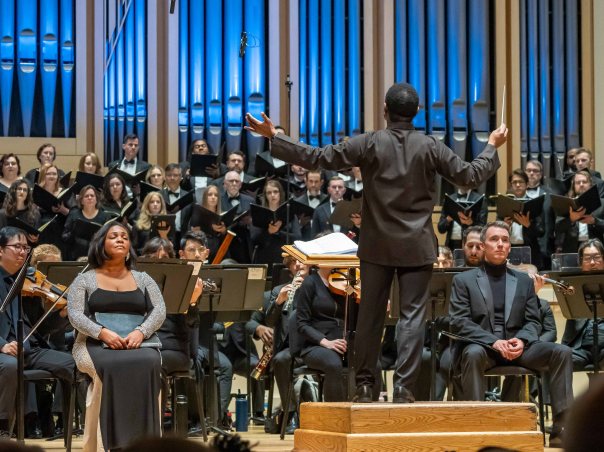
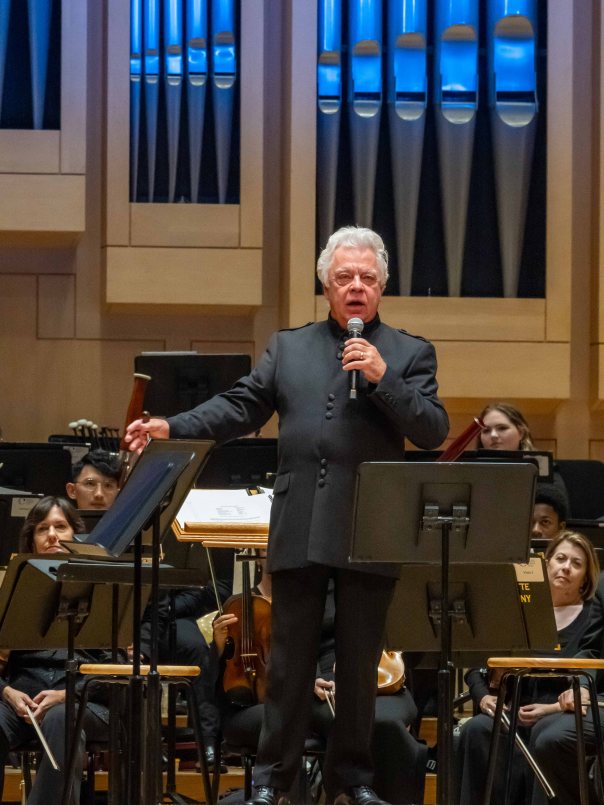
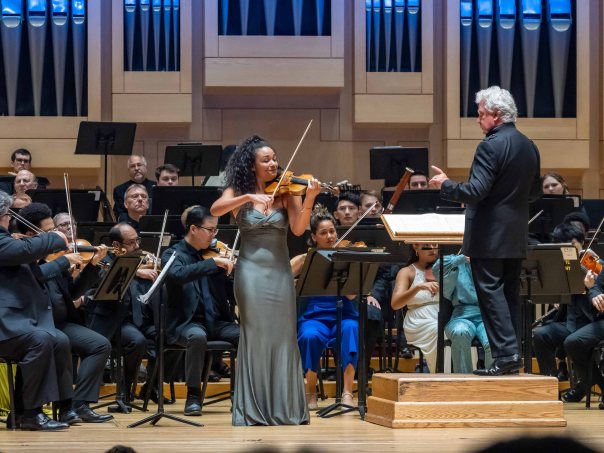
July 20, 2024, Greensboro, NC – You could almost hear the consternation behind the scenes as Gerard Schwarz and the Eastern Music Festival deliberated over what to call their most recent Saturday evening concert, the penultimate fourth of five offerings in this season’s Joseph M. Bryan Jr. concert series. All four of the pieces on the program could have been a headliner, beginning with Antonio Vivaldi’s Concerto for Lute and Strings, played on guitar by the estimable Jason Vieaux. At this banquet, Vieaux’s virtuosity and soul would merely be an appetizer, whetting our palates for Richard Strauss’s Don Juan, Paul Hindemith’s Mathis der Maler symphony, and Ludvig van Beethoven’s Triple Concerto for violin, cello, and piano – with three more virtuosic guests, violinist Chee-Yun, cellist Amanda Forsyth, and pianist Marika Bournaki.

With all the many opportunities for headshot placement in print and in an epic digital program booklet, the spotlight was more than ample enough for all four artists to get at least one four-color nod in a key location. In what might be taken as a tiebreaker, Schwarz listed Forsyth along with Béla Fleck as the most stellar EMF guests for 2024 in his seasonal welcome inside the printed festival program. So after what must have been extensive brainstorming, the cryptic “Symphonic Triptych” emerged in all caps as our concert title.

At first blush, the reference seems to be an oblique nod to Beethoven’s Triple, but it more solidly evokes Hindemith’s symphonic distillation of his opera. Mathis der Maler, for which Hindemith also penned the libretto, chronicled the struggles of painter Matthias Grünewald for artistic freedom during the German Peasants’ War, more than four centuries before its 1938 premiere. By that time, Hindemith had escaped Nazi Germany with his partly Jewish wife and was living in Switzerland, so the Zurich premiere was actually played three years after the composition was complete.

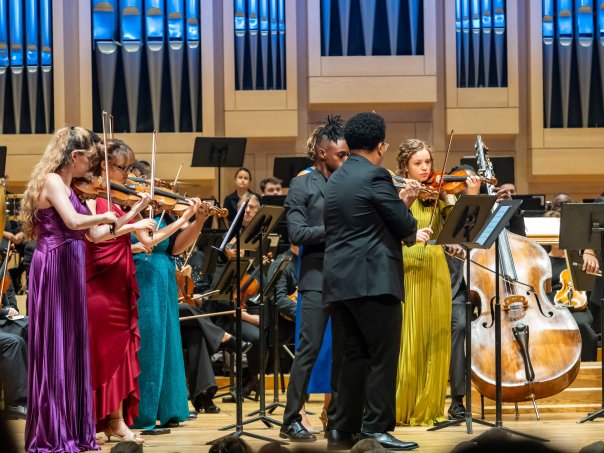
From a symphonic standpoint, the Mathis symphony was the highlight of the evening, providing the most sensational musical moment. Schwarz seemed to have rehearsed the piece even more meticulously than the Don Juan, for the mammoth student/faculty EMF orchestra at Guilford College occasionally overwhelmed Dana Auditorium with its ebullient volume. When the third and final movement of the Mathis exploded, where Hindemith evokes the hellish onslaught depicted by Grünewald in his Saint Anthony Tormented by Demons, the detonation could hardly have been more impactful and delightful – powerful yet deftly controlled.
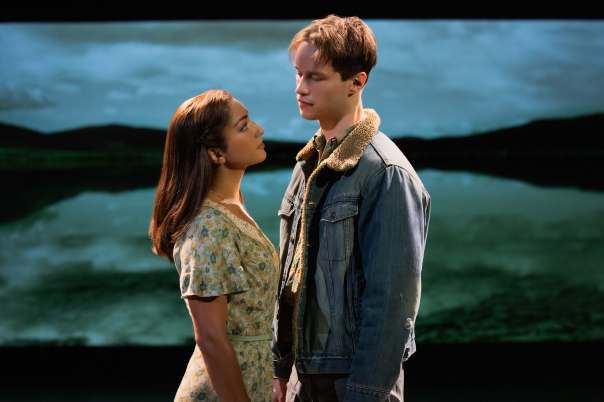
The éclat of this final movement, which shuttles to Grünewald’s Visit of Saint Anthony to Saint Paul the Hermit before returning to turbulence, may have been too much for the Greensboro audience. The number of satisfied – or dissatisfied? – ticketholders who did not return after intermission was shocking.

Did they not know that that Beethoven’s Triple – with a visual triptych of Chee-Yun, Forsyth, and Bournaki – was still to come? Were they so delighted that they feared the Beethoven would mar the perfection? Or was the worry that Beethoven’s mighty Triple, which is actually shorter than most of his piano concertos, might keep them up past their bedtimes? The other explanation that occurs to me is the most unfortunate: audience members presumed that the Symphonic Triptych was complete after three works had been performed.

Whatever explained the exodus, it wasn’t a good look when the three ladies made their regal entrances.

All three were rather entrancing afterwards. One of the challenges Beethoven posed to himself when he started on this behemoth was allotting all three soloists with ample parts – and letting all three achieve parity in how they measured against the orchestra. This goal obliged Beethoven to make adjustments and accommodations for the cellist and his or her background accompaniment.

The most noteworthy adjustment, playing the instrument in a higher register than usual, is a laudable last step that works beautifully in live performance as the cellist frequently introduces new melodies and themes that will be repeated by the pianist and the violinist. But this last graceful touch tends to disappear on recordings, where we often get the illusory impression that it’s the violin that’s leading the way.

All of the volleying back and forth gets its beautiful balance restored when we enjoy the Beethoven Triple live. Alternately facing each other and the audience, Forsyth and Chee-Yun delivered the chief revelation of live performance with the chemistry between them. Facing away from the string soloists, Bournaki divided her attention between the keyboard and Schwarz’s baton.

There were moments, especially during the epic outer movements of the Triple, when Bournaki and the orchestra were answering proclamations by both string players playing simultaneously, and there were moments when the whole trio was pitted against the full ensemble. These were most electric in the opening Allegro and in the closing Rondo alla Polacca, a finale that was absolute magic at the Dana. In between these two tidal waves was a pleasant paradise of a Largo, where the Forsyth/Chee-Yun chemistry took root almost immediately, preceding a gorgeous blossoming from Bournaki.

When you saw Forsyth leading the charge so frequently, that was only half of the revelation, for the agility of her cello became the equal of the violin while the sound invaded its range. Chee-Yun met these repeated challenges ruthlessly, passionately, emerging particularly triumphant in the whirlwinds of the Rondo, where her violin reached the highest peaks at the end of the thrilling, accelerating ascents.

Vieaux could never reach the decibel levels of the soloists who followed him, but he didn’t vie with nearly the same amount of heavy artillery behind him in the Vivaldi. Nor was there any type of boost in front of him like the mini-amp Sharon Isbin brought to her 2005 Zurich Chamber Orchestra concert in Charlotte. Here the outer Allegro movements, summoning scintillating technique from Vieaux, were not as memorable as the middle Largo, maybe the most beautiful flowering of melody that Vivaldi ever wrote. The mellow sounds Vieaux coaxed from his guitar were infused with glimmering sublimity.

While the Don Juan that ensued didn’t match Vieaux’s finesse, we weren’t looking for subtlety in Strauss’s heroic tone poem. Yet it was in the quiet, intimate passages where the faculty-student orchestra was most controlled. Even if it occasionally overflowed, the enthusiasm of this mammoth band was contagious, overpowering any quibbles one might have about discipline. This youthful enthusiasm and élan may be a prime reason why Schwarz might look forward to returning each summer to Greensboro, why the faculty revels in playing the old warhorses along with challenging outré pieces, smiling onstage with pride after long days of rehearsals and private lessons.

Playing with the new generation is likely exhilarating and rejuvenating for the guest artists as well. Every one of them at this concert also hosted a masterclass in addition to their valuable rehearsal time.