Reviews: Opera, Chamber Music, Orchestral Music, and Alisa at Spoleto
By Perry Tannenbaum
Three different sea changes have reshaped Spoleto Festival USA since Nigel Redden, responding to the WSYWAT turmoil that followed in the wake of George Floyd’s brutal murder, departed after the 2021 season. Redden saw himself in the crosshairs of the 2020 We See You White American Theatre manifesto, though he wasn’t strictly a theatre person, and felt that steeping as aside was the honorable thing to do.
Diversity has never been inimical to Spoleto, which has always looked more Euro and Afro than American. Yet as Spoleto 2025 concludes, a near-total change of artistic leadership has transpired – with an unmistakable lean toward diversity. Mena Mark Hanna has replaced Redden as general director. Paul Wiancko has filled the void left by the charismatic Geoff Nuttall’s sudden death, taking over the reins of chamber music programming. When John Kennedy was abruptly dismissed after the 2023 season, Timothy Myers became music director, wielding the Spoleto Orchestra baton.
And Joe Miller, after 20 seasons as director of choral activities, is resigning to lead the Vocal Arts Ensemble in Cincinnati. His Spoleto farewell, Bach’s Mass in B Minor, will be followed soon by an announcement of his successor in Charleston.
Conversely, Spoleto is responding to fiscal, box office, and government funding pressures to be more self-sufficient. While Kennedy’s programming arguably made the festival America’s chief hub for 21st century classical music composition, his afternoon Music in Time programs were as much box office poison as they were cutting edge. That experimental ghetto has disappeared while Wiancko and Myers have integrated more infusions of contemporary, new, and world premiere music into the festival’s chamber music and orchestral offerings.
Beyond shrinking the outré and avant garde, Spoleto is expanding its pop, punk, folk, and R&B presentations to no less than a dozen Front Row events with Patti Smith, Band of Horses, Mavis Staples, Lucinda Williams, and Jeff Tweedy among the headliners. The strategy is to “expand the aperture” in Hanna’s words, offset the losses of more adventurous fare, and make Spoleto more accessible to a wider audience. Hopefully, these newbies may be tempted into tasting the 17-day festival’s higher protein offerings.
Other belt-tightening measures include offering 15%-off discount packages of tickets to multiple events, and ending of the longstanding tradition of inviting a theatre company from abroad to co-tenant the Dock Street Theatre with the lunchtime chamber music series. Wilder still, two of the Dock Street chamber music concerts were staged during evening hours! Sacrilege.
Finally, little touches in the festival brochure and the program booklet underscored a deepset commitment to making Spoleto more navigable and customer-friendly. Jazz fans could gorge on all the Spoleto headliners within the space of 10 days, while theatre lovers could get their fill in seven.
While both of these lineups were tilted toward the latter half of the festival; opera, dance, and orchestral music could be largely traversed within the first 10 days; along with seven of the eleven chamber music programs. As compacted as the scheduling was for festivalgoers devoted to one genre, omnivores like me who preferred a mix found themselves stretched. For us, the scheduling was scattered and fragmented.
How appropriate, then, that the most awesome classical music event this season, intertwining 27 new works by living composers with J.S. Bach’s Six Cello Suites, was Alisa Weilerstein’s FRAGMENTS. Conceived during the global pandemic, FRAGMENTS has some of the randomness and the quirky, curated individuality of a mixtape. Weilerstein did not commit herself to playing the Suites in their entirety or – within each Suite – in their traditional order. Or tempo.
Beyond that, in commissioning 27 three-part compositions roughly 10 minutes long, Weilerstein obtained the right to shuffle the order of the parts and to slice and dice the new works to create smooth transitions into each other and the Bach. Layering on stage direction at Sottile Theatre by Elkhanah Pulitzer, scenic and lighting design by Seth Reiser, and costumes by Molly Irelan, Weilerstein crafted her FRAGMENTS into a creation you literally had to see.
As revealed in an interview event moderated by Martha Teichner, Weilerstein has no intentions of releasing an audio recording of FRAGMENTS. Video only. However, the cellist will honor the composers she commissioned by recording their works as written. All in all, Weilerstein was onstage soloing and fielding interview questions for more than seven hours spaced over six days, capped with world premiere performances of FRAGMENTS 5: Lament and 6: Radiance on her final day.
When you think about it, not too many comic books get to be adapted into plays or musicals. Movies and TV seem to be the hallowed afterlife of superheroes and Marvel headliners – except for that regrettable Spiderman the Musical fiasco. Only video games, if memory serves, make it to the big screen. But never to a live stage. Monopoly, Chutes & Ladders, and other pop culture board games were similarly neglected until Clue proved that it could have legs onstage.
So now we have playwright-director-choreographer Qui Nguyen’s She Kills Monsters, inspired by the legendary Dungeons & Dragons board game, onstage in Charlotte for at least the third time in the last 10 years, beginning with a UNC Charlotte production in 2016. In some ways, the current Central Piedmont Theatre production is an upgrade from the 2022 version presented at the Arts Factory by Charlotte’s Off-Broadway.
The bigger, newer Parr Center offers the spaciousness for scenic-and-projections designer James Duke to make Nguyen’s spectacle more spectacular. In cahoots with lighting designer Jeff Childs, costume designer Freddie Harward and prop designer Maxwell Martin have the equipment and budget to splash additional color across the Parr stage. Add the sound designs of Montavious Blocker and Carly McMinn and you have a sensory-rich fantasy brew.
To stage his own scripts and bring martial arts action into live theatre, Nguyen established the Vampire Cowboys Theatre Company in 2000 – and himself as the godfather of “Geek Theatre.” Presumably, he was convinced stage combat and martial arts could be a more visceral experience in live performance than it is on film, even if the resources of slow-motion photography, AI, and animation had to be tossed aside.
Much of Nguyen’s geekery can be comic book silliness and free-range Gothic imagination, delighting as much in creating outré villains as in birthing super-powered heroes – with a smattering of witchery and magic on both sides. What makes She Kills Monsters especially clever and brilliant is Nguyen’s use of Dungeons & Dragons as a game within a drama. His hero, Agnes Evans, uses D&D as a tool to recover the essence of her younger sister Tilly after her untimely death.
You will wonder how this can be possible if you don’t already know that D&D can be deeply and extensively personalized. You can create your own module for the game and envision heroes and monsters based on your own friends and enemies: a wonderful way for high school teens to vent their thwarted loves and seething hates.
Key example: Tilly, venerated as Tillius the Paladin among D&D geeks in Athens, Ohio, was jealous of her elder sister’s boyfriend, Miles. So along the path of Tilly’s scenario, Agnes will discover that Miles is a villainous force who must be vanquished, even though the evildoer has been imprisoned in a huge gelatinous cube.
That discovery will pale in comparison with the discoveries Agnes makes about Tilly’s sexuality. Geeks are merging with Greeks in Athens, as Nguyen is quite aware, so his female warriors will not be as straight as Homer’s Amazons.
Nor can Nguyen’s Athens be down in Georgia, for he has ordained that Agnes is average – the birthright of all Ohio citizens. For Agnes, it’s a journey into the underworld just to meet Chuck, who will serve as Dungeon Master for the surviving sister while entrusted with the precious posthumous work of Tillius the Paladin.
Layered onto all this teen angst (Tilly’s) and Agnes’s quest to recover her dead sister’s lost soul – both in the D&D game and in real life – is another Narrator, a high school guidance counselor, and numerous mundane classmates that Tilly has mirrored and immortalized in “The Lost Soul of Athens.” My picks for most lethal are the Athens High cheerleaders, Tina and Gabbi, turned into succubi in the D&D realm.
Carly McMinn directs the show, immersing herself and her cast in the action to a fault. I’m not sure McMinn sat herself more than three rows away from her players during rehearsals at the Parr Center. By the time Nguyen’s words reached my party in Row G, much of the Vietnamese playwright’s snappy dialogue had become unintelligible.
Get as close as you can if you wish to hear as joyfully as you’ll see.
If you don’t mind experiencing She Kills Monsters like Greek drama, knowing the plot beforehand, you can freely read and/or download the script online. Otherwise, you’re adding the Neil Simon layer afterward. If at all.
Generally speaking, the vaunts, boasts, and challenges within the game are louder than the conversations inside Agnes’s apartment, Chuck’s store, or the guidance counselor’s office – and more often competing with the soundtrack, which is not at all Dean Martin. Is it Beck’s “Loser” or LL Cool J’s “Mama Say Knock You Out” or Smashing Pumpkins as suggested by the script? Couldn’t say.
McMinn and her choreographers capture the spirit of Agnes’s odyssey beautifully, true to Nguyen’s saucy mix of fantasy and reality, silliness and profundity, fun and feeling, play and play. Fight choreographer Elizabeth Sickerman and dance battle choreographer Becky Rooney both grasp the double layer of artificiality that protects us from viewing violence, injury, blood, or death in the D&D world as any more serious than AEW on TNT.
But unlike AEW, Sickerman and Rooney can take advantage of the outright artifice for comedic purposes. How bad is it, then, if Tillius the Paladin wields her mighty sword – The Eastern Blade of the Dreamwalker, forged from the fiery nightmares of Gods and blessed by the demons of Pena – and slashes at a Bugbear, missing her target by two yards? Not at all. Especially if the Bugbear is mortally wounded anyway. Or if any other fearsome adversary writhes in agony, breathing its last for no apparent reason.
A little of this ridiculous fakery goes a long way.
To be fair, if McMinn doesn’t have her protagonists consistently declaiming at sufficient decibels, she has the wisdom to see that their character arcs are moving in opposite directions to make reconciliation – or even acquaintanceship – possible. Nguyen takes more care with the nuances of Agnes’s evolution since it’s moving in parallel directions in altering her relationships with Tilly and with Miles.
So Saskia Lewis as Agnes has a bunch of calibrating to do as she moves from average and static to insightful and savage. Lewis must be awkward for a while with her blade, shield, and helmet before Agnes the Ass-hatted can morph into Agnes the Badass. She also goes through gauche stages with Miles, with Vera the guidance counselor, and her squeamish attitude toward Chuck (some of it quite warranted).
It’s a curve that Lewis delineates well, though she never quite figures out how to give Average Agnes any spark or gusto. A little dopiness might do it. Or a little surprise when Agnes discovers she can have fun.
Whether or not McMinn saw the 2022 Monsters at the Arts Factory, she and Claire Grant demonstrate that less can be more in portraying Tilly and Tillius. Grant is never quite the legend Charlie Grass was as Tillius in 2022. There is no warpaint on Grant. You might even catch her slouching once or twice. She is mighty, yes, but we also see her as vulnerable. This Tillius is one that Agnes can envision, not the invincible Tilly she wants her to see.
Very likely, Brian DeDora was mostly enticed by the monster-in-gelatinous-cube side of Miles when he auditioned for the role, but I couldn’t help liking him even more as the wholesome boyfriend. Nguyen gives DeDora a wonderful pathway into making mundane Miles likable, for he earnestly wants to be a part of the D&D fun and fantasy once Agnes has gotten the bug.
Aside from Kameal Brown as the guidance counselor, slightly tainted by adulthood, all the other women get to revel in D&D nastiness and badassery. My favorite is Ashlie Hanke as Lilith Morningstar, Tilly’s right-hand fantasy demon, followed closely by Anaiah Jones and Kristina Ishihara as the Evil cheerleader succubi.
Hanke gets the best crossover into reality as Lily, more closeted at Athens High than Tilly. To Hanke’s credit, Lily is poignantly burdened with the sad consequences of spurning real-life Tilly to keep her cover. When they aren’t tormenting Tillius & Crew as succubi, Jones and Ishihara can tag-team Tilly, cruelly teasing her over her sexuality. Even if they’re a bit stereotyped as cheerleaders, they make Athens High more real.
All three of these wicked slayers are radically red-faced in New Landia, the country where Tillius tries to recover her lost soul. Their having to un-paint and repaint is the only good excuse I can imagine to explain why everyone onstage isn’t miked. So for me, it’s a love-hate relationship with these vicious vixens.
Among the remaining men, we should first consider the storytellers, Elon Womble as our Narrator and Maximilian Novick as geek master Chuck. Nguyen doesn’t specify how our Narrator should be attired, but he broadly suggests that she or he radiate a Lord of the Rings aura. Accordingly, Novick sports a garish green medieval outfit over long black boots, an implicit invite for us to straddle the real and fantasy worlds as the story unfolds.
Novick can roam more freely between teen nerdiness and master of the dark arts, a transition marked by donning a monkish cowl and deepening his voice. There’s also a mix of gawkiness, horniness, and bravado that Novick obviously relished.
As Orcus, the retiring Demon Overlord, Truman Grant gets to wear more majestic horns than those sported by Lilith (some history between them is hinted at). For old-school aficionados of The Wizard of Oz, Orcus might pleasantly echo the roaring veneer of the Cowardly Lion. Grant’s demon doesn’t suffer from self-image hangups, and he’s more of a careless, world-weary slacker than timid, having shrewdly traded Tillius’s soul for a badass TV/VCR combo.
Evangelicals and assorted homophobes despise She Kills Monsters, especially when it defiles their precious schools. Once again, such harmless and rollicking sacrilege is happening again in the QC. It’s particularly distressing for the haters to see Tillius and Orcus uniting with Agnes on her adventure. Both of them can tell the Ass-hat a thing or two about how to die.
March 28, 2025, Charlotte, NC – In so many ways – for me, for Charlotte Symphony enthusiasts, and for the city – last week’s Spring Gala at the Historic Carolina Theatre was a thrilling revival and an orgy of nostalgia. First and foremost was the reopening of the ancient movie theater and concert hall, dormant movie-wise since 1978 and briefly revived in the late 1990’s by Moving Poets Theatre of Charlotte and the beloved Creative Loafing Theatre Awards. The Carolina has stood in midtown Charlotte since 1927 and the Charlotte Symphony Orchestra sprang to life there with its first public performance on March 20, 1932. So a couple of auspicious centennials are on the horizon during the next decade.
On the other hand, Carolina Theatre crystallizes what Symphony has become in its recent years of modernization. Within the past month alone, our orchestra has performed in front of movie screens on three programs, John Luther Adams’ Become Ocean, John Powell’s How to Train Your Dragon in Concert, and the glittery Spring Gala featuring Renée Fleming. If memory serves, we hadn’t seen Fleming perform with the Charlotte Symphony since 2004, and the last time my mom and I saw her at the Metropolitan Opera was in 2014, playing the title role of The Merry Widow.
The epic assemblage of National Geographic footage added extra dimensions to Fleming’s live rendition of her Grammy Award-winning album of 2021, Voice of Nature: The Anthropocene – or it would have if the soprano had actually sung more than two of the album’s 17 tracks in front of the lushly cinematic backdrop. Two additional screens flanked the stage, not only tripling the Geo cinema to near-surround proportions but also supplying the texts or translations of the songs if you could peel your eyes away from Fleming, still glamorous at 66, accompanied by pianist Bradley Moore.
Cinematically and acoustically, the renovated Carolina Theatre was quite good for its age, too, but not spectacular. If you came to behold the sensational, that was taken care of before you entered the hall, for the glow of the lobby and the Carolina signage could be seen from blocks away as you began grappling with the riddle of where to park. Inside the lobby, where the sleek glassy modernity of the hall clashes with the quaintness of the updated Roaring Twenties marquee, you’re already in the presence of something unique, but when you enter the hall, spanking new with all its old-timey trimmings, you feel like you’re inside a time capsule.
So it’s hard for a critic to be churlish about Fleming delivering less than a quarter of her original Anthropocene in live performance when the 15 songs she substituted were so well-chosen and – mostly – flawlessly sung. From the album, Kevin Puts’s “Evening” and Reynaldo Hahn’s “L’heure Exquise” were the most delightful, but an objective assessment of Nico Muhly’s “Endless Space” was impossible for me. This was where the screens surrounding Fleming exploded with National Geo imagery: the glories of sky, ocean, rivers, and ice, followed by the ravages of fires, floods, drought, and sunbaked skeletons. Hazel Dickens’ “Pretty Bird” and an aria from G.F. Handel’s Atalanta were charming enough, but chiefly backed by massive tree trunks, comparatively sleepy on celluloid.
My favorites among Fleming’s inserts were Curtis and Pearce Green’s “Red Mountains Sometimes Cry,” Maria Schneider’s “Our Finch Feeder” from Winter Morning Walks,Giacomo Puccini’s “O mio babbino caro” from Gianni Schicchi,Rodgers & Hammerstein’s “The Sound of Music” and Joseph Cantaloube’s “Baïlèro” from his Chants d’Auvergne. Allow me a little churlishness on “Baïlèro”: although it was the most achingly lovely song that we heard before intermission, still magical though stripped down to Moore’s accompaniment, a full orchestral version with Symphony could have elevated the magic to sublimity with its lovelorn oboe passages and sprinklings of harp. Recorded versions by Frederica von Stade, Kiri Te Kanawa, and Victoria de los Angeles are the best – along with Fleming’s own, the final track on her 1998 Beautiful Voice album.
When Charlotte Symphony finally assembled onstage, it was more than an hour after president and CEO David Fisk and Charlotte Mayor Vi Lyles graced the evening with their gala presences and welcoming remarks. A bit undermanned for guest conductor Courtney Lewis in his Charlotte debut, the Orchestra sounded lackluster in the Overture to Mozart’s Le nozze di Figaro and downright moribund in the Overture to Gabriel Fauré’s Masques et bergamasques. It amazed me to find that nothing could mar or spoil this occasion when you felt privileged to be there. Partly because our expectations had been politely lowered, Lewis and Symphony seemed to overachieve in Richard Rodgers’ “Waltz” from Carousel.
Fleming’s voice has lost some of its creaminess above her midrange and I found myself rooting for her to easefully reach her top as she climbed to the climax of R&H’s “You’ll Never Walk Alone.” But Renée had banked plenty of his goodwill for arts lovers long before she resigned recently from the tainted Kennedy Center. Decades before she put her heart post-pandemic into the global environment, she championed American opera, most notably in 1998 when she premiered the role of Blanche in André Previn’s A Streetcar Named Desire while also collecting American arias into an 11-track album representing nine composers, I Want Magic! The aging diva is still banking residuals and Spotify pennies for her exemplary recorded output. Meanwhile, each time Charlotte Symphony had the chance to play live behind Fleming, they seemed to play better, producing fresh magic aplenty for us all – with the promise of much more from Fleming and the Carolina Theatre in years
A couple of simple online searches confirm the widespread shibboleth. “Everyone loves a parade” summons up millions of quotes and images – not to mention the occasional book, song, movie title, and a BRAND NEW sealed board game on eBay. Try “everyone does not love a parade” on Google and the engine blinks, seizes up, and drops a couple of pistons, yielding pretty much the same results, except for a couple of incredulous newspaper headlines.
“Who Doesn’t Love a Parade?” asked the New York Times in an opinion piece back in 2018. Jim Tews, the author of the piece, breaks rank with his headline in his opening sentence: “I love a parade.” No, we must go further back to 2007, when opinion writer Susan A. Nielsen wrote in the Seattle Times – on the Fourth of July! – asking, far more accusingly, “What kind of sick person doesn’t love a parade?”
“I recently became aware,” she begins solemnly, “that some people, including my spouse and closest friends, hate parades.” Mercifully, she does not name names, but you can almost hear their diabolical cackles in the background.
Not a peep of dissent from the Google results on the rest of that webpage or the next five. Everybody loves a parade; that’s the settled truth. Unless they are still alive and sequestered in Seattle.
So be forewarned: in Alfred Uhry’s retelling of the events that led up to Leo Frank’s murder trial in 1913 and his lynching two years later, his protagonist/victim is a man who despises a parade. A specific parade. Instead of attending the Confederate Memorial Day parade in Atlanta on April 26, 1913, he opted to go to work at the National Pencil Company, where he was superintendent. It will cost him.
Onstage at Belk Theater, where the touring version of Uhry’s PARADEopened on Tuesday, Frank gets to say that, as a Jewish man from the borough of Brooklyn, he still feels like an outsider: “How Can I Call This Home?” he laments. His bad feelings would only be exacerbated if he were to attend a parade celebrating the Confederacy. What is there to celebrate?
Atlanta prosecutor Hugh Dorsey and extremist pamphleteer Tom Watson were the foremost public figures – and the loudest – to proclaim that such an explanation for Frank’s truancy from the parade was impossible. No, the real reason he went to National Pencil that day was to ambush, rape, and murder 13-year-old Mary Phagan, who came to her workplace simply to collect her weekly pay. Quaintly enough, in cash.
For those who rushed to judgment against Frank without solid evidence to back their convictions, The Confederacy, civic pride, and celebration were all synonymous with this spurned parade. Just by choosing Parade for his title, Uhry was taking Leo’s side, flouting the idea that the word blends naturally with bliss. Led by Watson and Dorsey, the parading goes on despite criticism or opposition, becoming an orchestrated stampeding of Frank’s rights and humanity, deeply drenched in antisemitism.
Retribution for Dorsey and Watson? Hardly. Dorsey would subsequently be elected Governor of Georgia and Watson would become a U.S. Senator.
Plagued by technical difficulties when Halton Theater was young, the 2006 production of Parade at CPCC Summer Theatre didn’t rock my world, though my world is deeply drenched in Judaism and Jewish culture. So my wife Sue and I were surprised by how powerfully this touring production impacted.
It was like a stunning gut punch for me in the wake of Charlottesville, Pittsburgh, and the uptick of antisemitism since October 7. I felt physically nauseous as this horror of sensationalized press, suborned testimony, and a grotesque parade of cookie-cutter witnesses – factory girls who were obviously coached – took on the rancid smell of an inevitable conviction.
You could see Frank’s righteous self-confidence crumbling along with the suave composure of Luther Rosser, his cocksure defense attorney. Long before vigilantes entered the picture.
For others without my Ashkenazi DNA and yeshiva background, Parade might not elicit the same visceral response. It would be interesting to see whether Uhry, the Atlanta native who also gave us Driving Miss Daisy and The Last Night of Ballyhoo, would have had more success if he had worked alone on Parade – without the music and lyrics of Jason Robert Brown and the co-conceiving of the esteemed Harold Prince, who also directed the original production.
The upscaling of Uhry’s script was certainly warranted by the Leo Frank tragedy – and the crucial action that must unfold in a chaotic courtroom – but the timing was not ideal after Ragtime, painted on a far broader canvas, opened earlier in 1998 in a bigger house. Michael Arden’s restaging for the 2023 revival of Parade can also be off-putting if you don’t care for actors lurking silently around the action between scenes and becoming stagehands during transitions.
We cannot accuse the lead performances of any such artificiality. The passion of both of the principals reaches deep down into this cast, from Max Chernin as Leo to Jack Roden as Mary Phagan’s aspiring boyfriend. So the level of melodrama in their voices, ardently singing Brown’s Tony Award-winning music, rises to operatic levels and beyond.
Chernin is freed from meek innocence during Leo’s trial, becoming his own demonic caricature in “Come Up to My Office” as the robotic factory girls horrifically distort his personality. It was painful to watch him rise from his seat at the defense’s table, climb to the platform where witnesses gave sworn testimony – and Judge Leonard S. Roan presided – only to surrender totally to the girls’ perverse depiction of him and jubilantly surpass it.
Easily as talented as Chernin, Talia Suskauer struggles to clarify Lucille Frank’s marital problems with Leo, perhaps because her biggest opportunity, “What Am I Waiting For?” is saddled with lyrics by Brown that are too subtle. They have an arranged marriage in Uhry’s telling. While Leo has yet to cope with the cultural distance between Brooklyn and Atlanta, there is still an intimacy gulf after four years.
It would help a little if Suskauer sounded Southern more often, but if Parade is already grabbing you with its systemic intolerance, Lost Cause immorality, Gestapo cops, and hypocritical pomposity, the drawl deficit will evaporate amid the deluge of her straightforward “You Don’t Know This Man.” One of the chief beauties in Uhry’s script, true history be damned, is the growth of Lucille in Act 2, triggered by her “Do It Alone,” flung at Leo while he’s festering in jail, hoping for a retrial.
On the cast album, that song sounds like a vehicle for Streisand at her most histrionic, but Suskauer blazes her own trail. Implausibly, I haven’t found a single cover of this raging powerhouse outside of cast albums on Spotify.
As the ranting Tom Watson, we get Griffin Binnicker in a Colonel Sanders suit feverishly waving a bible – like a nightmare premonition of a J.D. Vance presidency. No less irritating or unscrupulous, Andrew Samonsky as prosecutor Hugh Dorsey is yet another evocation of the sort of pure evil politician we thought was ancient history.
There is more than a sprinkling of prejudice in Leo’s views of the South and his sexism. These go unchecked until Lucille rightfully scolds him and proves herself. As for Leo’s chronic alienation, aloofness, and lack of social skills, Uhry seems to overlook the fact that Frank was elected president by the 500 members of his local B’nai Brith and was instrumental in getting the national organization to stage its 1914 convention in Atlanta.
As a truly innocent little weakling, Olivia Goosman still stands out as Mary Phagan, and the creators are wise to bring her back to life a couple of times – during the courtroom trial and when the lynching becomes imminent. The only taint on her is her susceptibility to her dearest admirer, Roden as Frankie Epps.
It wasn’t her fault that Roden reminded me so chillingly of Hitler Youth once the mass hysteria began, another flashback to fascism that refuses to die.
Maybe the most delicate part of the storytelling is Uhry and Prince’s concept of the three African Americans who testify against Frank. Though both men are likelier suspects than Leo, neither Robert Knight as janitor Newt Lee nor Ramone Nelson as escaped prisoner Jim Conley comes off as a mouth-breathing predator. Knight is the meeker character (and the likelier suspect), yet even without Leo’s Ivy League education, Newt has a better grasp of how to deal with cops.
Same with Nelson, though as Conley he is gifted with a more elegant and dangerous street wisdom. You might easily associate him with the world of Porgy & Bess if you can imagine him as the best of Sporting Life and Crown – capsulized to a point where it under-employs Nelson’s talents.
Most nuanced among the Jim Crow roles is Danielle Lee Greaves as the Franks’ housemaid, Minnie McKnight. Scenic designer Dane Laffey gives us a playing space that looks more like a lumberyard or a construction site than a battlefield, a boulevard, a governor’s mansion, a courthouse, or a business executive’s home. We’re more inclined, in this hardscrabble world, to empathize with Minnie’s corruptibility or tribal loyalty.
And she has regrets over her incriminating testimony to luxuriate in after the trial. Unlike Chris Shyer as Governor Slaton, Greaves has little power to act on her remorse. Shyer has a wider, more satisfying character arc to work with. Thanks to projection designer Sven Ortel, we get stage-filling front-page headlines every step of the way, a parade of Watson-sparked alarms from the first news of the Phagan’s murder until Leo is hanged. So our first visit to Slaton’s mansion after the murder shows him prodding Dorsey to find and convict the killer as quickly as possible.
Capitulating to media pressure.
Later, once Lucille gets the green light to advocate on Leo’s behalf, the Governor of the great state of Georgia becomes Lucille’s private investigator, a white-haired Paul Drake to her Perry Mason. Then, in a U-turn to real life, he commutes Leo’s sentence. Nice try, Guv!
We have some empathy as well for Michael Tacconi as on-the-skids reporter Britt Craig, who “scoops” all other Atlanta reporters in spreading malicious disinformation about the case. Until he sees the light, he may seem like a tool for Dorsey and Watson. Just an average Joe grasping where his bread will be buttered.
Not a bit of empathy goes out to Evan Harrington as the Old Confederate Soldier and Judge Roan. Because of their majestic dignity, neither of these upright gargoyles has any regrets. To our great misfortune, such folks are still around, still waving their flags, and still parading.
So here’s something we’ve learned over the past month on the Charlotte theatre scene. There are two schools of thought on how to portray a horrifically scarred woman onstage. Back in late February, Carolina Actors Studio Theatre took the cinematic approach at the original Mint Museum on Randolph, painstakingly applying makeup to their leading lady, Zoe Matney, before every performance of Alabaster, down the entire left side of her body from head to ankle.
Now we have the Violet approach at Theatre Charlotte, where Destiney Wolfe stars in the title role with a hideous scar that looks more like a fine line drawn with a red ballpoint pen than a shocking horror. So it was – minus the fine red line – when Lauren Ward originated the role in 1997 on Broadway and when Sutton Foster revived it there in 2014.
Besides the risk of an Emperor’s New Clothes moment from an innocent child (“But Mommy, Violet doesn’t have any scar!”), it figures to be more effortful to watch Wolfe without the scar everybody onstage is talking about and constantly having to imagine a scar we are not seeing. That’s different from reading “The Ugliest Pilgrim” by Doris Betts, the short story that this Jeanine Tesori-Brian Crawley musical is based on.
Until the fourth page, the scar isn’t explicitly mentioned. Once the word is seen, it quickly becomes the center of the story – the reason why Violet is on a bus from Spruce Pine, NC, to Tulsa, where she ardently believes a venerated TV preacher will heal her terrible affliction. Nothing on the remaining 25 pages contradicts the image engraved in our imaginations.
Within the blissful two dimensions of a book, we don’t need to keep imagining what isn’t. Perhaps more subtly, as demonstrated by Matney’s portrayal of June in Alabaster,we can gradually get used to the disfigurement, look past it, and see the person. Along the way, we could also find plenty of relief looking at June’s unscathed side.
Notwithstanding her terrible scar and her pathetic reliance on Oral Roberts – oops, I mean the famed Oklahoma preacher – Violet is clearsighted enough to grasp her most valid reason for boarding the bus. Spruce Pine is a very small-minded town. Her elders stare at her in pity and her peers are worse, shunning her, mocking her, and pranking her.
As the saying goes, she needs to get out and meet people. Spruce Pine isn’t the place for it.
Betts had Violet saying that in a more biblical way: “Good people have nearly turned me against you, Lord. They open their mouths for the milk of human kindness and boiling oil spews out.”
Told objectively by Crawley rather than in first-person by Betts’s Violet, we see the townsfolk clearly sooner rather than judging them on a single casual quote. Scarred or not, Crawley and Betts agree on one key point: Violet is way too thin-skinned.
Meanwhile, reasons for dismissing Violet’s self-pity – and doubting her self-awareness – are multiplying. Before the bus reaches Arkansas, she has hooked up with two military men who are quickly captivated by her. Both of them, one black and one white, are eager to show their ardor on a stopover in Memphis, where they spend a night out together.
So the necessity of imagining that hideous scar becomes more urgent for us.
Thankfully, the Memphis sojourn allows Tessori to naturally widen her musical palette, welcoming us to the blues along with the Beale Street underbelly of town. Violet’s dream of healing and her actual Oklahoma encounters with the Preacher are welcome prompts for Tessori to branch out further into righteous, stomping, spirit-of-the-Lord gospel.
A five-piece band led from the keyboard by Danielle Barnes Hayes leaned into the gospel music at the Preacher’s revival meeting as lustily as the more countrified tunes that had gone before. Our eagerness to hear those gospel strains was certainly piqued and primed last Saturday when a seven-voice choir greeted us in the lobby of the old Queens Road Barn, accompanied by a wee electric keyboard, singing hymns and shouts for a half hour before showtime.
While director Stuart Spencer skimps on makeup design, he is deeply attuned to the material, having been part of the Davidson Community Players cast when Violet had its regional premiere in 2010. Was it a makeup job on Cassandra Howley Wood that gave me such a favorable impression of her local debut and the show? Or was it simply the intimacy of Armour Street Theatre, bridging the gap between first-person narrative and Broadway musical?
At the bus station where Violet embarks on her odyssey, at the Memphis music hall where Asley Benjamin belts a couple of songs, and at the Tulsa TV revival, a bigger stage is surely better. More space for more people and more decibels! More opportunities for lighting designer Gordon Olson to colorize costumer Sophie Carlick’s shiny robes for the Preacher’s hallelujah choir – and to add pizzazz to Sharlie Duncan’s choreography!
To their credit, neither of the soldier boys seriously believes that Violet will look any better after her Oral rendezvous in Tulsa when she reboards her Greyhound bus, heads back home to Spruce Pine, and stops off in Arkansas for another meet-up. With Sean Bryant as Flick and Ethan Vatske as Monty, the interracial relationship and rivalry between the soldiers occasionally becomes more compelling and suspenseful than Violet’s cosmetic quest.
Bryant gets the advantage of a more instructive interracial relationship between Flick and Violet. On the way to learning that her inner scars are more debilitating – and curable – than her outer ones, it’s necessary for her to appreciate that there are other, more serious skin problems in life. Beginning with pigment. In the Betts story, there’s one other huge hurdle in Violet’s spiritual growth that we don’t hear about onstage: her use of the N-word. More of Spruce Pine needs to be exorcized from her soul than she realizes.
On top of that, this thin-skinned Violet is stubborn, too. As dynamic as Wolfe’s vocals are, her adamant refusal to believe that anyone besides her daddy could love her is the most startling aspect of Violet we must encounter. We recognize this trait in people we’ve met, maybe in ourselves. Violet’s stubbornness goes so irrationally deep that it not only prolongs her path to enlightenment, it obliges Crawley to pile on a flashback recalling a cruel prank that was played on her by her schoolmates.
Counterbalancing Bryant’s shyness and vulnerability as Flick, Vatske draws the luxuries of being the more cocksure and aggressive Romeo. Just sitting down to play poker with Flick and Violet softens us up to Monty, and confident as he is, Vatske keeps us a little in suspense about with whether he’s playing with the lass or serious. The way Vatske is playing him, you’re not sure whether Monty is sure himself.
This upsized Violet is a special boon for Henk Bouhuys, who draws two plum roles, the sometimes surly, sometimes avuncular Bus Driver and the charismatic Preacher. Never mind that that the Preacher is surrounded by a fervid Gospel Choir, both in the TV flashback and in Tulsa, Bouhuys dominates the stage with his fiery motormouth exhortations.
It’s awesome enough to make his backstage powwows with this pilgrim unexpectedly tender and poignant – a quietly dazzling reality check – and allows Wolfe to enlarge upon Violet’s devotional and delusional traits.
Unfortunately, on a big musical stage, Bouhuys’s dazzle and the decadence of Memphis nightlife tend to cast the flashback scenes between Young Vi and her Father into comparatively dreary shadow. To put it bluntly, when Tessori worked with the multiple Allisons of Fun Home in 2015, she had a superior book and lyrics from Lisa Kron.
So Spencer, Abigail Sharpe as Young Vi, and Nick Southwick as her dad are doing the best they can with the weak hand they are dealt here. It’s heartwarming to see the widower dad teaching Young Vi how to play poker in order to jumpstart her math skills. “Luck of the Draw,” blending this flashback with Violet’s cardplaying triumph over Monty and Flick, puts Sharpe and Southwick to their best use.
But these flashbacks, before and after the catastrophic accident that scars Violet, are also the best reason why we never see that scar on the face of either protagonist. It would need to be applied to Young Vi during the show, a fearsome hurdle for a makeup artists and stage managers.
The script and the dumpy cardigan sweaters the Violets wear supply a wonderful way to differentiate between the two. When we first see Wolfe huddled at the bus station and boarding her bus, she looks more homeless than scarred. It’s only after dark in Memphis, when she’s escorted to the music hall by two strapping soldiers, that Wolfe tosses her cardigan aside and shows signs of full-blooded womanhood.
Review: A Small and Humble Erasure at Davidson Community Players
By Perry Tannenbaum
As playwright Tracy Letts knows well, there are unpleasant truths at the heart of American life and the American Dream. “Sometime tonight, when the temperature of your home drops to a specific mark and you hear the heater come on because that’s what you’ve programmed it to do, remember that you live in a cocoon of comfort and safety because a lot of people who came before you weren’t afraid to get their hands dirty.”
Those clear-eyed, merciless words were delivered by the Mayor Superba of Big Cherry at the climax of The Minutes, Letts’ unexpectedly savage and sensational 2017 drama. The Metrolina premiere was presented last month at the Armour Street Theatre as Volume 1 of Davidson Community Players’ Sacred Places project. With a no less of an innocuous title, the world premiere of Stephanie Gardner’s A Small and Humble Erasure is completing DCP’s project – with a sacred place that hits closer to home.
Gardner has actually customized her script for Armour Street and for the members of the cast, directed by Michelle Medina Villalon. While Letts located his drama at a fictitious City Hall built on the blood of slaughtered Native Americans, Gardner’s piece reminds us that Theatre Charlotte is built on more sacred ground, over a cemetery consecrated for African American slaves.
And she tells us, naming names, just how this cemetery was “deconsecrated” and who was responsible. Mayor Ben Douglas and numerous councilmen are in the room where it happened, all of them white men from respected Charlotte families: Baxter, Hovis, Albea, and Wilkinson – with mischievous colorblind and gender-blind inroads in Villalon’s casting. Starting with the famed Mayor whose name is perpetuated on the QC’s international airport.
A future councilman, attorney John Small, introduces the motion at a City Council meeting in 1936, nine years after Theatre Charlotte had been founded as the Charlotte Drama League and five years before the Old Queens Road Barn celebrated its housewarming. By this time, Tom Humble had settled into his role as Little Theatre of Charlotte’s artistic director.
So the workings of this Small & Humble alliance give Gardner’s title a clever double entendre. Humble, at least, is haunted by the fact that his new fixture in Charlotte’s cultural life was built on the backs and graves of Southern slaves. Big Cherry, on the other hand, leans into their past desecrations after the truth is painstakingly revealed to them by a rogue councilman. Their actions are sensationally horrifying, while Gardner’s white folk are more decorously rueful.
Of course, there’s considerable satirical bite to Gardner’s concept, above and beyond the casting vengeance she takes on all the benign and virulent segregationists who are culpable for this sacrilege. An African American, Andrew C. Roberts, portrays both Mayor Douglas and plutocrat Harold Dwelle, and Amy Wada, an Asian American, is our narrator!
She brings us into the Myers Park homes of these benefactors, the Dwelles and the Myerses themselves, delving into the petty maneuverings of their estates. These include the hallowed cemetery and the adjoining Cherry neighborhood. Yes, DCP executive director Steve Kaliski & Co. could have easily called their pairing “The Cherry Project.” Interestingly enough, both Cherrys have insulting and racist slurs associated with their names as well as complicit Mayors in their dramas.
Making Amy Wada our personable and slightly stressed narrator is obviously an entertaining choice. But I’m not always aboard with the idea of actors behind her frequently breaking character and interrupting her – perforating and undermining the seriousness of her narrative, threatening to trivialize the history.
Getting Hank West, indisputably one of Charlotte’s best, to play Tom Humble is a similarly two-edged sword. Villalon and Gardner must have been sure that West gave the best audition, and he impeccably balances the Indiana native’s haughty elitism, his ambitions for the Queen Road Barn, and his conscience. But for those of us who have seen West’s work over the last four decades, it’s a bit of a hurdle disliking his Humble in the artist’s worst moments.
Clean-cut with mature Everyman looks, Mark Ariail is a fine complement to West as the conniving Small, the lubricant that connects Humble and Myers Park to the Charlotte City Council. We have a hard time labeling him as evil despite the obvious earmarks. Little Theatre was little, after all, and Queens Road was the closest the fledgling company could hope to get to the QC’s high-priced Uptown real estate.
Gardner seems willing to allow that the upstanding Charlotte citizens of the 1930s were shaped by their times and less eager than Letts to condemn and ridicule them for their actions and customs. But she does provide a second backdrop to the unfolding Small & Humble “erasure”: black folk who set the plutocrats’ tables and black folk who were buried beneath them.
Roberts is neither of these, but he’s useful in Gardner’s concept beyond his key roles as Dwelle and Mayor Douglas. He’s also “new” to the cast, so Wada can be explaining the history – and the colorblind casting – to him as well as us. Lowell Lark, when he removes the enslaved Harvey Foster’s bloody bandage from his head, becomes a somewhat comical Councilman Baxter when the Theatre Charlotte ordinance is passed, returning years and years later to haunt Humble and become part of Queens Road lore. When that happens, it no longer seems amiss that he doesn’t strictly conform with Gardner’s description of him as a 17-year-old when he died.
Myneesha King as Johnsie Foster, the Dwelle family housemaid, gets to be a sometimes-acerbic conscience for the great white benefactors of Myers Park – and she’s pretty sassy toward Amy, so it isn’t a demeaning role. King is also significant the living descendant of the buried and betrayed slave population distilled into the voice and wounded image of Harvey Foster.
Briefly, King can relish returning as Barbara Burke, the first African American to appear in a Little Theatre production in 1970. It’s Wada, though, who points out that this was three years after Humble retired. Then we hear the vanilla quote in our newspaper’s coverage straight from King’s lips: “If the whole world would say people are people and not what color you are, it would be a wonderful place.”
We do get along here in Charlotte, don’t we? Ironically enough, Gardner reminds us that the first play produced at the new Little Theatre, once the gravestones were cleared away, was Moss Hart & George S. Kaufman’s George Washington Slept Here. Talk about a whitewash!
The white women of Myers Park, bless their hearts, are at least ambivalent about what’s going on over at the top of Queens Road. Pam Coble Newcomer as family matriarch Mary Rawlinson Myers insists that the Negro Cemetery should belong to the Cherry community in perpetuity, but has neglected to ensure that her wishes are legally airtight.
Along with King as Johnsie, we empathize with Mary the most, especially since she’s confined to her deathbed. Newcomer is liberated from her bedclothes for two comical turns, becoming Councilman Albea and Little Theatre actor Jack Knell. Jack’s wife, Dorothy Knell, is also in the cast of the first show presented at the new theater in 1941, so Cat Rutledge completes the amusing little gender-blind episode.
Rutledge, like Newcomer, also gets to have fun at City Hall as Councilman Wilkinson, one of our proud city’s banking visionaries. (Is the notorious boulevard named after him? Yup.) She also comes out as perhaps the meanest meanie onstage at Armour Street, jousting with both Mary and Johnsie as Mary Myers Dwelle – or Mary II – as she helps push the Little Theatre initiative through City Council.
Perhaps because she also pushed through the first art museum in the state, The Mint, Myers’ aristocratic daughter is allowed to luxuriate in regrets similar to Humble’s. Aw, cut them some slack, Gardner seems to say. Better to simply mention The Mint, IMHO.
Volume 2 isn’t speckled with shameful or diabolical celebrations like The Minutes, last month’s Volume 1. Nor does it chill us like Mayor Superba’s cynical admonition, cited above. The best Humble can do is “I don’t know how to fix it.” Honest enough. Mary Dwelle is more pragmatic and resolute, asking us “Why should we have to leave town for our culture? We’ll build it here!”
Ninety years later, the QC is teeming with theatre artists who believe Charlotte shouldn’t be the largest city in the country without a regional professional company. They’re still waiting for that same Myers Park/Banktown resolve to lead somewhere.
Maybe Roberts, the newbie to A Small and Humble Erasure, has drawn Gardner’s most devastating line. “Excuse me,” he asks Amy, “am I playing a white guy??”
His disdain and disgust speak volumes.
Needless to say, it was a bit awkward to be driving back home on I-77 through Charlotte after this bold show in Davidson. If DCP’s collaborator, Anne Lambert & Charlotte’s Off-Broadway, could contrive to bring Small and Humble to this side of Lake Norman, it might find a bigger audience at the right place. With the potential of reaching the right audience and getting the right proactive reaction. I’d suggest a peppier title, like The Small & Humble Desecration, when that happens.
Davidson Community Players now performs at three different venues, adding Davidson College and the Cain Center in Cornelius to their portfolio over the years. What do you have, Charlotte?
It’s like this on the QC’s pitiful theatre landscape: Since DCP’s Sacred Places began last month, two modest professional productions have opened in the QC, by CAST and Charlotte Conservatory Theatre – both of them at The Mint Museum. Yeah, that’s how much local theatre building we’ve done in the last 90 years.
Review: The Poetry of Music at St. Peter’s Episcopal Church
By Perry Tannenbaum
March 22, 2025, Charlotte, NC – You can’t say that 7th Street Concerts isn’t daring – or eclectic. Just within the past four weeks, the series has presented music ranging from the 12th to the 21st centuries, Hildegard van Bingen to Sky Macklay, with a heavy dose of Baroque writing in between. The two programs were staged just above street level in the St. Peter’s Episcopal Church sanctuary and then upstairs in the meeting hall. If that range weren’t sufficient, the latest concert featuring The Poiesis Quartet layered on spoken word by Charlotte’s poet laureate, Junious “Jay” Ward: four poems written specially for this “Poetry of Music” event.
The back-and-forth between the outré string quartet and the 2019 International Slam champ worked better than the average churchgoer would have hoped or believed. At times, the spoken word was a welcome counterbalance when the mod string compositions grew chaotic, cacophonous, or weird, for Jay’s modes were predominantly cosmic and engaged, without any lapses in lucidity. At other times, when the music grew quiet, dreary, or repetitive, it suddenly dovetailed handsomely with Jay’s rhythms and musings as a background.
It’s hard enough nowadays to discourage symphony subscribers from applauding between movements of a large orchestral work, and the corporate smiles that appear on musicians’ faces during these unexpected intervals only compound their awkwardness. “Sure, we love it when you applaud!” the performers seem to be saying through clenched teeth. So it’s been praiseworthy, both at Spoleto Festival USA and now here in Charlotte, to see musicians and conductors leaning into the idea that there shouldn’t be any applause until the end of a piece, a cluster of pieces, or the end of a concert. We can all stay in the moment longer and go home sooner.
Speaking on behalf of the quartet, cellist Drew Dansby made the request while making his acknowledgements and introductions. The pieces, about 41 minutes in length on their Spotify counterparts, would be played without any significant pauses – and without any notice about how Jay’s four poems would be wedged in. As a latecomer who had missed two-thirds of 7th Street artistic director Kristin Olson’s welcoming remarks, I may have been more disoriented than the punctual ticketholders when Poiesis readied themselves for the third movement Scherzo of Béla Bartók’s String Quartet No. 5 (if for no other reason than the printed program said it would be Quartet No. 3).
Was Jay even in the house as he began reading “Stunted,” his first poem? Lurking behind my left shoulder in the corner of the hall, outside my line of sight, he began behind a music stand holding a mic. Coming to me via a loudspeaker, his voice sounded pre-recorded! There was plenty to distract us onstage, for Poiesis doesn’t merely sport BIPOC credentials: more than a dash of gender fluidity greeted our eyes, along with assorted piercings. The first violinist’s long hair and attire, for starters, initially made Max Ball’s gender a mystery. Not to worry, Ball switched chairs at least twice with Sarah Ying Ma during the course of the program, so both genders earned first violin laurels during the evening. Choices in attire – and pronouns, if you read the program booklet – underscored the freewheeling fluidity.
Bartók (1881-1945) had completed five of his six string quartets before Dmitri Shostakovich had completed his first, so he is undoubtedly the wellspring for the modern rep. The Tokyo Quartet recording of the complete string quartets has been my favorite for over four decades. Since vinyl and cassette dubs. In the meanwhile, I’ve heard spirited live accounts by the St. Lawrence Quartet at Spoleto Festival USA and by the Emerson Quartet at Aspen, the latter a two-night marathon of the complete cycle. So it was rather astonishing to hear Poiesis’ confidence as they attacked the difficulties of the Scherzo and savor their maturity in intertwining its acerbic lines and sustaining its odd Bulgarian rhythms. Later that night, it was quite astonishing to come home and read that the Poiesis violist, Jasper de Boor, was currently a student of Ayane Kozasa, a mainstay at Spoleto and a member of the revered Kronos Quartet.
The entire quartet was playing at that high level before veering off into terra incognita – four works, two complete quartets and two excerpts by composers who were all unfamiliar to me. The excerpted composers, Joe Hisaishi (1950- ) and Winston-Salem native Coleridge-Taylor Perkinson (1932-2004), were my most egregious oversights. To those in the audience who were new to the Bartók string quartet soundworld, Hisaishi’s “Phosphorescent Sea,” the second movement of his String Quartet No. 1, was no less enticing. A printed illustration of M.C. Escher’s woodcut (sadly, not the correct illustration) added further allure to the evocative piece. Sonorous harmonies evoked the oceanic calm and its immanent magic until Ball pierced through on first violin with harmonics that conjured up the bioluminescence, sounding at times more like a flute than a stringed instrument over the plucked chords of Dansby’s cello.
Perkinson’s “Calvary” quartet, built on the traditional African-American spiritual of the same name, was easily the most soulful piece of the evening – and among the pair that were most uplifting. Like “Only Black,” which had been interwoven with Hisaishi’s “Sea,” Jay’s “All the Colors” was less topical and street-smart than “Stunted” but more serious, meditative, and profound. The quiescent second movement Adagio from “Calvary,” with its moody dialogue between De Boor’s viola and Dansby’s cello, provided the most appropriate platform for Jay to be seated onstage at the center of the Poiesis Quartet. Better yet, after Ying Ma soared above the viola and the cello – with a part that could almost have been scored for a second viola – the piece comes to a complete halt, accommodating the poet perfectly.
In Many Many Cadences by Sky Macklay (1988- ), a screechy scherzo that yields grudgingly to a dyspeptic drone from the lower strings before all four members get hyper, was undoubtably the best piece on the program for Jay not to write a poem for. Described by the composer as “lonely, disjunct ends-of-phrases [that] eventually congeal and transform into new kinds of phrases and sound objects,” her best-known piece – the opener on Spektral Quartet’s Grammy-nominated Serious Business album – is militantly modern. Yet Ma and Ball were obviously having a merry time helping Macklay “stretch the listeners’ perception of cadences” until De Boor and Dansby could join the party. It would have been a hoot to hear this spray of sound cells and objects down in the sanctuary!
After Jay joined Poiesis onstage for the “Calvary” excerpt, it seemed like we were headed for an anticlimax as the poet left the stage and began circling the hall as the ensemble launched into their finale, String Quartet No. 2 by Eleanor Alberga (1949- ), the longest piece of the evening. With its many varied episodes, gorgeously stitched together, Alberga’s piece abundantly merited its length and earned our extended delight. Teeming with prickly sonorities and folksy rhythms, Alberga’s quartet perfectly bookended the program with Bartók’s.
Theatrically, it also solved the problem of how to follow Jay’s onstage powwow with Poiesis. “Growth” may not have been loftier than “Only Black” and “All the Colors,” but it was certainly more speechy and oracular. Jay recited rather than read this last poem, adding to his spontaneity and flexibility. He walked slowly toward the stage from our left when we heard his voice again, able to look across the audience as he declaimed. Most of us likely assumed he would join the musicians onstage as before. Instead, he backed away down the center aisle that split the audience while the music soared and slowed, reaching an equally unexpected pinnacle. Backlit by the stage lights, there was a bright aura around Jay as he raised his voice, before Poiesis concluded with a final frenetic flourish. It was a uniquely magical moment, as if the poet were giving the musicians his benediction.
“Look! Here you are, the impossible, tall in the midst of chaos— a rose, a bloom of color broken beautiful against a morning sun.”
March 6, 2025, Charlotte, NC – Past and present eras of Charlotte Ballet intertwined at Knight Theater in their latest program, A Realm of Existence, named after none of the choreography below. Three of the four pieces were by artistic director Alejandro Cerrudo, including Dos y Dos y Dos, his first world premiere with the company since he was designated to lead it in 2022. After a break, Pacopepepluto lightened the mood with settings for three Dean Martin hits, and Cloudless cast an intimate, almost erotic aura before the second intermission. Hearkening back to the preceding Hope Muir stint as artistic director, nine dancers performed the surreal scenario of Johan Inger’s Walking Mad. It was the first piece performed at Knight Theater under Muir’s leadership in 2017, reprised there by Muir in 2019.
For a piece that emphasized pairs, Dos y Dos y Dos was strikingly touchless – and for that reason, perhaps most fascinating in its interstitial moments between the various couplings. The first ensemble reacted to one another in waves, like coils of a Slinky toy or a row of dominoes, creating the push-pull of gravity between them out of thin air. The intriguing style carried over into the pas de deux – not religiously since there was minimal contact – but wasn’t as unique for me in that idiom. While the variety of the ensembles grabbed me more, the variety of music for the couples – composed by Marek Hunhap, Jean Michel Blais, and Frederic Chopin – brought fresh vibes to their dreaminess.
Absent any props, scenery, or flashy costuming, Cerrudo placed strong emphases on form and flow in his new work. Lighting by Michael Korsch is important in this piece – but not expensive. Dim lighting has been almost a trademark of Cerrudo’s tenure, certainly CharBallet’s settled style in recent non-Nutcracker production photos. PR photos of A Realm of Existence couldn’t be anything other than dimly lit. But as Pacopepepluto quickly made clear, a dimly lit mood needn’t always chime with a Chopin Nocturne.
“Memories Are Made of This,” the first of Cerrudo’s three solo pieces (the “Paco” piece?), showcased a true gem of bad Dean Martin imitation by Joe Scalissi – or a treasure since neither Spotify nor Apple Music have a clue about Scalissi, Joe or otherwise. You could hardly imagine a better dance track for mocking Martin’s schmaltzy style, Cerrudo’s moves prodding Mouzon into projecting the antithesis of suavity.
Apparently, gems like Scalissi’s are very rare indeed, so Mario Gonzalez had to content himself with an authentic Martin cut, the exponentially schmaltzier and creepier “In the Chapel in the Moonlight,” so he drew more laughs than Mouzon’s antics anyhow. How did Cerrudo top himself after that for Rees Launer? With Dino’s most beloved – and outright silliest – hit, “That’s Amore,” complete with its original chart-topping chorus and accordions.
Packaging moon, stars, and an underfoot cloud, this was clearly the “Pluto” segment. There was so much intrinsic merriment in that track for Launer to build on with his discordantly spasmodic movements, and the choreographer mischievously brought back Gonzalez and Mouzon for comedic cameos as lagniappe. That really was amore, especially for the gals in the audience since the guys were hardly wearing a stitch.
Flipping the customary script, Cerrudo had objectified his men more than he would the women in Cloudless, Anna Owens, and Adriana Wagenveld on opening night. Branimira Ivanova’s costumes for this pas de deux were more for a dance studio than a runway. That enabled Owen and Wagenveld to build their chemistry, intimacy, and heat from scratch, a steeper climb without flashy lights and glam dresses. With the gentle music of Nils Frahm simmering in the background, there was actually a bit of tension for me, wondering how far the intimacy would go – and whether it would upset the giggling church ladies sitting behind us. The work out costuming helped to widen Cerrudo’s latitude.
As for Walking Mad, I’ve written about it before, here and elsewhere. So I’m dispensing with yet another description of the piece and developing a theory about Inger’s intent – after noting those same church ladies’ surprise and delight in seeing it for the first time. No doubt the wooden wall, nearly as versatile as the dancers who play with it, is in permanent storage somewhere in town now that this crowd favorite has been performed three times. This wall plays such a big part in the action that what it is can quickly elude our consideration.
It’s a wall that separates the insiders partying behind it from the outsiders who can’t seem to forget their worries and merge with the mindless, monotonous fun. That’s fairly obvious when a crowd of partyers with conical hats spill out from the sides of the wall and briefly join the lonely, trembling folks on our side – especially since they’re almost always engulfed by the hypnotic repetitions of Ravel’s Bolero. But there’s also a night-and-day monotony to Inger’s scheme, for the first dancer we see, seeking to toss away his workday attire and join the festivities, is wearing a bowler hat.
A group of male dancers will parade funereally across the stage later in the piece, all wearing similar Magritte bowler hats. It’s a broad hint that our days are as repetitious and monotonous as our nights, only more formal and mindful. That’s where the fears and trembling of the outsiders come from. Notwithstanding the surprised gasps and giggles from the crowd, this may not have been the best realm of existence.
Google and Alexa will tell you if you ask: it’s a little bit more than a 17-mile drive from Bessemer to Alabaster, Alabama. Every source I’ve checked also confirms that Gip’s Place, the last backyard juke joint in America, was in Bessemer until its blues guitarist founder, Henry “Gip” Gipson, passed away in October 2019 at the age of 99. It’s useful to know that when we meet Weezy, the first character to speak at the Mint Museum – in the first Carolina Actors Studio Theatre production anywhere since its 2014 NoDa demise.
Weezy tells us that she lives at a small farm “right near” Gip’s Place in Alabaster.
True, we have ample reason to question Weezy’s veracity from the get-go, since she also introduces herself as a goat. Titling her comical drama Alabaster,playwright Audrey Cefaly could coyly blame her geographical inaccuracy on this cantankerous barnyard beast she created. But the choice, invoking the special malleability of a stone that has been reshaped by sculptors and artisans for millennia, is clearly an artist’s choice.
As we continue to follow the scrappy encounter between two artists in backwoods Alabama, one a celebrated photographer of celebrities and the other an unknown painter, we often find that Weezy – among other things – is Cefaly’s surrogate. In one meta moment you can look out for, Weezy even delivers a message from the playwright to one of our protagonists.
Mostly, Weezy serves as an irascible Jiminy Cricket for June, the one human survivor on the farm. When she isn’t offering up prompts and explanations channeled from Cefaly, she becomes June’s better self, the self that is wishing to break free of her self-imposed isolation and artistic obscurity. When sweet optimism sours into clear-eyed skepticism and cynicism, Weezy becomes the painter’s inner voice: June’s worst critic.
And sometimes, she’s a goat, caring for her ailing mama. Weezy is fluent in English and goat. Occasionally, she’s also clairvoyant.
Both Bessemer and Alabaster are prone to tornadoes. Cefaly’s tornado has radically reshaped June, demolishing her farm and turning the entire left side of her body into a relief map of scars, patches, pocks, and swirling melty skin. Playing the role of June, Zoe Matney has a l-o-o-o-o-ng pre-show routine, for she must spend much more time than usual backstage getting director/makeup designer Michael Simmons’ concept applied – front and back, from torso upwards – with help from assistant director/makeup artist Dee Abdullah.
Then she is onstage as the audience arrives, long before lights dim and Weezy enters.
If Weezy weren’t there, we must also remember, we wouldn’t have a reason to hear from June, though her first response to the goat’s prodding is no more than a well-chosen finger. Fortunately, we are quickly liberated from the confines of an inner dialogue by June’s distingué visitor, Alice.
Acquainted, you can bet, with Annie Leibovitz and no further than a light meter’s distance from Demi Moore, Alice’s career has recent taken a hairpin turn to the scarred-women project she’s working on now. June is her seventh subject, and Alice works in multiple media. Trying to reach the traumatized inside of her subjects – all women – while finding the dignity and beauty mixed with the deformity outside, Alice documents them in video interviews and, when the time and light are right, by snapping coffee-table-quality portrait photos.
Are these scars a form of artwork?
A fresh aspect of artist’s choice comes into play with Cynthia Farbman Harris as Alice. Alabaster premiered in December 2019, just two months after Gip’s passing, in Fort Myers, Florida – the first stop in a “Rolling World Premiere” presented at 11 member companies of the National New Play Network, a rollout spanning from New Jersey to Oregon. The QC had a company in that Network, Actor’s Theatre of Charlotte, which had rolled with some of these co-op premieres before.
When asked about the switch away from glamor assignments, Alice deflects at first. She only gives herself away slightly when asking June about her “accident” – a word more apt for her own trauma – and when, egged on by June’s questioning, she scrolls back far enough among places she’s been before Alabaster to her rehab.
So it shouldn’t be too surprising to learn that Actor’s Theatre was scheduled to premiere Alabaster in the latter half of its 2022-23 season, just over two years ago. More of you will remember that Actor’s Theatre did not make it to the end of 2022, planting its gravestone among the most honored companies in Charlotte’s theatre cemetery before the halfway point of its 34th year.
For Harris, who auditioned for that abortive ATC production, it was a matter of not forgetting. She had worked with Simmons at CAST, with a variety of other stints at Moving Poets, Queen City Theatre, and Theatre Charlotte – including a pair of diva roles, Maria Callas in Master Class and Blanche DuBois in A Streetcar Named Desire. If the role of Alice stuck with her after ATC’s demise, there must have been plenty of meat on the bone.
With an eye toward reviving the edgy theatre vibe that reigned while ATC, CAST, and QC Theatre were all up and running, Cynthia and her husband, actor Michael Harris, have founded Actors Collaborative Theatre to help make it happen. The new ACT is an associate producer of Simmons’ rebirth, while Moving Poets and Charlotte Contemporary Theatre are among the companies listed in the digital playbill on CAST’s thank-you list.
If you know how long ago Harris starred as Blanche, then you know Alice is bit of a stretch, no matter how much she wanted it. We’re not just talking about the yoga scene. With Abdullah serving as intimacy director, June’s master bedroom becomes more than an artist’s studio. Scars and all, June brashly inquires whether Alice is gay, before we learn the photographer’s full backstory.
Somehow, Matney and Harris make their love-hate relationship work altogether naturally and spontaneously. It only becomes a little more cerebral than Cefaly imagined it. They lean into the age difference a little instead of pretending it doesn’t exist. But they do traverse the long, rugged terrain to the primal mode. The two artists debate whether their meeting is like The Bridges of Madison County or not. Yet they could also debate whether they are both hostile animals locked in cages of their own making – while the liberating keys are always in their hands.
Actually, they do talk about that.
Matney’s performance is every bit as stunning as Harris’s, if for no other reason than June is so moody and mercurial. Ambivalent about having her paintings exposed to outside world, June is living with desperate intensity in her present isolation, hoping for a sunnier future – she has invited Alice here, though she is wary – while repeatedly tortured by her past trauma.
Something as trivial as the beep of Alice’s camera can trigger flashbacks to the worst. Adding to the inner psychological circuitry are the stresses of fresh lightning and thunder – plus the partial nudity at the start of the photo session. Matney calibrates her various disturbances well when her hurting is raw, and she channels energy convincingly into compensatory actions when June is striving to appear calm and well-adjusted. She also leaves room for just the right amounts of flirtation and coquetry.
Kelly Mizell, who plays Weezy, can tell you how long ago Harris sashayed into Nawlins as Blanche, for she was an outstanding Stella Kowalski in that same Theatre Charlotte Streetcar way back when. Given the opening entrance, this talking goat decisively demonstrates that she can still command a stage before discreetly receding into the background, sometimes as a handy guide, sometimes as an annoyance, and sometimes as a mind-reader.
Mizell gets to show Weezy’s tender side caring for Bib, her mostly pallet-of-hay-ridden “Mmaaahaaaahaaaa… maaaaaah!” You can see Harris wanting to play Alice enough to partly bankroll and publicize a production, but with so much stage time and so little spotlight (or vocabulary) as this old goat, Debbie Swanson had to really want this Mama Bib role. She’s wonderful when her moment comes.
Otherwise, there are remarkably few signs that Simmons and the Harrises are doing all this on a shoestring. Lighting design by Dave Meeder easily ranks with the best we’ve seen at the Original Mint’s Van Every Auditorium on Randolph Road. Tim Baxter-Ferguson, another name we fondly associate with a bygone era, installs a marvelously rusticated twin-level set design that simultaneously gives off vibes of woodsiness, springtime color, and irreversible damage.
Sophie Carlick’s costumes don’t have to be lavish, but they enable June, Weezy, and Alice to radiate an outdoorsy aura. Cleverly enough, June’s bedroom outfit hides her preoccupation with painting as decisively as her splotched overalls proclaim it, but the goat costumes also strike a perfect note. So do the many artworks fashioned for June’s artistic oeuvre on barnwood, to be auctioned off when Alabaster completes its run.
Simmons’ sound design and special effects are on-point, but I wish they had impacted more: louder, with more lightning crackle and windy sweep. Nor was the ringtone on Alice’s cell as ugly as Cefaly intended. As a photographer, I had to chuckle at the sadly unprofessional equipment we were seeing, including a camera with an onboard flash. Yet I could empathize with Harris – and admire her all the more – when she had to keep that lame videocam running and the still camera showing snaps on its screen.
When Alice instructs June on how to use a smart phone, when she shows her how to trip the shutter, and how to review the photo portraits on the wee screen… Quiet moments like these resonate with us, because they are part of a bonding process, two healing processes intertwining. Two resurrections. Three if you count the rehab June and Alice join in on with those barnwood scraps.
Good reasons to smile as we left the Mint. Along with the resurrections of CAST and a vital drama Actor’s Theatre never got to present.
Review: Charlotte Symphony’s Become Ocean at Blume Studios
By Perry Tannenbaum
Animated bubbles rose from the pillars of four harps. Aquamarine waves flowed toward us and surrounded us. Revolving laser lights played upon silent infusions of smoke and mists, forming clouds and starbursts above.
Become Ocean by John Luther Adams, conducted by Yaniv Dinur at the newly unveiled Blume Studios, was not a typical Charlotte Symphony program. It was an elaborately crafted experience. All of the orchestra and all of the audience were together in a vast shoebox, walled by white curtains punctuated only by exit doors. The only people elevated above the musicians were Dinur, haloed in a spotlight, and the phalanx of lighting and sound technicians at the rear of the hall.
Touring Broadway shows usually bring fewer board operators to the Belk Theater soundbooth. Creative directors Aaron Mccoy and Ian Robinson, projections designer Jeff Cason, and lighting designer/laserist Jay Huleatt were duly listed in Symphony’s digital program as members of the production team headed by co-producers Bree Stallings and Scott Freck.
Likely they took their cue – and its immersive drift – from Adams’ own words, written before the live 2013 premiere of the work by the Seattle Symphony, which commissioned the work. “We came from the ocean, and we’re going back to the ocean, right? We’re made up mostly of water, and life on earth first emerged from the seas. And with the melting of the polar ice caps and the rising sea levels, we may become ocean sooner than we imagine.”
For all of its gorgeous waveforms, colors, and lights, there was no mistaking the doomsday lifelessness of the massive projections. No fish or mammals inhabited these waters. No crawlies moved or glimmered on seawalls. The smallest bubbles might be imagined to suggest primal cellular life, and translucent forms taking shape in the deep could be seen as lazy jellyfish if you didn’t require intentionality. Plant forms occasionally appeared on the ocean floor, always motionless, never as fragile or temporal as grass.
Additional golden light gently flooded Dinur’s players, so when we reached the darkest ocean depths, we might see them as a hopeful golden glow, guiding us forward through the gloom. The feel of the Charlotte performance, notwithstanding all the electronics, was organic.
Unlike a “Symphony at the Movies” concert, conductor and orchestra didn’t calibrate their tempo with a soundtrack. On the contrary, the techs at the back of the hall were able to interweave their effects and projection episodes in sync with the musicians. The even, somewhat glacial pacing of Adams’ score certainly eased the synchronization to the point where it consistently felt seamless.
The composer’s scenario, if there is one, does not begin with a theatrical catastrophe or cosmic apocalypse. More like Debussy’s La Mer, the opening rises up gradually out of silence, evoking the infinite. Seated midway between the front and rear of the space along the right-side audience wall, where Symphony seated us in order to best hear the score, my wife Sue and I couldn’t really discern exactly when the music reached us after Dinur gave his downbeat.
It almost seemed to emerge – via double basses, contrabassoon, and maybe tuba – from the lower depths of human audibility, more like a hearing test than melodic music when first discernible. If we’d insisted on seats that offered a view of the musicians, the effect would not have been as mystifying. On this level playing field, with its wretched sightlines to the orchestra, we were prodded into looking upwards and around us.
Even with a conspicuous absence of violins in the initial murmurs and the emerging sound weave, the score was not devoid of sweetness. Waveforms layered onto the low subterranean drone surely emanated from the harps. Whatever Adams added to these rising and falling arpeggios from the marimbas, vibraphones, celesta, and bells only added an electronic roundness – and a dim metallic glow – to the harps’ liquid ostinato. The crystallization of all this unseen plucking of soft pounding became quite magical.
Without cataclysm or catastrophe, becoming ocean could be experienced in a variety of ways, subtly aided by the light show. There was the gradual seduction of immersion in the liquid deep when we surrendered to it, each one of us at a different moment. Perhaps we moved further toward an acclimation to Adams’ prompt – proclaimed out loud by the sound system, like an epigraph preceding the performance – that this is “where we came from.”
As the projections evolved from abstract auroras and drifting bubbles to more solid shapes – waves, undersea gorges, boulders, and petrified plants – evidence mounted that the production team’s concept took us far, far away from the pivotal moments of environmental catastrophe. By now, millions of years after birds, men, reptiles, amphibians, and fish had breathed their last gulps of oxygen, we had become ocean in the sense that we were the hopeful spirit of a potential rebirth of life.
The structures of the score and the complementary projections open the doors to other interpretations. We could puzzle out the meaning when brass became as prominent as the harp and percussion ensembles. We could decide – or not decide – whether the extended whistling from the woodwinds was ominous or a hopeful sign.
In the longer scheme of planetary transformation, a similar ambiguity hovers over the long cataclysmic build near the end of this sea odyssey that crests with timpani, bass drums, and a muted trumpet. While it’s tempting to assume that this peak, subsiding into a quietude with sounds that evoked the funereal tolling of a bell, was the sealing of our doom, my reading was more upbeat.
The sea-shaking impact, millions of years from today, could signify a distant collision with an extraterrestrial object or force that eventually brings life back. The tolling would then signal a restarting of time.
What became clearer during this Charlotte Symphony performance piloted by Dinur was that Adams’ Become Ocean still merits all of its accolades, aging well since it was awarded the Pulitzer Prize in 2014. The Stalling-Freck production team has collaborated beautifully with Symphony and its new Blume Studios facility. Their multi-media addition never trivializes this epic symphony. Not does it constrain the visceral takeaways we can experience with the music. On the contrary.
First-timers will need GPS guidance when they venture away from Uptown Charlotte to their first Blume Studios experience. Plenty of free parking rewards their pioneering spirit when they arrive.

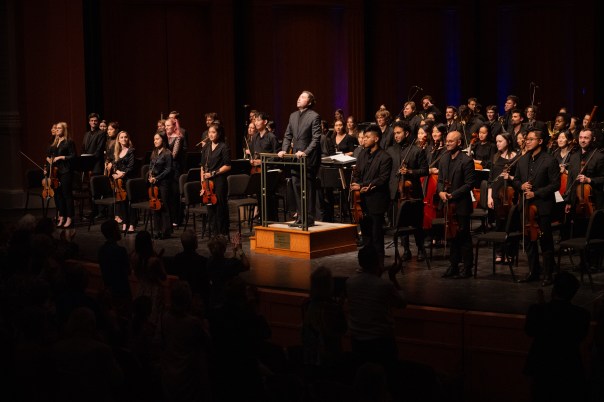


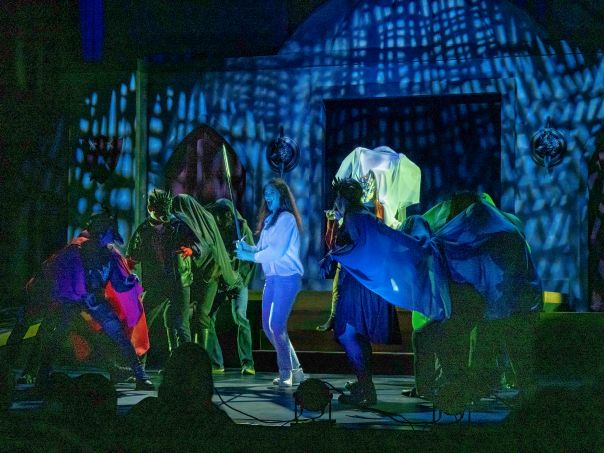
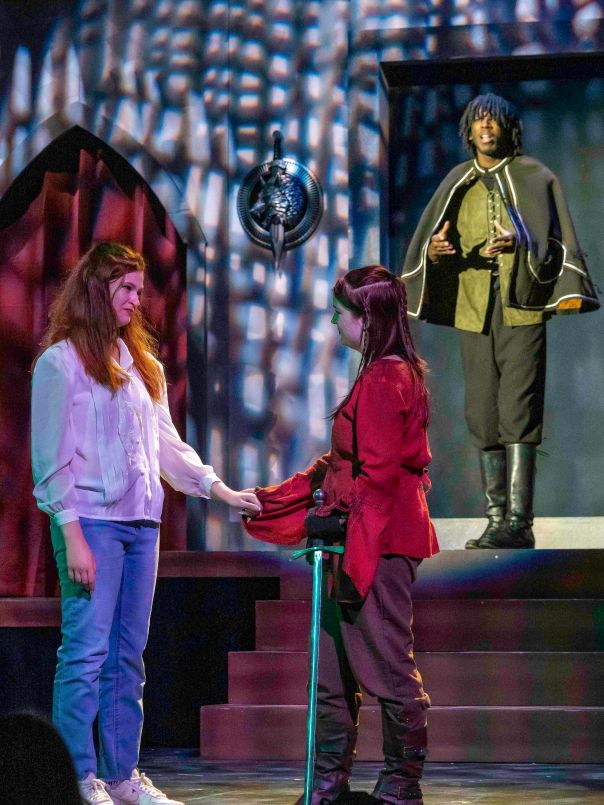
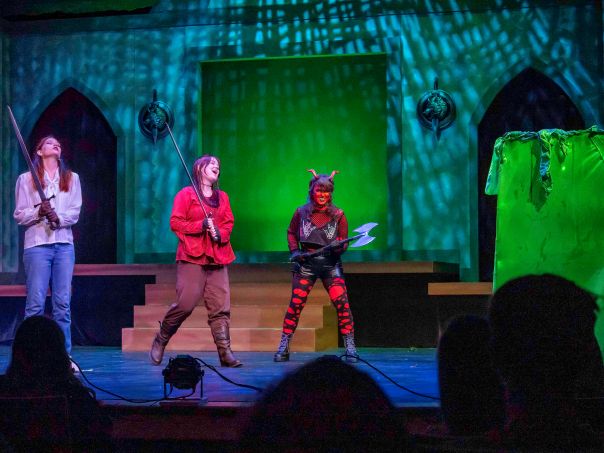


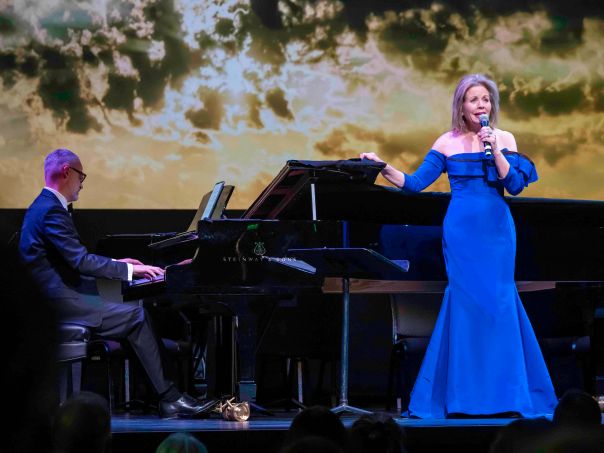
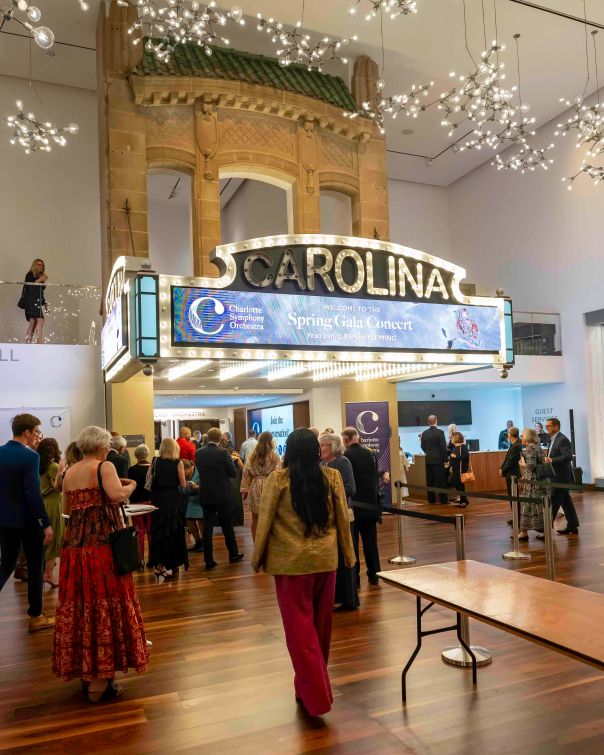

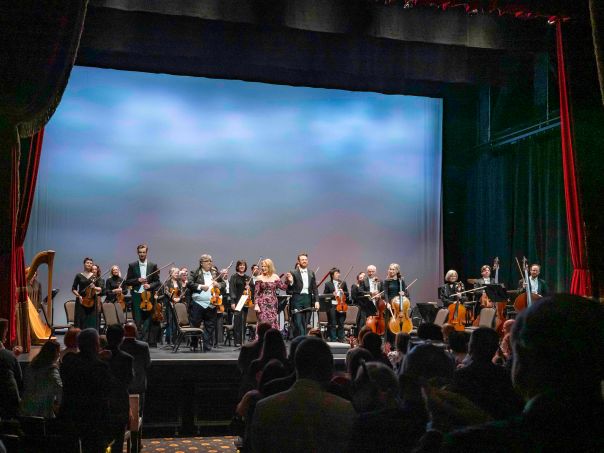


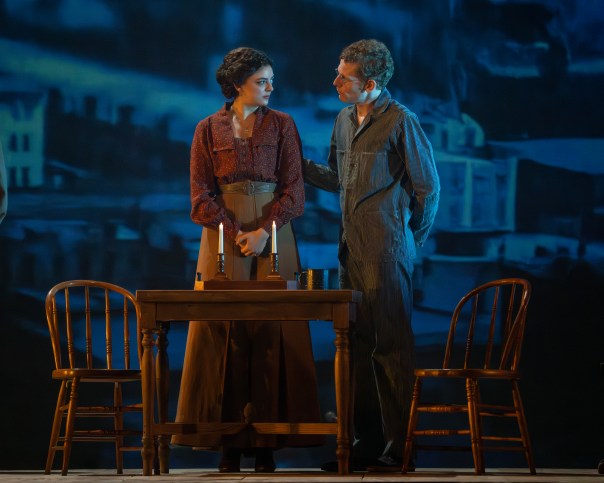


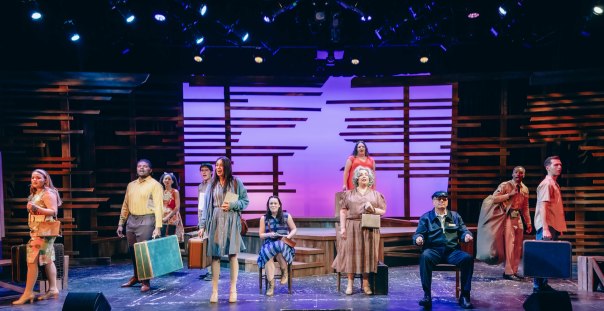
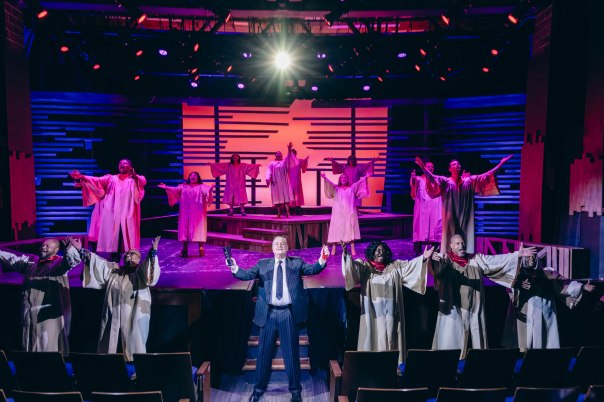
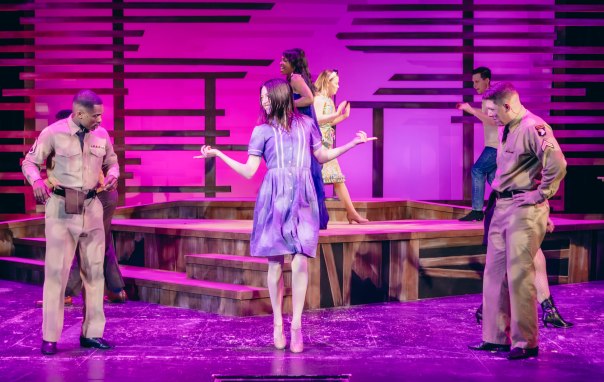


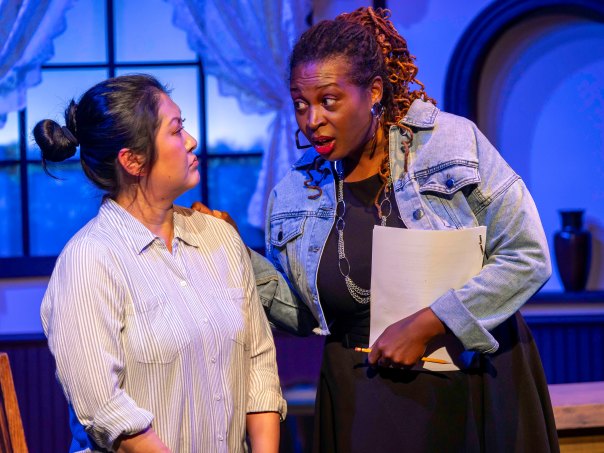
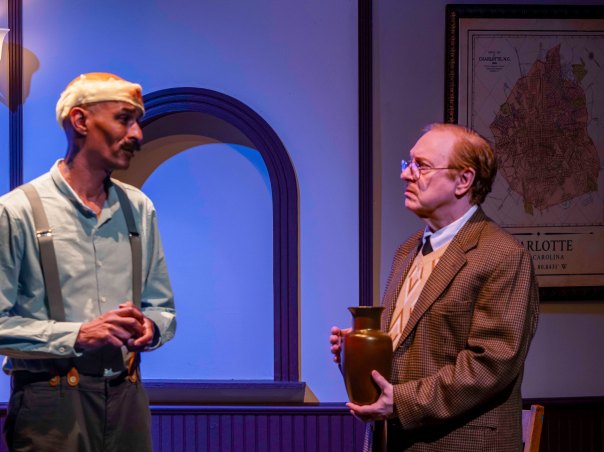


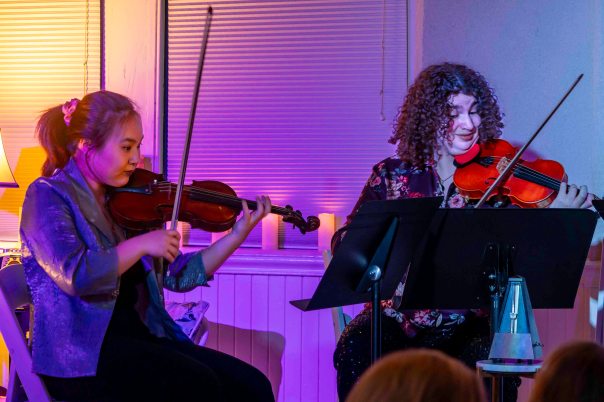
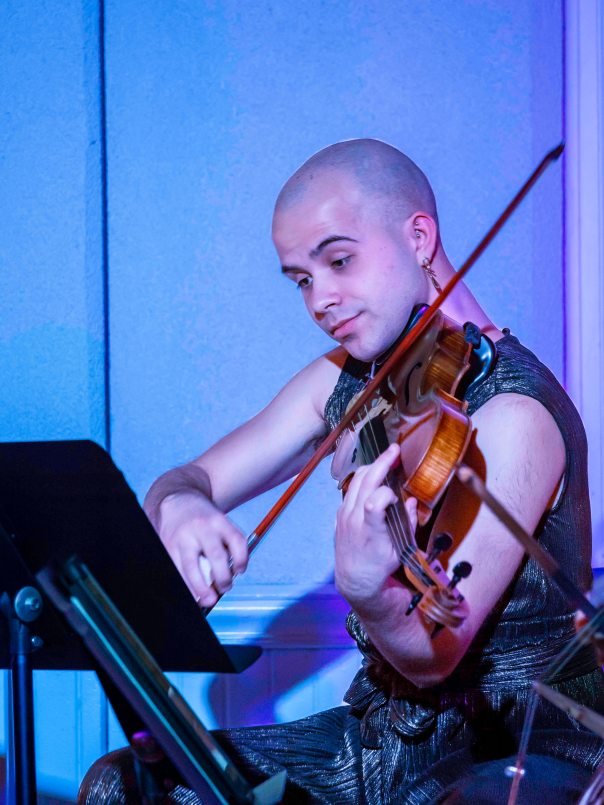

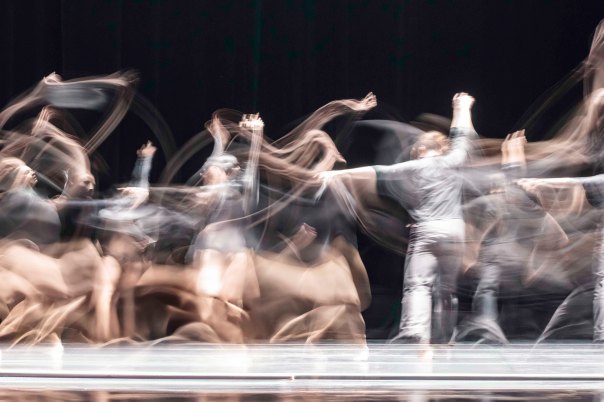

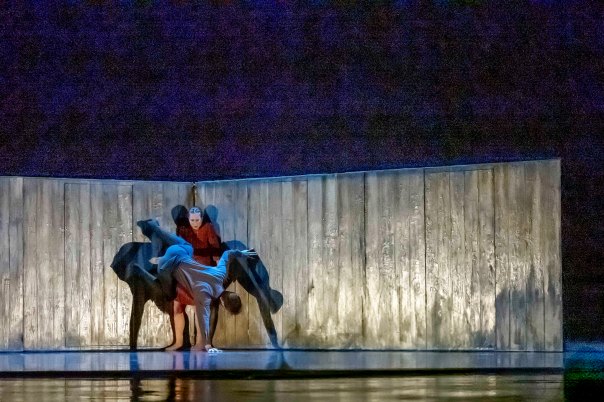

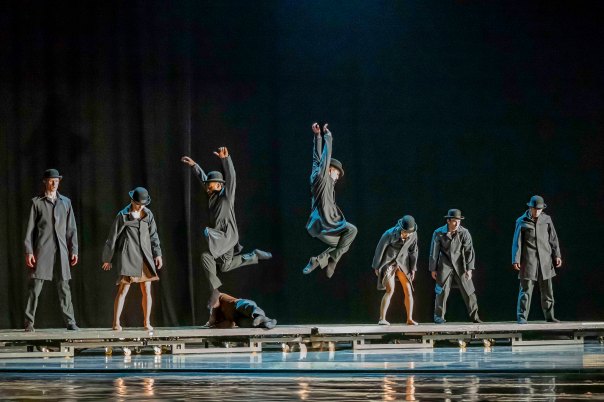

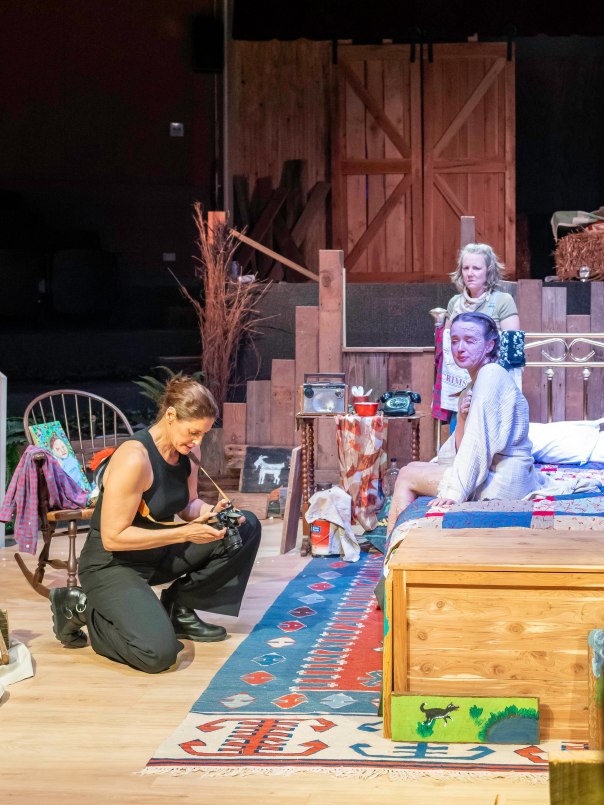

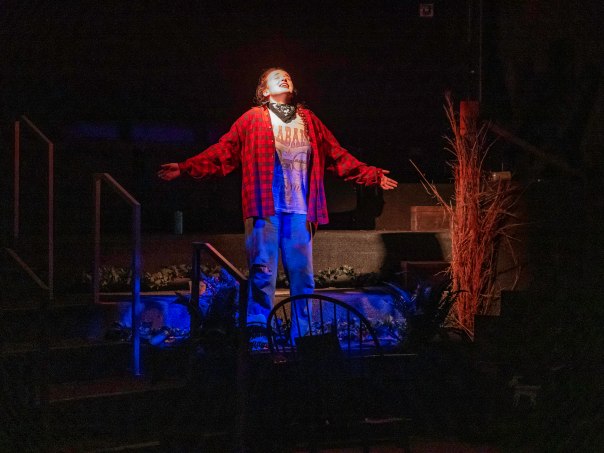

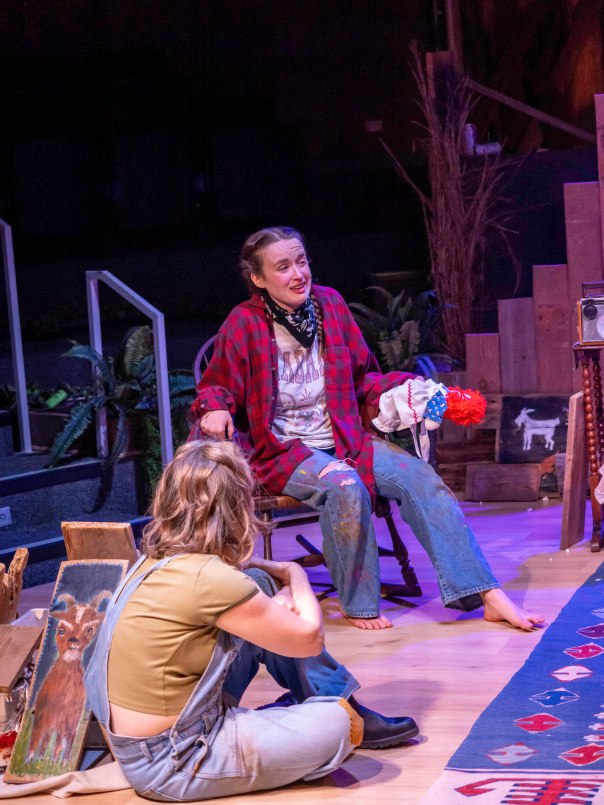

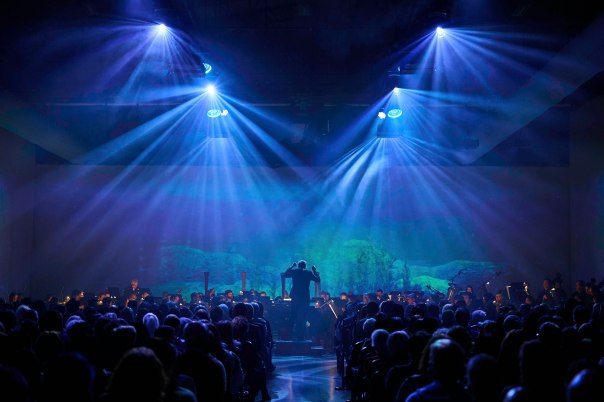





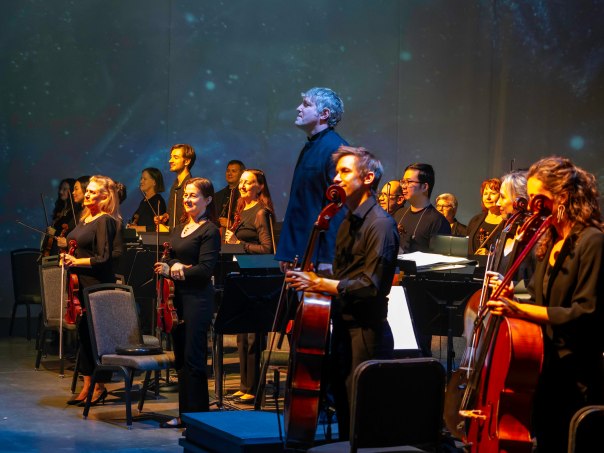

 Art on My Sleeve