“Beyond the Mint” Crosses the Street for Inspiration

Review: Charlotte Ballet’s Innovative Works: Beyond the Mint

By Perry Tannenbaum

Dispersal

Programmatic works seem to come more readily to choreographers than to symphonic composers. For many who love the art of dance, a ballet without a story to tell isn’t a ballet at all. So it’s natural, while choreographers at Charlotte Ballet search for music for their dancers, they’re also in quest of stories, ideas, and images to give their works added edge.

In her three seasons as artistic director at Charlotte Ballet, Hope Muir has enriched this collaboration by formally reaching out to other organizations in town – including UNC Charlotte, who collaborated on last season’s Innovative Works program, Shakespeare Reinvented, with two of their distinguished professors of literature. Surrounded by two neighboring museums at Knight Theater, where they are the resident company, it’s completely logical for Muir to reach out now to one of them for new inspiration – across the lobby to the Bechtler Museum of Modern Art or across the street to the Mint Museum Uptown.

The title of this year’s Innovative, Beyond the Mint, spells out her choice. Three choreographers have visited the Mint Uptown and soaked in their current exhibition, Immersed in Light, an installation of five works by Studio Drift, an influential Dutch studio established by Ralph Nauta and Lonneke Gordijn in 2007. Inspired by “Franchise Freedom” and “In Twenty Steps,” Chelsea Dumas created Journey Home. Christopher Stuart took his cue for Dispersal from “Fragile Future 3,” while Duane Cyrus was more general in citing the basis for his Colony of Desire, quoting the exhibit’s mission statement: “creating a dialogue between opposites, exploring the relationship between nature, technology, and mankind.”

Chelsea Dumas_Journey Home_Peter Mazurowski & Elizabeth Truell_Photo by Taylor Jones[1]

All three of the choreographies were certainly satisfying, but Dumas’ seemed to fulfill Muir’s objectives best, drawing the most from the Immersed in Light exhibition. Taking her cue from “Franchise Freedom,” she sought to juxtapose the freedom of the individual with the safety and security provided by a group, while “In Twenty Steps” prompted her to visualize the group like formations of birds in flight.

Costumes by Anna De La Cour had the spare simplicity and uniformity of futuristic sci-fi cults we often see skewered in movies and TV, while the John P. Woodey lighting design carved out the boundaries of two realms at the McBride-Bonnefoux Center for Dance: the circumscribed area of the individual, Peter Mazurowki, and the territory of the group, seven other dancers. Writhing around on the studio floor in his egg-shaped area, Mazurowki could hardly be described as comfortable or happy in his own little world, but you could construe Dumas’ sequence of movements as a birth of sorts.

Only Elizabeth Truell separates herself from the group, and only she traverses the divide between and the group. Yes, she invades Mazurowki’s space – his discomfort zone? – and coaxes him out of his isolation, but there’s little that is human in her efforts and nothing sexual or alluring. Truell’s actions are a pathway to joining the flock and an invitation to flight. Music by Philip Glass seems apt for this chaste avian action, but there are mellower moments when the score shifts to a track by composer Mark Yaeger and cellist Gautier Capuçon. Amid the flattery and fluttering that engulf Mazurowki, it’s obvious that there is tension – and a yearning to return to his former solitude.

Stuart told the opening night crowd at the post-performance talkback that he had worked on Dispersal for a mere 18 days and that he had called back to Nashville, where he is established as the resident choreographer of Nashville Ballet, for Christina Spinei to compose the music. Maybe because the choreography was so rushed, Woodey’s lighting and Katherine Zywczyk’s costumes seemed more spot-on in capturing the dandelions of “Fragile Future 3” and the floating essence of dandelion seeds. Relying heavily on pas de deux for four couples, Stuart seemed to be tugging against his Dispersal concept and a vision of their epic journeying.

Yet the couples and the composer certainly weren’t tugging against each other or Spinei’s original music. Sarah Hayes Harkins paired with Colby Foss, followed by Alessandra Ball James partnered with Josh Hall, displayed the kind of mutual trust and simpatico that takes time to develop. These couples, with their individuality and chemistry, surely helped shape the choreography and infuse the new music with their unique imprint. They are also, no doubt, motivating the newer couples – Juwan Alston with Amelia Sturt-Dilley, as well as Maurice Mouzon Jr. and newcomer Nadine Barton – to develop a comparable rapport.

Although his concept was the most abstract of the three choreographers, untethered to any specific work at the Studio Drift installation, Cyrus in collaboration with Emmy Award-winning costume designer Shane Ballard has produced the most exciting of the new Innovative Works – and arguably the work that goes furthest “beyond the Mint.”

Colony of Desire

Utilizing five men and three women, going from white to black costumes late in his piece, Cyrus’s give-and-take with opposites was not at all concerned with symmetry. Nor were Ballard’s glamorously bizarre costumes with their military silhouettes. No tidy pairings here, either. Foss is as likely to lift a man as a woman, emerging once again as the guy who does the splits. Unlike the other two choreographers, Cyrus takes a strong hand in conceiving the set, joining John Tringas in the scenic design to frame the splashy entrances that climax his scenario. Woodey adds drama to these entrances, widening the spectrum of his lighting design with orange, green, and violet after Ballard’s black costumes appear.

Cyrus is no less restless in the dance idioms he uses, as likely to pillage hiphop vocabulary as classic ballet moves. The soundtrack ranged from the contemporary beats of Angus Tarnawsky and Jonboyondabeat to the choral chants of David Lang. In contrast with Dumas’ superb synthesis and transmutation, Cyrus worked his wonders in a spirit of adventure and experimentation – plus a dash of showmanship.

Cherokee Nation Claims Territory Next to “Appalachian Spring”

Review: Appalachian Spring

By Perry Tannenbaum

2020~Symphony Si Otsedoha-11

When you think of an All-American concert at Belk Theater performed by the Charlotte Symphony, composers like Samuel Barber or Aaron Copland figure to be in the mix. Sure enough, Copland’s Appalachian Spring is the marquee attraction at the latest Symphony concert led by maestro Christopher Warren-Green, preceded by Barber’s equally familiar Adagio for Strings. What came between these works by a Pennsylvania blue-blood and a Brooklyn-born Jew was really surprising, enlightening, and inspiring – and frankly stole the show.

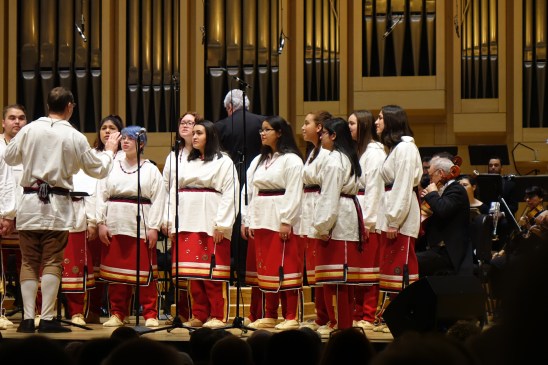
That work was by a composer most of us had never heard of, William Brittelle, titled Si Otsedoha in a language most of us don’t know. Commissioned by the North Carolina Symphony in 2017 and premiered the following year in Raleigh, the new piece tripled the Appalachian aspect of the concert, for the Boston-born Brittelle was raised in Newton, NC, the county seat of Catawba County. Appropriately enough, the featured performers of Si Otsedoha were the Cherokee Chamber Singers of Cherokee High School, led by Michael Yanette.

With English and Cherokee text by the Singers, the piece is divided into five sections, including a “Still Here Overture.” It’s forceful stuff from the beginning, with each of the Singers stepping forward to recount a segment of Native American or Cherokee history. The history goes back many millennia before the so-called “discovery” of the New World, and after each section – even after the sufferings, indignities, and betrayals inflicted by white European occupiers – the whole ensemble proclaims, “But we’re still here!” with an edge of affirmation and defiance. Special rancor is reserved for President Andrew Jackson.

2020~Symphony Si Otsedoha-05

These young men and women are telling us things. Though they mention the infamous “Trail of Tears,” they’re not complaining or asking for pity. In the softer second section, “Phoenix Rising,” we hear of the young people’s yearnings, sung in English and Cherokee, keyed by a recurring phrase, “When I look to the sky.” In the next section, we begin to notice the composer, the orchestra, soprano soloist Catherine Brookman and Yanette more; for it is here, with the women answering the men, that the Singers really begin to sing. Brittelle’s music leavens the message of “When Money Becomes Religion,” arguably containing the orneriest statements in the piece. The section on the Keystone Pipeline in North Dakota, in particular, aren’t intended to salve the sensibilities of Evangelicals or Republicans.

Adorned with silvery percussion and gossamer harp strings, “Walls of Glass” is the most soothing and ethereal section of the piece, where the lyricism of the composer and the harmony of the ensemble shine most brilliantly. The finale, “Si Otsedoha,” circles back to the “We’re still here” message of the opening section, but the Cherokee version is spoken with far less defiance than the earlier English preamble. Gradually the music, the singing, and the chanting grow insistent, then exclamatory and celebratory – with a little bit of a militant edge. The next time Native Americans wish to protest construction of a new pipeline that violates existing treaties, Si Otsedoha (first word is pronounced “she”) would be a stirring, powerful statement to fire up demonstrations.

2020~Symphony Si Otsedoha-08

Though Barber’s Adagio has been programmed at least twice since I heard Jacomo Rafael Bairos conduct it at Knight Theater in 2011, I had never seen what Warren-Green would do with it. Nobody who loves this affecting work will be disappointed. The cellos, violins, and even the violas get opportunities to stand apart during this eight-minute warhorse, and all three perform precisely and sensitively. Watching the performance is a treat – and after navigating the unexpected Uptown detours to find a feasible pathway to the Belk, which seemed to confound Google Maps as much as me, I can heartily credit the players for soothing my frazzled nerves.

Copland’s Appalachian Spring was more of a surprise than the Barber, last performed here in October 2015. After a moribund rendition of the score in 1993, which I consistently cite as among the most wretched Symphony performances I’ve ever witnessed, the orchestra conquered Copland’s iconic ballet suite the next two times I heard it in 2009 and 2015. For the current concert, Warren-Green expands his conquest, restoring music from the original Martha Graham ballet, which Copland called “Ballet for Martha” before Graham discerned spring in the music and took the eventual title from Hart Crane’s The Bridge.

Chamber and orchestral versions that flowed from the 1944 ballet abbreviated the score. Neither of the recordings in my collection break down the piece, but those conducted by Bernstein, Mehta, and Copland are among those you can find on Spotify. Of these, only Mehta’s begins to describe the ballet scenario with any of the detail that you’ll find so helpfully reproduced in Symphony’s program booklet. I suspect the absence or abbreviation of Section 4, “The revivalist and his flock,” was one of the things made that lamentable 1993 version so lifeless.

The “Calm and flowing” Section 7 of the piece, memorable for all its voicings of the “Simple Gifts” Shaker melody – by the violas, the cellos, and (most memorably) the clarinet – seemed to come with more off-road excursions by piano, brass, and percussion before the unforgettable orchestral explosion that Charlotte Symphony plays so grandly together. It may be a less cohesive Spring than Copland conceived in his suite, but after hearing the same-old-same-old so many times, I found it fresher and even more satisfying.

Robbins Hatches an Immigrant Experience

Quonta Beasley, Stephanie Lee, photo by Ashley Randall_Edit_1

Review: The New Colossus

By Perry Tannenbaum

If you are one of those knuckleheads who oppose illegal and legal immigration – “good” folks who scoff at the notion of allowing terrorists onto our sacred soil under the flimsy guise of political asylum – you won’t need to watch The New Colossus for long before concluding that this is not the show for you. On the other hand, if you were expecting Tim Robbins and his co-writers, The Actors’ Gang Ensemble, to bring a play to Knight Theater – or a suite of touching immigrant narratives – you might hang in there considerably longer before deciding that maybe you should have passed on this show as well.

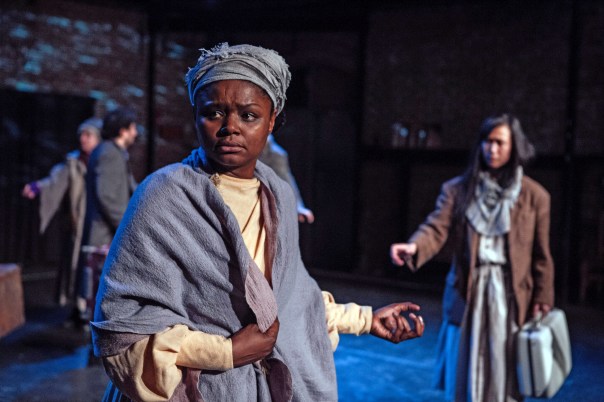
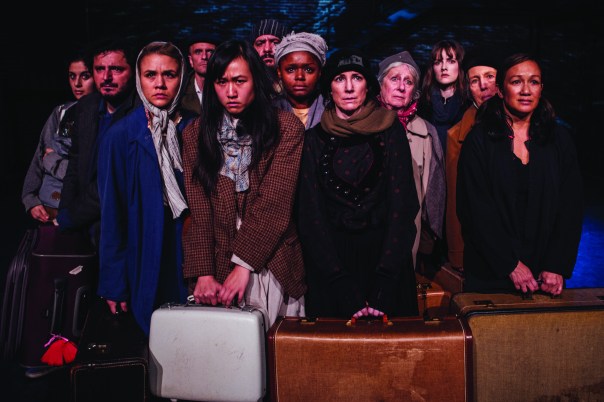
For despite the assurances of the playbill that we would be watching scenes and stories, The New Colossus was not a play on the opening night of its national tour. Actors in the Ensemble, representing refugees from 12 different countries – including the US Confederate States – speak 12 different languages in portraying their own ancestors.

But not that often. In his director’s notes, Robbins clarifies his intentions, describing Colossus as a movement piece, a “calling up of ancestors.” Here and there, we see supertitles as each of the 12 refugees voices the perils in his or her birthplace – Iran, Turkey, Malaysia, Germany, Vietnam, Mexico, Finland, Hungary, Yugoslavia, Russia, Austria, and Louisiana – driving them to find liberty and new lives in America.

The cast of The New Colossus, photo by Ashley Randall

More often, we see them as a raggedy group, toting valises that contain everything they own, then fleeing from pursuers, squatting by a stream to quench their thirsts, helping each other to dig a tunnel with their hands, freezing in the cold, urgently struggling to build a fire, basking in the heat and light once they’ve succeeded, scurrying for cover when they believe their pursuers might see them, standing at a border wall where they’re not allowed to cross, and desperately hailing passersby who might assist their journeys to freedom. It’s fair to say that these wordless actions and movements are at least two-thirds of the 90-minute piece that Robbins and Ensemble “wrote.”

No doubt about it, Actor’s Gang delivers an immigrant experience. There were moments during these diverse and harrowing pilgrimages to our shores that were heart-rending – moments when I couldn’t help thinking about people fleeing today from wartime atrocities in Syria or murderous drug gangs in Guatamala. What has become of governments here and in Europe that close their borders to such desperate refugees? What has become of those peoples who demand, with the force of their votes, such absolute callousness from their governments and elected leaders?

Around the 14th time, or maybe the 27th time, these immigrants circled the Knight stage; grunting, panting, and sometimes muttering phrases in their native tongues; I couldn’t help feeling that my liberal tolerance was being stretched past its breaking point, even if the Ensemble was credibly simulating the tedium of their forefathers’ and foremothers’ exhausting treks toward freedom. Robbins not only co-wrote The New Colossus, he directed it. Sitting at rehearsals or announcing his reactions afterwards, he should have had the sense to say, “We can definitely cut some of that action.”

Music by cellist Mikala Schmitz and percussionist David Robbins alleviates the tedium, while projections by technical director Josh Keh open up fresh possibilities. Those possibilities surfaced during the post-show powwow that Robbins emceed from the stage. By a show of hands, our opening night audience revealed how many descended from indigenous Native Americans, how many of us were immigrants, sons and daughters of immigrants, grandsons and granddaughters of immigrants, etc., all the way back to the Mayflower.

The indigenous folk were also prompted to give us their names and tribes, immigrants gave their countries of origin and dates of arrival, while sons and daughters of immigrants gave the names, dates, and countries of origin of family members who first set foot here. When all these names, tribes, countries of origin and dates had been called out, Robbins asked for volunteers in the audience to share their special immigration stories.

At times, the speakers became emotional, and again, this was no place for anti-immigration, America-is-closed knuckleheads. But this wasn’t necessarily the end of Robbins’ show, even after the add-on segment. If they wished, people who had shared their stories could come backstage afterwards and retell their tales with a camera rolling. Robbins even invited the shyer folk who hadn’t ventured to share their stories with the entire Knight crowd to come backstage and open up in a more intimate setting.

So I can only hope that Robbins is conceiving The Colossus as something more than a play, a movement piece, or a simulated immigration experience. I hope he really sees it as a dynamic project and that, someday soon, the stories he is filming will nestle in among the images projected behind his performers – filling in their silences and preventing the images already chosen from overstaying their welcome.

None of the actors gets to dominate the stage for very long amid the hurly-burly of fleeing their motherlands, so it probably shouldn’t surprise anyone that performers representing familiar stories resonated most with me, namely Quonta Shannell Beasley as the emancipated Sadie Duncan from Louisiana and Jeanette Rothschild as her grandmother Yetta Rothschild, escaped from Germany. It also helped that the stories of Stephanie Lee as Ly My Dung from Vietnam and Paulette Zubata as her mother Gabriela Mia Garcia from Mexico also arrived somewhat pre-warmed.

Zirko Petkovic and Pierre Adeli, photo by Ashley Randall

Influenced by my own ancestry, I had a special fondness for the performers who delivered the most Eastern European flavor, Zivko Petkovic as his Yugoslavian grandfather, Mirko Petkovic, and Dora Kiss as Hungarian grandmother Aranka Markus. Of course, Emma Lazarus, the Jewish American poet who gave the Statue of Liberty her voice when she wrote her “New Colossus” sonnet, had a soft spot in her heart for Eastern Europe. Small wonder, then, that Petkovic and Kiss strongly evoked for me the immigrants famously described by Lady Liberty in the Lazarus poem:

“Keep, ancient lands, your storied pomp!” cries she

With silent lips. “Give me your tired, your poor,

Your huddled masses yearning to breathe free,

The wretched refuse of your teeming shore.

Send these, the homeless, tempest-tossed to me;

I lift my lamp beside the golden door!”

Sobering reminders when even our courts are okaying the concept of income requirements for aspiring citizens – and the idea of rejecting other countries’ rejects has become White House policy. Hopefully, Robbins’ new piece will blossom into a project that will be heeded.

A Disfigured War Vet Struggles to Find – and See – Herself

Review: Ugly Lies the Bone

By Perry Tannenbaum

Jess-Kacie-Mom

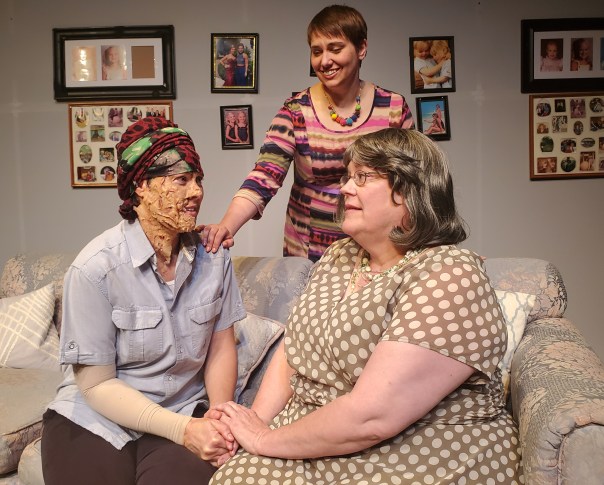
When Jess returns to her Florida hometown from her third deployment in Afghanistan, there are multiple obstacles littering her path to reintegrating into family and community life. Mentally, she’s suffering from PTSD. Physically, she’s tormented by the aftereffects of injuries inflicted by an exploding IED: she gets around – slowly – with help from a walker, her face is disfigured by burns and skin grafts, and she’s constantly in excruciating pain from burns and grafts all over her body.

That’s just the beginning in Lindsey Ferrentino’s Ugly Lies the Bone, now at Spirit Square in a Three Bone Theatre production. There’s a certain amount of friction between Jess and her sunny sister, Kacie, that reads like ingratitude for all the help and care Kacie is trying to give her. Jess also reflexively despises Kacie’s vulgar, tactless, and boisterous boyfriend, Kelvin, and she doesn’t express that feeling daintily. Nor does it help that Jess’s former boyfriend, Stevie, didn’t religiously wait for her to come back home. Instead, he went on with his life and got married.

Located near Cape Kennedy, Jess’s hometown of Titusville offers additional challenges. Not only do the sands on the nearby beaches trigger Jess’s PTSD, so will the earthshaking tremors from rocket launches at the Kennedy Space Center. True, NASA’s space shuttle program is about to end, minimizing the obstacles posed by future launch events. But layoffs have already struck the Space Center, reducing job opportunities in the citywide. Stevie was one of the impacted NASA workers, and Jess finds him behind the counter at a local gas station, making change, selling lottery cards, and wearing a dopey space beanie.

But wait a second. Jess had to run and conquer obstacle courses just to earn the dubious privilege of being deployed to Afghanistan in the first place, right? This nasty, bitter, and disfigured woman has grit. We also get hints from both Kacie and Stevie that, once upon a time, Jess had vitality and appeal. And notwithstanding all her current pain, disability, and orneriness, Ugly Jess gets meaningful help.

Jess2

The most intriguing – and theatrical – form of help is a form of VR therapy that Ferrentino tells us, in a program note, was actually the inspiration for her play. You can google “Snow World” therapy and find that its use with severely injured soldiers dates back to 2008, though it seemed pretty cutting-edge to me. Each time Andrea King as Jess puts on her VR goggles and immerses herself in a fabricated 3D snow-world, the Duke Energy Theater fills with dreamy projection designs by Ryan Maloney – so we’re fairly immersed as well.

Since the theory of the therapy is as much sensory bombardment as fantastical escape, the second ingredient of the treatments is music. Jess gets to choose between patriotic soldiering music and Paul Simon. The treatment is curiously impersonal: we never see Jess’s therapist; we only hear her voice. Amid the sensory overload, Jess’s sufferings subside sufficiently for the therapist to prompt her to move her legs through the snowdrifts and lift her arms – movements that would normally exacerbate her terrible pain by stretching her newly grafted skin.

For us as well as for Jess, these dreamy cinematic episodes are oases of calm that punctuate the stresses and occasional comedy of her readjustment to civilian life. She momentarily abandons her walker as she grabs the videogame controls, almost straightens up, and we find ourselves relaxing with her in the dimmed light.

Jess-Kelvin

Perverse as it was, I enjoyed the oafishness of Peter Finnegan as Kelvin and the nerdiness of Scott Tynes-Miller as Stevie. Anyone who saw Finnegan last summer as he feasted on the role of Bottom in the outdoor production of A Midsummer Night’s Dream at Queens University will need no further incentive to behold his Kelvin, which is nearly that far south of normal. And who better for director Dee Abdullah to turn to than Tynes-Miller for the wishy-washy, conflicted, and adorably humbled Stevie? We’ve watched his auditions for years.

Abdullah can allow both Finnegan and Tynes-Miller to go slightly overboard in making asses out of Kelvin and Stevie because Ferrentino eventually brings them back to conscience and virtue. Becky Schultz as Jess’s sister Kacie may seem too wholesome at first to go the distance with Kelvin. With only a trace of trashiness from Schultz, Finnegan’s loutishness startles us all the more, so we tend to empathize with Jess a little bit when she explodes on him early – and later on when she harbors darker suspicions.

Jess-Stevie1

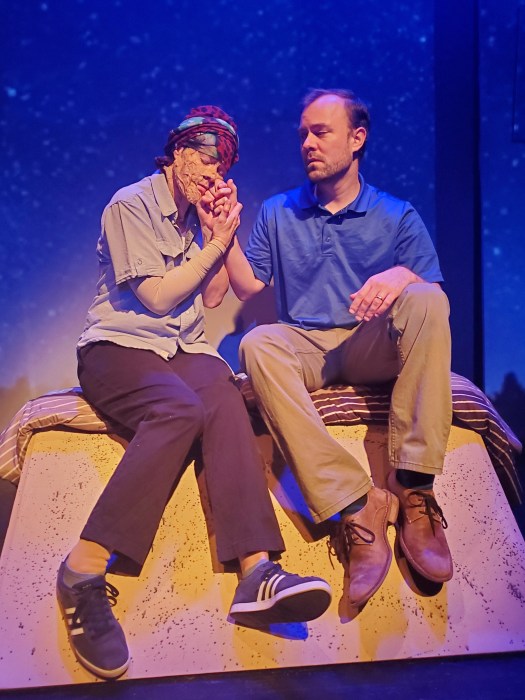
Before singing King’s praises as Jess, I’d be remiss if I didn’t insert some prefatory kudos to makeup designer Gregory Hewett and makeup artist Natasha Kay, unsparing in showing us what Jess is dealing with. You don’t need to imagine much of the pain when King slowly makes her first entrance with her walker. The pain really does seem to permeate every inch of her as she struggles to move and the endure the ocean of ache. When King declares that three operations were necessary to restore one eyelid, you believe it. Vulnerability, bitterness, anger, need, and an all-powerful doggedness course through her, slackened only when Jess dons those transporting goggles, or when she joins Stevie – again in relative darkness – for their climactic rooftop rendezvous.

We get to know Debbie Swanson as the voice of the therapist strictly from her performance up in the Duke’s soundbooth, so it’s gratifying to see her at last when she doubles as Jess and Kacie’s mom as the drama concludes. Swanson’s disembodied voice isn’t tough love so much as clinical care for Jess at the VR sessions. Sometimes soothingly, she patiently counsels Jess to move forward instead of looking back, following procedures with firm military precision.

Eventually, the voice from the booth warms up to Jess just enough to bend the rules. All this time, even before she appears, mom is adding to Jess’s stress and our suspense. Suffering from dementia, Mom may not recognize her own daughter anymore, another devastating blow for Jess. Or she might recognize Jess and freak out, which would hurt them both.

For Jess, avoidance of that confrontation brings little relief. Looking into the mirror, Jess is struggling to recognize herself.

A Fine Old-Timey “La Bohème” Comes Sprinkled With Youthful Energy and Fun

Review: La Bohème

By Perry Tannenbaum

200116_OPE_LAB_0097

Whether it’s tuberculosis or AIDS, Paris or Greenwich Village, La Bohème or Rent, 1896 or 1996, death and disease are intertwined in our imaginations with the struggling, impoverished lifestyles of Bohemian artists and intellectuals. What lifts these shivering, starving folk from seediness and squalor to the nobility of poetry, never upgrading their threadbare garments, is the music of Giacomo Puccini and his rock apostle, Jonathan Larson. Come to Belk Theater and the Opera Carolina production of Puccini’s seminal work and you may get an inkling of how inseparable the two composers’ works can become.

Scenic designer Peter Dean Beck has not updated the loft where we first meet the poet/playwright Rodolfo, his painter chum Marcello, musician Schaunard, and philosopher Colline. The boulevard bustle of the Latin Quarter and Café Momus is not on the awesome Franco Zefferelli scale of the beloved Metropolitan Opera production, but the spirit and colorfulness of Act 2 are also faithfully captured, where temptress Musetta and toyseller Parpignol highlight the broadened palette. Down in the pit, maestro James Meena and the Opera Carolina Orchestra are no less devoted to the shifting moods of the score, whether lovers are pining or Christmas-crazed children are running wild.

200116_OPE_LAB_0397

No, it’s director Aldo Tarabella in his Opera Carolina debut who bridges the gap between the 1830s, the actual setting specified in the Giuseppe Giacosa-Luigi Illica libretto, and the AIDs-plagued 1990s. From the outset through the intermission between Acts 2 and 3, Tarabella dispenses with subtlety in accenting the comedy of the first two scenes – the cavalier badinage between Rodolfo and Marcello as they cope with the cold, the successful conspiracy of the four tenants at the loft to thwart their landlord Benoit’s attempt to collect the rent, and the hoodwinking of Alcindoro, Musetta’s wealthy old sponsor, at Café Momus. There’s a certain amount of incorruptible idealism that infuses the Bohemians’ high spirits and deceptions, but with four performers making Charlotte debuts in this production, Tarabella also underscores the youthfulness of the Bohemians’ camaraderie and pranks.

Nor does Tarabella hold back when the mood shifts from mirth to tenderness, anguish, and heartbreak. When Alcindoro receives the bill at Café Momus after the Bohemian scamps have absconded, the old coot literally falls over backwards as the curtain comes down, and at the sad climax of Act 4, when Mimi has coughed her last, the impact on British tenor Adam Smith literally brings him to his knees as Rodolfo. In both instances, the direction is so flamboyant that we might feel like we’re watching a silent movie. Neither played like an overreach to the capacity crowd on opening night.

200116_OPE_LAB_0193

If Tarabella seemed to be persuaded by Rent of the efficacy of emphasizing the youthfulness of Puccini’s opera, then the singers onstage must certainly have exerted a persuasive power over youths in the Belk audience who were experiencing the source of Rent for the first time. Smith in particular didn’t merely touch your heart when he sang the famed “Che gelida manina (Your tiny hand is frozen)” to Mimi as he responded to her plea for him to light her candle. When Smith ascended to the blazing summit of this aria, his rich, full-bodied tenor sent a bloody stake through your heart. It would be an understatement to say that Smith equaled the Rodolfo of tenor Ramón Vargas when I reviewed him at the 1205th performance of Bohème at the Metropolitan Opera in December 2008. Vargas was past his 48th birthday when I saw him, and he could no more match Smith’s sheer vocal power than he could match his youth and freshness.

Smith’s singing ought to be sufficient incentive for snapping up what few tickets might be available for the remaining three performances of this Bohème, but he also delivered the frivolity and nerdiness of Rodolfo when needed. The other Charlotte debuts had more to recommend them than merely their youth. Italian soprano Stefanna Kybalova, though not ideally suited to the exquisite fragility of Mimi, poignantly delivered the seamstress’s consumptive weakness. Kybalova was more effective as a soloist in Acts 3 and 4, during Mimi’s final decline and when she repeated her signature “Mi chiamano Mimi (They call me Mimi)” theme, but the duets with Smith were always gorgeous, including the two fadeouts which seem to crystallize the whole opera.

200116_OPE_LAB_0534

Sicilian baritone Giovanni Guagliardo is considerably mellowed as Marcello compared with his previous Opera Carolina appearances as Tonio in Pagliacci and Sonora in La Fanciulla del West, joking and commiserating with Rodolfo in the loft scenes and sympathizing with the forlorn Mimi in the Act 3 snow scene. Yet he also flashed some fire dealing with the flirtatious, manipulative Musetta. The heat of their quarreling formed an effective counterpoint to Rodolfo and Mimi’s snowy reconciliation in the quartet that took us to the second intermission. For her part, soprano Corey Lovelace had all the sultry fire you could wish for in her Charlotte debut as Musetta, giving Guagliardo as much as he gave her in the fire department. She also had sufficient arrogant majesty to captivate us and dominate a stage full of people in front of Café Momus delivering “Musetta’s Waltz,” though Tarabella didn’t ask for Carmen-grade vamping from her.

200116_OPE_LAB_0848

Outside of the two main couples, I didn’t much notice bass baritone Peter Morgan’s debut as Colline – or, for that matter, Keith Harris’s return as Schaunard – until Act 4. But to help clear the stage for Mimi and Rodolfo’s last deathbed tête-à-tête, Puccini masterfully has Colline sing a tender valedictory to his coat, which he resolves to pawn in order to provide food and medicine for the invalid. Morgan gave the aria a near-Russian solemnity, yet the eccentricity of this episode still resonated with the more blithe and high-spirited action of the opening act, when Rodolfo made a similar sacrifice, feeding his playscript to the stove to keep the Bohemians warm. Not so comical after all, despite the jibes of his companions.

Before Meena took his place in the orchestra, there was a filmed fundraising appeal aimed at boosting contributions from 23 to 30 percent of the company’s budget. Explicitly occasioned by the failure of the Charlotte sales referendum on behalf of arts and parks last November, just two days before a poorly attended opening of Verdi’s Macbeth, the appeal was aptly timed. The production that followed, in front of a packed house, affirmed what Opera Carolina is capable of when it gets the robust support it deserves.

Sher Tinkers With “My Fair Lady,” Recalibrating Its Perfections

Review: Lerner & Loewe’s My Fair Lady

By Perry Tannenbaum

My fair Lady

Ah, perfection! It’s what so many of us unthinkingly strive for. Yet achieving perfection, the pedestal Lerner & Loewe’s My Fair Lady perches upon in the eyes of so many, invites a whole set of calamities, chiefly complacency and inertia. Worshipers at the altar of perfection would understandably strive to replicate the voice of Julie Andrews and the grace of Audrey Hepburn in presenting Eliza Doolittle – or the sublimely calibrated gruffness of Rex Harrison in reviving Professor Henry Higgins.

Their perfection has seemed to add layers of tamper-proof portrayals to Frederick Loewe’s cavalcade of memorable melodies, Alan Jay Lerner’s concise and pungent lyrics, and the duo’s deft adaptation of George Bernard Shaw’s Pygmalion. Over the decades since it premiered on Broadway in 1959, our concepts of the ideal Fair Lady have become the sound of the original cast album (a #1 best seller) and the lavish look of the Hollywood film (Oscar for Best Picture).

But what about the stage show? There we tend to be rather vague. If you’ve been following theatre in Charlotte for the past 30 years or so, seeing as many as half-a-dozen local revivals as I have, you dimly remember one or two of them. Last national Fair Lady tour to stop in Charlotte? Never happened before the current tour now playing at Ovens Auditorium.

Launched this past December, five months after it closed on Broadway, the acclaimed Lincoln Center Theater production directed by Bartlett Sher dares to mess with the perfect musical. You’ll most readily notice Sher’s ministrations in the final scene, where Eliza’s response to Higgins’ peremptory “Fetch me my slippers!” seems to draw a “did-that-really-happen?” reaction from the Professor. But Sher also makes a sumptuous meal of “The Servant’s Chorus,” a song that I could not remember hearing live before, an 84-second relic from the film soundtrack that was apparently shoehorned into the 1993 revival.

My fair Lady

The insertion of this interlude, between “Just You Wait” – with its gawky vowels and dropped aitches – and Liza’s breakthrough “Rain in Spain,” makes delicious dramatic sense, giving us some idea of the flower girl’s arduous toil to master proper English pronunciation and Higgins’ merciless prodding. A gaggle of servants scurries through a mammoth two-story house that Sher has tasked set designer Michael Yeargen to build in such grand fashion that it revolves, showing us three different rooms in Higgins’ home.

Extending Liza’s struggles into epic spectacle makes her sudden latenight “Rain in Spain” triumph that much more rewarding. The crowning point of the sequence, Liza’s exuberant “I Could Have Danced All Night” after Higgins and servants have wearily trudged off to sleep, had never moved me so much before, a true revelation.

But improving on perfection ran into technical difficulties on opening night. To clear the upstage wall for its subsequent rotations – and likely to ensure its stability – the two-story set must come forward a few feet toward the audience before it’s properly secured and ready to roll. Instead, there was a slight lurch before the mighty edifice stalled. True to the hallowed show-must-go-on spirit, Laird Mackintosh as Higgins launched into the scene with one of his butlers, only to be shut down by the crew. Houselights came up as the curtain came down, and we heard the dreaded announcement on the PA, which confirmed a problem rather than describing it.

The third stop on the new My Fair Lady tour had come to a dead stop. After a half-hour delay, I felt thankful that the snafu had occurred at the top of the scene so that the whole revelatory sequence was eventually delivered without interruption. Mackintosh as Professor Higgins and Shereen Ahmed as Eliza make a wonderful pair. Ahmed doesn’t have the #MeToo energy and cleverness attributed to Lauren Ambrose when she brought this production to Lincoln Center in 2018. She almost doesn’t need to with all the abrasiveness, conceit, and disregard that Mackintosh brings to Higgins’ misogynistic treatment of Eliza.

We feel like Eliza is being abused long before the Professor’s aborted physical attack on her, and Mackintosh never surrenders all the cruel edge of Lerner’s lyrics in “I’m an Ordinary Man” and “A Hymn to Him” to their comedy. Nor is there more potent testimony to Eliza’s triumph than Mackintosh’s chastened, broken rendition of “I’ve Grown Accustomed to Her Face.” Sher manages to remind us in his nuanced staging that women are still mobilizing behind the cause of suffrage at the time the action is set in 1912. We can cut some slack, then, if Ahmed seems a little deferential towards Higgins’ erudition, wealth, and gender – and, in turn, we can cut Mackintosh some slack for his troglodyte arrogance.

Sher also judges keenly in giving us a more youthful Higgins, for Mackintosh can react to Ahmed emotionally as she wins his admiration, almost sweeping away thoughts of her desirability as a maidservant or private secretary. That youthful casting gives Ahmed more to be giddy about when Higgins shows her his first glimmer of approval and pride. In “I Could Have Danced All Night,” Ahmed’s whole body seems to awaken to undreamed-of possibilities that surpass the prospect of becoming a private secretary or a flower shop owner.

MyFairLadyTour0052

Ahmed does sing superbly, showing steel and vitality in her bellicose songs, “Just You Wait,” “Show Me,” and “Without You.” Helped along by Catherine Zuber’s smashing costumes, Ahmed also transforms magnificently from the grubby Cockney we meet in the opening scene into a vision of regal elegance that credibly explodes Higgins’ wildest expectations of success for his phonetic experimentations – and his gentlemen’s bet with Colonel Pickering.

Pickering and Higgins’ patrician mom, whom you might expect to oppose Eliza, turn out to be her staunchest supporters. Sher doesn’t tamper with their traditional essences, bespeaking the good-heartedness of upper-crust Brits, getting zesty and stylish performances from Leslie Alexander as Mrs. Higgins and Kevin Pariseau as the Colonel.

My fair Lady

Yet when it comes to the young gentleman smitten by Eliza, Freddy Eynsford-Hill, Sher calls upon Sam Simahk to augment the chap’s dopiness and devotion. That allows for a broader comical take on Eliza’s gaucheries at the Ascot races in her society debut. And it equips Liza with a lovestruck, puppy dog valet throughout most of Act 2, reaffirming her new sheen. Simahk only slightly trims back the rhapsodic splendor of “On the Street Where You Live” in pulling off this alteration.

My fair Lady

Drunken, vulgar, and rascally, Adam Grupper as the irrepressible Alfred P. Doolittle now seems heaven-sent, purposed to make Higgins seem enlightened and evolved by comparison. Holding his hat respectfully in Higgins’ study as he sells his daughter’s virtue for five pounds sterling, or dancing the night away with barroom sluts the night before his wedding, Grupper is a quintessential scoundrel, lit up with earthy, peasant merriment. His “Get Me to the Church on Time” production number is even more extravagant than the pivotal “Servant’s Chorus,” with climactic funeral imagery in Christopher Gattelli’s choreography on loan from the Scrooge movie musical.

As Higgins proceeded afterwards to toy with thoughts of reconciliation and matrimony, I could see more clearly than ever before that he and Doolittle are kindred spirits. I could also appreciate more keenly the delicious irony that Higgins’ benevolent sponsorship of Doolittle’s welfare, which has a sequel beyond that five-pound note, is what lands Alfred P. in his matrimonial pickle.

But if you don’t like the ambiguous ending of My Fair Lady, you can take comfort in the fact that George Bernard Shaw didn’t write it. Unlike the 1938 screen version, the true source of Lerner’s adaptation, the GBS play ends with Higgins exclaiming, “Marry Freddy, ha!” A 14-page postscript incorporates Shaw’s prognostications about his vibrant protagonists’ futures.

Jilted Women at a Wine Bar Thirsting for Blood

Review: The Norwegians

By Perry Tannenbaum

IMG_1262 (2)

Bundle up! If you head north on I-77 to the Warehouse PAC later this week, playwright C. Denby Swanson will carry you off to the wilds of Minnesota, where she learned the frigid core lesson that inspired her dark arctic comedy, The Norwegians: “You gotta find a lover before the first freeze, or else it’s too late.” Two unescorted women, already bundled up in igloo mode, meet in a ladies’ room at a wine bar, get sloshed together, and bitterly commiserate over recently lost boyfriends.

But Betty, a devious plotter from Kentucky, and Olive, more recently arrived from Texas, aren’t passively drowning their sorrows.

No, no, no. Our first glimpse Olive is a far weirder scene. She’s hiring two hitmen, Tor and Gus, to knock off her asshole boyfriend. It just doesn’t look that way. Tor and Gus are questioning Olive as if she were the one who was trying to get hired for a job – making her sweat sometimes like cops grilling a criminal suspect.

Less askew, but with a definitely mean edge, are the barbs that the women aim at Minnesota and Texas. The Norwegians, Tor and Gus, pretty much demolish their own nationality by describing themselves and their Lutheran ways. These aren’t Lake Wobegon bachelor Norwegians, we should remember, that Garrison Keillor described so whimsically on the Prairie Home Companion comedy franchise. These are killers – and businessmen in competition with other area hitmen, most notably the Swedish outfit.

IMG_1170 (1)They are also pathologically serious, intense, and straightforward. Late in the action, Betty will take great satisfaction in bursting Tor’s “irony cherry.” Nor is there homespun solidarity between the carnivores that Betty has recommended to Olive. Every now and then, Tor will throw the fact that Gus is only half-Norwegian in his face.

Confronted by the strangely hostile and aggressive personalities of the Norwegians, Olive begins to have second thoughts and Tor begins to question Gus’s marketing expertise. We still haven’t heard anything concrete about her ex’s atrocities, or a solid reason for this radical payback, when Olive also has qualms about Gus’s weapon of choice, a baseball bat.

More complications, plot twists, and ironies ensue – and more second thoughts. After berating Gus for mixing business with pleasure, Tor realizes that he has feelings for Olive, who is resolving not to have the warmth of a lover during the oncoming winter. Or beyond. And Betty? She’s seriously considering contacting the Swedes and canceling the hit she ordered.

Well, everybody is serious here. Swanson has a knack for spicing up her dramatic tensions with wicked barbs and comedy. Meanwhile the oddity of her situations is enhanced by her odd structuring, which keeps us glued to Olive as she shuttles back and forth – in time as well as place – from the fateful wine bar meetup to the assassins’ lair.

Directing this exotic Slurpee of intrigue, Jessica Zingher doesn’t go overboard in finessing these transitions as Becca Worthington traverses the Warehouse. Together, Zingher and Worthington make a convincing case that a low-budget production at a storefront theater is an ideal way to present the shivery eccentricity of The Norwegians. The down-market wine bar is virtually built in!

Swanson’s quirky storytelling allows Worthington to shed her victim and protagonist roles, becoming a bystander like us. Her reactions are often more fun than her spoken responses. What she sees, when Tor and Gus regularly forget about her and engage with each other, is that they are not running a good-cop, bad-cop con. There’s real friction there, personality differences that go bone-deep. Bryce Mac as Gus is seething, suspicious, and volatile. Bill Reilly as Tor is comparatively stolid, stoical, trusting, and calm. He might erupt, and there are moments when we sense that there are limits to Tor’s patience for both Olive and Gus to be wary of.

Yet both of the Norwegians are rather tight-lipped and purposeful, which keeps their interrogation and negotiation scenes with Olive taut and quick-paced. Will Olive freak out or will Gus? Worthington and Mac keep us guessing.

IMG_1296 (1)

Over bottles of wine at a cocktail table, Olive’s conversations with Betty are noticeably less hostile, more leisurely paced, even if they’re mulling over similar homicidal subjects. Although Olive is clearly – visibly – the glue that binds the plot together, not to mention the two halves of the Warehouse stage, it’s Kerstin VanHuss as Betty who is the most loquacious of Swanson’s characters. VanHuss feasts on Swanson’s lengthiest and most outré monologues, giving Olive the lowdown on Minnesota life and persuading her that murder is the way to go.

Watching VanHuss cajoling her newfound chum and shakily delivering her pontifications, you begin to get the skewed idea that the Norwegians are more scrupulous than Betty. Another calibration might also happen as Worthington shuttles across the stage after each of her wine bar flashbacks: you may be thinking that the grilling Gus and Tor are giving her is helping Olive snap out of a hangover and back to sobriety.

The plot thickens after Betty makes her entrance for her first scene with the guys – and the action comically intensifies. Here we ultimately find the most intricate ensemble coordination, with Zingher’s most precisely timed direction, as Betty performs an epic ransacking of her supersized handbag that seems to extend at least five minutes and spill across a quarter of the stage. Others onstage while VanHuss performs this frantic, sloppy meltdown, searching for the Swedes’ business card, are largely unconcerned with Betty’s distress, digesting other news.

But as Betty’s junk pours out, and VanHuss feverishly rummages everywhere – inside the bag and out, on the table or under it – or on the floor – her epic search syncs with maximum comical impact on the dramatic conversation proceeding on a totally different topic. Amid an avalanche of trivial debris, pauses occur and certain items emerge on cue. Maybe we can compare this unique climax to a jazz improvisation, seemingly chaotic but precisely timed.

It’s funny and memorable, that’s for sure. If not altogether happily, everything falls satisfyingly into place as Swanson’s zany, treacherous comedy concludes.

Prague Symphony Stages a Glamorous Zukerman-Forsyth Season Opener

Review: Prague Symphony at Smetana Hall

By Perry Tannenbaum

DSC_4796

Sitting in our room at the Brewery Hotel on our last night in the Old City – after attending performances at the Estates Theatre, the Rudolfinum, and the Municipal House in the space of four evenings – I couldn’t help but reflect on how beer and classical music must run through the veins of Prague’s natives and people who visit the Czech capital. On our way to the Estates, where we saw the National Theatre Opera’s Don Giovanni in the very same hall where Mozart first conducted it, a gauntlet of pubs lined a narrow street, serving up an assortment of brews, including what is fiercely claimed to be the genuine Budweiser. A brewery and a restaurant are still a part of the hotel where we lodged, and we could have ordered beer-flavored ice cream until late at night.

Nor were our musical choices limited to the three programs we saw. On the night that we saw Pinchas Zukerman and Amanda Forsyth play the Brahms Double Concerto, we had to reject the National’s La Traviata because we were flying out the next morning. Two festivals were in full swing during our stay in Prague, the Young Prague International and the star-studded Dvořák Prague International, which offered five of its 16 events during our five-day sojourn. If that weren’t enough, the Church of Nicholas in the Old Town offers two concerts every day, including a handy 5pm event on the day we strolled by.

Aside from the National, the Czech Philharmonic and the Prague Symphony are the kingpins of the classical scene, though the Prague Philharmonia and the Czech Radio Symphony – both of which appeared at the Dvořák International – cannot be discounted. The Czech Philharmonic sports the more experienced maestro, Semyon Bychkov, and plays at the more euphonious Dvořák Hall at the Rudolfinum, but with violinist-conductor Pietari Inkinen on their podium in Smetana Hall at the Municipal, the Prague can lay claim to the hotter property.

DSC_4921

Inkinen also holds chief conductorships at the Japan Philharmonic and Deutsche Radio Philharmonie, and he is slated to conduct the new Wagner Ring next summer at Bayreuth. The 39-year-old Finn also has an affinity for the symphonic works of Jean Sibelius, having recorded complete cycles of the seven symphonies with both the New Zealand Symphony and Japan Phil. So I was just as eager to hear Inkinen and the Prague in the Sibelius 5 as I was to hear Zukerman and Forsyth do their glamorous Double.

Before their mighty husband-and-wife fireworks, Zukerman and Forsyth ingratiated themselves individually with two Dvořák gems, the violinist leading off with the Romance for Violin and the cellist following with Silent Woods. Neither posed the severe technical challenges you expect a featured guest artist to conquer, yet they both offered charming opportunities for expressiveness, proving they deserve to be heard live, not just on CDs or FM radio.

Though we needed to lean forward in the balcony at the Rudolfinum to get a full view of Gautier Capuçon when he played Tchaikovsky’s Rococo Variations the previous evening, the acoustics had been fabulous. At the Smetana, you needed to be at ground level if you wished to be enraptured by the sound of the soloists. The hall was kinder to Forsyth’s cello than it was to Zukerman as she floated through the dark orchestral shades of the orchestral setting, but the full sweetness of Dvořák’s woodwind writing never came close to full bloom.

DSC_4811

The Brahms was a better match for the venue, though Zukerman couldn’t break through in the opening Allegro with all the fiery immediacy you hear on the couple’s 2015 Analekta recording. We finally reached a higher plateau when Forsyth launched the middle Andante with a tone that the hall caressed – and Inkinen was able to draw the cohesive support from the Prague ensemble that he hadn’t mustered before. Chemistry between Zukerman and Forsyth, calmed and mellowed here, became sprightly and mischievous in the concluding Vivace non troppo now that the violinist had adjusted to the room. The double-bowed exchanges between the soloists were at the highest level as the concerto climaxed.

If the initial Dvořák pieces had been cagily chosen to showcase the guest soloists without stressfully testing the power couple, the encore was deftly selected to underscore Forsyth’s charm and Zukerman’s chivalry. The violinist gave way here, and it was Inkinen who picked up his violin and, sitting deferentially behind Forsyth, played a brief pizzicato duet with the cellist. A glamorous coda, as Inkinen and Forsyth shared a chaste smooch and Zukerman stood off proudly clutching a bouquet of flowers.

DSC_4869

Inkinen and the Prague struggled a little with the Smetana’s sonics in the Sibelius 5. Strings sounded a bit watery early in the opening movement, but their sound solidified later on. Pizzicatos weren’t ideally delicate to start the middle movement, but the bowed violins sweetened when they ascended the treble, and the reprise of the pizzicatos was notably improved. Flutes could sound dry or echoey at times in the opening movement, but the doubled flutes in the middle movement floated beatifically.

Fortunately, the hall is far more welcoming to trumpets, trombones, and oboes. The brass were unfailingly dramatic each time they were called upon and the principal trumpet was magnificent. Everything coalesced satisfyingly in the final movement, where the woodwinds were the first to impress. The alchemy between the flutes and the stealthy violins was nicely measured, and the roused violins had convincing ardor. As we neared the climax, the principal trombone excelled – the only non-string musician I could actually see clearly from ground level. To use a gymnastics phrase that is so apt for the end of this E-flat powerhouse, where timpani and brass mete out a string of sforzandos, Inkinen and the Prague’s big guns stuck the landing.


Barefoot in Carnegie Hall, Conqueror at the Knight

2020~Beethoven's Emperor-11

Review: Charlotte Symphony and Conrad Tao Perform Beethoven’s “Emperor” Concerto

By Perry Tannenbaum

Celebrations of Ludwig van Beethoven don’t really need to lean on a convenient excuse. Just before celebrations broke out worldwide on January 1, 2020, commemorating the great composer’s 250th birthday, New York City’s WQXR played out 2019 with their traditional New Year’s Eve countdown of their audience’s top 100 favorites, culminating in a marathon tribute to Beethoven. Not only did Beethoven’s “Choral” Symphony No. 9 take the top spot yet again at the flagship classical FM station, six works by Beethoven were in WQXR’s top 10, including the top three. Charlotte Symphony certainly wasn’t standing in back of the line of orchestras poised for celebration as the new decade began.

Returning to Knight Theater from a tour of Southeast Asia with the London Chamber Orchestra, maestro Christopher Warren-Green capped the first full week of 2020 with a double-dose of the birthday boy’s compositions, the “Leonore Overture No. 3” and the “Emperor” Concerto No. 5, which finished No. 10 in the latest WQXR popularity poll. In between, we heard the Symphony No. 7 in C by Jean Sibelius, perhaps the first time that the Finnish composer’s final symphony has been performed in Charlotte. Pianist and composer Conrad Tao made his Charlotte debut with the orchestra.

We don’t have too many instances of rewrites among Beethoven’s published works, but his lone opera, Fidelio, and its overture are prominent exceptions. The three Leonore overtures (plus a “Fidelio Overture”!) testify that Beethoven not only fussed over the music for his opera, he also fussed over the title. Leonore, Creatures of Prometheus, and Coriolan are the overtures most favored as fillers on CD collections of the symphonies, and Warren-Green programmed Coriolan in an all-Beethoven concert in 2012. As far back as I can trace, this is the first time Symphony has separated the “Leonore Overture” from Fidelio, but our musicians likely recalled rehearsing it for an opera-in-concert version conducted by Christof Perick in 2004 and when Opera Carolina offered us a fully-staged Fidelio in 2015.

2020~Beethoven's Emperor-14

Musicians were perhaps too amped-up for the celebration as the Overture kicked off the concert. The opening sforzando over a timpani beat and the mysterious fadeaway that follows that burst were beautifully played. Woodwinds blended effectively and the flutes had a wonderful rapport before forebodings of the big tune rippled through the lower strings. But the crisp delivery and sleekly calibrated dynamics we have come to expect from this orchestra were missing on the first pass through the main theme, and there was no room left to dramatically turn up the volume later when the big tune repeated twice more. Thankfully, the ensemble steadied immediately afterwards – for the entire evening – sharpening their focus. Winds and horns remained tightly knit, principal flutist Victor Wang continued to charm, and principal trumpeter Alex Wilborn, deployed deep in the balcony, brought us forlorn pathos before concertmaster Calin Lupanu, playing fervidly, triggered the final galloping reprise and climax.

2020~Beethoven's Emperor-04

Other than interpolating how exhausted he still was after conducting the Leonore, Warren-Green was all about Sibelius when he picked up his mic for the first time in 2020, pointing out that the Finn was battling two illnesses as he wrote the piece over a 10-year stretch: depression and alcoholism. He also drew our attention to the trombone solos with insights gleaned from the original 1924 manuscript. The winds and strings, particularly the violins, drew a sweetness from the music that I hadn’t found on either of the CDs in my collection, and there were definite hints in the darkest passages, where the violins played low in their range, of the illnesses that afflicted the composer – and possible promptings for the way Shostakovich would register WW2 in his symphonies. Only the flow and the full grandeur of my Ashkenazy recording with the London Philharmonia were missing in Warren-Green’s reading. As for principal trombonist John Bartlett, the orchestral wreath surrounding his contributions – along with the embroidery Sibelius weaves with the winds – might cause you to overlook his unquestionable excellence.

No such danger threatened Tao as he emerged in his colorful attire. Only later admitting that he had begun the new year by packing negligently and forgetting his formal attire, Tao attacked his opening cadenzas with swashbuckling panache, and his phrasing proved to be no less audacious and individual than his attire and attack. Clearly, Tao has heard this soaring masterwork in his own way – but without perversely differing with traditional interpretations or seeking to draw undue attention away from the composer. Warren-Green and the orchestra responded vigorously to the young soloist, as much in the forefront of the epic opening Allegro movement as the piano. Of course, Tao impressed us more in the softer passages than the accompaniment here, but Symphony was certainly an equal partner in the magical Adagio that followed. The upper strings, delicately supported by pizzicatos from the lower strings, solemnly and lyrically cleared the way for Tao’s ethereal entrance – with a clarity that I’ve never heard on a recording. A bit of subtlety and nuance eluded Tao here and there in his phrasing, but Warren-Green and his ensemble remained marvelously simpatico in sustaining the sublimity.

For those of us who love this piece, Tao’s way with the ingenious transition between the Adagio and the Rondo finale likely sparked the most controversy and admiration. He certainly took his time, not playing the ending quite as softly as the usual pianissimos I’ve heard, but the sforzando burst to launch the concluding movement still had a satisfying snap and éclat. Symphony was as zestful as ever in its response, and Tao parleyed a playfulness and a muscular power we had not seen from him earlier, conclusively proving he could punish a keyboard.

Two more Beethoven masterworks, his Missa Solemnis and “Pastoral” Symphony, highlight the remainder of the 2019-20 mainstage classics series, the latter to be led by JoAnn Falletta. Symphony certainly had the appeal of their Tao program nicely gauged, scheduling an extra Sunday matinee after the usual pair of performances. Of course, Tao may have been kidding us when he spoke of forgetting his formalwear. In his enthusiastic New York Times review of Tao’s Carnegie Hall debut back in November, critic Anthony Tommasini couldn’t help noting that the pianist was clad in black slacks, a black jacket, a black T-shirt… and barefoot!

Farewell, America

Review: Come from Away

By Perry Tannenbaum

9195_The First North American Tour Company of COME FROM AWAY, Photo by Matthew Murphy, 2018

Traveling to Europe by air, you may recall the animated maps that flash onto the seatback screens facing you, orienting passengers during the flight as your pilot follows the great circle route over the Atlantic. At the very eastern edge of North America, you’re likely to notice the name of Gander, a Newfoundland outpost oddly mixed among the names of larger, more familiar cities.

So when all of North America’s airspace was shut down during the emergency of September 11, 2001, and 38 commercial and 4 military flights were diverted to the Gander International Airport, it was the next-worst thing to forcing more than 6,600 civilians and soldiers to wait it out on the ocean. Passengers almost had to bid America farewell. It was no picnic for the citizens of nearby Gander, either, who suddenly discovered that their airport had been transformed into a major immigration hub – while the population of their sleepy town mushroomed by over 66%.

Yet somehow, the hubbub sorted itself out beyond all expectations. At the time when news hit of the warm-hearted welcome strangers were experiencing in the wilds of Newfoundland, it was the feel-good story to break through a tsunami of anger, grieving, finger-pointing, and Islamophobia. A little island of hospitality in an ocean of hostility.

Sixteen years later, when Canadian husband-and-wife team Irene Sankoff and David Hein retold the story in a Broadway musical, Come from Away, the time was ripe for the Gander love-in to strike a nerve once again. When the show opened for previews in mid-February 2017, less than a month after Inauguration Day, an infamous Muslim ban had recently gone into effect, a thousand-mile Southern border wall was still a political imperative – most intensely among small town rustics, it seemed – and a wave of anti-immigration sentiment was sweeping Europe.

In that climate, Come from Away must have seemed like a rallying cry, hearkening back to a time when Christian values hadn’t devolved into round-the-clock xenophobia. This week, as the touring version of the Broadway hit rolls through Belk Theater, there hasn’t been a politically-charged photo op from an internment camp in recent memory. Iran, Ukraine, Russia, or our pathetic Panthers are more likely to inflame our passions than any imminent threat from Guatemala.

We’ve turned the page, right? I wondered if the warmth of the quirky Canadians and their spontaneous connection with a global hoard of uninvited guests would still resonate, especially when the storytelling turned out to be so objective, bland, and non-confrontational.

As studiously as Sankoff and Hein avoid controversy, analysis, or agonized post-mortems, they do go into admirable detail about the logistical challenges of accommodating thousands of detainees in the middle of nowhere. Pandemonium may have broken loose near Ground Zero, but airspace across the continent was in virtual lockdown, security precautions around aircraft especially tight. Our first peeps inside a passenger cabin, as planes languish on the ground until proper processing can be set up, show us people going stir crazy during the 28 hours they must wait before deplaning – separated from their checked luggage in an information blackout.

The North American Tour of Come From Away Photo Credit Matthew Murphy_0423-Edit

Raiding their supply cabinets and freely handing out booze is one remedy a crew might try to ease the tedium, even if it doesn’t altogether restore quiet and calm – or appease the claustrophobic crone in the back row. Twelve actors draw the task of simulating all the global passengers and all the Newfoundlanders involved in this massive coping drill, so there’s an electric bustle as the actors switch from their traveler roles to townspeople.

While the passengers hovering over airstrips are disoriented, experiencing the surreal, on the ground in Gander, the impact is very much like a benign invasion has suddenly hit. An ordinary day that begins with the mayor ordering up his customary cuppa joe at Tim Horton’s is no longer pre-programmed. Instead of meeting with the leader of the school bus drivers to negotiate an end to their strike, he’ll be soliciting cooperation from this foe in transporting over 6,000 aliens from the airport to town.

Elsewhere, a school teacher will need to take charge of opening an emergency shelter and breaking the news of the attack to the passengers. Feeding, washing, and bedding all these travel-weary people must also be managed. The newcomers speak a host of languages and have a host of unforeseen needs – including kosher meals – and helping so many to simply check in with friends and relatives, by phone or by email, is a formidable challenge. It is almost comical when a local SPCA worker pops up, concerned about the plight of the cats, dogs, and monkeys stowed in the belly of the planes with the cargo.

In short, there’s a multitude of practicalities in the hurly-burly of this 100-minute musical that largely distract us from the two main things: the massive kindness that the Newfies showered on the newbies, and the massive changes to our world that came with the events in Manhattan, at the Pentagon, and aboard Flight 93. A few of the passengers remind us of the big picture. Beverley, a pilot, and Hannah, a mom, worry that loved ones may have perished, and there are multiple hints that the seeds of Islamophobia have already started germinating.

Otherwise, life goes on. Kevin T and Kevin J, a gay couple with personality differences, may or may not break up. A Texas woman and a British guy may get together, overcoming wariness, shyness, and the brevity of their acquaintance.

We aren’t deluged with one-on-one kindness from the friendly natives, but there are choice examples. The teacher, Julie Johnson as Beulah, bonds with Danielle K. Thomas as Hannah because her son is also a firefighter. Two Kevins walk into a Gander bar and find that their fears of Laramie homophobia are groundless – they’re accepted warmly and instantly. A nearby mayor invites the wary Bob to his home, opens up his liquor cabinet to the stranger, and helps him overcome his fear that he’ll wake up tomorrow without his wallet. Or how about the local store clerk? After thanking a first-time customer for shopping at Walmart, she invites her home to take a shower.

The North American Tour of Come From Away Photo Credit Matthew Murphy_0950-Edit

Beginning with “Welcome to the Rock,” most of the songs in the score are sung by the entire ensemble, choreographed with the right kind of vivacity by Kelly Devine, so we often get a sense that we are watching an energetic community response after all. With a script that doesn’t have the Twin Towers, al-Qaeda, radical Islam, Osama, or even terrorism prominently in its vocabulary, that communal energy seemed to be the most potent reason why Come from Away connected so viscerally with the near-capacity crowd at Belk Theater on opening night.

While there are plenty of feel-good experiences to be found on our current media landscape, including synthetic fantasies of communities bonding together and accepting one another, Come from Away comes to us at a time when we seem hopelessly fractious and divided, digging in against each other instead of helping each other out. And the comity of Come from Away strikes us as very real, very possible – and as a rebuke that isn’t saddled with a party label.

After the opening ensemble, there isn’t much in the Sankoff and Hein score to keep us airborne until we reach “Me and the Sky,” a showcase for Beverley, who turns out to be first female airline pilot at American Airlines. Marika Aubrey ably takes the controls here, counterbalancing the levity of the barroom scene that precedes. In that episode, we get the most genuinely communal spectacle of the evening, presided over by Kevin Carolan as the mayor.

The North American Tour of Come From Away Photo Credit Matthew Murphy_0503-Edit

While visitors get the opportunity to be initiated as honorary Newfies, Andrew Samonsky as Kevin T and Nick Duckart as Kevin J get to define their differences, while Chamblee Ferguson as the Brit and Christine Toy Johnson as the Texan get to share their first sloppy kiss. A local liquor, “Screech,” lubricates the zany ritual, along with a freshly-caught codfish.

Others in the cast who make an impression come across as the youngest – and maybe as surrogates or prompters for us as we watch. James Earl Jones II as the skeptical Bob registers his wonder at Northern hospitality most tellingly and holds our attention after he and his fellow passengers have returned home. When she isn’t clerking at Walmart, Julia Knitel is most notably a cub reporter on the local TV station, faced with the ginormous cataclysm of 9/11 on her first day in the field. Lanky, gawky, and adorable.

Sharone Sayegh may just be even more adorable as the SPCA zealot so mindful of the animals when all of humanity’s minds are elsewhere. No doubt about it, Come from Away comes to us with plenty of heart. Question is, will we come to Belk Theater to escape what we have become 18+ years later, or will we come to experience a reckoning? No matter which, audience reception on opening night seemed to hint that they had felt an unexpectedly positive vibe – an affirmation that, in the face of so much division and adversity assailing us, we can be better.