Review: The Woman in Black at Spoleto Festival USA
By Perry Tannenbaum
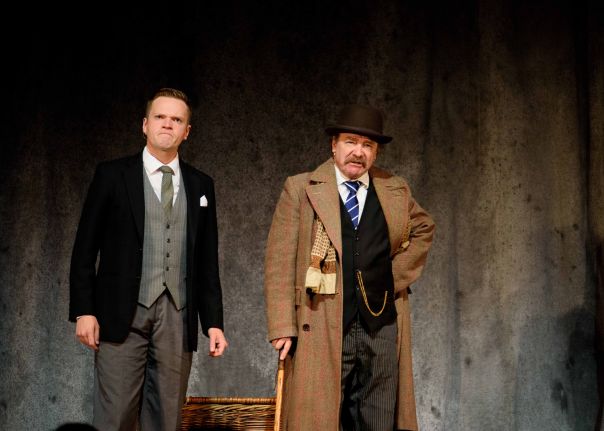
Perhaps we can declare that social distancing is as antithetical to telling a gripping ghost story as it is to sustaining a great vibe at a bar or a pub. After a 30-year run in London’s West End, where it remains on a pandemic-induced hiatus, The Woman in Black certainly has a pedigree to please. The play, adapted by Stephen Mallatratt from Susan Hill’s 1983 novel, is only surpassed by Dame Agatha Christie’s The Mousetrap as the longest-running play in West End history.
Currently in a 16-performance run at Spoleto Festival USA through June 13, the production is the real McCoy, delivered by the same artistic team that brought an acclaimed transplant of this creepshow to the McKissick Hotel in New York in January 2020. Yet between the time that The Woman in Black was announced as part of Spoleto’s 2021 lineup and opening night, the chosen venue for this production – the intriguing Charleston Visitor Center Bus Shed – had to be changed.
Now it’s completely indoors at Festival Hall, better known to longtime Spoleto subscribers as Memminger Auditorium. While the Memminger has been hospitable to such dark and gloomy pieces as Don Giovanni and Amistad, both of them lavishly and audaciously staged, the house seems to overwhelm this smaller, more conventional and portable spectacle. Nor does the spacing of our seats, with no empty seats in the spaces between us, help the atmosphere. In London, where it will play to 432 seats on three levels at the Fortune Theatre, you would probably feel much closer – and certainly more huddled together.
The conspicuously diminutive proportions of this production seem to most adversely affect Peter Bradley as Arthur Kipps. Shambling, humdrum, and somewhat diffident, Kipps has sought out the help of The Actor, to assist him in narrating his ghostly encounters to his family – and hopefully exorcize his feelings of being haunted and accursed. Not the boldest, most flamboyant or operatic of stage heroes.

Nick Owen as The Actor, on the other hand, has the luxury of being full-throated from the moment he enters the hall, hails Arthur from afar, and joins him onstage. Encouraging Kipps to project and emote, Owens can sustain a professional polish and a pedagogic authority, keeping his frustrations genially in check while trying to coax the aging solicitor into coming out of his shell.
Yet Arthur keeps resisting, meaning that we won’t hear Bradley projecting for a while. Mallatratt takes a little too long in building his own theatrical framework around Hill’s narrative; and director Robin Herford, who has not only directed all the seminal productions of The Woman in Black but also commissioned the original adaptation, is in no hurry. More ghost story and less framework would have suited me just fine the first time I saw this play in 2009 at Theatre Charlotte. Same here.
The solution that The Actor finds to his dilemma may strike non-actors as odd. When Arthur resists all urgings to become more voluble and dramatic, The Actor suggests that they switch roles: he will take on the role of Kipps in this narrative while Arthur will tackle all the other roles. Many an actor has testified that the joy and liberation of acting is in the escape from self into the skin of another person.
That idea works for Mallatratt and his protagonist. I didn’t find any hints, as I did when Kipps was portrayed in Charlotte, that either Bradley or Herford had any notion that the stodgy solicitor should suffer any relapses into hesitation or diffidence once roles were switched. It was full steam ahead for Bradley, probably the best call for those of us at Festival Hall who had strained to hear him in the early going.

As we plunged into Kipps’s narrative, Bradley was most memorable as Keckwith, a rustic cart driver who takes Arthur to and from the haunted house, and Sam Daily, the country squire who lends him his trusty dog, Spider. The terror and consternation that we see from Mr. Jerome, the liaison between Arthur and the deceased owner of the creepy Eel Marsh House, also links us to the stage-frightened Arthur we find at the beginning.
Neither production that I’ve now seen entertained the idea of The Actor simulating Arthur’s timidity when he takes on the role. Owen takes the years off the middle-aged man and glamorizes him as a somewhat intrepid action hero. When Arthur attempts to save Spider from sinking into quicksand, and when he investigates the knocking sounds in the abandoned nursery of an abandoned house in the middle of the night, a certain amount of steely backbone in required.
The manuscript that The Actor encounters is a five-hour read in his professional opinion, subtly assuring us that he has not read it – and that as he does, he will be experiencing the story as freshly as we do. Owen’s ability to retain a thin veneer of suave James Bond professionalism as The Actor, even in the most frightful and harrowing moments of Arthur’s adventures, is a key factor in his experiencing maximum shock when The Actor – and the audience – suddenly realize that he has become enmeshed in the story.
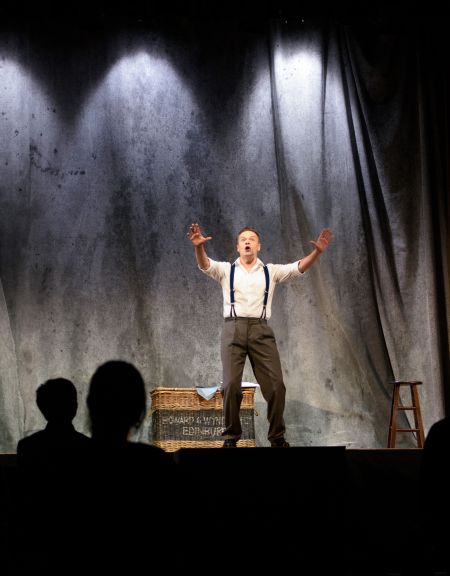
As I reported back in 2009, when my wife only grabbed my knee once, those frights are neither the most intense or frequent. I found the reveals of the Marsh House’s stairway and nursery to be deliciously macabre delights, thanks to the artistry of set designer Michael Holt and lighting designer Anshuman Bhatia, who also serves as production manager. Yet I suspect that many will leave Woman in Black at Festival Hall firmly convinced that sound designer Sebastian Frost delivered the most unnerving jolts of fright with a scattering of ultra-loud outbursts.
Such scarifying devices are no more welcome to me in theatre than they are in cinema, though the general public seems to accept them readily enough. Here I can admit that they compensated somewhat for the lack of campfire ghostliness and tribal involvement at Festival Hall. A bus shed would likely have been better, creepier, if conditions had allowed.


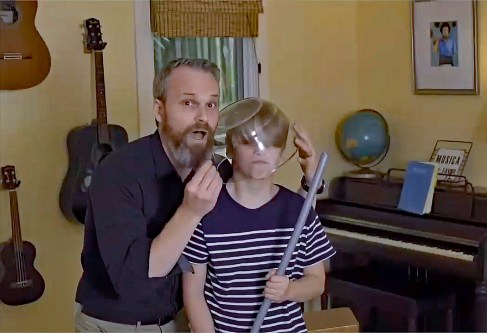 The comedy interlude stole the show as McKinny sang the familiar “Non più andrai” from Le Nozze. Adding to the hilarity, this Figaro recruited the singer’s son, Louis McKinny, to suffer Cherubino’s torments. They began incongruously enough as Dad pried away his son’s headset and then confiscated his cell phone. The indignities that followed were more in line with the action of the opera, where Figaro terrorizes the effeminate Cherubino with the prospects of heading into battle and achieving military glory. A glass mixing bowl became a soldier’s helmet and then a broom seemed to serve as a rifle – until our suffering Cherubino was commandeered for KP. “You missed a spot,” Dad barked as Miller played the final notes.

 .
.
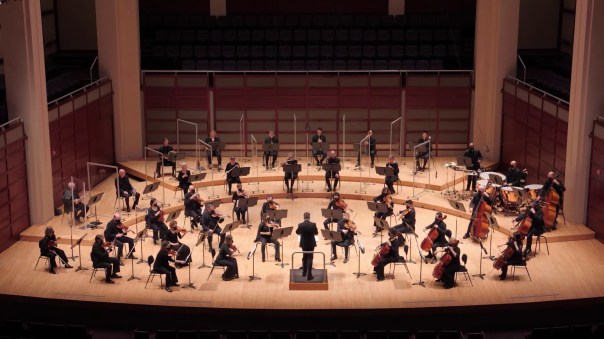
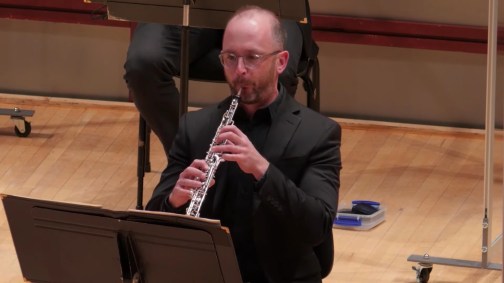
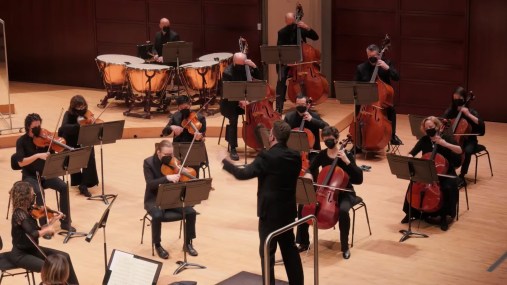
 Shuttling between the blaring ensemble and Apaza’s gurgling bassoon, the penultimate Allegro vivace had as much mischief as merriment to delight us, with quiet passages that had light fluty colorings and oboe shadings. Of course, Apaza had his most special moment when he keyed the recap of the final Allegro ma non troppo movement. That should tell you that Beethoven has taken us far from this Symphony’s brooding beginnings, that it was written when the composer could still joyously hear, see, smell, taste, and touch our material world in the full flush of his success and celebrity. Sunlight suffused this grand finale, with none of the gloom of the cathedral or the grave in sight. The stop-and-go was more dramatic here than it was in the opening, yet there was no sadness sat all mixed into the affirmation that Beethoven offered or in the way the North Carolina Symphony played. Looking forward to the end of a plague instead of back to its havoc and carnage, Symphony struck the right notes and a responsive chord.












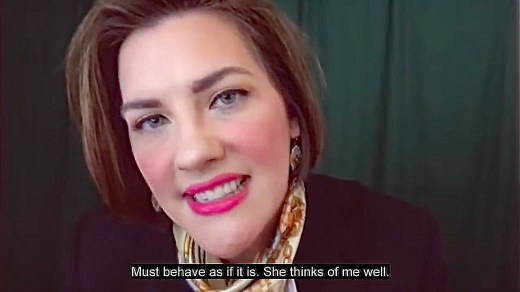

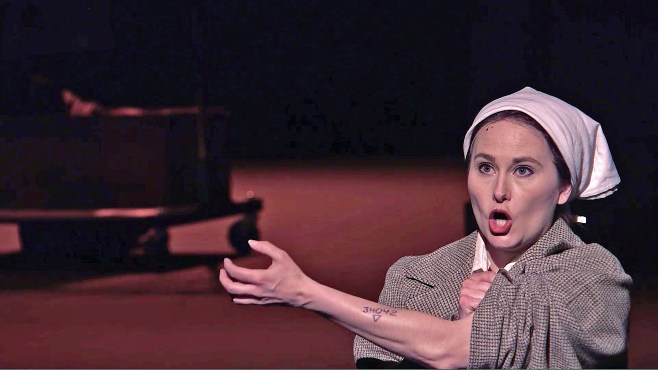

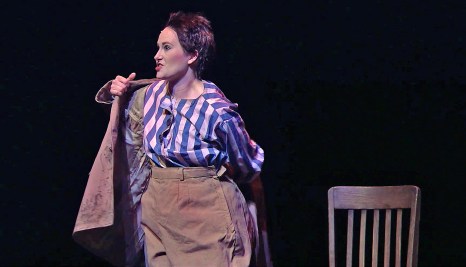
 Detachment and inhumanity are inevitable results of the plum jobs Susan is able to land at Auschwitz. The cushiest requires nothing more of her than drawing a line through the names of fellow prisoners, thousands of them, who have passed through “the gas” and the crematoriums. Another requires her to sort through the clothes and possessions of those who haven’t been as lucky as she has been – she can even scavenge some choice articles of clothing. No doubt this aspect of the story fascinated LaBorde as he adapted Cernyak-Spatz’s sprawling memoir for the stage. Thinking of changes in wardrobe as the organizing principle of Susan’s narrative is his idea, not hers. Magda Guichard’s wide range of costume designs help LaBorde depict Susan’s precipitous fall from her upper middle-class status in Vienna to her total degradation at the Birkenau death camp. Delamar spares Giles from the fullest indignities that the script allows, letting his star wear a flesh-colored leotard when Susan is ordered to strip for a delousing shower and allowing her to retain her own disheveled hair when she is shaven bald. A sleekly coiffed wig is removed to suggest the transition.








 Art on My Sleeve