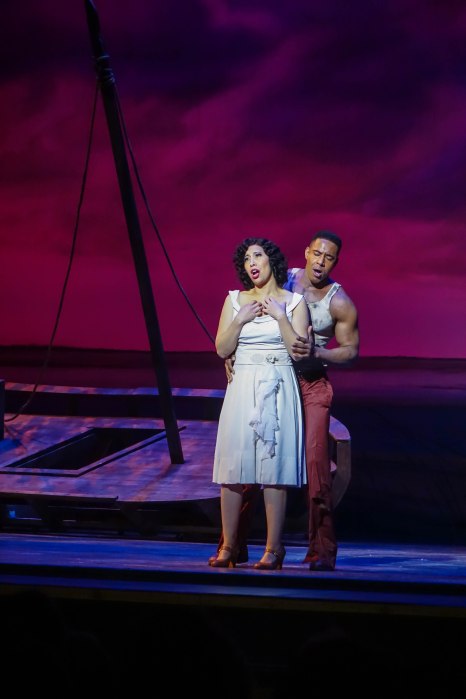
B’Way “Beetlejuice” Messes With the Franchise Mojo – Design to the Rescue!

Review: BEETLEJUICE at Blumenthal PAC

Beetlejuice-2By Perry Tannenbaum

Prepare yourself for an onslaught of ghoulish purple – and wicked green! The Broadway Lights series was fiendishly lighting up Belk Theater for its first opening night there in 2023. No less than 29 purple and green spotlights are arrayed around the proscenium, the box seats, and the balcony. Some of them swivel and sweep around the hall like a bat signal, periodically slapping you between the eyes and blinding you. Twenty more LED arrays – guess what colors! – frame the stage, blinking ominously.

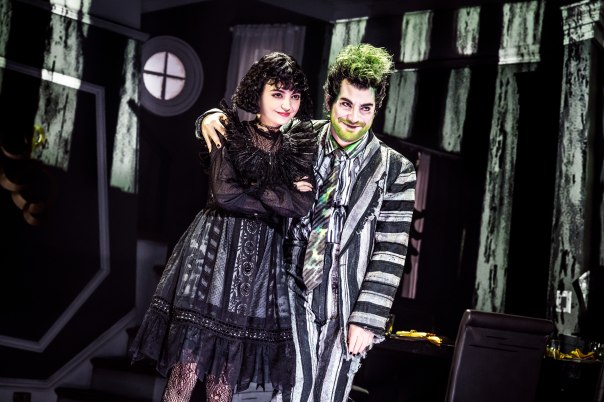
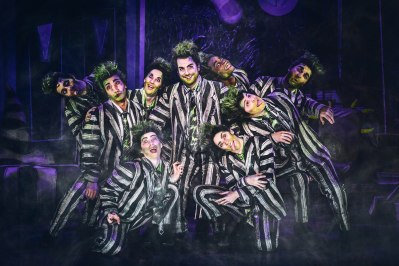
Organ music broods in the background, its Gothic drone abruptly halting for the BIG BANGS, two mighty jump scares that launch each of the two acts of Beetlejuice The Musical. Meanwhile, your helpful Encore playbill sports a different design scheme on its cover: black and white. Not a biggie, true, but lurking all around you, dressed in cosplay creations, are human echoes of the demonic Betelgeuse and his most famed and formal prison-striped suit. Complementing these parolees, waifs of all ages were sporting all-black ensembles such as those favored by Lydia Deetz, the title groom’s funereal bride-to-be.

Yes, I’d say somewhere around 10% of the Belk crowd on opening night were not merely pre-sold on the infernal nectar of Beetlejuice but also eager to proclaim their membership in its cult following. Scott Brown and Anthony King knew their audience well when they overhauled the 1988 screenplay that director Tim Burton wildly accessorized.Beetlejuice-9

Both the Betelgeuse role played by Michael Keaton and Winona Ryder’s Lydia have been hugely enlarged. Instead of standing in the wings (or camping underground), on-call until Barbara and Adam Maitland die and become desperate ghosts, Beetlejuice is our emcee, ingratiating himself with the audience moments after the curtain rises with a steady stream of shticks, topical references, wisecracks, and personal insults flung out to the audience. Or Justin Collette tries – oh so hard in his makeover of the Keaton portrayal, ululating his tongue when all else fails.

That obnoxious appeal can be hard to sustain when the meddlesome Bee is invisibly urging the wholesome and liberal Maitlands to electrocute themselves. Don’t remember that from the movie? Brown and King keep all their action indoors – or on the haunted house’s roof – after the opening funeral scene.Beetlejuice-11

You won’t see that scene in the movie, either. Here the graveyard scene begins to layer on new grieving and suicidal dimensions to Lydia’s familiar goth couture, establishing a new gravitas for the troubled teen. In the wake of Mamma Emily Deetz’s death, Lydia also acquires a seething Hamlet-like bitterness as she, Daddy Deetz, and his wanton fiancée Delia move into the Maitlands’ quaint country home. The sequence of events is painfully compressed here, and Lydia isn’t merely plagued by a goofy, artsy stepmother.

Since they haven’t tied the knot anymore, this is more of a betrayal and an abandonment by Daddy Charles and an opportunistic intrusion by Delia. Of course, this is a gift to Isabella Esler, who gets more of the spotlight here as Lydia and has more substantial woes to bewail in her interactions with the friendly Maitlands – more angst and yearning to belt in the punk ballads written by Eddie Perfect, most notably “Home” and “Dead Mom.”

Grievance and energy have noticeably shifted away from the rookie Maitland ghosts, played by Alec Baldwin and Geena Davis in the film. Picking up on the opening shots of Baldwin, where Adam meticulously picks up an invading spider and liberates it through his attic window, Perfect expands the Maitlands’ bleeding-heart reverence for life to the point of absurdity, demonstrating in “Fright of Their Lives” that they wouldn’t hurt a fly, much less haunt a house.

That’s likely Perfect’s best lyric, proving that the Maitlands are the neediest of the needy for Betelgeuse’s services as a “bio-exorcist.” Britney Coleman and Will Burton are so successful at convincing us of their air-headed ineffectuality that even devout Beetlejuice fans will be hard-pressed to care about whether they ever achieve their ghostly aspirations. Saving Lydia from herself and ridding the home of B-Juice become the top priorities.

Not that the elder Deetzes are any more repellent than their celluloid counterparts. Jesse Sharp actually projects a Raymond Burr-ish respectability as Daddy Charles, but even as Kate Marilley outshines him as Delia, getting her teeth into a couple of new songs, she’s no less kookie than Catherine O’Hara was, just oddly more salacious as she swaps professions, becoming a cliché-spouting life coach instead of a sculptress.Beetlejuice-1

With the diminished importance of the Maitlands and the constant pesky presence of Collette as Beetlejuice, further detaching our involvement with the story by breaking the fourth wall over and over, this horror-themed musical comedy might devolve into irredeemable silliness. Certainly, Perfect’s score doesn’t help Brown and King’s update.

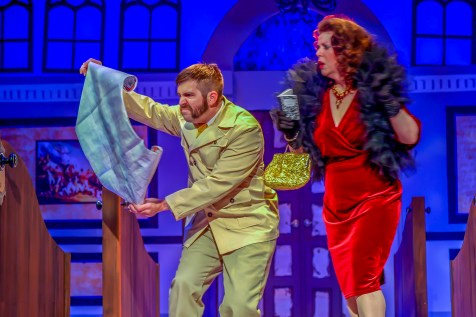
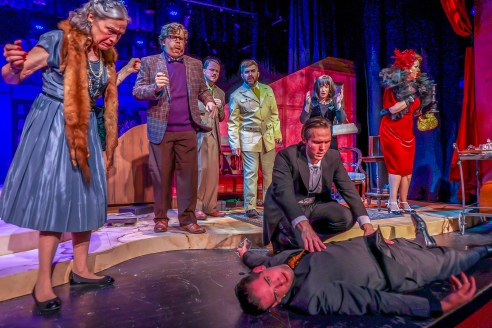
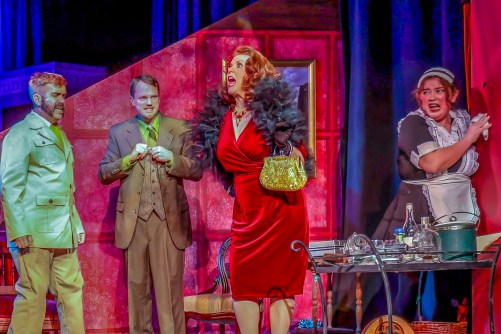
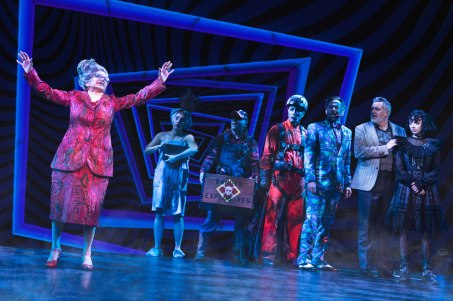
Design to the rescue! However you might react to the film’s storytelling, which also implicated Robert Goulet and Dick Cavett in cameo visits, Burton’s comedy-horror stew was a visual wow, with touches of Disney, Dali, Hitchcock, and Edward Gorey. Onstage at Belk Theater, we behold an orgy of scenic, costume, lighting, makeup, wig, and projection design – augmented by magic, SFX, a special illuminated edition of The Handbook for the Recently Deceased, and puppets. Fear not, the pinhead guy we encountered in Tim Burton’s netherworld has not been left behind.Beetlejuice-6

Although we must tolerate the tasteless intrusion of an NPR tote bag, we still get the zany “Day-O” possession via Harry Belafonte, our colossal man-eating sandworm, and a free consultation with Juno in hell, featuring a surprisingly frumpy Karmine Alers in the role previously graced by Sylvia Sidney onscreen. While we’re down there, we get to see how Beetlejuice The Musical producers added fresh Carmen Miranda spice to the 2022 Broadway remount of their COVID-stunted 2018 gumbo, when they upsized the role of Miss Argentina, now shaken and shimmied by Danielle Marie Gonzalez.Beetlejuice-4

Miss Argentina’s skimpy attire, one of local legend William Ivey Long’s many bizarre and resourceful creations, cues a startling alteration in the overall color scheme. Wicked and Emerald City may be eternally green, but once Lydia returns from the realm of the dead, there are startling infusions of fiery red into the décor, including the spectacularly gauche formalwear that Beetlejuice and Miss Deetz sport for their nuptials.

It all added up to complete delight for pre-sold Tim Burton worshipers, whose enthusiasm after the calypso finale tallied even higher dB readings than those jump scares. All was foreseen by the wizards of Blumenthal Performing Arts, who announced the return of Beetlejuice – for the Christmas vacation! – the morning after opening night.

CSO and the JCSU Concert Choir Lift Every Spirit at Brayboy

Review: Johnson C. Smith University and Charlotte Symphony

By Perry Tannenbaum

2023~CSO at JCSU-35

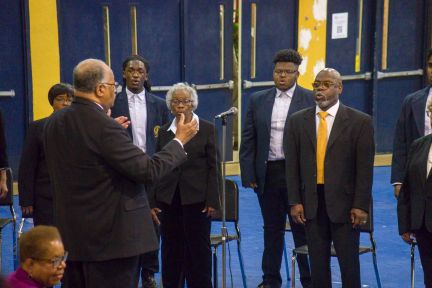
March 21, 2023, Charlotte, NC – You might have thought that a symphony orchestra performing in a college gymnasium would prove to be an odd coupling. Sure, there can be satisfying concerts staged at coliseums where a city’s basketball team plays, but those are usually performed by rockstars, pop icons, and the occasional Cirque du Soleil troupe when every note is processed electronically. My curiosity was certainly piqued when Charlotte Symphony Orchestra announced that its “In Concert with Johnson C. Smith University” program would be happening on campus at the Brayboy Gymnasium. Led by resident conductor Christopher James Lees, Symphony would be joined on the court – the hardwood covered with bright blue tarpaulin – by the JCSU Concert Choir, led by soprano Shawn-Allyce White and accompanied by pianist Frank Williams.2023~CSO at JCSU-13

A hookup between Symphony and JCSU at a more established concert venue should have seemed inevitable as long ago as 2015, when the leadership of Spoleto Festival USA visited the campus to announce that the Concert Choir would be participating in the high-profile production of Porgy and Bess the following year, celebrating the festival’s 40th anniversary. Yet when Lees picked up a microphone to greet the crowd, he reminded us that Symphony hadn’t been on campus for 13 years – indicating that this was his first time on campus and implying that CSO’s last musical director, Christopher Warren-Green, had never gotten around to the inevitable before his tenure ended. Were the optics or the acoustics the obstacles that had forestalled a return visit? Or was the idea simply slept on after Opera Carolina enlisted the men of the Concert Choir for their production of Cyrano in 2017, followed by the full choir’s appearance in I Dream in 2018?

Any questions about the Brayboy’s acoustics were swiftly dispelled. The sound from Lees’ microphone was crisp and present, nothing like the muffled sound from a faraway galaxy that emanates from PA systems at some basketball arenas or outdoor stadiums. As the brass heralded the assault of Franz von Suppé’s “Overture from Light Cavalry,” the sound remained bright and forward for all sections of the orchestra, not at all like an echoey gymnasium. French hornist Robert Rydel and principal flutist Victor Wang stood out sharply from the ensemble in their little cameos.

Rather than the controlled gallop and fury of Karajan’s recording with the Berlin Philharmonic, Lees seemed to favor the frantic onrush of Paul Paray’s recording with the Detroit Symphony, which shaves more than a minute off the Berliners’ 7:38 timing. The strings could show off their fast fingering as well as their lush tone, and when the familiar big tune surfaced, four percussionists sprang into action to make the cavalry charge more thrilling. Maybe more impressive – and surely boding well for the 14-member Concert Choir standing by for their pieces – was the syrupy sweetness of principal clarinetist Taylor Marino’s eloquence during a lull between two of the Cavalry dust storms.2023~CSO at JCSU-23

Fortified by two floor-standing mikes, the Concert Choir, eight women and six men on this occasion, were as stirring and powerful as ever at Brayboy, opening with William Henry Smith’s acapella arrangement of the traditional “Walk Together, Children.” Mostly tinted with treble and infused with jubilation, the main takeaway from the Choir’s performance wasn’t the urging of walking together but the excitement of “a great camp meeting in the Promised Land.” Richard Smallwood’s “Trust Me” was statelier, more equally weighted between the men and the women, never deteriorating into the sluggishness or singsong repetitiveness of other performances I’ve heard. The pause midway was particularly dramatic, daring to linger in silence long enough for the first smatterings of applause to break out before returning with thunder.

In between these two righteous chorales, Lees slipped in Jessica Meyer’s Slow Burn, reminding us in his intro that the composer was a violist and to be on the lookout for principal CSO violist Benjam2023~CSO at JCSU-07in Geller’s pivotal solo – but somehow neglecting to mention that the 2018 composition was written for a burlesque dancer. The piece was wonderfully apt when Symphony first performed it in early 2021, when wind players weren’t yet allowed back in concert halls due to pandemic restrictions, and the worldliness of this all-strings piece was a fine fit at the Brayboy. Bluesy strings did all of the sensual slitherings, while a pair of double basses provided percussion via pizzicatos, hand slaps, and vigorous thwacks of the bow on the necks of the instruments, accentuating Meyer’s jazzier passages. Most alluring was Geller’s suggestive glissando triggering the key swell of the strings that most vividly evoked Meyer’s title. Nor did Geller’s subsequent solo disappoint.

The two orchestral pieces that followed were more like what we expect from a city’s Symphony, but a pleasant surprise lurked in the first of these, a work dating back to the days of Haydn and Mozart, the Symphony No. 2 by Joseph Bologne, Chevalier de Saint-Georges. A champion swordsman, military leader, and political revolutionary, Saint-Georges was the son of a French planter and an African slave who would be called “The Black Mozart” because of his varied musical output, including orchestral works and operas. Saint-Georges played a key role in commissioning Haydn’s Paris Symphonies and may have mentored the younger Mozart. The outer movements, Allegro and then Presto, reminded me instantly of Mozart’s symphonic pieces, while the inner Andante brought Papa Haydn to mind. Violins dominated throughout, subtly backed by French horn and oboe in the opening movement, then by pizzicatos from the lower strings in the finale.

Some Slavic coloring had peeped into the Cavalry overture, but the performance of Antonín Dvořák’s Slavonic Dance No. 8 was the pure essence, a percussion orgy driving the main theme and the high woodwinds taking the spotlight. Anything less would have been anticlimactic in the wake of Dr. White’s stirring vocal on the Hall Johnson arrangement of “Ride on, King Jesus,” accompanied by Williams at the keyboard and crowned with a flurry of vocal fireworks. White was only slightly less impressive after the Dvořák, taking the lead vocal on the Moses Hogan arrangement of “Ev’ry Time I Feel the Spirit,” backed by the full choir with Williams conducting.

Lees stated the obvious when he declared that we were all waiting to see Charlotte Symphony and JCSU Concert Choir perform together. Would we get the Gershwin brothers or the Johnson brothers? Nothing less than the “National Black Anthem” would do at this point of the evening. While there are many YouTube examples of Dr. Roland Carter’s arrangement of “Lift Every Voice and Sing,” none on my radar sport more than a piano and an organ for their instrumentation. So Charlotte Symphony may have broken some new ground here with its uncredited orchestration.

The effect was electrifying as the entire audience rose to their feet to honor the anthem. In Carter’s arrangement, there are instrumental sections before each of the three stanzas where James Weldon Johnson’s lyrics are set to J. Rosamond Johnson’s music. Each of these interludes affording sufficient space where an orchestra can shine while providing an orchestrator with engaging new melodic material. Of course, you also want the orchestra to actively support the choir each time it enters, so the new CSO orchestration added a dimension that has always been missing in the YouTube versions. Together, Charlotte Symphony and the Johnson C. Smith Concert lifted the impact of “Lift Every Voice.”2023~CSO at JCSU-29

We weren’t quite done even now. Lees had hedged a bit in announcing that a surprise awaited us, probably remembering as he spoke that the JCSU Drumline, alias the Funk Phi MOB, was already mentioned in the digital program. But before they brought on the rhythm and the funk, we were all invited to participate in a lighter CSO-JCSU hookup. After a brief rehearsal of the seven-note melody, we all joined in on cue for vocal sections of Daniel Bernard Roumain’s La, La, La, La. Needless to say, the lyrics were not a challenge.

2023~CSO at JCSU-32

Amid this glee, Funk Phi MOB came marching in with their purely collegiate pandemonium, carrying me back to long-ago Saturday afternoons at the University of Iowa, the University of Oregon, and Williams-Brice Stadium where my shivers were alleviated or intensified by the fortunes of my hometown college football teams. This drumline was a bit more up-to-date than the drum corps I remember stationing themselves at midfield. Beside the customary bass drums and snare drums, a couple of these percussionists were outfitted with some sort of Yamaha hybrid, five or six flat shiny surfaces arrayed like a cross between timpani and a xylophone. If you’ve experienced how a stadium rocks during halftime, you can imagine the gymnasium version, peaking at a sensible 94dB according to my Apple Watch.

Topping off this mighty2023~CSO at JCSU-38mayhem, a drum major arrived with all his spirited, ceremonial, and high-stepping antics. Thanks for being here had been expressed long before this all-American climax, so without further adieus, the drum major could end the concert by leading the Drumline, Dr. White, and Lees out of the hall. When my wife Sue and I managed to navigate from our seats through the exiting audience and folks still milling on the court – conversing, posing for photos, and taking selfies – we emerged from the Brayboy Gymnasium and found that a drum party was still going on outside the entrance. Fortunately, I had brought my camera. Sue wouldn’t let me proceed to the parking lot until I took a few shots.

Misery Loves the Queens Road Barn

Review: Misery at Theatre Charlotte

2023~Misery-1

Fame can be unsettling, painful. It can be dangerous, corrupting, or toxic. But it was Stephen King who had the marvelous idea, with Misery, that fame could also be a gripping horror story – and in case anybody had forgotten, immensely lucrative. The 1990 film, adapted for the screen by William Goldman and directed by Rob Reiner, snagged a few awards for lead actress Kathy Bates as Annie Wilkes, bestselling author Paul Sheldon’s #1 fan. Goldman also crafted the 2012 stage adaptation that opened on Broadway in late 2015, starring Laurie Metcalf opposite Bruce Willis.

That’s the version playing now at Theatre Charlotte. Metrolina has seen previous incarnations of Misery, by Rock Hill Community and Off-Tryon Theatre, but those adaptations were by British screenwriter Simon Moore. So this Willis-Metcalf vehicle, directed by former Theatre Charlotte executive director Ron Law, qualifies as a local premiere.

The main attraction of the Moore version, retained by Goldman, is that it turned the restrictions of a live stage presentation to our advantage, stripping away the outside world almost entirely and making the story more claustrophobic – no pig, no media, no fretful literary agent, and just one law enforcement agent. It’s very much like a first-person narrative by an immobilized writer who wakes up unexpectedly inside a torture chamber.

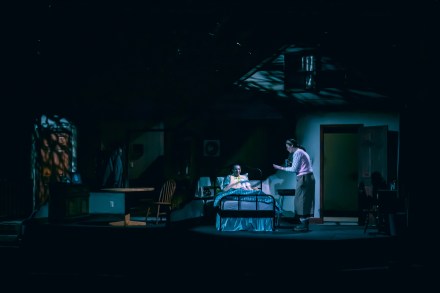
Chris Timmons builds a silhouetted two-story set that meshes well with his drab, gloomy, lightning-streaked lighting design, while Christy Edney Lancaster layers on plenty of thunderclaps in her sound design along with pop song recordings that sound like they originated on 78 rpm shellac (quite possibly the same Liberace cuts heard in the movie). It’s very creepy at the old Queens Road barn when lights dim out and our attention becomes centered on the light shining from Annie’s upstairs bedroom, framed by lightning flashes.

2023~Misery-3We seem to be in a macabre fairytale forest or wilderness, snowbound outside of Silver Creek, Colorado. Sheldon has been severely injured in a car crash, Annie has extricated him from his wrecked Mustang, and she has somehow carried him up from a deep ravine in a heavy snowstorm and brought him home, where she is nursing him back into shape with splints, pills, intravenous fluids, and injections. As Sheldon’s #1 fan, Annie must have obtained King’s permission to stalk her idol through the storm, making this whole yarn possible.

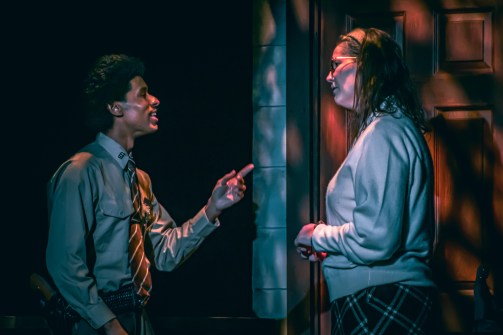
She is a nurse by trade, we quickly see, evidence of IV treatments still lingering in the bedroom Annie has selflessly devoted to Paul’s care. Yet as I observed in my review of the 2002 Off-Tryon production, this Annie is to nursing what Typhoid Annie was to food preparation. Whether she intends from very beginning to keep Paul on the premises as a companion to her pet pig, Misery, may be open to debate, but there are revelations that topple Annie’s already-shaky equilibrium.

Paul has decided that Misery’s Child, the newest installment in his popular Misery series, soon to arrive at bookstores everywhere, will be his last. The new manuscript in his briefcase, just finished at his nearby Colorado retreat, will be a total departure from those where Misery Chastain was his beloved protagonist, the woman who Annie credits for saving her life. Now that she has saved his life, she’s sees herself as entitled to disproportional payback from her captive. Autographing his new book for her will not be nearly enough.

She rips out the phone, fully cutting Paul off from the outside world and further plunging us into a nebulous bygone era. Devout enough to be outraged by the foul language in Paul’s manuscript, Annie can discard morality in the blink of an eye when it comes to granting her idol’s freedom. Anyone who has seen the film will vividly remember that violence is in her toolbag.

2023~Misery-2

Of course, sudden explosions can always blow Paul’s cunningest escape plans to smithereens in seconds, but the finest aspect of King’s plotcraft is the cerebral battle between the imaginative author and his fanatical, adulating nurse. Avidly following his books, scrapbooking multitudes of magazine articles about him, and maybe picking up inside dope about him from nearby locals in and around the Silver Creek Lodge, Annie is a formidable adversary. She controls his food and his medicine – and as Paul’s #1 fan, she compounds her advantage by knowing so much about him.

Paul must first recover health and mobility. Then he must watch and study his keeper closely if he hopes to prevail. Rescue is tantalizingly close each time Buster, the local sheriff, drops by. But Paul isn’t aware of the initial visits as his disappearance continues to be investigated. On your way home after the thrilling climactic scenes – or maybe days later – you may begin to surmise how Paul subtly aided the inquiry.

Not all of Paul’s stratagems work in this chess game, and the retributions Annie wields on her idol can be shocking. Even more shocking onstage, perhaps, because we never get a full peep at Annie’s scrapbook and her backstory. It’s got to be tricky role for Becca Worthington to pull off live, especially since she comes off as a little more rustic than Bates and a tad meeker. The range is broader without the Hollywood coquetry, and Worthington pitches her performance more darkly when Annie veers out of control, in keeping with the gloomy lighting scheme, where sunshine and snowbanks have no place.

Costume designer Sophie Carlick also darkens our portrait of Annie, discarding the crucifix necklaces and the prim nurse-like outfits, such as Julie Andrews might wear strumming a guitar in a meadow, in favor of more rugged clothes she can credibly wear indoors and out: boots, knit socks, and dumpy cardigans. Sadly enough, when Paul asks Annie to celebrate Misery’s rebirth with a romantic dinner, Worthington doesn’t have the time, in a no-intermission production, to elaborately glam herself up for the occasion.

2023~Misery-4

Timothy Hager has fewer rooms to navigate here as Sheldon than James Caan did in the movie, stealing contraband pills and a kitchen knife from the same room where his candlelight dinner scheme goes awry. Nor must he somehow emerge from a cellar – a fourth indoor location! – where he has been dumped because there is none. Yet Hager certainly manipulates his wheelchair with all the apparent difficulty of a newbie recovering from a separated shoulder, giving us the impression of an epic exploit. Without the benefit of closeup shots, he also makes sure that Paul’s fears are visible far beyond his eyes.

Effortlessly, Hager often radiates a shambling clumsiness in his attempts at hoodwinking Annie, a fallibility Caan hardly hinted at, endearing himself to us a bit pitiably in the darkness of this snakepit. Most importantly, Hager has a firm grip on the climactic typewriter scene where he precisely executes some truly nifty fight choreography.

2023~Misery-5

Transitioning to stage, Goldman most radically altered the role is Sheriff Buster, who only visited the Wilkes cottage once in Goldman’s screenplay. Law widens the discrepancies, casting Roman Lawrence as the lawman in an auspicious Charlotte debut. Buster is no less easygoing now, but he is conspicuously younger and less snoopy, no longer visible in scenes at the office with his wife, up in the sky in a helicopter, at the crash scene, at the lodge where Paul finishes his books, in a library researching, or at the general store. Lawrence is the closest thing in this show to sunshine, arriving each time without apparent urgency or suspicion. That sharpens the drama in the denouement.

Production levels have been a bit eye-opening in the first two shows at the Queens Road barn this year, a place we’ve never before compared with Children’s Theatre of Charlotte in terms of technical prowess. With Misery, Hollywood has arrived in Charlotte at the service of thrillers. Prep for King’s famed hobbling scene was impeccable, eliciting audible gasps from the audience, but that was mere prelude. Both blood splatters in the closing scenes were absolutely spectacular, worlds beyond what community theatre delivered in my day when we taped blood capsules to ourselves backstage and hoped for the best.

These more sophisticated spectacles were likely a collaboration between Timmons and all three of the players, possibly Carlick as well, and perhaps triggered by sound cues. Or Bluetooth! The difficulty of the tech was best demonstrated at a key moment when it went wrong – Play-That-Goes-Wrong wrong. A wastebasket began smoking before Hager could toss a kitchen match into it. Presumably unnerved, Hager then tossed a key manuscript page toward the basket instead of slam dunking it to be sure. He missed!

On a movie set, these screw-ups would become a hilarious outtake. But onstage, instead of cracking up, Hager and Worthington covered up. Good thing they did, for the next cluster of fight choreography and SFX followed immediately, the most challenging moment of all. It was perfect.

Monteverdi Validated at Myers Park With Venetian Vespers

Review: Venetian Vespers with Bach Akademie Charlotte

 By Perry Tannenbaum

2023~Venetian Vespers-03

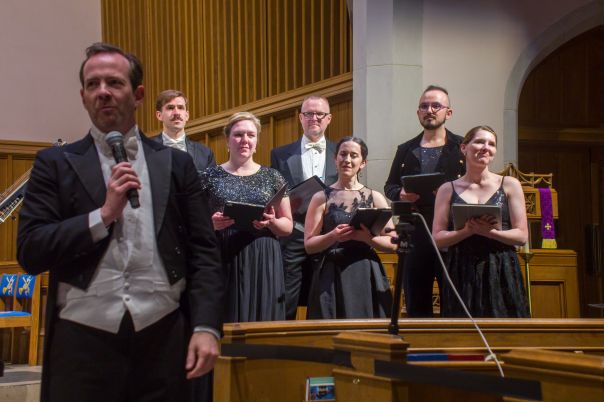
March 4, 2023, Charlotte, NC – You might gasp audibly upon learning that The Oxford Dictionary of Music proclaims that Claudio “Monteverdi’s place in the history of Renaissance music can justly be compared to Shakespeare’s in literature.” That high regard was echoed stateside by Ted Libbey in The NPR Listener’s Encyclopedia of Classical Music: “To paraphrase his contemporary Shakespeare, he bestrode the musical world like a colossus.” Yet many at the Myers Park Presbyterian Church; where Bach Akademie Charlotte presented their latest concert, Venetian Vespers conducted by Scott Allen Jarrett; were probably witnessing a live performance of Monteverdi’s music for the first time. Others had likely never heard Monteverdi anywhere but in church and/or on recordings in their entire lives.

As far as I can tell, the Renaissance colossus has never had a hearing at Belk Theater or Knight Theater in Charlotte. I’m fairly certain that my first live encounter with Monteverdi was at Spoleto Festival USA in 1991, when L’Incoronazione di Poppea was presented at Dock Street Theatre. Before then, my revelations had happened at local libraries in Columbia and Charlotte, where I could borrow and fall in love with vinyl recordings of Monteverdi’s Madrigals (there are nine books of them) followed by my discovery of L’Orfeo, the first masterpiece in opera history.

In keeping with the tone of the venues where Bach Akademie usually performs – and the liturgical spirit of their marquee composer – Jarrett, with a small chorus of six voices and an instrumental quintet, focused on two major sacred works that bookended Monteverdi’s career, his Vespro della Beata Vergine (1610) and his Selva morale e spiritual (1641). Sensing a general unfamiliarity with Monteverdi’s music and his importance, Jarrett spoke at length on both, stressing the cultural eminence of Venice at the peak of the Renaissance and Monteverdi’s towering influence over how composers would write for voice after he upended traditional practice by prioritizing text over music.

The texts that Bach Akademie performed were mostly scriptural and liturgical Latin, but Jarrett and his musicians also dipped into the “moral madrigals” found in the Selva collection, with Italian texts written by Francesco Petrarch and Angelo Grillo. In fact, Jarrett’s selections were admirably proportional to the original collections: we had twice as many excerpts from the Selva as we heard from the Vespro, and the Italian songs gave us a balanced representation of the larger collection, which on complete recordings is just over twice the size of the 1610 Vespers.

2023~Venetian Vespers-17

We began and ended the concert with full ensemble pieces from the Selva, starting with “Laudate Dominum” (second version). Sopranos Margaret Carpenter Haigh and Arwen Myers blithely chimed the opening exhortation – “let us praise” – over and over, interspersed with full choral and instrumental passages, along with a couple of merry exchanges between tenors Nick Karageorgiou and i. Four of the six Selva selections were originally for accompaniment by two violins, slots ably filled by two mainstays of Boston’s exemplary Handel and Haydn Society, concertmaster Aisslinn Nosky and Fiona Hughes.

2023~Venetian Vespers-32

Replacing the four trombones in the score as well as playing their own parts, Nosky and Hughes figured more prominently in the “Gloria” that followed Jarrett’s impressive disquisition. This larger-scaled composition also offered more opportunity for the vocalists to shine, the tenors declaiming the title word most often before the sopranos dominated with their filigree on the recurring “Domine.” Thanks to Jarrett’s intro, we were also on the lookout for the heavenly harmony lavished on the stately “peace on earth” passage, enriched by Edmund Milly’s bass-baritone, cellist Guy Fishman, and organist Nicolas Haigh.

2023~Venetian Vespers-13

Accompanied solely by Deborah Fox on theorbo, Myers and Margaret Haigh gave us a marvelous first sampling of the Vespro, “Pulchra es,” set to two amorous verses from the Song of Solomon, delicately straddling the borderline between chastity and seduction as they sang from opposite sides of the chancel. Both sopranos rejoined the male vocalists as we returned to the Selva with “Laudate pueri” (first version). The men harmonized sweetly to launch this setting of Psalm 113 before the sopranos quickened the tempo and lifted the music to joy and jubilation.

I wondered how Jarrett and Bach Akademie planned to handle “Duo Seraphim,” the next Vespro selection, since it was written for three tenors, according to the program booklet, and the conductor deployed Karageorgiou and Wilson to opposite ends of the stage. Akademie’s artistic director must have also anticipated some suspense in the room, for it wasn’t until halfway through the piece that the third tenor walked to his place upstage, behind organist Nicolas Haigh – Milly, the bass! While Milly’s tessitura didn’t need to reach quite as high as the two other tenors’, he did quite well, actually sounding louder than his comrades on a few notes. Of course, there’s another way of construing the drama of Jarrett’s staging. At the exact point where the text departed momentarily from its familiar Isaiah 6 refrain, and the heavenly witnesses to the seraphs’ “Holy, holy, holy” call were cataloged as “the Father, the Word, and the Holy Spirit,” Milly took his spot upstage before the three were said to be one.

Composed while Monteverdi was still in service to the Duke of Mantua, the “Dixit Dominus” for six voices and instruments seemed to be specially crafted for the acoustics of the Venetian Basilica of San Marco where he would later serve as the chapel maestro. John Eliot Gardner’s recording of the complete Vespro at San Marco with the English Baroque Soloists in 1986 implicitly made that point, and Jarrett, both in his introductory remarks and with the ensemble’s performance, made that point explicitly at Myers Park Presbyterian.

2023~Venetian Vespers-31

Although she didn’t get much of the vocal spotlight, alto Laura Atkinson picked up a microphone to preface the remaining three Selva selections. Both of the poems that followed, written by Monteverdi for the other five voices, proved worthy of the pulpit, as their translated titles indicated: Petrarch’s “O blind ones! What use is all your toiling?” and Grillo’s “This life is a flash of lightning.” Reminding us that this was Bach Akademie and that the Charlotte Bach Festival is slated for its return on June 10-17 (if interim managing director Garrett Murphy’s fundraising goal is met), Jarrett and company gave us a small-scale preview of the plenty to come with Johann’s “Sanctus in D.” Not the swiftest version you’ll ever hear, but light, lively, and irresistible.

“Beatus vir” (first version), set to Psalm 112, was an apt finale to this Venetian Vespers concert, carrying forward the festive mood of the penultimate Bach with invigorating vocal counterpoint – Monteverdi writing here for six exactly voices at last – and providing Nosky and Hughes, as the two violinists also prescribed by the score, with their best opportunities to shine. But it wasn’t until the music slowed down, where the Psalmist spoke on the steadfastness of a god-fearing man in the face of evil tidings, that the finale became truly grand. The sheer massiveness of the sound summoned up the church to mix its harmonies, reminding us that we were in a house of worship.

Mei-Ann Chen Rocks the Knight in CSO Debut

Review: Bruch’s Violin Concerto with Charlotte Symphony

By Perry Tannenbaum

2023~Bruch Violin-18We’ve been hearing about numerous identified and unidentified flying objects in recent weeks, emanating from numerous sectors of the globe, crossing over our nation’s territorial waters and seeking all sorts of military and meteorological intelligence. Less mysteriously, there have been precise predictions in recent months of astral objects whistling through our solar system, one of them brushing closer to dear Earth than the moon.
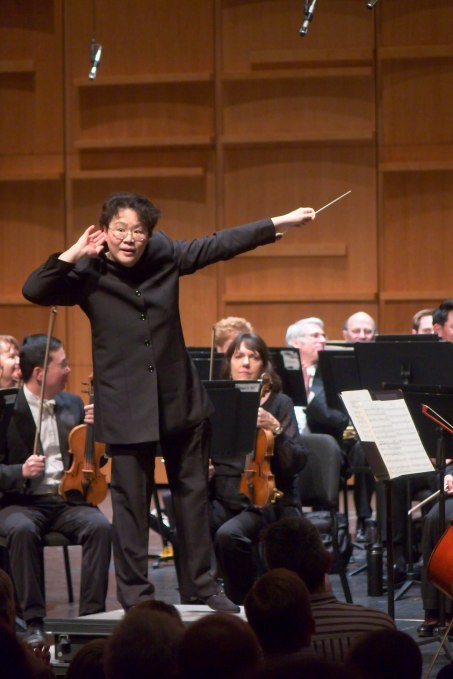
But until now, not a word about the meteor that struck the Knight Theater in the heart of Uptown Charlotte. Her name is Mei-Ann Chen, and we can only hope that the guest conductor now in our midst is vying for the vacant music directorship at the Charlotte Symphony. It would be grossly unfair, no doubt, but it wouldn’t a bad idea to sign her up before she left town.

Chen’s impact on – and appeal to – the Symphony’s musicians and subscribers was nothing short of electric.2023~Bruch Violin-09_Export

The orchestra had never performed Fanny Mendelssohn Hensel’s Overture in C Major before, yet they attacked the work zestfully, conveying its sharp contrasts and drama with unmistakable fervor. Flutist Amy Orsinger and principal oboist Hollis Ulaky excelled, jointly and separately, in the piece’s gentler moments. Although we had heard the CSO play the BRUCH VIOLIN CONCERTO as recently as 2016, Chen ignited the ensemble with fresh fire rather than receding to a subsidiary role behind concertmaster Calin Ovidiu Lupanu.

Instead of deferring to the soloist – or even seeking an agreeable balance between orchestra and violinist – Chen laid the gauntlet down to them both, so that Lupanu and Symphony spurred each other to greater heights vying for supremacy, achieving a higher level of parity through their combat. More adventurous now than I can recall, Lupanu was nearly note-perfect all the way through the treacherous terrain of the Allegro energico finale while his attack, confidence, and feeling were never better. His command was certainly impressive throughout the opening Allegro moderato, with a transition to the slow middle movement that was amorously smooth. Principal flutist Victor Wang helped to make this Adagio extra exquisite.

As the concerto climaxed, it might have been a toss-up to many in the audience whether Chen was inspiring the CSO or vice-versa. In respect for your colleagues, you’re not going to urge an orchestra too insistently to give us more during a performance – that has to have happened behind the scenes in rehearsal.

Our first glimpse of what that might have been like came right after the concerto, when Chen gestured to the audience to give Lupanu more love for his sterling performance. After the break, our impressions grew more vivid as Chen picked up a mic at the podium and greeted us. Not satisfied with our “Good evening!” Chen urged us to make a second try, somehow infusing this tired old emcee shtick with new energy and spontaneity – and getting results.2023~Bruch Violin-23

Speaking about the works on tonight’s program, Chen included info we could have gleaned from the program – a practice that Christof Perick and Christopher Warren-Green staunchly resisted – and made an effort to link the pieces together with a common theme. Faced with a crowd that was significantly more numerous than the crowd I’d seen three weeks earlier, but still significantly short of Knight’s capacity, Chen declared that Charlotte should be more supportive toward its Symphony.

That was a more compelling statement after delivering two examples of our musicians performing at their peak.

Chen rightly surmised that the main draw of the evening was the Bruch, since the César Franck Symphony in D minor, originally slated for its revival last March, hadn’t been heard in the Queen City since November 2003. Now that was a pitifully attended concert at Belk Theater, after striking CSO musicians had settled on a new contract and returned to work, so Symphony subscribers can pat themselves on the back for improving on that turnout.2023~Bruch Violin-10_Export

The main link between the two Francks that I’ve seen was the fine work by Terry Maskin on the cor anglais solo in the middle Allegretto movement. In the outer Allegro movements, our brass proved its mettle once again, though we’ve surely seen a Chening of the guard during the intervening decades. Associate concertmaster Joseph Meyer distinguished himself in the early Lento of the opening and principal French hornist Byron Johns had outstanding moments when the music quickened.

Chen improved most on the Perick performance of 2003 in the Allegretto, livening the effect of Maskin’s soulfulness on the English horn with more standout work from Johns and Andrea Mumm Trammell’s delicacy on the harp. Before the brass brought the finale to its brash climax, CSO’s principal harpist bubbled up tellingly in the symphony’s last calming episode.

Obviously content with her musicians’ handiwork, Chen gave the audience opportunity after opportunity to show the appreciation she had previously asked for. With unmistakable cues, Chen called upon us – already giving them a standing O – to really let the musicians hear it as she prompted them individually and collectively to take their well-earned bows. We did.

[If you missed Mei-Ann Chen in Charlotte, you can catch up with her on June 7, when the Chicago Sinfonietta music director conducts Antonín Dvořák’s “New World Symphony” at Spoleto Festival USA.]

Photos by Perry Tannenbaum

BNS Conquers Adversity in Opening of Speakeasy, Shining at the New Parr Center

Review: Speakeasy by Rory D. Sheriff

 By Perry Tannenbaum

2023~Speakeasy-15

February 17, 2023, Charlotte, NC – Quick adaptation and a be-ready-for-anything state of mind are key survival tools for any performer who ventures into the minefield of live performance. But as opening night for BNS Productions’ Speakeasy inched closer, booked for this weekend at the new Parr Center – where no local theatre company has performed before – Charlotte’s preeminent black repertory company stepped on an explosive they couldn’t avoid. Just before the three-day run was scheduled to begin, one of their lead players came down with COVID.

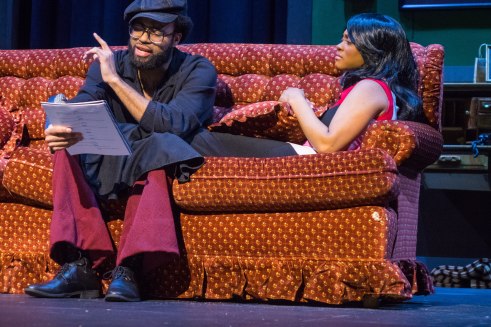
Rory D. Sheriff, the author of the new script and founding artistic director of BNS, was forced to shuffle his cast, elevating Marcus Looney from a minor role to leading man while stepping into the vacated role himself. Both of these actors appeared on opening night, turning what would ordinarily be termed a workshop production into a rather fancy reading stage effort, enhanced by the scenery and lighting (also by Sheriff) we would expect in a full production, with six of the eight cast members off-book.

A couple of the main themes in Sheriff’s new work, starting over and working together to save the day, mesh well with the behind-the-scenes tumult. After leaving her abusive husband, Virginia is hoping to make a new life for herself – without a man, for a change – back at her dead parents’ home in 1978 Reading, Pennsylvania. Doing this her way is hindered by her wanton sister Marge, who is tirelessly “pimping” the newly-available Virginia around town, and the inevitable pursuit of men who have heard about the breakup.

The most aggressive of these is Percy, the horny neighborhood cable guy. On top of that, while leering at Marge, the mailman delivers an alarming formal letter informing Virginia that her parents left their property taxes unpaid for over 10 years. She must quickly come up with over $1000 or get out. Older brother Roosevelt, a starchy preacher man, would much rather sell the place than provide her sister with the balance.

Well, if you already have a cable guy and a mailman knocking at your door and salivating, Marge proposes that Virginia do the next best thing to prostituting herself: jointly turning the family homestead into a speakeasy, where local men can pay out to enjoy the sisters’ company in exchange for alcoholic beverage, assorted snacks, and free cable TV, courtesy of Percy. Prohibition hasn’t returned to Pennsylvania, but the sisters can’t legally peddle booze without a state license.2023~Speakeasy-09

A volatile triangle develops before intermission as Percy feels entitled to take further advantage of Virginia, spending the night and tiptoeing out the back door with the speakeasy’s take. Hard to report a crime like that to police. Virginia might have a white knight willing to champion her cause, a Winston-Salem refugee named Horse who has fallen hard for her, but she keeps pushing him away even after he wins Marge’s sincere endorsement. Cecilia McNeill has taken on a very conflicted role in Virginia, earning our empathy with her troubles while drawing our impatience – and occasionally our annoyance – with her negativity and her deafness to what Marge, Horse, and her own heart are telling her about her new beau.

McNeill carried it all off rather brilliantly in her auspicious debut if you consider how little time she had been given to acclimate to Looney as her co-star and how often her true love had to gaze downwards at his script. It was hugely helpful that Looney was off-book when he made his first entrances through the back door to the sisters’ speakeasy, and that after intermission, when he always had his script with him, he prioritized memorizing those lines where Horse should be gazing most intently at Virginia instead of the script. Otherwise, the role never appeared to be beyond Looney’s depth. A lingering photo at the BNS website of Jonathan Caldwell, originally cast as Horse, made me think that Virginia’s worries about him tossing her over would be more credible if he were there. If it were Caldwell standing up to Tim Bradley as Percy when the action peaked, I also suspect that it would have looked more like an equal match and not as brave or quixotic.2023~Speakeasy-12

Such alterations are always the byproduct of casting different actors in the same role. Sheriff can make peace with them or he could possibly like them better, but I’m sure that he would hate to discard Bradley with his imposing presence and his boisterous vulgarity. Horse the outsider and Percy the loose cannon are the two men that remind me most readily of the American Century drama cycle by August Wilson, an inspiration that Sheriff candidly acknowledges. Having appeared in three different BNS productions of Wilson’s dramas – and importing an extra roar from the title role in Sheriff’s Be a Lion – Bradley straddles those two realms magnificently, a lowlife rascal who can be quite formidable and menacing.

Alana Jones, Bradley’s slinky consort in Lion, is a bit over-directed and overly frisky here as Marge, her broad comedy projecting far beyond the stage and hall to faraway Gaston County. But the audience adored her, so Jones will likely continue mincing around her speakeasy like a cartoon cat. The contrast is certainly effective when she becomes candid and caring with Virginia. A bit of a clothes horse, Jones is my prime suspect for slowing down scene changes, for costume designer Dee Abdullah’s ample wardrobe has her feverishly changing costumes whenever she’s not sashaying onstage. I’d be surprised if she wears less than five get-ups, but the guys also have multiple outfits.

All the guys are nicely seasoned and excellent, providing additional Wilson flavoring. Dominic Weaver as Roosevelt puts a nice soft spot for Virginia in the middle of his sanctimonious hauteur that we can see from the beginning, when the upright minister is difficult, obstinate, and stingy. In his BNS debut, Andrew C. Roberts gives us some meaty civil-rights-movement context in a powerfully delivered monologue, although it seems to come from nowhere. James Lee Walker, II, has done so many uniquely stylish roles for BNS and other companies around town that I was not at all surprised to see him shine – in one scene literally shine in a glittery shirt.

A bit of the stilted dialogue we heard an opening night will likely vanish as Sheriff refines his script, and more variety in how extended monologues are staged and lit will likely materialize in the hands of a defter director. For starters, the guys might explicitly confirm what card game they’re playing at the speakeasy and which Ali fight they’re watching on TV. Feedback that Sheriff receives from this workshop edition will likely help him to sharpen his characters’ sparring and deepen their drama. He and BNS are off to a great start at their new venue.

Off-Broadway Star Shines in Three Bones’ Andy and the Orphans

Review: Andy and the Orphans at The Arts Factory

By Perry Tannenbaum

Eddie Barbanell, Susan Cherin, David Canetazzo and Vanessa Robinson (1)

When playwright Lindsey Ferrentino wrote Amy and the Orphans about her Down Syndrome aunt Amy, she convincingly demonstrated that she didn’t need to write its fraternal twin, Andy and the Orphans. But the demonstration happened too slowly. Ferrentino and director Todd Haimes needed a second Down Syndrome actor to play the title role at matinee performances when the show opened for the Roundabout Theatre Company in 2018.

Presumably, Ferrentino thought that pickin’s would be slim after finding Jamie Brewer at a New York fashion runway, the first DS person to participate in Fashion Week, through a talent agency that specialized in performers with disabilities. So the playwright didn’t specify what gender her second DS actor should be. Along came Eddie Barbanell to step onstage as the matinee understudy, and along came Andy and the Orphans, the custom-tailored male version of Ferrentino’s tribute to her Aunt Amy.Eddie Barbanell as Andy_1

Five years later – and five years closer to Andy’s real age – Barbanell is here in Charlotte, wowing audiences at The Arts Factory in Three Bone Theatre’s production of Andy and the Orphans through February 25. Meanwhile, Ferrentino has learned, through versions of her work staged in London and Spain, that you can reliably find DS actors to play DS people onstage anywhere. The real stumbling block for DS performers is the lack of roles for them.

Three Bone was actually early to the Ferrentino party, bringing the playwright’s previous work, Ugly to the Bone, to Spirit Square’s Duke Energy Theater two years ago. It was another script that showed Ferrentino’s empathy with female castaways in our society and how they are treated. Then it was Jess, an Afghanistan War vet returning to her Florida home, disfigured and disabled physically while inwardly suffering from PTSD.

While the content of Amy/Andy is more autobiographical, the location moves away from the playwright’s native Florida to New York. Precise locations shift during the action, and Ferrentino is rather circumspect about where we are or when. Without the script in my hands, I guessed that at various times we were in Staten Island, outside LaGuardia or Kennedy Airport, at a group home in Queens or Long Island, on the road, and – quite memorably – at a Burger King. Andy, his elder siblings, and Kathy, the caretaker who must accompany Andy, are on a road trip to Dad’s funeral, past the end of the fabled Long Island Expressway (and Sunrise Highway afterwards) to Montauk, the eastern tip of New York.David Catenazzo and Susan Cherin_2

Maggie and Jacob, when they aren’t bickering over whether their yearly meet-ups are Christmas or Chanukah visits, are worried over how they will break the news that Dad has died – and that Mom has already died awhile ago. This is the right comedy varnish to apply to a story that has a rather horrific dramatic core. Likewise, being overdue on telling their DS little brother that Mom and Dad are dead is a rather innocuous patina to apply to the family trait the characterizes Andy’s sibs and parents, a shocking abdication of their responsibilities toward him.

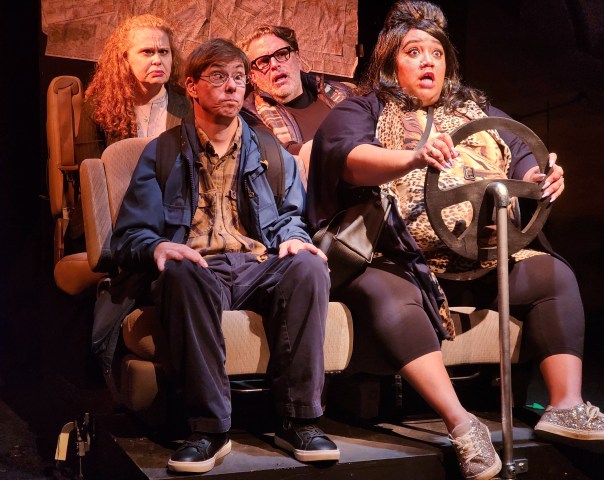
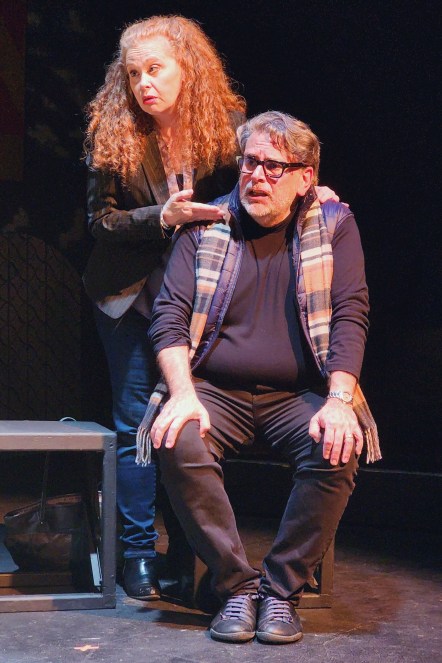
As this shabby trait becomes more and more exposed, the sideshow dinginess of Chip Davis’s traffic-themed set design becomes more and more apt for this story. It’s hard to escape the conclusion that director Danielle Melendez lucked out when Susan Cherin and David Catenazzo showed up for auditions. Cherin comes off as the kookier, more neurotic sib as Maggie, far more likely to be a fretful helicopter parent than her shambling brother. As Jacob, Catenazzo has the more Jewish name and delivers a more Jewish demeanor – compounding the comedy, since he’s the bible-toting convert who celebrates Christmas.

It’s really hard for us to be disgusted with either Cherin or Catenazzo until Maggie and Jacob are shown why they should be deeply disgusted with themselves. That’s why this key moment is such a gut punch for us.

Barbanell is extraordinary, giving us all that Ferrentino wrote into Andy and more. As an actor myself, I marveled at his cue pickup and his timing. We don’t need to be in his presence long for us to believe how he and Brewer blew away the playwright’s expectations for what a DS actor can do, or that they were the first Off-Broadway cast members to go off-book. Nor was I surprised by the end of the evening to read that Barbanell had burst into Shakespearean monologues by Romeo, Julius Caesar, and Puck the first time he met up with Ferrentino at a roadside diner, turning his interview into an audition and a theatre event. Each performance was “word perfect” by the playwright’s account.

Tacitly, then, she has admitted that she might have filled out Amy/Andy’s role more amply if she had known, going in, the full capability of DS actors. Critics who have faulted Ferrentino for not fleshing out her title character and letting us get to know him better may have overlooked just how pioneering this script is. Getting buffeted by myopic critics was the price she had to pay.

Nice thing is, Ferrentino has been asked by Netflix to adapt and direct a film version of Amy and the Orphans. That will allow her to reframe her story knowing her DS actors’ capabilities beforehand. Both Brewer and Barbanell have been tapped to be in the remake, so it’s probable we’ll get first look inside Amy and Andy’s group home. Maybe Andy’s unseen girlfriend, Tina Turner, will get thrown overboard in favor of Amy!

Sarah Molloy and Nathan Morris (1)Sarah Malloy and Nathan Morris are Sarah and Bobby – and the key reason why Ferrentino has moved her tale to the Staten Island vicinity. They are the parents of the title character, but it may take awhile before audiences catch on. My wife Sue, who taught special needs children for decades, got it the second time Sarah and Bobby locked horns. It didn’t come together for me, merely a special needs child’s elder brother, until maybe a half hour later.
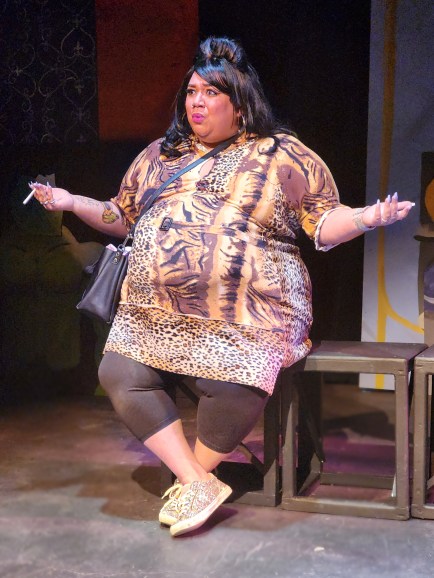
Even then, notwithstanding the fine work from Malloy and Morris, I wondered why the playwright felt these dead parents needed to be onstage, in the story. There was something unsavory about both of them, that I can say, before the big reveal. Then the Staten Island connect became crucial.

[[Spoiler Alert: In the run-up to the upcoming Netflix film, it’s hard for me to predict whether the Willowbrook State School will remain a spoiler. Back in his day, Senator Robert F. Kennedy visited the facility. Not too long afterward, Geraldo Rivera dropped by with a TV crew, coming away with similar impressions. Decide for yourself by googling Willowbrook – or delaying that search – whether you wish to know about it before or after you see Andy and the Orphans. Will Netflix insist on showing us the place? Stay tuned.]]Vanessa Robinson (1)

Finally, it must be said that Vanessa Robinson’s sensational Charlotte debut as Kate has absolutely nothing to do with luck on Melendez’s part. She went way against script, where Kathy is described as Italian-American, in casting Andy’s pregnant social worker. With a down-to-earth quality that masks her admirable ability to tolerate all the Maggies and Jacobs she has dealt with over the years – and the Andys – Robinson shows us a different way to be “the walking embodiment of Long Island, New York.”

When they perform their big monologues, both Barbanell and Robinson hit it out of the park.

One of the things I had to ponder on our drive home was whether Ferrentino had been dealing from the bottom of the deck when she showed us how normal and everyday Maggie and Jacob were – not to mention Sarah and Bobby before them – in their interactions with Andy and each other. It’s only when you factor in how many hundreds and thousands of parents and siblings behaved the same way, for over four decades, that the monstrousness of such normality becomes clear.

Ferrentino is slowly, cautiously, and carefully cushioning us for a hard truth. All the time we’re thinking that we’re in on the big reveal Maggie and Jacob have in store for Andy, we are being set up with devastating circumspection.

The tables are turned suddenly. Jarringly.

Cerrudo Revives Innovative Works With Fresh Excitement

Review: Innovative Works at Center for Dance

By Perry Tannenbaum

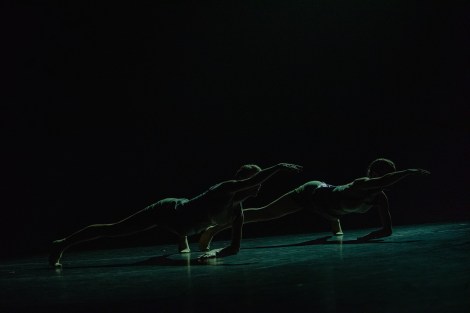
The Deatils Are the Meaning by Helen Simoneau - full cast - photo by Taylor Jones Charlotte Ballet’s reveal wasn’t as dramatic as the recent return of the renovated Old Barn on Queens Road with a full-fledged Theatre Charlotte musical. But after the COVID shutdowns, postponements and cancellations, and the abrupt departure of artistic director Hope Muir after barely five years – the last two during the pandemic – it was hard to feel that Charlotte Ballet was all the way back until last weekend. Until we had seen some choreography by the new AD, Alejandro Cerrudo. Extra frustrating for me, since I had declared his work a perfect fit for CharBallet when I had first seen it at Spoleto Festival USA in 2014, had been the absence of his imprint on the Fall Works program at Knight Theater last October.

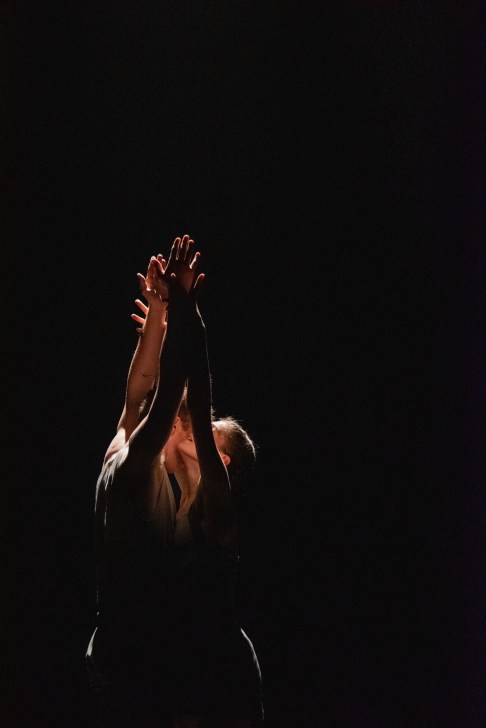
With Cerrudo now hosting the annual Innovative Works wintertime program, contributing a fine piece that crowns an invigorating evening at the McBride-Bonnefoux Center for Dance, we can let it all seep in. A new era has emphatically begun at the Center for Dance, with a new AD starting to reshape the company’s identity, working with a mix of familiar dancers, new dancers, and dancers who have matriculated to the varsity through the satellite Charlotte Ballet II troupe.

The state of Charlotte Ballet, to coin a phrase, is strong.HdrM by Jennifer Archibald - Olivr Oguma and Amelia Sturt-Dilley - photo by Taylor Jones

Jennifer Archibald’s vowel-starved HdrM and Helen Simoneau’s The Details Are the Meaning, both world premieres, preceded Cerrudo’s no-less-cryptic Silent Ghost. Silence was a subtle motif: It’s been awhile since Charlotte Ballet presented an entire evening of dance works that were devoid of storyline, song lyrics, or voiceovers. Taking on the hosting chores, Cerrudo recalled his takeaway from the first time he squired his daughter to a set of modern dance pieces. Comprehension was no problem at all, as it turned out. Just let it seep in was the core of his message.

On this occasion, anyway, Cerrudo discarded the introductory videos that have enhanced the studio ambience at past Center for Dance programs, where the evening’s choreographers, projected on screens flanking the audience, would talk about their works before we saw them, or dancers would give us their insights. Instead of those slick videos – all three “Behind the Ballet” videos are available at Charlotte Ballet’s website – we contented ourselves with Cerrudo’s remarks and a strange, mysterious welcome from CharBallet dancer Maurice Mouzon Jr. in a flowing black costume. Three quarters bacchante conjuration and one quarter airline steward pantomime, the conjuration was so absorbing that I really didn’t pay attention to the voiceover until Mouzon pointed out the exits to us.

That shtick was another great ice breaker, arguably the most amusing of the night.HdrM by Jennifer Archibald - Nadine Barton and Oliver Oguma - by Taylor Jones (1)

Like the other dances that followed, HdrM didn’t readily disclose its intentions, but Archibald offers a couple of useful hints in our program booklets. Her subject is environmental psychology, questioning whether society has a responsibility to humanize architecture. What the choreography takes aim at is “hard architecture,” as explored in Robert Sommer’s Tight Spaces: Hard Architecture and How to Humanize It (1974). Since there is no scenery with the fledgling piece, nor any projections, we can decide among several kinds of hard architecture that Sommer was concerned with: prisons, classrooms, asylums, hospitals, or zoos.

Kerri Martinson’s drab costumes seem to narrow that field to secure buildings for human adults, with no further clues provided by the music of Federico Albanese, Ludwig Ronquist, and Heilung. What I found most enjoyable here was Archibald’s struggling, yet never agonized, language of movement – a mixture of sensual interaction between the eight dancers and self-absorbed precision. Likewise, there were episodes when the dancers connected intimately with the flow of the music, interrupted by abrupt mechanical disconnects from the soundtrack.Silent Ghost - Anna Mains and Luke Csordas - photo by Taylor Jones

While the eight dancers never evoked a prison or an asylum, they brought us a dark, broken world. The moments of trauma were less common and affecting than the flow of brave, resolute striving. If the other choreographies reached these levels of intensity and artistry, I knew that the evening’s experience would be unforgettable.

Dressed in a different set of Martinson costumes, these in various colors with sheer unisex skirts, Simoneau’s The Details Are the Meaning showcased six fresh dancers whom we hadn’t seen in the previous piece. Though collections of Caroline Shaw compositions played by the Attacca Quartet have won two Grammy Awards since 2019, the music that Simoneau had selected was badly overmiked on Saturday night – far past the point of clarifying detail, if that was the point.

Movements in Simoneau’s setting were more classical and conventional than Archibald’s had been, with a greater tendency toward traditional partnering: Anna Mains with newcomer Oliver Oguma, Sarah Hayes Harkins with Rees Launer, and Isabella Franco with Mouzon. Beautifully executed lifts were no more lively or original, and I missed the point of the static, I-could-also-do-that poses in the middle of the piece. Combined with the wayward potting of the audio and the unsexy unisex outfits, this piece struck me as calling for more time in the workshop and more polish.Silent Ghost - Sarah Hayes Harkins and Sarah Lapointe - photo by Taylor Jones

Silent Ghost felt very consonant with the two premieres that had preceded it, so Cerrudo had been judicious in calling upon Michael Korsch to provide lighting design for the new works after serving as Cerrudo’s original designer back 2015, when Ghost premiered in Santa Fe. Saving his own work for last was also a sensible idea, for it presented more CharBallet dancers for our scrutiny and delight than either Simoneau or Archibald had engaged.

Yet as Cerrudo’s numinous title indicates, the mood was far from celebratory or triumphant, as you might expect capping an Innovative program. The ambiance hinted at in the ghostly title was perhaps best approximated by the music of Jon Hopkins and Kenny Anderson (King Creosote) – a dimly recorded household conversation mixed over New Age piano. The opening track, by Dustin Hamman, presented a similar profile with fuzzy guitar chords strummed over intermittently intelligible vocals. Additional tracks were by Ólafur Arnalds and Nils Frahm.

Costumes by Branamira Ivanova were even more monochromatic than Martinson’s for HdrM, but smarter somehow and more fun to wear and dance in. While Cerrudo’s style of movement never struck me as either edgy or outré, which Archibald’s choreography definitely had, the style was markedly individual, comfortably at odds with tradition rather than defiant of it. Silent Ghost flowed no less naturally than HdrM. There was no perceivable strain on the ensemble in clothing themselves with the choreographer’s movements, and they were all perpetually wedded to the soundtrack, no matter what combination was onstage.

These combos were often pas de deuxs pairing Sarah Hayes Harkins with Oguma or Mains with newcomer Luke Csordas, always excellent. To my understanding, past ADs at Charlotte Ballet haven’t given new company members so much spotlight so soon, tending to give the impression that there was an unofficial hierarchy. I applaud Cerrudo’s audacious impulse: it makes his new era of leadership feel more exciting and unpredictable.

Opera Carolina’s “Porgy and Bess” Remains True to Gershwin and Heyward

Review: Porgy and Bess at Belk Theater

 By Perry Tannenbaum

2023~Porgy & Bess-27

January 22, 2023, Charlotte, NC – Curiously enough, Opera Carolina didn’t get around to producing the Gershwin Brothers’ Porgy and Bess – an opera incomparably suffused with the sounds, scents, and DNA of the Carolinas – until its 33rd season in 1980. Turns out that was somewhat bolder than Spoleto Festival USA, which waited until its 40th anniversary in 2016 to bring this opera to Charleston, where the story is set, and where its creator/librettist DuBose Heyward was born. It can be argued that the snooty world of opera recordings was even more hesitant to acknowledge this American classic, issuing the first full-length CD edition in 1976, a full 41 years after the Boston and Broadway premieres.

Hesitancy has lingered a little at Opera Carolina, which brought back new homegrown productions of Porgy and Bess to Belk Theater in 1995 and 2003, but no others until now. OpCarolina did bring us a touring version in 2010, commemorating the 75th anniversary of the Broadway premiere, but that fiasco is best forgotten. A couple more touring versions have come our way over the past quarter century. The best of these was at the Belk in 2014, the touring version of the slimmed-down 2012 Broadway revival that had starred Audra McDonald and Norm Lewis (who just happened to be performing in the touring version of A Soldier’s Play as it finished up its two-week Charlotte run down the block at Knight Theater).

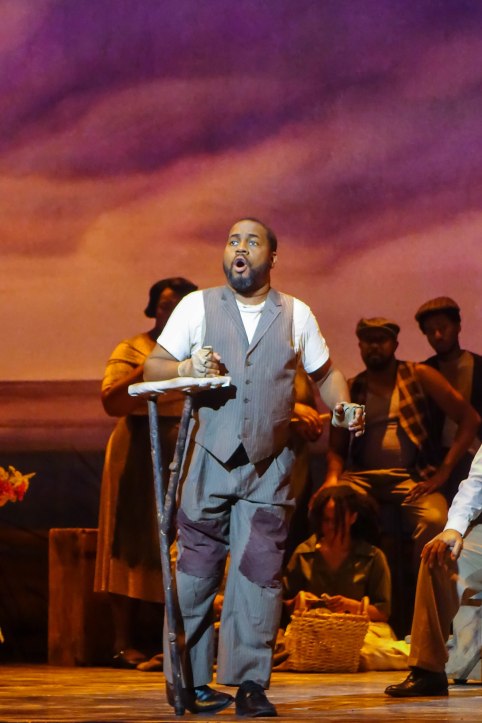
In comparison to that estimable touring treat, the new Opera Carolina production conducted by artistic director James Meena did not need to blush. At the Sunday matinee premiere, Sequina DuBose reprised her role of Clara from the Broadway tour while Nicole Cabell, featured as Clara – who sings the incandescent “Summertime” – on Decca’s landmark 2006 recording of the original 1935 Broadway score, made her Charlotte debut as Bess. Kenneth Overton, who was billed as the star of that infamous 75th-anniversary tour, was replaced by a fifth-string singer at Ovens Auditorium whose name could not be determined until five days later, finally got his chance to impress as Porgy. No less prestigious, Victor Ryan Robertson gave us a taste of what made the ornate Spoleto production so splendid by reprising his slickster grace as Sportin’ Life.

2023~Porgy & Bess-03

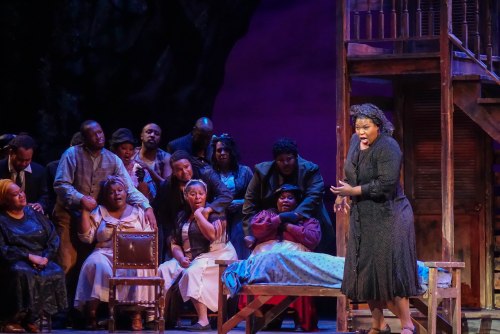
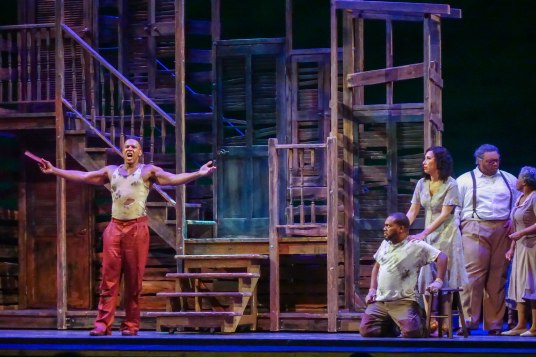
Stage director Dennis Robinson hasn’t sought to replicate that scenic Spoleto splendor, concentrating his attention instead on building the drama. Two rolling set pieces by scenic designer John Farrell replicate the dilapidated Catfish Row tenements, with backdrops and Michael Baumgarten’s wonderful lighting supplying much of the color. Those colors are usually upstaged by Ildikó Debreczeni’s artful costume designs, motley women’s and working men’s clothing in the outdoor community scenes, veering toward black in the dimly lit funeral scene for the murdered Robbins, and suddenly switching to a splash of white linens for the Kittiwah Island picnic.

Even the stylish Sportin’ Life, all purple with gold accents when we first see him, wears pure white pants and vest at the beach, though a lurid silk fuchsia shirt peeps through. Other costumes sketch the main characters’ evolution. Crown, Robbins’ murderer and Bess’s abusive former husband, is nearly as dandified as Sportin’ Life when we first see them shooting craps, yet he’s nearly in tatters when he madly emerges from hiding, seeking Bess. Debreczeni’s Bess transforms only slightly less dramatically, her first appearance in a flaming red dress when she still belongs to Crown, followed by a citified black “mourning” dress at the funeral – pointedly accessorized with pearls.

2023~Porgy & Bess-09

The funeral and picnic scenes both show off how dignity has triumphed over poverty along Catfish Row, though the seafaring men and a climactic hurricane remind us how tenuous their victory is. As Jake, Clara’s husband, reminds us as the lead voice in the men’s worksong, “It Take a Long Pull to Get There,” evoking the Promised Land in much the same way that Rev. Martin Luther King would at the Lincoln Memorial decades later. Laudably, Robinson isn’t ashamed of either Porgy or Bess. He permits Cabell’s Bess to be Bess, ambivalent toward Porgy, Crown, and Sportin’ Life, just as she was written – bold yet insecure. She yields resignedly to Crown after arguing and resisting, so she is absolutely credible when she confesses the full range of her fears in her famed “I Loves You, Porgy” of the imminent confrontation when Crown comes for her: “he hypnotize me when he take hold of me with his hot hand.”

2023~Porgy & Bess-61

Refusing to enlighten Bess or belittle her demons, Robinson collaborates with Overton to rehabilitate Porgy, making him happier and less pathetic than I’ve ever seen him before. Robinson doesn’t ignore Porgy’s mobility issues, but unlike other directors, he offers Overton multiple avenues for motion, dispelling the cripple’s usual monotony and impotence. In most productions, Porgy perpetually limps with a crutch or glides along on a cart. Occasionally, you might see that four-wheel vehicle at the rear of a goat cart, honoring Samuel Smalls, alias “Goat Cart Sam,” the real-life Charlestonian that Heyward based his protagonist upon in his celebrated 1920 novel.

2023~Porgy & Bess-04

Discarding that goat, Overton will limp, glide, crawl, and – at one key dramatic moment – even attempt to stand up and walk. This variety made Overton’s Porgy more restless, powerful, and dynamic. His crutch is a forked affair, topped by little ironing board-like cushion joining the branches, enabling Porgy to lean on it with his arm and stand upright. The cart is also cushioned to comfortably accommodate Porgy’s kneepads. We see that Overton can glide a good distance along the stage with a single paddling motion, braking with his toes, but I really didn’t notice that his wheels could swivel until the last possible moment. That revelation made Porgy’s final exit the most stunning I’ve ever seen.

2023~Porgy & Bess-46

When Overton first entered, the neighborhood greeted him with affection rather than pity. Even before he got his gal and somewhat domesticated her, he brimmed with sufficient confidence and joie-de-vivre to heartily sing “I Got Plenty o’ Nuttin’” to every woman along Catfish Row who had doubted him. You could believe in Overton as he jumped into the transcendent “I Loves You, Porgy” duet: he will stand up to Crown – and unlike the original libretto prescribed, this Porgy met Crown face-to-face rather than sneaking up on him.

2023~Porgy & Bess-53

Until Porgy’s surprisingly military departure, Robertson’s slithery balletic grace as Sportin’ Life provided the most delicious movement we saw. Executing Michael Jackson-styled spins, Robertson was the “happy dust” he peddled, the wicked exhilaration of the high life that Bess was giving up. Citified and flamboyant, Robertson also rocked Sportin’ Life’s cynicism smack in the middle of the idyllic Kittiwah picnic. His “It Ain’t Necessarily So” became a showstopper that launched Act 2 buoyantly, no less successful than DuBose’s spotlit “Summertime” when the curtain first rose. Nor did the quality wane after the drunken brawl at the dice game and Robbins’ murder when we adjourned to the gloomy funereal aftermath. Not only did we get to see Porgy duded up, upright on his feet, and escorted by a newly demure and penitent Bess, we got reminded by Michelle Johnson as Serena, Robbins’ grieving widow, of the heartfelt power pent up in “My Man’s Gone Now,” Serena’s swaying lament.

2023~Porgy & Bess-35

As the murderous Crown, Donovan Singletary had ample pects and biceps for Bess to ogle at in his OpCarolina debut, manhandling her on Kittiwah Island with the confidence – and restraint – of a brute who has willed “his” woman back to his arms for the last five years anytime he wished. The “Oh, What You Want wid Bess” duet had exactly the right blend of chemistry, antagonism, lust, and loathing. More of Singletary’s heat surfaced as Catfish Row rode out the hurricane, but his raunchy “A Red-Headed Woman” was too abbreviated, defanged, and on-the-fly for my liking. Give us a longer version, please!

Otherwise, the only persistent flaw in this beautifully sung, meticulously crafted production was the singers when they weren’t singing their arias. Nobody else came close to matching Overton’s intelligibility or audibility when dialogue or recitative pushed the story forward, an unwanted reminder of the touring production that played Ovens Auditorium in 1998. The dropout in decibels was especially dreary for me in the opening scene as the crap game dragged on, but my discomfort may be benign compared to what Porgy newcomers experienced if they didn’t already know the lyrics to the songs.

Once the brawl broke out, Heyward’s story pretty much told itself for me through the actions we watched, aided by George Gershwin’s music and orchestrations. Miking the dialogue, as most touring Broadway shows do, would certainly have been helpful, but the simplest solution for these nagging woes at the Belk would have been supertitles. That way, we could have appreciated Heyward and lyricist Ira Gershwin nearly as much as George.

Parameswaran Delights With Eclectic Mix of Moderns

Review: Sibelius No. 5 with the Charlotte Symphony

 By Perry Tannenbaum

2023~Sibelius 5-14

Maybe subscribers to Charlotte Symphony’s Classical Series aren’t as invested in choosing a successor to music director Christopher Warren-Green as I had presumed, or maybe the weather was too darn wintry for the wusses. Whatever the cause, the audience that came to see guest conductor Vinay Parameswaran perform a program that included music by Gabriella Smith, Benjamin Britten, and Jean Sibelius – while launching CSO’s celebration with a fine example of William Grant Still’s artistry – didn’t come close to filling Knight Theater to capacity.

Nor could anyone who looked over the stalwarts who braved the Arctic cold have called us diverse.

Could be that we’re complacent, self-satisfied, and spoiled. After hosting a musician as renowned and prestigious as Warren-Green, we may have forgotten that the candidates parading before us, seeking to impress in order to land a job offer, might just need to be sufficiently impressed by us to accept.

So it was interesting to watch how Parameswaran reacted when he looked out at the crowd, pocked with empty seats, and met us for the first time in his Charlotte debut. A rather sober look on his face abruptly turned to shock, surprise, and gladness as he heard our outsized enthusiasm.2023~Sibelius 5-02

He was rather charming, then, when he picked up the mic at the podium and described Smith’s piece, Field Guide, along with the works that followed. Any misgivings that concertgoers who stayed away could have harbored about his foreign-sounding name would have been instantly dispelled by the ease with which he spoke and the ease with which we understood – even if it was outré for him to describe Arthur Rimbaud’s Les Illuminations, the text for Britten’s song cycle, as “nonsensical.” I could hardly believe my ears.

Fortunately, the boldness of the San Francisco Bay Area native didn’t end there. He and the orchestra dug into Field Guide with gusto. Or tapped in, for the lower string players tattooed a sustained ostinato at the beginning of this pictorial voyage, delivering the sounds of insects, birds, animals, and swirling waters that Smith had recorded in the field and given new orchestral color. Cacophony was also mixed with the woodland stealth, and a look at the digital program booklet confirmed, in stray passages reminiscent of Debussy’s La Mer, that Smith had also taken her recording equipment to the ocean and under the sea.2023~Sibelius 5-24

Surreal, visionary, and hallucinatory though they might be, Rimbaud’s landmark prose poems are neither indecipherable nor dated. Canadian soprano Alexandra Smither, also making her Queen City debut, was evidently eager to share the wonder and variety of Britten’s settings, though she seemed as taken aback and gratified by our lusty greeting as Parameswaran had been. To fully savor the rightness of the music and the subtly crafted lucidity of Britten’s discreetly edited text, you’ll want to download the digital program booklet (via QR code) and follow along on your smartphone.

They do ask that you turn down the brightness of your screen as you’re reading the English translations of the French. Savor the irony as you reduce the illumination for Illuminations.

Our CSO thinned out during the transition from Smith to Britten, for the song cycle was written for strings and voice – with its intimacy compounded when concertmaster Calin Lupanu and principal cellist Jonathan Lewis play solos. Taking for a refrain a line of Rimbaud’s “Parade,” which concludes with “I alone have the key to this savage parade,” Britten turns his entire cycle into a savage parade – or as Duke University professor Wallace Fowlie translated it, “this wild circus.”

“Parade” doesn’t actually occur until the penultimate song in the 10-part suite, and both Smither and Parameswaran fully savored its climactic orchestral exuberance, appropriately rendered in marching tempo. Unlike Rimbaud’s masterpiece, which ends by scaling to a blasphemous pinnacle in “Genie,” Britten goes from “Parade” to a devastatingly subdued “Départ” (Departure), perhaps expressing empathy for the tragic gay poet. The effect was more powerful because Smither and the CSO had partnered in mostly uptempo songs until then. Excitement had been fairly intense from the beginning, when tremolos from the lower strings flowed into the first vocal scoring of Britten’s surreal refrain in “Fanfare,” taken by Smither at an infectious poco presto tempo with all her characterful ebullience.

Okay, so I’ll confess that I had slept as soundly as anybody on William Grant Still until Parameswaran brought him brashly to us. We’re catching up with him comfortably ahead of the centennial of Still’s ascension to the title of “Dean of African American Composers,” when he was the first black composer to have his work performed by the New York Philharmonic in 1930. The Naxos label and Apple Music are fairly woke to Still, woker than my first Spotify searches could confirm, though I found the same recording of Poem for Orchestra – by the renowned Fort Smith Symphony – at both streaming services.

With a helter-skelter cacophonous opening, Symphony and Parameswaran were far bolder and more modern than their Fort Smith counterparts as the full ensemble returned after intermission. Even when the CSO settled down and we could see the Brahms-and-Gershwin bloodlines of Still’s composition, with occasional soured passages paralleling Shostakovich’s wartime works, the music sounded more vibrant and contemporary. After that startling first onslaught, I very much liked what I heard.

There’s also plenty more for us to experience live after dipping into the streaming goodies we can sample. Still wrote at least four more symphonies after the NY Phil breakthrough, a fairly copious amount of piano and chamber music, and numerous memorable elegies, including one for “The Colored Soldiers Who Died for Democracy” and a “Threnody for Jean Sibelius.”

Following the Poem for Orchestra with Sibelius’ most admired and recorded symphony didn’t sound random, either. Last played at Belk Theater by the CSO and Warren-Green in the spring of 2015, the brassy Tempo molto moderato opening movement made itself immediately welcome, cresting with a grandeur that almost brought me to tears. The delicacy of the Andante middle movement, beginning with waves of pizzicatos and morphing convincingly into an Allegretto scherzo, was also brilliantly calibrated.

Perhaps because those pizzicatos sound so much more vivid in live performance than on recording, the deficiencies of the closing Allegro molto – Misterioso were more apparent compared to the CDs in my library, including the definitive 1997 interpretation by Osmo Vänskä. Parameswaran didn’t push the pace as thrillingly to start the movement, so the big tune from the brass didn’t arrive as majestically in repose. But the orchestra delivered amply on the restless, mysterious aftermath, and the six hammering whomps at the end, half of them spiked with timpani, satisfied everyone.

–Photos by Perry Tannenbaum