Category Archives: Theatre

“MJ”: About as Close to Jax as We Can Get

Review: MJ The Musical at Belk Theater

By Perry Tannenbaum

Whether it was his skin, his sunglasses, his surgeries, or his sleepovers, Michael Jackson always gave his fans – and his detractors – plenty to think about aside from his music and his iconic videos. Even if you tried to maintain ignorance or indifference, there were just too many of him to ignore. He seemed to be everywhere, all the time, always visibly troubled and in flux. The loudest soft-spoken person we’ve known: the most grandiose hermit, progressively weirder and more deformed as the years went by.

So in condensing the King of Pop’s life and art into the 150-minute MJ The Musical, without plunging into inconvenient truths that might revoke her “Special Arrangement with the Estate of Michael Jackson,” script writer Lynn Nottage had to look very, very carefully for a place where she could begin – and a place where she could discreetly and dramatically end. A two-time Pulitzer Prize winner (Ruined and Sweat), Nottage knows her way around the theater, so she chooses wisely and safely.

Approaching its 700th performance in its current Broadway run after premiering in late 2021, the touring version has been spreading the moonwalk, the cocked hat, and the glove across our land since the beginning of August. Rounding into its second week at Belk Theater, there’s no question whether this production is a crowdpleaser. Whether or not Nottage has made storytelling mistakes or sugarcoated the facts of Jackson’s life, there’s more than enough hot smokin’ talent onstage to incinerate such nitpicking concerns in white-hot flames.

We begin in an LA rehearsal hall, where Michael, his backups, his line dancers, his handlers, and a small band are gearing for their upcoming Dangerous tour in 1992, following up MJ’s latest smash album and trying to live up to expectations created by his past glories – Off the Wall, Bad, and, greatest of all, Thriller. Ultimately, after much discussion and consternation about how MJ can uniquely open his stage show, Nottage spirals slightly ahead to the opening moments of the Dangerous tour for our ending.

By this time, there’s more than ample inventory from the Jackson 5, the Jacksons, and MJ’s solo album catalog to fuel a four-hour musical – with additional detours into the Isley Brothers, James Brown, Olatunji, and Richard Rodgers – if Broadway producers had thought those were in vogue. There’s also enough weird MJ and cosmetically altered MJ swirling around in people’s minds for media to assail the King of Pop with troubling questions and pry into his past 25+ years as boy wonder and superstar to find out what makes him tick.

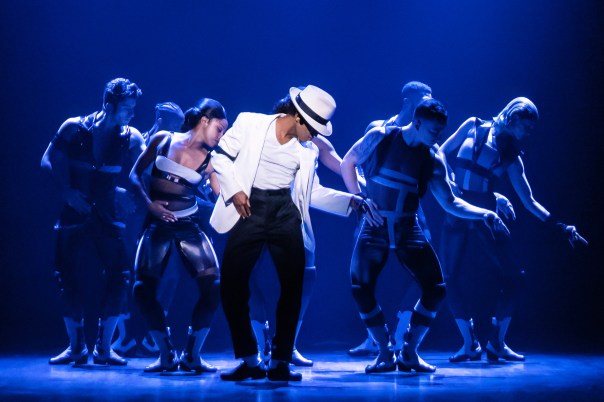
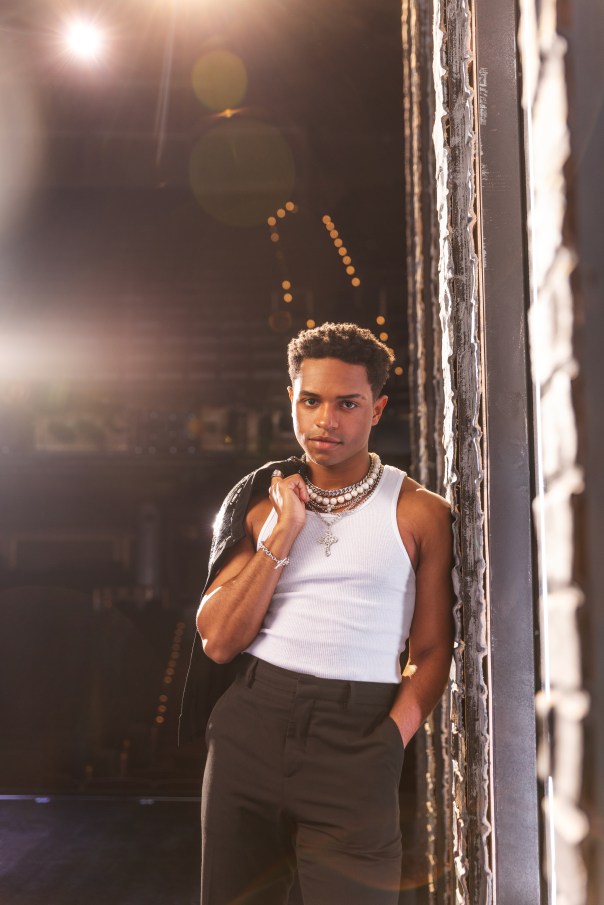
As soon as Roman Banks struts into this artsy loft, he begins flipping those legitimate questions into annoyances, for we can see that the silky moves are all there before he’s halfway through performing “Beat It,” meshed with a vocal that transcends impersonation. Musicians onstage are fortified by a dozen more lurking in the orchestra, adding heft to the opening number, and the dancers are Fosse sleek and Broadway tight. This is what came to see.

So we can empathize with MJ when Rachel and Alejandro, a TV reporter and her cameraman, walk into the busy room, hoping to get an in-depth interview and a behind-the-scenes scoop. Speaking with that preternatural softness of a singer saving his voice for his next performance, MJ yields to the eager cubs – but only on the condition that they keep it strictly about the music. Banks manages to suffuse that softness with a winsome sweetness.

Nottage doesn’t lavish much of her MacArthur genius into Alejandro, enabling Da’Von Moody to pour a smidge of his own personality into a generic, slightly geeky fanboy. There’s a modicum of humor because Rachel, not MJ, is his boss. Here Nottage gives us some texture, bringing us an opportunistic fan-tagonist in Rachel – pushing back over and over against MJ’s restrictions, pesky, persistent, and sometimes annoying. Stepping into this crucial role on press night last Friday from deep in the list of Swing players, Ayla Stackhouse added a touch of wicked allure to Rachel.

A wisp of seduction was in the air. As a result, Banks’ continued softness and firmness may have gained fresh strength. Yet when MJ kept saying no, he seemed to be veering toward maybe.

This sensation, that we were meeting the real MJ in person as Banks shuttled between guarded and candid moments, can be partially credited to the tech crew now at the Belk. MJ often speaks the gospel of detail and perfection, but this crew fulfills it. Over the last couple of Broadway Lights seasons, I’ve become so accustomed and resigned to the sound not being right on opening night at the Belk before Act 2, if at all, that I’ve lately tolerated the problem without comment.

Maybe that’s why Press Night for this two-week run was put on hold for two performances. On ordinary opening nights, you could expect Belk’s audio crew to turn MJ’s softspoken dialogue into the sound of microwaving popcorn. This time, everything was dialed in perfectly for the critics. Moments when I might be holding my breath, bracing for sonic gremlins to afflict MJ, were simply breathtaking.

All night long, the show maneuvered deftly, revealing subtle new merits. Timeshifts between the ‘90s rehearsal loft and the eye-popping ‘60s charm of the Jackson 5, juxtaposed with the abusive Jackson household and Michael’s taskmaster dad, could become somewhat disorienting as the retrospective took off. Part of what Nottage and director/choreographer Christopher Wheeldon are trying to accomplish is steering the narrative smoothly between songs in the Jackson catalog without the storytelling stalling and landing us at a gimmicky concert.

By the time we get our bearings in Act 2, about 23-25 hits into the 40-song list of musical numbers, we realize that anybody portraying MJ is pumping out too much energy onstage, singing and dancing, for him not to be whisked off to the wings for some rest. Giving Banks some breathers is also part of the navigation calculus. No less than three Michaels were onstage between 8:00 and 10:45 at the Belk, Banks as MJ, newcomer Jacobi Kai as Middle Michael, and Josiah Benson as Little Michael, timesharing the role on tour with Ethan Joseph.

If Banks amazed me, getting every signature move and vocal intonation of MJ, moonwalking through everyday life, Benson as the Afro-coiffed Little Michael left me gob-smacked. Maybe the Jackson Estate’s worries were misdirected: who knew that the roles of MJ and Little Michael could be cast so successfully, both on Broadway and on tour simultaneously? Little Michael’s timbre had always seemed to come from a once-in-a lifetime voice since that “ABC” moment when I first heard it. Not anymore.

What could have set MJ apart from the performers portraying him at various stages of development were his songwriting gifts and inspirations, never really explored in Nottage’s book. Likely, that would have rendered the show more intimate and even more Michael-centric. We get a fairly broad tapestry instead, including glimpses of singers Jackie Wilson and James Brown, along with the ballroom grace of Fred Astaire.

The supporting cast is very fine. Devin Bowles and swing-understudy Rajané Katurah were worthiest of mention as Little Michael’s parents, Joseph and Katherine, fleshing out their marital discords. Both make good on the vocal solos carved out for them. Bowles time travels as much as Banks, portraying MJ’s stage manager, Rob, throughout the contentious rehearsal scenes. Dancers, even when supposedly driven in rehearsals to smooth out imperfections, are exemplary, living up to Wheeldon’s strict demands. Is MJ pushing his dancers too hard to reach perfection – because Dad pushed him so relentlessly? We don’t miss the emotional turmoil lurking inside this connection.

Nottage is sufficiently fascinated by the intricacies of putting a show together that she not only reveals the micro levels of drilling the synchronicity of dance routines and sweating details. She also has Michael, Rachel, Rob, and Dave – MJ’s on-edge beancounter, excellently portrayed by Matt Loehr – discussing the larger concerns, namely the architecture, pacing, and budgeting of a show.

That helps us to swallow all the action in the drab rehearsal loft before the delayed gratification of seeing the all-out “Thriller” extravaganza deep into Act 2. A whole show of such MTV-like spectacles would have cost zillions, too mind-boggling to pack onto the biggest moving van known to man. An armada of trucks and set builders would need to be deployed for a full evening of such fantastical wonder.

In many ways, Nottage and Wheeldon deliver as much as we can expect of Michael Jackson’s life and artistry onstage without surrendering the rights to the music. I’d like to think that Nottage, dealing with the Jackson Estate’s constraints, saw herself as resembling her own persistent Rachel character during the process, pushing the envelope further and further, inch by inch, as far as it could be stretched. Perhaps her Pulitzer pedigree helped Nottage to make more territorial gains and bring us closer to the real MJ than The Estate was truly comfortable with when her work began.

“Yankee Tavern” Still Implodes With 9/11 Speculations

Review: Yankee Tavern at DCP’s Armour Street Theatre

By Perry Tannenbaum

Over the years, Steven Dietz has favored Charlotte with plenty of spookiness and suspense. We’ve seen his most acclaimed works in fine local productions, including God’s Country, Lonely Planet, and the oddball Becky’s New Car. On a couple of occasions, we’ve been singled out for some of the earliest transitions of Dietz’s scripts from page to stage. Most recently – and spectacularly – Children’s Theatre and Actor’s Theatre of Charlotte teamed up to commission a pair of upstairs/downstairs spookfests from Dietz, The Ghost of Splinter Cove and The Great Beyond.

Since 2009, when Actor’s Theatre presented Yankee Tavern as part of the New Play Network’s nationwide “rolling world premiere,” we really haven’t experienced how Dietz uses his surreal, supernatural, and conspiratorial toolkit to address daily American life. The current revival, directed by Matt Webster at Davidson Community Players, also gives us the opportunity to see how well Dietz’s wild theorizing still holds up three election cycles – and three US Presidents – later.

If anything, the suspense seems to work better now, since Webster’s cast, in their pedigree and their natural inclinations, comes across as less cerebral, readier to go with the flow of an action yarn liberally sprinkled with spycraft plus a pinch of the inexplicable. Confronted with two actors, Matt Cosper and Tom Scott, who might plausibly place the roles of Hamlet and Lear on their bucket lists, as Dietz’s protagonists, I can see in retrospect that I may have resisted following on the suspenseful path that Adam and Ray were designed to take us.

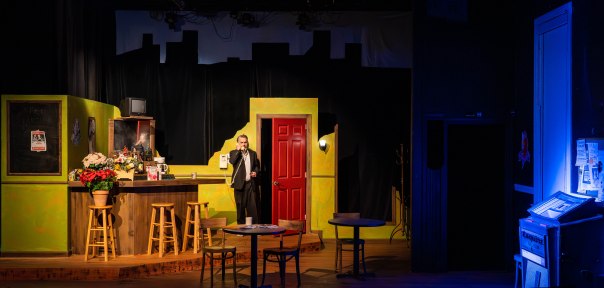
t’s easier to be ambivalent about Matt Stevens as Adam, the seemingly wholesome owner of the Yankee Tavern, and Bill Reilly as Ray, the crazed-or-visionary vagrant who lives in the empty hotel above the bar. Together, they take us down a rabbit hole of coincidences, suppositions, and conspiracy theories that might account for America’s total defenselessness on the morning of September 11, 2001, when airliners crashed into the Twin Towers in Lower Manhattan and both skyscrapers stunningly collapsed.

Two amazingly perfect demolitions of two fully-occupied, high-profile landmarks, presumably built to last and zealously guarded – within the space of 46 minutes. You didn’t need to be close to Ground Zero to be struck with shock and wonder.

But the closer you were to the World Trade Center or people who perished there, and the more narrowly you yourself escaped, the more you could be expected to obsess over the mountains of evidence, facts, theories, legends, and numerologies that were left to explore or were mysteriously obliterated along with the rubble. Ray, the raffish vagrant, seems to have gone overboard, a fountain of conspiratorial spew that points in multiple directions here and abroad, adding to his confusion and ours instead of clearing the fog.

Adam and his fiancée, Janet, seem to mischievously indulge Ray’s weird futility, voicing their skepticism to get the freeloader to be more passionate about his disorganized beliefs – and perhaps prodding him to spout new bullshit they haven’t heard before. The badinage gets out of hand when Janet carelessly reveals that Adam has collected Ray’s voluminous ravings into book form for his master’s thesis. Outraged by this betrayal, Ray has some secrets of his own to reveal about his betrayer.

Reilly renders Ray with such eccentric looniness that anything he says draws skepticism, beginning with his nocturnal conversations with the ghosts who haunt the boarded-up hotel rooms above, including Adam’s dad. Are these symptoms of madness or sources of insight? There are some compromising secrets that Adam is hiding from Janet. How damning these secrets are depends on how truthful you think he is in explaining his ongoing relationship with his ex-professor.

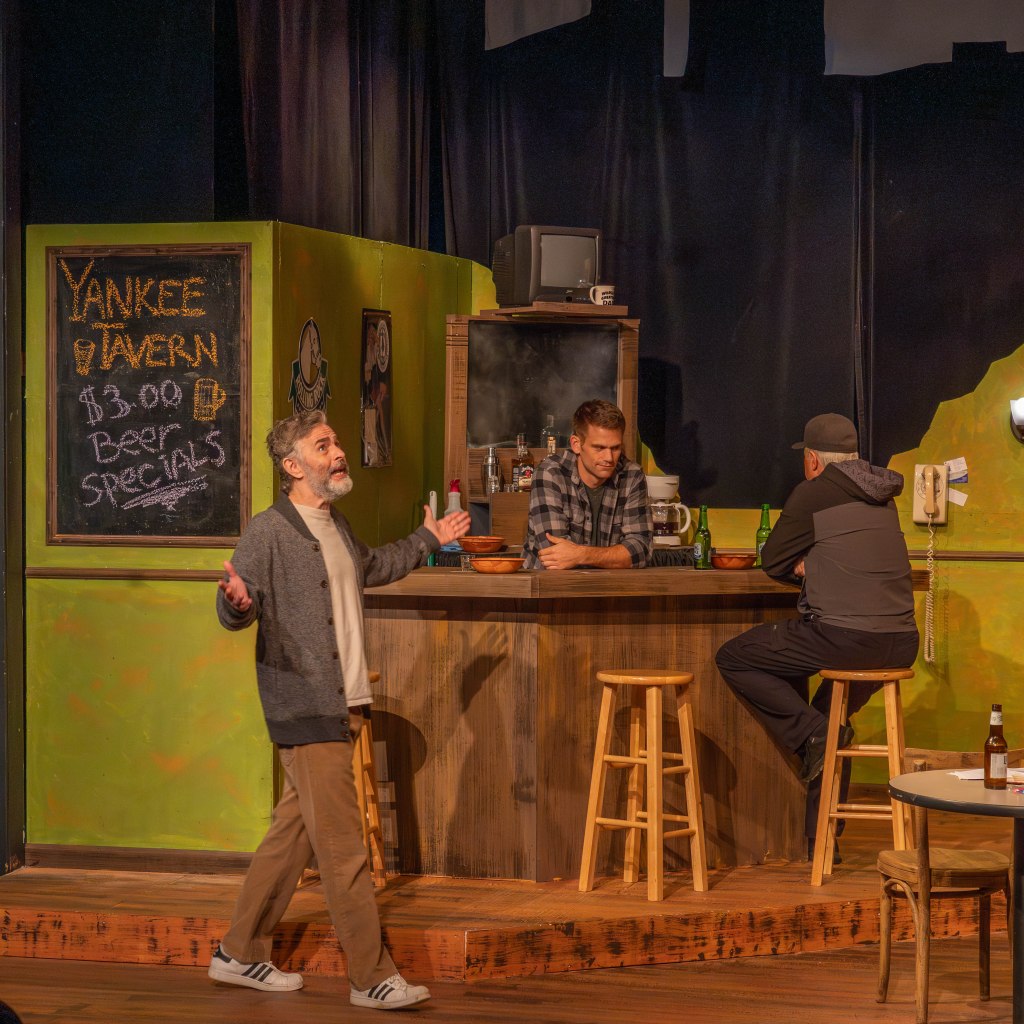
At first, Cordelia Hogan strikes us as a bit irritating as Janet with her persistent suspicions and distrust, so we tend to empathize with Stevens and his protestations of innocence as Adam. Things slowly change when the lights come up on a new scene with a quiet stranger seated at the bar, mostly facing away from us. He’s sitting with two bottles of Rolling Rock Beer perched on the bar, subtly evoking the Twin Towers, but he’ll refuse to drink one of them – leaving it full in memory of a friend that he never saw after the Towers’ collapse.

In his quiet way, Palmer is as obsessed with the mysteries of September 11 as Ray, but he has been more relentless and has roamed further, driven by the unsolved death of his close bud. When Steve Schreur breaks his silence as Palmer with a startling confession of wrongdoing at the colossal Twin Towers crime scene, a monologue that transforms his demeanor from a humble cop on the beat to a crusading zealot, the net of mystery and conspiracy widens to include Adam, his ghostly dad, and Yankee Tavern as focal points.

This may be Palmer’s first stop at the crumbling sports bar, but it isn’t his first sighting of Adam – and he also seems very well-informed about the ex-professor and her machinations. He definitely has his suspicions. Now we will reassess the mild-mannered Stevens and maybe see him as craftier, more secretive, and spy-like. You may also start wondering at this point whose side Palmer and Adam are on in this geopolitical tapestry, and you may believe there really could be a deal breaker on the horizon for Adam and Janet’s engagement.

At this point, we’re also caught up in the psychology of straining toward belief based on the devilish wisps of evidence and inference and eye-witness testimony that Dietz has doled out. The playwright, Webster, and his cast have all done their work well; the design team have created and sustained the playwright’s lazily surreal atmosphere; so the intended coupling will likely occur. Our speculations about Adam and Palmer will likely sprout fresh speculations about 9/11.

We’re built that way, which is precisely Dietz’s point, whatever the truth of history might be if it is ever untangled.

Problem is, Dietz couldn’t factor in 2016 or 2020. A US President who had lost the popular vote might conceivably orchestrate a catastrophe to rally the dubious electorate behind him. Could be worth the trouble for W. Until the Orange Marvel came along, who knew that a sitting US President could simply squat down on a toilet seat and remediate the situation by merely proclaiming, with two posable thumbs and a Twitter account, that he had actually won the lost election by a landslide?

Of course, that grim update won’t prevent the flareup of confusion and speculation we will feel when Dietz springs his ending. It’s a brutal reminder that the hotel above the action isn’t the only place that is haunted. Yankee Tavern is also spooked and so are we. Maybe more than ever before by the incurable virus of conspiracy theory.

Follow the Yellow Brick Road to the Queens Road Barn

Review: The Wizard of Oz at Theatre Charlotte

By Perry Tannenbaum

With her rustic picnic basket, her toy dog Toto, her beribboned pigtails, and her iconic gingham dress, the 1939 movie version of L. Frank Baum’s imperishable heroine, Kansas-born Dorothy Gale, was designed to closely echo the Dorothy found on the pages of Baum’s 1900 novel. She was conceived in the lineage of Little Red Riding Hood and Lewis Carroll’s Alice as a little girl – credulous, easily surprised or disappointed.

Judy Garland was 16 years old when she began shooting The Wizard of Oz at MGM Studios. Her sub-5-foot stature bridged some of the age gap, but director Victor Fleming and the MGM braintrust didn’t stop there, trussing Garland up to hide her curves. All of this subterfuge (some would call it barbarity) was logical only because Hollywood, suspicious of fantasy and children’s fiction, wanted to reassure us that Oz, The Wizard, the Witches, the Winkies, and the ruby slippers were all nothing more than a little girl’s dream.

Noel Langley’s screenplay, revised chiefly by Florence Ryerson and Edgar Allan Woolf, went to extraordinary lengths to frame Dorothy’s adventures as a dream. The celluloid version supplied the Scarecrow, the Tin Man, the Cowardly Lion, Glinda, the Wicked Witch, and The Wizard with Kansas counterparts she will transform into Ozians. Baum never created a Miss Gulch or a Professor Marvel. In fact, when he adapted The Wonderful Wizard of Oz for the stage in 1902, Baum actually expelled Toto and the Wicked Witch from his cast – and did not permit the Lion to speak.

Langley obviously hasn’t gotten enough credit for his contributions to Oz mythology. The whole preamble to the cyclone and Oz is his, along with the wholesome welcome home to Kansas that crowds the screen with patronizing adults. Aunt Em is the only person who greets Dorothy in the book, where the ending is dispatched in less than 75 words. Dorothy finds a new farmhouse that Uncle Henry has built to replace the old one that killed the Wicked Witch of the East. No question in Baum’s mind: Dorothy has been away to a real place in real time.

When John Kane adapted The Wizard of Oz for the Royal Shakespeare Company in 1987, he went with Langley’s version of the story. Not only were the songs by Harold Arlen and the lyrics by Edgar “Yip” Harburg brought along for the ride, so was “The Jitterbug,” an Arlen-Harburg song that didn’t make the film’s final cut. If anything, Kane’s additions to the screenplay served to underscore the idea that Oz was a dream, dropping more key words and phrases that linked the magical land to Kansas. Auntie Em and Uncle Henry were added to the roster of Kansans who change costumes and join Dorothy in Oz.

That’s the version we have now as Theatre Charlotte kicks off its 96th season with a rousing trek down the familiar Yellow Brick Road. After her TC debut in 2022 at Camp North End during the company’s vagabond season, Allison Modafferi Brewster directs for the first time at the Queens Road barn. Leaning heavily on projection designs by Alison Nicole Fuehrer to navigate the geographies of Kansas and Oz, Modafferi and her cast of 40 (plus nine “Ruby” Munchkins who timeshare with the “Emerald Cast” that performed on opening night) heartily buy into the notion that Oz is a dreamland.

But in choosing Winthrop University senior Cameron Vipperman as the lead, Modafferri and costume designer Rachel Engstrom are pushing back against the idea that Dorothy must be a child. Or, to cite the range prescribed for auditions in 2006, when Central Piedmont presented this Wizard as their first summer extravaganza at the newly-built Halton Theater, between the ages of 14 and 17.

Gone are the ribbons, the pigtails, and the gingham dress, though Vipperman’s do does sport a couple of fairly subtle weaves. Nor does this energetic production go along with the notion that Miss Gulch and the Wicked Witch of the West must be gnarly old crones. Wielding her broomstick in a rather gladiatorial black outfit, Mary Lynn Bain was quite the action figure as the Wicked One. No corny cone hat for her!

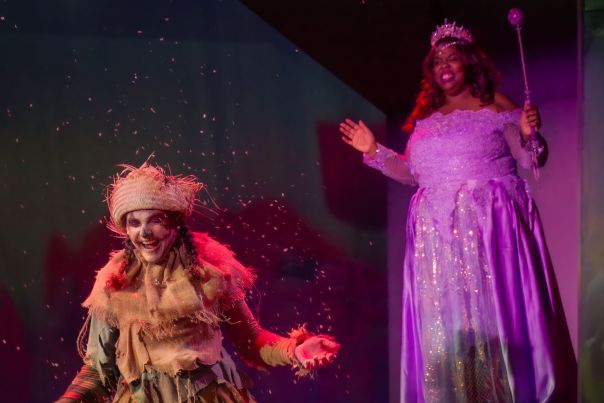
Unless you’ve scouted productions down at Winthrop and Matthews Playhouse, neither of these antagonists will be a familiar name. Casting is no less adventurous for Dorothy’s Yellow Brick pickups. As the Scarecrow, Devon Ovall comes to the Queens Road barn by way of Northwest School of the Arts. Ashley Benjamin, the first female Tin Man we’ve ever seen in Charlotte, seems to be freshly arrived from Georgia in her digital bio. Only Kyle J. Britt can boast previous Queen City exploits prior to his present turn as the Cowardly Lion, having appeared at the barn in last year’s Christmas Carol as the Ghost of Christmas Present.

Noticeably younger than any Oz supplicants you’ll ever see again in an adult production – so close to Dorothy’s age that they seem to be her pals and never her protectors – this youthful trio is remarkably appealing. Ovall flops around and collapses with infectious glee as Scarecrow. Aided by strategic sound effects, Benjamin brought plenty of creaky stiffness to the Tin Man, but she often needed stronger miking.

Rachel Engstrom’s costume designs for these two weirdos are masterworks of simplicity, but her greatest triumph may be her Lion, little more than a wig gone wild and a couple of fringed sleeves. This is sufficient armament for Britt to make delicious meals of both his Cowardly highlights, blustering his “top-to-bottomous” bravado with gusto and regally rolling his r’s on “King of the Forest” – with an extra-chesty baritone.

Modafferri’s infusions of diversity and gender switching don’t stop with Benjamin. Brandie Hill brings a righteous gospel flavor to Aunt Em and especially to Glinda the Good, while D. Laverne Woods brings out the gypsy in Professor Marvel and the sass in the Wizard. Darren Spencer as Uncle Henry is a softer, more indulgent contrast to Aunt Em’s law-abiding rigor, making him the obvious choice to play the softy old Guard at Oz’s palace.

Mostly at the service of Fuehrer’s projection designs, set designer Chris Timmons’ neutral-toned slabs don’t quite allow the colors to pop until we first espy the poppy field and Emerald City beyond. The cityscape lingered a few seconds too long as we transitioned from Oz to the wicked West, my first inkling that there was more than one projector in play. The more concerning miscue on opening night was the stage crew’s failure to secure the flight of stairs leading up to the platform where the Wicked Witch makes her immortal “What a world!” exit.

Poor Bain took a nasty little tumble trying to get up there, nearly breaking her neck before she had a chance to melt, prompting Vipperman to be very careful when she climbed up after her. The wonderful reversal was still effective.

That climactic scene cannot be withheld from an adoring public, so Timmons had to choose between the complexities of using a trapdoor in the middle of his stage or building a platform. The latter solution is likely simpler, but its hazards were frightfully exposed last Friday. No doubt all the furniture moving and fastening will go better this week as the run resumes.

Technically, the Theatre Charlotte version of The Wizard is nowhere near as dazzling as the CP version of 2006, when the Witches, the Wizard, Dorothy, the Scarecrow, Miss Gulch, and a cow all flew, and Glinda floated gloriously in a bubble. Such lavishness is probably the main reason why CP shitcanned its Summer Theater programming this season – after four decades of serving as the best launching pad for emerging professional talent that Charlotte has ever seen.

Musically, the lack of a live orchestra dulls the brilliance of Herbert Stothart’s scoring, but music director Matt Primm and his talented cast rescue things nicely. After a shaky start, when Vipperman was too studiously on the beat, “Over the Rainbow” came to full bloom. Surrounded by the loosey-goosey shenanigans of Ovall and Britt, she blossomed even more in Oz. Pepper Alpern as Toto remained a wild card. Nobody knew what the mutt would do next, behaving, barking, or otherwise stealing focus.

Engstrom and choreographer Vanessa Zabari held a deck full of winning cards to counteract this earthbound production’s lack of aerial aces. Dance numbers greatly enlivened the arrivals in Oz and the Emerald City when a bevy of Munchkins, a Youth Ensemble, and an Adult Ensemble strutted their stuff, captained by Aidan Conway. Punctuating the action at key moments with assorted tumbles, somersaults, and splits, Conway was also a pro-grade soloist when he wasn’t fronting the ensembles.

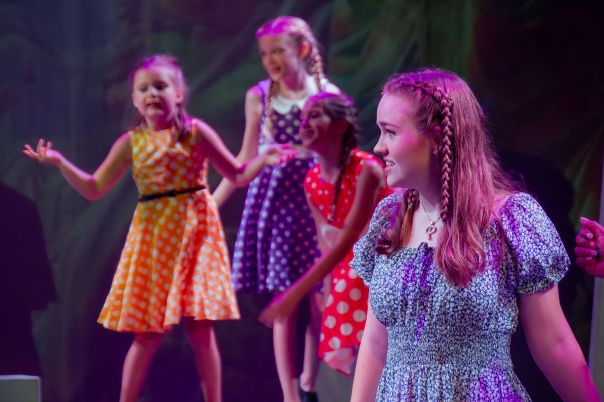
Thanks to Engstrom, Emerald City was a sea of multitudinous greens, and the changes of dresses for the adorable Munchkins were more than enough to convince me anew that Oz truly is a merry old land. But for the next two months, I’d be quite content if I didn’t see another damn polka dot.

“A Soldier’s Play Recalls” the Brink of a New Era

Review: A Soldier’s Play at The Gettys Center

By Perry Tannenbaum

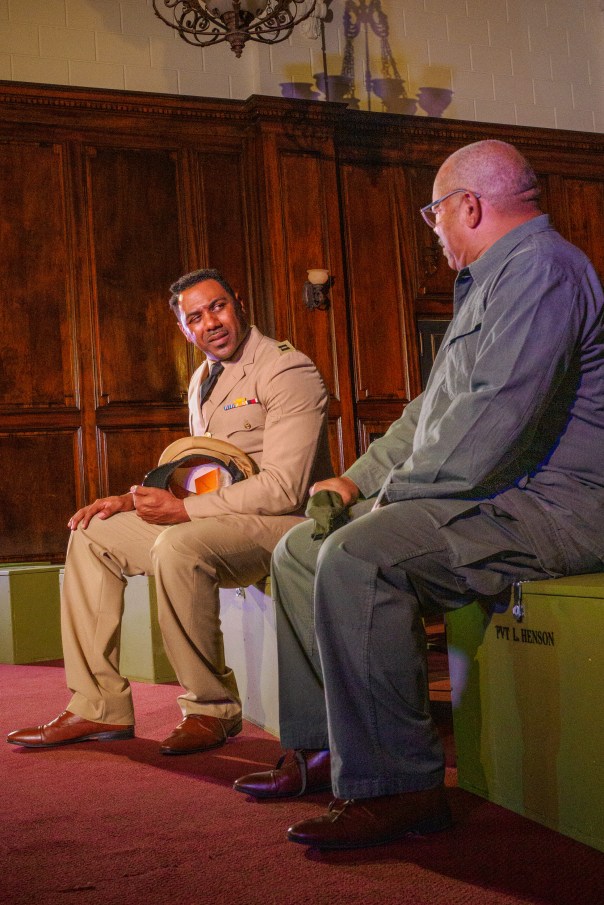
KKK, segregation, and Jim Crow are all in the air as Charles Fuller’s A Soldier’s Play unfolds in 1944 at Fort Neal, a fictitious army base in Louisiana. Yet there are beacons of hope, personified by the Black privates, the corporals, and the busted sergeant we see in a humble barracks. Broadway Lights subscribers saw a deluxe revival of the 1982 Pulitzer Prize winner at Knight Theater back in January, and the current Free Reign Theater reprise down in Rock Hill – not Rural Hill, that was Free Reign’s HQ last summer – only reaffirms the script’s stature as a classic.

Fuller captures these Black military men on the brink. Any day now, these eager recruits are hoping to be deployed across the Atlantic, where they can prove themselves on the battlefield fighting the Nazis. On the home front, we learn that this platoon of baseball players, culled from the Negro Leagues, has a chance to play the New York Yankees if their team can maintain its undefeated record through the rest of the season.

Not a far-fetched dream! Just three seasons into the future, Jackie Robinson will make his breakthrough MLB debut with the Brooklyn Dodgers, win Rookie of the Year honors, pop champagne with his white teammates as he celebrates his first National League pennant, and become the first Black athlete to play in the World Series – against the New York Yankees.

Fuller accurately fine tunes his soldiers’ aspirations, but he drops a bombshell into this Deep South outpost that is equally shocking to the Black scrubs and the white officers on base. When the ballclub’s manager, Tech Sergeant Vernon C. Waters, is murdered in the middle of the night, presumably by local racists, the feds in DC send Captain Richard Davenport to investigate.

DC or not DC, Davenport is a Black lawyer. How is he going to be able to point a finger at a gang of KKK knights, dragons, or wizards and proclaim “Arrest these men!” within the borders of Louisiana? It’s as if a DC thinktank had come up with the surest way for Waters’ murderers not to be prosecuted for their crime.

Nobody on base has ever seen a Black man like this before. Captain Charles Taylor, Waters’ former commanding officer, admits his discomfort in accepting Davenport as an equal. He’s also a bit flustered by the stranger’s cool and orders him to remove those glasses, forgetting that Davenport outranks him. Adams enjoys his teaching moment with a nice nonchalance as Tim Huffman seethes, finely calibrating Taylor’s redneck tendencies with his West Point pedigree.

Whether or not they can sense the Robinson breakthrough on the horizon – or grasp the MLK dream 19 years before he proclaims it – the Black ballplaying soldiers also show that there’s a learning curve for them in dealing with Davenport’s intelligence, competence, professionalism, and objectivity. Flustered, flummoxed, or wary, the corporals and privates quickly show that they are no less thrown by this Davenport phenomenon than Taylor.

And of course, they share Taylor’s skepticism about Davenport’s ability to charge a KKK-grade racist with any crime in Louisiana and make it stick.

Everybody, then, is taken aback as Davenport ignores race altogether, seeking to interrogate both Black soldiers and white officers in search of the facts, and allowing those facts – rather than easy presumptions – to lead him to the truth. Only the busted sergeant, Andrew Roberts as Private James Wilkie, seems to realize that Davenport is seeking evidence to form his opinion of who the murderer or murderers might be rather simply bolstering the opinion he already had.

Davenport is paying attention when Wilkie upsets the KKK hypothesis with a telling observation that Fuller cleverly assigns to the one man at Fort Neal who has lost his stripes. Roberts gives us a messy mix of servility and seething resentment as Wilkie’s complex layers unfold. It was Waters, after all, who busted Wilkie, so the former sergeant will become a prime suspect in the instant that the Klan is cleared of suspicion.

Not only does Wilkie open the door to new possibilities of viewing Waters’ murder, he also opens a window into the deep tensions that lurk beneath the graceful, flawless façade of the invincible team. In flashbacks triggered by Davenport’s ongoing interrogations, we soon see that Waters’ mix of servility and resentment was far more toxic than his subordinate’s. An unforgettable debasement of a Black man at the hands of white officers that Waters witnessed in France during World War I ignited a lifelong secret crusade against the “Geechies” that he despises, Southerners whom he sees as tarnishing the image of his race and hampering their progress.

It is an absolute mania, and even the best player on the team, Private CJ Memphis, does not escape Waters’ lethal prejudice. The chin-to-chin confrontation between Justin Peoples as Waters and Dominic Weaver as Memphis, modeled after the Claggart-Budd climax in Herman Melville’s Billy Budd, Foretopman, is more electric than any of the Davenport-Taylor faceoffs. In the sequel to the Waters-Memphis climax in the barracks, a jailhouse stunner where Waters berates and gloats over his latest victim, Memphis achieves a tragic stature when Weaver proceeds to channel Billy Budd’s Christ-like attributes.

Under Dr. Corlis Hayes’s beautifully judged direction, the deep Billy Budd conflict regains its dominance over the Davenport-Taylor sparring. The touring production, unlike the previous New York productions and the 1984 film adaptation, tilted our attention away from Waters toward Broadway star Norm Lewis, who took over the Davenport role on the road. Yet we still see quite vividly that the new man on base is the future.

Shining more light upon Waters’ diabolical obsession, Hayes and Peoples let us see that, in some ways, A Soldier’s Play is like a Perry Mason mystery. So many soldiers on his team detest Waters that almost every one is a legitimate suspect. Davenport’s main weapon is cross-examination – in Captain Taylor’s office, his own hastily-outfitted domain, or in front of the soldiers’ bunk beds and foot lockers.

Weaver’s performance as CJ, like a genial Willie Mays with a guitar, further focuses on the enormity of Waters’ crime. Memphis isn’t the only player who has tangled with his racist tech sergeant. PFC Melvin Peterson, a Northerner like Waters, is more offended than anyone by the sergeant’s bigotry, and Devin Clark, who shone so brightly as Brutus in Free Reign’s Julius Caesar last year, is more than up to capturing Peterson’s rage, which leads to a fight with Waters. His antagonism lingers on, flaring up again when CJ is baited by Waters and jailed.

Suspects abound, in the barracks and among the white officers. As Lieutenant Byrd, David Hensley’s defiance and antagonism toward Davenport, when he has the effrontery to question him, nicely contrasts with Hugh Loomis’s subdued pragmatism as Captain Wilcox, who realizes that his pal’s hot-headedness may have already landed them both in hot water. Hayes also has a welcome urge to expand the light and relaxed interludes Fuller built into his play, importing blues singer Big Mary from Fuller’s screen adaption, and offering Shar Marlin a chance to give us a sassy respite from the all-male action with her cameo. Nice touch.

Having seen numerous Jackie Robinson biopics and dramas over the years, we can see some pragmatism in Waters’ disciplined philosophy to the extent that it mirrors the template that the future Hall of Fame second baseman fit into when he made his debut on the big MLB stage – supplemented by some pointed advice. Waters keeps his feelings bottled up in the company of superior officers, eradicates rusticity and superstition from his actions and speech, maintains a sober low profile, and waits patiently for these quiet concessions to win him favor and advance his career.

There’s a constant tension between that approach and the tacks taken by Memphis and Peterson. Memphis likes being liked, displaying his talents, being himself, and letting his natural gifts take him where they may. Even if he does lack education and polish, Memphis is respectful, outgoing, and good, though we have to factor in the large portions of female adoration he attracts. Clark gets to be more pugnacious and far more fiercely intelligent, despising bigotry in any form, even if it comes from Waters, a superior whose orders he should obey. He will stand up strong for his beliefs at all times, even if it means taking a licking.

But the real deal, Jackie-wise, is Davenport. Adams amalgamates all the best of Waters’ calculated patience and Peterson’s egalitarian principles, with the ability to turn on some of CJ’s natural charm. Before the soldiers have shipped off to Europe, eager to prove themselves in World War II’s European theatre, Davenport is a fully-evolved marvel that people in Louisiana readily recognize and value. As we saw in the spit-and-polish version presented at Knight Theater, Adams also chafes a little at the relentless saluting and military barking that comes from Hayes’s drilling, aided by two military consultants who keep all the soldiers coming to attention.

After much seasoning and resourceful survival, Davenport arrives fully polished, ready for primetime and postwar America. He may not have the fire of Malcolm X or the towering eloquence of MLK, but we can imagine Davenport as a worthy ally for either of those pathfinders.

“Hit the Wall” Reminds Us of the Continuing Relevance of the Stonewall Riots

Review: Hit the Wall at The Arts Factory

By Perry Tannenbaum

August 19, 2023, Charlotte, NC – On the eve of the annual Charlotte Pride Festival & Parade, a series of LGBTQ+ events spread across the city in the coming week, Queen City Concerts has chosen a perfect moment to commemorate the Stonewall Riots of 1969, a watershed moment for gay liberation and empowerment. Best known for their resourceful reductions of big musicals to a more bare-bones concert format, Queen City has previously shattered their own template with a fine script-in-hand production of Tony Kushner’s Angels in America, Parts 1 and 2.

Three months later, after a return to form with Diana: The Musical late last month, the company has shown us that Angels wasn’t a fluke, staging the local premiere of Ike Holter’s Hit the Wall, a 2012 play with music that premiered in Holter’s hometown of Chicago before director Eric Hoff restaged his original Steppenwolf Garage production with a New York cast. That Off-Broadway production opened in the spring of 2013 at the Barrow Street Theater, not far from Christopher Park in Greenwich Village, where much of the original action went down.

Directing this concert version at The Arts Factory, J. Christopher Brown isn’t quite as resourceful or ambitious as he was with Angels in utilizing projections and costumes. Scenery and props are also less lavish, and there are no stage directions at all read aloud. With a rowdy rock trio roaring from one corner of the black box space, the experience remained richly visceral, though our awareness of where we are or who is speaking was sometimes delayed. We get an abbreviated staircase for the proverbial sidewalk stoop, where the “Snap Queen Team” of Tano and Mika hang out, and a couple of chairs occasionally appear.

Projections could have transported us inside the Stonewall Inn gay bar, but we only get the exterior, and a lamppost or a park bench could have transported us to Christopher Park more emphatically. It doesn’t take long to get the gist after scenes at these locations begin, but who is telling us in the opening tableau that “The reports of what happened next are not exactly clear”? Without a simple cop’s uniform on actor Nick Southwick, it takes a long while before we know how to digest this declaration.

Of course, a long while in a production that zipped through Holter’s script in less than 90 minutes wasn’t uncomfortably long. What Christopher continued to do extremely well was cut down on key moments when actors read from their scripts. For most of the production, actors were off-book and the booklets they clutched served as reminders of their cues rather than reading material. We were aware of the scripts onstage, but the flow of the action and the actors’ lively energy grabbed nearly all our attention. If anything, the occasional peep at a script reminded us how quickly and thoroughly this cast had mastered its essence with just a few rehearsals.

We should also understand that the sanctification of Stonewall over the past 54 years has partly happened as myth rushed in to fill in a vacuum of determined facts. It’s interesting to see the strategies Holter used to recreate Stonewall, chiefly by inventing a compacted community of fictionalized gay, lesbian, queer, and crossdressing people, from the neighborhood and from elsewhere, who gather at The Stonewall, owned by the mob but catering to this eight-person crowd.

As the Snap Queen Team, Lamar Davis as Mika and Zelena Sierra as Tano have attitudes, sometimes confrontational, about anyone who passes by. When Zachary Parham arrives as the queer Newbie, the Queens are not at all welcoming. But Holter’s style of hostility isn’t mean-streets raw or even ‘60s bohemian. Combats and putdowns come at us in the form of rap rhymes and poetry slams.

Aj White, arriving in high heels and a low-cut dress as Carson, is too much for the Snap Queens to handle despite his grieving over the recent death of Judy Garland. Yet he is visibly floored by the advances of lanky Neifert Enrique as the self-confident, draft-dodging, pot-smoking Cliff, a fatalistic drifter who assumes he will be dumped into the Viet Nam War the next time he is picked up in a raid. None of these core characters appear ripe for radicalization, though the tough Carson and roving slickster Cliff have agreed to meet at The Stonewall. Eric Martinez as the arrogant A-Gay further convinces us of the submissiveness that bonds the Newbie and the Queens. The Harvard grad lords it over all three.

Two catalysts for change are deftly stirred into the mix. Shaniya Simmons as Peg will combine with Carson in fomenting the police brutality at The Stonewall, and Valerie Thames as Roberta, an activist perpetually straining to draw a crowd, will finally be gifted with a galvanizing cause. Besides Southwick as the Cop, friction comes from Iris DeWitt as Madeline, a character who morphs from a concerned citizen to a disapproving sister. Music blasted by guitarist Daniel Hight, bassist Harley, and drummer Paul Fisher was most appropriate when we convened at The Stonewall and the bulk of our cast began to party.

Ironically, the music was most effective when it suddenly stopped as police commands triggered the raid. The music vibe and the slam poetry styling were shattered simultaneously. Soon we were in the ladies’ room watching the grim brutality. A little less riveting – but perhaps more emotionally fraught – was the climactic confrontation between the sisters after the raid.

Reports of what happened afterwards are unclear, but we do adjourn to the sidewalk stoop where the main point impacts the Queens who sit on it: there’s no turning back. Paired with Angels within three points, Hit the Wall reminds us that Kushner’s epic ended with a similar takeaway. The feeling that both dramas remain timely urgently underscores the fact that the Pride movement has more work to do.

Make the Speech and Slam the Door – Again?

Review: A Doll’s House, Part 2 at The Mint Museum

By Perry Tannenbaum

If you make a brief study of Henrik Ibsen’s original script – going beyond the Wikipedia write-up – you can get a good understanding of how playwright Lucas Hnath went about imagining his 2017 sequel, A Doll’s House, Part 2. Crack open the 1879 original, published the same year it was premiered, and you’ll find that Hnath plays fast-and-loose with the text, even before Ibsen’s characters speak. The architecture of the house is changed when Nora Helmer returns 15 years later to the place where she delivered the feminist “door slam heard around the world.” That iconic door is now emphatically displayed, rather than concealed, in Hnath’s reimagining of the scene where Nora liberated herself by simply walking out on her husband Torvald and their children.

This time, she knocks insistently rather than daintily ringing a doorbell offstage. Once she enters, received by her antique nanny Anne Marie, she notices several items are gone, including her piano, an old cuckoo clock, a cabinet with trinkets, and a portrait of Mom. But only the piano was actually there when Ibsen set the scene, and Hnath is treating Henrik’s stage directions as cavalierly as a modern stage director.

At the Mint Museum on Randolph, where Charlotte Conservatory Theatre is presenting the Queen City premiere, director Matt Cosper accurately gauges Hnath’s irreverence toward the papa of mod drama. But that doesn’t hinder Cosper from pushing the envelope a little further, by unleashing Gina Stewart to be the most skittish and hyper-fretful Anne Marie we can imagine – with a bit of hyperventilating slathered on. As the limping, desiccated nanny of yore becomes Nora’s sounding board once again, every juicy and exotic disclosure that Kellee Stall makes in the role about her tribulations and triumphs over the intervening 15 years becomes exponentially more scandalous, outre, and delicious by virtue of the old crone’s overreactions.

Cosper gives Stewart some extra business to accent her energy and curiosity, some laundry drudgery for starters as Nora is knocking on the door. Then as the wanderer opens up to her, Anne Marie is hungrily chewing on munchies or nibbling on the luxurious chocolate bonbon Nora has brought her, visibly devouring each scrap of news she hears. There’s a nibbling squirrel in both Ibsen’s Doll’s House and Hnath’s, but this time it isn’t Nora.

So exactly how has Nora thrived over these past years? For Stall arrives in a dress so resplendent, thanks to costume designer Beth Killion, that she evokes the majesty of a Macy’s Parade float or the Chrysler Building. Stretching the suspense, Nora asks Anne Marie to guess. This is fun, she remarks, bringing back more memories of Ibsen’s opening scene.

In Anne Marie’s first guess and in Nora’s subsequent revelation, we get keen glimpses into how deeply Hnath dived into Ibsen’s creation. Once you skim the Wikipedia write-up, after all, you realize that Nora is based on the marital turbulence of a writer, Laura Kieler, whom Ibsen knew well. By revealing Nora as a successful writer, Hnath is taking his cue from Ibsen, and by stealing Ibsen’s story, he exacts revenge on Kieler’s behalf, for the Norwegian novelist always resented the Norwegian playwright’s use of her story. (In real life, Mr. Kieler had his missus committed to an insane asylum.)

It’s kind of tasty.

Never guessing that her dear Nora had literary talent, Anne Marie guesses that she became an actress – a shrewd and prescient guess that will mirror Hnath’s thinking when Nora and Torvald thrash out their failed marriage. For the great fault – or fault-line – in Ibsen’s play has always been the wide gulf between the cheery and complaisant little magpie who charms Torvald in Acts 1 and 2 only to become an unbending and defiant crusader against her husband and society after the second intermission.

Famed New York Times theatre critic Walter Kerr pointed out this chasm in his analysis of the 1971 Broadway revival of the play, and he celebrated Claire Bloom’s approach to Nora as an effective way to bridge the gulf. What Kerr inferred from Bloom’s performance is pretty much what Hnath has Nora saying out loud in her final showdown with Torvald: the cheery, charming Nora that her husband remembers so fondly was largely a mix of playacting and manipulation, subterfuges that the new Nora disdains.

Shawn Halliday is as stodgy and respectable as the Torvald Helmer of old, but Hnath has given him fresh insights and self-delusions to play with – and to help Hnath in texturizing Nora a bit further. Ironically, the woman who went on to writing books that have espoused the end of marriage, inspiring other wives to walk out on their husbands, has soured Torvald on the idea of marriage simply by walking out and staying away.

“You sorta killed that for me,” he confesses.

There’s also 15 years of hurt for Halliday to harp on – and for Stall to coolly deflect. Cosper allows Halliday to play the victim card way past the brink of comedy as he turns his chair away from Stall, like a pouting child who will not speak until Nora explains why she has returned. With the exception of the elaborately decorated front door, Tom Burch’s simple set design veers as much toward hospital waiting room as it does toward a doll’s house. But when the two simple white chairs, seemingly stolen from a patio or a beach, come into the action on a matching white rug, the smallness of the Mint stage accents the husband-and-wife role reversal beautifully, especially Master Torvald’s regression.

Clearly, the best of Torvald’s grievances goes straight to her walkout. Disarmingly, he admits that Nora had made some good points before she left, but if they really hadn’t had a serious conversation on a serious subject during their whole marriage, it should have been imperative for them both to attempt to have an adult conversation right then, on the spot, aimed at building the marriage that should have been.

Nora doesn’t wish to have the what-about-the-kids conversation, but Hnath doesn’t let her off the hook. The passage of time allows him to bring Emma Helmer, Nora’s daughter, to maturity as essentially a fresh creation. It’s another plum role, and Laura Scott Cary makes a scintillating debut in it, offering Nora the most devastating pushback she gets all evening.

When Emma claims she bears no ill will toward her mom, Cary is so intelligent, poised, and tastefully dressed that we can’t be sure if she’s telling the truth. A wee bit doll-like? It would be easy to presume that Emma has been molded by the strictures Anne Marie and Torvald live by, perhaps processed through the smarts and spirit she inherited from Nora. Yet Cary lets us see with steely clarity that she is not intimidated by her notorious mom. Better yet, she lets Nora see that her absence, more than anything else, has cemented her daughter’s belief in the benefits of marriage and family.

Poof, Nora’s claim that marriage will be an extinct institution within 30 to 40 years, which instantly draws laughs from the audience as Hnath leverages history, now deflates before Nora’s eyes in the confines of her old doll’s house. Quite a supreme irony for someone who has picked up a torch on a mission to change society.

Every time somebody onstage lets loose with an f-bomb, we’re reminded that Hnath’s historical perspective fuels this dramatic comedy. Ibsen denied that he intended A Doll’s House as a feminist play, but Hnath hardly needs to bother making this claim. If anything, he might need to defend himself against the charge that, as exemplified by Anne Marie and Nora, he’s telling us that women don’t know what they want. No, you will not find the answer to why Nora returns in this review. The best way to find out what is driving Nora – and to experience all the shocks she delivers and receives – is to watch how Hnath’s rewarding sequel unfolds at the Mint Museum Randolph. Perhaps the better question to ask, after seeing this beautifully balanced Charlotte Conservatory Theatre production, is whether Nora will ever take yes for an answer

Hurry, Hurry, See “The Chinese Lady” for 50¢

Review: The Chinese Lady at The Arts Factory

By Perry Tannenbaum

Somewhere in China, either forgotten in the innards of a few cellphones and computer hard drives or hanging up proudly framed on living room walls, are photos of my wife Sue and me taken in front of the fabled Great Wall, posing with a couple of families who had never seen Westerners before. For a few fleeting moments during our 2016 travels, we could have empathized – a little – with Afong Moy, the teenager imported from Canton City in 1834 by traders Nathaniel and Frederick Carne and put on display. “To be stared at, for half a dollar a head,” according to a disapproving New York Mirror editorial.

But we hadn’t heard of Afong Moy, and our ignorance remained intact until last Friday evening when Lloyd Suh’s The Chinese Lady had its local premiere at The Arts Factory in an affecting Three Bone Theatre production. Directed by Three Bone co-founder Robin Tynes-Miller and starring Amy Wada, Suh’s 2018 script repeatedly reminds us that we’re merely witnessing a performance – not really hearing Moy’s voice or even her words and not really seeing her body.

For in the great tradition of American aggrandizement, the original Moy’s body wasn’t her own, either. It was purportedly on loan to the Carne Brothers from Moy’s dad for two years, a deal that the Americans found easy enough to break, setting the precedent for Madame Butterfly and other dealings Uncle Sam and her upright citizens have had with the Far East. As for the absurdity of it all, we can easily perceive sweet revenge for Moy as Wada introduces us to such exotic fundamentals as brewing tea, holding chopsticks, and actually managing to walk with her tiny bound feet.

We can almost hear that lusty voice of P.T. Barnum himself proclaiming, “Ladies and Gentlemen, you are being patronized!” Yes, after the novelty began to wear off, the exhibition at Peale’s Museum in Philadelphia and an ensuing national tour having run their course, Moy becomes a sideshow at Barnum’s traveling circus. Running parallel to that deepening degradation, Stephen West-Rogers is Atung, Afong’s translator. Since Moy never speaks a word of Cantonese to us, the modern surrogates for The Chinese Lady’s actual audiences, Atung is stoically aware of his irrelevance from the start.

West-Rogers bickers with Wada when he isn’t serving her or bossing her, no need for his translation services except in one climactic scene. At the height of her celebrity, Moy gets to see “America’s emperor,” President Andrew Jackson, at the White House. Suddenly, Atung is the only person in the room who can tell us everything that was said. It’s a feast for West-Rogers who gets to play the lascivious Old Hickory with a thick cowboy drawl only to spring out of his regal easy chair to portray Atung cunningly and diplomatically mistranslating key parts of the conversation – if that’s the proper word.

Wada plays a more nuanced set of multiple roles. At times, she’s channeling Moy and at other moments she has become Suh’s mouthpiece, for Moy is merely Exhibit A in an extensive list of atrocities, prohibitions, and indignities inflicted by Americans upon Asians since she arrived here as a tender 14-year-old – and the playwright is not letting them slide. Nor should he, since our widespread ignorance of Chinese and Asian travails in the US goes far beyond not knowing about Afong Moy.

More than likely, the players who deliver Suh’s sad drama are also learning and digesting some of this history. There’s still another dimension to Afong in her early years here, for her purposes were not strictly educational. The Carne Brothers had merch to sell to their captivated audiences via their exotic spokeswoman: maybe the chopsticks Moy was eating with for starters, maybe the quaint tea sets and trays that Atung officiously carries in from the wings.

Afong is surrounded, of course, by decorative furnishings, vases, fabrics, draperies, and – at the whim of set designer Chip Davis – an elegant wooden birdcage that may have been unloaded from the same ship she sailed in on. Our Chinese Lady simply models many of these items without saying a word, the Carne Brothers merely scripting her actions. But at other times, Moy was an actress dutifully mouthing words that were not her own, words of gratitude to her benefactors and words directing our attention to the Carne Brothers’ merch on sale nearby.

It’s bittersweet, then, when Barnum has relieved her of her commercial obligations and transformed her into one of many sideshow attractions. As she becomes more authentically herself and gradually learns the language of her new homeland, Afong becomes less unique, less celebrated, less valuable to her employer, and more degraded and disposable.

Just one altercation between Afong and Atung, when he attempts to draw the curtain closed around her little performing space, is enough to remind us that her comings and goings are not voluntary. Each closing of the curtain propels the action at last a year closer to our time. While Suh doesn’t spend much effort in dramatizing Moy’s increased mastery of her second language during those years – and partial forgetting of her first – he diligently opens her eyes to how we proceeded to exploit the influx of Chinese immigrants that came after her.

It wouldn’t have been a pretty sight even if Moy had lived past 1850, when history loses track of her. The first great wave of Chinese immigration was triggered by the California Gold Rush of 1849. By the time the Golden Spike completed Transcontinental Railroad in 1869, there were 12,000 Chinese in the construction crew that completed its western leg, working for the Central Pacific Railroad.

Sketching our great nation’s appreciation for Chinese labor, Suh’s Afong catalogs a few of the hideous slaughters of miners and laborers that Asians were treated to. Then in 1882, our US House of Representatives had their first opportunity to express their gratitude to the immigrants by voting down the Chinese Exclusion Act, which would stop immigration in its tracks for the next 10 years. But guess what. Our Congress passed the heinous restrictions overwhelmingly, the first such action Congress had taken against any nation, and 10 years later, they passed an extension of the Exclusion Act for another 10 years.

Then in 1902, our wise and magnanimous Congress said enough is enough. This time, they made the law permanent.

Now I can’t recall learning any of this back in my school days, no doubt a comfort to many framers of school curricula today who worry so devoutly about disturbing their fragile offspring. Lucky for them, The Chinese Lady was written before the COVID-19 pandemic rekindled widespread hatred and violence toward Asians. Tynes-Miller refrains from layering on any additional references to the re-emergence of this ugly bigotry, a kindness that was not granted by last year’s New York revival at the Public Theatre.

Still, Suh’s play won’t appeal to the haters or the educational censors who redline uncomfortable highlights of American history. Big green light, though, for those of you who feel like we should all know our history as fully and fairly as possible. You will be rewarded with new insights and an extraordinary pair of performances by both Wada and West-Rogers.

Walls and Borders Lurk Invisibly in “how to make an American Son”

Review: how to make an American Son at Barber Theatre

By Perry Tannenbaum

Beyond the first two capital letters ever used by playwright christopher oscar peña in any of his titles, peña injects a joke or two into his newest, how to make an American Son. Within a few minutes, we learn that Mando, the father of the title character, Orlando, doesn’t have the slightest interest in parenting. Mentoring or shaping Orlando as he journeys from childhood to adulthood seem to have been forgotten, replaced by a compulsion to provide him with the best that money can buy.

And then by setting limits on what the kid buys on Dad’s credit. Not so easy when you haven’t been concerned with parenting or tough love for the past 16 years.

We also learn that Mando, the founder/CEO of a successful janitorial firm, is a Honduran immigrant and his son was born in the US. So Orlando is an American! In the crudest sense, the fabrication of our young antihero was successfully consummated in dimly-lit intimacy.

Clearly, peña is working with a more nuanced definition of what an American truly is, pursuing a more nuanced answer on how one is made. Orlando is gay, piling fresh levels of challenge and difficulty on his quest to reach a feeling of belonging while making that quest more widely relatable to any member of a family with someone who has come out. Mom and Dad, to their credit, have accepted their son’s sexuality, though Mom (never seen) prefers that Orlando date Latinos.

Whether or not he has been bolstered by his parents’ liberal leanings, Orlando is fairly strong-willed. Yet he also has that second-generation softness of suburban children who take their money and privilege for granted, never needing to stoop or get down on his knees to clean a toilet at home or at work. We get different perspectives as new characters take us from Mando’s office to Orlando’s elite school, the interior of a schoolmate’s car, and the lobby of Mando’s most valuable client.

Toss in a careful, diligently hard-working immigrant, who reflects Mando’s work ethic more faithfully than his son, and you can see why peña’s piece appeals so strongly to Common Thread Theatre Collective. Formed last summer by theatre faculty at Davidson College and North Carolina A&T University, the nation’s largest HBCU, Common Thread pushes back against the top-down power dynamic of most professional companies. The Collective seeks to include rather than exclude perspectives of women, LGBTQ+ artists, and artists of color while highlighting today’s most critical issues.

At Barber Theatre, on Davidson’s liberal arts college campus, it’s safe to say that immigration, class divisions, and homophobia fit the bill. White folks aren’t banned from this conversation, but they comprise only one-third of peña’s cast and get an even smaller cut of the stage time. There’s a breezy lightheartedness at the core of Mando’s attempts to check Orlando’s extravagances – a new leather bag for school, tickets to a Madonna concert, and an impulse purchase of Rage Against the Machine tickets to impress the white schoolmate he’s hoping to date.

Comedy lurks in the details because Orlando can run circles around his dad with his tech savvy while he remains so self-centered and immature. A native Honduran who has assimilated more thoroughly than Mando, Rigo Nova brings a streetwise authenticity to this gruff businessman even though has chosen a more urbane path for himself. He makes Mando a juicy target for his son’s slights and barbs, only adding more to the impact of his own thrusts with his scarcely filtered vulgarity.

Directing this play in her Metrolina debut, Holly Nañes calls for a nicely calibrated mix of shock, resentment, curiosity, and cool from Nicolas Zuluaga as Orlando when his dad finally sheds his customary benevolence and test-drives the idea of punishment. There are no onsets of diligence, penitence, or heightened seriousness in Zuluaga’s demeanor as he dons a janitorial uniform for the first time in his life. Nor is there any childish pouting or seething resentment as he’s paired up with Rafael, the lowly immigrant.

That breeziness while playing with fire sometimes reminded me of Athol Fugard’s Master Harold in his insouciant superiority; at other times, when seducing Rafael, Curley’s wife from John Steinbeck’s Of Mice and Men came to mind – an undertow of foreboding as Orlando’s differences with Rafael mirror those he has with his dad. Zuluaga’s almost slothful dominance is nicely complemented by Richard Calderon’s wary and subdued debut as Rafael. He isn’t busting his butt either as he engages Orlando, but he’s working rather than slacking. We can see what Rafael has been through and that he knows the drill.

Striving to get over on Sean, the school jock and Rage Against fanatic, Orlando instinctively drops his cool superiority. We surely see that Logan Pavia as Sean is playing him, ruthlessly confident that he can get what he wants. Maybe Pavia’s audacity shocks you anyhow. The same sort of flipflop happens when Mando shows up Dick’s office, hoping his most-valued client will renew his contract.

We don’t see Rob Addison as Dick until late in the action, and it might have helped a little if we’d gotten to know the white plutocrat better. For this is Addison’s only scene, arguably the most explosive scene of the night as two generations of whites and Hispanics square off. A second blowup afterwards, registering somewhat less on the Richter scale, happens when Mando peeps in on his son and Rafael at precisely the wrong moment.

Stacy Fernandez as Mercedes, newly promoted to become Mando’s general manager, doesn’t witness either of these blowups – or Orlando’s humiliation in Sean’s car. That’s a double humiliation for Orlando because his dad has paused his promise to buy him a car. Without these contexts, Mercedes has a radically different perspective on how to make an American son than the one taking shape for Orlando and his dad. Fernandez gets the opportunity to express this bitter viewpoint in a blowup of her own, and she does not misfire – what she sees, we must acknowledge, is no less valid than what the men see.

Slick and antiseptic, Harlan D. Penn’s glassy set design thoroughly purges Mando’s office of any color, artifact, or furniture that might be regarded as ethnic. Even the bookcases are vacuously neutral, populated with trophies, plaques, correspondence, business records, and binders. As the script swiftly underscores, no books. One shelf is entirely devoted to cleaning liquids, always at the ready in case a fingerprint sprouts up on a glass window or a door.

We may yearn occasionally for less polished flooring to separate us from Mando’s desk and the full-size Honduran flag that hangs vertically behind him. The frequently mopped surfaces evoke a sterile lab or an ER lobby where dirt comes to die. Or with that flag perennially in the distance, we might view that empty space as the desert that Latinx immigrants have crossed to get here. Or the spanking clean desert they found when they arrived.

Peppered with a contemptuous sneer, what Mercedes would tell you in answer to peña’s prompt is that both father and son have effortlessly become Americans without even trying. The answer Mando and Orlando would give you is grimmer than that.

By the end of the evening, thanks to peña’s deft plotting, there are battle scars supporting both points of view. The Donald’s wall across our southern border is the worst by far, but peña methodically shows us that it isn’t the only one.

“Six” Brings Back Henry’s Iconic Queens, Dressed to Slay

Review: Six The Musical at Blumenthal Performing Arts

By Perry Tannenbaum

Many of the people who know nothing more about King Henry VIII of England than the number of wives he married erroneously assume that he executed them all. Not so. Only twice did he behead a wife – no more often than he divorced or, more accurately, annulled one of their marriages – so four of the dears died of natural causes. Still a half dozen is a large portion of partners and death-do-us-part oaths for any grown man, especially one who lives out his life very much in the public eye.

You don’t earn a pass, even as a king, for summarily ordering your wife to be beheaded just because you refrained on other occasions. Nor is it a moral lapse if, three wives and six years later, you do it again after thinking it over.

What’s important, then, is the solidarity of these wives as Toby Marlow & Lucy Moss bring them all back to us in SIX THE MUSICAL. No matter that the ladies’ villainous tormentor has been dead for 476 years – and barred from appearing this week at Belk Theater as the touring version, adorned with Tony Awards for best costume design and musical score, spends a holiday week in the Queen City. These resurrected queens are out for revenge.

Queen-spired by Beyoncé and Shakira, Lily Allen and Avril Lavigne, Adele and Sia, Nicki Minaj and Rihanna, Ariana Grande and Britney Spears, plus Alicia Keys and Emeli Sandé, they are here to SLAY!! Glittering in eye-popping skirts, dresses, and slacks worthy of hardcore heavy-metal thrashers. Dazzling tops, bustiers, shoulder plates, ruffles, collars, and sparkling sleeves ready for the battlefield Wicked platform shoes and boots. State-of-the-art hand mics.
Catherine of Aragon, Anne Boleyn, Jane Seymour, Anna of Cleves, Katherine Howard, and Catherine Parr are not here to play – not even with each other. They are here to ask us to decide, night after night, which of them suffered most under cruel King Henry’s hand. This is their battle, their consecrated competition.

If you are capable of biting your nails over the outcome of this high-stakes, high-decibel throwdown, then you’re likely to believe that I’m fully acquainted with all the inspirational pop queens I’ve just catalogued. Throngs of fanatics were no doubt pre-sold on Marlow &Moss’s handiwork before opening night at the Blumenthal Performing Arts Center, for their high-decibel responses often increased my difficulties in discerning what these dead queens were telling us.

A good portion of the screamers and shriekers had no doubt primed themselves by listening repeatedly to the cast album before the show or – like I did afterwards – by counting on Spotify and Apple to post the lyrics as it played. My recommendation would be to follow their example, though the sound crew’s performance on opening night was far better than average.

Intelligibility aside, as well as pertinence to the issue at hand, each of the six solos the queens sing has an unmistakable élan, and all six of the women onstage are powerhouses when the spotlight is most piercingly upon them. Of course, a Charlotte crowd is going to favor its own, and Amina Faye’s return to the Belk Theater stage as Jane Seymour, seven years after she took home a Blumey Award there for her stirring portrayal of Sarah in Ragtime – and a subsequent Jimmy Award up on Broadway – is already a triumph.

Clarity and intense emotion are already baked into “Heart of Stone,” so Faye is doubly set up for success with the Belk audiences. It’s the only song besides “I Don’t Need Your Love,” sung with searing urgency by Sydney Parra as Catherine Parr, that rises to the level of heartfelt testimony, a strange commonality for the two queens who have the least reason to feel aggrieved by Henry. Buoyed by this handicap, they are welcome counterweights to the prevailing glitz and silliness, and Faye is better to my ears than her cast album counterpart, Natalie Paris, who is comparatively plastic. Or pop plastic, if you don’t warm to that brand of singing.

Gerianne Pérez is surprisingly saucy as the senior – and longest reigning – among the royals, Catherine of Aragon, singing “No Way” in retelling how she rejected divorce and annulment from Henry. Nor does she fade into the background after taking the first solo, indisputably the most confrontational and contentious in the group. Her primary adversary, Zan Berube as Anne Boleyn, is by turns weird, wacky, lewd, and irreverent in “Don’t Lose Ur Head,” confiding that she lost her head only after giving some. Could be me, but it seemed like she was bragging, not gagging.

By the time we reached Terica Marie as Anna of Cleves and Aline Mayagoitia as Katherine, the idea that these badass queens were trying to point up their marital sufferings – or anything else besides telling their stories with varying degrees of attitude – was pretty much forgotten. Paradoxically, that made it easier to enjoy Marie’s “Get Down” as she went from down-low grooving to childish taunting. Anna seemed to be adopting Aragon’s playbook. Despising Mayagoitia’s all-men-are-alike messaging in “All You Wanna Do” came just as naturally as she narrated her way, chorus by chorus, to the hatchet man.

Interesting that the two women whom Henry beheaded get the most annoying songs. It’s a nice little hint from Marlow & Moss that the man was provoked. But then, so was the woman I heard complaining that, for 100 bucks a ticket, we should be able to understand the lyrics that these dead-queens-resurrected-as-rockstars are singing. Personally, I discarded such naïve notions at the last Avett Brothers concert I attended. At least at SIX, you can remain seated for the whole 80 minutes.

“I and You” Sings Songs of Myselves

Review: I and You at Theatre Charlotte

By Perry Tannenbaum

Stevie Wonder made the point so memorably over 50 years ago when he dropped his Talking Book album: “You and I” sounds so much more melodious and natural than if you reverse those pronouns. As Laura Gunderson’s unique 2014 dramedy reminds us, now wrapping up Theatre Charlotte’s 95th season, I AND YOU sounds and feels rather awkward – even if it’s grammatically correct.

Predictably, the play is written for two high-school-aged people going through an awkward meeting, and director Rasheeda Moore makes the two-hander a little more fit for community theatre programming by rotating two different casts during the production’s two-weekend run. Pronouns figure prominently in the plot from the beginning, for when Anthony enters Caroline’s bedroom and meets her – without prior notice – for the first time, he’s carrying a really lame handmade poster and a fairly shabby old book, overflowing with scraps of sticky notes and bookmarks.

He’s a young man on an urgent mission, so desperate in his pleading that he almost sounds commanding. You and I, he is telling her, need to collaborate on a project for our American Lit class where we show how the meaning of I and You keeps changing during the course of Walt Whitman’s “Song of Myself.” That’s a rather big ask of Caroline, a rather ornery young woman suffering from a liver disease that keeps her out of school most of the time. She actually hates poetry, let alone Walt Whitman.

Caroline’s objections to poetry and how it’s taught in school are rather intelligent, and Anthony’s advocacy of Whitman is passionate and rather erudite for a teen. If they can get together, the outcome could be provocative. We know that Caroline isn’t really going to throw Anthony out, and we know that Anthony isn’t going to storm off, never to be seen again, so it’s gratifying that Gunderson only briefly feints in those directions. Once these formalities are dispensed with, our main interest jibes with that of the people before us onstage: getting acquainted and finding out why they’re worth our time.

Gunderson keeps it personal and unpredictable, with mercifully few ensuing chances that Anthony and Caroline will break apart before they get to know each other. They do get to know each other over two acts, with multiple scenes before and after intermission. Through various disagreements, crises, musical jams, and accords – and of course, through the lyricism and the merging, pantheistic spirit of Whitman.

Along the way, Anthony’s classroom assignment becomes a subtle template. For while he and Caroline are wrestling with the multitudes that Whitman packs into his pronouns, we find ourselves on the lookout for how the I and You speaking to each other onstage are changing before our eyes – in their views of themselves, each other, and what they can do and be together. Even so, the outcome was beyond my wildest imagination, though Gunderson had skillfully dropped a hint or two.

Moore is similarly thoughtful in how she handles her two casts, the Walt Cast and the Whitman Cast. They are listed in that order on our playbills, but it was the Whitman Cast, Njoki Tiagha and John Emilio Felipe, who actually premiered this production last Friday at the Queens Road barn. That’s the cast I saw at the Sunday matinee, so the Walt Cast (Dorian Herring and Isabella Frommelt) will be performing more times during the second week of the run as they continue to alternate, evening the score for the last time at this coming Sunday’s matinee.

You’ll also notice – and perhaps appreciate – that the players in each cast are listed in the order of Whitman pronouns they will explore. Chris Timmons’ set design is richly hued, a nicely coordinated mix of turquoise, blue, and purple, always in tune with Timmons’ lighting. The décor is more dreamy than girly, particularly when Caroline turns on the little light show she has installed. Bedridden though she often is, she is outfitted with a laptop, a cellphone that serves as a gateway to her someday becoming a photographer, a smoke detector with a dead battery, and a turtle pillow that she hugs fiercely and talks to.

Anthony, we learn, is a varsity basketball player fresh from a game where he had a traumatic experience. Not a total loser with women, he comes bearing waffle fries.

Although Gunderson specifies the race of each character, Moore demonstrates that she finds such prescriptions disposable. Her results with the Whitman Cast are quite admirable, though she needs to tell both players to turn up the volume if they’re to conquer the acoustic problems of the renovated Old Barn. Even the most veteran actors who have appeared there since the grand reopening have sometimes struggled to be heard.

Tiagha is near-perfect as Caroline, particularly in mixing the teen’s intelligence with her eccentricities. She only needs to let us know a wee bit more clearly that Anthony is getting over on her and that she is falling for him (and Walt’s poetry). The opposite problem afflicts Felipe, who is perennially a couple of notches too shy and worshipful toward Caroline – he’s a popular jock at school! – without gaining sufficient confidence as he begins to make headway. While I question those choices, I must applaud how intensely Felipe inhabits every moment. Furthermore, the rapport that Tiagha and Felipe have sown is superb at every turn.

Gunderson strikes the right chord in developing her protagonists through the music they love. For a boomer like me – who owns Jerry Lee Lewis’s complete Sun Sessions as well as John Coltrane’s complete Atlantic, Impulse, and Prestige recordings – her choices couldn’t be more perfect. Or authentic. YMMV, y’all.