Category Archives: Theatre

Kennedy’s Bridge Circle Meets Its Quota of Quips – and More

Review: The Thursday Bight Bridge Circle at Theatre Charlotte

By Perry Tannenbaum

Since 1987, the last time I watched a live performance at St. John’s Baptist Church, I haven’t cut a deck, played a hand, won a rubber, or even bid a single No Trump – I’ve even lost track of my copy of Charles H. Goren’s Point Count Bidding. But since that night when PlayWorks staged The Octette Bridge Club at St. John’s, I haven’t needed much knowledge about the game of bridge or its culture. My last brushes with the game were in Sunday columns I would read in the arts section when The Charlotte Observer was a traditional newspaper.

So it was a little concerning, when I sat down at Theatre Charlotte for the premiere of Ray Kennedy’s The Thursday Night Bridge Circle, that I found no less than four bridge teachers were credited in the playbill for their contributions. My concerns were thankfully unfounded. Visitors to the Queens Road barn will not be assailed with bridge terminology, the intricacies of bidding, or even extensive card play.

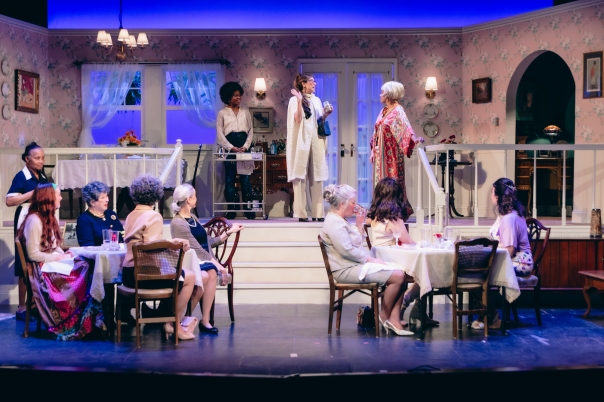
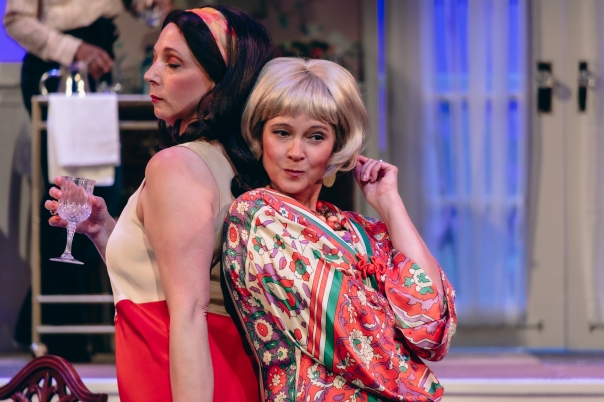
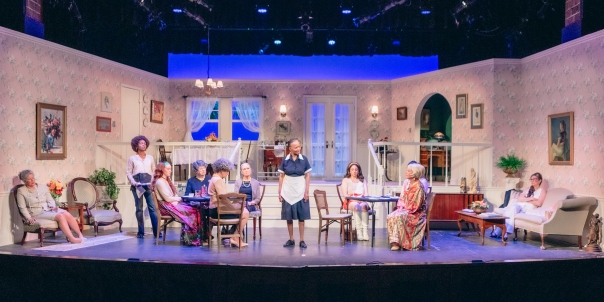
Louise Kennedy’s circle is a looser agglomerate than P.J. Barry’s octet, which was an unwavering group of eight sisters. And it’s only Louise’s circle tonight because hostess chores hopscotch from member to member on successive Thursdays. Nor are participants constant, we learn, as Louise welcomes us to her cheery, symmetrical, split-level living room – two tables flanked by two sofas – a luxe scenic design by Tim Parati that gives us peeps at the garden and the foyer.

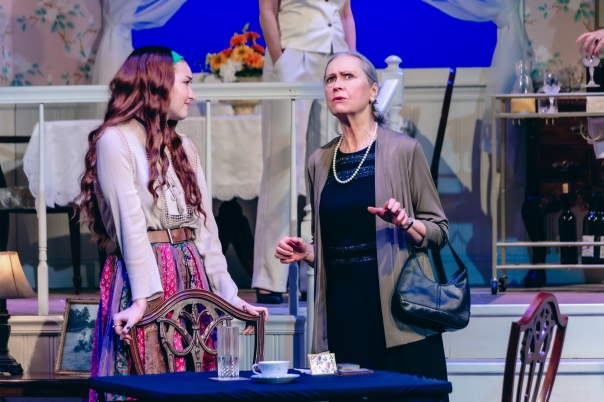
Tonight, for example, Louise’s college co-ed daughter, Mary Carter Kennedy, is in town to play one of the hands, to be partnered with Louise’s mother-in-law, Mrs. Kennedy, who has earned a risqué reputation in LaGrange, North Carolina, as a liberal. Since one of the regulars can’t make it this week, dear Louise is bracing herself for the arrival of Miss Virginia, who will likely be roaring drunk as soon as she can guzzle sufficient booze. Excitement is ratcheted up further by a new player that only our host knows, Carmella, feared to be a judgmental Yankee – and to have a profession!

Imagine that!

The two tables are filled out by Bootsie and Cluster, gals from Louise’s generation, and two more elders, Miss Caroline and the eternally disapproving Mrs. Coltrane, Louise’s mom. You can bet there will be plenty to rouse Mom’s umbrage, beginning with the fact that housemaid Margaret and her daughter Bernice will be mixing drinks, pouring beverages, and preparing the hors d’oeuvres. Mary Carter also has a truckload of disclosures that will disconcert her granny.

Hosting such an exhilarating event is so intricate, complex, and daunting that Louise – or anyone who hosts the circle – cannot be expected to participate in the cardplaying. The standard of perfection is too high for a hostess to divide her attention. Tables must be carefully set, partners thoughtfully chosen, and place cards placed exactly so at every chair.

Sadly, Carmella hasn’t chosen the best night for her first sampling of Southern hospitality – or the best year. It’s 1970, LBJ is midway through his second term and the backwater of LaGrange still has separate black and white schools, bathrooms, and post offices. “It’s always been that way,” Miss Caroline complacently declares, and none of the LaGrange ladies except the liberal Mrs. Kennedy seems to suspect that Margaret or Bernice might be discontented with the racist status quo.

Needless to say, Kennedy has concocted a comical time bomb that is primed to explode before our eyes. Desegregation has arrived and Louise’s mom and husband have decided to send their imperiled offspring to military school – a betrayal of Louise’s bestie, Bootsie, who was counting on her public-school solidarity. Nor will Mary Carter, an activist at school, take this well, while Carmella and Mrs. Kennedy will be reliably alarmed. Toss in a stray N-word from Virginia when she’s sufficiently lubricated and you may conclude that a polite evening of bridge has been scuttled.

Before his fictional kindred took the stage on opening night, the playwright Kennedy spoke to us about his autobiographical work and introduced us to the real-life Mary Carter, proudly sitting in the third row. So when Tonya Bludsworth entered as Louise, it was a bit like a continuation of the playwright’s monologue, except that the hostess was giddier with excitement and nervousness because she didn’t know how the evening would go.

Sketching each lady who would sit in each bridge chair, the intro was a bit draggy despite Bludsworth’s fretful charm, particularly since the playwright doubles down on his intros by granting Louise mystical foresight into who is arriving at her front door – tripling down when she greets them by name. Most people will be delighted with Kennedy’s style, which endows most of his characters with the ability to come up with a Southern-fried quip or a salty simile in nearly every sentence.

Almost by magic, Kennedy is able to differentiate between his ladies anyway, thanks to the big family squabble and the political, class, and age divides. Dennis Delamar’s stage direction is as handsome as Parati’s set, elegantly accessorized by “props team” Lea Harkins and Lois Marek. No doubt Delamar’s successes are facilitated by the presence of at least three more actor-directors in his cast, Corlis Hayes as Margaret, Paula Baldwin as Mrs. Kennedy, and Bludsworth as the fourth ace. Assistant director Dee Abdullah is no slouch, either, as a dramaturge.

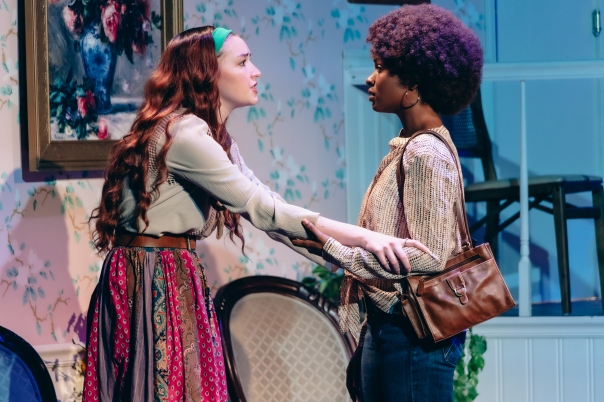
Kennedy’s lapses into logorrhea may be the result of his not realizing the full power of his script, which bursts forth with terrific force on Queens Road, first when Hayes reacts to the bombshell dropped by Kathryn Stamas late in Act 1 as the soused Virginia (which Grace Ratledge as Mary Carter and Ashley Benjamin as Bernice refuse to let go) and then a stunner by Ann Dodd as Mrs. Coltrane when she is unexpectedly confronted deep in Act 2.

Costume designer Angeli Novio accepts the challenge of making the hotsy-totsy New York lawyer, Stephanie DiPaolo as Carmella, stand out among the local LaGrange fashionistas in her haute couture. DiPaolo does her Long Island accent lightly enough to maintain her stature as an evolved Yankee outsider, but instead of leaning more into her legal expertise and feminist superiority, the playwright lets her devolve into an excuse to more thoroughly introduce us to the natives.

No matter how charmingly Jenn Grabenstetter as Bootsie and Amy Pearre Dunn as Cluster expound on the origin of their Dixie nicknames, I just don’t care, even if it did incentivize them to audition. Let’s get to the juicy stuff quicker! And when we do get there, let Baldwin have more space to bemoan and bewail how her son could conspire with Mrs. Coltrane to send her dear grandson off to a boarding school. It’s a glaring plot point that needs to be addressed – and weren’t we in the middle of a war in 1970?

Regardless of how much more meat Kennedy could pile onto our plates (and how much candy he could discreetly remove), Hayes makes an enduring impression in her climactic monologue, deftly calibrated by the playwright not to become a tirade. Ginger Heath, anointed my first Best Actress many years ago, get surprisingly little to sink her teeth into here despite her imposing wig, but that only spotlights the exploits of the newbies all the more.

Benjamin absolutely commands the stage when she unexpectedly returns in Act 2 as Bernice, a bit of a surprise after her badly miked debut as Tinman last September. That leads to a rather memorable sequence of assertiveness, contrition, and reconciliation begun by Dodd in her QC debut as the formidable Mrs. Coltrane. I didn’t expect to weep after intermission, but I did, even while the quips kept landing.

Small Sizing Yields Big Rewards in DCP’s Fun Home

Review: Fun Home at Armour Street Theater

By Perry Tannenbaum

Across the way from the Gershwin Theatre, where Wicked has been running for over 20 years, you can find my favorite Broadway theater, Circle in the Square. At the other end of an underpass that connects the two venues – and two or three flights of stairs underground – you and 800+ plus patrons (less than half the Gershwin’s capacity) can have a theater-in-the-round experience in a space that’s like a wee oval basketball court or a hockey rink.

I’ve seen seven different productions at this underground stadium since 1999, most unforgettably the world premiere of Tennessee Williams’ Not About Nightingales that year and the visionary waterworld of Mary Zimmerman’s Metamorphoses in 2003. Right now, two other Circle gems are playing in Metrolina revivals, Lombardi at the Lee Street Theater in Salisbury and five-time Tony Award winner Fun Home at the Armour Street Theater in Davidson.

A couple of admirable versions of Jeanine Tesori’s musical have already run in the QC, a Broadway tour at Knight Theater and an Actor’s Theatre reprise on the Queens U campus, so the current Davidson Community Players production, directed by Danielle Melendez, has big shoes to fill. What strikes me most positively about DCP’s effort, however, is how small it is. If you’re sitting in the front row, as my wife Sue and I were last Saturday evening, some of the action will be right next to you. Or behind you.

From that vantage point, DCP is better than even the 2019 Actor’s Theatre production at Queens’s Hadley Theater in replicating the intimacy of the Circle in the Square experience. Set designer Chip Decker, who stage directed the Hadley production during his years at the helm of ATC, retains his bright visual concept – a departure from the more funereal Broadway and touring versions – in depicting the Bechdel Funeral Home, allowing Alison Bechdel’s cartoons free play on the translucent windows of the parlor.

Often, they’re animated, with Bechdel’s words and drawings blooming before our eyes.

As we watch Lisa Kron’s adaptation of Bechdel’s graphic novel unfold, there’s a nice little studio perch set aside at stage right for the full-grown Alison to narrate. Sometimes as Alison, Kel Wright insinuates herself into the action, lurking in the main playing space, sketchbook in hand, as Small Allison and Middle Allison act out her vivid memories of growing up at a Pennsylvania funeral home and coming out as a lesbian at Oberlin College.

The bright visual concept tracks better with Kron’s book, because darkness only gradually seeps into the story. Alison’s dad, Bruce, seems like a bookish, excessively neat and proper mortician at first, mainly because he and his dutiful wife Helen conspire to hush up his big secrets. When Small Alison and her brothers sing “Come to the Fun Home,” a faux commercial jingle for the funeral home, the childish glee is as contagious as an early Jackson 5 hit or something fresh from little Donny Osmond and his backups.

Bruce may discourage these boisterous outbursts, but he cannot suppress them. Similarly, when Small Alison wants to go to her school party in jeans and sweater, Bruce can temporarily impose his will by shaming his daughter into wearing a dress. It’s only in retrospect that we and the full-grown Alison realize that Bruce was mostly protecting himself, shielding the truth of his own sexuality rather than upholding propriety.

Ironically, the fulcrum begins to shift for Middle Alison at Oberlin College, where she discovers her own gayness. This is jubilantly proclaimed in “Changing My Major (to Joan),” a song that equals the joy of “Fun Home” and surpasses it in exuberant sensual comedy. Tesori is at her best in these chamber sized songs with their pop flavorings and their Avenue Q spice. Even at her peak in Caroline, or Change and Kimberly Akimbo, Tesori’s other acclaimed shows, there’s a little bit of Sesame Street mischief going on.

Having coped with Bruce’s escapades for decades, Helen understandably freaks out when her daughter informs her that she has come out. Alison can only see her mom’s distress through a haze of misperception. Yet we always like Alison because she not only observes herself and her family with her sketchbook, she perseveres on her path and eventually, if still hesitantly, confronts her problems.

Despite Dad’s disdain, she continues to opt for cartooning instead of “serious” art, continues to wears jeans instead of dresses. Faced with Joan’s advances, Middle Alison retreats… temporarily. She seems to hibernate and marinate after writing home about her gay epiphany, processing Dad’s puzzling evasiveness and Mom’s distress, but she elects to bring Joan home with her when she returns from Ohio on winter break.

Darkness falls gradually, but it falls hard.

Mortician, English teacher, preservationist, and molester of underage boys – there’s a lot to unpack, even for adults in the audience, as we try to understand and judge Bruce in the context of his times. Coming off his outré antics in Vampire Lesbians of Sodom,Ashby Blakely is as varied, complex, and nuanced as we’ve ever seen him as Bruce. At times, he roars in his tyrannical moments, overpowering the small house. Like all the other players, he’s miked, but thanks to Kathryn Harding’s exemplary sound design, there’s never any distortion, clipping, or dropouts to mar the show or its music.

The one major sacrifice for theatergoing purists is the lack of a live orchestra at Armour Street. Nevertheless, Harding contrives a surround effect by channeling the prerecorded soundtrack and the amplified voices from the rear speakers. It was a pretty unique front-row experience for me, rather enjoyable.

After her exploits at Booth Playhouse as Norma Desmond in Sunset Boulevard, Alison Rhinehardt had already convinced me that she could overpower Armour without a mic. As Helen, she predictably knocks her showpiece, “Days and Days,” out of the park with diva aplomb. Until then, she’s rather wholesome and humdrum, accentuating Mom’s breakout.

Nor is there any perceptible cratering when we scrutinize the less familiar names in this cast. Recently unveiling her directing chops in the Queen City Concerts premiere of Local Singles,Wright brings an exacting intensity to Alison that always captures the drama, even when she sings. “Caption,” she keeps barking in Kron’s script, so her valuation of le mot juste always seems foremost as her castmates take care of the graphics.

As the Bechdel brothers, Aiden Honeycutt as John and Grayson Flowers as Christian help turn Small Allison’s “Fun Home” promo into an exhilarating panorama. Bailey Fischer takes flight almost from the first moment we see her as Small Alison – goodness, energy, and precocity personified until her last “Flying Away” moment. That energy is formidable when Ann Schnabel must take over as Middle Alison, especially in the intimidating context of a matriculating college freshman. In a sense, then, her “Changing My Major” is as much a rebirth as it is an affirmation.

It’s the needed embrace of the real world that will ultimately help her in coming to terms with the truth about Dad.

Criminal law is far more confident than my feelings in determining who the forbidden fruit is among the remaining cast. As the revelatory Joan, Sierra Key seems healthy enough, her seductiveness sufficiently muted for a Midwest coed. At school and visiting the funeral home, Key hits all the notes that emphasize Joan’s savoir-faire and discretion without pounding them. As the Bechdels’ handyman, Bart Copeland struts and preens enough to convince us that he’s also a consenting adult.

When he switches roles and becomes a former student that Bruce picks up on his nocturnal rambles, Copeland calls upon the naivete that made his star turn as Pippin so compelling last spring at Theatre Charlotte. Topped with a mop-top wig, you’ll see he’s also a perfect fit for Tesori’s retro pop music.

Doubling the Fun

Okay, so maybe you weren’t duly impressed that two shows are now running in Metrolina that premiered at the same Broadway theater. We can do better. Weirder. This coming weekend boasts two different shows set at a funeral parlor! Yes, as Fun Home continues for two more weekends up in Davidson, down here at Booth Playhouse, Charlotte Conservatory Theatre is bringing us the world premiere of Nan-Lynn Nelson’s Leaving Watermaine, directed by the playwright.

It opens on leap day this Thursday, at the tail-end of Black History Month, for a four-day run. By the end of Act 1, we’re greeted with a busy weave of plot threads involving undertaker Werly Mainlodge, his three daughters, and their beaus – both beloved or unwanted. Which of the three young ladies will be leaving first? Elopement or honeymoon? Will the Klan intervene on the eve of the planned departure?

Has there been a KKK lynching or a passionate murder? Or is the presumed victim still alive? Mystery, racism, colorism, and comedy peep into what seems like a tragedy, so you’ll need to stick around after intermission to learn how the dangling threads sort out. Nelson seemed to have it all calculated, incorporating her own musical soundtrack into her sound design.

Dialing Up the Almighty in Memphis

Review: The Mountaintop at Theatre Charlotte

by Perry Tannenbaum

A stage with a particularly authentic – or imaginative – set design is a good start for a director who wishes to immerse you in the world of a play. Yet few productions surround you with the theatre experience, making you feel outside your own world and inside theirs. Sleep No More was dedicated to achieving this mission with a Macbeth makeover up in Manhattan’s Chelsea district at a spooky hotel, where I saw it in 2015. So was Then She Fell the following night in Brooklyn, where I was plunged into the imagination – and mental illness – of Lewis Carroll.

In Charlotte, such efforts have been comparatively infrequent, but not unknown: Chickspeare’s Fefu and Her Friends on Cullman Avenue in 2001, numerous “environmental” productions by Carolina Actor’s Studio Theatre (CAST) in their days on Clement Avenue, and Matt Cosper’s legendary Bohemian Grove of 2014 that was staged god-knows-where – you had to agree to be kidnapped in a van by The Machine at the Actor’s Theatre parking lot to attend.

They do make an impression, these hyper-immersive presentations.

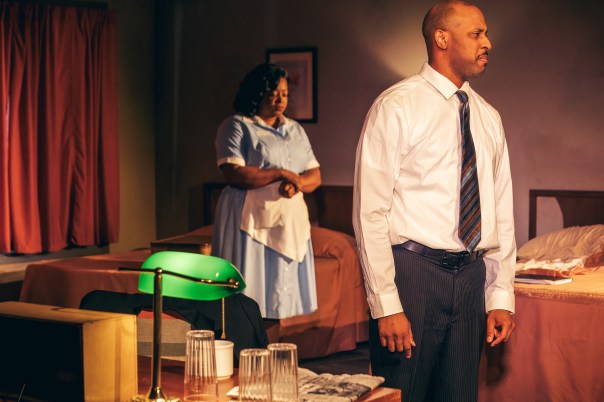
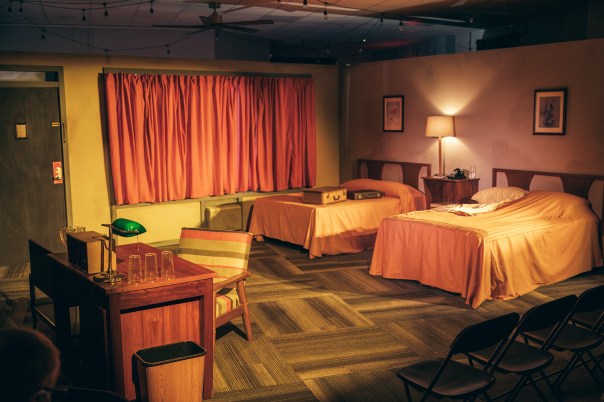
Cut to the legendary Queens Road Barn for the latest Queen City experiment in environmental staging. Yes, that’s Theatre Charlotte – in Myers Park! – on the cutting edge with its new production of Katori Hall’s The Mountaintop. Directed by the ageless Corlis Hayes and designed by Chris Timmons – with a nine-person “Lobby Transformation” team – this is the first fully-staged drama my wife Sue and I have seen in the 501 Queens Road lobby since the spare and forlorn Waiting for GODot in 2007.

Together with invaluable help from David Gallo, set designer for the 2011 Broadway production, and props designer Brodie Jasch from Fayetteville’s Theatre Squared, Dr. Hayes and her production team aim to take us back to the Lorraine Motel in Memphis on the night of April 3, 1968. Rev. Martin Luther King, Jr., returns from the Mason Temple, where he has just delivered his eerily prophetic “I’ve Been to the Mountaintop” speech.

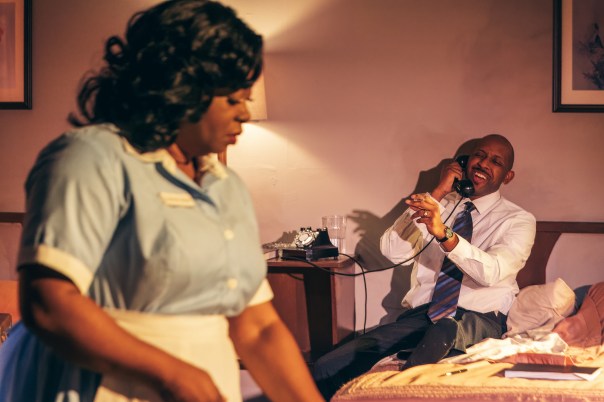
Every detail of the last room occupied by MLK has been replicated with meticulous authenticity – night tables and their contents, lamps, the chair and its fabric next to the window, the window curtains, the bed coverings – all the way down to the upside-down zero on the door to Room 306. With walls within walls, you must enter through this door to get your first view of the new theatre space in the lobby created for this production. Only the ceiling remains unaltered, with its fans and extinguished holiday lights. Explanations are appended in the digital program for those details which couldn’t be ascertained and those that would have conflicted with Hall’s script.

Since there is no intermission and all the usual concession outposts have been whisked away, they have thoughtfully made “Room Service” available to ticketholders via a QR code. In more ways than one, we are treated like kings at The Lorraine. Fun fact: the fateful motel was actually named after the hit 1928 song, “Sweet Lorraine,” popularized by jazz artists Teddy Wilson and Nat “King” Cole.

For all of Dr. Hayes’s reverent devotion to getting the look and feel of The Lorraine recreated as faithfully as she can, we soon see that it isn’t a shrine. Hayes is equally bent on getting to the heart of Hall’s pointedly irreverent drama. Hall provides ample time for solemnity and anguish at the end, but until then, she wants us to see the soon-to-be-martyred icon as a man, not a god, and not even as a holy man. The real Martin – or as God likes to call him, Michael – had his foibles, vices, and infidelities.

And notwithstanding the resounding valedictory declarations of the Memphis speech we’ve heard over and over – “So I’m happy, tonight. I’m not worried about anything. I’m not fearing any man” – Hall insists on reminding us that King did have worries and fears.

All obeisance to King’s saintly aura is swiftly discarded almost as soon as we see Justin Peoples taking on the role, before he walks through the audience to take a pee. Not only is he unkempt after his oratorical exertions and his walk through the rain, he has largely dropped his dignified public persona, at ease if not quite relaxed. Though he diligently examines his room’s rotary phone to make sure it isn’t bugged, we can hear that he has switched from formal to casual mode as soon as he speaks. It’s with an unmistakably Southern accent!

Immediately disarming. Neither the touring production by the famed Penumbra Theatre of Minneapolis that ran at Booth Playhouse in 2014, nor the homegrown Actor’s Theatre run of 2018 at Queens University, directed by April Jones, had quite the same spontaneous or undignified impact. The smallness of the lobby space at the Queens Road Barn certainly helps in establishing a closer intimacy with King and a sharper look at his vulnerabilities.

Maybe that folksy drawl would have been even more impactful if Peoples had held back on it until MLK had dialed room service after normal closing hours. The arrival of LeShea Stukes as the fetching Camae, a housemaid moonlighting as King’s waitress, would have been a good moment for Peoples to turn on the Southern charm. But for those of us who have seen The Mountaintop before, Stukes brings with her more than Camae’s sensual allure, more than her extra Pall Malls to satisfy King’s chain-smoking, and more than her working-class sass.

She now gives us solemn glances from behind King’s back, fully aware of the gravity of her true mission before she discloses it, morphing from pursued damsel to admonishing paramour to chum to messenger of God. None of these fresh wrinkles quite accounts for the marvelous voodoo or the juju that Hayes, Peoples, and Stukes have conjured up in creating the playful, poignant, and profound chemistry of this Camae and MLK.

Lighting designer Jennifer O’Kelly gently signals those moments when Camae might be contemplating why she’s there, foreshadowing the AV extravaganza that will accompany Stukes’ final mountaintop revelations. She will almost be speaking in tongues when we reach this visionary summit.

There’s little theology here, for when King dials up the Almighty, pleading his case for more time on this turbulent planet, she hangs up on him. Yet there just may be some deep dialectic in Hall’s scheme that narrows the gap that we might feel between God’s biblical judgment upon Moses at Mount Nebo and the judgment upon Martin in Memphis.

Moses was given a precise catalog of his greatest sins. Maybe in an afterlife he learned not to shatter any holy tablets or assault a boulder without God’s approval. But what was the great sin that deprived MLK of the Promised Land that awaited his people? The answer never comes explicitly in the play, but King’s sins – though relatively petty until we consider possible adultery – are graven in its marrow.

In an age when not a day goes by without yielding fresh images, outrages, and crimes committed by a lying orange buffoon, we might find ourselves shocked to be shoved towards such traditional moral moorings. Some of these values were written long ago in our marrow. Leading a people may still require adhering to a higher standard in God’s job description, not flouting the laws and proprieties that apply to everyone else.

Peoples and Stukes, with plenty of finely judged assistance, have found a way to make The Mountaintop more poignant, relatable, and human. Hall’s work becomes more touching, meaningful, and necessary each time I see it.

The More Things Change, the More Confederates Shocks and Delights

Review: Confederates at The Arts Factory

By Perry Tannenbaum

Symmetry, parallelism, continuity, and evolution are intricately interwoven throughout Confederates, Dominique Morriseau’s comical and sometimes farcical drama of 2022. The Charlotte premiere, now at the Arts Factory, comes to us less than two years after its Off-Broadway premiere in a highly polished, smartly aware Three Bone Theatre production.

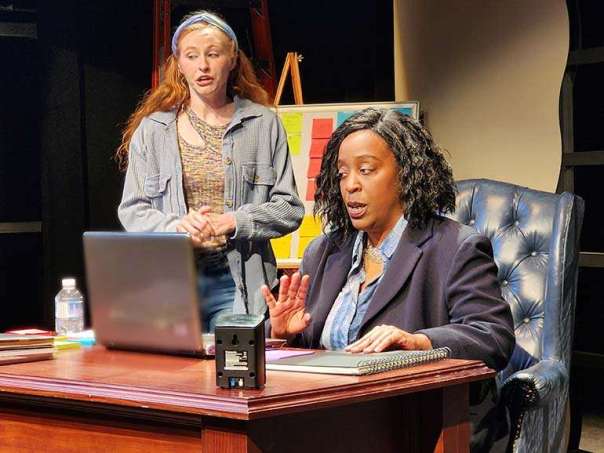
Morriseau’s symmetry isn’t subtle: it hits us straight in the eyes the first time we see Zachary Tarlton’s scenic design. Split down the middle, the Arts Factory stage gives two eras and two institutions equal play in an intimate black box format. One side evokes Civil War slavery on a Southern plantation, while the other half introduces us to contemporary academia.

We alternate between settings, starting with Sandra, a modern tenured Black professor, proclaiming her outrage and sense of violation in vivid terms – yet with the poise and sleekness of a contemporary college lecture accessorized with slides. From that peep into scandal in present-day academia, we flash back to the slave quarters of Sara as her brother Abner sneaks into her bedroom through a concealed trap door.

Sandra has been maliciously targeted by a student or teacher who pasted a demeaning old Civil War photo of a bare-breasted black wetnurse suckling a white baby – with Sandra’s face photoshopped to replace the original slave’s. Jumping to conclusions or instinctively making connections, we’re apt to immediately believe that Sara was that nurse. Abner has volunteered for the Union Army and has been wounded in battle, so as she sews up Abner’s wound, the subject of Sara’s nursing skills is inevitably addressed.

Sara’s skills and ambitions extend further. Dangerously. She has already learned how to read, breaking one terrible white taboo, and she wishes to nurse and fight for the Union alongside her brother – to learn how to fire a rifle right now. That’s a pill Abner can’t easily swallow.

Otherwise, the two women have separate storylines until Morisseau split-screens them together at the end. Portraying Abner in his Three Bone debut, Daylen Jones is the first subordinate character to cross the invisible line between pre-Emancipation Dixie and the hope and refuge of modern-day academia. Shedding his rags and his Union blue greatcoat, Abner becomes the aggrieved Malik in today’s world. He’s obviously a gifted student, and his gripe with Professor Sandra is that she grades his papers more harshly because he’s Black, protecting her immunity from being charged with favoritism.

Seeing that there are only Black females on faculty – and no men – Malik feels doubly oppressed by bias in academe: racial bias compounded by gender bias. Notwithstanding her starchy professional manner, Sandra is more of a crusading sociologist than a sober judge. So she may indeed have fallen prey to the trope heaped upon oppressed races and genders that says, “If you wish to be treated as an equal, you need to be better.” Pragmatic? Sure. But for a gifted scholarship student seeking to maintain his A average, cold comfort.

We eventually see that there are four characters on each side of the time divide, three of whom repeatedly change costumes to play double roles. Before and after we can tally all this, director DonnaMarie and sound designer Tiffany Eck place two snippets from Nina Simone’s “Four Women” at strategic spots in their playlist, layering on extra meaning – and mythic aura – during scene changes.

If Jones can be labeled as two provocatively different militants as he roams back-and-forth from opposite sides of the stage, then Holli Armstrong (also on my radar for the first time) can be regarded as two variants of an imperfectly enlightened white racist. She is most exaggerated and hilarious on the Southern plantation as Missy Sue, the master’s daughter, when she comes back home as an undercover born-again Abolitionist. It is Morisseau as much as DonnaMarie who is prompting Armstrong to bring a Gone With the Wind air-headedness to Missy Sue – and a twisted lesbian desire for Sara – and she obliges with fiddle-dee-dee gusto.

She offers Sara a perk in exchange for executing a dangerous mission: if Sara will transcribe and transmit Master’s battleplans, she gets to live in the big house while Sue delivers Dad’s secret intelligence across enemy lines. Sure, that’s an appreciable upgrade for Sara, but she’ll still be a slave doing Missy Sue’s dirty work.

Armstrong discards Missy Sue’s pea-brained giddiness when she transitions to Candice, retaining her sycophant tendencies and much of her high energy as she haunts Professor Sandra’s office, working off her tuition debt and gathering gossip. Her true manipulativeness gradually emerges in successive office scenes, but Candice never becomes as juicy a role as Missy Sue is, for she somewhat downplays her suck-up moments with faculty.

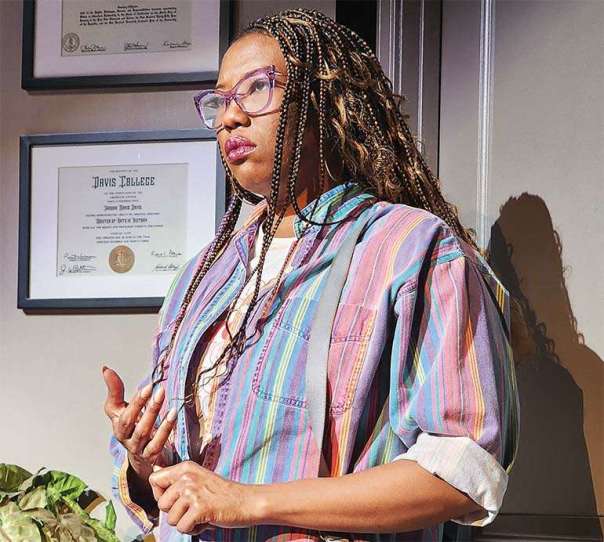
Last to appear onstage, Jess Johnson draws the most balanced – and delicious – of the dual-role combos. As the master’s Black mistress, the opportunistic Luanne effortlessly sniffs out that Sara’s access to the master’s office and desk are coming at a price the newcomer must pay, possibly beyond accepting Missy Sue’s sexual advances. On the academic side, Johnson gets the most radical of costume designer Chelsea Retalic’s backstage makeovers when she becomes Jade. Professor Jade is more stylish and popular than Sandra because she’s chummier with her students and would never dream of hamstringing the Black ones.

At both ends of the stage, Johnson gets to be a wily master of psychological warfare. Both Luanne and Jade want something vital from our protagonists. Luanne wants friendship from Sara and a path to freedom, but if Sara bars the way, she can work her charms on Abner. Needing Sandra’s endorsement, Jade doesn’t tiptoe around her differences with her superior, unleashing a torrent of scorn and chutzpah that took my breath away.

Indeed, Johnson unlocks Morisseau’s grimmest joke on her protagonists. Whether you’re at the bottom of the pecking order or at the top, you’re still the most oppressed person in the room. Times have changed, but not that much.

Sara is always being pulled at from multiple directions. Abner needs to be sewn back together, Missy Sue wants to recruit her as a spy, and Luanne wants her to plot an escape to freedom. Maybe that’s why the playwright stretched out Sara’s name to Sandra for the New Millennium! Our Professor is no less pressed upon, strongly urged to re-examine her grading philosophy, softly reassured that she is more admired than she really is, and arrogantly lobbied for tenure backing. Nobody seems to really care about the bare-breasted insult that was slapped on her office door.

Neither of these roles is fun-filled, but the challenges Sara and Sandra face allow them to grow in strength and stature before our eyes. Valerie Thames and Nonye Obichere are so fiery and authoritative in their separate roles that you can comfortably watch Confederates as two separate plays without constantly considering how meanings and brilliance bounce off the facets of the two gems. Not feeling compelled to track the finer points of Morisseau’s disquisition on racial or gender bias makes it all the easier for an audience to enjoy them.

Thames effortlessly takes on the self-assurance of an established TV guest whose knowledge and viewpoint are proven commodities, wearing Professor Sandra’s celebrity status with insouciant dignity. Just watch out when she bursts into flames! Maybe run for cover.

Although Sandra’s speeches frame the drama, Obichere gets to be a more physical presence as Sara – as nurse, spy, soldier, and lover – and she navigates a far wider character arc. Hers isn’t the funniest performance you’ll find this weekend at The Arts Factory. But it’s the most vivid, shocking, and memorable.

You may leave the theater convinced that both Sara and Sandra are depicted in that horribly racist slide. But it will mean more at the end than at the beginning. The magic of Morisseau and Photoshop are both at work.

Ensley and Schroeder Check All the Beautiful Boxes in Matthews

Review: Beautiful The Carol King Musical at Matthews Playhouse

By Perry Tannenbaum

When you think of singer/songwriter Carole King and Broadway musicals, there’s an instant disconnect: the humble simplicity of King’s Tapestry album cover clashing with the glitz and blare of the Great White Way. So a Broadway musical about King’s career is more of a stylistic stretch than a biomusical about most rock stars, pop stars, or jazz & blues divas. Everyone involved behind the scenes of the original 2014 production of Beautiful The Carol King Musical seemed keenly aware of the dichotomy, including director Marc Bruni, orchestrator/arranger Steve Sidwell, and scriptwriter Douglas McGrath.

Their idea of coping with the problem was by leaning into it. Not too subtly, they conspired to make the early stages of King’s career seem crass and commercial, as if she were trapped in the dog-eat-dog maw of the pop music industry. King and her writing partner, lyricist Gerry Goffin, write the songs while producer Don Kirshner finds the singers and the groups who will cut the singles – the likes of Bobby Vee, Little Eva, The Drifters, and The Shirelles. Yet somehow the hierarchy is flipped in the famed Brill Building in NYC.

Carole and Gerry are slaving for Kirshner, a genial industry mogul and taskmaster, and the couple’s best early music loses a lot of its luster when it’s farmed out, especially when “Up on the Roof” falls into the hands of The Drifters and “Will You Still Love Me Tomorrow?” is butchered by The Shirelles, thanks to excessively ornate Sidwell arrangements that would be more at home on Broadway or Vegas than Motown. These excesses helped Jessie Mueller to shine all the more brightly in the original cast – and for her sister, Abby Mueller, to shine equally when the touring version hit the QC in April 2016.

So a downsized production, like the one currently running at Matthews Playhouse, actually has the potential to be better than the Broadway and touring versions – with the right personnel and sufficient pizzazz. With Billy Ensley directing and Lindsey Schroeder leading a heavyweight cast, both those boxes are checked. The Broadway ensemble sheds two of its three keyboards nestling into Matthews, one its two guitars, and one of its percussionists. The slimming helps. No longer smothered by their orchestrations, Neil Sedaka’s “Oh! Carol,” Gene Vincent’s “Be Bop a Lula,” and Little Eva’s “Loco-Motion” sound more like rock music and less like mockeries.

Ensley targets the megahit by the King-Goffin duo’s friendly rivals, Barry Mann and Cynthia Weil, for his most farcical treatment. Not only is the arrangement of “You’ve Lost That Lovin’ Feelin’” garishly distorted, amped up from the swampy-echoey-churchy vibe of the original single, but the gulf between the bass and tenor voices of the Righteous Brothers is greatly emphasized, exaggerated, and comically exploited by Johnny Hohenstein and Zach Linick.

McGrath’s book is most affecting when it deals directly with King, though there’s bold poetic license in his voodoo, historically speaking. Pressured by Kirshner to come up with a new hit overnight for The Shirelles (in real life, they only had one hit record so far), King writes the music and goes to bed with Goffin. Perfect setup. Wouldn’t you like to wake up in the morning and find the handwritten lyrics for “Will You Still Love Me Tomorrow” perched on your piano – and be the first person on Earth to read and sing them?

No disrespect to the great Bobby Vee, but we’ve suddenly ascended more than a few notches above “Take Good Care of My Baby.” This moment still grabs me, but there are more moments like this after intermission, when “You’ve Got a Friend” and “A Natural Woman” are unveiled, that choke me up even more – as King breaks away from the Brill Building and starts to do her own thing. Schroeder replicates the sandy sound of Carole’s voice from the beginning, but as she transforms from a demo singer behind an upright piano to a chart-topping performer, watch out.

Schroeder can not only belt – she can tear your heart out.

McGrath’s dramatization heightens the magic most memorably when “You’ve Got a Friend” is reframed as a not-quite-farewell song, when King embarks for her solo career in LA with Kirshner’s blessing, and both Barry and Cynthia gather round the old upright with her to sing this newborn masterpiece. The song didn’t really come out until her second album, but who’s counting, right?

Nick Southwick as Barry and Sophie Lanser as Cynthia (get that woman a more reliable mic!) deliver polished performances all evening long, but they also grow more gravitas after intermission. Lanser sheds the frivolity of a “Happy Days Are Here Again” parody and “He’s Sure the Boy I Love” and joins Southwick – previously mired in the silliness of “Who Put the Bomp” and the wrong-key version of “You’ve Lost That Lovin’ Feelin’ – in a heartfelt “Walking in the Rain” duet.

Then if you haven’t started weeping with Schroeder’s “It’s Too Late,” you’re at the mercy of “You’ve Got a Friend” when Lanser and Southwick join in on the quivering-lip goodbyes. After playing Kirshner with avuncular savvy throughout King’s formative years, Ryan Dunn sprinkles some welcome laughter into this maudlin scene with a (purposely) bad attempt at vocalizing.

I’d forgotten that Carole had Aretha’s 1967 hit in her hip pocket when she cut Tapestry out on the Left Coast in 1971, so I found myself suddenly suppressing sobs when “A Natural Woman” began. Here it felt very right that Sidwell’s arrangement brought added vocalists and brass to beef up the simplicity of King’s version – and freed Schroeder to narrow the gap between Carole and the Queen of Soul with some fervent belting.

Marty Wolff’s simple two-story set design, with four wide strips of stained-glass paneling running vertically upstage in front of the eight-piece band led by Ellen Robison from the keyboard, needs only JP Woodey’s lighting to give it a rockin’ modernistic zing. Lisa Blanton’s choreography is devout doo-wop, most praiseworthy for how well the groups stay in sync, and Chelsea Retalic likely cranked out between 75 and 100 costumes for this large cast – all of them, from the sleekest to the grungiest, on point.

And the wigs! The only misfire here, among dozens of triumphant coifs – several for Schroeder – was the oceanic profusion of waves that perched on Joe McCourt’s head as Gerry Goffin, making him virtually unrecognizable. McCourt, a musical mainstay in the QC since his debut in 2008 as the lead in Godspell, has suavity to spare to spare and, in contrast with Southwick’s quirky neuroses as Barry, gets a nice and bumpy character curve as the only troubled soul we see.

This image has an empty alt attribute; its file name is beautiful24-139.jpg

As for the Afro-American doo-woppers… my, oh my! By bringing Nehemiah Lawson aboard to take over “Some Kind of Wonderful” from Schroeder and McCourt and then to bring him back again and again to sing “Up on the Roof” and “On Broadway,” the latter one of Weil & Mann’s best, Ensley and Robison signal that they have no plans of dissing The Drifters. Meanwhile, two lead singers are embedded among Ensley’s Shirelles. As Janelle Woods, the Shirelle who denigrates “Will You Still Love Me” as “too country” before fronting the breakthrough single (first Billboard #1 for an African-American girls’ group), Brianna Mayo gets a chance to show that her acting chops are as strong as her singing skills.

Shortly afterwards, Raven Monroe emerges from the backup Shirelles to become Little Eva and ignite “The Loco-Motion.” Until then, she moonlights as King’s babysitter during the leading lady’s brief marriage to the restless Goffin.

There’s a formulaic circle to McGrath’s storytelling that’s not at all displeasing, starting and ending with King as a star behind a grand piano singing a song from Tapestry. We flash back to her youth in Brooklyn and eventually touch down at Carnegie Hall, surely a kind of Jerusalem for a humble Jewish girl. Alongside her at the beginning and at the end is Carol Weiner as Genie Klein, King’s mother. Both were abandoned by her no-good father, steeled by adversity. Along the way to Carnegie, Weiner peeps in with a couple of overprotective warnings, a few salty quips, and a proud Mama’s lie.

If McGrath can embellish a good story, why shouldn’t she

Vampires and Trumpers

Reviews: Vampire Lesbians of Sodom and Thanksgiving: 2016

By Perry Tannenbaum

For devout upstanding citizens who had decided way back in the hippie ‘60s that Greenwich Village was an abominable den of sin, Charles Busch’s Vampire Lesbians of Sodom was a flaming and perverse poke in the eye. Or an argument clincher when it landed on Macdougal Street in 1985. The New York Times raved, the extravagant little trio of sketches became a cult obsession, and Vampire Lesbians had a five-year run.

Busch slipped away from his castmates when the review came out in the early morning after the Provincetown Playhouse premiere and had a good cry. Why did this diva desecrate his mascara? His career in theatre was now assured. He would write more outrageous comedies and send-ups that he, as the prima donna, could cross-dress and slay in, most famously Psycho Beach Party.

Vampire Lesbians made it to Charlotte at the Pterodactyl Club in 1991, after the slightly wholesomer Psycho Beach had paved the way during the previous year. George Brown directed this orgy of sacrilege with fiendish glee, while Innovative Theatre co-founder Alan Poindexter starred with Keith Bulla as the titular vamps.

With the Rev. Joe Chambers carrying the torch for fundamentalism in the wake of Jim Bakker’s disgrace, Banktown was still a very Christian place. It was my sacred duty to bring my daughter, not yet bat mitzvahed, to see Poindexter in all his counter-culture glory. After beholding the kinky wonders of Psycho Beach, my Ilana would have kissed Alan’s feet.

Flash forward to 2023. Poindexter is gone and the Pterodactyl Club, the one-time cultural capital of Freedom Drive, is goner. But thanks to Nicia Carla and her PaperHouse Theatre, Hollywood antagonists La Condesa and Madeleiné Astarté (a Succubus and a Virgin Sacrifice back in their Sodom days) are undead again!

Taking on Busch’s mantle, Carla directs and stars in this stunning revival at VisArt Video, tucked into the nether region of a strip mall on Eastway Drive – I’m trying to make this little suburban dive sound as risqué as the Pterodactyl! Walls are black as you walk inside, and hostesses in Goth attire and makeup are there to greet you. Whatever Google Maps has told you (it misled both me and my wife Sue on separate occasions), you can now be sure you’re in the right place.

Small as it is, the inner sanctum of VisArt is perfectly sized for Busch’s secret forbidden rites. The seats are soft enough to keep butt burnout at bay for 90 minutes, even if you don’t stretch for intermission and fall prey to the treats in the lobby. Yet sightlines are not ideal according to Sue’s scouting report.

The PaperHouse cast multitasks even more than Busch’s original ensemble, just six players covering the 14 roles instead of seven. All six are battle-tested in madcap comedy, so this outrage is hardly outside their comfort zones. Nicia probably hasn’t had this much fun onstage since Poindexter directed her as The Witch in Hansel & Gretel. She minces and manipulates here as the Virgin Sacrifice, growing regal and stentorian as theatrical megastar Astarté as she assaults the Left Coast. Opposite her, Ashby Blakely is a steely, sneering diva bridging four millennia as The Succubus, aging gracefully into La Condesa and crossdressing in costume designer Beth Levine Chaitman’s most outré couture.

That isn’t to say that Josh Looney and Charlie Carla are anything less than visions of decadence as Sodomite musclemen Ali and Hujar in complementary S&M outfits and Wagnerian wigs. Nicia is already fairly slutty in the opening sketch despite her somewhat revealing white dress, willing to break her hymen with Ali or cut a deal with the cave monster Succubus. Subsequent scenes in Hollywood and Sin City climax in a couple of startling onstage costume changes, most improbably by Tanya McClellan who snoops into La Condesa’s boudoir as gossip columnist Oatsie Carewe.

Gosh, it’s good to see McClellan back onstage in manic comedy mode. Squinting her snoopiness, she sniffs out the ungodly acts performed by Nicia as Astarté on La Condessa’s protégée, luminous Sarah Molloy as flapper Renee Vain, and her meddlesome boy toy, Looney as matinee idol King Carlyle.

Hard times for a vampire? You’ll need to come back after intermission for Blakely’s final transformations. Andrea King’s choreography, on loan from Jane Fonda, elegantly shows off McClellan’s dancing prowess.

Anyone who reads advice columns or cruises social media at this time of year will have an accurate inkling of what Thanksgiving: 2016 might be about. Millions of Turkey Day hosts are wondering how they will keep opposing family factions from shouting their lungs out or coming to blows while the sharp cutlery is still on the table. Playwright Elaine Alexander smartly calculates that the situation is prime fuel for a dining room comedy – or tragedy – but the world premiere of Charlotte’s Off-Broadway production now at VAPA also reveals that the NC native had a tough time deciding which way to go.

Ground Zero for the annual onset of hosting panic was clearly in November 2016 when Hillary Rodham Clinton resoundingly won the popular vote for the US presidency while Donald Jefferson Trump won the Electoral College – and the White House – just as resoundingly. Liberals, Democrats, and rational folk are still in shock. Yet as Alexander deftly reminds us along the way, they are all blissfully unaware of the betrayals of good sense, rationality, rule of law, and democracy to come.

As the West family up in the liberal Northeast prepares to host young Eric’s girlfriend, riding up the highway from Alabama, the aroma of crisis already fills the suburban kitchen. Papa Harry, after diligently knocking on hundreds of doors crusading for Clinton, was hospitalized – either for a nervous breakdown or a heart attack – immediately after watching CNN declare Florida for Trump. The chief Turkey Day watchword from Harry’s physician is for wife and son to prevent the shell-shocked Hillary soldier from indulging his CNN addiction.

Taking to drink in the wake of her husband’s collapse, either out of worry or guilt, Renee has pretty much abandoned any serious intent to impress Brittany, the Southern belle she’ll be meeting for the first time. So it has fallen to young Eric to try to cook a luscious feast for his beloved, even though Mom hasn’t properly shopped for the occasion. Some improvising and substitution will need to be done. Worse, frozen will occasionally need to stand in for fresh.

Worst of all, Brittany voted for Trump, so Eric desperately hopes to keep talk of politics – the subject Dad is obsessed with and still agonizing over – away from the holiday dinner table. Harry has enough difficulty digesting that his son would date a girl from Alabama. Nor does Dad have enough self-awareness to realize that, in a reflexive action stemming from his years in community theatre, he mocks every Southern drawl he comes in contact with.

Finding out she’s a Trump voter could send him over the edge. Getting Dad to refrain from talking politics promises to be even tougher than steering him away from CNN. Finessing how to keep Brittany off the touchy subject is a bridge Eric hasn’t crossed yet.

As a director, Alexander casts father and son perfectly. Matthew Howie is a master of timorous anxiety as Eric. He can craft crescendos of panic and befuddlement while doing a hilariously awful job of warding off disaster with a shit-eating smile. Nor could we improve much on Tom Ollis as Harry. Since his 1997 debut at Theatre Charlotte in Arsenic and Old Lace, Ollis has grown into the most visible volcano on the Metrolina theatre landscape. Whether as Mr. Blonde in Reservoir Dogs, Sweeney Todd, or Titus Andronicus, Ollis is peerless at seething, suspecting, and erupting into towering, raving rages.

Since Harry is also a trial lawyer recently dismissed from his law firm because of his excessive zeal, Ollis can feast on numerous opportunities to cross-examine everyone in sight, bullying and browbeating every witness. Alexander’s women don’t get nearly as much scenery to chew, but her casting choices are nearly as impeccable.

Donna Norcross seemed to be battling opening night jitters early in Act 1 as Renee, but as Mom yielded to a multitude of wine refills, Norcross also relaxed, becoming quite powerful in the Act 2 denouement. Quite ripe for stereotyping, Michelle Strom as Renee entered the West home like a sudden ray of sunshine, without the preamble of a knock or a doorbell chime, her drawl as wide as the Mississippi. No, Dad could not restrain himself, nor could I blame him.

As you can imagine, the setup of Thanksgiving: 2016 is almost pure comedy – until the Trumper truth finally comes out, as an announcement rather than a shy confession, with the proud flourish of a cheerleader’s somersault. Looking from Strom to Ollis as we reach intermission, we can only wonder whether Dad will clutch his head or his heart.

But what can come afterward from our host, our hostess, and from poor Eric? Admirably enough, Alexander lets her characters carry her along across Act 2. But her impulse to bludgeon Harry with more secrets and uncomfortable turns this comedy upside-down. We transition, not very gradually, from a Neil Simon comedy of futile secret -eeping to an impactful series of revelations that conjures up Sophocles’ Oedipus, Strindberg’s The Father, or Albee’s Virginia Woolf. Those revelations are topped off by a  couple of increasingly jaw-dropping ideological rebukes to Harry’s smug liberalism that might shake you up a bit.

We seem to fall over a cliff here, with too little before intermission to prepare us for the high drama afterward. By the time the cast is taking their bows, Renee has radically transformed from a borderline bimbo into a pieta resembling Steinbeck’s Rose of Sharon on the final pages of The Grapes of Wrath. Instead of dumping us off a high cliff, I’d advise Alexander to lay down more track that would guide us around the mountain: a sudden dramatic swerve – not too sudden – would be more satisfying than this swan dive.

A visit to VAPA for Thanksgiving: 2016 is still worth it, delivering hearty laughs and a gasp or two. By all means, dig in!

Boom and Bust With the Lehman Brothers

Review: The Lehman Trilogy @ The Arts Factory

By Perry Tannenbaum

Even when histories are epic in length, like Gibbons’ Decline and Fall or Churchill’s Second World War, what we read at a seemingly slogging pace is a severe abridgement of what actually happened. Onstage, we move so much more swiftly in so-called histories as dramatists bring familiar and obscure people back to life, give them lively dialogue, and select even more narrowly among many actions, events, and consequences.

So the effect of The Lehman Trilogy at the Arts Factory, in a brilliant Three Bone Theatre production directed by David Winitsky, will likely be a revelation to anyone who might dread spending over three hours with a family of Jewish merchants, traders, and bankers. The chronicle stretches more than three generations and 160 years, from 1844 to 2008. Our ultimate landing site is nearly four decades after the last Lehman stood at the helm of Lehman Brothers, when the mighty financial services behemoth collapsed into bankruptcy, triggering a worldwide market meltdown.

Played by just three actors, including a woman for the first time, The Lehman Trilogy moves like greased lightning. Even after reading – and enjoying – the entire script, I was shocked by how swiftly it moved onstage and how well it played.

Maybe we’ve been conditioned by historical miniseries on HBO, Netflix, Prime, and Hulu that parade a life story or a notable family history over weekly episodes that span months and spill over into seasons. Thanks to MSNBC, CNN, C-Span, Fox News, and Donald Trump, we also share a visceral understanding of how excruciatingly slowly real history actually moves. The 2024 election seems ages away because we are inching toward it with so much nuance and detail, amid echo chambers of daily polling and social media blather.

And the sleek three-hour edition now at West Trade Street, adapted by translator Ben Powers, is itself an abridgement of the original Stefano Massini script that premiered eight years ago in Milan, Italy – clocking in at a full five hours. What might a sloppier, more comprehensive Lehman Trilogy include with two more hours? On the positive side of the ledger, we might hear more about Governor Herbert Lehman and his key role in implementing the New Deal with FDR, or the considerable philanthropic exploits of the Lehman family, especially Robert, the last of the Wall Street line.

On the negative – or infamous – side of the Lehman account sheet, Massini’s play delves into how the family cornered the Southern cotton trade before the Civil War, but it almost completely glosses over how their great fortune was built on the exploitation of African-American slave labor.

Steering clear of ethics, politics, racism, and philanthropy, Massini maintains a lean laser focus on how, stage by stage, the Lehmans built their fortunes, keeping their eyes open, seizing opportunities, rolling with the punches, and changing with the times. Along the way, there are literal business signposts marking the new directions and expansions of the Lehman Brothers’ store in Montgomery, Alabama, and later at their offices and various corporate HQs in New York.

Condensed into the space of three hours, these changes come at us so quickly that wet paint on the newest sign the Lehmans put up would never get a chance to dry before a newer one must be freshly lettered. Signage updates are one of the few pauses or detours that slow the onrush of time and good fortune that implacably moves the Lehmans and their Lehman Brothers trademark to the heart of the global economy and its cyclical collapses.

Occasionally, there are comedic detours into courtships by the Lehman men, each one unique and bizarre until the script is finally flipped when we reach Robert or “Bobby,” whose seduction by Ruth Lamar begins elegantly at an unnamed racetrack where his horse has just won. More frequently, the naked moneymaking is paused, flavored, or otherwise cloaked with Jewish holidays and observances, Jewish wisdom, Jewish expressions, or references to Talmud and the Old Testament: Shabbat, Shiva, Chanukah, Sukkot, a housewarming mezuzah, a Reform-style bar mitzvah, Noah and the flood, the Ten Plagues, the Golden Calf, and the ultimate blueprint for insane capitalism, the Tower of Babel.

While the steadily increasing wealth of the Lehmans cannot help but uphold negative tropes about Jewish character, Massini’s explicit evocations of Jewish culture and tradition are a telling countercurrent. Especially in the manner that succeeding generations observe the Shiva ritual in mourning the deaths of their patriarchs, Massini shows us how the Lehmans are drifting away from the core traditions and values of their religion. Over the course of the Trilogy, it becomes clearer and clearer that the Lehmans’ business is based on a different kind of belief.

So much of what we hear is exposition or monologue aimed directly at the audience that my chief worry on opening night, entering the Arts Factory, was how well this dialogue-starved script would play. Ironically, all my worries evaporated before there was even a chance for true dialogue to happen.

Arriving in America with a single suitcase at the Port of New York at 7:25 AM on September 11, 1844, Kevin Shimko as Henry Lehman, nee Hayim Lehmann, not only speaks to us all, he seems to freshly inhabit every word. He catalogues the changes that have come over him during the ocean voyage and re-enacts them – all the skills he has picked up, the temperaments of nationalities he has encountered – so that America is no longer a pure dream when he arrives but an explosion of the wonders and variety he has already experienced enroute.

Keeping the peace between them is the mission of Scott Tynes-Miller as Mayer, the youngest Lehman and the last to arrive in Montgomery. Meek and obliging at first, Mayer eventually proves to be capable of ideas as pioneering as Henry’s and to have skills that are no less impressive than Emanuel’s. On a couple of occasions, Mayer is a bit of a miracle, far transcending his brothers’ labeling of him as a potato. Tynes-Miller’s face lights up in an utterly spontaneous, winsome, and irresistible smile on those special occasions.

Worthington and Tynes-Miller have impressed us many times before, in Three Bone productions and beyond. So it wasn’t a complete shock to see Worthington assume the full intellectual and moral authority of young Herbert Lehman as he intimidates his own rabbi by questioning the Ten Plagues. Nor will we marvel at Tynes-Miller’s ability to discard the meek winsomeness of Mayer to assume, a generation later, the cocksure sovereignty of plutocrat Philip Lehman. He’s done it before, and he does it with ease.

The revelations came from Shimko and Winitsky. Since his 2017 local debut in an ensemble piece, Eat the Runt, at the old Charlotte Art League location on Camden Road, Shimko has been off our radar. He has lurked in the cast of an Actor’s Theatre production that was short-circuited by COVID and the company’s demise – and in the ensemble of a subsequent Children’s Theatre production. Co-founder and artistic director of Comedy Arts Theater of Charlotte on South Boulevard, Shimko re-emerged briefly in theatre circles earlier this year when he directed the first theatrical event at CATCh, Sister Mary Ignatius Explains It All, and served as both emcee and the title nun’s monkish supplicant.

If you haven’t seen Shimko toiling in improv comedy at his club, his Henry Lehman and a slew of other characters old and young – of both genders – will be an ample, eye-opening intro. Winitsky’s work has been on view at Shalom Park, where he brought the Charlotte chapter of the nationwide Jewish Plays Project for a few exciting years, and at ImaginOn, where he twice directed the Children’s Theatre of Charlotte production of Tropical Secrets: Holocaust Refugees in Cuba, during and after the pandemic lockdown.

So a play that has been accused of antisemitism is in perfect hands here, but the jaw-dropping surprise is Winitsky’s attention to detail, his infusion of fresh life into so many moments: steering his actors through the often-lyrical text, rolling furniture back and forth across the black box stage, reconfiguring the space between acts, and even doubling down on audience involvement.

Sure, Shimko’s Hebrew pronunciation is still a work-in-progress, Some projections up on the Arts Factory walls might have let us in on Massini’s nifty chapter titles and helped us keep better track of the years. But Winitsky’s approach, bringing us Massini’s sprawling script as if it were intended for a teeny off-Off-Broadway space, disdains such high-tech luxuries. Anitra Tripathi’s set design is chiefly an endless clockface painted on the floor that spirals backwards from the perimeter in ever-smaller Roman numerals towards an off-centerstage beginning.

The only Arabic numerals along the way are key years in the journey where each of the three Trilogy “books” starts out. Above us, echoing the clockface below, clocks galore are hung from everywhere. More like an antique shop than a music box, but with three bankers scurrying around before us for three hours in three-piece suits, it’s a perfect look.

Even in a little back box, The Lehman Trilogy feels big. Through war and peace, boom and bust, trains, planes, movies, computers, and whatever derivatives are, this Jewish story cumulatively becomes a quintessential American story. It’s the thrill, the struggle, and the hard-won triumph of immigration – repurposed into an ups-and-downs rollercoaster ride, as only Americans can do.

Blow Out the Candles, Bobbie!

Review: Company at Belk Theater

By Perry Tannenbaum

Fifty years can begin to date and dismantle the most meticulously crafted Broadway musical, let alone one originally stitched together from five unrelated sketches by George Furth in 1970. The gilded thread that made COMPANY shine – enough for Furth to win the 1971 Tony Award – was to be found in Stephen Sondheim’s gorgeous music, wedded to his preternaturally insightful lyrics.

Over and over, the cavalcade of wondrous Sondheim’s songs to be found in the opening act alone – including “Sorry-Grateful,” “You Could Drive a Person Crazy,” “Have I Got a Gal for You,” “Another Hundred People,” and “Getting Married Today,” – have been covered by three generations of the best singers in the business. As for the end of Act 2, the one-two punch of “The Ladies Who Lunch” and “Being Alive,” two sharply contrasted gems, is arguably the best eleventh-hour combo ever seen on a Broadway stage. Affirmation upstages disillusionment – if it can. No extravagant staging required.

But the book of COMPANY has been a perennial liability. On the one hand, it circles modernistically around a single point in time, Bobby’s 35th birthday, and becomes a study of marriage as he seeks to determine whether he wishes to take the plunge or if he’s ready for it. Trouble is, Furth’s story is superficial. Sitcom deep. We get to the end of Bobby’s spiritual journey without any time having elapsed, without any scene impacting profoundly, and without being sure any scene ever really happened outside of Bobby’s head, dreaming or drunk.

Maybe the best way to treat this problem was the 2006 revival starring Raúl Esparza, which nearly dropped the pretenses of scenery and ordinary storytelling completely as the entire cast played multiple instruments throughout the evening. That production of COMPANY, directed by John Doyle, was more about the performers and the music. Yet the communal togetherness of Bobby’s circle and their marital intimacies were somehow deeply enhanced by their playing as well as singing together.

Directing the newest Broadway revival, now on tour at Belk Theater, Marianne Elliott took a bold new tack: diversifying Bobby’s circle, switching genders, and even remaking one of the couples as gay. Bobbie, nee Robert/Bobby, is now emphatically female, portrayed by Britney Coleman – a peripheral cast member in the Broadway production who also understudied Katrina Lenk in the lead role. Opposite the legendary Patti LuPone.

It all plays rather well, though the superficiality of Furth’s book is probably enhanced rather than diminished. The couples that entertain Bobbie are three notches zanier now in Elliott’s hands, so her friends are no longer drole or slightly poignant. They’re more energetic and eccentric. While Bobbie is wondering whether to plunge into the kinds of couplings her friends are modeling, you might be wondering why Bobbie doesn’t shed the whole bunch. Then ditch the boyfriends. None of the three “Have I Got a Guy for You” admirers stands out as a shining knight who might joyously sweep her away.

Coleman’s role, thin enough for a hero to start with, seems to retain her as an observer, but with the zaniness and eccentricity around her amplified, she also comes off as a bit of a level-headed intruder. Less connected to her more diverse circle. Observing the shenanigans, I guiltily felt more distanced as well. Elliott’s update can be a little off-putting.

Most awkward for Coleman are the two scenes that should be the climaxes in her drama. The showstopping “Marry Me a Little” was added by Sondheim at the end of Act 1 to help us see an arc in Furth’s story, as Bobby sang to a woman who had chickened out of marriage on her wedding day – a partial proposal offered as consolation to the would-be bride that becomes a little epiphany for our hero. Coleman belts it now to a balking gay man, a proposal that can’t even be taken as partial.

The situation is even worse when Bobbie confronts Joanne, in the climactic “Ladies Who Lunch” scene. There was some suspense for me on opening night as that scene approached. How would Elliott restage Joanne’s offer? Sadly, the original had more sting.

So what Elliott does best is freshening the 53-year-old musical, making this Sondheim masterwork seem more like a portrait of life today in New York. In a jolly fashion, Bunny Christie’s scenic design literally belittles the Big Apple’s pretensions, cramping Bobbie into a living room so small that there’s barely enough room for her to squeeze around the wee dinner table. Crouched down with their assorted gifts, waiting to spring their surprise birthday greetings as Bobbie enters, the cheery circle of friends is like a molten mass with barely enough room to breathe.

This image has an empty alt attribute; its file name is 0147-james-earl-jones-ii-as-harry-kathryn-allison-as-sarah-britney-coleman-as-bobbie-and-judy-mclane-as-joanne-in-the-north-american-tour-of-company.-photo-by-matthew-murph.jpg

Other apartments we see are similarly drab and confined. On the first of Bobbie’s excursions, she visits Kathryn Allison as Sarah, on a strict regimen of exercise and dieting, and James Earl Jones II as her husband Harry, nervously on the wagon. As the couple’s verbal jabs at their mate’s failures at abstinence hit home, escalating into physical martial arts combat, the mid-lifers have nowhere to safely collapse when they’re exhausted other than their couch – on top of their hapless guest.

The scene is a fertile launching pad for “The Little Things You Do Together,” triggered by Judy McLane as Joanne before other couples incongruously intrude – from multiple doors, including Bobby’s little apartment, attached to her hosts’ like adjoining hotel rooms. Of course, Jones II has a marvelous voice as he triggers “Sorry-Grateful,” incongruously joined by two other husbands as the scene fade-dissolves, but his range is higher and his timbre mellower that you might expect. Allison is a very zestful and complementary comedienne onstage, likely unapologetically anti-diet in the real world.

Despite the somewhat clunky aftermath – and Coleman’s inability to be on hand anymore as the couple’s best man – Matt Rodin as Jamie (nee Amy) and Ali Louis Bourzgui as Paul, still on the precipice of marriage, are the most charming and hilarious of all the couples. It doesn’t hurt that Christie’s scenic design reaches one of its zeniths with the couple’s cheery kitchen. Christie’s most radiant Act 1 costume design is reserved for Emma Stratton as The Priest, making her most surreal entrances into “Getting Married Today” through the French doors of the fridge.

A faulty electrical cord sabotaged opening night at Belk Theater, pausing the action twice before intermission so that circuits could be checked and restored. Blumenthal Performing Arts prez Tom Gabbard not only apologized to the crowd but staged an impromptu Q&A with two of the stars, McLane and Tyler Hardwick, who played PJ, the grungiest of Bobby’s frustrated admirers. Soon to excel in “Another Hundred People,” Hardwick charmingly refused to disclose his favorite moment in the show.
Thankfully, everything was shipshape for Act 2. This Charlotte audience stayed with it.
McLane acknowledged that she was following in the footsteps of megastars as Joanne, including the likes of Elaine Stritch, Lynn Redgrave, and LuPone. She wasn’t at all self-effacing as she answered, and she grandly met the challenge of her biggest moment, delivering “The Ladies Who Lunch” with a lounging crescendo of decadence. Draped in another smashing, glittering getup from Christie, McLane personified New York vogue in all its Fifth Avenue complacency. That in turn laid down the gauntlet to Coleman, who belted “Being Alive” out of the park.

Then, on her fourth or fifth attempt, she finally blew out Bobbie’s birthday candles.

The Road to “Baskerville” Is Paved With Shtick

Review: Baskerville at Theatre Charlotte

By Perry Tannenbaum

In a year when ginormous pink Barbie dolls and balloons are making inroads on normally ghoulish local lawns, there are valid reasons to fear for the soul of Halloween – though the marketability of its candy and saturnalia seems to be as healthy as ever. Civilization really is over if the lines of cars I’m seeing along I-77, stretched all the way back to the I-485 Interchange, are really inching toward this year’s Scarowinds just to see skeletal makeovers of Barbie and Ken.

Over at the Old Barn on Queens Road, one of the ripest places for haunting in the whole Metrolina region, Theatre Charlotte is presenting Ken Ludwig’s Baskerville, a comedy version of Sir Arthur Conan Doyle’s most famous and scarifying Sherlock Holmes novel. Make no mistake, Ludwig is the man for the job, odious as it might be. Best regarded for Lend Me a Tenor (1986), Moon Over Buffalo (1995), Shakespeare in Hollywood (2003) and his resourceful Gershwin musical, Crazy for You (1992), Ludwig is at his best dealing with showbiz.

Ludwig can do comedy and farce, comes at us with a great love of backstage intrigue, and knows the tricks of the trade. He racked up a wide range of adaptation experience before tackling the pinnacle of Sherlock: Murder on the Orient Express, The Game’s Afoot (Holmes for the Holidays), Moriarty, Sherwood, Treasure Island, and The Three Musketeers.

Rather than following his own voluminous playbook in 2015, Ludwig seemed to be enthralled with The 39 Steps, Patrick Barlow’s stage adaptation of Alfred Hitchcock’s screen classic. In that megahit, four players took on over 100 characters, two of them tethered to the superspy protagonist and his three romantic interests, while two others quick-changed and speed-dialed all the rest.

Here there are two main actors once again, the suave Allen Andrews as Holmes and Robert S. Brafford as a less-stuffy-than-usual Dr. John Watson, the great detective’s sidekick and Boswell. We encounter a grand total of merely 69 characters and cover less geography, shuttling between London and the sparsely populated Dartmoor. That is where Baskerville Hall is surrounded by fogs, bogs, heaths, mire, and moors, terrorized by a mythical canine for more than two centuries. Or is the massive, fearsome beast real?

Costume designer Sophie Carlick and a couple of ninja-clad stagehands, Rachel Griffin and Henry Schaffer, have the answer.

So will Holmes, of course, in due time. Meanwhile director Tom Hollis, after 40 years of haunting various Charlotte area stages, chiefly at CPCC, finally makes his Theatre Charlotte debut, deploying Caryn Crye, Christian Casper, and Roman Lawrence in a fairly dizzying array of roles, shtick, scenery-shifting, and mangled accents. To the extent that you don’t revere or care about the slowly building horror of The Hound of the Baskervilles – or haven’t experienced the madcap 39 Steps – this is fun.

Woe betide if you don’t fulfill these conditions, or if you like your comical foreign accents less mangled and more intelligible.

For decades, the CP Summer Theatre had one farcical comedy or mystery thriller wedged into its annual lineup of three musicals, so Hollis is very much at home with Dartmoor and Ludwig. At the center of the Baskerville whirlwind, you can expect Andrews and Brafford to deliver the time-honored mix of brilliance and judicious admiration. Holmes’s ratiocination is more squinting than pacing, yet there is a sprinkling of neurosis in Andrews’ portrayal. Deployed more than usual as the supersleuth’s scout, Brafford is a willing if not eager Watson, an action hero who can infuse some warmth into the doctor’s narrative chores.

Amid the whirlwind encircling the dynamic duo, Casper is the stabilizing force and the most consistently successful comedian. We see him first as Dr. James Mortimer, spinning the Baskerville yarn and importuning Sherlock to hasten and investigate the most recent murder of Sir Charles Baskerville on the moors. Later he’s probably the Baskerville butler under a fabulous black wig and the brother of Laura Stapleton, with whom Sir Henry Baskerville, the Texas heir to the Baskerville estate and fortune, instantly falls in love.

The blissful rapport between Crye and Lawrence as the lovebirds yields their best work, for Ludwig has wisely transplanted Henry from Canada to Texas before the action begins. That gives Lawrence the best of his accents to butcher while delicate idealized ingenues are definitely in Crye’s wheelhouse. Casper’s most memorable shtick probably occurs when he stoically stands in a picture frame as the portrait of Sir Hugo Baskerville, dutifully following the prompts of Holmes’s keen imagination.

As the mystery unfolds, there are flurries of quick costume changes, mustaches that fail to stick, actors playing multiple characters in the same scene, and some playful, purposeful screwups. Our main suspect for the frequent infusions of fog and smoke is Theatre Charlotte artistic director Chris Timmons, listed here as lighting designer, but perhaps the company’s tech director, Chris Morgan, was too modest to be credited. Either way, these eerie puffs of delight are desperately needed amid a dearth of actual scenery.

Projections on the upstage wall would have provided better transport between Baker Street and Baskerville Hall – but not as much sloppy confusion. Hollis isn’t the first director to enlist a dialect coach for Baskerville, but a broader, slower Peter Sellers approach to foreign accents would have yielded more comedy gold. Some of Lawrence’s best moments are as the crook-backed Inspector Lestrade, but he would have been an even more hilarious nitwit if we had more clues to what he was saying.

Second-Hand “Funny Girl” Still Delights

Review: Funny Girl at Belk Theater

By Perry Tannenbaum

For nearly 60 years, Funny Girl has been a Broadway musical in desperate need of fixing. With songs by Jule Styne and Bob Merrill like “People” and “Don’t Rain on My Parade,” there was enough musical merit for the show to stay afloat for a little while. Isobel Lennart’s book was the lead weight that threatened to capsize the 1964 score. Attempting to tell two stories, Fanny Brice’s rise to showbiz fame and her doomed romance with Nick Arnstein, Lennart botched them both.

Luckily, director Garson Kanin and production supervisor Jerome Robbins found an already-blossoming Barbra Streisand for their lead. All the show’s problems were magically solved: with Streisand’s talent and charisma, the weakly-scripted musical now had strong legs. Strong enough for there to be a Hollywood version four years later, where Lennart could sharpen her storytelling, drop some of the original Styne songs, call for a couple of new ones – including a title tune – and commandeer a couple of songs that Fanny Brice actually sang.

What a concept! Can you imagine a bio-musical written nowadays that wouldn’t package the hits that made Frankie Valli, The Temptations, Janis Joplin, Elvis, Carole King, The Supremes, or Michael Jackson famous?

So the 2022 Broadway revival of Funny Girl, now touring at Belk Theater, was really, really retro. Not only did it drop the two signature Brice songs added to the movie adaptation, “My Man” and “I’d Rather Be Blue Over You,” it also continued to shun Brice’s beloved “Second-Hand Rose,” a vaudeville hit that Streisand herself had been performing for over 50 years.

Now the eminent Harvey Fierstein was summoned to serve as a script doctor, but not to huge effect. There’s a new frame to the storyline that makes bookends of “Who Are You Now?” the song that only came late in Act 2 when Funny Girl premiered – and vanished from the 1968 film, replaced by the more affecting “My Man.”

So after all these decades when the most obvious void in Funny Girl could have been amply patched up and fixed, the show is now a curious relic, an updated replay of the vehicle that catapulted Streisand to superstardom rather than anything like an authentic homage to the fellow Brooklynite who rose to national fame and celebrity a generation earlier.

Was the goal in 2022 for Beanie Feldstein and, subsequently, Lea Michele to portray Fanny Brice? Or was the assignment to embody a youthful Barbra Streisand? Judging by the electrifying opening night performance by Katerina, I’d say director Michael Mayer’s compass is primarily pointed at Barbs, not Brice.

Even if the book still strays from the biography, we find that Brice, vaudeville, and the Ziegfeld Follies still dominate the ambiance. David Zinn’s set design, reminiscent of the old-timey Gentleman’s Guide to Murder, frames the action in an extra RKO proscenium, and Susan Hilferty’s costume designs remain devoutly old-school, whether she’s dressing Ziegfeld’s elegant chorines or she’s slumming with the kibitzers who schmooze and play poker in front of their Brooklyn tenements.

While McCrimmon belts every tune her larynx touches out of the park – and knows enough from Jewish to give her Fanny a slightly yiddishe ta’am – she doesn’t arrive with the name recognition of her Broadway counterparts. So the tour not only comes to us equipped with McCrimmon’s considerable verve and talent, we’re also favored with the presence of Melissa Manchester as Fanny’s mom, Rose Brice, a role that was juicy enough for Kay Medford to earn Tony Award and Oscar nominations back in the ‘60s.

Manchester’s poise, dignity, and zest help speed the early scenes off the runway even though we’re often grounded in Brooklyn – and the flight of “Who Taught Her Everything She Knows?” with tapdancing Eddie Ryan, formerly in Act 1, is now delayed until Act 2. Adorned with the tap choreography of Spoleto Festival favorite Ayodele Casel, Izaiah Montaque Harris as Eddie is a ray of sunshine every time the spotlight shines on him.

The other men are all top-notch. First heard as a disembodied voice of God at Fanny’s big audition, Walter Coppage’s awesome authority as Florenz Ziegfeld gradually melts upon further acquaintance to a stern, supportive, empathetic, and avuncular confidante. He remains a formidable and pragmatic Ziegfeld, one who will not partner with Arnstein in his latest get-rich scheme.

Stephen Mark Lucas has that Sky Masterson swagger about him as Nick, wicked enough to gamble and swindle for his livelihood but principled enough never to sponge off Fanny – until he does. Lucas doesn’t dance with the same robust confidence he sings with, but he executes a comical levitating move in his seduction scene with such suave insouciance that we forgive him.

Cranky, impish, and Irish, David Foley Jr. consistently delights as Tom Keeney, the two-bit revue entrepreneur who reluctantly recognizes Fanny’s talent before Ziegfeld whisks her away. Back in the neighborhood, Eileen T’Kaye and Christine Bunuan are Rose’s card-playing cronies, Mrs. Strakosh and Mrs. Meeker, T’Kaye freer to indulge in scene-stealing mischief.

Lighting designer Kevin Adams plays around with all the incandescent bulbs studding Zinn’s proscenium when music director Elaine Davidson and her 13-piece band (including seven locals) reach the climactic “Don’t Rain on My Parade” during the overture. That gives us a foreshadowing of the extravaganza awaiting us when McCrimmon will get her teeth into this scorching anthem to bring down the first act curtain. Milder eruptions accompanied “I’m the Greatest Star” with McCrimmon and Manchester and then “I Want to Be Seen With You,” the first love duet – itself a preamble to the more delicious “You Are Woman, I Am Man.”

Though the sound system wasn’t tweaked to the same perfection as MJ The Musical two weeks ago, there were no annoying glitches after one mic conked out early in Act 1. Audience enthusiasm was nearly as crazy, particularly when McCrimmon belted out her breathtaking “People.” Powerful, with plenty left in the tank.

Those footlights never did seem to come into play, but that’s showbiz. Second-hand or not, Blumenthal Performing Arts’ 2023-24 Broadway Lights Series is on a winning streak, with a pre-Broadway premiere of The Wiz waiting in the wings.