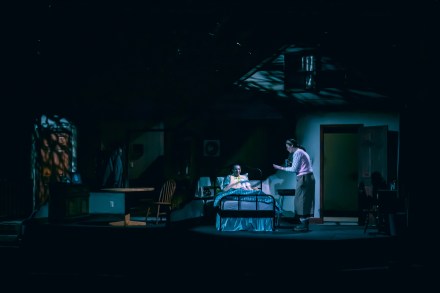
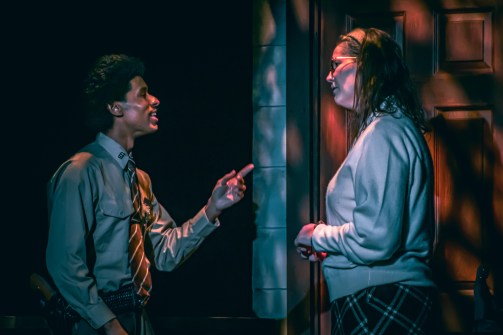
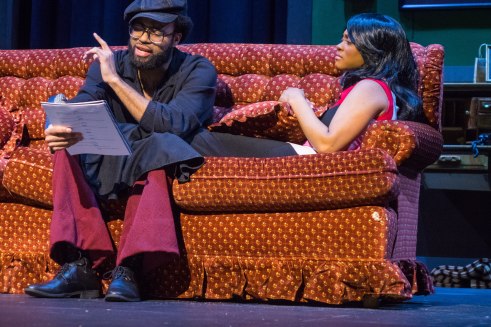
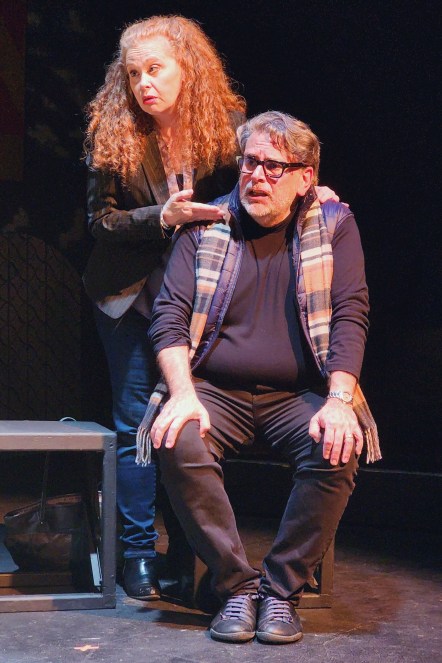
Category Archives: Theatre

Envy, Racism, and Pure Evil Explode in A Soldier’s Play

Review: A Soldier’s Story at Knight Theater

By Perry Tannenbaum

0042r - The Cast of the National Tour of A Soldiers Play - photo by Joan Marcus 

Premiered Off-Broadway by the Negro Ensemble Company at Theatre Four in late 1981, Charles Fuller’s A Soldier’s Play went on to win the Pulitzer Prize in 1982 – and had enough staying power for the original script, with its electrifying closing line, to finally make it to the Broadway stage 39 years later, just before the pandemic closed it down. Now the touring production, with more than the usual complement of actors who appeared on W. 42nd Street in the Tony Award-winning revival, is onstage for a two-week run at Knight Theater.

Set in 1944 at Fort Neal, Louisiana, this military whodunit still sizzles. Bigoted white officers lord it over justifiably resentful black recruits, who are prized only for their baseball talent and saddled with the meanest grunt work as soon as they triumphantly leave the diamond. These ballplayers’ deepest ambition, it turns out, isn’t to remain undefeated and play the New York Yankees. No, they’re itching even more mightily to be deployed to combat in Europe, where they will trounce Hitler’s Nazi army and prove themselves – and their race.

And if you didn’t know this already: all these fine athlete-soldiers can sing and dance.

Into this typical Deep South cauldron – stiffened with military spit and polish, flavored with Jim Crow scorn and bitterness – Fuller dropped his nuclear core, inspired by Herman Melville’s Billy Budd.

0013r - Eugene Lee as Sergeant Vernon C Waters in the National Tour of A Soldiers Play - photo by Joan Marcus

Sergeant Vernon C. Waters and Private C. J. Memphis are the counterparts of Melville’s naval petty officer John Claggart and foretopman Billy Budd. Even more than Iago, Othello’s treacherous lieutenant, Claggart’s hatred toward Billy was pure and unprovoked. Sergeant Waters, the highest-ranking black soldier at Fort Neal and manager of the awesome ballclub, is a unique kind of racist. Seeing himself and his subordinates through the eyes of his white superiors – and America at-large – Waters reserves his keenest hatred for his own race.

In particular, Waters despises the lazy, bowing-and-scraping, singing, clowning, and “geechy” Negroes whom he sees as keeping his race from advancing. Waters applies the N-word to those soldiers as contemptuously as a white man would and assigns himself the mission of diabolically hunting them down. Though the greenest envy is also at the heart of their common DNA, you could say that Waters eclipses the wickedness of Claggart and Iago, for Memphis is merely the most recent of the sergeant’s kills.

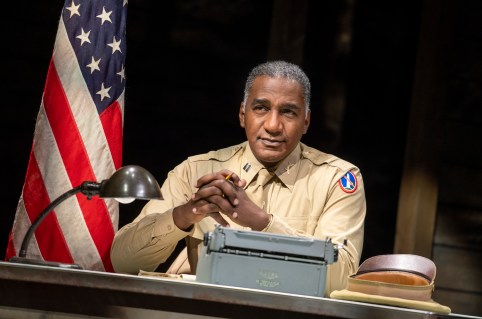
0018r - Norm Lewis as Captain Richard Davenport in the National Tour of A Soldiers Play - photo by Joan Marcus

By the time Captain Richard Davenport – also black, dispatched from DC – arrives at Fort Neal, both Memphis and Waters are dead. The mystery that Davenport must now solve is who killed the sergeant? We’ve swiveled away from the tragedies of Billy Budd and Othello into the modern realm of murder mysteries and police procedurals, from Hollywood to the BBC. Murder victims need to make as many enemies as possible so that Agatha Christie’s Hercule Poirot, Erle Stanley Gardner’s Perry Mason, S.S. Van Dine’s Philo Vance, and all their pulp novel and TV series descendants have as many suspects as possible to brilliantly glean through.

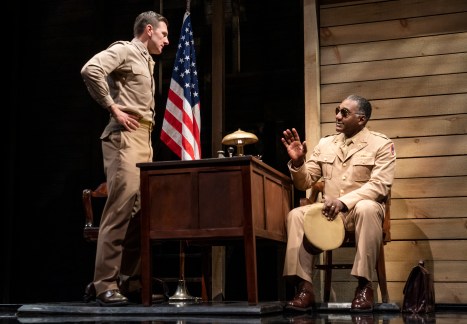
0026r - William Connell as Captain Charles Taylor and Norm Lewis as Captain Richard Davenport in the National Tour of A Soldiers Play - photo by Joan Marcus

Captain Charles Taylor, who brandishes a graduation ring from all-white West Point in welcoming Davenport to the base, is amazed, wary, and frankly skeptical that this black officer is the right man for the job. Yet Taylor also has his doubts about the widespread assumption that the KKK is responsible for Waters’ murder, which only multiplies Taylor’s skepticism. If white officers are to blame, how will Davenport manage to get at the truth? Worse, if the black DC outsider gathers sufficient evidence to charge a white man or white men – Waters was shot twice – how can anybody expect the charge to stick?

So the ongoing suspicion, skepticism, and open antagonism between Taylor and Davenport gradually turn out to be quite rational on both sides as it becomes clearer and clearer that Taylor really wishes to be rid of his bad apples. Each time Norm Lewis as Davenport and William Connell are alone together, the tension between them crackles, building to an Act 2 climax when they’re nose-to-nose, ready to rumble.

0033r - (From L) Sheldon D Brown - Branden Davon Lindsay - Will Adams in the National Tour of A Soldiers Play - photo by Joan Marcus

Much the same is true of Eugene Lee as Waters, each time he appears in flashbacks during Davenport’s interrogations. Unlike the Captains, Waters seems to revel in confrontations, not merely to show who’s boss but also as a prime tool in entrapping the “geechies” he has targeted for takedowns. Aside from a fistfight with Tarik Lowe as PFC Peterson and his demonic provocation of Sheldon D. Brown as the persecuted Memphis, there are numerous episodes of cruel disrespect, scornful scolding, arrogant orders, and stone-faced bullying for Lee to lean into.

Howard Overshown as Private James Wilkie gets about as close to being Waters’ confidante – and stooge – as possible, but only after the cruel monster has stripped Wilkie of the three stripes he has earned over 10 years in the Army. He can offer Davenport insights into Waters’ true feelings about his men. There is some slickness, polish, and deceptive acceptance in Overshown’s portrayal as Wilkie seeks to regain Waters’ favor and those lost stripes, but we also glimpse the grudge and his seething resentment as the sadistic sergeant demands more and more from him. Little sympathy flows from Wilkie’s bunkmates, and certainly no love.

And as he disintegrates late in life, Waters gets sufficiently soused in a couple of flashbacks to stumble back to the base disheveled and drunk, ranting and raving in the presence of white officers, and – worst of all – ignoring their commands. So it’s a role that offers Lee a wide spectrum of personal corruption to embody, from steely ferocity to weak-kneed intoxication, with a couple of moments where we can empathize a little with the sergeant’s twisted viewpoint.

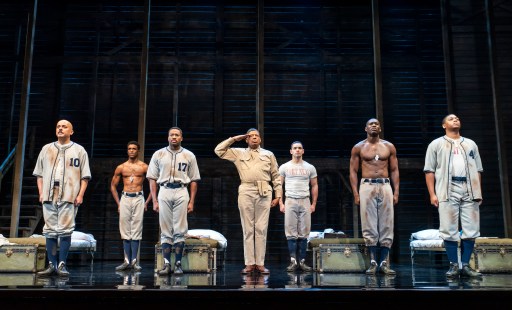
0039r - Eugene Lee (center) and the Cast of the National Tour of A Soldiers Play - photo by Joan Marcus

Lee is nothing less than magnificent. The only slack we need to cut him is when Waters challenges Peterson to settle their differences hand-to-hand. It should be axiomatic to us, as it is to Peterson, that Waters will beat the crap out of him, but Lowe is noticeably younger and taller than Lee. Unlike the 1984 film adaptation (A Soldier’s Story, screenplay by Fuller), where no less than Denzel Washington squares off and loses the fistfight, the action here at the Knight doesn’t draw a flashback, consigned to the wings when Peterson follows Waters offstage.

Directing the show here and on Broadway, Kenny Leon points up the advantages of the stage version over the film. In one way, Leon makes Fuller’s action more classical than Melville’s or Shakespeare’s. Coming and going from their interrogations, the black soldiers observe a military regimentation so strict that it gradually becomes ceremonial. Each one of them carves perfect perpendiculars entering and leaving Davenport’s office: left-face twice entering, about-face once when the questioning is done, and right-face twice exiting. They all seem on the exact same track, and they all salute so religiously that Davenport occasionally seems unnerved by it.

Whether these actions are evidence of their respect for top brass or a reverence reserved for the first black officer they have ever seen, we can easily recognize the difference when the soldiers are out of uniform or under Waters’ command. Discipline slackens and those perpendiculars vanish. These differences are subtly echoed by the contrasts in Derek Malone’s set design and Allen Lee Hughes’s lighting, bright and official for the Captains’ offices, dark and gloomy for the barracks and cots.

Action is so gripping and intense that we easily overlook the flaws in Fuller’s plot. So much infighting is happening on base that it seems almost natural that a watershed moment of World War 2 would happen smack in the middle of Davenport’s three-day investigation. We’re also so riveted by Lee’s ferocity, Connell’s grudging evolution, and Lewis’s cool charisma that we fail to step back and realize that Captain Taylor could have solved this case – before Davenport even arrived from DC – by saying five simple words: “Run a complete forensics review.”

Of course, forensics wouldn’t have helped Memphis when a murder weapon was planted under his bed. Unless some fool left his fingerprints on it. Strumming a guitar and singing sweet blues, Brown is so powerfully insouciant that we have no trouble believing that he is a once-in-a-generation talent at shortstop, able to clout home runs with the same nonchalance. Even when Waters provokes him, Brown has Memphis’s serenity giving way to spontaneity. There’s an almost stammering incomprehension to Memphis at this climax that links him to Billy Budd.

That primitive gloom we find in the soldiers’ shoddy barracks helps us forget that scientific crime-solving dates back to the era of Conan Doyle and Sherlock Holmes, let alone in the Perry Mason courtroom dramas, born in the ‘30s, where ballistic experts often testified. Following Davenport’s diligent process, we’re guided through a pungent set of truths that remind us how far we have progressed from the Jim Crow days to integration and beyond.

Yet we’re reminded how the oppressors of old have spawned descendants who still struggle to hold their control over non-whites and non-Christians. Their desperate efforts to fortify institutional racism and sustain white privilege are keeping full equality tantalizingly out of grasp – even as it comes more vividly into view.

JazzArts Sweetens Ellington’s Nutcracker Suite With Jazzy Elzy Choreography

Review: Ellington’s Nutcracker at Booth Playhouse

By Perry Tannenbaum

2022~Ellington's Nutcracker-08

December 8, 2022, Charlotte, NC – While JFK was campaigning for the White House in 1960, Duke Ellington was out west, arguably having his sweetest year as a bandleader and composer, with an extended stay at the Riviera Hotel in Las Vegas, a festival triumph at Monterey that yielded two albums, and three sweet suites that were released on additional Columbia albums. The Nutcracker Suite marked the first time Ellington and longtime collaborator Billy Strayhorn had worked so extensively on adapting and arranging another composer’s music, and the pair did not wait for audience reaction to the Tchaikovsky foray before embarking on a similar project with Edvard Grieg’s Peer Gynt Suites No. 1 and 2.

Perhaps sweetest of all was the duo’s original suite, Suite Thursday, inspired by John Steinbeck’s novel, Sweet Thursday, which was set in Monterey. Ellington had played with these homonyms before, wittily naming his 1957 Shakespearean suite Such Sweet Thunder, but after the success of Nutcracker, the wordplay was over: Far East Suite, Latin American Suite, New Orleans Suite, and Togo Brava Suite were albums that announced themselves explicitly.

2022~Ellington's Nutcracker-07

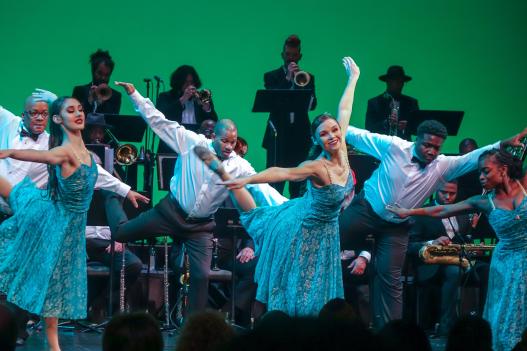
Although Ellington’s embrace of classical music and form was obviously a commercial success, his Nutcracker never became the perennial evergreen that Peter Tchaikovsky’s ballet has – with helpful nudges from world-class choreographers and ballerinas. Yet it was still surprising to learn that the current run of Nutcracker Swing performances, presented at Booth Playhouse by JazzArts Charlotte, is an area premiere. One could only grow more puzzled by the delay when trumpeter and musical director Ashlin Parker began tearing into the Duke’s score with an able, self-assured 16-piece band. Very likely, JazzArts had also pondered the popularity gap between the ballet Nutcracker and the big band version, opting to fortify their version with jazzy choreography by the co-founder of the New Orleans Dance Theatre, Lula Elzy, delivered with flair by a sassy 12-member dance troupe.

2022~Ellington's Nutcracker-04

Even more lagniappe was added to the front end of this special JazzArts Holiday Edition, before intermission, with appearances by vocalist Dawn Anthony and a quartet of JazzArts All-Star Youth Ensemble musicians. Warm-up songs included a tasty mix of jazz standards, including Richard Rodgers’ “My Favorite Things” and Ellington’s “C Jam Blues,” and a bouquet of holiday fare: vocals on “Someday at Christmas” and “What Are You Doing New Year’s Eve?” a big-band “Christmas Time Is Here,” and Youth Ensemble instrumentals on “O Tannenbaum” and “Santa Claus Is Coming to Town.” Ensemble’s tenor saxophonist, Gustavo Cruz, and bandmate bassist Lois Majors were nearly as well-received as Anthony’s high-energy singing, and the first appearance of the evening by the dancers made the instrumental from Vince Guaraldi’s Charly Brown Christmas even more endearing.

Parker and his bandmates had already proven their mettle before we reached the Ellington-Strayhorn orchestrations. As soloists, tenor saxophonist Elijah Freeman, altoist David Lail, and Tim Gordon, doubling on alto sax and clarinet, had also excelled. Yet the band’s work on Nutcracker Suite still eclipsed my rising expectations, reminding me why Ellington, before and during the big band era, stuck with Duke Ellington and His Famous Orchestra as the name of his group.


Ellington always believed that he wrote primarily for orchestra, but he launched his career and his band during the Jazz Age, so he kept the phonograph and the concert hall in mind when he wrote. That’s why most of the earliest jewels in Duke’s crown clocked in at approximately three minutes. The nine segments of Ellington’s Nutcracker barely exceed a half hour, but it’s a hardy concentrate, allowing the aforementioned soloists – and numerous others on the Booth Playhouse stage – to shine and shine again. Hearing this merry music swung live onstage, at sound levels that rose above 90 dB, was astonishing.

The quality of the choreography and the athleticism of the dancers will make it difficult for you to keep track of who is responsible for the instrumental excellence behind them – even when Lail stands up in his red cap and wildly wails. Henry’s work on clarinet is nearly as sensational, and Freeman remains rock solid on tenor. Parker’s rhythm section shines brighter after intermission, earning kudos for pianist Lovell Bradford, bassist Shannon Hoover, and drummer Kobie Watkins, particularly on the sinuous “Chinoiserie.” Elzy’s choreography lifted the excitement even higher, with costume changes for the women between their appearances.

2022~Ellington's Nutcracker-22

For the “Toot Toot Tootie Tout (Dance of the Reed Pipes)” segment, appropriately graced by Henry’s clarinet, they entered in cool turquoise dresses glittering with snowflakes, and for “Sugar Rum Cherry (Dance of the Sugar-Plum Fairy),” they sashayed in from the wings in hot red. The guys, in casual wear before the break, stuck with white shirts and black bowties afterwards, competing with the gals by executing higher leaps and more jivy steps. After they had been challenged by the women in “Sugar Rum” and “Entracte,” the men responded with their finest moves on “The Volga Vouty (Russian Dance).”

2022~Ellington's Nutcracker-28

Changing the order from the sequence you can hear on Ellington’s Three Suites album, Parker and company followed with an epic performance of “Arabesque Cookie (Arabian Dance),” the last and longest track. Here the men remained onstage after their triumphant “Volga” stint, surrounding the alluring alpha female, back in flaming red, while Lail blew his most memorable solo of the night. Out of its usual sequence, “Chinoiserie (Chinese Dance)” brought the full company of dancers back to the Booth stage for a rather startling cooldown, but energy built dramatically for the new finale, “Dance of the Floreadores (Waltz of the Flowers),” – loud, flamboyant, and for my money, the most Ellingtonian chart of the evening. Sensory overload was so total that I lost track of all the fine instrumental solos behind the lively dancers.

It Takes Two to Tina

Review: Tina – The Tina Turner Musical at the Blumenthal PAC

 By Perry Tannenbaum

Zurin Villanueva performing as ‘Tina Turner’ and Garrett Turner as 'Ike Turner' in the North American touring production of TINA – THE TINA TURNER MUSICAL. Photo by Mat thew Murphy and Evan Zimmerman for MurphyMade, 2022_

Open your playbill at Belk Theater to the cast list of Tina: The Tina Turner Musical, and you’ll find that two women are starring in the title role, Naomi Rodgers and Zurin Villanueva. So the question instantly confronted me: what gives? Not having seen any clarification in the touring show’s signage on the way in, I was on the alert for a pre-show announcement. Sure enough, we heard that tonight we should ready ourselves for Villanueva.

Zurin Villanueva as ‘Tina Turner’ in the North American touring production of T INA – THE TINA TURNER MUSICAL. Photo by Matthew Murphy for MurphyMade, 2022Well before Villanueva made her final exit two hours and 50 minutes later, I could easily understand why Phyllida Lloyd, who also directed the Broadway production, had opted for double-casting. In fact, with all the energy and fire that Villanueva expended on Queen Tina – dancing, shouting, and belting – I was mildly in awe of the fact that Rodgers hadn’t been brought in as a relief singer on opening night. That would have been an acceptable way to preserve our headliner’s fire and energy for her next performance.

Tasked with stringing together two dozen songs with a coherent bio-musical book, playwright Katori Hall glides over the years, toughens Tina, and struggles to make sense of her hardships and her comeback. Compared to The Mountaintop, Hall’s acclaimed MLK drama, this script is hardly even a foothill. Lloyd’s frenetic pacing isn’t exactly helpful to the storytelling, but the wayward Belk sound system, not at all as ceaselessly overbearing as it was last month for Jagged Little Pill, still wasn’t tack sharp at a softer volume.

Maybe that was a blessing in disguise, considering how the garbled lyrics prevented us from scrutinizing the strange, sometimes weird connections between hits like “Private Dancer,” “We Don’t Need Another Hero,” and “River Deep – Mountain High” and their place in Hall’s storyline.

As Ike Turner, Garrett Turner (no relation) is called upon to intimidate and bully a force of nature. Just about everyone knows about the Queen of Rock and Roll’s humiliating marriage walking into the theater, yet I was still shocked by the explosions of dragon fire (or phlegm) that Turner breathed into Ike. And I marveled at how much dirtier he sounded when he sang Ike’s signature “Rocket 88,” regarded by many as the fountainhead of rock. The edge he brings to his predatory marriage proposal – and his subsequent confrontation with Tina’s lover – is chilling.

The other men who revolve around Tina are also Broadway caliber, including Geoffrey Kidwell as record producer Phil Spector, Zachary Freier-Harrison as manager Roger Davies, and Max Falls as German music exec – and future husband – Erwin Bach. Lael Van Keuren as Rhonda, the small-time road manager who graciously gives way to Roger, is also very fine. Since Bach and Turner are the executive producers here, we can assume that all historical inaccuracies and fabrications have earned their seal of approval.

Tina diehards could have been disappointed only by the rendition of her iconic “Proud Mary,” aborted midway by the singer because Ike had yanked her out of a maternity ward to perform it. The two guys sitting next to me outsmarted themselves by walking out during the curtain calls. They missed out on the reprises of “Nutbush City Limits” and the full “rough” half of “Proud Mary,” where Villanueva, emptying her tank, was even more electrifying than she had been during the show.

One last stunner.

For Alanis Fanatics, “Jagged Little Pill” Is Easy to Swallow

Review: Jagged Little Pill at Blumenthal PAC

By Perry Tannenbaum

1250-3edd718564fff89d8d3205232f5ddccc

Overamped opening nights seem to be a tradition at Belk Theater when Broadway tours hit town, but this week’s JAGGED LITTLE PILL set a new standard, catapulting me out of my seat with the first words of the pre-show announcement – before the onstage band launched into the overture. Things quieted down mercifully after sound levels peaked at 103dB just before intermission, but despite an early lull, Act 2 peaked a couple of times at 104dB as the Alanis Morissette musical climaxed.

Diablo Cody’s stage adaptation of Morissette’s breakthrough Grammy Award album meshes well with those teen-anguished songs and the Belk’s high decibels. Sporting a fresh overload of angst and suffering unimagined by Morissette in 1995, Cody’s book shuttles between three plotlines and eight characters for most of the evening, ostensibly linked by the normal, successful, and well-adjusted Healy family, represented in each of the three stories – and not nearly as happy or well-adjusted as they appear.Heidi Blickenstaff and the North American Touring Company of JAGGED LITTLE PILL_ Photo by Matthew Murphy for MurphyMade, 2022

The somewhat disjointed stories are neatly bookended by Christmas letters that sunny matriarch Mary Jane Healy reads to us from her living room. Her first letter, prior to the humility and honesty she will learn during the coming year, whitewashes the Healy family’s struggles, discomforts, and resentments for public consumption. Mary Jane is not truly healing from her car accident earlier in the year with the wholesome aid of herbal essences or natural medicines: she is hooked on prescription Oxycodone and will soon be seeking out the neighborhood drug dealer when her doctors and pharmacist cut off her supply.

Meanwhile, all is not bliss in the Healy marriage, because husband Steve is working 60 hours at an unfulfilling job, spurned by his pill-popping wife in bed, and turning to porn for solace.Chris Hoch and Heidi Blickenstaff in the North American Tour of JAGGED LITTLE PILL - photo by Matthew Murphy, Evan Zimmerman for MurphyMade, 2022

MJ can be justifiably proud of her kids, whom Steve has done more to support than to father. Nick, the eldest, has just earned early admission into Harvard, a fabulous achievement he is not as excited about as his parents. Like his exemplary mom, he feels the pressure to be perfect – and remain the best thing she’s ever done.

Bisexual and African-American in a lily-white Connecticut town, young Frankie is obviously an adopted child, yet she remains the most normal of the Healys despite the dogged colorblindness of her parents, her brother, and her community. She already has a girlfriend that she’s keeping secret from her family, and just before Christmas break, Frankie attracts a new boyfriend in their creative writing class.

Frankie is an earnest rebel at first, in search of a cause. Her social consciousness leads her to spearhead a campaign to give out free tampons at her high school. The protest placards we see in Act 1 can be pretty droll.Jade McLeod and Lauren Chanel in the North American Tour of JAGGED LITTLE PILL - photo by Matthew Murphy, Evan Zimmerman for MurphyMade, 2022

Amid this underwhelming welter of decadence and angst, it’s the jilted girlfriend, Jo, who has the best reasons to feel aggrieved, upstaging the Healys and torching some choice vocals. Condemned by her Evangelical mom for her sexuality, obliged to keep her relationship a secret from Frankie’s parents, and thrown over for this upstart Phoenix guy just because he defends her writing in class, Jo is the twitchiest and most upset in her set. Topping all that, Jo is dragged to a Christmas Eve service by her pious mom while Phoenix puts his moves on Frankie at the school party.

All of these indignities set Jo afire amid this otherwise humdrum scenario. What sets it all ablaze is the febrile stage direction of Diane Paulus and the trembling all-shook-up movement and choreography of Sidi Larbi Cherkaoui. Every surreal sight and unmotivated tremor is further whipped to a frenzy by Morisette’s music and the overamped vocalists, often unintelligible in their cries and wails. Unless you’re moving furniture to the wings, no member of this cast makes an exit without a hugely melodramatic gesture of anger or frustration.(L to R) Heidi Blickenstaff, Allison Sheppard and Jena VanElslander in the North American Tour of JAGGED LITTLE PILL_ Photo by Matthew Murphy for MurphyMade, 2022

For all the Morissette fanatics who filled the Belk to its topmost balcony, all this excess, performed with gusto and bravura, was nirvana. You would have thought, with a title like Jagged Little Pill and all the enthusiasm greeting it, that we were watching a devastating denunciation of adult hypocrisy, rampant drug culture, industrial greed, and the onset of environmental catastrophe rather than much ado about nothing.

Until the Christmas party. This is where Cody finds a dramatic core to her script and adds two key dramatis personae, a rapist and his victim. As a result, Nick proves to be very imperfect, disagreeing with both his sister and MJ in his initial reactions to the assault. After meeting with Bella, the rape victim, Frankie now has a substantial cause to crusade for. Nick must decide whether to break with his rich best friend, Andrew, who perpetrated the rape and snapped the humiliating photos that are being texted during the Christmas break.Allison Sheppard and the North American Touring Company of JAGGED LITTLE PILL_ Photo by Matthew Murphy for MurphyMade, 2022

Wishing to protect her son’s future, MJ sides against Frankie, but her impregnable pill-fed armor begins to crack. She will begin some long overdue introspection and face up to her past. Poof, Cody’s chimerical soufflé of universal discontent will mostly deflate before MJ composes her next Christmas card.

Duke grad Heidi Blickenstaff shows us how – and why – she won the lead role of Mary Jane on Broadway after the COVID hiatus, bringing us an affecting mix of maternal warmth, diligence, cluelessness, and neurosis. Paired with Chris Hoch as a decidedly corporate-looking Steve, Blickenstaff as MJ struck me at times as somewhat surreal delving with her partner into the marrow of Morissette’s songbook.

Here the wildly enthusiastic audience was helpful in reminding me that the Healy parents, though clearly older than the 19-year-old or 20-something who wrote most of their lyrics, are younger than Morissette is now – like so many of us in the roaring crowd listening to their anguish. And it’s also helpful that they both yearn so earnestly to recapture and redeem their past.Lauren Chanel and the company of the North American Tour of JAGGED LITTLE PILL - photo by Matthew Murphy, Evan Zimmerman for MurphyMade, 2022

Dillon Klena and Lauren Chanel are marvelously mismatched as the siblings, Chanel as Frankie making the abrupt voyage from Connecticut to Greenwich Village in an effortless manner hard to imagine for Klena as the preppy elder brother. Both of these sustained presences, especially Nick, are upstaged by the more seriously aggrieved teens, Jade McLeod as the raffish Jo and Allison Sheppard as the flirtatious Bella.

McLeod pours their renegade voltage into two of Jo’s prime cuts from Little Pill, “Hand in My Pocket” and “You Oughta Know,” as well as the subsequently revealed phantom cut from that album, “Your House,” when they reveal their nasty side. Underscoring the best craftsmanship that went into updating the Morissette playlist with fresh #MeToo flavoring, Sheppard draws two new songs. “Predator” was released by Alanis as a single in 2021, two years after the JAGGED LITTLE PILL cast album came out, and she has never recorded “No,” an overtly didactic song penned by Guy Sigsworth.

Sheppard makes both of these late additions fit seamlessly into the musical as she grabs much of the spotlight after intermission. But she’s also fine in Bella’s first interactions with Frankie and Jo, accepting her victimhood with a nicely calibrated reluctance.

My suspicion is that while Bella ascended in prominence as this musical’s creative team tinkered with their handiwork, Phoenix and Andrew lost ground. Jason Goldstein as Andrew hardly utters a word, let alone sings one, after giving our story so much impetus by raping and humiliating Bella. If only the evildoers in our politics could be so totally silenced and ignored!Lauren Chanel and Rishi Golani in the North American Tour of JAGGED LITTLE PILL_ Photo by Matthew Murphy for MurphyMade, 2022

Perhaps Cody should be tossed from her scriptwriters’ union for neglecting her villain, but I felt we suffered more from the hasty dispatch of Rishi Golani as Phoenix. Golani shines in “Ironic,” his classroom duet with Chanel, and subsequently serves charmingly as the mellow edge of Frankie’s love triangle in “That Would Be Good,” sharply contrasting with the belligerent McLeod.

After fleeing from Frankie’s bedroom, we never really see Golani as the genial Phoenix again. Cody offers us a rather flimsy pretext for the cooldown in their relationship before Golani even gets a chance to weigh in on what happened to Bella. Surely, it’s the talk of the school – and the town, once Bella hits the police station.

So MJ’s valedictory Christmas letter gives us the illusion that all loose ends have been addressed, and Cody ultimately packages Morissette’s hits with the best giftwrap a jukebox musical has gotten since Mamma Mia. It’s more than enough to satisfy Alanis fandom, and it’s a forward-looking attempt that bodes well for a more woke future up on Broadway.

DREAMers on Guard in Three Bone’s “Sanctuary City”

Review: Sanctuary City @ The Arts Factory

By Perry Tannenbaum

202211203709590007197567742

In the wake of the 9/11 attack on the Twin Towers, as lethal smoke and dust afflicted policemen, firemen, and medics who converged upon Ground Zero, a wave of xenophobia began to sweep across America. Muslims and air travel were the prime targets of paranoia and impulsive policy adjustments in the early days, with follies in Iraq and Afghanistan soon to follow. As Martyna Majok’s Sanctuary City demonstrates, the seismic shock of the attack and the insidious xenophobia it unleashed were keenly felt across the Hudson River in Newark, New Jersey, where her two teenage protagonists face uncertain futures as undocumented Latinx immigrants.

Adapting a thrust-stage configuration at the Arts Factory black box, director Caroline Bower places the audience close to the action – and to the hearts of Majok’s teens as they navigate their treacherous paths to adulthood and possible US citizenship. We may look down pityingly on the adolescent recklessness and naivete of B and G, the rather generic names our playwright assigns to her main characters. G has a litany of fictional excuses for her serial truancies at school, but she can still coach B on his math homework.

Yet there’s plenty here in this Three Bone Theatre production to rattle our smug complacency. Humble and ignorant as they may seem, both B and G often school us in the brambly terrain of daily life in a Sanctuary City and the vagaries of US immigration law. As we will see, their paranoia wasn’t over-the-top in 2001, when most of us would have been skeptical, and their fears proved prophetic 15 years later when MAGA morons began to dominate our national discourse.202211205681389164319280691

G needs to fabricate reasons for skipping school because the welts and bruises that keep appearing on her face and limbs might be noticed by teachers, prompting a home visit from social services, a check of her mom’s immigration papers, a disclosure that her work visa expired years ago – and a swift deportation. Instead, B must tell G’s teachers that she is bedridden with flu until her black eye has cleared up.

Nor does B have it easy just because his mother isn’t tyrannized by a drunken, sadistic SOB. He and his mom can be easily shortchanged on their wages, since they have no legal recourse unless they’re willing to risk deportation. Indeed, it’s B’s mom, not G’s, who gets collared and deported. Paradoxically, Northerners can be smug and complacent in their convictions that such deportations define the inhumanity of red border states in the South, and that heartless Immigration feds are to blame for cruelly separating Latinx families.

Wrong on both counts, Majok reminds us. By not seeking out Federal assistance in clearing out undocumented immigrants, Sanctuary Cities do not prevent the Feds from swooping in, and it’s federal immigration law that discriminates between parents and their children. When B learns that his mom has been nabbed, he must make the painful call on whether to board the plane with her.

Bad news or good news often arrives suddenly as G climbs up the fire escape to B’s bedroom after dark and he mimes a window to let her in. Or occasionally the simple Bunny Gregory set design transforms and B visits G’s place to bring her some urgent news. Neither B nor G has any furnishings until years after B’s mom has been deported and he’s forced to survive on his own.Gus Zamudio

Meanwhile, G’s mom evolves, after seeming to be a hopeless doormat according to her daughter’s early reports. She sheds her abuser, secretly studies for – and passes – her citizenship exam, and achieves the naturalization that eluded B’s mom. In the blink of an eye, G is a legal as well, able to pursue higher education beyond a Newark community college when she graduates high school. Just as suddenly, since both of them know the laws, G can help B reach the same goals. Citizenship plus education.

Isabel Gonzalez sparkles in the rapidfire scenes with Gus Zamudio that open Sanctuary City. Some are brief flashbacks and flash-forwards, others a series of riffs on recurring events, and still others are jump cuts between parallel events in the illegals’ lives. Zamudio, who lived out a real-life DACA deportation drama chronicled by local media in 2017, taken into ICE custody just before he graduated from Northwest School of the Arts, has no problems at all internalizing B’s plight – or still passing for 17.

Making her Charlotte debut last year, portraying 10-year-old Paloma in Children’s Theatre’s Tropical Secrets, Gonzalez doesn’t have to regress nearly as far to bring us all the adolescent vitality, anxiety, and ambivalence of G. Somehow, it’s through Gonzalez and her wary intimacy with her bestie that I began to grasp why Northerners and Southerners alike fathom so little about how immigrants live in citizenship limbo. They’re a secret – and secretive – society who can only truly trust each other.Grant Cunningham and Gus Zamudio(1)

When Grant Cunningham entered as Howard deep into the second half of this no-intermission production, more than a couple of notable shifts came into play, including two new plot twists and an abrupt change in pacing as Majok’s script settled into one extended closing scene. All three actors quickly rev up intensity as the cluster of revelations forces them to rapidly shift their perspectives on each other. You couldn’t help feeling impressed by the melee and how well Cunningham fit into it, and you couldn’t help smiling when you saw the blind spot they all shared, for we have seen the social and political progress that can happen in less than two decades.

Howard, the first character we encounter here with a full name also comes equipped with a fuller character. Yes, he seems far more confident that he belongs here, and as a law student, far more definite about who he is and what he aspires to be. Gradually, he brings out one of the playwright’s salient points, that B’s plight not only focuses him sharply on the niceties of immigration law and enforcement, it makes him adept at attaching himself to people he can use to help his cause.

But really, I didn’t think arriving at that point was as important as the basic heartbeat of what Majok leaves us to speculate about: what specifically are these DREAMer hopefuls’ dreams? What aspirations stir their souls as they struggle to emerge from the shadows into full American lives?

A little more of that kind of intimate disclosure would have helped the emotional magnitude of Sanctuary City to align better with its cerebral clout. Even the dimwitted Lenny in Of Mice and Men had his rabbits to break our hearts. So even a Lin-Manuel Miranda bodega would help Majok’s taut drama – with a few stray spritzes of comedy – to sprout a little more Latinx color. And we shouldn’t have to Google a New York Times review or call upon Three Bone Theatre’s playbill to inform us that the drama is happening in Newark.20221111578320097703585702

More urban and aspirational detail would certainly make Majok’s brew more combustible, but Gonzalez, Zamudio, and Cunningham deliver plenty of firepower. Sarandon Shindon steps in to play G at the Wednesday and Thursday performances, with Gonzalez returning to close out the run on Friday and Saturday.

“Hadestown” Serves Up a Jazzy, Godly Nectar

Review: Hadestown at Blumenthal PAC

 By Perry Tannenbaum

2296_Hadestown North American Tour 2022_photo by T Charles Erickson

In Blumenthal Performing Arts’ Encore playbill, the distance between Anaïs Mitchell, who created the music, lyrics, and script of HADESTOWN, and Rachel Chavkin, who developed and directed Mitchell’s creation, is a scant three-and-a-quarter inches. Inside that space are the neatly typeset names of 42 actors, designers, and organizations who have helped bring their vision, the 2019 Tony Award winner for Best Musical, so vividly, raucously, and meaningfully to life.

You get the idea that, in crafting and concepting this marvelous retelling of the Orpheus-and-Eurydice myth, Mitchell and Chavkin became even closer than those 82+ millimeters. Together they have created a work that is slick and glitzy, yet we find primal and profound truths amid the razzle-dazzle.

Those truths can sting, particularly when we descend into the dark underworld ruled by Hades and his abducted queen, Persephone. While Mitchell and Chavkin discard the #MeToo aspect of the royals’ union, reimagining them as formerly true lovers, they point up King Hades’ inclinations toward greed, exploitation, oppression, and mindless acquisition, layering on prejudice and xenophobia for good measure.

So when Matthew Patrick Quinn as Hades brought down the curtain on the first act with “Why We Build the Wall,” written years before The Donald took up politics, the satire bit hard enough for the MAGA morons seated in front of us to get up in a mighty huff at intermission, never to return. Yet this concept of Hades, casually linking his excesses to global warming and climate change, isn’t really an absurd overreach. Why shouldn’t Mitchell and Chavkin portray him as the vilest of plutocrats, when Pluto is actually Hades’ most familiar alias?

And plutocracy is where we’re at.

Mitchell enriches her devilish brew with a score steeped in the decadence of New Orleans jazz, repeatedly underlined by a doo-wop trio of Fates whose only moral failing is going along with the flow. These stylish female backups are ultimately more successful in getting into the impoverished Eurydice’s head than Orpheus, who is preoccupied with finishing the song he believes will restore springtime to the world. Quinn’s basso sleaziness is given a robber baron vibe with an infectiously chugging railroad line running directly to his realm, and the combination of Rachel Hauck’s scenery and Michael Krauss’s costumes makes our dystopian world seem nearly as nocturnal as the netherworld.2022_(from top left clockwise) Matthew Patrick Quinn, Maria-Christina Oliveras, Chibueze Ihuoma, Nathan Lee Graham, Hannah Whitley and company in the Hadestown North American Tour 2022_photo by T Charles Erickson

Presiding over the action and gleefully shattering the fourth wall again and again, Nathan Lee Graham as Hermes keeps us from forgetting – graceful and gliding charmer that he is – the artifice and theatricality of all we see. At the same time, he is frequently seconding the ethereal voice of Chibueze Ihuoma as Orpheus, asserting the power of music in changing our world by envisioning a better one, reminding us how music and language intertwine in the ancient ritual of storytelling.

Singing has always been key in preserving our world and our heritage. Musical narrative, after all, isn’t a recent discovery championed by Verdi, Jerome Kern, Rodgers & Hammerstein, and Lin-Manuel Miranda. It dates back to King David’s psalter, anonymous campfire bards, Orpheus’ legendary lyre, and the Homeric Hymns, where the story of Hades and Persephone was originally told. By design, three of the pivotal songs Orpheus sings are grouped as a series of epics.

Potentially, as we find here, songs have magic. Consequence. “The Wedding Song,” a beguiling duet early in Act 1 where Orpheus responds to a sequence of challenges from Eurydice, is as memorable as Hades’ sardonic affirmation of walls. “Epic I” from Orpheus, the embryonic song he is working on, is enough to establish his magical power and win Eurydice’s belief in him. Doesn’t last when Hades comes personally calling with his saucy come-hither, “Hey, Little Songbird.”2260_Chibueze Ihuoma in the Hadestown North American Tour 2022_photo by T Charles Erickson

But Orpheus is able to march into hell for a heavenly cause (a recurring theme in world literature and religion, it would seem) when he melts Hades’ heart with his completed “Epic III” after intermission, transporting the steely King back to his tender courting days and reconciling him with Persephone. It’s here that the Fates get into Hades’ head as effectively as they had gotten into Eurydice’s earlier, so that the King of the Underworld attaches one pesky condition that prevents Eurydice’s release into Orpheus’ care from being unconditional.

Ihuoma’s naivete and spontaneity turn the moment when he succumbs to sudden heartbreaking tragedy, beautifully staged as everything freezes into silence. The essence of that heartbreak registers so poignantly in Hannah Whitley’s eyes as Eurydice, so achingly close to restoration, almost clearing the threshold of the railroad car that must now take her irrevocably down. All of Belk Theater and all of creation seem disappointed in that moment, even the lively and cynical Fates (Dominique Kempf, Belén Moyano, and Nyla Watson).

Paradoxically, when all stops for a precious few heartbeats, we may realize most keenly that the working relationship between Chavkin and choreographer David Neumann has been as close and precisely calibrated as the relationship between the director and Mitchell. Indeed, our director, composer, and choreographer are involved in perhaps the most delicious conspiracy of all in HADESTOWN, those precisely chosen beats when an unseen centerstage circle suddenly begins to revolve or abruptly halt.

Most of the players, particularly the drones who make up the Workers Chorus, are swept round and round by the wheel. Others like Hades and Orpheus walk at the precise pace that makes them seem like they’re stationary as they move, floating on air. Then the wheel stops, and on they go, like clockwork. Or since the subplot of Persephone’s arrangement with Hades is a mythic explanation of the cycle of the seasons, the circular motion we see is clockwork.2282_Matthew Patrick Quinn, Chibueze Ihuoma, and Maria-Christina Oliveras in the Hadestown North American Tour 2022_photo by T Charles Erickson

As fine as the Fates are in moving about the stage, sometimes while wielding musical instruments, our eyes are most intently riveted to the lithe movements – and eye-popping costumes – of Graham as Hermes and Lana Gordon as Persephone, bringer of springtime and wicked beverage. Graham and Gordon are both electrifying performers, so it’s rather amazing when Quinn, after brooding quietly in the background for most of the first act, instantly proves himself their equal.

Together, they are the spice, the heady godly nectar that helps us savor the purity and fragility of the mere humans, Eurydice and Orpheus, all the more.

“Mean Girls” Delivers High School Intrigue and Nostalgia

Review: Mean Girls at Blumenthal PAC

 By Perry Tannenbaum

Mean-Girls-11

John Keats, the great poet who never saw his 26th birthday, bid his younger brother George to look at the world as a “vale of soul-making,” a useful rewrite of the “valley of tears” handed down to generations of good Christians through the Latin liturgy. Two centuries later, when our world views were more likely to be molded by Tina Fey, that same epithet was nearly as apt a description of high school. That passageway, a hermetically sealed microcosm of the real world we seeped back into after the last bell rang, was seen to be the place where we were memorably loved, betrayed, scarred, pigeonholed and inspired to find our style, our niche, and our selves.

For the first time, anyway – or forever.

Amid stints as creator of 30 Rock and head writer on Saturday Night Live, a matched set of adult microcosms, Fey demonstrated her mastery of high school reality with her screenplay for Mean Girls in 2004 and, to a lesser extent, in the book she contributed to the musical adaptation of the box office success 14 years later. You’ll be better oriented to the touring version of the Broadway hit, now at Belk Theater, if you cuddle up with the 97-minute original on Netflix.Mean-Girls-1

There you will get a better feel for Evansville, the university town near Chicago where 16-year-old Cady Heron gets her first tastes of high school – and America – after growing up home-schooled in Africa. Markers along the way are clearer on film, where Cady checks in with her folks after days at school, and the progress of the conspiracy to take down queen bee Regina George is itemized and commemorated step-by-step. The musical score was written by Jeff Richmond, Fey’s husband, and clocks in at 66 minutes, supplanting those markers and eating into other key specifics.Mean-Girls-2

A couple of times when I was catching up with the film, where Lindsay Lohan squared off against Rachel McAdams, I found myself exclaiming inwardly, “Oh, that’s how mean she is!” when I saw Regina in action. The most egregious of these omissions from the musical occurred right before McAdams invited Lohan to come and sit with her exalted clique, The Plastics, and have lunch with them for the rest of the week. It’s a cringeworthy humiliation episode in front of the whole cafeteria that gets swallowed up by “Meet the Plastics,” the fourth consecutive lame and overloud song at the top of the show.

Or so it was in the early going on opening night at the Belk, where techs in the soundbooth offered more than a judicious amount of support for the lead singers and ensemble combatting the fortissimo orchestrations by John Clancy. They seemed to get the hang of the hall after intermission, so I was able to decipher more than half of Nell Benjamin’s lyrics. That will be a tremendous godsend at future performances before intermission, when some in the audience might otherwise be struggling to get their bearings.Mean-Girls-8

The show improves when it moves to Cady’s Calculus class, where English Bernhardt gets to sing the calmer, relatively low-key “Stupid With Love” when she’s smitten by the dreamboat sitting in front of her, Adante Carter as Aaron Samuels, Regina’s ex. A nice complex of intrigues begins soon after Janis, Cady’s Goth guide to the treacherous terrain, hatches her three-pronged strategy to dethrone Regina. While Cady sets about infiltrating the Plastics, sowing dissension among Regina’s acolytes, and ruining her perfect bod; Regina learns of Cady’s crush on Aaron and nonchalantly lures him back.

Cady doesn’t blow her cover by showing her anger and jealousy, but she doesn’t give up on Aaron. She begins pretending that she’s dumb rather than brilliant at math, starts taking dives on exams, and reaches out to Aaron to be her tutor – when she should actually be tutoring him. Since Regina’s crimes against her classmates are abridged, we can wonder more readily here in the musical who’s the real meanie than we could in the movie.Mean-Girls-3

These intrigues get to be pretty tasty as the thrust of the songs switches from sketching the horrors of high school to more personal feelings and drama. After Barnhardt bemoans Cady’s Calculus crush, Lindsay Heather Pearce gets to vent her fury at Regina in “Apex Predator,” hoping to destroy Cady’s naïve delusions about the reigning prom queen. It’s apex of this musical’s hard-rock pretensions. Even Eric Huffman as Damian, Janis’s genial gay chum, gets a nice cautionary confessional at the top of Act 2, though “Stop” sounds like he’s shamelessly stealing from Avenue Q or The Book of Mormon.

Reveling in our tragic teen diva, standby Adriana Scalice* subbed on relatively short notice for Nadina Hassan as Regina, growing more admirable in her screaming power ballads as the sound system settled down. You could pretty much get the onslaught of her cattiness late in the opening act as she thrust her predatory claws into Aaron with “Someone Gets Hurt,” but she was far more sensational after the break in her apocalyptic “World Burn.” That’s when Regina discovers that she’s been played.

Hassan disappeared so suddenly from the tour that her name still appears in the top row of both the cast marquee and the photo gallery in the playbill. More amazing at the sold-out opening night performance, a woman sitting close behind me screamed her head off – and nearly mine – each time Scalice appeared! Most amazing was driving home with my wife Sue and two other women: I found myself surrounded by pure nostalgic bliss. High School USA!

*For the Saturday matinee, understudy Olivia Renteria steps in

Toni Stone’s Path to Glory Goes Beyond Winning and Losing

Review: Three Bone Theatre’ Toni Stone at The Arts Factory

By Perry Tannenbaum

202208173480315507725654890

Trivia questions: who replaced Hank Aaron when the future home run king moved up from the Indianapolis Clowns of the Negro American League to the majors? And who was the first woman to sign a professional baseball contract and play with a men’s team? The answer to both questions is Toni Stone, nee Marcenia Lyle Stone (1921-1996) – unless you’re a stickler for fact-checking and historical accuracy.

Then we need to face the truth that Hammerin’ Hank was already playing for the Braves’ farm club, the Eau Claire Bears, a season before Stone made her Negro League debut at second base with the Clowns. And before team owner Syd Pollock signed her to a Clowns contract, Stone had played in professional men’s leagues – if not the topmost major league – for 16 or 17 years, depending on which capsule biography you read.

Hearing all this for perhaps the first time, you’ll probably ask a truly important question, one that playwright Lydia R. Diamond surely asked after reading Martha Ackmann’s 2010 biography, Curveball: The Remarkable Story of Toni Stone the First Woman to Play Professional Baseball in the Negro League. Why haven’t we all heard about Toni Stone before, and why isn’t she more celebrated?

202208031526236485966839727

Amazingly enough, when Diamond’s Toni Stone premiered Off-Broadway in June 2019, the playwright didn’t blare out the answers that would become so glaringly obvious to everyone the following summer in the midst of #MeToo, #BlackLivesMatter, and our communal COVID hibernation. Diamond’s portrait of the pioneer nicknamed Tomboy during her childhood in St. Paul is more nuanced, diffuse, and detailed than it might be if she had begun sketching it after the cataclysms, polarization, and pandemic chaos of 2020. Or the nationwide schism of January 6.

Lucky us? In some ways, Three Bone Theatre’s production at The Arts Factory, meticulously directed by Dr. Corlis Hayes, reminds us how relatively dispassionate we were less than three years ago when we looked at neglected pathfinders and feminist icons. There’s a certain amount of useful calibration when Diamond seemingly steps aside and lets Toni tell us her story – and what she thinks of herself.

In her third standout outing of the year, Nasha Shandri immerses herself engagingly in all of Toni’s quirks, vulnerabilities, and strengths; candid rather than arrogant, sassy rather than seductive. Above all else, Toni loves baseball – the ball, the glove, the game. Both Diamond and Shandri make us believe it.

When she runs out of things to say, to us or her teammates, Toni will recite major league player stats, as if she’s collected and memorized every baseball card out there – as if the numbers have magic healing powers when she’s distressed. Diamond makes her so obsessed with baseball that romance and sexuality make her uncomfortable. Shandri has a mumbling recitation of stats at her disposal, or a Peter Pan aversion to being touched, whenever hormones begin flowing around her. She’s a natural, either way she goes.

202208174341351609522811290

An all-Black ensemble of eight men hustles around Jennifer O’Kelly’s appropriately seedy set, which packages a movable tavern, a ramshackle players’ dugout, and a dimly lit brothel, leaving most of the Arts Factory playing space free to fancifully, maybe laughably, serve as a baseball diamond. Eight men aren’t going to be enough to bring us all the mentors, parents, teammates, and romantic interests of multiple races and genders that Toni will deal with from her childhood through her baseball career (1936-1954). Props and costumes are stowed in the dugout as well as offstage to keep things flowing.

Cutting through much of the confusion, Diamond keeps the names, personalities, and fielding positions of Toni’s teammates as constant as the parks she plays in. All evening long, Shandri and her team wear the same Clowns uniforms, authentically rendered by costume designer Kara Harman. That way, Toni’s path comes across as less solitary while she moves from her early ballplaying days in a local church league to a series of American Legion and minor league teams in Minnesota, San Francisco, and New Orleans before her major-league apotheosis: a full year with the Indy Clowns in 1953, before she joined the famed Kansas City Monarchs for her final season.

Diamond and Hayes are both aware of the perils of allowing Toni and the shorthand differentiation of her crew to devolve into a wholesome replay of Snow White and the Seven Dwarfs. The playwright not only gives us frequent glimpses of the racism that dogs Toni’s progress, she also shows us the sexism and piggishness behind the scenes in the clubhouse, occasionally checked but never eradicated.

We also see that there are good reasons for the men’s resentments when Stone signs on with the Clowns. When Jackie Robinson broke the color barrier in 1947 and Larry Doby integrated the American League during the following season, the Negro Leagues began to crumble. By the time Aaron is signing with the Braves in 1952, the talent drain is on the verge of killing Negro League baseball, reducing its remaining teams to barnstorming roadshows.

Clowns owner Syd Pollock – nearly overacted here by James Lee Walker II – didn’t sign Stone to make his team better. Unlike previous owners, who signed Toni on her merit, Pollock signed her as a novelty to improve the marketability and entertainment value of the team, already baseball’s equivalent of the Harlem Globetrotters. In a notable confrontation between Shandri and Walker, Diamond shows us that Pollock isn’t interested in showcasing his new acquisition on a level playing field. To ensure his investment – not very much, if we’re talking about Toni’s salary – Pollock colludes with other owners to ease up on her in the middle innings, when their pitchers will throw her more hittable pitches.

Toni grudgingly keeps the secret, but her teammates aren’t as oblivious or dimwitted as Pollock presumes.  202208175826162527256458676

Hayes does her part, casting the other Clowns, so that Shandri doesn’t stick out uncomfortably as the smallest on the team. In particular, the other middle infielder is diminutive, in the vein of Phil Rizzuto, Jose Altuve, or Joe Morgan. On the other hand, Miles Thompson as Spec, the team intellectual, is not at all the dwarf that he was reputed to be. Along with Justin Jordan as Woody, the embittered teammate who is by far the most trouble for Toni, Thompson is quite an imposing figure.

More than one of the Clowns points up Toni’s sexual inexperience in their dugout and locker room banter. One whole scene, a rather bawdy little prank played on her with a baseball bat, more than emphasizes her naivete. It also heightens uncertainty among the men about Toni’s sexual orientation.

Clearly, Diamond wants to keep us guessing, too. The juiciest roles outside the clubhouse go to Robert Rankin as Millie, the madam of that brothel, and Keith Logan as Captain Aurelious Alberga, an elderly admirer who persistently pursues her at Jack’s Tavern, a San Francisco joint. Skittishly resisting Alberga’s initial advances, Shandri seems more attracted to Millie, whose sexual appeal is aimed at her teammates. Both Rankin and Logan give charismatic performances, worldly and mature, charismatic and confident.

Doubling as Drunk Willie when he dons his Clown uniform, Walker as Pollock is probably the best at marking those moments when white men enter the story. Hayes could have sharpened the portraiture a bit more when we meet the other white folk: Father Charles Keefe, the neighborhood parish priest who paves the way for Toni to play organized ball; and Gabby Street, nicely handled by Thompson, the former manager of the world champion St. Louis Cardinals, who yields to Toni’s repeated entreaties, making it possible for her to aim higher.

Melissa McDaniel Grisham’s choreography seems a bit toothless and pointless when the Clowns team goes into their pre-game shtick. From reviews I’ve read on the Off-Broadway production, the aim there was not just to show how athletic and entertaining the players were but also to show the degradation and of being clowns as well as ballplayers. There’s not even a hint of cringeworthiness here at The Arts Factory that critics had perceived in New York.

202206295146239102907529957

Yet the chemistry among the players has exactly the tang we want when they’re playing the game they love – under shabby, hateful conditions. Johnathan McKnight as the catcher Stretch exudes the authority of the team’s quarterback, and Devin Clark has the aloof dignity of Elzie, the Clowns’ pitching ace. Tito Holder energetically grins and pouts as Jimmy, the team dumbass, and Frank FaCheaux makes the most of the glimpse Diamond gives us of team comedian King Tut, whom Pollock dubbed “The Clown Prince of Negro Baseball.”

Toni Stone has a hazy mythic aura to it unlike most biographical baseball sagas. Intense nail-biting games down to the last pitch or the cumulative drama of a torrid pennant race are nowhere to be found. They are as irretrievable as the barnstorming Clowns’ won-lost records, batting averages, ERAs, and boxscores. What binds the roaming Clowns together like family, in spite of their frustrations and resentments, is the love they share with Toni – for the game.

Newborn Charlotte Conservatory Conjures Theatre Magic – and Memories of Charlotte Rep – with “Witch”

Review: Witch from Charlotte Conservatory Theatre

By Perry Tannenbaum

Witch Photo

August 11, 2022, Charlotte, NC – Last April, when theatre was just beginning to emerge from its pandemic hibernation, would have the perfect moment for Charlotte Conservatory Theatre to spring to life with its first production, Jen Silverman’s Witch, now at Booth Playhouse. For the 2018 tragicomedy was based on The Witch of Edmonton, a lurid script written by William Rowley, Thomas Dekker and John Ford. All of that original play – all five acts, mostly in iambic pentameter – was written and readied for performance within the space of four months. That’s how long it had been since the true-life “witch” the play was based upon, Elizabeth Sawyer, was hanged for witchcraft on April 19, 1621. A year and four months after the quadricentennial of that execution, when our fears have shifted from death by COVID to inflation and monkeypox, the sardonic tear-it-all-down thrust of Silverman’s play may have blunted a little, but its fierce feminism remains intact.

Make no mistake, most of the gripping power of this evening at the Booth emanates from the white-hot Charlotte debut of Audrey Deitz as the lonely, defiant, and principled Elizabeth. But then there’s also the Charlotte debut of Stephen Kaliski as Scratch to bring out all of Dietz’s bewitching charisma, for his portrayal of the Devil has plenty of charisma to vie with Elizabeth’s. Kaliski was guileful, quick-witted, disarmingly frank, and surprisingly vulnerable on opening night. Here the Devil had met his match and more.

Such stunning simultaneous debuts of two experienced out-of-town actors with a local theatre company at Booth Playhouse are phenomena we haven’t enjoyed since the demise of Charlotte Repertory Theatre in early 2005. The regional professional aroma of that long-gone LORT company was sustained by the polish of the design team, led by scenic designer Tom Burch, whose previous local gigs I’ve praised at UNC Charlotte and Children’s Theatre. With their brushwork, scenic artist Lane Morris and portrait artist Eva Crawford clash a bit with Burch’s 17th century furnishings, echoing how Silverman pulls against the bygone era with her idiomatic dialogue. But Kellee Stall’s costume designs settle the matter, sort of. “Then-ish. But equally of our moment,” is Silverman’s dictate on the era of her work.

We see the “Then” most vividly in Stall’s costumes when we shuttle to Silverman’s other plotline at Sir Arthur Banks’s castle, which occupies most of the stage. After Elizabeth’s opening burn-it-all-down aria, delivered under a sharply brilliant spotlight, the other actors parade onstage, following the lead of Cuddy Banks, Sir Arthur’s foppish/effeminate son, who may be morris-dancing around Dad’s imposing dinner table. Anyway, he will soon tell Scratch that he performs in a morris-dancing troupe. What Silverman and Elizabeth seem to enjoy most about Scratch is that he’s selective.

So what Cuddy likes about Scratch, when he comes offering temptations in exchange for his soul, is that he’s coming to him before approaching either Elizabeth or the up-and-coming Frank Thorney. You see, Dad has taken Frank into his household and is now thinking about adopting the upstart, because Frank is clearly more likely to produce an heir. Robert Lutfy, who has been off our radar as a director for over a decade, makes an interesting alteration in how he sees Cuddy, pointing up his sexuality and discarding his shyness, handing a plum comical role to Jeremy DeCarlos, who feasts on it. What was easy to forget on opening night, amid DeCarlos’s prancing and his Percy Blakeney fopperies, was that Cuddy first considered asking for Winnifred, Dad’s servant, in exchange for his soul. Scratch short-circuits that request by pointing out that Winnifred is secretly married to Frank – a revelation that is doubly devastating to Cuddy. Even as he switches the bargain, exchanging his soul for Frank’s life, he is wildly in love with his manly, dashing nemesis.

If you’re scratching your head a little over Scratch’s objection to Winnifred, you will learn more intriguing details about Silverman’s concept of the tempter. He is not all to be confused with Satan or Lucifer – or with their supernatural omniscience. Instead, he’s like a traveling salesman, assigned to a specific territory, not exactly a rookie but lacking in past prestigious catches to boast of. Watching Witch at the Booth, I had the feeling that, after bagging Cuddy, Scratch moved on to Elizabeth and Frank because his bargaining with Cuddy yielded those leads. Dominic Weaver plays the confident and ambitious Frank with a hulking, self-assured swagger that contrasts perfectly with DeCarlos’s spindly fidgeting.

When Frank sets his price at becoming Sir Arthur’s heir, in exchange for his soul, Scratch’s answer is exactly the same as when Cuddy asked him to kill Frank: “I think we can make that work.” You might wonder how Satan’s Edmonton rep accommodates both rivals. Without explicitly answering, I’ll surmise that Silverman may have read Macbeth as profitably as she read The Witch of Edmonton. Fulfilling the devil’s work delivers some complications, of course, not the least of them are Winnifred’s flare-ups when she hears that her husband is yielding to Sir Arthur’s efforts to fix Frank up with a nobly-born wife.

It’s not just Elizabeth and Cuddy, then, who get their opportunities to sing their woes. From her multiple cares and troubles, Savannah Deal gets to deliver a fine aria – Silverman’s term for all the soliloquies she doles out to her players – touching us as she transcends her worldly status of peasant wench. Ron McClelland certainly gets multiple chances to humanize Sir Arthur, pouring his heart out to his deceased wife (the woman in the portrait) and agonizing over the future of his family name.

Witch Photo 2

Your only worry, as Silverman’s separate plotliness develop, is whether she will ever tie them together. It’s not a terrible concern, for Elizabeth’s destiny becomes as fascinating as the love triangle at the castle once Scratch becomes as besotted with Elizabeth as we are. Silverman offers the choice of casting the outcast witch as a woman from her 40s to her 60s, but after seeing the vibrancy of Dietz in the title role, I believed Lutfy made the ideal choice in going for the low end of that scale. Aside from one single bobbled line, the opening night performance was seamless, magical perfection. What an auspicious beginning for Charlotte Conservatory Theatre! May their future runs be longer than four days.

Cosper’s Take 2 on Genet’s “The Maids” Is a Keeper

Review: XOXO Presents The Maids at The Mint Museum

By Perry Tannenbaum

IMG_2297

Why hasn’t Absurdism ever taken root in America as it has across Europe? After analyzing the plays of Samuel Beckett, Eugene Ionesco, Harold Pinter, and Jean Genet in his renowned study, The Theatre of the Absurd, Martin Esslin briefly pondered the question. What America seemed to lack, according to Esslin, was the deep disillusionment that sprouted up in the UK and France, the epicenters of Absurdism, as they languished in the lingering ashes of World War 2.

On this side of the Atlantic, we still had a strong sense of meaning and purpose, for the American Dream still flourished during the Ike Age. Watergate, Vietnam, and Edward Albee hadn’t yet dented our optimism – or our tough, leather-clad cynicism – while Absurdism percolated abroad.

Well, 75 years after the premiere of Genet’s The Maids, disillusionment and despair seem to be the most unifying features of American life. Coin of the COVID realm. So the times could hardly be riper for the gestation of new Absurdist playwrights in the Land of the Free, though inhabitants of MAGA World may have gotten a head start in their alternate universe.

Certainly, The Maids should be considered in-season at the Mint Museum, where a stylish and purposeful XOXO production is running through August 14. We’ve waited long enough: since I last reviewed The Maids in 2002, we’ve hardly heard a peep around here from Pinter, Ionesco, Beckett, or Genet.

Over the past 35 years, Charlotte’s main proponents of the notoriously criminal Genet – thief, prostitute, smuggler, deserter – have been UNC Charlotte, where I saw The Balcony and The Maids in the late ‘80s, and Matt Cosper, who directed both the 2002 edition of The Maids at the Hart-Witzen Gallery and the current effort in the Mint’s Van Every Theater. Imprisoned many times, “Saint Genet” (as Sartre called him) could have easily fit Esslin’s profile of disillusionment and despair.

Yet a look at Genet’s most notorious works (add The Blacks to those suspects I’ve already named) shows the Frenchman to be subversive, nihilistic, angry, rebellious, wickedly sarcastic, and restlessly playful. At the same time, The Maids is an especially oblique and mercurial text, tough on readers and even tougher on actors, directors, and audiences.IMG_2229

In his second shot at presenting Genet, Cosper takes the script by the scruff of the neck and bends it to his will, making the action more sensational and surreal, adding musical interludes for the sister maids, and taking charge of the denouement and the final tableau, making the experience easier for us to take in. With an outstanding set and lighting from production designer Will Rudolph, and with composer Shannon J Hager’s sound design deepening the spell, this may be the richest theatre experience we’ve had at the Van Every.IMG_2192

Rudolph captures the Louis-Quinze ambiance prescribed for Madame’s boudoir with his furnishings and eclipses the playwright’s wildest imaginings with his follow-through on Genet’s call for flowers-flowers-everywhere ornamentation. We seem to be watching Madame dressing up and admiring herself more convincingly here, waited on by her maid Claire, than we did at the Hart-Witzen 20 years ago. Yielding partway to Genet’s perverse suggestion that men play all three roles, Cosper had one man onstage as the action began.

Not this time. We can see in our playbills that this is an all-female cast, but we still might think there’s a misprint even if we recognize Kadey Ballard and Kate McCracken when they first appear. It’s not long before Cosper’s players let us know that things are more than a little out of whack.5680C148-E886-464F-88DA-28A0326C5891

Two-time Blumey Award winner McCracken is noticeably histrionic, sometimes almost operatic as Madame, preening herself and striking attitudes. Ballard, QC Nerve’s 2021 Best Singer-Songwriter, is even more bizarre, veering as Claire from Southern drawl to bossy Irish brogue and then to a French accent. Then she shifts from sweet maid to bossy dominatrix, slapping Madame hard in her expensively powdered face.

Then an alarm clock goes off, bringing the ritual to a halt, and soon afterward, the phone rings – another sudden reversal that further excites and confuses us because it discombobulates the sisters. We gradually understand that two maid sisters, Solange as Claire and Claire as Madame, have been playacting while Madame is away, fondling their mistress’s jewelry, modeling her dresses and lingerie, building toward the climax in the sisters’ fantasy when they will murder Madame.

But the alarm going off startles them, signifying that the real Madame is returning from her nocturnal partying. The telephone call brings news that Madame’s beloved Monsieur, whom they have cleverly contrived to send to prison – apparently an easy chore in Genet’s world – has been released on bail. The delicious jig-is-up panic between Ballard and McCracken, seasoned with a desperate mix of sisterly animosity and solidarity, weaves a wonderful red carpet for Jennifer Adams to make a serenely regal entrance upon as the true Madame.IMG_2353

And indeed, an exit door from the theater opens and Adams descends three straight flights of stairs to join the quaking siblings, instantly and effortlessly establishing her superiority and dominion. Adams is the diva that McCracken has pretended to be, her crises are as big as life, maybe bigger, and her dictates are to be followed.

Or at least Madame’s tragic and operatic sufferings are real until Claire stupidly blurts out that Monsieur has been released. In the blink of an eye, the air of fantasy and seething underclass resentment turns into a movie thriller predicament. Now if Claire doesn’t kill the real Madame before she gets to have a tête-à-tête with the liberated Monsieur, her mistress might get to the bottom of why her beloved was thrown into jail, and the two complicit maids could be facing some prison time of their own.

It’s urgent, for the impulsive Madame plans to rush out and rendezvous with Monsieur immediately, past midnight, at a designated place.

The 20-year interval since my last experience with The Maids was enough for me to have forgotten the outcome, even if Cosper weren’t bent on changing it. Curiously enough, the comical vibes from the three extravagant performances allowed me to feel a certain amount of detachment. After all, if the bumbling maids couldn’t manage to knock off Madame in multiple roleplaying sessions, what could we expect when it all had to become real, outside their hurriedly aborted play-within-a-play?IMG_2364

Yes, I could root for the maids because Adams had regally discarded feelings in favor of decorous posturing, her Madame never condescending to display any sort of interior. Cosper flips the chemistry between the females by making his Madame older than her servants, rather than 5-10 years younger as Genet prescribed. Somehow this Madame is less innocent in her imperiousness, more heartless than she might have been in Genet’s mind. The oppression of these maids by their mistress seems more severe.

At the same time, McCracken and Ballard point up the youthfulness and playfulness of the sibs, adding extra edge – and a bit of shock – to McCracken’s sweetly murderous Claire and Ballard’s wickedly cruel Solange. Even if you read Genet’s script tonight, you’ll be surprised tomorrow at the Van Every by how energetically and decisively this duo navigates the changes in mood, tone, and subject in their dialogues. One moment, they are in their ritual roles. Next, they’re themselves, bickering sisters, berating each other as Madame would.

For they admire the mistress they hate.

Late in the playscript, there’s a moment when only the audience should be able to see Claire. It’s a moment where Cosper would need to reconfigure his stage design to comply with Genet’s demands. Instead, he becomes wildly imaginative, with electrifying results. The ghostly, demonic ceremony of flaming despair that concludes The Maids at The Mint remains in the spirit if the lurid script, if not the letter, becoming Genet and Cosper at their best. Perhaps the rogue playwright, beholding this director’s boldness and impudence, would have been as awestruck as we were.