Category Archives: Jazz

Spoleto’s 2025 Jazz Lineup Cements the Festival’s Place Among America’s Finest Jazz Showcases

Reviews: Phillip Golub, Cécile McLorin Salvant, Branford Marsalis, Vijay Iyer, Etienne Charles, and Ambrose Akinmusire

By Perry Tannenbaum

June 6, 2025, Charleston, SC – Jazz roots run deep in the Carolinas, where such international jazz ambassadors as Thelonious Monk, Dizzy Gillespie, Nina Simone, and John Coltrane were born. Though we’re usually not mentioned in the same breath as Newport, Monterey, SFJazz, DC, or Montreal, the Carolinas are home to significant festivals worth celebrating in High Point, Columbia, and – in years when we get our act together – Charlotte. Yet our most significant jazz festival has been hiding in plain view for nearly 50 years: Spoleto Festival USA. From its first year in 1977; when the headliners included Phil Woods, Urbie Green, and Louis Bellson; jazz has been a constant at Charleston’s international performing arts revels. Unlike visual arts, country music, puppetry, or circus, jazz has been on the bill at every Spoleto.

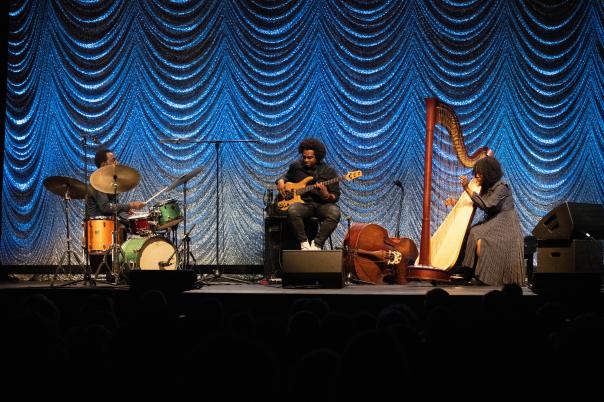
Of course, so much more besides jazz is offered at Spoleto. Any of the staple components of the festival – opera, theatre, chamber music, choral music, or dance – can find itself hiding in plain view amid the prodigious entirety of the festival, 120+ performances this year over 17 days. Strip away that mass of other stuff and it isn’t really hard to see that the 2025 lineup down in Charleston measures up with the best in North America. Cécile McLorin Salvant, Branford Marsalis, Vijay Iyer, Ambrose Akinmusire, Phillip Golub, and Etienne Charles not only match up well with the most elite festivals on the continent. Two of them, trumpeter Akinmusire and keyboardist Golub, lingered at multiple festival sites for three-day residencies, giving four and six performances respectively.

Thanks to the efforts of general director Mena Mark Hanna to make the massive festival more navigable, the jazz artists were listed on consecutive pages in the festival’s promotional brochure and the free – and comprehensive – festival program books for the first time. Scheduling was also conveniently compressed so that you could sample all of these jazz giants within the space of 10 days. Mavis Staples and Arooj Aftab, headliners at multiple jazz festivals around the country, were also slotted into Spoleto’s Front Row pop/country/rock/folk series, and accessible during that same timeframe.
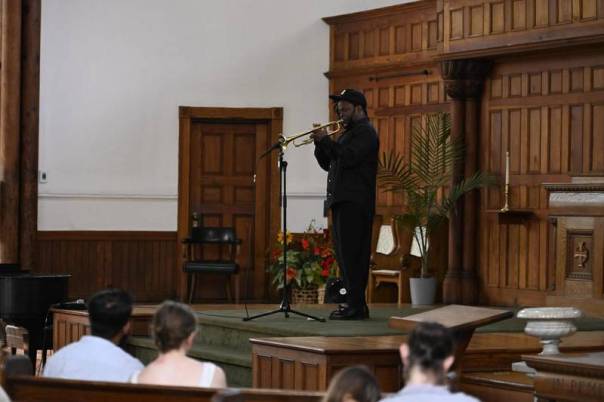
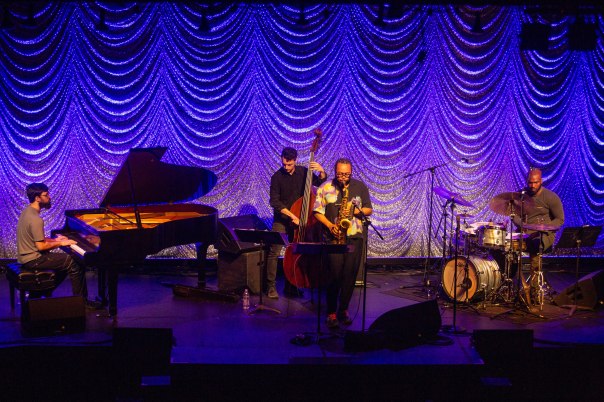
My own jazz feast started on Day 5 of the festival with Golub’s quintet, his final program at the Circular Congregational Church. My fondest memory of the Circular dates back to 1997 when Spoleto’s production of Benjamin Britten’s moody Curlew River was staged there in dim gilded light. As a jazz venue, the Church was most unkind to Golub’s piano, which seemed to emerge from its corner as a somewhat muffled echo, though the bandleader’s perch was fortified with a Rhodes synthesizer. Neither Alec Goldfarb’s electric guitar nor Daniel Hass’s cello was spooked by the hall’s acoustics, and the remainder of the rhythm, Sam Minaie’s bass and Adriano Vicentino’s drums, may have actually been enhanced.

The quintet played Golub’s Abiding Memory Suite in its entirety, with Vicentino as the only newcomer to the ensemble that recorded the studio album released in 2024. Once the piece, played without significant pauses, drifted away from the piano, it proved to be nicely varied and unpredictable. After Goldfarb’s guitar pierced the hall with its ethereally thin and silvery timbre in “Threads Gather,” the oddest, most scattered and modernistic episodes, “A Regrouping” and “Unspooled (Waiting Quietly),” cast a quiescent spell. “In a Secret Corner” carried that irregular flow forward, building gradually before breaking back into metrical jazz. Though he played provocatively in spots, Hass seemed underemployed until late in in the suite, when he at last justified his presence with some memorable solo work in “At the 11th Hour.”

It was fascinating to see and hear various configurations of the Spoleto Festival USA Orchestra throughout our 12-night stay. Massenet’s Thaïs, a Mozart symphony, Britten’s The Turn of the Screw, the Sibelius Violin Concerto, and Cécile McLorin Salvant each had a uniquely configured ensemble – led by three different conductors. It was a bit surprising for me, nonetheless, that the ensemble playing behind Alexi Kenney in the Sibelius underperformed compared with the superb support Salvant received three nights earlier in the same hall, Gaillard Center.

There was a sense, after three previous appearances at Spoleto, that both the festival and Salvant were wanting to try something different and reach higher. And until the festival premiered its production of The Turn of the Screw, Salvant was incontestably the highlight. We haven’t seen a new album from Salvant in two years, but none of Darcy James Argue’s orchestral arrangements were from that mostly French Mélusine release. Neither of the songs in the set that the diva has recorded, her own “Left Over” and Noël Coward’s “Mad About the Boy,” had orchestral arrangements before Salvant brought them to Charleston, and she sat down at the piano to replace the esteemed Sullivan Fortner (cover boy on the February 2025 issue of DownBeat) for her own original.

The highlights of the set were Salvant and Argue’s fresh takes on Duke Ellington’s “Sophisticated Lady” and Billy Strayhorn’s “Lush Life,” perhaps their most beloved ballads. But the audience showed even more enthusiasm for Stephen Sondheim’s “Send in the Clowns” and Michel Legrand’s “I Will Wait for You” from The Umbrellas of Cherbourg. With a disdain that would have pleased Parisians, Salvant sang the original French lyrics, “Je ne pourrai jamais vivre sans toi,” without a single interpolation of the English lyric. Salvant’s “Send in the Clowns” reminded us of the quirkiness that charmed the world from the outset of her career, flouting the usual 3/4 groove, speak-singing some of the familiar lyric, and wiping away some of the usual nostalgia and sentimental goo. Best version I’ve heard since Carmen McRae.

Naturally enough, since Branford Marsalis was on the May cover of DownBeat, he and his quartet surely do have a new album out there to tour with, Belonging. Marsalis didn’t lean on the recent release as heavily as Golub leaned on his, but he certainly referenced his magazine celebrity with the two titles he did pluck from that CD, “’Long as You Know You’re Living Yours” and “Blossom.” Both were Keith Jarrett compositions, chiming well with the front page May headline, “Marsalis Tackles Keith Jarrett.”

Branford was pretty cool as a bandleader, usually slipping away after his soprano or tenor sax solos were done – often abruptly – behind Justin Faulkner and his drumkit when others were soloing. Pianist Joey Calderazzo not only had ample chances to shine in the Jarrett pieces, but he also had two of his compositions, “The Mighty Sword” and “Conversation Among the Ruins,” prominently featured on the setlist.

With past stints jammin’ with Sting and leading The Tonight Show band, it would appear Branford’s appetite for celebrity has long since been satisfied. Bassist Eric Revis also got some love when Marsalis called for his “Nilaste” toward the end of the concert. Lighter gems – and more popular with the Charleston Music Hall crowd – were Jimmy McHugh’s “On the Sunny Side of the Street” and the rousing encore, “My Bucket’s Got a Hole in It” (more likely by Buddy Bolden or Clarence Williams than Hank Williams).

Iyer took over Sottile Theatre with his supertrio two nights after Marsalis. Like Iyer, bassist Linda May Han Oh and drummer Tyshawn Sorey (a fellow MacArthur Fellow) had both headlined at Spoleto in past festivals. As a group, they’ve put out two albums in the past four years, but in live performance, it was hard to see them as close-knit. Whether they wished to simulate a recording studio ambiance or someone in the group wished to remain unmasked despite COVID fears is anyone’s guess. But they sat and stood at more than the customary distance away from each other. When I last saw Iyer play at the Jazz Standard in New York, my wife Sue and I were seated closer to Iyer than either Sorey or Oh.

Despite the trio’s separation, their chemistry and interaction were all the more amazing. Each appeared to be in his or her own world, yet they were constantly interconnected. If one of them was not playing, he or she seemed to have peeled off at a predetermined or spontaneously signaled moment. Intensity didn’t wane in those moments when balances shifted among the players. Sorey could assert himself with a single stroke anywhere in a measure and take complete control with a sudden flurry, endlessly inventive and colorful. Oh showed us once and for all that she is a composer/improviser who can easily hold her own in the presence of two major virtuoso composers – even though her bass didn’t penetrate at the Sottile like it does on the trio’s recent Compassion recording, where it’s as intimate as your heartbeat.

As for Iyer, he once again proved nonpareil. In the space of a single piece or solo, he could build to the epic force of McCoy Tyner, jet through that thunderous cloud he and Sorey stirred up, and emerge with all the purposefulness, lyricism, and freedom from mannerism of Bill Evans. “Overjoyed,” a very inventive and angular cover of Stevie Wonder’s tune, was probably the easiest for newcomers to Iyer’s music to latch onto. The “Free Spirits/Drummer’s Song” pairing was far more exciting for me because Sorey was so much sparer, explosive, and creative than he was on the Compassion track. Other trios might have swung harder, but since the great Evans trios, none I’ve heard was more beautiful or compelling.

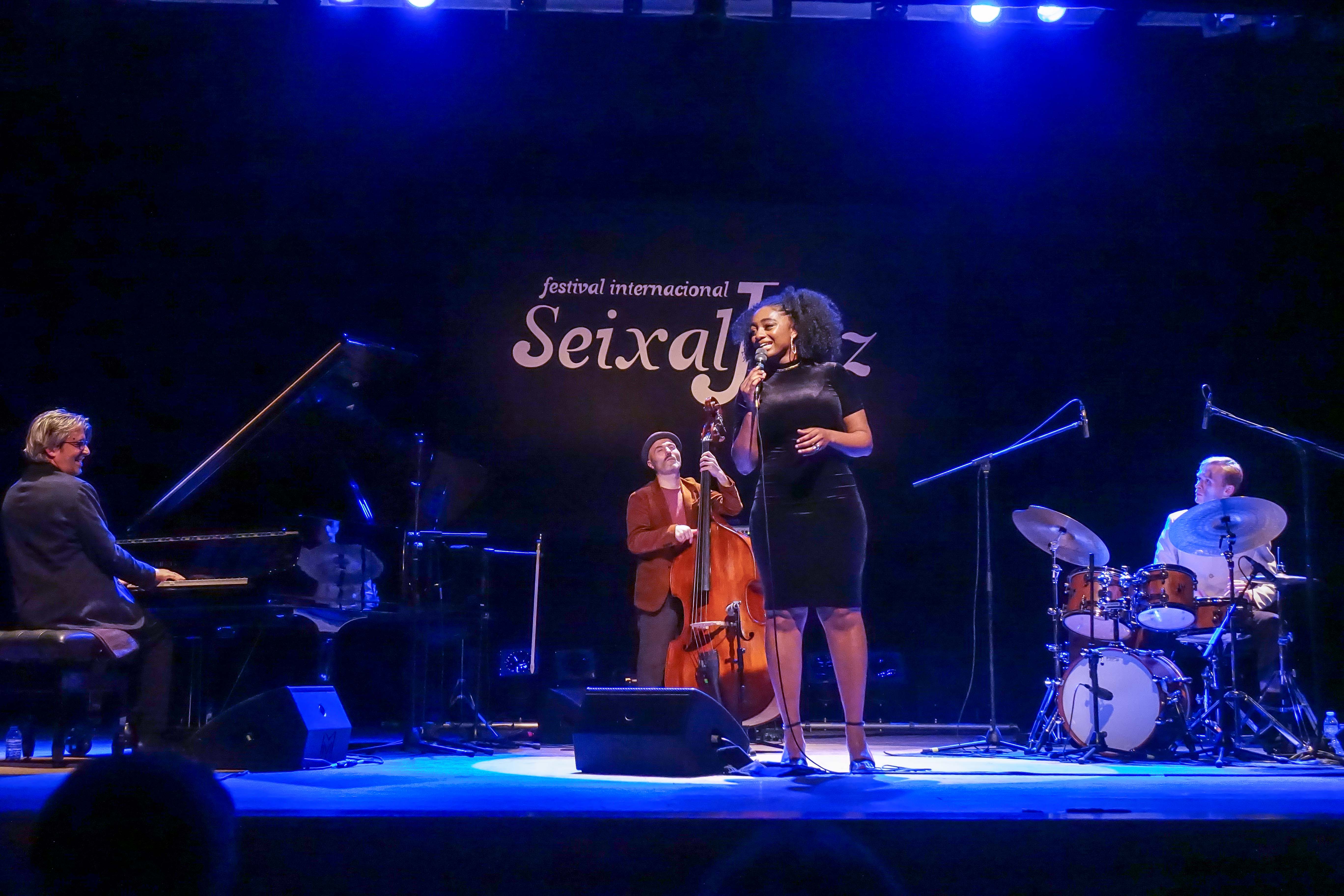
Since I had seen him live at the Seixal Jazz Festival in Portugal with his quartet less than three years earlier, Akinmusire’s residency was by far the most intriguing for me. But we had to find out what “An Evening with Isaac Mizrahi” was all about – the festival brochure and program book seemed to imply that Mizrahi was everything – so we had to miss out on Akinmusire’s quartet and trio concerts, both of which overlapped. It was especially brutal for me not to attend what would have been my first jazz concerts at Dock Street Theatre after more than 30 years of attending Spoleto, but Sue’s reactions to the giddy Mizrahi and the cutting-edge trumpeter vindicated my choice.

Akinmusire’s gig at the Sottile, our last event in the Holy City this year, was likely the most unique and accessible of his residency, though I’m still bemoaning my lost opportunity to behold an Akinmusire-Fortner-Sorey trio at the Dock. The nine performers in the Honey from a Winter’s Stone concert, including the PUBLIQuartet and vocalist Kokayi, were spread out across the Sottile stage even more widely than the Iyer Trio. Boundaries between what was written by Akinmusire for the string quartet and what was improvised by his quartet were more distinct, but it seemed like Kokayi’s rap rants, rhythmic and melodically on key, straddled those boundaries as the speed of the spewed verbiage increased. Most infectious rap performance I’ve ever experienced, even though most of the words weren’t clear.

Reggie Washington on electric bass and Justin Brown on drums counterbalanced the strings and Kokayi by sticking to their jazz rhythms, but keyboardist Sam Harris brought an acoustic and an electric instrument to the stage, another straddler. Through the course of the evening, as the group traversed their 2025 honey from a winter’s stone recording – with nearly identical personnel – Harris might lay down a vamp on his synthesizer or trigger a modulating drone as frequently as he soloed. Generous space was also set aside for Brown’s thrashings.

Akinmusire had little to say between selections, usually pointing to and naming one of his bandmates, but his horn said plenty, with judicious electronic alterations here and there. You could argue that Akinmusire had somehow synthesized the earliest electronic explorations of Bitches Brew Miles Davis with the two acoustic periods that preceded that revolution, the Kind of Blue period and Davis’s playing with the quintet he led that introduced Herbie Hancock and Wayne Shorter to the universe. But the living trumpeter is undoubtedly building upon that legacy.
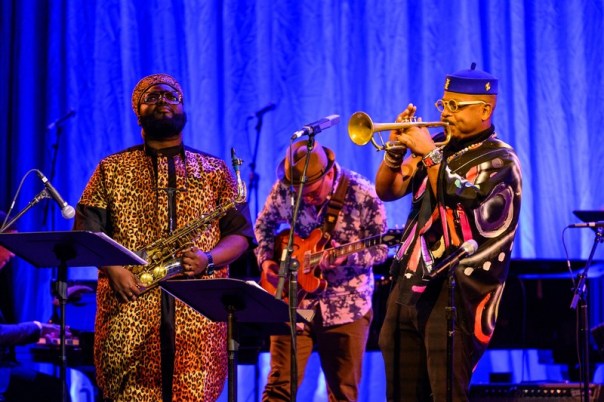
None of this year’s jazz events took place outdoors at Cistern Yard, the temple of Spoleto jazz in years gone by. Like last year, when Trombone Shorty had to move his show to the College of Charleston’s TD Arena, weather intervened between us and seeing Etienne Charles and his Gullah Roots band under the live oaks. By now, such last-minute schedule switches are almost routine at the festival: the sound system is tight and the lurid outdoor lighting arrives somewhat intact. Charles’s show was not quite as rambunctious or gaudy as Shorty’s extravaganza had been, but his suite – soon to be officially released on CD – was far more profound, moving, and relevant.

Nor was there any lack of showmanship in the presentation of this epical suite, which traversed the arrival of the Gullah in the New World via the Middle Passage to the morning when Lincoln’s Emancipation Proclamation took effect. In three stages, the Gullah Roots ensemble grew from six to seven, seven to eight, and eight to 14 as the massiveness of Charles’s concept enlarged. Those two historical watersheds were both marked with two-part compositions, “Igbo Landing” and “Watch Night.” After the foundational “Gullah Roots” piece, special guest Quentin Baxter, a longtime Charleston-and-Spoleto fixture, joined the group as a second percussionist for the dramatic “Landing.” Later for “Bilali,” Samir LaGus came forth in more striking African garb than we had seen before, bringing with him a guembri, a three-stringed lute-like instrument that merited its own introduction from Charles.

For “Watch Night,” taking us back to New Year’s Eve on December 31, 1862, a four-woman choir (The Wives), vocal soloist Quiana Parker, and organist/choir conductor Damian Sneed joined the solemn vigil and ultimate jubilation. Visually the spectacle was as grand as the music as Sneed and his singers filled the side of the stage opposite LaGus and the percussion. Issued on September 22, the iconic Proclamation would become law at midnight, the beginning of Freedom Day. One day after Juneteenth 2025, Charles brought his Gullah Roots to the Stage Door at Blumenthal Center for what promised to be a very special Jazz Room concert presented by JazzArts Charlotte.

Bearde Crosses the Border With Ziad to Sublimity

Review: Jazz @ Theatree Bechtler with Nicolas Bearde

By Perry Tannenbaum

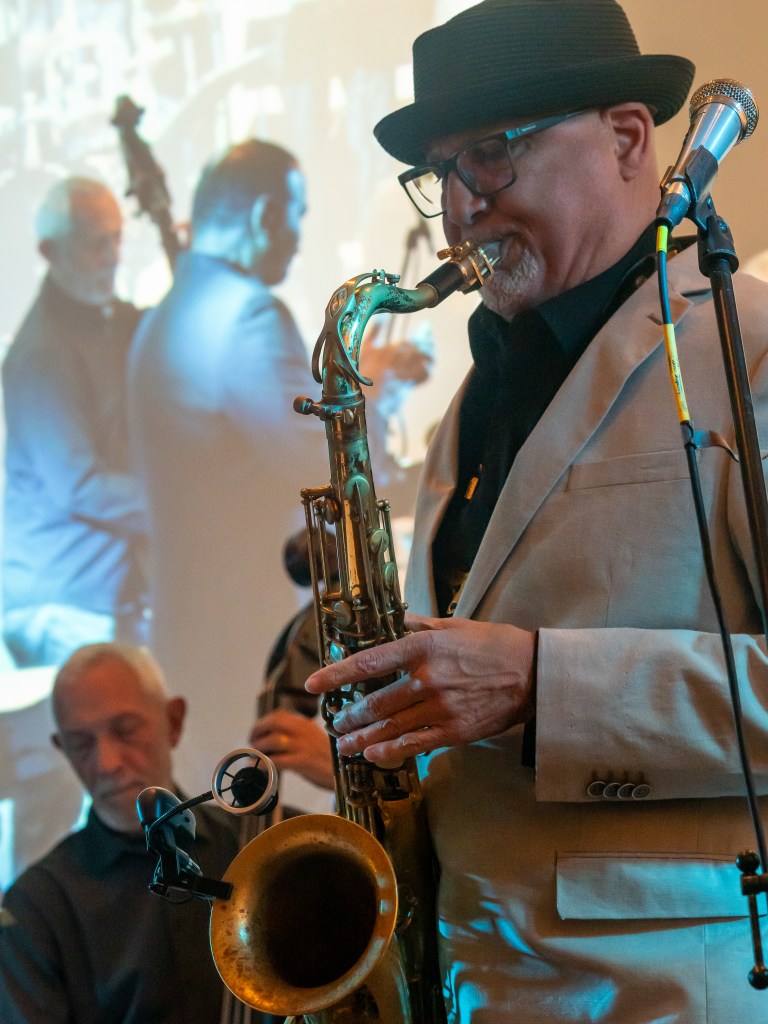
October 4, 2024, Charlotte, NC – As a listener and a sometime vocalist, my feeling is that a jazz singer backed by a piano trio can only verge on the sublime. Until a horn is added – saxophone, trumpet, or clarinet parlaying and intertwining with the vocalist – the divine nectar never quite sparkles with maximum effervescence. So it’s always a joy when the Jazz at the Bechtler series hosts a guest vocalist, for the leader of the house band, Ziad Rabie, always carries a tenor and soprano sax with him to fortify the artillery. Before Nicolas Bearde’s appearance on Friday, I hadn’t been to one of these bacchanals since Nnenna Freelon guested in May 2022, so I was behind the curve in terms of how the experience in the Bechtler Museum of Modern Arts lobby has been enhanced.

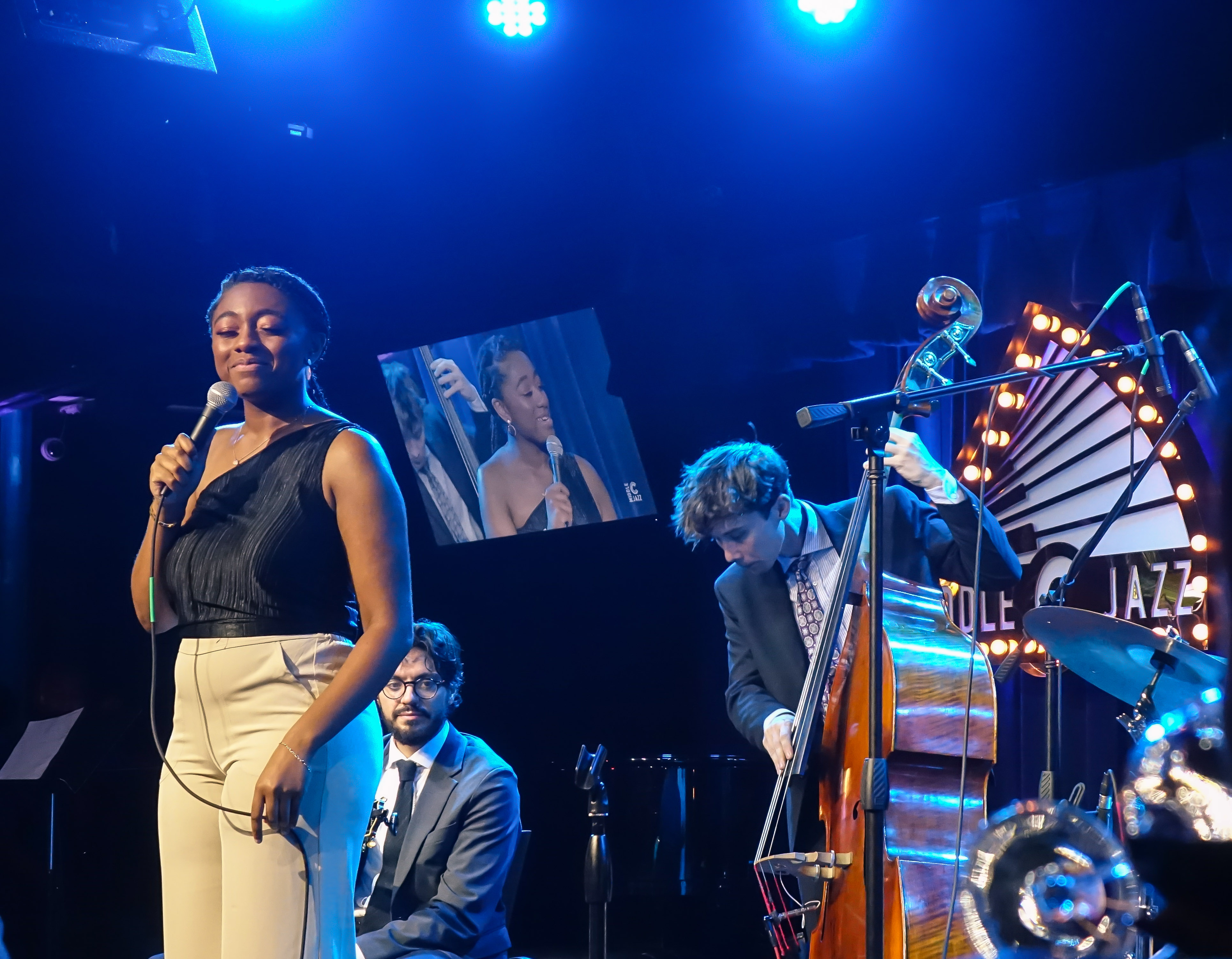
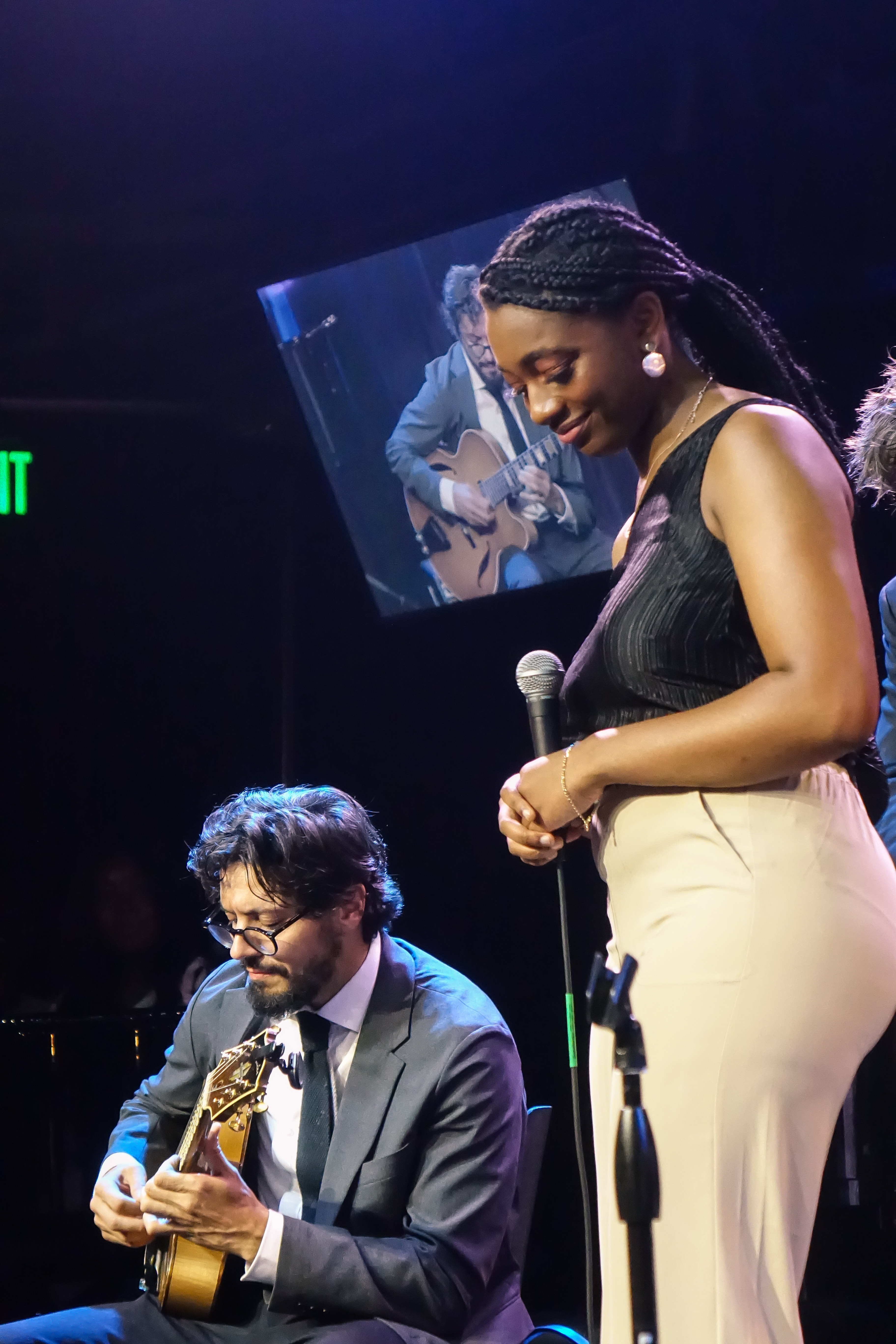
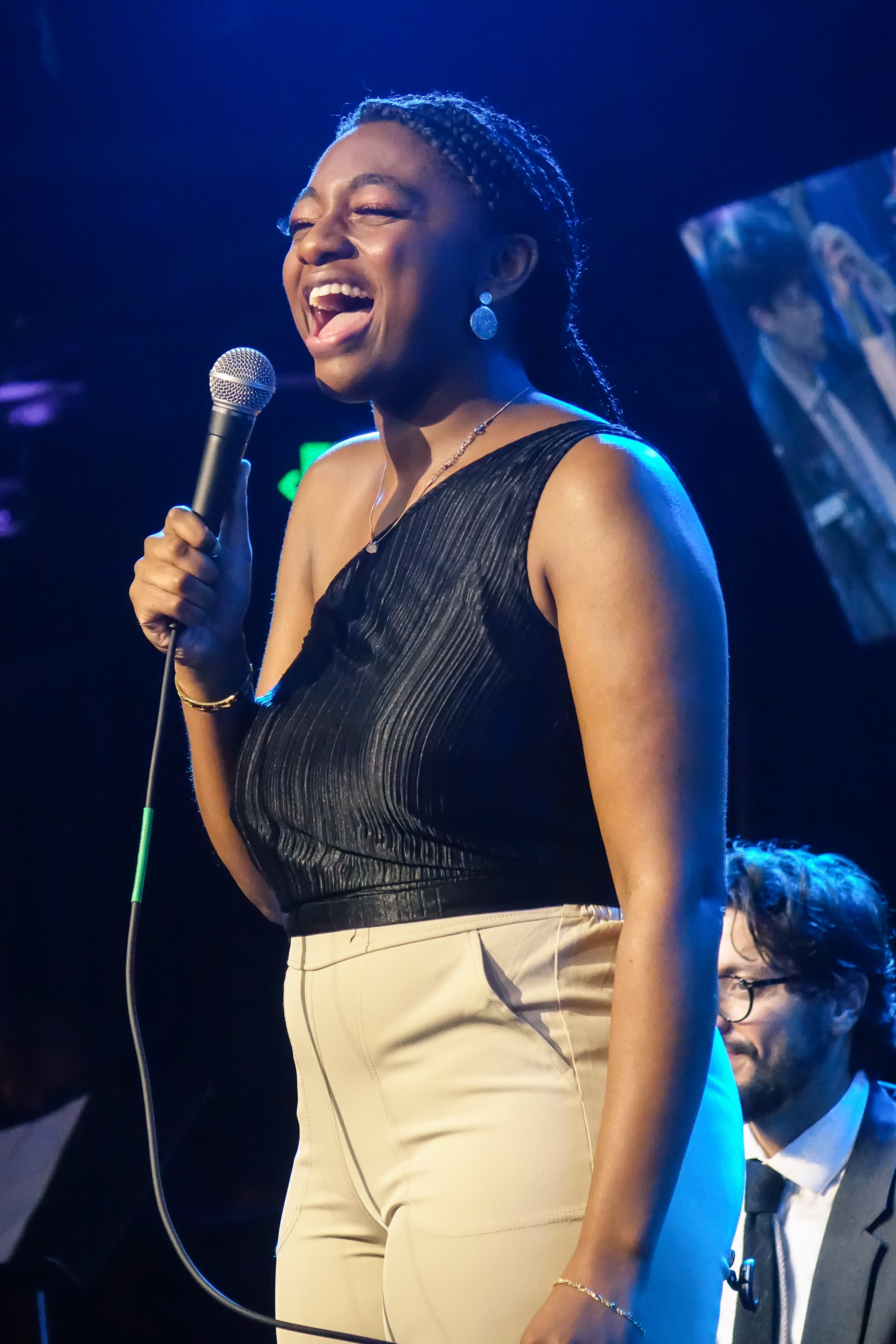
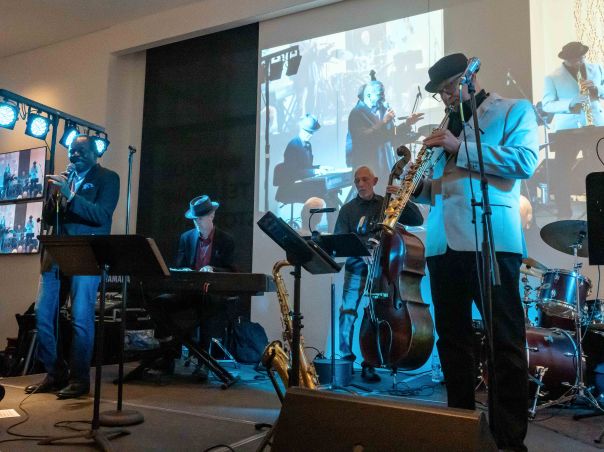
Perhaps influenced by Middle C Jazz over on Brevard Street, the Bechtler bandstand is now framed by large video monitors displaying a live feed of the concert – that is also projected as a larger-then-life backdrop upstage of the players. The effect of the live pastel projections is electrifying, especially if your sightline differs radically from the camera’s, and the projected images are helpful if your view of one of the musicians is obscured. A music stand downstage blocked my view of drummer Rick Dior sitting behind Rabie, but when I stood up briefly to snap a photo of him, I discovered that a second music stand right at his drum kit was still blocking my view. Luckily, the live feed up above him was available to us when he took a solo.

Bearde last sang in Charlotte at the tenth anniversary celebration of the Bechtler series staged at the adjoining Knight Theater in January 2022. That was my gateway to his discography, which certainly reinforced my notion that he agreed with me on jamming with a horn. There were plenty of Nat King Cole tracks online that were delightful to discover from his recent album on Spotify, along with a few Johnny Hartman gems on past recordings. He’s been around long enough, since before the turn of the millennium, to have accumulated two Spotify artist listings that do not overlap – and he still sounded like he’s at the top of his game. The two saxophonists who have played on Bearde’s last two albums, Eric Alexander and Vincent Herring, are both self-recommending – and they both supplied a sheaf of candidates for seamless transport to the Bechtler lobby and Ziad’s capable hands.

So did two of the songs Bearde sang in 2022, his own “Falling in Love Again” and Abbey Lincoln’s “Living Room,” both of which were reprised in more extended versions. The baritone began his set with the same song that began his 2016 album, Invitation,Burton Lane and Alan Jay Lerner’s “Come Back to Me.” Where Herring had inserted his alto, Ziad now blazed with his soprano sax, with extra space in the arrangement set aside for pianist Noel Freidline’s ruminations – all with the speed and verve of the lyric’s “turn the highway to dust, break the law if you must” spirit.

With “That Sunday, That Summer,” Bearde brought us the first of two tracks selected from his Nat Cole tribute album, both of which, not at all coincidentally, featuring Alexander on tenor sax. Bearde’s way with the song is jazzier than Cole’s 1963 saccharine hit – with its lush strings, full chorus, and glinting triangle – but I can’t say I like all the added syncopation he brings to the table. Best of the covers, to me, is a Sarah Vaughan version not to be found on Spotify. That revelation is online exclusively at Apple Music on her Jimmy Rowles Quintet album from 1974.

Bearde was entirely in his groove thereafter, beginning with his cha-cha inflected Burt Bacharach hit, “Close to You,” with some fine solos by both Ziad and Freidline – and a wonderful breakaway into 4/4 tempo in the middle of the vocal reprise – with some extra Beard/Ziad jamming afterwards. Lincoln’s “Living Room” was beautifully embroidered the second time around with an introductory Freidline fantasia intro from his electric keyboard and a regal solo from bassist Ron Brendle after Ziad’s tenor sax proclamation. Most unexpected and exciting was a new song, “Si Vous Saviez,” written by Rabie with Jennifer Shea. If you’ve heard John Coltrane’s Ballads album, you can begin to imagine the lovely sound of Ziad’s creamy, buttery intro on tenor sax, and Bearde took to the longish tune like he was seriously considering recording it on his next album.

The rest of the set included songs that Bearde has already taken to the studio, starting with the moody title tune from the Invitation release, which saw a fine intro and later solo from Ziad and, notwithstanding the comparatively mellow mood, a fine chunk of work from Dior on the solo I screened. Plucked from his Nat Cole tribute, “Thou Swell” actually began life as part of Rodgers & Hart’s A Connecticut Yankee in 1927, where its archaic language was perfectly apt. Both Ziad and Freidline contributed zippy, palate cleansing solos that readied us for the finale.

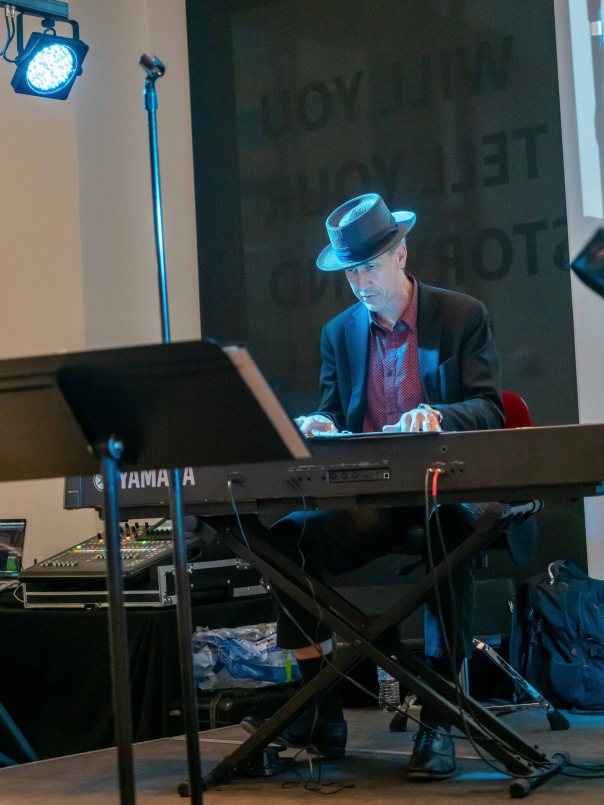
Once again it was “Falling in Love Again,” with Bearde elucidating on his composition at greater length before performing it this time. Further engaging us, he encouraged us in the audience to clap out the rhythm as Freidline, chided all through concert for his snazzy (and Sinatra-like) chapeau, pounded out a genial piano intro. Everybody was in great spirits by this point, and Ziad gave us one more reason to applaud with his screaming tenor sax.

Photos by Perry Tannenbaum

Down at Spoleto USA, the Vibe Is Shifting

Review: Spoleto Festival USA in Charleston

By Perry Tannenbaum

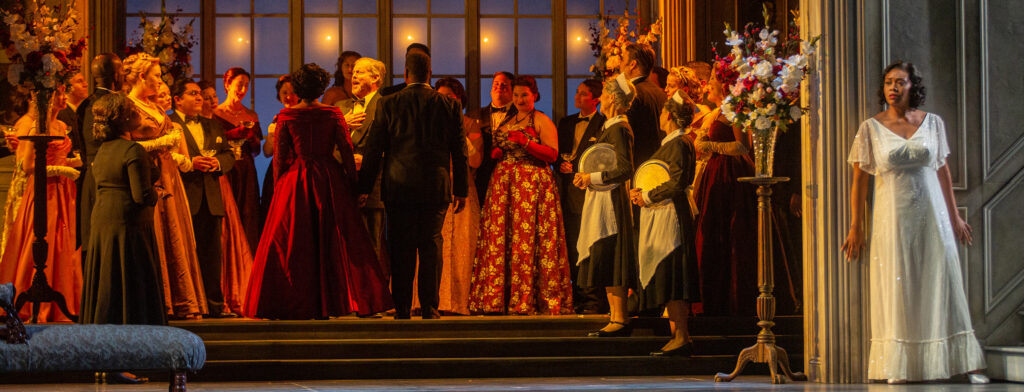
‘Song of Rome’ at Spoleto Festival USA in Charleston. (Photo by William Struhs)

Looking down benignly at his Dock Street Theater audience, the newly anointed host of Spoleto Festival USA’s chamber music series, Paul Wiancko, gave us a slight ceremonial nod. “You have chosen wisely,” he said sagely.

But he wasn’t exactly speaking to me, since this was already the fifth program in the noonday series – the backbone of Spoleto – that I was attending this year. Nor was he speaking to the “eleven-ers” in the audience who were signed up for the complete set of programs down in Charleston through June 9.

He was speaking directly to those in the audience who would only attend one of the concerts. Today. And he would go on to ask us all to participate in making the experience special and unforgettable.

It would be very special – beginning with a Beethoven piano trio that showcased Amy Wang at the keyboard, Benjamin Beilman on violin, and Raman Ramakrishnan on cello. How’s that for diversity? My love affair with Wang’s artistry and demeanor had begun just two hours earlier when she played the Schumann Violin Sonata, teamed up with the Slavically expressive Alexi Kenney.

Enough to mightily crown most concerts, the Beethoven was merely a satisfying appetizer. For Wiancko had cooked up a powerful combo, calling upon two living composers that I was barely familiar with, Jonathan Dove (b. 1959) and Valentin Silvestrov (b. 1937).

Our contribution to the magic would be to withhold our applause between the two pieces. It was easy enough to maintain stunned silence after In Damascus, Dove’s heartfelt setting of Syrian poet Ali Safar’s grieving – and aggrieved – reaction to a senseless car-bombing in his nation’s war-torn capital.

The prose poems were achingly and angrily sung by tenor Karim Sulayman, perhaps most indelibly after an extended instrumental interlude, turbulently delivered by a string quartet that included Kenney, Beilman, Wiancko (on cello), and violist Masumi Per Rostad.

“We will be free,” Sulayman sang in Anne-Marie McManus’s ardent translation, “of our faces and our souls – or our faces and our souls will be free of us. And the happy world won’t have to listen to our clamor anymore, we who have ruined the peace of this little patch of Earth and angered a sea of joy.”

Sulayman was visibly in tears as the lights went down on In Damascus and pianist Pedja Mužijević entered with his iPad and sat down at the Steinway. In the dimness, Mužijević played Silvestrov’s Lullaby, an appropriate coda to a song sequence that began with the children of the Zuhur neighborhood in Damascus who would never wake from their sleep – or survive a bogus “holiday truce” – and ended with the evocation of mothers and loved ones who would always await their return.

Amazingly enough, this isn’t the only instance where Sulayman is singing about children caught in the web of brutal war and barbaric terror, for his wondrous voice also figures at Spoleto in the world premiere of Ruinous Gods, a new opera with exotic music by Layale Chaker and libretto by Lisa Schlesinger.

Co-commissioned by Spoleto, Nederlandse Reisopera, and Opera Wuppertal, Ruinous Gods is a fantastical deep dive into the mindworld of Uppgivenhetssyndrome, a rare traumatic response to living in the limbo of displacement. It was first observed in children detained in Sweden, but the syndrome has now been observed in refugee camps around the world. Hopeless children simply go to sleep in reaction to their endlessly unresolved status. Some die, others lapse into coma – sustained only by a feeding tube.

Encased in a surreal bubble over a grassy bed from scenic designer Joelle Aoun, that is how we find our sleeping-beauty protagonist, Teryn Kuzma as H’ala, when the opera begins. Mezzo-soprano Taylor-Alexis DuPont as her mom, Hannah, is stressing and blaming herself while two doctors, Overcast and Undertow, hover over their patient, unsympathetic researchers hoping to analyze and classify the disease.

Meanwhile, Sulayman is decked out in a feathery all-black outfit as Crow, the mentor who, like Dante’s Virgil, guides all these comatose children from around the globe into a common underworld dreamscape where all are free. Is that a spaghetti rainbow dropping down across the Sottile Theatre stage from the fly loft as the imprisoning globule lifts off H’ala, or is there an unfathomably large jellyfish floating above?

Sinuous, jazzy, and sensuously obsessive, Chaker’s music resurfaced in the jazz sector of Spoleto 2024 – at Charleston Music Hall, a venue never used by the festival before. Bigger than Spoleto’s customary hall for chamber jazz (and eccentric modern music), the Emmett Robinson at the College of Charleston, the Music Hall was an acoustic revelation and a welcome escape from the Robinson’s clean-room sterility. Bonus points for the stars that lit up on the black backdrop.

Attendance was astonishing, more than could ever be seated at the Robinson, as Chaker, leading her Sarafand quintet on violin – with an occasional vocal – delved into her two most recent albums, Radio Afloat (2024) and Inner Rhyme (2019). Having worked with Daniel Barenboim and his West-Eastern Divan Orchestra, Chaker has created a jazz equivalent in Sarafand with Phillip Golub on keyboards, Jake Charkey on cello, John Hadfield on drums, and Sam Minaie behind the bass.

Compared to her opera, Chaker’s jazz and her Sarafand personnel made subtler political points. But this wasn’t the only jazz gig that came loaded with extra cargo. Terri Lyne Carrington returned to Cistern Yard for a pointedly themed concert under the moon and the live oaks – with political firebrand diva (and NEA Jazz Master) Dianne Reeves as her special guest.

Carrington’s cargo was collected into her Grammy-winning album of 2022, New Standards, Vol. 1, the first studio sprouting of her pathfinding songbook collection, New Standards: 101 Lead Sheets by Women Composers. So without much preaching, her set was a celebration of Geri Allen, Gretchen Parlato, Eliane Elias, and – at a high summit where Reeves duetted for the first time with Christie Dashiell – the great Abbey Lincoln and her mesmerizing “Throw It Away.”

All these greats joined together again on Allen’s “Unconditional Love,” with Kris Davis on piano, Matthew Stevens on guitar, and trumpeter Etienne Charles all getting in their licks, plus spoken and dance stints from Christiana Hunte. Wow.

Theatre at Spoleto this season is densely messaged. Or not. The Song of Rome was deeply immersed in issues of immigration and sexism, with an overarching interest in the fate of republics, in ancient day Rome and 21st century USA. Cassette Roulette, on the other hand, was pure frivolity, barely deeper than its title and whole lot bawdier.

After starring in An Iliad last season, Denis O’Hare could be logically expected to follow up that one-man conquest with An Odyssey. Well, he has, sort of. O’Hare co-wrote A Song of Rome with Lisa Peterson, his Iliad writing partner, but this time he doesn’t appear onstage, handing over the acting chores to Rachel Christopher and Hadi Tabbal.

Christopher is Sheree in modern times, a grad student striving to learn Latin, and Octavia, Emperor Augustus’s sister at the dawn of the Roman Empire. Tabbal is Azem in present day, Sheree’s immigrant Latin tutor – and our overall storyteller – and the poet Virgil during the reign of Augustus.

So O’Hare is skipping over the rest of Homer to engage with Rome’s great epic, The Aeneid, knowing full well that Virgil based the first six books of his masterwork on The Odyssey and the last six on The Iliad. As a thematic bonus, O’Hare and Peterson discovered during their research for this world premiere that Virgil himself was a refugee, forced out of his ancestral home in Northern Italy by Roman avengers of Julius Caesar who got Dad’s estate for their prize.

Although Virgil’s epic was likely commissioned by Emperor Augustus, aka Octavian, doubt remains whether The Aeneid is a work of propaganda justifying the Roman Empire as divinely ordained – tracing Octavian’s ancestry back to Aeneas and Venus as meticulously as the New Testament traces Jesus back to King David, son of Jesse – or a subversive work by an immigrant genius settling a score. While getting handsomely paid to do it.

Octavia and Virgil go back and forth on this point because the Emperor’s sister is both an admirer and a keen reader, but both are critical of Octavian, who is hell-bent on buttressing the legitimacy of Rome while closing off its path back to a glorious Republic.

“The Republic is over,” they agree. And how about ours?

While Sheree is learning about the Roman issue that comes up as Virgil delivers more and more manuscript pages to Octavia over the years, Sheree must face the issue in American terms when Azem receives a deportation notice. Does she instantly jump to his defense and rescue, or does she immediately suspect him of criminal activity?

Meanwhile, Sheree is reading The Aeneid differently from Azem and Octavia. Why is Octavia left out of literary history if she played such a key role? Why are Virgil’s women, particularly Dido and Lavinia, so passive and pathetic while the strong woman, Camilla, is a she-devil?

Finding this insidious neglect and defamation rampant in literary history and beyond, Sheree comes up with a radical, shocking solution that she announces on her podcast. She will pour fuel over every single book piled on the Dock Street stage and burn them all.

When will all this vicious animosity end? Citing the end of Virgil’s epic, where Aeneas, the immigrant from far-off Troy, killed the vanquished Turnus instead of offering peace, conciliation, and mercy, Sheree answers us curtly lighting the flame: it won’t. Opting for chaos, she almost says it aloud – to hell with the immigrants. (Or give it to the immigrants, if you’ve heard of the Goths.)

Moments like that land hard at Spoleto. Deep in Trump Country, at the Sunday matinee of Ruinous Gods, there was a loud boo among all the lusty cheering as the singers took their bows. Good. The nurturing point of the opera, gushing with empathy toward immigrants worldwide, had hit home, no matter how you feel about it.

Depending on whether you were attuned to John Cameron Mitchell’s Hedwig and the Angry Inch cache, or whether you resonated with Amber Martin’s worship of Reba McIntyre, Bette Midler, and Stevie Nicks, Cassette Roulette was hit-and-miss, redeemed or further cheapened by Martin’s bawdiness. Nicks’ “Rhiannon” was the crowd fave and mine on the night I attended, getting a far more epic performance that you’ll hear on AM radio or an elevator. But neither David Bowie nor Midler got much of a rise. The diet of ‘70s and ‘80s hits didn’t draw much of a youth crowd to Festival Hall, which was made over to a quasi-cabaret setup.

Trombone Shorty slayed far more decisively at TD Arena, where his outdoor revels with Orleans Avenue were abruptly moved when rain threatened. At the height of the indoor bacchanale, Shorty paraded through the audience at the home of College of Charleston basketball with key members of the band (none of whom were named in Spoleto’s fabled program book). They slashed up the rear aisle of the stadium, swung around to the side of the gym and came down along the side.

Snaking through the stadium, Shorty & Orleans reigned over the reigning pandemonium. The prohibition against photography was washed out to sea in a riptide of glowing cellphones.

Shoot, the band was taking selfies! And through it all, the sound remained perfect, Shorty and his brass perfectly aligned with the rhythm section on the TD stage, absolutely distortion-free. Sure, a few dissenters and defectors also trickled through the aisles, accompanied by true believers seeking and returning with beverage.

The most pathetic sufferer sat right across the aisle from my wife Sue and me, hunched over, elbows on kness, with his hands tightly cupped over his ears. Probably needed a ride to escape. Maybe he would have fared better in the open air, where at least some of the sound could have escaped skyward through the live oaks of Cistern Yard.

Final week highlights: Bank on it, the Bank of America Chamber Music series has four more different programs to offer – and a dozen performances – before Spoleto wraps up on Sunday. The Wells Fargo Jazz lineup continues strong, with an all-star Latin twist. Puerto Rican saxophonist Miguel Zenón and Venezuelan pianist Luis Perdomo bring their Grammy-nominated El Arte Del Bolero albums to life at the Dock Street Theatre in a three-day, five-performance engagement (June 6-8) while Cuban percussionist extraordinaire Pedrito Martinez lights up Cistern Yard with an Afro-Cuban stewpot of infectious rhythm, Echoes of Africa (June 7).

After distinguishing themselves in Mahler’s Fifth, the Spoleto Festival USA Orchestra returns to Gaillard Center with Beethoven’s Third (June 5), plus a Rachmaninoff concerto for piano + trumpet and composer-in-residence Reena Esmail’s “Testament” for tabla and orchestra. Upstaged by a visitation from the Charles Lloyd Sky Quartet this past weekend, the Spoleto Festival USA Chorus rebounds with a two-performance run of The Heart Starts Singing (June 6-7), sporting another Esmail piece that will feature Wiancko’s cello – and an eclectic mix of works by Tomás Luis de Victoria, Rachmaninoff, Irving Berlin, and more.

The Festival Finale of yore is gone this year, but there’s more folk, funk, Americana, and alt-country in this year’s Spoleto lineup. Still to come are Andrew Marlin and Emily Frantz’s latest partnering, Watchhouse (June 5), with their own band-backed experiments in folk-rock playing at Cistern Yard; Grammy Award winner Aiofe O’Donovan (June 7) returns with the SFUSA Orchestra to Sottile Theatre; and Jason Isbell (June 8-9) headlines the final weekend with a two-night stint at the Cistern.

Theatre continued during Spoleto’s second weekend with sharply contrasting shows, the wholesome Ugly Duckling from Lightwire Theater and the savagely satirical send-up of the American West, Dark Noon, from the Danish fit + foxy company in its US Premiere. A similar dichotomy prevails this week as Australian company Casus Creations takes over Festival Hall with Apricity (June 6-9), a family-friendly mix of aerial and acrobatic astonishment, with sprinklings of comic shtick and moody music.

On the edgy side, RuPaul’s Drag Race fans can rejoice greatly as Season 9 champion Sasha Velour deigns to bring her presence to Gaillard Center with The Big Reveal Live Show! (June 6). Is Charleston’s big house big enough for drag’s Queen of Queens? The Holy City and Spoleto haven’t been so sensationally desecrated since Taylor Mac ruled the festival.

Veronica Swift: Militantly Containing Multitudes

Interview: Veronica Swift

By Perry Tannenbaum

At the tender age of 29, Veronica Swift can look back on a career that stretches over two decades. Yet it’s just in recent years that she has broken through, getting prodigious airtime on jazz radio and racking up high play numbers on the Spotify and Apple Music services. Her 2021 album, This Bitter Earth, was her breakout, landing her on JazzWeek’s Top 50 listings for 27 weeks – and at the #3 slot for the year in total airplay. That CD came to my attention through those jazz listings and via glowing reviews in newspaper and magazine reviews. The buzz for Swift’s latest release, the eponymous Veronica Swift, has been harder to ignore. My inbox has been hit with emails from publicists, a steady stream of hype from Middle C Jazz, where she performs this Saturday, and news from JazzWeek on September 28 that the album made the highest debut among albums in their Top 50 for that week.

People are clamoring for Veronica Swift partly because there’s more of an industry push behind her, but also because she’s finding her voice and daring to proclaim there are many voices – and languages – at her command. The jazz singer has songs by Nine Inch Nails and multiple dips into Freddie Mercury and Queen. At what might normally be termed the other end of the spectrum, there are a couple of Broadway songs bookending the CD, plus an Ellington and a Jobim in the middle. But that wide range isn’t wide enough for Swift anymore. There’s a gush of Beethoven, Gounod, and Chopin on the songlist, with additional glimpses of Puccini, Leoncavallo, and Rachmaninoff. Her current tour, promoting the new CD, is spreading the word from San Francisco to Italy.

We caught up with her earlier this week on her cellphone.

Hello. This is Perry Tannenbaum from Cultural Voice North Carolina.

Veronica Swift: Hi.

Hi. How are you?

Good.

Where are you?

Los Angeles.

Oh my heavens. Okay. And your next stop is?

Well, tomorrow we’re headed to Alabama to play in Auburn, and then we come to you guys.

What’s it like? I mean, I know the last time you cut an album, This Bitter Earth, I was only hearing about it through jazz media, but now I’m hearing it through publicity agents and you’re out there promoting it. Is that a big change for you?

Well, I just focus on the music part. I’m not behind the scenes with the publicity stuff. I just take the calls when they come. But all I do is I go where I’m needed, where the gigs are happening. That’s the important thing. And so, you know, just moving forward, onwards and upwards. It’s all part of the evolution.

So you’re not noticing any intensification in the amount of bookings you’re getting at this point?

Well, I don’t really go into that, because it’s not always cohesive with someone’s career moving forward. It’s non-linear. That’s something that’s kind of hard to describe. But basically, since I’m doing something now that’s genre-wise, it’s genre-bending and it’s a little bit harder to market. So actually, my bookings have become slightly less because of that. Because a lot of venues, one also post-COVID, a lot of venues, we’ve all had to scale down.

And so I’ve lost a lot of stuff because of COVID. Even though we’re all back out there going to shows, the world, the economy is still like its response to those two years of having nothing going on. It’s just still the aftermath. It’s really very real for us musicians.

So knowing that you do have an eclectic album out, do you feel like you need to tailor that somewhat when you come into a Middle C Jazz Club?

I absolutely do not tailor any part of my set because there’s nothing far-reaching. It’s not avant-garde. All the genres we play were at one point pop music. We do swing and standards and Judy Garland-style theater stuff. We do rock and roll, like 70s classic rock stuff like Janis Joplin. We also do funk and soul, like Aretha Franklin stuff. So basically, everything is palatable.

And so everywhere we play, whether it’s an orchestra, if it’s a jazz club, or if we’re opening for a rock band in a rock club or a festival, we do the same set, because you have to stay true to your message. And if I tailor my set to fit the room, or I hope people like it more if I do this, then you’re going against the message, which is the all-inclusive, all-inclusivity and embracing the full spectrum of who you are.

It goes beyond music. I’m using music as a metaphor, but that’s what I hope to inspire people to do. And everyone’s been getting it. So I’m really happy that the audiences have just been so supportive. And they’ve known my past catalog, but that that hasn’t hindered their experience or enhanced it. It’s just all music. It’s all good music.

Yeah. I’m noticing, though, that there’s a real paradox and a real expansiveness in your new album in terms of the genres, the orchestrations, the arrangements that you’re doing. Are all those clocks in the cover photo supposed to signify that this is a carpe diem album, “live for the moment”?

Oh, yeah. You know me. I like to have multiple ambiguous symbolism, of course. But that’s definitely… you got it. That’s one of the meanings behind the album cover. And there’s an element of that for sure, because I have a 20-year career.

I mean, I know I’m young. I’m 29. But I have a 20-year career of singing one genre. And it’s been my dream to do this album like this, this way. But I have never had the opportunity or the, you know, it didn’t make sense because I had a, there were expectations put on me at a very young age that I just kind of, I was on that trajectory.

And I had to say, no, the time is now or never. So yes, there’s the carpe diem element. And also, I look at myself and my band. Like, we’re playing all these different genres. And the imagery I’ve used is time travel. And we’re almost like, you know, going through time and collecting all of the best of all the genres through different eras.

And so the clocks, if you notice, they come from different eras in history. There’s a sundial, and there’s a cuckoo clock, and there’s a metronome, and there’s all kinds of different ways to tell time from different eras, but time is the constant.

You are not the constant. I mean…

Well, actually, if you think about it, I am the only constant in this. That’s why this works, is because who I am is in all of these genres. I am the cohesive element. My voice is still my voice. It’s not Veronica wears different hats. It’s Veronica wears the same hat different ways. So yes, I am the cohesive element.

But you’re not at all hesitant about embodying opposite philosophies within the space of two or three songs. I mean, “I Am What I Am” is like, I contain multitudes, and just let me be what I am. And whatever it is you’re saying that you are singularly. And then two songs later, you’re in this kind of bossy, “Do Nothing Till You Hear From Me” mode.

Well, if you… Yeah, so basically what this album does is connects the through lines from genre to genre. If you break it down, the elements of each song, there is an element, whether it’s a rhythmic or harmonic or melodic or thematic element that is passed through song to song.

For example, “I Am What I Am” is bebop. It’s got a little of my Bach fugue love for Baroque music in there that I wrote. And then the bebop, which is my roots was passed through to the next song, which is “Closer” with the bebop solo. Right. But that’s a funk fusion tune that’s written by Nine Inch Nails, which is 90s alternative rock. So what we’re doing is actually these aren’t really opposite philosophies, but we’re connecting these through lines that are very subtle and expanding them so that people can see that these genres really are all connected.

And that it’s a part of who all these artists that I love, they’re all a part of me and they inform what I do, whether it’s jazz or rock or funk or classical, that it’s okay to love all of that in one space. You don’t listen to just one genre of music all the time.

No, I couldn’t make a living that way. But I almost suspect a militancy in your crossing genres because you’re swinging Juliet’s waltz and then you’re singing a Jobim almost in an operatic way.

Yeah, it’s connected. That’s what I’m doing. I’m showing how the time, it bends with the time. And so a song that was written 150 years later could have been written 150 years ago. It’s like that Zelig movie. You ever see Zelig?

Yeah.

It’s like he shows up in every picture through time. That’s kind of how I imagine myself in this record and in these songs. They’re like Zelig.

And yet you have no hesitation about revisiting songs like “As Long As He Needs Me” and “He Hit Me (And It Felt Like A Kiss).” I mean, you do these songs unapologetically without any irony or any sarcasm. And it seems like you are time traveling into whatever the mindset must have been at the time that these songs were written.

Yeah, that’s one way our musical mission in life is to… We look at like Mozart and Beethoven, like, oh, that was so long ago. But when you read their journals and their notes they’ve written to students or lovers or what have you, they’re very much relatable people. And the music is the same way. And so that’s my mission in life is to do that, to be the person that connects.

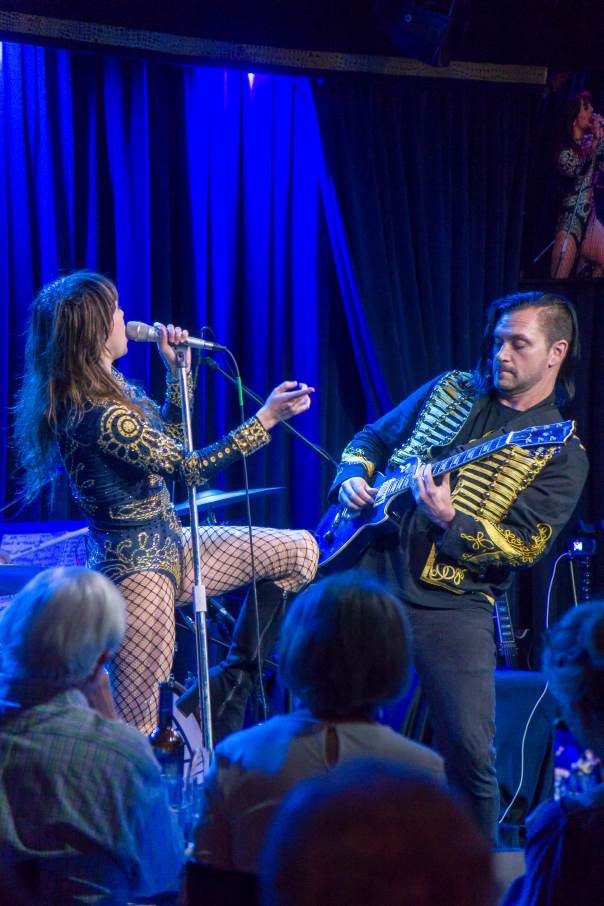
You said militancy: I love that because we actually wear – our band uniform is like black and gold parade military outfits that I put together because we’re kind of like soldiers. We’re fighting this world that wants to suppress creativity and freedom of self-individualism and expression.

But all the like TikTok and be-trendy and be-like-everyone-else. No, we’re fighting that.

Well, I have to admit I was wondering which Veronica we were going to get. Going to get the hoodie Veronica…

The answer is yes!

…the strapless Veronica or the leather Veronica. I just didn’t know, you know?

Well, the outfit is just the outfit, but it’s always been me. It’s the same Veronica, you know?

You say you’re still kind of concentrating on the music. Does it get more difficult when you have such an ultra-produced album like your current album? When there must be just so much input from orchestrators and people from front office saying what you should and what you shouldn’t sing right now?

Well, it’s taken me years to surround myself with the right people, and that’s something you learn as you get, as we all learn as we get older. We start to notice people around us that are negative influences, that are hindering. You know, that are suppressing our kind of, you know, free will, if you will. And just about the last couple years I’ve put together a band and management team and booking team and product.

My producer is actually my drummer, Brian Viglione, who’s been my hero since I was 12 years old. Like I’ve listened to his band, the Dresden Dolls, my whole life and Brian is a brilliant collaborator. So it’s knowing the kinds of people you’re surrounding yourself with: Are they stars and are they collaborators?

You know, everybody has something important that they want to say, but ultimately, they’re looking to me because as the leader, you have to step up to the plate. You can’t, because I usually tend to be like very democratic, like everybody has their input, but I found that people really want to be led, too. They want someone strong who has a vision, like a David Bowie type.

So everything that’s happened on the record has always come to me and Brian as well. We both have the same – it’s very rare to find someone who has the same vision that you do. And Brian and I share not only the same vision but we share the same taste, the expansive multi-genre taste.

I mean he’s a rock drummer that plays jazz and plays all this stuff because his favorite drummer is Elvin Jones and my favorite singer is Freddie Mercury. So we both come from these worlds of, you know, these crossed worlds and we brought them together in such a beautiful way.

Freddie Mercury. I do get the Janis Joplin vein in what you’re doing now, but a lot of people would say, well you introduced one new thing but the classical strain. I didn’t detect that in anything previous. I know there’s a Broadway strain in what your repertoire represented in the past, but to bring it in and to bring it in in such bulk is really very audacious and very much risking to rock the boat of who identifies as your fandom.

It’s interesting, you’re talking a lot about rocking the boat and audacity. It doesn’t feel like that for me, man. I’m just being myself and being very, you know, like at peace with who I am, and that’s what people are responding to. They’re following that strong sense of self and leadership.

People need that right now, because what the world is trying to do, like you look at everything, like I mentioned TikTok and Instagram is this very conformist view even though they want you to follow the trend, follow the algorithm and that’s just what I mean. This whole record is about just standing up to that, and that’s what I think people are responding to, and it’s of course using the music as a metaphor like I said.

It’s easy for me because I love all this. It’s not hard what I’m doing. I’m singing music I love. It’s not simple and classical music is an important part of my upbringing. I mean my first love was Baroque music. I didn’t love jazz as a kid. It’s just something I was good at. I found my love for it much later in life when I matured a little, but my actual love was classical. You know the harmonic content of the Tchaikovsky and, you know. Beethoven.

I would study these scores when I was about seven or eight years old. I started to study scores and playing piano of course you know exposed my ear to that kind of harmonic sophistication and so I loved Bach. I loved how all the lines would intertwine within and out of each other and so I’ve just found a way to do it that way that’s authentic and unique to myself and that includes connecting it with these other genres like “Je Veau Vivre” for example.

Talk about you know Django Reinhart and I mean he’s not he’s not French but he is very big in France and Stephane Grappelli is French and so that lineage is an important part of why I’m because I used to sing at Birdland with the Django Reinhart all-star band, and so that’s the way I’ve gotten to bring that element of who I am in here as well.

I used to sing all those arias in high school. I don’t sing opera anymore but I believe you know maybe with an orchestra someday we’ll do it.

Yeah absolutely, but you were hinting a while ago that now is the time – maybe I’m detecting that some of this these impulses to do all this and be all this have been repressed or advised against.

You got it, man. If it was advised against it was only because I was surrounded by the wrong people, you know, and that doesn’t mean that they’re bad people. They just didn’t have the vision or the image. They just they saw the world that they saw. And that’s fine, you know. It’s like it’s like asking a Subaru salesman to sell a Ferrari.

They’re not going to know what how to sell a Ferrari. So what we’re we’re selling… it’s like talking to somebody who you’re trying to get them to try Baked Alaska when they don’t even know what it is. They know chocolate chip cookies. That’s something that’s easily packaged, easily marketed, and you can sell chocolate chip cookies in a second to anybody. But Baked Alaska is a gourmet dish. When you try it, you’re going to like it, but you got to try it. There’s no way to describe it to you until you’ve tried it.

So that’s what our show is like, and I’ve just surrounded myself with people that get it and know how to help bring that to life, that vision. So yeah it’s just like I’m really excited to bring this show to North Carolina.

How many pieces can you possibly bring to a jazz club?

We’ve brought I mean we brought the quintet with horns three horns before, but that may be a little bit tight on the stage, so we’re just going to bring the quintet this time.

Okay, does that count you as part of the quintet?

Oh yes, absolutely.

Okay, so we could expect one horn?

No, no – myself, piano, bass, drums, guitar.

Ah, okay!

Yeah, you can’t play rock and funk without the guitar in there.

Yeah, yeah, I forgot about that aspect of it. Okay, I remember some guitar licks on the new album. Wow, yeah. “Was it on Don’t Rain on My Parade”?

Yeah, that’s the that’s the book-ended somatic message. The first song, “I Am What I Am,” of course being about being yourself and all that. But then, it book it’s bookended with the last song, “Don’t Rain on My Parade.” It’s the same kind of song, you know, to send people off with the message of the the album. keep yourself alive of course is like the finale and don’t rain on my parade is like the encore.

But “Keep Yourself Alive” is the Queen song and “Don’t Rain on My Parade” – I mean that that arrangement just wrote itself because just it’s such a brilliant song.

Yes. I was in fact thinking about “I Am What I Am”: that could serve at either side of the bookend as an encore. Or it’s probably too emphatic to be an encore, because you’re going to have to sing another song after that one.

Yeah. No, that’s the one that always works as an opener.

Uh-huh. Yeah, that that definitely introduces yourself. How intensely do you concentrate on the stuff you have just issued, and how much might we see of what’s coming in the future?

That’s a really good question. I try to, talking about time, I try to comprise a show that speaks to past, present, and future, because quite most people now have only just discovered me. So that’s been an interesting experiment, you know? Like I’m still building my career, so of course the emphasis is on present because I as a person tend to be so future-oriented that I miss the now. So we are really focusing on the present and pushing the record now, and that’s the statement.

But there is an element of the future as well in this show, and that is the next phase, which is to show people that okay, I’ve established myself as a jazz singer and my roots in jazz music with my parents having been brought up with jazz singers on the road. Then I’m showing you who I am now, which is this multitude, this beautiful color palette or spectrum of genres.

Then what I really identify as is a storyteller, and I’ve never gotten to tell my own story with my own words, save for a couple songs. So my next future album may be an album of all original music, so I think we’ll be including a lot of originals on this show as well.

Oh, that’s exciting! Do you regret calling yourself Swift for your stage name?

Why would I that’s my that’s my that’s my biological name!

Is it? I look at your father’s name and your mother’s name, and I don’t see a Swift in there. Okay…

Yeah. My mother has used her maiden name as her stage name, Nicasian. My father was adopted by O’Brien he’s not really an O’Brien by blood. He’s a Swift.

Oh, okay!

So I’ve chosen to stick with my biological name.

Ah, there you go! Then you can always measure up against and Taylor and feel modest.

I don’t measure up against anybody. I measure up against myself and myself alone.

So you’re not daunted – or driven – by the fact that your most popular tracks get maybe two million plays, and she has multiple tracks with a billion?

No, she’s a pop star! I don’t sing pop music, you know? I have my own artistry, and what I teach to young artists – because I teach as well – and I talk to a lot of artists trying to navigate and find themselves in this new world in this new industry that’s really kept by the gatekeepers. For artists that have something unique: one, when you have something so niche like this – it’s you – when you create your own universe that is uniquely yours, like no one else can touch it…

Right…

…then you’ve really touched on a goldmine. You’ve come across something really special, because then you have your own universe, your own fan base, your own career that is truly yours. You can’t compare it. It’s like Ella or Sarah: you can’t compare, you know?

There’s people with different tastes. Some people may not get you, and then, okay. Your job is not to get them to get you, your job is just be yourself and carve your own
path.

Right. So in no shape or form should we confuse the fact that your new album is eclectic and multicolored with the idea that it has anything to do with your ambition to become more marketable.

That is just an added bonus, my friend. That was absolutely a joke. Look, if I wanted to be marketable, I wouldn’t have been a jazz singer for 20 years, you know what I mean? I just sing music I love! It’s that simple. I mean I love rock music and classical music because it’s passionate, powerful, dramatic, and it fulfills that dramatic side of who I am. And I love singing jazz because it fulfills the connection to my family and my roots. It has nothing to do with anything other than that!

Yeah, so you must have the same joking attitude that Ella had – at every concert – when she bemoaned the fact that she never had a big hit.

I don’t focus on that stuff. You can’t focus on that shit as an artist, you know?

Right.

You have to focus on the art, because otherwise you’re going to lose why you do it in the first place. I see it happen with so many friends and artists, constantly comparing themselves to other… Once you start doing that, you’re dead. you can’t compare yourself to anybody You can’t. There’s no measuring up. It’s you and you alone.

I notice, really deep in your records, that there’s what I would say is a foundational interplay between you and the piano, and I know it begins with you and your dad, but say something about the piano and what it means to you and how you interact with it.

Hmm, that’s a really, really good question. So on an emotional level the piano has always been – that was always my first instrument, as it is with most people, you know? Like you take piano lessons when you’re a kid, right? The piano was – just because of my father – his approach to piano was so different than mine. I’m more classical, like I said, like my first love is classical. So my approach to piano is I try to play like…

When I found Queen, of course, that was like, oh my god, you put these worlds together! Forget about it, I love this! But the Rachmaninoff and the stuff like Chopin, like Liszt – all that stuff you know. The best songs I write come from playing the classical stuff on the piano and then trying… to work some of these harmonic structures into a song.

WTC, I’ve written a couple songs of WTC pieces. So really, my relationship to the piano is very personal, you know. I actually had a house fire about 11 years ago, and the piano that I learned to play on was saved from the fire. And so, the piano has become just like the phoenix – my phoenix – the phoenix is my spirit animal because of the concept of fire and, you know, rejuvenating, reborn from the ashes, and how the piano survives the fire. So it’s kind of become a whole extra set of symbolism, you know?

Maybe the next record will have me playing the piano within a fire or something, you know? And I don’t know, that’s kind of what it is. I look at the piano, and I just see, you know, me being reborn.

I’d like you to exhume some of those tantalizingly described early recordings of you where you’re putting vocalese to Lester Young so…

Oh, that album I did when I was 21!

Yeah, I know! I’d like to hear them, but I don’t find them on any of the services. Because I have to look them up on amazon or something

It’s a little bit of power I do have. I don’t have to cater. I can put – those albums are just physical copies. So I’ll be – are you going to be at the show? I’m going to be selling those, actually. I can – I’ll have those records with me.

Yeah, I’ll be at the show definitely. I’m coming to the early one.

Wonderful!

So… and the rapport that you have with the horn players. A lot of singers just resist recording the way Billie Holiday did way back when, and you’ve jumped right into it, which is really a heartening thing for me.

Oh, thank you! Well I think music – I see it as a language, you know? And it’s very conversational, the way I approach it. And the way you look at Billie and Lester, the way – it’s a conversation between two people. And being a scat singer as well, I look at bebop and the vocabulary of music as if it was a language: the notes are like words, and musical phrases are the sentences.

When you have notes by themselves, yeah, they have some meaning and qualities but they don’t have much of meaning without the context of the musical phrase or the sentence surrounding it. And so, when you have that element of that understanding of music, then you can have rapport with any musicians. Of course, the fact that I play trumpet makes it fun for me to play with the horns, because then I actually bring out my trumpet and…

Oh, all right

…but I won’t be doing that in North Carolina, because I don’t have the horn, sadly.

Oh, that’s a shame all right yeah that would that would be something to really tout or balleyhoo or have a scoop about. Yeah, so I’m looking forward to it and thanks so much for for your time and for your candor.

Thank you very, very much. I’ll see you at the show.

Absolutely. Thank you.

Thank you.

Both: Bye!

Living Legends and Young Lionesses Featured in Spoleto Festival USA Jazz Lineup

Review: Brandee Younger, Henry Threadgill Zooid, Immanuel Wilkins Quartet, and Abdullah Ibrahim & Ekaya at Spoleto Festival USA

By Perry Tannenbaum

Respect for the elders in this year’s Spoleto Festival USA jazz lineup was gracefully counterbalanced by a hearty welcome to newer generations. It only felt fleetingly like the closing of the book on a previous era when South Africa’s iconic pianist-composer Abdullah Ibrahim returned to Charleston, one of the last – if not the very last – headliners booked for the canceled 2020 festival to make his belated post-pandemic appearance.

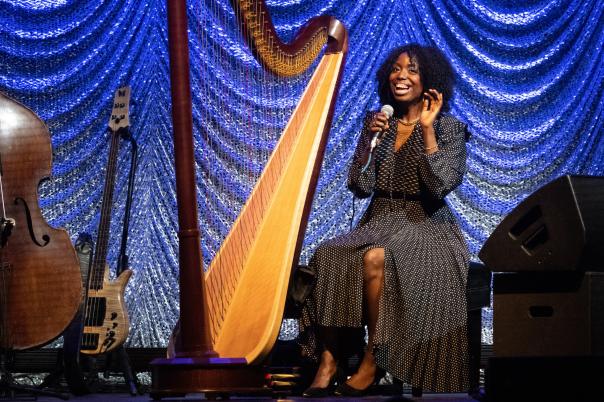
Henry Threadgill, the NEA Jazz Master and 2016 Pulitzer Prize winner for his In for a Penny, In for a Pound, was the other esteemed elder in the lineup, making his overdue debut at Spoleto. Festival jazz curator Larry Blumenfeld, who would have interviewed Ibrahim in 2020, had no difficulty shifting his Jazz Talks events – and venues – to Threadgill at the Riviera Theatre and harpist Brandee Younger at Queen Street Playhouse, two halls that had never been in play at Spoleto before.

Younger was announced as a substitution (for Courtney Bryan) just three weeks before Spoleto opened on May 26, adding to the luster of Blumenfeld’s agility – as a producer and as an interviewer. Other young lions and lionesses in the lineup included Charleston native Quentin Baxter, Kris Davis Diatom Ribbons, and the Immanuel Wilkins Quartet.

Ibrahim, absent from the festival for an epic 25 years, may have carved the largest arc of departure and return in Spoleto history, but others in the lineup had links with past festivals. Baxter appeared with Ranky Tanky in 2018 and as a concert host in other years, Diatom Ribbons included guitarist Julian Lage (2010) and NEA Master Terri Lyne Carrington (2019), and Younger was a gleaming feature of last year’s Universal Consciousness, Ravi Coltrane’s stunning tribute to his mom, Alice Coltrane.

Rashaan Carter, Younger’s bassist, was also a holdover from Ravi’s tribute – and so, almost inevitably, were additional nods to Alice Coltrane in a well-chosen pair of compositions. The first of these, “Ghost Trane” from Coltrane’s Monastic Trio album of 1968, set a nifty precedent for the second nod to follow, “Turiya and Ramakrishna” from the imposing Ptah, The El Daoud release of 1970. Both were recorded by Coltrane on piano rather than behind her iconic harp, expelling any taint of imitation from Younger’s performances.

If you ever thought Alice couldn’t truly belong in a John Coltrane Quartet, or if you’ve thought of her strictly in terms of spirituality and ethereality, the original “Ghost Trane” track, with its groovy line and Coltrane’s finger-busting solo, will dispel your delusions. After an intro that subtly suggested the line to come, Younger made the lustrous, silky sound of her harp swing. Jumping off into her improvisations, riffing with wave after wave of invention, Younger almost dared anyone to say she is anything less than the McCoy Tyner of the harp. Yet it would be silly to pretend that any pianist could play as softly as Brandee did on her outro.

Nor would it be correct to imply that Younger allowed the sublimity of Alice Coltrane to be forgotten for long. “Love & Struggle” had a mixture of sublime Coltrane with a few flecks of soaring Carlos Santana fire, punctuated by a couple of fine Carter solos on acoustic bass. Fitfully, Younger’s harp can evoke the sound of a guitar or reverberate like a set of vibes – even within her harp timbre, she can veer away from the velvety, mesmerizing Coltrane idiom into the crisper sound Dorothy Ashby espoused.

“Unrest,” parts I and II, delivered without a pause, began with an extended meditative Younger solo before Allan Mednard, filling out the trio on drums, and Carter abruptly upshifted the tempo. Younger began comping chords behind her rhythm as Mednard steadily galloped until Carter briefly emerged as the dominant ingredient in the percolating stew, leaving space for Mednard to back away, restart, and take over with a palpitating solo. As in the previous piece, the drummer had the last word.

“Turiya and Ramakrishna” and “Spirit U Will” continued on this lofty plane. “Turiya” was the more exciting of the two because it revivified Coltrane’s piano version with virtuosic brio and it was the one title on this setlist that Younger hasn’t recorded. Taking us gracefully into a soft landing, Younger finished with two titles from her current Brand New Life release – a beautiful “If It’s Magic” solo that hushed the hall and a sweet trio version of “You’re a Girl for One Man Only” at a loping mid-tempo.

After Younger played Spoleto’s first jazz gig at the Queen Street, Threadgill turned a longtime theatre and dance venue, Sottile Theatre, back into a jazz hall for the first time since 2007, when Dino Saluzzi and Anja Lechner played there. Unluckily, Ibrahim was scheduled to reopen the Sottile to jazz in 2020, which would have been the largest jazz group to perform there since the Fred Hersch Ensemble, with Kurt Elling and Ralph Alessi, in 2004. Tyshawn Sorey put the classy old place into play at last year’s Spoleto in the capacity of a composer, when a concert of his classical works was performed at the Sottile in the wake of his jazz trio’s performance at TD Arena two nights earlier.

Acoustically, the idea worked well, as Threadgill and his oddly configured Zooid quintet played a set of six selections culled from releases stretching back to their This Brings Us To, Vol. 1 of 2009, plus a newborn to end the program. The lineup included, but did not overstress, Threadgill’s Pulitzer Prize winner, dipping more generously into his newer Poof outing with the group.

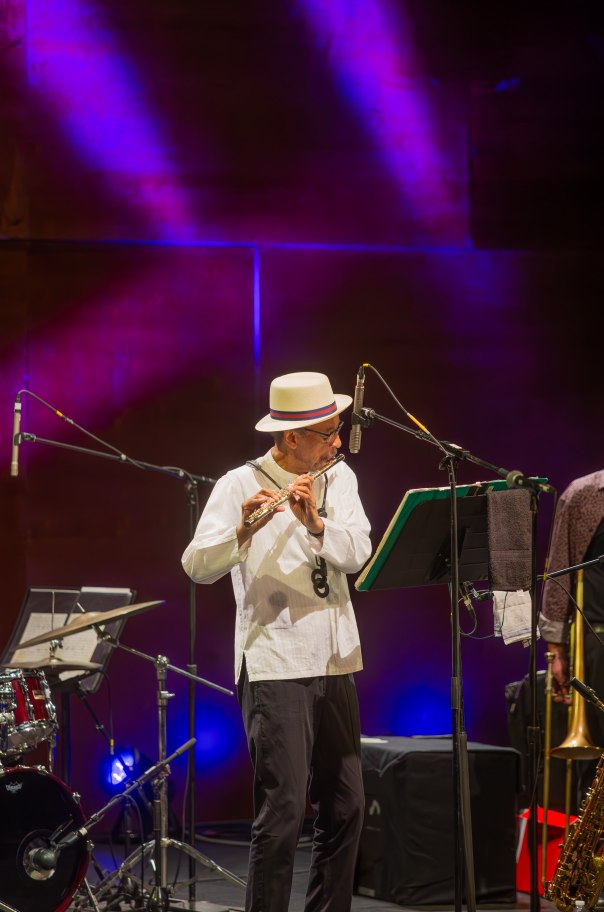
No matter how far the group hearkened back, they still looked and sounded cutting-edge, Threadgill starting out on flute for the first two compositions, “To Undertake My Corners Open” and “Beneath the Bottom,” before switching to his alto horn for “Chairmaster.” Jose Davila followed a parallel path, switching from trombone to tuba, playing the intro to “Chairmaster” over Christopher Hoffman’s cello until Threadgill entered with such rambunctiousness on alto that he briefly reminded me of Eric Dolphy. Hoffman then went into a bowed solo, further varying the sound palette.

Found more readily in a Google search than by scouring Threadgill’s discography, “Not the White Flag” was a special live treat, begun by Davila on tuba before Threadgill, Hoffman, and guitarist Liberty Ellman took a series of tasty solos. Continuing to blur the borderline between composition and improvisation, Threadgill returned with a mysteriously diffident coda.

The genial stridency of “Now and Then,” very much in an Ornette Coleman mold on Zooid’s recent Poof album, had more Hoffman cello beneath Davila’s tuba ramblings, a brief bluesy interlude in the middle, with Ellman’s guitar explorations moved to the end of the arrangement. “Off the Prompt Box” retained its astringency from the In for a Penny release with Hoffman’s bowed solo, yet it sprouted new sections before and after the cellist seized the spotlight, allowing Threadgill fresh opportunities to extemporize on alto, most notably after Chris slowed the tempo.

Threadgill’s new composition, “Fluoroscope,” was an apt closer for his Sottile set, not only affording ample space to showcase the members of the quintet but also bringing a rugged circularity to the concert. Zooid drummer Elliot Humberto Kavee, who began the concert so auspiciously with an extended solo on “Undertake My Corners” – playing his cymbals, toms, high-hat, and pedal rather than thrashing them – drew the spotlight three times in this final arrangement. Ellman and Threadgill hooked up in the final section of this impressive concert.

Starting off his five-show engagement at Queen Street, Wilkins plunged straight into a set of compositions he is readying for the studio, accessorized with some electronics that the altoist used sparingly and initially struggled with. Yet the minor difficulties never obscured the exquisite chemistry of this quartet, with Micah Thomas at the keyboard, Rick Rosato on bass, and Kweku Sumbry behind the drums. Wherever it was emanating from so softly, the synthesized vamp from Wilkins’ electronics barely intruded as he played the line and soloed on “The Big Country,” discreetly disappearing as Thomas held forth.

Detractors might have charged that the synthesized sounds interrupted the flow of music in “Apparition,” bridging the gap between the leader’s solo and the rhythm section’s takeover, while defenders might claim they personified the title. Wilkins himself seemed a bit dissatisfied, calling out to the soundbooth, and the next two numbers were acoustically sourced, mics working well though Immanuel’s monitor may have been a concern.

By shedding their electronic woes, Wilkins and the quartet reached higher altitudes with their music. Grooving into a mellow mid-tempo, “Dark Eyes Smile” was their most engaging piece so far, Wilkins introducing the line over Rosato’s bass, then sharing solo honors with Thomas before returning for the outchorus. The ascent continued to its zenith with “If That Blood Runs East,” where piano and alto harmonized on the melody before Sumbry kicked up the tempo behind the kit. Thomas mostly asserted himself afterward via a hypnotic ostinato while Wilkins soloed, ceding the spotlight back to Sumbry before re-entering for a moody landing.

“Blues Blood,” the closer, was no less exciting and even more varied, for Wilkins was emboldened to try out his electronics once more after he and Thomas had soloed. Before settling into a bluesy groove as Wilkins vamped, Thomas showed us he could swing as well, and as this winsome tune faded out, he sprinkled some gospel flavoring into his comping.

Wilkins’ engagement at Queen Street was fortuitously timed, so that he and the quartet could take in the Threadgill concert on the evening before their four-day engagement began and comfortably peep in on Ibrahim and Ekaya midway through his sojourn after his second performance. Ironically, Ibrahim’s timing turned out to be less fortunate. Bad weather prevented him from returning to Cistern Yard, one of the two festival sites where he played in 1998.

Instead, the concert was transplanted indoors to the TD Arena a couple of blocks away, where the sound is better than the lighting and the lawn seating can be faithfully replicated. Delayed by the rescheduling, Ibrahim’s arrival in the College of Charleston basketball arena was more solemn and dramatic in the dimmer light. Aside from introducing the members of Ekaya, the Zulu word for homeland, we heard little from Ibrahim, but it’s very likely that the Ekaya sextet heard – and saw – plenty of prompts from their leader.

The intricate tapestry woven by the ensemble included seven piano solos from Ibrahim, three trio performances, and six arrangements with the horns – 14 Ibrahim compositions doled out into seven music clusters – before the group returned after a feint toward the exit and covered Thelonious Monk’s “Skippy” in their encore. Most easily recognized among the Ekaya arrangements were “Tuang Guru” and “Nisa” from The Balance,the 2019 release where “Skippy” also appears.
After a trio entrance that was likely an abbreviated “Mindiff,” a chameleonic staple in Ibrahim’s discography that he has recorded in multiple forms, Cleave E. Guyton, Jr., jumped all over bassist Noah Jackson and drummer Will Terrill with his piccolo, the signature instrument of “Tuang Guru” in the studio version. Michael Pallas took a fine solo on trombone before Lance Bryant, a session mate with the rhythm section on The Balance, steered the arrangement toward solemnity with his tenor sax – and more massive scoring with the horns and piccolo.

Joshua Lee’s bodacious baritone sax solo was the most salient identifier when we segued from an Ibrahim solo, likely on “For Coltrane,” to an epic arrangement of “Nisa.” Guyton switched to flute on this piece, and there were succinct and tasty solos from Bryant and Jackson. In his ability to stamp his individuality and genius on a piece in the space of eight bars or less, Ibrahim reminded me here of Ellington in his concise regality after the tempo slowed to a stately march. Yet after the reeds and Jackson had distinguished themselves, Pallas emerged as the dominant force in this arrangement, soloing and leading the horns with his muted trombone, then opening up for a brilliant cadenza.

At age 88, Ibrahim still has impressive skills, a prodigious band, and enough venturesome spirit – and trust in his musicians – to continue tinkering with his arrangements. “Skippy” as an encore was notably different from the studio track, with Guyton switching back to flute and Jackson back to bowed cello, the weaponry they had used at the start of the concert, and without a clarinet solo from Guyton, a highlight of the 2016 Mukashi album, it was difficult to be sure where “Mississippi” occurred in the magnificent 80-minute concert.

So let’s prayerfully put it out there that four years is already too long since the most recent Ibrahim & Ekaya recording. Greedy though the request may be, we need to hear more.

Spoleto Festival USA: More Diverse, Hybrid, and Inclusive Than Ever

By Perry Tannenbaum

With so many theatre, dance, opera, jazz, orchestral, choral, and chamber music events to choose from – more than 300 artists from around the world, streaming in and out of Charleston over 17 days (May 26 through June 11 this year) – planning a dip into Spoleto Festival USA is always a challenge. Even Spoleto’s general director, Mena Mark Hanna, struggles to prescribe a strategy, as hesitant as a loving mother of 39 children to pick favorites.

“My suggestion for a first-time participant,” he says, sidestepping, “would be to see two things you like and feel comfortable about seeing, maybe that’s Nickel Creek (May 31-June 1) and Kishi Bashi (June 3), and two things that are really pushing the envelope for you. So maybe that’s Dada Masilo (June 1-4) and Only an Octave Apart (June 7-11).”

Nicely said. Only you can easily take in the first three events Hanna has named within three days, but you’ll need another four days before you can see singer-songwriter phenom Justin Vivian Bond and their monster opera-meets-cabaret-meets-pop collaboration with countertenor sensation Anthony Roth Costanzo. If you happened to see the recent Carol Burnett tribute on TV, the cat is out of the bag as far as what that will sound like, if you remember the “Only an Octave Apart” duet with opera diva Beverly Sills – recreated for Carol by Bernadette Peters and Kristin Chenowith.

What it will look like can be savored in the Spoleto brochure.

The giddy Bond-Costanzo hybrid is one of the key reasons that my wife Sue and I are lingering in Charleston through June 9. Equally decisive is the chance to see jazz legends Henry Threadgill (June 6) and Abdullah Ibrahim (June 8), the Spoleto Festival USA Chorus singing Thomas Tallis’ Spem in alium (June 7-8),and Jonathon Heyward conducting Hector Berlioz’s Symphonie Fantastique (June 9).

One other irresistible lure: the opportunity to see Maestra Mei-Ann Chen conduct Antonín Dvořák’s New World Symphony (June 7), along with works by Florence Price and Michael Abels – less than four months after her scintillating debut with the Charlotte Symphony.

Abels, you may recall, teamed with Rhiannon Giddens last year in composing Omar, the new opera that premiered at Spoleto – after an epic gestation that spanned the pandemic – and won the Pulitzer Prize for Music earlier this month. It was a proud moment for Spoleto, for Charleston, and for the Carolinas. For Hanna, it was an extra special serendipity to help shepherd that work to completion.

“I mean, it’s kind of incredible,” he explains, “to be someone who comes from Egyptian parentage, speaks Arabic, grew up sort of fascinated by opera and stage work and spent their career in opera and was a boy soprano – to then have this opportunity to bring to life the words of an enslaved African in Charleston, South Carolina. And those words are Arabic!”

We may discern additional serendipity in the programming of this year’s opera, Samuel Barber and Gian Carlo Menotti’s Vanessa (May 27-June 10), which garnered the Pulitzer in 1958. Revived at Spoleto in 1978, the second year of the festival – with festival founder Menotti stage directing – the production was videotaped by PBS and syndicated nationwide on Great Performances, a huge boost for the infant fest. That revival also sparked a critical revival of Barber’s work.

Omar was the centerpiece of a concerted pushback at Spoleto last year against the Islamophobia of the MAGA zealots who had dominated the headlines while the new opera was taking shape. Vanessa is part of what Hanna sees as a subtler undercurrent in this year’s lineup, more about #MeToo, Black Lives Matter, and the repeal of Roe v. Wade.

“I want there to be a kind of cohesiveness without necessarily us being able to see what the theme is,” Hanna reveals. “If there is something that unifies a lot of these pieces, it’s about understanding that we are telling stories from our past, some of them the most ancient stories that we have in our intellectual heritage. We are looking at these stories with a different sense that takes on the reverberations of today’s social discourse.”

Among other works this season at Spoleto that Hanna places in his ring of relevance are An Iliad (May 26-June 3), a one-man retelling of Homer’s epic featuring Denis O’Hare; Igor Stravinsky’s The Rite of Spring (June 5), as an orchestral concert and the inspiration for Masilo’s The Sacrifice; Helen Pickett’s new adaptation of Arthur Miller’s The Crucible for Scottish Ballet (June 2-4); and A Poet’s Love (May 26-30), a reinterpretation of Robert Schumann’s Dichterliebe song cycle by tenor/pianist Jamez McCorkle, who played the title role in Omar last year – with stagecraft, shadow puppetry, and projections by Miwa Matreyek.

“Going back to the Trojan War, An Iliad is as much about war and plague then as it can be today with the reverberations of Ukraine and the pandemic,” says Hanna. “Vanessa, is reinterpreted here through the lens of a remarkable female director, Rodula Gaitanou. The cast is just killer: You have Nicole Heaston as the lead with Zoe Reams and Edward Graves and Malcolm McKenzie and Rosalind Plowright, just a world class cast at the very, very top. And it’s also really cool to see these roles, which are traditionally sung by Caucasian people, being sung by people of color.”

Aside from the recurring motif of reclusion, so vividly resonant for all of us since our collective pandemic experience, Hanna points to a key turning point in the opera. Menotti left it mysterious and ambiguous in his libretto at a key point when Vanessa’s niece, Erika, either has a miscarriage or – more likely – an abortion.

For Hanna, that brings up an important question: “What does that mean now when we are looking at a renewed political assault on female autonomy? So these stories take on new messaging, new reverberation in 2023. And we need to retell these stories with the new lens of today.”

Especially in the Carolinas.

Long accompanied by a more grassroots and American-flavored satellite, the Piccolo Spoleto Festival, Menotti’s international arts orgy has taken a long, long time to shed its elitist mantle. Now it is moving forcefully in that inclusive direction with a new Pay What You Will program, offering tickets to about 20 performances for as low as $5 – thanks to an anonymous donor who is liberating about $50,000 of ticket inventory.

Hanna brought this exciting concept to the unnamed donor, hasn’t talked to him or her or them – yet – about sponsoring the program in future years, but he is pledging to continue it regardless.

“What art can do is endow you with a new experience, a transformational experience that you did not have before you took your seat,” he says. “It can help create an understanding of another side that is normally seen by one perspective as socially disparate, as highly politicized, as a discourse that’s just way too far away. Art can break down that barrier through the magic and enchantment of performance. To me, having those artists onstage, representative of a demographic we wish to serve, only takes us so far. We also have to lower the barrier of entry so that we can actually serve that demographic.”

Kishi Bashi not only continues Spoleto’s well-established outreach to Asian culture, he also typifies the more hybrid, genre-busting artists that Hanna wants to include at future festivals.

“We want to try to find these artists that are like pivot artists, who occupy these interstitial spaces between dance and theater and classical music and jazz and folk music,” Hanna declares. “And Kishi Bashi is one of those. He plays the violin on stage. He has all of these violinists on stage with him, but it’s this kind of strange, hallucinatory, intoxicating music that’s like somehow trance music and Japanese folk music, but using sort of Western classical instruments. Yet it’s very much in an indie rock tradition as well.”

Other wild hybrids include Leyla McCalla (May 26), the former Carolina Chocolate Drops cellist who blends Creole, Cajun, and American jazz and folk influences; Australian physical theatre company Gravity & Other Myths (June 7-11), mixing intimate confessions with acrobatics; Alisa Amador (June 7), synthesizing rock, jazz, Latin and alt folk; and the festival finale, Tank and the Bangas (June 11), hyphenating jazz, hip-hop, soul, and rock. Pushing the envelope in that direction is exciting for Hanna, and he promises more of the same for the ’24, ’25, and ’26 festivals.

Until the Pulitzer win, the year had been pretty rough on Hanna, losing Geoff Nuttall, the personable host of the lunchtime Chamber Music Series at Dock Street Theatre. Nuttall was the artist who convinced Hanna to come to Spoleto. At the tender age of 56, Nuttall had become the elder of Spoleto’s artistic leadership when he died, beloved for his style, wit, demonstrative fiddling, and his passionate advocacy of the music. Especially Papa Haydn.

The special Celebrating Geoff Nuttall (May 26) concert will gather his close friends and colleagues for a memorial tribute at Charleston Gaillard Center, including violinist Livia Sohn, cellist Alisa Weilerstein, countertenor Anthony Roth Costanzo, tenor Paul Groves, pianist Stephen Prutsman, and surviving members of the St. Lawrence Quartet. The occasion will be enhanced by the Spoleto Festival USA Orchestra and Atlanta Symphony’s Robert Spano – plus other guests soon to be announced.

Hosting chores for the lunchtime 2023 Chamber Music series, spread over the full festival, 11 different programs presented three times each (16 performances at 11:00am, 17 at 1:00pm) will be divvied among vocalists and instrumentalists who perform at the Dock. It was totally inappropriate, in Hanna’s eyes to replace Nuttall onstage this year, but he will begin to consider the charismatic violinist’s successor during the festival and into the summer. Hanna assured me that the player-to-be-named later will be a performer who participates in the musicmaking.

Continuing on the trail blazed by Amistad (2008), Porgy and Bess (2016) and Omar, Hanna wants to place renewed emphasis on the Port City and its African connection. It must run deeper than seeing Vanessa delivered by people of color.

“Charleston was the port of entry for the Middle Passage,” Hanna reminds us. “And Charleston has at its core an incredibly rich Gullah-Geechee-West African-American tradition that is part of the reason this is such a special, beautiful place to live in with its baleful history. So I think that you see that this year, you see that with Gakire Katese and The Book of Life (June 1-4), you see that with Dada Masilo and The Sacrifice, you see that with Abdullah Ibrahim and Ekaya.”

Resonating with the brutalities of Ukraine, Ethiopia, and Syria on three different continents, the US Premiere of Odile Gakire Katese’s The Book of Life may be the sleeper of this year’s festival, crafted from collected letters by survivors and perpetrators of Rwanda’s 1994 genocide and performed by Katese, better known as Kiki. “After the unthinkable, a path forward,” the festival brochure proclaims. The finding-of-hope theme will be underscored by music created by Ingoma Nshya, Rwanda’s first-ever female drumming ensemble, founded by Katese.

“Kiki is engaging with how a country tries to reconcile with its recent, terrifically horrific past of the Rwandan genocide as someone who grew up Rwandan in exile. You see that in the work of Abdallah Ibrahim, who was really one of the great musicians of the anti-apartheid movement, who composed an anthem for the anti-apartheid movement, was in a kind of exile between Europe and North America in the 80s. And then when he finally came back to South Africa for Nelson Mandela’s inauguration, Nelson Mandela called him our Mozart, South Africa’s Mozart.”

Marvelous to relate, you can hear more of South Africa’s Mozart this year at Spoleto Festival USA than Vienna’s Wolfgang Amadeus – or Germany’s Ludwig von Beethoven. That’s how eclectic and adventurous this amazing multidisciplinary festival has become.

See for yourself.

JazzArts Sweetens Ellington’s Nutcracker Suite With Jazzy Elzy Choreography

Review: Ellington’s Nutcracker at Booth Playhouse

By Perry Tannenbaum

2022~Ellington's Nutcracker-08

December 8, 2022, Charlotte, NC – While JFK was campaigning for the White House in 1960, Duke Ellington was out west, arguably having his sweetest year as a bandleader and composer, with an extended stay at the Riviera Hotel in Las Vegas, a festival triumph at Monterey that yielded two albums, and three sweet suites that were released on additional Columbia albums. The Nutcracker Suite marked the first time Ellington and longtime collaborator Billy Strayhorn had worked so extensively on adapting and arranging another composer’s music, and the pair did not wait for audience reaction to the Tchaikovsky foray before embarking on a similar project with Edvard Grieg’s Peer Gynt Suites No. 1 and 2.

Perhaps sweetest of all was the duo’s original suite, Suite Thursday, inspired by John Steinbeck’s novel, Sweet Thursday, which was set in Monterey. Ellington had played with these homonyms before, wittily naming his 1957 Shakespearean suite Such Sweet Thunder, but after the success of Nutcracker, the wordplay was over: Far East Suite, Latin American Suite, New Orleans Suite, and Togo Brava Suite were albums that announced themselves explicitly.

2022~Ellington's Nutcracker-07

Although Ellington’s embrace of classical music and form was obviously a commercial success, his Nutcracker never became the perennial evergreen that Peter Tchaikovsky’s ballet has – with helpful nudges from world-class choreographers and ballerinas. Yet it was still surprising to learn that the current run of Nutcracker Swing performances, presented at Booth Playhouse by JazzArts Charlotte, is an area premiere. One could only grow more puzzled by the delay when trumpeter and musical director Ashlin Parker began tearing into the Duke’s score with an able, self-assured 16-piece band. Very likely, JazzArts had also pondered the popularity gap between the ballet Nutcracker and the big band version, opting to fortify their version with jazzy choreography by the co-founder of the New Orleans Dance Theatre, Lula Elzy, delivered with flair by a sassy 12-member dance troupe.

2022~Ellington's Nutcracker-04

Even more lagniappe was added to the front end of this special JazzArts Holiday Edition, before intermission, with appearances by vocalist Dawn Anthony and a quartet of JazzArts All-Star Youth Ensemble musicians. Warm-up songs included a tasty mix of jazz standards, including Richard Rodgers’ “My Favorite Things” and Ellington’s “C Jam Blues,” and a bouquet of holiday fare: vocals on “Someday at Christmas” and “What Are You Doing New Year’s Eve?” a big-band “Christmas Time Is Here,” and Youth Ensemble instrumentals on “O Tannenbaum” and “Santa Claus Is Coming to Town.” Ensemble’s tenor saxophonist, Gustavo Cruz, and bandmate bassist Lois Majors were nearly as well-received as Anthony’s high-energy singing, and the first appearance of the evening by the dancers made the instrumental from Vince Guaraldi’s Charly Brown Christmas even more endearing.

Parker and his bandmates had already proven their mettle before we reached the Ellington-Strayhorn orchestrations. As soloists, tenor saxophonist Elijah Freeman, altoist David Lail, and Tim Gordon, doubling on alto sax and clarinet, had also excelled. Yet the band’s work on Nutcracker Suite still eclipsed my rising expectations, reminding me why Ellington, before and during the big band era, stuck with Duke Ellington and His Famous Orchestra as the name of his group.


Ellington always believed that he wrote primarily for orchestra, but he launched his career and his band during the Jazz Age, so he kept the phonograph and the concert hall in mind when he wrote. That’s why most of the earliest jewels in Duke’s crown clocked in at approximately three minutes. The nine segments of Ellington’s Nutcracker barely exceed a half hour, but it’s a hardy concentrate, allowing the aforementioned soloists – and numerous others on the Booth Playhouse stage – to shine and shine again. Hearing this merry music swung live onstage, at sound levels that rose above 90 dB, was astonishing.

The quality of the choreography and the athleticism of the dancers will make it difficult for you to keep track of who is responsible for the instrumental excellence behind them – even when Lail stands up in his red cap and wildly wails. Henry’s work on clarinet is nearly as sensational, and Freeman remains rock solid on tenor. Parker’s rhythm section shines brighter after intermission, earning kudos for pianist Lovell Bradford, bassist Shannon Hoover, and drummer Kobie Watkins, particularly on the sinuous “Chinoiserie.” Elzy’s choreography lifted the excitement even higher, with costume changes for the women between their appearances.

2022~Ellington's Nutcracker-22

For the “Toot Toot Tootie Tout (Dance of the Reed Pipes)” segment, appropriately graced by Henry’s clarinet, they entered in cool turquoise dresses glittering with snowflakes, and for “Sugar Rum Cherry (Dance of the Sugar-Plum Fairy),” they sashayed in from the wings in hot red. The guys, in casual wear before the break, stuck with white shirts and black bowties afterwards, competing with the gals by executing higher leaps and more jivy steps. After they had been challenged by the women in “Sugar Rum” and “Entracte,” the men responded with their finest moves on “The Volga Vouty (Russian Dance).”

2022~Ellington's Nutcracker-28

Changing the order from the sequence you can hear on Ellington’s Three Suites album, Parker and company followed with an epic performance of “Arabesque Cookie (Arabian Dance),” the last and longest track. Here the men remained onstage after their triumphant “Volga” stint, surrounding the alluring alpha female, back in flaming red, while Lail blew his most memorable solo of the night. Out of its usual sequence, “Chinoiserie (Chinese Dance)” brought the full company of dancers back to the Booth stage for a rather startling cooldown, but energy built dramatically for the new finale, “Dance of the Floreadores (Waltz of the Flowers),” – loud, flamboyant, and for my money, the most Ellingtonian chart of the evening. Sensory overload was so total that I lost track of all the fine instrumental solos behind the lively dancers.

Joy and Akinmusire Cap SeixalJazz 2022

Review:  Ambrose Akinmusire and Samara Joy at SeixalJazz 2022

By Perry Tannenbaum

2022~Portugal-190At SeixalJazz, across the graceful April 25th Suspension Bridge from Lisbon, Portugal’s renowned capital, the festival must go on. The last couple of pandemic editions, in annual two-meters-apart format, had been muted echoes of the expansive new direction SeixalJazz had taken in 2019, when Kenny Barron, Ralph Towner, Peter Bernstein, and the John Beasley Monk’estra had all been headliners – while afternoon and latenight concerts had been added at separate venues.
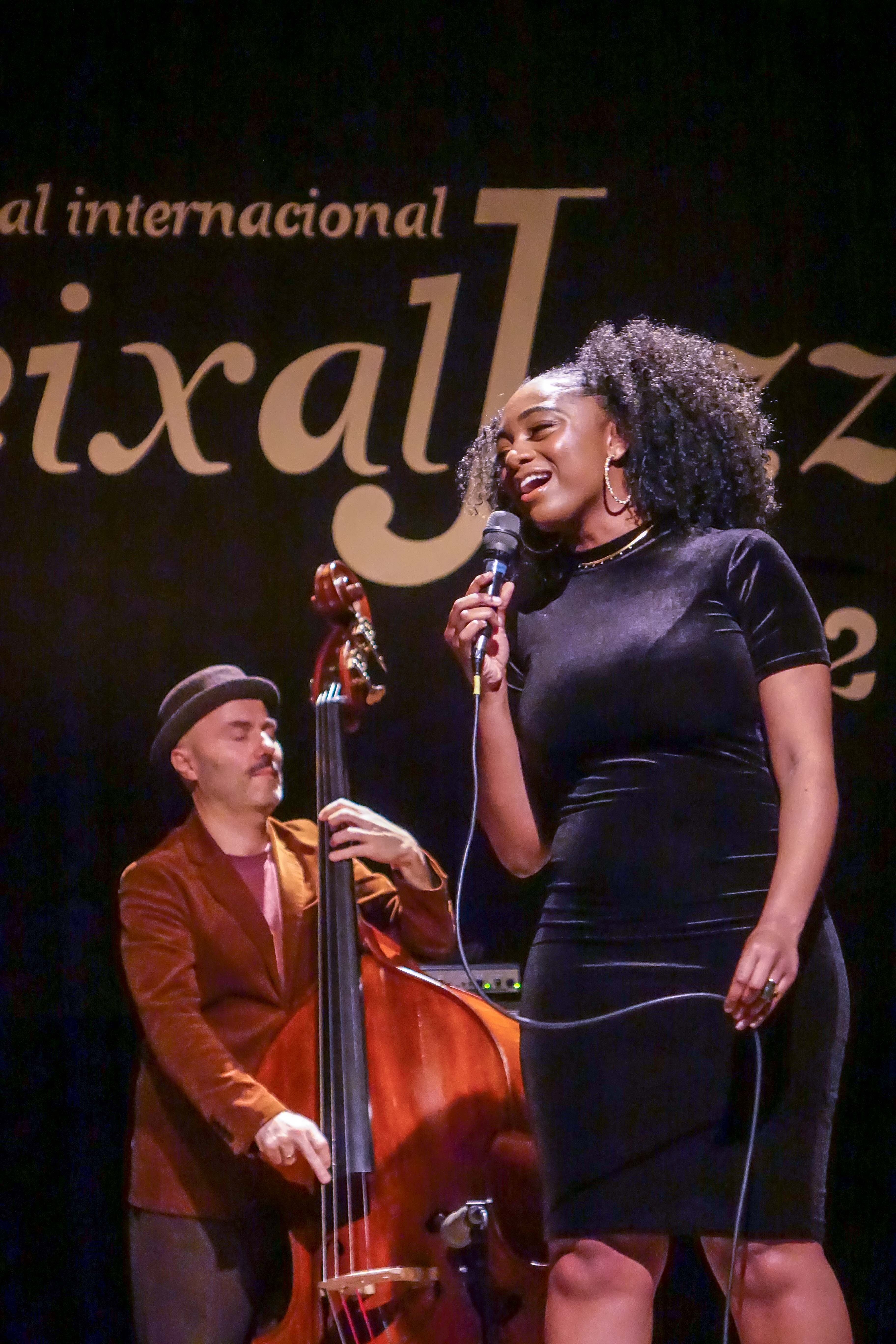
After a strategic retreat to an all-Portuguese lineup in 2020, the 2021 festival celebrated its 25th anniversary with a stellar smorgasbord for its socially-distanced audience, including Seamus Blake, Melissa Aldana, Ted Nash, and a high-powered Billy Hart Quartet that slipped in Mark Turner and Ethan Iverson. But it was SJ 2022 that turned on the burners full blast once again at the Municipal Auditorium of the Seixal Cultural Forum, discarding the social-distancing of previous years and restoring the alternate slate of free-admission “Clube” programming at the Sociedade Filarmónica Democrática.

2022~Portugal-186Monty Alexander, Ambrose Akinmusire, and Samara Joy were the big names ready to cook at the Municipal. Breaking our own personal travel bans, my wife Sue and I had already shortlisted Portugal as an attractive autumn destination. Seeing Joy perform with guitarist Pasquale Grasso in August, at Charlotte’s Middle C Jazz Club, pretty much cinched our decision. The opportunity to also see Akinmusire, whose albums I had supported on multiple JazzTimes Critics Picks lists in past years, made the closing weekend at SeixalJazz even more irresistible.
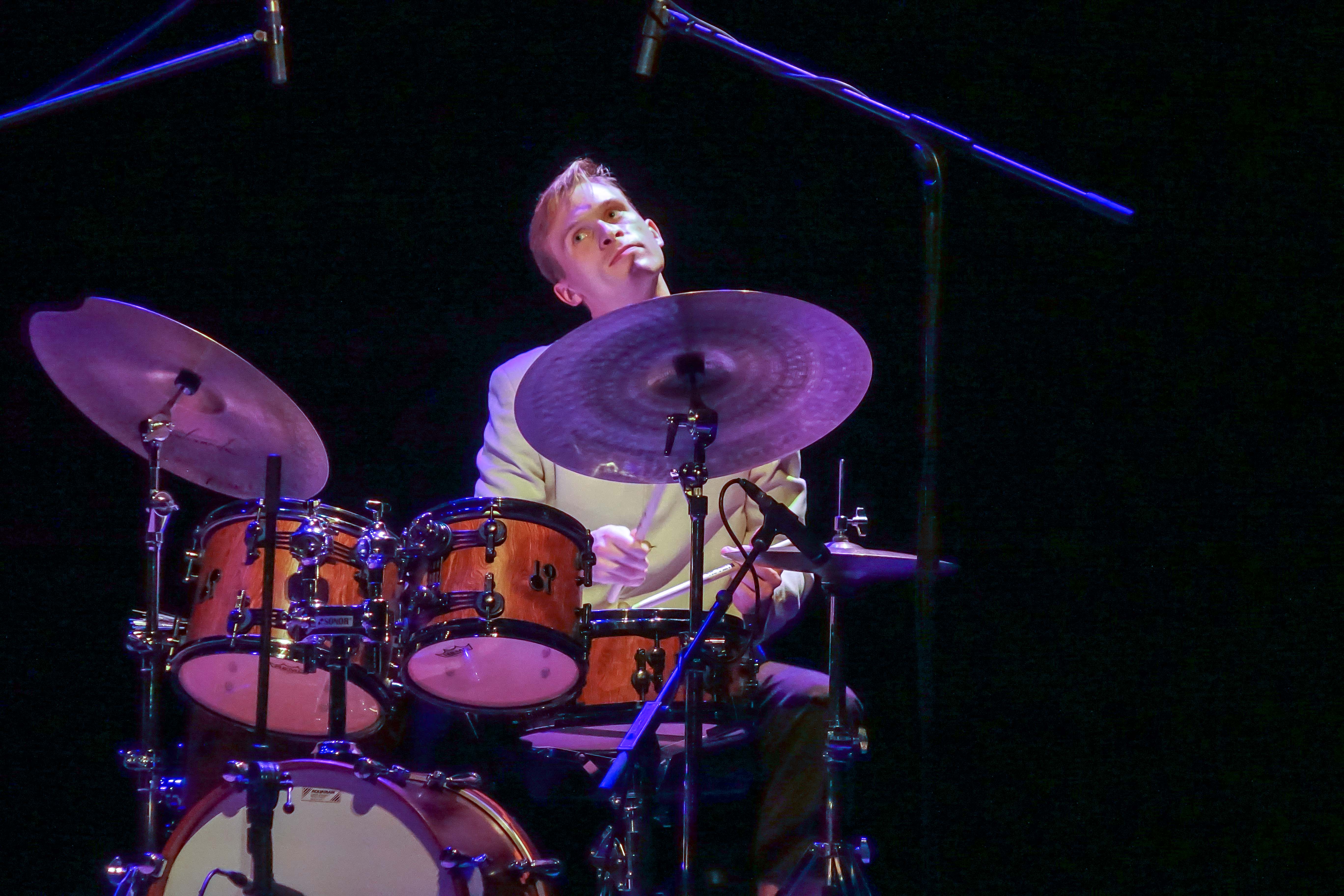
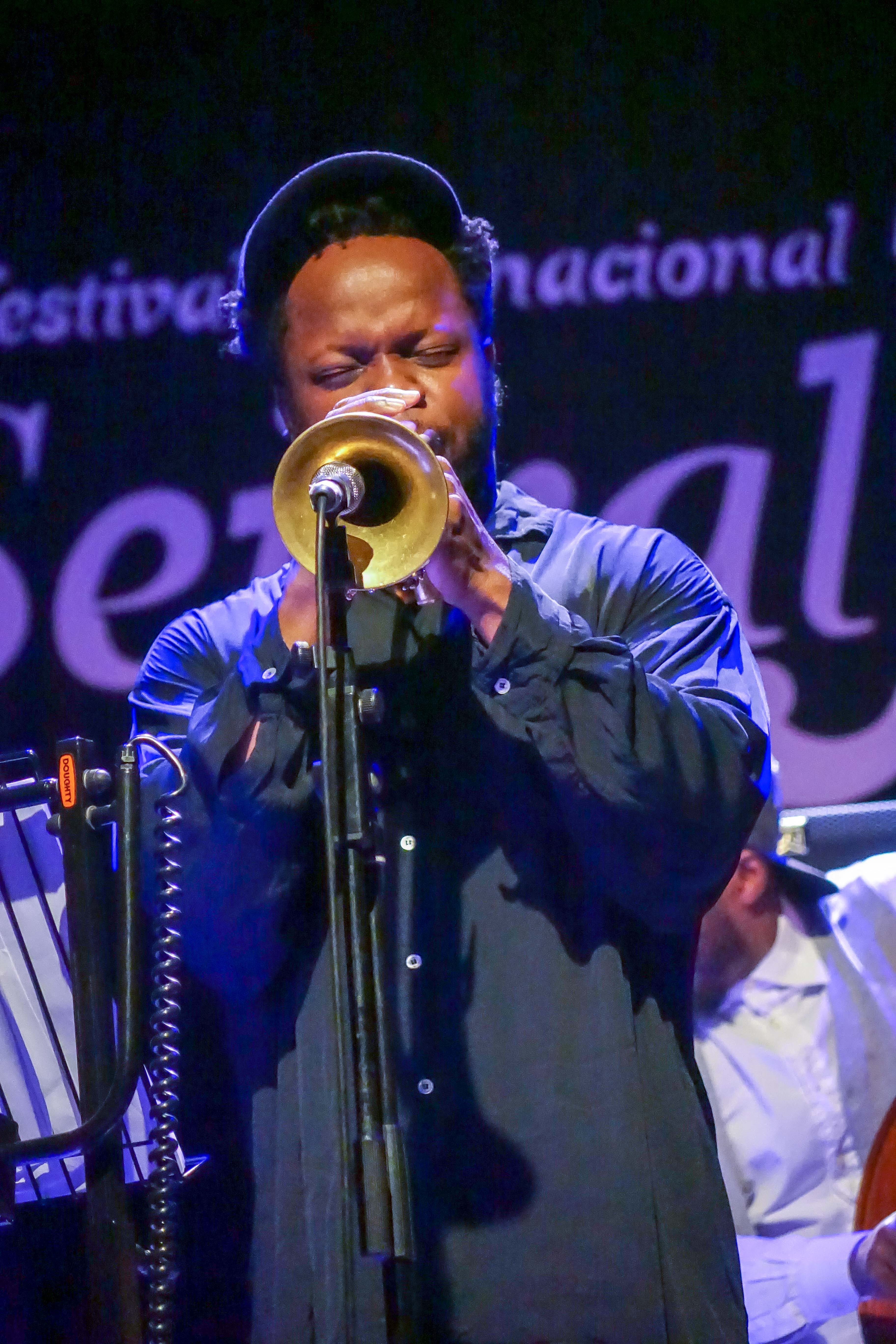
If that weren’t enough, the 10:00pm starting time for all Municipal Auditorium concerts left us free to tour as we wished during daylight hours without being rushed or constricted in our evening dining choices. Across the Tagus River from Lisbon, atop an imposing slope overlooking the shore, the Municipal sports a hillside parking lot that could likely accommodate an audience of 1000. We were rather surprised when the hall, unlike most festival spaces we’ve experienced, had a cozy capacity of 400 or less – completely sold out on both nights we attended.2022~Portugal-196

Akinmusire was actually more familiar with the Municipal than we were, having played on closing night of SeixalJazz 2014 with two other members of his current quartet, pianist Sam Harris and drummer Justin Brown. Missing in action from that gig eight years ago were tenor saxophonist Walter Smith III and bassist Harish Raghavan, staples in the trumpeter’s formative years, replaced by Joe Sanders wielding the upright.

So the rapport between Akinmusire’s bandmates – and between the band and their festival audience – figured to be solid. Knowing each other for more than 20 years, the returning members of the Akinmusire Quartet could hearken back to the leader’s earliest recordings, play off on the tender spot of every calloused moment, Ambrose’s latest release, and even play a new composition for the first time. Adding to the band’s comfort level, no doubt, the acoustics and the sound crew at the Municipal quickly proved to be admirable, and the audience’s energy and courtesy were outstanding.2022~Portugal-066

While the sound of Akinmusire’s band put me in mind of the Miles Davis Quintet that astounded me at the Village Vanguard in the mid-1960s, with Wayne Shorter and Herbie Hancock in the lineup, the shape of the compositions and the composer’s arrangements were freer in form. Meters, tempos, moods, and dynamics could all change abruptly during each piece on multiple occasions. Except perhaps for Sanders’ occasional bass solos, bars and choruses seemed to be an arcane concept when the soloing players took the spotlight.

Nor did Harris or Brown diligently withdraw into accompaniment when handing off the lead to each other – or even when Akinmusire was had the reins. Because Harris and/or Brown were so persistently expressive instead of subordinating themselves, the very definition of soloing was often in flux as each arrangement organically unfolded. It was as if all were so eagerly joining in on a narrative – and so comfortable with each other – that nobody ever hesitated to speak up or interrupt.2022~Portugal-072

Yet the Quartet’s volatile brew never gave any sign of devolving into cacophonous chaos. Most freely expressive was Akinmusire, growling, squealing, whining, sighing, or ranting – angrily or urgently or plaintively – with his horn. Nearly always, he had the last word, more like a soliloquy than a cadenza. Pieces often seemed to end after a moment of reflection when Ambrose decided he had said exactly enough.

The crowd was only thrown once by the Quartet, three pieces into the concert, when a cooldown Akinmusire offering was followed by a titanic solo by Brown. It was so epic that the hall burst into wild applause when the drummer simply paused for a breath and a mood shift – followed by a briefer trumpet solo crackling with fury. “Mr. Roscoe (consider the simultaneous),” for composer and multi-instrumentalist Roscoe Mitchell, was the most cerebral and rigidly arranged nugget on the playlist, showcasing Harris in a wonderfully thoughtful vein.2022~Portugal-062

That provided a perfect segue to Akinmusire immersing us in his ballad mode with “Roy” for trumpet great Roy Hargrove, also from the most recent album but in a live version that was more extended and virtuosic. Not having seen Ambrose playing live before – or even on YouTube, I’ll confess – I was more than a little surprised that this brass player, unlike Wynton Marsalis or Wycliffe Gordon, didn’t bring a collection of mutes, plungers, or assorted doodads onstage to help him produce that wide array of signature sounds he perfected.

And of course, I was impressed. Even Miles had his famed Harmon mute in his arsenal.

Nestled at the bottom of the hilltop commanded by the Municipal Auditorium, a gaudy riverboat with a gangway leading down to it stood gleaming on the shore. Our first night at SeixalJazz, we mistook the riverboat for the ferry from Lisbon, which had its last run of the night when festival concerts began. As it turned out, the posh vessel was the Lisboa à Vista, a truly fine seafood restaurant where we had booked reservations for the following night – and where we first encountered Samara Joy and her band, already seated at the table next to ours.

2022~Portugal-054

My wife recognized her first, but I soon felt compelled to confront jazz’s newest diva with a question that had been nagging at me all the way across the Atlantic. Since Joy had favored us back in August with a song she had written in French for a previous concert abroad, could I get a scoop on a new song she had written in Portuguese?

Not quite. Joy hadn’t written a song in Portuguese for tonight, but she assured us that she would be singing one.

Joy’s career has certainly been in high gear over the past few months, so I’ve needed to shift into overdrive just to keep up with the news. At Middle C, she was signing pre-release copies of Linger Awhile, and eight weeks later when she sang at Seixal, the new album was rapidly climbing the charts. By the time we returned stateside, Linger Awhile was #1 on the Jazz Week airplay chart. Two Grammy nominations came in shortly afterwards, including Best New Artist, and word of a seven-city Big Band Holidays tour with the Jazz @ Lincoln Center Orchestra was posted online, to be followed with a stint on the 2023 Jazz Cruise.

At the Municipal, the contour of Joy’s set was very much as it had been back in North Carolina, about half of the songs from her two albums, leaving her plenty of space for pleasant surprises – and leaving us plenty of additional delights to discover in her new album if we hadn’t heard it. Unlike Akinmusire (one Grammy nom, we should mention), who started off full steam and never let up except for his well-placed but no-less-intense balladry, Joy started off at a high level, less chatty and playful than she had been at Middle C, but there was a gradual build in the second half of her set list.2022~Portugal-218

Once again, “Can’t Get Out of This Mood” was near the beginning of the program, unmistakably echoing the Sarah Vaughan arrangement from her landmark In Hi-Fi album of 1950. This time, pianist Ben Paterson instead of Grasso was Joy’s prime collaborator, so the performance was far closer to the sound of the Grammy-nominated studio version. On the other hand, Grasso – like Paterson, a major voice on Linger Awhile – had played the intro and instrumental solo on “Nostalgia (The Day I Knew)” where Joy has added fresh lyric to Fats Navarro’s 1947 solo on the Tadd Dameron original. So that tune got a fresh twist in Seixal, with a Euro edge as French bassist Mathias Allamane and Danish drummer Malte Arndal rounded out Joy’s rhythm.

“’Round Midnight” has a bigger horn arrangement in the studio version, so I preferred the intimacy that Joy established with her audience in both of her live performances here and abroad, though I’d be eager to hear a J@LC arrangement. The other Monk tune, with Joy’s vocalese on “San Francisco Holiday (Don’t Worry Now),” hasn’t been recorded yet. Both Grasso and Paterson were exemplary when I heard them, so it will be interesting to see which one Joy will choose for her studio take.

With his work on “If You Never Fall in Love With Me,” swung with Joy more confidently and energetically than “This Mood,” Paterson made his case that the vocalist’s eponymous debut album, cut exclusively with Grasso’s trio, could have benefitted from his presence. The lingering rush of adrenalin from that uptempo romp provided a perfect moment for Joy to spring her Portuguese surprise, a lyrical tribute to Lisbon’s own “Queen of Fado,” Amália Rodrigues (1920-1999).2022~Portugal-201

Not attempting to emulate the fadista’s oft-imitated style, Joy charmed her audience with her sincerity, humility, and individuality. Clearly, she was buoyed by their response, for after rocking the house with a newly-minted “Blues in Five,” Joy ripped my heart out with the best “Guess Who I Saw Today” I’ve heard from her, better than the cut on Linger Awhile and better than her Middle C encore. I can’t honestly say the same about her rendition of the title song: it flashes by so quickly every time, like lightning – ironically, the shortest track on both Joy’s and Sassy Sarah’s Linger Awhile albums.

The truest measure Joy’s growth over the past couple of years – she’s still only a tender 22! – was her valedictory rendition of Hoagy Carmichael’s “Stardust,” with multiple levels of depth beyond what you’ll hear on the opening track of last year’s Samara Joy debut. Coupled with her extraordinary voice and command, she seems to possess an unquenchable urge to seek out the purest essence of the music and the lyrics she sings.

Photos by Perry Tannenbaum

Gelb and La Fiesta Latin Jazz Quintet Dim the Party Lights on New CD

Review: The Latin Jazz Pandemic Suite – CD

By Perry Tannenbaum

image006

CD: The Latin Jazz Pandemic Suite – Gregg Gelb, leader, tenor saxophone; Stephen Anderson, piano; Andy Kleindienst, bass; Beverly Botsford, percussion; Ramon Ortiz, drums – 30:10

If you think about the makeup of a Latin jazz quintet, your expectations would likely include a pianist, a drummer, a conguero, an acoustic or electric bassist, and another soloing musician – on marimba or vibes if you’re looking for a tropical flavor, on trumpet if your taste runs to South-of-the-border salsa. The sound is easier to conjure: light, breezy, festive, or celebratory. Always joyous. So it’s almost redundant that tenor saxophonist Gregg Gelb and his group named themselves the La Fiesta Latin Jazz Quintet. By far more surprising for this quintet is their ambitious new project, composed by Gelb, that provides the main core – and the title – for the group’s second album, The Latin Jazz Pandemic Suite. Sunshine and celebration discarded in favor of morose ruminations on COVID-19?

No, that never quite happens in the new six-track collection, five of them forming the Suite. Yet a haze of lassitude, discomfort, or discontent hangs over the entire set – sheer jubilation never fully breaks out, even in the “Tiempo de Fiesta (Party Time)” finale. Millions of us have had many of the same thoughts, agonized in similar isolation, and experienced many of the same fears and frustrations. But however much we have experienced in common during our nearly two years apart, the global pandemic has done little to bring us together – and plenty to increase our divisions. Serving as a preamble to the Suite, Gelb’s first composition for La Fiesta during the pandemic, “Juntos De Nuevos (Together Again),” would likely be merrier and more anthemic if the togetherness were accomplished rather than merely yearned for – and if it extended beyond his quintet, which was “looking forward to when we would be together again and be able to play,” in the composer’s words.

image002

“Juntos” starts with a lush rain-forest quietude, Stephen Anderson’s piano faintly dripping, Andy Kleindienst’s bass replicating a soft acoustic guitar, and Beverly Botsford’s exotic percussion clucking, ticking and moaning rather than pounding. The pounding arrives when drummer Ramon Ortiz switches away from his cymbals and rims to the heart of his drums, making a nice launchpad for the saxophonist’s brash entrance and the announcement of his virile theme, more like Sonny Rollins’ or John Coltrane’s concept of Latin jazz than Cal Tjader’s. Anderson’s soloing, on the other hand, is suppler, more apt to feature Latin rhythms as well as chords, yet able to layer on some McCoy Tyner gravitas as the pianist builds to peak moments. The rhythm section gets ample space here to show why Gelb missed them, Kleindienst’s airy bass solo leading into a more intense jam between Ortiz and Botsford before the leader returned with the theme. After repeating his melody, Gelb played on it briefly, bringing the track to an abrupt, invigorating halt. A zesty reunion.

None of the five parts of the Suite is nearly as long as “Juntos de Nuevos,” but hardly a beat separates the flow – none at all between parts 2 and 3. With shifting tempos and themes, Gelb’s Pandemic Suite acquires a cumulative heft, only let down in those two fused sections, “New Normal” and “Mucha Positiva,” where the quintet becomes a bit too literal, first the rhythm section and then the leader, in simulating the monotony and repetitiveness of isolation. The outside sections, “Quarantine Dance” and “Tiempo de Fiesta,” both find the right balance between the festive impulses of Latin jazz and the grim reality of COVID confinement. Sunshine dominates, occasionally dimmed. Introduced by a mildly domesticated Mongo Santamaria shuffle, “Quarantine” soars midway through its melody line before falling down and stomping with a jazz riff. All of the solos that follow from Gelb, Anderson, and Kleindiest ultimately tumble into that recurring riff. Unlike his arrangement on “Justos,” Gelb didn’t play on the melody when he returned with it, signing off abruptly after repeating one chorus, stomping his riff one last time with Anderson.

Gelb injects a little more Latin spice into his “Fiesta” riff, with a sax component all his own interspersed with emphatic punctuation from the rhythm section, so the composition sports a bit of hard-bop jauntiness a la Horace Silver, one of the two composers the Quintet covered in their eponymous 2016 debut album. Unadorned by this zippy sax riff, Anderson’s piano solo is energetic and inspired as ever, nicely complementing Gelb’s best blowing on this set. Percussion kicks in twice surrounding Gelb’s final solo, the last a rather chastened jam, pointedly slowed down to underscore that we cannot readily recover our carefree pre-pandemic sunniness just yet.

The penultimate piece in the Pandemic Suite, “The Sad Truth,” the ballad that it sorely needed: as Gelb’s liner notes tell us, “As March 2022, almost one million Americans have died from the virus. We still wait for it to end.” This is the saxophonist at his most soulful, invoking the gruff artistry of Dexter Gordon and Rollins. What I do wish for here is a composition that would have extended more than 16 bars – and solos that lengthened with it. Anderson enters ever so lightly and, abetted by Ortiz’s work, succeeds in making this ballad a Latin Jazz “Truth.” The pianist, in fact, seems to love this composition more than the composer, for he continues to lavish filigree upon it even after Gelb reprises the theme. Botsford asserts herself along with Anderson toward the very end of the arrangement, where the saxophone becomes slower and softer. That makes the sudden onset of the “Fiesta” finale explosive and satisfying.


Joy and Grasso Revivify the Kings and Queens of Bebop at Middle C

Review: Samara Joy and the Pasquale Grasso Trio at Middle C Jazz Club

 By Perry Tannenbaum

2022~Samara Joy~13-1

August 27, 2022, Charlotte, NC – Born in the Bronx, Samara Joy didn’t stray far from home to win best vocalist honors in the annual Essentially Ellington high school competition at Lincoln Center. You can get to that Versailles of Jazz overlooking Columbus Circle by taking any of four Bronx subway lines, including the A train. Nor was it much of a drive – if she didn’t simply hop a bus – for Joy to go across the Hudson River to Newark and win the prestigious Sarah Vaughan International Jazz Vocal Competition in 2019 while still a collegian.

Recently, she graduated from the jazz program at the State University of New York at Purchase, less than 35 miles from the Big Apple, where she was an Ella Fitzgerald Scholar. No, Joy hasn’t needed to hit the road to pick up these auspicious accolades. But make no mistake, teamed up with an extraordinary bebop guitarist, Pasquale Grasso, young Joy is going far. The 7:00pm set last Saturday evening was sold out at Middle C Jazz, where Joy and Grasso’s trio made their Charlotte debut, testifying to the already impressive momentum of Joy’s career and the spiraling sophistication of the Queen City’s jazz audience.2022~Samara Joy~12-1

Hard to say where the crowd had caught the buzz. A year ago, both Joy and Grasso were featured in August issues of major magazines, the singer in Downbeat and the guitarist in a JazzTimes write-up. Both have toured recently and both have been listed in their respective “Rising Star” categories for the past two years in Downbeat’s International Critics Polls, the more established Grasso rising to #3 in this year’s rankings. Grasso’s discography is also more extensive, but news of Joy’s triumphs is hitting my inbox more frequently these days. Verve, one of the choicest pearls among jazz recording companies, has signed Joy and will be dropping her first CD (and vinyl) on her new label in mid-September, and she has recently climbed aboard the list of heavyweight headliners for Jazz Cruise 2023. Yes, Grasso will be in the same boat, not quite as high on the quirky marquee.

Although only two tracks from the new album, Linger Awhile, have been released, the full songlist – otherwise greyed out – can already be viewed at Apple Music, and you can hunt down one other new song in a YouTube concert. Maybe even more exciting and auspicious than the half dozen songs she sang from the new release, including the title track, were the five songs that have not appeared on either of her two albums to date, including new lyrics for tunes by Thelonious Monk, Fats Navarro, and a tryout for Joy’s French translation of “April in Paris,” mashed up with the original English by Yip Harburg for composer Vernon Duke.2022~Samara Joy~16-1

Nor was Hoagy Carmichael’s “Stardust,” the lone tune Samara performed from her eponymous debut album of 2021, merely a lazy reprise. The YouTube concert recorded last July at Duck Creek, just after the release of Samara Joy, leans far more heavily toward Sarah Vaughan than the studio version, which shuttled between Sassy Sarah and Ella Fitzgerald in its timbre and interpretation. At Middle C, she was bolder, more self-assured, more venturesome, and more individual. Freed by Grasso’s lacy and linear accompaniment to take liberties with the beat, Joy bent the melody – and the lyric – more audaciously, particularly in the final sentence, letting Hoagy’s vain “dream” float longer than those previous versions and ending with a little cadenza that stretched out the final “refrain” to two or three long breaths.

Since Vaughan was the vocal great most closely associated with bebop, it was inevitable that Joy would gravitate toward melodies by Monk and bebop phrases coined by Charlie “Bird” Parker – especially since Grasso, in addition to his latest Be-Bop! album on the Sony label, has also released solo EPs devoted exclusively to Bird, Monk, and the wellspring of his unique guitar style, bebop pianist extraordinaire Bud Powell. Sprays of dazzling lucidity poured from Grasso’s fingers whether he was setting the stage for Joy’s vocals with oblique intros or soloing midway to give our featured artist a well-deserved breather. Not that this future diva ever took a seat or even a sip of water. She’s just 22!2022~Samara Joy~4-1

Jumping right into “Can’t Get Out of This Mood,” a somewhat neglected gem that Vaughan introduced in 1950 on her first LP, Joy’s vocal kinship with Sassy was instantly apparent – but she was getting to the song a few years earlier in her career, so her voice had a lighter, more youthful sound. She sounded like a younger Vaughan from back in the ‘40s, when you could only hear her “Perdido” on 78rpm. That made a difference when Joy sang the payoff line, “Heartbreak, here I come!” almost embracing disaster. After giving her “April in Paris” a French twist, Joy played around a little bit with Cole Porter’s “Just One of Those Things,” starting at a ballad tempo with the bridge, which slightly veiled the song’s identity before she hit the familiar opening line with an abrupt uptempo splash.

For me, the most delightful segment of the program came at the midpoint, when Joy concentrated on retrofitting some lost bop treasures with fresh lyrics. “Sweet Pumpkin,” already gathering plays on the streaming sites as the B-side of Joy’s first Verve single, has had two separate lives – as a Ronnell Bright song recorded by Bill Henderson in 1959 and as a Blue Mitchell instrumental in 1960. Joy’s second chorus was so unlike her first that you could accuse her of a second melody in vocalese, a precipice from which Neal Caine’s ensuing bass solo contrasted like a pleasant, peaceful valley. The young singer really did craft new lyrics for the next tune, Navarro’s “Nostalgia,” which will pick up a parenthetical new title, “The Day I Knew,” when the new album releases. Most fun of all for me was the Monk tune that Joy may not have taken to the studio yet, her new setting for “San Francisco Holiday,” nearly renamed “Don’t Worry Now” – I say nearly because one cover of the tune I’ve found has “Worry Later” as its parenthetical title.

Joy sang her song so slowly that it was unrecognizable at first. Aside from Carmen McRae, the only diva I know who has dared to devote a whole album Monk’s marvelously eccentric music, nobody has ever sung such a prickly, astringent song so slowly. It is blaring, repetitive, brassy music that would lose most of its flavor on piano or guitar, cresting with a bridge that echoes the main theme maybe an octave higher – with more discordant harmony. Only when Joy sped up the melody on her second pass did I recognize the Frisco melody and the wan, soused gleefulness of the original 1960 recordings by Monk’s quintet. Prudently, Grasso took a pass on soloing here, ceding that honor to drummer Keith Balla, who fashioned a fine and witty tribute to Monk’s legendary eccentricity, playing three-quarters of his solo quietly with his bare hands and his finale with a pair of sticks held no further than three inches above his drum kit.2022~Samara Joy~17

There was no letdown after this delight. Joy will be building to the climax of the Linger Awhile CD with the title song followed by the pinnacle of Monk’s composing genius, “’Round Midnight” – a fairly objective judgment if our measuring stick is either the number of cover versions the work has drawn by other jazz greats or the number of plays the pianist’s own versions have tallied on Spotify. If Joy’s recording is like the Charlotte performance, you will not be disappointed. The live version had all the trimmings and more, with Joy singing the verse, the vocal, and what seemed to be an even longer version of the familiar out-chorus vamp than even McRae’s, with little melodic variants all Joy’s own. Separating the two vocals, Pasquale played his most soulful solo in the set. Arriving as a signature song for her upcoming album, “Linger Awhile” was capped by a gleeful trading of fours by the instrumental trio, another pleasant and cordial valley after another majestic peak.

For the Middle C audience, the most delight was probably delivered with Duke Ellington’s “Just Squeeze Me.” Not only did Joy wail it with two pairs of soaring choruses, she challenged the crowd to repeat a series of scatted riffs, breaking the room into two competing teams, and choosing sides. Just a bunch of fun, underscoring how relaxed and self-confident Joy had been throughout her sellout set. The encore was a nicely chosen mellowing agent from the forthcoming album, “Guess Who I Saw Today,” a special bouquet for Nancy Wilson fans. There seemed to be many of them in the house.