Category Archives: Feature

COVID Kindred Behind the Scenes of Local Singles

Preview: Local Singles at The Arts Factory

By Perry Tannenbaum

Once you’ve scaled the summit and staged the legendary Sunset Boulevard at Booth Playhouse with a 40-piece orchestra – the pinnacle of Andrew Lloyd Webber’s achievement, or at least the K2 rivaling the Everest of Phantom –you might think that QC Concerts founder Zachary Tarlton would ask himself how can I top this? But when Tarlton formed his company in 2020, the Q stood for Quarantine, and the modest aim was to keep musical theatre going online via Instagram when actual theatergoing wasn’t possible.

So pianist/actor/musical director Tarlton can think small, no matter how wildly Queen City Concerts has grown and overachieved in less than four years. His idea of following up Sunset Boulevard is to take us from the macabre Hollywood mansion of movie icon Norma Desmond to a room at a Pittsburgh YMCA where Nancy and Richard host weekly therapy sessions that struggle to attract lovelorn clientele. That’s the main HQ for Local Singles (down the hall from Hot Local Singles), the new musical by Nick Navari.

Never heard of Navari? You are forgiven. While Lloyd Webber has been bringing hit musicals to Broadway since 1971, Navari is counting on his first Off-Broadway production to open in January 2025.

That’s the allure for Tarlton and his loyal QC Concerts fanatics: being in on a new creation from a new talent as the new organism develops. Instead of begging publishers and Broadway legends for the rights to produce their masterworks – or in the case of Parade, the stirring piece by Jason Robert Brown and Alfred Uhry, going through the ordeal of having those rights suddenly snatched away – Tarlton had the less stressful experience of Navari coming to him.

Flashing back to the summer of 2022, when QC Concerts was readying to begin its second season with the regional premiere of Kinky Boots, Tarlton recalls Navari reaching out.

“He had somehow found us on Instagram and, through the power of social media, followed along with what we were doing,” Tarlton confides. “Then he reached out to me, presented his whole kind of sales pitch for the musical.”

And why not? Backed by a grant from the National Endowment of the Arts, Navari wrote the music, the lyrics, the script, and the six-piece orchestrations for Local Singles. Then he directed the stage premiere at the New Hazlett Theater in 2021 as well as the cast album and a pro-shot film version. Musicians in the promo video for the world premiere jammed the score in surgical face masks, and the first production of Local Singles in front of a live audience didn’t happen until February 2022 at the Lamp Theater in Irwin, PA. Actors caught on-camera in rehearsals for that production were still sporting N-95s.

That second premiere was midway through QC’s opening season, a mere five months before Kinky Boots gave notice that Tarlton had his eye on blockbuster productions like Titanic, Angels in America, and Sunset Boulevard. The prevailing Tick, Tick… Boom! template of Tarlton’s opening seasonmust have seemed rightdown Navari’s alley.

So while Tarlton was navigating beyond his comfort zone with his first company, taking his quarantine concept live, Navari was venturing beyond writing, directing and performing into the wild frontiers of publicity and promotion, hawking his own work. You could say they were kindred COVID spirits. Accidental entrepreneurs.

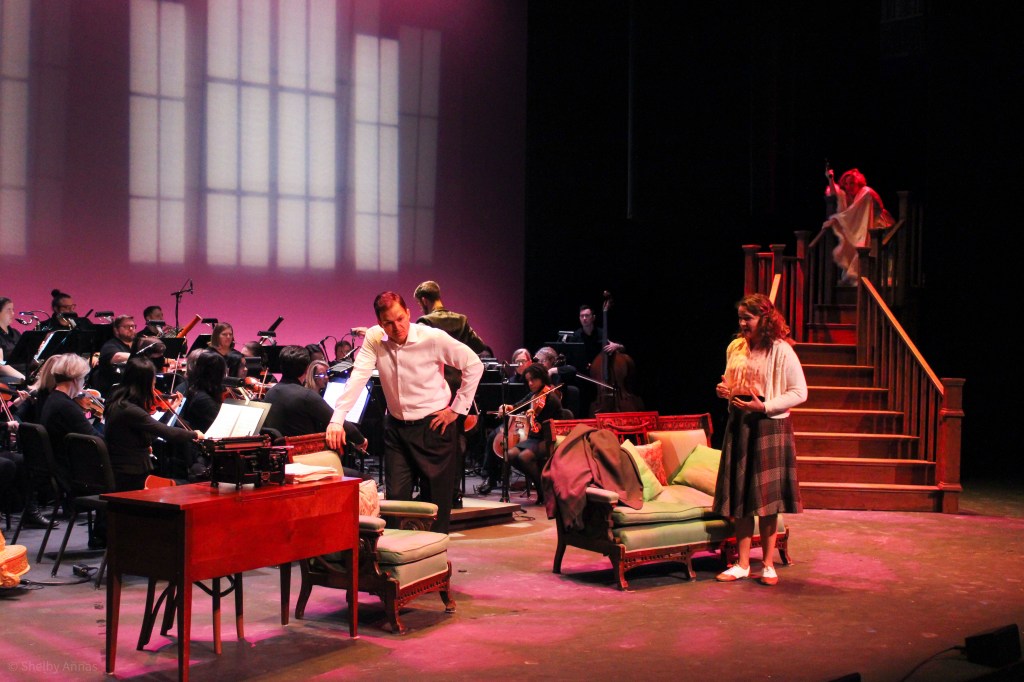
Nor are they averse to doctoring their creations. By the time Sunset Boulevard dazzled at the Booth, Tarlton had totally discarded QC’s script-in-hand format in favor of a workshop concept with costumes, lighting, barebones, scenery and onstage orchestra. Meanwhile, Navari has not been idle. After the Pittsburgh premiere and the cast album, one of Navari’s numerous videos proclaims that he has written five new songs and added a character to Local Singles.

You don’t need to go far in the playscript to see a difference. By the second scene – and the second track of the cast album – the script and Spotify diverge. The version we will get at the Arts Factory this weekend will be the closest yet to the Off-Broadway edition slated to open at Players Theatre in Greenwich Village for a five-week engagement next January.

“He’s made a few more changes for our production,” Tarlton reveals. “So I know that he’s excited to have this chance to get it in front of another audience just to see what still may need to be tweaked and changed before it goes to New York.”

When we first see them, Richard and Nancy have been life companions for nine years, not exactly flush with success. Not only are they competing with the Hot Singles group down the hall, they are tied into a six-year deal for this cursed time-slot for another 42 months. The group seems to have been founded in order to help their friend Jack, a good-hearted paranoid mess.

We don’t meet them right away, likely because we need to be prepared for Jack’s eccentricities and for Nancy’s arsenal of therapy tools – including pairs of yellow rubber gloves, a bubble gun, a portable park bench (with an important plaque), and Morgan. In rehearsal photos, she is portrayed by a piece of hard-sided rolling luggage and the head of a mop. But she may evolve – or devolve – before performances begin at the Arts Factory later this week.

A couple of messy breakup scenes pave our way to the Y.

“So the show opens with Penny, who has just discovered that she is pregnant,” Tarlton explains. “Then we meet Wes and then Wes’s ex-girlfriend. There’s a great [new] song where she’s, like, throwing all these clothes out of the apartment. It’s the whole breakdown moment. It’s lovely.”

And it’s fair to say both Penny and Wes are hurting.

Then we travel into the support group,” says Tarlton. “Over the course of the first act, we find how Wes and then Penny makes their way into the group, one of them on purpose, one of them by accident. And then basically it tracks their continual journey with the group where they both end up continuing to come back week after week, getting to know each other more, getting to be a part of each other’s lives.”

The musical’s through-path is the support group bonding with Penny along the journey of her pregnancy. Navari tosses in some goofy detours, including overtures to Morgan and Jack’s daring adventure with his personalized park bench.

“There’s kind of a big twist at the end of act one with Jack as he’s trying to put himself out there and meet the person of his dreams.”

One advantage of turning down Local Singles for QC’s second season would be Tarlton’s ability to increase prep time for its upcoming run. Hitching onto the CharlotteShout Festival last April gave QC the opportunity to preview Season Three in a revue-style concert – and for Tarlton and director Kel Wright to cast all the younger roles. By the time Titanic was staged in the fall of 2022, Wright and all four of the younger players had already worked with QC: Mary Beth Ritter would sing the preggy Penny; Patrick Stepp would be Wes, our leading man; the versatile Lamar Davis would be the pitiful Jack; and Hannah Risser would belt and bellow The Ex, the key cameo.

Thinking big had allowed Tarlton to test-drive a multitude of singers and musicians.

But what about the adults in the room? Those decisions weren’t cinched until last fall in the weeks following the Sunset Boulevard run at the Booth – when Wright and Tarlton saw Nicia and Charlie Carla on Eastway Drive at VisArt Video in a deathless PaperHouse Theatre production of Vampire Lesbians of Sodom.

Turns out that Wright and Tarlton wished to emphasize the acting skills of their therapist partners, especially the zany Nancy, and the Carlas fit the bill perfectly. So let’s forget that we can’t remember the last time Nicia performed in a musical!

“I am super excited that we’re getting to work with Nicia on the show,” Tarlton gushes. “Just the acting presence she brings to the role of Nancy is astounding. We crack up in rehearsal every day – just her line delivery and the way she handles all these moments is perfection. The stuff that Nancy sings in the show is definitely very much still that talk thingy vibe, and she is owning it and comfortable with it.”

Sitting at the keyboard as music director, Tarlton will have a prime vantage point as the Carlas and their castmates work their magic. Maybe a few in the audience will recognize the vestiges of COVID as the musicians play along. The show is scored for keyboard, guitar (Daniel Hight), bass (Ben Stewart), drums (Mike Charlton), violin (Nikki Redman), and cello (Peter Case).

No winds and no brass. Remember those days?

Navari himself plays piano, guitar, and “a few other instruments,” Tarlton reports, explaining the composer’s facility in handling the chamber-sized orchestrations.

He savors the flavor of the strings. “It adds a little mix of more classical string music,” Tarlton observes, “with your very contemporary rock band feel of a traditional kind of modern contemporary, musical theater, off-Broadway sound.”

The idea is for this kooky Y therapy to go beyond the little support group and become contagious. For us.

Rendezvous With Our “Sunset Boulevard” Diva

Interview: Allison Rhinehardt

By Perry Tannenbaum

After an amazing reading stage production of Angels in America in Matthews this past spring, followed by a regal Diana: The Musical up in NoDa this summer, nothing seemed to be beyond the grasp of Queen City Concerts. Their unique concert style has seemingly been bent to the breaking point, with actors mostly going off-book while more and more scenery and costumes have been layered on.

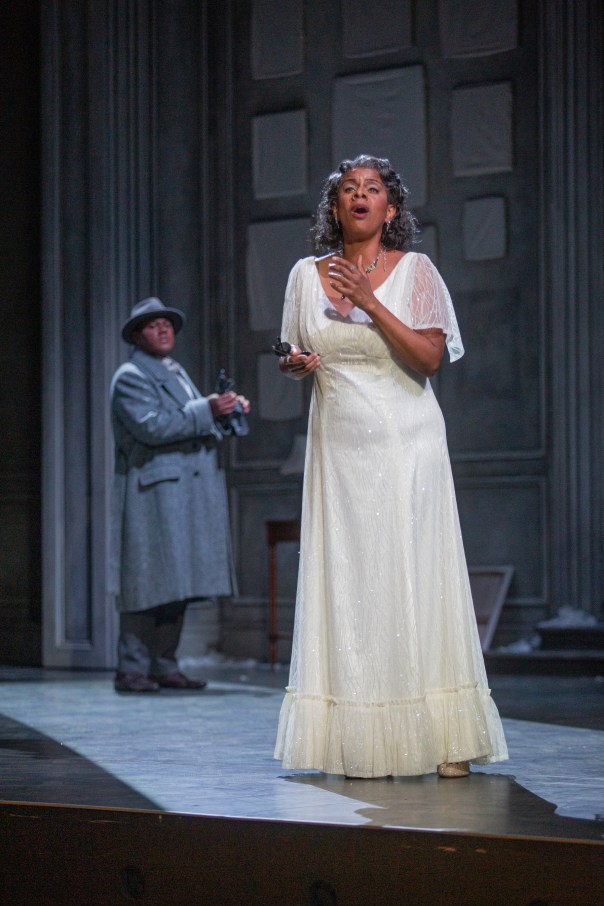
Yet the upcoming Sunset Boulevard this weekend takes everything that Zachary Tarlton and his sensational company have done so far to an even higher level. Onstage with diva Norma Desmond, her youthful paramour, Joe Gillis, and the legendary Cecil B. DeMille will be a 40-piece orchestra led by Tarlton, the first band of that size to play the full Andrew Lloyd Webber score since the 2017 Broadway revival starring Glenn Close.

“When I got the email out of blue asking to talk about the possibility of me directing it,” says Stuart Spencer, “I did have to read it a couple times before it sunk in.”

It’s a preciously short and intense opportunity for performers and audiences alike. Rehearsals are few and audiences will only get three shots at witnessing this glorious Sunset, perhaps Lloyd Webber’s very best musical. With 40 musicians onstage with his cast, Stuart’s time and space are severely cramped as opening night approaches.

“With fewer rehearsals, I have to be more specific and move faster,” Spencer admits. “A few times, I thought ‘if I had more time, I’d run that again… but we have to keep moving.’ In the end, you have to trust that your actors will do the extra work on their own to keep us moving.”

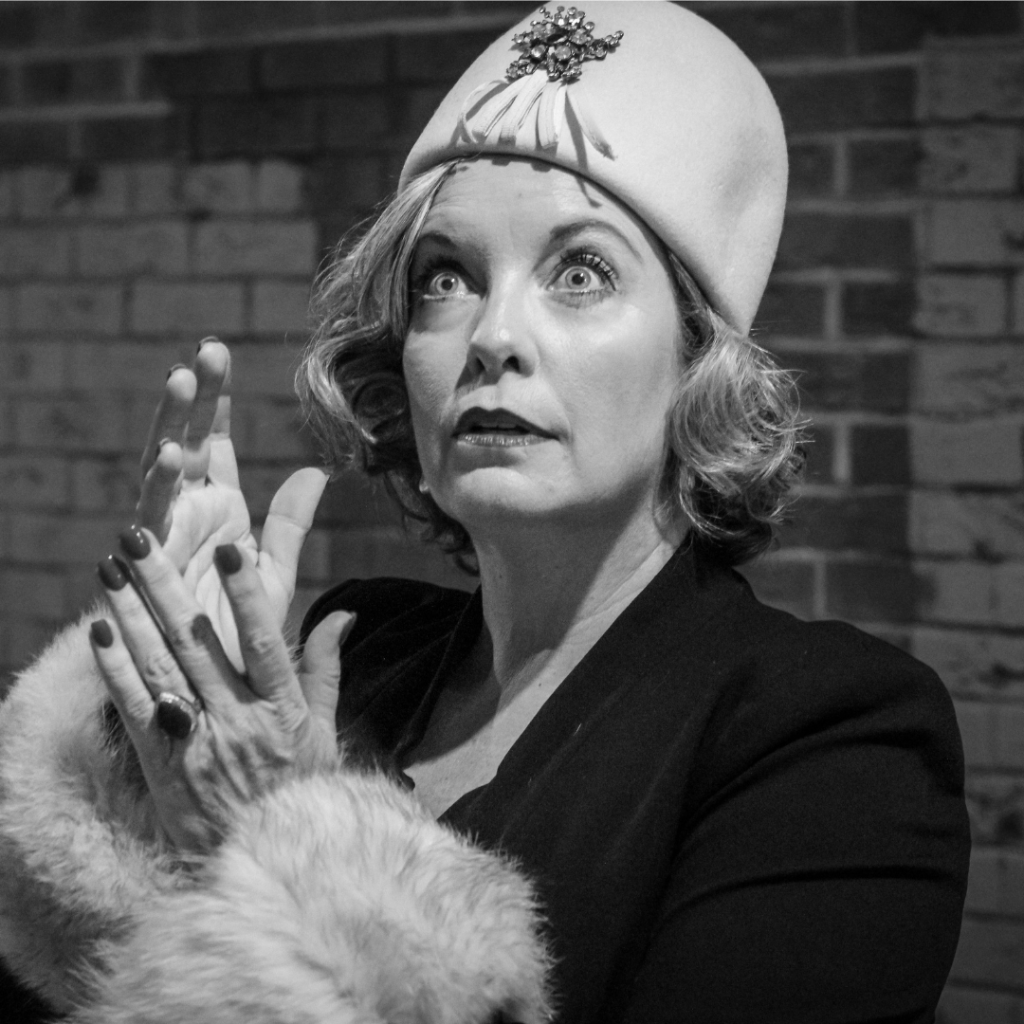
As Norma, Charlotte diva Allison Rhinehardt will be the performer that Spencer must trust the most. We had this exchange with Rhinehardt about the role, her prep, and the whole giddy experience.

QC Nerve: Is Norma Desmond the role of roles for you, or does the concert format – and the brevity of both the process and the run – dampen your enthusiasm?

Allison Rhinehardt: Norma Desmond isn’t just the role of a lifetime, it’s the role of a generation. I had never even considered taking on this role as a possibility in my life, so spending these last several weeks studying Norma, singing her iconic songs, retorting: “I am big, it’s the pictures that got small,” and watching this entire cast bring 1,000% has been both my honor and sheer delight. I think you will find this concert format to be different from past QC Concerts. This is fully staged and costumed with set pieces and props. Everyone is off-book, which was definitely a feat for some of us! Would I like more time? Absolutely. But not just for me. This show is something incredibly special. I would love to be able to share it with as many people as possible.

What in your mind makes Norma unique?

I love Norma Desmond. She is wonderfully complex. She is bursting with passion, and despite her grandeur, there is insecurity and need for validation. As a working actor in Charlotte, one of my gigs is working as a simulated patient for Atrium. This program gives med students and nursing students the opportunity to practice in a safe environment of simulated situations to help with diagnosis and patient care. One of my regular characters is exhibiting signs of mania with bipolar disorder. The character is undiagnosed and just living her life at this point. I am not a doctor and certainly wouldn’t try to diagnose anyone, but I see a lot of similarities in both characters.

Norma’s emotions swing wildly between elation and despair. She clings to “what once was” instead of forging ahead during a time of big change. Falling in [a perverted co-dependent version of] love with Joe, is just the current obsession that the audience witnesses. You get to have a 6-month living room view of a decades-long “normal.”

If you’ve experienced the performances of Patti LuPone, Glenn Close, or Betty Buckley in the role, is it a struggle not to be intimidated by the challenge – and to resist emulating at least one of them?

I have studied A LOT since being cast in this iconic role. I read an interesting book (Close-Up on Sunset Boulevard by Sam Staggs) which was a fascinating retrospective on the darkness of Hollywood dreams and the actresses that may have inspired the character Norma Desmond. I also had a trip to London the beginning of October, so I went to see the reimagined Sunset Boulevard starring Nicole Scherzinger in the West End (a whole separate interview, haha!).

Naturally, as a musical theatre person, I have always adored Betty Buckley, Glenn Close, and Patti LuPone (I saw her when I was child in Evita!). It’s impossible not to be influenced by these Broadway divas in general, but I have made a conscious effort to make my performance my own and to not rely on those before me. You may find a vocal nod to Stephanie J. Block or Elaine Paige, but Norma Desmond is such a rich and complex character, she deserves genuine authenticity which requires one to be fully immersed and present in the moment.

Am I intimidated? A month ago I would have said “intimidated” wasn’t a strong enough word (Zack and Stuart can tell you when I got the casting offer, I emailed back making sure they knew it was me they had sent it to). But now, I almost feel like I’ve joined a sisterhood of strong women telling a tragically beautiful story…or is it beautifully tragic? Am I still intimidated? Of course. I always am with any role honestly. If you’re not a bit afraid, then there’s no risk, nothing to fight for, and you’ve lost your edge.

Is the point for you to penetrate beyond the musical divas and Gloria Swanson to your own authentic Norma Desmond, or must you stop at Gloria’s iconic screen performance, obviously Lloyd Weber’s inspiration, and transfuse Swanson’s screen Norma into a fresh musical Norma?

I think it’s important to understand that while this story is on a grand scale, it is not a fairytale. The movie came out in 1950, yet it’s a tale as old as time, still relevant today. I remember distinctly the moment I was made aware that I was no longer in consideration for the ingénue; that I had moved on to the more matronly roles. It hurt. A LOT. I myself struggled with identity. Who I had always been, I no longer was, and never would be again. There were still roles I wanted to play, but had somehow “aged out of.”

As a woman in her 50s, who has been in the business for nearly 5 decades and is now looking for where I fit, I absolutely empathize with Norma. I understand her. I love Gloria Swanson’s embodiment in the movie. I love Glenn Close’s embodiment in the musical. My goal is to bring the story to life through Andrew Lloyd Webber’s words and music having not just my own decades of experiences, but also having whispers with me of all the Glorias, Glenns, Bettys, Diahanns, Pattis, Stephanies, Elaines…all the actresses “of a certain age” in my life.

What excites, frustrates, or frightens you about working in the concert stage format? How much will you be able to abandon script and score to become Norma?

What I love about the concert format that Zack has created is the trust between the creative team and the actors. We may only have a handful of official rehearsals, but that doesn’t mean work is not being done outside that time. The entire cast received the script before rehearsals began. On day one of rehearsal we were running and staging songs because everyone had done their homework, everyone came in knowing the music.

Trusting the actors to do what good actors do is what makes it work. While my script and score have been an extension of my right arm for weeks now…it goes everywhere I go and is currently sitting right next to my laptop…I’ve been off-book for at least a couple of weeks and able to really concentrate on nuance. Of course moving into the Booth on Wednesday and gaining a 40-piece orchestra on the stage will present new logistical challenges, but that is par for the course in theatre. I think theatre folk roll with the punches better than most. As Little Red so aptly put it, I’m “excited and scared.”

More rehearsal time would help, right?

More rehearsal time for a show this size certainly wouldn’t hurt, though I firmly believe things can (and often are) over rehearsed. I wish we could run the show for more than 3 performances over 2 days after putting so much heart and hard work into it. We have to work within the reality many theatre groups in Charlotte face. Rehearsal space takes money. Performance space takes money. Charlotte is a vibrant city with an incredible network of talented artists. Support and funding for the arts in Charlotte is imperative to the community.

Fun fact: This 40-piece symphonic orchestration production is only the 2nd of its kind in the country with the first being the 2017 Broadway revival with Glenn Close. So New York’s Broadway and now Charlotte, NC? That is cool. The Booth holds about 400 seats, so over our three performances, 1,200 people in a city of nearly 1 million will get to see Sunset Boulevard. That is Zachary Tarlton and QC Concerts’ gift to the city of Charlotte…

Still in Flux, Spoleto USA Runs Brash Gamut From Barber To Balloon Pops

Review: Spoleto Festival USA

By Perry Tannenbaum

Photo by Leigh Webber

It’s been a tumultuous year for Mena Mark Hanna in his second season as the new general manager at Spoleto Festival USA. Chamber music director Geoff Nuttall, the festival’s most recognizable personality – the charismatic violinist who convinced Hanna to come aboard at Spoleto – died in mid-October at the age of 56 while undergoing treatment for pancreatic cancer.

Amid all his antics and flamboyance, Nuttall never seemed to be that old.

Then as all the pieces of Spoleto 2023 fell into place, including the memorial concert for Nuttall scheduled on the opening holiday weekend, last year’s centerpiece, the world premiere of Omar, won the Pulitzer Prize for composers Rhiannon Giddens and Michael Abels. That opera, rooted in the festival’s Charleston home, would stand as the signature achievement of Nigel Redden, Hanna’s predecessor. Redden handed over final alterations and trimmings to the new GM, who piloted the grand project into port.

So this year’s festival will likely be remembered as Hanna’s first true lineup, though Scottish Ballet, mandolin sensation Chris Thile, and iconic jazz artist Abdullah Ibrahim will be the last holdovers to file into Spoleto from the 2020 event that never happened. Yet without a replacement for Nuttall, a key member of Hanna’s hiring committee as well as an engaging host and performer, there’s a feeling that the festival remains in flux.

Even as I spoke to Hanna, a week before this year’s Spoleto began, he wavered between declaring he was in no hurry to replace Nuttall and assuring me that considering his successor was definitely on his to-do list during the festival and in the summer ahead.

It’s safer to say that sustaining the momentum for opera is an urgent priority for Hanna. Programming Samuel Barber’s Vanessa in 2023 is certainly a major statement, since its strong libretto was written by Spoleto founder Gian Carlo Menotti, and for 2024, the festival is commissioning a new opera. Announced at the same time the curtain was rising for the final performance of Vanessa, the new piece, Ruinous Gods by composer Layale Chaker and librettist Lisa Schlesinger is ballyhooed as “another bold project with powerful themes” in the mold of Omar. Opera Wuppertal and Nederlandse Reisopera will be co-commissioners and co-producers of the new chamber opera.

Menotti hasn’t been regularly involved at Spoleto since 1993, when he stage-directed one of his weakest works, The Singing Child. True, there was a revival of Menotti’s most heralded opera, The Medium, in 2011, but that production has come to seem like an obligatory celebration of the composer’s 100th birthday. Twelve years later, Vanessa feels like a whole-hearted embrace: bolder and more contemporary with Rodula Gaitanou’s daring stage direction, more searching with Timothy Myers wielding the baton.

A long pandemic after Gaitanou’s vision of Vanessa was first presented in 2016, the loneliness and isolation of Vanessa resonated more keenly in its US premiere, the effect only enhanced because her icy-cold vigil is self-imposed. The entire household seems to be in suspended animation, The Old Baroness mother perpetually painting at her easel, daughter Vanessa faithfully awaiting her former lover’s return after 20 years, and Vanessa’s niece Erika as much on auto-pilot as the maids and butlers.

All the many paintings and mirrors on the walls are covered, adding to the surreal atmosphere. It’s as if Vanessa were protecting herself from a raging plague, or as if this were a summer home about to be abandoned until next year. The futile circularity of the Baroness painting pictures that will be covered up as soon as they are hung up on the wall subtly prefigures what will happen when Vanessa’s beloved Anton arrives.

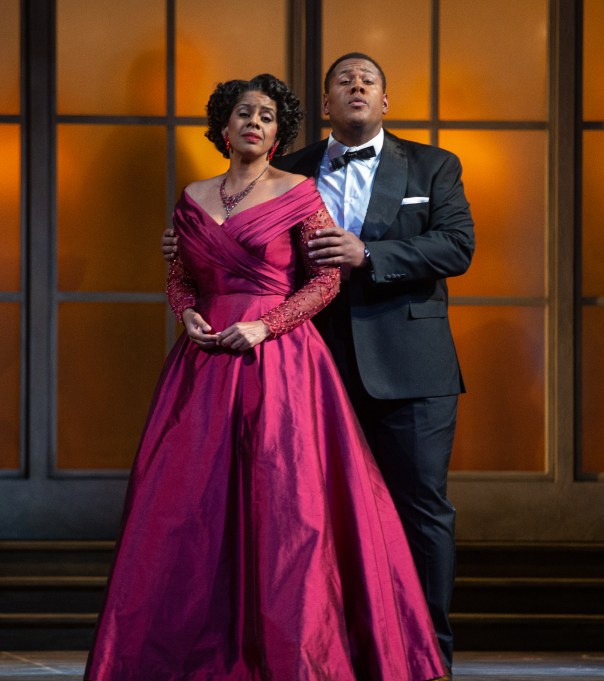
As Hanna had promised, the cast was killer. Nicole Heaston brought a neurotic hauteur to Vanessa, a steely cold soprano in her rendering of the tense “Do Not Utter a Word” aria that weirdly echoed Rosalind Plowright’s iciness as the Baroness, a role that the English mezzo originated at the Wexford Festival premiere of this production – before she reprised the role at Glyndebourne in 2018 (available on DVD and Blu-Ray). Compared to the stony and unwavering Plowright, Heaston’s Vanessa proved to be vulnerable, capricious, malleable, and oblivious in a quietly disturbing way.

If Heaston personified the creepiness and the supernatural tinge of Menotti operas, mezzo Zoie Reams as Erika inclined more to Barber’s sad and wistful Romanticism. More emotion poured out of her in “Must the Winter Come So Soon” than on any of the full-length recordings this side of the original live recording conducted by Dmitri Mitropoulos in 1958. Heaston ably gets across to us that her attraction to the second-generation Anton is a rekindling of her youthful ardor, but Reams shows us that Erika’s love for Anton is a first flowering, with a more hormonal heat and fire.

Yet Erika never wears her heart on her sleeve. Perhaps because of her more precarious finances, there’s a secretive and withdrawn aspect to Reams’ performance that marks her as a member of the family. So self-denying and self-destructive are they all that it becomes richly ambiguous whether tenor Edward Graves as young Anton is a ruthless fortune hunter or an idealistic romantic. It was rather wonderful, when Graves engaged Heaston in the slowly cresting “Love Has a Bitter Core” duet, how Anton and Vanessa could be seen triggering spontaneous passion in each other.

The denouement was a walloping “To Leave, To Break, To Find, To Keep” quintet with baritone Malcolm MacKenzie, a welcome presence as The Old Doctor, completing the fugal fabric. It all sounded so present and powerful at Gaillard Center, the singing perfectly balanced with Myers’ ardent work in the pit, while ever-present, precisely synced supertitles projected above facilitated transmission of Menotti’s text.

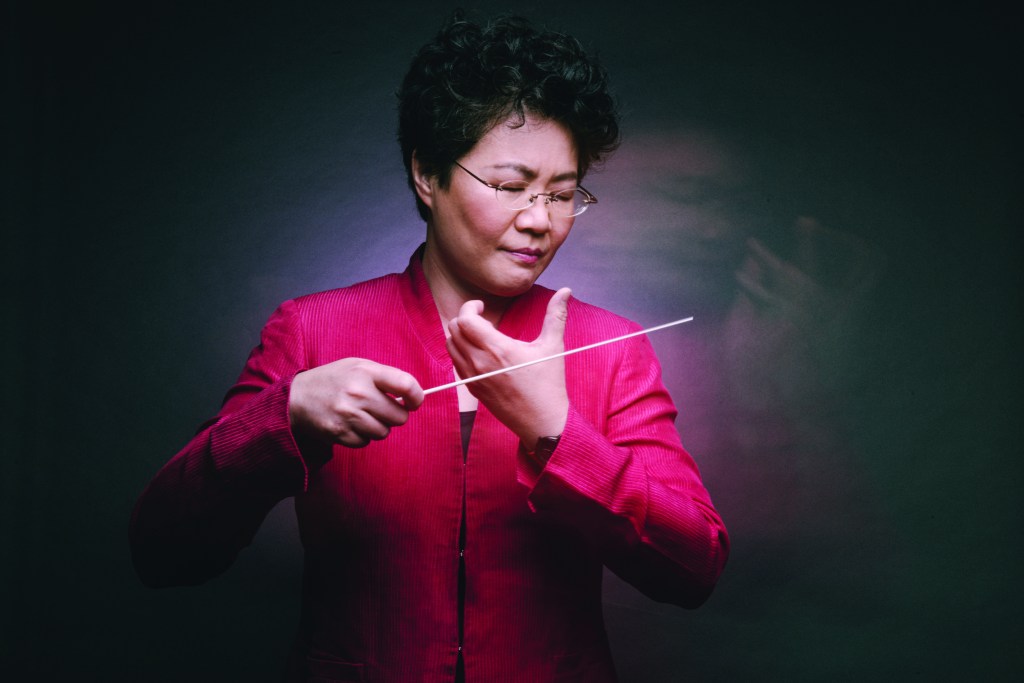
For those of us who were fortunate to attend Vanessa and the big orchestral performances of Spoleto 2023 – John Kennedy conducting The Rite of Spring, Mei-Ann Chen navigating the New World Symphony, and Jonathon Heyward reveling in the Symphonie Fantastique – the Gaillard and its fine acoustics were arguably the center of the festival. Both the Spoleto Festival Orchestra and the Spoleto Chorus, recruited in nationwide auditions, are rather awesome. And fortunate: not only do they get to perform at the Gaillard, they individually and collectively get to perform edgy, outré, and contemporary pieces at other Spoleto venues that you’re unlikely to experience anywhere else.

Chen, the music director at Chicago Sinfonietta, dug into her wide-ranging repertoire to greet us with Florence B. Price’s Ethiopia’s Shadow in America, a three-movement work that likely begins a mile or two away with an Introduction and Allegretto depicting the arrival of slaves in America. The brief yet solemn middle movement vividly evoked the famous New World Largo we would hear later in the evening, and the concluding Allegro, “His Adaptation,” had the urbane Ellingtonian strut of the Jazz Age.

Delights and Dances, gleaned from Chen’s 2013 Cedille CD that gathered three different concertos for string quartet and the Sinfonietta, was a welcome dive into an earlier Abels work in the wake of his Pulitzer. Nor was it difficult for me to exit the Gaillard feeling that the New World was Antonín Dvořák’s fantastic symphony, for the onset of the trombones in the final movement brought on goosebumps.

The lesser-known Heyward, the music director designate at the Baltimore Symphony, was not to be upstaged – not by Chen, at any rate. A native of Charleston, Heyward received a hearty greeting from the hometown crowd that puzzled the out-of-towners sitting behind me. Heyward began his grand homecoming with the US premiere of Nymphéa, a 2019 work by Doina Rotaru inspired by Borin Vian’snovel, L’écume des jours, with a sprinkling of Duke Ellington’s “Chloe,” the namesake of Vian’s heroine.

What the music evokes, partly through a delicate combo of piano and muted trumpet that grows fearsome and awesome – embroidered by plentiful percussion – is the growth of a huge destructive water lily (nymphéa) inside Chloé. Call it a 19th-century tone poem written with a 21st-century quirkiness, with a rubbed oriental gong, a plucked Steinway, and a stray mallet head that accidentally bounced into the front row of the audience.

Yet all of this spookiness was upstaged in an instant by the return of another local musician, pianist Micah McLaurin. With a glittery, androgynous, and otherworldly David Bowie aura, the slender McLaurin strutted onstage to a huge ovation in a blinding fuchsia jumpsuit with a lowcut back and a single silver sleeve. He proceeded to pound out the opening chords of Grieg’s Piano Concerto once the startled crowd had quieted, working the pedals with platform shoes, which had only increased his considerable height and the éclat of his entrance.

The outer Allegro movements showed off McLaurin’s strengths better than middle Adagio. Even there, the soft and loud passages were gorgeously shaped until late in the movement when his tone grew too steely for maximum effect. But the latter stages of the final movement were irresistible, crackling with authentic thunder.

When he reached Hector Berlioz’s Symphonie, Heyward benefited from the luck of the draw in delivering a more consistently satisfying account than we had of the New World. All 100 members of the Festival Orchestra don’t appear together, and the principals who performed featured solos with Heyward outperformed Chen’s chosen.

Not only did Heyward send his principal oboist offstage in the wondrous countryside movement, he deployed tubular bells to the wings for the closing “Witches’ Sabbath” movement to chilling effect. The drumbeats and sforzandos in that movement and in the preceding “March to the Scaffold” were nothing short of electrifying. Audience buzz after the Fantastique was every bit as enthusiastic as it had been at intermission in the wake of McLaurin’s exit.

The other Spoleto venues were rich in talent and adventurous spirit. At Dock Street Theatre, countertenor Anthony Roth Costanzo performed an outrageous hybrid lark, Only an Octave Apart, with cabaret icon Justin Vivian Bond, nary a male outfit in their wardrobes. Otherwise, we could compile an epic review of the 11 lunchtime chamber music programs that rocked the Dock, though my wife Sue and I only witnessed seven – enough for us to see 11 different hosts standing in for Nuttall introducing 25 pieces (nine by living composers), including an original score by pianist Stephen Prutsman for 7 Chances, the most hilarious Buster Keaton film we’ve ever seen.

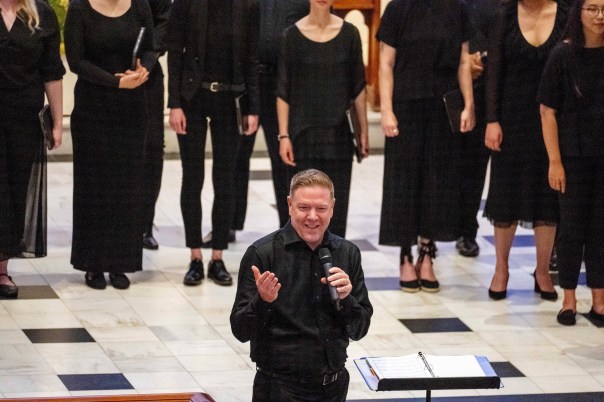
St. Matthews Lutheran Church and Sottile Theatre were both graced with concerts led by director of choral activities director Joe Miller. Surprisingly, the Festival Chorus program at the church, Density 40:1, was more secular than the one two blocks south, a precedent-breaking concept from beginning to end. Miller and his 32+8 voices all ascended to the organ loft in order to spread out over us and perform the 40 parts of Thomas Tallis’s Spem in alium. More earth-shattering, the choir did not perform “Danny Boy” or an encore. Instead, we all sang “Over the Rainbow” together.

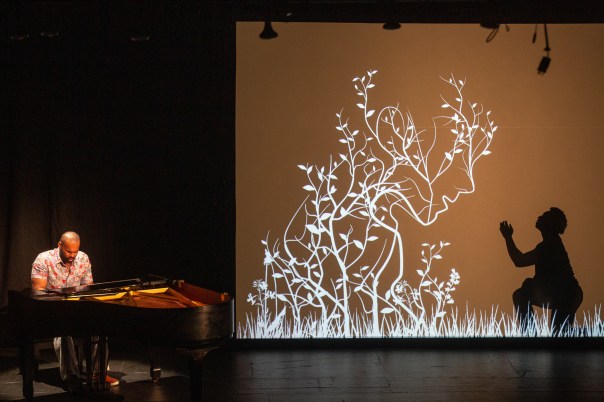
A new venue, the Queen Street Playhouse, was added to the Spoleto portfolio with mixed success. Artistically, A Poet’s Love was a resounding triumph for tenor Jamez McCorkle, powerfully following up his exploits of last season in the title role of Omar by singing Robert Schumann’s Dichterliebe – while accompanying the entire song cycle by himself at the piano. Designer and choreographer Miwa Matreyek made this a completely immersive experience with animated projections, shadow puppetry, and the movement she designed for Jah’Mar Coakley.

But the staging was badly bungled. Once McCorkle sat himself behind the Steinway, I never saw more of him than his scalp from my second-row seat. Fortunately, Matreyek and Coakley combined on a magnificent performance I didn’t miss.

After a rather bizarre foray at Festival Hall (formerly Memminger Auditorium) for his first Music in Time concert, Kennedy made better use of Queen Street Playhouse for Sanctum, a wild collection of contemporary pieces, concluding with the 2020 work by Courtney Bryan that gave the program its title.

That piece was decisively upstaged by Everything Else, a 2016 composition that I will likely never forget. For this novelty, 15 members of the Spoleto Festival USA Orchestra laid aside their instruments and drove the everyday concept of music to new frontiers most of us had never pondered before. One musician sat with a newspaper, turning the pages at leisurely intervals, another put on a jacket and zipped it up, three of the women passed around and munched a bag of chips, and another tapped obsessively on the keyboard of a laptop while, across the stage, another blew bubbles.

All of this low-volume action – and a multitude of louder acts – continued simultaneously. There were pennywhistles, a kazoo, somebody blowing on the rim of a bottle, two guys slapping cards down on a table in a game of war, and balloons blown up, shaped, and worn as comical crowns. Of course, there was the obligatory popping of balloons near a woman who insouciantly demonstrated how many different things can be done with a bottle of water without hardly making a sound.

Kennedy had seated himself with us in the audience so he could join us. Yet every musician onstage seemed to know exactly what to do onstage, when exactly it was time to launch into a new action, and when exactly to initiate interactions with other musicians. Anyone who thought about it had to wonder how such a multifarious sea of chaos could be taught, rehearsed, and performed – so precisely that the entire ensemble, without a conductor in front of them, stopped at the same instant.

I still can’t decide whether or not I wish to know.

Sensory-Friendly Theatre, or “How can I help you be you?”

Preview: Tropical Secrets: Holocaust Refugees in Cuba

By Perry Tannenbaum

2021~Ilana Visits-02

Tyler made a surprising and daring decision at ImaginOn before attending the Sunday matinee of My Wonderful Birthday Suit. His mom, Ilana, had been sure that Tyler would want to wear noise-cancelling headphones at the performance, so I had to assure her that Children’s Theatre would be offering them prior to the show. Otherwise, she would need to pack his set of phones before they flew in from El Paso and make sure he had them when they left their hotel.

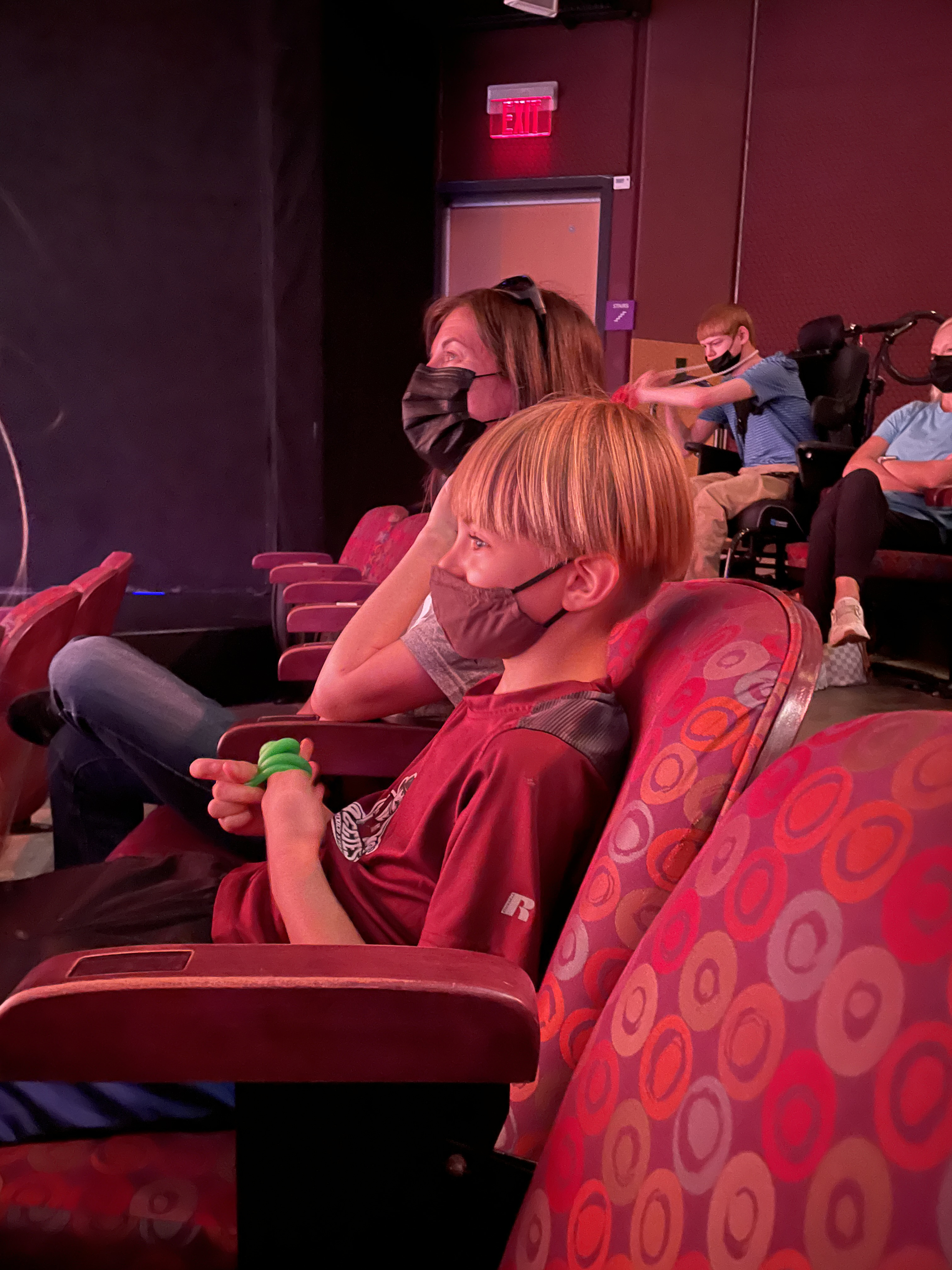
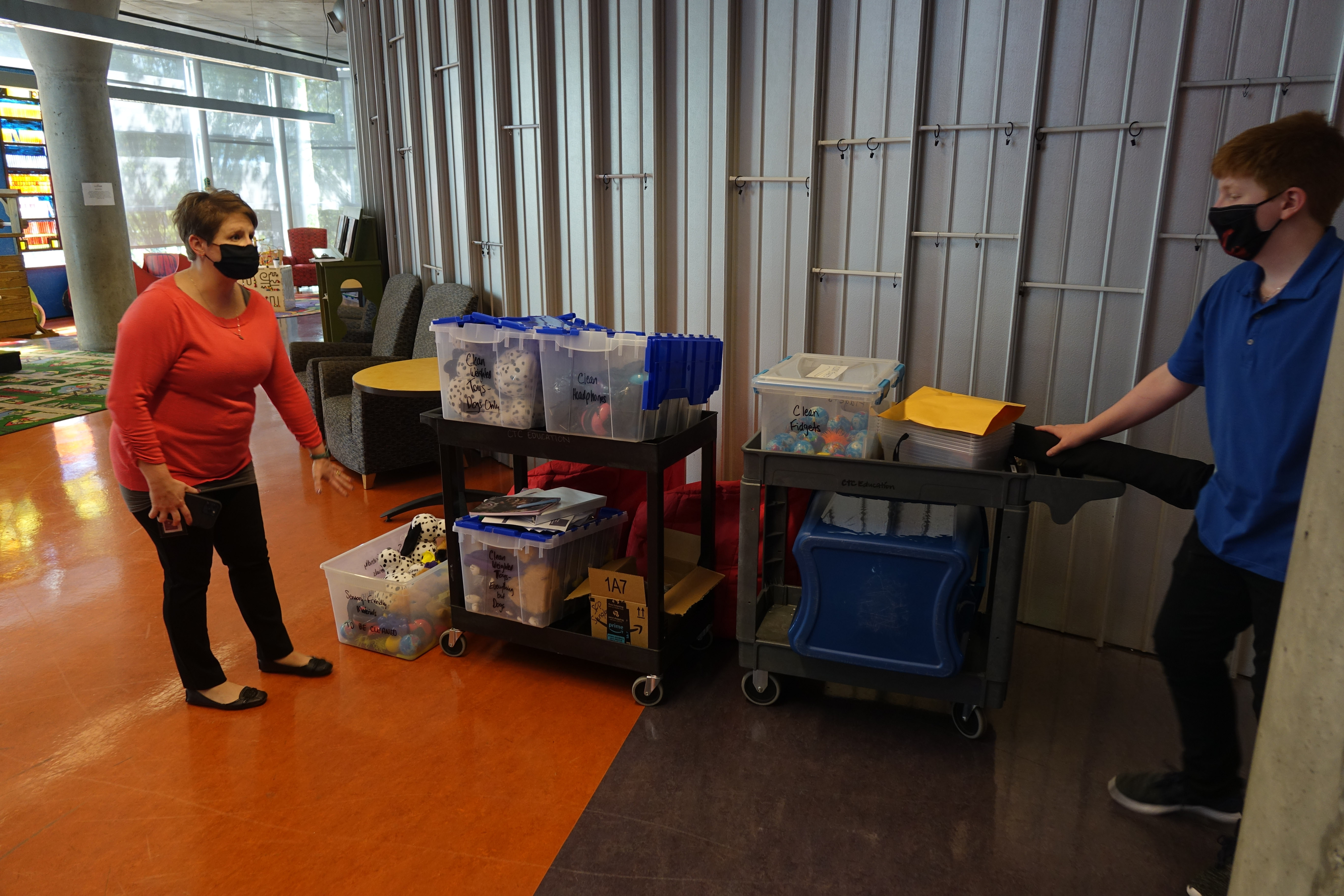
But Tyler refused the headphones that were available – in a really cool variety of colors, it should be mentioned – at the entrance of McColl Family Theatre. Instead, he chose a day-glo green worm, about eight inches long, from a wide array of fidgets and weighted cuddles on display. His younger sister, Brynn, chose a spotted little Dalmatian doggie that weighed five pounds. More surprises.2021~Sensory Friendly Theatre-01

Tyler had to live with his choice. Now when Oobladee and Oobladah, best friends on this side of Moonbeam, started blowing up balloons for the surprise birthday party they were planning for Shebopshebe, Oobladee’s bestie from the other side of Moonbeam… Tyler covered his ears with both hands, dreading the moment when a balloon would suddenly explode.

Yet he didn’t cower or turn away. He didn’t run for cover. His beautiful blue eyes remained glued to the stage.2021~Sensory Friendly Theatre-12

I was sure that none of the balloons would explode. Even if I hadn’t seen this show before, I could see that, sitting in front of the stage, “Tree” (resident teaching artist Kaitlin Gentry) hadn’t raised her two green glow sticks, the signal that “sensory rich” moments were around the corner. Anybody who had downloaded the Parent’s Guide from the Children’s Theatre of Charlotte website would also know that the balloons were “being blown up and let go, but they do not pop or make much sound.”

Tyler’s attention never wavered after the balloon scare, but he didn’t remain completely quiet. Gloria Bond Clunie’s script becomes heavier and more emotional. When Shebopshebe shows up from the other side of the rainbow, Oobladah is shocked to discover that Oobladee’s other best friend is brown. From the start, when he points at Shebopshebe and says, “You’re brown!” it doesn’t sound at all like a description – and she hears that clearly.

The pointing and the tone get meaner, more hateful, overtly racist. “People say that brown skin is…,” Oobladah stammers, leaning over a ledge and pointing an accusing finger down at Shebopshebe. He’s heard whispers that “you know…” and finally he blurts out: “Together – we should not play!”2021~Sensory Friendly Theatre-03

You might think the two girls would be furious. Instead, they’re both rolling on the floor, laughing hysterically.

“On the Other Side of Moonbeam – we play all the time!” Shebopshebe will respond, once she and Oobladee have caught their breaths.

And this is where Tyler breaks his silence. In a voice loud enough for Mom sitting next to him to hear. It’s also loud enough for me – his grandpa – to hear, sitting two seats away, next to his sister.

“That’s NOT funny!” Tyler calls out.

Nobody turns around to shush him. Nobody glares. At all of Children’s Theatre’s Sensory-Friendly Performances, autistic nine-year-olds like Tyler are free to call out, fidget, roam around the theater, cower in a corner, or find refuge in a quiet room, where they can still watch and hear all the comedy and drama with their mom or dad.

That’s really the point: they’re free to be themselves without being judged.2021~Sensory Friendly Theatre-17

Julie Higginbotham of Precious Developments has been overseeing the Sensory-Friendly Performances at Children’s Theatre since 2016, when ImaginOn’s new project was still a pioneering rarity. Now every run of every mainstage production gets a Sensory-Friendly Performance at its closing Sunday matinee. That includes the upcoming Tropical Secrets: Holocaust Refugees in Cuba, opening this Saturday and running through November 14.

“It’s a big deal!” Higginbotham often says – because it’s so true in so many ways.

She’s preparing actors, directors, designers, technicians, and ushers for the special performance – as well as carefully preparing printed and online guides for protective parents and surprise-averse children. This involves meeting face-to-face with the stage manager, the stage director, the musical director, and the actors. Higginbotham also attends the designers’ run-through, dress rehearsals, and performances during the run of the show, where she scribbles over the Children’s Theatre director of production Steven Levine’s script, containing all the light and sound cues.

Where should the volume on the mics be turned down? Where should a scream be changed into a loud exclamation? Where should a live gunshot effect be changed into a muffled recording? Where must a scene with strobe effects – almost automatically a two-light-cue alert – be redesigned so that triggers that would be hazardous to seizure-prone kids are gone?

Amid the final tweaks to lights and sounds happening during the run of the show, Higginbotham takes hundreds of photos – because the Parent’s Guide and the Child’s Guide are also illustrated full-color scenarios that prepare audiences for what they will see. That’s helpful when a stage adaptation or a set design significantly departs from an original book that kids and their parents are already familiar with.

She also annotates the script for “Tree” so that she can closely follow and precisely time her one-light and two-light cues. Higginbotham remained involved in the last 90 minutes before the Sensory-Friendly Performance and even while “Tree” was upfront waving her traffic-control glow sticks.

Grandpa had to rise and shine a couple of hours earlier than Ilana and the grandkids to witness Higginbotham’s final preps for My Wonderful Birthday Suit – after getting buzzed in at the ImaginOn loading dock.2021~Sensory Friendly Theatre-24

First came the final powwow with the actors, lighting crew, and “Tree.” Actors portraying Oobladee, Oobladah, and Shebopshebe all received Higginbotham’s final notes and reinforcements, with opportunities to air last-minute questions and concerns. Then the reconfigured “REWIND” scene – Shebopshebe’s brilliant and zany answer to the contrite Oobladah’s wish to “begin again” – was rehearsed and rerun without the strobes.

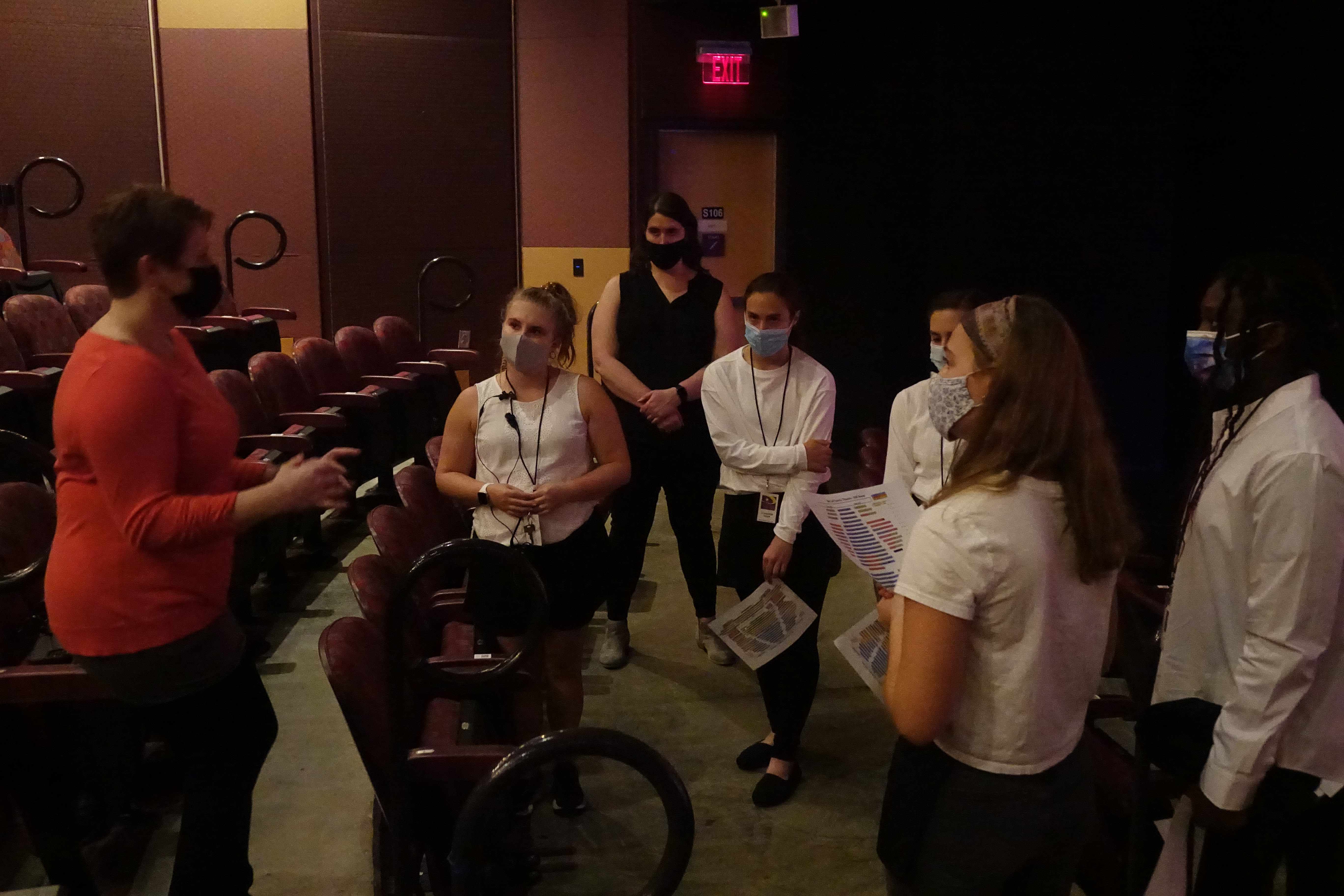
As the three actors exited and changed into their costumes, makeup, and matching masks (since ImaginOn is a public building, masks are worn by actors during performances), Higginbotham ascended the long lobby ramp to the top level of McColl Family Theatre. Time to prep the ushering staff, a mix of vets and newbies overseen by volunteer coordinator Louise Lawson.

Some ushering basics are turned on their head at Sensory-Friendlies. Ushers don’t simply show you to your seat, retreat to anonymity, and maybe sit back and enjoy the show themselves. They’re actively engaged in helping to ensure this special audience will enjoy their experience before the show and during the show.

Audience members don’t have a seat. With open, socially distanced seating, they have any seat. If say, they run up to the front of the house and find out that the sensory onslaught is too intense there, they can move back as far as they wish to any empty seat.

What ushers pay closest attention to is the kids’ needs. So my Tyler actually had extra backup during the little balloon scare that his mom may not have been aware of. Ushers were armed with the same fidgets, cuddly dogs, sunglasses, and headphones that Tyler was offered when he came in, standing at-the-ready, spread throughout the theater, instructed to come to his aid if they noticed he was constantly putting his hands over his ears and flinching.

“The biggest thing,” Higginbotham emphasizes to the volunteers, “is this: a lot of these families are overlooked, or they get stares. Our job is to actually see these folks, make eye contact, engage with everyone. If their communication style is one you don’t understand, that’s OK. Say, ‘Hello. We are really, really glad that you are here. What can we do for you? Can we show you to your seats? This is an amazing production, and we want to make sure you guys have a good time.’”

Any questions? Higginbotham is there to answer ushers’ concerns before and during the show, supervising the operation over a headset from the rear of the hall. Like a second stage manager.

Higginbotham’s meeting with Laura Beth Lee, the actual stage manager for Tropical Secrets, gave me a close-up view of how the Sensory-Friendly process begins – and a rewarding overview of the Precious Developments methodology.

2021~Tropical Secrets-18

The situation was somewhat surreal for this reviewer, since Higginbotham had not yet read the L M Feldman stage adaptation of Margarita Engle’s young adult verse novel. I’d covered the original webcast premiere back in March, but there were never live performances of the show and no Sensory-Friendly edition. The same cast, starring Adrian Thornburg as the Jewish boy Daniel and Isabel Gonzalez as Cuban native Paloma, are back with director David Winitsky. But Lee will be new to Cuba behind the scenes.

New wrinkles will confront everyone involved, however, since the production is moving from the McColl Theatre at the east side of ImaginOn to Wells Fargo Playhouse on the west, with a shrunken, more abstract set design customized for the new venue. Before Higginbotham and Lee powwowed in the “Lizard Room” on October 20, the returning cast had already rehearsed on the new set, likely because there hadn’t been a live show at the Wells since January 2020.

As the title indicates, Tropical Secrets is very much about this world – historical racism rather than the Moonbeam brand. With the 83rd anniversary of Kristallnacht falling on November 9, during the run of the show, Engle’s story will be very much in season. We really begin with that cataclysmic 1938 event in Nazi Germany, which prompts Daniel’s family to rush the 11-year-old onto an ocean liner bound for New York, where they all plan to reunite and live happily ever after.

Except that the USA turns the ship away from its ports – all of them – because there are Jews on board. Canada does the same. Hello, Havana! How in this wide world will Daniel’s family find their boy now?

Miracles aren’t likely here, and you can rule out rewinds. Meanwhile, with little more than an overcoat and a flute, little Daniel must find ways to survive and fit in. Paloma and Daniel bridge the gap between languages and cultures far more easily than their elders, but Daniel finds a link to his heritage in crusty old David, played by Tom Scott, a Yiddish-speaking ice cream vendor who sports a gaudy yarmulke.

“It’s also a very emotional show,” Lee tells Higginbotham, “a Holocaust show, so you’ve got police officers who are bursting in and yelling, there’s scary emotional outburst moments, so I can definitely see that there are these big impactful things.”2021~Tropical Secrets-32

Together with our dip into Yiddish and repeated Judaic references, Paloma has her own story – and considerable depths. She is our gateway into Cuban culture and the Afro-Cuban beat. Daniel will discard his flute for a drum and jam with percussionist Raphael Torn, who will also play the vibraphone. Topping that outbreak of rhythm and dance, there’s a full-fledged carnival scene.

Yes, there is sensory richness aplenty in Tropical Secrets – and the kid protagonists are sharp. Explaining to Paloma what living Jewish was like back in Munich, Daniel says, “In Germany, you have to wear a star on your shirt, so everyone can know what you are and hate you for it.”

Paloma’s dad is El Gordo, played by Frank Dominguez, the notorious decider when it comes to which ships are allowed to dock in Havana and which are turned away. Defending his wartime profiteering, El Gordo schools his daughter: “The world runs on business!” With no less conviction, Paloma looks her dad straight in the eye and fires back, “The world runs on kindness!

Emotional.

Impactful as Tropical Secrets will be, part of Higginbotham’s job will be to prep the able actors onstage for what to expect from their ultra-sensitive, surprise-averse audience – especially when volume has been trimmed to 75% or less and houselights turned down to half. They will see their audience more clearly than they did at previous performances. There will be fewer kids out there, socially distanced and maybe moving around or fidgeting. It may be jarring to look out into the audience and see kids talking back to the actors or wearing headphones. Or holding their hands over their ears. Or not making eye contact.

They might not even clap.

Parents will need to show proof of vaccination to enter the Wells for Tropical Secrets, but they won’t need to bring doctor’s notes or medical records for the Sensory-Friendly finale. Nor will this be an entirely special-needs crowd.

“Some folks prefer the softer presentation,” Higginbotham explains. “Some parents feel it gives their kids more freedom, and some folks can only get tickets for the Sunday matinee!”

If all goes according to plan, Higginbotham’s guides for parents and children will go out to all ticketholders on November 8, giving families six days to prepare.

Ilana was impressed by both Birthday Suit guides, but she didn’t see them as particularly useful for her Tyler, whom she describes as falling in the mild-to-moderate range of the autistic spectrum. Medication also helps him in tolerating sensory irritants.2021~Ilana Visits-22

“I don’t think Brynn or Tyler would’ve benefited,” Ilana says of the illustrated guide, “and it may actually have detracted from their experience. In children’s theatre, anything that dampens the surprise and wonder of a performance wouldn’t be optimal for my kids. And the show itself didn’t have anything too jarring (sensory-wise) that we would’ve needed to warn him about.”

On the other hand, My Wonderful Birthday Suit was far more palatable to Tyler than his previous theatre experience at Sesame Street Live! in 2019.

“Brynn loved it, but it was too loud and glitzy for Tyler,” Mom recalls. “Crazy loud, confetti storm, etc. We had to buy him off with a snow cone to get him through it.”

Higginbotham points out that the guides aren’t merely handy in preparing kids for Sensory-Friendly Performances, they also help in revisiting and remembering what they’ve seen. That can happen soon after the theatre experience is over or before the next theatre experience, when parents want to pique their children’s interest and anticipation.

“I showed Tyler the Child’s Guide,” Ilana wrote me, “and he was very excited and asked if you had sent pictures of the stage. Then he asked if I could send him screenshots of his 3 favorite pictures. Why? ‘Because they’re beautiful!’”

Unforeseen as that reaction might be, it’s what Higginbotham aims for.

“People need the freedom to be exactly who they need to be,” she says, “and to be able to feel like they’re supported. And man, we can’t predict everything, but we try. They need a non-judgment zone that I defend to the death. How can I help you be you? That’s my job.”

Too Much Will Be Plenty in Charlotte Ballet’s “Rite of Spring” Revival

Preview: Charlotte Ballet’s 50th Anniversary Celebration

 By Perry Tannenbaum

2021~Rite of Spring-2

Nothing about North Carolina Dance Theatre’s 50th anniversary was predictable when the company was founded in 1970 at the North Carolina School of the Arts in 1970. Economics transplanted the headquarters of the troupe to Charlotte in 1990, and their marketing department changed the name to Charlotte Ballet in 2014. Due to COVID, even the year of the jubilee celebration had to be reset to 2021 – and then, because the pandemic lingered, that celebration, scheduled for April, had to be pushed back again to October.

So why should the celebration itself be predictable – all champagne, fluff, fizz, and thanksgiving? This week’s program will be capped with a reprise of Salvatore Aiello’s The Rite of Spring, a savage, primal spectacle set to Igor Stravinsky’s notorious groundbreaking score. Appropriate for April, no doubt, but bold and pagan now that we’ve endured into October.

“We are not easing back into it,” says Kati Hanlon Mayo, who danced the part of The Chosen One – the one who is sacrificed – when The Rite premiered in 1993. “We are not daintily coming back to the theater and doing something light and fluffy. We are back, and we are powerful.”

Known as Kati Hanlon back in those NCDT days, Mayo had only recently joined the company when Aiello chose her to be The Chosen One. Now an associate director at the Charlotte Ballet Academy, Mayo is coaching her successors, Amelia Sturt-Dilley and Sarah Lapointe, both of whom are beginning their seventh seasons with the company.

Asserting the power of dance was as much on Aiello’s mind in 1993 as reminding the community is now. Famously, the premiere Stavinsky’s incendiary score with Vaslav Nijinsky’s outré choreography provoked a sensation at its 1913 Paris premiere, nearly a riot. So the Aiello premiere 80 years later in Charlotte was not presented with some trepidation.

“We were fairly new to Charlotte,” Mayo recalls, “and we were doing some really wonderful rep, but I think he really wanted to show the limits of what he could do, like test the waters with the audiences here in Charlotte and see how that would pan out. I remember being a little bit anxious, nervous about the audience reaction even when we premiered it in Asheville. I didn’t know if it would be just too much – you know, too different from what they would expect, like a ballet with tutus.”

To create music and choreography that will consume audiences with their power, it is almost axiomatic that both the composer and the choreographer themselves must be consumed. Then it’s the dancers’ turn.

2021~Rite of Spring-1

“We all knew that Sal really wanted to do his version of The Rite of Spring,” Mayo says. “He had spoken to us about it. He was almost obsessive about the score and his research and the work that he was doing. Sometimes you would see him on lunch breaks, just working out choreography, working on counts. So when it came to us, for me personally, I was not used to contemporary work like that, and such tribal – like bombastic – music and dance, but for some reason, between Sal and myself and the rest of the company, it just clicked.”

Jerri Kumery, currently the ballet master at Richmond Ballet, was Aiello’s associate artistic director when his masterwork was in development, taking every choreographic note, passing along every correction, and giving out “The Bible” – notations on Stravinsky’s entire score – to all the dancers. Curator of The Salvatore Aiello Trust, it is Kumery who now brings the spirit of choreographer to rehearsals at the Patricia McBride & Jean Pierre Bonnefoux Center for Dance, while Mayo brings the authentic essence of The Chosen One.

Along with “The Bible.”

“Very thick,” says Lapointe, describing this holy writ. “All counts of every single section. And it’s very helpful, very detailed. It’s amazing.”

Amazing enough that it was performed again and again in Charlotte in 1993, 1996, 1997, 2000, and lastly in 2003, more than seven years after Aiello’s untimely death in 1995 at the age of 51. If the success of NCDT’s Rite of Spring paved the way for the audacity of Angels in America in 1996, the resulting furor of the Angels controversy sent shockwaves back to the dancers: Mayo vividly remembers “being very frightened that we would be asked not to perform” in 1997.

2021~Rite of Spring-3

The spectacle has a visceral impact. Taken back to pagan ritual, tribal warring, intoxicating dance, and human sacrifice – while witnessing the combustible power of the dances and the rituals – we may ruefully note how little humanity has changed over the eons. Although Lapointe assures us that the dancers will not be attired like the infamous rioters in DC on January 6, the point will resonate.

As we experience the incantatory derangement of Stravinsky’s music and watch an entire tribe go haywire, both Mayo and Lapointe hint that there’s more than a little voodoo magic in being out there, centerstage, and knowing that you have been chosen to bring the sensational role of The Chosen One to life – and death.

“We have to come up to the music,” Mayo says, “and we have to go beyond what the music is delivering to the audience. And that’s the challenge. And that’s what I think we find so beautiful in his choreography is that it’s not hard to get there with the movement he’s given us. It’s easy to match that music, which is a tall order.”

You will have to wait for this climax, of course. Lapointe and Sturt-Dilley won’t be appearing until about halfway into Aiello’s 40-minute ballet, entering with a bevy of young maidens. Then there’s the drama of being chosen for the ultimate sacrifice before we go hurtling into it. And yes, The Chosen One gets swept away as surely as the audience does.

“There’s parts where I feel like a wild animal,” Lapointe exclaims, “and I just feel so rambunctious, so wild, so free and natural. It’s a feeling like no other, really. Yeah, the music, the costumes, everyone around you banging on the floor, it all comes together – just how it’s supposed to. It’s kind of surreal. I don’t think I’ve ever done a piece that just makes it come out of you like that.”

The Rite of Spring will be the longest piece in Charlotte Ballet’s 50th anniversary celebration, its obvious pièce de resistance, and the rousing finale. Lapointe dances The Chosen One at the Thursday and Saturday night performances and Sturt-Dilley takes over the lead on Friday. Both are appearing in the other three pieces as well. First in the running order will be a premiere choreographed by Charlotte Ballet II program director Christopher Stuart, set to a Philip Glass score to be played by the Charlotte Symphony Orchestra. A longer piece, Crystal Pite’s A Picture of You, comes next, followed by Val Caniparoli’s even longer Ibsen’s House.

The human sacrifice at the end of the evening shouldn’t be dismaying. More than a couple of religions celebrate the mysteries of death and rebirth, and The One Who Dies is at the heart their power. You can be sure the ancient mojo of Aiello’s Rite hasn’t been lost on the women who have danced in its vortex. The Chosen One’s nobility and her awesome dignity come through her acceptance of her fate.

In our ZOOM interview, Mayo and Lapointe intertwined to describe the experience.

“There are many points within the choreography,” Mayo began, “where you’ve found that you’re the Chosen One… It’s a conflict, but you feel this…”

“…power,” Lapointe interjected.

“…power,” Mayo continued. “If you can think of it as something you’ve been reaching towards, you’re honored by it. But yet… It’s part of the ritual, and you’re not going to end in the best manner… However, it’s an honor to be chosen! It’s an honor to be that force.”

“And to be that,” added Lapointe, “for the tribe and for everyone else.”

Recapturing Old Hostilities – and the Path to Peace

Preview:  Three Bone Theatre Production of Oslo

By Perry Tannenbaum


Oslo_Square

Peace and the Middle East – they just don’t seem to belong in the same sentence, do they? Every week, we hear about a new flareup, a new conflict, a new bombing, and more death. So it’s timely that Oslo, the 2017 Tony Award winner for Best Play by J.T. Rogers, will be opening this week at Spirit Square. The Three Bone Theatre production, a Charlotte area premiere, revisits the back-channel talks that led to the historic handshake between Israeli prime minister Yitzhak Rabin and PLO chairman Yasser Arafat on the White House lawn on September 13, 1993.

Simpler, more innocent times – before we were educated (superficially, of course) about Sunnis and Shiites, before Americans discovered we despised Iran as much as Iraq, before Al Qaeda, 9-11, ISIS, beheadings, and chemical warfare. Long ago.

Beginning with a guerilla production of The Vagina Monologues at the WineUp wine loft in NoDa six years ago, Three Bone has grown gradually to the point where artistic director Robin Tynes feels ready for the challenge. Ready or not, Oslo is a substantial stretch for Three Bone.

There are more than 20 roles in Oslo, and most of 15 players covering them are making their company debuts. Actors in both the Israeli and Palestinian delegations need to feel the distrust and animosity of each side toward the other, travel the compressed journey to understanding and agreement in Rogers’ script, and repeat that three-hour odyssey – starting all over again with the same ferocious edge – night after night in performance.

That journey gets rockier if you’re fielding a diverse cast of Jews, Muslims, and Christians who come to the table with their own settled views. Respecting diversity had to go hand-in-hand with respecting the values of each performer’s time.

Negotiations1

“Yes, the rehearsal schedule was quite the challenge,” says director Paige Johnston Thomas, “15 people for 65 scenes! As they say in the theatre: I was told there’d be no math!”

Thomas, a fixture on the local scene for over 20 years, is making her debut with Three Bone. Kat Martin, brought aboard as assistant director and dramaturg, hasn’t worked at any theatre company before in the QC – and she’s drawing “rock star” accolades for her work in her Charlotte debut.

“Although I am not a Middle East expert,” says Martin, “a dramaturg’s job is to become an expert quickly then create points of entry for deepened understanding for creatives as well as community members.”

A dramaturg’s outreach to the community, after briefing directors and performers, often takes the form of explanatory materials in the show’s playbill. Martin’s involvement has been more proactive, involving the Oslo cast during her search for historical contexts. She began by speaking with John Cox, associate professor of Holocaust, genocide & human rights studies at UNC-Charlotte, who encouraged her to create a dramaturgy day where actors could listen and learn from community stakeholders like Palestinian activist Rose Hamid and Rabbi Judy Schindler, director of the Stan Greenspon Center for Peace and Social Justice.

Israelis1

That solid core was augmented by the participation of former Israeli soldier Stefan Pienkny, a veteran of the 1967 war, and two Palestinian refugees, Wafa Omran and Khalid Hijazi. Rounding out her gathering – and acknowledging the all-important peacemaking perspective of the Norwegians – Martin also invited facilitation expert Candice Langston, managing director of The Lee Institute.

“My biggest challenge was to keep the research real,” Martin emphasizes, “so I wanted to cultivate information for the cast while also making sure they were learning with their gut.” The three-hour crash course she organized for dramaturgy day began with Cox reviewing the historical background and Langston addressing the topic of building community dialogue.

Then there were hourlong small group meetups that paired the Israelis and Palestinians in the cast with the community stakeholders who represent those points of view. At the same time, actors cast as Norwegians lingered with Langston for more info on facilitating high-level negotiations. Climaxing the evening, the whole cast gathered together right after ingesting an hour of diverging partisan viewpoints, plunging into exercises designed to simulate the process of bridging those gaps, understanding the “other,” and finding common ground.

It was intense.

“An evening as an actor I won’t forget,” says Dennis Delamar, who will portray Yair Hircshfeld, one of the back-channel negotiators, and Shimon Peres, the foreign minister who would share the Nobel Peace Prize with Rabin and Arafat after the Accords were signed. “The evening focused on lived experiences, personal stories, facts, and some tears I observed which were quite integral in shaping my mindset. Stakes were definitely raised. I loved every minute of it.”

Norwegians2

Peres doesn’t enter until well after intermission. A political rival of Rabin, he keeps the Oslo talks secret – because he knows the Prime Minister will reject any agreement that isn’t airtight. It must be an offer that cannot be refused. Until the Israelis are close to that, no member of the government can be seen talking to the Palestinians. Needless to say, the Americans engaged in their endless fruitless talks must also be kept in the dark.

So that’s why Delamar is Hirschfeld all through the opening act – an economics professor at the U of Haifa!

“I connect with and enjoy playing Yair’s passion and intellect,” he says, “but also a certain amount of humor J.T. Rogers developed with this character. Sometimes he is out of his depths in the negotiations, but he’s never without a passion for the grave reason he’s there, fully invested in the outcome, proud of his part in the start of it all. I’ve enjoyed making him relatable in an endearing and real way.”

Yes, there are comical moments that leaven the animosities and tensions, but there are thriller elements aplenty. The possibility of ruining Peres’s political fortunes keeps the Israelis on edge, while for Mona Juul and Terje Rød-Larsen, the Norwegians pushing negotiations forward, getting their government to buy into the process – knowing they must keep the Americans in the dark – ratchets up their anxieties.

For the Palestinian delegation, PLO finance minister Ahmed Qurie and PLO liaison Hassan Asfour, secrecy is a matter of life-or-death. Only Arafat knows about these talks and how they’re progressing.

Vic Sayegh will take on the role of Qurie. Although he the mellower, less militant of the two Palestinians, he’s a radical departure for an actor whose QC credits began in 2003 with appearances in Steve Martin’s The Underpants and Charles Busch’s Psycho Beach Party. There’s no Kanaka shtick here, but there is a certain amount of savoir faire.

And the Palestinian does provide some comedy when he lets his guard down. Before encountering Hirschfeld in London for the first time, he confides to Larsen, his intermediary: “I have never met an Israeli. Face-to-face.”

Palestinians1

Very unique comedy, typical of the tensions Oslo whips up. But the finance minister quickly recovers in Hirschfeld’s presence, informing him that he hasn’t been to his homeland since 1967 when his whole village was forced to flee from “the advancing hordes of Zionism.” Awkwardness turns to polite hostility in a flash.

“Qurie often has an ulterior motive behind his words,” Sayegh notes. “He is very calculated. Like a poker player, he never lets his face give away his hand.”

Poker-faced or not, Sayegh sees Qurie’s motivations as deep and honorable. He’s relating them to his own experiences and heritage.

“As a young man, I remember meeting people who were Palestinian and subsequently looking for Palestine on a map,” Sayegh reminisces. “I would ask myself why they called a place that no longer existed, ‘home.’ Now I understand. Personally, my paternal grandparents were born in Aleppo, Syria. It was once a beautiful region of the world, but many years of conflict have reduced it to rubble. I hope that one day, peace in the entire region will allow me to visit the land of my ancestors.”

While Terje is the visionary who devises a successful model for conflict resolution – with a mixture dogged determination and quixotic optimism to keep it going – it’s the calm, meticulous, and brilliantly resourceful Mona who steers her husband around the political complications that threaten to scuttle his mission. Fresh on the heels of her pivotal role in the world premiere of Steven Dietz’s The Great Beyond, Tonya Bludsworth takes on the role of this unsung hero who buoyed her husband’s confidence while clearing his path.

“Prior to reading Oslo,” says Bludsworth of her journey, “I’m sure I felt like most Americans, that peace in the Middle East is not likely to ever really happen. But I was in tears when I first read the script, not because I was sad, but because I was overwhelmed by this incredible feeling of hope, and I still feel it every night in rehearsal. As Terje says, if we could just get past the politics and see the people, the personal, then there is a way.”