Category Archives: Concert

Wiancko Takes the Baton at Spoleto’s Fabled Chamber Music Series

Review: Spoleto Festival USA Chamber Music at Dock Street Theatre

By Perry Tannenbaum

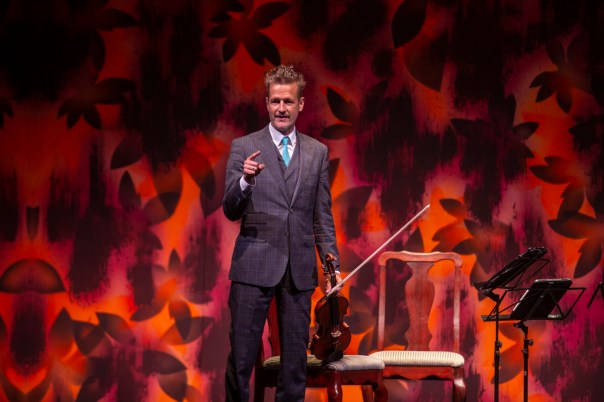
When Geoff Nuttall died of pancreatic cancer in October 2022, Spoleto Festival USA lost its most distinctive personality, the “Jon Stewart of chamber music,” before any of us had noticed a single gray hair on his glorious mane. Replacing him as director of the festival’s noonday chamber music series, the backbone of Spoleto, seemed like sacrilege last season to those close to the ebullient violinist. However, Nuttall’s stylish hosting chores still needed to be done.

Fittingly, a cavalcade of other chamber music players stepped into the role, for hosting at Dock Street Theatre had always been handled by musicians who contributed to the playing. Esteemed harpsichordist Charles Wadsworth had passed the baton over to Nuttall after many years as Spoleto’s most recognizable personality and the series’ jovial noonday host. Nobody would say whether the parading pinch-hitters were auditioning for the role of Nuttall’s successor. Still, it felt that way, especially since the festival’s general director, Mena Mark Hanna, had declared that the musician-host tradition would go on in Charleston.

And Charleston is a very traditional city.

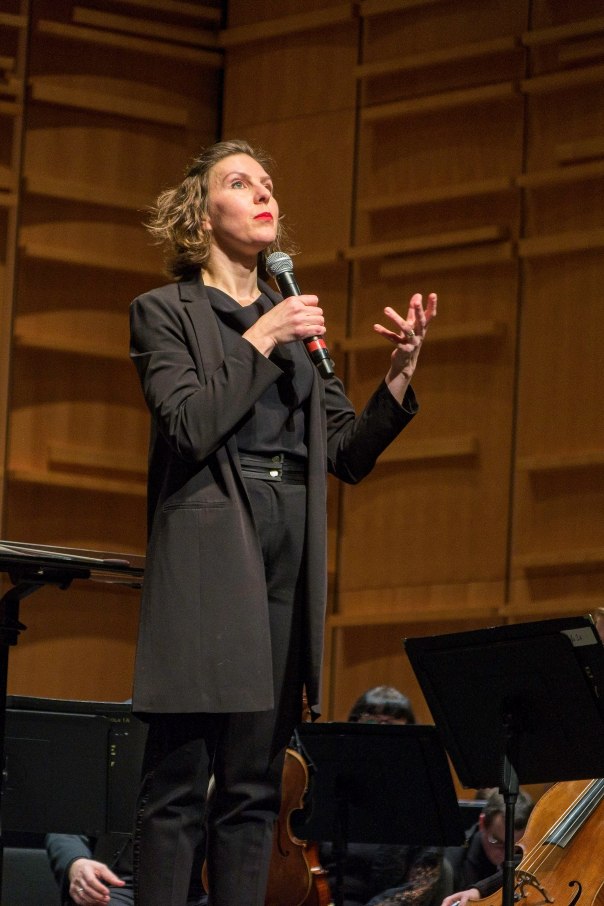
So for cellist/composer Paul Wiancko, 2023 was an auspicious year. In late winter, before his fourth appearance at Spoleto, Wiancko became the new cellist with the pioneering Kronos Quartet, and in early fall, he was named SFUSA’s third chamber music director. Changes to the series have been noticeable: nine of the 22 performers in the 2024 festival are making their Spoleto debuts, and there are 50 percent more pieces by living composers in the program lineup.

Coupled with the abrupt terminations of resident conductor/director of orchestral activities John Kennedy and his Music in Time series, Wiancko becomes not only Spoleto’s chamber music guru but also the festival’s chief purveyor of contemporary classical music.

And he’s doing it with his own unique style.

Wiancko is more about theming each of the 11 concerts in the chamber music, more about the Zen of each program. Nuttall was very laid-back and West Coast in his attitude toward programming and concertgoing, stressing variety in his repertoire choices and encouraging his audiences to be at ease. If you want to applaud between movements, go right ahead. At a couple of concerts, Wiancko took what seemed like a Far Eastern approach, requesting that we withhold applause – to magnify the cumulative effect of two pieces he was presenting in tandem.

The first time Wiancko employed this tactic, it became emotional on the Dock Street stage. In retrospect, we can understand why. For this coupling, Wiancko led off with an unfamiliar work, Marejada, created during the 2020 pandemic by Puerto Rican composer Angélica Negrón, and then in the silence segued to Franz Schubert’s posthumous String Quintet in C, perhaps the most-played chamber work in Spoleto history – for many years, the last piece performed in the lunchtime series.

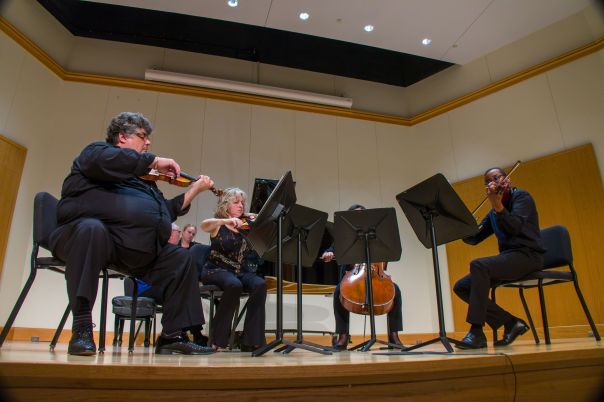
Written for string quartet, assorted percussion, and pre-recorded ocean waves (referenced in Negrón’s title), performers for Marejeda included Wiancko, violinists Alexi Kenney and Livia Sohn, and Wiancko’s spouse, violist Ayane Kozasa. Kenney would leave crumpled paper onstage after the piece as he exited along with Wiancko and Kozasa, respectively carrying a conch shell and a can – plus a spoon to hit it with.

That left Sohn and her gong onstage as Owen Dalby entered to take over the first violin chair, Lesley Robertson replaced Kozasa place on viola, and cellists Christopher Constanza and Ramakrishnan spelled Wiancko. It was quite possible to overlook the fact that three of the four members of the now-defunct St. Lawrence String Quartet – Dalby, Robertson, and Constanza – were now reassembled, minus their first violin, Geoff Nuttall. Or it was until, more than a half hour later, the sweetly mournful, fiercely and achingly turbulent second movement Adagio concluded and Sohn, Nuttall’s widow, broke down momentarily.

Dalby understood as the delay continued, softly clutching Sohn’s bow hand until she could go on. More of us would have shed tears, I believe, if they had reprised that Adagio.

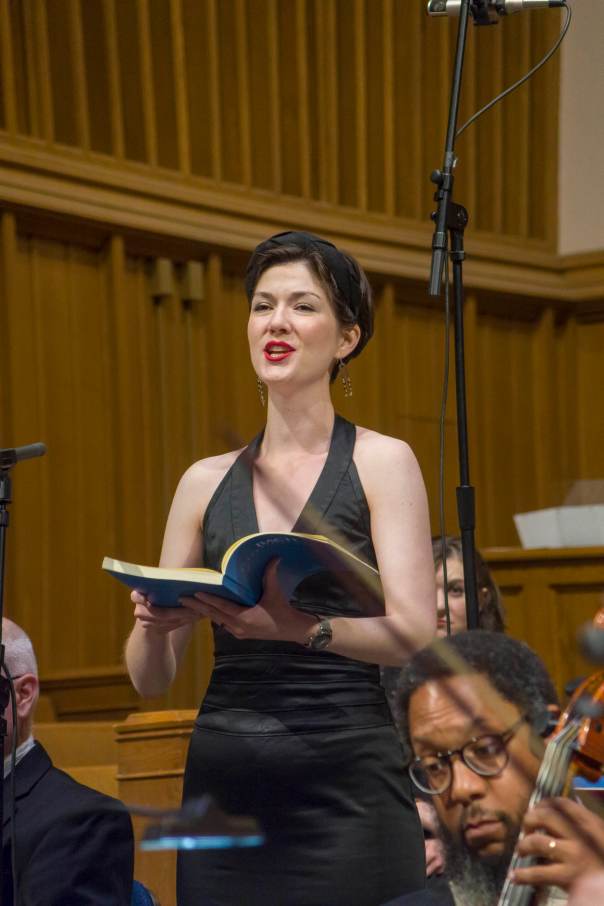
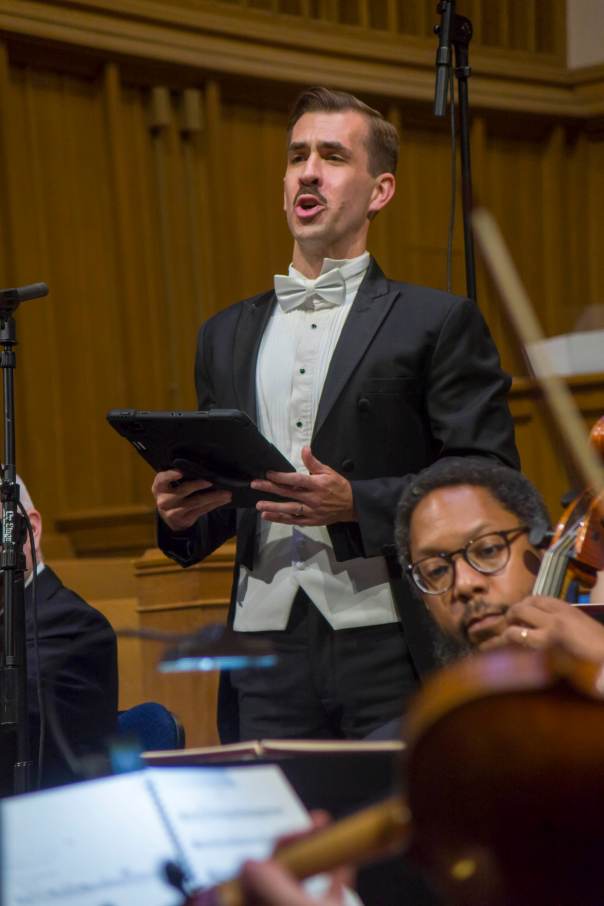
More tears flowed more predictably three days later when Wiancko coupled two contemporary composers, Jonathan Dove and Valentin Silvestrov, in his next hold-your-applause tandem. Another string quartet was augmented by a fifth voice, this time tenor Karim Sulayman in Dove’s In Damascus, set to the prose poem sequence by Syrian poet Ali Safar, as translated by Anne-Marie McManus.

Eclipsed by Rhiannon Giddens’ Omar when he brought his Unholy Wars to Charleston in 2022, Sulayman has been indelible this year, first in the world premiere of Layale Chakar’s new opera, Ruinous Gods, which embraces the most vulnerable refugee children from war and terror worldwide, and then in this absolute Dove-Safir stunner.

Two days ago we were standing where the long line of Syrians trying to leave the country waited… Nothing happened, except that we saw a nation where the sun had burned out. Over time, no spark remained for its residents except the sparks of their eyes, which were fading… Like tears…

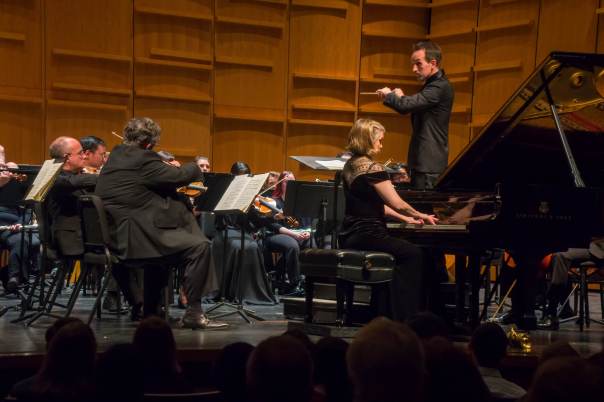
After Dove’s 11-part cycle – only the sixth part was wholly instrumental, featuring Wiancko, violist Masumi Per Rostad, and violinists Alexi Kenney and Benjamin Beilman – the lights dimmed as Pedja Mužijević entered from the wings to play Silvestrov’s touching Lullaby at the Steinway. But the funereal gloom and Mužijević’s entrance at stage right weren’t sufficient to distract us from Sulayman, still standing at centerstage, weeping profusely before he daubed his eyes.

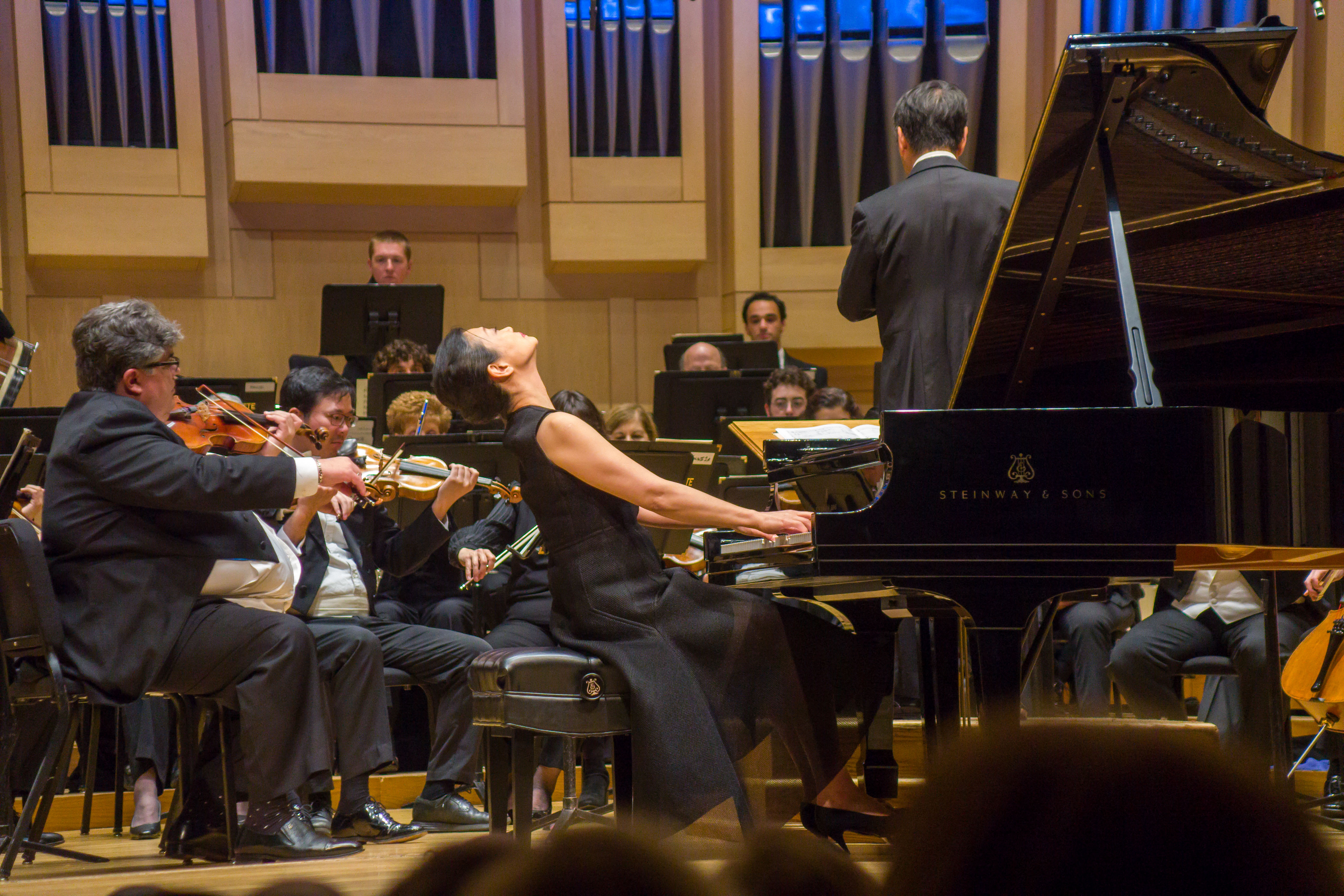
Preceded by Beethoven’s Piano Trio No. 3, with Beilman playing violin, Ramakrishnan cello, and newcomer Amy Yang at the keyboard, this was surely one of the greatest of the many great chamber music concerts ever performed at the Dock. Yet just two hours earlier, I’d witnessed Yang’s debut at Spoleto, definitely one of the most sensational in recent years as she teamed with Kenney on Robert Schumann’s majestic Violin Sonata No. 1, the best and most passionate live performance I’ve seen of a violin sonata since Daniel Hope and Sebastian Knauer played Beethoven’s Kreutzer at the Savannah Music Festival in 2011.

Both Yang and Kenney can be regarded as among Wiancko’s inner circle, Kenney along with Kozasa being fellow members of Owls, an “inverted string quartet” with two cellists, and Yang being one of the artists Wiancko has composed for. They seemed to be kindred spirits from the opening bars. With admirable subtlety, Wiancko themed this concert as a “Celebration of Resonance,” never mentioning that Yang’s debut solo album of 2019 was Resonance, including pieces by Bach, Caroline Shaw, and Schumann.

Of the 11 programs presented during the lunch hours at Spoleto in 2024, I only saw seven, so I cannot offer an authoritative judgment on whether Yang’s big splash was surpassed by any of the other debuts. But two strong contenders emerged in Program VII on my last day in Charleston, cellist Sterling Elliott and percussionist Ian Rosenbaum, both of whom made their debuts in Program VI the previous day.

Elliott had slipped in among a string septet that played the original 1978 version of John Adams’ breakthrough piece, Shaker Loops, where fitting in was a prime objective. Standing out became the mission when the cellist sat down with Mužijević to play William Grant Still’s Mother and Child – Elliott’s transcription of Still’s 1943 Suite for Violin and Piano, Part II. It really sounded like his own piece, the tenderness of the composition darker and more aching and the affirmation nearly as joyous.

Rosenbaum’s debut had kicked off Program VI, more high-profile since he was paired with Wiancko on Andy Akiho’s 21 for cello, marimba, bass drum, tambourine, and electronics. Plucking strings, clapping, tapping the top and sides of the cello, and pedaling the big drum – as well as plain bowing – Wiancko garnered most of the attention at the beginning and end of the piece, though the percussionist was also performing some extracurricular antics behind the marimba, switching mallets, rapping the tambourine, and triggering the electronics.

Played on steel pans as it was originally written, Akiho’s piece looks and sounds a little better, particularly when the sides of the pans are struck. But the marimba version was still spectacular, building to a pounding climax, four instruments and electronics sounding simultaneously. Almost as spectacular, Christopher Cerrone’s Double Happiness, with Rosenbaum playing vibraphone and a small array of malleted instruments in duet with a prepared piano, was far more sublime. We watched over Wiancko’s shoulder as Yang prepared the Steinway’s innards.

Nor did Wiancko disappear after he and Yang delivered their play-by-play of the piano prep, retreating to one wing to operate electronics on cue. At a somewhat hypnotic pace, Yang was obliged to stand up at the keyboard, plucking or strumming or dampening the strings inside the Steinway, sometimes while playing the keys with her free hand. Usually wielding two mallets in each hand, Rosenbaum performed similar wonders at his instruments, occasionally striking both the vibraphone and a smaller instrument behind it with mallets wielded by the same hand.

Paradoxically, the prerecorded electronics and reverb effects layered onto Double Happiness added the echoey steel pan aura that was missing the day before. The cathedral of sound at Dock Street Theatre was magical, like nothing I had experienced since I first heard A Genuine Tong Funeral,composed by Carla Bley, on Gary Burton’s memorable CD with quartet and orchestra.

Wiancko may not be a perfect fit for the Jon Stewart label, but there’s something in each of his programs that reminds me of the Comedy Central shows I once watched regularly. More than Nuttall ever did, Wiancko makes it his business to interview at least one other musician or composer during every program. More often than not, he frames these encounters like a podcast. Very entertaining.

When composer-in-residence Reena Esmail made her debut on the same program where Rosenbaum and Elliott made their bows, Wiancko greeted her like a starstruck fan. The build-up stood up as Yang and longtime Spoleto stalwart Todd Palmer gave a very fine account of Esmail’s Jhula Jhule for clarinet and piano.

Falletta and Wilborn Dazzle at the Knight

Review: Charlotte Symphony Plays Wagner + Strauss

By Perry Tannenbaum

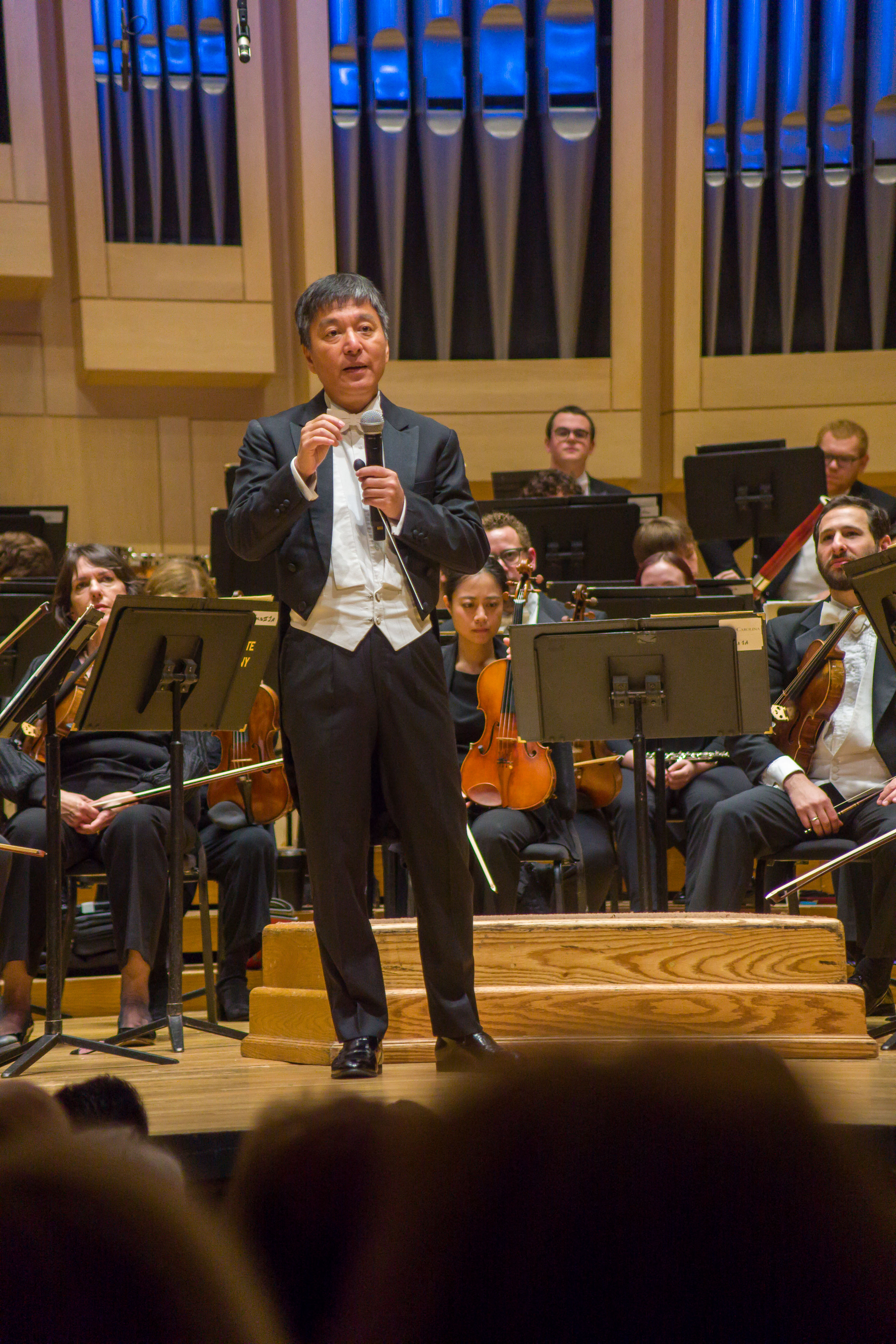
March 22, 2024, Charlotte, NC – Charlotte Symphony’s latest concert pairing, Wagner + Strauss, is logical and cohesive enough, but with the two Germans represented by the “Liebestod” (love-death) from Tristan and Isolde followed by the great Death and Transfiguration tone poem, abundant jollity seemed unlikely at Knight Theater. Wedged between these famed titans of 19th and 20th century music, however, were two lesser-knowns, Richard Strauss’s contemporary Oskar Böhme (1870-1938) and American composer Julia Perry (1924-1979). Thankfully, these composers, especially Oskar, lightened things up. Originally scheduled to perform with Symphony in August 2020, renowned conductor JoAnn Falletta returned for her first guest appearance with the orchestra since 2002, and principal trumpeter Alex Wilborn, similarly postponed by the pandemic, made his solo debut in Böhme’s Trumpet Concerto.

When former Symphony music director Christof Perick last performed the “Liebestod” at Belk Theater – almost precisely 15 years ago – he also paired the piece with a revered Strauss tone poem, Also Sprach Zarathustra. Strauss was one of Perick’s prime passions, and the Friday evening performance reaffirmed that the ardent Prelude and Liebestod remains deeply embedded in the ensemble’s DNA. Falletta’s reading, gradually peaking to a lovers’ climax, with delicious peeps at the hypnotic love theme that blossomed with promise, made me feel afterwards like asking if anybody else in the audience craved a cigarette.

Musically, it seems like a trumpet is a better post-coital sequel for Symphony than a cigarette when they finish the Liebestod, for who can contemplate Strauss’s Zarathustra without recalling its trumpet heraldry? Now that Wilborn is in the principal chair, he could bring us a virtuosic account of Böhme’s Trumpet Concerto with a surprise bonbon afterwards. The opening Allegro moderato brought forth a beautifully burnished tone from Wilborn’s horn and delectably supple phrasing, hardly seeming to challenge his technique, while Falletta emphasized the massiveness and lyricism of the orchestral accompaniment. That foundation segued nicely into the middle Adagio religioso movement, which began with stately dignity from the strings and brass and peaked with soaring aspiration from the soloist, no less pleasing than the melodic opening movement. It was only in the closing Rondo that we could savor anything close to Wilborn’s full virtuosity. Some real jollity here.

Perhaps both Wilborn and Falletta felt that the fireworks were all too brief in Böhme’s finale, for after the audience ovation, the trumpet virtuoso returned with perhaps the lengthiest encore ever heard at Knight Theater. Jean-Baptiste Arban’s “Variations on The Carnival of Venice” had all the virtuosic challenges and exploits you could ask for, with merciful orchestral interludes between the clusters of variations so that Wilborn could catch his breath. It wasn’t just speed that was demanded: in the most intense variations, we needed to make out the main melody amid a blizzard of relatively quiet filigree. The effect was sensational, exhilarating, and exhausting. Falletta showed us how much fun she was having long before she could rest her weary arms and face us again, and Wilborn, in a gesture that promised both him and his audience some respite, jokingly signaled to us when there were only three variations remaining.

Sadly, it would be an understatement to say that African American composer Julia Perry’s work has been neglected in her homeland. Only a handful of recordings – and no full-length CDs – exist from her voluminous output, which included 12 symphonies and four operas. The work unveiled in Charlotte, A Short Piece for Orchestra (1952), has only been recorded once, 14 years ago by the Imperial Philharmonic of Tokyo.

Falletta’s helter-skelter reading of the work made it feel far more modern and audacious than the more lyrical and legato Tokyo take under William Strickland’s baton. A live performance certainly brought out more textures after the raucous opening, including some dreamy reeds from principal clarinetist Taylor Marino and acting principal oboist Erica Cice. From the rear of the ensemble, a snare drum’s tattoo and some noodling from a celesta crept in. Really lovely stuff. My first exposure to Perry came just three days before her centennial birthday might be celebrated (apparently, there’s a half-billion-dollar bond deadline that’s considered to be a bigger deal).

The crisp dynamics that distinguished A Short Piece made a difference once again as Falletta turned to Tod und Verklärung. There was thunder like Perick brought to the work plus a little more electric crackle. In the more sweeping passages, the orchestral blend was as exquisite as ever, yet there were also ample opportunities for Cice, Marino, principal flutist Victor Wang, and concertmaster Calin Lupanu to shine in the hushed moments. Perick’s interpretation had more narrative cohesiveness and continental flavor, while Falletta’s took the piece in a more American direction, almost exiting the realm of a tone poem and crossing over into a concerto for orchestra. Opening up the dynamic range was certainly an intriguing and exciting approach. After waiting an extra four years, Falletta clearly triumphed in her return.

Charlotte Symphony Heralds the New Year in All-American Style

Review: Koh Plays Mazzoli at Knight Theater

By Perry Tannenbaum

January 19, 2024, Charlotte, NC – Just a little more than a year after Kwamé Ryan guest directed an all-American program at Belk Theater featuring violinist Bella Hristova, Charlotte Symphony (after naming Ryan as the music director designate for 2024-25) greeted guest conductor Lidiya Yankovskaya to the Knight Theater podium, with violinist Jennifer Koh making her debut in another all-American program. This year’s explosion of Americana came four days after MLK’s birthday instead of two days before. The Adams-Korngold-Copland program of 20th century pieces could be counted as a bold advance in 2023, but the current offerings, with two 21st century compositions by American women, Jennifer Higdon and Missy Mazzoli, getting equal playing time with the 20th century composers, Samuel Barber and Aaron Copland, is arguably even more diverse and inclusive.

Distilled from Higdon’s opera, Cold Mountain, of 2015, and co-commissioned by Charlotte Symphony, the new Cold Mountain Suite could credibly be categorized as a concerto for orchestra by virtue of its length, variety, and profusion of solo instrumental passages. Like many opera suites you may have heard, Cold Mountain takes a serpentine route through the score rather than a sequential path, using the opening of Act 2 and the close of Act 1 as its bookends in repackaging eight snippets from the score.

On my first hearing, I could distinguish seven distinct sections and some fine soloing not only from string principals – cellist Jonathan Lewis, violist Benjamin Geller, second violinist Oliver Kot, and associate concertmaster Joseph Meyer – but especially from acting principal oboist Erica Cice and principal trombonist John Bartlett. The most memorable section of the piece was the “Storm Music” with its swirling strings and the atonal whistling of the high winds, but the ending, launched by the reunion scene between Ada and Inman was authentically stirring, with soaring work by principal trumpeter Alex Wilborn heralding the closing crescendos.

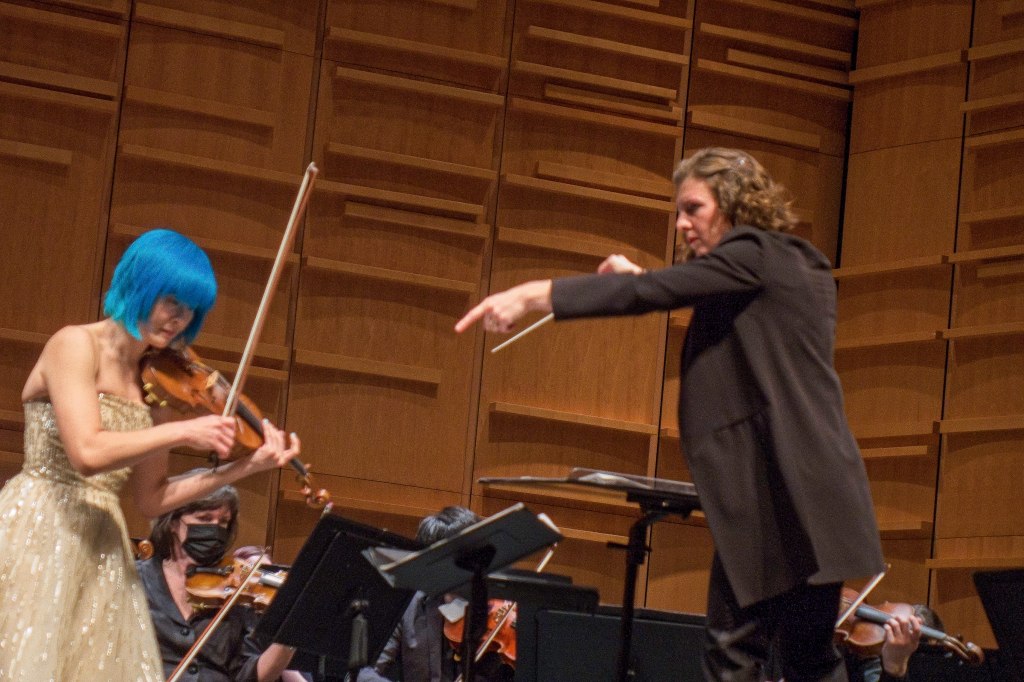
Since Mazzoli’s Procession Violin Concerto was commissioned by Koh, the music remained in-house until intermission. Notwithstanding her outré blue hair, Koh is actually a few years older than the composer, with a recording career extends more than 25 years. The former Chicago prodigy still plays with a youthful zest and a frenetic edginess – but not immediately in “Procession in a Spiral,” the opening section that unfolds slowly in a keening treble and increases its tension about 3/4 of the way into the section. The thinnest ethereal note from Koh’s violin bridges the gap into the unexpectedly calm beginning of “St. Vitus,” but the onset of intensity comes sooner here, still without the manic speed we might have expected from this title. The weepiest of the sections, “O My Soul,” has the most sustained of Koh’s thin harmonics and she hangs out with the flute and piccolo before breaking into more neurotic bowing.

A nice orchestral swell transitioned us to “Bone to Bone, Blood to Blood,” the most dramatic section, spiced with a series of whipcracks and a sprinkle of percussion. Jollity never prevailed in this rather somber concerto, nor was there an Allegro. “Procession Ascending” began rather unexpectedly for a finale with some lovely solo work from principal bassoonist Joseph Merchant, dramatizing how high Koh would need to ascend on her violin. If I were Koh, I’d pay Mazzoli a few more bucks to extend her struggles to take flight, blocked by the cellos and the double basses. She seems to clear this viny undergrowth too soon and too easily for the music to reach its full dramatic intensity, but I loved how briefly her freedom lasts and how cruelly it ends.

While there is a fine Baltimore Symphony account of Barber’s Second Essay for Orchestra in my collection, I cannot confirm ever hearing the piece performed live, though it was scheduled for a Symphony concert in April 2008. Hard to imagine that I snubbed it in my review, though Dvorak’s New World, ballet excerpts from Mozart’s Idomeneo, and Barber’s Violin Concerto were also on the bill. The music really is sumptuous, with oboe and clarinet illuminating the opening, viola mixing into additional oboe action later on, and some tasty propulsive percussion triggering its climax. It came across as a fresh and welcome discovery for me.

Of course, Copland’s Billy the Kid Ballet Music was the most familiar nugget on the program, revived at the Knight after an absence of less than four years. We’ve all been through a lot since February 2019, so I suspect more of the mournfulness of Copland’s “Introduction: The Open Prairie” and more of the fleeting, elegiac pathos of the penultimate “Billy’s Death” will land on listeners. Merriment is similarly magnified, with the clopping woodblocks of “Street in a Frontier Town” and even more heartily in the marching band energy, fueled by the woodwinds, of the gala “Celebration (after Billy’s Capture).” For the youngest buckaroos, the warring timpani and snare drum tattoos of “Gun Battle” will likely be the hugest delight.

“Christmas: Home” Shows Off Charlotte Master Chorale and T. Oliver Reid in Sublime Light

By Perry Tannenbaum

December 8, 2023, Charlotte, NC – We’ve reached that season when the arts calendar fills with a cluster of productions that reprise Dickens’ Christmas Carol, Handel’s Messiah, and Tchaikovsky’s Nutcracker – a rather traditional season not noted for novelty or wild innovation. So it’s nice to survey the Yule schedule and find events that even gently push the envelope and attempt to trailblaze with new styles like cirque or soul, or entertain the possibility that, come December, we’re not completely averse to secular fare.

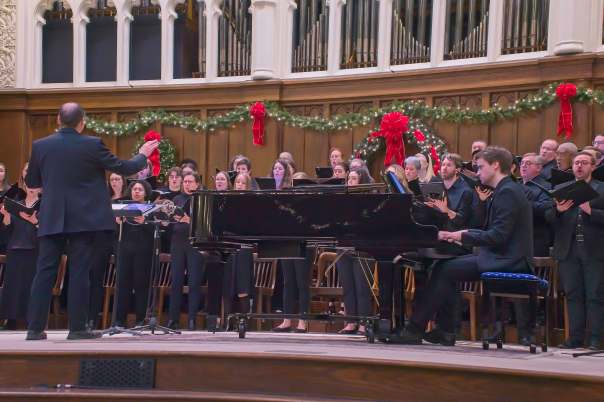
Better yet, amid a thicket of Nutcracker and Christmas Carol variants, we could find Charlotte Symphony venturing beyond its customary Holiday Pops medleys to a “Soulful Christmas” or Charlotte Master Chorale taking a thematic approach with “Home.” Although I prefer the acoustics at Symphony’s venue, Knight Theater, over First United Methodist Church, guest artist T. Oliver Reid tipped the balance for me in favor of Chorale’s “Home,” where he shared the pulpit with the choir, conducted by Kenney Potter, and pianist Philip Biedenbender.

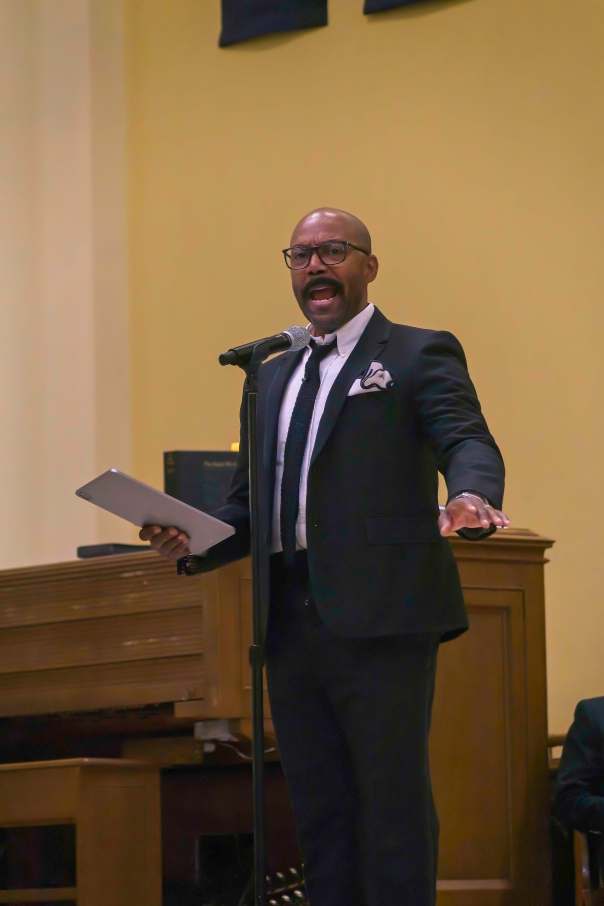
Very likely, I’d seen Reid long before he took over the role of Hermes in the Broadway production of Hadestown for nearly three months in 2022, since he figured in productions of Thoroughly Modern Millie, La Cage aux Folles, and After Midnight that I had witnessed over the years (in 2002, 2004, and 2014) during my pilgrimages to the Great White Way. A native of Metrolina who appeared in Shenandoah at Little Theatre of Gastonia long, long ago, Reid may have traveled far to participate in this holiday gig, but he could certainly identify with the homespun theme. In his bag of goodies, Reid brought a couple of songs from The Wiz, including his opener, “Soon as I Get Home,” and his finale, “Home.” With a silken voice that stretched lower and more richly beyond my expectations, Reid hit home runs with both these songs that are usually belted by Dorothy.

Potter’s programming for “Christmas with the Charlotte Master Chorale: Home” consistently accommodated this kind of generous latitude. Of course, there were seasonal favorites tailored for the theme, including “I’ll Be Home for Christmas,” Mel Tormé’s “The Christmas Song,” and – presented as a Biedenbender instrumental – “Home for the Holidays.” Nobody onstage at First United displayed any liking for the Christmas songs I dread and loathe, so we were never assaulted with the annoying fun of “Jingle Bells” or the torturous tedium of “The Little Drummer Boy.” Nor were the unexpected readings from Reid overladen with saccharine or sentimentality. Sara Teasdale’s “A Winter Night” and Ella Wheeler Wilcox’s “The Year” were both somber and seasonal. Even the excerpt from the Dickens classic, “Ignorance and Want,” refrained from depicting a vapid, gleeful wonderland.

“Christmas Dreams,” “Be Born, O God,” “Lost in the Night,” “Prayer of the Children,” and “Music in My Mother’s House” were all new to me. Similarly, I doubt that composer Alan Menken figures prominently on many Spotify songlists for Christmas, but Potter, Biederbender, and the Chorale dipped into his catalogue twice, for “God Bless Us Everyone” from his musical version of A Christmas Carol and – far more unexpected – “Someday” from The Hunchback of Notre Dame, written with Stephen Schwartz.

For me, Schwartz actually upstaged his collaborator with his other selection, “Through Heaven’s Eyes” from The Prince of Egypt, since it sprinkled the program with the right amount of levity along with Jerry Herman’s “We Need a Little Christmas” from Mame. Musically, “Through Heaven’s Eyes” took us closer to Jerusalem than Rome, for the sound had unmistakable klezmer flavoring. “Simcha” from the same musical where Moses is the protagonist, might have had a little more Jewish flavor and the liberating spirit of Chanukah, but “Through Heaven’s Eyes” was the most extravagant entertainment of the evening – and the Master Chorale clearly delighted in backing Reid up with their syncopated, klezmer-kissed la-las.

After an acapella rendition of “The Christmas Song” by the Chorale – with Reid repeating the final bars – the program built to a simple and sublime climax as Biedenbender accompanied Reid in a fervid rendition of Adolphe Charles Adam’s glorious “O Holy Night.” I’d never known that the song had three stanzas in English, compared to just two in the original French lyric by Placide Cappeau that inspired Adam. We can thus forgive a Celine Dion for only singing two, but for Reid to sing a second and a third stanza provided a wonderful surprise and a singular experience.

Goodbye Tokenism, Charlotte Symphony Is Embracing True Diversity – NOW

By Perry Tannenbaum

October 20, 2023, Charlotte, NC – Face it: in the wake of #MeToo, #BlackLivesMatter, and COVID-19, we’ve entered a complex cultural transition. Charlotte Symphony, never the most daring nor the most timid of orchestras in their programming, serves as a useful barometer. Their current program, with works by Emilie Mayer and William Grant Still, is even more impressively diverse – judging strictly by the playing times of these pieces – than their season opener, spotlighting the music of Valerie Coleman and The Butterfly Lovers Violin Concerto by two modern Chinese composers, Chen Gang and He Zhanhao.

But in 2023, these are not yet household names, or even widely known among Symphony subscribers. Accordingly, the season opening concert was titled “Beethoven’s Eroica Symphony No. 3” and the current offering is billed as “Chopin’s Piano Concerto No. 2,” pragmatically restoring balance and marketability. We haven’t reached the Promised Land in claiming our full musical heritage, but we’re definitely beginning to cross the Jordan.

As recently as 12 years ago, when I purchased The Gramophone Classical Music Guide for the last time, there was no mention of Mayer (1812-1883) in that doorstop nor in the Penguin Guide, The Oxford Dictionary of Music, or The NPR Listener’s Encyclopedia of Classical Music – all upstanding residents on my bookshelves. Indeed, the earliest recording of Mayer’s work that can found on Spotify, Apple, or Amazon was released in 2000, and the earliest that can be streamed came out in 2010, seven years before the first recording completely devoted to her compositions – pretty remarkable for a 19th century German composer who wrote eight symphonies, six of which have now been recorded. We had a nice taste of Mayer’s handiwork in her Faust Overture with resident conductor Christopher James Lees on the Knight Theater podium.

Recorded twice in the past two years and topmost among suggestions when I type the composer’s name in a Google search, the work has unmistakable gravitas, build, and power, welling up in the strings and releasing from its somber Adagio opening with a tattoo from the timpani that shifts us more lightheartedly into an Allegro colored by the wind section and easing into waltz tempo. Of the two name-brand pieces lurking in the program, Chopin’s Concerto and Antonín Dvořák’s The Noonday Witch, the Faust pairs best with Dvořák and his storytelling. Mayer’s work became more volatile and episodic past the halfway mark, a palpable struggle between good and evil as sturm and drang sections alternated with milder retorts from the winds, which gradually more assertive, with more sinew, before the antagonists merged majestically in the climax. Lees’ tempos and dynamics could have been more restless and spasmodic, but none of the walloping power was lost.

My last sightings of pianist Orli Shaham were at Spirit Square in 2002 at the Brightstar Music Festival, so I had no live experience of her full voltage beyond her exploits in a Brahms Piano Quintet, a Prokofiev flute sonata, and a Poulenc trio. Any doubts that Shaham and Symphony had the muscle and finesse needed for an optimum Chopin 2 vanished by the time the pianist finished her first kaleidoscopic turn in the opening Maestoso, after a spirited orchestral intro. Shaham’s delicacy, already convincingly established in this epic opening, became even more ethereal – and personal – in the sublime larghetto that followed. Neither Shaham nor Symphony was as captivating as the winsome 1999 recording by Christian Zacharias, where both the pianist and the Lausanne Chamber Orchestra honed in on the lilt of the waltzing rhythms that are so emblematic in Chopin’s work. But there are plenty of other flavors to Chopin, as the many master recordings of this concerto readily attest, and Shaham merely chose a different journey, rousing enough to trigger an ovation that demanded an encore.

When Lees picked up a microphone after intermission, it was to summarize the story of Polednice, the Czech poem by Karel Jaromír Erben, for the maestro maintained that Dvořák’s The Noonday Witch – one of four tone poems set to Erben’s ballads – followed the story bar-by-bar. Whether or not Lees’ claim can be verified, the piece offered Erica Cice, in her first outing as Symphony’s acting principal oboist, a swift opportunity to shine just 13 days after her predecessor, Hollis Ulaky, made her farewell appearance in the Eroica.

Here the oboe represented the misbehaving boy who was threatened with a visit from the fearsome by his frustrated mom in repeated attempts to quiet him – until she loses it and issues her fatal summons. Enter Allen Rosenfeld with his bass clarinet as the wicked visitor, who surprises and alarms both mother and son with her arrival. Much orchestral tumult ensues as the witch implacably chases her prey – until the tubular bells chime 12 times and the witch disappears at noon. Ah, but the story isn’t quite finished, with more orchestral turbulence on the horizon.

With a brief paragraph in the Oxford Dictionary and a more respectful entry in the NPR Encyclopedia, we can’t tout Still (1895-1978) as newly-discovered. As Lees hinted in his intro, however, the “Dean of African-American Composers” has been unconscionably neglected. The appearance of work in the clean-up spot on Symphony’s program, mighty orchestral works by brand-name Europeans usually dwell, may be unprecedented. With all of Symphony’s artistry and enthusiasm behind it, Still’s “Afro-American” Symphony No. 1 proved worthy of its esteemed position on the bill, even after Shaham dazzled us. In the bluesy opening movement of this 1930 work, “Longing,” you may actually catch a violinist or two smiling as she plays. You might have the same reaction. The middle movements, “Sorrow” and “Humor” retain a residue of ethnic flavoring, but here it’s less a part of the mix with traditional orchestral writing all-American strike-up-the-band jubilation. The sheer majesty of the closing “Aspiration” movement took me by surprise, for I’d never heard it before in live performance. America is very much carved into this closing, encompassing the swagger of our cities, the grandeur of our mountains, the serenity of our prairies, and maybe a few echoes of Native Americans we took it all from.

Master Chorale Excites and Excels With Superior Renditions of Dett & Bernstein

Review: Dett & Bernstein at the Cain and Gambrell Centers

By Perry Tannenbaum

September 28 and 30, 2023, Cornelius and Charlotte, NC – Historically, a collaboration between Charlotte Symphony and the Charlotte Master Chorale is far from a groundbreaking event, since the two organizations had been joined for a while before breaking apart when Symphony absorbed the original Oratorio Singers of Charlotte after many years of proud collaboration. But when the rebranded Master Chorale not only partners with Symphony but also with two additional choirs, the Queens University Chamber Singers and The University Chorale of UNC Charlotte, something special must be brewing. Bring in five guest solo vocalists and expectations rise to Mahlerian proportions. That wasn’t the kind of extravaganza that the longtime collaborators had in mind, however, when they conceived their Dett & Bernstein program and reached out so dramatically.

Less intimidating, the event at Gambrell Center, on the Queens University campus, was a welcoming epic of diversity and inclusivity. For all the ensembles never gathered grandly together in symphony-of-a-thousand fashion. R. Nathaniel Dett rightfully headlined the bill, for The Ordering of Moses (1937) is more than double the length of Leonard Bernstein’s Chichester Psalms (1965) and armed with more vocal soloists and instrumental artillery. In something of a tune-up for the Gambrell event, the Master Chorale and Symphony had performed both of the headliner pieces at the new Cain Center in Cornelius two nights earlier. Neither of the University ensembles made the trip up I-77 to Cornelius, but tenor Jason Dungee, who would sing the title role in Dett’s oratorio, is also director of UNCC Chorale, so a couple of his prize students mysteriously appeared as two of the four adult solo singers in Chichester Psalms, obviously smuggled onto the tour bus.

Losing out on seeing the full University choirs, missing the opportunity to hear the gems by Adolphus Hailstork and Margaret Bonds that kicked off the Saturday program at Gambrell, the Cain Center still had the honor of hosting the North Carolina premiere of The Ordering of Moses. Commissioned by the May Festival Chorus, who premiered the piece in Cincinnati, the piece triumphed in front of the festival audience, but its live national NBC radio broadcast was abruptly snatched from the airwaves about 40 minutes into the performance, clearly a craven cave-in to a few racist listeners. Righting this wrong, if not the subsequent neglect of Dett’s oratorio, Moses was revived by the Cincinnati May Festival in 2014 and given a Carnegie Hall premiere a few days afterward – adorned with a live broadcast by WQXR that was not aborted.

As the Bridge recording of that concert demonstrated, the revival conducted by James Conlon was well-deserved. Hearing the live performance with Chorale artistic director Kenney Potter conducting the Charlotte Symphony was a very different experience from the sonorous broadcast version on the Bridge label, longtime champions of American composers. From the start, the work of Symphony’s assistant principal cellist Allison Drenkow stood out more boldly in relief, yielding a better grasp of how Dett structured his piece, for there are cello solos strewn throughout the piece, acting as friendly bookmarks, that she gorgeously performed with gossamer tone. Nor were the vocal soloists less than the equals of their Carnegie Hall counterparts, mezzo Sarah Brauer bringing wondrous elan to The Voice of Israel, soprano Anne O’Byrne fortifying Miriam in her biblical song and in duets with brother Moses with her fervor, and bass-baritone Marques Jerrell Ruff thundering The Word and afterward The Voice of God – with rumbling timpani quaking the earth around him.

In his introductory remarks during a pre-show segment, Dr. Marques L.A. Garrett had us looking out for the core of Dett’s music, the two themes of “Go Down, Moses.” The famous refrain theme peeps in behind a veil of different melodies, most notably the keening “When Israel was in Egypt land” theme before the full chorus breaks forth – after a vocal trio from Brauer, O’Byrne, and Ruff followed by a swirl of cellos and a bassoon – with the fortissimo command, further developed with fugal filigree. Yes, Ruff’s Voice of God is a tough act to follow, but who knew that Dungee, rising from his seat with the aid of a cane, had such a piercing, rafter-cracking tenor voice to answer the Almighty’s call? The dialogue between God and Moses was a thrilling highlight, enough for me to justify attending the second North Carolina performance as well as the first.

Fresh rewards awaited me at the Gambrell that lived up to my expectations. The Master Chorale is a large chorus, too large to share the Cain Center stage with Symphony, so they doubly split on both sides of the audience on two levels of the building. Gambrell Center has a more commodious hall and stage, but only one side level for deploying the choristers, so the Master Chorale waited to make their appearance while the two University choirs gathered on opposite sides of the audience, spilling onto short flights of stairs the led up from the orchestra to the sloped exit aisles. To our right, Dundee led the UNC Charlotte ensemble in two songs by Hailstork (b. 1941). Crucifixion or not, “My Lord, What a Moanin’” had a grace and energy worthy of a program finale or an encore. The hushed and reverent “Blessed Is the Man” was written as a gift specially for Dungee, who chose Hailstork as the subject of his doctoral dissertation, and the tenor’s fondness for the piece suffused his choir’s performance.

Not to be outdone by her UNC Charlotte colleague, soprano Sequina DuBose has had a song cycle written by Maria Thompson Corley for her recent Blurred Lines: 21st Century Hybrid Vocal Works recording on the Albany label, reviewed at this site earlier this year. You could say she crossed the line when she appeared as a guest soloist with the Queens U Chamber Singers in excerpts from Credo by Margaret Bonds (1913-1972) – if there were a rivalry between the two schools rather than hospitality and fellowship. Set to a prose poem by W. E. B. Du Bois, the posthumous Credo was premiered by Zubin Mehta and the LA Symphony shortly after Bonds’ death but not recorded until earlier this year on a magnificent Avie Records release by the Dessoff Choirs and Orchestra.

Presented at Gambrell with a spare piano accompaniment, the performance was admirable for its promptness, but it gave only a hint of the work’s full grandeur when heard unabridged with a full orchestra behind it. At Gambrell, pianist Brenda Fernandez provided all the accompaniment. The complete work, now that it has conquered with a brief foretaste, should be on top of Charlotte Symphony’s short list of new and newly-discovered pieces to be programmed at their Uptown venues.

Nor was DuBose to be outdone in her rendition of the second song in the six-song suite, “Especially Do I Believe in the Negro Race.” If you’ve heard her luminous performance of “Summertime” in two extended runs of Porgy and Bess in Charlotte, most recently with Opera Carolina back in January, or her Elvira in Don Giovanni, you won’t be surprised to learn that the smoothness of her tone and the clarity of her diction far eclipse what you might hear on Spotify in the world premiere recording.

Recordings do have an influence on repertoire selection, which may be why I’ve never heard Charlotte Symphony perform Chichester Psalms before – and why I haven’t heard a performance of Bernstein’s paean to peace in the Queen City since 2009, when Carolina Voices’ Festival Singers brought a slimmed-down version of the work to Temple Beth El for a Yom HaShoah commemoration, accompanied by piano, percussion, and harp. Marin Alsop’s version of the work on Naxos with the Bournemouth Symphony and Chorus is only slightly less wretched than Bernstein’s own version on DGG with the Israel Philharmonic and the Vienna Boys Choir.

Both of their engineering teams failed them miserably in the pivotal middle movement, where Bernstein juxtaposes the incandescent Psalm 23, “The Lord Is My Shepherd,” sung by a boy soprano, with the angry Psalm 2, sung by the Master Chorale in a sudden crescendo. The Hebrew text is probably most familiar to us via the powerful aria in Handel’s Messiah,“Why do the nations rage so furiously together, and why do the people imagine a vain thing?”

To replicate the dynamic range so easily rendered at the Cain and Gambrell Centers, you’ll need to turn your volume knob to the one or two o’clock position to make out the boy soprano faintly in the outer sections of this movement – and hurriedly turn back to the 11 o’clock position for the midsection to avoid waking your wife and neighbors when the full chorus unleashes their fury. Even sitting at the front end of these halls, I never felt assaulted by the fortissimos: acoustic balances and clarity were always tight. It was a joy to hear Calvin Potter singing the soprano part so clearly, stealing nervous glances at his dad on the podium as he awaited his cues. The boy was nearly perfection on the Hebrew until his unfortunate gaffe in the final line, mispronouncing the penultimate word at both performances.

Immediate consolation gushed forth after the Potter lad departed, for the final Chichester section, set to the warm and placid Psalm 131 with a sprinkling of 133, is preceded by a gorgeous orchestral lament that brought out Symphony’s best playing of the night. The transition between these last two Psalms was also treasurable, a lovely cello quartet. A wonderful vocal quartet – including those two UNC Charlotte imports – led into the final sublime fadeout, dominated by the women’s treble. Again: the last minute of Chichester Psalms was divine in live performance, but turn your hi-fi volume past 12 o’clock at home.

CP’s Connor Series Signs Off With Two Powerhouse Piano Quintets

By Perry Tannenbaum

September 17, 2023, Charlotte, NC – Even before the Connor Chamber Music series began six years ago at Tate Hall, Catherine and Wilton Connor were among the strongest advocates of chamber music in the Metrolina area. They had previously helped to give the St. Peter’s Chamber Music series extra reach beyond Uptown church by hosting Living Room Concerts in their Myers Park home. Furthermore, they had opened their doors to violinist Rosemary Furniss and her chamber trio when her husband, Christopher Warren-Green, was the Charlotte Symphony’s music director.

So it was bittersweet to hear Mr. Connor announce that the latest concert on the Central Piedmont Community College campus, showcasing piano quintets by Béla Bartók and Antonín Dvořák, would be their last. Connor hastened to console us, hyping the recent and future concerts of Chamber Music for All, led by Charlotte Symphony concertmaster Calin Lupanu. And in fact, the program we were soon to hear had already been performed a week earlier at the Lancaster Cultural Arts Center, the climactic event of the inaugural Historic Lancaster Music Festival. Future CM4A concerts are already scheduled there, at Sedgefield United Methodist Church, and at the Steinway Piano Gallery.

Not nearly as renowned, recorded, or as frequently performed as his six string quartets, Bartók’s Piano Quintet in C Major is one of the composer’s earliest works, written in 1903-4, a mere 17 years after Dvořák’s quintet was premiered and 35 years before his own final string quartet. Often in its outer movements, the opening Andante and the concluding Poco Vivace, the music has an anthemic openness that you might expect from a 19th-century piece written in the shadows of Liszt, Strauss, and Brahms, before Bartók leaned more toward folk music and modernistic experimentation.

At the keyboard, Phillip Bush resisted the temptation of steering the joyousness of the piano part into stentorian jubilation, resulting in more ensemble cohesiveness and more contemplative edge. Lupanu could stay more within himself to match Bush’s fire without ever flattening the peaks and valleys of the volatile music where Bartók abruptly changed tempos and dynamics. Marcus Pyle, who had inched onto our radar earlier this year as a preview speaker for Opera Carolina’s production of Porgy and Bess, impressed almost instantly on viola with his lush tone and sleek double-bowing.

The inner movements, a Vivace-Scherzando followed by an Adagio, are more forward-looking. The Scherzando did not lack for quirkiness, but Bush could have been more provocative and eccentric in the second movement. With cellist Marlene Ballena and second violinist Monica Boboc making valuable contributions, the quartet sounds were dominant in the Adagio, though the 2019 Alpha Classics recording, captured live at the Lockenhaus Chamber Festival, dares to be more raucous and astringent. When Lupanu’s quintet surrendered more fully to the closing Vivace, they delivered more of its fire and madness.

Competition among recordings of the Dvořák Piano Quintet No. 2 in A Major not only increases exponentially compared with the sparse field of Bartók recordings, so does the name recognition of the pianists, violinists, and string quartets who have entered the fray. On the other hand, the musicians onstage at Tate Hall must have had so many more opportunities to glean master classes from this immense discography – and likely more opportunities to rehearse and perform this perennial favorite before bringing it to CPCC. The electricity and sound quality of live performance, the familiarity of the audience with the piece – particularly when it settled into the dreamy Dumka movement after the rousing Allegro opener – brought the Connor concert experience into gratifyingly close alignment with the best CDs available.

Bush played with confident élan, pliant and at ease navigating the tempo shifts of the opening movement, charming and lyrical in the gorgeously pianistic Andante passages that make the Dumka so memorable, and unbridled with the onset of the folksy interludes. Lupanu also played with loose and spontaneous abandon, slashing boldly with his bow at the quick tempos and delicately caressing the strings in the lovely soft passages. Ballena shone most with her cello as she introduced the first theme of the Allegro, and Pyle was equally convincing introducing the second. Everybody seemed to be having a jolly time as the sober ending of the Dumka gave way to the penultimate Scherzo. Lupanu and Bush mischievously frolicked on the left side of the Tate stage, answered to humorous effect by Ballena and Pyle with their suave mellowness.

Boboc had her most memorable spot in the Allegro Finale when we jumped away from the spirited interplay between Bush and Lupanu into a fugal section where Ballena and Pyle also got a taste. There were also harmonious sections that reminded me of the uniqueness of Dvořák’s string quartets. Yet it was Bush who was most dominant at the concert’s climax, trilling and ding-a-linging merrily before he ramped up the speed and intensity toward the very end. Obviously relishing the encounter, Lupanu matched him note for note as they raced to the precipice.

Charlotte Bach Fest Opens With Christmas-in-June Verve and Plenty of Brass

Review: Christmas Oratorio at Charlotte Bach Festival

By Perry Tannenbaum

June 10, 2023, Charlotte, NC – When Bach Akademie Charlotte artistic director Scott Allen Jarrett explains the oddity, it makes perfect sense. Nothing that Johann Sebastian Bach wrote is more perfectly suited for presentation at the Charlotte Bach Festival than his Christmas Oratorio, even though the Akademie’s festival is celebrated in June. Bach never intended this oratorio to be performed annually on just one occasion. No, each of the six parts of the Oratorio was to be performed on a different day of an extended Christmas celebration, extending to the Feast of Epiphany on January 6 and including New Year’s Day festivities on January 1, marking the Feast of the Circumcision and Naming of Jesus.

Similarly, Jarrett is dicing the six parts of the oratorio into four concerts, two evenings at Myers Park Presbyterian Church and two Bach Experience matinees at Myers Park United Methodist, spreading out Oratorio performances over a period of four days. Interspersed with these choral events, a harp recital at the Olde Mecklenburg Brewery, an Uptown organ recital at St. Peter’s Episcopal, and a vocal fellows recital give the five-day fest extra variety and reach.

Recordings of the complete Oratorio range in length from 2:15 to 2:45, and the timings listed in the wonderfully informative Festival Program Guide add up to 2:28, just below the median. If 148 minutes of music divvied into four concerts sounds like small portions, never fear. Each of the Oratorio concerts is fortified with at least one other Bach piece, and each concert is illuminated by a Jarrett intro or lecture, with demonstrations at the lunchtime Experiences. The opening concert at Myers Park Presbyterian began the cycle with Parts 1 and 2 of the Oratorio, “The Birth of Jesus” and “The Annunciation of the Shepherds.” These delights were followed after intermission by one of two Sanctus settings that will be presented at this year’s Festival, and a “Cantata for Christmas Day,” Christen, ätzet diesen Tag.

The opening Chorus of “The Birth,” with pounding timpani and three baroque trumpets triggering the ensemble’s proclamation of “this Day of Salvation,” brought back ancient memories. My first encounter with the Oratorio was in the late ‘80s when I borrowed it on a set of CDs from the Mecklenburg Public Library. There was a brilliant flash of familiarity moments after I pressed the play button, for I had previously dubbed a marvelous recording, by tenor/conductor Peter Schreier and soprano Edith Mathis, of two earlier Cantatas by Bach, BWV 213, and 214, both written to celebrate auspicious birthdays. It was the opening of the latter Cantata, written for the nobody less than the Queen of Poland, that leaped to mind as soon as the Christmas Oratorio began because the music and scoring are exactly the same. Only the text is changed. As Brett Kostrzewski’s program notes meticulously chronicle, both of the Cantatas on the Schreier recording (with the Berlin Chamber Orchestra) figure prominently in the first four parts of this Oratorio.

Looking up the recording on Spotify, you’ll find that the opening chorus of BWV 214 is by far the most popular track on the album, racking up more plays than the other eight sections of that Cantata combined. So Bach chose well, and the three baroque trumpets played live at Myers Park Presbyterian were far more thrilling than any recording can convey – and that’s before the éclat of the chorus layered on. When the 16 voices are trumpeting “this Day of Salvation,” they’re singing music that Bach previously set to “trumpets resound!” It was nothing short of thunder where I sat.

Tenor Gene Stenger was the Evangelist in both Parts 1 and 2, a warm and authoritative narrator. For anyone who hadn’t experienced the solo voices in the Bach Festival Chorus before, alto Sylvia Leith quickly established that they would be topnotch, with a creamy rendition of the “Prepare thyself, Zion” aria, preceded by a stirring recitative. Edmund Milly, singing the bass solos in the penultimate pair of movements before the concluding Chorale and the return of the trumpets, kindled and rekindled a dignified fire. There are full texts and translations in the Program Guide, so the German can be followed word by word and understood, but if you were simply satisfied with the translations, they were alertly – and legibly – projected on both sides of the stage for even more comfort amid the sonic excitement.

Though the trumpets temporarily retired, Part 2 was not at all anticlimactic, unfolding more gradually with a Sinfonia and another Evangelist pronouncement from Stenger before the onset of the full chorus. Stenger parleyed briefly with soprano Arwen Myers, portraying the Angel, who announced the birth of a savior, in the City of David, to the shepherds. Milly reappeared almost as much in Recitative as Stenger the Evangelist, with new voices taking on the Arias. “Happy shepherds” was a special treat as tenor Patrick Muehleise joined in a jocund duet with principal flutist Colin St-Martin.

After the intermission and the brief setting of the Sanctus (which has a very special place in the Jewish liturgy as well), we had to be impressed when Jarrett told us that Christen, ätzet diesen Tag was the only Bach piece he knew of that was scored for as many as four trumpets. Co-principals Josh Cohen and Perry Sutton, mainstays at Charlotte Bach since 2018 and 2019 respectively, were joined this year by Dillon Parker and a Charlotte Symphony recruit, principal trumpet Alex Wilborn, usually seen with a modern valved horn. Written a full 20 years before the Christmas Oratorio, the Cantata for Christmas Day showed off different colors and vocal configurations, and Jarrett chose vocal and instrumental soloists who hadn’t been featured before the break, adding to the freshness of the performance.

The heavy brass-and-drums artillery in the opening and closing sections of the earlier Cantata was as thumping as the bookends of the Christmas Day suite in Part 1of the Oratorio. Thank you, Jonathan Hess, for your verve on the timpani. No Evangelist or storyline appeared here, for this earlier Bach work was more prayerful and preachy in its celebration. Laura Atkinson sang the long alto recitative, stressing how the birth of Jesus is the fulfillment of Old Testament prophecy. After tenor Corey Shotwell extolled the newborn as a relief from the fear and sorrow that “poor Israel had been oppressed [with] unduly,” Atkinson joined him in a superb “Come and bring your prayers to heaven” duet.They were only slightly upstaged by the more leisurely paced duet that preceded them, “Lord how blest is thine ordaining,” the true centerpiece between the brassy bookends of the Cantata. Surely this was one of the highpoints of the evening. Principal oboist Margaret Owens shone in accompanying soprano MaryRuth Miller and bass Craig Juricka, ably embroidering the intervals between their vocals. The repose of this song beautifully combined the spirits of Christmas and thanksgiving.

Spoleto Festival USA: More Diverse, Hybrid, and Inclusive Than Ever

By Perry Tannenbaum

With so many theatre, dance, opera, jazz, orchestral, choral, and chamber music events to choose from – more than 300 artists from around the world, streaming in and out of Charleston over 17 days (May 26 through June 11 this year) – planning a dip into Spoleto Festival USA is always a challenge. Even Spoleto’s general director, Mena Mark Hanna, struggles to prescribe a strategy, as hesitant as a loving mother of 39 children to pick favorites.

“My suggestion for a first-time participant,” he says, sidestepping, “would be to see two things you like and feel comfortable about seeing, maybe that’s Nickel Creek (May 31-June 1) and Kishi Bashi (June 3), and two things that are really pushing the envelope for you. So maybe that’s Dada Masilo (June 1-4) and Only an Octave Apart (June 7-11).”

Nicely said. Only you can easily take in the first three events Hanna has named within three days, but you’ll need another four days before you can see singer-songwriter phenom Justin Vivian Bond and their monster opera-meets-cabaret-meets-pop collaboration with countertenor sensation Anthony Roth Costanzo. If you happened to see the recent Carol Burnett tribute on TV, the cat is out of the bag as far as what that will sound like, if you remember the “Only an Octave Apart” duet with opera diva Beverly Sills – recreated for Carol by Bernadette Peters and Kristin Chenowith.

What it will look like can be savored in the Spoleto brochure.

The giddy Bond-Costanzo hybrid is one of the key reasons that my wife Sue and I are lingering in Charleston through June 9. Equally decisive is the chance to see jazz legends Henry Threadgill (June 6) and Abdullah Ibrahim (June 8), the Spoleto Festival USA Chorus singing Thomas Tallis’ Spem in alium (June 7-8),and Jonathon Heyward conducting Hector Berlioz’s Symphonie Fantastique (June 9).

One other irresistible lure: the opportunity to see Maestra Mei-Ann Chen conduct Antonín Dvořák’s New World Symphony (June 7), along with works by Florence Price and Michael Abels – less than four months after her scintillating debut with the Charlotte Symphony.

Abels, you may recall, teamed with Rhiannon Giddens last year in composing Omar, the new opera that premiered at Spoleto – after an epic gestation that spanned the pandemic – and won the Pulitzer Prize for Music earlier this month. It was a proud moment for Spoleto, for Charleston, and for the Carolinas. For Hanna, it was an extra special serendipity to help shepherd that work to completion.

“I mean, it’s kind of incredible,” he explains, “to be someone who comes from Egyptian parentage, speaks Arabic, grew up sort of fascinated by opera and stage work and spent their career in opera and was a boy soprano – to then have this opportunity to bring to life the words of an enslaved African in Charleston, South Carolina. And those words are Arabic!”

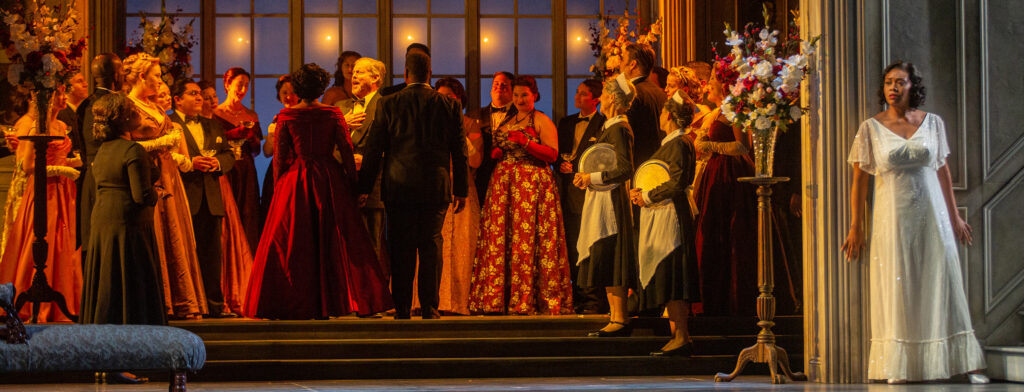
We may discern additional serendipity in the programming of this year’s opera, Samuel Barber and Gian Carlo Menotti’s Vanessa (May 27-June 10), which garnered the Pulitzer in 1958. Revived at Spoleto in 1978, the second year of the festival – with festival founder Menotti stage directing – the production was videotaped by PBS and syndicated nationwide on Great Performances, a huge boost for the infant fest. That revival also sparked a critical revival of Barber’s work.

Omar was the centerpiece of a concerted pushback at Spoleto last year against the Islamophobia of the MAGA zealots who had dominated the headlines while the new opera was taking shape. Vanessa is part of what Hanna sees as a subtler undercurrent in this year’s lineup, more about #MeToo, Black Lives Matter, and the repeal of Roe v. Wade.

“I want there to be a kind of cohesiveness without necessarily us being able to see what the theme is,” Hanna reveals. “If there is something that unifies a lot of these pieces, it’s about understanding that we are telling stories from our past, some of them the most ancient stories that we have in our intellectual heritage. We are looking at these stories with a different sense that takes on the reverberations of today’s social discourse.”

Among other works this season at Spoleto that Hanna places in his ring of relevance are An Iliad (May 26-June 3), a one-man retelling of Homer’s epic featuring Denis O’Hare; Igor Stravinsky’s The Rite of Spring (June 5), as an orchestral concert and the inspiration for Masilo’s The Sacrifice; Helen Pickett’s new adaptation of Arthur Miller’s The Crucible for Scottish Ballet (June 2-4); and A Poet’s Love (May 26-30), a reinterpretation of Robert Schumann’s Dichterliebe song cycle by tenor/pianist Jamez McCorkle, who played the title role in Omar last year – with stagecraft, shadow puppetry, and projections by Miwa Matreyek.

“Going back to the Trojan War, An Iliad is as much about war and plague then as it can be today with the reverberations of Ukraine and the pandemic,” says Hanna. “Vanessa, is reinterpreted here through the lens of a remarkable female director, Rodula Gaitanou. The cast is just killer: You have Nicole Heaston as the lead with Zoe Reams and Edward Graves and Malcolm McKenzie and Rosalind Plowright, just a world class cast at the very, very top. And it’s also really cool to see these roles, which are traditionally sung by Caucasian people, being sung by people of color.”

Aside from the recurring motif of reclusion, so vividly resonant for all of us since our collective pandemic experience, Hanna points to a key turning point in the opera. Menotti left it mysterious and ambiguous in his libretto at a key point when Vanessa’s niece, Erika, either has a miscarriage or – more likely – an abortion.

For Hanna, that brings up an important question: “What does that mean now when we are looking at a renewed political assault on female autonomy? So these stories take on new messaging, new reverberation in 2023. And we need to retell these stories with the new lens of today.”

Especially in the Carolinas.

Long accompanied by a more grassroots and American-flavored satellite, the Piccolo Spoleto Festival, Menotti’s international arts orgy has taken a long, long time to shed its elitist mantle. Now it is moving forcefully in that inclusive direction with a new Pay What You Will program, offering tickets to about 20 performances for as low as $5 – thanks to an anonymous donor who is liberating about $50,000 of ticket inventory.

Hanna brought this exciting concept to the unnamed donor, hasn’t talked to him or her or them – yet – about sponsoring the program in future years, but he is pledging to continue it regardless.

“What art can do is endow you with a new experience, a transformational experience that you did not have before you took your seat,” he says. “It can help create an understanding of another side that is normally seen by one perspective as socially disparate, as highly politicized, as a discourse that’s just way too far away. Art can break down that barrier through the magic and enchantment of performance. To me, having those artists onstage, representative of a demographic we wish to serve, only takes us so far. We also have to lower the barrier of entry so that we can actually serve that demographic.”

Kishi Bashi not only continues Spoleto’s well-established outreach to Asian culture, he also typifies the more hybrid, genre-busting artists that Hanna wants to include at future festivals.

“We want to try to find these artists that are like pivot artists, who occupy these interstitial spaces between dance and theater and classical music and jazz and folk music,” Hanna declares. “And Kishi Bashi is one of those. He plays the violin on stage. He has all of these violinists on stage with him, but it’s this kind of strange, hallucinatory, intoxicating music that’s like somehow trance music and Japanese folk music, but using sort of Western classical instruments. Yet it’s very much in an indie rock tradition as well.”

Other wild hybrids include Leyla McCalla (May 26), the former Carolina Chocolate Drops cellist who blends Creole, Cajun, and American jazz and folk influences; Australian physical theatre company Gravity & Other Myths (June 7-11), mixing intimate confessions with acrobatics; Alisa Amador (June 7), synthesizing rock, jazz, Latin and alt folk; and the festival finale, Tank and the Bangas (June 11), hyphenating jazz, hip-hop, soul, and rock. Pushing the envelope in that direction is exciting for Hanna, and he promises more of the same for the ’24, ’25, and ’26 festivals.

Until the Pulitzer win, the year had been pretty rough on Hanna, losing Geoff Nuttall, the personable host of the lunchtime Chamber Music Series at Dock Street Theatre. Nuttall was the artist who convinced Hanna to come to Spoleto. At the tender age of 56, Nuttall had become the elder of Spoleto’s artistic leadership when he died, beloved for his style, wit, demonstrative fiddling, and his passionate advocacy of the music. Especially Papa Haydn.

The special Celebrating Geoff Nuttall (May 26) concert will gather his close friends and colleagues for a memorial tribute at Charleston Gaillard Center, including violinist Livia Sohn, cellist Alisa Weilerstein, countertenor Anthony Roth Costanzo, tenor Paul Groves, pianist Stephen Prutsman, and surviving members of the St. Lawrence Quartet. The occasion will be enhanced by the Spoleto Festival USA Orchestra and Atlanta Symphony’s Robert Spano – plus other guests soon to be announced.

Hosting chores for the lunchtime 2023 Chamber Music series, spread over the full festival, 11 different programs presented three times each (16 performances at 11:00am, 17 at 1:00pm) will be divvied among vocalists and instrumentalists who perform at the Dock. It was totally inappropriate, in Hanna’s eyes to replace Nuttall onstage this year, but he will begin to consider the charismatic violinist’s successor during the festival and into the summer. Hanna assured me that the player-to-be-named later will be a performer who participates in the musicmaking.

Continuing on the trail blazed by Amistad (2008), Porgy and Bess (2016) and Omar, Hanna wants to place renewed emphasis on the Port City and its African connection. It must run deeper than seeing Vanessa delivered by people of color.

“Charleston was the port of entry for the Middle Passage,” Hanna reminds us. “And Charleston has at its core an incredibly rich Gullah-Geechee-West African-American tradition that is part of the reason this is such a special, beautiful place to live in with its baleful history. So I think that you see that this year, you see that with Gakire Katese and The Book of Life (June 1-4), you see that with Dada Masilo and The Sacrifice, you see that with Abdullah Ibrahim and Ekaya.”

Resonating with the brutalities of Ukraine, Ethiopia, and Syria on three different continents, the US Premiere of Odile Gakire Katese’s The Book of Life may be the sleeper of this year’s festival, crafted from collected letters by survivors and perpetrators of Rwanda’s 1994 genocide and performed by Katese, better known as Kiki. “After the unthinkable, a path forward,” the festival brochure proclaims. The finding-of-hope theme will be underscored by music created by Ingoma Nshya, Rwanda’s first-ever female drumming ensemble, founded by Katese.

“Kiki is engaging with how a country tries to reconcile with its recent, terrifically horrific past of the Rwandan genocide as someone who grew up Rwandan in exile. You see that in the work of Abdallah Ibrahim, who was really one of the great musicians of the anti-apartheid movement, who composed an anthem for the anti-apartheid movement, was in a kind of exile between Europe and North America in the 80s. And then when he finally came back to South Africa for Nelson Mandela’s inauguration, Nelson Mandela called him our Mozart, South Africa’s Mozart.”

Marvelous to relate, you can hear more of South Africa’s Mozart this year at Spoleto Festival USA than Vienna’s Wolfgang Amadeus – or Germany’s Ludwig von Beethoven. That’s how eclectic and adventurous this amazing multidisciplinary festival has become.

See for yourself.

Lan Shui’s Rachmaninoff Is a Special Gift – and a Flexion Point for Charlotte Symphony

By Perry Tannenbaum

2023~Rahmaninoff 2-19

April 28, 2023, Charlotte, NC – It’s time to admit that Charlotte Symphony has flipped the script. After a string of four consecutive concerts that I’ve reviewed in 2023, with four different guest conductors, every one of them immaculately played, I can no longer agree that CSO is in search of a new music director who will take the orchestra to the next level. The virtuosity and consistency are here, the responsiveness to varied composers and conducting styles is here, and the mastery of a multitude of musical styles can no longer be overlooked.

My moment of revelation came after the intermission in this week’s program at Belk Theater with guest conductor Lan Shui. Everything had been wonderful so far: Samuel Barber’s “Overture to The School for Scandal” had been colorful, cohesive, and melodious; the accompaniment of guest pianist Mari Kodama’s scintillating work on Mendelssohn’s Piano Concerto No. 1 had been as robust as the support Canadian soprano Alexandra Smither received on Benjamin Britten’s Les Illuminations with guest conductor Vinay Parameswaran on the podium.

My moment of realization came as the opening Largo-Allegro movement of Sergei Rachmaninoff’s Symphony No. 2 came to its finish – epic in its variety, impeccable in its flow, and utterly convincing in its pacing and drama. I had never appreciated how rich and gorgeous this music was. Repeatedly over the years, I have written about the low points in my CSO concertgoing experiences, when I needed to hurry home after performances of Beethoven’s Eroica and Copland’s Appalachian Spring to re-establish, via CDs in my collection, that I actually liked and admired this music. Finding out at Belk Theater what I’d missed on recordings I have heard before at home, as I did last night with Symphony’s Rachmaninoff, was a complete 180-degree turnaround.

Mei-Ann Chen’s exhortations that Charlotte should support their orchestra as much as it deserved weren’t tainted at all with pragmatic flattery as I had thought, it was plain honesty. The only reason she remains the top candidate among those I’ve heard after Shui’s equal triumph is that I still feel Chen will bring more youth and effort to the true tasks at hand – keeping CSO’s performance level at its admirable height, enlarging its numbers, and enhancing its reputation and touring opportunities. Nor should I leave what is implied here unspoken, that Christopher Warren-Green completed his mission of lifting Symphony’s quality to international standards by the time his tenure ended in 2022.

2023~Rahmaninoff 2-24

Triggering the lush and playful violins, principal oboist Hollis Ulaky and principal clarinetist Taylor Marino played beguiling solos. Pacing and dynamics were beautifully judged until the cycle repeated, the violins seeming to respond lower in the treble and Marino playing more challenging passages. The Mendelssohn that followed was Molto allegro from the start, Kodama’s febrile attack matched by Symphony’s zesty engagement. When we flowed into quieter interludes the transitions were utterly seamless, with lyricism spontaneous enough to foreshadow an ethereal rapturous treat when we reached the middle movement – so transporting that I need to rouse myself and realize we were already in that dreamy movement and that the orchestra had arrived there without a pause.

2023~Rahmaninoff 2-12

Kodama caressed the treble at times with her delicate right hand while cherishing it in her left hand with a closed fist, at other times, she leaned back and gazed almost directly upwards. Shui and the orchestra were far more emphatic in signaling the segue to the finale, a rousing Presto-Molto allegro. Early in the movement, Kodama wasn’t as crystalline in her fingering as Howard Shelley in his recording with the London Mozart Players, and I’m not sure she quite equaled the drama of the manic build at the very end that Stephen Hough achieved with the City of Birmingham Orchestra. Overall, though, the live Kodama-CSO performance matched them both.

2023~Rahmaninoff 2-21

As the glory of Symphony’s performance of the Largo-Allegro moderato opening movement flowed so gorgeously from pinnacle to pinnacle, cogent and suffused with seething tension, it occurred to me that the orchestra’s immersions outside their mainstage classical offerings – in big band jazz charts and film scores – has paid off in handsome dividends. From measure to measure, like frame to frame at the movies, connections remained ironclad. Shui’s spoken intro was entertaining and informative, not above repeating some of the information in the digital program booklet, a practice that Warren-Green religiously avoided. He warned us of the hourlong length of the piece and had us on the lookout for Marino’s lovely clarinet spot at the beginning of the Adagio third movement. It emerged unforgettably out of a hush and took sad flight until the strings joined in the restless, aching keening, flowing into work’s biggest tune.

I couldn’t trace any previous CSO performances of this grand piece on my calendar or in my document dating back to 1994, so few if any of the musicians onstage were much more familiar with this gem than those of us in the audience marveling at its beauty. Shui has recorded all the Rachmaninoff symphonies with Singapore Symphony Orchestra, where he was music director from 1997 to 2019, so he has a special affinity for this music. Getting to hear his interpretation of the E minor No. 2 is a special gift for us.