Category Archives: Classical

Three Women Empathize Historically With “Stabat Mater” on a Historic Night

Review: Pergolesi’s Stabat Mater at The Mint Museum

By Perry Tannenbaum

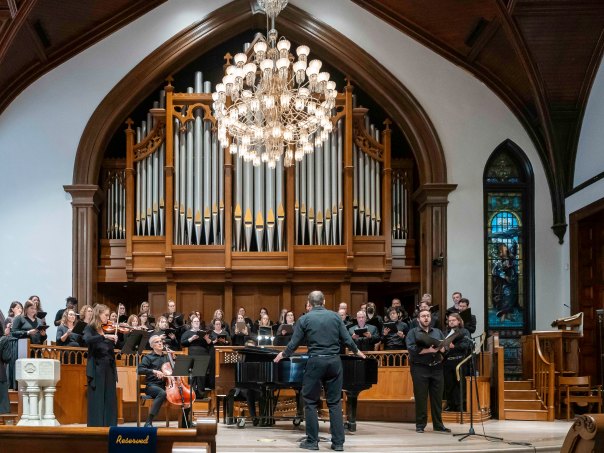
September 11, 2025, Charlotte, NC – With its stained-glass windows, high ceiling, and resonant wooden flooring, the Uptown Mint Museum proved to be an unexpectedly apt venue for Opera Carolina and Charlotte Symphony to join in commemorating mournful, horrific events with sacred music. Reflexively, we look to the past – and to religion – to express our feelings amid present woes, but neither of the musical organizations could have anticipated the extra layers of calamity earlier in the week that would pile onto their memorial to the victims and heroes of 9/11 on its 24th anniversary. The work they performed, Giovanni Battista Pergolesi’s Stabat Mater, has always had a tragical tinge. Pergolesi composed his most-performed work near the end of his life, all too suddenly ended in 1736 by the onset of tuberculosis at the age of 26.

The Italian was casting his eyes across the centuries in scoring his Latin text, which had already existed for four or five hundred years, depending on whether it was written by Jacopone da Todi, a Franciscan friar, or by Lotario de’ Conti di Segni, better known as Pope Innocent III. The “Stabat mater dolorósa” poem, 20 three-line stanzas written in trochaic tetrameter, meditates on the sorrows and sufferings of Jesus’ mother, more than a millennium further back in time, standing by her son during the agonies of crucifixion. While the Oxford Dictionary of Music describes the piece as originally written for male soprano, male alto, and orchestra, most of the vocalists on the 60 or so recordings of the work have been female sopranos and mezzos.

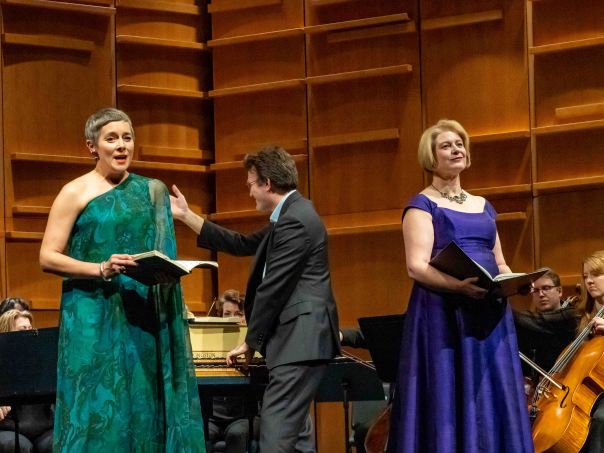
Marie Van Rhijn was the first woman to conduct a recording of Pergolesi’s chef d’oeuvre in 2021 on the Chateau de Versailles label, so Emily Jarrell Urbanek was almost a pioneer in adding her special empathy toward the grieving Virgin Mary as she stood on the podium leading the Charlotte Symphony Orchestra Ensemble. But wait: the Van Rhijn recording was done with two male vocalists! Samuel Mariño and Filippo Mineccia, listed on the album cover as the “deux costrats,” also perform the Vivaldi Stabat Mater on that release with Van Rhijn conducting. So together, Urbanek, soprano Corey Raquel Lovelace, and mezzo Leyla Martinucci may have been making feminist history after all.
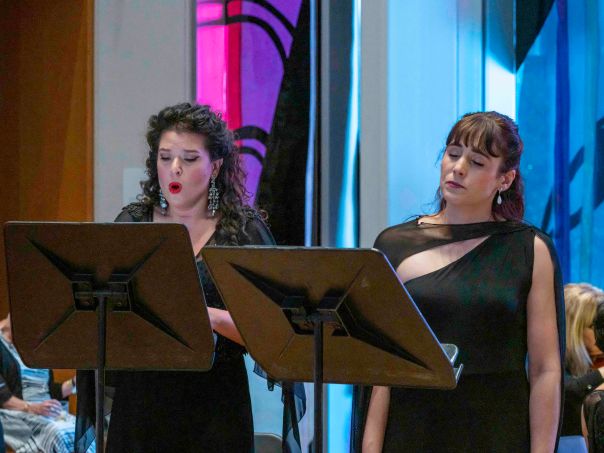
Of course, the Van Rhijn recording remains a great place to begin if you’re wishing to hear how Pergolesi’s Stabat Mater actually sounded at its premiere in Naples. Yet it didn’t take long for the first all-female version ever led by a woman in Charlotte – and the first Symphony concert we’ve heard at The Mint – to impress. Pergolesi divided the twenty-stanza text into 12 compositions, and the opening “Stabat Mater dolorosa” duet is by far the most beloved. While the orchestral intro was engaging enough, though recordings with an organ yield more heft, the blending of Martinucci’s voice with Lovelace’s was sublime.

The first five sections of Pergolesi’s Stabat Mater fully demonstrate the composer’s strengths in solo and duet writing, his lithe capacity for transitioning back and forth between those modes, and his perverse disregard for the stanza couplings of the text’s rhyme scheme. After hearing Lovelace and Martinucci, I sampled Van Rhijn’s recording, then a starry version with Anna Netrebko and Magdelena Kožená, and finally ancient music specialist Christopher Hogwood’s prestigious recording with Emma Kirkby and James Bowman. My admiration only grew for both Lovelace and Martinucci’s approach to the music. Less vibrato and ornamentation seemed more in keeping with the sacred music and the solemn occasion.

Martinucci was the more unique find overall because of the creamy richness of her sound, though Lovelace sang equally well and matched her purity. Not long after Martinucci’s luscious and revelatory “Quae moerebat et dolebat,” Lovelace’s most affecting solo was the “Vidi suum dulcem natum,” two sections later. Between them came Pergolesi’s fifth section, “Quis est homo qui non fleret,” perhaps the apex of the concert. Lovelace launched into this section at some length, so it briefly seemed like this was a solo and Martinucci had neglected to take her seat. But Martinucci had an equally gorgeous solo afterwards and Lovelace didn’t return to her seat, either. We would be ascending heavenwards once more when the two voices soon intertwined.

The tone of the special occasion was nicely prefaced with words from OpCarolina general director Shanté Williams and Profit Insight senior advisor Duncan MacNichol, who a tolled a bell for each of the four planes that crashed in 2001 when the Twin Towers fell. The only discernible shortcoming at the Mint Museum was the lack of supertitles keeping track of where we were in the text. Though Lovelace was often difficult to follow, Martinucci usually lost me. Better to luxuriate in her voice than to decode her Latin.

Xuefei Yang Thrusts Herself Into the Classical Vanguard

Review: Xuefei Yang at The Parr Center

By Perry Tannenbaum

It wasn’t until my third time around with the Shuman Public Relations press release that it hit me. A national solo tour by any classical guitarist – let alone a Chinese female guitarist – is a rather unique event. No other pre-publicity had registered on my radar, so my curiosity was doubly piqued. To my eagerness to determine whether Xuefei Yang would live up to the hype was added fresh worries.

What kind of audience do we have in Charlotte, NC, for classical guitar? Would people be able to find the Parr Center, the two-year-old venue that had only been used once before for classical music – by Opera Carolina over 18 months ago?

Timed to coincide with the release of her new Chapeau Satie album – itself chiming with the centennial of Erik Satie’s death – the Yang tour isn’t running on fumes. Yang is one of the first artists to be signed onto Apple’s Platoon label, another encouraging sign alongside lossless music files that Apple Music is committed to classical. Enough Yang videos are on YouTube to suggest that she is quite savvy about marketing.

Her Parr concert quickly dispelled my fears of an empty house. Because of Yang’s impressive technique, her winsome rapport with the audience, and her wide-ranging repertoire, the evening was a buoyant mix of retro intimacy and decorum counterbalanced by an open-armed diversity and eclecticism: classical, jazz, tango, and Tin Pan Alley. Gleaned from four continents.

Aside from the finely calibrated sound, the deep Apple pockets behind Yang’s tour were out of sight. No printed programs were handed out at the entrance, and no QR codes lurked in the house. No poster-sized signage for selfies loomed in the lobby, and no merch was on sale. The prerecorded announcement introducing the guitarist was as slick and primetime as Yang’s best videos, yet efficiently brief.

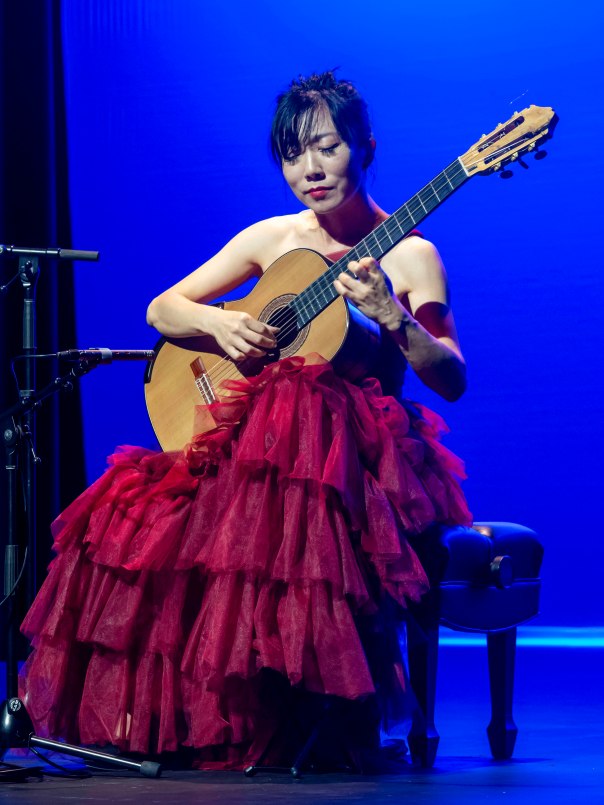
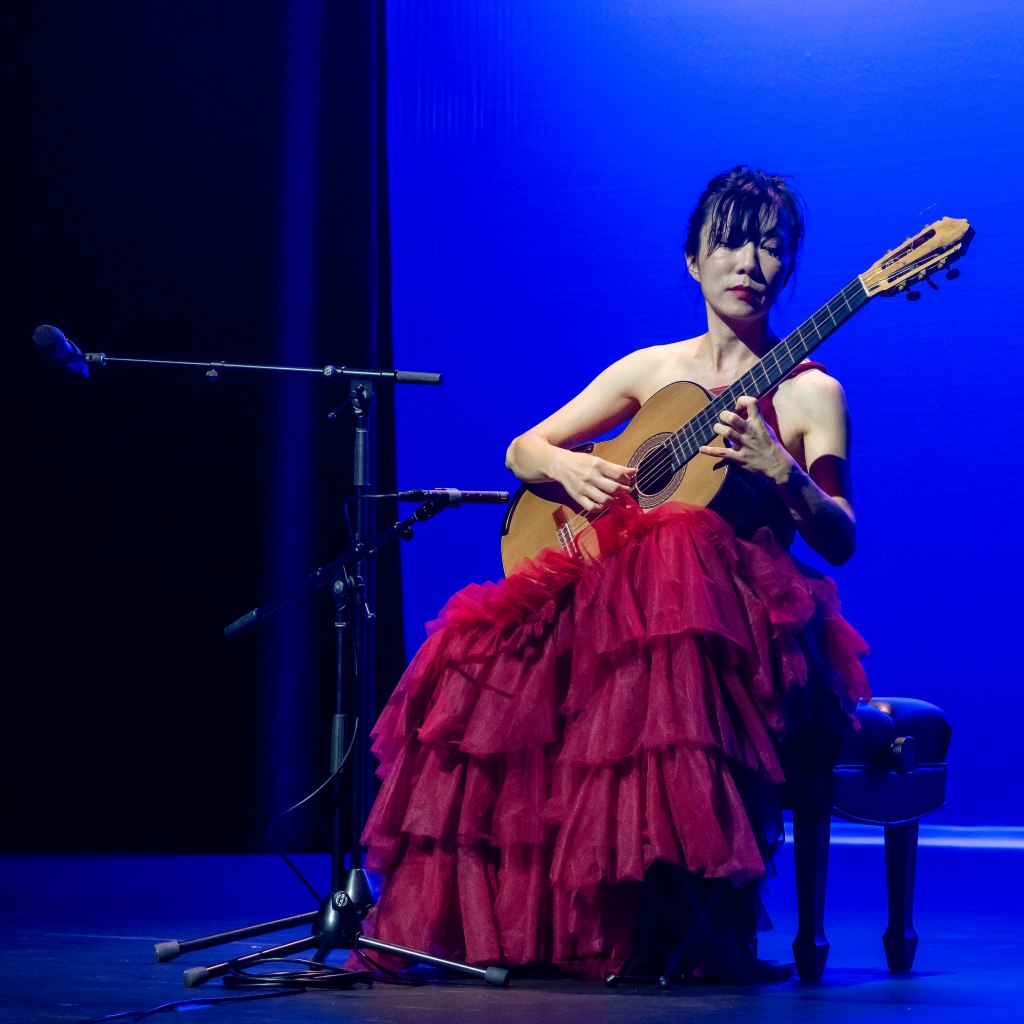
With nobody else onstage to greet her, Yang walked in from the wings, acknowledged the enthusiasm of what turned out to be a good-sized audience, sat herself down on an adjustable piano bench, and positioned herself – and a rather fluffy red skirt – on her foot rest. Though the applause was robust, there were no jumpers, no double-time clappers, and no whoopers in the crowd to indicate the presence of rabid fans.

Six minutes later, things would be different. Yang opened fire with Isaac Albeniz’s Asturias (Leyenda), a piece that you never forget once you’ve heard it. Nor do you have to see it being played to appreciate its rapidly compounding difficulties. It begins with a flamenco-styled bassline, layers on a trilling treble, and peaks with repeated strums stomping as the third layer – the fiercer, the better – as the bass and treble keep going, seemingly uninterrupted.

Or at least the flow sounds steady, undeflected by the ferocity, in the John Williams recording of 1974, which made me fall in love with the piece. Gradually, the sublimity of the slow middle section etches itself into memory after repeated hearings, the more so as you appreciate how perfectly it circles back to the opening bassline, trills, and strums.

At the Parr Center, Yang played better than she had in either of her 2022 studio recordings, first on the Decca label and then on a rushed and misjudged retake on Warner. She set the land speed record for the Asturias on Warner but surrendered her grasp of the argument. Now she was just a tad slower than Williams in the bravura sections, still in a thrilling groove, and only marginally swifter in the malagueña middle, her lucidity abounding and connecting both sections, with sublime harmonics perfectly timed.

An audacious beginning, to be sure. Now there were whoops aplenty, a couple of them uncomfortably close to my ears. Yang stood up with a bigger smile, holding her beautiful guitar in her open hands in a way that surely plays well at the seven churches on the 15-city tour. But she didn’t begin speaking to us until she reset herself and swiveled a second microphone her way.

We had begun our four-continent journey in Spain, she told us, and would continue to Paris with a couple of pieces from the new album. Again, these were transcriptions of pieces originally composed for piano that showed two sides of Satie, the spare and contemplative Gnossienne No. 3 and the unexpectedly frisky “La Diva de l’Empire.” Prepare for a cakewalk, Yang told us.

Of course, the cakewalk was the more adventurous Satie setting, especially since Yang is contriving on tour to replace vocalist Héloïse Werner, who sings with her on the recorded track. She soloed with a beautiful lilt, especially jaunty and supple where she was replacing Werner’s vocal.

Onward to Asia, where we were given a Japanese treat, an excerpt from Ryuichi Sakamoto’s Merry Christmas, Mr. Lawrence film score, my first gratifying discovery of the evening. You can actually check out the final track on Yang’s 2023 X Culture release and see how her version improves upon the composer’s soundtrack album – sadder, moodier, and poignant. To my ears, the Parr Center performance was even better, adding dimensions of foreboding as the tempo quickened, heartbreak and disillusion as the performance climaxed, crowned by a beautifully delicate coda.

Those in the audience who knew Sakamoto’s original could more fully appreciate the extras that Yang had imaginatively lavished upon it. For me, Yang’s excellence as a composer did not become apparent until she unveiled her own Xinjiang Fantasy. The tempo changes and the trilling treble might tell us of Yang’s desire for more pieces like Asturias in the repertoire – and perhaps more room for improvisation. Compared to the version she recorded on the same Decca album where her Asturias first appeared, the Parr version was more thoughtful, contemplative, and impressionistic, all of the percussive embellishments banished.

Perhaps because of the scarcity of flights from China to South America, Yang stopped over in Mexico for a couple of pieces by Manuel Ponce before crossing the equator. “Scherzino Mexicano” was an adorable departure from the broodings that had preceded, and “Estrellita” was like a sentimental homecoming, played ardently with touches of the sublime and Yang’s bell-toned harmonics.

The rest of our stay in the New World was more casual, relaxed, and jazzy. Astor Piazzolla chipped in one of his multitudinous tangos, “La muerte del ángel,” and Luiz Bonfá welcomed us to Brazil with his famed “Manhã de Carnaval” from Black Orpheus. We lingered in Brazil, in bossa nova, and in Black Orpheus with Antônio Carlos Jobim’s “A felicidade” before arriving at last in the USA.

So you can’t name a single piece written in America for classical guitar, right? Yang to the rescue with three superb transcriptions of tunes by Erroll Garner, Jerome Kern, and Billy Strayhorn. Garner’s “Misty” was the most innovative of the three, most adventurous in its bravura variations on the midsection (or bridge) of the familiar melody. Strayhorn’s “Take the A Train” was probably the most popular selection of the evening, delivering Duke Ellington’s familiar keyboard intro transposed to guitar, along with some of the familiar big band riffs. Nor did “Smoke Gets in Your Eyes” disappoint.

These American arrangements may indicate a new direction for Yang in upcoming releases, since there are no studio parallels to be found on Spotify or Apple Music. It’s tempting to think that Yang is also at the vanguard of a new wave of national tours by solo classical artists. That Apple and its new Apple Platoon label are at work preserving and recording classical music in higher fidelity and promoting live performance is as amazing as it is encouraging.

Berko’s “Sacred Place” Is the Chief Revelation at Master Chorale’s Wholeness Concert

Review: Wholeness Concert at First Presbyterian Church

By Perry Tannenbaum

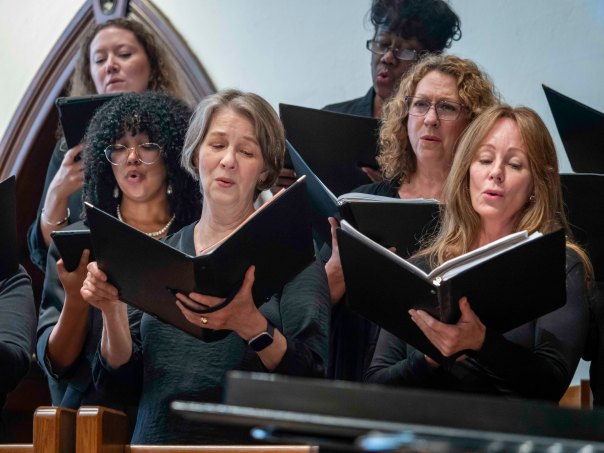
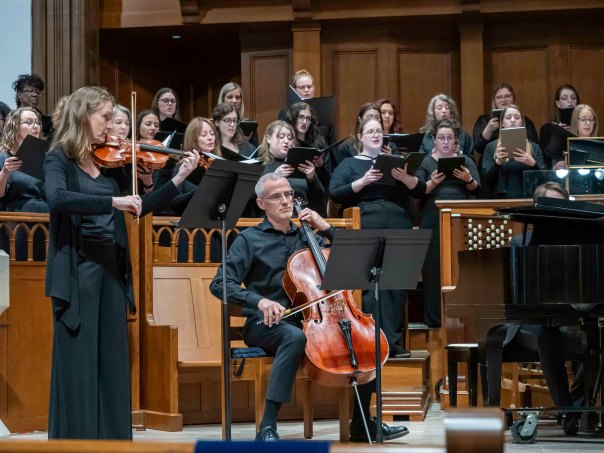
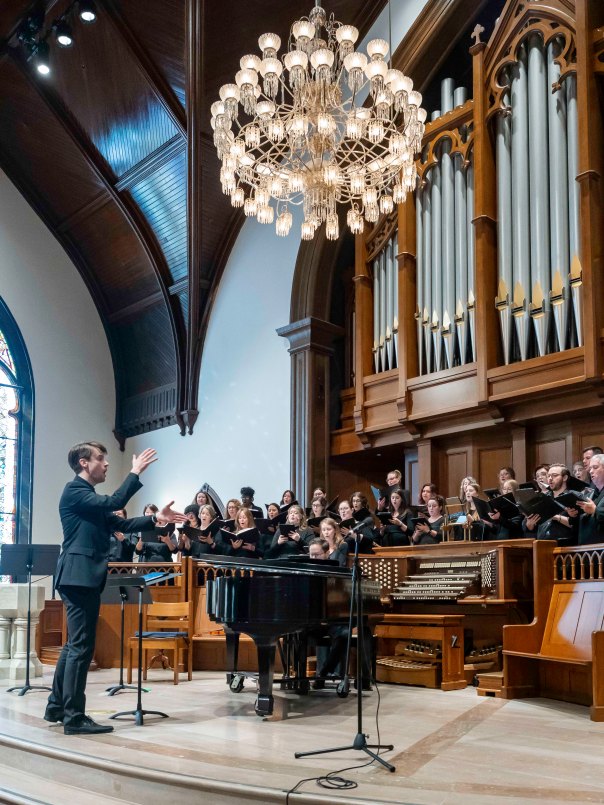
May 17, 2025, Charlotte, NC – Noted singer, conductor, and educator Helen Kemp (1918-2015) was most concerned with the musical training and development of children through children’s choirs when she coined her beloved mantra, “Body, mind, spirit, voice. It takes the whole person to sing and rejoice.” But in times of widespread warfare, terrorism, societal fracturing, and political upheaval, the Charlotte Master Chorale aptly adopted these words to subtitle its final concert for the 2024-25 season. Their “Wholeness” concert, conducted by Kenney Potter and Philip Biedenbender, affirmed the First Presbyterian Church of Charlotte as a place of healing, harmony, and communal gathering.

With Alex Berko’s Sacred Place as the centerpiece of the program, ecumenical engagement became the most salient feature of Wholeness for me. Between Shabbat morning services at Temple Israel of Charlotte and a Charlotte Symphony concert at dusk with works by Jewish composers Bernstein and Copland topping the marquee, Wholeness – and especially Sacred Places – proved to be a surprisingly perfect bridge. Berko’s six-part service is modeled on Jewish liturgy, with four of the six sections bearing the Hebrew title of a foundational prayer. These core elements of this prayerful suite were framed by an identical opening and closing prayer, excerpted from Wendell Berry’s 1966 poem, “The Porch Over the River.”

The prayers became a distillation of the poem, where Berry’s porch was the most benign human intrusion upon the primeval serenity of nature at a wooded riverfront. As for the Jewish service, texts chosen by Berko were only obliquely connected to the original Hebrew – actual connection in the instance of “Amidah” vestigially retained only in the composer’s introductory note. The music echoes the transition in Berko’s chosen texts from the hushed tranquility of Berry’s riverscape to John Muir’s evocations of majesty and glory in his eloquent description of Yosemite. It was originally sent to Theodore Roosevelt, urging the president to preserve this magnificent temple of nature. Only the connection between text and the literal meaning of “Amidah,” mostly a silent prayer said while standing, remained obscure.

Musically ranging from solo vocals to grand choral proclamations – accompanied by violinist Sarah Case and cellist Peter Case, with Biedenbender at the keyboard – the “Amidah” was only slightly eclipsed by the ensuing “Shema,” which superbly referenced the cornerstone of all Jewish prayer. Orthodox Jews will have the words of the “Shema” on all their doorposts and say them at least two times daily, if not three, biblically enjoining Israelites to listen and hear that the Lord is their god and the Lord is one. For this pivotal section, Berko chose William Stafford’s 1961 poem, “In Response to a Question: ‘What Does the Earth Say?’” Unlike the voice of the Lord, thundering from the peak of Mount Sinai and proclaimed by Moses to the people below, Stafford strains to hear what the earth says. Presumably, the poet has divined its message: “The earth says have a place, be what that place requires…” So again, Berko’s music roars and whispers.

Text for the “Mi Shebeirach” had a smidge of Hebrew in it, but contrary to Berko’s belief, it was not a translation of the actual prayer. Instead, it was taken verbatim from a setting that Debbie Friedman had written for the prayer in 1993, using the English she had interspersed with the original Hebrew. The Friedman version has amazing popularity, widely replacing the original “Mi Shebeirach” prayer across the English-speaking world, so Berko’s mistake is not unusual. Nor is it the worst.

A drama that was judged for the 2013 Jewish Plays Project, The Man in the Sukkah, presumed that the song, with its mishmash of Hebrew and English, was sung by persecuted Jews during the days of the Holocaust. When Berko’s setting reached the brief Hebrew phrase in Friedman’s lyric – “Bless those in need of healing with r’fuah sh’leimah” – the section, which had been more like recitative until this point, swelled with melody and feeling. The section that followed, “Kaddish,” retreated briefly toward the quietude of “Closing Prayer” with a snippet from Rabidranath Tagore’s Stray Birds (No. 273). It was good to have the delayed final words, “at the margin of starry silence,” printed out in the program booklet for the sake of clarity – and to fully savor the music’s sublimity.

Although the other nine pieces on the program didn’t benefit from the favor of being printed out – or credited, when the lyricist was not the composer – they were all worthy of the Wholeness theme. None of them were at all too brief, cute, or at all bouncy. The closest to rejoicing was Reginal Wright’s “We Are the Music Makers.” Less facile and more propulsive was the Adam and Matt Podd arrangement of “How Can I Keep from Singing,” with touches of melancholy throughout, especially in its concluding decrescendo.

The most intimate and solemn of the short works was Don Macdonald’s “When the Earth Stands Still,” with lyrics by the composer that merited inclusion alongside Berko’s texts. But the most remarkable piece of the afternoon was arguably Craig Hella Johnson’s beauteous, slightly sugary “Psalm of Life,” set to one of Mattie J.T. Stepanik’s Heartsongs. Before succumbing to a rare form of muscular dystrophy at the age of 13, the astonishing prodigy appeared on TV with Larry King, Oprah Winfrey, with former president Jimmy Carter on Good Morning America, and on New York Times bestseller lists on multiple occasions with his books of poetry and essays. Like all the other composers and writers behind the Wholeness concert, I’d never been acquainted with Stepanik before. He was a revelation to me among revelations.

Must-See Classical Abounds at Spoleto Festival USA

Reviews: Opera, Chamber Music, Orchestral Music, and Alisa at Spoleto

By Perry Tannenbaum

Three different sea changes have reshaped Spoleto Festival USA since Nigel Redden, responding to the WSYWAT turmoil that followed in the wake of George Floyd’s brutal murder, departed after the 2021 season. Redden saw himself in the crosshairs of the 2020 We See You White American Theatre manifesto, though he wasn’t strictly a theatre person, and felt that steeping as aside was the honorable thing to do.

Diversity has never been inimical to Spoleto, which has always looked more Euro and Afro than American. Yet as Spoleto 2025 concludes, a near-total change of artistic leadership has transpired – with an unmistakable lean toward diversity. Mena Mark Hanna has replaced Redden as general director. Paul Wiancko has filled the void left by the charismatic Geoff Nuttall’s sudden death, taking over the reins of chamber music programming. When John Kennedy was abruptly dismissed after the 2023 season, Timothy Myers became music director, wielding the Spoleto Orchestra baton.

And Joe Miller, after 20 seasons as director of choral activities, is resigning to lead the Vocal Arts Ensemble in Cincinnati. His Spoleto farewell, Bach’s Mass in B Minor, will be followed soon by an announcement of his successor in Charleston.

Conversely, Spoleto is responding to fiscal, box office, and government funding pressures to be more self-sufficient. While Kennedy’s programming arguably made the  festival America’s chief hub for 21st century classical music composition, his afternoon Music in Time programs were as much box office poison as they were cutting edge. That experimental ghetto has disappeared while Wiancko and Myers have integrated more infusions of contemporary, new, and world premiere music into the festival’s chamber music and orchestral offerings.

Beyond shrinking the outré and avant garde, Spoleto is expanding its pop, punk, folk, and R&B presentations to no less than a dozen Front Row events with Patti Smith, Band of Horses, Mavis Staples, Lucinda Williams, and Jeff Tweedy among the headliners. The strategy is to “expand the aperture” in Hanna’s words, offset the losses of more adventurous fare, and make Spoleto more accessible to a wider audience. Hopefully, these newbies may be tempted into tasting the 17-day festival’s higher protein offerings.

Other belt-tightening measures include offering 15%-off discount packages of tickets to multiple events, and ending of the longstanding tradition of inviting a theatre company from abroad to co-tenant the Dock Street Theatre with the lunchtime chamber music series. Wilder still, two of the Dock Street chamber music concerts were staged during evening hours! Sacrilege.

Finally, little touches in the festival brochure and the program booklet underscored a deepset commitment to making Spoleto more navigable and customer-friendly. Jazz fans could gorge on all the Spoleto headliners within the space of 10 days, while theatre lovers could get their fill in seven.

While both of these lineups were tilted toward the latter half of the festival; opera, dance, and orchestral music could be largely traversed within the first 10 days; along with seven of the eleven chamber music programs. As compacted as the scheduling was for festivalgoers devoted to one genre, omnivores like me who preferred a mix found themselves stretched. For us, the scheduling was scattered and fragmented.

How appropriate, then, that the most awesome classical music event this season, intertwining 27 new works by living composers with J.S. Bach’s Six Cello Suites, was Alisa Weilerstein’s FRAGMENTS. Conceived during the global pandemic, FRAGMENTS has some of the randomness and the quirky, curated individuality of a mixtape. Weilerstein did not commit herself to playing the Suites in their entirety or – within each Suite – in their traditional order. Or tempo.

Beyond that, in commissioning 27 three-part compositions roughly 10 minutes long, Weilerstein obtained the right to shuffle the order of the parts and to slice and dice the new works to create smooth transitions into each other and the Bach. Layering on stage direction at Sottile Theatre by Elkhanah Pulitzer, scenic and lighting design by Seth Reiser, and costumes by Molly Irelan, Weilerstein crafted her FRAGMENTS into a creation you literally had to see.

As revealed in an interview event moderated by Martha Teichner, Weilerstein has no intentions of releasing an audio recording of FRAGMENTS. Video only. However, the cellist will honor the composers she commissioned by recording their works as written. All in all, Weilerstein was onstage soloing and fielding interview questions for more than seven hours spaced over six days, capped with world premiere performances of FRAGMENTS 5: Lament and 6: Radiance on her final day.

Elgar and Olga Headline a Sparkling Euro Evening at Symphony

Review: Elgar’s Enigma Variations at Belk Theater

By Perry Tannenbaum

February 14, 2025, Charlotte, NC – Russian-born pianist Olga Kern has now played in Charlotte at least five times, making her one of our most popular and welcome guest artists. Yet, it wasn’t exactly inevitable that she would someday sit before us in a Charlotte Symphony program headlined by the music of Edward Elgar. We’ve had distinguished artists here playing Elgar concertos, including violinist Nigel Kennedy and cellist Alisa Weilerstein, but Sir Edward’s fame has never rested upon his scant keyboard output, though his piano quintet is a masterpiece.

More predictable, perhaps, was the pairing of German-born guest conductor Ruth Reinhardt, the music director designate at the Rhode Island Philharmonic, with Elgar’s Enigma Variations (1899) – or with Robert Schumann’s Piano Concerto, since it was premiered in 1842 with Clara Schumann, the composer’s wife, at the keys.

Better yet, Reinhardt brought a piece with her by Josef Suk, a Czech composer we rarely hear in the Queen City. Suk was Antonín Dvořák’s most prized student, and his Pohádka (Fairy Tale) premiered as incidental music for Julius Zeyer’s play, Radúz and Mahulena, less than eight months before he became Dvořák’s son-in-law on his mentor’s silver wedding anniversary in 1898. Adding to the poignancy of this very romantic and dramatic music, Dvořák and Otilka would both die less than a year apart before Suk could ever celebrate his seventh wedding anniversary.

The opening movement, “The True Love of Radúz and Mahulena and Their Sorrows,” rearranged from Acts I and III, swept in with the warm cellos, dominating until the high winds and then the violins entered. CSO concertmaster Calin Ovidiu Lupanu had a lovely pair of solos sandwiched around the two sorrowful orchestral swells, the first triggered by the timpani and the second by the French horn. Since Suk was also a violinist, co-founder of the famed Czech String Quartet, it might be possible to imagine Lupanu as the composer serenading his bride-to-be with the Princess Mahulena’s theme, “Lovely Maiden with the Violin,” when the spotlight fell on the concertmaster.

Plenty of scurrying sounds sketched the “Game of Swans and Peacocks” intermezzo, apparently a game played by the young lovers (duck and goose, anyone?). The liveliness crested grandly into hints of massive carnival joy, bounced by the percussion, winds, and brass. While the printed program omitted the “Intermezzo” labeling from the ensuing movement, “Funeral Music,” you’ll find it preserved in the gorgeous digital program, where useful glosses on each section of the Enigma Variations also appear. Even before the twin tragedies would befall Suk, he a had natural talent for this lugubrious solemnity, initiated by the cellos and basses. There’s a uniquely queasy sound from the winds at this funeral that I jotted down as “nauseating” at first blush.

“The True Love” was long enough to elicit applause from audience members who weren’t following in their programs, but even though a percussionist pointedly rose at the end of “Funeral March” and readied his cymbals to launch the finale, more applause splurted forth to provide an extra gap before “Runa’s Curse and Victory of Love.” Subtitles above the stage cuing the beginning of movements could have prevented or muted these outbursts, which seem smilingly tolerated by the musicians rather than welcomed. The juicy story of Runa’s curse and the lovers’ escape, since Zeyer’s play will not likely ever be seen again, would have been a nice topping to the rising and falling episodes of the music, raucous in the wake of the cymbals before receding into a mellow calm with a lovely spot for clarinetist Taylor Marino.

Runa’s curse, the program or supertitles could have told us, turns the lovely Mahulena into a poplar tree and erases Radúz’s memory. Yet love – or fabulous luck – conquers all! The tragical Radúz somehow decides to chop down the poplar. Out pops Mahulena, breaking Runa’s curse and killing the witch. The last graceful decrescendo glided into a valedictory solo from concertmaster Lupanu evoking the Princess.

To be fair, adding supertitles to Reinhardt’s finely sculpted performance of Fairy Tale wouldn’t have come to mind if supertitles hadn’t proven to be such an enjoyable extra in CSO’s Enigma Variations, last given in 2010 with Christopher Warren-Green at the podium in an all-Elgar program – the program that featured Weilerstein’s Charlotte Symphony debut. Even if you had read the 15 blurbs from the digital program, occasionally condensed on the projections, you might not remember them all while the music was playing. As early as the second section, where the opening Andante slides smoothly into Variation I – (C.A.E.) L’istesso tempo, dedicated to his wife, you could lose track of where we were.

When we reached Variation XI (G.R.S.), for example, we could more fully be in the moment knowing that the piece wasn’t really about organist George Robertson Sinclair but about his bulldog plunging into a river. No doubt Elgar was purposely (needlessly?) cryptic in his Enigma dedications, as in the penultimate Variation XIII, dedicated to (***) rather than Lady Mary Lygon or a previous fiancée. The last, dedicated to himself, is initialed E.D.U. Word of warning: though this towering finale should be crowned with an obbligato organ, the impressive array of upstage organ pipes have never made a peep at Belk Theater since it opened in 1992. Temper your expectations if they’re on a Westminster Abbey scale.

Warren-Green always had a wonderful touch with programmatic music, usually engaging and helpful when he lent his bass-baritone to witty and concise spoken intros. Reinhardt had no less sensitivity or success with the music, so the supertitles added zest, flavor, and purpose to the music. But she never spoke to us, missing the opportunity to shape the occasion or even briefly add extra coherence to the program. This was Valentine’s Day, and all of the listed works were inspired by a wife or a fiancée.

Kern certainly personified the theme, playing the grand work inspired by its first soloist, Clara Schumann. It’s easy to forget the Cliburn Competition winner’s first appearances in Charlotte when she pounded Rachmaninoff to raucous submission before her Symphony debut. Carolinas Concert Association subscribers were absolutely besotted with her beauty and power in 2006 and 2007. Only when Alan Yamamoto reined her in on the Rach 2 later in 2007 could I jump onto the bandwagon. In the outer Allegro movements of the Schumann, she was certainly the powerhouse that Stephen Hough was when he gave the concerto here in 2014 with Warren-Green, and almost equaled his magical finesse in the beguiling middle movement Andantino. Two dazzling encores, immediately smashing the evening’s Valentine motif with the first, Gershwin’s “Fascinating Rhythm,” ensured that the devotion of her Charlotte fanbase would endure.

Bach and Mozart Strive With Stravinsky at Knight Theater

Review: Orion Weiss with Charlotte Symphony

By Perry Tannenbaum

January 11, 2025, Charlotte, NC – Although we still get steady rations of Mozart from Charlotte Symphony since the days when Christof Perick passed the baton to Christopher Warren-Green, we havn’t heard much Bach from the orchestra since the autumnal Bachtoberfest faded from Symphony’s portfolio nearly a decade ago. This is understandable, if lamentable: after bringing us a double dose of the Baroque titan in 2018 – plus a shot of Vivaldi’s Four Seasons – violinist/conductor Aisslinn Nosky became a mainstay at Bach Akademie Charlotte (and one of the annual Charlotte Bach Festival’s primary claims to national prominence). A return to the Classics Series, set for 2020 via the Leipzig master’s Brandenburg Concerto #2, was quashed by the onset of COVID.

You could say that the suspense has been building. For a while, it seemed like CSO was tacitly conceding the high ground to the Akademie and its festival, presented by musicians from across the country who perform on authentic Baroque instruments. Playing the music of Bach on modern instruments, you could argue, has become paradoxically retro.

Yet the more deeply you explore musical history and authenticity, the more obvious it becomes that ancient (looking at you, Vivaldi-Schubert-Tchaikovsky) composers eagerly embraced new instruments, recycled their compositions for different instruments and different-sized ensembles, and encouraged musicians to copy, interpret, modify, and spread their music as they pleased. Reverence for absolute fidelity to original compositions is as absurd as assuming that top recording artists, whether it were Bob Dylan or Taylor Swift, would never allow covers of their greatest hits. If it sounds good – and magahits often do – go for it!

So it was heartening to find that CSO was intrepid enough to present a Bach Orchestral Suite in a modern-instrument performance and, perhaps to underscore the point, Johann Sebastian’s Keyboard Concerto No. 6, adapted by the composer himself from the Brandenburg No. 4. A certain amount of ambiguity pervaded Knight Theater as guest conductor Jeri Lynne Johnson made her debut. The house that greeted her was packed to the topmost row of the balcony. Yet the cause for the crush may have been the cancellation of the previous evening’s performance due to a “snowstorm” that had generated more bloated hype than solid news.

The only sparsity was on the Knight Theater stage. Johnson and the CSO would not be discarding all of the orthodoxies of the authenticists: the size of the orchestra had been scaled back to those employed in Bach’s days and those that would have played Mozart’s Symphony No. 25. The interloper on the program, Stravinsky’s Concerto for Piano & Wind Instruments, was also conspicuously downsized.

Viewed in profile, Johnson’s black suit – and her decisiveness – enhanced her resemblance to Kamala Harris. Symphony responded energetically to her baton all evening long, yet there was no lack of lyricism or finesse when Bach’s Orchestral Suite No. 3 transitioned from its brassy opening Overture to the famed Air (on a G string). Concertmaster Calin Lupanu, accorded considerable space in the opening movement, spearheaded the ethereal violin section to the requisite sublimity as the big tune gracefully swelled. Their intimacy quickly pointed up the advantage of a trimmed ensemble.

Subscribers who hadn’t scrutinized their program leaflets, let alone scanned its QR code for the full booklet, were likely shocked by the mass departure of the string sections, the arrival of the Steinway, and the empty chairs that remained as pianist Orion Weiss made his genial entrance. Deceptive! After a rather solemn Largo opening from the winds, with a somewhat promising crescendo at its center, Weiss’s first notes from the keyboard in the Allegro section were savage knuckle-busting clusters, met by a lusty clamor from the previously wan winds, crowned by a thumping of timpani.

Amid the cascade of chords that Weiss inflicted on the keyboard, a jazzy percussive rhythm infectiously emerged – even if it was impossible to determine whether the blizzard of notes Weiss was playing were the right notes. Suddenly, Weiss had taken on the appearance of a febrile Russian madman! The ensuing Largo provided lyrical reassurance, with some primeval passages set aside for oboists Erica Cice and principal Timothy Swanson. The pacing of the closing Allegro was almost as frenetic as the opening: if there were wrong notes here, Stravinsky had put them there with wicked glee.

This image has an empty alt attribute; its file name is 2025bach-mozart-7.jpg

Unless you were expecting an enormous horde of string players to flood the stage for the Mozart symphony, the biggest surprise after intermission was at the beginning, when Weiss returned for the Bach Keyboard Concerto. When Johnson stood by, she applauded not only Weiss but also flutists Amy Orsinger Whitehead and principal Victor Wang. Jackson’s outfit hadn’t been the only one I’d noticed until then. As she took her place with the winds for the Orchestral Suite, Whitehead’s black attire seemed to be strikingly ornate and elegant. So this featured slot explained the seeming breach of decorum.

Nor do you need to go more than a couple of bars into the Brandenburg Concerto No. 4 or its Keyboard Concerto offspring to savor the impact of its paired flutes delivering the catchy theme of its opening Allegro. Baroque aficionados, on the other hand, might have needed a minute or so to acclimate themselves to hearing the more rounded and gilded timbres of modern metal flutes. Their record shelves are likely clogged with trendier authentic recordings, marked by the presence of ancient wooden flutes and their hollower sound. Frankly, it was refreshing – and fun – for me, and Weiss bore a distinctly merrier look as well, though his cadenzas remained challenging.

Let’s not waste any more time in declaring that Charlotte Symphony retains its zest for Mozart. With this trim ensemble and Jackson’s accenting, what we heard at the Knight ranked among the most exemplary performances CSO has lavished on a Mozart symphony, even if the youthful No. 25 doesn’t rank among his very best. The opening 25-note sequence from the legendary 17-year-old prodigy, a 16-note vamp followed by a nine-note melody, hasn’t worn out its winsomeness in over 250 years.

Standing out almost as much as the crispness of the orchestra were the lovely solo spots from Swanson, capping what was perhaps his finest evening since assuming the first oboe chair this season. Jackson was gratifyingly bold in differentiating Mozart’s dynamics, finishing out the penultimate Menuetto with a satisfying crescendo. The closing Allegro featured more assertive playing from the winds pitted against the ferocity of the strings. Every now and then, we could discern Swanson’s oboe hovering above the fray.

Caritas a Cappella Delivers a Mix of Ancient and Modern Gems

Review: Caritas a Cappella Ensemble @ St. Alban’s

By Perry Tannenbaum

January 19, 2025, Davidson, NC – With so many churches in the metro Charlotte area, it’s little wonder that the Queen City is fertile ground for choirs and choristers – and receptive audiences for choral music. Considering this profusion of talent and activity, as well as the total absence of Caritas A Cappella Ensemble press releases in my voluminous mailbox and the lack of catch-up info on the Caritas website, I was able to forgive myself for not having known about this organization, founded by Cathy Youngblood in 2017, until signing up for this review.

More ominous, as we entered the St. Alban’s Episcopal Church, was the elephant in the room: a spanking new grand piano in the middle of the sanctuary, standing in front of two rows of music stands where the singers would be placing their iPads and music scores. Was there somebody at Caritas HQ (if there’s more to it than the PO Box given at the website) who needed to learn the meaning of a cappella?

Thankfully, the piano was there for a delayed pre-show, so the mammoth obstacle turned out to be a blessing. For once, my wife Sue and I had arrived early enough for a Music at St. Alban’s concert to take in the prelude event, where star students from the Davidson area are given the opportunity to play for an audience and warm us up for the featured guests.

Those of us who had arrived on time for the pre-show were rewarded, while awaiting the arrival of Tianyang Chen, with a couple of delightful morsels of Brahms from his teacher, Cynthia Lawing. Once Chen had gone through his recital of pieces by Ginastera, Liszt, Brahms, and Debussy, the elephant could be moved to make way for the marquee players.

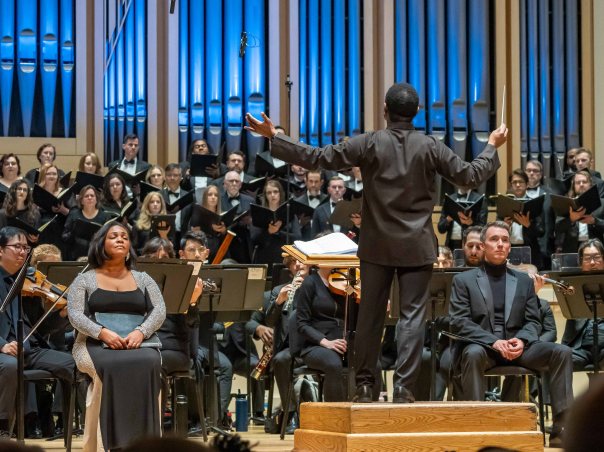
Surprises didn’t cease with the piano’s exit. Caritas artistic director Jeremy Mims entered the sanctuary in the usual way, but the Ensemble didn’t take their places behind the music stands. Instead, they encircled the audience – men in front, women at the rear of the hall – for the opening selection, “Musick’s Empire” from Triptych by Lloyd Pfautsch (1921-2003). Besides the ethereal surround sound blend, this presentation heightened the drama when Mims cued the female voices. Fittingly, the outré deployment of the Ensemble was devoted to a modern piece. It wasn’t until the singers took their places after this opening that the title of their concert, “A Capella Through the Ages,” could be fulfilled in a more orderly, chronological manner.

Fussing a bit with the printed program, replacing a couple of titles on the list with new selections and occasionally shuffling the order of performance, the concert kept to its original design, flashing back to the Baroque days of Vivaldi, Palestrina, and the Scarlattis with a nice mix of sacred and secular lyrics. Whether it’s Handel or Bach, we hear many of the mightiest works from that wondrous era, so it was nice to sample these less familiar gems.

What interested me most on the program was the predominance of more modern pieces, from the days of Bruckner, Holst and Vaughan Williams to the present day. Pieces like these, which sound surprisingly retro compared to the modern chamber and orchestral pieces we’re familiar with, have always been mainstays at Spoleto Festival USA concerts down in Charleston, SC, so I was eager to see how these performances would compare and how a North Carolina audience would react.

The composers’ names were no less intriguing and enticing. We don’t readily recognize contemporary composers Elaine Hagenberg (1979-), Kevin Memley (1971-), Eric Whitacre (1970-), and Pärt Uusberg (1986-) by their last names. As for Frank Tichelli (1958-), whose “Earth Song” was inserted after the program was printed, I was nowhere close to knowing how to spell his name when Mims announced it. “Sikelly” was my first stab. Well-matched to the slow-paced, richly-scored music, Earth’s lyric was rather simple at its core: “Oh war and power, you blind and blur. The torn heart cries out in pain. In pain. But music and singing have been my refuge, and music and singing shall be my light.”
Uniquely, the beauty of the hallelujahs later on was more like a solemn sunset than a jubilant festival. Sadly, Caritas’s enunciation was no clearer than that of multiple recordings – including one by the famed Seraphic Fire – I sampled on Spotify, which offered welcome first aid in deciphering the lovely lyrics. Consonants were often unclear, vain routinely indistinguishable from pain. And vowels! Try to hear “light” when that word pops up!

Never again will I blame myself for losing track of what a choir is singing in Latin (or any other foreign language) when I have the printed text before me. For that reason alone, Uusberg’s magical “Ōhtul” nudged “Earth Song” aside for me as the most impressive piece on the program. Since translations were appended to the program, full contentment with the performance was a simpler matter. The grand swell, as the poet’s song paddled away, was a lovely surprise after everything else – bird, little flower, and forest trees – had been silenced and lulled to sleep by the twilight. Erkki-Sven Tüür (1959-) and Arvo Pärt (1935-) will need to leave some space for this youngster on their pedestal as my favorite Estonian composers.

As for the practice of printing translations for vocal performances, a brief word. Follow the practice of most opera companies nowadays who project subtitles even when the operas are performed in English. Print the English texts with the translations for our fullest enjoyment.

“Nunc Dimitis” by Gustav Holst (1874-1934) impressed me nearly as much as the Uusberg, with solos from soprano Sarah Ochoa and tenor Nicholas Setzer. The soloists not only sang their brief solos purely, they set the stage for responses from the Ensemble at a dramatically augmented volume. Wisely, the Latin didn’t appear in the program, clearing the pathway to pleasure when we went straight to the translation.

Of course, the fullest experiences at this concert came from songs in our language that were either familiar to us or readily grasped in real time. The most enjoyable of these included Hagenberg’s joyous “Alleluia,” though it sported few more words aside from amen, and the finale that followed, “Ezekiel Saw de Wheel” as arranged by William L. Dawson (1899-1990). Most surprising of all was Vaughan Williams’ “O Mistress Mine,” from his Three Elizabethan Part-Songs, a rather frisky departure for a composer better known for the grandeur of A Sea Symphony, the anguish and majesty of Job,and the simple tragedy of Riders to the Sea.

Gerald Finzi’s “My spirit sang all day,” mercifully brief, didn’t really speak to me, and “Shenadoah,” as arranged by James Erb (1926-2014) disappointed. Crossing the “wide Missouri,” we have an inalienable right to more bass and sinew between the shores. Bypassing my personal distaste for the foundational baby-worship that pervades Christianity, the pairing of Whitacre’s “Lux Aurumque” and Memley’s “O Magnum Mysterium” were more pleasing to me in Latin, since ignoring the translations – and savoring Memley’s heavenly harmonies – was an option.

Amusingly enough, I had to adjust my attitude toward Caritas’s choice of William Billings’ “I am the Rose of Sharon” past the midway point of a largely repetitive and pedestrian performance. When the famed snippet from the Song of Solomon reached its denouement, “for, lo, the winter is past and the rain is gone,” you could look out the huge St. Alban’s windows and see that the rain really was stopping in response to these pertinent repetitions.

If you missed that, you couldn’t help but notice streaks of bright sunlight suddenly streaming across the front rows of singers. In his intro to the piece, Mims had hoped that the concluding verse would bring an end to the rain. But the power of Caritas’s incantations exceeded this extravagant hope. Repetitions and all, you won’t find me arguing with such cosmic success!

Photos by Perry Tannenbaum

Review: “Messiah” at Knight Theater

Handel’s Messiah Rejoices Greatly with Charlotte Symphony

By Perry Tannenbaum

December 13, 2024, Charlotte, NC – While I’m not as faithful to the Yuletide visitations of George Frideric Handel’s Messiah as I was ages ago at Queens College CUNY, where I attended free concerts at least three of my four years, my diligence has lately improved. In the last decade, I’ve seen four performances, counting the one that launched this weekend’s run at Knight Theater, with Kenney Potter preparing the Charlotte Master Chorale and guest conductor Julian Perkins leading the Charlotte Symphony. I’d actually had my heart set on a Messiah performed at the Teatro Colón in early November, but an unresponsive press office and an unexpected dress code, discovered at the box office after we had landed in Buenos Aires, thwarted our plan.

Wrapped into our plans were an opportunity to hear how a Bach choir flying in from Stuttgart would handle the King’s English, and how the vocalists would compare with our esteemed Chorale and guests. Not to mention the fabled acoustics of Teatro Colón. Lacking those Argentinian comparisons, I can still say that the Chorale was a match for any chorus I’ve heard in Messiah, and that the guest vocalists were the best I’ve heard in recent memory, including those who performed with the New York Philharmonic in 2015. Those who look for a massive orchestra might have reason to pause before rushing to the Knight, for the scale of forces led by Perkins seemed more like the North Carolina Baroque Orchestra that performed with the Chorale at First United Methodist in 2018 than the band we saw at the Knight in 2017. Over a dozen different orchestrations evolved during Handel’s own performances of Messiah over 17 years, from 1742 to 1759, so Perkins could easily match a version to the number of his orchestral recruits.

Leading from behind a harpsichord – pretty novel in itself – Perkins had some interesting ideas on staging, deploying the brass to the balcony for their dramatic entrance into “For unto us a Child is Born” and then after intermission, bringing principal trumpeter Alex Wilborn downstage for a climactic “The Trumpet Shall Sound” confrontation with bass baritone Hadleigh Adams. Otherwise, it would seem presumptuous to say that Perkins, for all his Handel and Baroque expertise, directed any of the four guest soloists at all. Each one of them was magisterially confident and self-assured. Hadleigh was not the least of them in that regard, striding auspiciously to centerstage for the first time and quaking the hall with his “Thus saith the Lord” proclamation. After delivering his towering “Why do the nations so furiously rage together?” rebuke at the crest of Part 2, Hadleigh loudly clapped his book shut and stormed back to his seat.

Richard Pittsinger was not quite so flamboyant, for the tenor wore his hair the same way before and after intermission. But his impact came sooner with supremely creamy accounts of the “Come ye, my people” recitative and the “Ev’ry valley shall be exalted.” He truly made the “rough places plain” again and again with soft floating glides that never strained his breath control. Drama was definitely in his arsenal, just before the climactic “Hallelujah” chorus, when he delivered one of the more militant verses of the Psalms, “Thou shalt break them with a rod of iron.”

It was no less difficult deciding whom to love most among the women. Mezzo-soprano Diana Moore sang her first air, “But who may abide the day of His Coming,” so richly and dramatically that I could hardly wait for her return in “O Thou, that tellest good tidings to Zion” so she could conquer its challenging low notes. Even the QR code on the program sheet doesn’t lead to the text, so Moore faced a more amusing hurdle when she came to the “spitting” in her “He was despised and rejected of men” air near the beginning of Part 2. Pronounced too diffidently, the audience might wonder what was said – too emphatically and you risk laughter. Passing that test, she went on to a satisfying Part 3 duet with Pittsinger in “O death, where is thy sting?”

Less tasked and dramatic but far more lyrical, soprano Anna Dennis dazzled in each of her airs, especially in her first splash late in Part 1, “Rejoice greatly, O daughter of Zion!” Here the refrain ideally exemplified how spectacularly Handel brought his lyrics to life. Equal to the joy she delivered here was the sanctified tenderness Dennis lavished upon “I know that my Redeemer liveth” launching Part 3. The effect was all the more ethereal for the effortless way that Dennis reached her highest notes.

Of course, the “Hallelujah” and the closing “Amen” fugue make the mightiest, most lasting impressions, but the Chorale delivered drama and delight all evening long. They were hardly accompanied by more than the harpsichord and organ until the brass and sawing violins exploded into “Wonderful! Counsellor!” in the incomparable “For unto us a Child is born.” The dynamic was no less dramatic toward the end of the evening when they reached the shuttling between gloom and jubilation in “Since by man came death.” Most exquisite, perhaps, was the delicacy Potter and Chorale endowed upon “All we, like sheep, have gone astray” seemingly more staccato than we’d ever heard it before. A disagreement seemed to arise whether it was “glorify” or “purify” when the Chorale broke into so many contrapuntal groups for “And He shall purify.” Any other blemish in the evening was almost impossible to detect.

Photos by Perry Tannenbaum

Ryan Clicks with the Master Chorale in a Walloping CSO Debut

Review: A German Requiem at Belk Theater

By Perry Tannenbaum

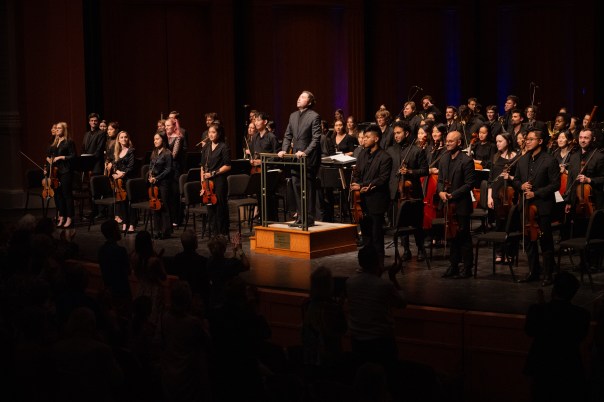
November 22, 2024, Charlotte, NC – In Kwamé Ryan’s first full season as the new music director of Charlotte Symphony, we aren’t getting to see him perform as much as we would hope, but when we do see him onstage at Knight Theater or Belk Theater, he always appears to be overjoyed to be here. Ryan was absolutely beaming as he took the Belk’s centerstage for the first time as CSO’s leader – and he certainly didn’t wear out his warm welcome, delivering a walloping performance of Johannes Brahms’ Ein deutches Requiem. Even before Ryan’s arrival, the new season has proven to be adventurous and diverse in its programming, showcasing fresh repertoire and youthful guest soloists.

Subscribers can judge for themselves whether Ryan’s outré intro to his debut program, coupling the Brahms with Latvian composer Pēteris Vasks’ Musica Dolorosa, was a sign of confidence or a symptom of nervousness. Whether or not my recollection can be trusted, Ryan’s scripted intro was unprecedented. Some intros we may have seen in the past could be dismissed as gratuitous – or countenanced as witty fluff. Here, Ryan’s intro was necessary, for we needed to be prepped for how the program would be delivered: without a pause between the music of the two composers. That would also be fairly unique. Our new maestro was crafting an experience.

Indeed, Ryan’s preface was necessary for another reason. Vasks’ piece flowed into the Brahms so smoothly it was as if they were written in collaboration and in the same key. Outside that merging point, the two pieces were quite different in the ways that they dealt with death. Responding to his sister’s untimely death, Vasks voiced his personal despair and compounded his feelings with grieving for his nation, still subject to Soviet rule when the Dolorosa premiered in 1984. Written for string orchestra, the mood of the opening section of Dolorosa may put you in mind of Barber’s Adagio. But the Vasks elegy eventually transcends the sameness and the hypnotic monotony of Barber’s dolor with louder and more piercing pain.

As the lower strings tap and strum percussively, Vasks gradually quickens the pace and turns up the volume as the beat becomes more insistent and dramatic. Once the dynamics peak, the strings, now smoothed out with a cessation of the percussion, become even more disturbing, tossing away pleasant tonality in a disciplined cacophony of fearsome chaos. The slashing lower strings, however, hadn’t been vanquished. They punctuated this harshness and dissonance at its height, seemingly puncturing it, for the noise homogenized into the sound of a diminishing wind or a siren receding into the distance – clearing the way for the quietest and most memorable episode in the Dolorosa. Principal cellist Jonathan Lewis, echoing the opening bars, played an eloquent lament from his downstage seat, accompanied only by the low mysterious hum – like a bass clarinet or a contrabassoon – emanating from upstage, hidden from my sight. The higher strings now took up the cello’s increasingly bold cry and built it to raw anguish.

The slightly hushed and abrupt ending of the Dolorosa nicely conformed with Ryan’s concept, and it dispensed with the shuffling of chairs usually necessary for the transition to full orchestra with winds, brass, and drums. Nor were the troops of the Charlotte Master Chorale obliged to parade in from the wings and settle into their perches above the Symphony. That honor was reserved for the guest vocalists, soprano Janai Brugger and baritone Alexander Birch Elliott, gracefully delayed until well after the transition between the Dolorosa and A German Requiem. The Brahms is not new to the CSO, last given by Christopher Warren-Green almost exactly 10 years ago – after his predecessor, Christof Perick, had presented it (already for the second time this century) in 2005.

With its consoling attitude, the Requiem is not at all a bad fit for the holiday season. You’re likely to recognize more than a couple of verses from the Brahms, conveniently projected in supertitles, as German translations of verses from Handel’s Messiah, the most beloved musical birthday celebration that we have. Most notably, you’ll get an Oktoberfest taste of “The trumpet shall sound.” Maybe sitting down in the orchestra, as opposed to the Grand Tier Circle, accounted for the heightened thunder of Ryan’s rendition, but Symphony somehow sounded crisper. The sudden sforzandos struck like a punch to the jaw, yet Ryan kept the ensemble under strict control, never threatening to overwhelm the hall with volume, emphatically relishing the work’s percussive moments.

Both Brugger and Elliott shone in their debuts. There was a noticeable Renee Fleming-like milkiness and sheen to Brugger’s voice, most appropriate for the motherly comfort she delivered in “Ihr habt nun Traurigkeit (You now have sorrow).” Elliott was even more impressive in his larger workload, a more pleading “Herr, lehre doch mich (Lord, teach me),” bolstered by a lusty Chorale response, before he delved into the “trumpet shall sound” mystery and affirmation of “Denn wir haben hie keine bleibende Statt (For here we have no everlasting city).” Belatedly, Music Chorale artistic director Kenney Potter was summoned onstage to share the credit for his singers’ brilliance and verve. He was absolutely beaming with delight.

Photos by Perry Tannenbaum

Charismatic Parnther Justifies Shostakovich’s Top Billing at the Knight

Review: Charlotte Symphony Presents Shostakovich and Mendelssohn

By Perry Tannenbaum

November 8, 2024, Charlotte, NC – Hailing from Norfolk, VA – and perhaps the Sith Order of the Galactic Empire – guest conductor Anthony Parnther has brought a big James Earl Jones voice to Knight Theater and an even bigger personality. He instantly engaged Charlotte Symphony subscribers with a lengthy intro to the first piece of the evening, Samuel Coleridge-Taylor’s Ballade in A Minor (1898). Amid some insightful observations on the Black Britisher’s talents and his fin de siècle milieu, Parnther threw in some shtick that drew attention to his mighty larynx, looking askance at what appeared to be a perfectly fine microphone and coming to the mic’s rescue with his “opera voice” and, a bit later, with his “Shakespeare voice.”

In short, he dared to educate us and did a damn good job of it. The performance was just as brash, though occasionally too loud for the hall. There was gravitas in the opening measures sweeping into a zingy elan. Violins excelled in the midsection of the work with some very tender section playing, and the piece built nicely to an anthemic climax, reminding me of Jean Sibelius’s less-neglected symphonic masterworks. North Carolinians can point with pride to the best recorded version available on Spotify or Apple Music, featuring the Royal Liverpool Phil directed by Grant Llewellyn, who has given so much to The Old North State. Beyond that, Parnther could tell us very confidently that Black composers, according to the latest tallies, account for only 2.5% of programming among America’s top orchestras, knowing that we were quite entitled to feeling superior in the wake of hosting Sphinx Virtuosi a month ago – in a mostly Black and Hispanic program.

Sphinx’s visit turned out to be a gift that kept on giving, for the guest soloist playing Mendelssohn’s Violin Concerto in E minor, 16-year-old Amaryn Olmeda, was a first-prize winner – and audience fave – at the 24th Annual Sphinx Competition and toured with the Virtuosi two years ago. While I wouldn’t wish to compare Olmeda’s performance to my favorite recordings; including those by David Oistrakh, Yehudi Menuhin, and even Itzhak Perlman (who gave a live rendition at Belk Theater in 2019); there was certainly beauty aplenty in Olmeda’s account, with virtuosity to spare. But Symphony concertmaster Calin Lupanu attacked the infectious Allegro opening more fiercely in 2021, bowing with bolder panache when he played the piece online with Christopher Warren-Green at the podium. After a simple and lovely transition from principal bassoonist AJ Neubert, Olmeda was at her best in the middle Andante movement, freeing Parnther and the CSO to give her more robust support.

Olmeda relaxed and reveled more in the closing Allegretto-Allegro than she had in the previous outer movement, so Parnther and the CSO could be more assertive in their support, but true brilliance seeemed still beyond her at this tender age. Nonetheless, the audience joined me in giving Olmeda a standing O, perhaps sharing my feeling that we should pay her forward. Although attendance at the Knight was strikingly sparse, the young violinist was beaming. With a nicely articulated Bach solo, she returned our appreciation with an encore. Instinct tells me that the ripple of applause from the audience as intermission ended was in response to Olmeda joining them.

The young prodigy could not be faulted for the disappointing turnout, for the Sphinx Virtuosi had triumphed at Symphony’s annual gala last month. More likely, it was Shostakovich, topping the bill with his Symphony No. 9, who was the culprit on a beautiful autumn evening. Yet here was where Parnther and the CSO were at their best. The Norfolk native was pointedly suggestive in his introductory remarks, but mostly objective in his lengthy explorations – cuing us on what to look for in each of the five movements rather than telling us what to make of it. Thorough but never boring or academic, not at all show-offy or self-indulgent. Truly helpful.

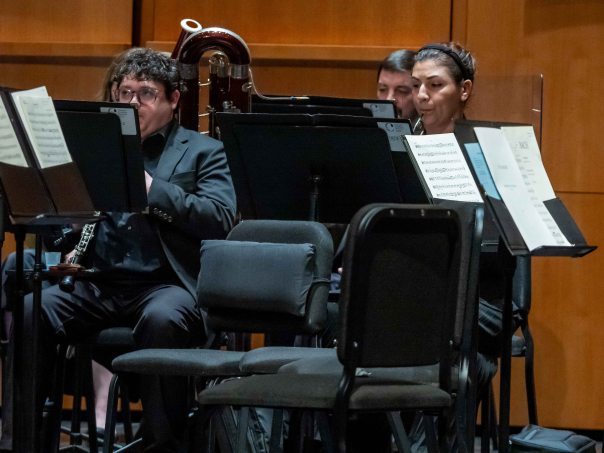
The performance was spectacular, brilliantly contoured to the hall with fine evocative details, fully justifying Parnther’s enthusiastic intro. Which instrumentalist shone brightest in the opening Allegro was a tossup between Lupanu and piccolo stalwart Erinn Frechette, but principal trombonist John Bartlett stole all the scenes, emphatically partitioning the many episodes and injecting Shosty’s comedy with just two oompah notes. From that lighthearted opening – antithetical to what all Ninth Symphonies should be in the wake of Beethoven’s behemoth – we plunged into the depths and dolor of the Moderato, the lengthiest movement in this lapidary stunner. Principal clarinetist Taylor Marino, bolstered by section mate Samuel Sparrow, set the doleful tone of this sharply contrasting movement (again antithetical to the triumphal music Soviet Premier Joseph Stalin expected in 1945), achingly extended by two other principal winds, flutist Victor Wang and Neubert. Dreary strings increased the profundity of this oppressed lament, with Marino returning to soar above it in near-manic anguish.

It’s easy to lose your place after this unforgettable pairing of light and dark movements because the last three are played without pause, steadily increasing in intensity until a steady locomotion of victorious woodwinds are prodded into accelerating by the pulsations of the lower strings. These, in turn, triggered and excited the violins. Blaring brass then drove the journey into complete madness – and off the rails. Adding to the overwhelming bite of this sonic climax, the slashing, plucking, and sawing of the bowstrings across the stage added vivid visual drama.

Photos by Perry Tannenbaum