All posts by perryt77

Shouldn’t Gardner’s “A Small and Humble Erasure” Be Retitled – and Replayed?

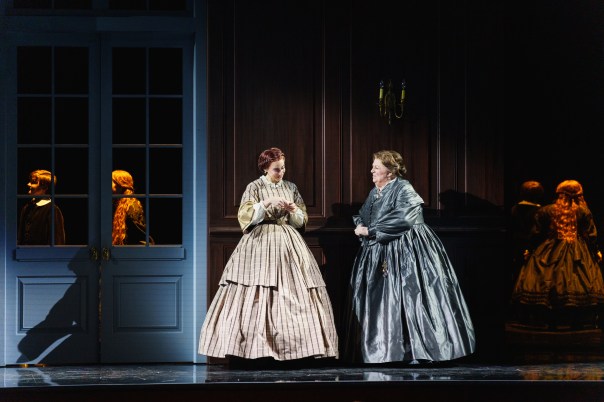
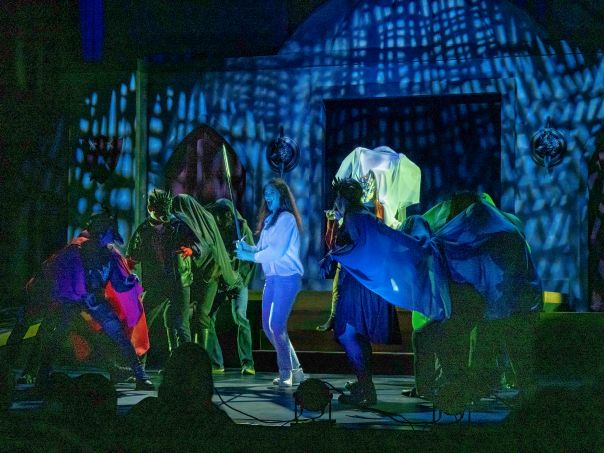
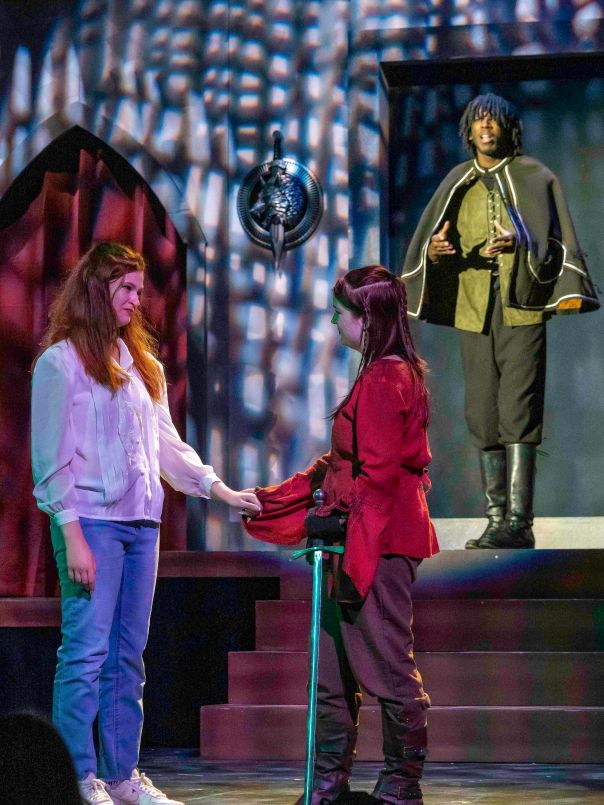
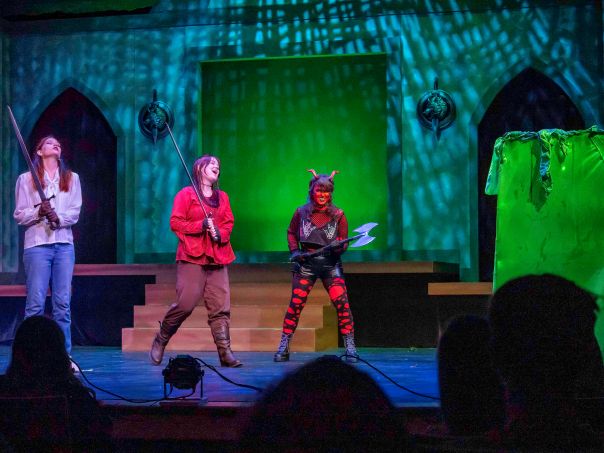
Review: A Small and Humble Erasure at Davidson Community Players

By Perry Tannenbaum

As playwright Tracy Letts knows well, there are unpleasant truths at the heart of American life and the American Dream. “Sometime tonight, when the temperature of your home drops to a specific mark and you hear the heater come on because that’s what you’ve programmed it to do, remember that you live in a cocoon of comfort and safety because a lot of people who came before you weren’t afraid to get their hands dirty.”
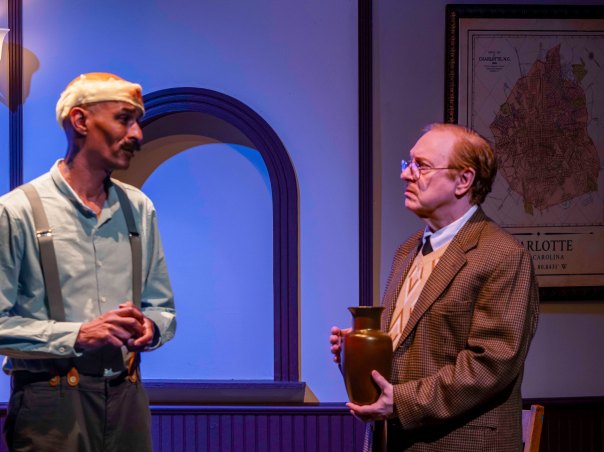
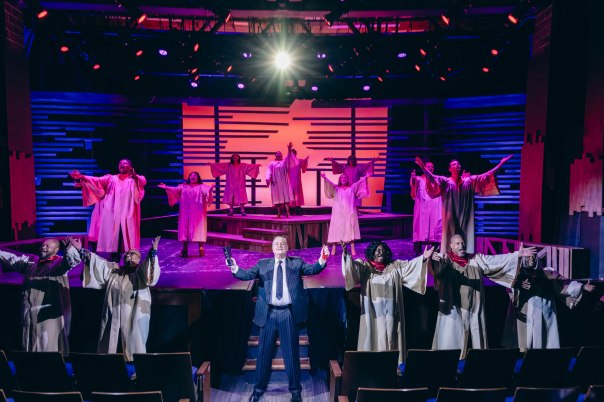
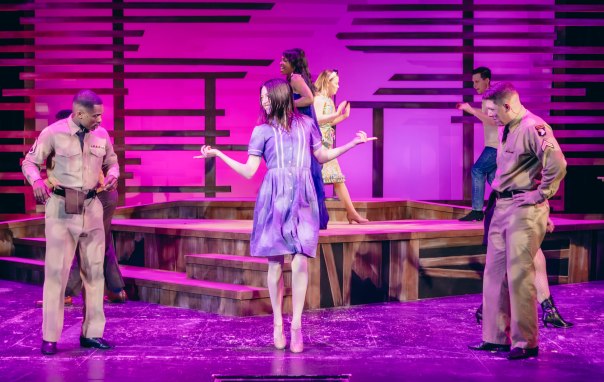
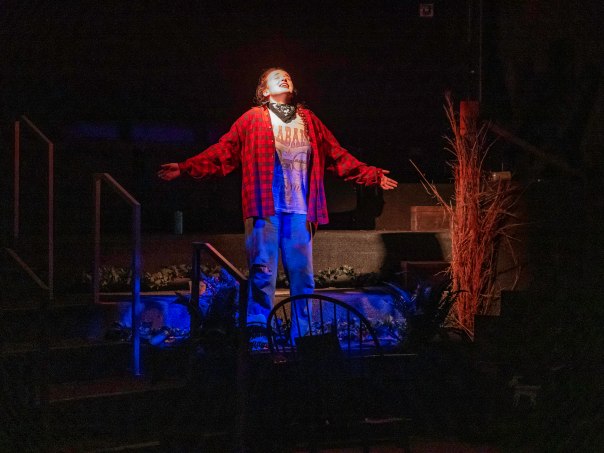
Those clear-eyed, merciless words were delivered by the Mayor Superba of Big Cherry at the climax of The Minutes, Letts’ unexpectedly savage and sensational 2017 drama. The Metrolina premiere was presented last month at the Armour Street Theatre as Volume 1 of Davidson Community Players’ Sacred Places project. With a no less of an innocuous title, the world premiere of Stephanie Gardner’s A Small and Humble Erasure is completing DCP’s project – with a sacred place that hits closer to home.

Gardner has actually customized her script for Armour Street and for the members of the cast, directed by Michelle Medina Villalon. While Letts located his drama at a fictitious City Hall built on the blood of slaughtered Native Americans, Gardner’s piece reminds us that Theatre Charlotte is built on more sacred ground, over a cemetery consecrated for African American slaves.

And she tells us, naming names, just how this cemetery was “deconsecrated” and who was responsible. Mayor Ben Douglas and numerous councilmen are in the room where it happened, all of them white men from respected Charlotte families: Baxter, Hovis, Albea, and Wilkinson – with mischievous colorblind and gender-blind inroads in Villalon’s casting. Starting with the famed Mayor whose name is perpetuated on the QC’s international airport.

A future councilman, attorney John Small, introduces the motion at a City Council meeting in 1936, nine years after Theatre Charlotte had been founded as the Charlotte Drama League and five years before the Old Queens Road Barn celebrated its housewarming. By this time, Tom Humble had settled into his role as Little Theatre of Charlotte’s artistic director.

So the workings of this Small & Humble alliance give Gardner’s title a clever double entendre. Humble, at least, is haunted by the fact that his new fixture in Charlotte’s cultural life was built on the backs and graves of Southern slaves. Big Cherry, on the other hand, leans into their past desecrations after the truth is painstakingly revealed to them by a rogue councilman. Their actions are sensationally horrifying, while Gardner’s white folk are more decorously rueful.

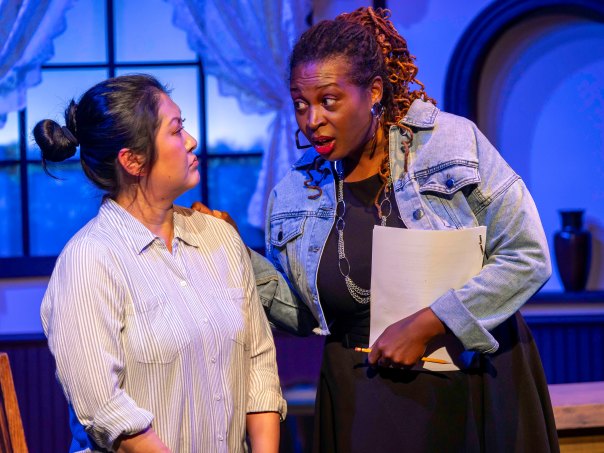
Of course, there’s considerable satirical bite to Gardner’s concept, above and beyond the casting vengeance she takes on all the benign and virulent segregationists who are culpable for this sacrilege. An African American, Andrew C. Roberts, portrays both Mayor Douglas and plutocrat Harold Dwelle, and Amy Wada, an Asian American, is our narrator!

She brings us into the Myers Park homes of these benefactors, the Dwelles and the Myerses themselves, delving into the petty maneuverings of their estates. These include the hallowed cemetery and the adjoining Cherry neighborhood. Yes, DCP executive director Steve Kaliski & Co. could have easily called their pairing “The Cherry Project.” Interestingly enough, both Cherrys have insulting and racist slurs associated with their names as well as complicit Mayors in their dramas.

Making Amy Wada our personable and slightly stressed narrator is obviously an entertaining choice. But I’m not always aboard with the idea of actors behind her frequently breaking character and interrupting her – perforating and undermining the seriousness of her narrative, threatening to trivialize the history.

Getting Hank West, indisputably one of Charlotte’s best, to play Tom Humble is a similarly two-edged sword. Villalon and Gardner must have been sure that West gave the best audition, and he impeccably balances the Indiana native’s haughty elitism, his ambitions for the Queen Road Barn, and his conscience. But for those of us who have seen West’s work over the last four decades, it’s a bit of a hurdle disliking his Humble in the artist’s worst moments.

Clean-cut with mature Everyman looks, Mark Ariail is a fine complement to West as the conniving Small, the lubricant that connects Humble and Myers Park to the Charlotte City Council. We have a hard time labeling him as evil despite the obvious earmarks. Little Theatre was little, after all, and Queens Road was the closest the fledgling company could hope to get to the QC’s high-priced Uptown real estate.

Gardner seems willing to allow that the upstanding Charlotte citizens of the 1930s were shaped by their times and less eager than Letts to condemn and ridicule them for their actions and customs. But she does provide a second backdrop to the unfolding Small & Humble “erasure”: black folk who set the plutocrats’ tables and black folk who were buried beneath them.

Roberts is neither of these, but he’s useful in Gardner’s concept beyond his key roles as Dwelle and Mayor Douglas. He’s also “new” to the cast, so Wada can be explaining the history – and the colorblind casting – to him as well as us. Lowell Lark, when he removes the enslaved Harvey Foster’s bloody bandage from his head, becomes a somewhat comical Councilman Baxter when the Theatre Charlotte ordinance is passed, returning years and years later to haunt Humble and become part of Queens Road lore. When that happens, it no longer seems amiss that he doesn’t strictly conform with Gardner’s description of him as a 17-year-old when he died.

Myneesha King as Johnsie Foster, the Dwelle family housemaid, gets to be a sometimes-acerbic conscience for the great white benefactors of Myers Park – and she’s pretty sassy toward Amy, so it isn’t a demeaning role. King is also significant the living descendant of the buried and betrayed slave population distilled into the voice and wounded image of Harvey Foster.

Briefly, King can relish returning as Barbara Burke, the first African American to appear in a Little Theatre production in 1970. It’s Wada, though, who points out that this was three years after Humble retired. Then we hear the vanilla quote in our newspaper’s coverage straight from King’s lips: “If the whole world would say people are people and not what color you are, it would be a wonderful place.”

We do get along here in Charlotte, don’t we? Ironically enough, Gardner reminds us that the first play produced at the new Little Theatre, once the gravestones were cleared away, was Moss Hart & George S. Kaufman’s George Washington Slept Here. Talk about a whitewash!

The white women of Myers Park, bless their hearts, are at least ambivalent about what’s going on over at the top of Queens Road. Pam Coble Newcomer as family matriarch Mary Rawlinson Myers insists that the Negro Cemetery should belong to the Cherry community in perpetuity, but has neglected to ensure that her wishes are legally airtight.

Along with King as Johnsie, we empathize with Mary the most, especially since she’s confined to her deathbed. Newcomer is liberated from her bedclothes for two comical turns, becoming Councilman Albea and Little Theatre actor Jack Knell. Jack’s wife, Dorothy Knell, is also in the cast of the first show presented at the new theater in 1941, so Cat Rutledge completes the amusing little gender-blind episode.

Rutledge, like Newcomer, also gets to have fun at City Hall as Councilman Wilkinson, one of our proud city’s banking visionaries. (Is the notorious boulevard named after him? Yup.) She also comes out as perhaps the meanest meanie onstage at Armour Street, jousting with both Mary and Johnsie as Mary Myers Dwelle – or Mary II – as she helps push the Little Theatre initiative through City Council.

Perhaps because she also pushed through the first art museum in the state, The Mint, Myers’ aristocratic daughter is allowed to luxuriate in regrets similar to Humble’s. Aw, cut them some slack, Gardner seems to say. Better to simply mention The Mint, IMHO.

Volume 2 isn’t speckled with shameful or diabolical celebrations like The Minutes, last month’s Volume 1. Nor does it chill us like Mayor Superba’s cynical admonition, cited above. The best Humble can do is “I don’t know how to fix it.” Honest enough. Mary Dwelle is more pragmatic and resolute, asking us “Why should we have to leave town for our culture? We’ll build it here!”

Ninety years later, the QC is teeming with theatre artists who believe Charlotte shouldn’t be the largest city in the country without a regional professional company. They’re still waiting for that same Myers Park/Banktown resolve to lead somewhere.

Maybe Roberts, the newbie to A Small and Humble Erasure, has drawn Gardner’s most devastating line. “Excuse me,” he asks Amy, “am I playing a white guy??”

His disdain and disgust speak volumes.

Needless to say, it was a bit awkward to be driving back home on I-77 through Charlotte after this bold show in Davidson. If DCP’s collaborator, Anne Lambert & Charlotte’s Off-Broadway, could contrive to bring Small and Humble to this side of Lake Norman, it might find a bigger audience at the right place. With the potential of reaching the right audience and getting the right proactive reaction. I’d suggest a peppier title, like The Small & Humble Desecration, when that happens.

Davidson Community Players now performs at three different venues, adding Davidson College and the Cain Center in Cornelius to their portfolio over the years. What do you have, Charlotte?

It’s like this on the QC’s pitiful theatre landscape: Since DCP’s Sacred Places began last month, two modest professional productions have opened in the QC, by CAST and Charlotte Conservatory Theatre – both of them at The Mint Museum. Yeah, that’s how much local theatre building we’ve done in the last 90 years.

Poiesis Quartet and Charlotte Poet Laureate “Jay” Combine for a 7th Street Benediction

Review: The Poetry of Music at St. Peter’s Episcopal Church

By Perry Tannenbaum

March 22, 2025, Charlotte, NC – You can’t say that 7th Street Concerts isn’t daring – or eclectic. Just within the past four weeks, the series has presented music ranging from the 12th to the 21st centuries, Hildegard van Bingen to Sky Macklay, with a heavy dose of Baroque writing in between. The two programs were staged just above street level in the St. Peter’s Episcopal Church sanctuary and then upstairs in the meeting hall. If that range weren’t sufficient, the latest concert featuring The Poiesis Quartet layered on spoken word by Charlotte’s poet laureate, Junious “Jay” Ward: four poems written specially for this “Poetry of Music” event.

The back-and-forth between the outré string quartet and the 2019 International Slam champ worked better than the average churchgoer would have hoped or believed. At times, the spoken word was a welcome counterbalance when the mod string compositions grew chaotic, cacophonous, or weird, for Jay’s modes were predominantly cosmic and engaged, without any lapses in lucidity. At other times, when the music grew quiet, dreary, or repetitive, it suddenly dovetailed handsomely with Jay’s rhythms and musings as a background.

It’s hard enough nowadays to discourage symphony subscribers from applauding between movements of a large orchestral work, and the corporate smiles that appear on musicians’ faces during these unexpected intervals only compound their awkwardness. “Sure, we love it when you applaud!” the performers seem to be saying through clenched teeth. So it’s been praiseworthy, both at Spoleto Festival USA and now here in Charlotte, to see musicians and conductors leaning into the idea that there shouldn’t be any applause until the end of a piece, a cluster of pieces, or the end of a concert. We can all stay in the moment longer and go home sooner.

Speaking on behalf of the quartet, cellist Drew Dansby made the request while making his acknowledgements and introductions. The pieces, about 41 minutes in length on their Spotify counterparts, would be played without any significant pauses – and without any notice about how Jay’s four poems would be wedged in. As a latecomer who had missed two-thirds of 7th Street artistic director Kristin Olson’s welcoming remarks, I may have been more disoriented than the punctual ticketholders when Poiesis readied themselves for the third movement Scherzo of Béla Bartók’s String Quartet No. 5 (if for no other reason than the printed program said it would be Quartet No. 3).

Was Jay even in the house as he began reading “Stunted,” his first poem? Lurking behind my left shoulder in the corner of the hall, outside my line of sight, he began behind a music stand holding a mic. Coming to me via a loudspeaker, his voice sounded pre-recorded! There was plenty to distract us onstage, for Poiesis doesn’t merely sport BIPOC credentials: more than a dash of gender fluidity greeted our eyes, along with assorted piercings. The first violinist’s long hair and attire, for starters, initially made Max Ball’s gender a mystery. Not to worry, Ball switched chairs at least twice with Sarah Ying Ma during the course of the program, so both genders earned first violin laurels during the evening. Choices in attire – and pronouns, if you read the program booklet – underscored the freewheeling fluidity.

Bartók (1881-1945) had completed five of his six string quartets before Dmitri Shostakovich had completed his first, so he is undoubtedly the wellspring for the modern rep. The Tokyo Quartet recording of the complete string quartets has been my favorite for over four decades. Since vinyl and cassette dubs. In the meanwhile, I’ve heard spirited live accounts by the St. Lawrence Quartet at Spoleto Festival USA and by the Emerson Quartet at Aspen, the latter a two-night marathon of the complete cycle. So it was rather astonishing to hear Poiesis’ confidence as they attacked the difficulties of the Scherzo and savor their maturity in intertwining its acerbic lines and sustaining its odd Bulgarian rhythms. Later that night, it was quite astonishing to come home and read that the Poiesis violist, Jasper de Boor, was currently a student of Ayane Kozasa, a mainstay at Spoleto and a member of the revered Kronos Quartet.

The entire quartet was playing at that high level before veering off into terra incognita – four works, two complete quartets and two excerpts by composers who were all unfamiliar to me. The excerpted composers, Joe Hisaishi (1950- ) and Winston-Salem native Coleridge-Taylor Perkinson (1932-2004), were my most egregious oversights. To those in the audience who were new to the Bartók string quartet soundworld, Hisaishi’s “Phosphorescent Sea,” the second movement of his String Quartet No. 1, was no less enticing. A printed illustration of M.C. Escher’s woodcut (sadly, not the correct illustration) added further allure to the evocative piece. Sonorous harmonies evoked the oceanic calm and its immanent magic until Ball pierced through on first violin with harmonics that conjured up the bioluminescence, sounding at times more like a flute than a stringed instrument over the plucked chords of Dansby’s cello.

Perkinson’s “Calvary” quartet, built on the traditional African-American spiritual of the same name, was easily the most soulful piece of the evening – and among the pair that were most uplifting. Like “Only Black,” which had been interwoven with Hisaishi’s “Sea,” Jay’s “All the Colors” was less topical and street-smart than “Stunted” but more serious, meditative, and profound. The quiescent second movement Adagio from “Calvary,” with its moody dialogue between De Boor’s viola and Dansby’s cello, provided the most appropriate platform for Jay to be seated onstage at the center of the Poiesis Quartet. Better yet, after Ying Ma soared above the viola and the cello – with a part that could almost have been scored for a second viola – the piece comes to a complete halt, accommodating the poet perfectly.

In Many Many Cadences by Sky Macklay (1988- ), a screechy scherzo that yields grudgingly to a dyspeptic drone from the lower strings before all four members get hyper, was undoubtably the best piece on the program for Jay not to write a poem for. Described by the composer as “lonely, disjunct ends-of-phrases [that] eventually congeal and transform into new kinds of phrases and sound objects,” her best-known piece – the opener on Spektral Quartet’s Grammy-nominated Serious Business album – is militantly modern. Yet Ma and Ball were obviously having a merry time helping Macklay “stretch the listeners’ perception of cadences” until De Boor and Dansby could join the party. It would have been a hoot to hear this spray of sound cells and objects down in the sanctuary!

After Jay joined Poiesis onstage for the “Calvary” excerpt, it seemed like we were headed for an anticlimax as the poet left the stage and began circling the hall as the ensemble launched into their finale, String Quartet No. 2 by Eleanor Alberga (1949- ), the longest piece of the evening. With its many varied episodes, gorgeously stitched together, Alberga’s piece abundantly merited its length and earned our extended delight. Teeming with prickly sonorities and folksy rhythms, Alberga’s quartet perfectly bookended the program with Bartók’s.

Theatrically, it also solved the problem of how to follow Jay’s onstage powwow with Poiesis. “Growth” may not have been loftier than “Only Black” and “All the Colors,” but it was certainly more speechy and oracular. Jay recited rather than read this last poem, adding to his spontaneity and flexibility. He walked slowly toward the stage from our left when we heard his voice again, able to look across the audience as he declaimed. Most of us likely assumed he would join the musicians onstage as before. Instead, he backed away down the center aisle that split the audience while the music soared and slowed, reaching an equally unexpected pinnacle. Backlit by the stage lights, there was a bright aura around Jay as he raised his voice, before Poiesis concluded with a final frenetic flourish. It was a uniquely magical moment, as if the poet were giving the musicians his benediction.

“Look! Here you are, the impossible, tall in the midst of chaos— a rose, a bloom of color broken beautiful against a morning sun.”

Dimming the Lights, Cerrudo Delights With Three Dance Originals

Review: Charlotte Ballet’s A Realm of Existence

By Perry Tannenbaum

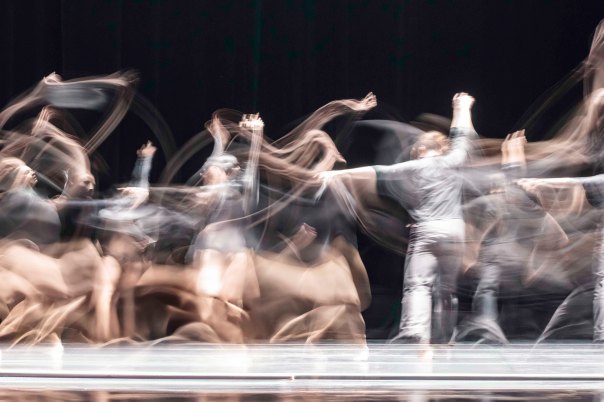
March 6, 2025, Charlotte, NC – Past and present eras of Charlotte Ballet intertwined at Knight Theater in their latest program, A Realm of Existence, named after none of the choreography below. Three of the four pieces were by artistic director Alejandro Cerrudo, including Dos y Dos y Dos, his first world premiere with the company since he was designated to lead it in 2022. After a break, Pacopepepluto lightened the mood with settings for three Dean Martin hits, and Cloudless cast an intimate, almost erotic aura before the second intermission. Hearkening back to the preceding Hope Muir stint as artistic director, nine dancers performed the surreal scenario of Johan Inger’s Walking Mad. It was the first piece performed at Knight Theater under Muir’s leadership in 2017, reprised there by Muir in 2019.

For a piece that emphasized pairs, Dos y Dos y Dos was strikingly touchless – and for that reason, perhaps most fascinating in its interstitial moments between the various couplings. The first ensemble reacted to one another in waves, like coils of a Slinky toy or a row of dominoes, creating the push-pull of gravity between them out of thin air. The intriguing style carried over into the pas de deux – not religiously since there was minimal contact – but wasn’t as unique for me in that idiom. While the variety of the ensembles grabbed me more, the variety of music for the couples – composed by Marek Hunhap, Jean Michel Blais, and Frederic Chopin – brought fresh vibes to their dreaminess.

Absent any props, scenery, or flashy costuming, Cerrudo placed strong emphases on form and flow in his new work. Lighting by Michael Korsch is important in this piece – but not expensive. Dim lighting has been almost a trademark of Cerrudo’s tenure, certainly CharBallet’s settled style in recent non-Nutcracker production photos. PR photos of A Realm of Existence couldn’t be anything other than dimly lit. But as Pacopepepluto quickly made clear, a dimly lit mood needn’t always chime with a Chopin Nocturne.

“Memories Are Made of This,” the first of Cerrudo’s three solo pieces (the “Paco” piece?), showcased a true gem of bad Dean Martin imitation by Joe Scalissi – or a treasure since neither Spotify nor Apple Music have a clue about Scalissi, Joe or otherwise. You could hardly imagine a better dance track for mocking Martin’s schmaltzy style, Cerrudo’s moves prodding Mouzon into projecting the antithesis of suavity.

Apparently, gems like Scalissi’s are very rare indeed, so Mario Gonzalez had to content himself with an authentic Martin cut, the exponentially schmaltzier and creepier “In the Chapel in the Moonlight,” so he drew more laughs than Mouzon’s antics anyhow. How did Cerrudo top himself after that for Rees Launer? With Dino’s most beloved – and outright silliest – hit, “That’s Amore,” complete with its original chart-topping chorus and accordions.

Packaging moon, stars, and an underfoot cloud, this was clearly the “Pluto” segment. There was so much intrinsic merriment in that track for Launer to build on with his discordantly spasmodic movements, and the choreographer mischievously brought back Gonzalez and Mouzon for comedic cameos as lagniappe. That really was amore, especially for the gals in the audience since the guys were hardly wearing a stitch.

Flipping the customary script, Cerrudo had objectified his men more than he would the women in Cloudless, Anna Owens, and Adriana Wagenveld on opening night. Branimira Ivanova’s costumes for this pas de deux were more for a dance studio than a runway. That enabled Owen and Wagenveld to build their chemistry, intimacy, and heat from scratch, a steeper climb without flashy lights and glam dresses. With the gentle music of Nils Frahm simmering in the background, there was actually a bit of tension for me, wondering how far the intimacy would go – and whether it would upset the giggling church ladies sitting behind us. The work out costuming helped to widen Cerrudo’s latitude.

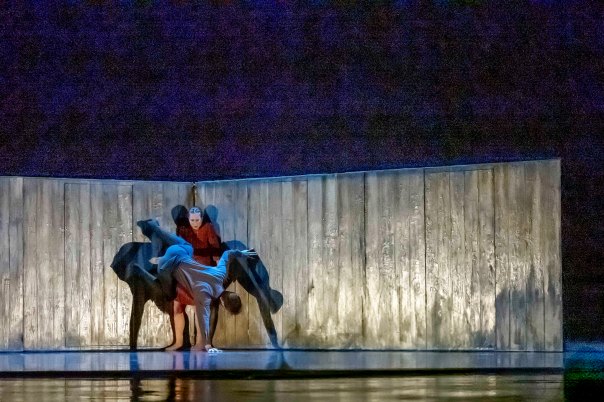
As for Walking Mad, I’ve written about it before, here and elsewhere. So I’m dispensing with yet another description of the piece and developing a theory about Inger’s intent – after noting those same church ladies’ surprise and delight in seeing it for the first time. No doubt the wooden wall, nearly as versatile as the dancers who play with it, is in permanent storage somewhere in town now that this crowd favorite has been performed three times. This wall plays such a big part in the action that what it is can quickly elude our consideration.

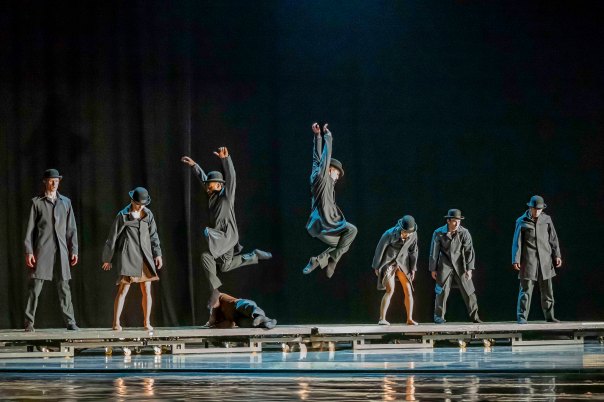
It’s a wall that separates the insiders partying behind it from the outsiders who can’t seem to forget their worries and merge with the mindless, monotonous fun. That’s fairly obvious when a crowd of partyers with conical hats spill out from the sides of the wall and briefly join the lonely, trembling folks on our side – especially since they’re almost always engulfed by the hypnotic repetitions of Ravel’s Bolero. But there’s also a night-and-day monotony to Inger’s scheme, for the first dancer we see, seeking to toss away his workday attire and join the festivities, is wearing a bowler hat.

A group of male dancers will parade funereally across the stage later in the piece, all wearing similar Magritte bowler hats. It’s a broad hint that our days are as repetitious and monotonous as our nights, only more formal and mindful. That’s where the fears and trembling of the outsiders come from. Notwithstanding the surprised gasps and giggles from the crowd, this may not have been the best realm of existence.

Risen from the Dead, CAST’s Alabaster Is All About Artists in Crisis

Review: Alabaster at The Mint Museum

By Perry Tannenbaum

Google and Alexa will tell you if you ask: it’s a little bit more than a 17-mile drive from Bessemer to Alabaster, Alabama. Every source I’ve checked also confirms that Gip’s Place, the last backyard juke joint in America, was in Bessemer until its blues guitarist founder, Henry “Gip” Gipson, passed away in October 2019 at the age of 99. It’s useful to know that when we meet Weezy, the first character to speak at the Mint Museum – in the first Carolina Actors Studio Theatre production anywhere since its 2014 NoDa demise.

Weezy tells us that she lives at a small farm “right near” Gip’s Place in Alabaster.

True, we have ample reason to question Weezy’s veracity from the get-go, since she also introduces herself as a goat. Titling her comical drama Alabaster,playwright Audrey Cefaly could coyly blame her geographical inaccuracy on this cantankerous barnyard beast she created. But the choice, invoking the special malleability of a stone that has been reshaped by sculptors and artisans for millennia, is clearly an artist’s choice.

As we continue to follow the scrappy encounter between two artists in backwoods Alabama, one a celebrated photographer of celebrities and the other an unknown painter, we often find that Weezy – among other things – is Cefaly’s surrogate. In one meta moment you can look out for, Weezy even delivers a message from the playwright to one of our protagonists.

Mostly, Weezy serves as an irascible Jiminy Cricket for June, the one human survivor on the farm. When she isn’t offering up prompts and explanations channeled from Cefaly, she becomes June’s better self, the self that is wishing to break free of her self-imposed isolation and artistic obscurity. When sweet optimism sours into clear-eyed skepticism and cynicism, Weezy becomes the painter’s inner voice: June’s worst critic.

And sometimes, she’s a goat, caring for her ailing mama. Weezy is fluent in English and goat. Occasionally, she’s also clairvoyant.

Both Bessemer and Alabaster are prone to tornadoes. Cefaly’s tornado has radically reshaped June, demolishing her farm and turning the entire left side of her body into a relief map of scars, patches, pocks, and swirling melty skin. Playing the role of June, Zoe Matney has a l-o-o-o-o-ng pre-show routine, for she must spend much more time than usual backstage getting director/makeup designer Michael Simmons’ concept applied – front and back, from torso upwards – with help from assistant director/makeup artist Dee Abdullah.

Then she is onstage as the audience arrives, long before lights dim and Weezy enters.

If Weezy weren’t there, we must also remember, we wouldn’t have a reason to hear from June, though her first response to the goat’s prodding is no more than a well-chosen finger. Fortunately, we are quickly liberated from the confines of an inner dialogue by June’s distingué visitor, Alice.

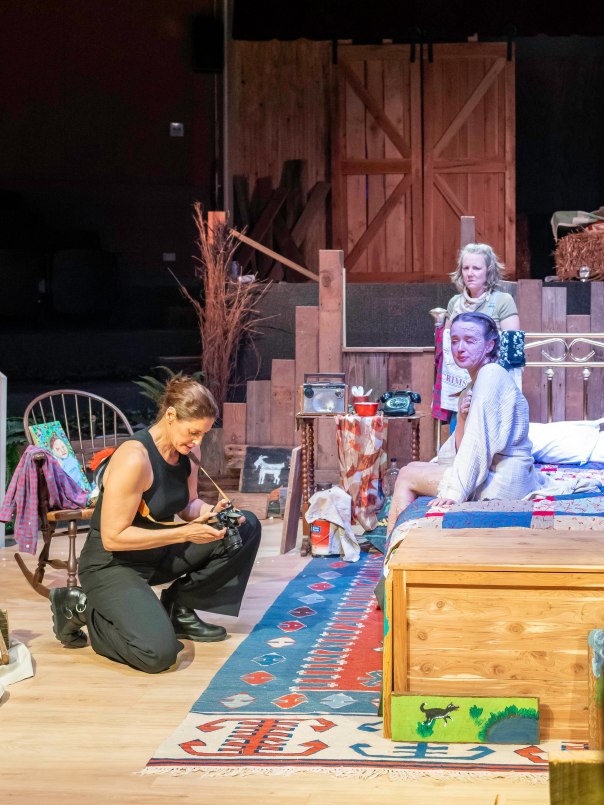
Acquainted, you can bet, with Annie Leibovitz and no further than a light meter’s distance from Demi Moore, Alice’s career has recent taken a hairpin turn to the scarred-women project she’s working on now. June is her seventh subject, and Alice works in multiple media. Trying to reach the traumatized inside of her subjects – all women – while finding the dignity and beauty mixed with the deformity outside, Alice documents them in video interviews and, when the time and light are right, by snapping coffee-table-quality portrait photos.

Are these scars a form of artwork?

A fresh aspect of artist’s choice comes into play with Cynthia Farbman Harris as Alice. Alabaster premiered in December 2019, just two months after Gip’s passing, in Fort Myers, Florida – the first stop in a “Rolling World Premiere” presented at 11 member companies of the National New Play Network, a rollout spanning from New Jersey to Oregon. The QC had a company in that Network, Actor’s Theatre of Charlotte, which had rolled with some of these co-op premieres before.

When asked about the switch away from glamor assignments, Alice deflects at first. She only gives herself away slightly when asking June about her “accident” – a word more apt for her own trauma – and when, egged on by June’s questioning, she scrolls back far enough among places she’s been before Alabaster to her rehab.

So it shouldn’t be too surprising to learn that Actor’s Theatre was scheduled to premiere Alabaster in the latter half of its 2022-23 season, just over two years ago. More of you will remember that Actor’s Theatre did not make it to the end of 2022, planting its gravestone among the most honored companies in Charlotte’s theatre cemetery before the halfway point of its 34th year.

For Harris, who auditioned for that abortive ATC production, it was a matter of not forgetting. She had worked with Simmons at CAST, with a variety of other stints at Moving Poets, Queen City Theatre, and Theatre Charlotte – including a pair of diva roles, Maria Callas in Master Class and Blanche DuBois in A Streetcar Named Desire. If the role of Alice stuck with her after ATC’s demise, there must have been plenty of meat on the bone.

With an eye toward reviving the edgy theatre vibe that reigned while ATC, CAST, and QC Theatre were all up and running, Cynthia and her husband, actor Michael Harris, have founded Actors Collaborative Theatre to help make it happen. The new ACT is an associate producer of Simmons’ rebirth, while Moving Poets and Charlotte Contemporary Theatre are among the companies listed in the digital playbill on CAST’s thank-you list.

If you know how long ago Harris starred as Blanche, then you know Alice is bit of a stretch, no matter how much she wanted it. We’re not just talking about the yoga scene. With Abdullah serving as intimacy director, June’s master bedroom becomes more than an artist’s studio. Scars and all, June brashly inquires whether Alice is gay, before we learn the photographer’s full backstory.

Somehow, Matney and Harris make their love-hate relationship work altogether naturally and spontaneously. It only becomes a little more cerebral than Cefaly imagined it. They lean into the age difference a little instead of pretending it doesn’t exist. But they do traverse the long, rugged terrain to the primal mode. The two artists debate whether their meeting is like The Bridges of Madison County or not. Yet they could also debate whether they are both hostile animals locked in cages of their own making – while the liberating keys are always in their hands.

Actually, they do talk about that.

Matney’s performance is every bit as stunning as Harris’s, if for no other reason than June is so moody and mercurial. Ambivalent about having her paintings exposed to outside world, June is living with desperate intensity in her present isolation, hoping for a sunnier future – she has invited Alice here, though she is wary – while repeatedly tortured by her past trauma.

Something as trivial as the beep of Alice’s camera can trigger flashbacks to the worst. Adding to the inner psychological circuitry are the stresses of fresh lightning and thunder – plus the partial nudity at the start of the photo session. Matney calibrates her various disturbances well when her hurting is raw, and she channels energy convincingly into compensatory actions when June is striving to appear calm and well-adjusted. She also leaves room for just the right amounts of flirtation and coquetry.

Kelly Mizell, who plays Weezy, can tell you how long ago Harris sashayed into Nawlins as Blanche, for she was an outstanding Stella Kowalski in that same Theatre Charlotte Streetcar way back when. Given the opening entrance, this talking goat decisively demonstrates that she can still command a stage before discreetly receding into the background, sometimes as a handy guide, sometimes as an annoyance, and sometimes as a mind-reader.

Mizell gets to show Weezy’s tender side caring for Bib, her mostly pallet-of-hay-ridden “Mmaaahaaaahaaaa… maaaaaah!” You can see Harris wanting to play Alice enough to partly bankroll and publicize a production, but with so much stage time and so little spotlight (or vocabulary) as this old goat, Debbie Swanson had to really want this Mama Bib role. She’s wonderful when her moment comes.

Otherwise, there are remarkably few signs that Simmons and the Harrises are doing all this on a shoestring. Lighting design by Dave Meeder easily ranks with the best we’ve seen at the Original Mint’s Van Every Auditorium on Randolph Road. Tim Baxter-Ferguson, another name we fondly associate with a bygone era, installs a marvelously rusticated twin-level set design that simultaneously gives off vibes of woodsiness, springtime color, and irreversible damage.

Sophie Carlick’s costumes don’t have to be lavish, but they enable June, Weezy, and Alice to radiate an outdoorsy aura. Cleverly enough, June’s bedroom outfit hides her preoccupation with painting as decisively as her splotched overalls proclaim it, but the goat costumes also strike a perfect note. So do the many artworks fashioned for June’s artistic oeuvre on barnwood, to be auctioned off when Alabaster completes its run.

Simmons’ sound design and special effects are on-point, but I wish they had impacted more: louder, with more lightning crackle and windy sweep. Nor was the ringtone on Alice’s cell as ugly as Cefaly intended. As a photographer, I had to chuckle at the sadly unprofessional equipment we were seeing, including a camera with an onboard flash. Yet I could empathize with Harris – and admire her all the more – when she had to keep that lame videocam running and the still camera showing snaps on its screen.

When Alice instructs June on how to use a smart phone, when she shows her how to trip the shutter, and how to review the photo portraits on the wee screen… Quiet moments like these resonate with us, because they are part of a bonding process, two healing processes intertwining. Two resurrections. Three if you count the rehab June and Alice join in on with those barnwood scraps.

Good reasons to smile as we left the Mint. Along with the resurrections of CAST and a vital drama Actor’s Theatre never got to present.

Lasers, Projections, and Artful Plumbing Bring New Vitality to “Become Ocean”

Review: Charlotte Symphony’s Become Ocean at Blume Studios

By Perry Tannenbaum

Animated bubbles rose from the pillars of four harps. Aquamarine waves flowed toward us and surrounded us. Revolving laser lights played upon silent infusions of smoke and mists, forming clouds and starbursts above.

Become Ocean by John Luther Adams, conducted by Yaniv Dinur at the newly unveiled Blume Studios, was not a typical Charlotte Symphony program. It was an elaborately crafted experience. All of the orchestra and all of the audience were together in a vast shoebox, walled by white curtains punctuated only by exit doors. The only people elevated above the musicians were Dinur, haloed in a spotlight, and the phalanx of lighting and sound technicians at the rear of the hall.

Touring Broadway shows usually bring fewer board operators to the Belk Theater soundbooth. Creative directors Aaron Mccoy and Ian Robinson, projections designer Jeff Cason, and lighting designer/laserist Jay Huleatt were duly listed in Symphony’s digital program as members of the production team headed by co-producers Bree Stallings and Scott Freck.

Likely they took their cue – and its immersive drift – from Adams’ own words, written before the live 2013 premiere of the work by the Seattle Symphony, which commissioned the work. “We came from the ocean, and we’re going back to the ocean, right? We’re made up mostly of water, and life on earth first emerged from the seas. And with the melting of the polar ice caps and the rising sea levels, we may become ocean sooner than we imagine.”

For all of its gorgeous waveforms, colors, and lights, there was no mistaking the doomsday lifelessness of the massive projections. No fish or mammals inhabited these waters. No crawlies moved or glimmered on seawalls. The smallest bubbles might be imagined to suggest primal cellular life, and translucent forms taking shape in the deep could be seen as lazy jellyfish if you didn’t require intentionality. Plant forms occasionally appeared on the ocean floor, always motionless, never as fragile or temporal as grass.

Additional golden light gently flooded Dinur’s players, so when we reached the darkest ocean depths, we might see them as a hopeful golden glow, guiding us forward through the gloom. The feel of the Charlotte performance, notwithstanding all the electronics, was organic.

Unlike a “Symphony at the Movies” concert, conductor and orchestra didn’t calibrate their tempo with a soundtrack. On the contrary, the techs at the back of the hall were able to interweave their effects and projection episodes in sync with the musicians. The even, somewhat glacial pacing of Adams’ score certainly eased the synchronization to the point where it consistently felt seamless.

The composer’s scenario, if there is one, does not begin with a theatrical catastrophe or cosmic apocalypse. More like Debussy’s La Mer, the opening rises up gradually out of silence, evoking the infinite. Seated midway between the front and rear of the space along the right-side audience wall, where Symphony seated us in order to best hear the score, my wife Sue and I couldn’t really discern exactly when the music reached us after Dinur gave his downbeat.

It almost seemed to emerge – via double basses, contrabassoon, and maybe tuba – from the lower depths of human audibility, more like a hearing test than melodic music when first discernible. If we’d insisted on seats that offered a view of the musicians, the effect would not have been as mystifying. On this level playing field, with its wretched sightlines to the orchestra, we were prodded into looking upwards and around us.

Even with a conspicuous absence of violins in the initial murmurs and the emerging sound weave, the score was not devoid of sweetness. Waveforms layered onto the low subterranean drone surely emanated from the harps. Whatever Adams added to these rising and falling arpeggios from the marimbas, vibraphones, celesta, and bells only added an electronic roundness – and a dim metallic glow – to the harps’ liquid ostinato. The crystallization of all this unseen plucking of soft pounding became quite magical.

Without cataclysm or catastrophe, becoming ocean could be experienced in a variety of ways, subtly aided by the light show. There was the gradual seduction of immersion in the liquid deep when we surrendered to it, each one of us at a different moment. Perhaps we moved further toward an acclimation to Adams’ prompt – proclaimed out loud by the sound system, like an epigraph preceding the performance – that this is “where we came from.”

As the projections evolved from abstract auroras and drifting bubbles to more solid shapes – waves, undersea gorges, boulders, and petrified plants – evidence mounted that the production team’s concept took us far, far away from the pivotal moments of environmental catastrophe. By now, millions of years after birds, men, reptiles, amphibians, and fish had breathed their last gulps of oxygen, we had become ocean in the sense that we were the hopeful spirit of a potential rebirth of life.

The structures of the score and the complementary projections open the doors to other interpretations. We could puzzle out the meaning when brass became as prominent as the harp and percussion ensembles. We could decide – or not decide – whether the extended whistling from the woodwinds was ominous or a hopeful sign.

In the longer scheme of planetary transformation, a similar ambiguity hovers over the long cataclysmic build near the end of this sea odyssey that crests with timpani, bass drums, and a muted trumpet. While it’s tempting to assume that this peak, subsiding into a quietude with sounds that evoked the funereal tolling of a bell, was the sealing of our doom, my reading was more upbeat.

The sea-shaking impact, millions of years from today, could signify a distant collision with an extraterrestrial object or force that eventually brings life back. The tolling would then signal a restarting of time.

What became clearer during this Charlotte Symphony performance piloted by Dinur was that Adams’ Become Ocean still merits all of its accolades, aging well since it was awarded the Pulitzer Prize in 2014. The Stalling-Freck production team has collaborated beautifully with Symphony and its new Blume Studios facility. Their multi-media addition never trivializes this epic symphony. Not does it constrain the visceral takeaways we can experience with the music. On the contrary.

First-timers will need GPS guidance when they venture away from Uptown Charlotte to their first Blume Studios experience. Plenty of free parking rewards their pioneering spirit when they arrive.

Alyson Cambridge Turns Up the Voltage Reprising the Sass and Savagery of Carmen

Review: Opera Carolina’s Carmen at Belk Theater

By Perry Tannenbaum 

“Prends garde à toi!” You better watch out when la Carmencita gazes at you lovingly. The queen of Seville’s cigarette girls proclaims this insolent challenge – to the men she slinks past in the town square and a detachment of lascivious soldiers lazing on guard duty – almost as soon as we see her in Bizet’s Carmen. Differences between her and Micaëla, Corporal Don José’s fiancée, are artfully shown to go much deeper than city-girl brunette and country-girl blonde. When the drooling men in uniform offer their hospitality to Micaëla while she awaits Don José’s arrival, the chaste damsel skitters away in distress, promising to return later. Carmen quickly proves to be much different: shameless, seductive, and fearless, a wicked brew of beauty, passion, playfulness, and gypsy flair.

And yet we’ve still haven’t seen all the colors and facets of her portrait – or realized the full depths of what we’ve already seen in the eleven French scenes of Act 1. Alyson Cambridge, striking in appearance and lithe as ever in her movement, satisfied almost instantly at Belk Theater on opening night in reprising her Opera Carolina triumph of 2019, igniting and seething sooner as she built to the frenzy of the “Chanson Bohème” (“Les triangles des sistres tintaient”) that torches the opening of Act 2. Cambridge is as much the temptress now as she was in 2016 when she took on a title role in the special 40th Anniversary production of Porgy and Bess at Spoleto Festival USA. If anything, she’s more brazen and confident than she was as Tosca late in 2022, when she also seemed to be saving her strength for the more tempestuous final acts.

Certainly, stage director Dennis Robinson, Jr. deserves some of the credit for this higher-voltage Carmen, but so does the contrast so vividly framed by soprano Melinda Whittington as the sweetheart Micaëla, quaintly relaying a kiss to Don José from his dear ailing mother back home. Each of Whittington’s plaintive arias in the first three acts is a gem, wafting an anthemic lyricism from Micaëla’s native countryside over the stage and threatening to steal Carmen’s thunder. Cambridge must respond! Yet the new dimension for me came from the men who capture Carmen’s flitting fancy, tenor Jonny Kaufman as Don José and baritone Daniel Scofield as Escamillo, the dashing bullfighter.

No disrespect to tenors Ramón Vargas and the charismatic Roberto Alagna, both extremely capable vocalists that I’ve seen at the Metropolitan Opera as José, but neither was a hulking or intimidating presence. With or without his pearly smile, Kaufman does stand out among his fellow dragoons. Discarding the smiling ease of his welcome to Micaëla for the torments of love and passion that Carmen arouses, Kaufman is already anguished by the end of Act 1, two months before the deeper agonies of Act 2. Between this José and this Carmen we saw a battle between fidelity and wanton caprice. That’s what we expect from Bizet’s masterwork, and it escalated through Act 4 when Carmen’s fatal presentiments were fulfilled.

What comes into focus more sharply in this Opera Carolina revival, on top of the palpable danger of loving a woman who flouts soldiers, hangs out with smugglers, and dishes out a mean lap dance, is that Carmen is drawn to formidable strong men – able to see the violence lurking within before we do. She embraces the scent of danger. She loves the hunt, the capture, the freedom, the risk, and the danger of a wild predatory life. We saw a Carmen bent on living life on her terms, willing to die for it.

Scofield delivers the goods better than most of the Escamillos we’ve seen at the Belk parading into Pastia’s Tavern with his torchlit “Toreador Song,” but while all Josés we’ve seen are credible as the great matador’s fans, none have been as formidable as adversaries. That makes the outcome of the Act 3 knife fight between the rivals, by far the best of Dale Girard’s fight choreography here, as credible as José’s candid admiration. Carmen can see what this soldier is capable of in this production, believe in the terrible fate that her deck of cards predicted, and spit in his face anyway.

A production this well-staged, acted, and sung deserves a grander set design than the one we see here from Annabelle Roy, but the costumes by Susan Memmott Allred – on loan from Utah Opera – go far in making up for the colorlessness of this Seville. In fact, the yellow-gold of the dragoons’ uniforms vividly reminded me of the amazing clay surface of the Plaza de Toros and its dazzling buttery hue, where bulls and bullfighters shed their blood, more like Seville for me than Roy’s standard-issue arches.

When performances are this committed and intense, whether from conductor James Meena and the Charlotte Symphony or from Cambridge as the Gypsy temptress, even a moment of slackness can be instantly telling. Such a moment happened on opening night when the trumpets’ retreat was sounded – seemingly from backstage – summoning José back to his barracks right in the middle of Carmen’s quiet, sexy, up-close dance for him alone. Riled up by Kaufman’s impulse to depart in mid-enchantment, Cambridge yielded up to Carmen’s full insulted fury – except when she took off her castanets and carefully set them down on a nearby café table instead of flinging or slamming them down, breaking character for nearly a full second. By the time she flung José’s saber and hat to the floor, she was fully returned to raging diva mode. Kaufman was just one among multitudes in the house who would now follow Cambridge anywhere.

Elgar and Olga Headline a Sparkling Euro Evening at Symphony

Review: Elgar’s Enigma Variations at Belk Theater

By Perry Tannenbaum

February 14, 2025, Charlotte, NC – Russian-born pianist Olga Kern has now played in Charlotte at least five times, making her one of our most popular and welcome guest artists. Yet, it wasn’t exactly inevitable that she would someday sit before us in a Charlotte Symphony program headlined by the music of Edward Elgar. We’ve had distinguished artists here playing Elgar concertos, including violinist Nigel Kennedy and cellist Alisa Weilerstein, but Sir Edward’s fame has never rested upon his scant keyboard output, though his piano quintet is a masterpiece.

More predictable, perhaps, was the pairing of German-born guest conductor Ruth Reinhardt, the music director designate at the Rhode Island Philharmonic, with Elgar’s Enigma Variations (1899) – or with Robert Schumann’s Piano Concerto, since it was premiered in 1842 with Clara Schumann, the composer’s wife, at the keys.

Better yet, Reinhardt brought a piece with her by Josef Suk, a Czech composer we rarely hear in the Queen City. Suk was Antonín Dvořák’s most prized student, and his Pohádka (Fairy Tale) premiered as incidental music for Julius Zeyer’s play, Radúz and Mahulena, less than eight months before he became Dvořák’s son-in-law on his mentor’s silver wedding anniversary in 1898. Adding to the poignancy of this very romantic and dramatic music, Dvořák and Otilka would both die less than a year apart before Suk could ever celebrate his seventh wedding anniversary.

The opening movement, “The True Love of Radúz and Mahulena and Their Sorrows,” rearranged from Acts I and III, swept in with the warm cellos, dominating until the high winds and then the violins entered. CSO concertmaster Calin Ovidiu Lupanu had a lovely pair of solos sandwiched around the two sorrowful orchestral swells, the first triggered by the timpani and the second by the French horn. Since Suk was also a violinist, co-founder of the famed Czech String Quartet, it might be possible to imagine Lupanu as the composer serenading his bride-to-be with the Princess Mahulena’s theme, “Lovely Maiden with the Violin,” when the spotlight fell on the concertmaster.

Plenty of scurrying sounds sketched the “Game of Swans and Peacocks” intermezzo, apparently a game played by the young lovers (duck and goose, anyone?). The liveliness crested grandly into hints of massive carnival joy, bounced by the percussion, winds, and brass. While the printed program omitted the “Intermezzo” labeling from the ensuing movement, “Funeral Music,” you’ll find it preserved in the gorgeous digital program, where useful glosses on each section of the Enigma Variations also appear. Even before the twin tragedies would befall Suk, he a had natural talent for this lugubrious solemnity, initiated by the cellos and basses. There’s a uniquely queasy sound from the winds at this funeral that I jotted down as “nauseating” at first blush.

“The True Love” was long enough to elicit applause from audience members who weren’t following in their programs, but even though a percussionist pointedly rose at the end of “Funeral March” and readied his cymbals to launch the finale, more applause splurted forth to provide an extra gap before “Runa’s Curse and Victory of Love.” Subtitles above the stage cuing the beginning of movements could have prevented or muted these outbursts, which seem smilingly tolerated by the musicians rather than welcomed. The juicy story of Runa’s curse and the lovers’ escape, since Zeyer’s play will not likely ever be seen again, would have been a nice topping to the rising and falling episodes of the music, raucous in the wake of the cymbals before receding into a mellow calm with a lovely spot for clarinetist Taylor Marino.

Runa’s curse, the program or supertitles could have told us, turns the lovely Mahulena into a poplar tree and erases Radúz’s memory. Yet love – or fabulous luck – conquers all! The tragical Radúz somehow decides to chop down the poplar. Out pops Mahulena, breaking Runa’s curse and killing the witch. The last graceful decrescendo glided into a valedictory solo from concertmaster Lupanu evoking the Princess.

To be fair, adding supertitles to Reinhardt’s finely sculpted performance of Fairy Tale wouldn’t have come to mind if supertitles hadn’t proven to be such an enjoyable extra in CSO’s Enigma Variations, last given in 2010 with Christopher Warren-Green at the podium in an all-Elgar program – the program that featured Weilerstein’s Charlotte Symphony debut. Even if you had read the 15 blurbs from the digital program, occasionally condensed on the projections, you might not remember them all while the music was playing. As early as the second section, where the opening Andante slides smoothly into Variation I – (C.A.E.) L’istesso tempo, dedicated to his wife, you could lose track of where we were.

When we reached Variation XI (G.R.S.), for example, we could more fully be in the moment knowing that the piece wasn’t really about organist George Robertson Sinclair but about his bulldog plunging into a river. No doubt Elgar was purposely (needlessly?) cryptic in his Enigma dedications, as in the penultimate Variation XIII, dedicated to (***) rather than Lady Mary Lygon or a previous fiancée. The last, dedicated to himself, is initialed E.D.U. Word of warning: though this towering finale should be crowned with an obbligato organ, the impressive array of upstage organ pipes have never made a peep at Belk Theater since it opened in 1992. Temper your expectations if they’re on a Westminster Abbey scale.

Warren-Green always had a wonderful touch with programmatic music, usually engaging and helpful when he lent his bass-baritone to witty and concise spoken intros. Reinhardt had no less sensitivity or success with the music, so the supertitles added zest, flavor, and purpose to the music. But she never spoke to us, missing the opportunity to shape the occasion or even briefly add extra coherence to the program. This was Valentine’s Day, and all of the listed works were inspired by a wife or a fiancée.

Kern certainly personified the theme, playing the grand work inspired by its first soloist, Clara Schumann. It’s easy to forget the Cliburn Competition winner’s first appearances in Charlotte when she pounded Rachmaninoff to raucous submission before her Symphony debut. Carolinas Concert Association subscribers were absolutely besotted with her beauty and power in 2006 and 2007. Only when Alan Yamamoto reined her in on the Rach 2 later in 2007 could I jump onto the bandwagon. In the outer Allegro movements of the Schumann, she was certainly the powerhouse that Stephen Hough was when he gave the concerto here in 2014 with Warren-Green, and almost equaled his magical finesse in the beguiling middle movement Andantino. Two dazzling encores, immediately smashing the evening’s Valentine motif with the first, Gershwin’s “Fascinating Rhythm,” ensured that the devotion of her Charlotte fanbase would endure.

“The Play That Goes Wrong” Fits Perfectly at The Barn

Review: The Play That Goes Wrong at Theatre Charlotte

By Perry Tannenbaum

Every time Inspector Carter declares his determination to solve “The Murder at Haversham Manor,” lights at Theatre Charlotte suddenly turn a lurid red to triple-underline the melodrama. This may be the only technical element that consistently goes right in The Play That Goes Wrong, now running – and decomposing before our very eyes –through February 23.

The mantelpiece over the fireplace in Charles Haversham’s study remains a work-in-progress long after the master is murdered. The painting above the mantle – clearly the wrong painting – doesn’t stay where it belongs, and a pesky door stubbornly resists efforts to unlock it when it isn’t wandering off its hinges. In similar disrepair, we may count the phone, the intercom, the elevator leading up to the second-floor office, and the walls themselves.

It is a precisely flimsy set, lovingly put together by Theatre Charlotte artistic director Chris Timmons, so precisely flimsy that it must conform to approximate dimensions to accommodate the cast. So active that the set predictably won the Tony and Drama Desk Awards for best scenic design in its 2017 Broadway debut. Like Michael Frayn’s famed Noises Off, another British play-within-a-play that goes comically wrong and wronger – but on a stage that revolves a full 180ᵒ – the set is like a machine. It could be packaged like an Ikea kit.

Written by Henry Lewis, Jonathan Sayer & Henry Shields, The Play That Goes Wrong nestles more naturally at the Old Queens Road Barn than at Knight Theater, where the national tour touched down in the QC six Novembers ago. The basic concept is that a small-time community theatre, perennially understaffed and underfunded, has suddenly received a grant that will finally enable it to present a full-fledged production.

No longer will Chekhov’s classic Three Sisters be reduced to Two Sisters at the Cornley University Drama Society. Nor will Lloyd Webber’s resplendent Cats be shrunk to Cat. It’s the birth of a new era!

But unfortunately, the new era hasn’t ushered in an influx of fresh acting talent and technical know-how. Dennis struggles with her lines and usually mispronounces the tough words written on her hands. Jonathan repeatedly re-enters the action before he’s supposed to. Sandra has an unfortunate knack of being in the wrong place at the wrong time; and her understudy, Annie, after subbing for Sandra when she’s knocked unconscious, reads terribly. Yet she refuses to yield back her role when Sandra revives.

Props aren’t reliably placed in their assigned locations by the incompetent crew. When they are properly placed or deployed, like the stretcher needed to carry the corpse through the finicky front door, they may not function properly. The Duran Duran CD, sought after by lighting-and-sound man Trevor before the play begins, will turn up inconveniently onstage deep into Act 2.

Which reminds me: even though those redlight cues are absolutely reliable, the portentous sound cues accompanying them are not.

Tonya Bludsworth directs all this carefully calibrated chaos with an able assistant director, Brian Lafontaine. Together, they and Brandon Samples as Chris bring out a key point that didn’t strike home for me as forcefully when I saw the touring version in 2019. Chris not only plays the plum role of Inspector Carter in The Murder at Haversham Manor, but he also serves as the stage director, prop maker, box office manager, and PR rep – totally responsible for this catastrophe, and obviously overstretched.

On the smaller Theatre Charlotte stage, Samples is closer to us and we can focus on him more sharply than if his flop sweat were dripping down at Knight Theater. Makes a difference when one protagonist seems to be especially invested in the worsening outcome, valiantly trying to cover up the metastasizing miscues, and gaping at the sheer scale of his own mismanagement and incompetence.

For me, Sample’s visible struggles – from his nervous shit-faced grins on up to his hissy fits – made Chris a little more poignant for me. Here is a man who cares so much about theatre, and he’s watching all his multiple shortfalls in artistry and management implode so spectacularly. We can feel for the rest of this woeful team, but not nearly as much.

Lee Thomas earns a distant second place in our sympathies just for the physical punishment he takes as Charles Haversham, the stepped-on, sat-on, and mishandled murder victim. Or for the dismal ratio of abuse absorbed to dialogue delivered. When he finally does speak, maybe for the first time at Theatre Charlotte since 2020, it is as an actor of mind-boggling incompetence, eclipsing nearly all of his castmates. Thomas is rather good at looking quietly embarrassed, confused, and discombobulated.

Jenn Grabenstetter as Sandra starts off in a sympathetic slot, cast as Florence Colleymore, the murder victim’s bride-to-be. Our empathy for her slackens when we learn that Charles’s brother, Cecil Haversham, is Florence’s true love. Or when we see how stylized Sandra is as a performer. Or when she skips ahead one line, answering Inspector Carter’s questions before he asks them. But we feel for her – a little bit, anyway – when the front door flattens her and her castmates prop her up inside a clock. When Florence revives, she has to battle Annie to reclaim her role with some fine screwball fight choreography by Allison Collins.

The character arc for Rachel Mackall as Annie is even more transformational, for her Florence starts off in a near-catatonic monotone until she does the first of her pratfalls, scattering the pages of her script and maybe dislodging a contact lens. That raises Annie’s energy level, leading to the subsequent miracle where, battling Grabenstetter for the spotlight, she suddenly has her lines memorized while becoming a vicious gladiator.

More WWWF-style action would not have been amiss, but there’s still plenty.

Like Selsdon in Noises Off, Dennis’s prime reason for existing in The Play That Goes Wrong is to roundly muck things up. Lewis, Sayer & Shields seem to be indicating that he’s inept, miscast, or over-the-hill. What the hell, Bludsworth casts a woman in the role, the venerable Andrea King, who may have actually portrayed more women on QC stages than men and describes herself like a cute puppy for sale in the digital playbill.

With so much incompetence surrounding the Haversham Murder production, it’s a bit cruel to arraign her as the sole culprit for substituting turpentine when a decanter of adult beverage is served to guests at the Manor. Or it is when that happens for the first time. It’s on her when the screwup is repeated, sparking a prolonged series of spit-takes because she has also forgotten a line that would propel the action forward instead of casting it into a never-ending loop.

King maintains a cheery insouciance no matter what kind of havoc she causes, enabling Cody Robinson as Robert to become king of the spit takes as the bride-to-be’s brother, Thomas Colleymore. With a preternatural Joe Belushi energy, Robinson demonstrates that Robert’s distaste for “White Spirit” can actually increase with each sip! When we think Robinson’s frustration and rage have peaked or even exceeded expectations, he still turns it up a couple of notches.

Adam Peal as Robert and Roman Michael Lawrence as Trevor fill out the roster of actors implicated in the murdering of The Murder at Habersham Manor. Robert is not only amateurish but also a carefree hambone, so naturally Chris gives him two roles to botch. Initially, Peal appears as Cecil Haversham, Charles’s scheming brother and Florence’s true love. But there’s more to butcher when Robert resurfaces as Arthur the gardener, laying on some eyewitness evidence.

Did I mention that Trevor, after losing track of his Duran Duran treasures, must abandon his functions as lighting and soundman when Annie, replacing Sandra, is also stricken? That script-scattering pratfall was just the beginning of her misadventures. While Lawrence has already shown us – and will continue to show us – how badly Trevor performs at his chosen specialties, we can brace ourselves for his slaughter of Florence Colleymore, postponed only by his reluctance to play the role.

On my second viewing, it was possible to pay more attention to the convoluted mystery plot by “Susie H. K. Brideswell.” Now I can confidently proclaim that Habersham Manor is a masterpiece of implausibility. Doesn’t work at all.

Woefully, Theatre Charlotte doesn’t seem to have experienced a financial windfall that parallels Cornley University’s. That would have enabled them to append a faux playbill for the Habersham Manor production to the conventional Play That Goes Wrong program. Then we could learn the last names of the players and the Habersham roles they play with less fuss and bother. A few tidbits about the players also enriched the experience of the touring production.

Apparently, when the playwrights founded their Goes Wrong franchise (Peter Pan and The Nativity are among the spin-offs), they must have been focused on crafting three of the roles for themselves to perform in London and Broadway – and meshing with Nigel Hook, their mad genius set designer. So they didn’t insist that their faux playbill must be printed to accompany the show.

That lack of detailing serves to emphasize where The Play That Goes Wrong doesn’t measure up to Noises Off! Frayn’s work fleshes out relationships between the actors onstage when they’re backstage and, with its first-act rehearsal scene, gives us a more vivid idea of how the play-within-a-play is intended to go. For that reason, despite all the hilarity that Lewis, Sayer & Shields deliver, I’d hesitate to recommend The Play That Goes Wrong to anyone who is new to theatre – or hasn’t experienced a play that goes right.

But for sheer fun in frightening times, this show is welcome medicine for everyone else. TikTok & Friends may have brought nostalgia for America’s Home Videos to a screeching halt, but this latest romp at the Queens Road Barn revives the special pleasure – and laughter – of similar train wrecks large and small running right at us, non-stop, on a live stage.

Joe Turner’s Come and Gone, directed by Corlis Hayes, last came and went at Central Piedmont Community College in 2015. Back then, the production demonstrated how ill-suited even a renovated Pease Auditorium was for the best of August Wilson’s dramas. Panoramic Pease has now been demolished, so it will be interesting to see Hayes come back again to the CP campus, along with Jonavan Adams reprising his role as Herald – at a real theater in the fledgling Parr Center. Dominic Weaver, also in the mix ten years back, gets a juicier role this time as Bynum, the conjuring root doctor.

Turner, the second play in Wilson’s decade-by-decade traversal of the 20th century, The Pittsburgh Cycle, is set at a Pittsburgh boarding house in 1911. Rather than hinting at WW1 later in the decade, the drama hearkens back to slavery, the Civil War, and their aftermath, both glorious and sad.

“Every character has a story, and every story has a song,” says Hayes. “The play explores African American identity, healing from trauma, and the power of community and self-discovery. More significantly the play is an examination of Black people in transition during The Great Migration.”

This weekend only!

“Bright Star” Shines Zestfully in Matthews

Review: Bright Star at Matthews Playhouse

By Perry Tannenbaum

Though it never settles down here in the QC, it’s nice to know that Steve Martin’s beautifully crafted Bright Star, while tracing its graceful decades-longstory, carves a North Carolina oval around Charlotte. Crisscrossing between Asheville and Raleigh with stopovers in Hayes Creek and Zebulon. Martin’s music leans pleasantly westward, delivering bluegrass and mountain flavors, brightly flecked with sounds of the comedy polymath’s signature banjo. Nor in transporting the original “Iron Mountain Baby” story to the Blue Ridge Mountains, does Martin neglect the rhythm of the rails, for a train traveling over a river is pivotal to the plotline.

So of course, this genial musical, which stopped at Belk Theater on its national tour in 2018, is a perfect match for Matthews Playhouse (and its nearby depots) as it arrives for a richly deserved revival. Newly crowned last month with the 2024 North Carolina Theatre Conference Community Theatre Award, headquartered at the Matthews Community Center, this company is perfectly poised to deliver the authentic vibe.

Under the meticulous direction of Paula Baldwin, it does. Her design team, also leaning mountainward, delivers a rusticated look overall, with Yvette Moten’s varied costume designs pushing gently back against the drift of scenic designer Marty Wolff’s driftwood-and-tree-trunk set. Even when we’re at the Asheville Southern Journal, where Alice Murphy passes judgment on manuscripts by Carl Sandburg and Tennessee Williams, the fancy signage over the office is painted on wood. This buttoned-up office is no less rusticated than Jimmy Ray Dobbs’ porch at the mayoral mansion in Zebulon, way over past Raleigh.

And the music! Nestled in an upstage shed framed by the timbers, musical director Ellen Robinson leads a zesty septet from the keyboard, with Nelson Frazier on the banjo. Edie Brickell’s lyrics ain’t no great shakes, but he had a hand in composing the music, so we’ll give him a pass.

Shuttling across the Tarheel State, we also shuttle between 1923 and 1946, when Alice decides to tell us her story. Although I loved the tale when I first set sight on it over six years ago, it wasn’t until I revisited it last week that I experienced its full power. Part of the revelation came from the alchemy of gradually remembering the Bright Star story as it unfolded anew inside Fullwood Theater – knowing what was coming a few minutes before it happened – and part of it came from Baldwin and her company simply doing a better job.

It seemed like the director of the touring production, whose name I didn’t mention in my review, cast his Alice solely on the basis of how well she personified the spinster-like stickler editor of 1946 rather than how well she evoked the vivacious and vulnerable underage victim of 1923. But Hilary Powell is consistently flesh-and-blood in spanning the wide gap between her prim present and her more primal past.

Powell decisively makes these Alices different people when we finally get to see the lass who captivated Jimmy Ray, the mayor’s son. Her smiles are like a sudden outpouring of sunshine on a previously rainy day. When we first saw her as a formidable editor, still aggrieved by her ancient breakup, we could hardly guess how it all had ended. As open and joyous as she once was, the prestigious editor is now largely inscrutable. Was her dear Jimmy Ray cruel and alive or devoted and dead?

Turns out there’s another possibility when we delve into Alice’s past, meet Jimmy Ray, and revisit their illicit romance. Lit up by Powell, Nick Culp as her beau brings us more radiance, eclipsing the touring portrayal we saw in 2018 as charismatically as his paramour does.

While we’re time-traveling out in Asheville and over in Zebulon, the story in Hayes Creek moves steadily forward from 1945, when Billy Cane returns from WW2, apparently unscathed, undecorated, and unkissed. He’s an aspiring writer with many stories to tell about his hometown, so it’s natural that the owner of Margot’s Bookstore is the first to greet him – clearly more chastely than she’d like. Billy’s heart is set on Asheville, where he hopes to publish his first works in the Southern Journal.

Not above a little subterfuge, Billy pens a letter of recommendation from Thomas Wolfe to bring along with his manuscripts to the Journal office. Gatekeepers Lucy and Daryl find Billy’s presumptions ludicrous, blithely tossing the unknown’s precious manuscript in the trash before his eyes. Fortunately, Alice happens by and, knowing that Wolfe has been dead these seven years, finds herself impressed by Billy’s duplicitous audacity.

We can presume that Billy knew enough about Wolfe’s connection to Asheville to accurately gauge how a recommendation from him would resonate there. Conveniently enough for Martin’s purposes, Wolfe’s Asheville home – a boarding house really, if you remember Look Homeward Angel – wasn’t turned into a memorial landmark until 1949. Sandburg’s home in Flat Rock, as you may know, is also a National Historic Site.

Billy sheepishly realizes that he’s been busted by the person he most wishes to impress, which only enhances his naïve charm. Alice keeps one of the manuscripts, not to publish but because she sees promise. Subsequently, she puts Billy under Daryl’s tutelage as his personal editor and sounding board. Robert Allen isn’t too swishy as Daryl but gay enough, and he provides a cosmopolitan contrast to Joshua Brand’s wide-eyed innocence as Billy.

I’m willing to entertain the idea that Brand is fulfilling the role of a drop-dead dreamboat, but it’s Hannah Daniels as Lucy who cements his magnetism, coming on to Billy after his first tastes of alcohol. Brand is hit-and-miss in rendering Billy’s reactions, overacting more than once, but I’ll admit that made him more unpolished and adorable for me.

Truth is, the augmented professionalism of Theatre Charlotte and Matthews Playhouse – in the absence of big Equity companies across the Metrolina region – makes me miss community theatre. Yet I also found the exaggerated greenhorn aspects of this Billy to be very complementary to the dark, melodramatic side of Martin’s yarn. Softened only by his contrite drunkenness deep in Act 2, Darren Spencer was absolutely fiendish as Mayor Josiah Dobbs, more like the ketchup Trump we’ve never seen than the eating-cats debater who is merely hilarious TV.

Jimmy Ray’s dad was a man who could stuff a newborn baby in a satchel, board a train, toss his grandson in a river, and inspire a lurid folksong. Spencer revels in the moment and Baldwin makes a point of triple underlining it. She also makes sure that Culp and Murphy don’t mute their reactions to the loss of their child and the atrocity.

Of course, in this retelling, the satchel dropping doesn’t become notorious. Alice keeps seeking to discover the whereabouts of her adopted son and her parents nurse their regrets, dad for signing the papers and mom for letting him. Compared to Mayor Dobbs, John West as Daddy Murphy and Liz Waller as Mama are benign, eventually earning our empathy with their years of suffering, estrangement from their daughter, and remorse. Even at his worst, West contrasts meaningfully with the diabolical mayor, rejecting his grandson out of wrongheaded righteousness rather than self-interest.

Back in Hayes Creek, Daddy Cane and Margot eagerly follow Billy’s progress over in Asheville. Looking at Todd Basinger as the dad, you can easily see where Billy’s simplicity and goodness came from. And if Gabriella Gonzalez as Margo seems conspicuously more experienced as an actress than Brand, that also plays beautifully. Remember, she’s a successful bookstore owner. Like Alice, she knows good writing when she sees it.

Daddy Cane has a big secret, but in a moment that reverberates back to Ulysses’ scar in The Odyssey, the secret gives itself up without him. Aristotle himself would have been delighted to see how Baldwin brought his concept of anagnorisis – the moment of recognition – to life. That heart-stopping revelation brought me close to tears, mostly because I saw it coming.

Bach and Mozart Strive With Stravinsky at Knight Theater

Review: Orion Weiss with Charlotte Symphony

By Perry Tannenbaum

January 11, 2025, Charlotte, NC – Although we still get steady rations of Mozart from Charlotte Symphony since the days when Christof Perick passed the baton to Christopher Warren-Green, we havn’t heard much Bach from the orchestra since the autumnal Bachtoberfest faded from Symphony’s portfolio nearly a decade ago. This is understandable, if lamentable: after bringing us a double dose of the Baroque titan in 2018 – plus a shot of Vivaldi’s Four Seasons – violinist/conductor Aisslinn Nosky became a mainstay at Bach Akademie Charlotte (and one of the annual Charlotte Bach Festival’s primary claims to national prominence). A return to the Classics Series, set for 2020 via the Leipzig master’s Brandenburg Concerto #2, was quashed by the onset of COVID.

You could say that the suspense has been building. For a while, it seemed like CSO was tacitly conceding the high ground to the Akademie and its festival, presented by musicians from across the country who perform on authentic Baroque instruments. Playing the music of Bach on modern instruments, you could argue, has become paradoxically retro.

Yet the more deeply you explore musical history and authenticity, the more obvious it becomes that ancient (looking at you, Vivaldi-Schubert-Tchaikovsky) composers eagerly embraced new instruments, recycled their compositions for different instruments and different-sized ensembles, and encouraged musicians to copy, interpret, modify, and spread their music as they pleased. Reverence for absolute fidelity to original compositions is as absurd as assuming that top recording artists, whether it were Bob Dylan or Taylor Swift, would never allow covers of their greatest hits. If it sounds good – and magahits often do – go for it!

So it was heartening to find that CSO was intrepid enough to present a Bach Orchestral Suite in a modern-instrument performance and, perhaps to underscore the point, Johann Sebastian’s Keyboard Concerto No. 6, adapted by the composer himself from the Brandenburg No. 4. A certain amount of ambiguity pervaded Knight Theater as guest conductor Jeri Lynne Johnson made her debut. The house that greeted her was packed to the topmost row of the balcony. Yet the cause for the crush may have been the cancellation of the previous evening’s performance due to a “snowstorm” that had generated more bloated hype than solid news.

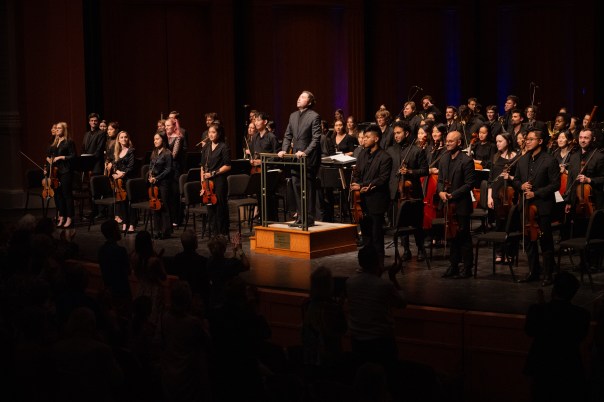
The only sparsity was on the Knight Theater stage. Johnson and the CSO would not be discarding all of the orthodoxies of the authenticists: the size of the orchestra had been scaled back to those employed in Bach’s days and those that would have played Mozart’s Symphony No. 25. The interloper on the program, Stravinsky’s Concerto for Piano & Wind Instruments, was also conspicuously downsized.

Viewed in profile, Johnson’s black suit – and her decisiveness – enhanced her resemblance to Kamala Harris. Symphony responded energetically to her baton all evening long, yet there was no lack of lyricism or finesse when Bach’s Orchestral Suite No. 3 transitioned from its brassy opening Overture to the famed Air (on a G string). Concertmaster Calin Lupanu, accorded considerable space in the opening movement, spearheaded the ethereal violin section to the requisite sublimity as the big tune gracefully swelled. Their intimacy quickly pointed up the advantage of a trimmed ensemble.

Subscribers who hadn’t scrutinized their program leaflets, let alone scanned its QR code for the full booklet, were likely shocked by the mass departure of the string sections, the arrival of the Steinway, and the empty chairs that remained as pianist Orion Weiss made his genial entrance. Deceptive! After a rather solemn Largo opening from the winds, with a somewhat promising crescendo at its center, Weiss’s first notes from the keyboard in the Allegro section were savage knuckle-busting clusters, met by a lusty clamor from the previously wan winds, crowned by a thumping of timpani.

Amid the cascade of chords that Weiss inflicted on the keyboard, a jazzy percussive rhythm infectiously emerged – even if it was impossible to determine whether the blizzard of notes Weiss was playing were the right notes. Suddenly, Weiss had taken on the appearance of a febrile Russian madman! The ensuing Largo provided lyrical reassurance, with some primeval passages set aside for oboists Erica Cice and principal Timothy Swanson. The pacing of the closing Allegro was almost as frenetic as the opening: if there were wrong notes here, Stravinsky had put them there with wicked glee.

This image has an empty alt attribute; its file name is 2025bach-mozart-7.jpg

Unless you were expecting an enormous horde of string players to flood the stage for the Mozart symphony, the biggest surprise after intermission was at the beginning, when Weiss returned for the Bach Keyboard Concerto. When Johnson stood by, she applauded not only Weiss but also flutists Amy Orsinger Whitehead and principal Victor Wang. Jackson’s outfit hadn’t been the only one I’d noticed until then. As she took her place with the winds for the Orchestral Suite, Whitehead’s black attire seemed to be strikingly ornate and elegant. So this featured slot explained the seeming breach of decorum.

Nor do you need to go more than a couple of bars into the Brandenburg Concerto No. 4 or its Keyboard Concerto offspring to savor the impact of its paired flutes delivering the catchy theme of its opening Allegro. Baroque aficionados, on the other hand, might have needed a minute or so to acclimate themselves to hearing the more rounded and gilded timbres of modern metal flutes. Their record shelves are likely clogged with trendier authentic recordings, marked by the presence of ancient wooden flutes and their hollower sound. Frankly, it was refreshing – and fun – for me, and Weiss bore a distinctly merrier look as well, though his cadenzas remained challenging.

Let’s not waste any more time in declaring that Charlotte Symphony retains its zest for Mozart. With this trim ensemble and Jackson’s accenting, what we heard at the Knight ranked among the most exemplary performances CSO has lavished on a Mozart symphony, even if the youthful No. 25 doesn’t rank among his very best. The opening 25-note sequence from the legendary 17-year-old prodigy, a 16-note vamp followed by a nine-note melody, hasn’t worn out its winsomeness in over 250 years.

Standing out almost as much as the crispness of the orchestra were the lovely solo spots from Swanson, capping what was perhaps his finest evening since assuming the first oboe chair this season. Jackson was gratifyingly bold in differentiating Mozart’s dynamics, finishing out the penultimate Menuetto with a satisfying crescendo. The closing Allegro featured more assertive playing from the winds pitted against the ferocity of the strings. Every now and then, we could discern Swanson’s oboe hovering above the fray.