All posts by perryt77

Small Sizing Yields Big Rewards in DCP’s Fun Home

Review: Fun Home at Armour Street Theater

By Perry Tannenbaum

Across the way from the Gershwin Theatre, where Wicked has been running for over 20 years, you can find my favorite Broadway theater, Circle in the Square. At the other end of an underpass that connects the two venues – and two or three flights of stairs underground – you and 800+ plus patrons (less than half the Gershwin’s capacity) can have a theater-in-the-round experience in a space that’s like a wee oval basketball court or a hockey rink.

I’ve seen seven different productions at this underground stadium since 1999, most unforgettably the world premiere of Tennessee Williams’ Not About Nightingales that year and the visionary waterworld of Mary Zimmerman’s Metamorphoses in 2003. Right now, two other Circle gems are playing in Metrolina revivals, Lombardi at the Lee Street Theater in Salisbury and five-time Tony Award winner Fun Home at the Armour Street Theater in Davidson.

A couple of admirable versions of Jeanine Tesori’s musical have already run in the QC, a Broadway tour at Knight Theater and an Actor’s Theatre reprise on the Queens U campus, so the current Davidson Community Players production, directed by Danielle Melendez, has big shoes to fill. What strikes me most positively about DCP’s effort, however, is how small it is. If you’re sitting in the front row, as my wife Sue and I were last Saturday evening, some of the action will be right next to you. Or behind you.

From that vantage point, DCP is better than even the 2019 Actor’s Theatre production at Queens’s Hadley Theater in replicating the intimacy of the Circle in the Square experience. Set designer Chip Decker, who stage directed the Hadley production during his years at the helm of ATC, retains his bright visual concept – a departure from the more funereal Broadway and touring versions – in depicting the Bechdel Funeral Home, allowing Alison Bechdel’s cartoons free play on the translucent windows of the parlor.

Often, they’re animated, with Bechdel’s words and drawings blooming before our eyes.

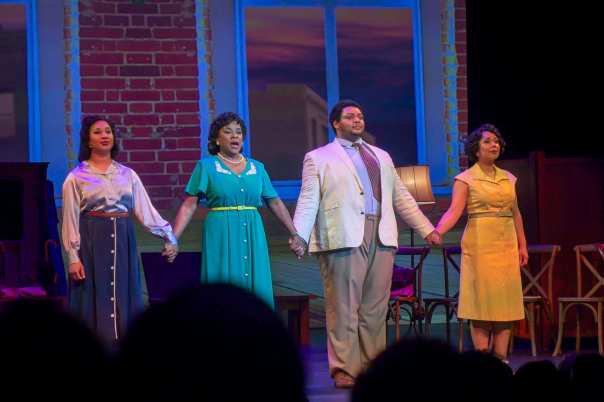
As we watch Lisa Kron’s adaptation of Bechdel’s graphic novel unfold, there’s a nice little studio perch set aside at stage right for the full-grown Alison to narrate. Sometimes as Alison, Kel Wright insinuates herself into the action, lurking in the main playing space, sketchbook in hand, as Small Allison and Middle Allison act out her vivid memories of growing up at a Pennsylvania funeral home and coming out as a lesbian at Oberlin College.

The bright visual concept tracks better with Kron’s book, because darkness only gradually seeps into the story. Alison’s dad, Bruce, seems like a bookish, excessively neat and proper mortician at first, mainly because he and his dutiful wife Helen conspire to hush up his big secrets. When Small Alison and her brothers sing “Come to the Fun Home,” a faux commercial jingle for the funeral home, the childish glee is as contagious as an early Jackson 5 hit or something fresh from little Donny Osmond and his backups.

Bruce may discourage these boisterous outbursts, but he cannot suppress them. Similarly, when Small Alison wants to go to her school party in jeans and sweater, Bruce can temporarily impose his will by shaming his daughter into wearing a dress. It’s only in retrospect that we and the full-grown Alison realize that Bruce was mostly protecting himself, shielding the truth of his own sexuality rather than upholding propriety.

Ironically, the fulcrum begins to shift for Middle Alison at Oberlin College, where she discovers her own gayness. This is jubilantly proclaimed in “Changing My Major (to Joan),” a song that equals the joy of “Fun Home” and surpasses it in exuberant sensual comedy. Tesori is at her best in these chamber sized songs with their pop flavorings and their Avenue Q spice. Even at her peak in Caroline, or Change and Kimberly Akimbo, Tesori’s other acclaimed shows, there’s a little bit of Sesame Street mischief going on.

Having coped with Bruce’s escapades for decades, Helen understandably freaks out when her daughter informs her that she has come out. Alison can only see her mom’s distress through a haze of misperception. Yet we always like Alison because she not only observes herself and her family with her sketchbook, she perseveres on her path and eventually, if still hesitantly, confronts her problems.

Despite Dad’s disdain, she continues to opt for cartooning instead of “serious” art, continues to wears jeans instead of dresses. Faced with Joan’s advances, Middle Alison retreats… temporarily. She seems to hibernate and marinate after writing home about her gay epiphany, processing Dad’s puzzling evasiveness and Mom’s distress, but she elects to bring Joan home with her when she returns from Ohio on winter break.

Darkness falls gradually, but it falls hard.

Mortician, English teacher, preservationist, and molester of underage boys – there’s a lot to unpack, even for adults in the audience, as we try to understand and judge Bruce in the context of his times. Coming off his outré antics in Vampire Lesbians of Sodom,Ashby Blakely is as varied, complex, and nuanced as we’ve ever seen him as Bruce. At times, he roars in his tyrannical moments, overpowering the small house. Like all the other players, he’s miked, but thanks to Kathryn Harding’s exemplary sound design, there’s never any distortion, clipping, or dropouts to mar the show or its music.

The one major sacrifice for theatergoing purists is the lack of a live orchestra at Armour Street. Nevertheless, Harding contrives a surround effect by channeling the prerecorded soundtrack and the amplified voices from the rear speakers. It was a pretty unique front-row experience for me, rather enjoyable.

After her exploits at Booth Playhouse as Norma Desmond in Sunset Boulevard, Alison Rhinehardt had already convinced me that she could overpower Armour without a mic. As Helen, she predictably knocks her showpiece, “Days and Days,” out of the park with diva aplomb. Until then, she’s rather wholesome and humdrum, accentuating Mom’s breakout.

Nor is there any perceptible cratering when we scrutinize the less familiar names in this cast. Recently unveiling her directing chops in the Queen City Concerts premiere of Local Singles,Wright brings an exacting intensity to Alison that always captures the drama, even when she sings. “Caption,” she keeps barking in Kron’s script, so her valuation of le mot juste always seems foremost as her castmates take care of the graphics.

As the Bechdel brothers, Aiden Honeycutt as John and Grayson Flowers as Christian help turn Small Allison’s “Fun Home” promo into an exhilarating panorama. Bailey Fischer takes flight almost from the first moment we see her as Small Alison – goodness, energy, and precocity personified until her last “Flying Away” moment. That energy is formidable when Ann Schnabel must take over as Middle Alison, especially in the intimidating context of a matriculating college freshman. In a sense, then, her “Changing My Major” is as much a rebirth as it is an affirmation.

It’s the needed embrace of the real world that will ultimately help her in coming to terms with the truth about Dad.

Criminal law is far more confident than my feelings in determining who the forbidden fruit is among the remaining cast. As the revelatory Joan, Sierra Key seems healthy enough, her seductiveness sufficiently muted for a Midwest coed. At school and visiting the funeral home, Key hits all the notes that emphasize Joan’s savoir-faire and discretion without pounding them. As the Bechdels’ handyman, Bart Copeland struts and preens enough to convince us that he’s also a consenting adult.

When he switches roles and becomes a former student that Bruce picks up on his nocturnal rambles, Copeland calls upon the naivete that made his star turn as Pippin so compelling last spring at Theatre Charlotte. Topped with a mop-top wig, you’ll see he’s also a perfect fit for Tesori’s retro pop music.

Doubling the Fun

Okay, so maybe you weren’t duly impressed that two shows are now running in Metrolina that premiered at the same Broadway theater. We can do better. Weirder. This coming weekend boasts two different shows set at a funeral parlor! Yes, as Fun Home continues for two more weekends up in Davidson, down here at Booth Playhouse, Charlotte Conservatory Theatre is bringing us the world premiere of Nan-Lynn Nelson’s Leaving Watermaine, directed by the playwright.

It opens on leap day this Thursday, at the tail-end of Black History Month, for a four-day run. By the end of Act 1, we’re greeted with a busy weave of plot threads involving undertaker Werly Mainlodge, his three daughters, and their beaus – both beloved or unwanted. Which of the three young ladies will be leaving first? Elopement or honeymoon? Will the Klan intervene on the eve of the planned departure?

Has there been a KKK lynching or a passionate murder? Or is the presumed victim still alive? Mystery, racism, colorism, and comedy peep into what seems like a tragedy, so you’ll need to stick around after intermission to learn how the dangling threads sort out. Nelson seemed to have it all calculated, incorporating her own musical soundtrack into her sound design.

Dialing Up the Almighty in Memphis

Review: The Mountaintop at Theatre Charlotte

by Perry Tannenbaum

A stage with a particularly authentic – or imaginative – set design is a good start for a director who wishes to immerse you in the world of a play. Yet few productions surround you with the theatre experience, making you feel outside your own world and inside theirs. Sleep No More was dedicated to achieving this mission with a Macbeth makeover up in Manhattan’s Chelsea district at a spooky hotel, where I saw it in 2015. So was Then She Fell the following night in Brooklyn, where I was plunged into the imagination – and mental illness – of Lewis Carroll.

In Charlotte, such efforts have been comparatively infrequent, but not unknown: Chickspeare’s Fefu and Her Friends on Cullman Avenue in 2001, numerous “environmental” productions by Carolina Actor’s Studio Theatre (CAST) in their days on Clement Avenue, and Matt Cosper’s legendary Bohemian Grove of 2014 that was staged god-knows-where – you had to agree to be kidnapped in a van by The Machine at the Actor’s Theatre parking lot to attend.

They do make an impression, these hyper-immersive presentations.

Cut to the legendary Queens Road Barn for the latest Queen City experiment in environmental staging. Yes, that’s Theatre Charlotte – in Myers Park! – on the cutting edge with its new production of Katori Hall’s The Mountaintop. Directed by the ageless Corlis Hayes and designed by Chris Timmons – with a nine-person “Lobby Transformation” team – this is the first fully-staged drama my wife Sue and I have seen in the 501 Queens Road lobby since the spare and forlorn Waiting for GODot in 2007.

Together with invaluable help from David Gallo, set designer for the 2011 Broadway production, and props designer Brodie Jasch from Fayetteville’s Theatre Squared, Dr. Hayes and her production team aim to take us back to the Lorraine Motel in Memphis on the night of April 3, 1968. Rev. Martin Luther King, Jr., returns from the Mason Temple, where he has just delivered his eerily prophetic “I’ve Been to the Mountaintop” speech.

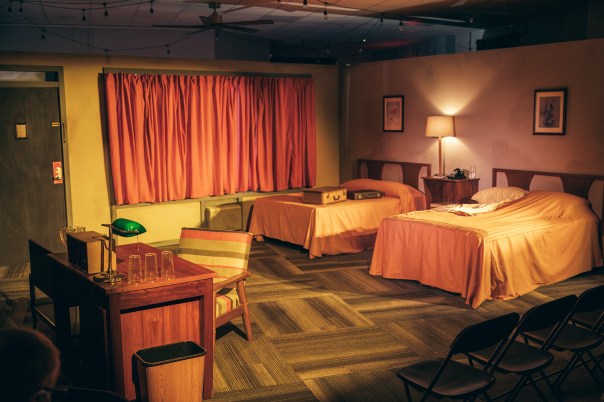
Every detail of the last room occupied by MLK has been replicated with meticulous authenticity – night tables and their contents, lamps, the chair and its fabric next to the window, the window curtains, the bed coverings – all the way down to the upside-down zero on the door to Room 306. With walls within walls, you must enter through this door to get your first view of the new theatre space in the lobby created for this production. Only the ceiling remains unaltered, with its fans and extinguished holiday lights. Explanations are appended in the digital program for those details which couldn’t be ascertained and those that would have conflicted with Hall’s script.

Since there is no intermission and all the usual concession outposts have been whisked away, they have thoughtfully made “Room Service” available to ticketholders via a QR code. In more ways than one, we are treated like kings at The Lorraine. Fun fact: the fateful motel was actually named after the hit 1928 song, “Sweet Lorraine,” popularized by jazz artists Teddy Wilson and Nat “King” Cole.

For all of Dr. Hayes’s reverent devotion to getting the look and feel of The Lorraine recreated as faithfully as she can, we soon see that it isn’t a shrine. Hayes is equally bent on getting to the heart of Hall’s pointedly irreverent drama. Hall provides ample time for solemnity and anguish at the end, but until then, she wants us to see the soon-to-be-martyred icon as a man, not a god, and not even as a holy man. The real Martin – or as God likes to call him, Michael – had his foibles, vices, and infidelities.

And notwithstanding the resounding valedictory declarations of the Memphis speech we’ve heard over and over – “So I’m happy, tonight. I’m not worried about anything. I’m not fearing any man” – Hall insists on reminding us that King did have worries and fears.

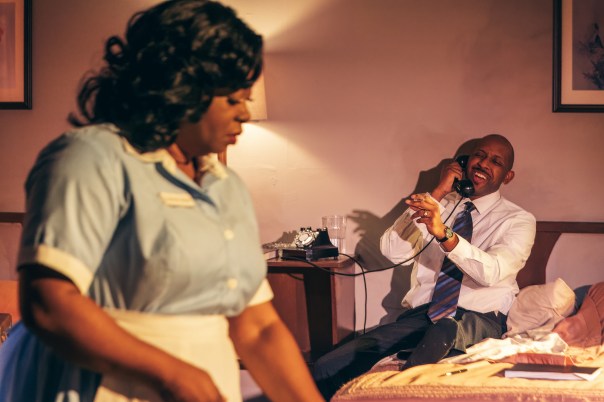
All obeisance to King’s saintly aura is swiftly discarded almost as soon as we see Justin Peoples taking on the role, before he walks through the audience to take a pee. Not only is he unkempt after his oratorical exertions and his walk through the rain, he has largely dropped his dignified public persona, at ease if not quite relaxed. Though he diligently examines his room’s rotary phone to make sure it isn’t bugged, we can hear that he has switched from formal to casual mode as soon as he speaks. It’s with an unmistakably Southern accent!

Immediately disarming. Neither the touring production by the famed Penumbra Theatre of Minneapolis that ran at Booth Playhouse in 2014, nor the homegrown Actor’s Theatre run of 2018 at Queens University, directed by April Jones, had quite the same spontaneous or undignified impact. The smallness of the lobby space at the Queens Road Barn certainly helps in establishing a closer intimacy with King and a sharper look at his vulnerabilities.

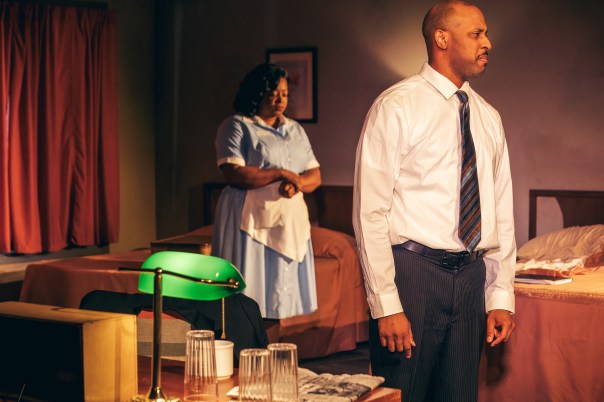
Maybe that folksy drawl would have been even more impactful if Peoples had held back on it until MLK had dialed room service after normal closing hours. The arrival of LeShea Stukes as the fetching Camae, a housemaid moonlighting as King’s waitress, would have been a good moment for Peoples to turn on the Southern charm. But for those of us who have seen The Mountaintop before, Stukes brings with her more than Camae’s sensual allure, more than her extra Pall Malls to satisfy King’s chain-smoking, and more than her working-class sass.

She now gives us solemn glances from behind King’s back, fully aware of the gravity of her true mission before she discloses it, morphing from pursued damsel to admonishing paramour to chum to messenger of God. None of these fresh wrinkles quite accounts for the marvelous voodoo or the juju that Hayes, Peoples, and Stukes have conjured up in creating the playful, poignant, and profound chemistry of this Camae and MLK.

Lighting designer Jennifer O’Kelly gently signals those moments when Camae might be contemplating why she’s there, foreshadowing the AV extravaganza that will accompany Stukes’ final mountaintop revelations. She will almost be speaking in tongues when we reach this visionary summit.

There’s little theology here, for when King dials up the Almighty, pleading his case for more time on this turbulent planet, she hangs up on him. Yet there just may be some deep dialectic in Hall’s scheme that narrows the gap that we might feel between God’s biblical judgment upon Moses at Mount Nebo and the judgment upon Martin in Memphis.

Moses was given a precise catalog of his greatest sins. Maybe in an afterlife he learned not to shatter any holy tablets or assault a boulder without God’s approval. But what was the great sin that deprived MLK of the Promised Land that awaited his people? The answer never comes explicitly in the play, but King’s sins – though relatively petty until we consider possible adultery – are graven in its marrow.

In an age when not a day goes by without yielding fresh images, outrages, and crimes committed by a lying orange buffoon, we might find ourselves shocked to be shoved towards such traditional moral moorings. Some of these values were written long ago in our marrow. Leading a people may still require adhering to a higher standard in God’s job description, not flouting the laws and proprieties that apply to everyone else.

Peoples and Stukes, with plenty of finely judged assistance, have found a way to make The Mountaintop more poignant, relatable, and human. Hall’s work becomes more touching, meaningful, and necessary each time I see it.

The Passion of Mary Cardwell Dawson Brings a Neglected Pioneer Back into the Spotlight

Review: The Passion of Mary Cardwell Dawson at the Parr Center

By Perry Tannenbaum

  February 15, 2024, Charlotte, NC – Commissioned by the Glimmerglass Festival and premiered there during the summer of 2021, The Passion of Mary Cardwell Dawson is a fascinating, informative, and inspiring hybrid. Part documentary, partly a new play by Sandra Seton with operatic arias composed by Carlos Simon, and partly an eye-opening “Building the Stage” exhibition, the new co-production by Opera Carolina and The Denyce Graves Foundation have found a perfect landing spot at the posh Parr Center on the CPCC campus.

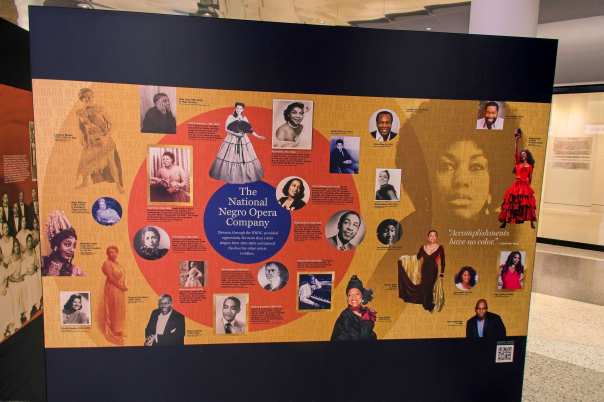
With numerous glitterati on hand from Charlotte’s African American community to celebrate opening night, Dawson, and Black History Month, the Parr Center lobby dazzled as never before. Just 15 minutes before the curtain was scheduled to rise, I encountered a roomful of beautiful people and formalwear; imposing billboard-sized exhibits of museum quality devoted to Dawson, the National Negro Opera Company she founded, and the luminaries of opera – and jazz – that she tutored; accessorized with video stretching from one entrance to the New Theater to the other. All the bells, whistles, and glamor you could want, with a live bass and alto sax duo playing Charlie Parker bebop in the background.

The production was certainly equal to the new hall. Accompanied solely at this point of its development by pianist Gregory Thompson, The Passion would seem smallish at Belk Theater with its cast of four and an orchestra of one. Unfortunately, the Seaton-Simon creation also struck me as too small for Dawson, its subject, and too small for Graves, its star. With a sympathetic director like Kimille Howard already on board, and Op Carolina’s set designer demonstrating fresh possibilities with his wonderful projections on the upstage wall, the avenues are certainly opened for a fuller exploration of Dawson’s talents and achievements.

Seaton places all of the action in Pittsburgh, mostly at the headquarters of Dawson’s company on Apple Street, in a studio upstairs from her husband Walter’s electric company. Her compressed timeline results in a format that wavers between masterclass and a professional rehearsal. On one side of the stage, Thompson presides at a Steinway, and at the other, we see three humble chairs that might be occupied by students in a Dawson masterclass. If the libretto were allowed to breathe a little, the curtain would rise on the three students we will see, either seated and ready to perform or engaged in conversation, giving Simon – composer-in-residence at the Kennedy Center in DC – a chance to begin penning some recitative, and giving Graves a grander entrance.

Alas, this is a rehearsal of Bizet’s Carmen on the day that the Negro Opera Company’s production is set to premiere on a floating outdoor stage by the shore of one of Pitt’s famed three rivers. This setup gets more improbable as the story unfolds, undercutting Dawson’s wisdom as a performing artist, an opera director, and a business person. Would an operatic director allow her performers to risk overtaxing their voices by rehearsing on the day they perform? Wouldn’t the entire cast be summoned to a last-minute rehearsal? Wouldn’t it be in full dress? Wouldn’t standard rep like Carmen be so far under the belts of professional-grade singers that their director wouldn’t feel compelled to instruct them on how to present Bizet’s music or penetrate to his protagonists’ cores?

By heightening her drama on the day of the opening, Seaton actually manages to be more unflattering to the Dawsons. A rainstorm is raging across Pittsburgh, threatening the cancellation of tonight’s outdoor performance and the ruination of Dawson’s company. Administrators at Spoleto Festival USA and ticketholders from around the globe would laugh out loud at the notion that a scheduled outdoor production would bring in national and international stars to Charleston without making contingency plans for bad weather beforehand. Not sound judgment for Dawson or her husband, who handled her company’s business end.

Of course, Seaton’s scheme makes it easier for The Passion to have legs, because the roles of Dawson’s singers – Isabelle as Micaela, Phoebe as Carmen, and Frank as Don José – only need to be versed in their presumably familiar Bizet music rather than having to learn anything written by Simon. Even so, Diana Thompson-Brewer as Isabella, Ladejia Tenille as Phoebe, and Johnnie Felder as Frank, are all forced to look and sound slightly amateurish at times during their lamentably brief moments in the spotlight. Howard helps them all out from her director’s chair, occasionally obliging Graves to be a bit fussier – and a lot more prudish – than Seaton may have imagined Dawson when she wrote the script.

I was most impressed by Felder in the tenor role, and wondered how much his superiority might have figured in Seaton’s concept or Howard’s casting. Most of Graves’ vocal coaching, after all, is reserved for the younger women onstage and the music she has excelled in all the way the Metropolitan Opera, Covent Garden, and the Vienna Staatsoper, to name a few – so it would be a pity not to hear Graves in this repertoire while we have her here and not perceive her superiority to Dawson’s protégées. The diva and the drama deserve that. Simon’s music, scant as it is, is also worthy of Graves. Those two arias, when Dawson is alone with her thoughts and later when her class/rehearsal is done, both have the qualities of the best arias sung at Spoleto’s production of Barber’s Vanessa last spring.

A fuller version of The Passion of Mary Cardwell Dawson would be a full-length opera with a fuller view of Dawson as a singer, teacher, and impresaria. Ideally, it would take us back to the North Carolina native’s childhood and the foundations of her love for music and opera, but we should at least cover the arc of Dawson’s founding of her company, a more substantial exploration of her teaching methods and philosophy, and a nicely drawn arc of her prize students’ development into professional opera singers that do full credit to Dawson and her pioneering company in their Carmen. A full opera company at the end – with a fuller orchestra – would bring the entire enterprise up to scale. Make no mistake, though, this handsome Opera Carolina production is an exciting coup for Charlotte and a compelling argument for Denyce Graves’ project to reach its fullest fruition.

The More Things Change, the More Confederates Shocks and Delights

Review: Confederates at The Arts Factory

By Perry Tannenbaum

Symmetry, parallelism, continuity, and evolution are intricately interwoven throughout Confederates, Dominique Morriseau’s comical and sometimes farcical drama of 2022. The Charlotte premiere, now at the Arts Factory, comes to us less than two years after its Off-Broadway premiere in a highly polished, smartly aware Three Bone Theatre production.

Morriseau’s symmetry isn’t subtle: it hits us straight in the eyes the first time we see Zachary Tarlton’s scenic design. Split down the middle, the Arts Factory stage gives two eras and two institutions equal play in an intimate black box format. One side evokes Civil War slavery on a Southern plantation, while the other half introduces us to contemporary academia.

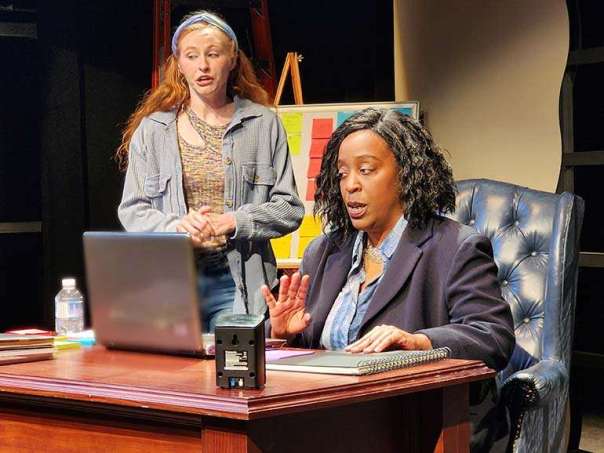
We alternate between settings, starting with Sandra, a modern tenured Black professor, proclaiming her outrage and sense of violation in vivid terms – yet with the poise and sleekness of a contemporary college lecture accessorized with slides. From that peep into scandal in present-day academia, we flash back to the slave quarters of Sara as her brother Abner sneaks into her bedroom through a concealed trap door.

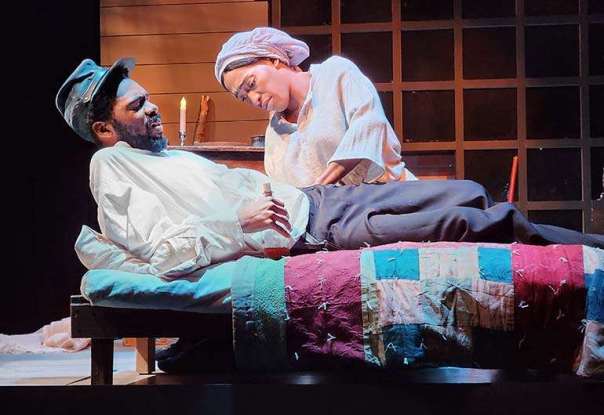
Sandra has been maliciously targeted by a student or teacher who pasted a demeaning old Civil War photo of a bare-breasted black wetnurse suckling a white baby – with Sandra’s face photoshopped to replace the original slave’s. Jumping to conclusions or instinctively making connections, we’re apt to immediately believe that Sara was that nurse. Abner has volunteered for the Union Army and has been wounded in battle, so as she sews up Abner’s wound, the subject of Sara’s nursing skills is inevitably addressed.

Sara’s skills and ambitions extend further. Dangerously. She has already learned how to read, breaking one terrible white taboo, and she wishes to nurse and fight for the Union alongside her brother – to learn how to fire a rifle right now. That’s a pill Abner can’t easily swallow.

Otherwise, the two women have separate storylines until Morisseau split-screens them together at the end. Portraying Abner in his Three Bone debut, Daylen Jones is the first subordinate character to cross the invisible line between pre-Emancipation Dixie and the hope and refuge of modern-day academia. Shedding his rags and his Union blue greatcoat, Abner becomes the aggrieved Malik in today’s world. He’s obviously a gifted student, and his gripe with Professor Sandra is that she grades his papers more harshly because he’s Black, protecting her immunity from being charged with favoritism.

Seeing that there are only Black females on faculty – and no men – Malik feels doubly oppressed by bias in academe: racial bias compounded by gender bias. Notwithstanding her starchy professional manner, Sandra is more of a crusading sociologist than a sober judge. So she may indeed have fallen prey to the trope heaped upon oppressed races and genders that says, “If you wish to be treated as an equal, you need to be better.” Pragmatic? Sure. But for a gifted scholarship student seeking to maintain his A average, cold comfort.

We eventually see that there are four characters on each side of the time divide, three of whom repeatedly change costumes to play double roles. Before and after we can tally all this, director DonnaMarie and sound designer Tiffany Eck place two snippets from Nina Simone’s “Four Women” at strategic spots in their playlist, layering on extra meaning – and mythic aura – during scene changes.

If Jones can be labeled as two provocatively different militants as he roams back-and-forth from opposite sides of the stage, then Holli Armstrong (also on my radar for the first time) can be regarded as two variants of an imperfectly enlightened white racist. She is most exaggerated and hilarious on the Southern plantation as Missy Sue, the master’s daughter, when she comes back home as an undercover born-again Abolitionist. It is Morisseau as much as DonnaMarie who is prompting Armstrong to bring a Gone With the Wind air-headedness to Missy Sue – and a twisted lesbian desire for Sara – and she obliges with fiddle-dee-dee gusto.

She offers Sara a perk in exchange for executing a dangerous mission: if Sara will transcribe and transmit Master’s battleplans, she gets to live in the big house while Sue delivers Dad’s secret intelligence across enemy lines. Sure, that’s an appreciable upgrade for Sara, but she’ll still be a slave doing Missy Sue’s dirty work.

Armstrong discards Missy Sue’s pea-brained giddiness when she transitions to Candice, retaining her sycophant tendencies and much of her high energy as she haunts Professor Sandra’s office, working off her tuition debt and gathering gossip. Her true manipulativeness gradually emerges in successive office scenes, but Candice never becomes as juicy a role as Missy Sue is, for she somewhat downplays her suck-up moments with faculty.

Last to appear onstage, Jess Johnson draws the most balanced – and delicious – of the dual-role combos. As the master’s Black mistress, the opportunistic Luanne effortlessly sniffs out that Sara’s access to the master’s office and desk are coming at a price the newcomer must pay, possibly beyond accepting Missy Sue’s sexual advances. On the academic side, Johnson gets the most radical of costume designer Chelsea Retalic’s backstage makeovers when she becomes Jade. Professor Jade is more stylish and popular than Sandra because she’s chummier with her students and would never dream of hamstringing the Black ones.

At both ends of the stage, Johnson gets to be a wily master of psychological warfare. Both Luanne and Jade want something vital from our protagonists. Luanne wants friendship from Sara and a path to freedom, but if Sara bars the way, she can work her charms on Abner. Needing Sandra’s endorsement, Jade doesn’t tiptoe around her differences with her superior, unleashing a torrent of scorn and chutzpah that took my breath away.

Indeed, Johnson unlocks Morisseau’s grimmest joke on her protagonists. Whether you’re at the bottom of the pecking order or at the top, you’re still the most oppressed person in the room. Times have changed, but not that much.

Sara is always being pulled at from multiple directions. Abner needs to be sewn back together, Missy Sue wants to recruit her as a spy, and Luanne wants her to plot an escape to freedom. Maybe that’s why the playwright stretched out Sara’s name to Sandra for the New Millennium! Our Professor is no less pressed upon, strongly urged to re-examine her grading philosophy, softly reassured that she is more admired than she really is, and arrogantly lobbied for tenure backing. Nobody seems to really care about the bare-breasted insult that was slapped on her office door.

Neither of these roles is fun-filled, but the challenges Sara and Sandra face allow them to grow in strength and stature before our eyes. Valerie Thames and Nonye Obichere are so fiery and authoritative in their separate roles that you can comfortably watch Confederates as two separate plays without constantly considering how meanings and brilliance bounce off the facets of the two gems. Not feeling compelled to track the finer points of Morisseau’s disquisition on racial or gender bias makes it all the easier for an audience to enjoy them.

Thames effortlessly takes on the self-assurance of an established TV guest whose knowledge and viewpoint are proven commodities, wearing Professor Sandra’s celebrity status with insouciant dignity. Just watch out when she bursts into flames! Maybe run for cover.

Although Sandra’s speeches frame the drama, Obichere gets to be a more physical presence as Sara – as nurse, spy, soldier, and lover – and she navigates a far wider character arc. Hers isn’t the funniest performance you’ll find this weekend at The Arts Factory. But it’s the most vivid, shocking, and memorable.

You may leave the theater convinced that both Sara and Sandra are depicted in that horribly racist slide. But it will mean more at the end than at the beginning. The magic of Morisseau and Photoshop are both at work.

Ensley and Schroeder Check All the Beautiful Boxes in Matthews

Review: Beautiful The Carol King Musical at Matthews Playhouse

By Perry Tannenbaum

When you think of singer/songwriter Carole King and Broadway musicals, there’s an instant disconnect: the humble simplicity of King’s Tapestry album cover clashing with the glitz and blare of the Great White Way. So a Broadway musical about King’s career is more of a stylistic stretch than a biomusical about most rock stars, pop stars, or jazz & blues divas. Everyone involved behind the scenes of the original 2014 production of Beautiful The Carol King Musical seemed keenly aware of the dichotomy, including director Marc Bruni, orchestrator/arranger Steve Sidwell, and scriptwriter Douglas McGrath.

Their idea of coping with the problem was by leaning into it. Not too subtly, they conspired to make the early stages of King’s career seem crass and commercial, as if she were trapped in the dog-eat-dog maw of the pop music industry. King and her writing partner, lyricist Gerry Goffin, write the songs while producer Don Kirshner finds the singers and the groups who will cut the singles – the likes of Bobby Vee, Little Eva, The Drifters, and The Shirelles. Yet somehow the hierarchy is flipped in the famed Brill Building in NYC.

Carole and Gerry are slaving for Kirshner, a genial industry mogul and taskmaster, and the couple’s best early music loses a lot of its luster when it’s farmed out, especially when “Up on the Roof” falls into the hands of The Drifters and “Will You Still Love Me Tomorrow?” is butchered by The Shirelles, thanks to excessively ornate Sidwell arrangements that would be more at home on Broadway or Vegas than Motown. These excesses helped Jessie Mueller to shine all the more brightly in the original cast – and for her sister, Abby Mueller, to shine equally when the touring version hit the QC in April 2016.

So a downsized production, like the one currently running at Matthews Playhouse, actually has the potential to be better than the Broadway and touring versions – with the right personnel and sufficient pizzazz. With Billy Ensley directing and Lindsey Schroeder leading a heavyweight cast, both those boxes are checked. The Broadway ensemble sheds two of its three keyboards nestling into Matthews, one its two guitars, and one of its percussionists. The slimming helps. No longer smothered by their orchestrations, Neil Sedaka’s “Oh! Carol,” Gene Vincent’s “Be Bop a Lula,” and Little Eva’s “Loco-Motion” sound more like rock music and less like mockeries.

Ensley targets the megahit by the King-Goffin duo’s friendly rivals, Barry Mann and Cynthia Weil, for his most farcical treatment. Not only is the arrangement of “You’ve Lost That Lovin’ Feelin’” garishly distorted, amped up from the swampy-echoey-churchy vibe of the original single, but the gulf between the bass and tenor voices of the Righteous Brothers is greatly emphasized, exaggerated, and comically exploited by Johnny Hohenstein and Zach Linick.

McGrath’s book is most affecting when it deals directly with King, though there’s bold poetic license in his voodoo, historically speaking. Pressured by Kirshner to come up with a new hit overnight for The Shirelles (in real life, they only had one hit record so far), King writes the music and goes to bed with Goffin. Perfect setup. Wouldn’t you like to wake up in the morning and find the handwritten lyrics for “Will You Still Love Me Tomorrow” perched on your piano – and be the first person on Earth to read and sing them?

No disrespect to the great Bobby Vee, but we’ve suddenly ascended more than a few notches above “Take Good Care of My Baby.” This moment still grabs me, but there are more moments like this after intermission, when “You’ve Got a Friend” and “A Natural Woman” are unveiled, that choke me up even more – as King breaks away from the Brill Building and starts to do her own thing. Schroeder replicates the sandy sound of Carole’s voice from the beginning, but as she transforms from a demo singer behind an upright piano to a chart-topping performer, watch out.

Schroeder can not only belt – she can tear your heart out.

McGrath’s dramatization heightens the magic most memorably when “You’ve Got a Friend” is reframed as a not-quite-farewell song, when King embarks for her solo career in LA with Kirshner’s blessing, and both Barry and Cynthia gather round the old upright with her to sing this newborn masterpiece. The song didn’t really come out until her second album, but who’s counting, right?

Nick Southwick as Barry and Sophie Lanser as Cynthia (get that woman a more reliable mic!) deliver polished performances all evening long, but they also grow more gravitas after intermission. Lanser sheds the frivolity of a “Happy Days Are Here Again” parody and “He’s Sure the Boy I Love” and joins Southwick – previously mired in the silliness of “Who Put the Bomp” and the wrong-key version of “You’ve Lost That Lovin’ Feelin’ – in a heartfelt “Walking in the Rain” duet.

Then if you haven’t started weeping with Schroeder’s “It’s Too Late,” you’re at the mercy of “You’ve Got a Friend” when Lanser and Southwick join in on the quivering-lip goodbyes. After playing Kirshner with avuncular savvy throughout King’s formative years, Ryan Dunn sprinkles some welcome laughter into this maudlin scene with a (purposely) bad attempt at vocalizing.

I’d forgotten that Carole had Aretha’s 1967 hit in her hip pocket when she cut Tapestry out on the Left Coast in 1971, so I found myself suddenly suppressing sobs when “A Natural Woman” began. Here it felt very right that Sidwell’s arrangement brought added vocalists and brass to beef up the simplicity of King’s version – and freed Schroeder to narrow the gap between Carole and the Queen of Soul with some fervent belting.

Marty Wolff’s simple two-story set design, with four wide strips of stained-glass paneling running vertically upstage in front of the eight-piece band led by Ellen Robison from the keyboard, needs only JP Woodey’s lighting to give it a rockin’ modernistic zing. Lisa Blanton’s choreography is devout doo-wop, most praiseworthy for how well the groups stay in sync, and Chelsea Retalic likely cranked out between 75 and 100 costumes for this large cast – all of them, from the sleekest to the grungiest, on point.

And the wigs! The only misfire here, among dozens of triumphant coifs – several for Schroeder – was the oceanic profusion of waves that perched on Joe McCourt’s head as Gerry Goffin, making him virtually unrecognizable. McCourt, a musical mainstay in the QC since his debut in 2008 as the lead in Godspell, has suavity to spare to spare and, in contrast with Southwick’s quirky neuroses as Barry, gets a nice and bumpy character curve as the only troubled soul we see.

This image has an empty alt attribute; its file name is beautiful24-139.jpg

As for the Afro-American doo-woppers… my, oh my! By bringing Nehemiah Lawson aboard to take over “Some Kind of Wonderful” from Schroeder and McCourt and then to bring him back again and again to sing “Up on the Roof” and “On Broadway,” the latter one of Weil & Mann’s best, Ensley and Robison signal that they have no plans of dissing The Drifters. Meanwhile, two lead singers are embedded among Ensley’s Shirelles. As Janelle Woods, the Shirelle who denigrates “Will You Still Love Me” as “too country” before fronting the breakthrough single (first Billboard #1 for an African-American girls’ group), Brianna Mayo gets a chance to show that her acting chops are as strong as her singing skills.

Shortly afterwards, Raven Monroe emerges from the backup Shirelles to become Little Eva and ignite “The Loco-Motion.” Until then, she moonlights as King’s babysitter during the leading lady’s brief marriage to the restless Goffin.

There’s a formulaic circle to McGrath’s storytelling that’s not at all displeasing, starting and ending with King as a star behind a grand piano singing a song from Tapestry. We flash back to her youth in Brooklyn and eventually touch down at Carnegie Hall, surely a kind of Jerusalem for a humble Jewish girl. Alongside her at the beginning and at the end is Carol Weiner as Genie Klein, King’s mother. Both were abandoned by her no-good father, steeled by adversity. Along the way to Carnegie, Weiner peeps in with a couple of overprotective warnings, a few salty quips, and a proud Mama’s lie.

If McGrath can embellish a good story, why shouldn’t she

COVID Kindred Behind the Scenes of Local Singles

Preview: Local Singles at The Arts Factory

By Perry Tannenbaum

Once you’ve scaled the summit and staged the legendary Sunset Boulevard at Booth Playhouse with a 40-piece orchestra – the pinnacle of Andrew Lloyd Webber’s achievement, or at least the K2 rivaling the Everest of Phantom –you might think that QC Concerts founder Zachary Tarlton would ask himself how can I top this? But when Tarlton formed his company in 2020, the Q stood for Quarantine, and the modest aim was to keep musical theatre going online via Instagram when actual theatergoing wasn’t possible.

So pianist/actor/musical director Tarlton can think small, no matter how wildly Queen City Concerts has grown and overachieved in less than four years. His idea of following up Sunset Boulevard is to take us from the macabre Hollywood mansion of movie icon Norma Desmond to a room at a Pittsburgh YMCA where Nancy and Richard host weekly therapy sessions that struggle to attract lovelorn clientele. That’s the main HQ for Local Singles (down the hall from Hot Local Singles), the new musical by Nick Navari.

Never heard of Navari? You are forgiven. While Lloyd Webber has been bringing hit musicals to Broadway since 1971, Navari is counting on his first Off-Broadway production to open in January 2025.

That’s the allure for Tarlton and his loyal QC Concerts fanatics: being in on a new creation from a new talent as the new organism develops. Instead of begging publishers and Broadway legends for the rights to produce their masterworks – or in the case of Parade, the stirring piece by Jason Robert Brown and Alfred Uhry, going through the ordeal of having those rights suddenly snatched away – Tarlton had the less stressful experience of Navari coming to him.

Flashing back to the summer of 2022, when QC Concerts was readying to begin its second season with the regional premiere of Kinky Boots, Tarlton recalls Navari reaching out.

“He had somehow found us on Instagram and, through the power of social media, followed along with what we were doing,” Tarlton confides. “Then he reached out to me, presented his whole kind of sales pitch for the musical.”

And why not? Backed by a grant from the National Endowment of the Arts, Navari wrote the music, the lyrics, the script, and the six-piece orchestrations for Local Singles. Then he directed the stage premiere at the New Hazlett Theater in 2021 as well as the cast album and a pro-shot film version. Musicians in the promo video for the world premiere jammed the score in surgical face masks, and the first production of Local Singles in front of a live audience didn’t happen until February 2022 at the Lamp Theater in Irwin, PA. Actors caught on-camera in rehearsals for that production were still sporting N-95s.

That second premiere was midway through QC’s opening season, a mere five months before Kinky Boots gave notice that Tarlton had his eye on blockbuster productions like Titanic, Angels in America, and Sunset Boulevard. The prevailing Tick, Tick… Boom! template of Tarlton’s opening seasonmust have seemed rightdown Navari’s alley.

So while Tarlton was navigating beyond his comfort zone with his first company, taking his quarantine concept live, Navari was venturing beyond writing, directing and performing into the wild frontiers of publicity and promotion, hawking his own work. You could say they were kindred COVID spirits. Accidental entrepreneurs.

Nor are they averse to doctoring their creations. By the time Sunset Boulevard dazzled at the Booth, Tarlton had totally discarded QC’s script-in-hand format in favor of a workshop concept with costumes, lighting, barebones, scenery and onstage orchestra. Meanwhile, Navari has not been idle. After the Pittsburgh premiere and the cast album, one of Navari’s numerous videos proclaims that he has written five new songs and added a character to Local Singles.

You don’t need to go far in the playscript to see a difference. By the second scene – and the second track of the cast album – the script and Spotify diverge. The version we will get at the Arts Factory this weekend will be the closest yet to the Off-Broadway edition slated to open at Players Theatre in Greenwich Village for a five-week engagement next January.

“He’s made a few more changes for our production,” Tarlton reveals. “So I know that he’s excited to have this chance to get it in front of another audience just to see what still may need to be tweaked and changed before it goes to New York.”

When we first see them, Richard and Nancy have been life companions for nine years, not exactly flush with success. Not only are they competing with the Hot Singles group down the hall, they are tied into a six-year deal for this cursed time-slot for another 42 months. The group seems to have been founded in order to help their friend Jack, a good-hearted paranoid mess.

We don’t meet them right away, likely because we need to be prepared for Jack’s eccentricities and for Nancy’s arsenal of therapy tools – including pairs of yellow rubber gloves, a bubble gun, a portable park bench (with an important plaque), and Morgan. In rehearsal photos, she is portrayed by a piece of hard-sided rolling luggage and the head of a mop. But she may evolve – or devolve – before performances begin at the Arts Factory later this week.

A couple of messy breakup scenes pave our way to the Y.

“So the show opens with Penny, who has just discovered that she is pregnant,” Tarlton explains. “Then we meet Wes and then Wes’s ex-girlfriend. There’s a great [new] song where she’s, like, throwing all these clothes out of the apartment. It’s the whole breakdown moment. It’s lovely.”

And it’s fair to say both Penny and Wes are hurting.

Then we travel into the support group,” says Tarlton. “Over the course of the first act, we find how Wes and then Penny makes their way into the group, one of them on purpose, one of them by accident. And then basically it tracks their continual journey with the group where they both end up continuing to come back week after week, getting to know each other more, getting to be a part of each other’s lives.”

The musical’s through-path is the support group bonding with Penny along the journey of her pregnancy. Navari tosses in some goofy detours, including overtures to Morgan and Jack’s daring adventure with his personalized park bench.

“There’s kind of a big twist at the end of act one with Jack as he’s trying to put himself out there and meet the person of his dreams.”

One advantage of turning down Local Singles for QC’s second season would be Tarlton’s ability to increase prep time for its upcoming run. Hitching onto the CharlotteShout Festival last April gave QC the opportunity to preview Season Three in a revue-style concert – and for Tarlton and director Kel Wright to cast all the younger roles. By the time Titanic was staged in the fall of 2022, Wright and all four of the younger players had already worked with QC: Mary Beth Ritter would sing the preggy Penny; Patrick Stepp would be Wes, our leading man; the versatile Lamar Davis would be the pitiful Jack; and Hannah Risser would belt and bellow The Ex, the key cameo.

Thinking big had allowed Tarlton to test-drive a multitude of singers and musicians.

But what about the adults in the room? Those decisions weren’t cinched until last fall in the weeks following the Sunset Boulevard run at the Booth – when Wright and Tarlton saw Nicia and Charlie Carla on Eastway Drive at VisArt Video in a deathless PaperHouse Theatre production of Vampire Lesbians of Sodom.

Turns out that Wright and Tarlton wished to emphasize the acting skills of their therapist partners, especially the zany Nancy, and the Carlas fit the bill perfectly. So let’s forget that we can’t remember the last time Nicia performed in a musical!

“I am super excited that we’re getting to work with Nicia on the show,” Tarlton gushes. “Just the acting presence she brings to the role of Nancy is astounding. We crack up in rehearsal every day – just her line delivery and the way she handles all these moments is perfection. The stuff that Nancy sings in the show is definitely very much still that talk thingy vibe, and she is owning it and comfortable with it.”

Sitting at the keyboard as music director, Tarlton will have a prime vantage point as the Carlas and their castmates work their magic. Maybe a few in the audience will recognize the vestiges of COVID as the musicians play along. The show is scored for keyboard, guitar (Daniel Hight), bass (Ben Stewart), drums (Mike Charlton), violin (Nikki Redman), and cello (Peter Case).

No winds and no brass. Remember those days?

Navari himself plays piano, guitar, and “a few other instruments,” Tarlton reports, explaining the composer’s facility in handling the chamber-sized orchestrations.

He savors the flavor of the strings. “It adds a little mix of more classical string music,” Tarlton observes, “with your very contemporary rock band feel of a traditional kind of modern contemporary, musical theater, off-Broadway sound.”

The idea is for this kooky Y therapy to go beyond the little support group and become contagious. For us.

Charlotte Symphony Heralds the New Year in All-American Style

Review: Koh Plays Mazzoli at Knight Theater

By Perry Tannenbaum

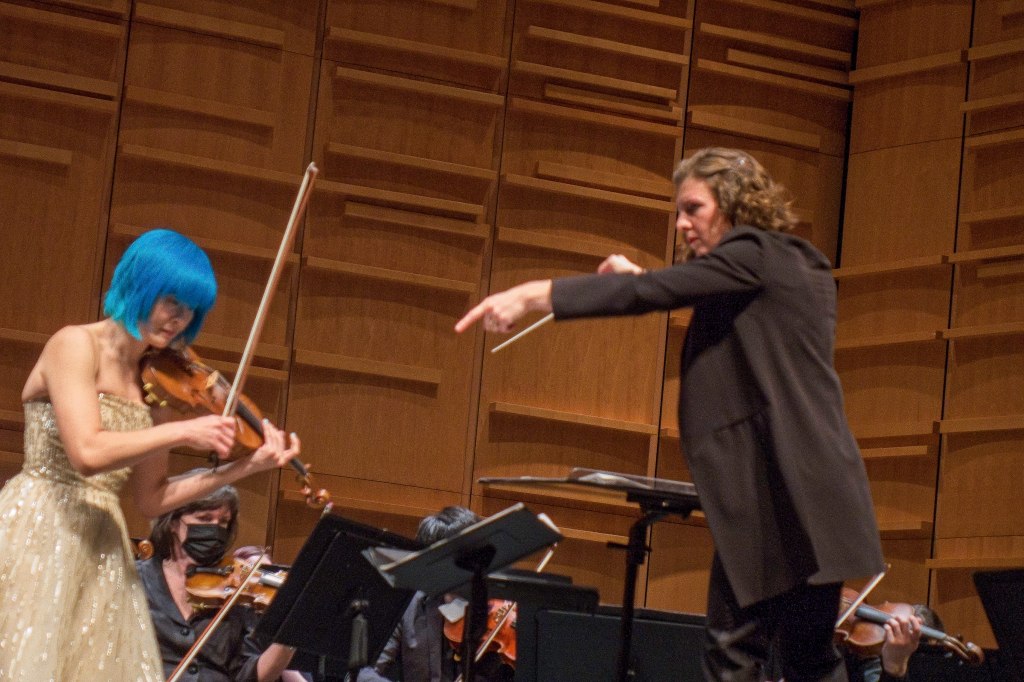
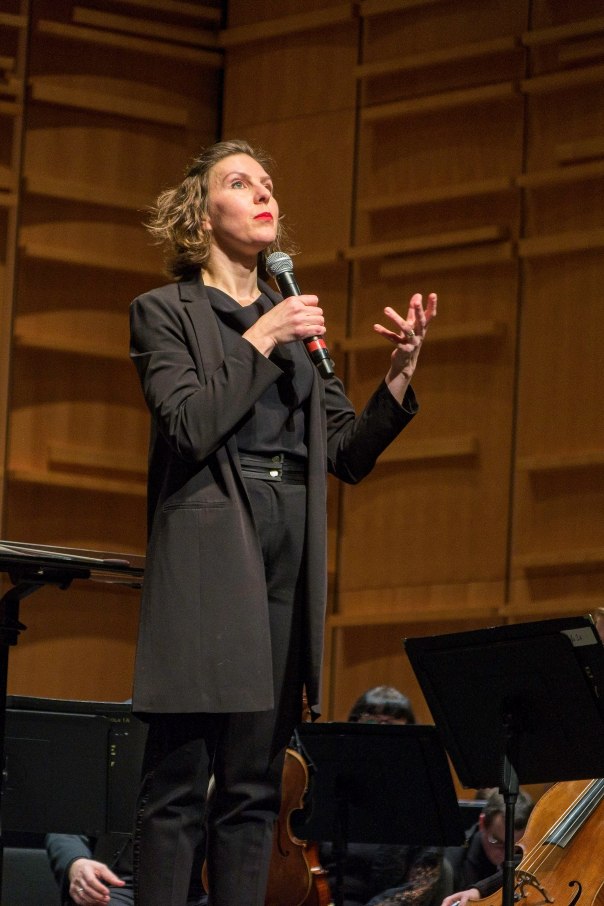
January 19, 2024, Charlotte, NC – Just a little more than a year after Kwamé Ryan guest directed an all-American program at Belk Theater featuring violinist Bella Hristova, Charlotte Symphony (after naming Ryan as the music director designate for 2024-25) greeted guest conductor Lidiya Yankovskaya to the Knight Theater podium, with violinist Jennifer Koh making her debut in another all-American program. This year’s explosion of Americana came four days after MLK’s birthday instead of two days before. The Adams-Korngold-Copland program of 20th century pieces could be counted as a bold advance in 2023, but the current offerings, with two 21st century compositions by American women, Jennifer Higdon and Missy Mazzoli, getting equal playing time with the 20th century composers, Samuel Barber and Aaron Copland, is arguably even more diverse and inclusive.

Distilled from Higdon’s opera, Cold Mountain, of 2015, and co-commissioned by Charlotte Symphony, the new Cold Mountain Suite could credibly be categorized as a concerto for orchestra by virtue of its length, variety, and profusion of solo instrumental passages. Like many opera suites you may have heard, Cold Mountain takes a serpentine route through the score rather than a sequential path, using the opening of Act 2 and the close of Act 1 as its bookends in repackaging eight snippets from the score.

On my first hearing, I could distinguish seven distinct sections and some fine soloing not only from string principals – cellist Jonathan Lewis, violist Benjamin Geller, second violinist Oliver Kot, and associate concertmaster Joseph Meyer – but especially from acting principal oboist Erica Cice and principal trombonist John Bartlett. The most memorable section of the piece was the “Storm Music” with its swirling strings and the atonal whistling of the high winds, but the ending, launched by the reunion scene between Ada and Inman was authentically stirring, with soaring work by principal trumpeter Alex Wilborn heralding the closing crescendos.

Since Mazzoli’s Procession Violin Concerto was commissioned by Koh, the music remained in-house until intermission. Notwithstanding her outré blue hair, Koh is actually a few years older than the composer, with a recording career extends more than 25 years. The former Chicago prodigy still plays with a youthful zest and a frenetic edginess – but not immediately in “Procession in a Spiral,” the opening section that unfolds slowly in a keening treble and increases its tension about 3/4 of the way into the section. The thinnest ethereal note from Koh’s violin bridges the gap into the unexpectedly calm beginning of “St. Vitus,” but the onset of intensity comes sooner here, still without the manic speed we might have expected from this title. The weepiest of the sections, “O My Soul,” has the most sustained of Koh’s thin harmonics and she hangs out with the flute and piccolo before breaking into more neurotic bowing.

A nice orchestral swell transitioned us to “Bone to Bone, Blood to Blood,” the most dramatic section, spiced with a series of whipcracks and a sprinkle of percussion. Jollity never prevailed in this rather somber concerto, nor was there an Allegro. “Procession Ascending” began rather unexpectedly for a finale with some lovely solo work from principal bassoonist Joseph Merchant, dramatizing how high Koh would need to ascend on her violin. If I were Koh, I’d pay Mazzoli a few more bucks to extend her struggles to take flight, blocked by the cellos and the double basses. She seems to clear this viny undergrowth too soon and too easily for the music to reach its full dramatic intensity, but I loved how briefly her freedom lasts and how cruelly it ends.

While there is a fine Baltimore Symphony account of Barber’s Second Essay for Orchestra in my collection, I cannot confirm ever hearing the piece performed live, though it was scheduled for a Symphony concert in April 2008. Hard to imagine that I snubbed it in my review, though Dvorak’s New World, ballet excerpts from Mozart’s Idomeneo, and Barber’s Violin Concerto were also on the bill. The music really is sumptuous, with oboe and clarinet illuminating the opening, viola mixing into additional oboe action later on, and some tasty propulsive percussion triggering its climax. It came across as a fresh and welcome discovery for me.

Of course, Copland’s Billy the Kid Ballet Music was the most familiar nugget on the program, revived at the Knight after an absence of less than four years. We’ve all been through a lot since February 2019, so I suspect more of the mournfulness of Copland’s “Introduction: The Open Prairie” and more of the fleeting, elegiac pathos of the penultimate “Billy’s Death” will land on listeners. Merriment is similarly magnified, with the clopping woodblocks of “Street in a Frontier Town” and even more heartily in the marching band energy, fueled by the woodwinds, of the gala “Celebration (after Billy’s Capture).” For the youngest buckaroos, the warring timpani and snare drum tattoos of “Gun Battle” will likely be the hugest delight.

“Christmas: Home” Shows Off Charlotte Master Chorale and T. Oliver Reid in Sublime Light

By Perry Tannenbaum

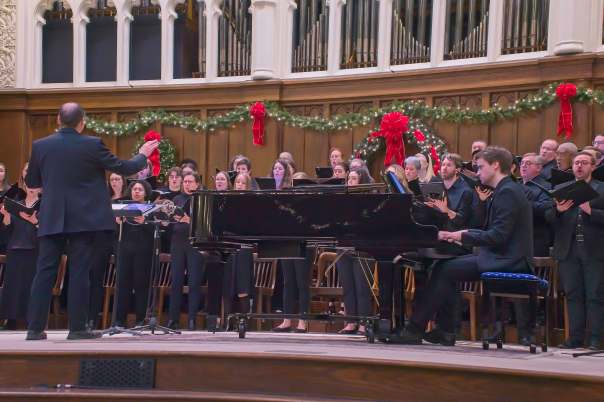
December 8, 2023, Charlotte, NC – We’ve reached that season when the arts calendar fills with a cluster of productions that reprise Dickens’ Christmas Carol, Handel’s Messiah, and Tchaikovsky’s Nutcracker – a rather traditional season not noted for novelty or wild innovation. So it’s nice to survey the Yule schedule and find events that even gently push the envelope and attempt to trailblaze with new styles like cirque or soul, or entertain the possibility that, come December, we’re not completely averse to secular fare.

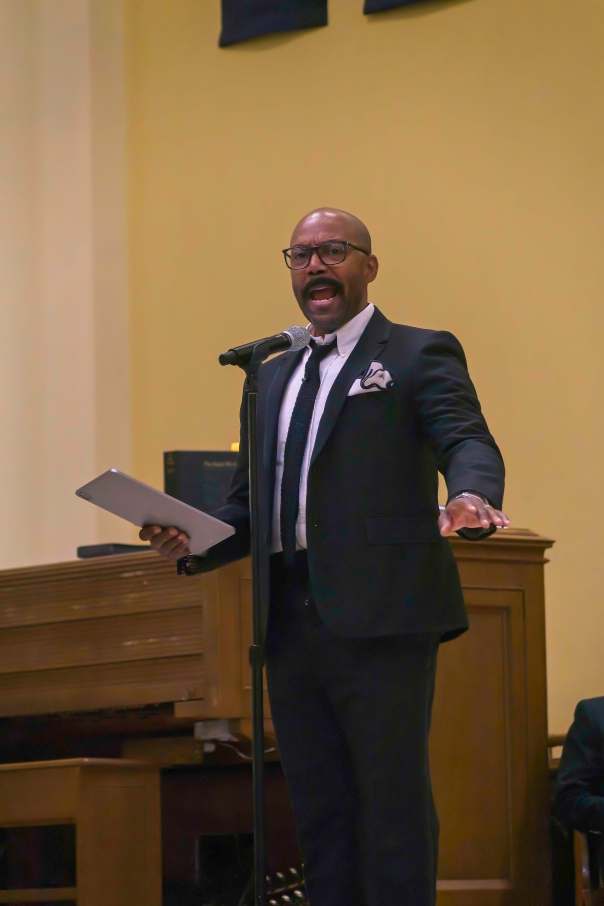
Better yet, amid a thicket of Nutcracker and Christmas Carol variants, we could find Charlotte Symphony venturing beyond its customary Holiday Pops medleys to a “Soulful Christmas” or Charlotte Master Chorale taking a thematic approach with “Home.” Although I prefer the acoustics at Symphony’s venue, Knight Theater, over First United Methodist Church, guest artist T. Oliver Reid tipped the balance for me in favor of Chorale’s “Home,” where he shared the pulpit with the choir, conducted by Kenney Potter, and pianist Philip Biedenbender.

Very likely, I’d seen Reid long before he took over the role of Hermes in the Broadway production of Hadestown for nearly three months in 2022, since he figured in productions of Thoroughly Modern Millie, La Cage aux Folles, and After Midnight that I had witnessed over the years (in 2002, 2004, and 2014) during my pilgrimages to the Great White Way. A native of Metrolina who appeared in Shenandoah at Little Theatre of Gastonia long, long ago, Reid may have traveled far to participate in this holiday gig, but he could certainly identify with the homespun theme. In his bag of goodies, Reid brought a couple of songs from The Wiz, including his opener, “Soon as I Get Home,” and his finale, “Home.” With a silken voice that stretched lower and more richly beyond my expectations, Reid hit home runs with both these songs that are usually belted by Dorothy.

Potter’s programming for “Christmas with the Charlotte Master Chorale: Home” consistently accommodated this kind of generous latitude. Of course, there were seasonal favorites tailored for the theme, including “I’ll Be Home for Christmas,” Mel Tormé’s “The Christmas Song,” and – presented as a Biedenbender instrumental – “Home for the Holidays.” Nobody onstage at First United displayed any liking for the Christmas songs I dread and loathe, so we were never assaulted with the annoying fun of “Jingle Bells” or the torturous tedium of “The Little Drummer Boy.” Nor were the unexpected readings from Reid overladen with saccharine or sentimentality. Sara Teasdale’s “A Winter Night” and Ella Wheeler Wilcox’s “The Year” were both somber and seasonal. Even the excerpt from the Dickens classic, “Ignorance and Want,” refrained from depicting a vapid, gleeful wonderland.

“Christmas Dreams,” “Be Born, O God,” “Lost in the Night,” “Prayer of the Children,” and “Music in My Mother’s House” were all new to me. Similarly, I doubt that composer Alan Menken figures prominently on many Spotify songlists for Christmas, but Potter, Biederbender, and the Chorale dipped into his catalogue twice, for “God Bless Us Everyone” from his musical version of A Christmas Carol and – far more unexpected – “Someday” from The Hunchback of Notre Dame, written with Stephen Schwartz.

For me, Schwartz actually upstaged his collaborator with his other selection, “Through Heaven’s Eyes” from The Prince of Egypt, since it sprinkled the program with the right amount of levity along with Jerry Herman’s “We Need a Little Christmas” from Mame. Musically, “Through Heaven’s Eyes” took us closer to Jerusalem than Rome, for the sound had unmistakable klezmer flavoring. “Simcha” from the same musical where Moses is the protagonist, might have had a little more Jewish flavor and the liberating spirit of Chanukah, but “Through Heaven’s Eyes” was the most extravagant entertainment of the evening – and the Master Chorale clearly delighted in backing Reid up with their syncopated, klezmer-kissed la-las.

After an acapella rendition of “The Christmas Song” by the Chorale – with Reid repeating the final bars – the program built to a simple and sublime climax as Biedenbender accompanied Reid in a fervid rendition of Adolphe Charles Adam’s glorious “O Holy Night.” I’d never known that the song had three stanzas in English, compared to just two in the original French lyric by Placide Cappeau that inspired Adam. We can thus forgive a Celine Dion for only singing two, but for Reid to sing a second and a third stanza provided a wonderful surprise and a singular experience.

Vampires and Trumpers

Reviews: Vampire Lesbians of Sodom and Thanksgiving: 2016

By Perry Tannenbaum

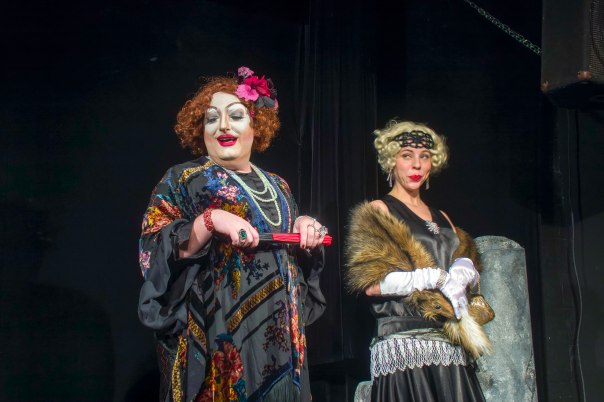
For devout upstanding citizens who had decided way back in the hippie ‘60s that Greenwich Village was an abominable den of sin, Charles Busch’s Vampire Lesbians of Sodom was a flaming and perverse poke in the eye. Or an argument clincher when it landed on Macdougal Street in 1985. The New York Times raved, the extravagant little trio of sketches became a cult obsession, and Vampire Lesbians had a five-year run.

Busch slipped away from his castmates when the review came out in the early morning after the Provincetown Playhouse premiere and had a good cry. Why did this diva desecrate his mascara? His career in theatre was now assured. He would write more outrageous comedies and send-ups that he, as the prima donna, could cross-dress and slay in, most famously Psycho Beach Party.

Vampire Lesbians made it to Charlotte at the Pterodactyl Club in 1991, after the slightly wholesomer Psycho Beach had paved the way during the previous year. George Brown directed this orgy of sacrilege with fiendish glee, while Innovative Theatre co-founder Alan Poindexter starred with Keith Bulla as the titular vamps.

With the Rev. Joe Chambers carrying the torch for fundamentalism in the wake of Jim Bakker’s disgrace, Banktown was still a very Christian place. It was my sacred duty to bring my daughter, not yet bat mitzvahed, to see Poindexter in all his counter-culture glory. After beholding the kinky wonders of Psycho Beach, my Ilana would have kissed Alan’s feet.

Flash forward to 2023. Poindexter is gone and the Pterodactyl Club, the one-time cultural capital of Freedom Drive, is goner. But thanks to Nicia Carla and her PaperHouse Theatre, Hollywood antagonists La Condesa and Madeleiné Astarté (a Succubus and a Virgin Sacrifice back in their Sodom days) are undead again!

Taking on Busch’s mantle, Carla directs and stars in this stunning revival at VisArt Video, tucked into the nether region of a strip mall on Eastway Drive – I’m trying to make this little suburban dive sound as risqué as the Pterodactyl! Walls are black as you walk inside, and hostesses in Goth attire and makeup are there to greet you. Whatever Google Maps has told you (it misled both me and my wife Sue on separate occasions), you can now be sure you’re in the right place.

Small as it is, the inner sanctum of VisArt is perfectly sized for Busch’s secret forbidden rites. The seats are soft enough to keep butt burnout at bay for 90 minutes, even if you don’t stretch for intermission and fall prey to the treats in the lobby. Yet sightlines are not ideal according to Sue’s scouting report.

The PaperHouse cast multitasks even more than Busch’s original ensemble, just six players covering the 14 roles instead of seven. All six are battle-tested in madcap comedy, so this outrage is hardly outside their comfort zones. Nicia probably hasn’t had this much fun onstage since Poindexter directed her as The Witch in Hansel & Gretel. She minces and manipulates here as the Virgin Sacrifice, growing regal and stentorian as theatrical megastar Astarté as she assaults the Left Coast. Opposite her, Ashby Blakely is a steely, sneering diva bridging four millennia as The Succubus, aging gracefully into La Condesa and crossdressing in costume designer Beth Levine Chaitman’s most outré couture.

That isn’t to say that Josh Looney and Charlie Carla are anything less than visions of decadence as Sodomite musclemen Ali and Hujar in complementary S&M outfits and Wagnerian wigs. Nicia is already fairly slutty in the opening sketch despite her somewhat revealing white dress, willing to break her hymen with Ali or cut a deal with the cave monster Succubus. Subsequent scenes in Hollywood and Sin City climax in a couple of startling onstage costume changes, most improbably by Tanya McClellan who snoops into La Condesa’s boudoir as gossip columnist Oatsie Carewe.

Gosh, it’s good to see McClellan back onstage in manic comedy mode. Squinting her snoopiness, she sniffs out the ungodly acts performed by Nicia as Astarté on La Condessa’s protégée, luminous Sarah Molloy as flapper Renee Vain, and her meddlesome boy toy, Looney as matinee idol King Carlyle.

Hard times for a vampire? You’ll need to come back after intermission for Blakely’s final transformations. Andrea King’s choreography, on loan from Jane Fonda, elegantly shows off McClellan’s dancing prowess.

Anyone who reads advice columns or cruises social media at this time of year will have an accurate inkling of what Thanksgiving: 2016 might be about. Millions of Turkey Day hosts are wondering how they will keep opposing family factions from shouting their lungs out or coming to blows while the sharp cutlery is still on the table. Playwright Elaine Alexander smartly calculates that the situation is prime fuel for a dining room comedy – or tragedy – but the world premiere of Charlotte’s Off-Broadway production now at VAPA also reveals that the NC native had a tough time deciding which way to go.

Ground Zero for the annual onset of hosting panic was clearly in November 2016 when Hillary Rodham Clinton resoundingly won the popular vote for the US presidency while Donald Jefferson Trump won the Electoral College – and the White House – just as resoundingly. Liberals, Democrats, and rational folk are still in shock. Yet as Alexander deftly reminds us along the way, they are all blissfully unaware of the betrayals of good sense, rationality, rule of law, and democracy to come.

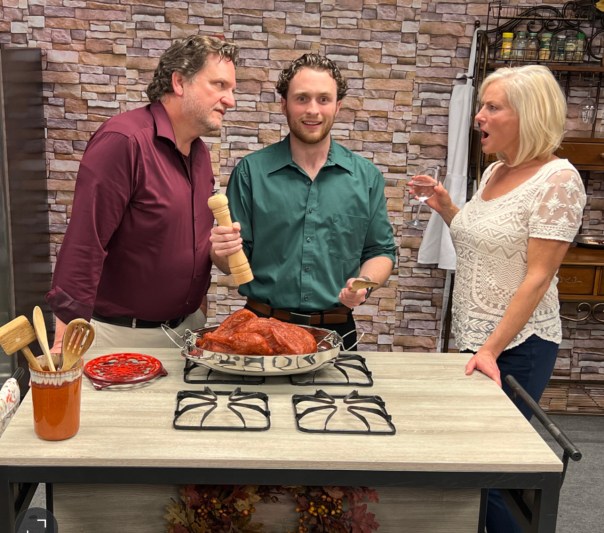
As the West family up in the liberal Northeast prepares to host young Eric’s girlfriend, riding up the highway from Alabama, the aroma of crisis already fills the suburban kitchen. Papa Harry, after diligently knocking on hundreds of doors crusading for Clinton, was hospitalized – either for a nervous breakdown or a heart attack – immediately after watching CNN declare Florida for Trump. The chief Turkey Day watchword from Harry’s physician is for wife and son to prevent the shell-shocked Hillary soldier from indulging his CNN addiction.

Taking to drink in the wake of her husband’s collapse, either out of worry or guilt, Renee has pretty much abandoned any serious intent to impress Brittany, the Southern belle she’ll be meeting for the first time. So it has fallen to young Eric to try to cook a luscious feast for his beloved, even though Mom hasn’t properly shopped for the occasion. Some improvising and substitution will need to be done. Worse, frozen will occasionally need to stand in for fresh.

Worst of all, Brittany voted for Trump, so Eric desperately hopes to keep talk of politics – the subject Dad is obsessed with and still agonizing over – away from the holiday dinner table. Harry has enough difficulty digesting that his son would date a girl from Alabama. Nor does Dad have enough self-awareness to realize that, in a reflexive action stemming from his years in community theatre, he mocks every Southern drawl he comes in contact with.

Finding out she’s a Trump voter could send him over the edge. Getting Dad to refrain from talking politics promises to be even tougher than steering him away from CNN. Finessing how to keep Brittany off the touchy subject is a bridge Eric hasn’t crossed yet.

As a director, Alexander casts father and son perfectly. Matthew Howie is a master of timorous anxiety as Eric. He can craft crescendos of panic and befuddlement while doing a hilariously awful job of warding off disaster with a shit-eating smile. Nor could we improve much on Tom Ollis as Harry. Since his 1997 debut at Theatre Charlotte in Arsenic and Old Lace, Ollis has grown into the most visible volcano on the Metrolina theatre landscape. Whether as Mr. Blonde in Reservoir Dogs, Sweeney Todd, or Titus Andronicus, Ollis is peerless at seething, suspecting, and erupting into towering, raving rages.

Since Harry is also a trial lawyer recently dismissed from his law firm because of his excessive zeal, Ollis can feast on numerous opportunities to cross-examine everyone in sight, bullying and browbeating every witness. Alexander’s women don’t get nearly as much scenery to chew, but her casting choices are nearly as impeccable.

Donna Norcross seemed to be battling opening night jitters early in Act 1 as Renee, but as Mom yielded to a multitude of wine refills, Norcross also relaxed, becoming quite powerful in the Act 2 denouement. Quite ripe for stereotyping, Michelle Strom as Renee entered the West home like a sudden ray of sunshine, without the preamble of a knock or a doorbell chime, her drawl as wide as the Mississippi. No, Dad could not restrain himself, nor could I blame him.

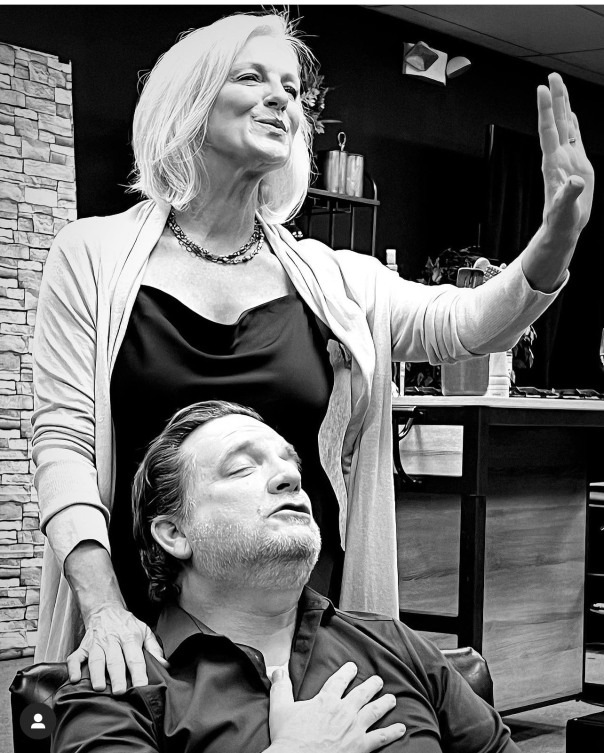
As you can imagine, the setup of Thanksgiving: 2016 is almost pure comedy – until the Trumper truth finally comes out, as an announcement rather than a shy confession, with the proud flourish of a cheerleader’s somersault. Looking from Strom to Ollis as we reach intermission, we can only wonder whether Dad will clutch his head or his heart.

But what can come afterward from our host, our hostess, and from poor Eric? Admirably enough, Alexander lets her characters carry her along across Act 2. But her impulse to bludgeon Harry with more secrets and uncomfortable turns this comedy upside-down. We transition, not very gradually, from a Neil Simon comedy of futile secret -eeping to an impactful series of revelations that conjures up Sophocles’ Oedipus, Strindberg’s The Father, or Albee’s Virginia Woolf. Those revelations are topped off by a  couple of increasingly jaw-dropping ideological rebukes to Harry’s smug liberalism that might shake you up a bit.

We seem to fall over a cliff here, with too little before intermission to prepare us for the high drama afterward. By the time the cast is taking their bows, Renee has radically transformed from a borderline bimbo into a pieta resembling Steinbeck’s Rose of Sharon on the final pages of The Grapes of Wrath. Instead of dumping us off a high cliff, I’d advise Alexander to lay down more track that would guide us around the mountain: a sudden dramatic swerve – not too sudden – would be more satisfying than this swan dive.

A visit to VAPA for Thanksgiving: 2016 is still worth it, delivering hearty laughs and a gasp or two. By all means, dig in!

Boom and Bust With the Lehman Brothers

Review: The Lehman Trilogy @ The Arts Factory

By Perry Tannenbaum

Even when histories are epic in length, like Gibbons’ Decline and Fall or Churchill’s Second World War, what we read at a seemingly slogging pace is a severe abridgement of what actually happened. Onstage, we move so much more swiftly in so-called histories as dramatists bring familiar and obscure people back to life, give them lively dialogue, and select even more narrowly among many actions, events, and consequences.

So the effect of The Lehman Trilogy at the Arts Factory, in a brilliant Three Bone Theatre production directed by David Winitsky, will likely be a revelation to anyone who might dread spending over three hours with a family of Jewish merchants, traders, and bankers. The chronicle stretches more than three generations and 160 years, from 1844 to 2008. Our ultimate landing site is nearly four decades after the last Lehman stood at the helm of Lehman Brothers, when the mighty financial services behemoth collapsed into bankruptcy, triggering a worldwide market meltdown.

Played by just three actors, including a woman for the first time, The Lehman Trilogy moves like greased lightning. Even after reading – and enjoying – the entire script, I was shocked by how swiftly it moved onstage and how well it played.

Maybe we’ve been conditioned by historical miniseries on HBO, Netflix, Prime, and Hulu that parade a life story or a notable family history over weekly episodes that span months and spill over into seasons. Thanks to MSNBC, CNN, C-Span, Fox News, and Donald Trump, we also share a visceral understanding of how excruciatingly slowly real history actually moves. The 2024 election seems ages away because we are inching toward it with so much nuance and detail, amid echo chambers of daily polling and social media blather.

And the sleek three-hour edition now at West Trade Street, adapted by translator Ben Powers, is itself an abridgement of the original Stefano Massini script that premiered eight years ago in Milan, Italy – clocking in at a full five hours. What might a sloppier, more comprehensive Lehman Trilogy include with two more hours? On the positive side of the ledger, we might hear more about Governor Herbert Lehman and his key role in implementing the New Deal with FDR, or the considerable philanthropic exploits of the Lehman family, especially Robert, the last of the Wall Street line.

On the negative – or infamous – side of the Lehman account sheet, Massini’s play delves into how the family cornered the Southern cotton trade before the Civil War, but it almost completely glosses over how their great fortune was built on the exploitation of African-American slave labor.

Steering clear of ethics, politics, racism, and philanthropy, Massini maintains a lean laser focus on how, stage by stage, the Lehmans built their fortunes, keeping their eyes open, seizing opportunities, rolling with the punches, and changing with the times. Along the way, there are literal business signposts marking the new directions and expansions of the Lehman Brothers’ store in Montgomery, Alabama, and later at their offices and various corporate HQs in New York.

Condensed into the space of three hours, these changes come at us so quickly that wet paint on the newest sign the Lehmans put up would never get a chance to dry before a newer one must be freshly lettered. Signage updates are one of the few pauses or detours that slow the onrush of time and good fortune that implacably moves the Lehmans and their Lehman Brothers trademark to the heart of the global economy and its cyclical collapses.

Occasionally, there are comedic detours into courtships by the Lehman men, each one unique and bizarre until the script is finally flipped when we reach Robert or “Bobby,” whose seduction by Ruth Lamar begins elegantly at an unnamed racetrack where his horse has just won. More frequently, the naked moneymaking is paused, flavored, or otherwise cloaked with Jewish holidays and observances, Jewish wisdom, Jewish expressions, or references to Talmud and the Old Testament: Shabbat, Shiva, Chanukah, Sukkot, a housewarming mezuzah, a Reform-style bar mitzvah, Noah and the flood, the Ten Plagues, the Golden Calf, and the ultimate blueprint for insane capitalism, the Tower of Babel.

While the steadily increasing wealth of the Lehmans cannot help but uphold negative tropes about Jewish character, Massini’s explicit evocations of Jewish culture and tradition are a telling countercurrent. Especially in the manner that succeeding generations observe the Shiva ritual in mourning the deaths of their patriarchs, Massini shows us how the Lehmans are drifting away from the core traditions and values of their religion. Over the course of the Trilogy, it becomes clearer and clearer that the Lehmans’ business is based on a different kind of belief.

So much of what we hear is exposition or monologue aimed directly at the audience that my chief worry on opening night, entering the Arts Factory, was how well this dialogue-starved script would play. Ironically, all my worries evaporated before there was even a chance for true dialogue to happen.

Arriving in America with a single suitcase at the Port of New York at 7:25 AM on September 11, 1844, Kevin Shimko as Henry Lehman, nee Hayim Lehmann, not only speaks to us all, he seems to freshly inhabit every word. He catalogues the changes that have come over him during the ocean voyage and re-enacts them – all the skills he has picked up, the temperaments of nationalities he has encountered – so that America is no longer a pure dream when he arrives but an explosion of the wonders and variety he has already experienced enroute.

Keeping the peace between them is the mission of Scott Tynes-Miller as Mayer, the youngest Lehman and the last to arrive in Montgomery. Meek and obliging at first, Mayer eventually proves to be capable of ideas as pioneering as Henry’s and to have skills that are no less impressive than Emanuel’s. On a couple of occasions, Mayer is a bit of a miracle, far transcending his brothers’ labeling of him as a potato. Tynes-Miller’s face lights up in an utterly spontaneous, winsome, and irresistible smile on those special occasions.

Worthington and Tynes-Miller have impressed us many times before, in Three Bone productions and beyond. So it wasn’t a complete shock to see Worthington assume the full intellectual and moral authority of young Herbert Lehman as he intimidates his own rabbi by questioning the Ten Plagues. Nor will we marvel at Tynes-Miller’s ability to discard the meek winsomeness of Mayer to assume, a generation later, the cocksure sovereignty of plutocrat Philip Lehman. He’s done it before, and he does it with ease.

The revelations came from Shimko and Winitsky. Since his 2017 local debut in an ensemble piece, Eat the Runt, at the old Charlotte Art League location on Camden Road, Shimko has been off our radar. He has lurked in the cast of an Actor’s Theatre production that was short-circuited by COVID and the company’s demise – and in the ensemble of a subsequent Children’s Theatre production. Co-founder and artistic director of Comedy Arts Theater of Charlotte on South Boulevard, Shimko re-emerged briefly in theatre circles earlier this year when he directed the first theatrical event at CATCh, Sister Mary Ignatius Explains It All, and served as both emcee and the title nun’s monkish supplicant.

If you haven’t seen Shimko toiling in improv comedy at his club, his Henry Lehman and a slew of other characters old and young – of both genders – will be an ample, eye-opening intro. Winitsky’s work has been on view at Shalom Park, where he brought the Charlotte chapter of the nationwide Jewish Plays Project for a few exciting years, and at ImaginOn, where he twice directed the Children’s Theatre of Charlotte production of Tropical Secrets: Holocaust Refugees in Cuba, during and after the pandemic lockdown.

So a play that has been accused of antisemitism is in perfect hands here, but the jaw-dropping surprise is Winitsky’s attention to detail, his infusion of fresh life into so many moments: steering his actors through the often-lyrical text, rolling furniture back and forth across the black box stage, reconfiguring the space between acts, and even doubling down on audience involvement.

Sure, Shimko’s Hebrew pronunciation is still a work-in-progress, Some projections up on the Arts Factory walls might have let us in on Massini’s nifty chapter titles and helped us keep better track of the years. But Winitsky’s approach, bringing us Massini’s sprawling script as if it were intended for a teeny off-Off-Broadway space, disdains such high-tech luxuries. Anitra Tripathi’s set design is chiefly an endless clockface painted on the floor that spirals backwards from the perimeter in ever-smaller Roman numerals towards an off-centerstage beginning.

The only Arabic numerals along the way are key years in the journey where each of the three Trilogy “books” starts out. Above us, echoing the clockface below, clocks galore are hung from everywhere. More like an antique shop than a music box, but with three bankers scurrying around before us for three hours in three-piece suits, it’s a perfect look.

Even in a little back box, The Lehman Trilogy feels big. Through war and peace, boom and bust, trains, planes, movies, computers, and whatever derivatives are, this Jewish story cumulatively becomes a quintessential American story. It’s the thrill, the struggle, and the hard-won triumph of immigration – repurposed into an ups-and-downs rollercoaster ride, as only Americans can do.